Nangang: The District That Keeps Being Reminded It Was Once a Port
Nangang means "south port," though the port vanished a century ago. What follows is a history of a place that has spent a hundred and fifty years being repeatedly, almost punctually, reminded of what it used to be — by tea, by smoke, by state violence, and four times by water.

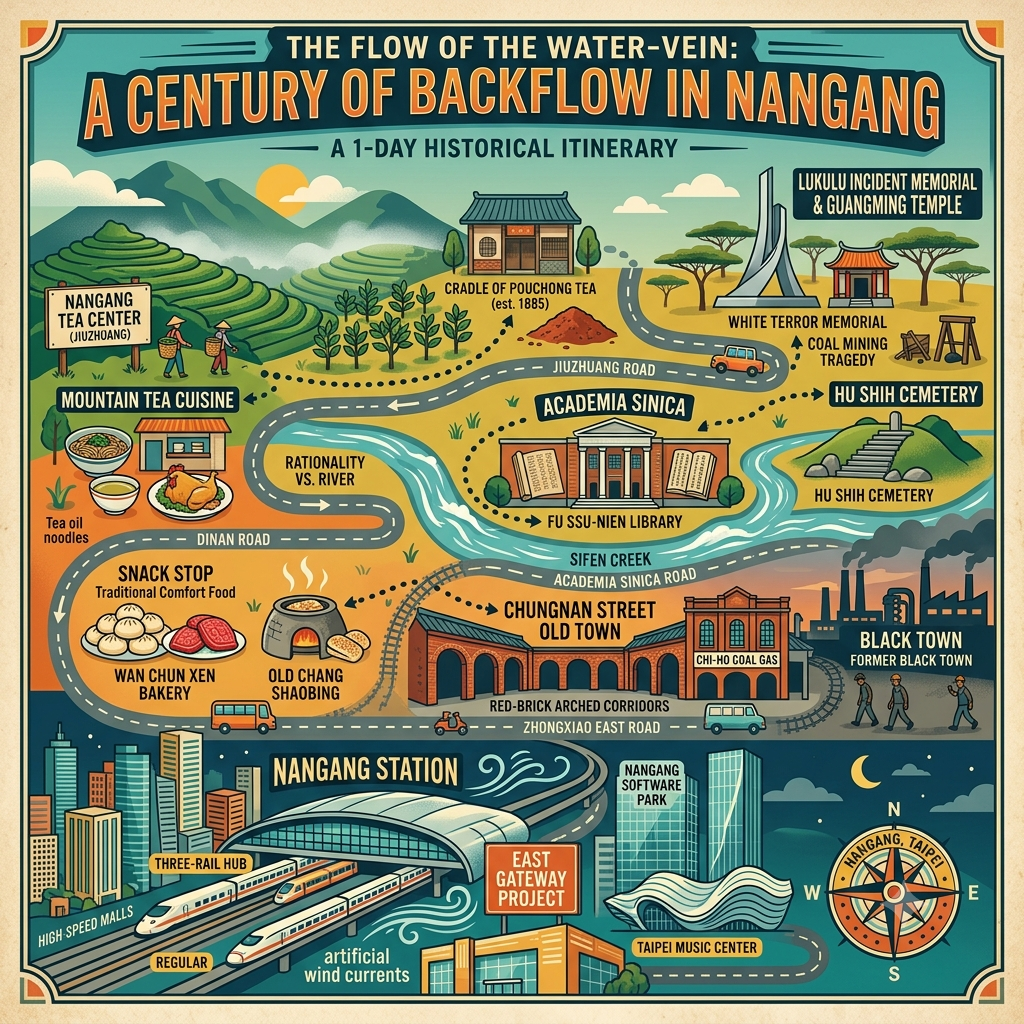
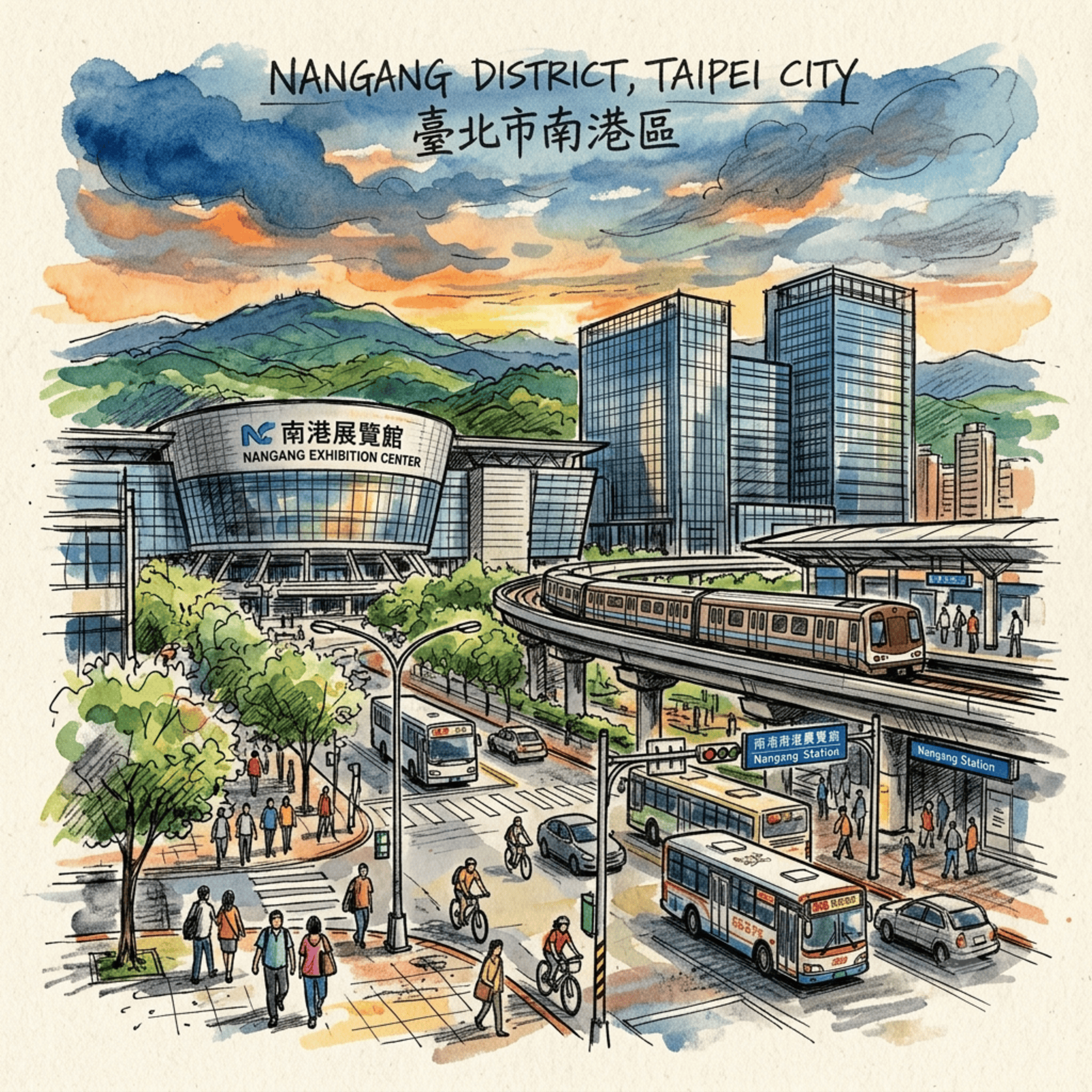
A historical walk through Taipei's Nangang District — once a river port, then a coal town, a site of political massacre, home to Taiwan's foremost research institute, and now a rail hub. This is the story of a place that keeps being flooded by its own forgotten name.
 Lawrence
There's a particular kind of place-name that outlives its own meaning — a fossil word, still spoken daily by people who've stopped noticing what it once described. Nan-gang: south port. Say it enough times on the platform announcements of the metro and it stops sounding like a claim about the world. But claims about the world have a way of persisting long after the world has moved on, and this one, it turns out, has spent the better part of a century and a half quietly making good on itself — not through nostalgia, but through recurrence. Water, once excluded from a place, tends to apply for readmission. Nangang's history is, among other things, a long record of that application being granted.
An Opening Note on What This Is
This isn't a guide to Nangang's cafés or its shopping mall. It's an account of five things that happened in a corner of eastern Taipei that most visitors pass through on the way to somewhere else — the high-speed rail terminus, mostly, or a connecting metro line — without ever suspecting that the ground beneath the platform has an unusually long memory. What follows draws on the district's tea archives, its industrial records, a national commission's findings on a 1952 political massacre, and Academia Sinica's own institutional history of being, repeatedly, rained on.
Listen to the historical stories told in detail (For subscribers only)
I. The Grounded History: Five Things Nangang Remembers
1. The Tea Hills (Qing Dynasty–Early Japanese Colonial Period)
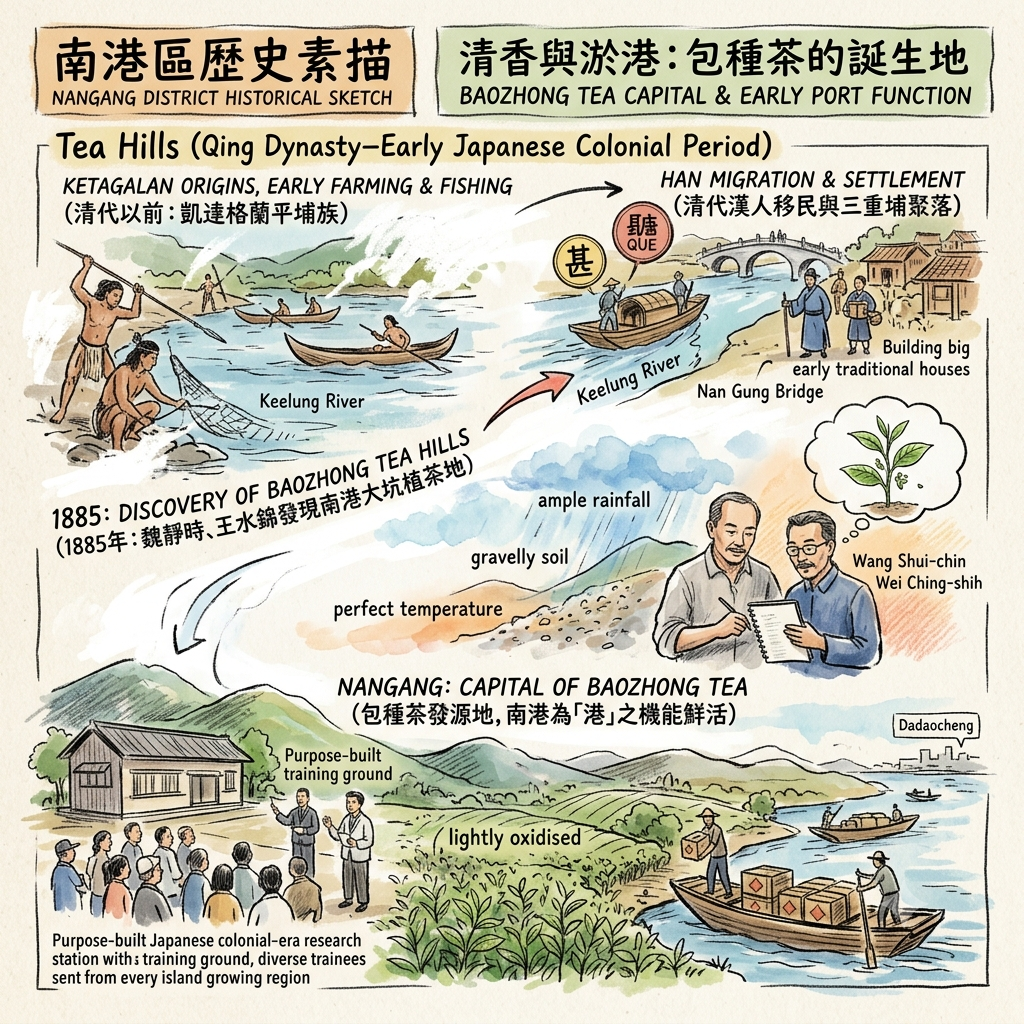
Four hundred years ago, the lower reaches of the Keelung River belonged to the Ketagalan people — the Tatuyu, Lichi, Malysyakkaw, and Volangits communities, who fished and farmed along its banks in a pattern of settlement the written record barely registers before Han migration erased most of the evidence of it. That erasure matters, and this account won't pretend otherwise: what we know of Nangang's deep past is a gap, not a story, and the honest thing is to say so rather than dress the silence up as mystery.
What the record does hold begins properly in 1885, when two men from Anxi in Fujian — Wang Shui-chin and Wei Ching-shih — arrived in the hills above what's now Nangang and noticed something the land was already doing: its temperature, its rainfall, its gravelly soil, were quietly, almost accidentally, perfect for tea. They planted. The variety that took hold there — baozhong, a lightly oxidised oolong — would come to define Taiwanese tea for the next half-century, and Nangang became its capital. Under Japanese colonial rule, the two men were retained as instructors at a purpose-built research station, training tea farmers sent from every growing region on the island. For a few decades, this quiet river district was the place other places sent their sons to learn a craft.
2. The Black Township (1950s–1970s)
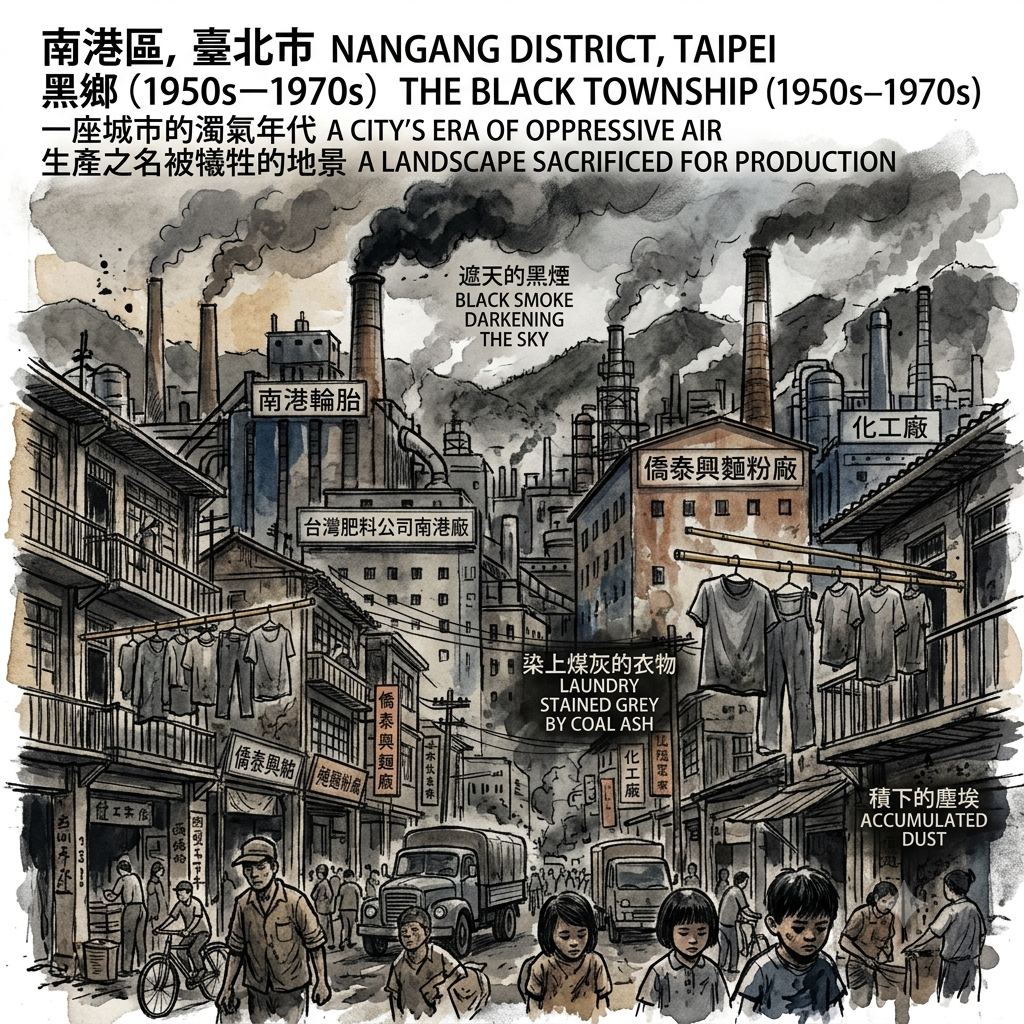
Tea, as an economy, is patient and slow-yielding. Coal is neither. As the tea trade declined in the closing years of Japanese rule, coal mining and brick-making took its place in Nangang's hills, and in 1955 the Taiwan Provincial Government formally designated the district an industrial zone. What followed arrived with the particular speed of postwar reconstruction: a rubber-tire factory, a state fertiliser plant, flour mills, chemical works, a shell-casing arsenal. Prosperity came with them, and so did a specific, unlovely nickname — locals in the rest of the city began calling Nangang the Black Township. Laundry hung on bamboo poles came in grey. Children's lungs, in ways nobody would fully understand for another thirty years, were quietly filing away a debt.
3. Luku (December 1952)
A note before this section: what follows is written without the vocabulary of feng shui or spiritual resonance that frames the rest of this article. State violence is not a matter of ill-aligned energy, and dressing it in mystical language would be a way of softening something that shouldn't be softened. This is written, instead, in the plainer register of trauma geography — the study of how landscapes hold the memory of what was done to the people in them.
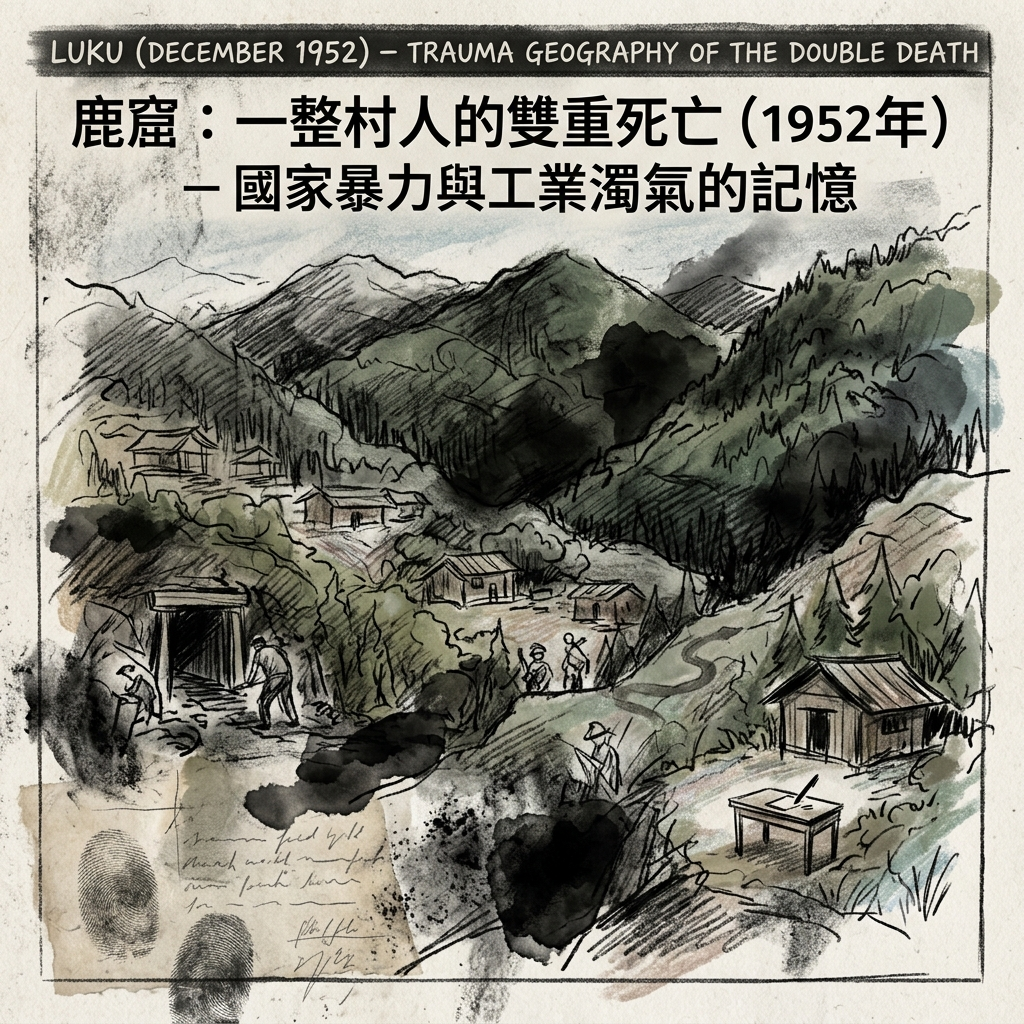
In the mountainous border where Nangang meets Shiding and Xizhi, a small, defensible pocket of terrain called Luku became, in 1949, a hideout for a handful of underground Communist organisers fleeing the crackdowns that followed the February 28 Incident. Over three years they recruited quietly among local miners and farmers — many of them illiterate, most of them with only the vaguest sense of what they were being asked to sign their names, or press their thumbprints, to.
On the night of December 28, 1952, nearly ten thousand military police surrounded the mountain. What followed over the coming weeks was the largest single political prosecution of Taiwan's White Terror period: more than four hundred people detained, thirty-five sentenced to death, most of them coal miners and farmers with no meaningful understanding of the ideology they were accused of serving. Among the dead was the writer Lü Heruo, once called "Taiwan's first genius" — he is said to have died of a snakebite while hiding in the hills, refusing to have the bitten arm amputated, and was buried without ceremony or a marked grave.
The crueler detail, and the one this article can't set aside, is what happened to the miners who survived and were eventually released. Most went back to the only work they knew. Many died decades later of pneumoconiosis — black lung, the coal dust finally calling in what the interrogators hadn't finished. Politics and industry, working separately, took the same men's lives twice.
4. The Institute and the Flood (1954–present)
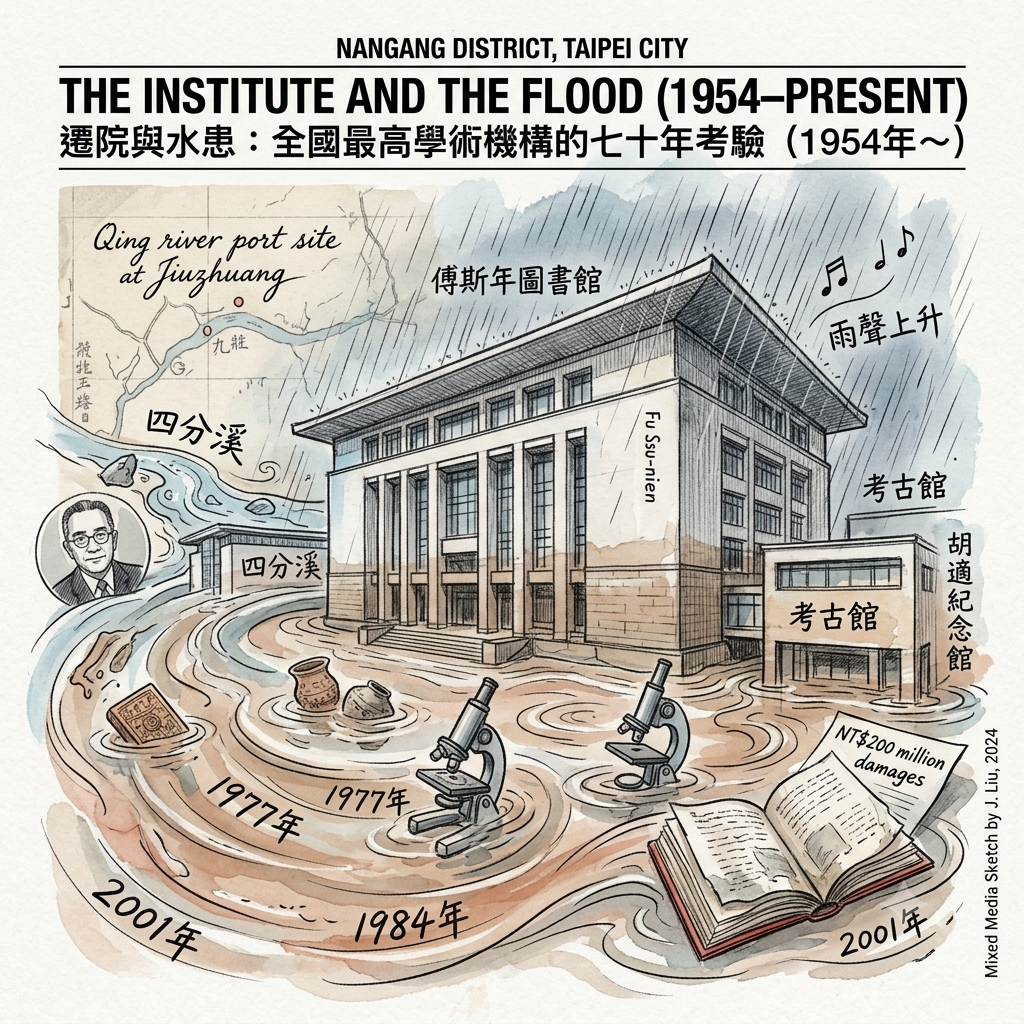
In 1954, Academia Sinica — Taiwan's foremost national research institution, in exile since the 1949 retreat from the mainland — selected a site to rebuild itself: Nangang Jiuzhuang, "Nangang Old Village," which happened to be the exact original settlement site of the Qing-era river port the district was named for. Nobody involved in the decision seems to have registered the coincidence. The Institute of History and Philology moved in first; over the following decades the campus grew into dozens of research institutes spanning the sciences and humanities, and Hu Shih, the philosopher and diplomat, served as its president until his death there.
What the planners hadn't accounted for was the Sifen Creek, a tributary of the Keelung River, running directly alongside the new campus. In 1977, a mountain flash flood submerged roughly half the campus buildings, including the Institute of History and Philology's archaeology museum and Hu Shih's memorial hall. In 1984, the "June 3rd Flood" struck again, prompting the city government to straighten the creek's course in an attempt to control it. It wasn't enough. In 2001, Typhoon Nari drove the creek over its banks a third time, flooding the basement levels of seven research institutes — irreplaceable archaeological samples, precision laboratory equipment, and rare manuscripts among the losses, with damages estimated above NT$200 million and research losses beyond estimation.
Holographic Sensory Cue: the air thickens before a summer downpour, the creek water turning the colour of wet clay, a swirl visible before the first drop falls. Inside the rare-book stacks of the Fu Ssu-nien Library, the low hum of the climate-control system runs against the rising sound of rain on the roof — the whole building seeming to hold its breath, as though it remembers, in whatever way a building can remember, the times the water got in anyway.
5. The Gateway (21st Century)
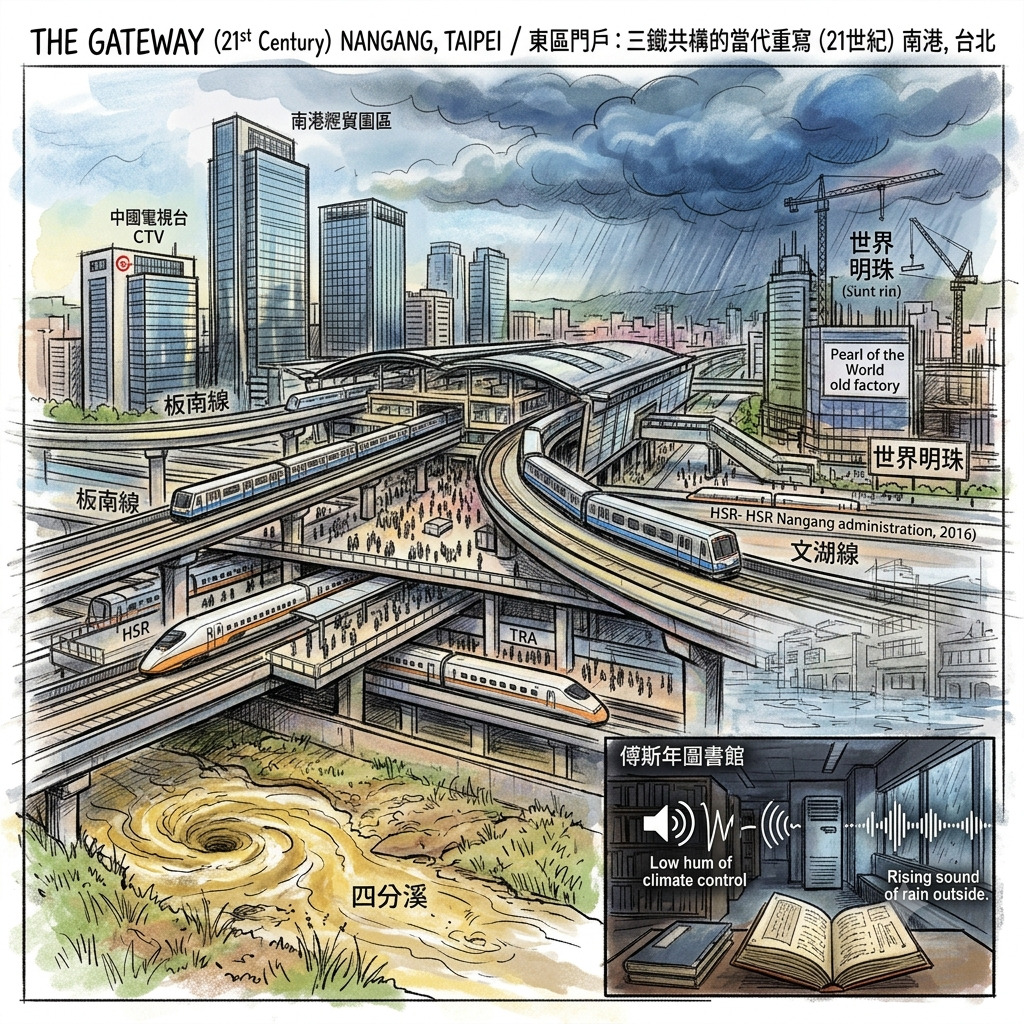
As the polluting industries closed or relocated, the fertiliser plant's grounds became the Nangang Trade and Exhibition Park; a television network moved its headquarters in; and the city's "East District Gateway" plan began threading rail lines through the district — two metro lines, then, in 2016, the terminus of Taiwan's High Speed Rail, making Nangang Station a genuine three-rail interchange: HSR, the Taiwan Railway main line, and the metro's Blue Line. The old tire factory site is now under redevelopment as a mixed-use tower complex; insurance companies and developers have moved in. Local planners now describe Nangang, without apparent irony, as Taipei's largest emerging business district of the coming decade.
II. The High-Dimensional Lens: Reading Nangang Through Daoist Water-Doctrine
To understand what Nangang has actually been doing for a hundred and fifty years, it helps to set aside the tidy Western narrative of progress — agriculture, then industry, then tragedy, then knowledge, then commerce, each phase quietly superseding the last — and instead pick up the interpretive framework the district's own settlers actually carried with them: the Daoist doctrine of water, shuifa (水法), inherited alongside the broader logic of feng shui and the dragon-vein (longmai, 龍脈) reading of landscape.
In that tradition, water is never simply an obstacle to be removed. It is the carrier of qi, of fortune, of circulation itself — and the discipline of shuifa lies almost entirely in guiding water, never in blocking it outright. A watercourse straightened or built over may solve an immediate problem, but it severs water from its own preferred path, and water, denied a path, does not disappear. It waits, and it returns with more force than before.
Seen this way, Nangang's tea hills weren't simply agriculturally convenient — they were, in the vocabulary the Anxi settlers themselves would have used, a textbook configuration: hills forming a protective enclosure to the south, the Keelung River as the mouth through which qi (and, not incidentally, trade) could gather and disperse, mountain spring water running clear. The site that suited tea and the site that satisfied the old geomantic instincts for a good dwelling were, it turns out, the same site, because both instincts were reading the same terrain.
How Feng Shui Built A Tea Empire
But it's the Academia Sinica story that makes the case most starkly. The nation's highest research institution built its campus, unknowingly, directly on top of the district's original water-mouth — the exact settlement site from which the vanished port once operated. Over seventy years, the creek beside it has returned, on something close to a regular cycle, to submerge the very archives and instruments built to embody rational, empirical knowledge. It's difficult, from within this framework, not to read that as a kind of terrain speaking back: the name was never forgotten. It was only buried. And burial, in shuifa, is never permanent.
The Ghost Port That Drowned Science
Even the industrial "Black Township" years and the pneumoconiosis that later killed so many Luku miners can be read, within this same vocabulary, as an extension of the same imbalance — qi that should circulate instead trapped, thickened, forced to settle in lungs and rooftops rather than move as it should. The Luku Incident itself sits outside this reading; state terror is not a matter of misaligned energy, and this account has deliberately withheld the geomantic vocabulary from that section as a matter of respect. But the industrial and hydrological stories bend, again and again, toward the same shape.
The Toxic Skies of Taipei's Black Village
And the three-rail interchange now rising at Nangang Station might be the district's first genuine attempt, in a century, to reopen its own water-mouth — not with a river this time, but with rail. In shuifa terms, a point where flows of people, goods, and information converge and disperse is itself a form of qi kou, an energy-mouth. Nangang has simply built a new one out of steel where the old one, made of water, silted shut. Whether this new mouth will one day face its own version of the same reckoning is, at the time of writing, still an open question — but the pattern, so far, has not once failed to repeat.
The Harbor Made of Steel
Resonance Node: Hu Shih's grave sits on a small rise just beside the Academia Sinica campus, separated from the traffic on Yanjiuyuan Road by a single low wall, and yet startlingly quiet. Local residents walk there in the evenings without, most of them, registering the coincidence: that this lifelong advocate of empirical rationalism — "bold hypotheses, careful verification" was his own motto — is buried a few hundred metres from a creek that has spent seventy years declining to be verified, straightened, or fully believed.
A second, quieter node worth the detour: the Luku Incident Memorial, tucked at the mountain boundary where Nangang meets Shiding, reachable only by a narrow winding road. It appears on almost no tourist map. Most days it receives nobody at all — a stone marker, sometimes a bundle of flowers already faded, sometimes nothing. That absence of visitors is, in its own way, the most accurate monument possible to a history the state spent decades trying not to have happened: official acknowledgment and popular memory, even now, have not quite closed the distance between them.
The Dual Death of the Luku Miners
Conclusion: What the Water Was Trying to Say
There's a particular vanity in believing that concrete, zoning, and institutional permanence can fully overwrite what a landscape remembers about itself. Nangang's water disagrees, patiently, on a schedule of its own choosing. What travels through the district has changed — tea, then coal, then political prisoners, then rare manuscripts, now data and capital and high-speed trains — but the underlying grammar hasn't: something arrives, something gathers, something eventually finds its way back to the mouth of the port that supposedly stopped existing generations ago.
Historical memory, it turns out, behaves rather like water itself: it can be rerouted, built over, officially declared resolved — and it will, with something close to geological patience, keep finding its way back to the shape it was always going to take. In an age that moves increasingly fast and forgets increasingly efficiently, there may be something worth learning from a district that simply refuses to.
If places that keep telling the truth about themselves, however inconveniently, are of interest to you, consider subscribing — there's another one of these waiting.
Accessing the Physical Node
Getting there: Nangang Station is served by Taipei Metro's Blue Line and Wenhu Line, and functions as a genuine three-rail interchange with Taiwan High Speed Rail and the Taiwan Railway main line — making it one of the most straightforward historical sites in this collection to reach without a car. The Luku Incident Memorial, by contrast, requires a car or scooter and a narrow mountain road along Dingnan Road Section 2; allow extra time and drive carefully, as the route is single-lane in places.
Where to stay: Several international and business-class hotels have opened near Nangang Station and the Exhibition Centre in recent years, making the district a practical base for exploring both eastern Taipei and the mountainous Shiding–Pingxi corridor beyond it.
A suggested route: Spend a morning walking the Academia Sinica campus — the History and Philology Institute's archaeology museum, the Hu Shih Memorial Hall, and Hu Shih's grave itself. In the afternoon, head into the hills toward Nangang's remaining tea gardens for a sense of what the district smelled like before the smoke arrived. Return to the station district by evening, where the contrast between the old shophouses of Zhongnan Street and the new towers rising around the rail terminus makes the district's whole history legible in a single city block. If your schedule allows, give the Luku Incident Memorial its own half-day rather than folding it into a busier itinerary — it's not a place that rewards being visited in a hurry.
📌 Taipei Nangang Historic Exploration: Deep Travel FAQ
Q1: Where can I experience authentic tea culture in Taipei away from the crowds of Maokong?
A: While most tourists flock to Maokong, Nangang is the true birthplace of Taiwan’s famous Pouchong (Baozhong) tea. In the late 19th century, master tea makers developed a unique oxidation process in Nangang’s hills, producing a tea celebrated for its natural, elegant floral aroma without using artificial scenting. Today, the misty slopes of the Nangang Tea Mountain (Jiuzhuang area) offer a serene, authentic escape. Walking along the historic tea trail or visiting the Nangang Tea Processing Demonstration Sector allows travelers to immerse themselves in original Taiwanese tea heritage, sample local brews, and enjoy panoramic city views without the crowds.
Q2: What is Taipei’s industrial heritage tourism, and where can I find it in Nangang?
A: In the mid-20th century, Nangang was designated as a heavy industrial zone, packed with brick kilns, coal mines, and chemical factories that powered Taipei’s economic miracle. This era earned it the gritty nickname "Black Town" due to the constant soot. Today, Nangang has fully transformed into a high-tech hub, but its historic industrial bones remain. Urban explorers can find remarkable remnants of this era preserved throughout the district, most notably the Nangang Bottle Cap Factory, alongside old brick kiln chimneys and forgotten railway sidings that hint at Taipei's mid-century manufacturing boom.
Q3: Why should I visit POPOOPARK (Nangang Bottle Cap Factory) and what is its history?
A: Located just steps from Nangang Station, this site was originally founded in 1943 during the Japanese colonial era as a cork factory, later becoming Taiwan's largest bottle cap production base supplying the state tobacco and liquor monopoly. Today, it has been beautifully revitalized as POPOOPARK (Bottle Cap Factory Taipei Manufacturing Place). It is a must-visit for travelers interested in adaptive reuse and Japanese-era industrial architecture. The complex showcases striking geometric wooden roof trusses, historic factories, and vintage machinery, all repurposed into a vibrant creative hub filled with local artisan workshops, exhibitions, and sustainable design pop-ups.
Reference and Further reading
First layer – Main sources of literature and institutions:
- 臺北市南港區公所〈歷史沿革〉官方網頁;南港區公所〈認識南港〉。
- 臺北市南港區公所〈歷史沿革〉(工業區指定、進駐廠商名錄)。
- 監察院2017年鹿窟事件調查報告;促進轉型正義委員會(促轉會)2018年撤銷罪名決議;國史館《鹿窟事件史料彙編》。
- 中央研究院官方院史網頁;歷史語言研究所〈建築地景〉院史檔案(詳載1954年遷院、歷次建築落成年代)。
- 臺北市南港區公所〈今日南港〉〈未來遠景〉〈交通建設〉官方頁面。
The second layer – secondary academic materials:
- 台灣茶業史相關學術研究(包種茶產製研究中心之殖民地農業科學史,建議進一步查證原始檔案,如台灣總督府殖產局檔案)。
- 戰後台灣區域工業化與環境史相關學術研究(建議進一步查證原始檔案,如台灣省政府建設廳工業區檔案、南港輪胎公司廠史)。
- 林傳凱(2007年起)白色恐怖受難者訪談研究;台灣白色恐怖政治案件相關學術專書。
- 維基百科「中央研究院」條目(1977、1984、2001年水患紀錄,附具體受損範圍與金額估計,建議進一步查證原始檔案,如中研院總務處歷年災損報告)。
- 台北市都市發展相關學術與政策研究(東區門戶計畫,建議進一步查證原始檔案,如台北市都市發展局正式規劃書)。
Third layer – Supplementary information:
- 地方耆老口述(如闕山坑先生對南港仔命名由來之口述)、地方部落格田野紀錄(如南港老街古厝踏查文章)。
- 地方口述史中「黑鄉」稱號之集體記憶敘事。
- 受難者陳皆得、李石城等人之口述訪談紀錄(見於新聞報導與紀錄片)。
- 院內人員與周邊居民對水患之集體記憶敘事(散見於院慶紀念文章與地方旅遊部落格)。
- 媒體對南港輪胎「世界明珠」都更案及周邊企業開發案之報導。
Historiographical Discontinuities and Contradictions:
- Existing literature is almost entirely devoid of information regarding the interactions, conflicts, or integration between the Ketagalan Nangang community and subsequent Anxi immigrants; it is recommended that relevant field records held by the Council of Indigenous Peoples or the Institute of Ethnology, Academia Sinica, be consulted.
- Systematic epidemiological studies on the long-term health impacts of industrial pollution in Nangang on local residents (beyond silicosis among miners) are extremely scarce; it is recommended that original records or historical statistics from the Ministry of Health and Welfare be examined.
- The complete original military records regarding the incident have not yet been fully disclosed, and Wikipedia explicitly notes that "current knowledge is pieced together from one-sided accounts and does not reflect the true picture"—it is recommended that original archives be consulted, particularly the complete dossiers held by the Ministry of National Defense and the Bureau of Investigation and Statistics (Secret Service).
- Public information regarding the specific technical decision-making process and subsequent hydrological impact assessment for the Sifen Stream channel straightening project is limited; it is recommended that historical records from the Hydraulic Engineering Office, Public Works Department, Taipei City Government, be consulted.
- Public information regarding the social impact assessment of the "Eastern Gateway Project" on existing residents (particularly those in older settlements such as Zhongnan Street) is limited; it is recommended that relevant social impact reports from the Urban Regeneration Office, Taipei City Government, be consulted.
 Lawrence
 Lawrence
 Lawrence
The sources for this article include primary historical records, academic papers, and public records from various levels of administrative bodies, with a commitment to historical accuracy; instances requiring further verification against primary archival materials have been noted in the text. Last updated: July 2026.