(ENG) The Architecture of Survival: How the 1894 Plague Redefined Cheung Chau
Explore how the 1894 plague reshaped Cheung Chau. Discover the spatial history of the Bun Festival, colonial boundary stones, and the Hoklo spiritual resistance.
How did the 1894 plague transform the Cheung Chau Bun Festival?
What is the history of racial segregation and boundary stones on the island?
Why did the 'Bun Scrambling' tradition change from bamboo to steel?
This article follows on from "The Dumbbell Island’s Hidden Layers: 5 Surprising Histories of Cheung Chau" and will continue to explore the relationship and mutual influence between the 1894 Hong Kong plague and the Cheung Chau Bun Festival.
 Lawrence
The Gateway: Why Cheung Chau’s History is Written in Its Streets
The geography of Cheung Chau is not merely a collection of scenic vistas and narrow alleys; it is a physical archive of the 1894 plague, a pandemic that fundamentally rearranged the social and spiritual architecture of Hong Kong. For the thoughtful wanderer, the island’s famous Bun Festival—or Jiao—is far more than a vibrant spectacle. It is a residual community response to a health crisis that redefined the colony’s social hierarchy. During the outbreak, the island served as a "strategic depth" for urban migrants, particularly the Hoklo (Haiguluo) community, fleeing the aggressive "sanitary" measures of the city. To walk these streets today is to traverse a landscape where the trauma of the past was transmuted into ritual survival. To understand the island’s contemporary soul, one must follow the path of a displaced God whose journey began in the fires of a plague-ridden slum.
Listen to the historical stories told in detail (For subscribers only)
The Displacement of the Divine: From Tai Ping Shan to Pak She Street
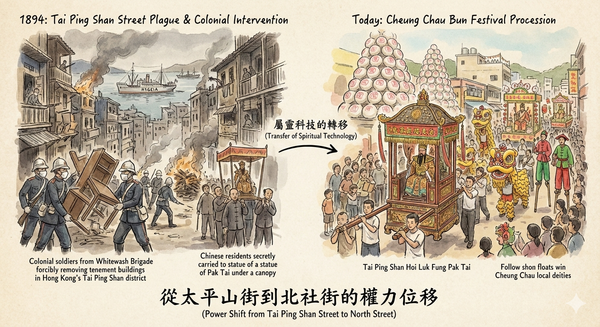
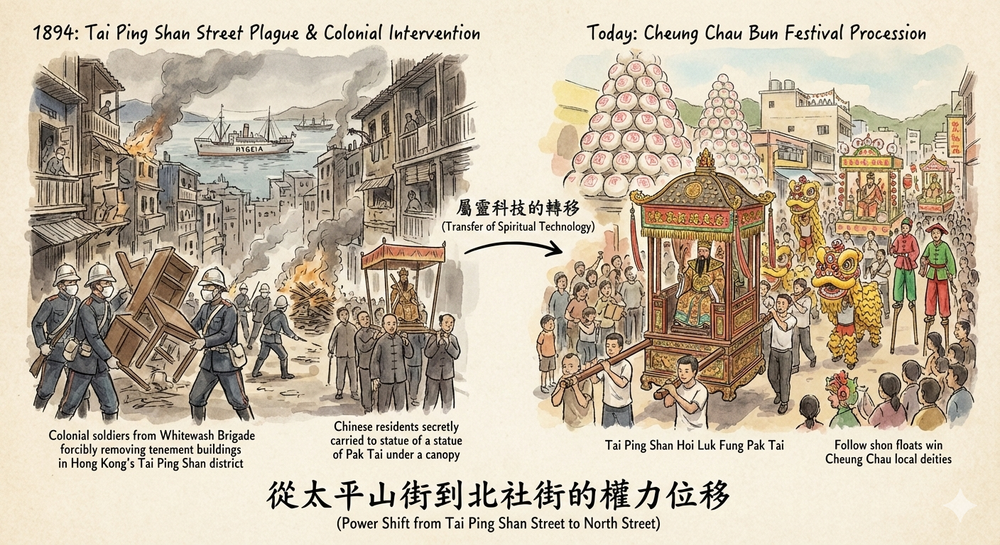
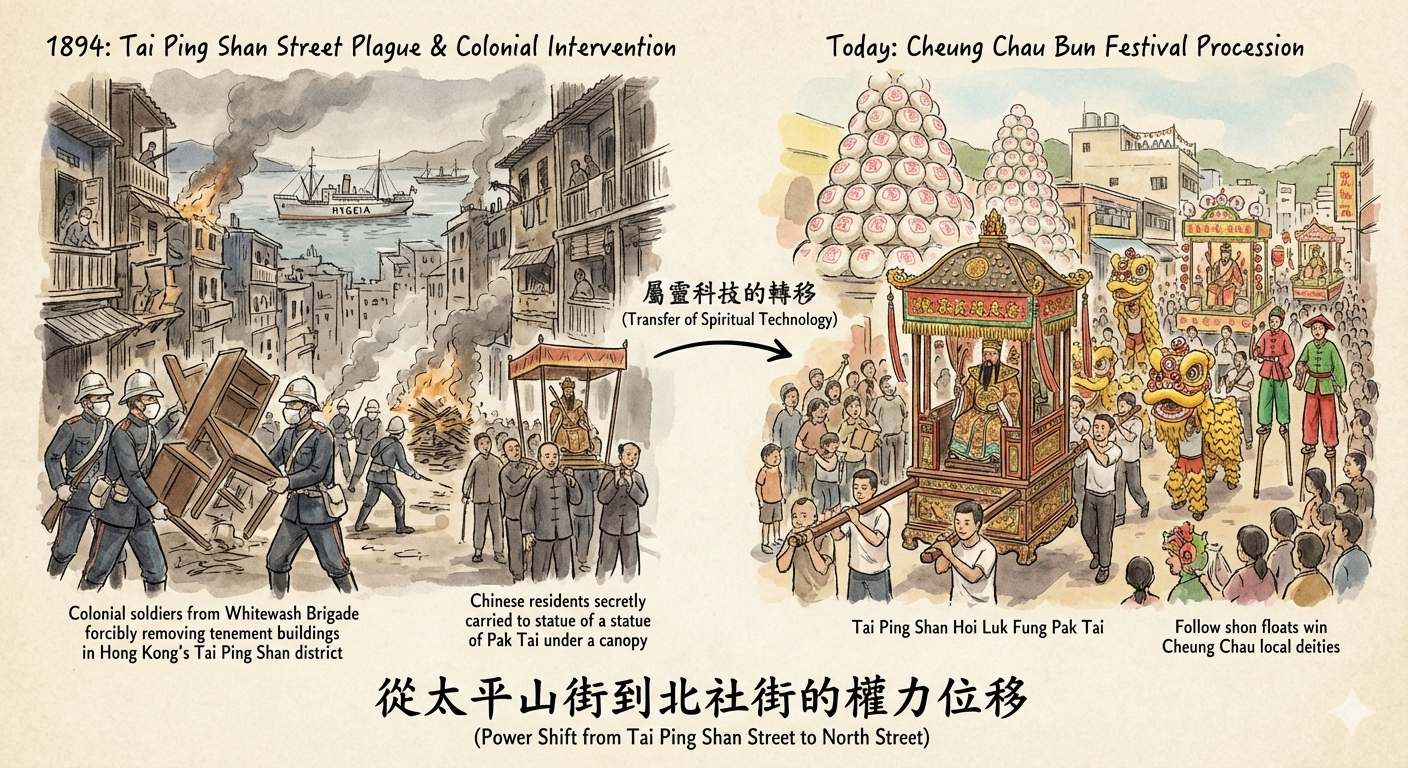
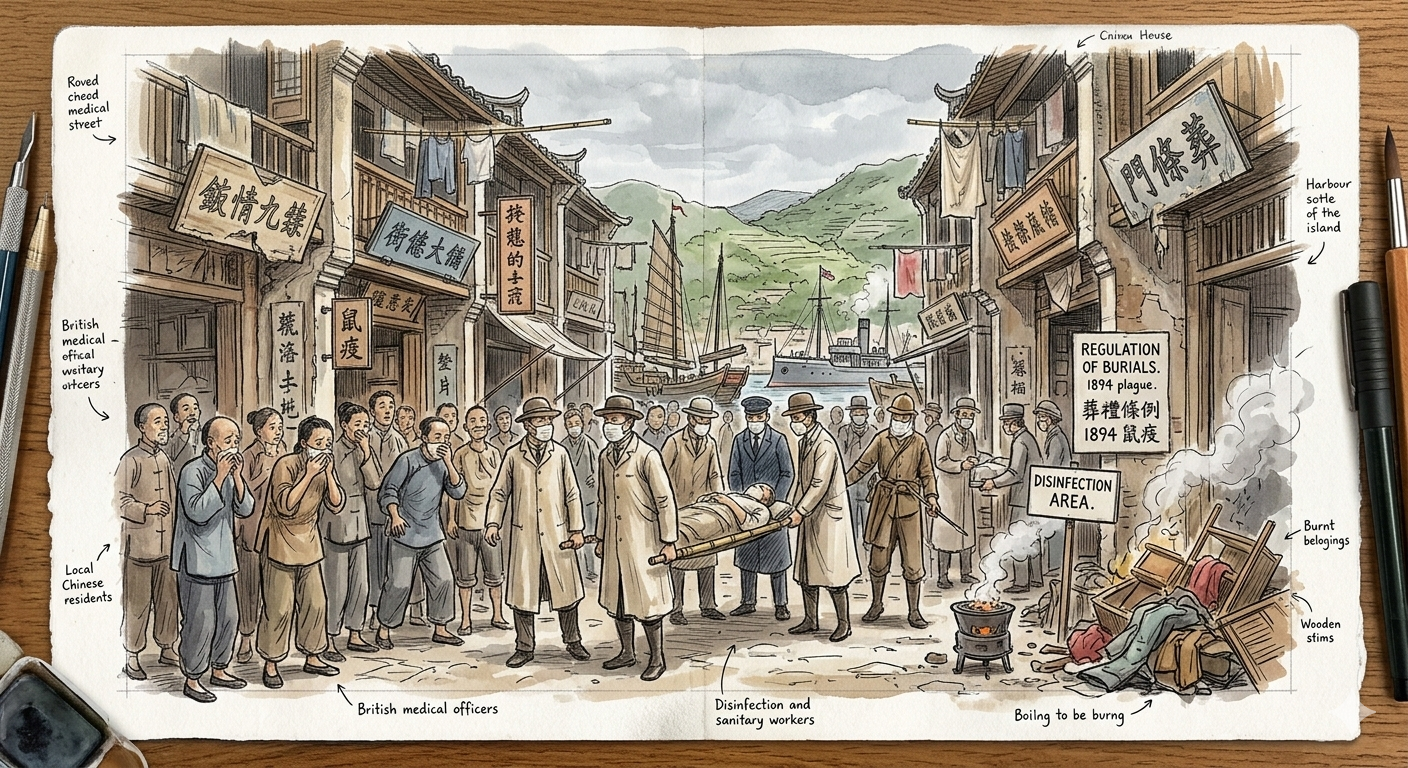
In the face of colonial crisis, marginalized communities often deploy "Spiritual Technology"—a synthesis of religious ritual and social organization—to reclaim agency over their physical environment. This was the case in 1894, when the plague erupted in the overcrowded tenements of Tai Ping Shan Street. The colonial government, influenced by "Miasma Theory," believed the disease rose from foul air and filth. They deployed "Whitewash Brigades"—military units that forcibly entered homes, burned furniture, and dragged the sick to the Hygeia hospital ship.
Distrustful of these military incursions, the Hoklo community turned to their own defenses. They paraded the deity Pak Tai through the streets, using collective fasting, incense, and "street washing" to cleanse their space. When the government restricted these rituals in the urban core to maintain "order," the community performed a strategic act of spatial resistance: they moved the "Tai Ping Shan Pak Tai" to Pak She Street on Cheung Chau.
The "So What?" Layer: This relocation ensured the survival of the Jiao ceremony outside the direct gaze of the colonial center. Today, the "Tai Ping Shan Pak Tai" still leads the Bun Festival parade, positioned ahead of the local Cheung Chau deities. This hierarchy is a silent, enduring testament to the 19th-century displacement and the power of the Hoklo diaspora to maintain their cultural sovereignty through "Spiritual Technology."
"The Haiguluo community... developed a set of 'Spiritual Technology'... including collective fasting, street washing, and deity processions, redefining the community's concept of 'cleanness' against colonial medical monopoly."
The Silent Sentinels of Segregation: The 1919 Boundary Stones
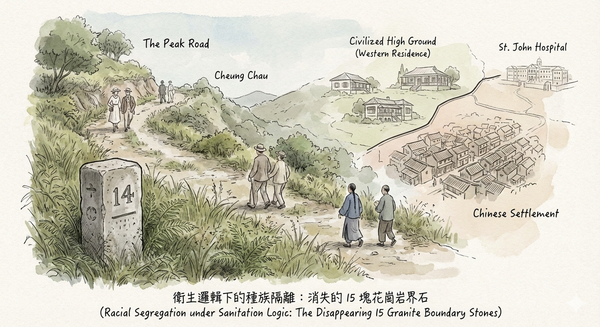
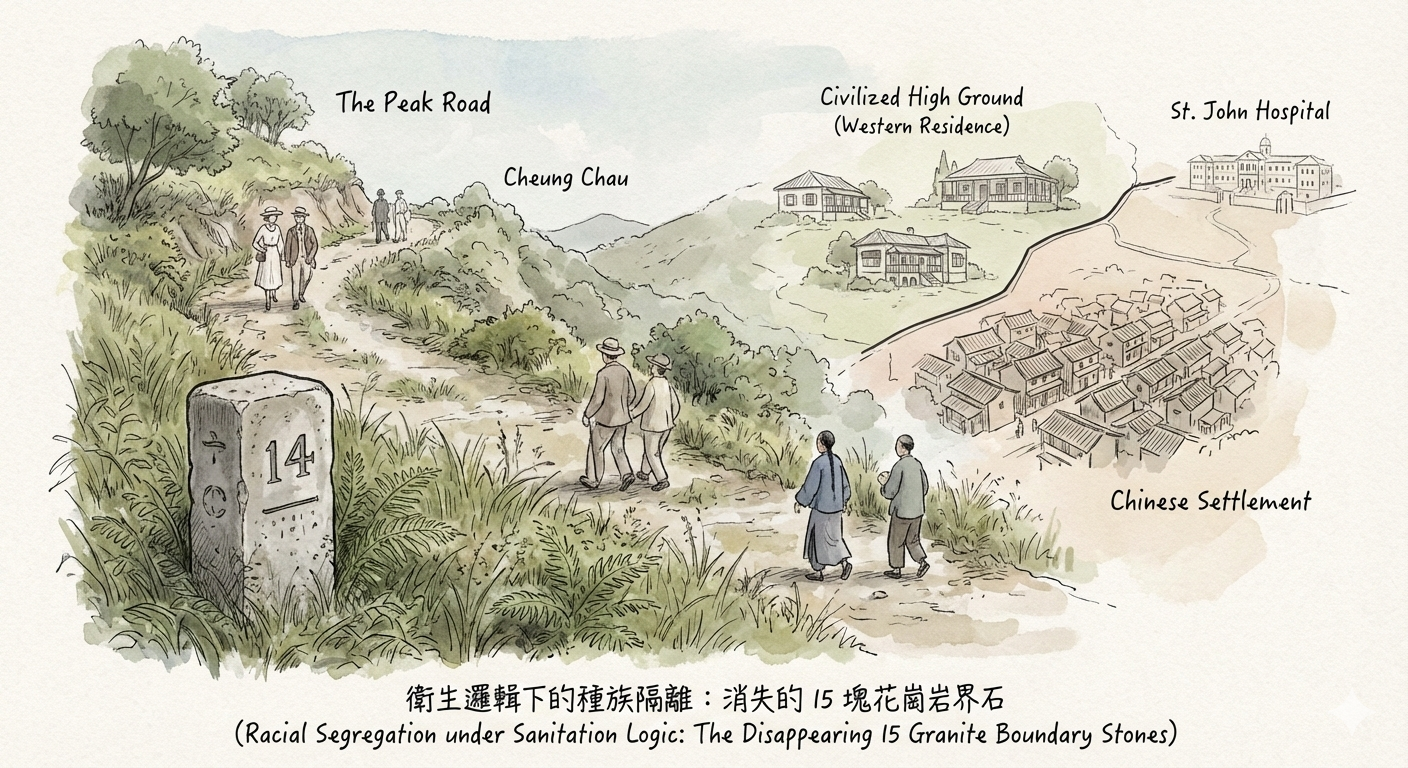
By the early 20th century, the "sanitary logic" of the plague years had evolved into a tool for formal racial segregation. The colonial administration associated Chinese living conditions with "uncleanness," utilizing the fear of disease to justify "Sanitary Governance." This manifested in the Cheung Chau (Residence) Ordinance of 1919, which designated the "Dumbbell Island Southern Portion"—the island’s airy, hilly heights—as an exclusive enclave for Europeans, primarily missionaries and officials.
To mark this divide, the government installed 15 granite boundary stones. These markers created a physical "sanitary red line" that separated the "clean" colonial heights from the "chaotic" Chinese village clustered around the harbor.
The "So What?" Layer: These weathered stones are artifacts of "Racial Capitalism," where the plague provided the ultimate justification for stripping local residents of the right to inhabit their own hills. While modern hikers often pass them without a second glance, these stones represent a competitive landscape where health and hygiene were used to delineate who belonged in the sun and who was relegated to the crowded alleys below.
Where to Find the Boundary Stones:
- Near St. John Hospital: Several markers remain near the hospital grounds, where the "hygienic" boundary was most strictly enforced.
- The Peak Trail: Search for the weathered granite blocks along the higher elevation paths, often partially reclaimed by vegetation.
- Boundary Stone No. 14: Located along the hilltops, this remains one of the most poignant reminders of the 1919 ordinance’s legal reach.
The Landlords of Tradition: Wong Wai Tsak Tong and the 1905 Lease
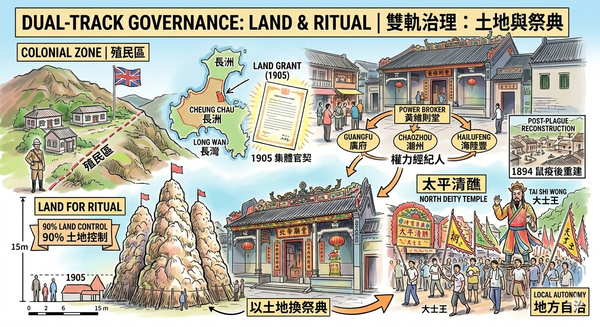
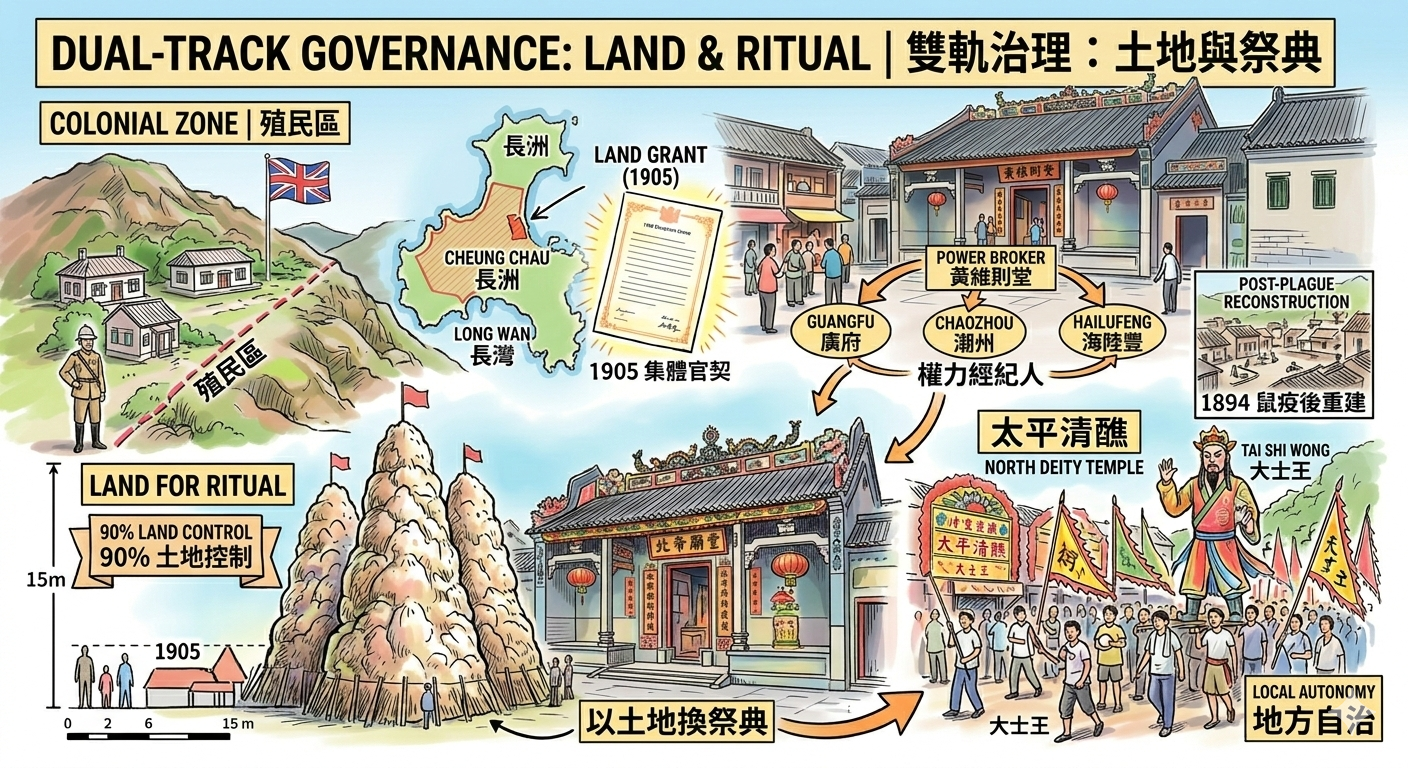
While the colonial government sought to regulate the island through health ordinances, an indigenous power structure held the keys to the land itself. The Wong Wai Tsak Tong clan had controlled 90% of the island’s private land since the Qing Dynasty. Following the plague, the British issued the 1905 Block Crown Lease, officially recognizing the clan as the primary leaseholder.
This created a "double-track governance": the British provided the legal framework, but the clan controlled the actual economic and religious resources. The Wong Wai Tsak Tong acted as the "power brokers" between the state and the three major ethnic associations—the Cantonese, Teochew, and Hoklo.
The "So What?" Layer: This economic dominance was the engine of the Bun Festival’s survival. By controlling land and rents, the clan funded the massive "Bun Mountains" as a display of local autonomy. The festival was not merely a religious event; it was a demonstration of traditional prestige, allowing the clan to maintain community loyalty even as the colonial state attempted to impose its administrative order.
A Refuge for Dignity: Fong Bin Hospital
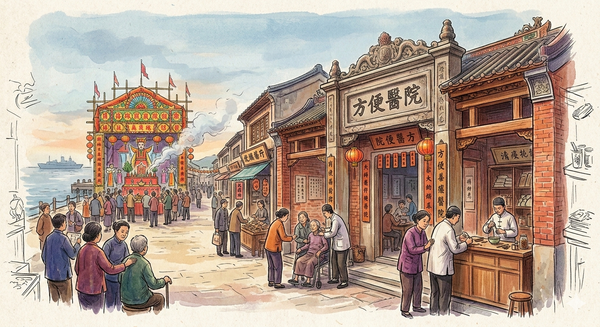
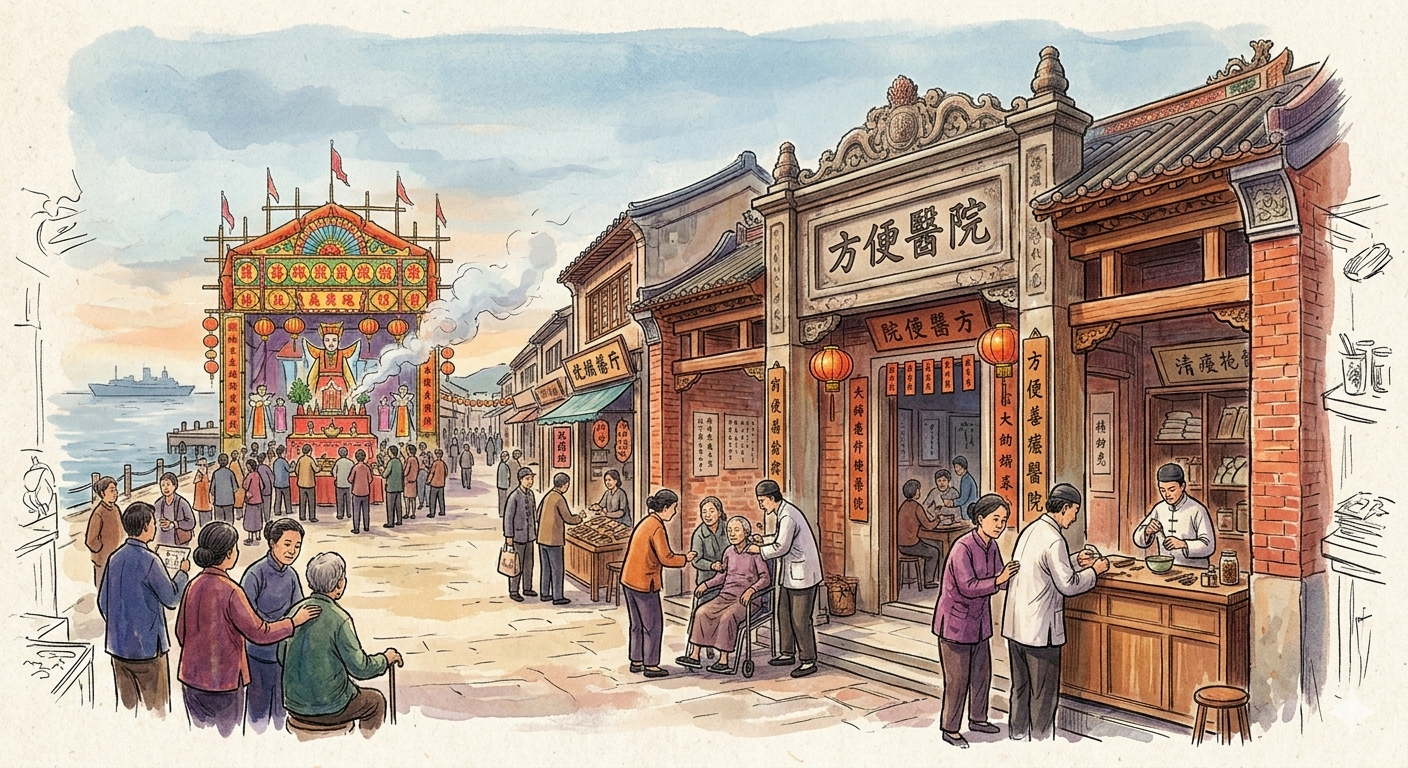
During the 1894 plague, a deep ethical rift emerged between Western clinical medicine and Chinese traditions regarding death. Western "Germ Theory" demanded the isolation of the sick and the clinical disposal of the dead, which many residents viewed as a terrifying violation of filial duty. In response, local gentry and itinerant fishermen founded Fong Bin Hospital near the island’s wharf.
Fong Bin was not a surgical facility but a charitable shelter. It was positioned strategically at the island’s entrance to serve fishermen who, lacking land-based homes, were especially vulnerable to the plague.
The "So What?" Layer: Fong Bin served as a vital "buffer zone," providing "terminal dignity" that Western plague wards lacked. The hospital’s role was the physical counterpart to the Bun Festival’s spiritual goals: while the hospital cared for the physical body of the dying, the Jiao ceremony sought to appease the "wandering ghosts" (the Hungry Ghosts) of those who died unnaturally, ensuring their spirits did not haunt the living.
"Fong Bin Hospital provided not only Chinese herbal prescriptions but also 'terminal dignity'... The hospital handled the physical body, while the festival handled the souls of those who died unnaturally from the plague."
The Re-Invention of the Bun Scramble: From Ritual to Sport
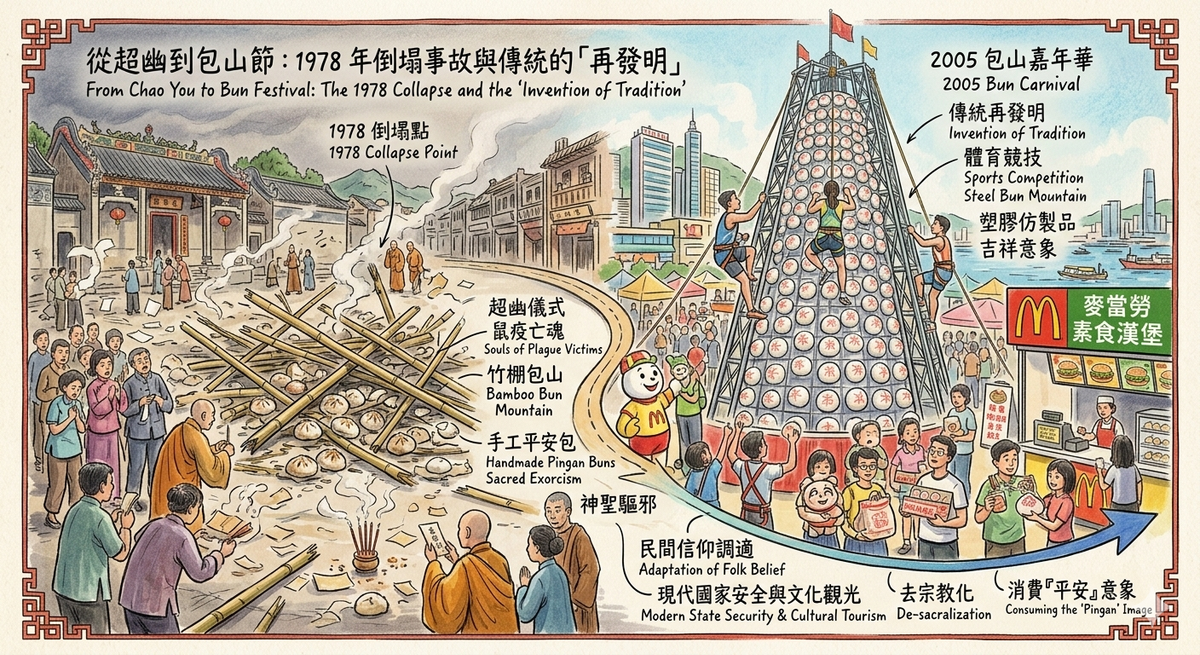
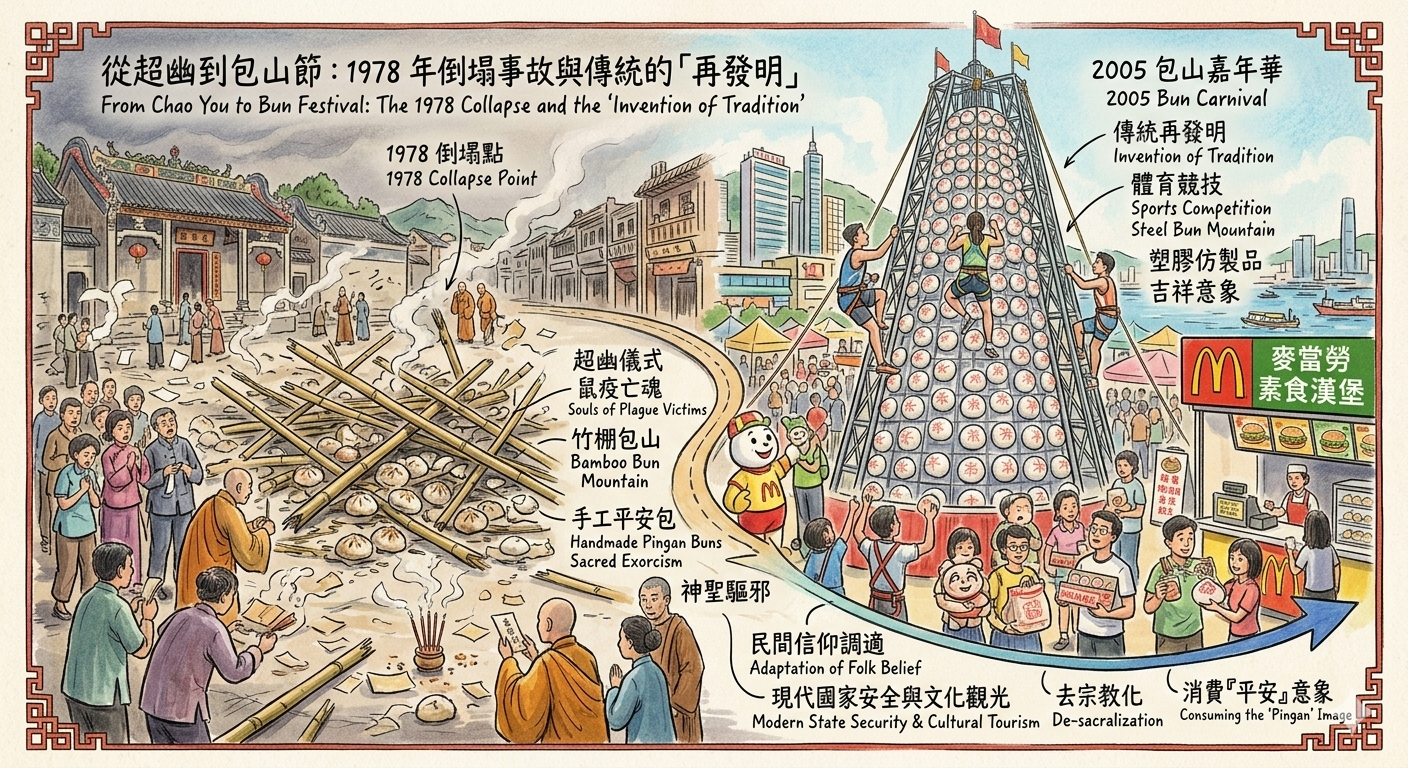
History is constantly re-invented to suit the safety and sensibilities of the present. The Bun Festival underwent a dramatic transformation following the 1978 collapse of a bun tower, an accident the government used to "secularize" the ritual under the guise of public safety. Following a 26-year ban, the "Bun Scramble" returned in 2005 as the "Bun Carnival."
The "So What?" Layer: This transition represents the "secularization of fear." The original "Ghost Buns" (Yu Pao), intended to feed the spirits of plague victims, were rebranded as "Peace Buns" (Ping On). The sacred, spontaneous competition was replaced by a regulated sporting event with steel towers and trained athletes. Perhaps the ultimate symbol of this cultural adaptation is McDonald’s on the island, which serves veggie burgers during the festival—a global corporate compromise with an ancient requirement for ritual vegetarianism.
Hidden Gems for the Historical Traveler
- Fong Bin Hospital Old Site: Located at the end of Pak She Street, the original stone lintel of this institution remains. It is a quiet, evocative site representing the community’s attempt to provide a dignified refuge for the dying when colonial medicine offered only isolation.
- Boundary Stone No. 14: Found along the Peak hiking trail, this granite marker is a physical remnant of the 1919 racial segregation ordinance. It serves as a stark reminder of the "invisible lines" drawn by colonial hygiene laws that once split the island in two.
Philosophical Reflection: The Layers of the Island
Cheung Chau is a living testament to the fact that a city’s soul is found in "layered observation." To the casual observer, the Bun Festival is a colorful tourist attraction. To the historical traveler, it is a map of survival. We see the plague ghost behind the tourist bun; we see the "Spiritual Technology" of an oppressed migrant class in the face of the "Whitewash Brigades."
The island teaches us that pandemics do not just leave behind medical data; they leave behind gods, hospitals, and boundary lines. As we walk through modern cities that have faced their own recent traumas, we must ask: What rituals are we currently inventing to appease our own ghosts? How will our descendants read the "spatial stories" we are leaving behind in the wake of our own global crises?
Walking the History: Traveler’s Logistics
- How to Get There: Board the ferry from Central Pier No. 5. The fast ferry (35 minutes) or ordinary ferry (55 minutes) both offer a slow approach to the island's historical harbor.
- Recommended Sites:
- Pak Tai Temple (Yuk Hui Temple): The spiritual heart of the island where the migration of the "Tai Ping Shan Pak Tai" is still honored.
- The Peak Walking Trail: A scenic hike to locate the remaining 1919 Boundary Stones.
- Pak She Street: Explore the alleys where the rituals of "street washing" and communal care first took root during the 1894 crisis.
For more deep-dives into the spatial history of South China, subscribe to our dispatch.
References and further reading
- 1894 Hong Kong plague, accessed February 26, 2026,
- 1894年香港鼠疫-, accessed February 26, 2026,
- Kwan, Benjamin: The 1894 Bubonic Plague 68 - History, accessed February 26, 2026,
- the 1894 Hong Kong Plague in Two English Medical Journals - Mattioli 1885, accessed February 26, 2026,
- (PDF) Reorganizing Hospital Space: The 1894 Plague Epidemic in Hong Kong and the Germ Theory* - ResearchGate, accessed February 26, 2026,
- Selfless Dedication in the Time of Plague, accessed February 26, 2026,
- The Hong Kong Plague Medal | HKMJ, accessed February 26, 2026,
- 非物質文化遺產與東亞地方社會, accessed February 26, 2026,
- History of Cheung Chau: Pirates, Rituals and Segregation, accessed February 26, 2026,
- Yuk Hui Temple (Pak Tai Temple), Cheung Chau - Chinese Temples Committee - 華人廟宇委員會, accessed February 26, 2026,
- 長洲玉虛宮(北帝廟) - 華人廟宇委員會, accessed February 26, 2026,
- 長洲太平清醮:傳承百年的香港非遺盛典 - 拍拖好去處, accessed February 26, 2026,
- 長洲太平清醮 - 香港非物質文化遺產資料庫, accessed February 26, 2026,
- 香港天主教診所歷史, accessed February 26, 2026,
- 長洲太平清醮的流變, accessed February 26, 2026,
- governing health and space in colonial Hong Kong and Shanghai Freddie Stephenson Student ID - - Nottingham ePrints, accessed February 26, 2026,
- 從長洲節慶到香港節日: 從星島日報看長洲太平清醮的演變,1946-1965 - Publication, accessed February 26, 2026,
- 長洲鼠疫, accessed February 26, 2026,
- 長洲太平清醮的流變, accessed February 26, 2026,
- 節日商業化對民間宗教傳承的影響: 以長洲太平清醮爲例, accessed February 26, 2026,
- CORPORATE BROCHURE 2023/2024 - 東華三院, accessed February 26, 2026,
- Reorganizing Hospital Space: The 1894 Plague Epidemic in Hong Kong and the Germ Theory* - PMC, accessed February 26, 2026,
- 保育與旅遊共存搶包山去社團化, accessed February 26, 2026,
- 長洲北帝廟與太平清醮, accessed February 26, 2026,
- 香港故事|從瘟疫到非遺,看太平清醮飄色巡遊搶包山, accessed February 26, 2026,
- Cheung Chau Jiao Festival - Home - Intangible Cultural Heritage Office, accessed February 26, 2026,
- Cheung Chau bun festival - to home with love, accessed February 26, 2026,
 Lawrence
 Lawrence
 Lawrence