(ENG) The Dumbbell Island’s Hidden Layers: 5 Surprising Histories of Cheung Chau
Stories of Cheung Chau. From pirate rule to colonial segregation, discover how walking around this island reveals the soul of Hong Kong.

How did the Wong Wai Tsak Tong clan maintain a monopoly on land for 200 years?
How did the 1894 plague transform the Jiao Festival into a cultural defense?
How did pirate leader Cheung Po Tsai transition from outlaw to naval officer?
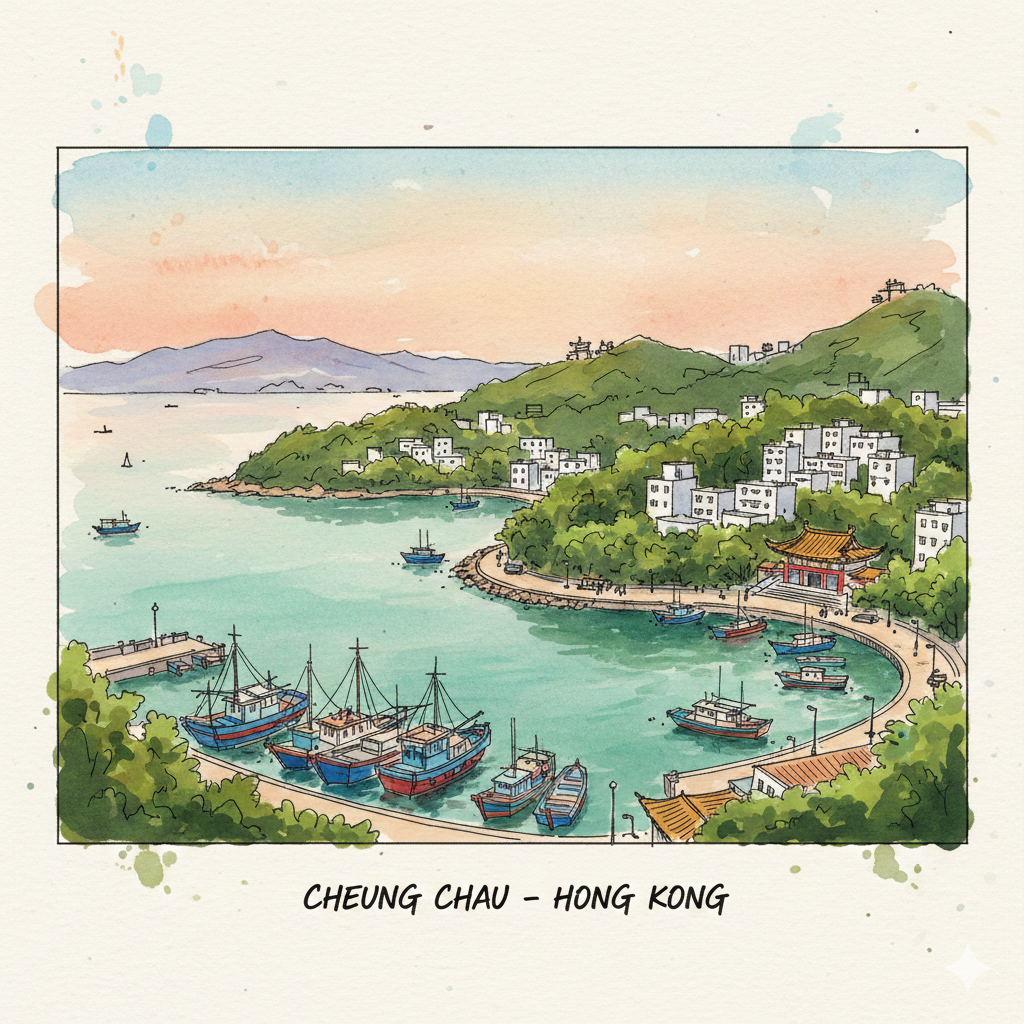
To the casual visitor, Cheung Chau appears as a vibrant, car-free retreat defined by its seafood stalls and narrow, bustling alleys. However, the island's very shape tells a deeper story of geological and social evolution. Its unique "dumbbell" geography is a tombolo—a slender neck of sand and sediment formed over millennia, connecting two distinct granite masses. Walking across this narrow waist, where the sea nearly meets from both sides, one feels a sense of topographical precariousness. This fragile bridge became a strategic necessity for the maritime world, offering a deep-water harbor that sheltered fishing fleets and traders long before the British colonial project.
As one of Hong Kong’s oldest inhabited sites, Cheung Chau is a dense palimpsest where layers of maritime power and colonial experimentation are etched into the street grid. It is not merely a day-trip destination, but a historical theater where the transition from an ancient fishing hub to a colonial frontier can be traced through specific stones and landmarks. These stories reveal an island defined by an "economic dumbbell" as well—the complementary yet distinct worlds of the itinerant fisherman and the landed shop owner.
The first layer of this history is invisible to the eye but dictates every square inch of the island: a cadastral monopoly that endured for centuries.
Listen to the historical stories told in detail (For subscribers only)
The Invisible Monopoly: The Century-Long Battle for Land Rights
For much of its modern history, Cheung Chau operated as a "state within a state." Unlike the rest of Hong Kong, where the Crown held ultimate land authority, a single clan organization—the Wong Wai Tsak Tong—maintained a near-total monopoly on land rights from the Qianlong era of the Qing Dynasty until the late 20th century.
 Lawrence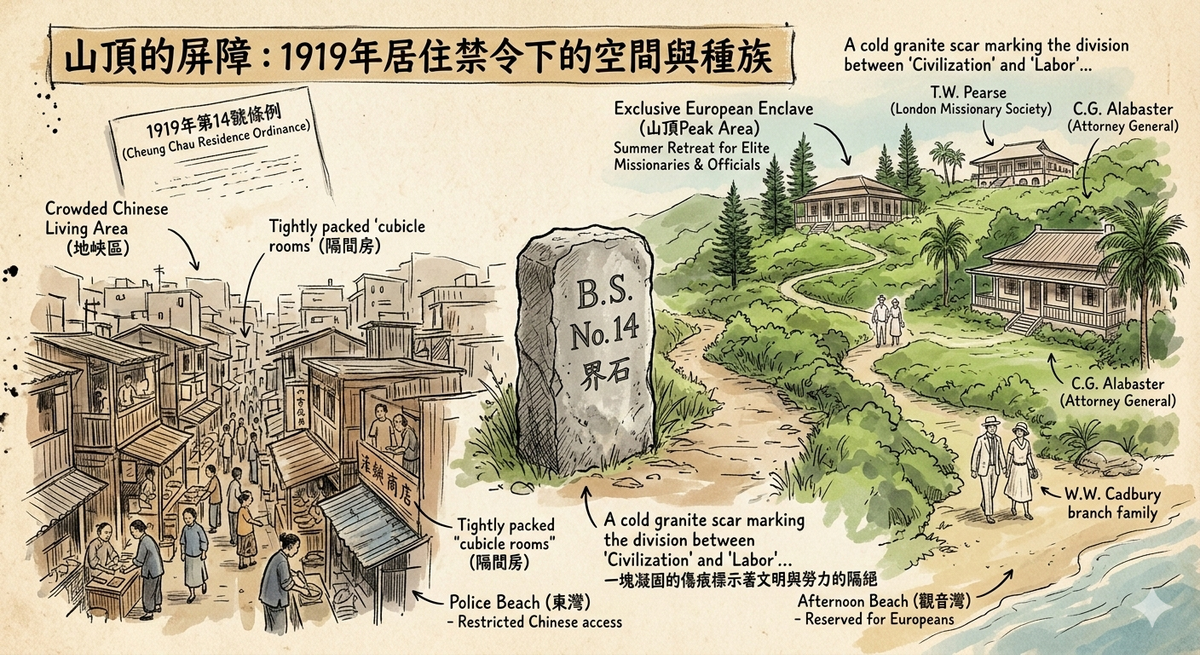
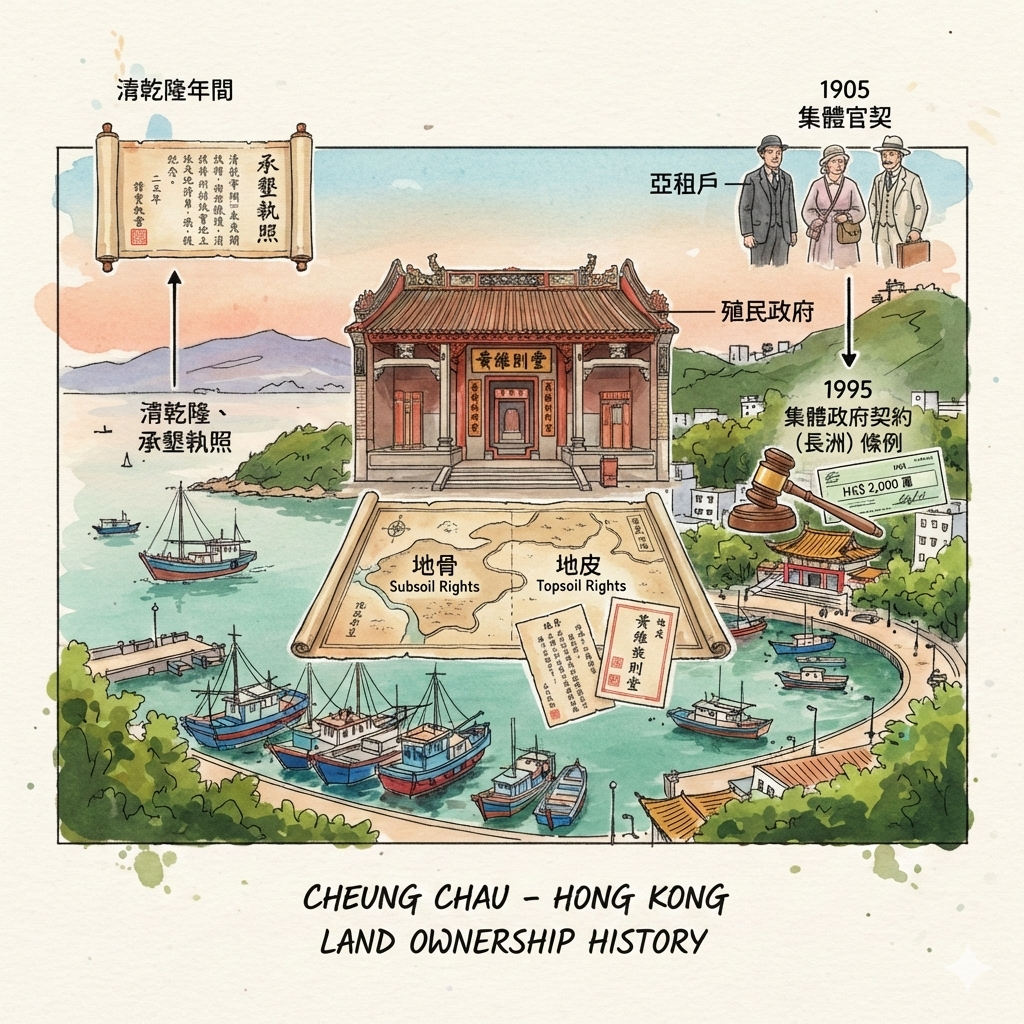
This control was rooted in the Chinese "dual-ownership" system, a sophisticated legal anomaly. The Wong clan held the Subsoil Rights (地骨), or the "bones of the land," recognized by the imperial government. The actual residents held the Topsoil Rights (地皮), acting as permanent tenants who could build and trade but were required to pay "ground rent" to the clan. When the British leased the islands in 1898, they engaged in "pragmatic borrowing," choosing to co-opt this traditional Chinese structure to lower administrative costs rather than dismantling it.
Era | Power Subject | Legal Framework | Ownership Attribute |
Qing Dynasty | Wong Wai Tsak Tong | Xin’an County Cultivation License | Traditional Subsoil Rights (地骨) |
Colonial (1905–1995) | Wong Wai Tsak Tong | Block Crown Lease | Sole legal landlord; managed 90% of private land |
Post-1995 | Hong Kong Government | Block Crown Lease (Cheung Chau) Ordinance | Reclaimed rights; HK$20M settlement paid to clan |
This legal remnant of the Qing era persisted until 1995, when the government finally ended the monopoly by paying the Wong Wai Tsak Tong a settlement of HK$20 million to reclaim the rights. Only then did the islanders finally escape the status of sub-tenants to a singular clan lord.
From Outlaw to Officer: The Strategic Pivot of Cheung Po Tsai
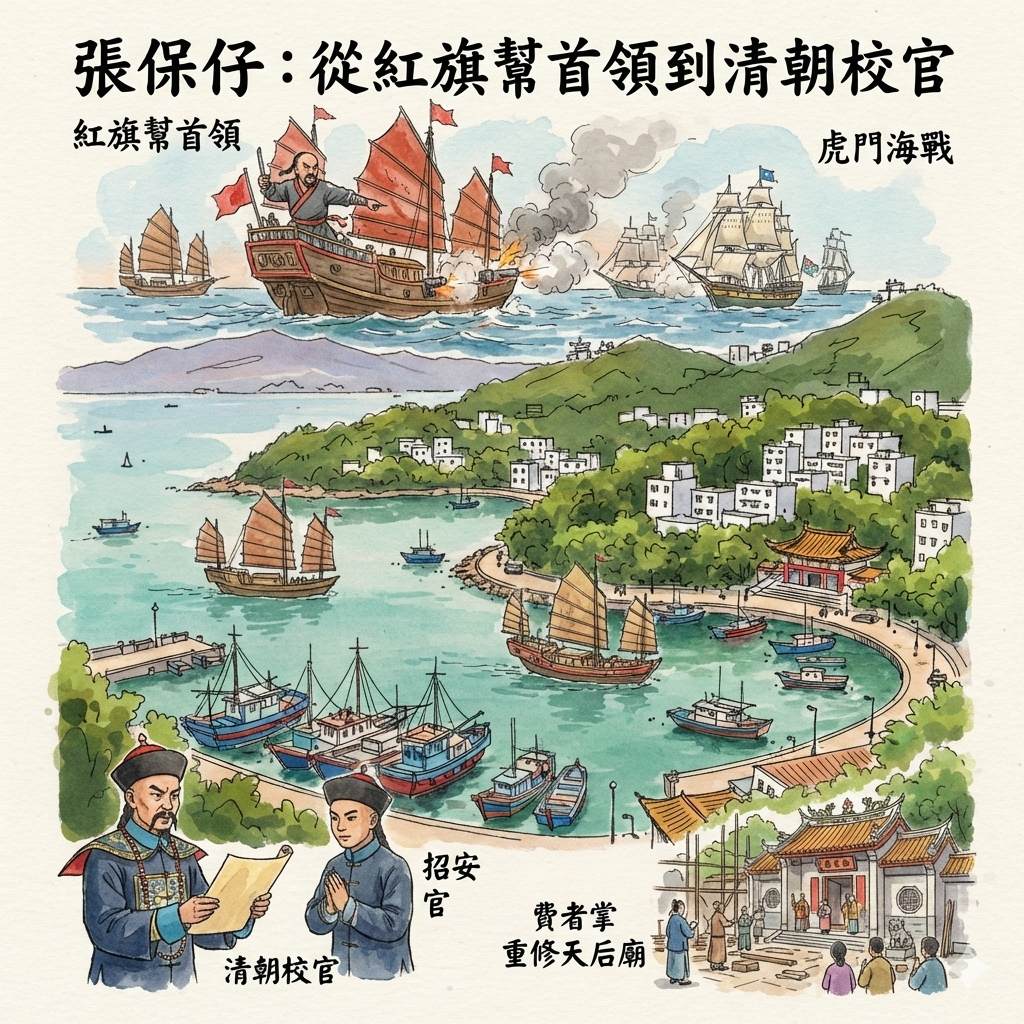
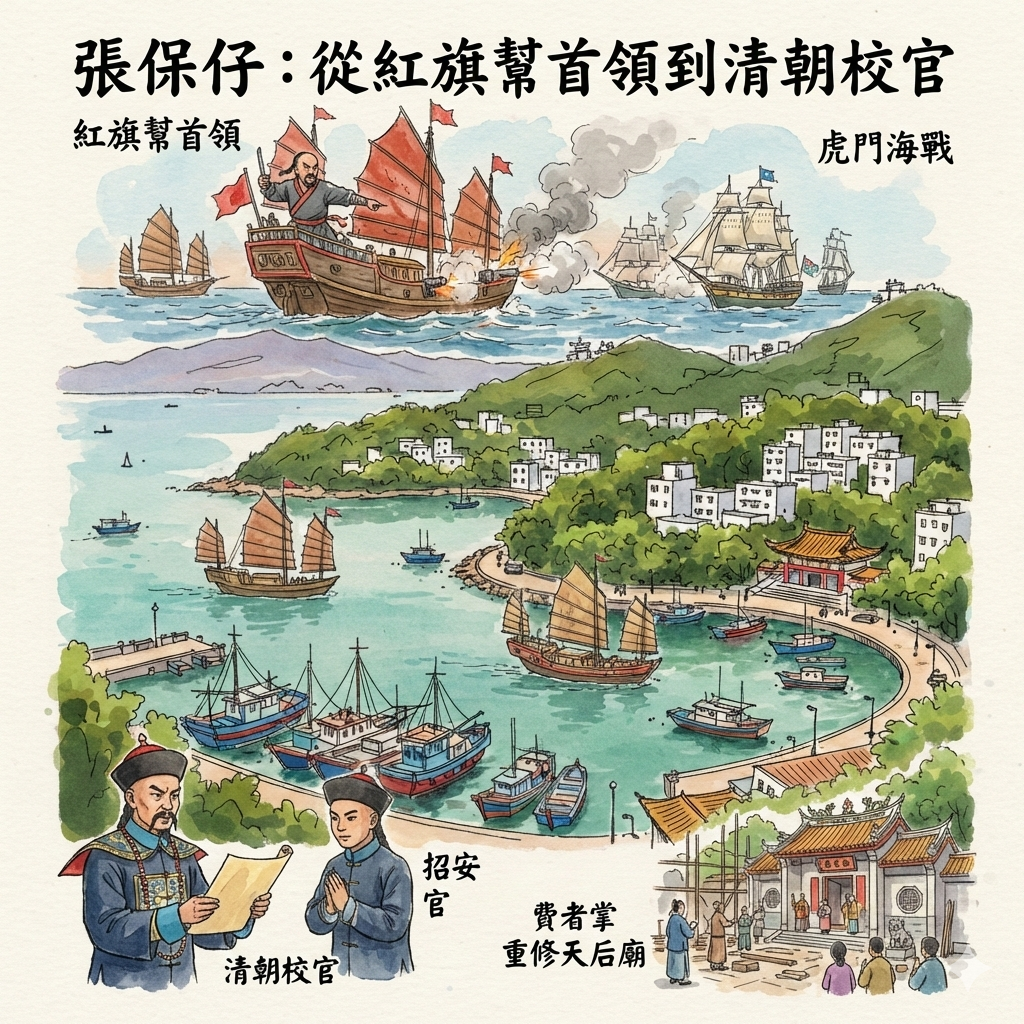
While the land was governed by clan law, the surrounding waters were ruled by the volatile force of the Red Flag Fleet. In the early 19th century, the South China Sea was dominated by a pirate coalition that rivaled imperial navies. At its helm was Cheung Po Tsai, a leader of 50,000 men and 600 ships who used Cheung Chau’s deep-water harbor as a primary supply base.
The narrative of Cheung Po Tsai is often reduced to myth, but historical records such as the Jing Hai Fen Ji reveal a sophisticated power transaction. In 1810, following the brutal "Battle of the Tiger's Mouth" near Lantau—where his fleet faced a combined Qing and Portuguese force—Cheung Po Tsai realized the era of maritime outlawry was closing. The scale of the conflict was staggering; the pirate leader eventually faced a blockade involving over 300 ships, 1,500 cannons, and 20,000 soldiers.
 Lawrence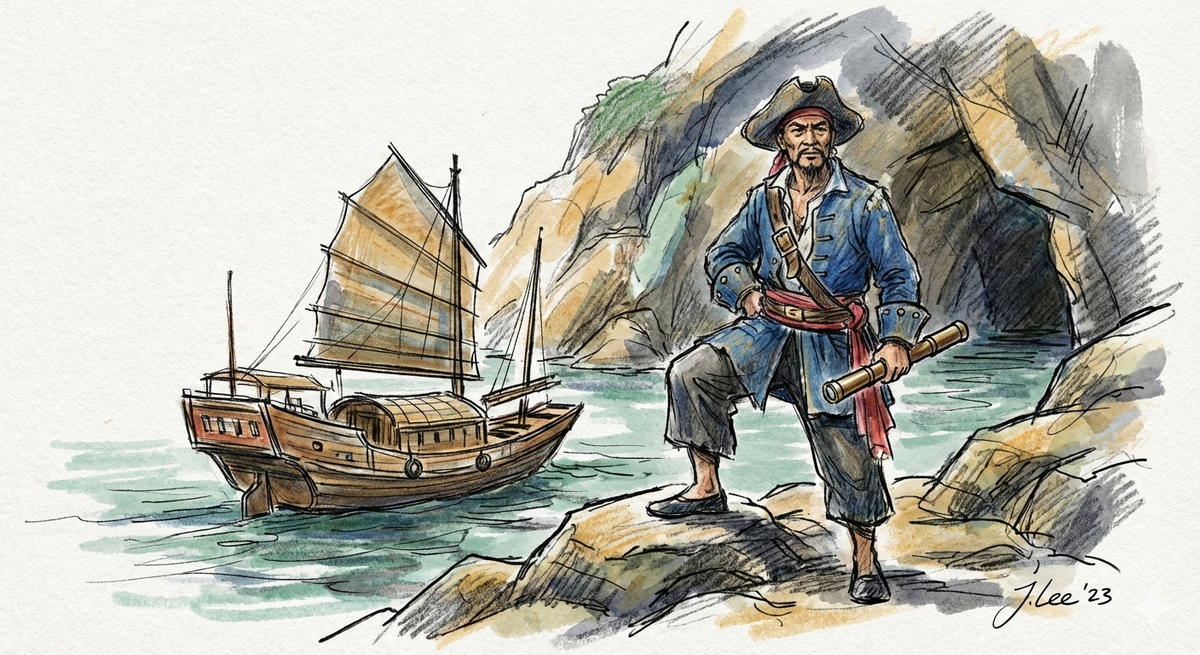
"In 1810... [Cheung Po Tsai] did not choose a fight to the death with the Qing court, but instead engaged in a complex political dialogue... On April 20, 1810, he formally surrendered his arms."
This "strategic surrender" allowed him to transition from a "pirate king" to a naval Colonel (Fujian Vice-General). He traded his fleet for a pardon and an official commission, using his intimate knowledge of the coast to police the very waters he once terrorized. Today, the Cheung Po Tsai Cave serves as a vessel for collective memory regarding the blurred lines between officialdom and piracy that defined this maritime frontier.
Spiritual Defense: The 1894 Plague and the Birth of the Bun Festival
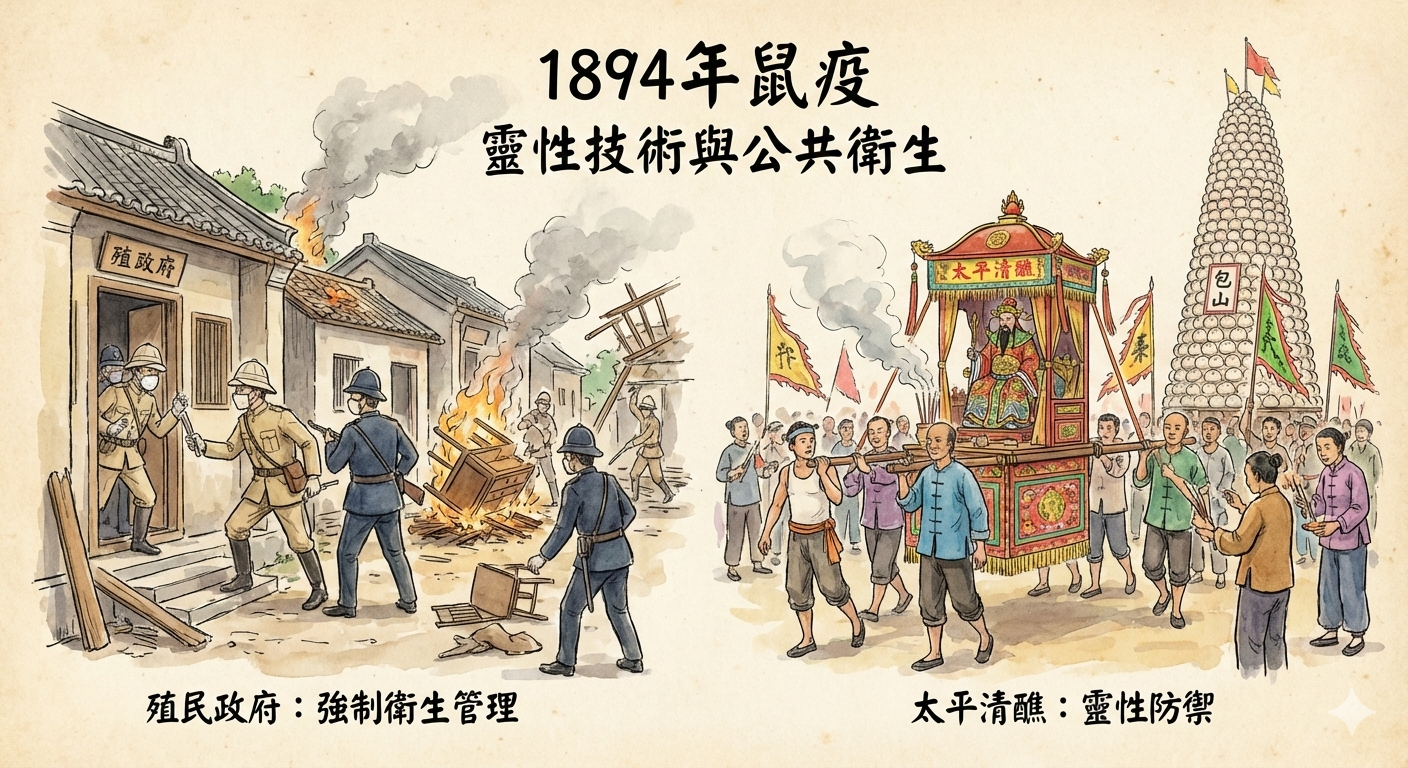
In 1894, a global bubonic plague reached Hong Kong, devastating the urban population. On Cheung Chau, the crisis triggered a clash between colonial medical "science" and local belief systems. The British government, adhering to "miasma theory," enforced house-burnings and searches that sparked terror. In response, the island’s Hailufeng (Hoklo) immigrant community deployed their own "spiritual technology": the Jiao Festival, now known as the Bun Festival.
They turned to Pak Tai, the "Emperor of the North" and a maritime protector, to perform a territorial defense against the "plague ghosts." What began as a localized ritual of the Hailufeng people eventually transformed into a total-island event, merging immigrant traditions with the collective survival of the island.
 Lawrence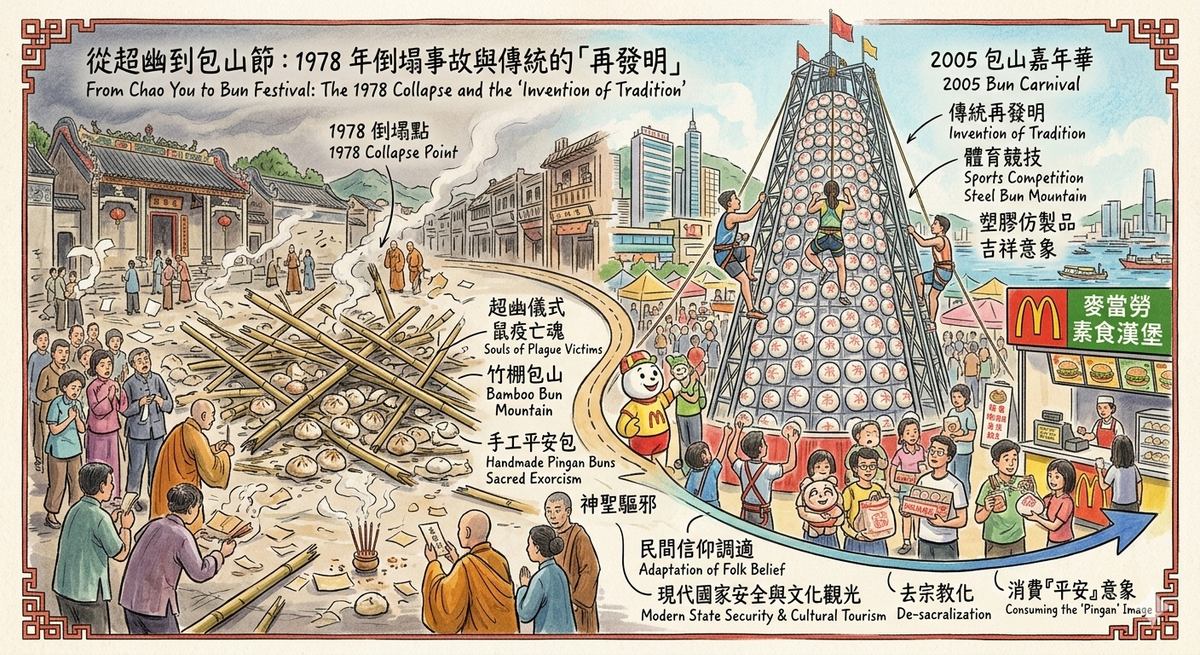
Historical Elements of the Original Jiao Festival:
- Universal Vegetarianism: A three-day island-wide fast to purify the community.
- North Point Parade: Carrying the Pak Tai statue through the streets to drive out wandering spirits.
- Bun Scrambling: Constructing massive bamboo towers covered in "ping on" (peace) buns to appease the spirits of the hungry dead.
The Racialized Landscape: The 1919 Residence Ordinance and Boundary Stones
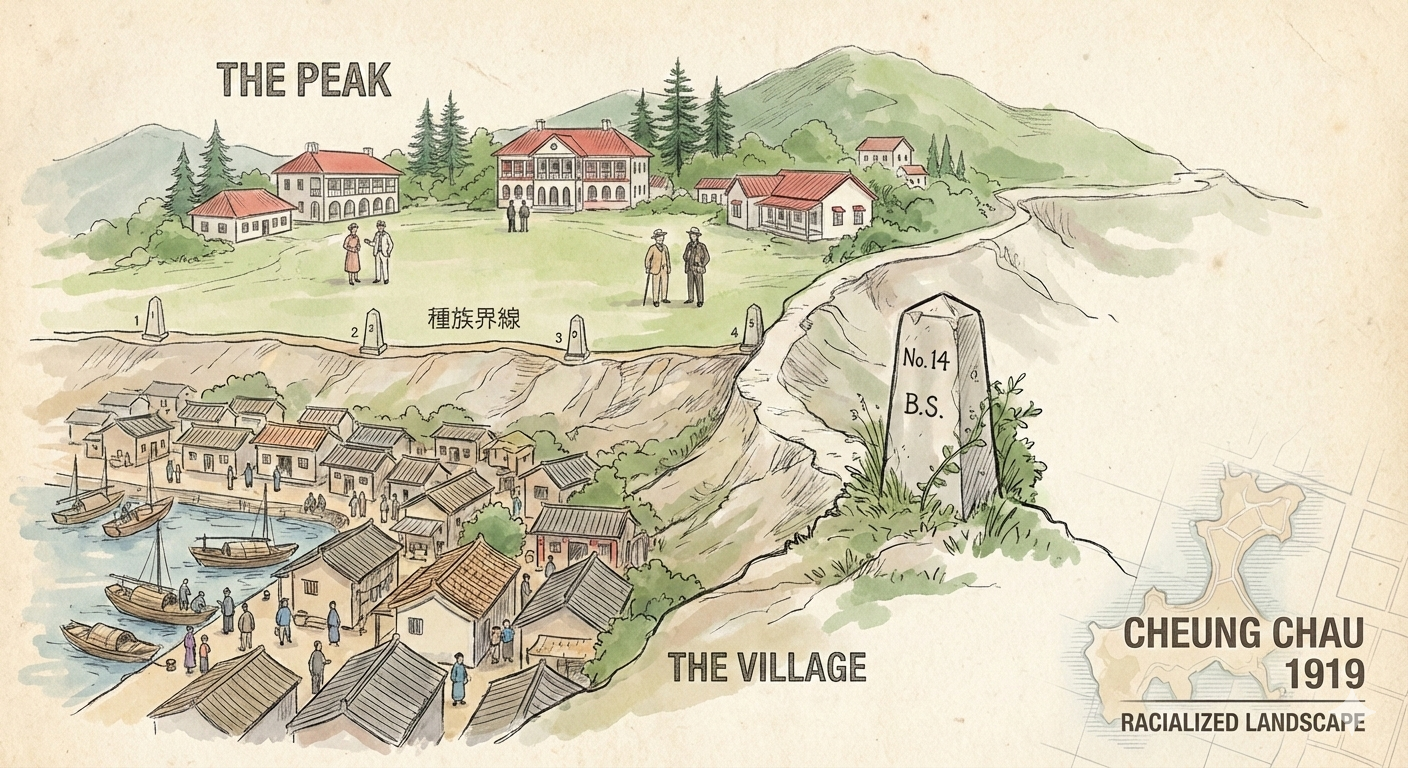
In the early 20th century, geography was used to enforce a strict social hierarchy. While the central village remained a crowded hub for Chinese residents, the southern hills—The Peak—were legally transformed into a "White-only" elite enclave.
Under the Cheung Chau (Residence) Ordinance of 1919, anyone wishing to reside in the southern zone required permission from the Governor-in-Council. Though British officials framed this as a "sanitary" measure to protect the economic interests of Western missionaries, it was a tool of racial segregation. The Chinese unofficial member of the Legislative Council, Ho Fook, vehemently protested the ordinance as an insult to loyal non-white subjects. The efficacy of this exclusion was absolute: a 1938 map reveals that of the 36 residences in this zone, not one was owned by a Chinese person.
To demarcate this zone, the government erected 15 boundary stones. These granite markers acted as physical barriers between the "unclean" village and the colonial heights. Today, Boundary Stone No. 14 remains visible within the grounds of St. John Hospital, a silent witness to a landscape once legally divided by race.
A Laboratory of Compassion: Post-War Refugees and the Care Village
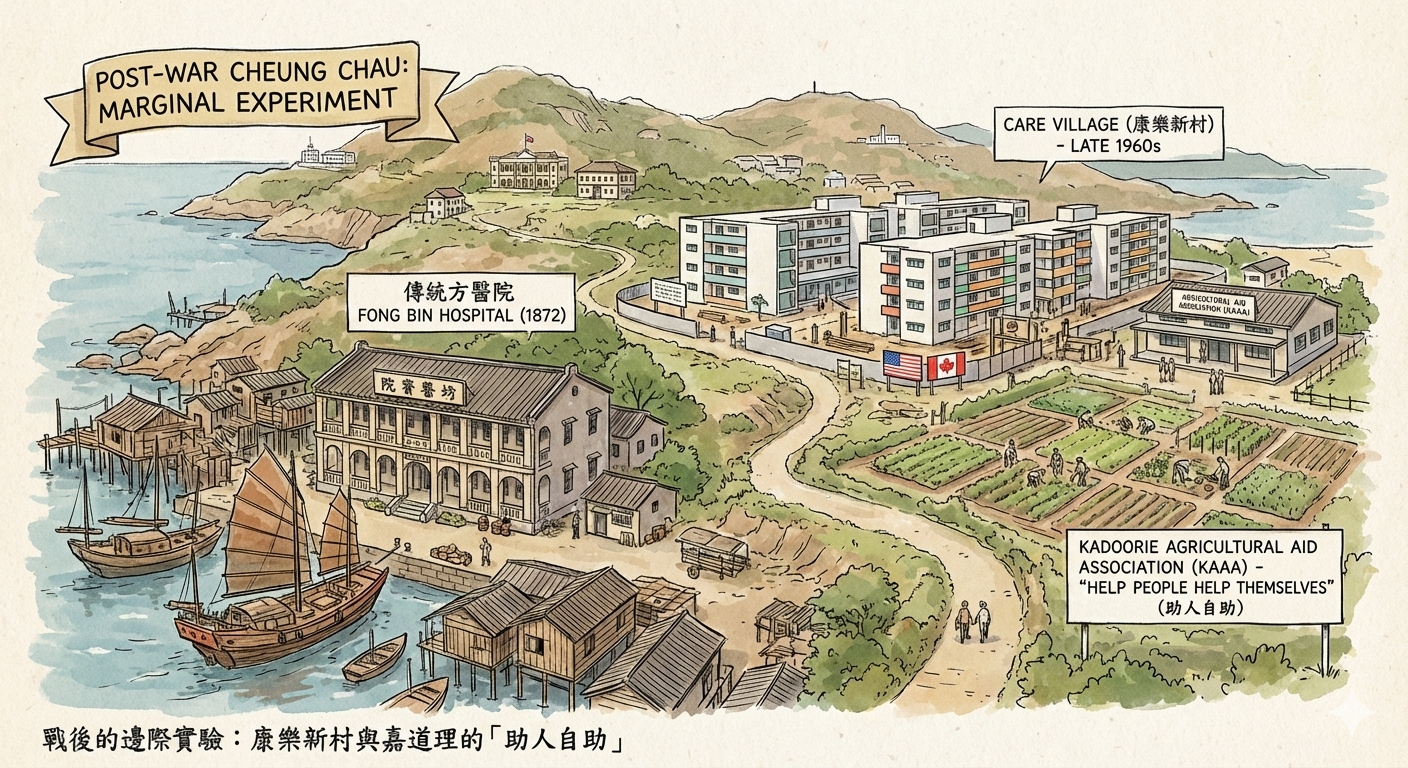
The mid-20th century brought a shift from colonial exclusion to humanitarian experimentation. Following the 1949 revolution, a surge of refugees fled to Hong Kong just as the traditional fishing industry began to decline. Cheung Chau became a site for "self-help" philanthropy.
The Kadoorie Agricultural Aid Association (KAAA) provided interest-free loans and livestock to help residents transition to farming. This was followed in the late 1960s by the construction of the Care Village (康樂新村). Funded by international donations from the US and Canada, this "model village" was built specifically to replace the dilapidated wooden huts that had housed the influx of refugees. This era marked the transition from the traditional merchant philanthropy of the late-Qing period—exemplified by the Fong Bin Hospital—to a modern, international welfare model.
Walking Through History: The Traveler’s Perspective
To experience these layers, one must walk the island with an eye for its contradictions. Begin at the Pak Tai Temple, the heart of the spiritual defense, before winding through the central alleys to the ruins of the Fong Bin Hospital (built 1872). Once a testament to the philanthropy of Chinese merchants, it served as a final refuge for homeless persons and victims of shipwrecks, its current ivy-covered walls reflecting a deep maritime pathos.
Continue toward the southern hills to find the remaining Boundary Stones, particularly the one at St. John Hospital. By connecting these sites—from the pirate’s cave in the west to the care villages of the interior—the traveler can see the island not as a static retreat, but as a living record of survival and adaptation.
Conclusion: The Layered Observation of an Island
Cheung Chau is a microcosm of how law, race, and ritual adapt to the edge of an empire. The "dumbbell" island is a landscape of boundaries—some invisible, like the Wong clan’s subsoil rights that cost the government millions to reclaim, and some physical, like the granite stones that once barred residents from their own hills.
As you walk these streets today, reflect on the freedom of the modern tombolo. The invisible boundaries of the past have faded, yet they continue to shape the physical freedom we feel today. The island remains a testament to how communities negotiate their place between the sea and the state.
For more deep dives into the fabric of the past, subscribe to the ‘Historical Travel Stories’ newsletter.
Practicalities
- How to Get There: Take the ferry from Central Pier 5. "Fast ferries" take approximately 35 minutes, while the "Ordinary ferry" takes 55 minutes and offers an open-deck experience of the harbor.
- Recommended Nearby Tours: Seek heritage-focused walking tours that cover the Pak Tai Temple and the 1919 Boundary Stones.
- Stay: To truly experience the "dumbbell" tombolo after the day-trippers leave, consider a local B&B near Tung Wan Beach. The atmosphere shifts at night, revealing the quiet, maritime village that has persisted for centuries.
References and Continue Reading
- Cheung Chau - accessed February 23, 2026
- History - Cheung Chau, accessed February 23, 2026,
- CHEUNG CHAU 1850-1898 INFORMATION FROM ..., accessed February 23, 2026,
- 長洲島的著名地標,歷史,和社區資訊- Part 7 - Cheung Chau Magazine, accessed February 23, 2026,
- 黃維則堂, 長洲 - Cheung Chau Magazine, accessed February 23, 2026,
- 老店長洲, accessed February 23, 2026,
- Introduction - The Chinese University of Hong Kong Press, accessed February 23, 2026,
- 話你知:黃維則堂集體官契1995年終止 - 文匯報- 香港文匯網, accessed February 23, 2026,
- 黃維則堂, accessed February 23, 2026,
- 發展局局長新聞公報: 立法會五題题:長洲黃維則堂(6589), accessed February 23, 2026,
- Cheung Po Tsai Facts for Kids, accessed February 23, 2026,
- Cheung Po Tsai - accessed February 23, 2026,
- Cheung Po Tsai - History of Piracy, accessed February 23, 2026,
- The pirate becomes the pirate catcher | macaomagazine.net, accessed February 23, 2026,
- Famous Pirate: Cheung Po Tsai - The Way Of The Pirates, accessed February 23, 2026,
- Selfless Dedication in the Time of Plague, accessed February 23, 2026,
- THE GREAT PLAGUE OF HONG KONG, accessed February 23, 2026,
- (PDF) Reorganizing Hospital Space: The 1894 Plague Epidemic in Hong Kong and the Germ Theory* - ResearchGate, accessed February 23, 2026,
- Cheung Chau Jiao Festival - Home, accessed February 23, 2026,
- Protection and Promotion of Intangible Cultural Heritage in Hong Kong: Jiao-festival of Cheung Chau, accessed February 23, 2026,
- Cheung Chau Bun Festival - Jay Tindall, accessed February 23, 2026,
- All About Cheung Chau Bun Festival (May 3-6, 2025) - The HK HUB, accessed February 23, 2026,
- The Cheung Chau Bun Festival: A Hong Kong Soundscape Study, accessed February 23, 2026,
- Cheung Chau Bun Festival - accessed February 23, 2026,
- Hong Kong's Other Peak – and the City's Overlooked History of ..., accessed February 23, 2026,
- Peak District Reservation Ordinance 1904 - accessed February 23, 2026,
- Old Hong Kong Boundary Stones - Hidden HK, accessed February 23, 2026,
- CHEUNG CHAU (RESIDENCE) ORDINANCE, 1919 - Historical Laws of Hong Kong Online, accessed February 23, 2026,
- CHEUNG CHAU (RESIDENCE) ORDINANCE, 1919 - Historical Laws of Hong Kong Online, accessed February 23, 2026,
- Cheung Chau's European Reservation - Gwulo, accessed February 23, 2026,
- hong kong legislative council. 58 28th august, 1919., accessed February 23, 2026,
- The Hong Kong Fishing Industry, accessed February 23, 2026,
- Fishing Villages – HK 360 2019 - Project, accessed February 23, 2026,
- Kadoorie Family: A Short History 嘉道理家族簡史 - Hong Kong Heritage Project, accessed February 23, 2026,
- 嘉道理農業輔助會| 歷史::嘉道理農場暨植物園, accessed February 23, 2026,
- Dr. Janel Curry — >Cheung Chau Island: The Mackinac Island of ..., accessed February 23, 2026,
- 長洲方便醫院, 1872年, accessed February 23, 2026
 Lawrence
 Lawrence