Tokyo Iriarai-machi Historical Walk – 5 Forgotten Stories of Showa Nostalgia
A historical walking guide to Tokyo's Iriarai-machi in Ota City. Featuring five stories of Showa-era nostalgia, literary history, and neighborhood change, this guide offers a slow-travel perspective on a hidden corner of Tokyo.

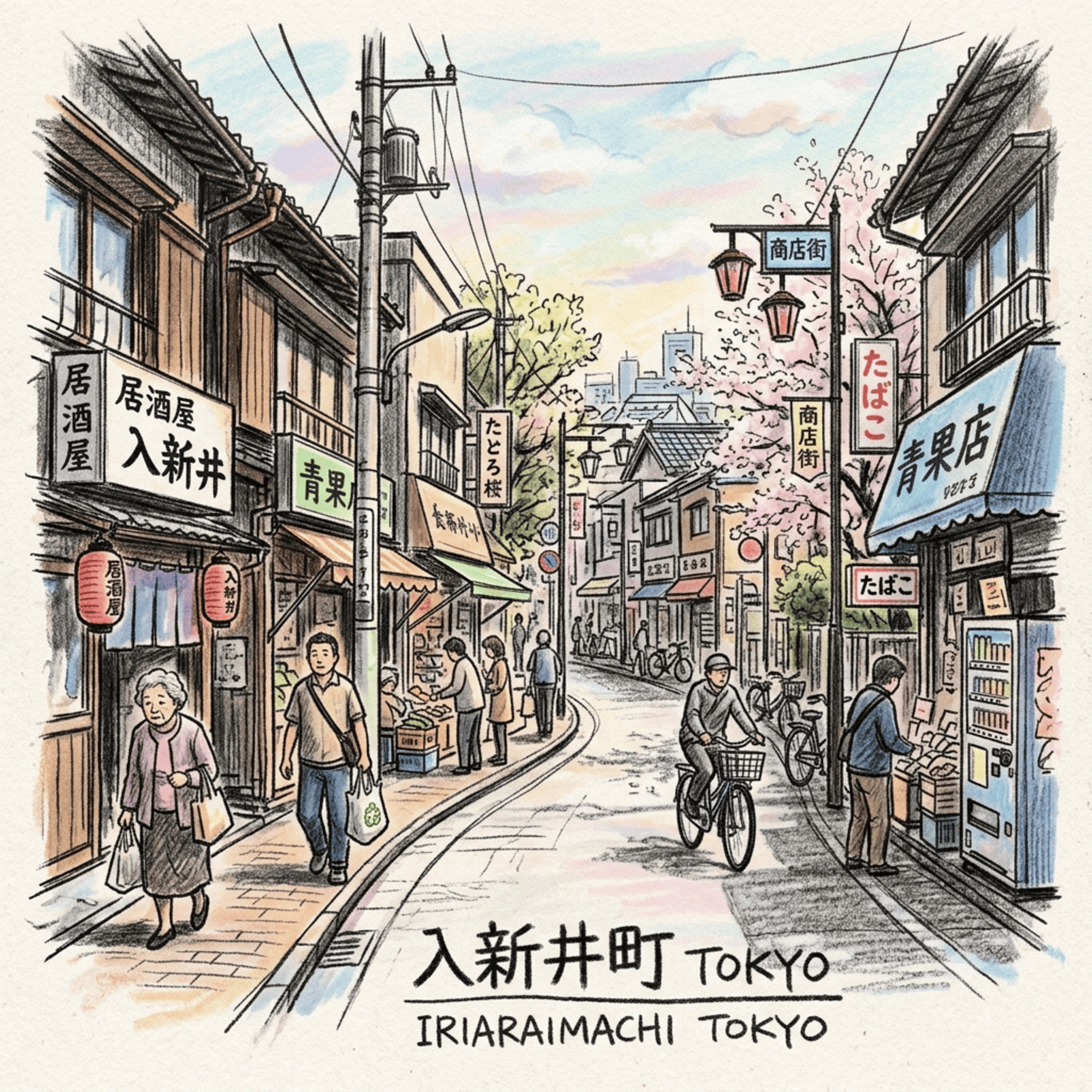
This is a historical travel story and walking guide to Iriarai-machi, a nostalgic neighborhood tucked away in Tokyo's Ota City. Through five forgotten stories, it explores the area's rich Showa-era heritage, former railway history, and literary footprints between Omori and Kamata. Readers will discover a unique route and a fresh perspective on how old neighborhood warmth and modern urban life intertwine in Tokyo's shitamachi.
 Lawrence
The Existential Hook: The Soul Weight of the Liminal Edge
Iriarai-machi—known to the modern urbanite as the districts of Omori and Sanno—is far more than a mere coordinate in Tokyo’s sprawl. It is a "Pillar Node," a liminal space perched precariously on the eastern edge of the Musashino Terrace where the high plateau descends into the lowlands of the bay. Here, the vibrational frequency of human struggle and cosmic energy converges. This specific geography acts as a boundary between the terrestrial and the maritime, holding an existential weight forged through millennia of indivisible stratigraphic memory. From the Jomon period’s "Okuri" worldview—where the landscape was a portal for sending spirits back to the eternal world—to the industrial era, Iriarai-machi has served as an anchor point where the physical landscape and ontological history form a resilient matrix. Underneath the asphalt lies a legacy of immunity, resistance, and alchemical harmony that refuses to be erased by the flattening force of modernity.
Listen to the historical stories told in detail (For subscribers only)
Node I: The Sacred Immunity of Iriyamazu (Non-Entry Rights)
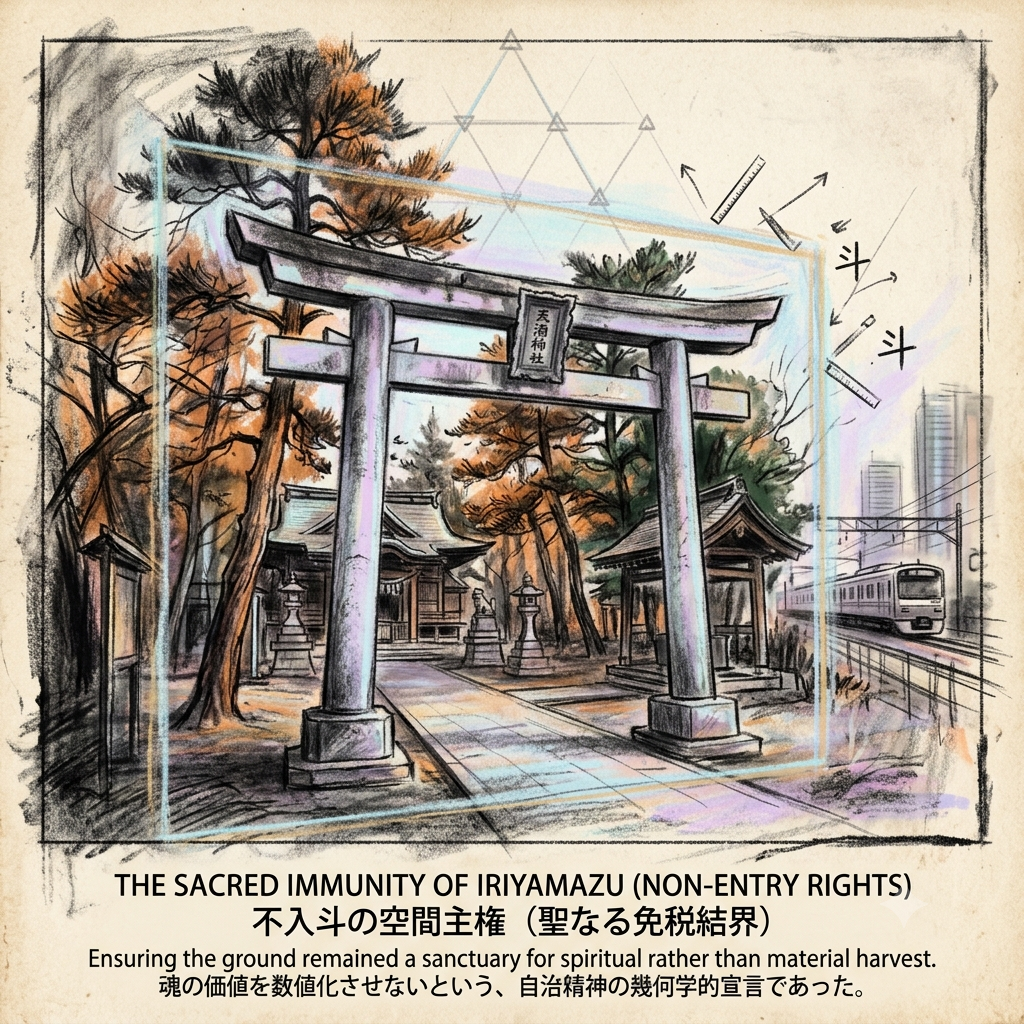
The strategic importance of Iriarai-machi begins with the concept of "Space Sovereignty." Long before modern borders, the area practiced Funyū-ken, or non-entry rights, creating a spiritual fortress designed to repel secular extraction and maintain the integrity of the land’s Ki (energy).
Medieval records, such as the 1371 Engaku-ji documents, identify Iriyamazu as a "non-entry village," a status it maintained through the Kamakura and Muromachi periods as an independent zone. This status meant that secular tax collectors were legally barred from crossing its boundaries. The geometric resonance of this "Sacred Boundary" was anchored by the Iwai Shrine and the Washinomiya. The exclusion of the "To"—the physical measurement tool of tax—was not merely a fiscal tactic; it was a high-dimensional defense mechanism. By barring the "To," the community physically repelled secular regulation, ensuring the ground remained a sanctuary for spiritual rather than material harvest.
How_Sacred_Borders_Stopped_Tax_Collectors
As you stand at the edge of Iriyamazu Park near the Ama-sake Inari Shrine—rebuilt in 1852 as a node for healing—the sensory data shifts. There is a distinct scent of dry pine needles and old wood. Beneath the stone torii gate, a subtle 0.5-degree temperature drop marks a geological and spiritual anomaly at the edge of the terrace. Here, a muffled silence prevails; the sharp, metallic screeches of the modern Keikyu trains seem to dampen as they reach the ancient boundary, as if the sound itself respects the non-entry rights of a sovereign past.
Node II: The Hidden Resistance (The Arai-juku Gimin Six)
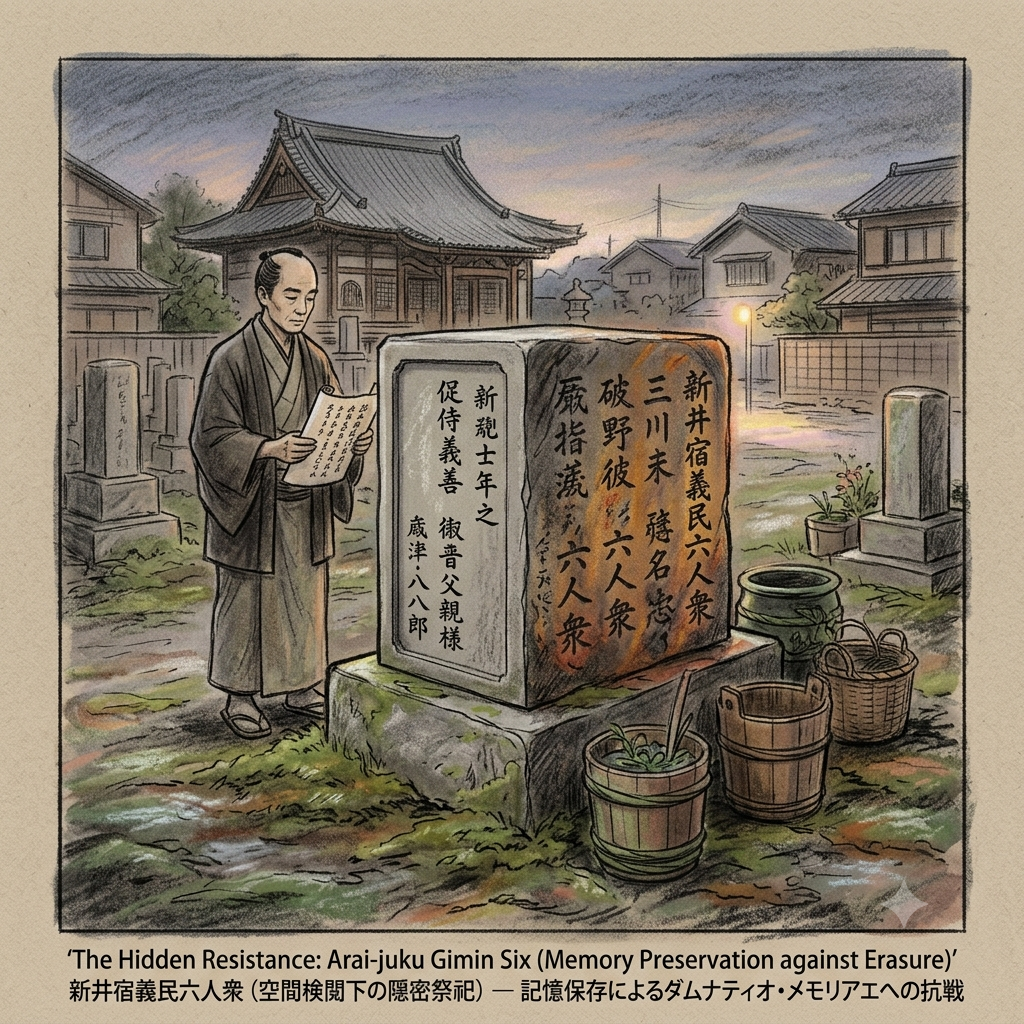
Where space sovereignty protects the land, "Memory Preservation" protects the soul against Damnatio Memoriae—the total erasure of one's existence from history. In 1677, six brave individuals from Arai-juku, led by the village headman, executed a forbidden Osso (direct appeal) to the Shogun against the Kihara clan’s predatory taxation, which had doubled the village’s burden despite catastrophic flooding. For this defiance, the "Arai-juku Gimin Six" were captured and secretly executed. The ruling clan forbade funerals or headstones, attempting to delete their resonance from the earth.
The Gravestone That Hid Treason
Resistance, however, utilized "Geometric Information Camouflage." At Zenkei-ji Temple, a double-sided tombstone was erected by Mamiya Fuji-hachiro, the son of one of the martyrs. On the front, it displays standard Confucian piety and the names of his parents to satisfy secular censors. But on its hidden back and sides, the true names and revolutionary energy of the martyrs are carved into the granite. It functions as a multi-layered data storage device, vibrating with a frequency of defiance. This secret preservation was facilitated by Zenkei-ji monks who used "Seaweed Vats" (海苔甕) and horse feed buckets to secretly transport the martyrs' remains under the cover of night—a tactical bridge between the resistance of the people and the industry of the sea.
The Zenkei-ji cemetery today offers a heavy tactile experience; the granite feels perpetually moist, smelling of damp earth and rusted iron. Amidst the low-frequency hum of the Sanno residential area, there is a palpable tension—the lingering resonance of those who refused to be forgotten.
Node III: The Water Alchemy of the Suwa Immigrants
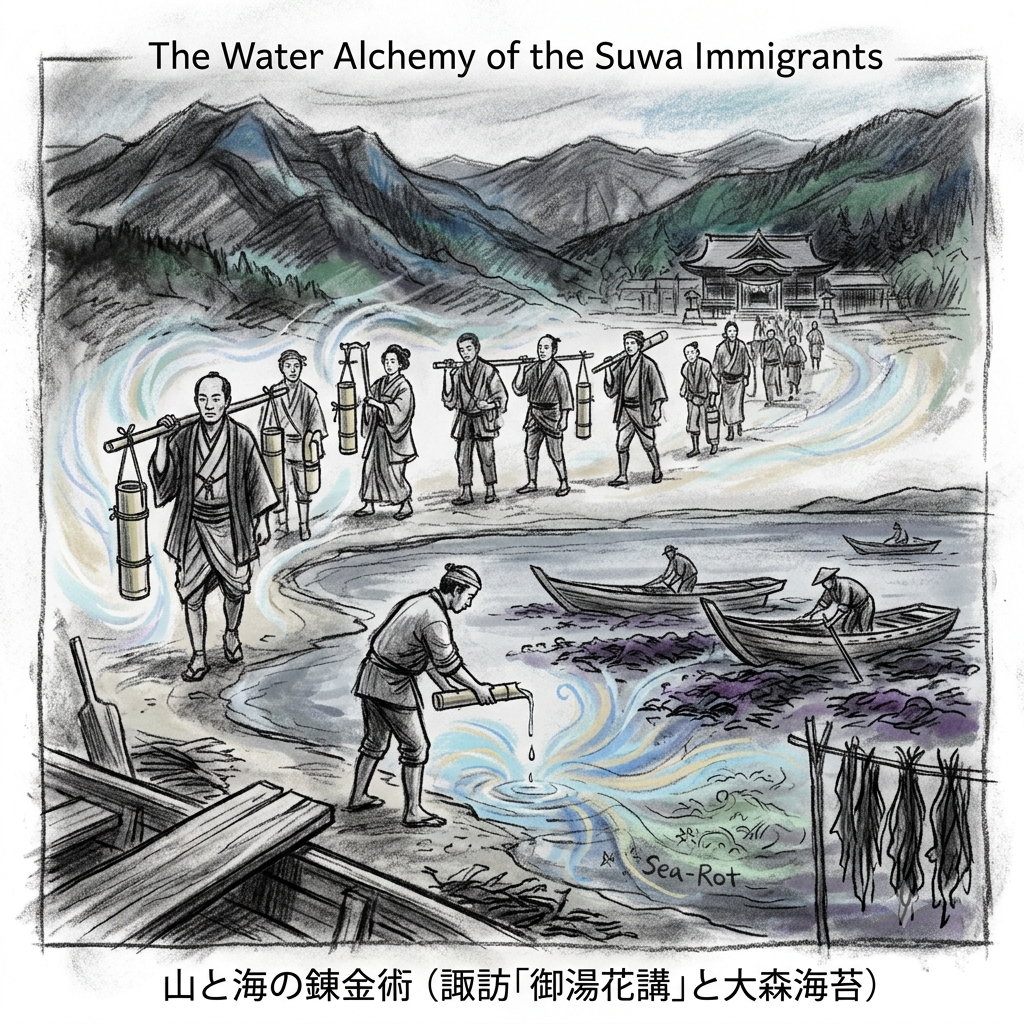
The resilience of the region was further bolstered by "Trans-regional Energy Mapping." Beginning in 1804, laborers from the Shinshu Suwa region migrated to the Omori coast to work the seaweed beds, forming the O-Yubana-kou guild in 1861. To stabilize the high-risk "gambling" nature of seaweed farming, these immigrants performed a feat of "Spiritual Geo-engineering."
How Mountain Water Hacks Ocean Seaweed
They brought "Otensui" (Heavenly Water) and "Shin-sha" (Sacred Sand) from the Suwa Grand Shrine. Crucially, the ritual dictated that the water must never touch the ground during transport from the mountains to the coast, lest it trigger a local storm. By ritually introducing this "Alpine Lake Frequency" (Mountain Yang) into the Tokyo Bay saltwater, they neutralized the "Sea-Rot" and maritime pathogens (Maritime Yin) that plagued the beds. This alchemical synthesis provided the spiritual "grip" necessary to dominate the industry for a century. In the Omori Nori Museum, the air is still thick with the scent of ancient cedar boat planks and the phantom saltiness of dried seaweed, a sensory bridge to a time when mountain and sea were a single, fluid energy circuit.
Node IV: The Great Severance (The 1910 Flood and the Railway Seal)
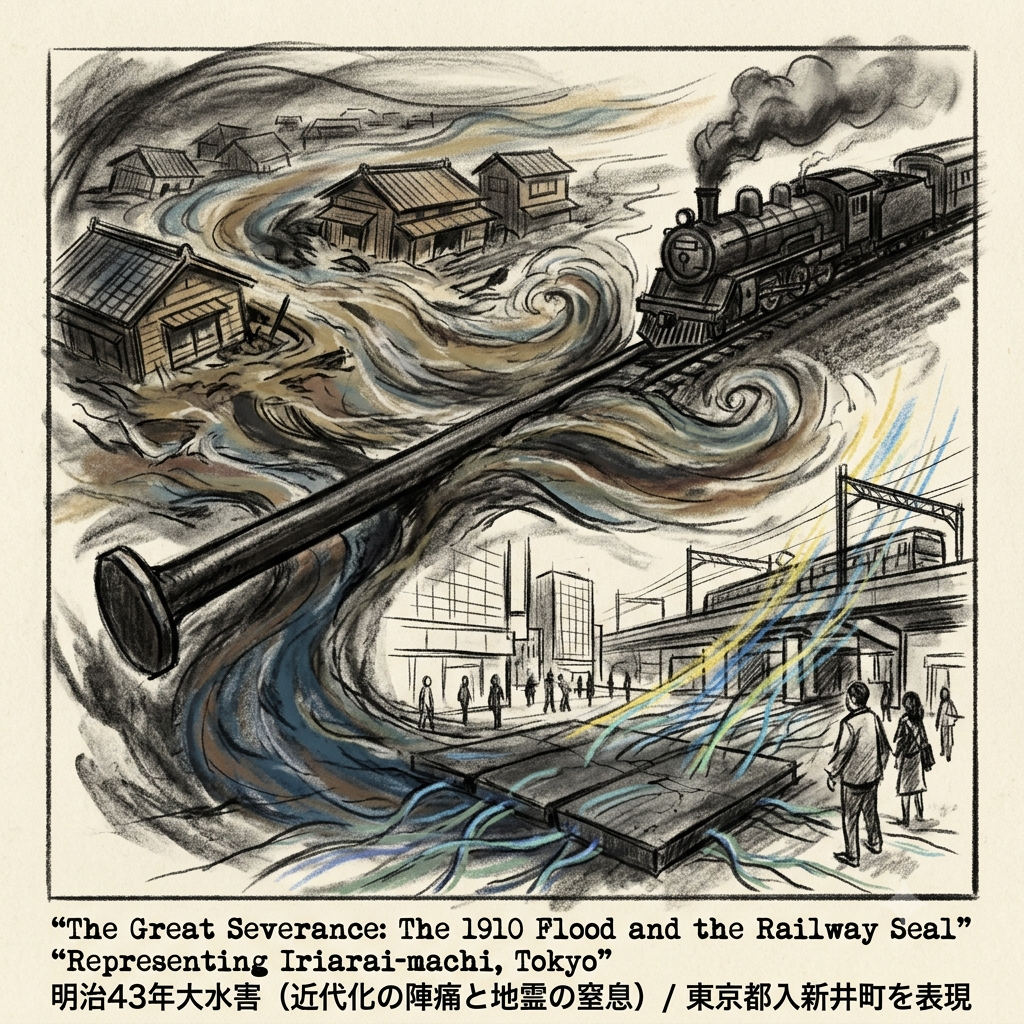
The modern era brought a "Spirit-Geological Backlash," where the natural ley lines of the Musashino Terrace were forcibly suppressed by industrial "nails." In August 1910, a catastrophic flood devastated Iriarai, impacting 800 households. This was not merely a natural disaster, but the land’s desperate attempt to clear its "blocked capillaries."
How a Modern Railway Drowned a Village
The construction of the Keihin Railway and Route 178 had created "Steel Seals" across the landscape. The railway acted as a high roadbed embankment that physically blocked the natural organic drainage paths. The 1910 flood was an "energy reflux" of the Genius Loci reacting to this obstruction. In the aftermath, the village was subjected to Western-style gridification, encasing waterways in concrete and silencing the land's natural voice. At the West Exit of Omori Station, the collision of energies is constant: the high-frequency vibration of modern trains overhead grinds against the low-frequency memory of the rushing mudwater that once tried to reclaim this ground.
Node V: The Split Portal (The Shell Mound Monument War)
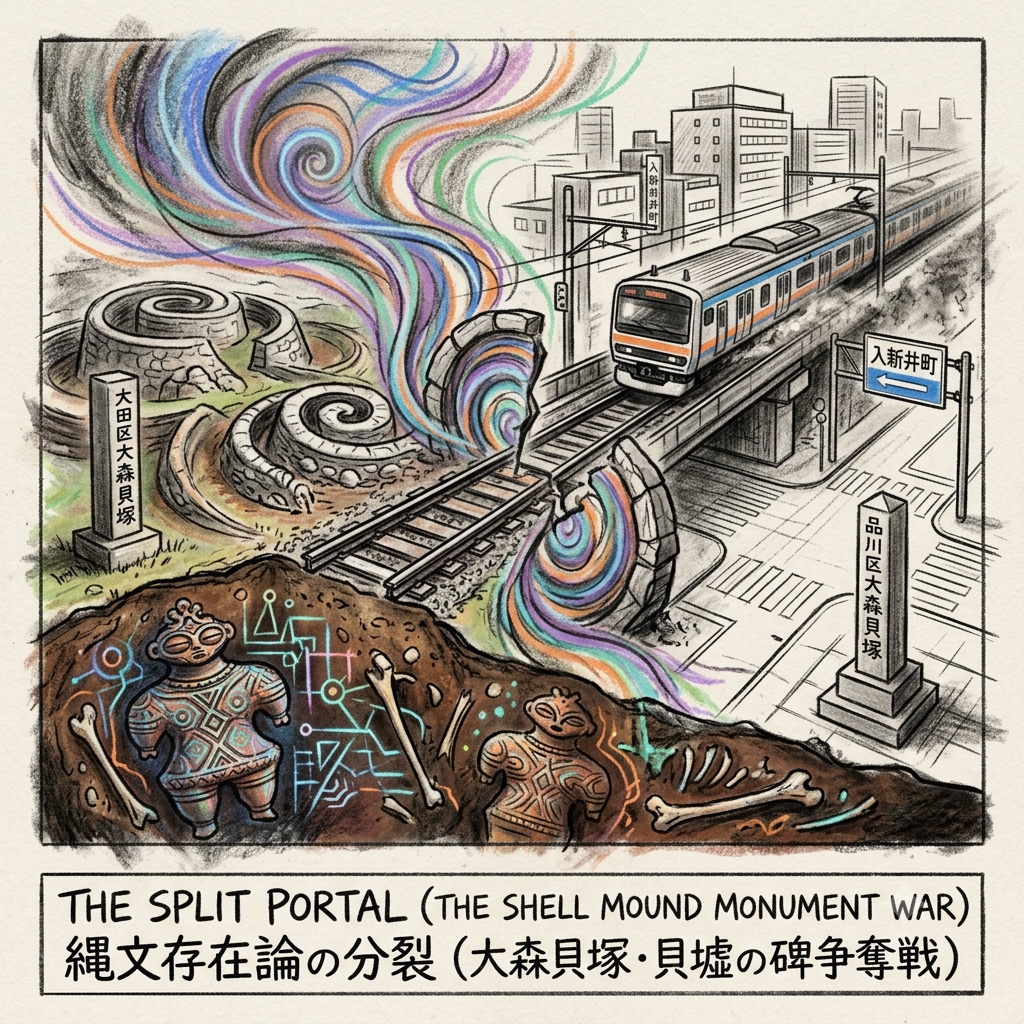
The final layer of the matrix involves "Ontological Fracturing," where bureaucratic desire divides a singular spiritual truth. In 1877, Edward Morse discovered the Omori Shell Mounds from a train window. By 1930, this sparked a "Monument War" between Shinagawa and Ota wards, each claiming the "true" coordinates, effectively splitting a single archaeological site into two administrative assets.
This conflict highlights the clash between the Jomon "Okuri" (Sending Spirits) world-view—where the mound was a multidimensional portal for reincarnation—and the modern "Administrative Grid." Hidden within this history is a "History Blank": Morse reportedly discovered several clay Dogū figures with mysterious geometric lines that never appeared in official reports, suggesting a layer of suppressed archaeological data.
The Severed Portal of Omori
The site remains a Resonance Node at the Omori Kaikyo monument in Sanno 1-chome. Here, the veil is at its thinnest. Pressing a hand against the slanted, rough stone of the monument, the air takes on a metallic taste from the JR train tracks' friction dust interacting with the ancient soil. The rhythmic vibration of the passing tracks mimics a Jomon chant, a reminder that the portal for reincarnation remains open, even if bisected by a commuter line.
Conclusion: The Philosophical Anchor
Iriarai-machi stands today as a "Spirit Isolation Chamber," a rare geographic coordinate that has preserved human agency and spiritual complexity against the flattening "Secular Grid." The historical memories embedded here—the sacrifice of the Gimin martyrs, the alchemical rituals of the Suwa merchants, and the suppressed Jomon artifacts—are humanity's most valuable cosmic assets.
Underneath the concrete and the relentless hum of the JR lines, the vibrational frequency of the ancestors still pulses. To walk these streets is to engage with a living, stratigraphic timeline. We invite you to anchor your soul in this history by subscribing to our 'Historical Travel Stories' newsletter, where we continue to map the unseen ley lines and "History Blanks" of our world.
Accessing the Physical Node (Practical Integration)
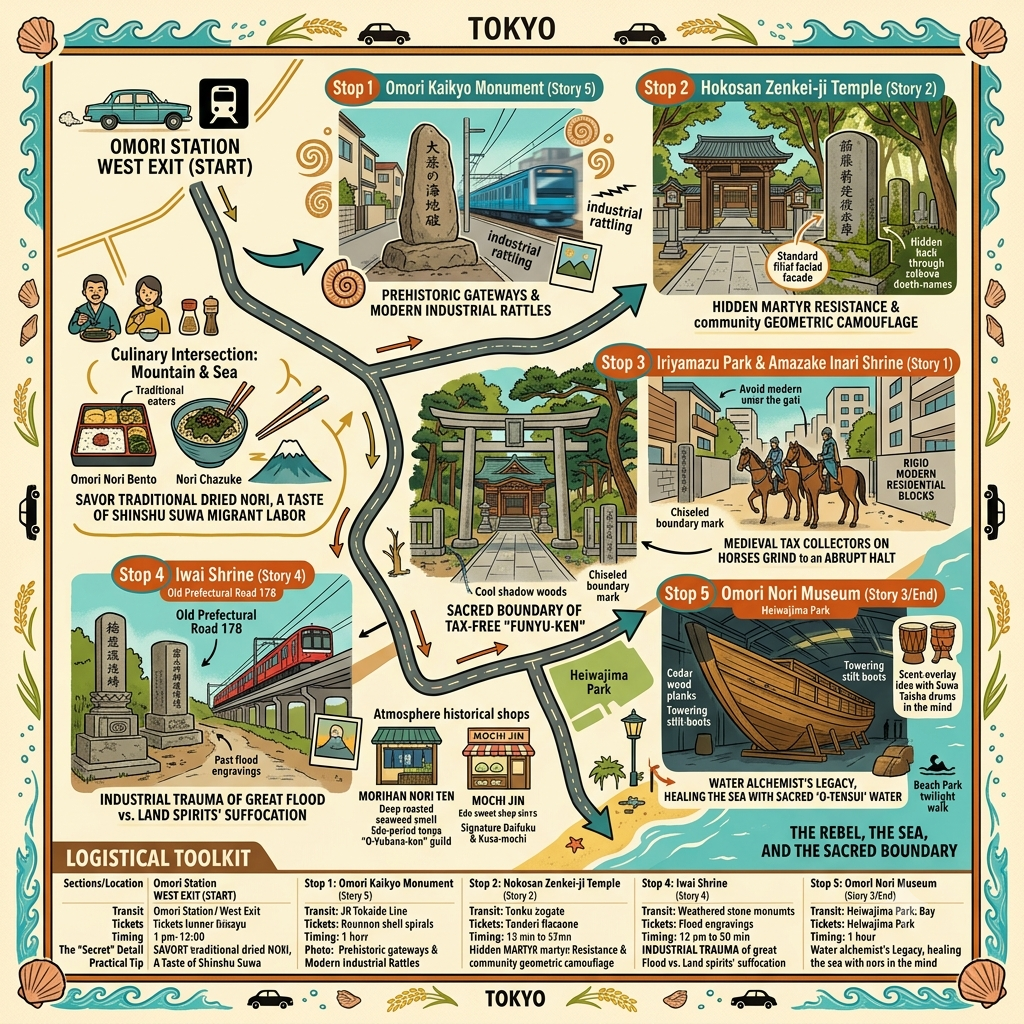
- Physical Arrival: Navigate to the JR Omori Station (West Exit) to begin your descent from the Musashino Terrace.
- Temporal Anchoring: Spend an evening staying near the Sanno Terrace; as the city noise fades, the night-time "resonance" of the ancient plateau becomes most perceptible.
- Temporal Walks: Follow this path to experience the matrix in sequence:
- The Portal: Start at the Omori Kaikyo monument (the node of beginning and reincarnation).
- The Resistance: Walk to Zenkei-ji to pay respects at the double-sided tombstone and view the seaweed vats used to hide the martyrs.
- The Immunity: Conclude at the Iwai Shrine and Ama-sake Inari to witness the remnants of the sacred boundary and the 0.5-degree temperature shift.
Reference and Further reading
- 大森北- 維基百科,自由的百科全書,
- 入新井町とは? わかりやすく解説 - Weblio辞書,
- 新大田区百景 「義民霊廟」,
- 大森貝塚 - ジャパンナレッジ,
- 地名の由来と史跡と文化財 - 市原ふるれんネット,
- 【大田区】平和島駅周辺|nama - note,
- 5/10(日) 大森貝塚縄文マルシェ初開催 来年2027年の大森貝塚発掘150周年に向けて 民間主体で、品川・大田区境を越え、ネットワークを広げて パフォーマンス、ワークショップ、講座 - note,
- 大森鷲神社 / 東京都大田区 - 御朱印・神社メモ,
- 磐井神社 - Wikipedia,
- 鷲神社|大田区大森北の神社 - 猫の足あと,
- 大田区文化財散歩(上),
- 善慶寺 (大田区) - Wikipedia,
- 武蔵山王 年貢減免を訴えるも斬首刑に処された新井宿六人衆を祀る『善慶寺』散歩 (大森・大井町),
- 大森海苔文化遗产Part 2 #198 - note,
- 諏訪海苔商団 御湯花講【庶民からみた諏訪大社信仰】,
- 大森海苔之道 (Omori Seaweed Road) Part3 諏訪の人々が築いた海苔養殖の基盤 (大森東・糀谷) #18 - note,
- 不入斗 - Wikipedia,
- 諏訪の海苔行商の歴史まとめ - 下諏訪町を考えるプロジェクト,
- F 市原市内の地名の由来,
- 不入斗とは何なのか 10 - protoplastico surfboards and designs,
- 鎌倉日記(德川光圀歴覽記) 德川光圀 附やぶちゃん注 - 鬼火,
- 不入斗村(いりやまずむら)とは? 意味や使い方 - コトバンク,
- 入新井歴史散歩マップ 裏面(PDF:3997KB) - 大田区,
- 入新井町 - Wikipedia,
- 歴史的事実と伝承(延宝5年1月11日、「義民六人衆」、斬首される) - 馬込文学マラソン,
- 法光山善慶寺|東京都大田区|1292年建立の日蓮宗寺院|新井宿義民六人衆,
- 新井宿-001 - HIROKIphoto.net,
- https://www.hirokiphoto.net/shiryousyu-/%E6%96%B0%E4%BA%95%E5%AE%BF-001.pdf
- 大田区の 維持及び向上すべき歴史的風致 第2章,
- 新井宿義民六人衆第350年報恩感謝パレード(令和8年4月12日),
- 【大田区】善慶寺で行われた#新井宿義民六人衆報恩感謝祭の法要に参加して参りました。,
- 長野県諏訪の周辺から東京の大森への出稼ぎに来ていた人たちについて知りたい。特に、海苔問屋に来ていたら... | レファレンス協同データベース,
- 創業者は元々は長野の生まれ?海苔屋さんの意外なルーツ |創業百年史 海苔一筋 伊藤海苔店 前編,
- 会社概要 - 海苔問屋 藤正,
- 【諏訪大社上社本宮を歩く】諏訪信仰の歴史を感じる散策【諏訪】,
- 展示紹介 - Oomori Nori Museum - 大森 海苔のふるさと館,
- 『大森貝塚とモース博士vol.1』 関俊彦 - 国際縄文学協会,
- 史跡「大森貝塚」二つの石碑の謎に迫ってみる(東京都),
- 東京都大田区・品川区 同じ遺跡が2つある(!?)編 - EIKOH LiNKSTUDY
 Lawrence
 Lawrence
 Lawrence
Historical Travel Stories publishes long-form historical travel writing rooted in primary research. All historical claims in this article are sourced from institutional records, academic publications, and municipal historical archives. Last updated: July 2026.