(ENG) Tokyo’s Oimachi Deep History Walk: 5 Stories of Deep Time and Dark Karma Along the Cliffline
A deep historical travel guide to Tokyo's Oimachi. Moving beyond the modern transit hub, this walk follows the ancient Musashino cliffline to unearth five historical nodes.

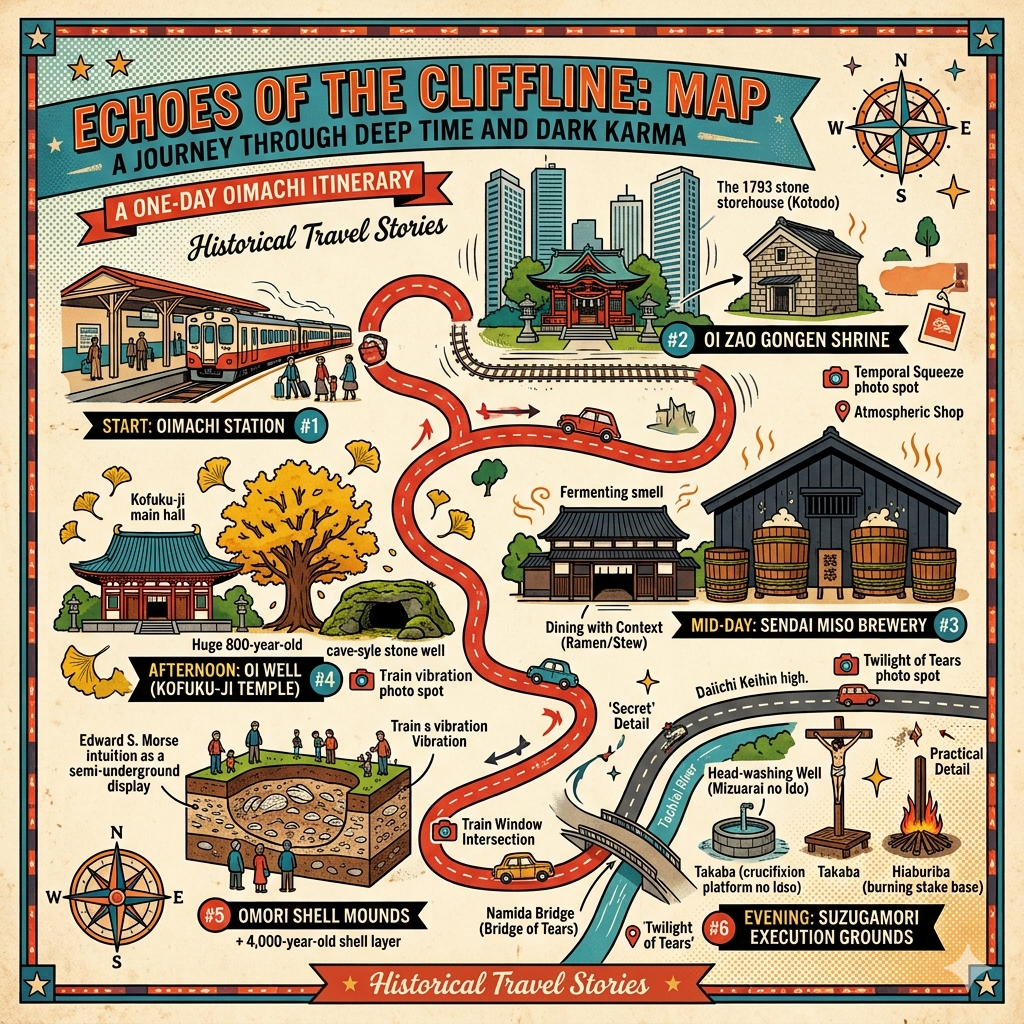
This is a deep historical travel story and walking guide to Oimachi, a unique transit and topographical threshold in Tokyo. Navigating the ancient Musashino cliffline, it explores five critical spatial nodes—including Kofuku-ji, Zao Gongen, and the grim Suzugamori execution grounds. Readers will uncover how prehistoric human memory, sacred exiled deities, and feudal karmic history converge beneath the concrete of this modern urban metropolis.
 Lawrence
Beneath the neon hum and relentless train tracks of Tokyo lies an invisible topography of soul-weight, a spatial threshold where time fractures. Oimachi is not merely a modern transit hub; it is a profound Pillar Node in human consciousness, acting as a multidimensional shock absorber for the metropolis. Straddling the ancient cliffline where the Pleistocene Musashino terrace sharply plummets into Tokyo Bay's lowlands, this coordinate-space holds the raw, vibrating resonance of human memory. Here, the echoes of ancient hunter-gatherers, the terror of feudal executions, and the sacred frequencies of hidden deities collide within a single urban fabric. Walking these streets steps into a geoelectrical matrix that has quietly stabilized the karmic and structural balance of eastern Japan for millennia. It remains a spiritual anchor in a rapidly changing universe.
Listen to the historical stories told in detail (For subscribers only)
Layer 1: The Grounded Human History of the Cliffline
To understand the existential weight of Oimachi, one must peel back the layers of industrialized concrete and map the raw, emotional human dramas anchored to its specific physical coordinates. For centuries, this geography has marked a literal and metaphorical edge—a borderland where empires clashed, souls departed, and everyday resilience took root against the backdrop of shifting coastlines.
       [ 武蔵野台地 / Musashino Terrace ]
                  (High Ground)
  ----------------------------------------------  <- THE CLIFFLINE (崖線)
  [Oi no I Well]   [Zao Gongen]   [Sendai Miso]      (Energy Shear Zone)
  ----------------------------------------------
                  (Low Ground)
       [ 東京湾沖積平原 / Tokyo Bay Lowlands ]
       [Omori Shell Mounds]    [Suzugamori]
The Sacred Genesis at Kofuku-ji
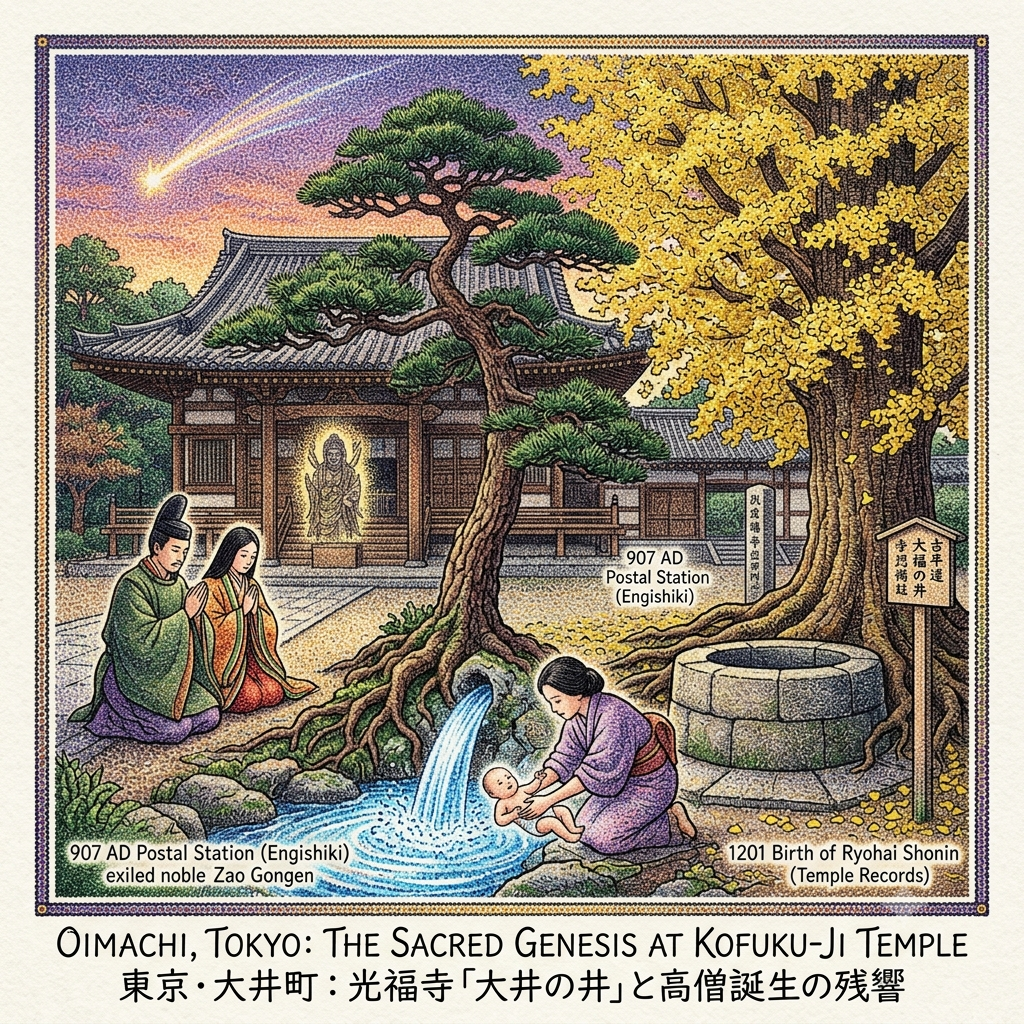
At the coordinates of 6-9-17 Oi, hidden within the quiet enclave of Kofuku-ji Temple, lies the literal birthplace of the area's identity. In the twilight of the Heian period, Nakamizuto Mitsumasa, an exiled noble descended from Emperor Toba, found himself displaced to this eastern frontier. Desperate for an heir, Mitsumasa and his wife engaged in rigorous, fasting prayers to the local deity, Zao Gongen. Following a vision of a falling star, their son Matsumaru—who would grow up to become the legendary Buddhist monk Ryohai Shonin—was born in 1201.
At the exact moment of his birth, a crystal-clear spring miraculously erupted from the roots of an ancient pine tree. This water served as the infant's ubuyu (first ceremonial bath), earning the spring the name "Oi" (The Great Well), which would eventually lend its name to the entire region.
The Historiographical Gap: While local temple records adamantly tie the name "Oi" to Ryohai's 1201 birth myth, official imperial records like the Engishiki list "Oi" as a designated postal station as early as 907 AD. This chronological friction reveals a profound historical truth: the真宗 (Shinshu) Buddhist sect likely retrofitted an even older, prehistoric site of indigenous water worship to legitimize their sacred lineage, weaving human biography into the pre-existing geomythology of the well.
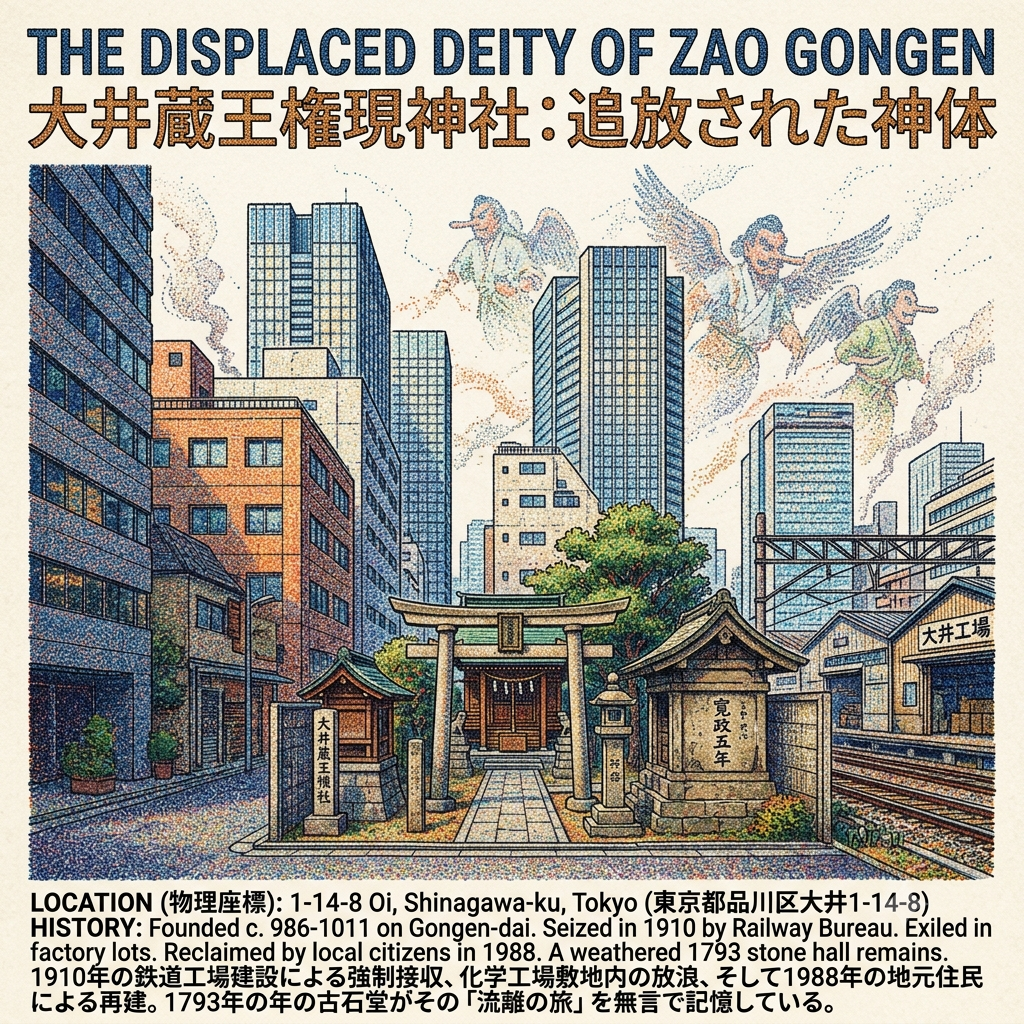
The Displaced Deity of Zao Gongen
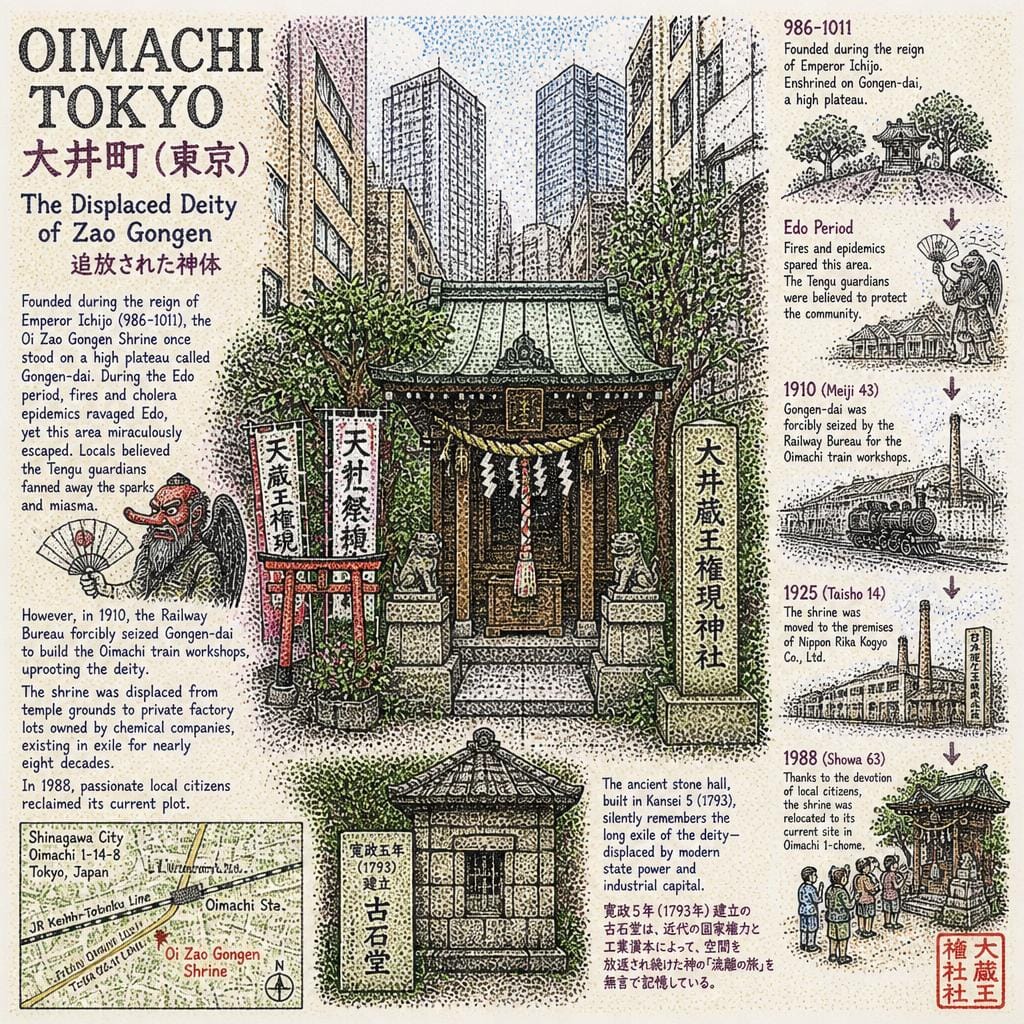
A short walk away at 1-14-8 Oi, the Oi Zao Gongen Shrine stands as a testament to everyday resilience against state-enforced spatial erasure. Founded during the reign of Emperor Ichijo (986–1011), the shrine sat atop a high plateau known as Gongen-dai. During the Edo period, when catastrophic fires and cholera epidemics regularly ravaged the heart of Tokyo, the communities surrounding Gongen-dai miraculously escaped unscathed. Local lore attributed this immunity to the Tengu—spirit guardians who supposedly fanned away the sparks and miasma.
However, the 20th century brought a different kind of destruction: industrial expansion. In 1910, the Railway Bureau forcibly seized Gongen-dai to construct the Oimachi train workshops, uprooting the deity. The shrine was bounced from temple grounds to private factory lots owned by chemical companies, existing in a state of geopolitical exile for nearly eight decades before passionate local citizens successfully reclaimed its current plot in 1988.
The Grim Threshold of Suzugamori
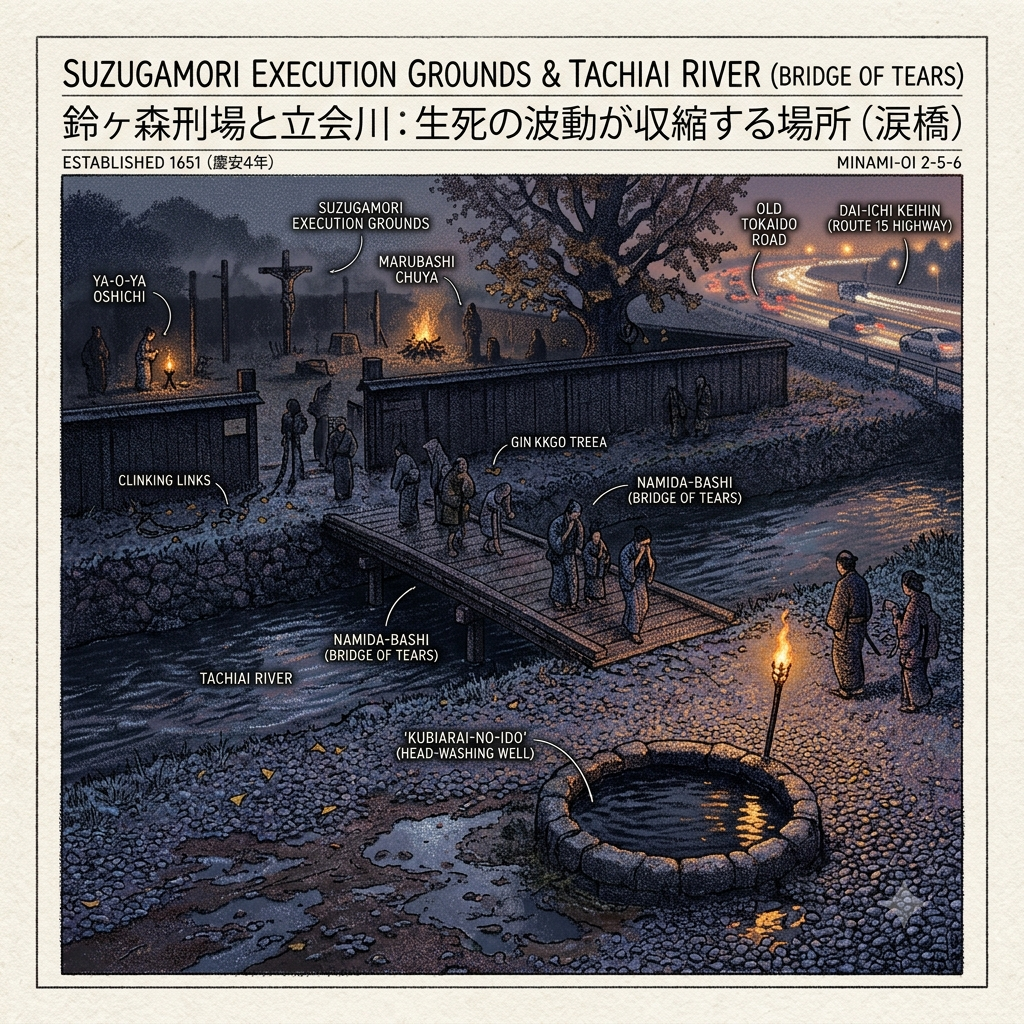
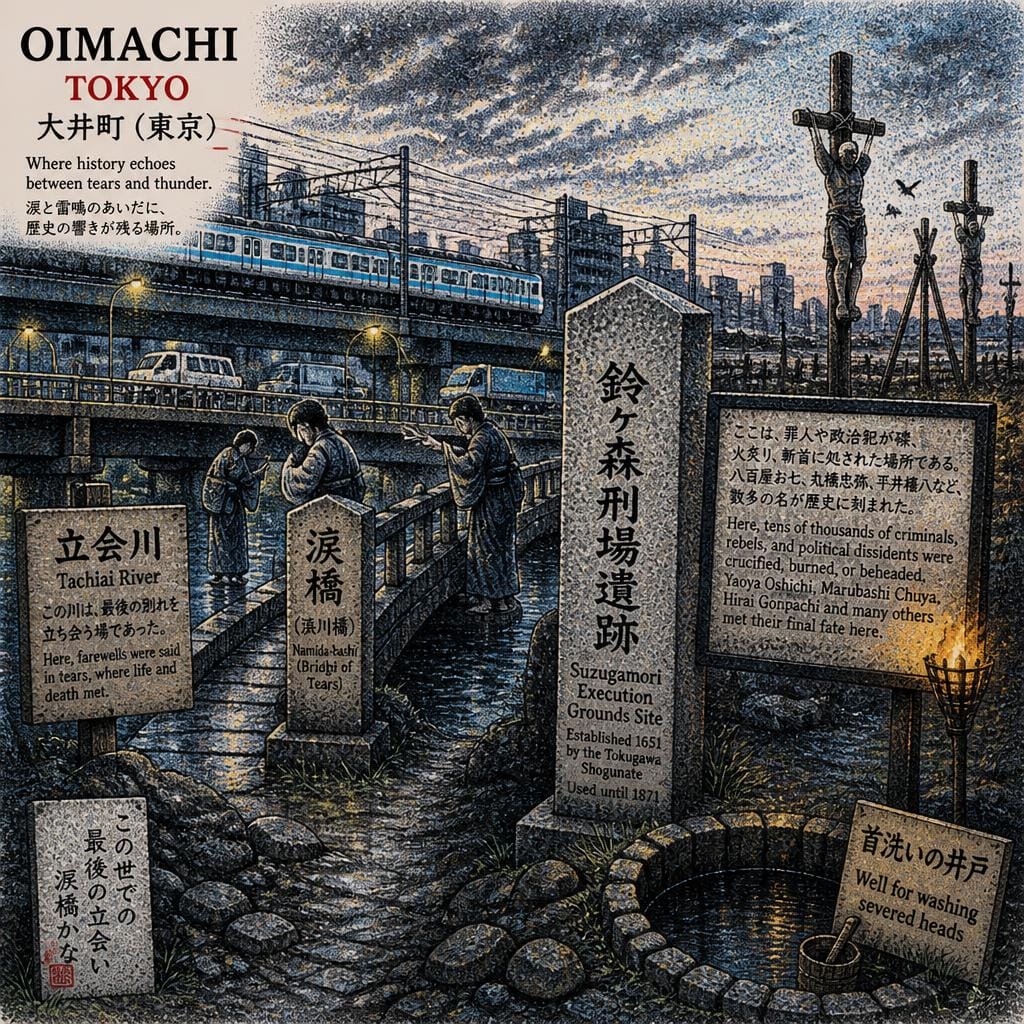
Further south, where the modern highway roars at 2-5-6 Minami-Oi, lies the darkest anchor of the region: the Suzugamori Execution Grounds. Established by the Tokugawa Shogunate in 1651 along the Old Tokaido road, this coastal spit of land became the final destination for an estimated tens of thousands of criminals, rebels, and political dissidents over two centuries. Here, historical figures like the fiery八百屋お七 (Yaoya Oshichi) and the rebel leader Marubashi Chuya were subjected to crucifixion, burning, and decapitation.
Before reaching the executioners, prisoners crossed the Namida-bashi (Bridge of Tears) over the Tachiai River. It was here that families were permitted a final, heartbreaking glimpse of their condemned kin, their weeping giving the bridge its tragic moniker.
The Low-Entropy Sanctuary of Sendai Miso
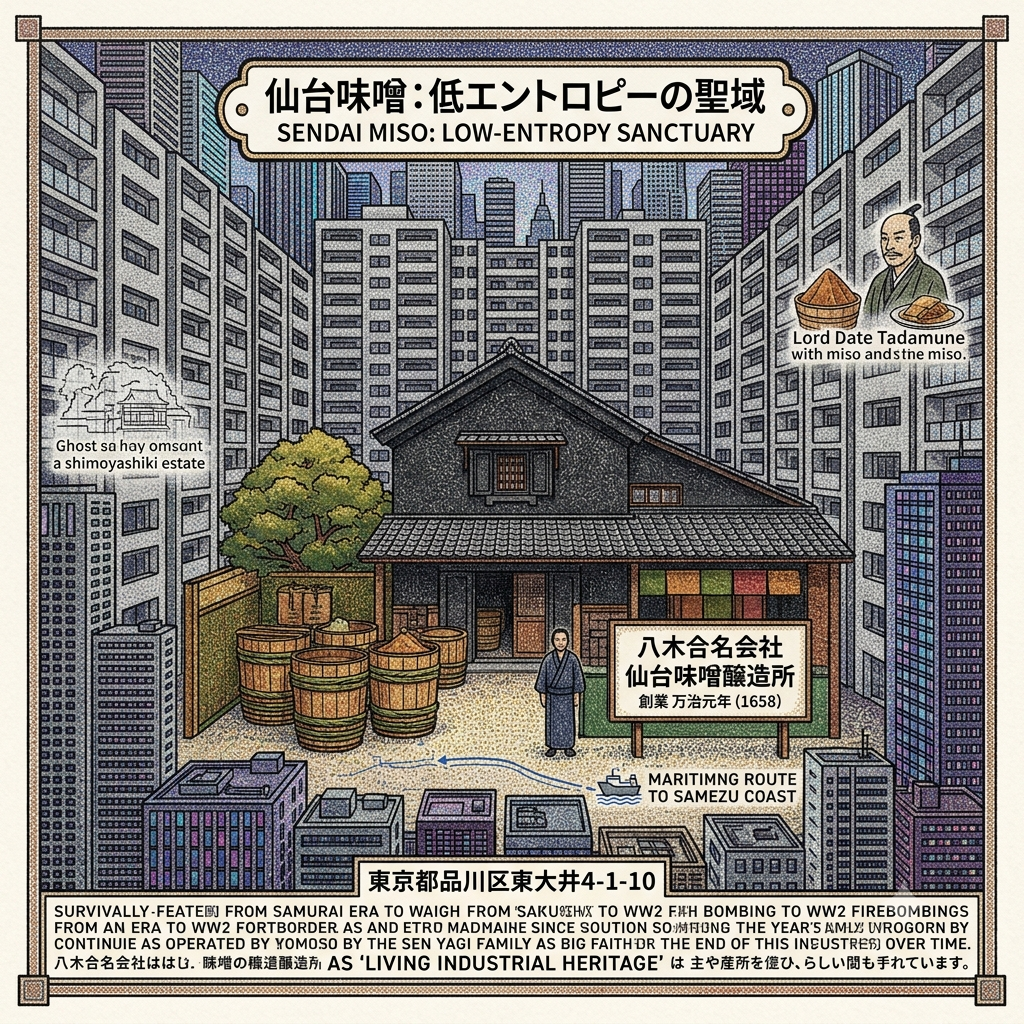
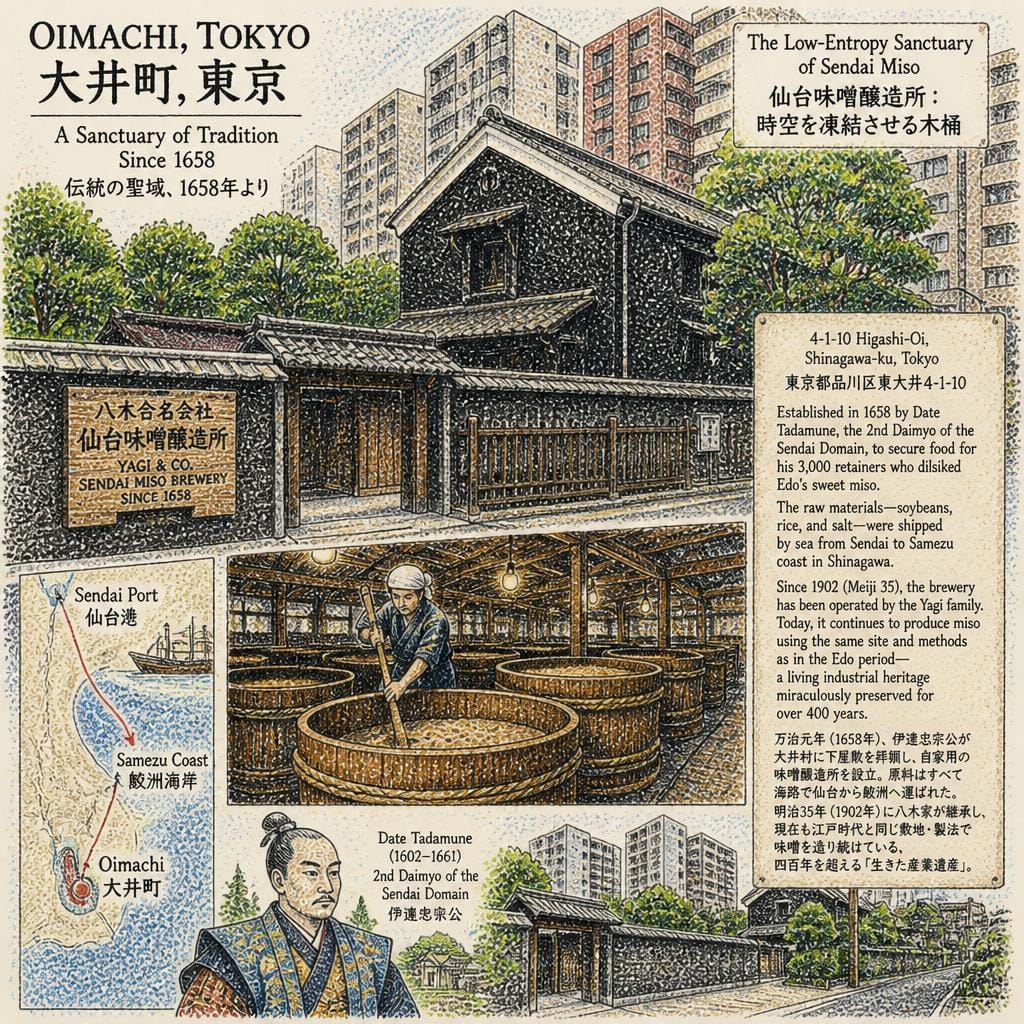
In stark contrast to the violence of Suzugamori, a pocket of deep, nurturing stillness has persisted at 4-1-10 Higashi-Oi since 1658. Here, Date Tadamune, the second Daimyo of the Sendai Domain, established a vast suburban estate (shimoyashiki). Dismayed by the overly sweet taste of local Edo miso, Tadamune ordered the construction of a private brewery within the estate, shipping raw soybeans and salt via maritime routes directly to the nearby Samezu coast.
Remarkably, this brewery survived the fall of the samurai, the firebombings of World War II, and Tokyo’s hyper-modernization. Today, operated by the Yagi family, it remains an active, breathing artifact of Edo-period industrial design nestled within a wall of contemporary apartment complexes.
The Deep-Time Revelation of Omori Shell Mounds
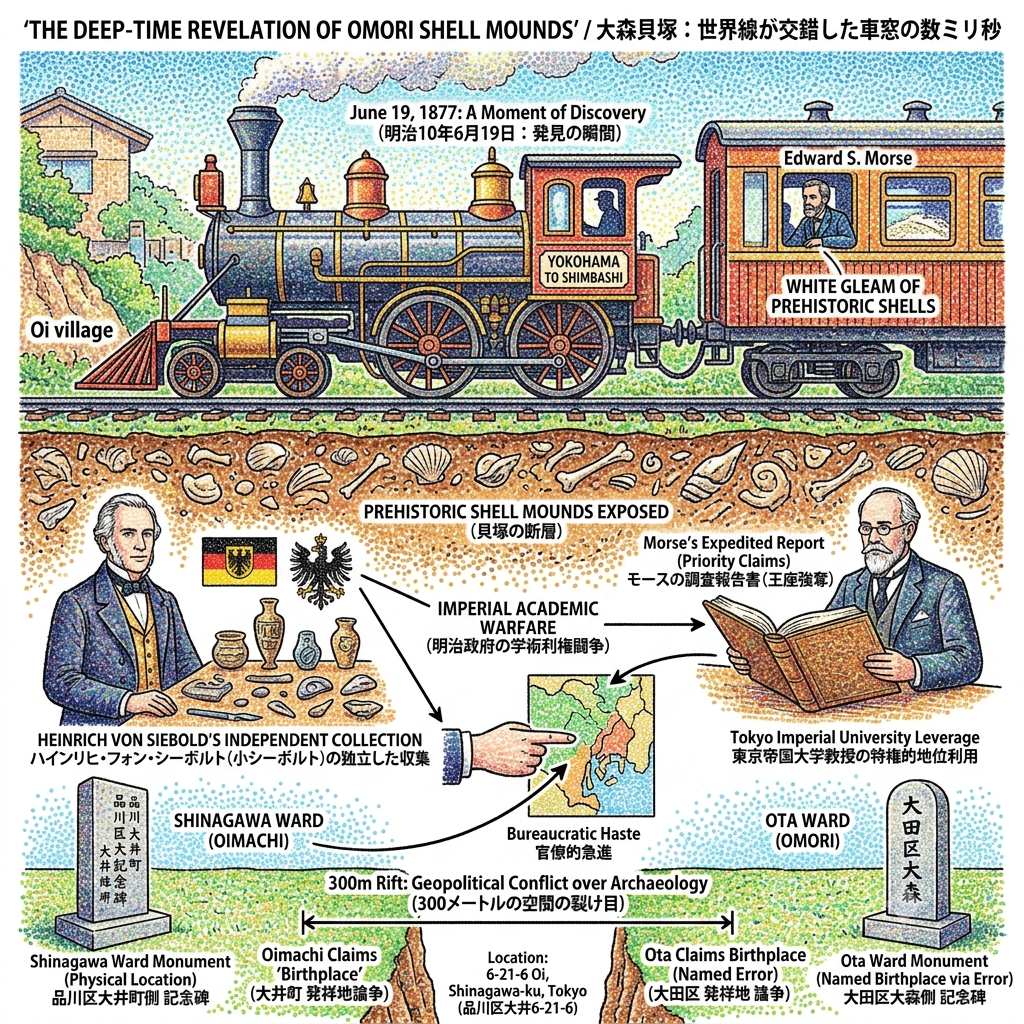
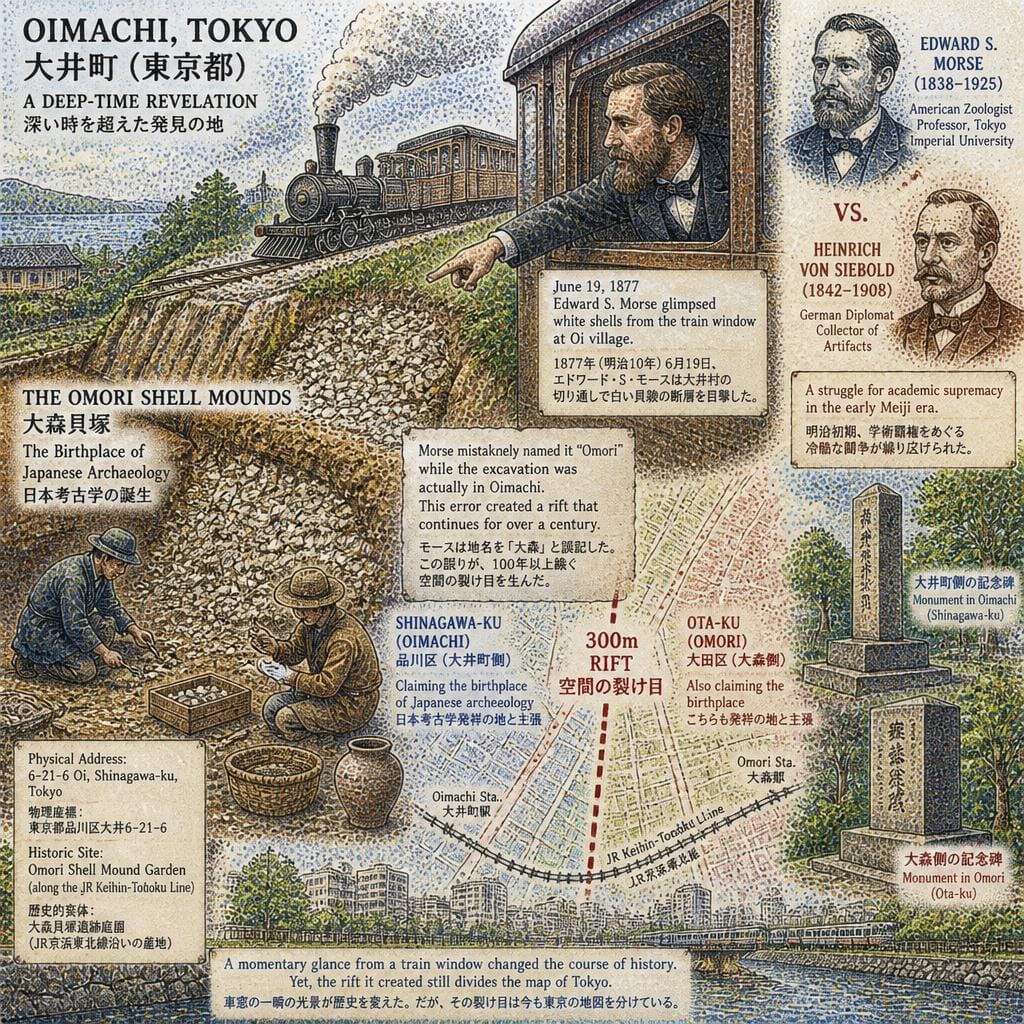
The deepest historical layer of Oimachi was unearthed at 6-21-6 Oi by a stroke of pure, historic synchronicity. On June 19, 1877, American zoologist Edward S. Morse was riding a newly inaugurated steam train from Yokohama to Shimbashi. As the train cut through the Oi village section, Morse glanced out the window and spotted a white gleam of prehistoric shells exposed by the railway cutting.
His intuition was correct: he had discovered the Omori Shell Mounds, triggering the birth of Japanese archaeology. Yet, this scientific triumph was instantly mired in imperial academic warfare. Heinrich von Siebold, a brilliant German diplomat, had discovered the site independently and amassed an extensive collection of artifacts. Morse, utilizing his institutional leverage at Tokyo Imperial University, rushed his report into print to claim absolute priority, mistakenly naming the site "Omori" (which lay in a neighboring district) despite the excavation physically occurring in Oimachi. This bureaucratic haste left a literal 300-meter geopolitical rift that persists today, with two separate wards claiming the "birthplace of Japanese archaeology".
Layer 2: Decoding the Matrix via High-Dimensional Physics
When viewed through the lens of Daoist cosmology and quantum topography, these five sites cease to be disconnected historical footnotes. Instead, they form a highly integrated geometric resonance field designed to stabilize the volatile energy fields (Qi / 炁) of the Kanto Plain.
==================================================================================
Node Name              Dimensional Feature     Daoist Elements     Metaphysical Function
==================================================================================
Oi no I Well           Non-Euclidean Orifice   Yin Water / Void    Telluric Anchor
Zao Gongen Shrine      Spatial Non-Locality    Zhen / Xun (Wind)   Electromagnetic Shield
Suzugamori & Tachiai   Karmic Threshold        Qian / Kan (Water)  Wavefunction Collapse
Sendai Miso Brewery    Temporal Stasis Pocket  Mu / Tu (Earth)     Entropy Retardation
Omori Shell Mounds     Akashic Archive         Gen (Mountain/Stone) Deep-Time Broadcast
==================================================================================
Telluric Orifices and Geometric Locks
The "Oi no I" well at Kofuku-ji is a classic "telluric orifice"—a non-Euclidean opening positioned precisely where the subterranean water tables of the Musashino terrace shear against the saline pressure of Tokyo Bay. The historical Shinpen Musashi Fudokiko notes that looking into the well caused visitors an immediate sense of "vertigo". In high-dimensional terms, this vertigo is the physiological result of a local geomagnetic variance where spatial dimensions slightly fold.
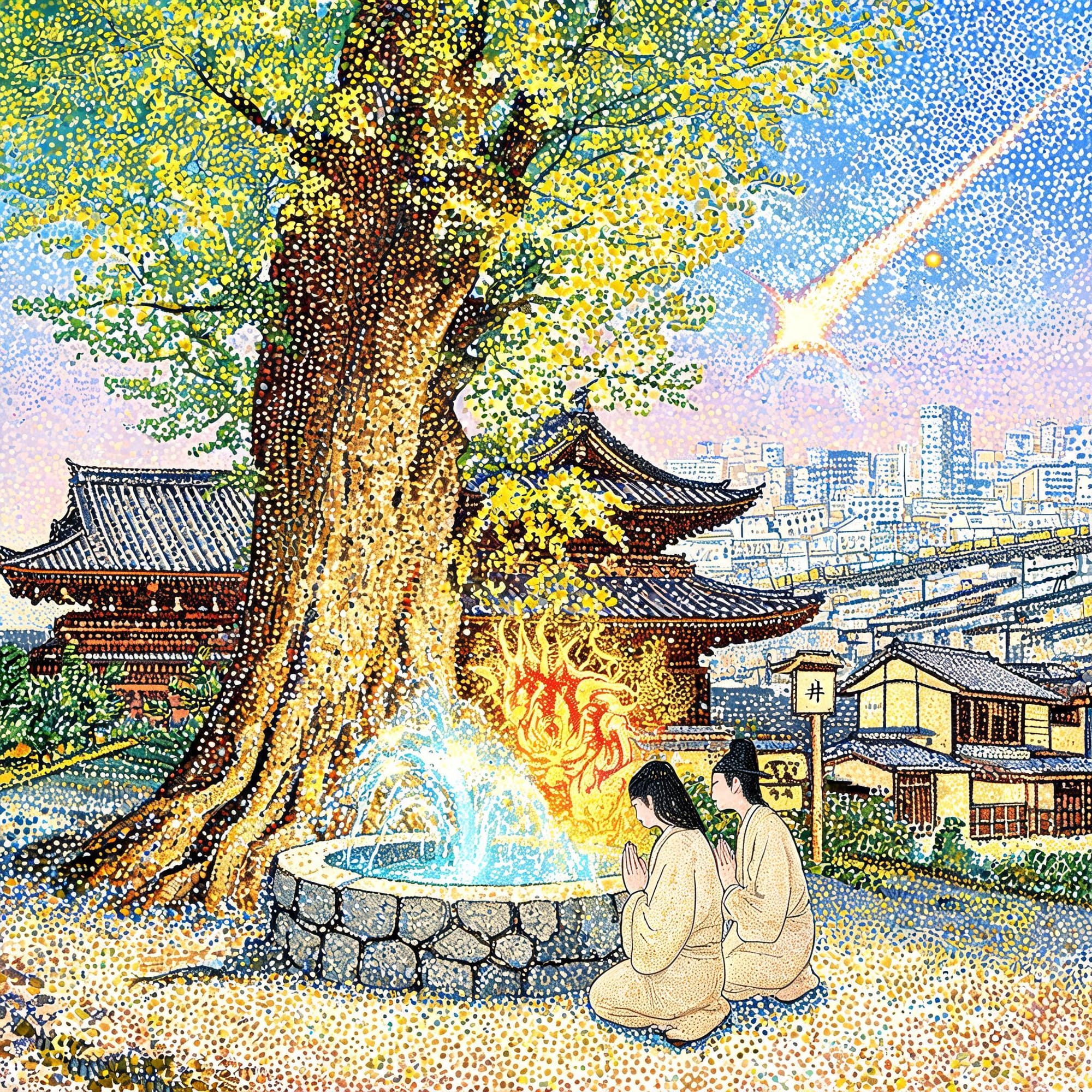
The 800-year-old ginkgo tree standing beside it acts as a living, biological antenna. With a massive trunk circumference of 6.4 meters, its deep root system anchors the Earth-energy (Tu / 土) of the cliffline, while its canopy historically emitted a subtle electromagnetic frequency that coastal fishermen used as a literal navigational beacon.
The Oi Zao Gongen Shrine operates on a principle of spatial non-locality. In Daoist physics, Zao Gongen represents the Zhen (Thunder) and Xun (Wind) hexagrams—forces that manipulate atmosphere and energy movement. When the Railway Bureau physically uprooted the shrine in 1910, they split its three-dimensional form from its higher-dimensional signature.
The entity maintained its connection to the site through its Kansei-era stone hall (built in 1793), which accompanied every relocation. This stone hall functioned as a quantum lock:
$$\Psi_{\text{shrine}} = \frac{1}{\sqrt{N}} \sum_{i=1}^N \psi(\mathbf{r}_i)$$
The stone's crystalline structure held the original frequency of Gongen-dai, ensuring that no matter where the physical shrine drifted across the industrial landscape, its protective "Tengu damping field" remained active, shielding the surrounding community from systemic entropy.
Wavefunction Collapsers and Temporal Stasis
The Suzugamori Execution Grounds and the Tachiai River must be understood as a macro-scale wavefunction collapser. In the quantum mechanics of the soul, a living being exists as a cloud of infinite probabilities. Crossing the Namida-bashi bridge forced a violent decoherence. As thousands of conscious minds faced abrupt, terrifying termination at this specific geographic boundary, an immense amount of trauma-energy was injected into the local environment.
To prevent this chaotic psychic static from flowing northward along the Tokaido road into Edo Castle, ancient esoteric masters deployed a geometric countermeasure: the massive Lotus Sutra題目碑 (daimoku monuments) erected in 1698 and 1741. These heavy granite steles, carved with sacred Sanskrit and kanji graphemes, act as harmonic overtones. They capture the jagged, high-amplitude frequencies of fear and anger, grounding them safely into the Earth's tectonic crust:
$$\hat{H} \Psi = E \Psi$$
where the boundary operator $\hat{H}$ represents the cutting edge of the Musashino terrace intersecting with Tokyo Bay's water mass, absorbing the karmic shockwaves of the metropolis.
[Trauma Waves from Execution] ---> (Lotus Sutra Monuments) ---> [Grounded Low-Frequency Energy]
At the Sendai Miso Brewery, we encounter a temporal stasis pocket. The process of fermenting miso within massive thirty-koku (approx. 5,400 liters) cedar barrels across three continuous years requires an environment free from thermodynamic disruption.
By continuously repeating this organic cycle for nearly four centuries within the same timber-framed kura (storehouse), the brewery has slowed down the local rate of entropy. The microscopic yeast and mold cultures form a collective biological shield, creating a zone where time moves at a noticeably denser, more sluggish pace than the frenetic railway lines just meters away.
Finally, the Omori Shell Mounds represent a solid-state Akashic Archive. Formed during the catastrophic Jomon cooling period 3,000 to 4,000 years ago, when dropping temperatures forced coastal tribes to adapt to rapid ecological collapse, this massive deposit of calcium carbonate and animal bone acts as a literal hard drive.
The frantic survival-intent of thousands of ancient humans was chemically etched into the mineral matrices of the shells. When Edward S. Morse looked out that train window in 1877, his subconscious mind did not merely perceive white spots in the dirt; it experienced an instantaneous data-download via electromagnetic resonance with the Jomon deep-time broadcast.
Holographic Sensory Cue: Drop the ambient temperature by 4 degrees Celsius. Introduce a heavy, localized humidity saturated with the scents of wet river mud, oxidized iron rust, and burning pine charcoal. Layer a low-frequency rumble of a passing modern train over the acoustic environment, interspersed with the distinct, metallic clinking of cold chains and the rhythmic, hollow wind rustling through ancient ginkgo leaves. The tactile surface underfoot must shift from smooth concrete to coarse, freezing river gravel, and the ambient lighting should dim into a flickering, amber torchlight reflecting off a dark, stagnant well surface.
The Resonance Node
To experience this multidimensional matrix firsthand, you must bypass the standard maps and seek out the true Namida-bashi (Bridge of Tears) over the Tachiai River. Located where the ancient Tokaido highway intersects the modern concrete canal of the Tachiai River, this ordinary-looking asphalt bridge is a profound tear in the fabric of spacetime.
Stand directly over the center of the concrete culvert at dusk. Here, the veil between worlds is razor-thin. If you quiet your breathing, the frantic roar of the adjacent highway fades, replaced by the ghost-frequency of thousands of silent, weeping relatives letting go of their loved ones' hands. It is a point of absolute emotional transition, where the heavy residue of human sorrow has permanently altered the local atmospheric density.
Conclusion: The Philosophical Anchor
Oimachi reveals a vital truth: a city is never merely a collection of real estate, steel tracks, and asphalt. It is a living, breathing multidimensional document written in water, stone, bone, and blood. In our contemporary era—where digital abstraction threatens to untether human consciousness from the physical world—places like Oimachi serve as indispensable anchors. They remind us that our historical memories, our collective traumas, and our spiritual triumphs are not ephemeral data points; they are cosmic assets woven directly into the energetic fabric of the Earth itself[cite: 1]. Even if technology advances to the point of infinite virtual simulation, it cannot replicate the deep-time resonance of a place where humanity has wept, prayed, and endured for four millennia.
To receive deeper mappings of the world's hidden spatial networks and join our ongoing expedition into the planet's metaphysical architecture, consider anchoring your consciousness to our collective field.
[Subscribe to Lawrence’s Travel Stories for Future Temporal Coordinates.]
Accessing the Physical Node
Arriving at the Threshold
To begin your calibration, take the JR Keihin-Tohoku Line, the Tokyu Oimachi Line, or the Rinkai Line directly to Oimachi Station. The station itself sits atop the fractured edge of the ancient cliffline.
Anchoring Yourself Overnight
- The Capsule Anchor: For those seeking isolation to process the local electromagnetic frequencies, seek out minimalist capsule lodgings immediately west of the station, allowing your body to realign with the low-frequency vibrations of the train lines.
- The Plateau Sanctuary: Secure a room at an upper-level business hotel overlooking the old Gongen-dai plateau, granting an elevated perspective of the geoelectrical transition zone from the high terrace to the sea-level flats.
Guided Temporal Walks
- The Edge of Space-Time Walk: Begin at Kofuku-ji (6-9-17 Oi) to witness the ancient well, descend along the winding path of Sendai坂 (Sendai Slope) past the Sendai Miso Brewery, and terminate your journey at the Omori Shell Mounds Park. This path mimics the physical flow of ancient telluric currents down the face of the cliffline.
- The Karmic Boundary Excursion: Depart Oimachi Station heading south along the old coastal road, tracking the Tachiai River until you cross the Namida-bashi. Conclude your walk within the solemn gates of the Suzugamori Execution Site to study the geometric grounding properties of the ancient Lotus Sutra steles.
Reference and Further reading
- 大井町の歴史を感じるスポット | 大井町駅で不動産屋をお探しならおすすめ物件情報の豊富な不動産会社「リブリッチ大井町店」へ,
- 【保存版】大井町の歴史完全ガイド|地元ライターが語る発展の軌跡と見どころ,
- 大森貝塚 - ジャパンナレッジ,
- 縄文時代の海岸つたい歩き~大森貝塚と“縄文神社”をめぐる - さんたつ by 散歩の達人,
- 東京の「でこぼこ」風景を読む | 鈴木 毅彦 | [公開講座] 早稲田大学,
- 大井の井 - 品川区,
- 光福寺~東京都品川区大井・浄土真宗東本願寺派の寺院、境内に大井の井戸 - あの頂を越えて,
- 光福寺 (品川区),
- 「大井」の地名の由来 | 雑学ネタ帳,
- 品川区大井にある大井蔵王権現神社を調べてわかった面白い言い伝え,
- 大井蔵王権現神社 - タイムアウト東京,
- 大井蔵王権現神社 | 東京都品川区 - 古今御朱印研究所,
- コース 踏破記 - Wine and Dine and Osanpo,
- 鈴ヶ森刑場跡 - 散歩日記,
- 鈴ヶ森刑場跡 - 歴史探訪と温泉 - FC2,
- 大井町トラックスを出て、仙台坂を抜け、旧東海道の風に触れる散歩|門田和雄 - note,
- 東京 (18/12/20) 江戸城 (13) 外曲輪12門 / 外濠 (13) 大名屋敷 品川 | Kazu Bike Journey,
- 仙台味噌醸造所 - しながわ観光協会,
- 仙台旧城下町に所在する 民俗文化財調査報告書⑥,
- 大森貝塚|品川区立 品川歴史館,
- 大森貝塚 - Wikipedia,
- プロフィール - 大井蔵王権現神社,
- 光福寺|品川区大井にある浄土真宗系単立寺院 - 猫の足あと,
- 品川区大井 光福寺 | 東京百景,
- 光福寺と大イチョウ - しながわ百科,
- 大井 (品川区) - Wikipedia,
- 平間街道(旧池上道)04-大井 - TEIONE BLOG - 平山 貞一 - エキサイトブログ,
- ~地名の由来~ ~品川史跡めぐり~,
- 大井蔵王権現神社:歴史と信仰の継承 | 医療法人社団大井町矯正歯科,
- 大井蔵王権現神社 / 東京都品川区 - 御朱印・神社メモ,
- 【東京】東急線花御朱印巡り 『大井蔵王権現神社』でいただいたステキな【御朱印帳】&【御朱印】,
- 鈴ヶ森刑場跡を歩く|東京観光 歴史と文学の旅,
- 品川を歩く①~鈴ヶ森刑場跡|かずくんの備忘録 - note,
- 名のある橋と坂(27~28) - NPOしながわ花海道HP,
- 泪橋(浜川橋) - 散歩日記,
- 立会川にもあった「泪橋」ならぬ「涙橋」⁉ | 遊んで学べる体験プラットフォームaini(アイニ),
- 知っているようで意外に知らない、歴史あふれる身近なまち【立会川】 - and trip.,
- 立会川 - Wikipedia,
- 心霊スポット「鈴ヶ森刑場遺跡」,
- 大経寺の御朱印・アクセス情報(東京都大森海岸駅)(日蓮宗) - ホトカミ,
- 大経寺(東京都品川区)|お寺情報 - やさしいお葬式,
- 大経寺 (品川区) - Wikipedia,
- 神社・仏閣等(1~14) - NPOしながわ花海道HP,
- 仙台市文化財調査報告書第375集,
- 仙台味噌醸造所|沿線ガイド 駅ナビ - りんかい線,
- 大森貝塚の発見者は?(明治10年6月19日 - 馬込文学マラソン,
- 東京都大田区・品川区 同じ遺跡が2つある(!?)編 - EIKOH LiNKSTUDY,
- 大森貝塚 - 東京都 - 行ってみよう〜全国遺跡・博物館マップ,
- 大森貝塚遺跡庭園 | しながわ観光協会,
- 古墳巡り:番外編|【東京都品川区】大森貝塚:教科書に絶対載ってる超有名史跡に行ってきた。
 Lawrence
 Lawrence
 Lawrence
Historical Travel Stories publishes long-form historical travel writing rooted in primary research. All historical claims in this article are sourced from institutional records, academic publications, and municipal historical archives. Last updated: June 2026.