(ENG) Okuto Historical Walk – The Sacred Serpent Rituals and Spatial Defense of a Tokyo Village
Step into the lowland history of Okuto, where ancient serpent rituals once guarded against the twin threats of flood and plague. This story explores how the sacred energy of Tenso Shrine’s massive straw snakes infiltrated private homes to create a fortified, spiritual landscape in Tokyo.

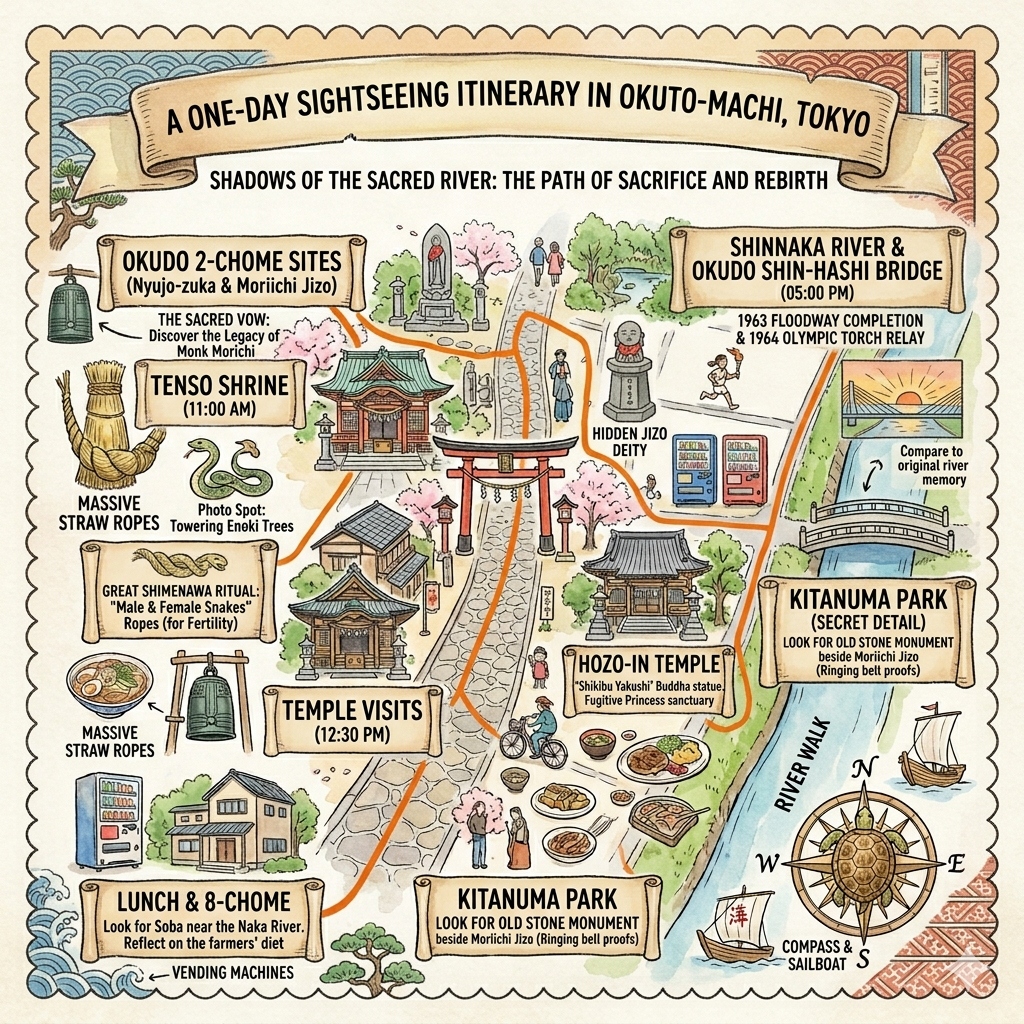
This is a historical travel story and walking guide to Okuto, a resilient lowland district in Katsushika, Tokyo. By exploring the ancient "Great Shimenawa Ritual" at Tenso Shrine and the unique tradition of carrying sacred straw serpents into private homes, it reveals how early settlers used "sympathetic magic" to defend against floods and plagues. Readers will gain a deep understanding of how sacred rituals and domestic spaces intertwined to ensure the survival and fertility of this historic Tokyo community.
 Lawrence
To understand Okuto is to read the landscape not as a static map, but as a sedimentary record of water and belief. Situated as a river-locked node between the Nakagawa and the modern Shin Nakagawa in Katsushika, this district is defined by its "riverine identity"—a geographical destiny shaped by the fluid borders of the Edo periphery. The authority of this narrative is etched in the Katori Monjo of 1398, which identifies the site as "Okutsu," a vital medieval port and ferry terminal between Musashi and Shimosa provinces. Over six centuries, this terminal transformed from a sacred Shinto estate (the Kasai-mikurya) into a bustling agricultural village, and finally into its current residential form. In this deep-layered journey, we move beyond the superficial modern facade to uncover a topography where every bend in the river and every temple bell echoes with the resonance of a community’s survival and faith.
Listen to the historical stories told in detail (For subscribers only)
The Monk’s Bell: Mori-ichi and the Sacrifice of the "Nyujo"
In the history of lowland river communities, the threat of environmental instability often necessitated a form of "sacrificial faith." To secure the land against the unpredictable whims of flood and plague, these communities looked toward spiritual interventions that transcended the ordinary, requiring a profound bridge between the human and the divine.
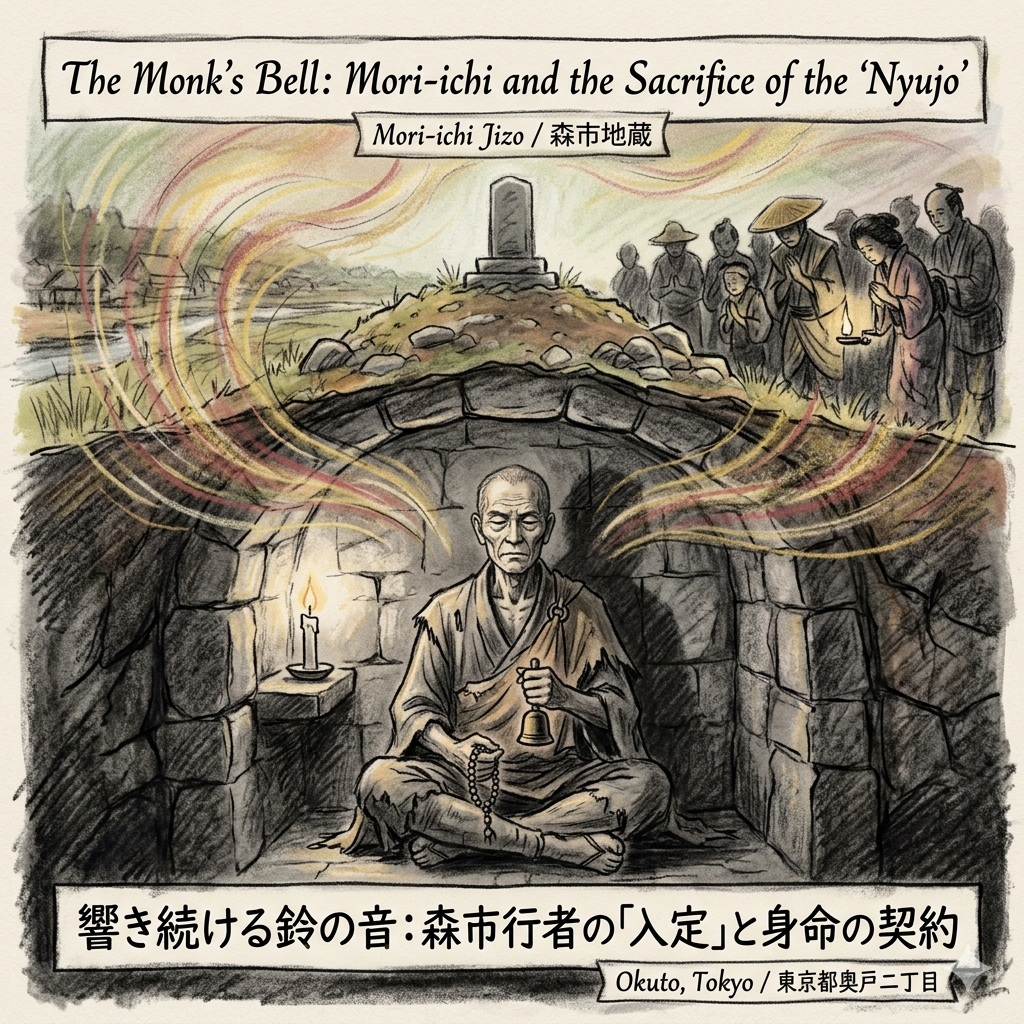
The story of Mori-ichi, a Rokubu or itinerant pilgrim of the Edo period, represents this spiritual boundary-crossing. Mori-ichi was an outsider—a wanderer who settled in a modest dwelling on the village edge—yet he earned the community's deep respect through his ascetic practice. Upon sensing his end, he chose the path of Nyujo—living mummification. By entering a stone chamber beneath the earth to wait for death while in a state of meditative prayer, he performed a transformation that redefined the village's spiritual topography. This act elevated an outsider to the status of a Marebito (local guardian deity), anchoring the village's safety to his own physical remains.
"As long as the bell rings, I am praying for your prosperity; when the silence falls, I have achieved Buddhahood for this land."
For three days and three nights, the sound of his bell rose from the stone chamber, a rhythmic covenant between the monk and the villagers. When the ringing stopped on the fourth day, the transition was complete. Mori-ichi was no longer a man but a landmark—the Mori-ichi Jizo. This movement from individual sacrifice to communal protection serves as a spiritual precursor to the political tragedies that would later leave their own distinct marks on the local soil.
The Exile’s Buddha: Political Echoes at Hozo-in
National political upheavals frequently rippled outward from the Shogunate’s center, finding refuge in the "hidden" waterways of the Edo periphery. Districts like Okuto, with their labyrinthine canals and dense lowlands, became a "sanctuary culture" for those marginalized or persecuted by central authorities.
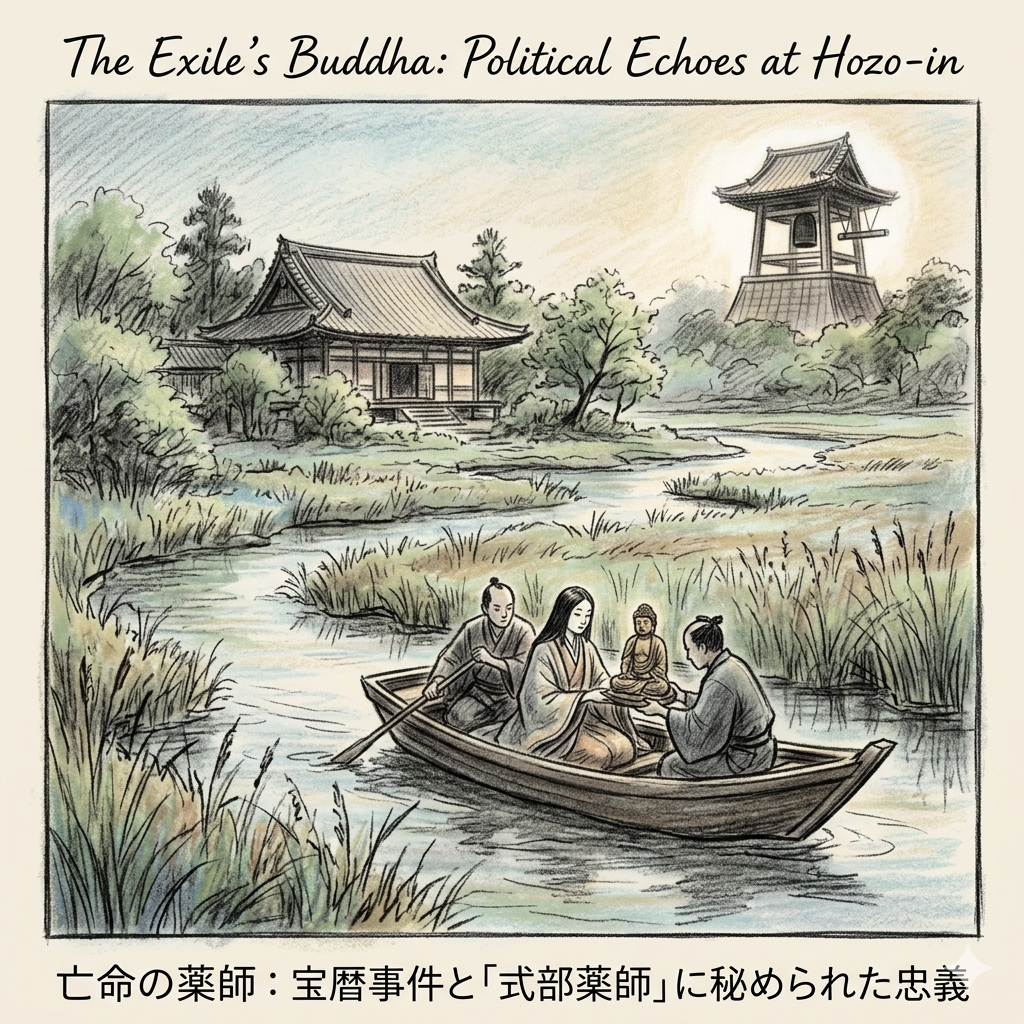
This legacy of refuge is preserved at Hozo-in, a temple housing the "Shikibu Yakushi." The history is linked to the Horeki Incident of 1758—a crackdown on pro-imperial scholars like Takeuchi Shikibu. Legend tells of the daughter of a high-ranking court official who fled the political storm in the capital, finding asylum in Okuto’s marshes. Carrying a small statue of the Medicine Buddha (Yakushi Nyorai), she and her retainers established a life in hiding. The significance of this narrative lies in how it positioned Okuto as a space of moral and physical sanctuary, where the marginalized could preserve their dignity and their deities far from the eyes of the Shogunate.
The site’s literary weight was later solidified by the novelist Yasushi Inoue, who penned the inscription for the "Wako-no-Kane" (Bell of Harmonious Light), erected to commemorate the river’s management. The bell tower stands as a monument to this intersection of human trauma and hydrological engineering, seeking to harmonize the internal peace sought by exiles with the external stability required of an agrarian community seeking fertility from its waters.
The Serpents of Tenso: Fertility and the Spatial Infiltration of the Divine
The "defensive faith" of Okuto was not merely about guarding against political or spiritual threats, but about ensuring the biological and agricultural continuity of the village. Lowland life was a constant negotiation with the twin specters of flood and plague, requiring rituals that were raw, visceral, and deeply connected to the earth’s cycles.
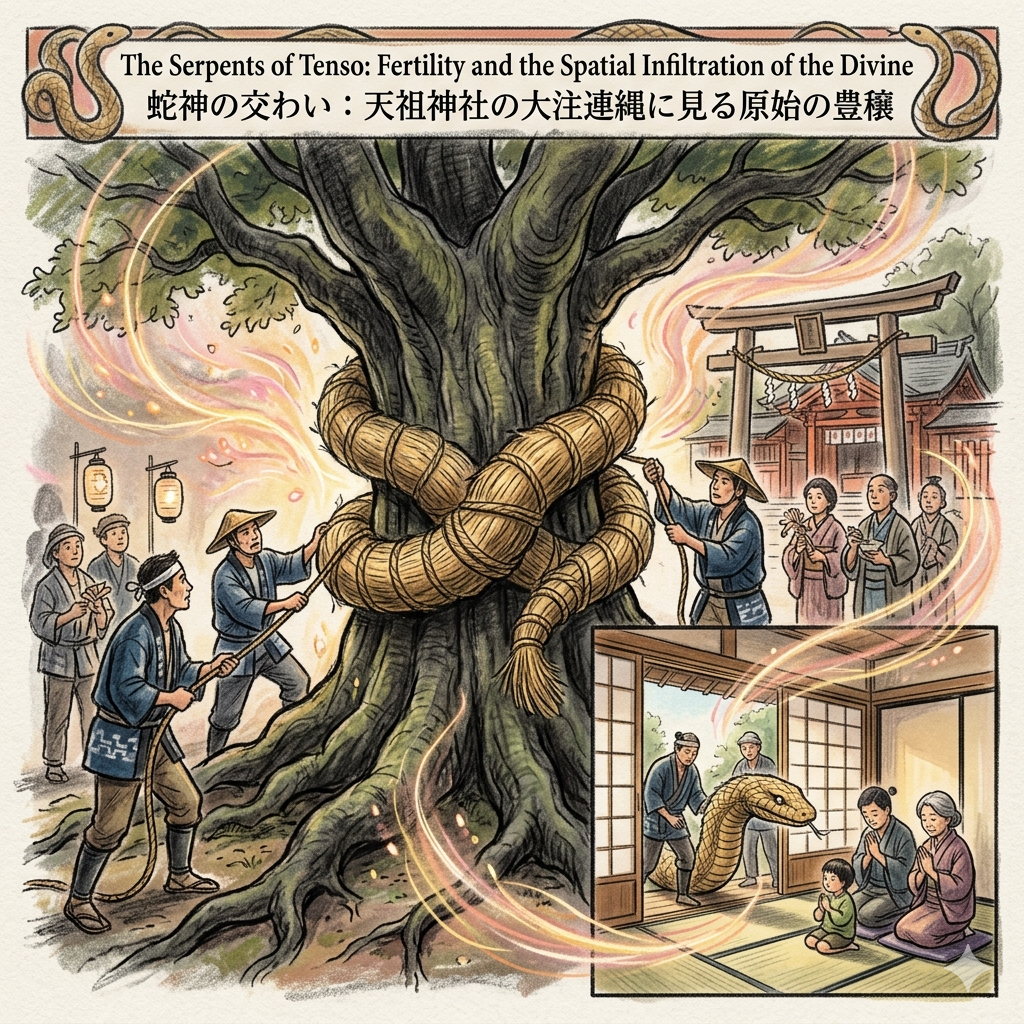
At Tenso Shrine, this is manifested in the "Great Shimenawa Ritual." In an act of "sympathetic magic," villagers construct massive straw serpents—one male and one female—which are wound around an ancient Enoki tree. The profound resonance of these straw serpents lies in their simulated mating; the ritual represents the pregnancy of the female snake, a symbolic act intended to trigger the fertility of the land itself. This represents an unpolished form of agrarian worship that predates the more organized religious structures of the medieval era.
This sacred energy was not confined to the shrine. Through the tradition of Zashiki-toori (passing through living rooms), the giant straw serpents were carried directly into the private homes of the villagers. This blurring of the boundary between the sacred realm and the private domestic space was essential for community cohesion. It ensured that divine protection was spatially infiltrated into every corner of the village, turning individual households into part of a singular, fortified whole before the formal religious organizations of the Shingon sect took root.
The Hidden Jizo of Myogon-ji: Aesthetics of the Afterlife
As the village matured, its temples became "archives of death," meticulously managing the transition of souls. The expansion of the Shingon sect in the 15th century, particularly through Myogon-ji (founded in 1415), brought a structured, aesthetic approach to the afterlife and the pursuit of salvation.
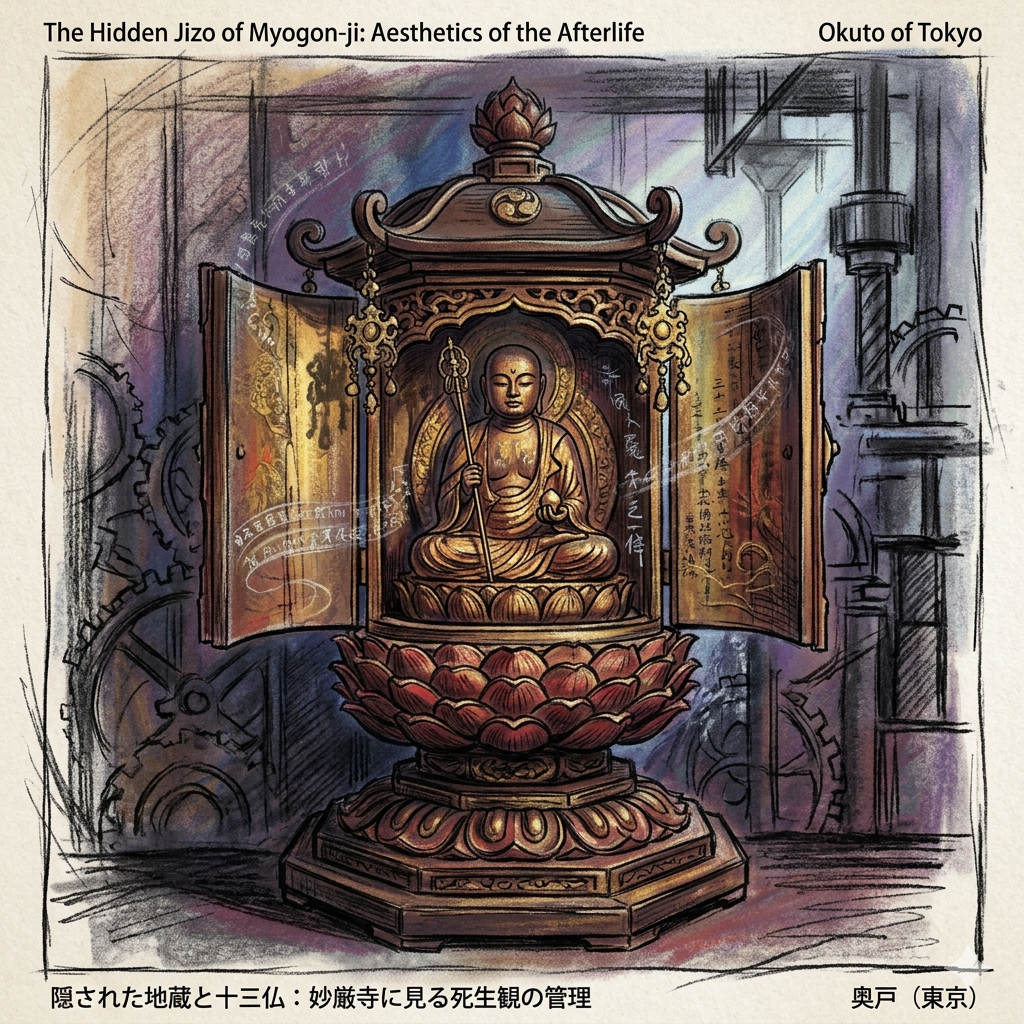
A focal point of this spiritual archive is the "Hidden Jizo" of 1737. This wood-carved figure is housed within a complex Hoju (treasure orb) mechanism, designed so that the deity is only revealed when the orb is opened. This "hidden/revealed" ritual mirrors the medieval obsession with the suddenness of spiritual salvation—the idea that grace is ever-present but only occasionally perceived. Such sophisticated artifacts were made possible by the wealth of local patrons like the Murakoshi clan, whose prominence is reflected in the quality of the temple's treasures.
Treasures of Myogon-ji
Item | Historical Significance |
Wood-carved Jizo (1737) | Features the "Hoju" mechanism; represents the suddenness and mystery of salvation. |
Gilt Bronze Keman (1733) | Ritual flower ornaments donated by the Murakoshi clan; indicators of significant local wealth. |
Thirteen Buddhas Collection | A rare, complete set of icons representing the systematic management of the afterlife. |
The static preservation of these temple treasures would eventually meet the violent, landscape-altering changes of the 20th century, where faith was replaced by the cold logic of industrial engineering.
The River That Split a Town: The 1964 Olympics and the Shin Nakagawa
Modern Okuto is a product of "Hydrological Determinism." Following the devastating floods of Typhoon Kathleen in 1947, the Japanese government determined that the safety of metropolitan Tokyo required a radical intervention: the carving of the Shin Nakagawa (the Nakagawa Floodway or 放水路) through the heart of the district.
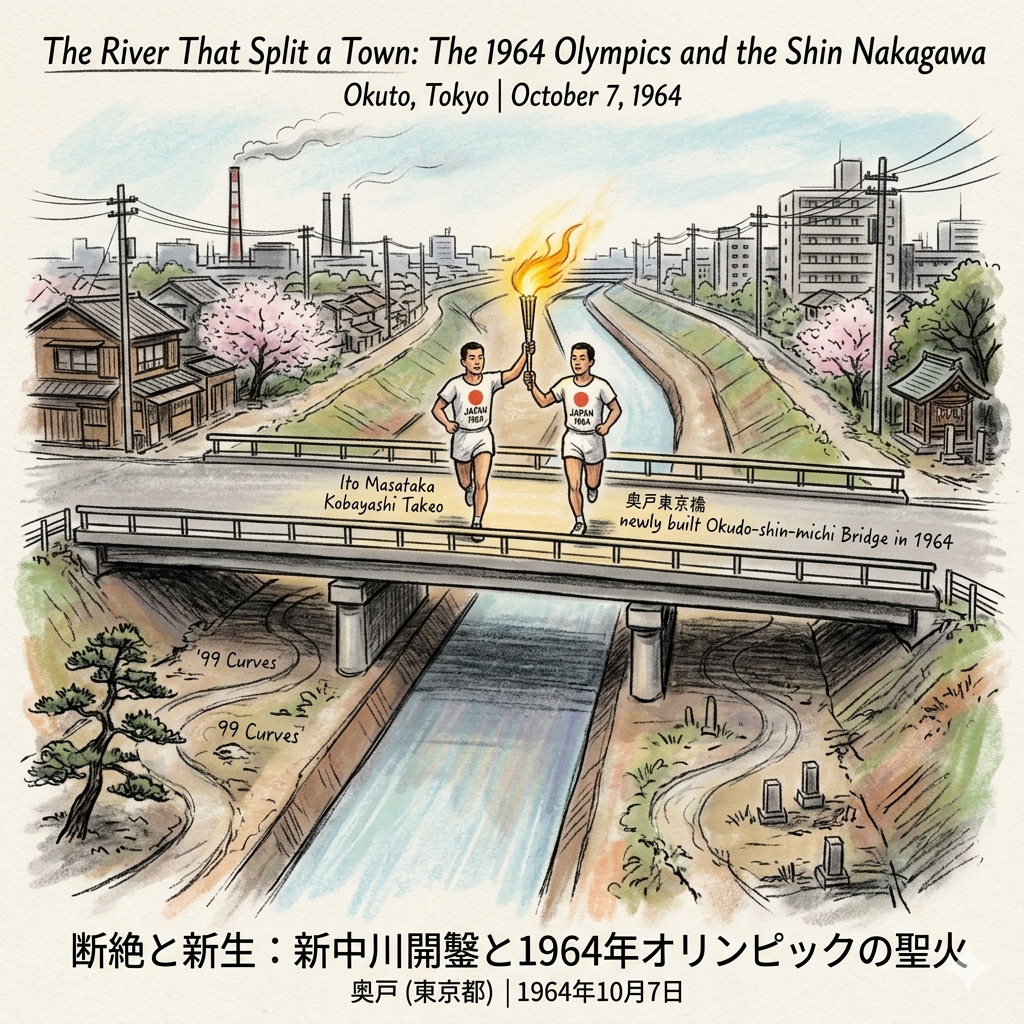
The excavation between 1949 and 1963 resulted in the "amputation" of the town. To create this massive drainage channel, the ancient, meandering "99 Curves" of the original river were straightened, and ancestral lands, homes, and graveyards were sacrificed. Crucially, this was a modern iteration of the Nyujo—the town itself was asked to sacrifice its physical integrity for the safety of the greater metropolis.
A symbolic healing of this fractured landscape occurred during the 1964 Olympic Torch relay. On October 7, 1964, the flame was carried across the newly constructed Okudo-shin-michi Bridge by local torchbearers Ito Masataka and Kobayashi Takeo. This moment transformed the bridge from a symbol of division into a monument of connection. Today, modern Okuto stands as a place where industrial progress and ancient memory coexist on the riverbank, the straightened waters masking the ghosts of the curves that once defined the land.
Hidden Gem: North Numata Park
For the modern traveler, North Numata Park (Kita-numa Koen) and the site of the former Morinaga Milk Factory represent a unique "hidden gem" where Okuto’s industrial past and its recreational present meet the river’s edge. Walking these riverbanks allows one to observe the "spatial continuity" of the district's history. Even where the water has been engineered into straight lines, the observant walker can still feel the phantom presence of the "99 Curves" in the way the older streets and temple boundaries refuse to align with the modern grid.
Philosophical Reflection & Conclusion
The history of Okuto reveals three enduring patterns: the cycle of sacrifice and transformation, the resonance between the national center and the local margin, and the role of faith as the "glue" that binds a community across centuries of landscape change. From the monk Mori-ichi to the residents who surrendered their ancestral lands for the Nakagawa Floodway, Okuto is a testament to the belief that collective safety is often bought with individual loss.
It raises a haunting question for the modern era: What "sacrifices" do we make for our cities today, and what rituals will remain to explain them to those who walk our streets centuries from now?
To walk deeper into the forgotten water-maps of Tokyo, subscribe to our dispatch from the lowlands.
Traveler’s Essentials
- How to Get There: Take the Keisei Line to Aoto Station or Keisei-Tateishi. Okuto is best explored by taking a bus toward the riverine district or enjoying a long, meditative walk to observe the shifting topography.
- Recommended Walking Route: Begin at Myogon-ji to examine the medieval archives, walk south to Tenso Shrine for the serpent legends, and conclude at the Shin Nakagawa riverbank near North Numata Park to see the scale of the floodway.
- Nearby Historical Tours: Look for local walking tours focusing on the "Nankatsu 88 Temple Pilgrimage" (Mori-ichi Jizo is the 12th station) and the hydrological history of the Katsushika drainage systems.
Reference and Further reading
- PowerPoint プレゼンテーション - 葛飾区郷土と天文の博物館, accessed April 22, 2026,
- 妙厳寺|葛飾区奥戸にある真言宗豊山派寺院 - 猫の足あと, accessed April 22, 2026,
- 新中川 - accessed April 22, 2026,
- 「入定塚」 | 古墳なう, accessed April 22, 2026,
- 12番 - BIGLOBE, accessed April 22, 2026,
- 森市地蔵|葛飾区奥戸の名所旧跡、南葛八十八ヶ所霊場 - 猫の足あと, accessed April 22, 2026,
- しばられ地蔵 Shibararejizo Narihirasan Nanzoin - 天台宗 業平山 南蔵院, accessed April 22, 2026,
- 宝蔵院|葛飾区奥戸にある真言宗豊山派寺院 - 猫の足あと, accessed April 22, 2026,
- 【宝蔵院(式部薬師)】アクセス・営業時間・料金情報 - じゃらんnet, accessed April 22, 2026,
- 宝蔵院(式部薬師) - アソビュー!, accessed April 22, 2026,
- 葛飾区史|第3章 地域の歴史, accessed April 22, 2026,
- 葛飾区史|第5章 天祖神社の大しめ縄神事, accessed April 22, 2026,
- 大しめ縄の鳥居を見に行く!【奥戸天祖神社】へ参拝 - おでかけ!ゆるオタおじさん, accessed April 22, 2026,
- 葛飾区の神社・神宮・寺院ランキングTOP10 - じゃらんnet, accessed April 22, 2026,
- 江戸川区平井を知る!旧中川の歴史とその背景とは? - タキザワ住販, accessed April 22, 2026,
- 葛飾区郷土と天文の博物館(郷土展示室) / 資料館 / 白鳥 / お花茶屋駅 - 葛飾区時間, accessed April 22, 2026
 Lawrence
 Lawrence
 Lawrence