"Omori-machi Historical Walk – Exploring Tokyo’s Vanished Coastline and Deep Stratigraphic Memories"

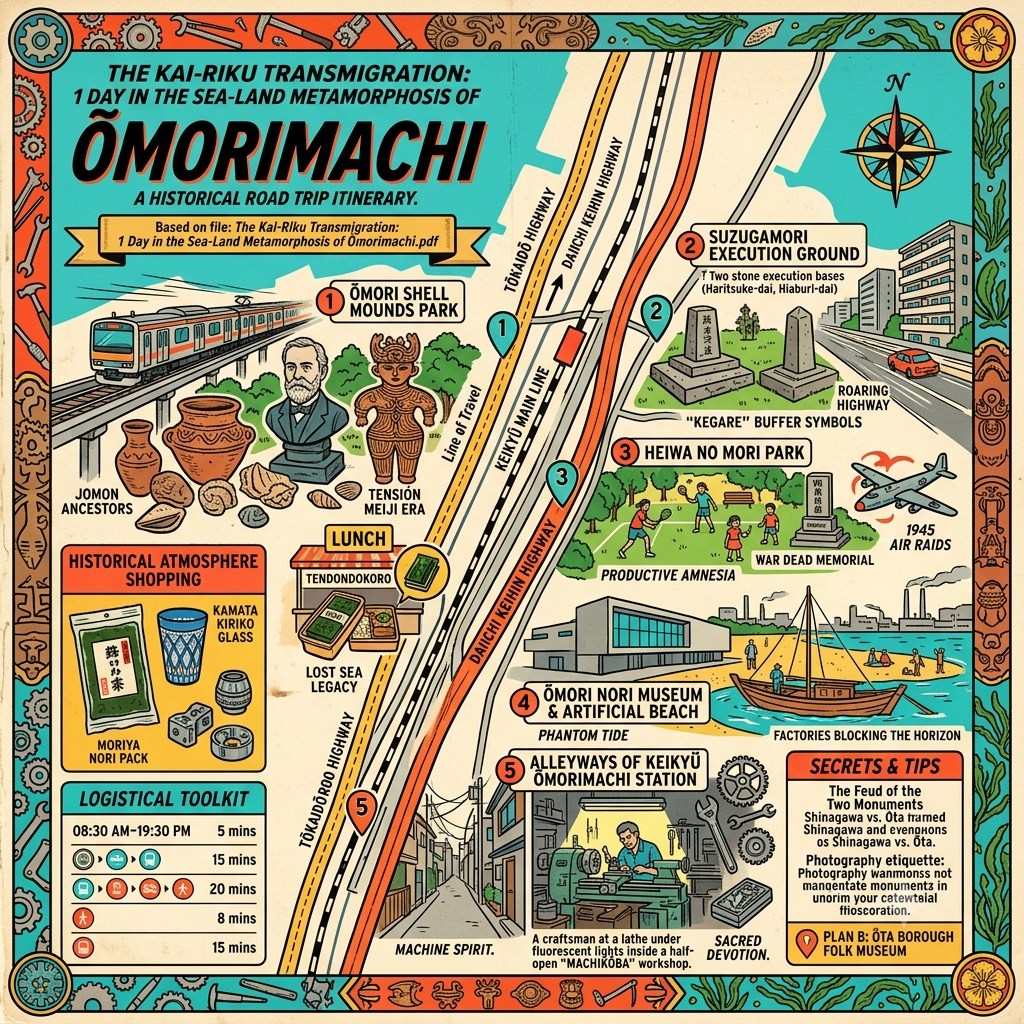
This is a deep historical travel story and walking guide to Omori-machi, a Tokyo district defined by layer upon layer of vanished worlds. Through a journey bridging the ancient Jomon period and modern industrialization, it explores the Omori Shell Mounds, the forgotten Nori (seaweed) coastline, and the grim political theater of the Suzugamori Execution Grounds. By tracing this hidden psychological geography, readers will uncover a unique perspective on Tokyo's urban evolution and the profound, invisible memories buried beneath the concrete.
 Lawrence
Omori-machi is a stratigraphic anomaly—a vertical accumulation of extinct worlds masquerading as a horizontal district. In the shifting geography of Tokyo, it represents a rare phenomenon defined not by organic evolution, but by a cycle of continuous extinction and rebirth. Each era of its existence, from the Jomon prehistoric to the industrial height of the 20th century, has been marked by a total ontological rupture, where one identity is buried to make way for another. This creates a profound existential weight; the energy of these past transitions physically vibrates within the urban fabric today as a "Sea-Land Transmigration Syndrome." To navigate Omori is to walk upon layers of productive amnesia, where the memory of vanished coastlines and machine spirits leaks through the concrete. This journey into the district’s deep soul begins with a mechanical heartbeat: the railway that first cut through the earth to reveal the ancestry of a nation.
Listen to the historical stories told in detail (For subscribers only)
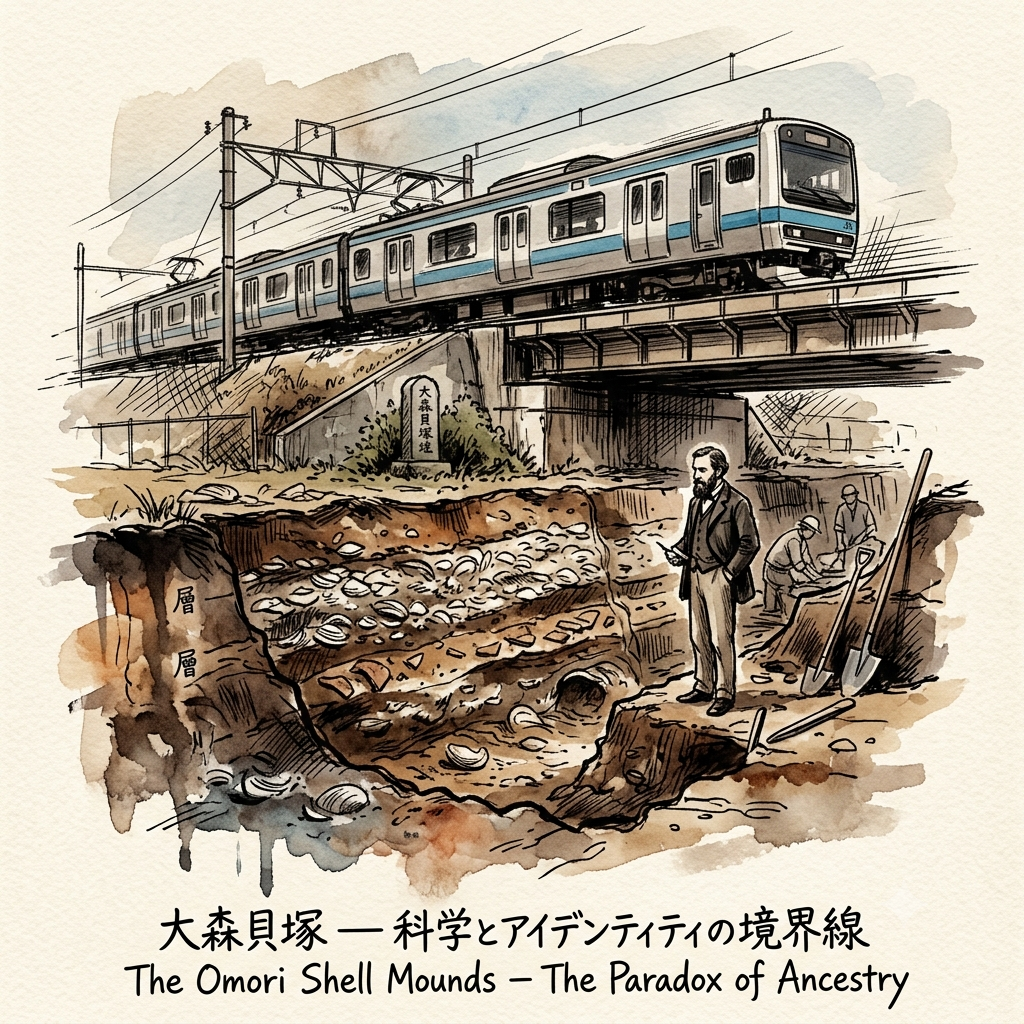
Node I: The Omori Shell Mounds – The Paradox of Ancestry
The 1877 discovery of the Omori Shell Mounds was the strategic moment Japan was "revealed" to itself through the lens of Western science. It was here that the nation’s prehistoric roots were first quantified, creating a lasting tension between scientific inquiry and the sovereign national image.
In June 1877, American zoologist Edward S. Morse looked out the window of a train traveling from Yokohama to Tokyo. Along the embankment of what is now the JR Keihin-Tohoku line, he spotted layers of shells exposed by the railway’s construction—a literal incision into the past by the machinery of progress. Morse’s excavation of the Jomon-period mounds ignited a political firestorm when he suggested the presence of "cannibalism" based on skeletal analysis. For a Meiji-era Japan desperate to prove its "civilized" status and successfully renegotiate "Unequal Treaties" with Western powers, the notion of cannibalistic ancestors was a strategic threat. This was a Darwinian shock; the excavation was a Western scientific performance that forced Japan to see its origins through a lens it could not yet control.
The Cannibal Scandal of Meiji Japan
In Shinto cosmology, a Tsuka (mound) is a boundary node where the daily and the spirit worlds overlap. Morse’s excavation was a form of "Ritual Transgression." By unearthing ancestral remains without traditional purification, he introduced Kegare (pollution) into the spiritual field. The mounds were never mere refuse heaps; they were ancestral connection points. Today, the site remains caught in a temporal paradox: the Jomon ancestors are physically suppressed beneath the foundations of modern rail, yet their presence remains a fundamental baseline of the local spiritual geography.
Standing near the mounds today, one feels the low-frequency vibration of modern trains merging with the heavy scent of damp earth and ancient shells. The rhythmic roar of the Keihin-Tohoku line acts as a mechanical heartbeat, momentarily masking the profound, static silence of the thousands of years buried beneath the tracks, where the velocity of the present grinds against the stillness of the deep past.
As we move from the earth of the mounds, we transition toward the vanished waters of the Edo period, where the district’s identity was once defined by the rhythmic tides of the sea.
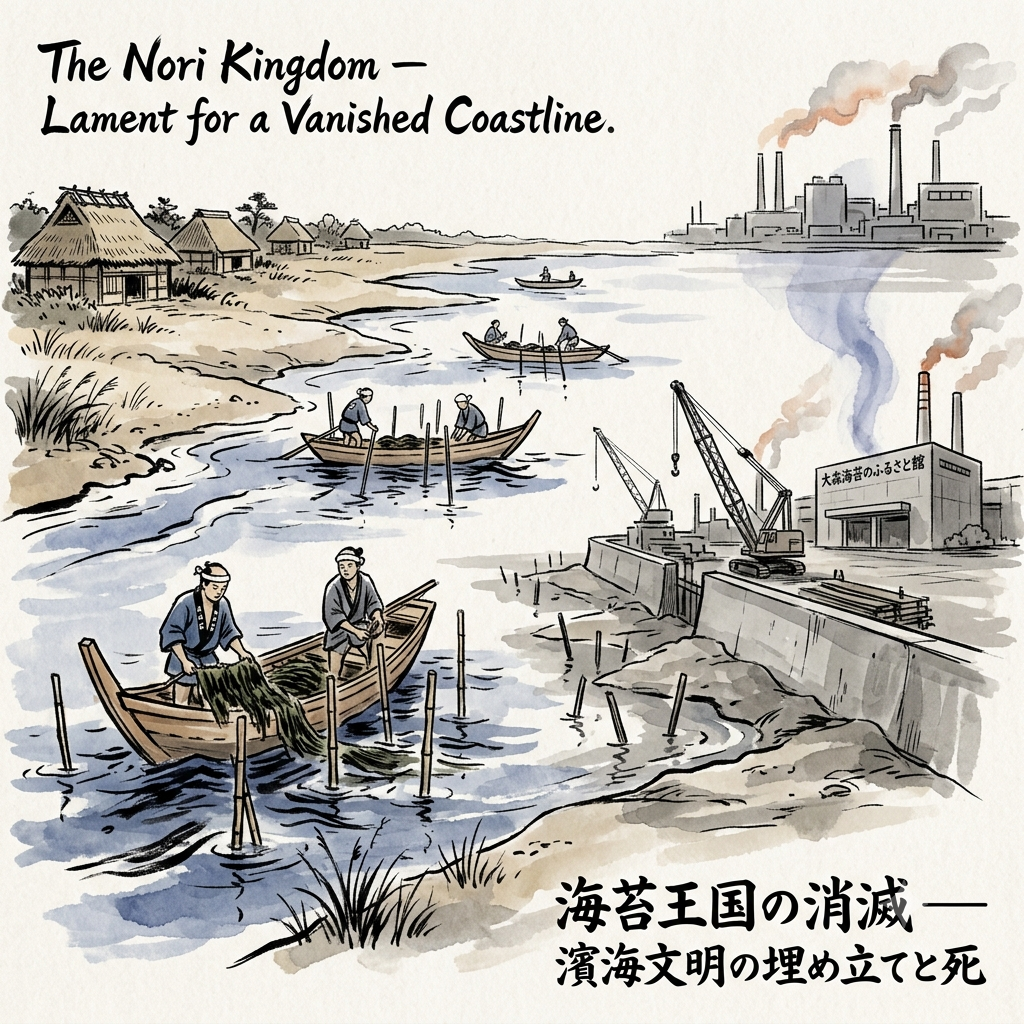
Node II: The Nori Kingdom – Lament for a Vanished Coastline
The strategic shift from a "Sea" identity to a "Land" identity represents a fundamental trauma in the collective psyche of Omori. The destruction of the coastline was not merely an economic change but a "Cosmological Violence" that severed the community's connection to the natural order.
The Ghost Beach of Omori
From the mid-Edo period until 1963, Omori was the "Nori Kingdom," defined by an artisan class of Nori-shi who possessed specialized, tacit knowledge of the tides. This coastal civilization flourished until massive industrial land reclamation projects "drowned" the industry in concrete. This reclamation was the permanent sealing of the "gods’ entrance"—the destruction of the intertidal zone, or the Ma (the sacred gap between land and sea). In Shinto, this boundary is where the gods of the sea transition into the human realm. By converting this space into industrial land, the community’s ritual connection to the tides was permanently severed.
The modern Omori Seaweed Museum (大森海苔のふるさと館) now serves as a node of "Dry Memory," a symbolic vessel holding the ghost of a civilization that no longer has an ocean. The phantom scent of brine persists in a place now covered by concrete, a lingering echo of a world that was sacrificed for the fires of industry.
Node III: Suzugamori – The Executioner’s Buffer Zone
Omori historically sat at the edge of a lethal threshold, where the state utilized physical violence to define the spiritual boundaries of the capital.
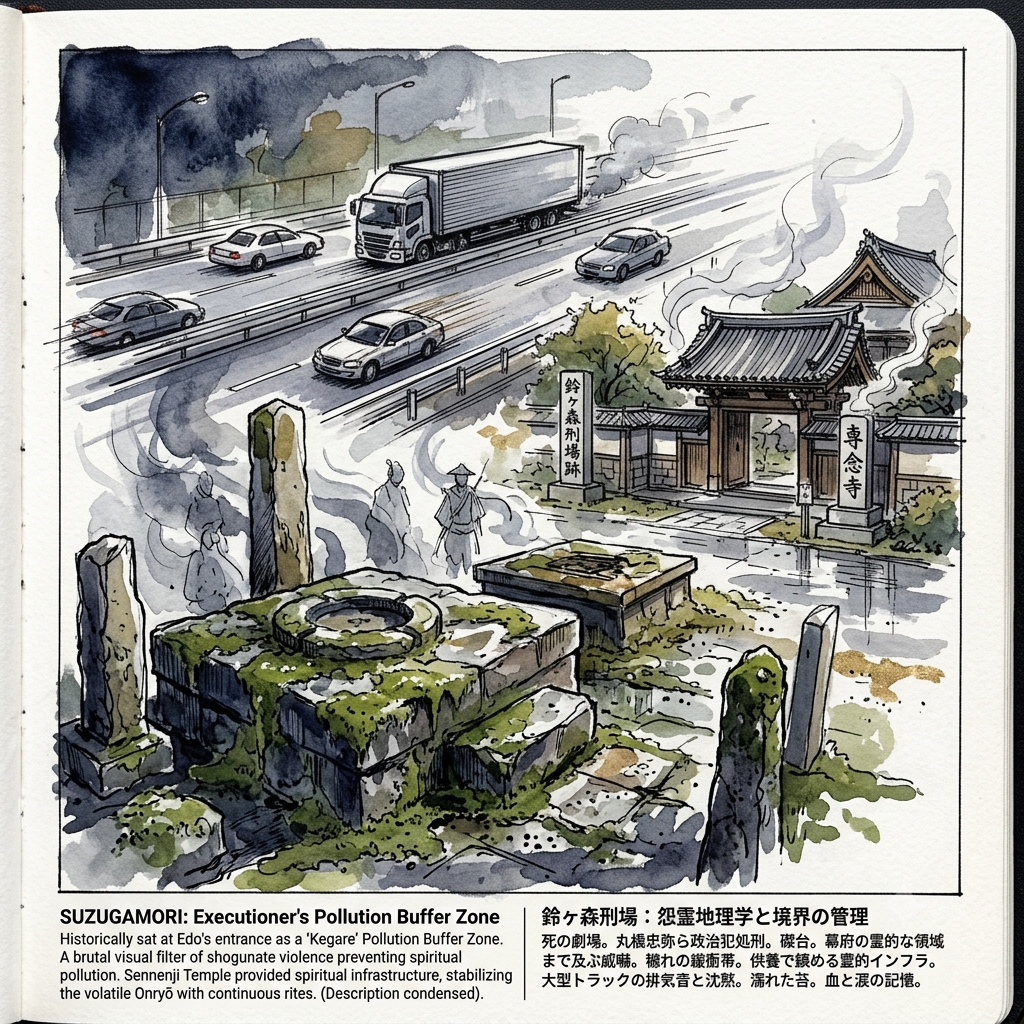
The Suzugamori Execution Ground (1651–1871) was a site of "Visible Governance" for the Tokugawa Shogunate. Located at the entrance to Edo along the Tokaido road, it served as a brutal visual filter for all who entered the city. Spiritual architects viewed Suzugamori as a Kegare no Kanchōtai (Pollution Buffer Zone). It was designed to absorb the spiritual "pollution" of death at the city's periphery, preventing it from reaching the Shogun's core. To manage the resulting Onryō (vengeful spirits), the nearby Sennenji Temple was established as "Spiritual Infrastructure." The temple was not merely a neighbor; it was a required functional component of the state, performing continuous Buddhist rites to stabilize the volatile energy generated by the Shogunate’s violence.
Edos Firewall Against Vengeful Ghosts
The sensory experience at Suzugamori is one of jarring juxtaposition: the unrelenting velocity of Route 15—the modern successor to the Tokaido—clashes with the cold, mossy silence of the execution stones. The air feels heavy, trapped between the friction of modern transit and the static, unpurified trauma of the executioner's blade.
From the literal fires of execution, the narrative moves toward the total "Zero Moment" of 1945.
Node IV: The 1945 Firebombing – Spatial Zeroing
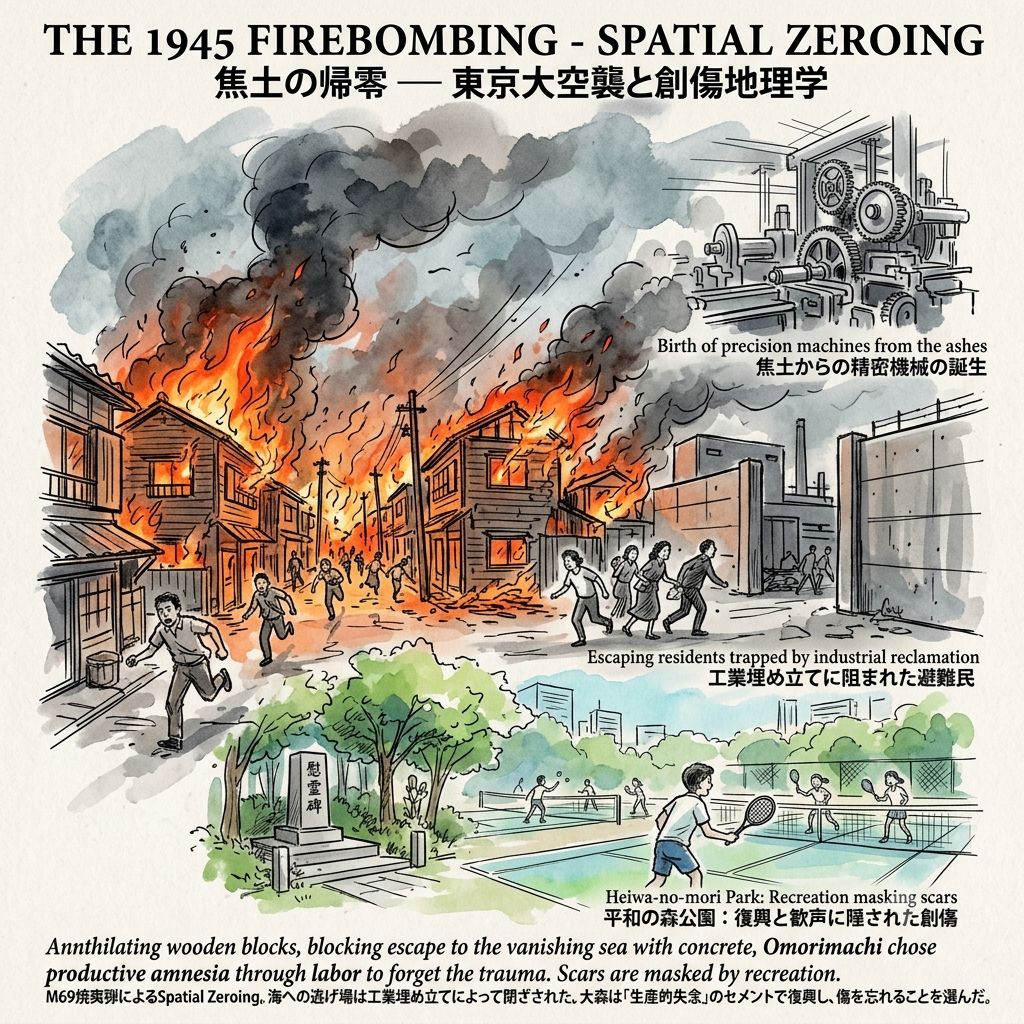
The air raids of March 1945 acted as a violent reset, wiping away the physical record of Omori and forcing a rebirth from the ashes. This "Spatial Zeroing" created a unique trauma geography. During the firebombing, a visceral tragedy unfolded: as the fires consumed the wooden residential blocks, thousands of residents fled toward the coast—the traditional safety of the water. However, their escape was blocked by the very industrial reclamation they had built just decades prior. The "vanished sea" could not save them; the concrete walls of the new land became a lethal trap.
The City That Worked To Forget
In the aftermath, Omori engaged in "Productive Amnesia." Unlike Hiroshima, which preserved physical ruins, Omori rebuilt immediately, focusing on labor to transcend the horror. Today, in Heiwa-no-mori Park, daily recreation and sports facilities mask these deep scars. This lack of monuments is a strategic choice of the survivor: to work is to forget. Yet the ashes of war provided the fertile ground for Omori’s next transmigration: the rise of the precision machine.
Node V: The Empire of 9,000 Factories – The Spirit of the Machine
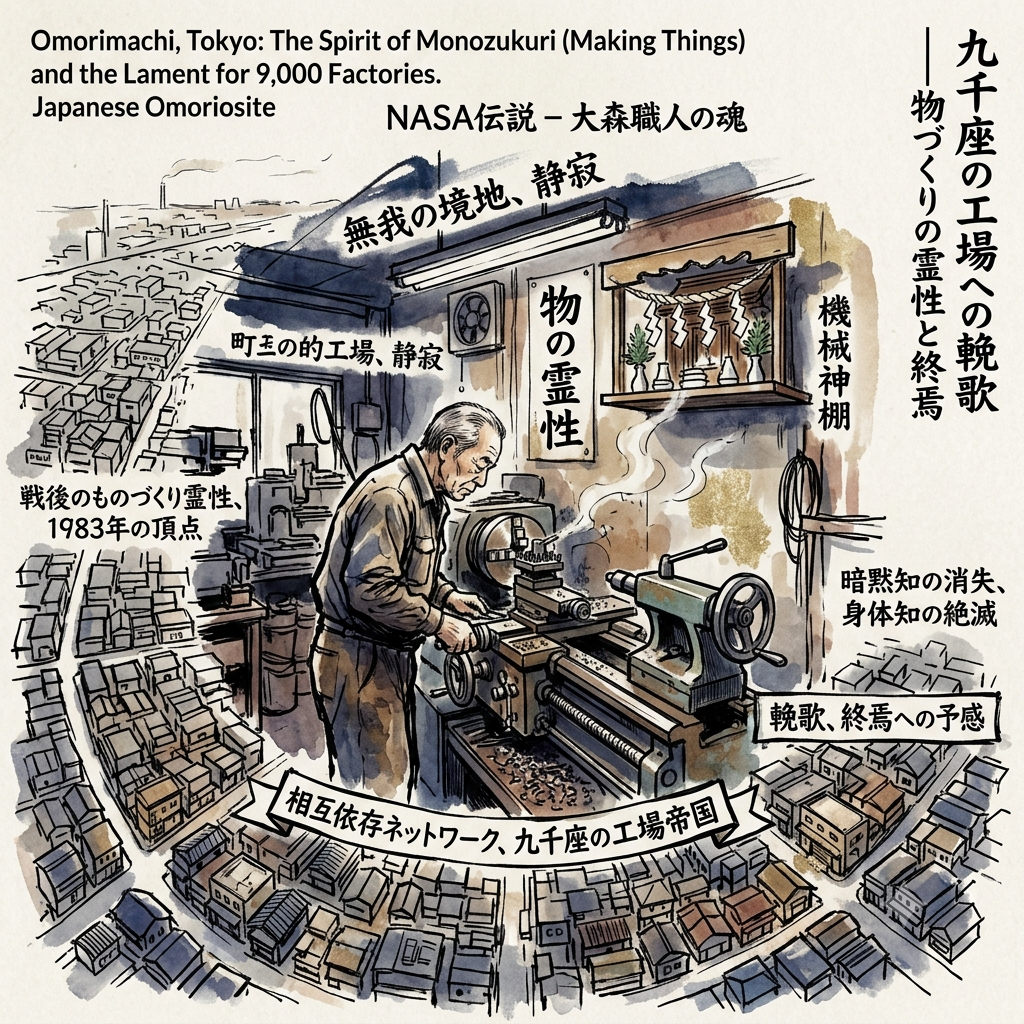
In the post-war era, Monozukuri (the craft of making things) became a spiritual vocation. By 1983, Omori reached its industrial peak with approximately 9,000 Machikōba (small factories). This was an empire built on "Social Capital" and a network of interdependent family shops. This era gave birth to the "NASA Legend"—the claim that Omori’s craftsmen were essential to the American space program. While the truth likely involves these artisans acting as the vital foundation for large optical firms like Canon and Nikon, the legend reflects the actual spiritual weight of their labor.
How the Machikoba Network Builds Precision Tech
The craftsmen practiced a modern animism, an adherence to Mono no Reishi (The Spirit of Objects). Factories often featured "Machine Kamidana" (shrines) to honor the spirits of their lathes and presses. This "Spirit of the Machine" suggests that tools possess a soul developed through years of human interaction. Consequently, the current decline of these factories represents a "Spiritual Extinction." When an artisan retires without a successor, his unwritten "Tacit Knowledge"—and the spirit of the machine itself—vanishes from the world.
The atmosphere of a surviving Machikōba is defined by the sweet-acidic smell of machine oil and the rhythmic, percussive clanging of metal on metal. Inside, a craftsman works in a state of focused silence, a meditative trance where the boundary between the man and the tool dissolves into a single creative consciousness.
Synthesis: The Sea-Land Transmigration Syndrome
The history of Omori-machi is a series of "Involuntary Memory Leaks." While the district appears to be a standard urban sprawl, it is actually a stratigraphic text of vanished worlds.
Moment | Former Identity | New Identity | Trigger | What was Forgotten |
1877 | Sleeping Ancestry | Scientific Specimen | Western Railway | Jomon spiritual geography |
1945 | Pre-war Community | Spatial Zero / Ash | Total War | Neighborhood networks & names |
1963 | Coastal Civilization | Inland Industrial Land | Reclamation | The tidal order & sea-kami |
1985 | Manufacturing Empire | Residential Units | Plaza Accord | Tacit artisan knowledge |
Present | Residual Craft Culture | Uncertain Urban Flux | Development | The soul of the machine |
The Philosophical Anchor: In an era of technological flux, our "involuntary memories"—the scent of brine in a landlocked park or the acidic tang of machine oil near a luxury apartment—are our most valuable cosmic assets. Omori-machi reminds us that even when a world is "extinguished," its frequency continues to resonate in the land. To listen to these echoes is to anchor one's soul in the deep time of the city.
To deepen your connection to the hidden layers of our reality, you are invited to join the "Spiritual Anchor" network—a collective dedicated to the ontological history of our evolving urban nodes.
Accessing the Physical Node
To ground yourself in this multidimensional spacetime, utilize these access cues:
- Arrival: Use JR Omori Station to access the Shell Mounds and the industrial heartland, or Keikyu Omori-machi Station to find the remnants of the Nori district.
- Anchoring: Stay within the Ota Ward industrial-residential mix. The "vibrational frequency" is best felt in small local guesthouses where the rhythmic clanging of the remaining Machikōba still provides a morning wake-up call.
- Temporal Walks:
- The Ancestral Track: Visit the Omori Shell Mounds Park, located precisely where the railway first cut the earth.
- The Vanished Coast: Walk from the Omori Seaweed Museum through Heiwa-no-mori Park to the artificial beach at Omori Furusato-no-hamabe Park to witness the "simulated reality" of the lost sea.
- The Lethal Gate: Ground yourself at the Suzugamori Execution Ground site near Route 15 to feel the friction between the high-speed present and the static trauma of the Edo period.
FAQ
- Q: Is Omori-machi Tokyo worth visiting for tourists?
- A: Yes, Omori-machi is highly worth visiting for travelers seeking an authentic, off-the-beaten-path Tokyo experience. Located in the Ota City district, this historic neighborhood beautifully preserves a nostalgic "Shitamachi" (old downtown) atmosphere far from tourist crowds. It offers a unique glimpse into local daily life, featuring traditional shopping streets (Shotengai), cozy neighborhood cafes, and lush urban parks like Heiwajima Park. It is an ideal half-day destination for history buffs and slow-travel enthusiasts looking to uncover hidden local stories and Tokyo's coastal heritage.
- Q: How to get to Omori-machi and what is nearby?
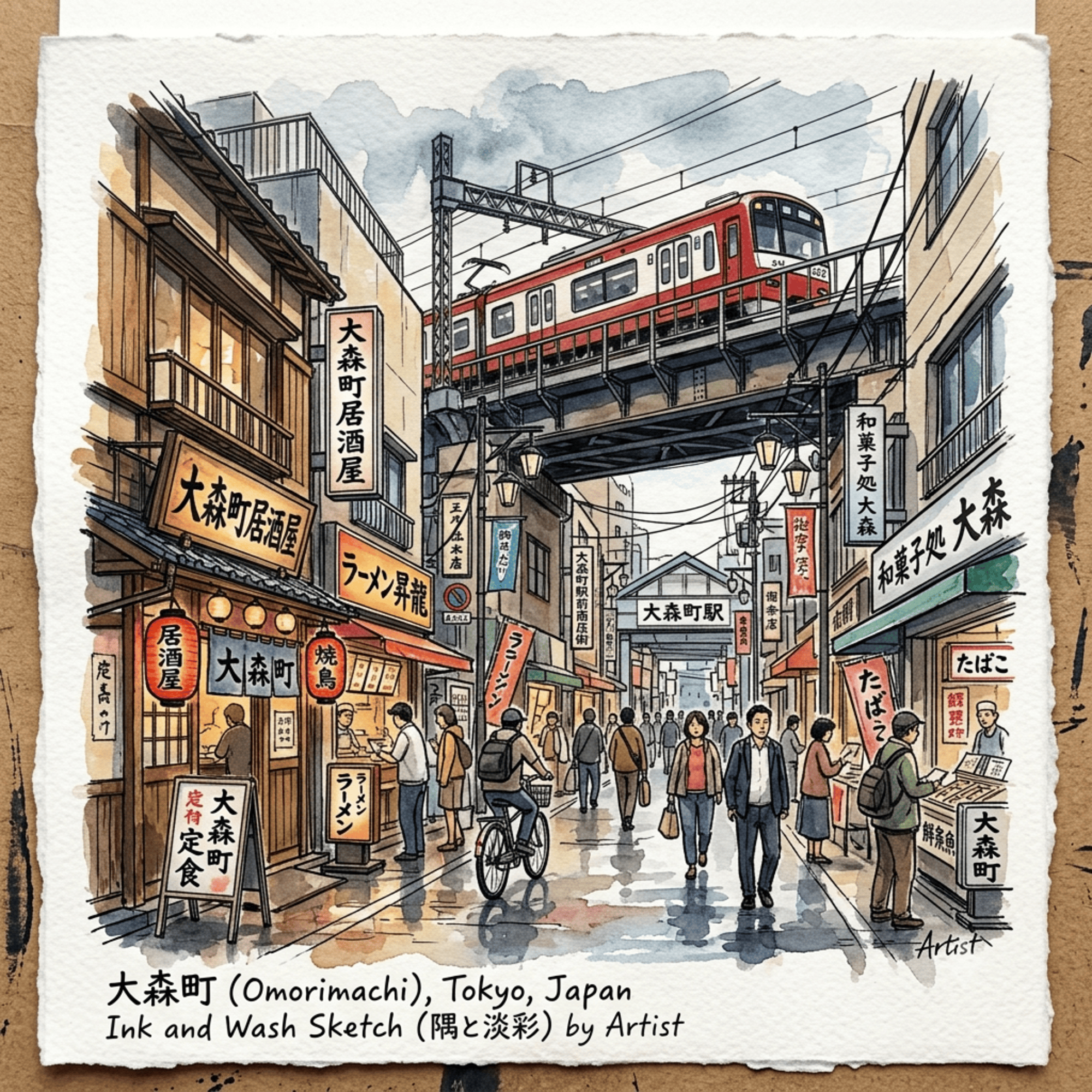
- A: Omori-machi is easily accessible via the Keikyu Main Line at Omori-machi Station. It is strategically located just 10 minutes from Shinagawa Station and about 15 to 20 minutes from Haneda Airport, making it a perfect stop for early arrivals or late departures. Right outside the station, you can explore the bustling Omorimachi Kyorokai shopping street for affordable local street food. Within walking distance, you can also visit Heiwa-no-mori Park or head toward neighboring Omorikaigan Station to explore the famous Omori Shell Mounds archeological site.
- Q: What is the history of seaweed farming in Omori Tokyo?
- A: Omori is celebrated as the historic birthplace of Japanese nori (seaweed) cultivation, dating back to the Edo period. It was once the nation's primary nori supplier, deeply shaping Tokyo's culinary identity. While modern coastal development led to the end of local cultivation in 1963, this fascinating maritime history is beautifully preserved at the Omori Norifurusato Museum. The museum offers free admission and showcases authentic wooden fishing boats, traditional processing tools, and interactive exhibits detailing how this former fishing village evolved into today's vibrant Tokyo residential neighborhood.
Reference and Further reading
First layer – Main sources of literature and institutions:
- 東京都教育委員会:大森貝塚特別史跡指定文件及境界測量記錄
- 莫爾斯原著:E.S. Morse, Shell Mounds of Omori (Memoirs of the Science Department, University of Tōkyō, Vol. I, Art. I, 1879)(現已公共領域,可於哈佛大學圖書館數位館藏取得)
- 哈佛大學皮博迪博物館(Peabody Museum of Archaeology and Ethnology):莫爾斯捐贈的大森出土品藏品資料庫(可能存有日本學界尚未充分利用的一級資料)
- 大森海苔のふるさと館:館藏一級文獻、家族史料、口述歷史錄音/文字記錄
- 大田区立郷土博物館:大森漁業權相關行政文書、東京灣漁業史料
- 東京都公文書館:東京灣填埋工程許可文件與施工記錄(昭和期)
- 品川区教育委員会:鈴ヶ森刑場遺址保存及整備相關記錄文件
- 国立公文書館:江户期评定所(幕府最高司法機構)的刑事判決記錄(部分已數位化)
- 東京都公文書館:慶安の変相關幕府記錄
- 大田区立郷土博物館:大田区の戦争体験記録(口述歷史、照片、地圖)
- 防衛省防衛研究所:戦史叢書中的関東地方空襲記録
- 米国国立公文書館(NARA, College Park, MD):第二十航空軍(Twentieth Air Force)任務記録、爆撃目標選定文書及損害評估報告(可線上申請取得部分文件)
- 東京都慰霊協会:東京都の戦災概要
- 大田区産業振興課:大田区工場数の推移統計(年度統計,此為最關鍵的量化基礎資料)
- 大田区中小企業振興公社:産業集積調查報告書(定期出版)
- 経済産業省・中小企業庁:大田区産業集積相關政策文件(可於経産省網站查找)
The second layer – secondary academic materials:
- 小林達雄(Kobayashi Tatsuo):繩文考古學的社會空間分析相關著作
- 藤本強:日本考古學史及貝塚研究史的學術回顧
- 建議查證:戰前(1930-1945年)日本考古學期刊中對莫爾斯食人論的反駁文獻(具有重要的科學政治史價值)
- 大田区史(各版本)對大森漁業的相關記述
- 東京湾漁業史・水産史相關學術論文(農業技術史研究期刊)
- 建議查證:熊本利治等漁業経済史研究者對江戸期東京湾漁業的論著
- 石井良助《江戸の刑罰》(中公文庫):江戶時代刑罰制度的標準學術參考文獻
- 高柳眞三:幕府刑事司法史相關著作
- 高橋敏:江戶時代社會史及刑罰制度相關論著
- 早乙女勝元:《東京大空襲》及相關著作(日本最重要的東京空襲民間記錄者)
- 奥住喜重、工藤洋三:空爆の歴史、戦略爆撃史研究
- Kenneth Werrell: Blankets of Fire (1996):USAAF燃燒彈戰術的英語學術研究
- 中小企業庁:大田区産業集積研究報告(多年份版本,1980年代後陸續出版)
- Noboru Kashiwagi et al.: Industrial district studies on Ota Ward(建議查證相關英語學術期刊論文)
- Tessa Morris-Suzuki: The Technological Transformation of Japan (1994):大田區相關章節
Third layer – Supplementary information:
- 大森海苔のふるさと館的海苔師家族訪談錄音/文字記錄(最重要的在地一級資料)
- 地域雜誌中的「大森の海苔師」相關採訪(建議進一步查證原始檔案)
- 江戸川柳與黄表紙中的鈴ヶ森刑場相關記述(作為集體記憶的文學表達,不作為事實一級資料)
- 品川・大森地域の民話集中的鈴ヶ森相關記述
- 大田区平和都市宣言推進協議会の証言集
- 大田区立郷土博物館の空襲体験者録音資料庫(若存在系統性整理)
- おおたオープンファクトリー實施記錄:歷年工匠訪談(每年11月舉辦;組織者為一般社団法人おおたクリエイティブタウンセンター)
- 大田区中小企業振興公社的職人口述歷史資料(若存在系統性整理)
Historical gap:
- Contemporary Japanese archaeological consensus documents on the cannibalism debate (further verification of original archives is recommended).
- The perspectives of Japanese personnel (landowners, workers, assistants) during the excavation—the entire "discovery narrative" heavily relies on Morse's singular perspective.
- Documents detailing the administrative decision-making process regarding the disputed locations of the two monuments (further verification of relevant written records from the two district education committees is recommended).
- Whether the Ōmori shell mounds of the Jomon period had a specific ritual function remains inconclusive in archaeology.
- Specific records of Shinto rituals of the seaweed makers' community (prayer content, ritual forms, festival ceremonies) are almost entirely absent from existing publicly available literature—this... This is a largely unexplored area of "lost coastal religious folklore" (further verification of original archives is recommended).
- The exact year the last group of seaweed makers ceased operations and the government compensation negotiation process (further verification of original archives is recommended).
- The collective attitude of the seaweed makers' community towards the landfill project—whether there was resistance or passive acceptance (further verification of original archives is recommended).
- Precise primary data on the number of people executed at the execution site (further verification of original archives is recommended). Specific records of Shinto-Buddhist elements in the execution rituals (verification of the temple's archives and records is recommended).
- The perspective of the executed's family members—their... How the bereaved families arranged funerals and support (almost no documentary records; further research is recommended).
- Records of the disposal of existing instruments of torture such as the crucifixion when the execution grounds were abolished (1871).
- Precise district-level statistics on the number of deaths in the Ota Ward air raid (further research into original archives is recommended).
- Oral accounts of the specific escape routes of Omori residents on the night of the air raid and their evacuation along the coastline.
- Administrative documents regarding the land redistribution process during the post-war reconstruction period (who rebuilt what, how land ownership was determined, and the fate of former landowners).
- Women's experiences with the air raid in Ota Ward (existing documents tend to focus on the perspectives of male factory workers or male combatants).
- Factory Systematic records of kamidana (shrines) and Shinto rituals in Ota Ward town workshops are almost nonexistent—this is a nearly untouched area of interdisciplinary research in religious folklore and industrial history (further verification of original archives is recommended).
- A specific list of permanently vanished technology types (which precision manufacturing techniques can no longer be reconstructed). The labor history of women in Ota Ward town workshops (systematically obscured by male artisan narratives; further verification of original archives is recommended).
- The life histories of factory owners after selling their land—where did they go in their later years, and how did their artisan identities transform (further verification of original archives is recommended).
 Lawrence
 Lawrence
 Lawrence
Historical Travel Stories publishes long-form historical travel writing rooted in primary research. All historical claims in this article are sourced from institutional records, academic publications, and municipal historical archives. Last updated: July 2026.