(ENG) The Osaki Matrix: Decoding the Industrial Mandala and Spiritual Boundaries of Multidimensional Spacetime
This Tokyo Osaki historical guide explores the Meguro River valley's "Seven Capes" geography, sacred highland shrines, and the birth of early precision industries, offering a soulful walk that connects Zen legends with Japan's modern manufacturing spirit.

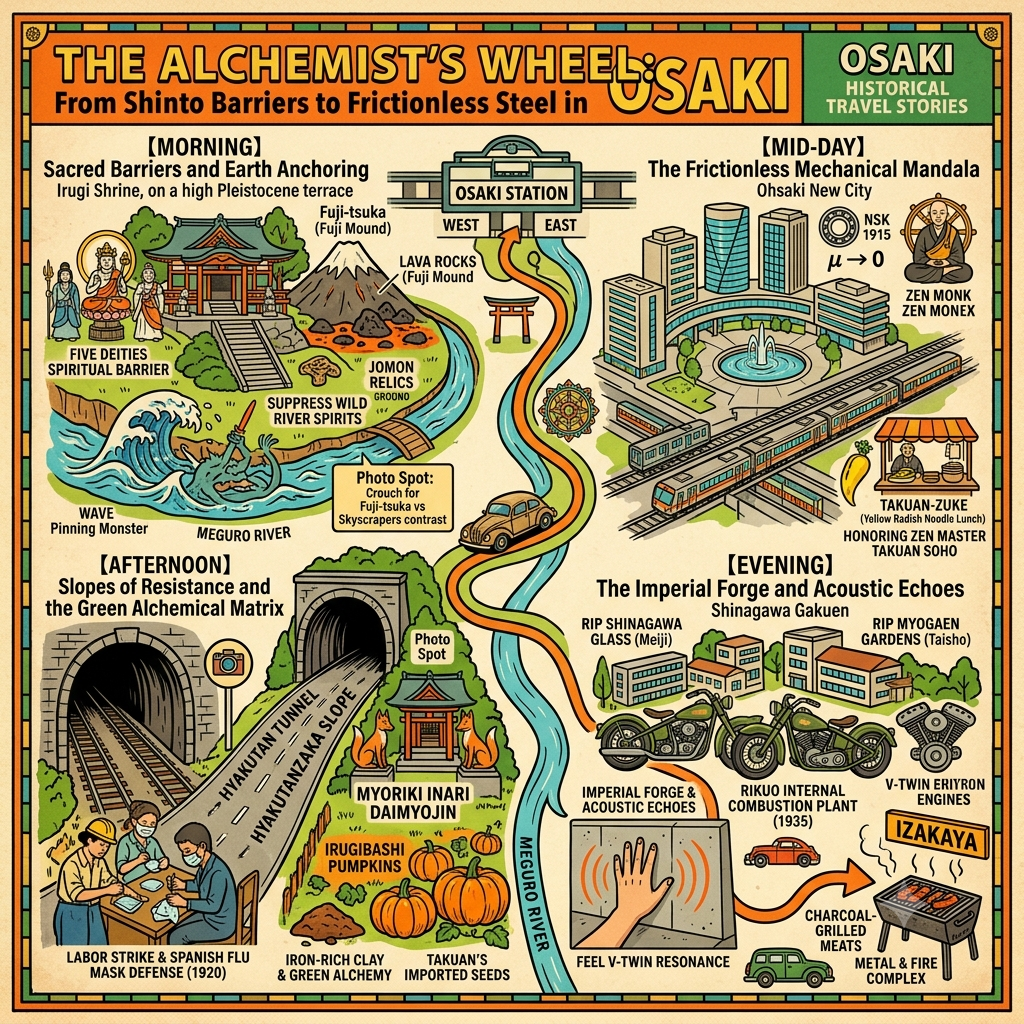
This is a historical travel story and walking guide to Osaki, a major transportation hub with a deep manufacturing past in Tokyo. Through the lens of the ancient "Osaki Shichizaki" (Seven Capes), it explores hidden shrines, Zen-related pumpkin legends, and pioneering factories along the Meguro River to show how sacred boundaries, artisan pride, and modern urban landscape overlap.
 Lawrence
The Existential Hook: The Soul Weight of the Great Cape
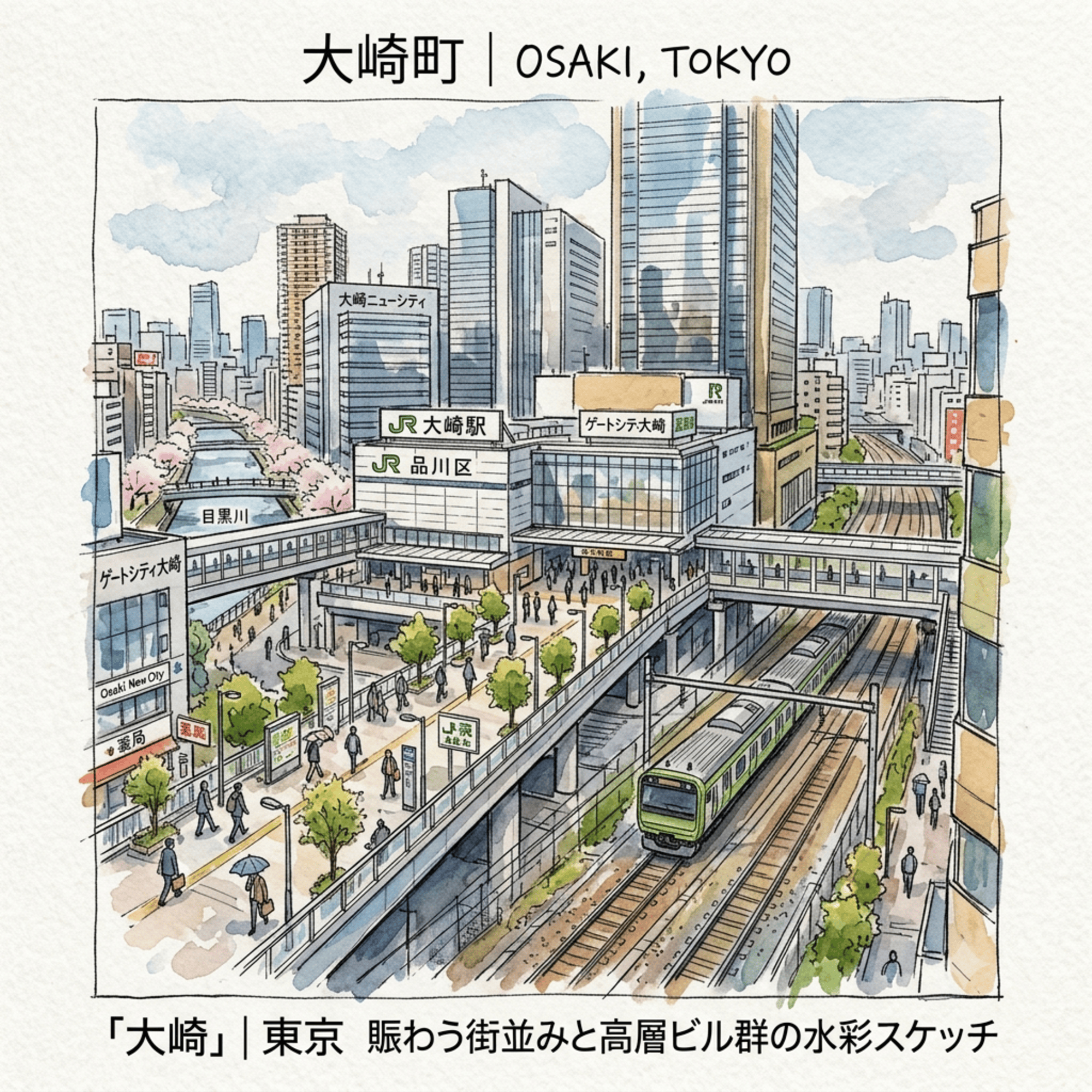
In the higher-order cartography of Tokyo, Osaki is frequently misidentified as a mere cluster of corporate monoliths. To the Ontological Historian, however, it reveals itself as a "Spiritual Anchor" of immense density. The district’s ancient topography, known as Oda-zaki (the Great Cape), was not a passive geographic feature but a primary "大地錨定點" (earth anchor). This massive diluvial cape, jutting out between the alluvial lowlands of the Meguro River and the ancient Shinagawa Bay, functioned as a geometric fortress of consciousness.
This landscape was an intentional barrier against the Aramitama (wild spirit) of the Meguro River—a water body traditionally perceived as a carrier of entropic chaos, flood, and plague. Even amidst the high-frequency vibrations of the modern Yamanote Line, the urban fabric of Osaki resonates with the memory of the Jomon-era shoreline. It remains a site where human intent first anchored itself to resist the formless encroaching tide, initiating a sequence of sacred relocations that would dictate the district’s metaphysical trajectory.
Listen to the historical stories told in detail (For subscribers only)
Node I: The Geometric Displacement of the Five-Shrine Shield (Irugi Shrine)
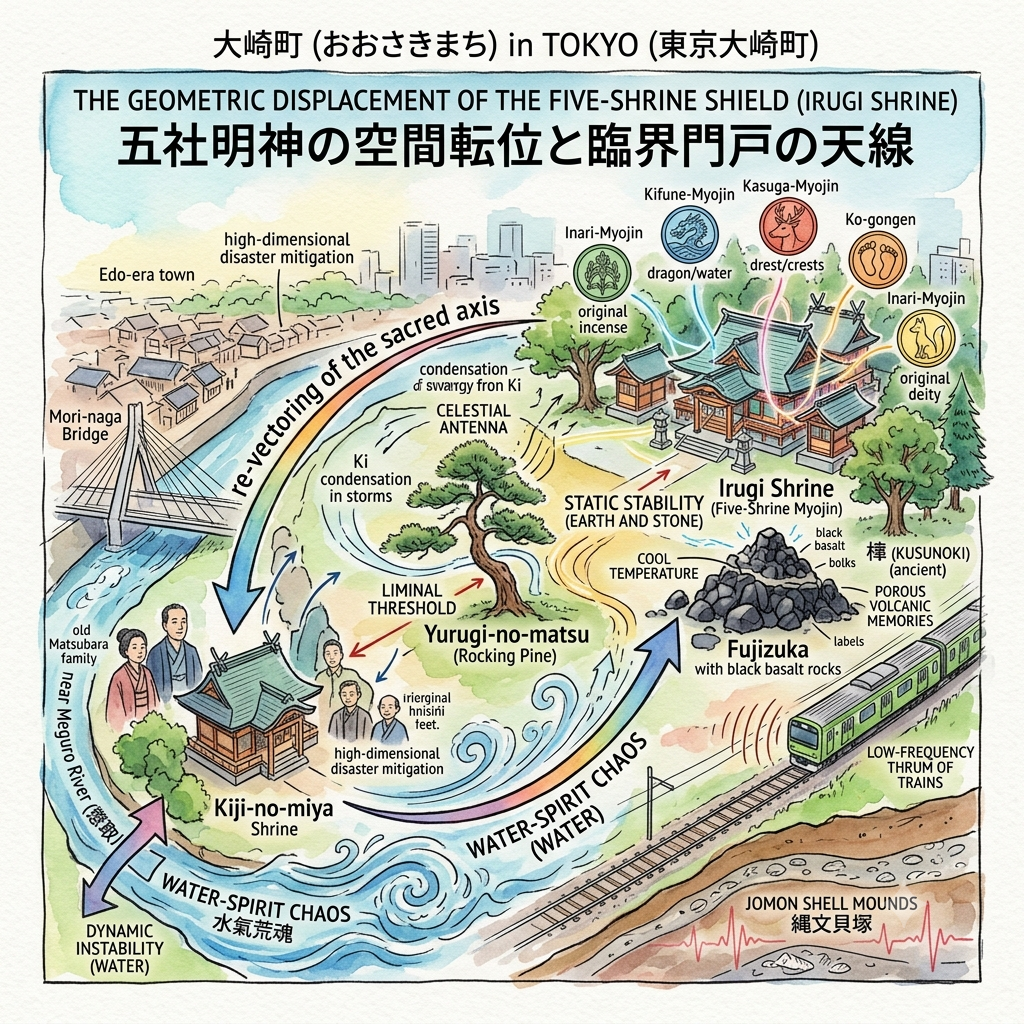
To stabilize a landscape besieged by the elements, one must engage in the "re-vectoring of the sacred axis." In the spiritual ecology of old Tokyo, the physical displacement of a deity was a sophisticated form of high-dimensional disaster mitigation.
Historical Narrative: Re-vectoring the Sacred
The Matsubara family, hereditary headmen of the Irugi Bridge Village, oversaw the strategic relocation of the "Kiji-no-miya" shrine. Originally situated in the flood-prone lowlands near the modern Mori-naga Bridge, the sanctuary was perpetually assaulted by "水氣荒魂" (water-spirit chaos). In a decisive act of spiritual engineering during the early Edo period, the community moved the shrine southwest to the stable Pleistocene terrace. This was more than a relocation; it was a merger. Four specific deities—Kifune-Myojin (Water Control), Kasuga-Myojin (Fujiwara Ancestral Protection), Ko-gongen (Guardians of Children and Feet), and Inari-Myojin (Harvest)—were synthesized with the original deity into the Five-Shrine Myojin (now Irugi Shrine).
High-Dimensional Retrofitting
This transition represents a spatial leap from "Dynamic Instability" (Water) to "Static Stability" (Earth and Stone). By positioning the shrine on the high plateau, the community established a "high-altitude visual control" point that suppressed the chaotic energy of the river below. Standing as a "Liminal Threshold" between these worlds was the "Yurugi-no-matsu" (Rocking Pine). This legendary tree acted as a celestial antenna, its violent swaying in storms serving to condense the scattered "Ki" (energy) of travelers and anchor the village’s spiritual boundaries.
Holographic Sensory Cue: Feel the exact, cool temperature of the Fujizuka’s black basalt rocks—porous, volcanic memories stacked into a miniature peak. Breathe in the scent of ancient, cedar-heavy incense mingling with the dry ozone of the Yamanote tracks. Beneath your feet, the low-frequency thrum of passing trains is conducted through the deep earth layers of the Jomon shell mounds, a rhythmic heartbeat of the Great Cape.
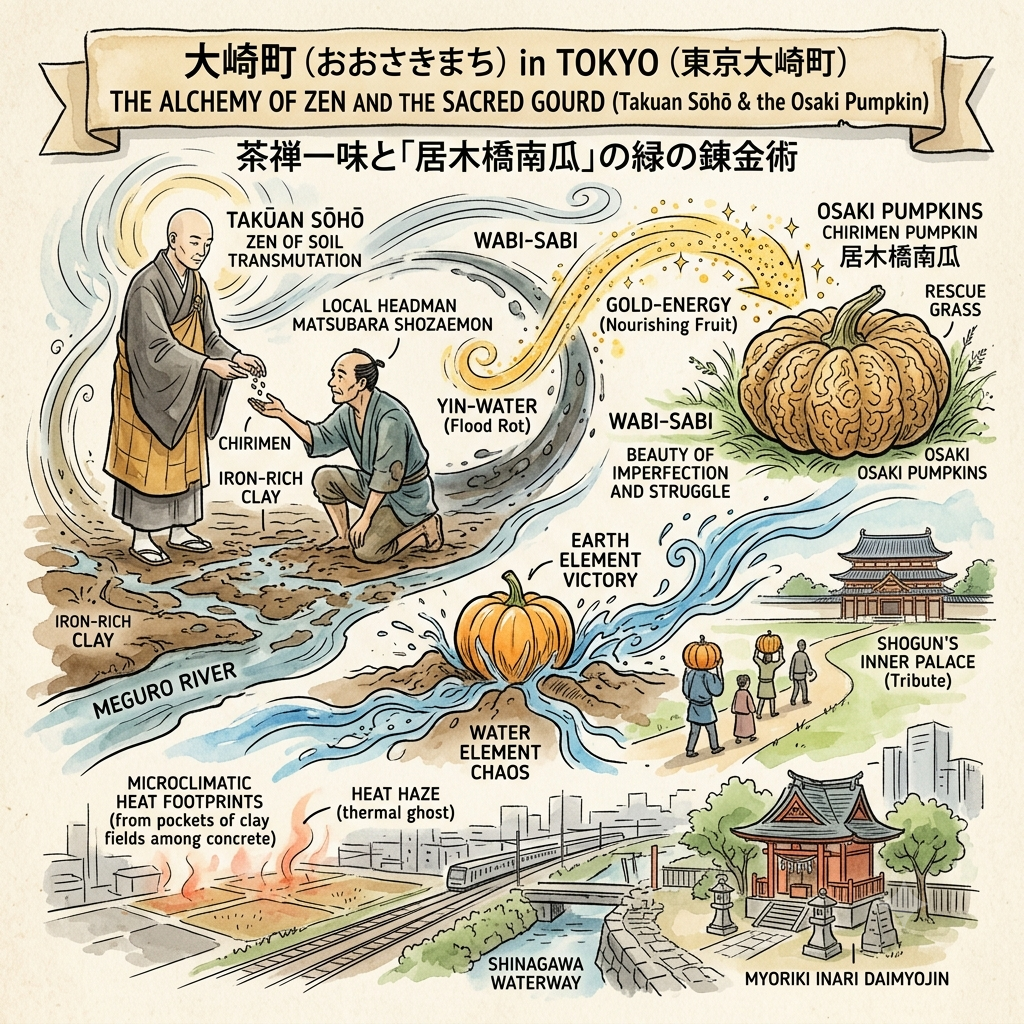
Node II: The Alchemy of Zen and the Sacred Gourd (Takuan Sōhō & the Osaki Pumpkin)
Land alchemy suggests that spiritual intent can transmute the soil itself, turning the residue of disaster into a "rescue grass" for the masses.
Historical Narrative: The Zen of Soil Transmutation
During the Edo period, Zen Master Takuan Sōhō, founding abbot of Tokai-ji, introduced "Chirimen" pumpkin seeds to Osaki. The local headman, Matsubara Shozaemon, utilized the iron-rich, flood-deposited clay of the Meguro River to perfect the crop. While the river’s silt brought destruction, it also provided a nutrient-dense medium. The "Osaki Pumpkin" emerged as a biological marvel: a water-resistant, high-calorie "rescue grass" that fed the capital during famines and was eventually presented as tribute to the Shogun’s inner palace.
High-Dimensional Retrofitting
The "Chirimen" (wrinkled) geometry of the pumpkin is a biological expression of Wabi-Sabi—the beauty of imperfection and struggle. Through the lens of Daoist physics, this was the transmutation of "Yin-water" (flood rot) into "Gold-energy" (nourishing fruit). The pumpkin thrived in the heavy, iron-rich clay, a literal "Earth element" victory over "Water element" chaos.
Resonance Node: Myoriki Inari Daimyojin
The Myoriki Inari Daimyojin, situated near the remnants of the Shinagawa Waterway, serves as a specific resonance node for this organic history. Here, among the stone traces of the former canal, one can still detect the microclimatic heat footprints of the former clay fields—pockets of air that retain solar energy differently than the surrounding concrete, a thermal ghost of the agricultural alchemy that once flourished here.
Node III: The Zero-Friction Mandala (NSK and the Birth of the Bearing)
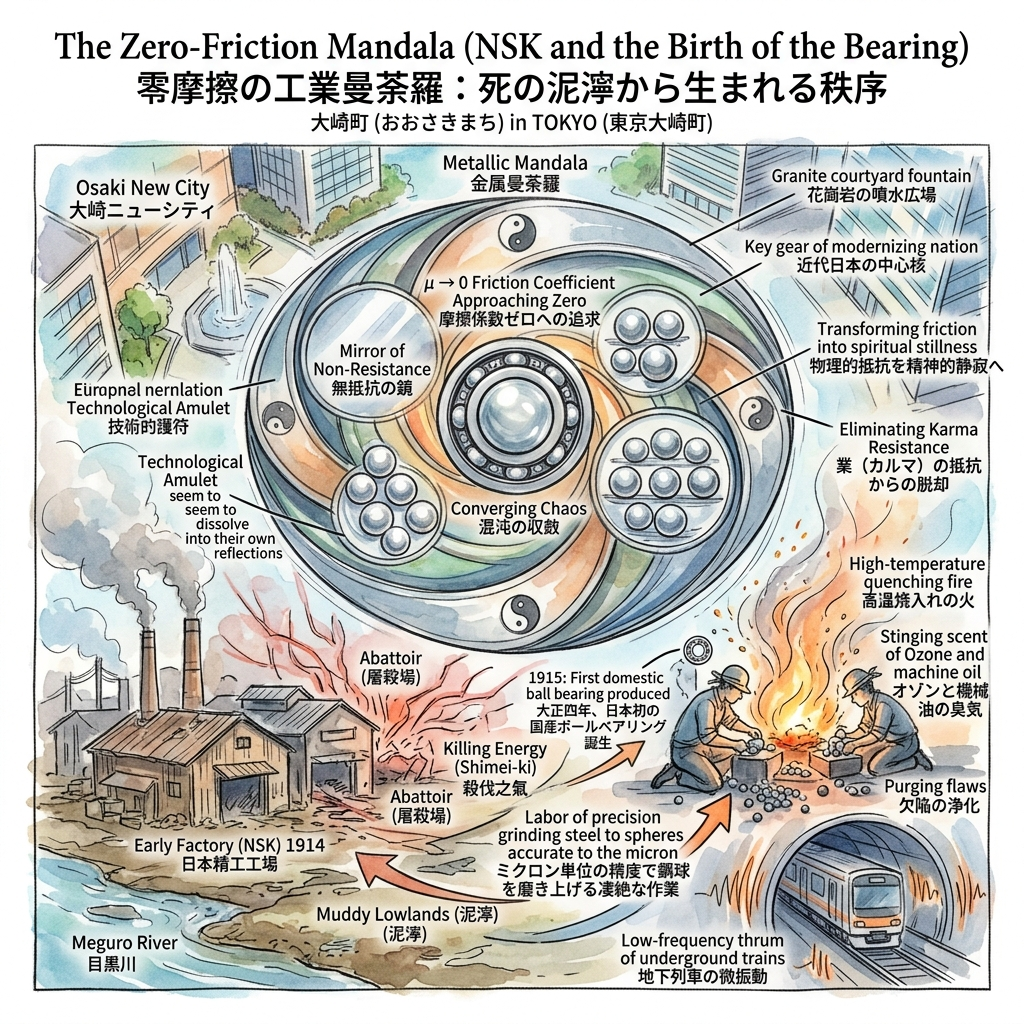
The industrial quest for precision is the modern mirror of the Buddhist pursuit of "Non-Resistance." In Osaki, this manifested as a literal attempt to eliminate the friction of existence.
Historical Narrative: 1914—The Forge of Precision
In 1914, Nippon Seiko (NSK) was founded at Site 410 in Osaki. The factory was born in a zone of intense spiritual friction: a muddy lowland adjacent to a slaughterhouse. This proximity meant the factory was bathed in "Shimei-ki" (殺伐之氣)—the killing energy of the abattoir. Yet, in 1915, amidst the stench of death and the threat of flood, NSK produced Japan’s first domestic ball bearing. This small steel sphere transformed Osaki into the "key gear" of a modernizing nation.
High-Dimensional Retrofitting
The ball bearing is a "Metallic Mandala"—a perfect geometric circle mirroring the Taoist Taiji. In this space, the mathematical quest for \mu \to 0 (the friction coefficient approaching zero) is a spiritual ritual aimed at eliminating "Karma Resistance." The labor of grinding steel into spheres accurate to the micron acted as a ritual to 收斂 (converge) the surrounding industrial and slaughterhouse chaos into a "Technological Amulet" of perfect rotation.
Holographic Sensory Cue: Inhale the sharp, stinging scent of ozone and machine oil. Feel the oppressive, radiating heat of the high-temperature quenching fire against your skin—a fire designed to purge the steel of its flaws. Observe the sight of thousands of polished spheres, each reflecting the dim light of a Meiji-era workshop, their surfaces so smooth they seem to dissolve into their own reflections.
Node IV: The Breath-Barrier of Hyakutan-zaka (The 1920 Mask Strike)
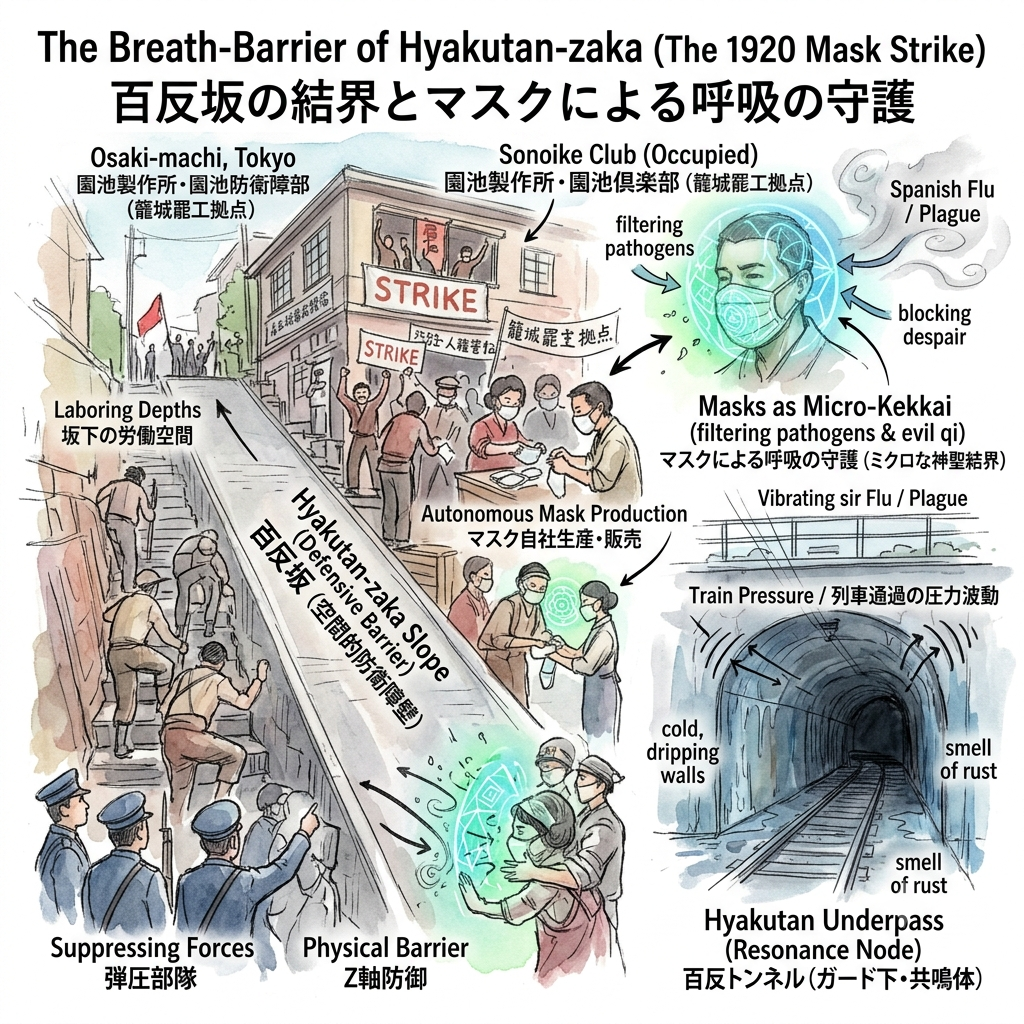
The Hyakutan-zaka slope is a psychological and physical boundary, a vertical axis separating the laboring depths from the heights of power.
Historical Narrative: The Siege of 1920
In 1920, the Sonoike Manufacturing plant became the epicenter of a fierce labor struggle. Faced with the post-WWI depression and the Spanish Flu pandemic, 450 workers occupied the "Sonoike Club" at the top of Hyakutan-zaka for 18 days. To survive the police and the plague, they established an autonomous production line for masks. Selling these "anti-flu masks" funded their resistance and ensured "zero infection" within their ranks.
High-Dimensional Retrofitting
These masks functioned as "Micro-Kekkai" (spiritual boundaries), filtering both physical pathogens and the "evil qi" of despair. The strikers utilized a "Z-axis defense," using the "Elevation Margin" of the Hyakutan-zaka slope to physically and psychologically hinder the ascent of suppressing forces. They turned a traditionally low-status district’s topography into a high-ground fortress of industrial democracy.
Resonance Node: Hyakutan Underpass
The Hyakutan Underpass remains a potent Resonance Node. Walking through this damp tunnel beneath the tracks, one experiences the crushing atmospheric pressure changes as trains roar overhead. The cold, dripping walls and the smell of rust serve as a sensory reminder of the weight of the "depths" that the workers once fought to transcend.
Node V: The Empire’s Iron Horse (The Rikuo Motorcycle and the Void of the Garden)
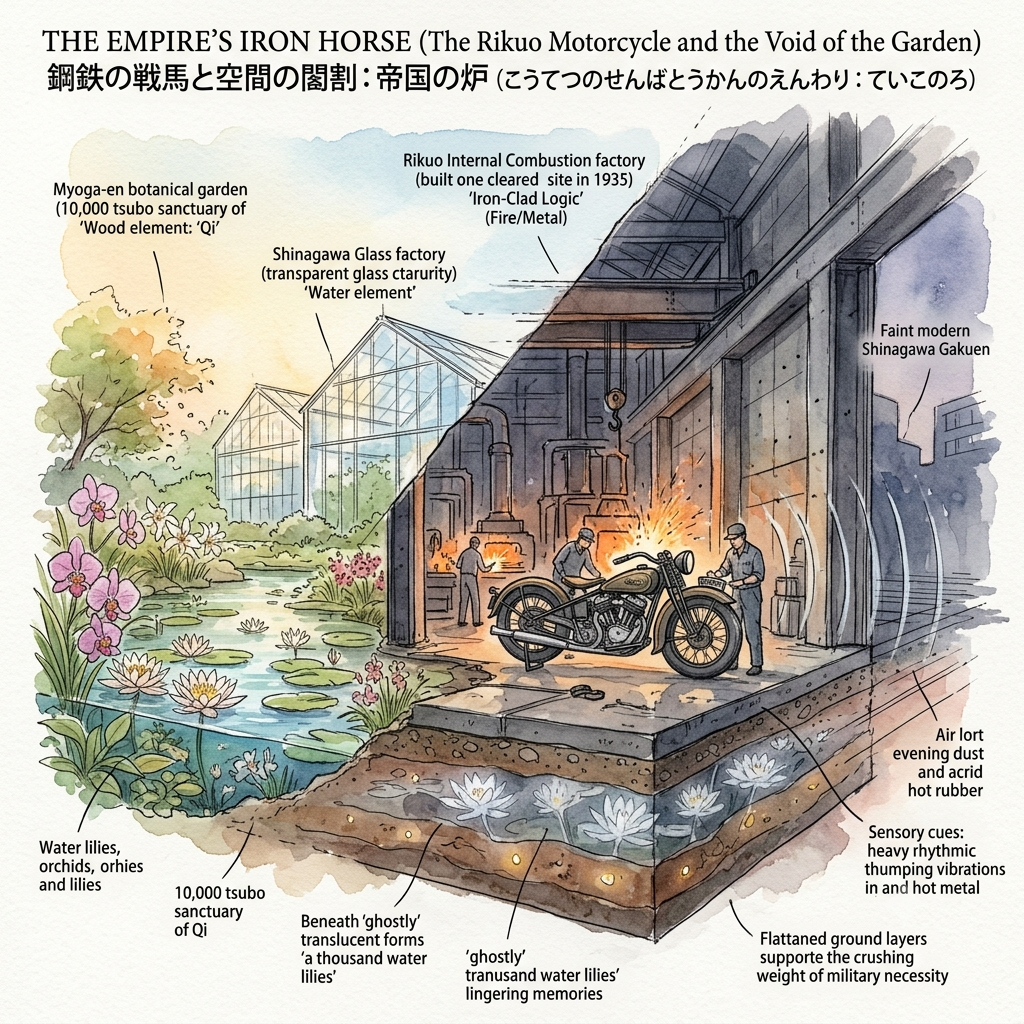
In the era of military expansion, "Earth Spirit Emasculation" occurred as the state enacted a "topographical erasure" of Osaki’s delicate organic history.
Historical Narrative: The Overwriting of Glass and Green
In 1935, the "Myoga-en"—a botanical garden featuring 10,000 tsubo of lilies, orchids, and water lilies—and the pioneering "Shinagawa Glass" factory were cleared. In their place rose the Rikuo Internal Combustion factory. Here, the "Iron Warhorse" was forged: the 500kg Rikuo motorcycle. The transparency of glass and the fragility of a water lily were crushed under the weight of imperial steel.
High-Dimensional Retrofitting
The V-Twin engine’s roar acted as "Artificial Infrasound," designed to suppress the natural "Qi" of the landscape. This was a conflict of elements: the transparency of Water (Glass) and the life-force of Wood (the Garden) were overwritten by the "Iron-Clad Logic" of the Fire/Metal complex. The land was forcibly flattened to support the crushing weight of military necessity.
Holographic Sensory Cue: Listen to the heavy, rhythmic thumping of V-twin engines echoing off concrete walls, a sound that vibrates the very marrow of your bones. Smell the acrid scent of hot rubber and the dust of evening shadows on the grounds of Shinagawa Gakuen, where the ghost of a thousand water lilies lies beneath the pavement.
Conclusion: The Grand Narrative of Human Destiny
Osaki serves as a "Spiritual Piston" for Tokyo—a mechanism that absorbs the shocks of history and converts them into progress. Its true value is its resilience: its ability to absorb catastrophe—the Aramitama of floods, the Shimei-ki of the slaughterhouse, the plague, or the "iron logic" of war—and output order through shrines, food, precision, and democracy.
Historical memory is our most valuable asset. By decoding the layers of the Great Cape, we anchor our own consciousness in a multidimensional universe, ensuring that the "Zero-Friction" future is built upon a foundation of deep, acknowledged history.
Call to Action: To anchor your consciousness in the hidden geographies of our world, subscribe to the "Temporal Nodes" newsletter—your guide to the high-dimensional explorations of our shared future.
Accessing the Physical Node (Logistics as Ritual)
Arriving at the Node
- Station: Osaki Station (JY24).
- The Ontological Divide:
- West Exit: Immediate access to the "Static Stability" zone and the high-plateau residential terraces.
- East Exit: Entry into the "Industrial Mandala" and the redeveloped lowlands of the modern Osaki Matrix.
Anchoring Points
- For those seeking to observe the matrix from above, the local high-rise accommodations offer "high-dimensional views" that allow one to trace the geometric resonance of the Great Cape and the curving, now-tamed path of the Meguro River.
Temporal Walks
- The Stability Route: Begin at Irugi Shrine to ground yourself at the "Five-Shrine Shield." Observe the black basalt of the Fujizuka.
- The Slope of Resistance: Descend Hyakutan-zaka, passing the Myoriki Inari node, and walk through the Hyakutan Underpass to feel the pressure of the historical depths.
- The Garden Void: Conclude at the Shinagawa Gakuen grounds (former Rikuo factory site) to reflect on the transformation of "Iron Warhorses" into a space for the next generation.
Reference and Further reading
- 大崎(JY24) : 「大きな谷」の「谷」が「崎」に変化―工場の街は高層ビル林立するビジネス街に,
- 居木神社 / 東京都品川区 | 御朱印・神社メモ,
- 大崎の今昔を見守る鎮守の杜。居木神社と街の新旧探訪 - JONAN MAGAZINE|東京城南エリアの魅力発掘マガジン,
- 大崎 (品川区) - Wikipedia,
- 江戸および荏原の名称の概要 - 品川区,
- 目黒川流域浸水実績図 - 東京都総合治水対策協議会,
- 東海道「品川宿」 ~ 品川・荏原 | このまちアーカイブス - 三井住友トラスト不動産,
- 居木神社 | 東京都品川区 - 古今御朱印研究所,
- カボチャも、シクラメンも、“農作と植物栽培の地” 大崎から。,
- 居留木橋カボチャ | 東京農業歴史めぐり,
- 「おおさき今昔MAP」PDFはこちら,
- お取り寄せ> 復刻古地図 明治40年 東京市15区 近傍34町村 番地界入 18.荏原郡品川町・大崎町,
- 31知られざる大崎の歩みを訪ねて【ものづくり編】,
- NSKのあゆみ | 日本精工 (NSK) - NSK Ltd.,
- 20ものづくり100年の歴史に輝く、大崎発展の担い手「NSK」,
- 日本精工 - Wikipedia,
- 大正八年から十三年にかけて大崎町の園池製作所で世間の注目を集める争議が四たびにわたって起った。園池の労働者は友愛会の東京鉄工組合(一九一八年十月 - ADEAC,
- 人のぬくもりに溢れた「百反坂」,
- 上大崎一丁目 「寺町」の紹介です - ADEAC,
- 居木神社 - Wikipedia,
- 天祖諏訪神社 / 東京都品川区 - 御朱印・神社メモ,
- 御祭神と由緒 | 大崎鎮守 居木神社(いるぎじんじゃ),
- 居木神社 - 品川区 - 東京都神社庁,
- 居木橋 - しながわ百科,
- 江戸の伝統野菜と健康,
- 「カボチャ-カロテン豊富な健康野菜-」 Pumpkins - Caroten-rich healthy vegetables -,
- 特別展「品川産業事始~日本を支えた近代産業群」 @品川歴史博物館・東京都品川区大井6丁目,
- 百反坂(大崎) - ぼのぼのぶろぐ,
- 昔は工場地帯、今やタワマンシティー 意外と知らない「大崎」のディープな歴史をたどる,
- 大崎町 (東京府) - Wikipedia,
- 【大正期の園池製作所争議】 - ADEAC,
- 百反坂 - 品川区,
- 百反坂下(品川区大崎 1989年) - 善本喜一郎 kiichiro yoshimoto,
- 大崎歴史発見物語,
- 国産初の大型オートバイ、伝説の「陸王」誕生,
- おおさき今昔MAP & 大崎てくてくマップ - 歩・探・見・感,
- 心に熱と開拓魂を持ち合わせているか~区役所アート・品川区編,
- 陸王 (オートバイ) - Wikipedia
 Lawrence
 Lawrence
 Lawrence
Historical Travel Stories publishes long-form historical travel writing rooted in primary research. All historical claims in this article are sourced from institutional records, academic publications, and municipal historical archives. Last updated: June 2026.