(ENG) Shinagawa, Tokyo: A Post Town Walked in Five Layers
Discover Shinagawa beyond the train station. This historical walking guide takes you through the remnants of Tokyo’s first Edo-period post town, revealing how ancient shrines and coastal history still breathe beneath the shadow of modern skyscrapers.

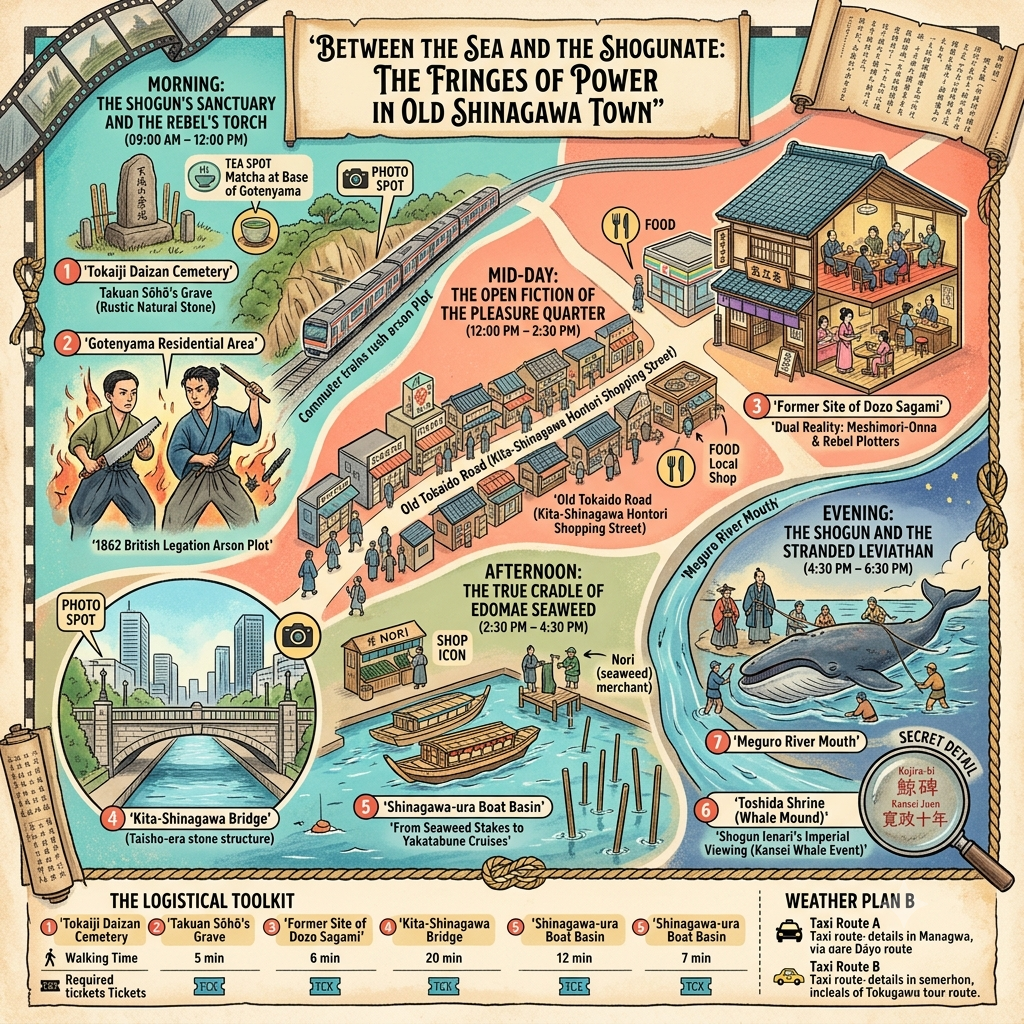
This is a historical travel story and walking guide to Shinagawa, once the bustling first post station of the historic Tokaido road in Tokyo. Navigating through quiet temples, old coastal alleys, and modern high-rises, this walk uncovers the hidden layers of Edo-period heritage left behind in today's sleek transport hub. It offers a fresh perspective, a detailed route, and a deep appreciation for how Tokyo’s samurai past coexists with its futuristic present.
 Lawrence
Most people who pass through Shinagawa never actually go there. They change trains, maybe buy a box lunch, and keep moving — the station's main job, for over a century, has been to send people somewhere else. But one block south of the platforms, the old Tokaido road is still doing what it did four hundred years ago: it's a working street, narrow enough that you can touch both sides if you stretch your arms out, and it remembers more than the station ever will.
This stretch of road was once Shinagawa-juku, the first of the fifty-three official stations on the Tokaido — the highway that connected Edo, the shogun's capital, to Kyoto, the emperor's. Everything that moved between the two cities, official or otherwise, passed through here first. What follows are five things that happened on this short walk of road, and what they still explain about how the city above it works.
Listen to the historical stories told in detail (For subscribers only)
A Shogun Once Came to Look at a Whale.
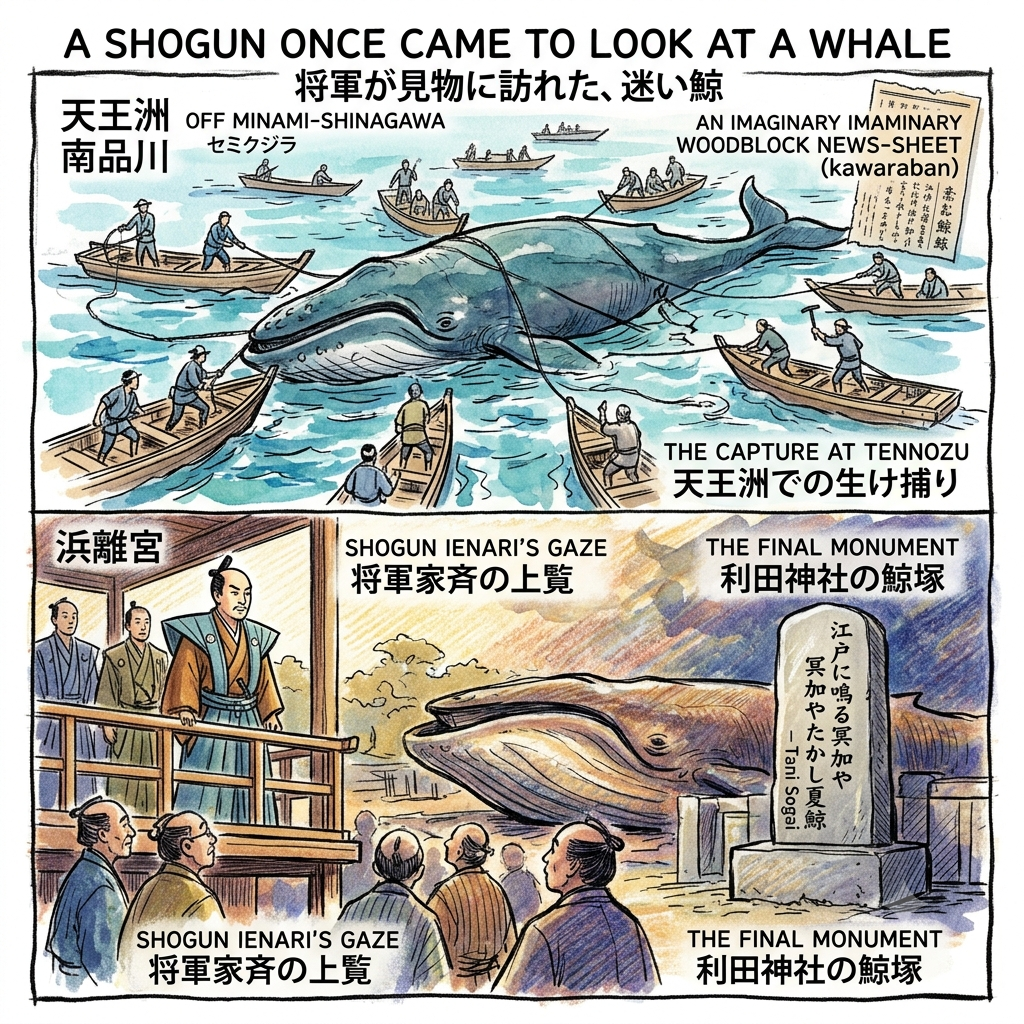
In the early summer of 1798, a storm pushed a whale — likely a right whale, around fifty feet long — into the shallow water off Shinagawa. The local fishermen of Minami-Shinagawa, who made their living mostly on much smaller catches, cornered it near Tennozu and brought it down by hand.
Word got out fast. Boat operators started charging Edo residents for a closer look, and the crowds were thick enough that the event made it into the woodblock-print equivalent of the evening news. Then the shogun himself, Tokugawa Ienari, came down to the shogunal villa at what's now Hama-rikyu to view the carcass in person — the head of a military government that ran on rigid hierarchy, standing in line, more or less, with everyone else who wanted to see the whale.
江戸に鳴る冥加やたかし夏鯨 ("All of Edo rings with this stroke of fortune — what a tall order, this summer whale.") — the poet Tani Sogai, inscribed on the whale monument at Toda Shrine
The whale's skull was buried at a small shrine on newly reclaimed land nearby, with a stone marker raised over it. That marker is still there. It's easy to read the story as a curiosity — a fish story, literally — but it's really a small case study in how premovern authority worked: a leader's legitimacy wasn't just maintained through law and force, it was performed, in public, in front of a crowd that had gathered for an entirely different reason.
A Monk's Exile Built a Temple Designed Around an Inside Joke
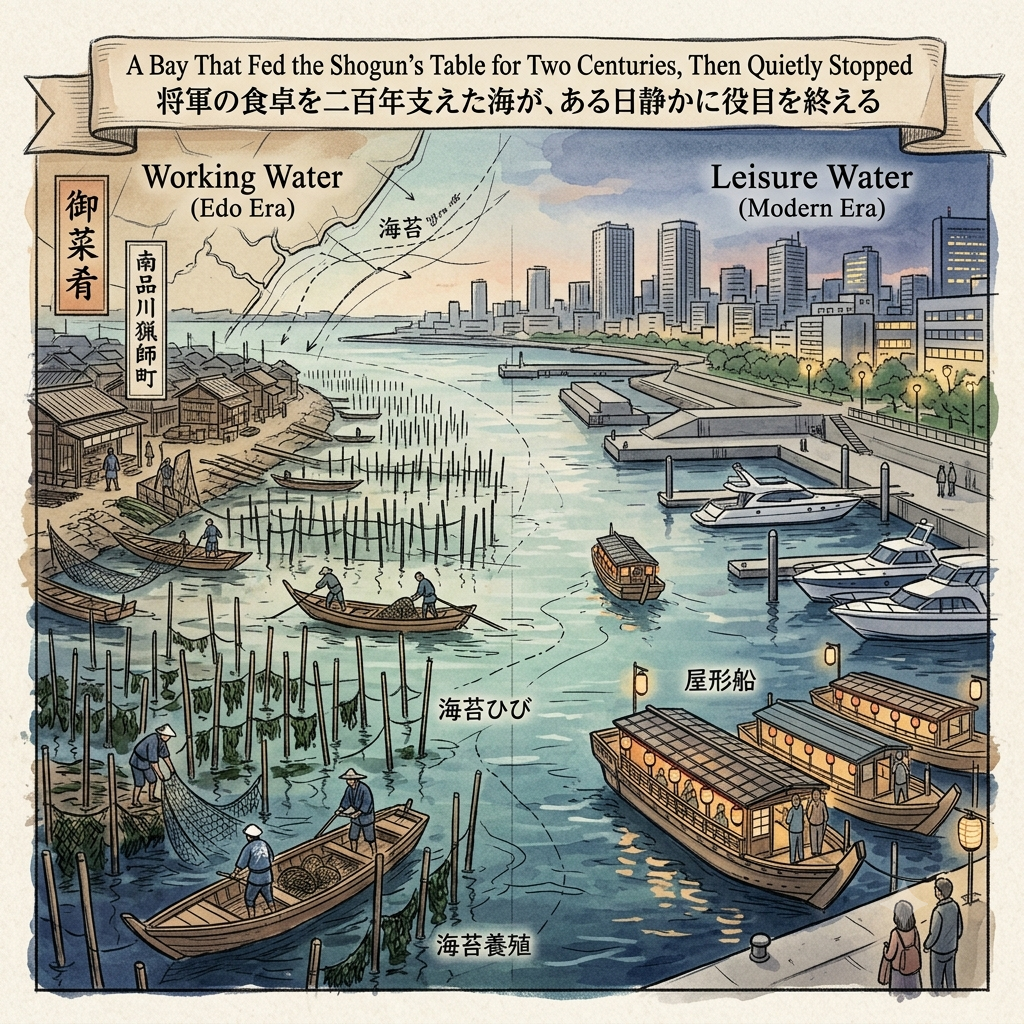
In 1629, a Zen priest named Takuan Soho got on the wrong side of a fight over who actually controlled Buddhist clergy in Japan — the emperor's court, which had been handing out honorary purple robes for centuries, or the shogunate, which had just decided it wanted final say. Takuan sided with the court. The shogunate exiled him to the provinces.
Three years later, a general amnesty brought him back, and a meeting was arranged with the young shogun, Tokugawa Iemitsu. The two apparently got along well enough that Iemitsu refused to let him return to Kyoto at all — he gave him land in Shinagawa instead, on a parcel close enough to the water that you could smell the tide, and built him a temple: Tokai-ji, "Temple of the Eastern Sea."
The story that survives from their friendship is a small piece of wordplay. Iemitsu reportedly teased him: the temple sits right on the coast, so why name it "Eastern Sea" instead of "Far Sea"? Takuan's answer, recorded in the Tokugawa Jikki chronicles, was this:
"It's the same as how Your Majesty is addressed as 'Great Lord' rather than directly as 'Shogun.'"
It's a throwaway line that happens to summarize the entire constitutional tension of the era — the shogun ran the country, but the fiction of imperial supremacy had to be maintained in the naming of things, even on a stone marker by a temple gate. Banishing a monk over a dispute about titles, then turning around and building him a temple structured around a joke about titles, is the kind of detail that tells you more about Edo politics than most textbooks manage to.
"Yoshiwara in the North, Shinagawa in the South"
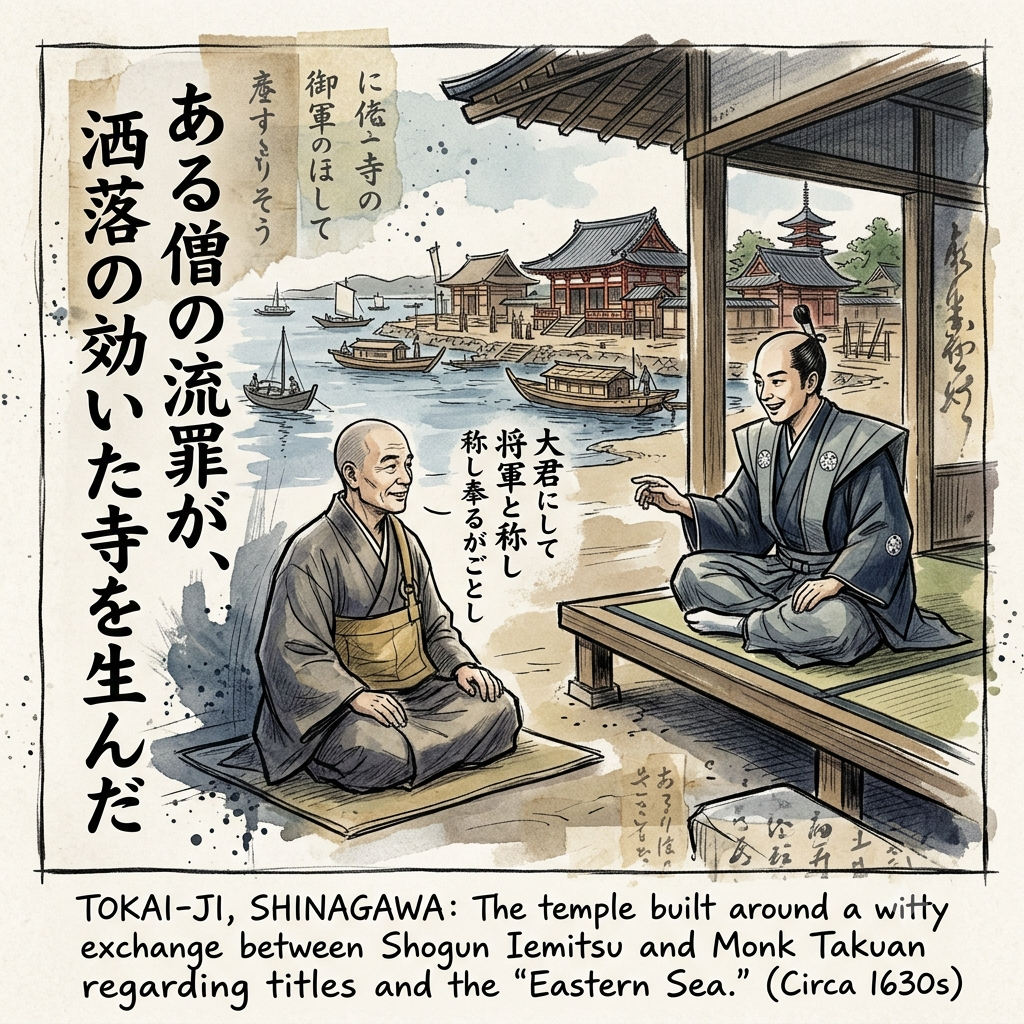
Edo-period law technically banned post towns from operating brothels. It also made those same post towns responsible for an enormous, unpaid burden of moving official traffic along the highway — horses, porters, lodging, all of it unfunded. Shinagawa, like the other stations, solved its budget problem by hiring "meal-serving women" (meshimori onna) who served food and, unofficially, much more.
By 1772, the shogunate had given up pretending otherwise and capped the practice at 500 women townwide. The cap didn't hold. Records from 1843 show over ninety inns operating, with somewhere north of 1,400 women working in them — several times the legal limit, and close to the scale of Yoshiwara itself, Edo's only officially licensed pleasure district. Locals had a phrase for it: Yoshiwara in the north, Shinagawa in the south.
What's worth sitting with here isn't the romance of an "old red-light district" — it's the mechanism. The shogunate built a national road system and then quietly outsourced its financing to women's labor, maintaining a legal fiction (they're food servers, not prostitutes) that everyone involved understood to be false. This wasn't an accident of one town; it was standard operating procedure for how Edo-period infrastructure paid for itself, repeated at checkpoint towns up and down the country. The practice, in one form or another, continued at Shinagawa until Japan's 1958 anti-prostitution law finally shut it down — nearly three centuries after it started.
The old road itself is now the Kita-Shinagawa Hondori shopping street: grocers, a few old confectioners, motorbikes parked at angles. The width of the street hasn't changed since the Edo period. You're walking the same lane, at the same scale, and almost nothing tells you so.
Twelve Young Men Burned Down an Embassy That Hadn't Opened Yet
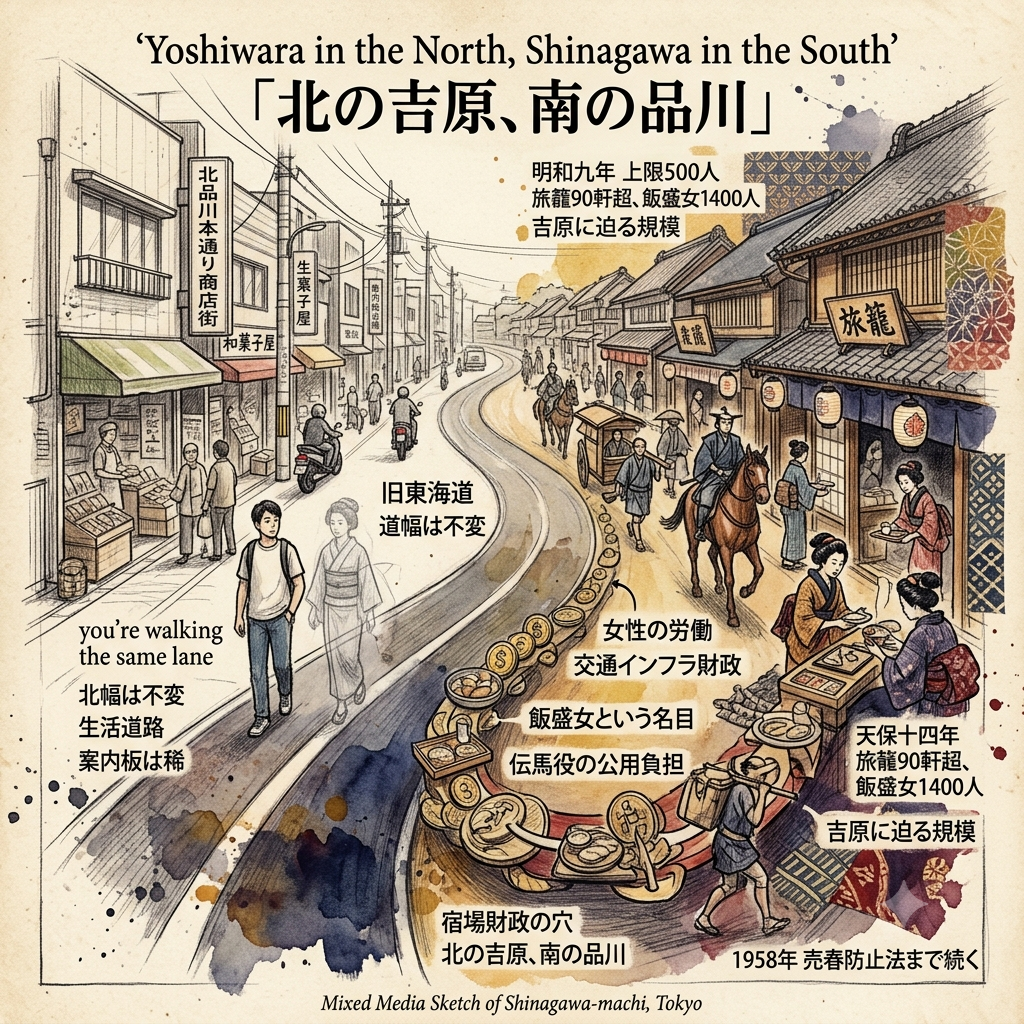
By 1862, the shogunate had been forced into trade treaties with Western powers it didn't particularly want, and anti-foreign sentiment among the samurai class had hardened into actual political violence. Goten-yama, a hillside in Shinagawa once known for cherry-blossom viewing, had been chosen as the site for a permanent British legation — and to the men who would later torch it, that decision alone was an insult worth answering.
On the night of December 12, a group of around twelve domain samurai from Choshu, led by Takasugi Shinsaku, met beforehand at a brothel called Dozo-Sagami on the old post road, then crossed the construction site's perimeter, cut through a fence, and set the unfinished building on fire. No one was hurt — the legation hadn't opened yet — but the building burned to the ground, and the men reportedly watched the blaze from a teahouse across the bay.
The shogunate knew roughly who was responsible. No one was ever charged.
What makes this story worth telling isn't the arson — it's who these arsonists became. Ito Shunsuke, who helped cut the fence that night, became Ito Hirobumi: the principal author of Japan's first constitution and its first prime minister. Inoue Monta became Inoue Kaoru, a foreign minister of the same government that would go on to court Western diplomats rather than burn down their buildings. In old age, Ito told the story of the burning as a piece of personal swagger, not a confession.
"The officials no doubt had us marked as the likely culprits, but without proof, and with some deference to the domain's standing, they didn't press the matter — and not one of us was ever punished for it." — Ito Hirobumi, recalling the incident years later
It's one of the better illustrations available of how thoroughly Japan's modernizers were drawn from the ranks of its former reactionaries. There's no marker today at the legation site, which is now an ordinary apartment block. The brothel where they plotted does have a small plaque, easy to miss, on the corner of a building with a convenience store on the ground floor.
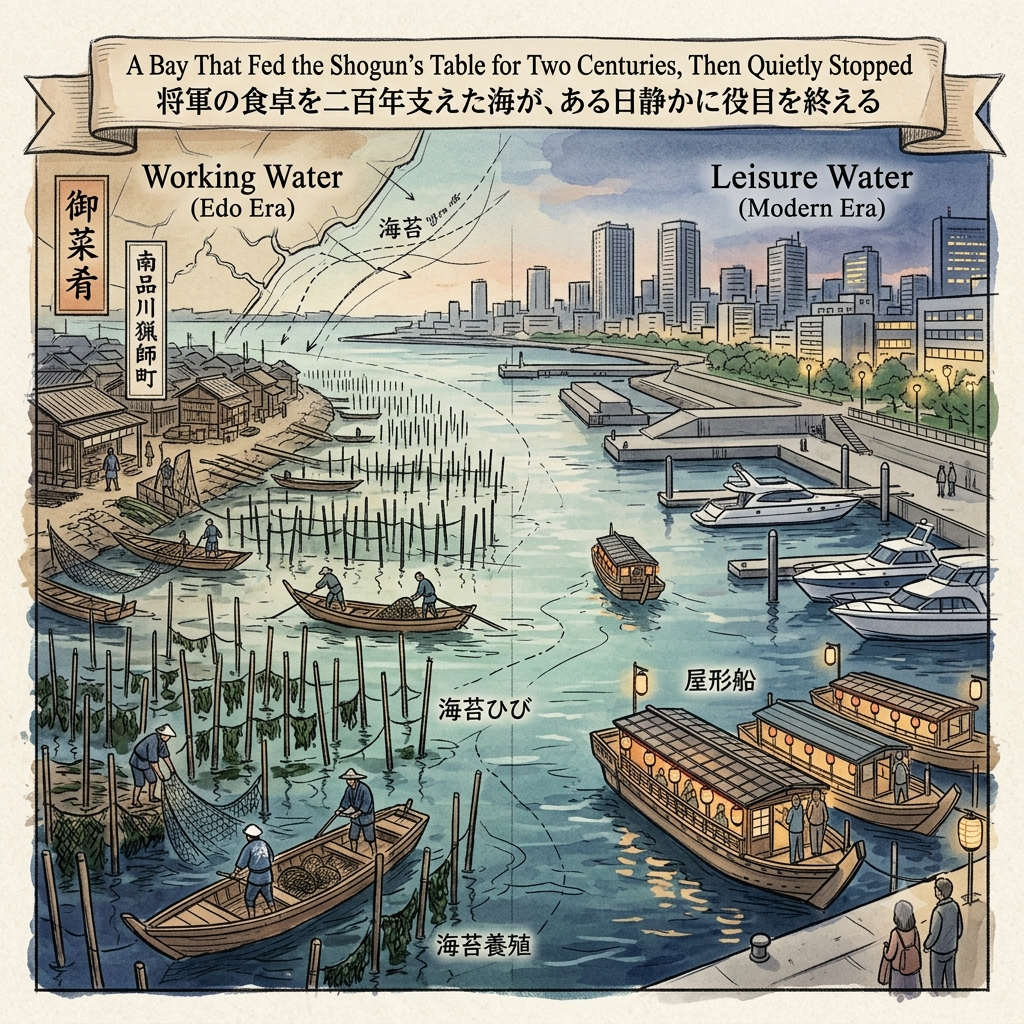
A Bay That Fed the Shogun's Table for Two Centuries, Then Quietly Stopped
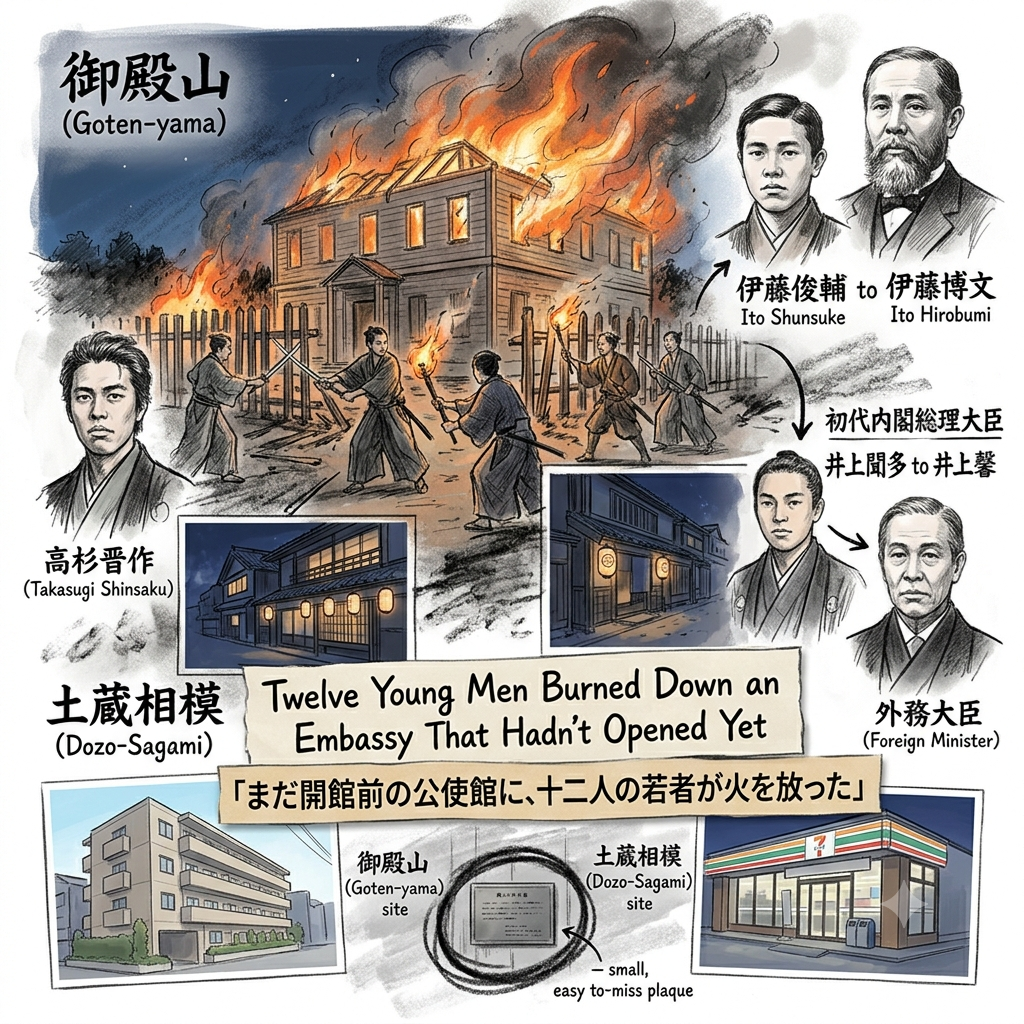
Long before it became a name for sushi-bar nori, "Asakusa seaweed" was mostly grown somewhere else entirely. The village of Minami-Shinagawa Ryoshi-machi — Shinagawa's fishing settlement — was one of eight bay villages formally obligated to supply fresh seafood to Edo Castle. Sometime in the early 1700s, fishermen here began staking branches in the shallows to cultivate nori, a technique that later spread up the bay to Omori and Haneda. The harvest was shipped to wholesalers in Asakusa for distribution, who got the naming rights despite doing none of the growing.
The arrangement outlasted the shogunate itself. It survived the Meiji Restoration, two world wars, and most of the twentieth century. Then, in 1962, with Tokyo pushing to expand its port facilities, the fishing rights were formally surrendered to the metropolitan government. By 1963, more than two hundred years of seaweed cultivation in Shinagawa Bay had ended.
The harbor is still there — it just holds different boats now. Pleasure craft and yakatabune, the lantern-lit dinner boats popular with tourists, sit where fishing boats used to. It's a clean, almost too-tidy example of a pattern familiar from waterfronts everywhere: working water becomes leisure water, usually within a single working lifetime, and usually with very little fanfare at the moment it happens.
A site worth seeking out on purpose: the whale monument at Toda Shrine — a small, badly weathered stone marker tucked in a corner of the shrine grounds, easy to walk straight past. It's the only surviving whale grave-monument in Tokyo, and the one spot on this walk where two completely separate stories — Takuan's reclaimed shrine land and the shogun's whale — physically overlap.
The Street Matters More Than Any Single Building
What holds this walk together isn't any one site — it's the fact that the road itself hasn't moved or widened since the Edo period. Starting from Shin-Bansho Station, the old Tokaido runs south past the Dozo-Sagami marker, Tokai-ji, the Shinagawa fishing harbor, and the whale monument, all within about twenty minutes on foot.
That continuity of width is the actual artifact here. The same narrow lane carried Ito Hirobumi toward an arson plot, carried meshimori onna between inns on their daily rounds, and carries you, today, past a vegetable shop that doesn't know it's standing on any of it. Cities rarely keep their history in museums. More often they keep it in the dimensions of a street that nobody thought to widen.
A Closing Thought: Borderlands Don't Get to Stay Quiet
Looked at together, these five stories all describe the same kind of place: a border. Shinagawa sat at the edge of Edo's formal boundary, at the edge of legal and illegal economies, at the edge of imperial and shogunal authority, at the edge of an isolationist country forced open to the world. And in nearly every case, when that edge came under pressure, Shinagawa is where it cracked first — a stranded whale drew the shogun to the shore, a banished monk's reconciliation produced a private temple, a construction site became a crime scene, a fishing bay quietly handed itself over to a port authority.
It raises a question worth carrying to the next place you visit: are border districts like this one simply overlooked by history, or are they overlooked precisely because they're the places history keeps asking to absorb the shock first?
If this kind of layered reading is your idea of a good afternoon, the broader Tokyo Bay walking history is worth your time next, along with a companion piece on the other forgotten checkpoint towns of old Edo. We send out one new walk like this every couple of weeks — worth keeping an eye out for, if you're the type who reads plaques.
Practical Notes
Getting there: Take the Keikyu Main Line to Shin-Bansho or Kita-Shinagawa Station, both of which open directly onto the old Tokaido. Alternatively, from JR or Keikyu Shinagawa Station's Takanawa exit, it's about a ten-minute walk via Yatsuyama Bridge to the same starting point.
Where to stay: Shinagawa Station itself is a shinkansen stop, which makes the business hotels clustered immediately around it a practical base for day trips along the old post road and onward to Odaiba or Shibaura.
Nearby: The full walk — Tokai-ji, the Takuan gravesite at Tokai-ji's Oyama Cemetery, the whale monument, the fishing harbor, and the old shopping street — takes one to two hours and fits comfortably into a layover between trains. If you'd rather see the bay than the street, the harbor still runs yakatabune charters, which is, in its own way, the most honest way to look at water that used to be a fishing ground.
Reference and Further reading
Primary sources (archives and official historical materials)
- 品川區立品川歷史館——「品川を愛した将軍 徳川家光」特展相關資料及解說頁面
- 品川區公式網站〈品川人物傳〉系列——沢庵宗彭專題
- 品川區觀光協會官方網站——東海寺、東海寺大山墓地條目
- 《徳川実記》(徳川實紀)相關記載(家光與沢庵問答河岸軼事之原始文獻依據)
- 利田神社境內「鯨碑」品川區指定有形文化財解說牌(品川區教育委員會設置)
- 《新編武蔵風土記稿》原文記載(江戶幕府編纂之地誌,記錄南品川新開場辨天社及鯨塚由來)
- 《東京都神社名鑑》利田神社條目
- 品川區觀光協會官方網站——利田神社・鯨塚條目
- 品川區觀光協會官方網站——舊東海道品川宿巡覽路線、土蔵相模跡條目
- 品川區立品川歷史館——〈近世の品川〉常設展解說頁面
- 品川區公式網站〈品川人物傳〉等地方史系列資料
- 品川區立品川歷史館——《御殿山外國公使館の建設と焼き討ち事件》解說資料(品川歷史館解說シート系列)
- 品川區觀光協會官方網站——御殿山、土蔵相模跡、品川台場相關條目
- 品川區立品川歷史館——〈近世の品川〉常設展解說頁面、《浅草海苔の始まり》《江戸湾の漁業》品川歷史館解說シート系列
- 品川區觀光協會官方網站——品川浦舟だまり條目
- しながわデジタルアーカイブ(品川區數位典藏)相關地方史資料
Level 2 materials (academic works)
- 日語維基百科「沢庵宗彭」「東海寺 (品川区)」條目所引用之史料脈絡(可作為查找原始研究文獻的索引,但不應視為終局學術依據)
- 紫衣事件相關之江戶幕府宗教政策研究,建議進一步查證原始檔案,例如近世佛教史、近世天皇制研究領域之專書與論文
- 江戶後期庶民文化與瓦版研究、江戶內海漁業史相關學術論著,建議進一步查證原始檔案以確認具體期刊與專書出處
- 歌川廣重《名所江戸百景・品川すさき》之圖像史料研究,可作為視覺史佐證
- 日語維基百科「品川宿」「飯盛女」條目所引用之江戶交通史、宿驛制度研究脈絡,可作為查找原始學術文獻(如近世交通史、近世風俗史相關專書與論文)之索引
- 末吉惠、菊地俊夫〈旧宿場町の歴史資源を活かしたまちづくりの構造とその地域性:品川宿と千住宿の比較研究〉,《観光科学研究》2009年第2號(首都大學東京大學院都市環境科學研究科),可作為品川宿與千住宿比較研究之學術參照
- 江戶四宿性產業史、近世公娼制度研究,建議進一步查證原始檔案以確認完整書目資訊
- 日語維基百科「英国公使館焼き討ち事件」條目所引用之史料與研究脈絡,包括英國外交官歐尼斯特・薩道(Ernest Satow)回憶錄《一外交官の見た明治維新》(A Diplomat in Japan)中對事件背景與緊張局勢的當事人記述,此書可作為英方視角的一手史料,建議直接查證原書相關章節
- 幕末長州藩政治史、伊藤博文與井上馨早年活動之傳記研究,建議進一步查證原始檔案(如《伊藤博文傳》等原始傳記文獻)以核實具體行動細節與人數記載之出入
- 江戶內海漁業史、近世海苔養殖技術史相關學術研究,建議進一步查證原始檔案以確認具體期刊與專書出處(如近世漁業史、東京灣岸環境史相關專門研究)
- 戰後東京港灣開發史、漁業權收購與沿岸產業轉型相關研究,建議進一步查證東京都港灣局或相關行政史料
Level 3 Information (Supplementary Background)
- 各類地方史散步部落格與寺院巡禮紀錄,可作為現場景觀描述的輔助參考,但不可作為史實依據
- 地方歷史愛好者部落格對碑文現狀、保存狀態之實地踏查紀錄(可作為現況描述參考,非史實依據)
- 地方史踏查部落格對土蔵相模跡現況、品川宿商店街現狀之實地紀錄
- 落語「居残り佐平次」「品川心中」等口傳曲藝文本,作為民間記憶與文化再現的輔助參照(非史實本身)
- 後世通俗歷史敘述與地方踏查紀錄中關於「芝浦飲酒慶祝」等軼事性細節,史料確定性較低,建議視為民間記憶而非確證史實
- 電影、戲劇等文化再現中對此事件之描繪,可作為理解事件在近現代日本大眾記憶中地位的輔助材料
- 歌川廣重《名所江戸百景・南品川鮫洲海岸》圖像史料(視覺佐證,非文字史料)
- 地方商店街(如鮫洲商店街)官方網站對猟師町歷史之整理介紹
- 屋形船業者及地方踏查紀錄對品川浦現況之描述
 Lawrence
 Lawrence
 Lawrence
Historical Travel Stories publishes long-form historical travel writing rooted in primary research. All historical claims in this article are sourced from institutional records, academic publications, and municipal historical archives. Last updated: June 2026.