(ENG) Toneri: A Pentimento of Tokyo’s Northern Borderland
Beyond the modern terminus of Tokyo’s Nippori-Toneri Liner lies a deep historical borderland. This walking guide uncovers Toneri's hidden past through five stories—from a vanished Sengoku fortress to secret artisan codes on a temple ceiling.

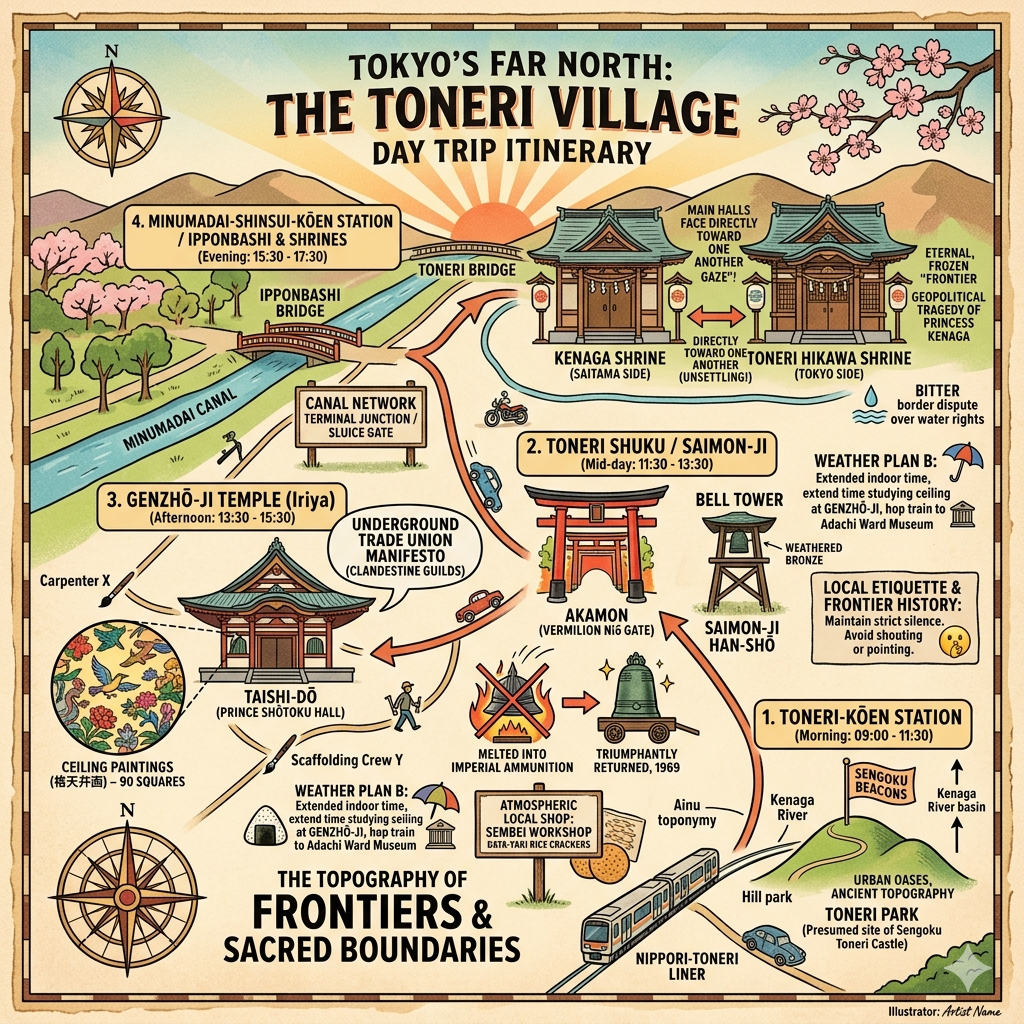
This is a deep historical travel story and walking guide to Toneri, a quiet residential terminus at the northern reach of Tokyo. Through five fascinating time-layers, it explores Toneri Park, Seimon-ji temple, Genzo-ji’s secret craftsman hall, and the Kenaga riverbank to reveal how Sengoku fortresses, artisan unions, and ancient water conflicts shaped this forgotten frontier. Readers will discover a hidden walking route that peels back Tokyo's modern urban veneer to expose the enduring survival and resilience of its local community.
 Lawrence
The Edge of the Shogun’s Capital
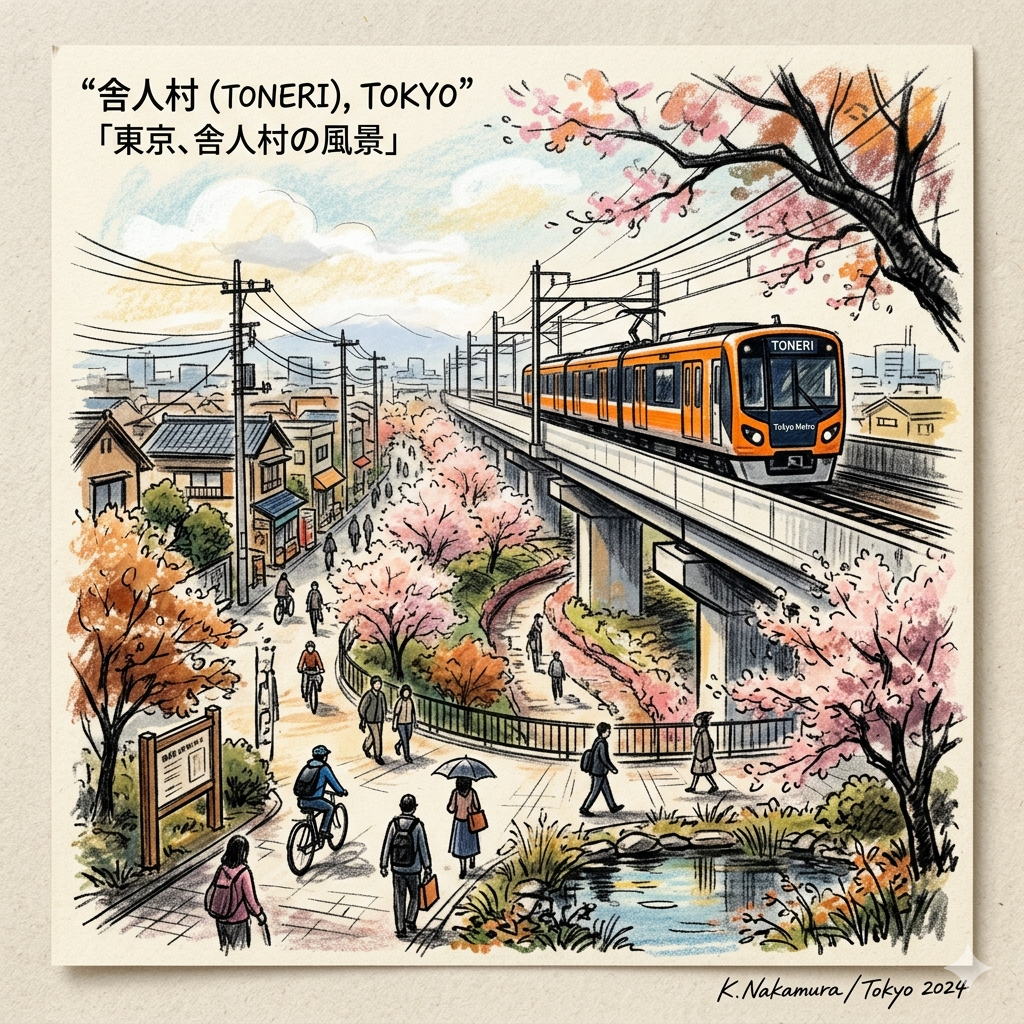
To the modern commuter, Toneri appears as the liminal edge of the urban sprawl—a quiet residential terminus at the northern reach of the Nippori-Toneri Liner. Yet, for the cultural cartographer, this landscape is a vital "historical frontier." Positioned at the strategic confluence of the Ara and Kenaga rivers, Toneri served for centuries as a porous boundary between the ancient Musashi Province and the untamed lands to the east. It was here that the central authority of the Emperor and the Shogun met the stubborn complexities of local geomorphology. This guide is not a mere tour of landmarks, but an invitation to peel back the urban veneer. We will navigate five distinct "time-layers" still etched into the physical fabric of the district, revealing a borderland that has perpetually redefined itself against the currents of Japanese power.
To walk through Toneri is to engage with its ghosts, beginning with the very syllables of its name.
Listen to the historical stories told in detail (For subscribers only)
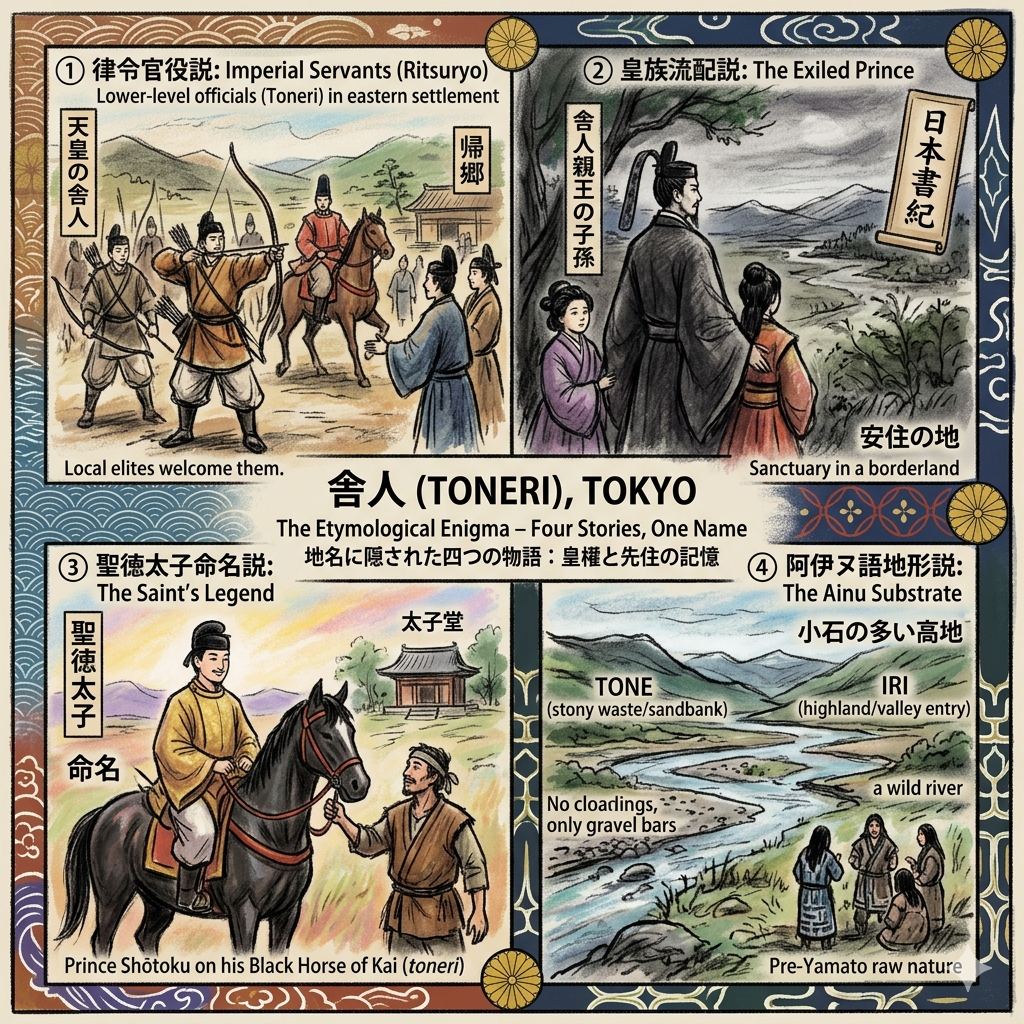
The Etymological Enigma – Four Stories, One Name
Naming is an act of political world-building. In Toneri, the competition between four distinct origin stories reflects how successive eras attempted to claim this borderland.
- The Imperial Servants (Ritsuryo): This theory identifies "Toneri" as the ritsuryō era officials—lower-level attendants or guards to the Emperor. Local elites from the Adachi District were often conscripted to serve in the capital; upon returning, their settlements retained the title of their prestigious service, marking the institutional penetration of the Imperial state into the eastern frontier.
- The Exiled Prince: A weightier claim links the name to the descendants of Prince Toneri (676–735), the compiler of the Nihon Shoki. It is suggested that his lineage, caught in the political shifts of the Nara period, found sanctuary here, sacralizing the wild northern reaches with royal pedigree.
- The Saint’s Legend: The Taishi-do Engi (History of the Prince’s Hall) at Genzo-ji offers a religious gloss. It tells of Prince Shotoku traveling the Kanto region on his "Black Horse of Kai" around the year 600. When a local attendant (a toneri) recognized the disguised prince, Shotoku supposedly bestowed the name upon the land.
- The Ainu Substrate: Linguistic analysis offers a pre-Yamato geomorphological truth. The name may derive from the Ainu Tone (stony waste or sandbank) and Iri (highland or valley entry). "Tone-iri" describes the ancient landscape—a patchwork of gravel bars and wetlands at the river’s edge.
Analysis: These conflicting stories represent a "borderland" identity—a place perpetually seeking to anchor itself to central authority (Imperial service, royal blood, or Buddhist hagiography) while its underlying Ainu etymology whispers of a raw, natural landscape that predates the arrival of the state.
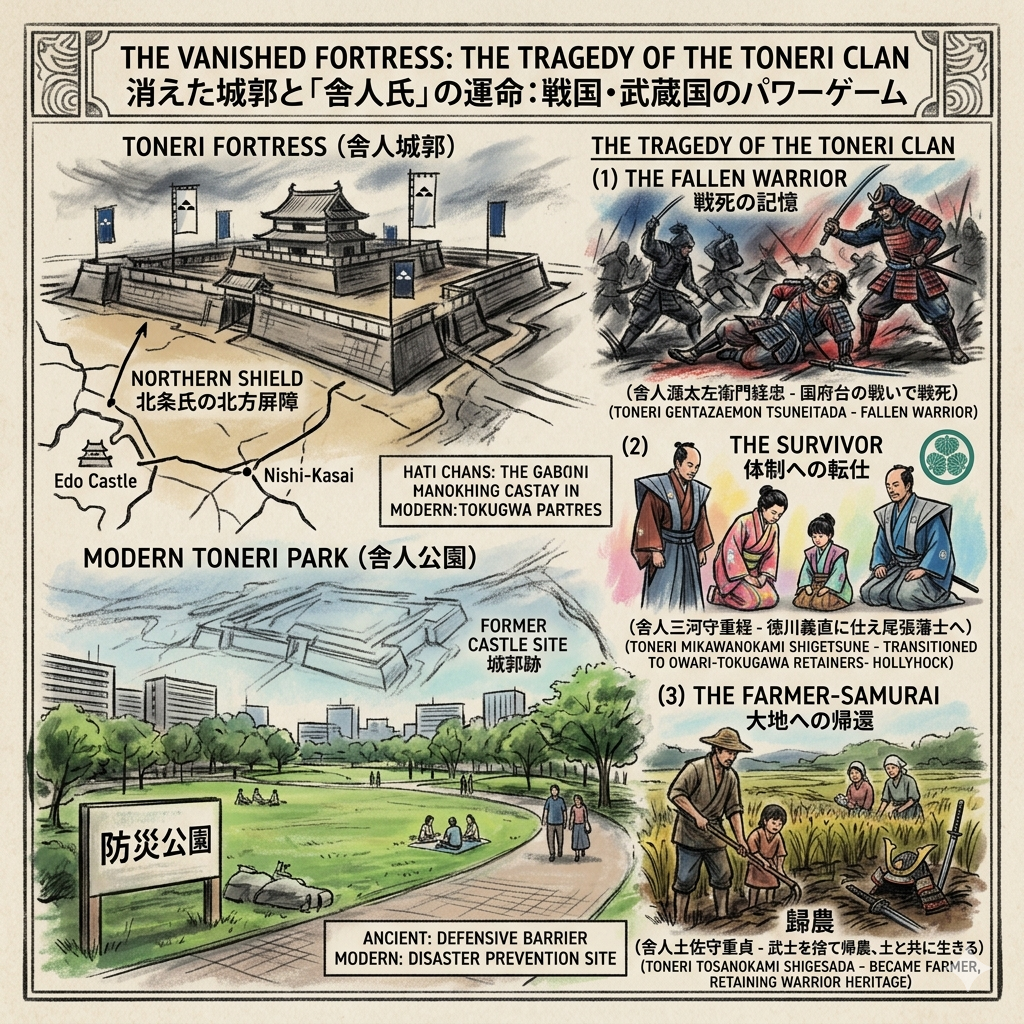
The Vanished Fortress – The Tragedy of the Toneri Clan
During the 16th-century Sengoku period, Toneri was the northern shield of the Hojo clan's domain. It formed a vital defensive triad alongside Chiyoda (Edo) and Nishi-Kasai, designed to protect the heart of Musashi from the rival Uesugi and Satomi clans.
The material testimony of the Toneri clan’s fate reveals the fractured transition of the samurai class:
- The Fallen Warrior: Toneri Gentazaemon Tsuneitada led his forces into the Second Battle of Konodai in 1564. His death alongside the Hojo commander Toyama Tsunakage marked the beginning of the fortress's decline.
- The Survivor: Other branches demonstrated political fluidity. Toneri Mikawanokami Shigetsune’s lineage eventually transitioned into the prestigious ranks of the Owari-Tokugawa retainers, bridging the gap from medieval warlord to early-modern bureaucrat.
- The Farmer-Samurai: Most poignant is the fate of Toneri Tosanokami Shigesada. Following the Hojo collapse, his family chose 歸農 (returning to the soil). They remained as local peasants, embedding their warrior heritage into the agricultural fabric.
Spatial Anchor: Today, the 63-hectare Toneri Park stands as the presumed site of Toneri Castle. The silence of this modern green space—once a 1940s air-raid buffer—masks the clamor of the 1564 battle. The park’s very existence as a "disaster prevention" site mirrors the ancient fortress's role as a defensive barrier.
The Wandering Bell of Seimon-ji
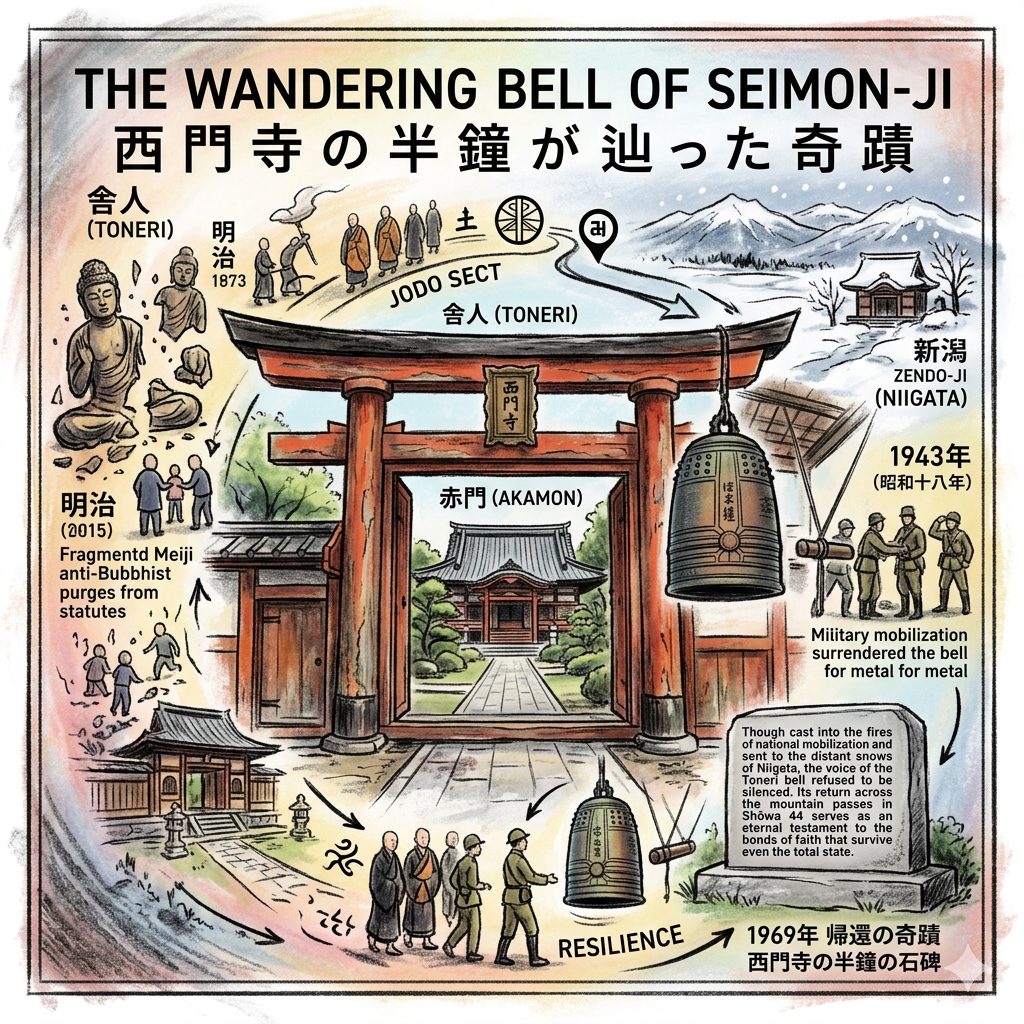
As the violence of the Sengoku era faded, the resilience of Toneri shifted to its ecclesiastical survival. Seimon-ji, founded in 1377, became a sanctuary for the region’s displaced history during the "Haibutsu Kishaku" (anti-Buddhist) purges of the Meiji era, taking in statuary from abolished local temples.
However, its most evocative relic is the Hanjō (half-bell). Surrendered in 1943 for the imperial war effort, the bell was destined for the furnace. Instead, it "wandered" through the Jodo sect network, eventually surfacing at Zendo-ji in Niigata Prefecture. In 1969, it made its miraculous return, as recorded on the temple’s stone monument:
"Though cast into the fires of national mobilization and sent to the distant snows of Niigata, the voice of the Toneri bell refused to be silenced. Its return across the mountain passes in the 44th year of Shōwa serves as an eternal testament to the bonds of faith that survive even the total state."
Visualizing History: Look for the Akamon (Red Gate). It stands not merely as an entrance, but as a symbol of local sanctuary that survived the state's attempt to strip the community of its metal and its meaning.
The Craftsman’s Secret Code – Genzo-ji and the Taishi-ko
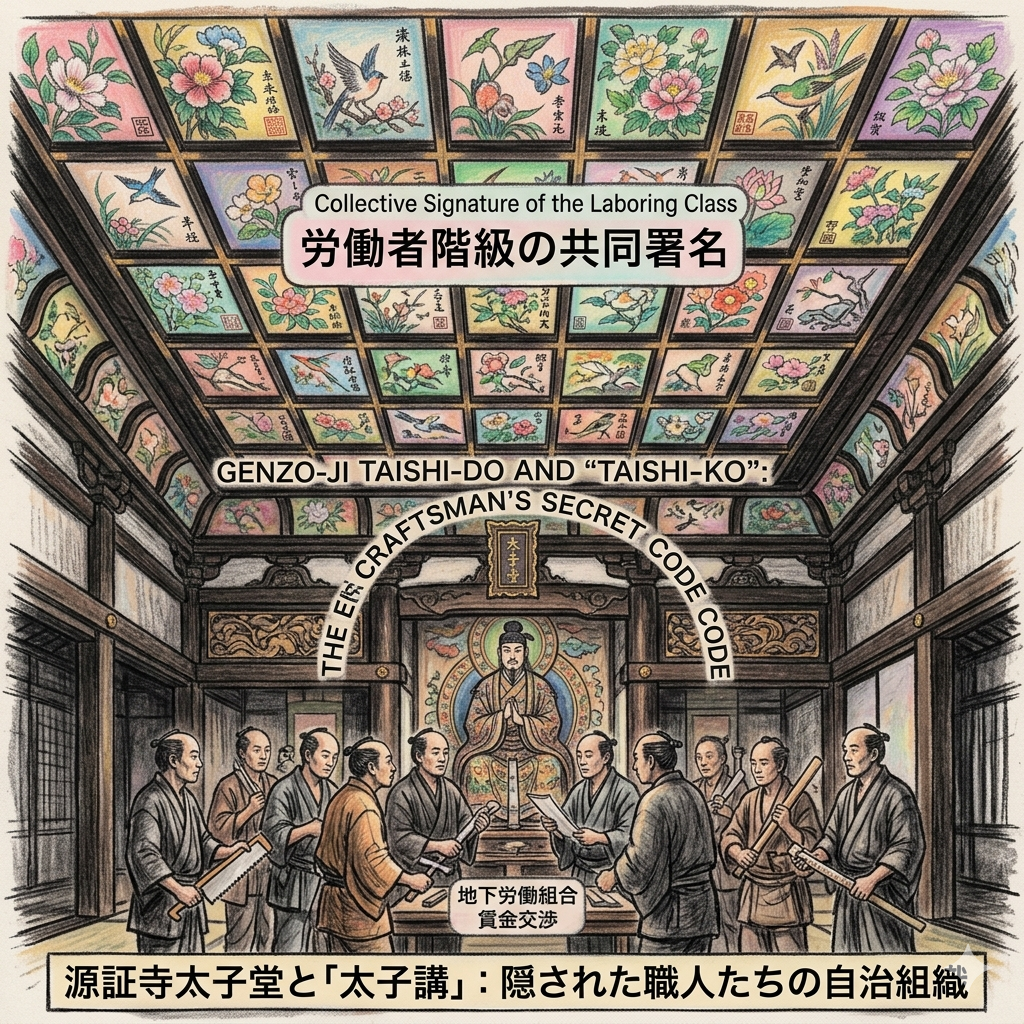
While the Shogun’s officials drew maps, the shokunin (artisans) built the reality. Genzo-ji temple, once an offshoot of the Shogun’s funeral temple (Zojo-ji), provided a prestigious canopy for the Taishi-ko—a mutual aid guild of carpenters and masons disguised as a religious society.
The Underground Union: The Taishi-do (Prince Shotoku Hall), built between 1711 and 1716, served as a physical manifesto for these laborers. Behind its ornate façade, craftsmen organized wage negotiations and insurance networks under the guise of devotion to their patron deity.
The most profound evidence of this "hidden agency" is the 90 Ceiling Paintings within the hall. These polychromatic panels are not the work of court painters, but the cultural declarations of commoners. If you look closely, you can see the actual signatures of the craftsmen who built the surrounding district, transforming the temple ceiling into a collective signature of the laboring class.
The River of Strands – Water Rights and the Kenaga Legend
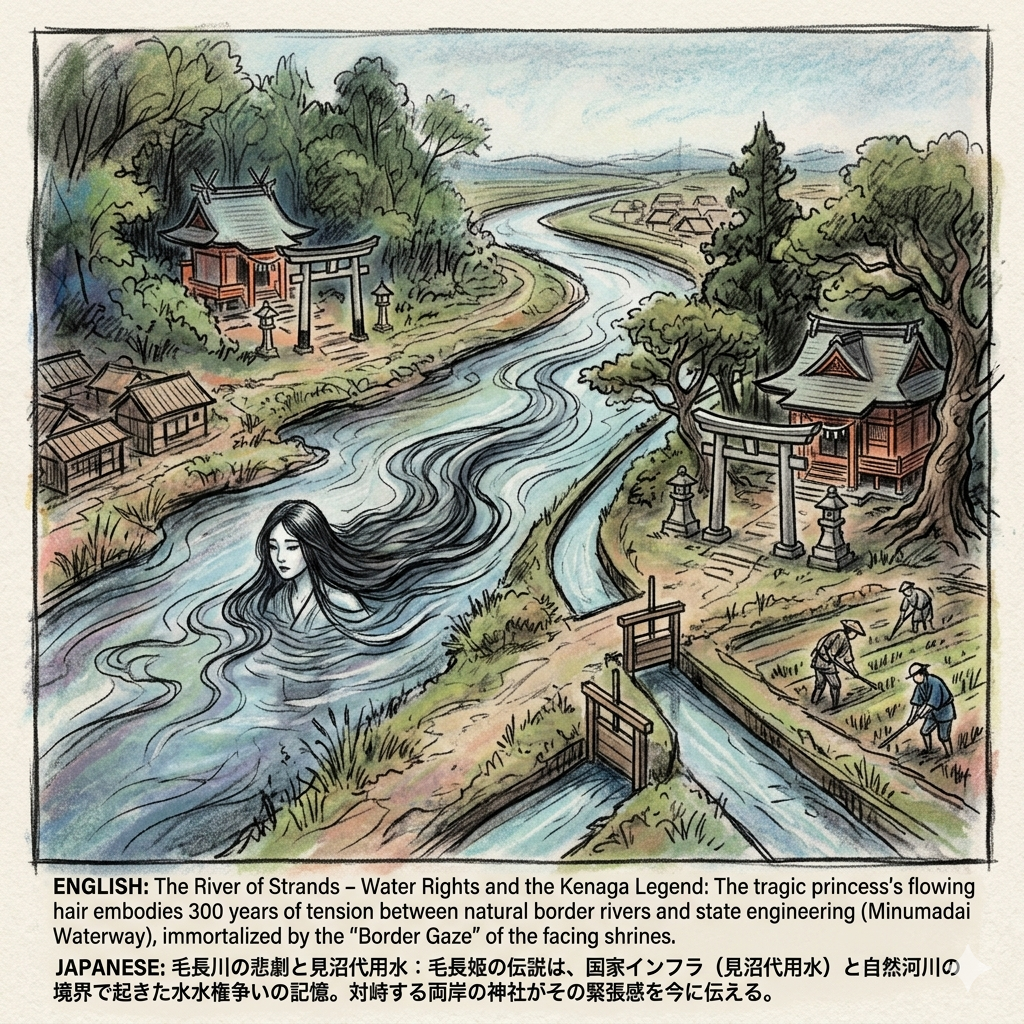
In the 1720s, the Kyoho Reforms brought central state engineering to the border via the man-made Minumadai Waterway. This collision with the natural Kenaga River sparked socio-political tensions that were eventually sublimated into the Legend of Princess Kenaga.
Myth as History: The tragedy of the princess—a bride from Niisato who drowned herself in the river due to the fierce water disputes between her home and her husband’s village of Toneri—is a cultural metaphor for violent water-rights conflicts. Her long hair (kenaga) was salvaged and is preserved today at Kenaga Shrine in Soka as a divine relic (goshintai), a rare physical artifact of a local myth.
The Spatial Standoff: To this day, Kenaga Shrine (Soka) and Toneri Hikawa Shrine (Adachi) face each other directly across the water. This unusual orientation creates a permanent, sacred "Border Gaze," immortalizing the 300-year-old tension between the state-engineered irrigation flows and the natural course of the border river.
Hidden Gem: The Living Artifact
At the terminus of the Minumadai Waterway lies the "Ipon-bashi" (One-Stick Bridge). This unassuming spot is a geographical pivot point: it is the precise location where the state-controlled irrigation waters finally merge with the natural course of the Kenaga River. It marks the boundary where human engineering yields back to the ancient hydrology of the Kanto Plain.
Philosophical Reflection: The Palimpsest of the Border
Toneri is a historical palimpsest—a parchment that has been written upon, erased, and overwritten for a millennium. To walk its streets is to navigate a landscape where the Ainu "stony valley" lies beneath a Sengoku fortress, which in turn supports the secret guilds of Edo craftsmen and the echoes of water wars.
The significance of Toneri lies in its persistence as a border. Whether defining the edge of Imperial law, the limits of a samurai’s territory, or the boundary of modern Tokyo and Saitama, it has always been a place of collision between different systems of power and nature. Understanding a city requires this "layered observation"—looking past the Nippori-Toneri Liner to see the "Borderland" that still defines the northern limit of the capital.
As modern development continues to reshape the district into a commuter hub, we must ask: what "unseen layers" are we creating today that future historians will one day have to uncover?
Traveler’s Logistical Appendix
- How to Get There: Take the Nippori-Toneri Liner to Toneri-koen Station or the northern terminus at Minumadai-shinsui-koen Station.
- Walking Route: Begin at Toneri Park (Layer II), walk south to Seimon-ji (Layer III), head east to Genzo-ji (Layer IV), and conclude your journey at the Kenaga River and Ipon-bashi (Layer V).
- Scholar-Traveler Recommendation: For those seeking further immersion into the hidden narratives of the Kanto Plain, consider our curated list of accommodations in the Adachi district that specialize in "deep travel" and spatial history.
Q & A
How did local temples preserve history during wartime and reform?
In the Toneri region, local Buddhist temples acted as resilient bastions for preserving history and communal identity when faced with aggressive state reforms and the pressures of wartime. They achieved this through strategic concealment, cross-regional networks, and leveraging their religious status to shield social organizations.
1. Preservation During the Meiji Religious Reforms
During the early Meiji period (beginning in 1868), the state-sponsored Haibutsu Kishaku (anti-Buddhist movement) led to a systematic purge of Buddhist influence.
- Secret Guardianship: In the Toneri area, two temples—Saiko-ji and Henjo-ji—were forced to close. To counter this destruction, Saimon-ji (a Jodo sect temple) took the significant political risk of secretly taking in and hiding the primary Buddhist statues from these abolished temples.
- Cultural Continuity: This act of defiance allowed the traditional religious and historical lineage of the community to survive "underground" despite the state's efforts to erase it.
2. Safeguarding Artifacts During World War II
During the Pacific War in the 1940s, the Japanese government issued the Metal Collection Edict, forcing temples to surrender bronze bells and ornaments to be melted down for weapons.
- The Survival of the "Hansho": Saimon-ji was forced to hand over its hansho (a medium-sized bronze bell). However, rather than being destroyed, the bell survived through a complex non-official network.
- Cross-Regional Networks: The bell was eventually discovered intact hundreds of kilometers away at Zendo-ji in Niigata Prefecture. This survival is attributed to the informal mutual aid networks of the Jodo sect, which cooperated to hide cultural assets from state mobilization. The bell was finally returned to Saimon-ji in 1969.
3. Preserving Social and Professional History
Temples also preserved history by providing a "religious cloak" for social groups that the state might otherwise have banned or strictly controlled.
- The Taishi-ko Guilds: During the Edo period, Gensho-ji became the center for the Taishi-ko, a religious association for construction craftsmen (carpenters, plasterers, etc.).
- Bypassing State Bans: While the Shogunate strictly forbade unauthorized public assemblies, these craftsmen used the temple’s sacred space to meet legally. They preserved their professional history and communal strength through the Taishido ceiling paintings, a collection of 90 frames donated by various craft guilds that serve as a permanent record of the aesthetic and economic power of the commoner class.
4. Archival Preservation of Regional Identity
Temples served as the primary repositories for the region's foundational legends and history:
- Gensho-ji continues to preserve the Taishido Engi, a key manuscript that documents the naming legends of Toneri, including the story of Prince Shotoku. By physically housing these documents, the temple ensured that the community's origin stories remained intact even as the surrounding political landscape shifted from feudal domains to a modern metropolis.
What is the secret history of the Saimon-ji bell?
The "secret history" of the Saimon-ji bell (a hansho, or middle-sized bronze bell) is a remarkable tale of survival against state-mandated destruction and a testament to the resilience of non-official religious networks.
The story unfolds across three major historical phases:
1. The Wartime Confiscation (1940s)
During the Pacific War, the Hideki Tojo cabinet issued the Metal Collection Edict (Kinzoku-rui Kaishu-rei) due to severe shortages of military supplies. Saimon-ji, a Jodo sect temple founded in 1377, was forced to surrender its bronze bell to the government to be melted down for weapons. For decades, it was assumed the bell had been destroyed in the furnaces of the imperial war effort.
2. The Mysterious Survival and Discovery
In a "miraculous" turn of events, the bell was never melted. It was eventually discovered hundreds of kilometers away from its home in Tokyo, located in Zendo-ji, a temple in Itoigawa City, Niigata Prefecture.The sources suggest this survival was not accidental but was facilitated by the non-official mutual aid networks of the Jodo sect. These religious networks worked behind the scenes to move and hide sacred objects, protecting them from the "totalitarian plunder" of the state.
3. The 1969 "Homecoming"
After the bell was identified, a long period of coordination took place between the monks and believers of both Saimon-ji in Tokyo and Zendo-ji in Niigata. In 1969 (Showa 44), the bell was finally returned to Saimon-ji. Today, it remains a registered Tangible Cultural Property of Adachi Ward, still hanging in the temple's bell tower as a symbol of survival.
Historical Context: A Tradition of Resistance
The bell's survival is consistent with Saimon-ji's broader history of resisting state control. During the Meiji-era "Haibutsu Kishaku" (anti-Buddhist movement), the temple took the significant political risk of secretly harboring Buddhist statues from nearby temples (Saiko-ji and Henjo-ji) that had been forced to close by the government.
Together, these incidents reveal that Saimon-ji served as a hidden archive and sanctuary, using its religious status to preserve the community's cultural and spiritual heritage when the state attempted to erase or weaponize it.
Reference and Further reading
- 「舎人」の地名の由来 - 雑学ネタ帳, accessed May 23, 2026,
- 西門寺 - accessed May 23, 2026,
- 江戸旧蹟を歩く 毛長川(武蔵野の路 舎人コース), accessed May 23, 2026,
- 東京再発見 第29章 ネモフィラきらきらと・日本一混み合う電車の終点あたり~足立区・舎人公園, accessed May 23, 2026,
- 舎人公園 - 足立区観光交流協会, accessed May 23, 2026,
- 舎人氏館(推定地)|宮城氏館(東京都足立区)の周辺スポット - ニッポン城めぐり, accessed May 23, 2026,
- さくら - 足立区, accessed May 23, 2026,
- 舎人ってどんな街 | コミュニティプラットフォームあだち- COMMUNITY PLATFORM ADACHI-, accessed May 23, 2026,
- 難読名字「舎人」。歴史好きや東京都民は読める? | 家庭画報.com|“素敵な人”のディレクトリ, accessed May 23, 2026,
- 埼玉県足立区を散歩 - 雅万歩, accessed May 23, 2026,
- 戦国時代の足立 武蔵千葉氏と中曽根城・瑞応寺, accessed May 23, 2026,
- 足立区って? - 小金井不動産 足立区入谷舎人の不動産屋さん, accessed May 23, 2026,
- 舎人 (足立区) - accessed May 23, 2026,
- 日暮里・舎人ライナーの開通で注目が集まる舎人の街の特徴や歴史 - 東京事務所探しプラス, accessed May 23, 2026,
- 舎人公園 - 東京都, accessed May 23, 2026,
- 寺院のご案内 西門寺 | お寺・お墓のアイエム, accessed May 23, 2026,
- 舎人村 (東京府) - accessed May 23, 2026,
- 西門寺 永代供養墓|足立区 おひとり様・後継者のいないご夫婦にぴったり, accessed May 23, 2026,
- 源証寺の問合せ/価格・空き状況・アクセス | 足立区のお墓【ライフドット】, accessed May 23, 2026,
- 【霊園】 足立区 浄土宗 源証寺 墓石、墓地、霊園などお墓の事なら全国優良石材店の全優石, accessed May 23, 2026,
- 源証寺 - 東京都足立区 - 舎人の整った寺 - 舎人駅8分 - 伝統の日本紀行, accessed May 23, 2026,
- 源証寺(太子堂) | あだち観光ネット, accessed May 23, 2026,
- 源証寺 - accessed May 23, 2026,
- 源証寺太子堂|足立区, accessed May 23, 2026,
- 【足立区立郷土博物館】アクセス・営業時間・料金情報 - じゃらんnet, accessed May 23, 2026,
- 2年4ヶ月ぶりのリニューアル!“美術も郷土も”楽しめる「足立区立郷土博物館」。大谷田周辺おすすめスポットも紹介します。 | 竹の塚情報局たけトピ, accessed May 23, 2026,
- 「見沼台」じゃないの? 謎の駅名「見沼代親水公園」に300年の歴史 日暮里・舎人ライナー | 乗りものニュース, accessed May 23, 2026,
- 見沼代用水の消滅地点を求めて散策したら『毛長川伝説』に出会った! - フォートラベル, accessed May 23, 2026,
- 古い入間川川跡をたどる その4 現在の芝川流路から毛長川流路 - 散歩の途中, accessed May 23, 2026,
- あだちの不思議な物語 - 足立区, accessed May 23, 2026,
- 市内に流れる河川 毛長川 - 草加市役所, accessed May 23, 2026,
- #3 足立区-草加市(埼玉県)|晰 - note, accessed May 23, 2026,
- 毛長神社(草加市新里町), accessed May 23, 2026,
- 【あだちミステリーハンターが行く!】舎人には昔話がいっぱい!恋愛成就にも効果あり!? 毛長姫にまつわる悲しい恋の物語【後編】, accessed May 23, 2026
 Lawrence
 Lawrence
 Lawrence