(ENG) Umejima Nostalgia – A Slow Walk Through the Retro Alleys and Shitamachi Soul of Adachi, Tokyo
Escape the crowds of central Tokyo for a slow walk through Umejima. This travel story explores the nostalgic charm of Adachi City, featuring retro shopping streets and quiet residential histories that reveal the authentic, everyday soul of a Japanese neighborhood.

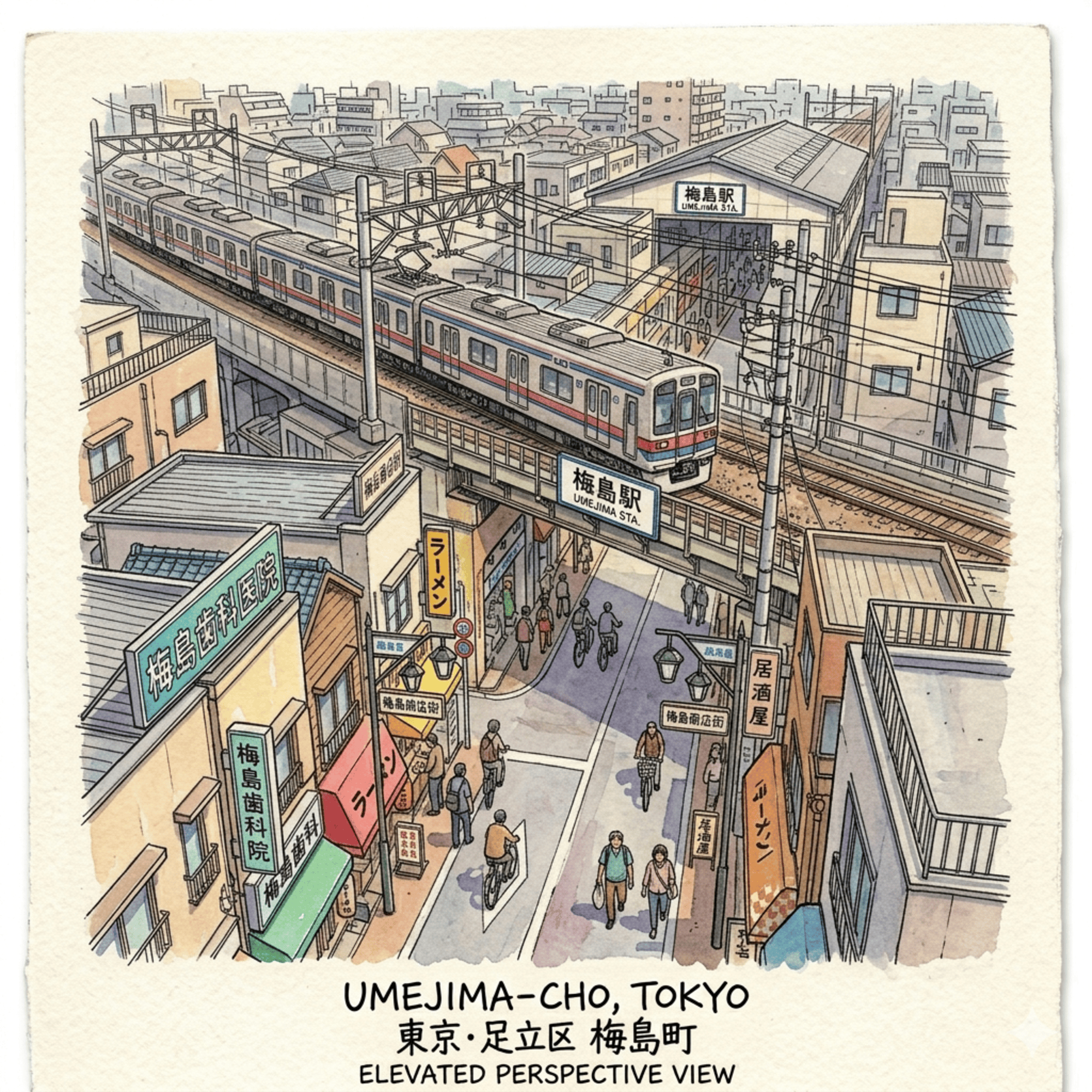
This is a historical travel story and walking guide to Umejima, a hidden neighborhood in Tokyo's Adachi City. By exploring its quiet residential alleys, retro shopping streets, and local shrines, it captures the fading "Shitamachi" atmosphere and offers a peaceful perspective on everyday Tokyo life away from the urban center.
 Lawrence
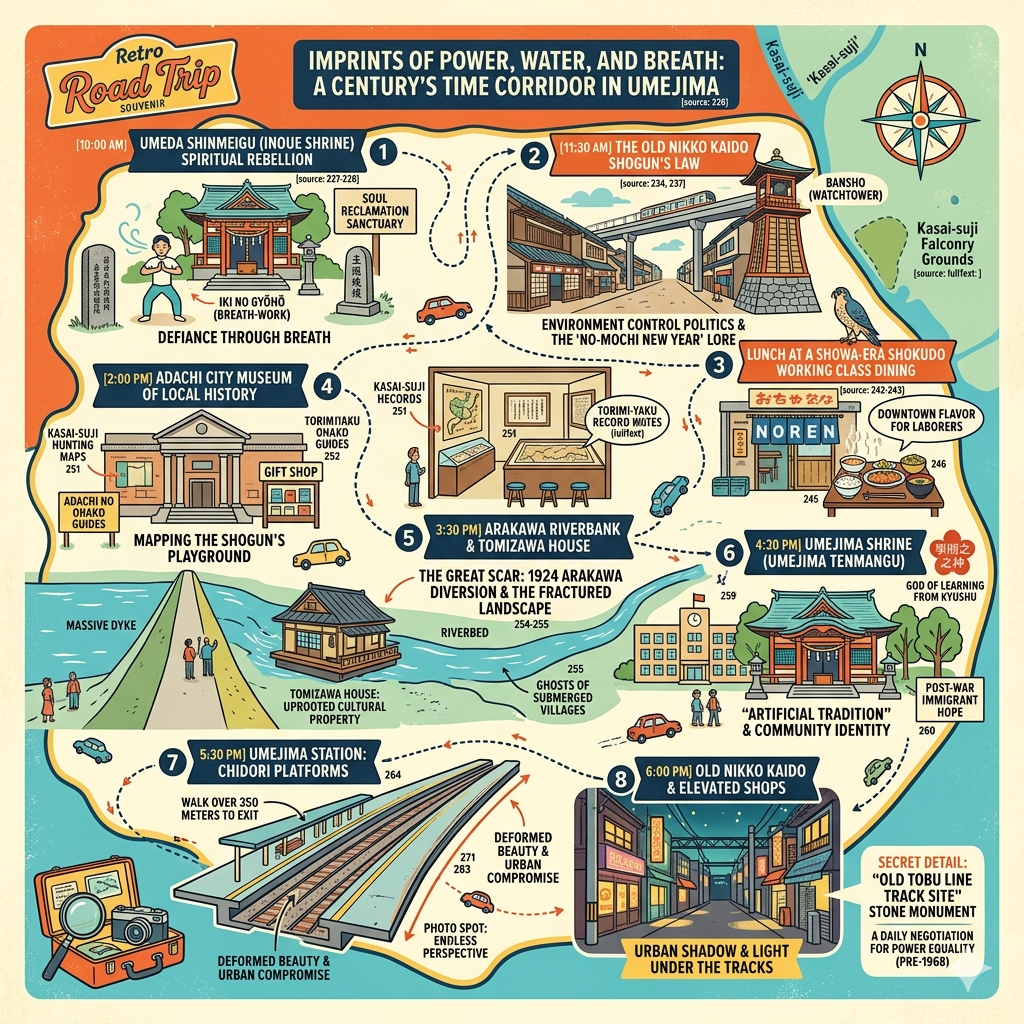
To the modern commuter, Umejima is a blur of gray tile and the rhythmic clatter of the Tobu Skytree Line. Yet, to walk these streets with a deliberate pace is to peel back the skin of a city that has been repeatedly reimagined. This district in North Tokyo was once a swampy frontier, a "functional sacrifice zone" where the landscape was bent to the will of the Shogunate’s leisure, the state’s engineering ambitions, and the industrial hunger of a growing capital. What remains today is a fascinating urban palimpsest—a place where the ghosts of feudal hunting masters and spiritual rebels reside just beneath the surface of the "high-growth" era architecture. Understanding Umejima requires looking past the convenience stores to find a neighborhood defined by its quiet, persistent resilience.
Listen to the historical stories told in detail (For subscribers only)
The Shogun’s Invisible Walls: The Hunting Grounds and the Curse of the New Year’s Mochi
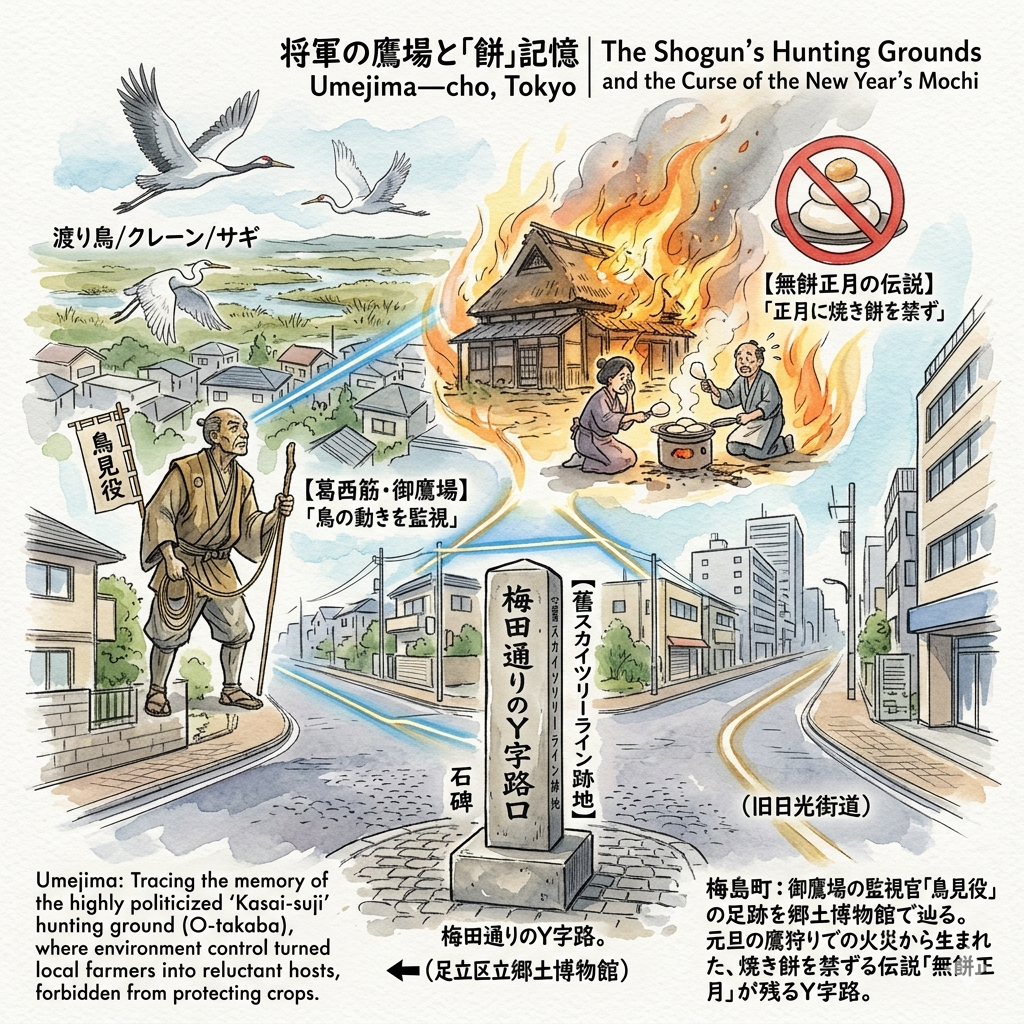
In the 18th century, the air in Umejima—then part of the "Kasai-suji"—did not ring with train whistles, but with the cries of migratory cranes and white herons. For the Tokugawa Shogunate, these marshlands were a highly politicized O-takaba (御鷹場), or Shogun’s Hunting Ground. This was not wilderness; it was a monitored environment. The Shogunate appointed Tsunasashi—specialized officials like Kano Jinnai—to act as "rope-holders," meticulously tracking bird movements and ensuring the landscape remained a pristine playground for the ruling class.
This "environment control politics" turned the local farmers into reluctant hosts of the Shogun’s birds. They were forbidden from protecting their crops, forced into a state of economic suspension to preserve the Shogun’s sport. The tension of this era is etched into the local folk memory through the legend of the "No-Mochi New Year."
Mochinashi Shogatsu (No-Mochi New Year) Legend tells of a Shogun’s sudden arrival for a hunt on New Year’s Day in the village of Yotsuya. In their frantic haste to prepare for the visit, a fire broke out while a household was roasting mochi (rice cakes). The Shogunate viewed the disturbance as a desecration of their authority, resulting in severe punishment for the village. To this day, the tradition of abstaining from grilled mochi on New Year’s remains a quiet echo of the fear once commanded by the central power.
Walking Connection: Visit the Adachi City Museum to examine the "Kasai-suji" maps and the records of the Torimi-yaku (hunting overseers). Afterward, stand at the Y-junction at Umeda-dori, where a stone monument marks the old Tobu line. This junction follows the ancient village boundaries that were dictated by the early road networks of the Old Nikko Kaido.
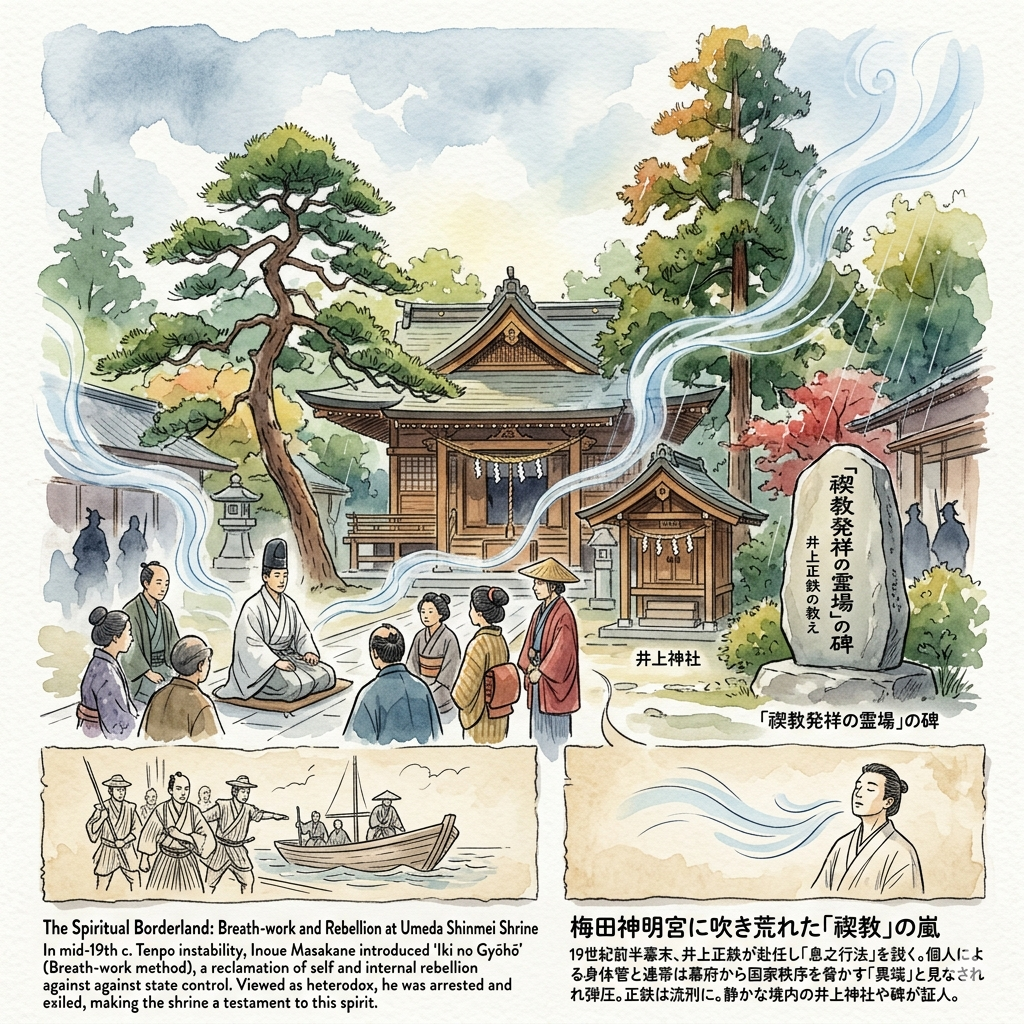
The Spiritual Borderland: Breath-work and Rebellion at Umeda Shinmei Shrine
As the Shogunate’s grip began to fray in the mid-19th century, Umejima emerged as a spiritual frontier. In 1840, during the social instability of the Tenpo era, a man named Inoue Masakane arrived at Umeda Shinmei Shrine. He didn't bring new idols, but a radical new practice: Iki no Gyōhō (息之行法), or the "Breath-work method."
This was a reclamation of the self. By teaching commoners to achieve mental and physical autonomy through controlled breathing, Inoue was bypassing state-sanctioned religious structures. The Tokugawa authorities recognized the "heterodox" threat immediately; to control the breath was to control the soul, an act of internal rebellion the state could not permit. In 1843, a crackdown led to Inoue’s arrest and eventual exile to Miyake Island. Today, the shrine remains a testament to that brief moment when Umejima served as a sanctuary for those seeking agency against an overbearing center.
Walking Connection: Within the Umeda Shinmei complex, seek out the Inoue Shrine and the "Misogi-kyo Birthplace" stone monument. Pause here to consider the weight of the air—once a tool of political defiance.
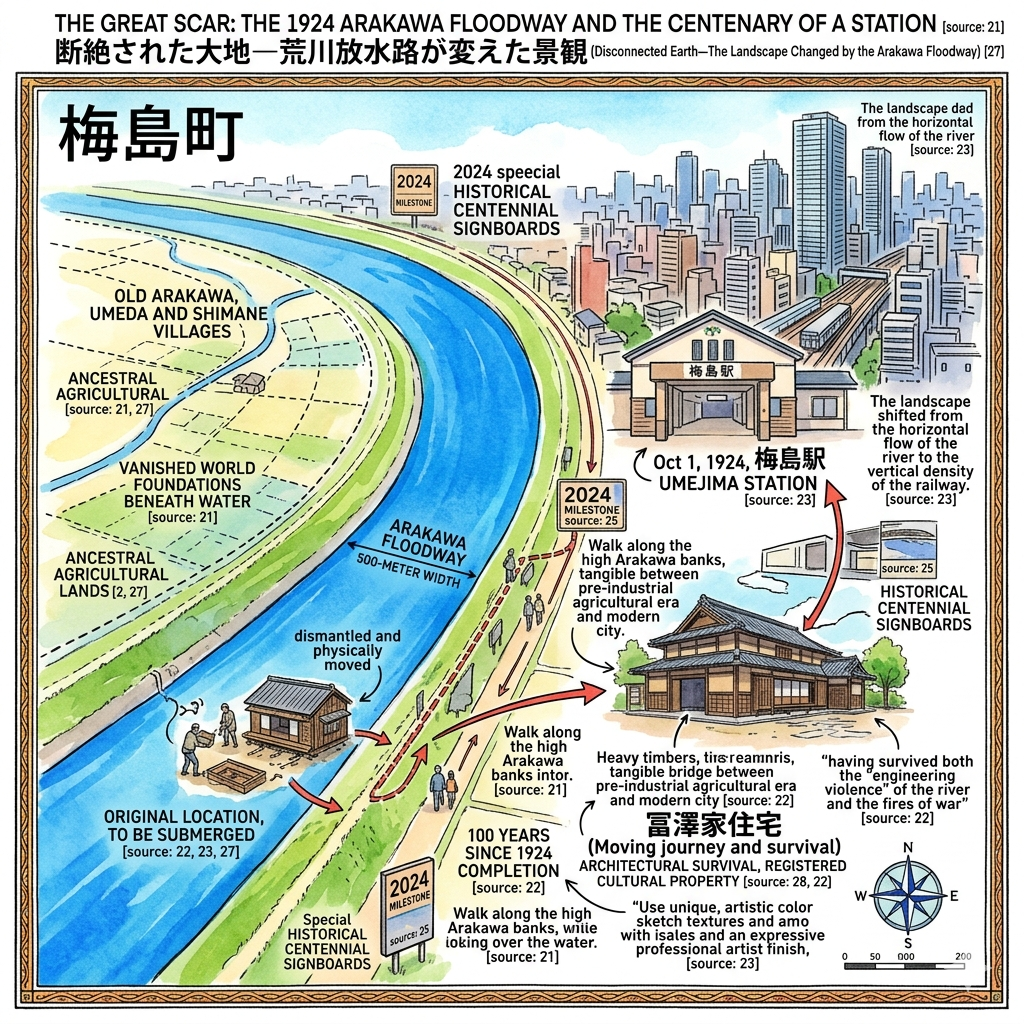
The Great Scar: The 1924 Arakawa Floodway and the Centenary of a Station
The year 2024 marks a somber and significant centenary for Umejima: 100 years since the completion of the Arakawa Discharge Channel (Arakawa Floodway) and the opening of Umejima Station. Following the devastating Great Flood of 1910, the state enacted a form of "engineering violence," carving a 500-meter-wide artificial river through the landscape.
This project physically severed ancestral lands, swallowing portions of the Umeda and Shimane villages. While it protected the capital from the river's whims, it uprooted entire communities. However, from this scar, the modern district was born. On October 1, 1924, Umejima Station opened its doors, transitioning the area from a water-dependent agricultural society to a rail-dependent urban node. The landscape shifted from the horizontal flow of the river to the vertical density of the railway.
Walking Connection: Walk the high banks of the Arakawa River and look out over the water. Somewhere beneath the surface lie the foundations of a vanished world. Look for the historical centennial signboards placed throughout the area in 2024 to mark this milestone.
A testament to architectural survival, this registered cultural property is a must-see for any traveler. Originally located in the path of the 1924 Arakawa Floodway, the house was physically dismantled and moved to its current location to escape being submerged. It stands today as a rare, tangible bridge between the pre-industrial agricultural era and the modern city, its heavy timbers having survived both the "engineering violence" of the river and the fires of war.
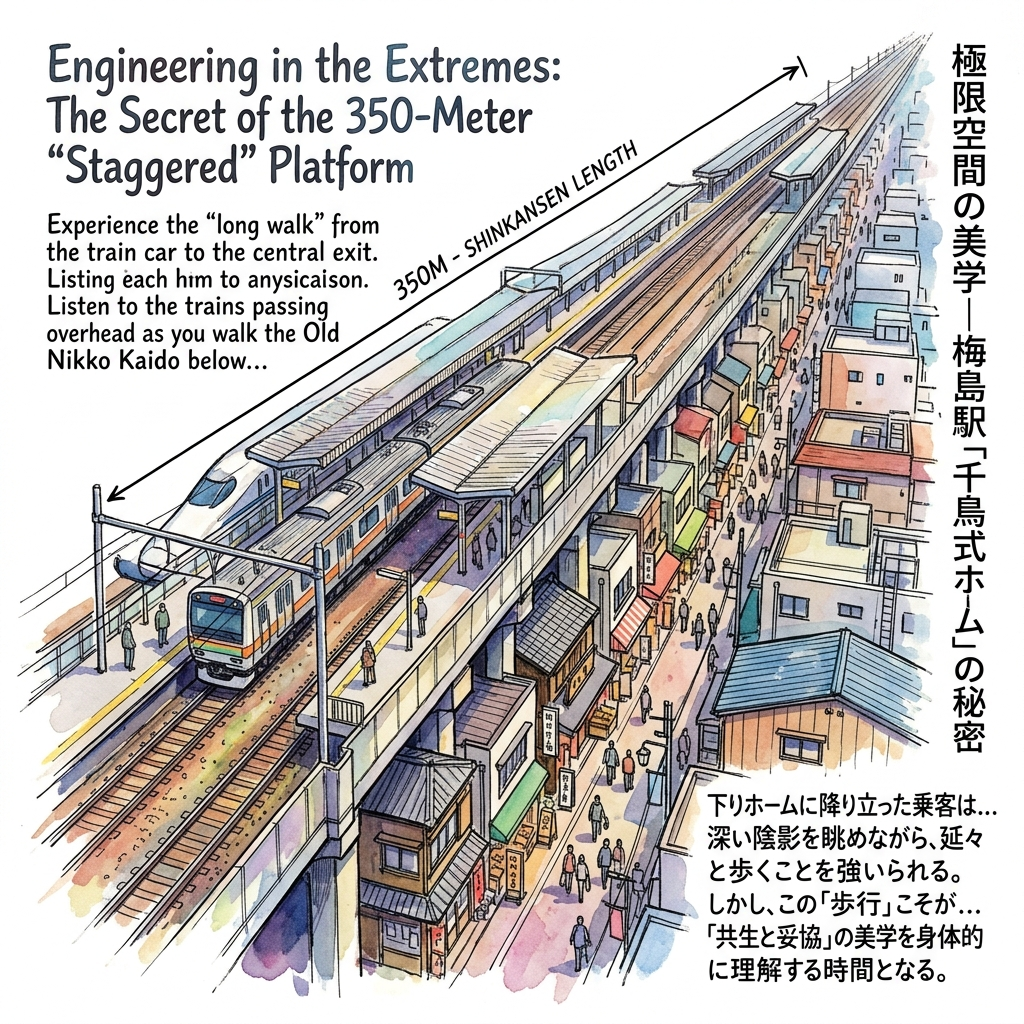
Engineering in the Extremes: The Secret of the 350-Meter "Staggered" Platform
As Japan entered the "High-Growth Period" of the 1960s, the Tobu Line faced a crisis of density. Umejima Station needed to expand to accommodate a surging population, but it was hemmed in by the established shops of the Old Nikko Kaido. There was no room to widen the tracks.
The solution was a feat of "urban symbiosis": the Chidori-style (staggered) platform. Instead of sitting side-by-side, the north and southbound platforms were placed in a single, continuous line stretching over 350 meters—a length usually reserved for Shinkansen bullet trains. This design is a physical bow to the history of the street; the railway chose to stretch itself to extreme lengths rather than demolish the existing commercial heart of the community.
Walking Connection: Experience the "long walk" from the train car to the central exit. Listen to the trains passing overhead as you walk the Old Nikko Kaido below; the "staggered" design above you is the reason this historic road still breathes today.
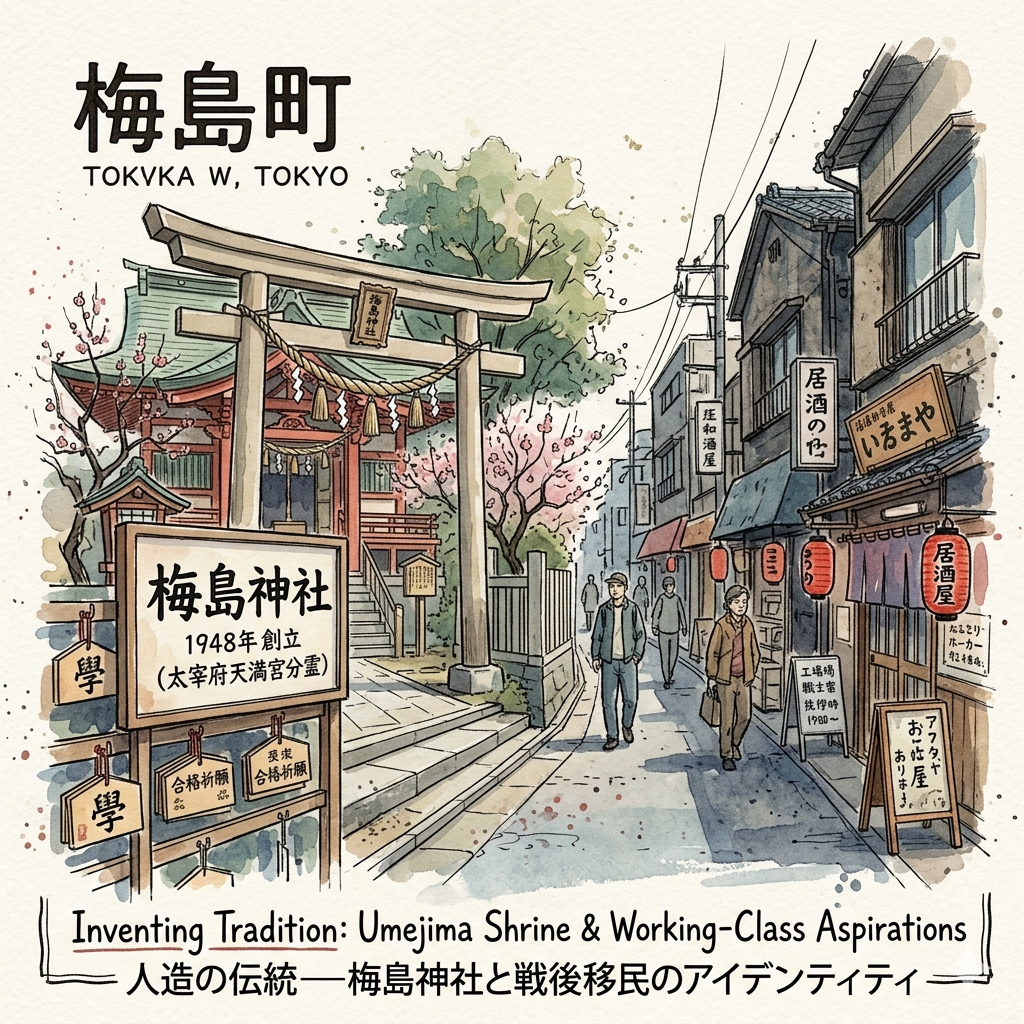
Inventing Tradition: Umejima Shrine and the Aspirations of the Working Class
The post-WWII era brought a new influx of residents: factory workers from rural Japan looking for a foothold in the capital. Lacking the deep ancestral roots of the older villages, these migrants practiced a form of "inventing tradition." In 1948, they founded Umejima Shrine, "splitting the spirit" (bunrei) from the prestigious Dazaifu Tenmangu in Fukuoka.
By choosing to worship the God of Learning, Sugawara no Michizane, these families were making a strategic investment in the future. In an industrial suburb, education was the primary vehicle for social mobility. The shrine became more than a place of worship; it was a sanctuary for the aspirations of a new middle class, anchoring their rural past to an industrial future.
Walking Connection: After visiting the shrine, wander into the Showa-era izakayas clustered around the station. These gritty, narrow establishments once served the post-shift factory crowds and remain the heart of the neighborhood’s social fabric.
Reflection: The Palimpsest of Umejima
Umejima is a city written and rewritten. It is a place where the Shogun’s hunting laws, a rebel’s breath-work, the "scar" of an artificial river, and the extreme geometry of a train platform all coexist. It demonstrates the "resilience of the ordinary"—the way a community adapts when the heavy hands of government and nature reshape its world.
To understand Umejima is to practice "layered observation." As you stand on the platform of the 100-year-old station, look past the convenience stores. Can you see the ghosts of the Tsunasashi? Can you feel the rhythm of Inoue’s breath-work? We must wonder: what layers of our modern urban life will remain as echoes for travelers a century from now?
To explore more of Tokyo’s hidden narratives, subscribe to our series or read our broader "Adachi District Historical Guide."
Planning Your Walk
- Getting There: Take the Tobu Skytree Line to Umejima Station. Note that only local trains stop at this unique, 350-meter-long platform.
- Recommended Tours: We recommend the "East Tokyo Historical Walking Tours" for those seeking a guided deep-dive into the Shitamachi and Adachi areas.
- Nearby Accommodation: For the "slow traveler," staying in the nearby North Senju area is ideal. It offers a rich historical continuity and serves as a perfect base for exploring the northern layers of the capital.
Q & A
How did the Shogun's hunting grounds shape Umejima's early culture?
The Shogun’s hunting grounds, known as 御鷹場 (Otakaba), fundamentally shaped Umejima’s early culture by transforming a simple rural marshland into a highly regulated, semi-military administrative zone where the survival needs of local farmers were secondary to the political rituals of the Tokugawa Shogunate.The following factors illustrate how this hunting status defined the region's early cultural and social landscape:
1. A Culture of Surveillance and "Transparent" Space
Because the area (then known as the Kasai-suji district) was a prime habitat for cranes and geese, the Shogunate established a network of guardhouses (番所, Bansho) and appointed hunting supervisors (鳥見役, Torimiyaku) to monitor the region. This oversight meant that Umejima was not a typical autonomous village; it was a transparent space where every action was scrutinized to ensure the Shogun’s hunting environment remained pristine. This created a local atmosphere characterized by a high degree of caution and deference to authority.
2. The Legacy of the "No-Mochi New Year"
Perhaps the most enduring cultural imprint is the "Mochinashi Shogatsu" (無餅正月) custom. According to local legend, a fire caused by roasting New Year's rice cakes (mochi) during a Shogun's visit led to severe collective punishment for the village. To avoid ever again "profaning the Shogun's authority," the community adopted a strict taboo against eating roasted mochi on New Year’s Day. This custom represents more than just a culinary quirk; it is a "cultural imprint of fear" that has been passed down for centuries as a survival strategy.
3. Subordination of Agriculture to Environment
The hunting grounds dictated the local economy and environmental management. Farmers were legally forbidden from driving away birds, even when their crops were being destroyed. Furthermore, the Shogunate restricted land development to preserve the marshy terrain favored by migratory birds, which effectively stunted intensive agricultural growth in the region. Early Umejima culture was thus defined by a "functional sacrifice," where the residents' primary role was to maintain a landscape for the Shogun’s leisure.
4. Specialized Social Roles: The "Tsunasashi"
The hunting grounds created unique social roles within the community. The Shogunate appointed specific residents as "Tsunasashi" (綱差), officials responsible for capturing and raising "reserve cranes" for the Shogun’s hunts. Figures like Kano Jinnai, a specialist from Kishu, were settled in the area specifically to oversee these hunting logistics. This integrated the Shogun's administrative needs directly into the local social hierarchy.
5. Shaping Early Infrastructure
While the hunting status restricted agriculture, it facilitated the development of early administrative road networks. The predecessors to major routes like the Old Nikko Highway were influenced by the Shogun's need for accessible travel between the hunting grounds and Edo Castle. These early pathways laid the structural foundations for the urban layout that still influences Umejima’s street patterns today.
In summary, the Shogun’s hunting grounds forced Umejima into a state of "environmental control politics," where local customs, economic stagnation, and even the physical layout of the town were products of a power struggle between the Shogunate’s hunting privileges and the villagers' right to survive.
Tell me more about the Misogi-kyo religious conflict.
The Misogi-kyo (禊教) conflict was a significant religious and political confrontation in the mid-19th century centered at Umeda Shinmei-gu (梅田神明宮) in the Umejima area. It represented a struggle between the Tokugawa Shogunate's desire for social control and an emerging movement focused on personal spiritual empowerment.
The conflict can be understood through the following key elements:
1. The Rise of a "Rebellious" Faith
During the Tenpo era (1830–1844), a period marked by natural disasters and social instability, Inoue Masakane (井上正鐵) became the priest of Umeda Shinmei-gu. He introduced a practice known as the "Breath-work method" (息之行法), which emphasized deep breathing and meditation to restore mental and physical health. This focus on "individual experience" and "physical practice" resonated deeply with commoners and lower-ranking samurai who were dissatisfied with the status quo.
2. The Shogunate’s Fear of "Heresy"
The rapid expansion of Inoue’s followers, which eventually reached into the heart of Edo (modern Tokyo), alarmed the Shogunate’s Commissioner of Temples and Shrines (寺社奉行). The authorities viewed Misogi-kyo as:
- Dangerous Heresy (Shingii-ryu): Because it was not a state-authorized sect, it was branded an "unorthodox" and dangerous teaching.
- A Political Threat: The Shogunate feared that such a large, unauthorized collective could become a breeding ground for anti-Shogunate sentiment or social uprisings.
3. The "Tenpo Crackdown" and Exile
In 1843 (Tenpo 14), the Shogunate launched a major purge of the movement. Inoue Masakane was arrested, interrogated, and ultimately sentenced to exile on Miyake Island. He remained in exile until his death in 1849. This crackdown was a clear attempt by the state to maintain its monopoly over the "spiritual and physical lives" of its subjects.
4. Historical Significance and Legacy
The conflict transformed Umejima into a "spiritual frontier," where alternative ideologies were incubated and used to challenge the central government’s authority. The movement was not officially vindicated until the Meiji era, when Inoue’s disciples formally established Misogi-kyo as a recognized sect.
Today, the site of the conflict remains a place of pilgrimage. Umeda Shinmei-gu features a dedicated Inoue Shrine and a stone monument marking it as the "Sacred Birthplace of Misogi-kyo". Inoue’s remains were eventually moved back to the shrine from Miyake Island in 1878, where followers continue to hold memorial services.
Reference and Further reading
- 鷹狩の鷹場跡-仲台院と加納甚内 - edo→tokyo, accessed May 11, 2026,
- 生きている沿線の歴史 鷹狩りと地名, accessed May 11, 2026,
- 徳川家ゆかりの地を辿る - 足立区に遺る歴史の足跡, accessed May 11, 2026,
- 郷土博物館 | あだち観光ネット, accessed May 11, 2026,
- 検索トップ | 収蔵資料データベース | 足立区立郷土博物館, accessed May 11, 2026,
- 東武「北千住から西新井」途中駅には何がある? 小菅・五反野・梅島、下町の商店街と銭湯が推し, accessed May 11, 2026,
- 映像で観る 美と知性の宝庫 足立|足立区立郷土博物館, accessed May 11, 2026,
- 足立区立郷土博物館トップページ|足立区, accessed May 11, 2026,
- 【あだちミステリーハンターが行く!】舎人には昔話がいっぱい!恋愛成就にも効果あり!? 毛長姫にまつわる悲しい恋の物語【後編】, accessed May 11, 2026,
- 梅田神明宮【しんめいさま】 - 東京都神社庁, accessed May 11, 2026,
- 井上正鉄(いのうえまさかね)とは? 意味や使い方 - コトバンク, accessed May 11, 2026,
- 幕末の天台宗に伝わった井上正鐡の「信心」の系譜 荻原稔氏(1/2ページ) - 中外日報, accessed May 11, 2026,
- 足立区 - accessed May 11, 2026,
- 区内3駅が開業100周年を迎えます - 足立区, accessed May 11, 2026,
- 知っていますか?荒川放水路のこと「荒川放水路通水100周年」 - 足立区, accessed May 11, 2026,
- 梅島駅 - accessed May 11, 2026,
- 妙に長いホーム 上下線で盛大に「ズレた」乗り場なぜ? 長さ新幹線 ..., accessed May 11, 2026,
- 妙に長いホーム 上下線で盛大に「ズレた」乗り場なぜ? 長さ新幹線級、東武・梅島駅, accessed May 11, 2026,
- あ だ ち オ ハ コ, accessed May 11, 2026,
- 143. 梅島天満宮(足立区梅島) - 菅公巡拝記, accessed May 11, 2026
 Lawrence
 Lawrence
 Lawrence