Tokyo's Yaguchi Ferry: A Medieval Murder, a Shrine Built Overnight, and the Unlikely Origin of Japan's New Year Arrow
For nearly six hundred years, a ferry crossing on the Tama River in what is now Tokyo held together one of the most complete systems of sacred ghost management in Japanese history. In 1949, the last boat docked. The system has been running without a living interface ever since.
 Lawrence
A deep historical essay about the Yaguchi ferry crossing in Tokyo's Ōta Ward — a site where a fourteenth-century political assassination triggered one of the most structurally complete systems of sacred memory management in Japanese history, producing along the way a celebrated puppet-theatre masterpiece and the legendary origin of the hamaya arrow sold at shrines across Japan every New Year. This is a walking article and a thinking article: it moves between the medieval killing ground, the village elder's impossible decision, and the commuter train that still announces a crossing that hasn't existed since 1949.
The Name That Outlived the River
There is a station on the Tokyu Tamagawa Line — an unremarkable commuter railway threading through the residential spread of Tokyo's southern wards — where, several dozen times a day, a recorded voice announces the stop with four syllables: Ya-gu-chi-no-wa-ta-shi. The name contains within it a word that has not been accurate for more than seventy years. Watashi: a ferry crossing. The crossing closed in April 1949, when a new concrete bridge made it redundant. The station, opened in 1923 and renamed in 1930, has been announcing a thing that no longer exists ever since.
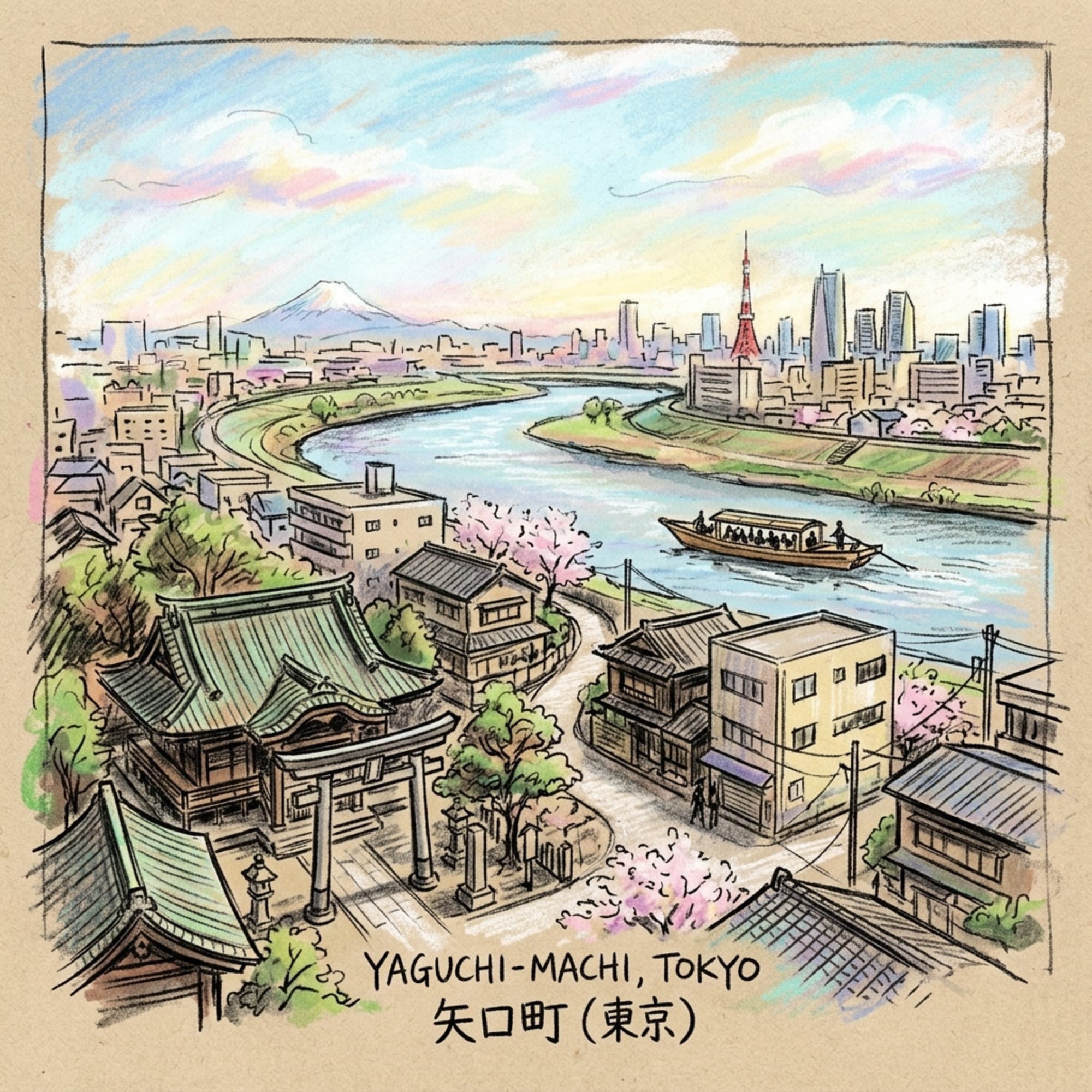
This is not, in itself, unusual. Cities are full of names that have outlasted the things that gave them birth. What is unusual about Yaguchi — this quiet, low-rise neighbourhood in Ōta Ward, where residential blocks and small metalworking shops alternate without drama along the southwestern edge of Tokyo — is the specific weight of what that vanished crossing once held. For nearly six hundred years, the ferry at Yaguchi was not merely a river crossing. It was the physical centre of one of the most elaborate and sustained systems of sacred memory management in Japanese history: a system set in motion by a single act of political murder on a river in October 1358, and not formally concluded until the morning the last boat docked.
To walk through Yaguchi today is to move through a landscape whose visible surface — the convenience stores, the narrow streets, the train tracks running parallel to the river — gives almost nothing away about the depth of time compressed beneath it. This essay is an attempt to read what lies underneath.
Listen to the historical stories told in detail (For subscribers only)
I. The Arrow-Mouth
The place name is a beginning. Ya (矢) means arrow. Guchi (口) means mouth, or entrance — the aperture through which something passes. Arrow-mouth. The local chronicles offer two explanations, each archaic enough to feel more like memory than history. The first holds that Yamato Takeru — the warrior-prince of Japan's founding mythology, said to have marched east in the service of the imperial house — conducted archery practice at this bend of the Tama River during his campaigns. The second, recorded in a Tokugawa-era gazetteer compiled between 1810 and 1830, gives the older name as Yashoku-mura, Arrow-Food Village, which may preserve something about the economics of an arrowhead-making community, or may simply be the eroded sound of a word whose meaning has been lost.
Either way, something in the landscape of Yaguchi seems to have always been associated with the flight and fall of arrows. Which makes what happened here on October 10, 1358, feel less like coincidence than like an ancient pattern finally finding its event.
Japan in the middle of the fourteenth century was in the grip of what historians call the Nanboku-chō — the era of the Northern and Southern Courts. Two rival imperial lines had been at open or covert war for decades. The Ashikaga family held power in Kyoto and had established a new shogunate; the Southern Court clung to legitimacy in the mountain redoubt of Yoshino. Among the Southern Court's most formidable remaining military assets in the east was a general named Nitta Yoshioki — twenty-eight years old in 1358, son of the celebrated commander Nitta Yoshisada, fighting a war he had inherited before he was fully grown. Yoshioki was, to the Ashikaga shogunate, a persistent and dangerous problem. Not an enemy who could be defeated cleanly in open battle, but one who kept reconstituting himself in the Musashi plain — the broad territory that is now Tokyo and its surroundings — threatening the stability of the eastern territories.
The 1358 River Trap That Birthed A Vengeful God
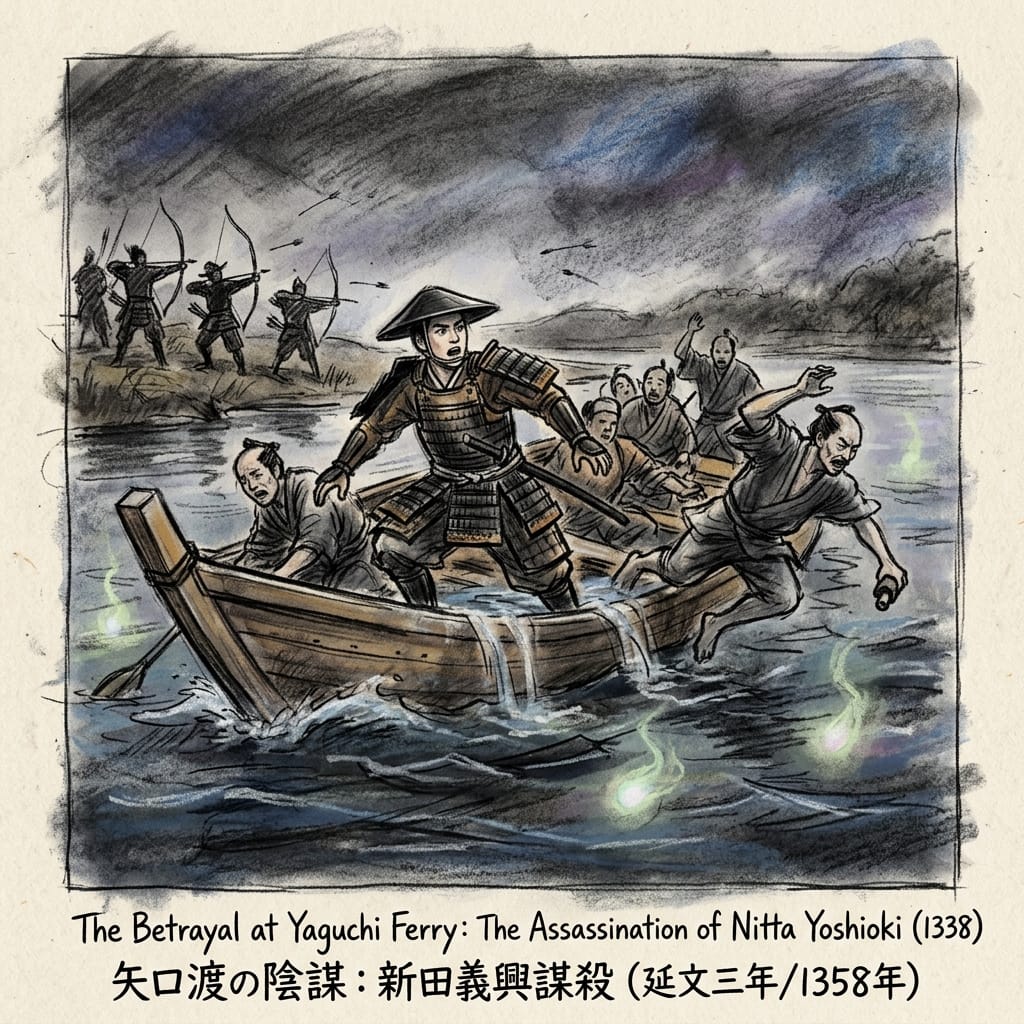
When the senior Ashikaga commander died in 1358, Yoshioki judged the moment right for a decisive push south toward Kamakura. The shogunate's regional governor and his administrator judged something different: that the cleanest solution was murder, and that the place to do it was the Yaguchi ferry crossing on the Tama River, where Yoshioki's route south would force him onto a boat.
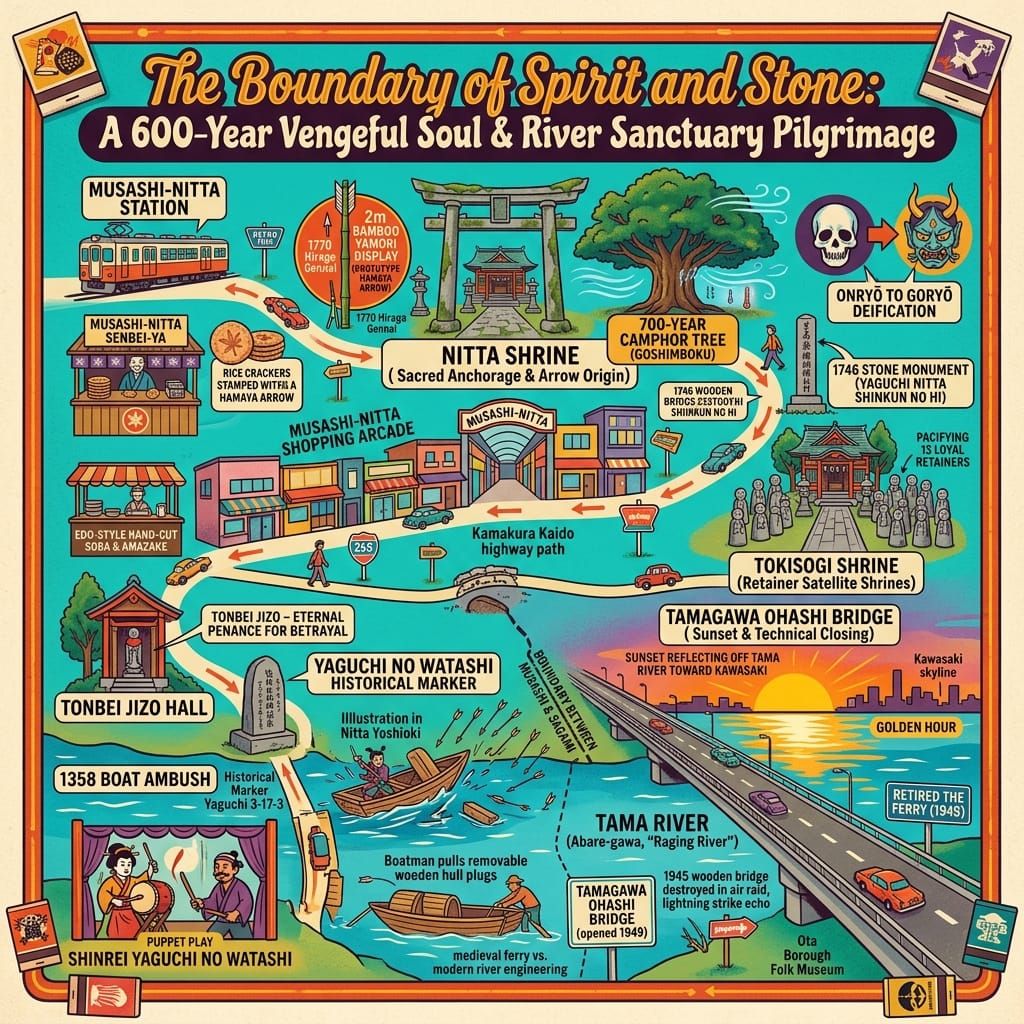
The boat's ferryman had been bribed. A plug had been fitted to a hole drilled through the hull. Two forces of archers waited on opposite banks, out of sight. Yoshioki crossed with thirteen retainers. Somewhere in the middle of the river — where the Tama runs wide and current-strong, where neither bank offered refuge — the ferryman pretended to drop his oar, slipped into the water on the pretext of retrieving it, and pulled the plug. The boat began to take on water. Arrows came from both banks simultaneously. Yoshioki, surrounded and sinking, understood what had happened. He died by his own hand in the Tama River. All thirteen of his retainers died with him.
Thirteen days later, one of the principal conspirators was struck by lightning. The population of Yaguchi, and of the Musashi plain more broadly, took note of the timing.
II. What the Village Elders Decided
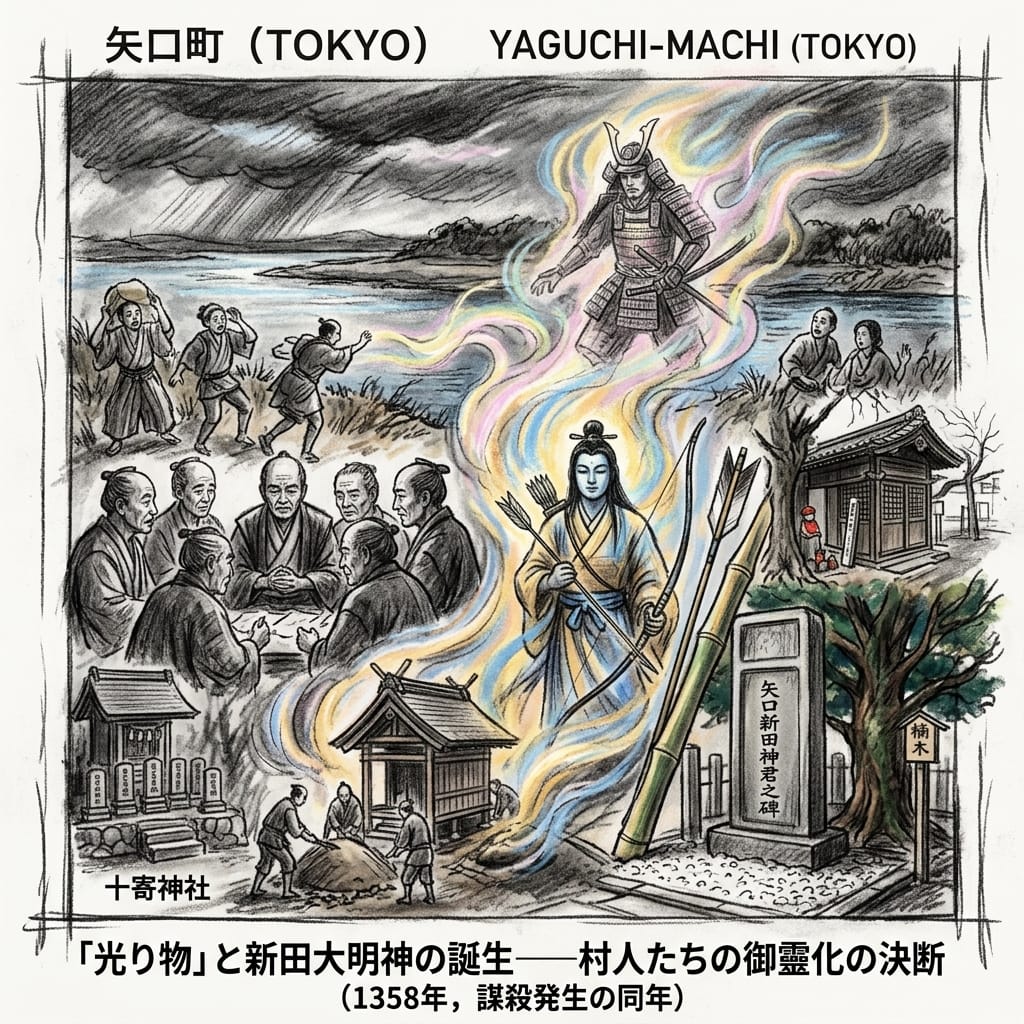
After the killing, something began happening at the crossing after dark. The chronicles call the phenomenon hikari-mono — glowing things — floating lights that appeared along the riverbank at night, disturbing travellers and unsettling the community. In the interpretive vocabulary of medieval Japanese Shinto, this was not an ambiguous sign. It was legible, and it was urgent: a powerful man had died in conditions of extreme injustice, and his onryō — his vengeful spirit — had found no territory, no form of containment, and was announcing its presence through the most available medium.
The village elders of Yaguchi faced, in the months following the assassination, a genuinely difficult problem. Yoshioki had been killed on the shogunate's orders; to openly enshrine him was, in one reading, a political statement, an implicit acknowledgement that the Southern Court's general had been murdered rather than defeated. Against this, the nightly disturbances continued, travellers were frightened, and the crossing was becoming a place to be avoided. The elders made their decision in the same year as the killing. They built a burial mound for Yoshioki's remains, erected a shrine hall before it, and gave the complex a name: Nitta Daimyōjin — Great Deity of the Nitta House. The glowing lights, the records say, stopped appearing.
Weaponizing A Vengeful Samurai Ghost
The shrine that stands at 矢口1-21-23 in present-day Ōta Ward — Nitta Shrine — traces its founding to this act. Its annual festival is held on October 10: the exact date of the assassination. This is not, in the logic of Japanese Shinto, a historical commemoration. It is a maintenance interval — a yearly recalibration of the contract between the community and the spirit it has agreed to house, to ensure that what was pacified stays pacified. Six hundred and sixty years of October 10ths. The same date, the same obligation, repeated until the last generation that remembers what it is for.
Among the shrine's holdings: a hand-painted illustrated scroll depicting the events of 1358 and the founding of the shrine, designated a Cultural Property of Tokyo Metropolitan Government. A stone stele, erected in 1746 by Matsudaira Yorihiro — lord of a domain in present-day Fukushima, nearly two hundred miles from Yaguchi — bearing a commemorative inscription for a general who had been dead for close to four centuries. Why a distant feudal lord felt compelled to make this gesture remains one of the questions Yaguchi's archives have not yet answered.
III. The Polymath's Two Gifts
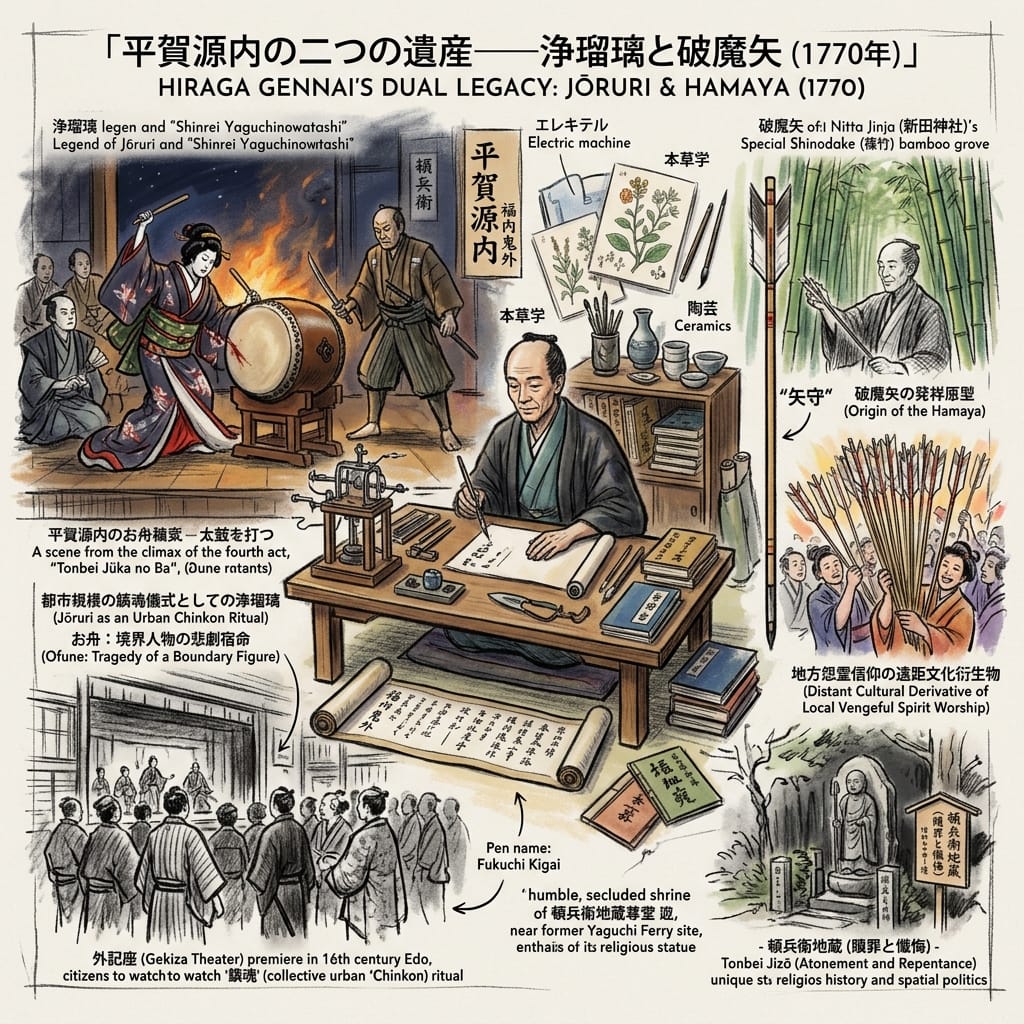
In the 1770s, there walked through Edo — the city that would become Tokyo — a man who seemed constitutionally incapable of confining himself to a single discipline. Hiraga Gennai (1728–1780) was a botanist and a scholar of Dutch science; he built a working friction electrostatic generator from parts sourced through the trading networks at Nagasaki; he wrote satirical fiction; he made ceramics; he produced ukiyo-e prints; he is sometimes credited, improbably, with inventing the concept of marketing grilled eel in summer as a health food. Later generations would call him the Japanese Leonardo — which is perhaps three-quarters accurate, and generous at that.
At some point in his peripatetic career, Gennai visited Nitta Shrine. He found, growing in the shrine precinct, a stand of shinodake — a slender, straight-culmed bamboo considered sacred to the site — and cut from it a quantity of stalks, which he fashioned into a type of ritual arrow he called yamori: a warding object, designed to deflect malign energies from the household that kept it. The shrine at Yaguchi identifies this invention as the direct ancestor of the hamaya — the evil-breaking arrow, sold at tens of millions of Japanese shrines every New Year, carried home by people who have, for the most part, no idea that its origin story runs back through a specific grove of bamboo in a quiet neighbourhood of southwestern Tokyo, to a shrine built to manage a ghost, to a political murder in 1358.
The Ghost Behind Japan S Lucky Arrow
In January 1770, Gennai — writing under the pen name Fukuchi Kigai, partly to circumvent the Tokugawa censorship that prohibited the direct theatrical portrayal of historical figures — staged the premiere of his puppet-theatre drama Shinrei Yaguchi Watashi (The Miraculous Spirit of the Yaguchi Crossing) at the Gekiza theatre in Edo. The play runs to five acts and takes as its central subject not the assassination itself but its aftermath: a warrior connected to Yoshioki's lineage, fleeing retribution, takes shelter at the home of a ferryman named Tonbei at the Yaguchi crossing. Tonbei's daughter, Ofune, falls in love with the fugitive. Tonbei, motivated by greed, plans to betray him for a reward. Ofune discovers the plot, places herself between her father's sword and the man she loves — and then, in the image that made the play famous, drags herself bleeding to a drum and beats out a signal to buy the warrior time to escape. She dies at the drum.
The play ran first as bunraku, crossed to kabuki in 1794, and accumulated over the following centuries a recorded history of more than three hundred productions. It is still performed. What is stranger, and more revelatory of how Yaguchi accumulates meaning, is what happened to Tonbei — the greedy ferryman, the villain. Near the old ferry crossing site in Yaguchi, there exists a Jizō statue — a figure of the Buddhist guardian deity — named, explicitly and without irony, after him. Tonbei's Jizō. The villain of the most famous play about the crossing, enshrined within walking distance of the crossing itself. We will return to this.
IV. The River That Would Not Obey
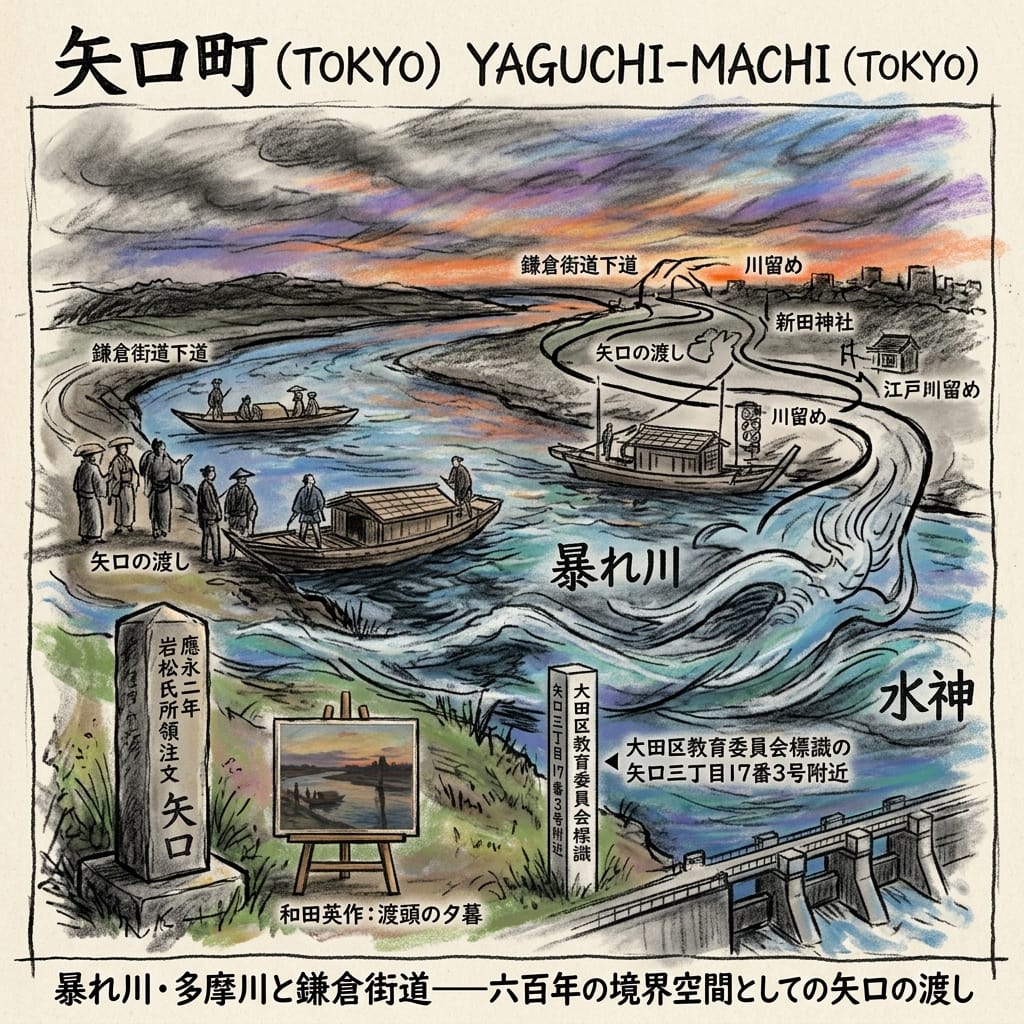
The Tama River, in the centuries before the concrete flood barriers went up, was known by a name that the engineers who eventually tamed it would have preferred to retire. The locals called it abare-gawa: the Rampage River. It flooded regularly, following the rhythms of the typhoon season; on September 17, 1876, a storm caused the embankment at Yaguchi to breach in multiple places, destroying farmland and damaging the settlement. The river had its own logic, and the logic was not always hospitable to the people who lived beside it.
The Bridge That Killed A River God
The ferry at Yaguchi had been operating since at least the Kamakura period — since the thirteenth century, when this stretch of road formed part of the Kamakura Kaidō, one of the major routes connecting the political centre at Kamakura with the provinces to the north and east. In the feudal governance of the Edo period, the crossing was formally regulated: the ferryman licensed, the fee fixed by law, and the system known as kawadome — river-stoppage — meaning that when the Tama rose to a dangerous level, all crossing was prohibited by authority. Every suspension of the crossing was a form of lesson: the river had not been conquered. It had been negotiated with, temporarily, on terms it could revoke.
The painter Wada Eisaku captured the Yaguchi crossing sometime in the middle Meiji period — the 1890s, perhaps — in an oil painting called Watari no Yūgure, Evening at the Ferry. The painting shows the crossing at dusk: the river, the waiting figures, the particular quality of light on a landscape just before the twentieth century arrives to change its terms. It is the most direct visual document of a space that was, by that point, already beginning to lose the conditions that made it what it was — still operating, still carrying its freight of history, but surrounded by a world accelerating away from the kind of time it embodied.
V. Fifteen Days
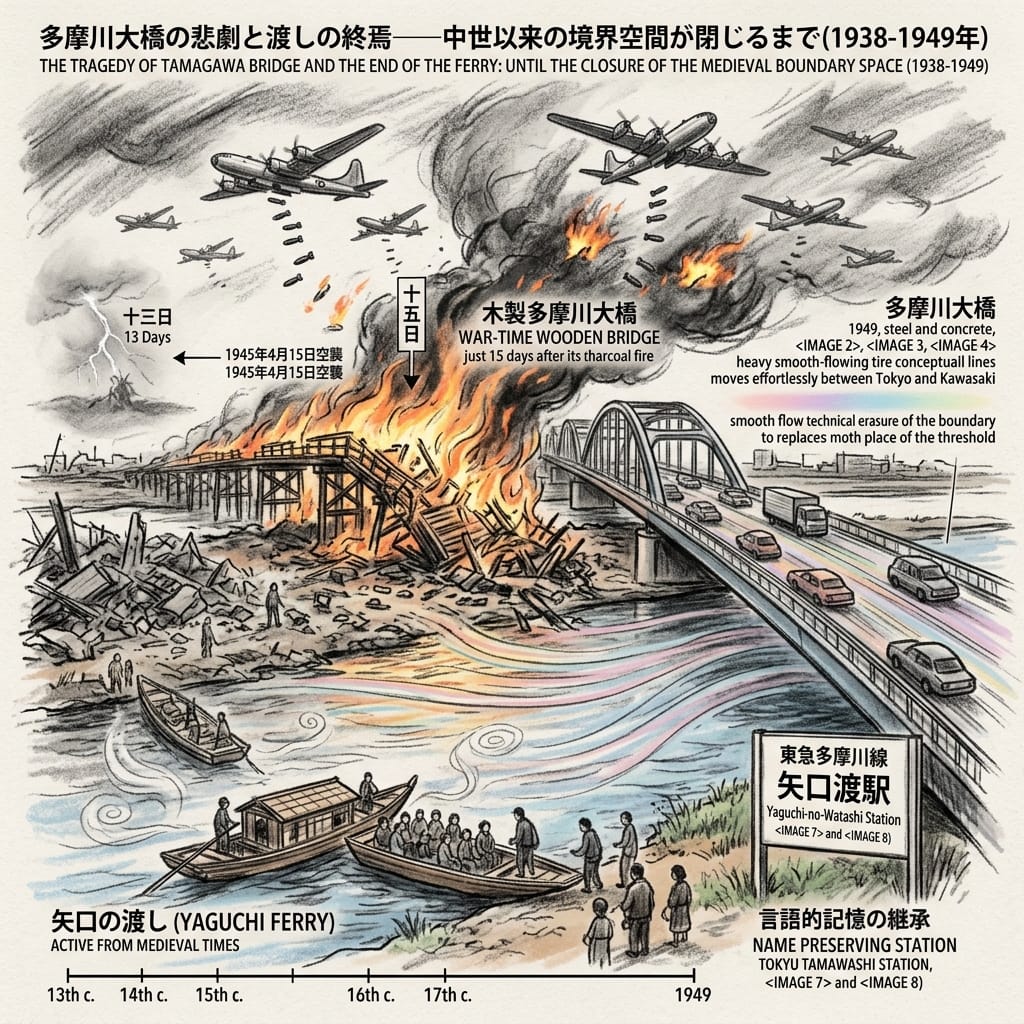
In 1938, the Japanese state began constructing a modern road bridge across the Tama at the Yaguchi site — a span for the Second Keihins National Highway, one of the new arterial routes feeding the expansion of the Tokyo metropolitan area. The lower structure was completed in 1942. The war consumed everything else, and the upper works waited.
On March 31, 1945, a temporary wooden bridge was completed. Seven years of interrupted construction. Finally, a crossing. The ferry had kept running through all of it.
Fifteen days later, on April 15, 1945, an American air raid destroyed the bridge.
Fifteen days: the number sits in the historical record without commentary, and it is difficult to encounter it without a sense that something is being said — some irony too blunt to be poetic and too precise to be accidental. The ferryman went back to the water. The crossing continued.
Death Of A Tokyo Ghost Crossing
The bridge was rebuilt in the postwar years, completed in March 1949 and opened to traffic on April 30. The Yaguchi ferry — last remaining on the Ōta Ward stretch of the Tama, heir to a tradition reaching back to the thirteenth century, holder of the accumulated weight of everything this essay has described — was declared officially closed on the same day the bridge opened.
No ceremony is recorded. The last boat docked. The station on the Tokyu line kept its name, and keeps it still. Every morning the recorded voice announces the stop, and the name of the crossing hangs in the air of the car for a moment, and the doors open, and it is swallowed by the ordinary sounds of people getting on and off a train.
The Shinto Logic of Dangerous Memory
To understand what Yaguchi has been for six centuries requires spending time with a set of ideas that are native to Japanese Shinto and have no precise equivalent elsewhere, though they address questions that every culture has eventually had to answer for itself.
The word onryō (怨霊) describes a specific class of spirit: one generated by a death that was violent or unjust, or both, in which the person's accumulated sense of wrong persists as an active force in the world after death. The concept runs through Japanese culture from the Heian court poetry through the kabuki tradition to contemporary horror cinema, but it is not primarily a narrative device. It is, or was, a practical concern: a powerful person dying in conditions of acute injustice was understood to represent a genuine danger to the surrounding community, proportional to the power of the person in life and the severity of the injustice at death.
Yoshioki's death at Yaguchi satisfied, by the standards of medieval Japanese Shinto, something close to the maximum conditions for generating a formidable onryō. He was a senior military commander — a man whose willpower and martial competence had shaped the course of a war. His death was not in battle but by calculated betrayal, weaponising the conventional safety of a ferry crossing — a public, neutral, functionally protected space — against him. And the death occurred at a sakai: a provincial boundary, a zone that Shinto identifies as inherently unstable, where the kami of one province's jurisdiction ends and another's begins, and where the gap between those jurisdictions creates something like a crack in the world's surface. Jurisdiction-crossing, in Shinto spatial logic, is precisely the condition in which ordinary rules of containment fail, in which the normal mechanisms by which dangerous energies are managed at the local level break down. Yoshioki died at the most difficult possible location for his spirit to be managed.
What the village elders did in response reflects a principle that distinguishes Shinto's approach to dangerous spiritual energy from the approaches of most other traditions. The logic is not exorcism — not the attempt to drive the dangerous force away. It is transformation. The more powerful the onryō, the more powerful the goryō — the pacified, enshrined, redirected version of the same energy — that can be produced by correctly incorporating it into a shrine structure. A community that enshrines its most dangerous ghost correctly acquires, in the process, a proportionally powerful protector. The danger becomes the protection. This is not a metaphor. It was a practical operating principle, and the elders of Yaguchi applied it within the year of the killing.
What makes Yaguchi exceptional is the scale and continuity of the ecosystem that then grew around this decision over the following six and a half centuries. A system that was not sealed and concluded at the moment of enshrinement but continued to absorb and incorporate new elements with each generation:
The same year as the killing, a second shrine — Tokisogi Jinja — enshrines the spirits of the thirteen retainers who died with Yoshioki. Thirteen individual deaths, requiring thirteen individual resolutions.
1746: A feudal lord from distant Fukushima erects a stone stele at the shrine. The system's orbit has expanded to include a powerful man several hundred miles away who feels, for reasons the historical record has not preserved, an obligation to maintain the ritual register.
1770: Gennai's play makes the story of the crossing known to every literate person in Edo, and eventually to the whole country. The emotional charge of Ofune's death at the drum carries the weight of the system to people who will never visit the shrine and know nothing of the history.
Somewhere in the Edo or Meiji period: a Jizō statue is placed near the ferry crossing site and named after the villain of the play. Even the fictional re-enactment of the betrayal has been given an address. Even the imagination of treachery has been contained.
And the hamaya — if the shrine's tradition is accurate — means that every New Year, tens of millions of people across Japan purchase a warding arrow whose chain of causation runs back to a bamboo grove in Ōta Ward, and from there to a decision made in a village in 1358.
The ferry closure in 1949 ended the last living component of this system. Not the shrine — it still stands, still holds October 10. Not the Jizō. Not the plays or the arrows. But the crossing itself: the daily, embodied act of pausing at the river's edge and waiting to be carried across, the physical enactment of the threshold, the moment of suspension between one province and another that had, for six centuries, been the most primal interface with the original event. Every previous disruption to the system had been answered by something new being added. The 1949 closure was answered by nothing.
Holographic Sensory Cue: Stand on the flood embankment above the old Yaguchi crossing site — a ten-minute walk south from Yaguchinowatashi Station, near the junction of the river and the Second Keihins Highway. The embankment is concrete, grey, continuous, and entirely without ceremony. The wind off the Tama comes from the southwest; in autumn it carries river moisture and the faint industrial edge of the city on both banks simultaneously. Downstream, the Tamagawa Ōhashi — the 1949 bridge — carries six lanes of highway traffic across the water, and when a heavy vehicle crosses you feel the vibration through the soles of your shoes. The opposite bank is Kawasaki, in Kanagawa Prefecture, once the province of Sagami: perhaps a hundred and fifty metres of moving water away. It might as well be, still, another country. The river between is wide and fast and the surface carries nothing that would tell you what once happened here.
Resonance Node: The Villain's Jizō
Near the old ferry crossing site, off the main pedestrian routes and easy to miss without specifically looking for it, there stands a small altar housing a Jizō Bodhisattva — the Buddhist figure associated with protection and the welfare of the dead — which bears the name of Tonbei. The villain. The fictional villain of a puppet play first performed in 1770, based on a historical betrayal that occurred in 1358.
There is almost no English-language literature about this statue. There is, as far as I know, no established interpretive tradition for a protective deity erected in the name of a fictitious murderer. What seems to have happened — and this is interpretation, not record — is that over the two and a half centuries during which Shinrei Yaguchi Watashi was performed hundreds of times across Japan, the figure of Tonbei became sufficiently real in the community's imagination to require its own ritual address. The logic of the place, which had spent four centuries absorbing and managing every form of dangerous energy associated with the 1358 assassination, eventually turned its attention to the fictional re-enactment of that assassination, and found that even the villain of the story needed to be placed.
Find this statue. It requires patience. It is the most honest monument in Yaguchi — the one that concedes, without explanation or apology, that in some places, not even the imagination is allowed to go unmanaged.
What Every Hamaya Carries
The question that Yaguchi poses to anyone who spends time with its history is not a question about Japanese culture specifically. It is a question about what communities owe to their most dangerous memories, and what happens when the structures built to hold those memories are dismantled without replacement.
The village elders of 1358 made a decision that was, by conventional political logic, inadvisable. They built a shrine to a man killed by the ruling power. They committed their community to an annual ritual on the date of his murder. They created institutional infrastructure around the proposition that the injustice done to him was a real thing, that it had produced a real and persistent energy, and that this energy needed a real home. What followed was not a fixed monument but a living ecology: shrine, stele, play, arrow, statue, festival. Each generation adding its own node to the network. None of them cancelling what came before. The network growing more complex, more self-reinforcing, more capable of carrying the original charge across time — until the concrete bridge in 1949 quietly disconnected the last living interface and the charge went into a kind of suspension.
The hamaya arrows sold at every Japanese shrine this coming January are small, lacquered, tipped with white feathers, and almost never thought about too carefully by the people who buy them. They are a convenience, a tradition, a small ritual of domestic protection. It is easy to dismiss them as superstition and equally easy to sentimentalise them as ancient wisdom. Neither response is adequate to what Yaguchi reveals.
What Yaguchi reveals is something more difficult: that the human act of building a structure around dangerous memory — of refusing to let the violence of the past drift unaddressed through a community's body, of insisting on giving it a form, an address, an annual appointment — is not superstition. It is one of the fundamental things that communities must do in order to remain coherent across time. The form it takes will differ by culture, by century, by the nature of the violence being managed. The function it performs will not.
The last ferryman at Yaguchi docked his boat on April 30, 1949, and walked away from the river. No record preserves his name, or what he felt. The station on the commuter line still announces the crossing. The shrine still holds October 10. The Tonbei Jizō still stands somewhere near the bank, waiting for whoever finds it.
The system is still running. It simply has no interface left.
If this essay changed the way you see a place you thought you understood — or opened a door into a history you didn't know existed — consider subscribing to Historical Travel Stories. New articles arrive by email, in five languages, one location at a time.
Getting to Yaguchi
By rail
The Tokyu Tamagawa Line is your primary route. It departs from Tamachi and Musashikosugi (among other stations), running along the Tama River's eastern bank through Ōta Ward.
For Nitta Shrine and the Tokisogi Shrine: alight at Musashinoda Station (武蔵新田駅). The Nitta Shrine is a three-to-five-minute walk southwest. Signs are sparse; a brief look at a map beforehand is worthwhile.
For the ferry crossing marker and the Tonbei Jizō: continue one stop to Yaguchinowatashi Station (矢口渡駅), then walk south toward the river for approximately ten to fifteen minutes, following the old embankment road (kyūtei-dōri) toward the National Route 1 bridge. The crossing-site marker — a stone explanatory panel installed by the Ōta Ward Board of Education, designated a ward cultural property — is near the river's edge at approximately 矢口3-17-3.
Suggested walking route (allow two to two and a half hours)
Nitta Shrine → Tokisogi Shrine → old embankment road southwest → Yaguchi ferry crossing marker → Tonbei Jizō (patience required) → Tama River Bridge (for the downstream view of the crossing site)
When to go
October, and specifically the week around October 10, is the obvious choice: the Nitta Shrine's annual festival falls on that date, and has fallen on it, without interruption, for six and a half centuries. The shrine's obligations are at their most visible. Autumn light on the Tama is also, aesthetically, its best.
If October is not possible, early morning on any day reduces the ambient noise of the residential district and lets the shrine precinct feel more like itself. The ferry crossing site has no operating hours — it is a stretch of riverbank with a stone panel — and can be visited at any time.
Where to stay
Kamata (蒲田) is the most practical base: a ten-minute walk from Yaguchinowatashi Station, or one stop on the Tokyu Tamagawa Line to Tamagawa, then transfer. Kamata is a dense, ungentrified commercial district with a wide range of hotels at moderate prices. Toyoko Inn, Dormy Inn, and APA Hotel all have properties in or adjacent to Kamata. For those who prefer central Tokyo, Shinagawa and Gotanda provide Tokyu and JR access to the line without excessive journey time.
Practical notes
Nitta Shrine has a shrine office (shamusho) with staff who can, on request, provide information about the cultural properties held on site. The illustrated founding scroll is not always on public display and may require advance arrangement to view. The Tonbei Jizō requires active searching; it is not marked on standard tourist maps. The Shimomruko Library (下丸子図書館), a short walk from Musashinoda Station, maintains a specialist local history collection on the Yaguchi and Shimomruko area and is worth a visit if you read Japanese.
💡Frequently Asked Questions about Yaguchi-machi
What is the historical significance of Nitta Shrine and the Yaguchi Ferry incident in Tokyo?
Nitta Shrine in Ota Ward, Tokyo, stands on the tragic history of the 1358 Yaguchi Ferry incident. During the chaotic Nanboku-chō period, the samurai general Nitta Yoshioki was betrayed and assassinated while crossing the Tama River at Yaguchi Ferry. According to local lore, his untimely death unleashed a vengeful spirit (onryō), manifesting in sudden thunderbolts, violent river swells, and mysterious fatalities among his betrayers. To appease Yoshioki’s wrathful spirit and transform destructive supernatural energy into protective divine power, locals established Nitta Shrine. Today, this historic site marks a vital chapter in Tokyo’s spiritual geography, showcasing how medieval trauma, ritual pacification, and river crossing culture shaped the urban heritage of the modern Yaguchi-machi district.
How did Hiraga Gennai and Kabuki make Nitta Shrine famous for Hamaya arrows?
Nitta Shrine’s national fame blossomed during the Edo period through the genius of Hiraga Gennai, a legendary polymath and playwright. In 1770, Gennai authored the celebrated Kabuki masterpiece Shinrei Yaguchi no Watashi (The Miraculous Yaguchi Ferry), dramatizing Nitta Yoshioki’s betrayal and divine vengeance. Inspired by the sacred bamboo (shinboku) growing mysteriously behind the shrine—which legend claims rustled only when enemies approached—Gennai conceptualized Hamaya (evil-dispelling arrows). He designed arrow talismans crafted from this sacred bamboo for pilgrims to bring home as spiritual protection. This brilliant synthesis of theatrical storytelling and sacred craft established Nitta Shrine as the historical birthplace of Japan’s iconic New Year Hamaya tradition, attracting pilgrims across centuries.
How did the 1949 Yaguchi Bridge transform the spiritual geography of Yaguchi-machi?
For over six centuries, the Yaguchi Ferry served as a strategic yet spiritually charged crossing point over the treacherous Tama River, connecting ancient Musashi Province routes. Crossing the river required travelers to navigate both physical currents and spiritual boundaries linked to the memory of Nitta Yoshioki. However, the inauguration of the modern concrete Yaguchi Bridge in 1949 permanently altered this landscape. The new bridge eliminated the ancient ferry tradition, replacing a centuries-old ritualistic water boundary with seamless modern transport infrastructure. This physical transition allowed Yaguchi-machi to rapidly evolve from an agrarian riverfront village into a thriving small-scale manufacturing and residential hub in Ota Ward, while Nitta Shrine remains its enduring cultural and spiritual core.
Reference and Further reading
First layer – Main sources of literature and institutions:
- 《太平記》——室町時代成立的軍記物語,記有義興謀殺的詳細敘述(卷三十三)。研究者應注意《太平記》的文學性質,其史實部分需與其他史料交叉比對。
- 東京都神社廳——新田神社公開記錄
- 大田区立郷土博物館蔵史料
- 東京都神社廳公開記錄;大田区指定文化財調查書(大田区教育委員会)
- 早稲田大学演劇博物館蔵浄瑠璃脚本資料庫;国立国会図書館デジタルコレクション
- 《新編武蔵風土記稿》(天保年間)——矢口村の直接記述資料;国土交通省関東地方整備局京浜河川事務所——多摩川治水歷史記錄
- 国土交通省関東地方整備局——多摩川大橋竣工記錄(1949年)
- 大田区空襲被害記錄(大田区立郷土博物館)
- 矢口渡駅歷史記錄(東急電鉄)
The second layer – secondary academic materials:
- 山川出版社《日本史小辞典(改訂新版)》,2016年(「新田義興」條目)
- 保立道久等中世武家政権史研究
- 守随憲治《浄瑠璃史》
- 民俗学的御靈信仰研究(网野善彦、保立道久等中世史研究者)
- 「光り物」現象的歷史記錄方法論:需比較同時代其他怨靈案例的「物理異象」記錄模式
- 田中優子《平賀源内》(朝日新聞出版)
- 国立劇場上演資料集512号(《神霊矢口渡》解説)
- 東京都及川崎市の地方交通史研究(鎌倉街道路線確定に関する学術論文)
- 和田英作油画研究(「渡頭の夕暮」在日本美術史中的地位及現藏位置)
- 東京都戰後都市復興史研究(吉見俊哉等)
- 戰時帝都インフラ整備史
Third layer – Supplementary information:
- 《新編武蔵風土記稿》(文化・文政期,1810-1830年完成)——對矢口地域的直接描述,為重要的江戶時代地誌一次資料
Historical gap:
- 謀殺地點(大田区矢口 vs. 稲城市矢野口)的爭議尚無考古學定論。主謀者的具體後續命運(尤其是竹沢右京亮)在史料中記錄片段,缺乏系統性梳理。建議進一步查證:大田区立郷土博物館原始地誌藏品及神奈川県立歴史博物館相關館藏。
- 十寄神社和頓兵衛地蔵的具體創建年代在現有公開資料中記錄不完整。建議查證:大田区立郷土博物館民俗資料。
- 源内選擇矢口地理素材的個人創作動機尚無一手文獻佐證(現有研究多從源内的博學傾向推測)。矢守/破魔矢連結的確切歷史記錄(何時、以何種文獻形式)需要進一步查證:是否有江戶時代的文獻記載,或是明治以後才出現的起源神話?建議查證:平賀源内記念館(香川県)蔵品及神社傳存文書。
- 矢口地域的水神儀式實踐文字記錄目前尚未找到系統性的學術整理資料。鎌倉街道渡口的精確使用起始年代(中世的渡口使用は何時から確定できるか)需要進一步考古/文書查證。建議查証:下丸子図書館(下丸子・矢口地区史跡・文化財専門地域資料蒐集機関)。
- 矢口の渡し的最後一位渡し守(船頭)的具體個人記錄,在現有公開資料中未見記載。渡口廢止的「最終一渡」(最後一次渡河服務)的具體日期是否有留下任何地方記錄?這是一個值得追查的人文史學空白。建議查证:大田区立郷土博物館口傳史料、地方居民歷史訪談記錄。
 Lawrence
 Lawrence
 Lawrence
All historical records cited in this essay are drawn from primary and secondary Japanese-language sources, including the Ōta Ward historical archives, the Tokyo Metropolitan Shrine Board, the National Diet Library digital collection, and scholarly literature on the Nanboku-chō period. A complete source tier listing and historiographical gap analysis is available in the companion research dossier.