(ENG) Tokyo's Forgotten Road: 5 Whispers from a Ghost Village Hidden in Plain Sight, Kami-itabashi
The journey through the ghost village of Kami-Itabashi reveals a truth that resonates powerfully today. Its true value lies not in grandeur, but in its quiet humility—from its unassuming post town, to the bowed head of the beggar Rokuzō, to the silent faith of its roadside stones.

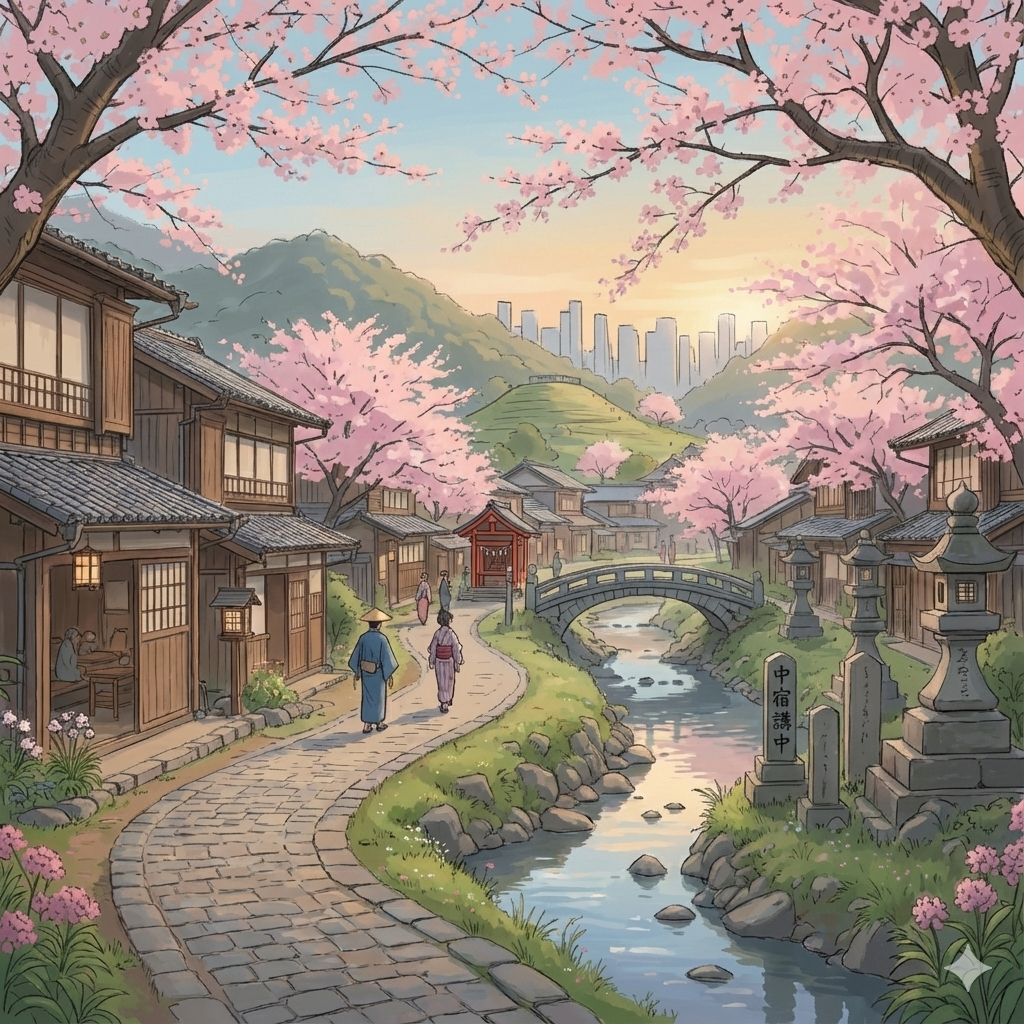
Shakujii River Promenade
Listen attentively to the historical stories told in detail
The Echoes of an Older Tokyo
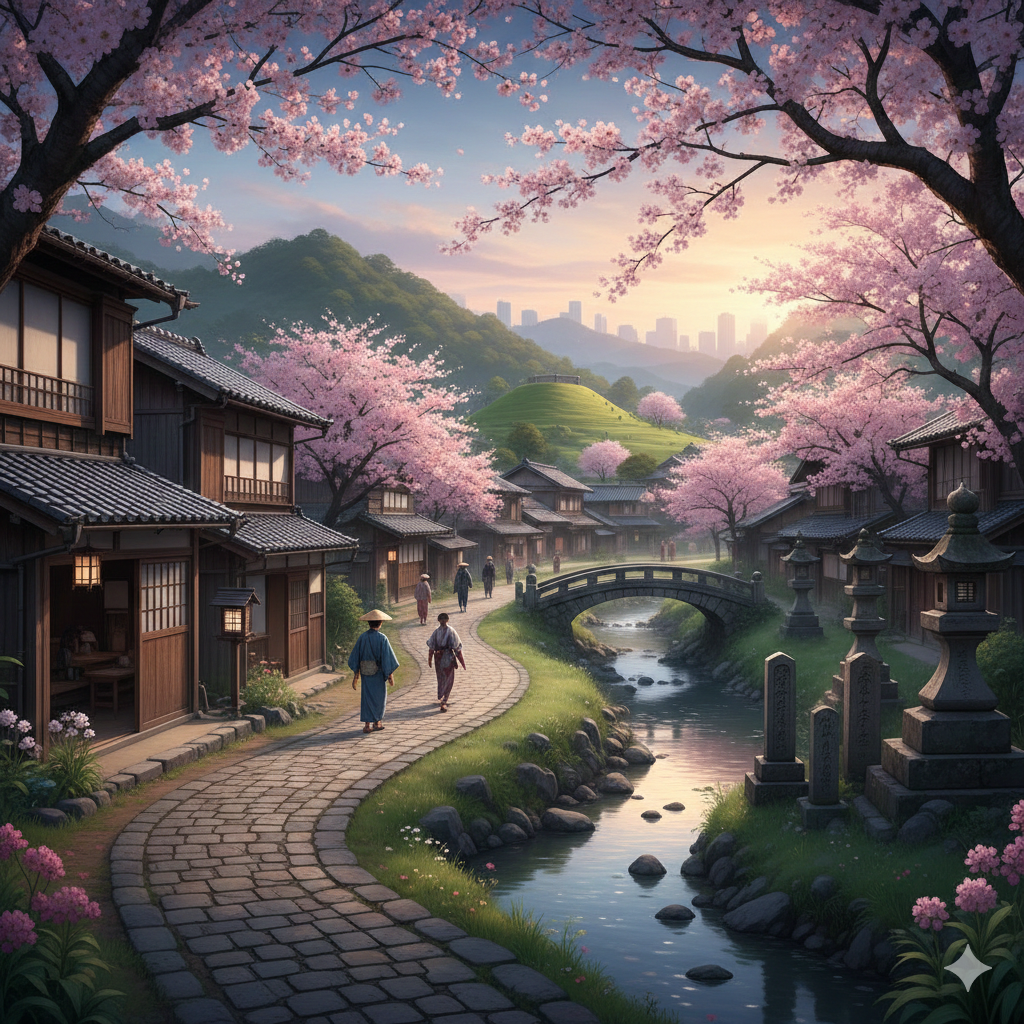
Picture Tokyo: a neon-drenched cityscape of soaring towers, bullet trains, and Shibuya's ceaseless human river. It’s a metropolis defined by its relentless pursuit of the future. Yet, beneath this hyper-modern skin lie ancient, quiet paths, where the echoes of a forgotten city still whisper. These are the roads less traveled, the histories hidden in the shadows of skyscrapers, waiting for those willing to look beyond the obvious.
Our quest takes us along the Kawagoe Kaido, an ancient road connecting the shōgun's capital of Edo with the prosperous castle town of Kawagoe. Its roots run deep, potentially even older than the famed Nakasendo, one of the five great highways of the Edo period. Along this artery lies the ghost of a vast village, Kami-Itabashi, whose true scale and story have been obscured by the misleading geography of modern train stations. What was once a sprawling territory is now a puzzle scattered across multiple neighborhoods, its historic heart beating in a place few would think to look.
This journey will uncover five surprising stories and hidden gems from this forgotten corner of Tokyo. It is an invitation to step off the beaten path, to trade the cacophony of the present for the humble, profound silence of the past, and to discover a version of the city that history almost left behind.
The Post Town That Slept: The Surprising Serenity of Kami-Itabashi-juku
In the intricate tapestry of Edo-era Japan, post towns (shukuba) were the vibrant, pulsating nodes of the nation's highway system. They were bustling hubs of commerce and travel, where samurai, merchants, and pilgrims sought rest, sustenance, and fresh horses. One would expect Kami-Itabashi-juku, a designated station on a key artery, to fit this lively mold.
The historical reality, however, is far more subtle and serene. While the mighty Itabashi-juku on the main Nakasendo road boasted 573 households, a main inn (honjin), three sub-inns (waki-honjin), and 54 lodges in 1843, its neighbor on the Kawagoe Kaido was a picture of quiet modesty. The post town area of Kami-Itabashi comprised a mere 90 households. The reason for this tranquility was elegantly practical: the thirteen-ri (an old Japanese unit of distance, roughly 50km) journey from Edo to Kawagoe was short enough for most travelers to complete in a single day, eliminating the need for extensive overnight accommodations. Instead of a bustling travel hub, Kami-Itabashi-juku functioned as a humble rest stop and a local administrative point, its atmosphere described as:
"a fairly quiet townscape"
To find the ghost of this quiet post town today, one must commit a small act of historical rebellion and ignore the modern "Kami-Itabashi" station. The real journey begins near Naka-Itabashi station, where the past still lingers. For the modern traveler, this means making Naka-Itabashi Station or Tokiwadai Station on the Tobu Tojo Line your starting point, deliberately bypassing the modern station that shares the village's name.
- Your first stop is Hōkei Inari, a small shrine in the Yayoi-cho neighborhood. Here, you will find a treasure for any historical detective: a detailed reconstruction map of the old post town. This is not an ancient artifact, but a labor of love painstakingly created by local volunteers in 1976 based on historical records, and it is the perfect chart to orient yourself in a world that no longer exists.
- From there, make your way to Manpuku-ji temple, also in Yayoi-cho. Look closely at its historical artifacts, such as an old bronze gong dating to 1825. There, you can find characters engraved that refer to the "Naka-juku" (middle section) of the old post town, a tangible link to the community that once prayed and lived here.
The quietude of the official post town, however, belies the dramatic human stories that unfolded just a few steps further down the road.
The Bridge of Bowed Heads: A Tale of Humility and Redemption
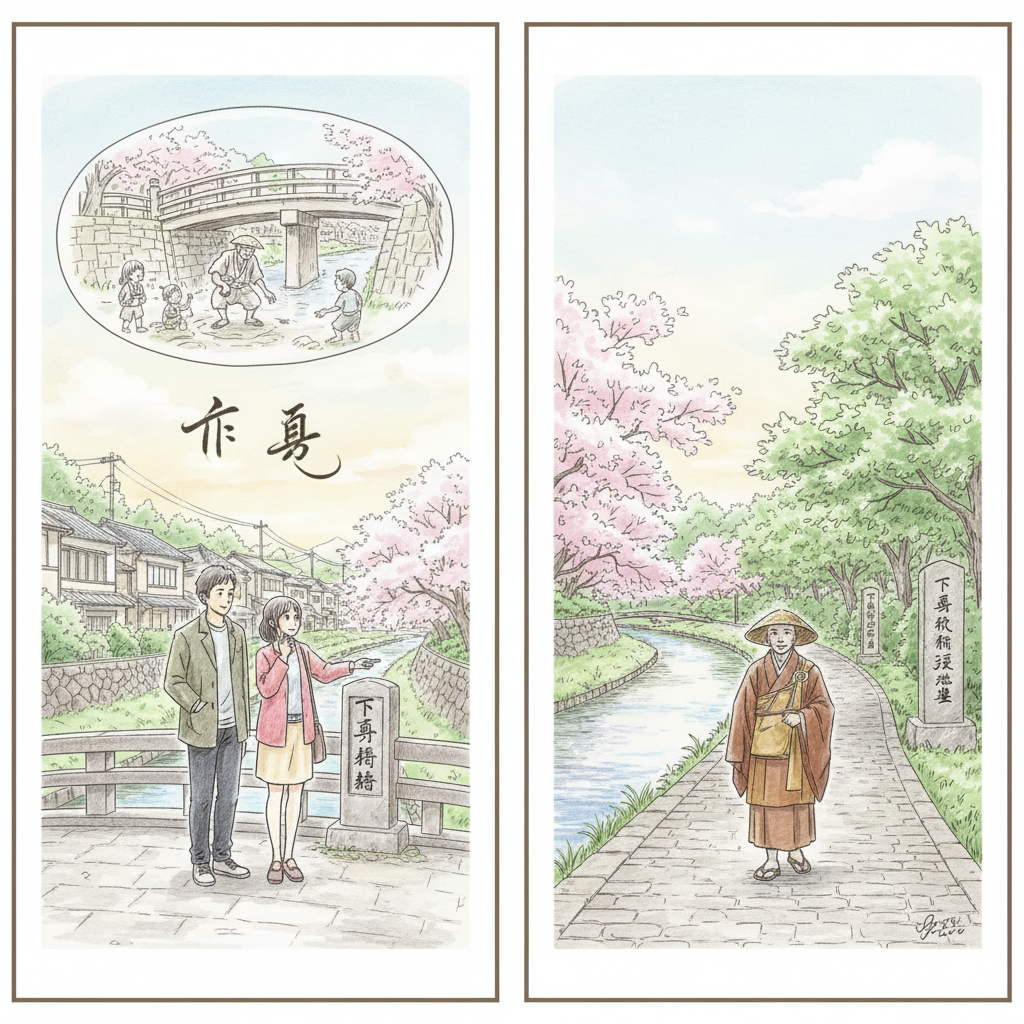
Imagine a weary traveler on the old Kawagoe Kaido. The dust of the road clings to their clothes as they approach the gentle murmur of the Shakujii River. In Edo Japan, a bridge was more than a mere crossing; it was a landmark, a meeting point, and often, a place where profound stories took root and grew into local legend. Here stands Gedobashi—the "Lowered Head Bridge."
The original folk tale is a poignant lesson in humility. It speaks of a beggar named Rokuzō who lived under the simple wooden bridge. Wracked by hardship, he always walked with his head bowed low, earning the ridicule of village children who would taunt him, "Lowered-head Rokuzō, always looking down." After his death, a traveling monk passed through and offered a new perspective: Rokuzō’s perpetually bowed head was not a sign of shame, but an act of profound, lifelong humility in the face of the world. To honor this quiet spirit, the villagers named the crossing the Lowered Head Bridge.
Centuries later, the novelist Yoshikawa Eiji masterfully layered a new, dramatic meaning onto this simple story. In his 1933 tale, the beggar is revealed to be "Iwa-kō," a samurai from Odawara in disguise, living in penance while on a secret mission of vengeance. His bowed head is no longer just a symbol of humility, but a conscious act of atoning for his sins—an embodiment of the Buddhist concept of shimetsu zaijō, the expiation of crime and karma. Yoshikawa Eiji transformed a story of humility into a powerful narrative of redemption.
Today, you can stand at this confluence of legend and literature and contemplate its dual meaning.
- The physical Gedobashi (Lowered Head Bridge) still marks the intersection of the old road and the river, a quiet spot to reflect on the stories of Rokuzō and Iwa-kō.
- For deeper contemplation, take a walk along the Shakujii River Promenade. Away from the city's noise, the gentle flow of the water provides a serene backdrop to ponder the legend's themes of humility, hidden identity, and the timeless human search for salvation.
This single, dramatic story of one man's burden gives way to the collective, quiet faith that protected every traveler who walked this path.
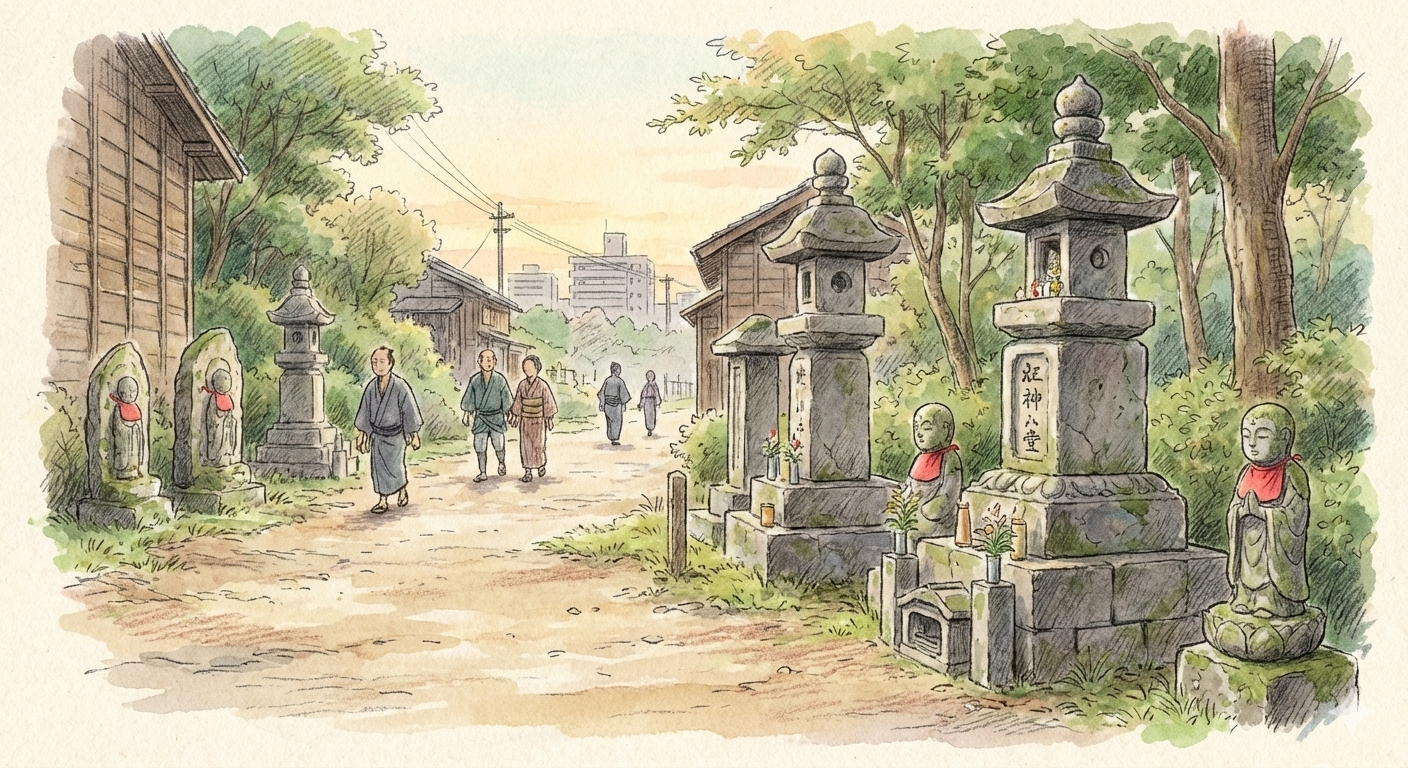
The Roadside Guardians: Finding Faith in Forgotten Stones
For the common people of the Edo period, a long journey was a venture fraught with peril. Their sense of security came not from the official post town administration, but from a network of humble, silent guardians standing sentinel along the roadside. These stone markers were the true spiritual anchors for the average person, a "micro-monument network" whose history is more personal and profound than that of any official structure.
Two types of guardians were paramount: Kōshin towers and Jizō statues. The Kōshin faith, a folk belief tied to Daoist traditions, promised longevity and protection from disaster to those who stayed awake through the night on certain dates. The stone towers erected by believers served as both practical markers for village boundaries and potent reminders of this protective faith. Alongside them stood statues of Jizō, the gentle bodhisattva who was a guardian of travelers, children, and lost souls. This was the "history of the common people," written not in official ledgers, but in stone and faith.
To walk the Kawagoe Kaido today is to engage in a form of cultural archaeology, seeking out these forgotten protectors. It is a quest that requires one to lower their gaze from the skyscrapers to the curbside stones, where the real stories lie.
- Embark on a modern-day pilgrimage to find the scattered throughout the historical Kami-Itabashi area. This walking tour connects you directly to the spiritual landscape of the Edo commoner, offering a glimpse into their simple, earnest prayers for a safe journey.
This quest for spiritual sustenance naturally leads to the more worldly, and surprisingly delicious, motivations for traveling this particular road.
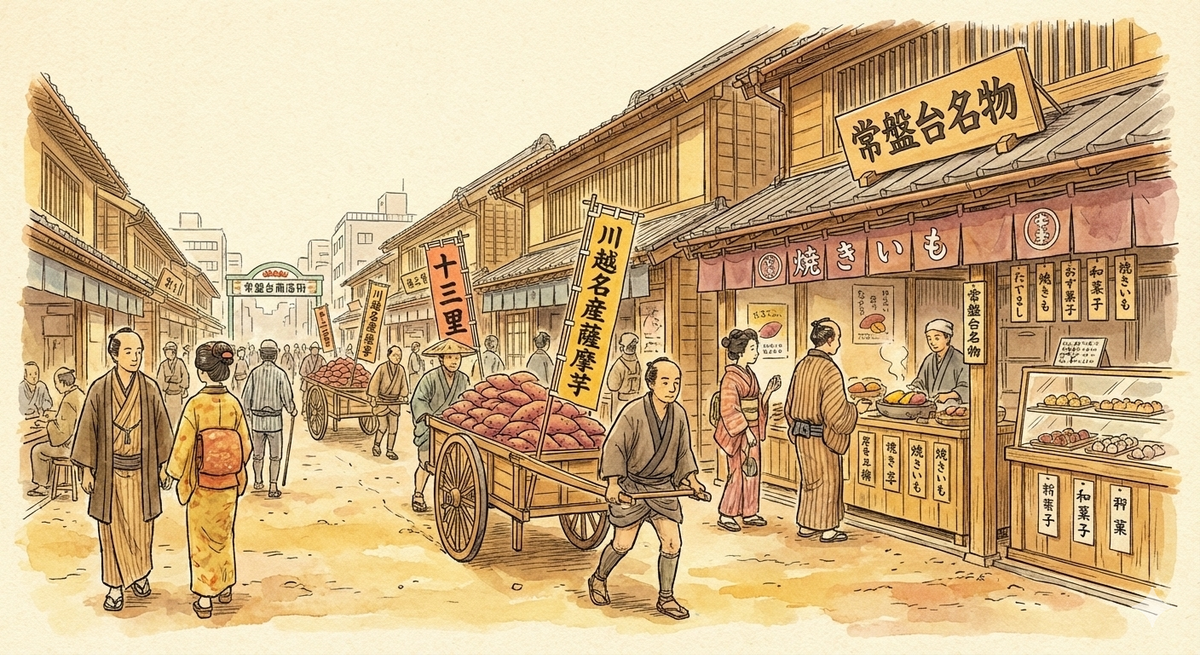
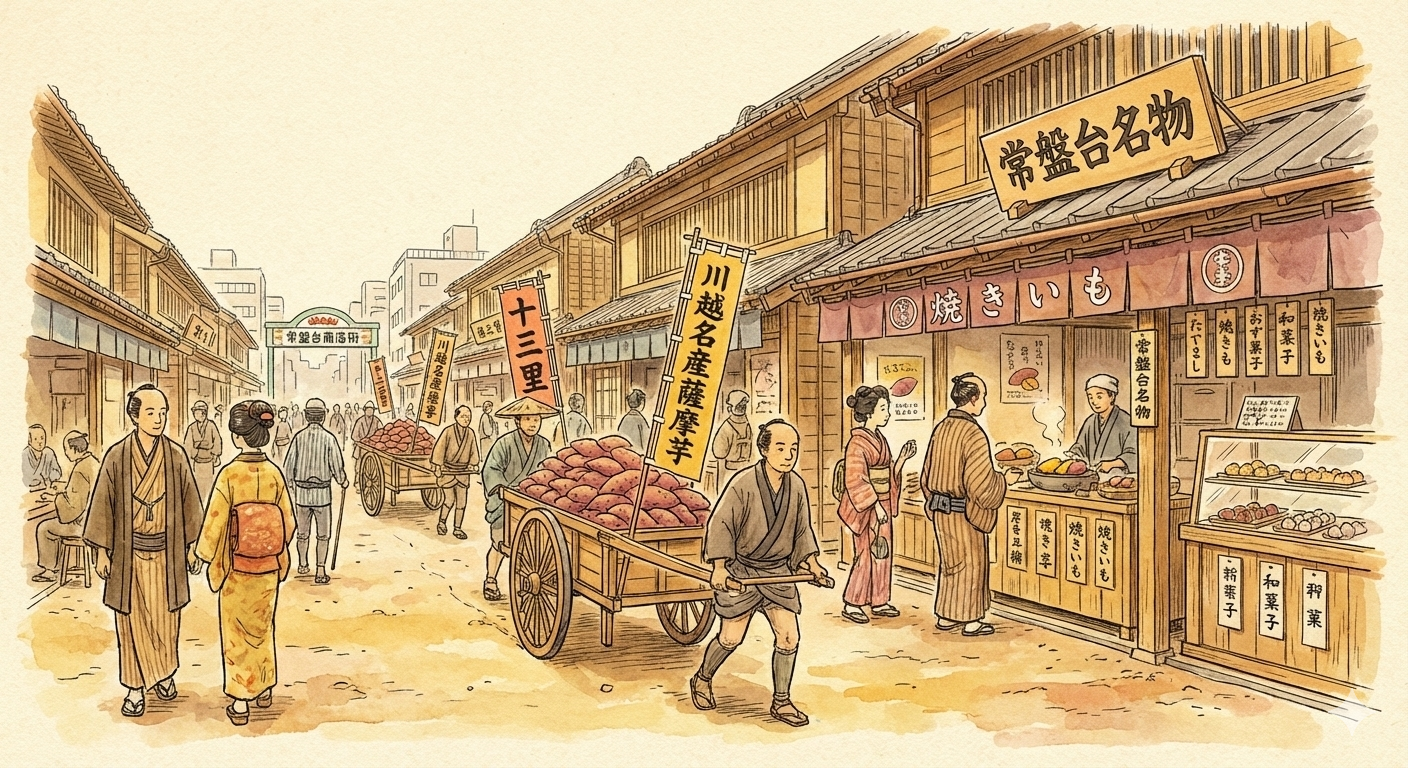
The Thirteen-Ri Secret: How a Road Became a Sweet Potato
Along the Kawagoe Kaido, a curious proverb took root, blending geography with gastronomy: "More delicious than nine ri (chestnuts) is thirteen ri." This was a brilliant piece of Edo-era wordplay. The word for chestnut, kuri, sounds identical to ku-ri, or "nine ri." The length of the Kawagoe Kaido, however, was thirteen ri, or jūsan ri. Because the town of Kawagoe was famous for its exceptionally delicious sweet potatoes (satsuma-imo), "thirteen ri" became a clever nickname for the vegetable itself, implying it was even tastier than roasted chestnuts.
Kami-Itabashi’s location along this "sweet path" gave it a crucial role. It was not just a rest stop for people, but a vital link in the agricultural supply chain. Much of the historical village was productive farmland, and its post station would have been a key transit point for produce—especially those famous sweet potatoes—moving from the fields of Kawagoe to the insatiable markets of Edo.
Today, you can embark on a culinary quest to find the modern heirs of this sweet legacy. While the old transit station is gone, its spirit lives on.
- Explore the local shopping streets in areas like Tokiwadai, which was historically part of the vast Kami-Itabashi village.
- Hunt for traditional Japanese sweet shops (wagashi-ya) that may still sell confections made from sweet potato or other classic desserts. This is more than just snacking; it is a way to literally "taste" the history of the road, connecting a modern flavor to an ancient proverb.
This journey from worldly treats brings us to the divine protection that defined the village's very boundaries.
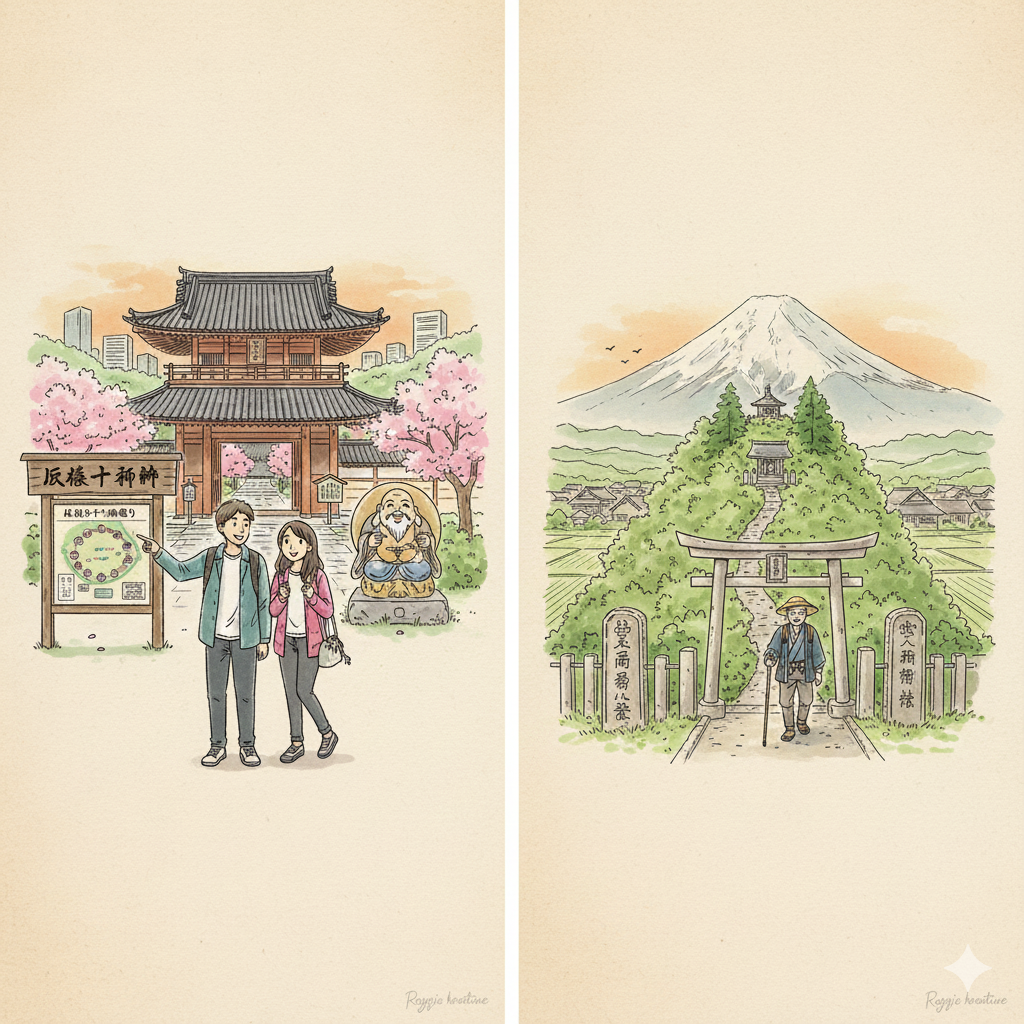
Where Fortune Meets Fuji: The Sacred Borders of the Village
In the spiritual geography of the Edo period, temples and shrines were far more than places of worship. They were powerful landmarks that defined the physical and sacred boundaries of a community, acting as spiritual anchors for the vast territory of Kami-Itabashi village. Exploring these sites reveals the twin pillars of faith that protected its residents: worldly fortune and transcendent reverence.
First, there were prayers for tangible blessings, offered at places like Chōmei-ji Temple. Founded in the early Edo period, this Shingon Buddhist temple in Tokiwadai holds immense modern appeal. It is a key stop on the "Itabashi Seven Lucky Gods" pilgrimage, enshrining Fukurokuju, the god of longevity, happiness, and wealth. Pilgrims still flock here seeking good fortune in their daily lives.
Second, there was a more transcendent form of worship directed toward nature itself: the profound reverence for Mount Fuji. For believers in the Fuji-kō faith who could not make the arduous pilgrimage to the sacred mountain, communities built Fuji-zuka—miniature, man-made replicas of Mt. Fuji. These earthen mounds were sacred spaces in their own right, allowing villagers to perform worship rituals locally and connect with the divine power of the great mountain.
A final exploration of the historical village's outer edges allows you to experience this dual-layered faith.
- Visit Chōmei-ji Temple in Tokiwadai, not just as a beautiful temple, but as a living piece of the Seven Lucky Gods pilgrimage, a tradition that brings worldly hope to the modern city.
- Expand your search to find the remaining Fuji-zuka mounds in Itabashi Ward. Discovering one of these sacred replicas is to understand the sacred landscape that gave the old village its spiritual protection and its deep connection to the natural world.
These sacred boundaries, marking both the pursuit of worldly fortune and a profound reverence for the natural world, form the final layer of a story defined not by grand ambition, but by a quiet, persistent faith.
Finding Humility in Hyper-Modernity
The journey through the ghost village of Kami-Itabashi reveals a truth that resonates powerfully today. Its true value lies not in grandeur, but in its quiet humility—from its unassuming post town, to the bowed head of the beggar Rokuzō, to the silent faith of its roadside stones. This profound modesty stands in stark contrast to the loud, ambitious, and ever-reaching energy of modern Tokyo.
Perhaps the most profound travel experiences are those that require us to look past the obvious signposts—the modern station names and tourist maps—and to metaphorically "lower our heads." By doing so, we learn to see the subtle, powerful, and deeply human histories that lie right at our feet, waiting patiently to be rediscovered.
In the rush of our own cities, what quiet histories and humble stories are we walking past every day?
Work cited
- Visiting Kami-itabashi-juku | Itabashi History Society - note, accessed October 13, 2025
- See | Burari Itabashi, Itabashi Ward Tourism Association, accessed October 13, 2025
- Nerima Ward 12 (23/01/23) Kami-itabashi Village - Kotake-cho/Asahigaoka - Kazu Bike Journey, accessed October 13, 2025
- Itabashi Attractions: Dcard recommends 15 indoor and outdoor spots for couples' day trips, accessed October 13, 2025
- New Taipei | Banqiao Day Trip: Strolling through Fangqiao Ancient City and Market Delicacies - Yam Travel, accessed October 13, 2025
- Rokuzō-san of Gedobashi - Research on Shakujii River, accessed October 13, 2025
- Itabashi History Society’s Recommended Spots in the Ward [Kami-itabashi Area] - note, accessed October 13, 2025
 Lawrence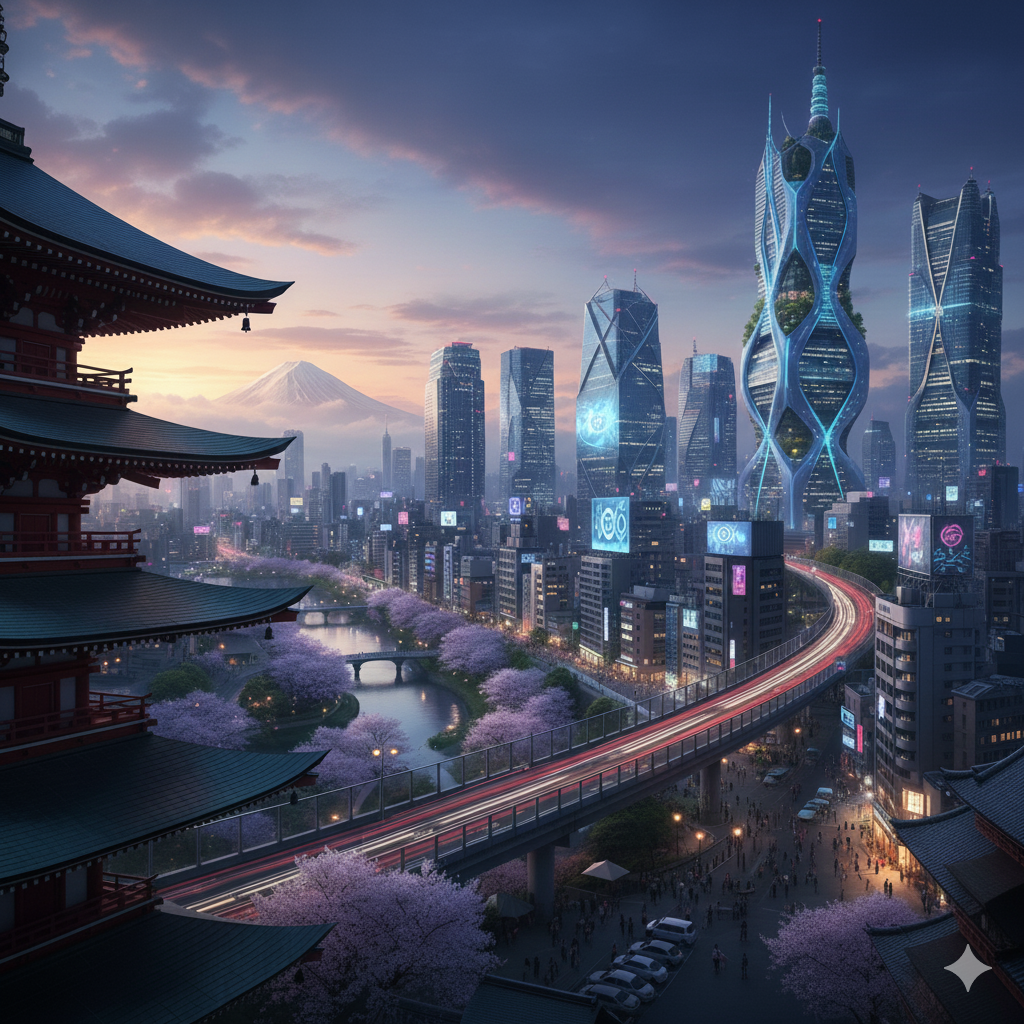
 Lawrence