(ENG) Uncovering the Haunting Histories of Itabashi, Tokyo
The true value of Itabashi lies not just in its individual stories, but in its consistent role as a "transitional place" where Japanese history turned critical corners.

The Echoes in a Seemingly Ordinary Place
When we picture Tokyo, our minds often conjure images of a gleaming, futuristic metropolis—a city of neon-drenched crossings, soaring skyscrapers, and relentless forward momentum. It is a city that seems to live perpetually in the future. Yet, beneath this polished modern surface lies a labyrinth of deep history, its stories not always found in grand castles or imperial palaces, but whispered in the quiet streets of seemingly ordinary neighborhoods.

Listen to the historical stories told in detail (For subscribers only)
This is the Tokyo of Itabashi Ward, a place you won't find on the typical tourist circuit. It is not a district of spectacle, but of substance. For centuries, Itabashi served as a crucial historical gateway to the capital, a borderland where journeys began and ended, where eras collided, and where the fate of a nation was often decided. It was one of the revered "Four Great Post Towns of Edo," the first official stop on the great Nakasendō highway, making it the true threshold of the capital. It is a memory anchor, holding fast to pivotal moments in Japanese history. This is a guide to uncovering five of its most surprising stories—tales that will change how you see the city forever.
The Bridge That Birthed a Name and Witnessed a Millennium
A place’s name is often the key to its oldest identity, a linguistic fossil preserving its original character. In Tokyo, no name is more literally tied to its origin than Itabashi. The story begins not with a decree or a battle, but with a simple, functional structure: a bridge.
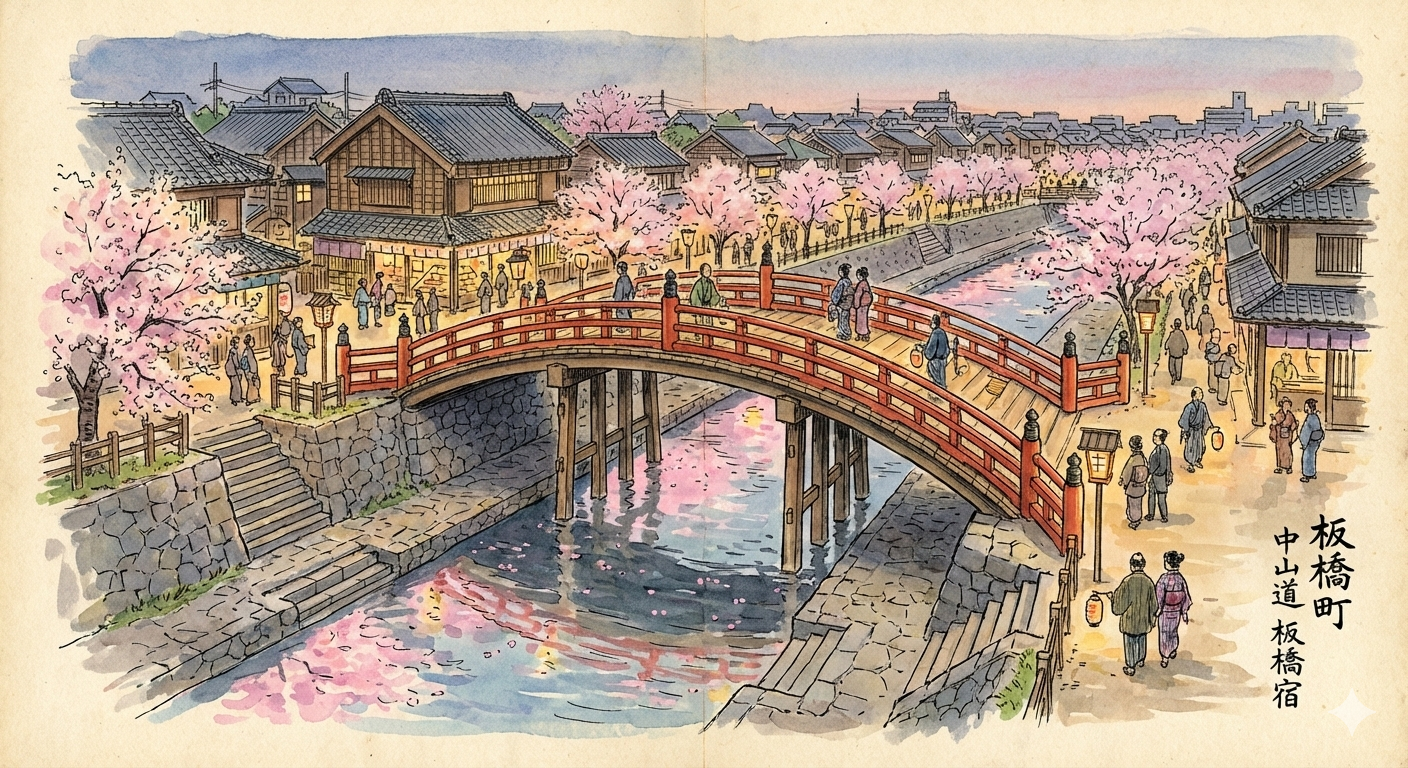
Over 800 years ago, during the Kamakura period, a wooden plank bridge—an itabashi—was built across the Shakujii River. In an era of simpler earthen crossings, this sturdy structure was a significant landmark, so notable that it was recorded in the classic epic, The Tale of the Heike, and lent its name to the entire surrounding area. By the Edo period, its importance had magnified. As a critical crossing on the vital Nakasendō highway, the main artery leading west from the capital, it was rebuilt as a formal, taiko-drum-shaped arched bridge. Its dimensions were strictly dictated by the government—16.2 meters long and 5.4 meters wide—a physical manifestation of the shogunate’s absolute control over the gateways to its seat of power.
Today, you can stand where centuries of travelers have stood at the modern 'Itabashi' bridge, designated as one of the 'Ten Views of Itabashi'. While no longer made of wood, the site retains its profound sense of place. The experience is especially serene in spring, when cherry blossoms line the riverbanks, their fleeting beauty creating a perfect harmony of deep history and transient nature. This simple spot reveals how a piece of infrastructure can become a powerful symbol, anchoring a district's identity for nearly a thousand years.
"A bridge is more than a crossing; it is a landmark so powerful it can name a place for centuries, serving as the first and most enduring chapter in a city's story."
But this bridge didn't just mark the beginning of a journey; it also stood near the site where a famous warrior's journey came to a bloody end.
The Traitor's Grave and a Comrade's Vow
As the first official post town—the Itabashi-shuku—on the road out of Edo, Itabashi was more than a resting place; it was a stage. It was the symbolic boundary between the capital and the rest of Japan, making it the perfect setting for the dramatic political theater that unfolded during the Meiji Restoration.
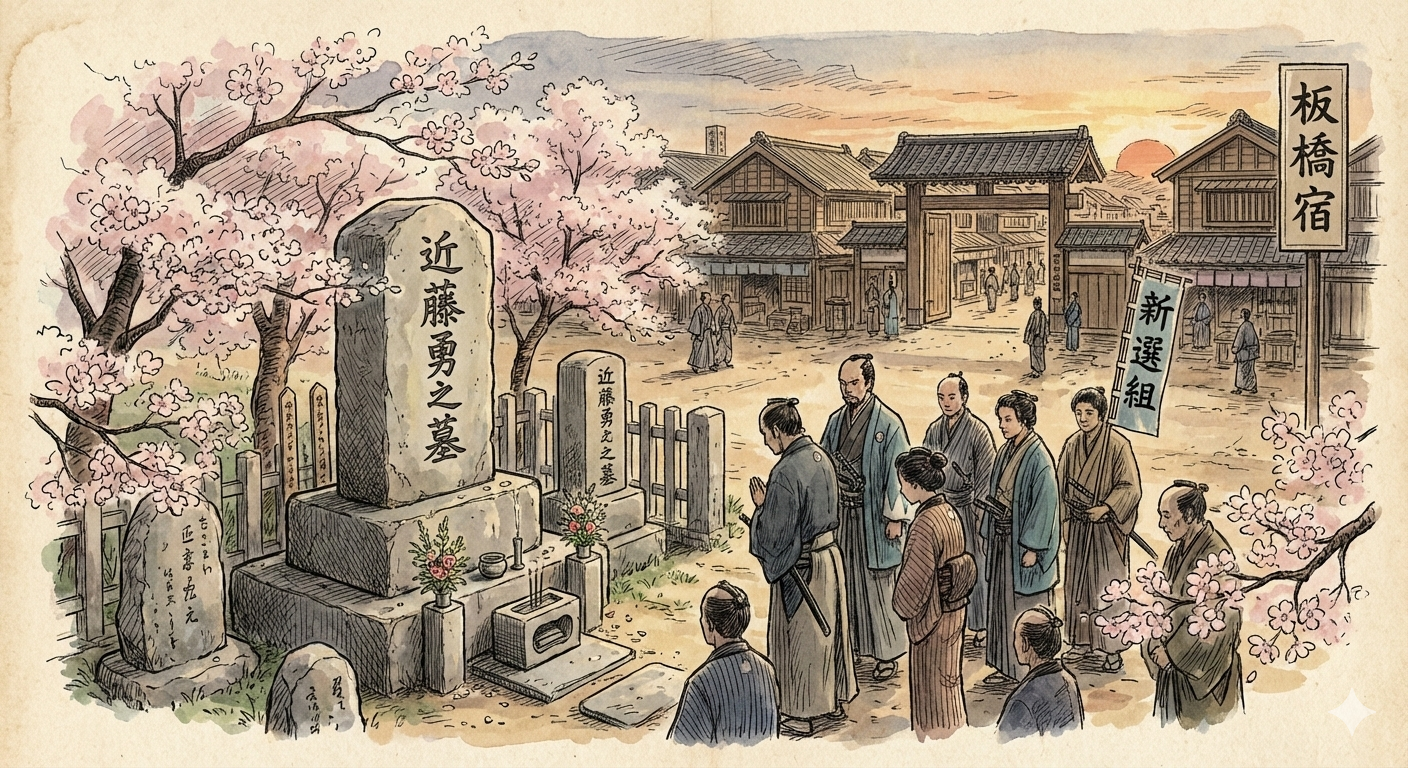
In 1868, as the age of the samurai drew to its violent close, the famed and feared leader of the Shinsengumi, Kondō Isami, was captured by the new imperial forces. He was brought to Itabashi and executed. The choice of location was no accident; by executing a symbol of the old regime at one of the four official gateways to the city, the new government declared, in no uncertain terms, that the warrior era was over. Kondō was officially branded a "national enemy," his death meant to be a final, dishonorable chapter.
Yet, a poignant counter-narrative of loyalty refused to let this be the end. The grave that stands today was not an official monument but a private memorial erected by Kondō's loyal comrade, Nagakura Shinpachi. In a profound act of defiance, Nagakura honored his fallen leader, ensuring that memory would outlast political verdict. His spirit, and that of over one hundred fallen Shinsengumi comrades, is honored at the Kondō Isami Grave, a short walk from JR Itabashi Station. This small, quiet plot of land became a "memorial of reversal," a sacred space where personal loyalty triumphed over state-sanctioned persecution. It remains a pilgrimage site for those captivated by the tragic romance of the samurai spirit.
"History is written by the victors, but memory is preserved by the loyal. This small gravesite is a testament to a bond that politics could not erase."
While Itabashi witnessed the fall of the old warrior class, it was also built to serve its highest echelons.
The Vanished Inn That Housed a Nation's Elite
During the Edo period, the Tokugawa shogunate maintained control over its powerful feudal lords, the daimyō, through a brilliant system of political leverage called Sankin-kōtai. This policy required every daimyō to spend alternate years in Edo and maintain a permanent residence there, forcing them to make costly annual processions to and from the capital, draining their resources and keeping them under the shogunate's watchful eye.
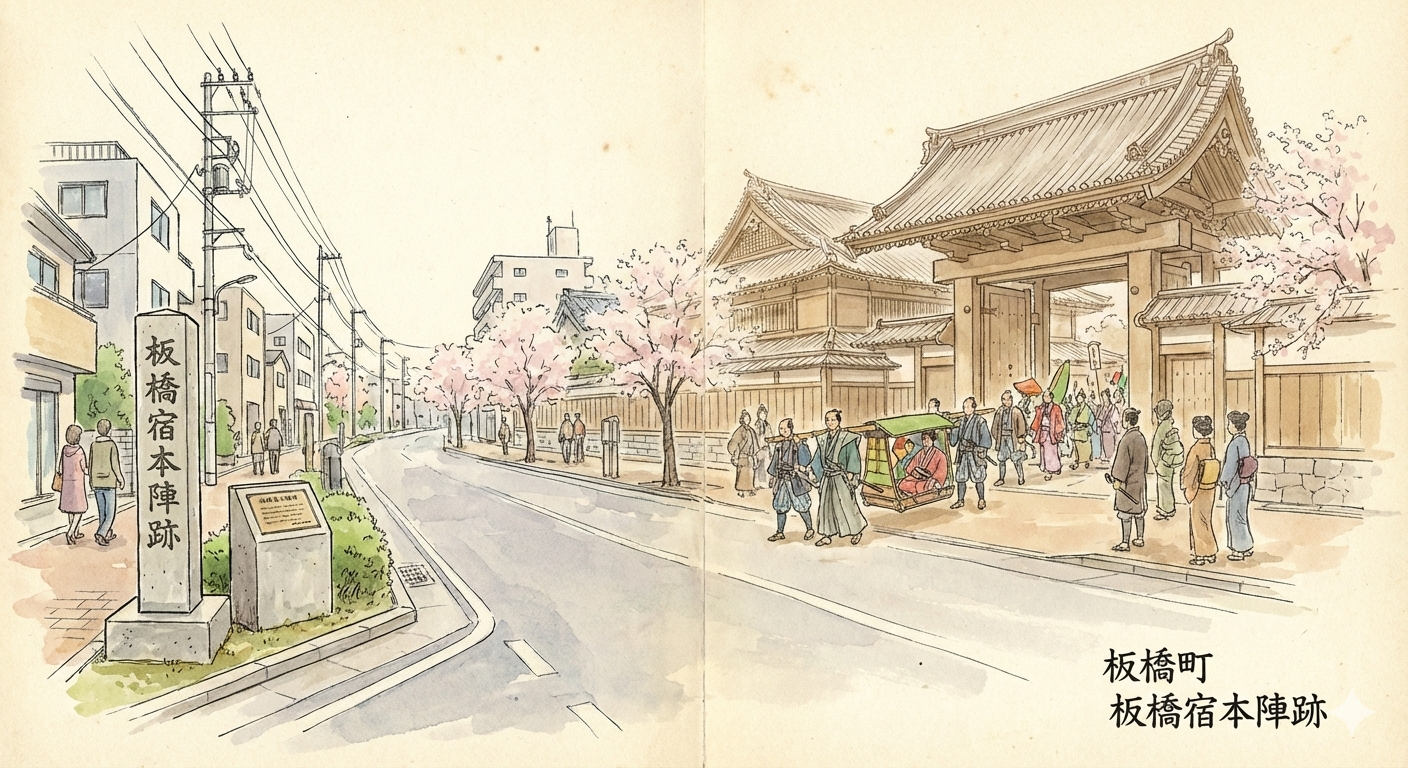
As the first stop on the Nakasendō highway, Itabashi-shuku was home to a honjin—the highest class of inn, reserved exclusively for daimyō, shogunate officials, high-ranking monks, and court nobles. Managed for generations by the Iida family, this was not a place of commerce but of immense, unseen power. It would have hosted the massive, glittering processions of Japan’s most influential lords, its grounds echoing with the silent formalities of the feudal hierarchy. The honjin was the physical embodiment of the shogunate's control.
Travelers seeking this symbol of feudal power will find the Itabashi-shuku Honjin Site, a place now marked only by a simple historical sign on a modern street. Yet, there is a unique power in this emptiness. The absence of the grand structure forces visitors to engage their imagination, to mentally reconstruct the pageantry of a daimyō procession against the mundane backdrop of contemporary life. In this way, the void becomes a powerful meditation on the impermanence of power and the quiet, inexorable passage of time.
"Sometimes, the most powerful historical sites are not the ones that remain, but the ones that have vanished, demanding we listen for the echoes of the past in the silence of the present."
Though the honjin itself is gone, the legacy of one of its most powerful guest clans reshaped the landscape of Itabashi forever.
The Feudal Lord's Garden That Forged a Nation's Might
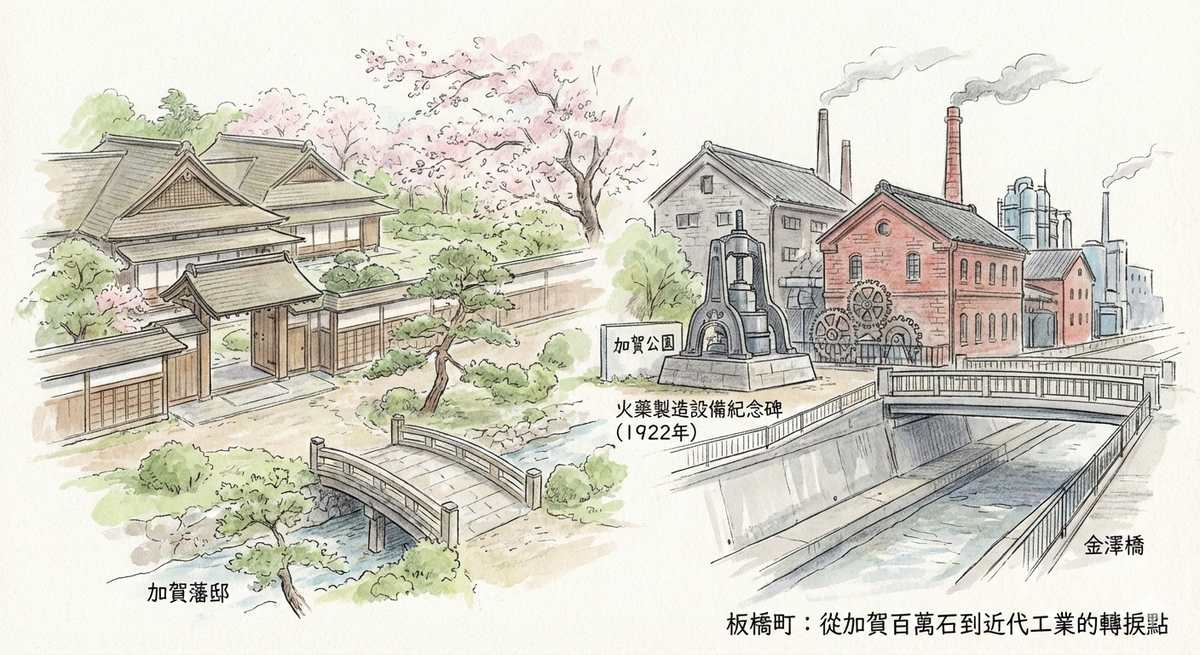
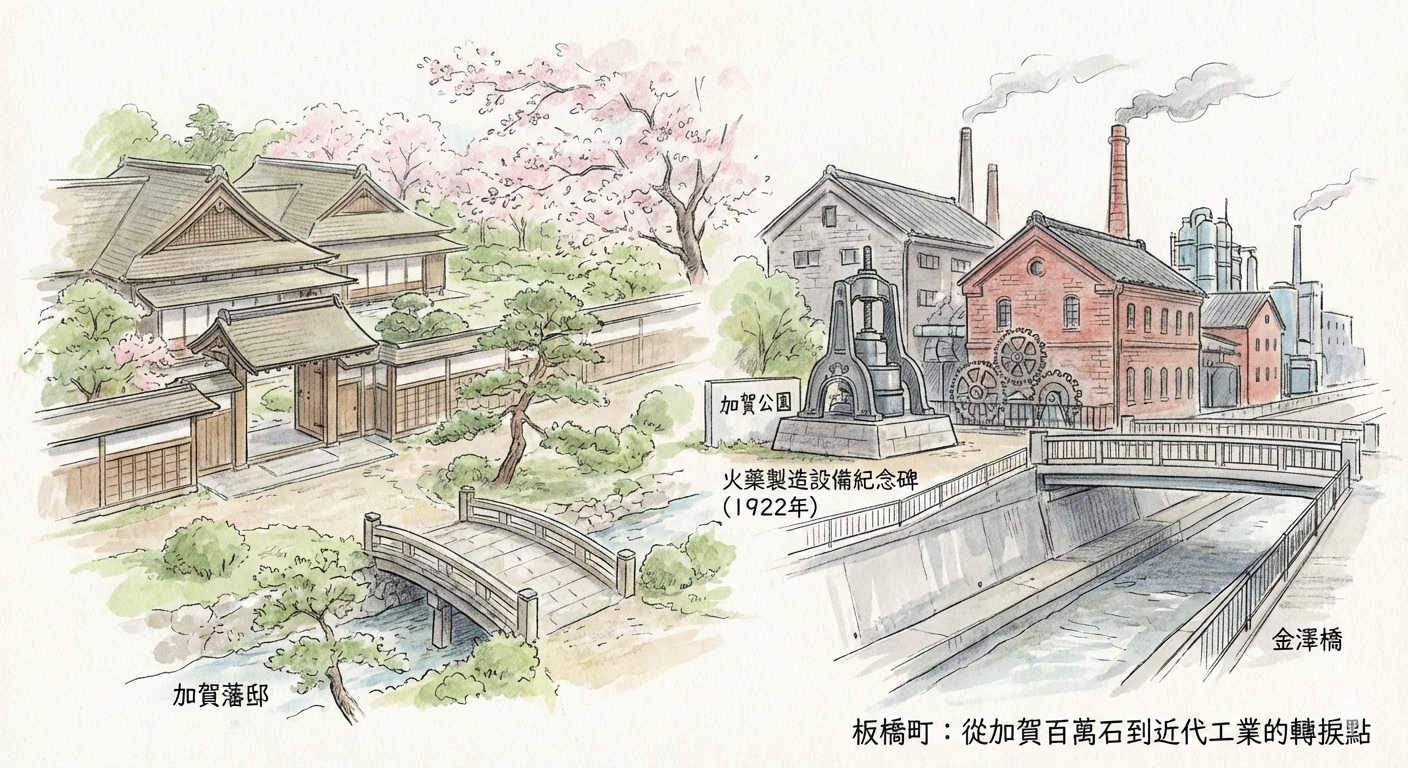
Among the many powerful lords who passed through Itabashi, none were wealthier than the Maeda clan of the Kaga Domain, whose domain was valued at over one million koku of rice. Their vast suburban estate, or shimo-yashiki, was located right here in Itabashi, a sprawling testament to their immense influence.
The story of this land is a microcosm of Japan's rapid, often brutal, modernization in the late 19th century. After the Meiji Restoration, the Maeda clan's peaceful estate was nationalized and its purpose dramatically repurposed. The new government, desperate to build a modern military, transformed the land into a massive arsenal. Taking advantage of the nearby Shakujii River for industrial power, the site became a key center for manufacturing gunpowder, fueling the ambitions of a new empire. The land of a feudal lord was remade into a factory for national might.
This layered history can be explored today at Kaga Park, the nearby Kanazawa Bridge, and a striking monument to the area's gunpowder manufacturing past, which is built from actual equipment used in the factory. The area's names are a direct link to its feudal origins, and a friendly city relationship between Itabashi and Kanazawa (the Kaga Domain's historic capital) serves as a living connection to this shared past. Here, you can physically trace the seismic shift from one era to the next.
"Here, the soil of a feudal lord's retreat was repurposed to fuel an empire's ambition, perfectly illustrating Japan's convulsive leap from the age of samurai to the industrial world."
But Itabashi's secrets are not all writ large in politics and industry; some are whispered in the shadows of local folklore.
The Cursed Tree That Became a Cultural Curiosity
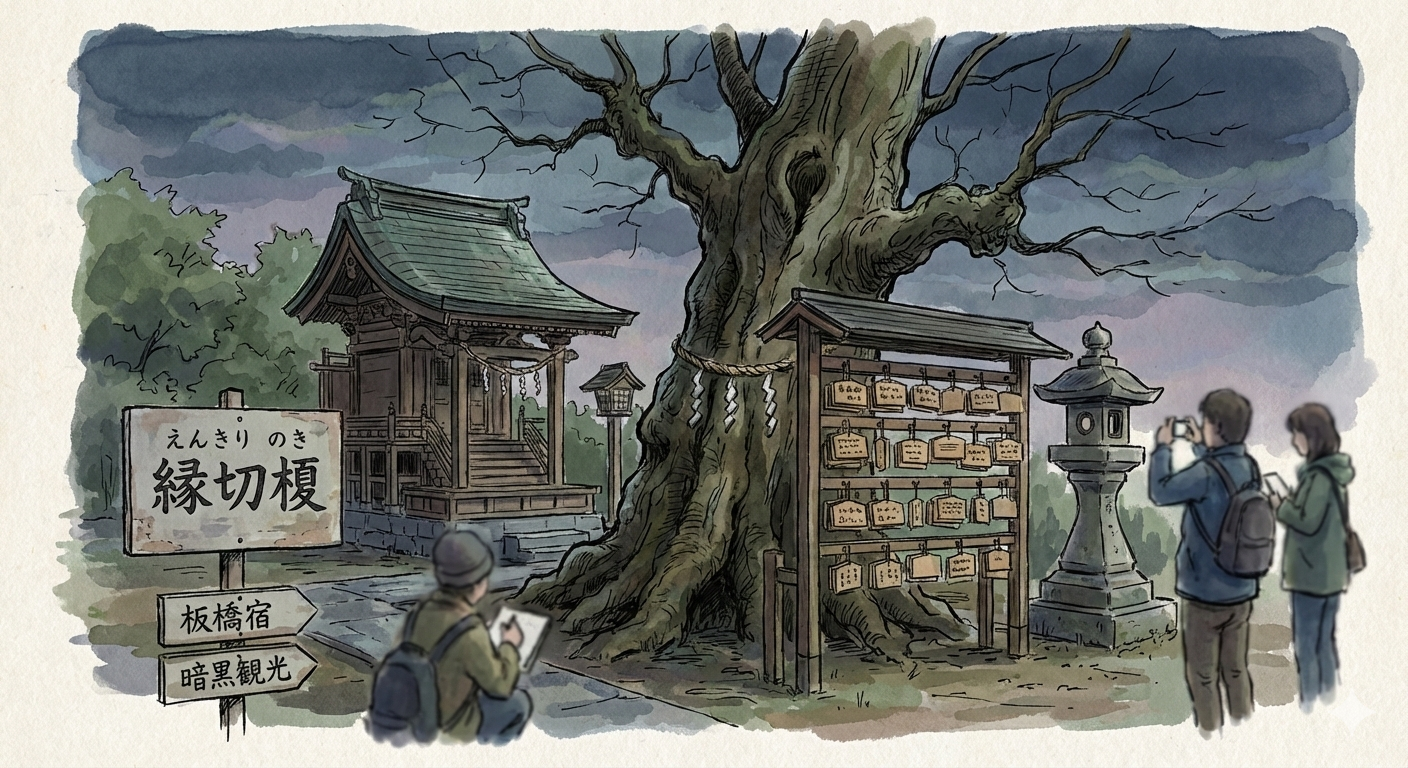
Away from the grand narratives of shoguns and industrialists, the history of a place also lives in the folklore and superstitions of its ordinary people—in their hopes, anxieties, and fears. No site in Itabashi captures this more viscerally than the Enkiri Enoki, the "relationship-cutting tree."
For centuries, this tree has been the focus of a dark and compelling legend. It was known as a place of power where one could pray to sever ties—to cut off bad relationships, illness, or misfortune. This function, rooted in deep-seated human fears, gave the tree a forbidding and powerful aura. In a society that values harmony, a place dedicated to deliberate severance was both necessary and terrifying.
In a fascinating modern twist, this ancient site of local belief has been absorbed into contemporary culture as a "dark tourism" destination. Its ominous reputation has inspired authors of modern urban horror, who have claimed to feel its palpable "negative energy." The tree has evolved from a place of genuine spiritual practice to an object of morbid curiosity. Those brave enough can visit the Enkiri Enoki tree itself and observe the votive plaques (ema) at the nearby shrine, witnessing a living tradition of managing life's darker connections. The site reveals society’s ever-changing relationship with folklore, as old superstitions are consumed as unique, and thrilling, cultural experiences.
"This tree stands at the crossroads of faith, fear, and modern fascination, reminding us that sometimes the most enduring stories are the darkest ones."
From statecraft to superstition, Itabashi's stories reveal a side of Tokyo far from the beaten path.
Tokyo's Living Past
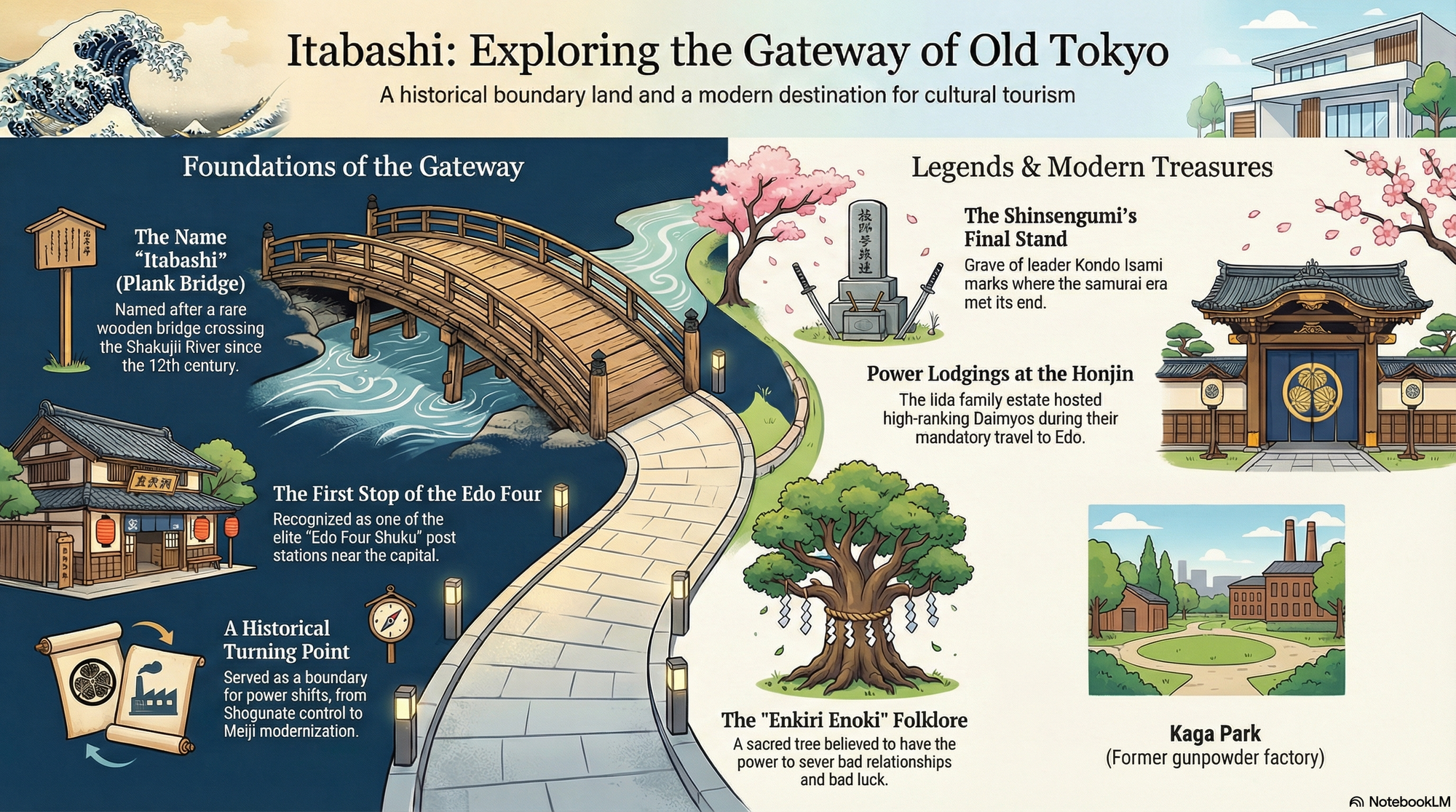
The true value of Itabashi lies not just in its individual stories, but in its consistent role as a "transitional place" where Japanese history turned critical corners. It was here, at the edge of the capital, that the nation moved from feudalism to modernity, from the age of the samurai to the age of industry, and where official histories were challenged by fiercely held personal loyalties.
The sites scattered throughout its modern landscape—a bridge, a grave, a vanished inn, a park, and a cursed tree—are more than just points on a map. They are "memory anchors" that hold the past firmly in place, offering a deeper, more profound understanding of Tokyo's complex and layered identity. For those wishing to delve even deeper, the excellent and free-to-enter Itabashi City Local History Museum serves as a knowledge center, tying all these disparate threads together into a single, compelling history. They remind us that history is not just something to be found in museums, but a living presence that shapes the world around us.
The next time you walk through a quiet Tokyo neighborhood, what forgotten histories might be waiting just beneath your feet?
 Lawrence
 Lawrence