(ENG) The Ghost in the Grid: How Toyotomi Hideyoshi transformed the city of Osaka

How did Hideyoshi use urban planning to exert political control?
Why did the Tokugawa Shogunate bury the original Osaka Castle?
What is the legacy of the 'Taiko' infrastructure in modern Osaka?
 Lawrence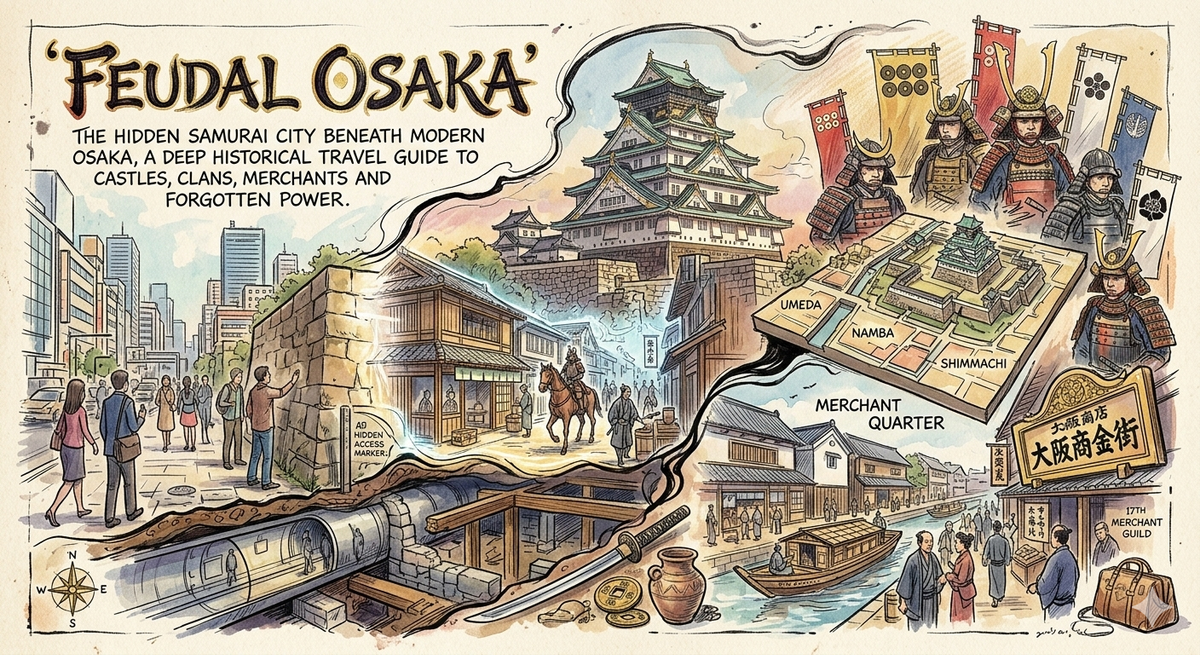
The Architect of Modern Japan
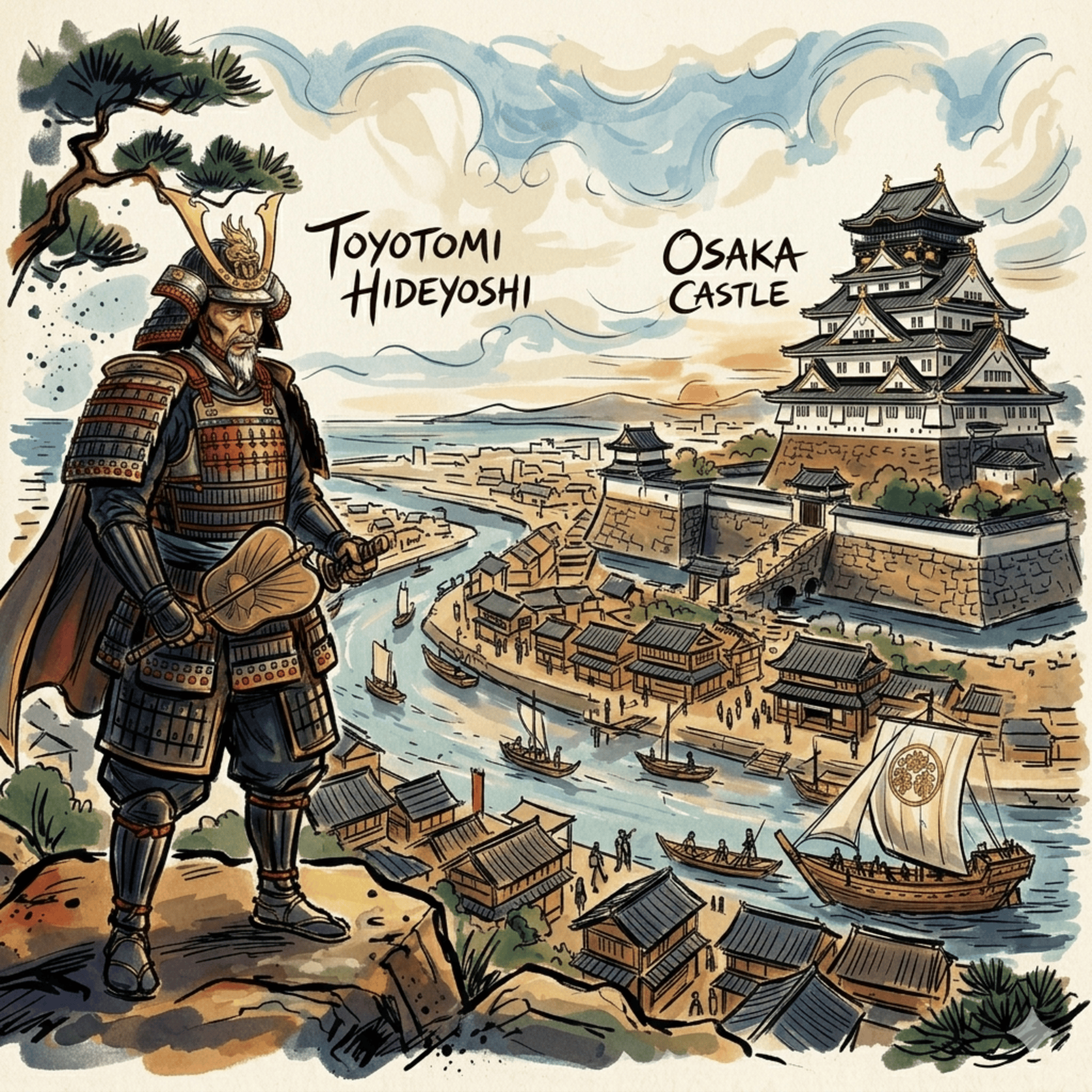
Modern Osaka is not a product of organic urban evolution; it is a deliberate political project chiseled into the landscape by the 16th-century warlord Toyotomi Hideyoshi. When Hideyoshi selected the site of the former Ishiyama Honganji temple for his castle in 1583, he was not merely constructing a military bastion. He was engineering a new center of gravity intended to eclipse the ancient authority of Kyoto and the commercial autonomy of Sakai. His decisions from over 400 years ago—from massive river diversions to the standardization of city blocks—formed the city's "DNA." To truly understand Osaka, one must look beneath the contemporary pavement to see how the Tenka-bito (Unifier) used spatial management to transition Japan from the chaos of the Sengoku period to an organized early modern state. What follows is a guide to the invisible hand that still directs the flow of life in the "Nation's Kitchen."
Listen to the historical stories told in detail (For subscribers only)
The Subterranean Civilization: "Taiko Gesui" and the Birth of Order
In the late 16th century, urban sanitation was not merely a matter of health; it was a tool for political stability and social control. As Hideyoshi forced the samurai class to relocate to the castle town and attracted a dense population of artisans and merchants, the resulting waste became a threat to the order of his new capital. His response was the "Machiwari" policy, a rigorous standardization of urban space.
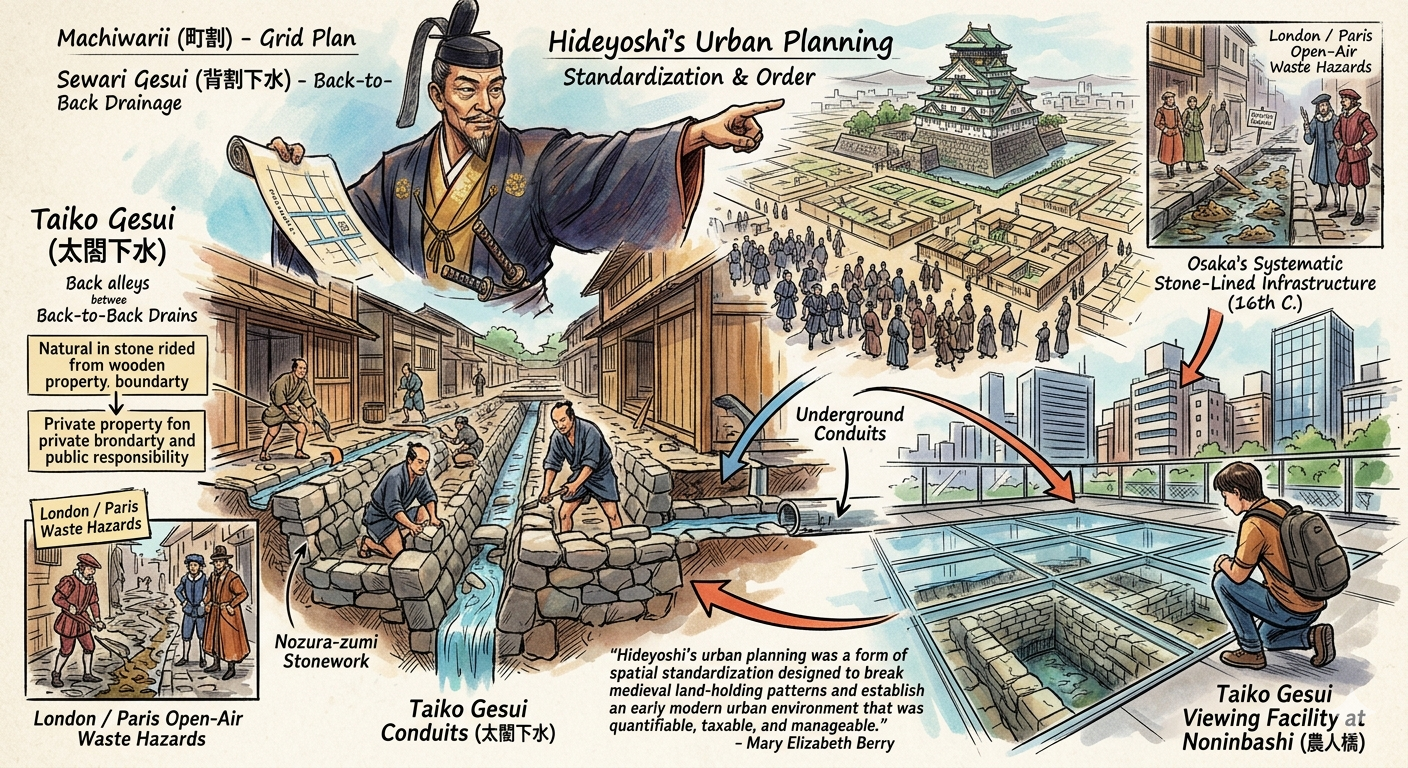
Hideyoshi divided the city into precise grid blocks of approximately 72 meters square. Central to this plan was the Sewari Gesui (back-to-back drainage) system, popularly known as the "Taiko Gesui." This represented a fundamental transition from the natural, haphazard growth of medieval settlements to planned management. Within these blocks, Hideyoshi ordered the excavation of stone-lined channels at the rear boundaries where properties met. These "back-to-back" drains were constructed using Nozura-zumi (natural stone) masonry, creating a functional network of underground conduits that defined the boundaries of private property and public responsibility.
The forward-thinking nature of this engineering was remarkable for its era. While the residents of 16th-century London and Paris were still grappling with the hazards of open-air waste and the resulting plagues, Osaka had already established a systematic, stone-lined subterranean infrastructure. By dictating the physical environment of private life to ensure the functionality of the collective, Hideyoshi’s regime pioneered a level of urban management that few contemporary European cities could match.
To touch this 400-year-old engineering, leave the bustling main streets and find the Taiko Gesui Viewing Facility at Noninbashi (near Minami-Oe Elementary School). Through a glass observation floor, you can look down into the original stone-lined trenches. The Nozura-zumi stonework—irregular but tightly fitted—remains intact, and remarkably, parts of this system are still utilized for the city's drainage today.
As historian Mary Elizabeth Berry notes in her analysis of Hideyoshi’s urban reforms:
"Hideyoshi's urban planning was a form of spatial standardization designed to break medieval land-holding patterns and establish an early modern urban environment that was quantifiable, taxable, and manageable."
The Forced Migration: How Sakai’s Merchants Created "The Nation’s Kitchen"
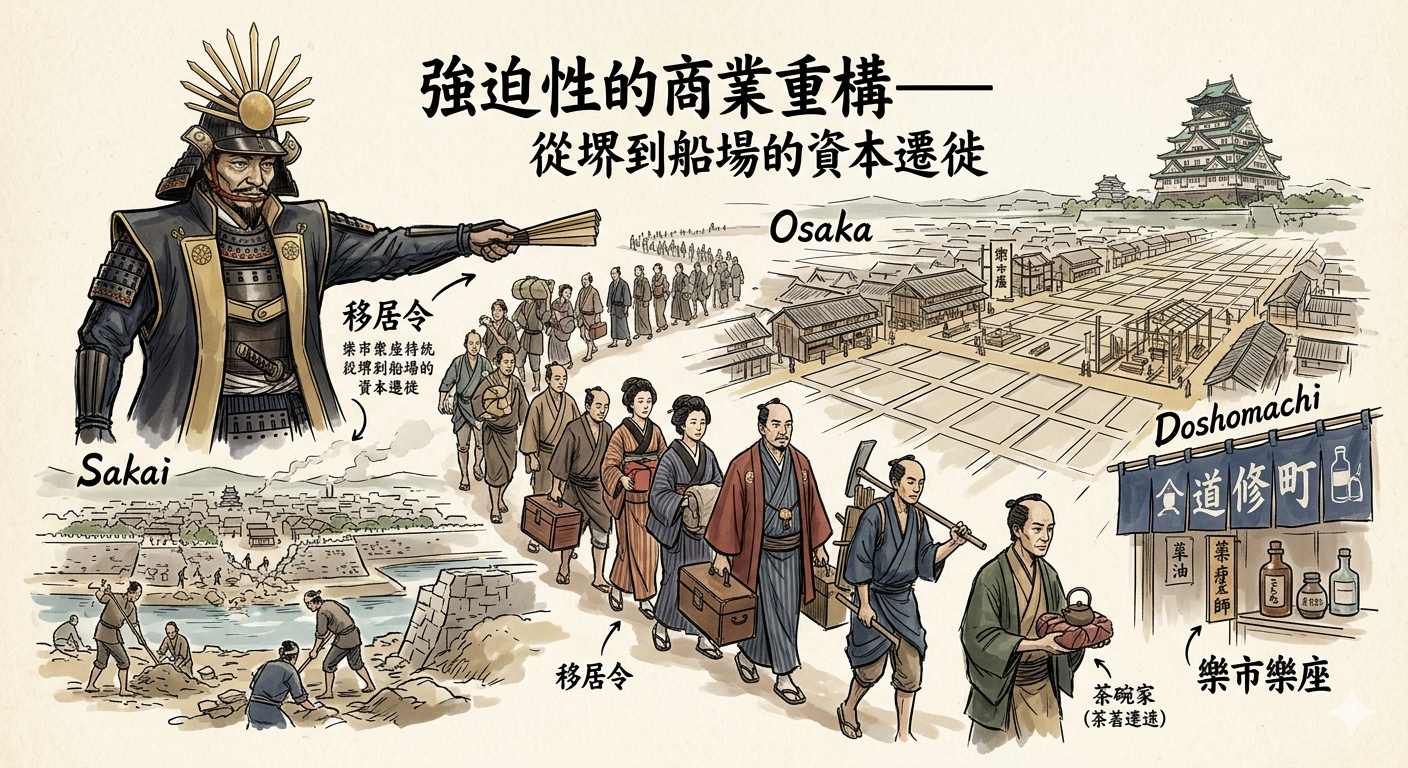
To consolidate power, Hideyoshi needed to dissolve the "state within a state" represented by Sakai, an autonomous city known as the "Venice of the East." Economic centralization was a prerequisite for national unification.
In 1586, Hideyoshi issued a transformative 移居令 (migration order). After dismantling Sakai’s physical defenses by filling in its moats, he forcibly moved its most influential merchant families, craftsmen, and tea masters to Osaka’s Semba district. These families were granted land and tax privileges, but the move came at the price of their political independence.
This migration was a profound "social contract." The merchants traded their autonomy for national market privileges and security. This exchange birthed the pragmatic "merchant soul" of Osaka—a culture that pursued extreme economic benefit while navigating the shadows of centralized power. This forced concentration of capital and expertise transformed Osaka into a logistics powerhouse, earning it the title of "The Nation’s Kitchen."
Walk the precise grid of the modern Semba district (between Kitahama and Yodoyabashi). In particular, explore Doshomachi, the pharmaceutical street. This area remains the heart of Japan’s medical industry today as a direct legacy of the 16th-century migration, where Hideyoshi originally clustered drug merchants to simplify oversight and trade.
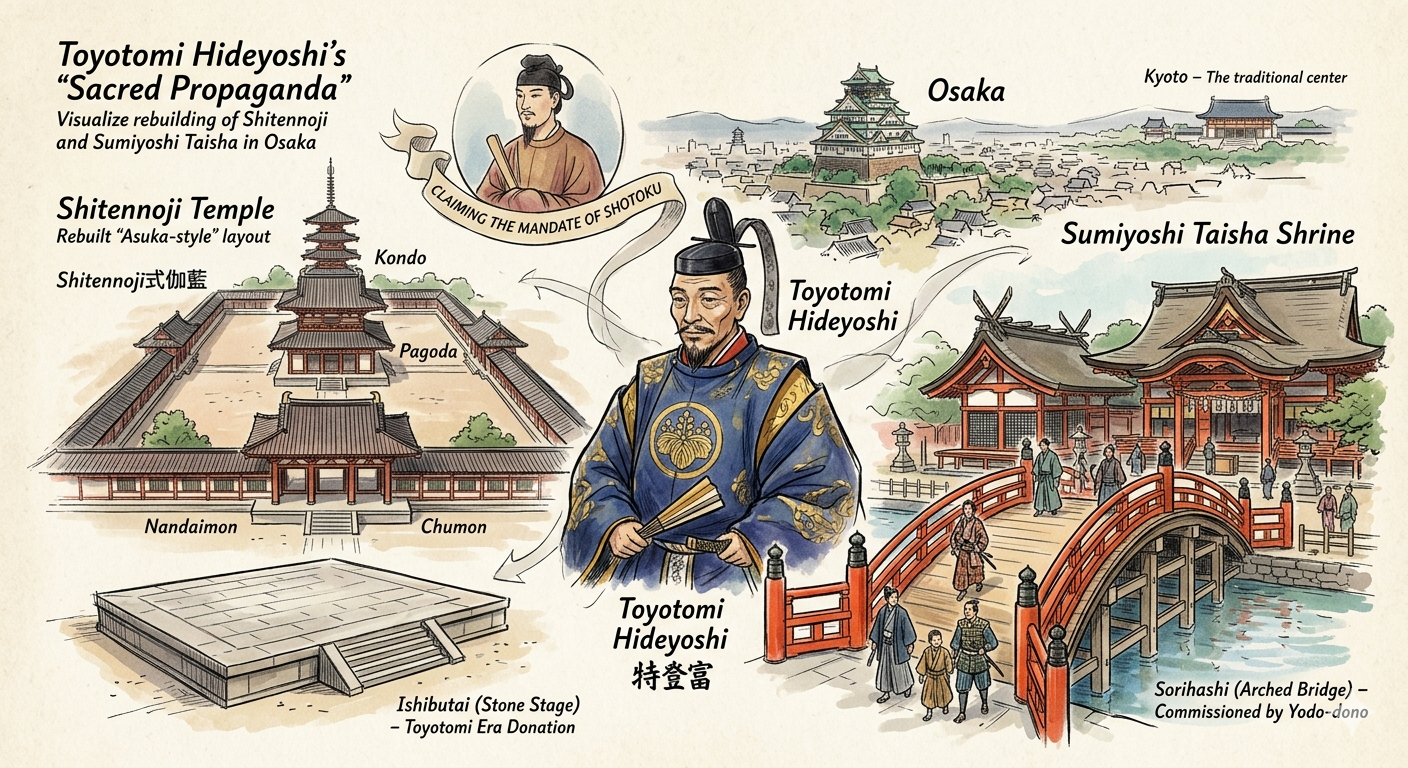
Sacred Propaganda: Rebuilding Shitennoji and Sumiyoshi Taisha
As a leader of humble origins, Hideyoshi lacked the noble lineage required for traditional legitimacy. He turned to architectural restoration to claim a spiritual and historical mandate that his bloodline could not provide.
Hideyoshi and his son, Hideyori, undertook massive, state-level restorations of Shitennoji and Sumiyoshi Taisha. At Shitennoji, they insisted on a strict adherence to the ancient "Asuka-style" layout—a linear arrangement of the gate, pagoda, and main hall. By restoring these ancient forms, Hideyoshi visually linked the Toyotomi name to Prince Shotoku, the temple’s 6th-century founder and a paragon of Japanese governance.
This was a masterful use of "space memory." By rebuilding the oldest temples and shrines, Hideyoshi positioned himself as the protector of Japanese tradition. In doing so, he created a spiritual center of gravity in Osaka that rivaled Kyoto, effectively diluting the Emperor's ceremonial monopoly and signaling that both secular and sacred legitimacy now resided with the Toyotomi.
At Shitennoji, look for the Ishibutai (Stone Stage) in front of the main hall, a surviving Toyotomi-era structure donated by Hideyori. At Sumiyoshi Taisha, the iconic Sorihashi (Arched Bridge), though renovated, retains the original design commissioned by Yodo-dono, Hideyoshi’s consort, as an act of maternal devotion.
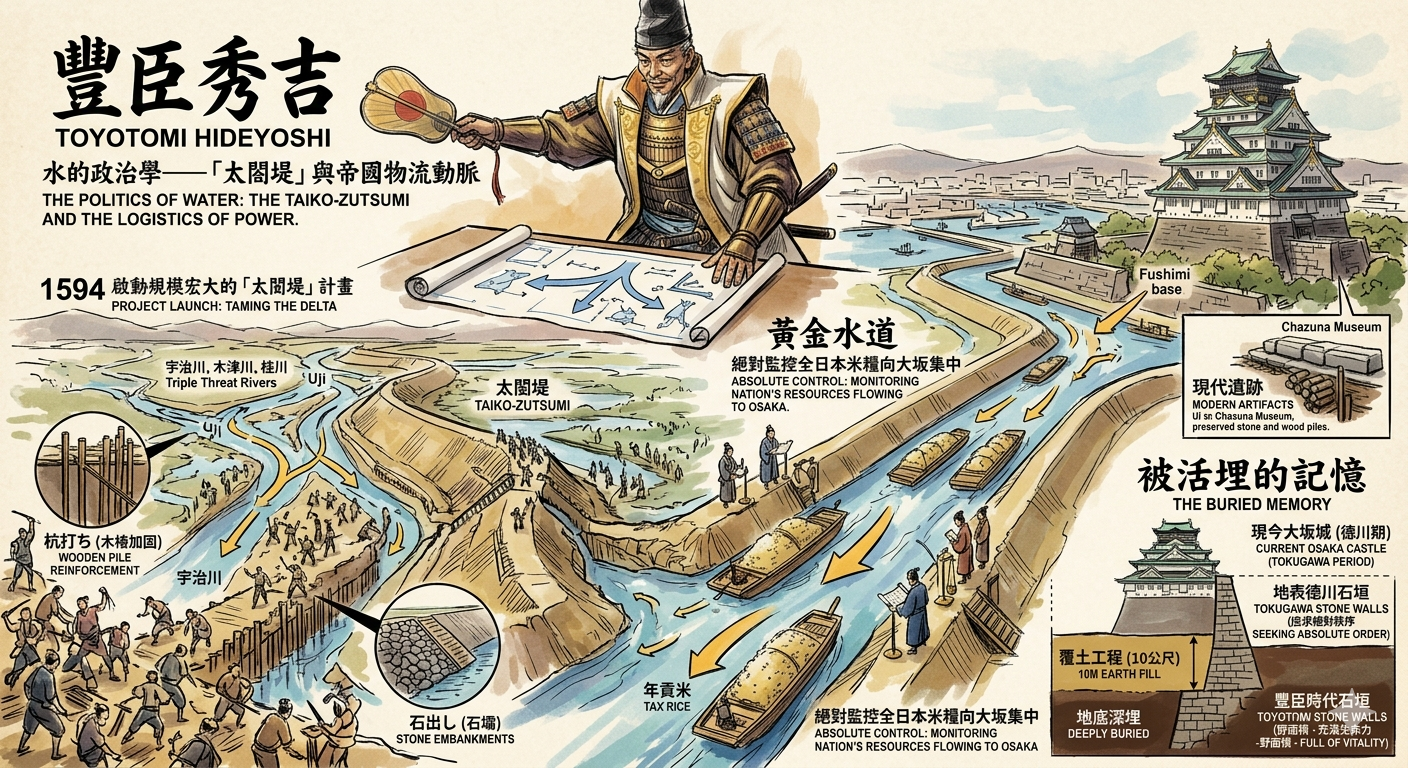
The Golden Waterway: The Taiko-zutsumi and the Logistics of Power
Hideyoshi understood the "politics of water." To make Osaka a national logistics hub, he had to tame the unstable delta of the Yodo River.
In 1594, Hideyoshi launched the Taiko-zutsumi project. This was a massive engineering feat that involved the artificial separation of the "triple threat" of the delta—the Uji, Kizu, and Katsura rivers—which previously converged in a chaotic wetland. By constructing tens of kilometers of high, fortified embankments, he created a stable, navigable channel between his power bases in Fushimi and Osaka.
This project transformed a "natural delta" into an "engineered logistics artery." It allowed Hideyoshi to monitor and tax every grain of 年貢米 (tax rice) entering the city. By controlling the flow of water, he controlled the flow of wealth, ensuring that Osaka became the inescapable destination for the empire’s resources.
Visit the Uji River Taiko-zutsumi Site and the Chazuna museum in Uji to see the 400-year-old stone and wooden-pile embankments. Within Osaka city, the very course and width of the Higashi-Yokobori River remains a direct artifact of Hideyoshi's original 16th-century hydraulic layout.
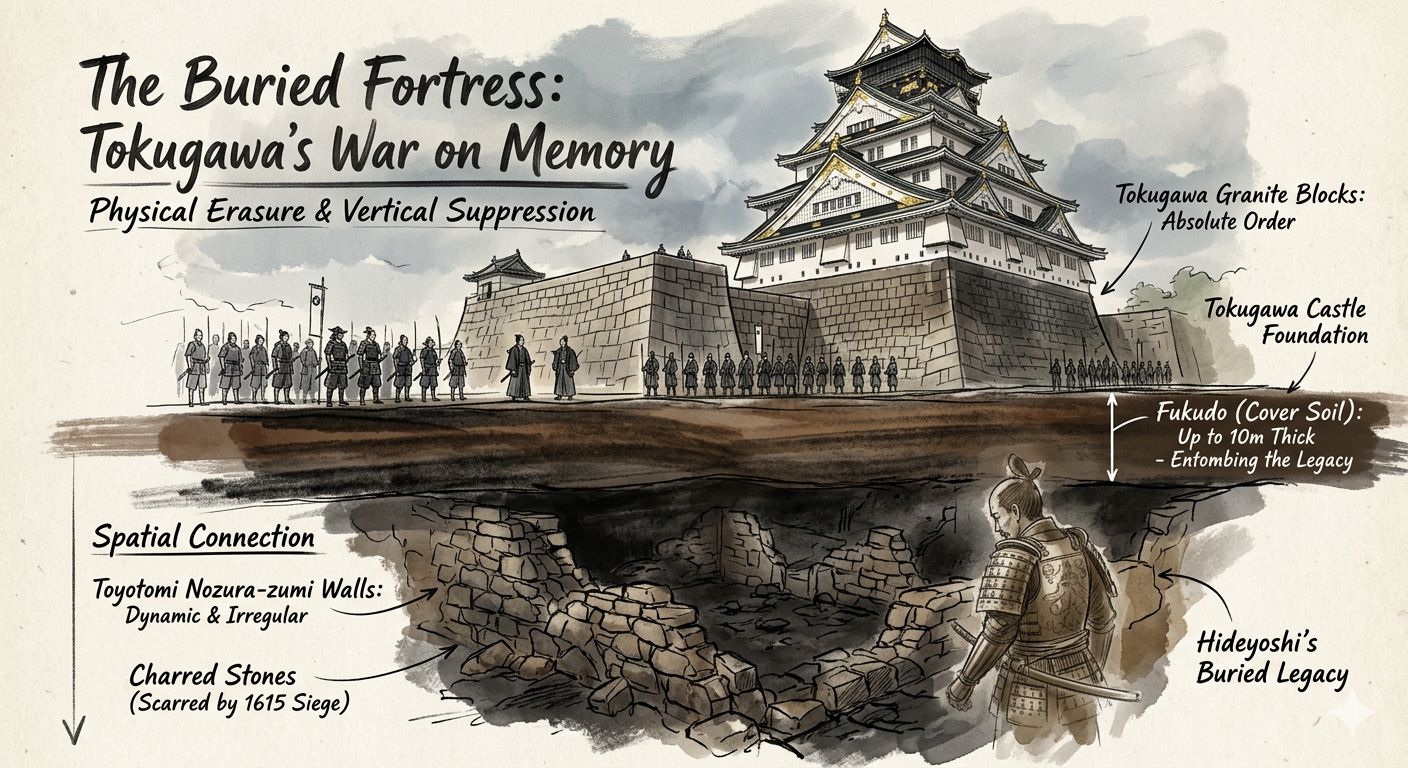
The Buried Fortress: The Tokugawa War on Memory
After the fall of the Toyotomi clan in 1615, the succeeding Tokugawa Shogunate engaged in Damnatio Memoriae—the physical erasure of their predecessor's memory.
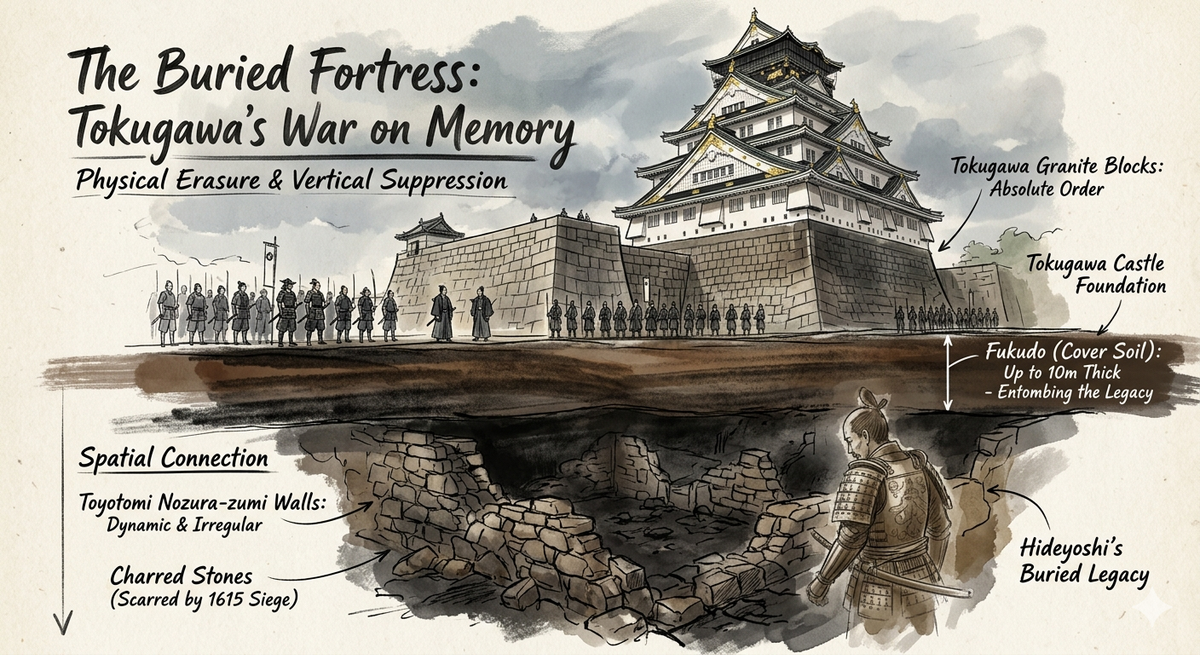
The Tokugawa did not merely destroy the original Osaka Castle; they entombed it. They covered the ruins with a layer of Fukudo (cover soil) that is, in some places, up to ten meters thick. Upon this artificial ground, they built an entirely new fortress with higher walls and deeper moats, designed to literally and figuratively stand on top of the Toyotomi legacy.
This was an act of "vertical suppression." Every stone of the Tokugawa castle seen by visitors today was intended as a constant reminder of their supremacy over the buried "corpse" of the previous regime. The shift from Hideyoshi’s irregular Nozura-zumi masonry to the Tokugawa’s precise, massive granite blocks marks the transition from the tension of the Sengoku period to the absolute order of the Edo era.
To see the true Toyotomi castle, one must look below the surface. The Toyotomi Stone Wall Gallery at Osaka Castle (scheduled for full public opening in 2025, but currently accessible via specific archaeological tours) allows you to descend into a pit to view the charred Nozura-zumi stones of the original 16th-century walls, scarred by the fires of the 1615 siege.
Hidden Gems for the Curious Traveler
To appreciate the "Rise and Fall" of these two cities, visit the Konishi Family Residence in Semba—a stunning example of the merchant architecture that flourished after the 1586 migration. Conversely, explore the Sakai Plaza of Rikyū and Akiko in Sakai, where reconstructed maps reveal the city’s layout before Hideyoshi’s order dismantled its autonomy, offering a poignant look at the ghost of a city that chose trade over independence.
Conclusion: A City Built of Layered Intentions
Osaka is a city of "layered observation," a palimpsest where the ambitions of the past provide the infrastructure for the present. Understanding the city requires acknowledging that the ghosts of the 16th century still dictate our modern paths—from the grid we walk to the sewers that run beneath our feet. As we navigate the streets of Semba or the grounds of Shitennoji, we are walking through the physical manifestation of Toyotomi Hideyoshi’s political will.
Is a city ever truly finished, or is it merely a series of erasures and overwrites? In Osaka, the answer lies ten meters down.
To discover more deep-dives into the bones of the world's great cities, subscribe to Historical Travel Stories.
Travel Logistics
Planning Your Historical Walk
- How to Get There: Use the Osaka Metro. Tanimachi 4-chome Station provides the best access to Osaka Castle and the upcoming Stone Wall Gallery. Noninbashi (for Taiko Gesui) is a short walk from here. Use Hommachi Station or Kitahama Station to explore the Semba merchant district.
- Recommended Historical Accommodation: Stay in the Semba area to experience the historic grid and the atmospheric pharmaceutical and textile districts.
- Nearby Historical Tours: Look for specialized walking tours focusing on "Osaka Castle Archaeology" or "Semba Merchant History" to gain access to restricted archaeological sites.
Reference and Further reading
- What is osaka known for? - HotBot, accessed March 18, 2026,
- Historical overview - 大阪市, accessed March 18, 2026,
- Toyotomi Hideyoshi - accessed March 18, 2026,
- 2026 Recommended History in Osaka (Updated March) - Trip.com Singapore, accessed March 18, 2026,
- https://sg.trip.com/moments/theme/destination-osaka-293-history-993176/
- Osaka Travel Guide - What to do in Osaka City - Japan Guide, accessed March 18, 2026,
- Patterns of urbanization, 1400 to 1800 (Chapter 5) - The Cambridge World History, accessed March 18, 2026,
- The People of Tokugawa Japan: The State of the Field in Early Modern Social/Economic History - Brill, accessed March 18, 2026,
- Osaka history series (6 of 6)- Intellectual History of Osaka, accessed March 18, 2026,
- Tokugawa Japan: An Introductory Essay - University of Colorado Boulder, accessed March 18, 2026,
- 太閤下水/大阪市中央区, accessed March 18, 2026,
- 太閤(背割)下水見学施設 - 大阪市, accessed March 18, 2026,
- 太閤(背割)下水|観光スポット検索 - 大阪ミュージアム, accessed March 18, 2026,
- 豊臣石垣館 | 大阪城天守閣, accessed March 18, 2026,
- Hideyoshi 0674390261, 9781684172849 - DOKUMEN.PUB, accessed March 18, 2026,
- Building Japan: Technology as a problem-space for Veridiction, Jurisdiction, and Subjectivation. - eScholarship, accessed March 18, 2026,
- 太閤下水|オオサカマニア|Osaka Metroが届ける大阪のお出かけサイト, accessed March 18, 2026,
- The End of Civil War and the Formation of the Early Modern State in Japan (Chapter 1), accessed March 18, 2026,
- The Role of the Merchant Coalition in Pre-modern Japanese Economic Development: An Historical Institutional Analysis, accessed March 18, 2026,
- Domestic Commerce during the Tokugawa Period | Oxford Research Encyclopedia of Asian History, accessed March 18, 2026,
- The History of Sakai City | Welcome to Sakai! | SAKAI tourism & convention Guide, accessed March 18, 2026,
- 5 -The talented souls of Sakai - OSAKA LOCAL JOURNEY, accessed March 18, 2026,
- 船場商家 - accessed March 18, 2026,
- せんばについて, accessed March 18, 2026,
- 船場の魅力 アーカイブ - 一般社団法人アーバンツーリズム大阪・船場, accessed March 18, 2026,
- Full text of "Japanese Culture" - Internet Archive, accessed March 18, 2026,
- Understanding Omotenashi in Japan | PDF | Quantitative Research - Scribd, accessed March 18, 2026,
- Tea Diaries - Japan Past & Present, accessed March 18, 2026,
- Japanese medieval trading towns: Sakai and Tosaminato, accessed March 18, 2026,
- Osaka Castle and Shitennoji Highlights for a One Day Tour - True Wind Healing Travel, accessed March 18, 2026,
- 四天王寺の歴史, accessed March 18, 2026,
- 豆知識 石舞台と豊臣家 - 住吉大社, accessed March 18, 2026,
- [Part Ⅱ] The Eternal Beauty of Comfortable Colors Brings Peace of Mind to the Present and Future Generations | NIPPON PAINT HOLDINGS CO.,LTD., accessed March 18, 2026,
- 四天王寺の慶長再建について - 神戸大学文学部, accessed March 18, 2026,
- Imaging Japanese History: | TEA Online Curriculum Projects | University of Colorado Boulder, accessed March 18, 2026,
- 宇治川太閤堤跡 - 文化遺産オンライン, accessed March 18, 2026,
- 宇治川太閤堤跡パンフレット [PDFファイル/7.29MB] - 宇治市, accessed March 18, 2026,
- The Siege of Osaka (1614–1615): The Fall of the Toyotomi Clan and the Rise of Tokugawa Power - Supein Nihonto, accessed March 18, 2026,
- 大阪城 豊臣石垣館 | 体験・イベント・スポット | 来てな!オモロイがいっぱい大阪旅 - Osaka info, accessed March 18, 2026,
- Episode 524 – The Tokugawa System - By Isaac Meyer and Demetria Spinrad, accessed March 18, 2026,
- Osaka Explore Every Bit of Osaka Castle in 3 Hours - Happy To Visit, accessed March 18, 2026,
- Castle History, Samurai, and Ninja | Visit Matsumoto, accessed March 18, 2026,
- Explore the Historic Inside of Osaka Castle and Its Autumn Splendor - Lemon8-app, accessed March 18, 2026
 Lawrence
 Lawrence
 Lawrence