Camden, London: Railways, Relocated Graves and a Demolished Arch
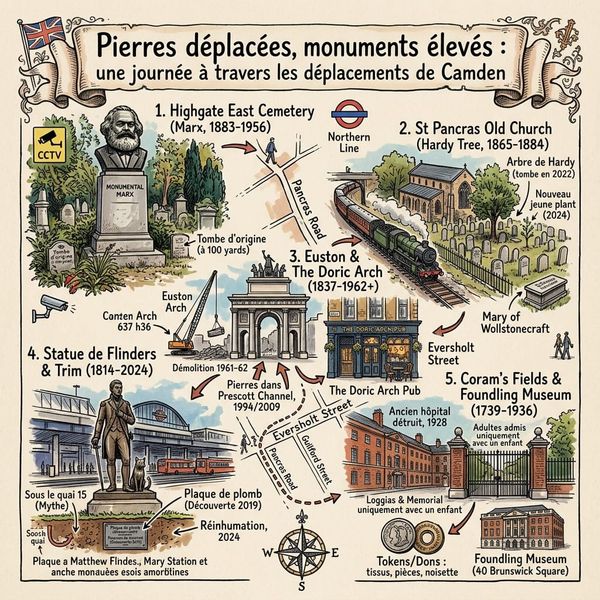
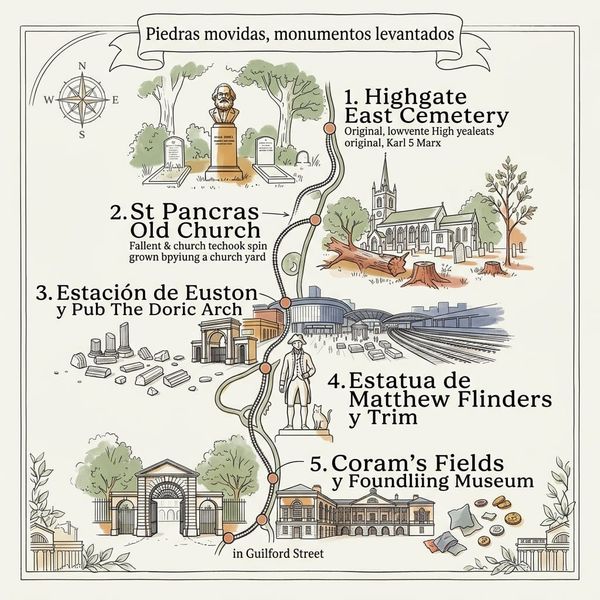
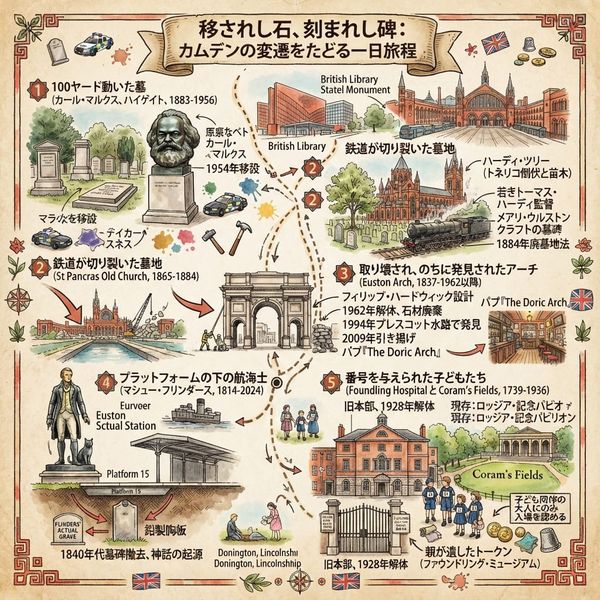
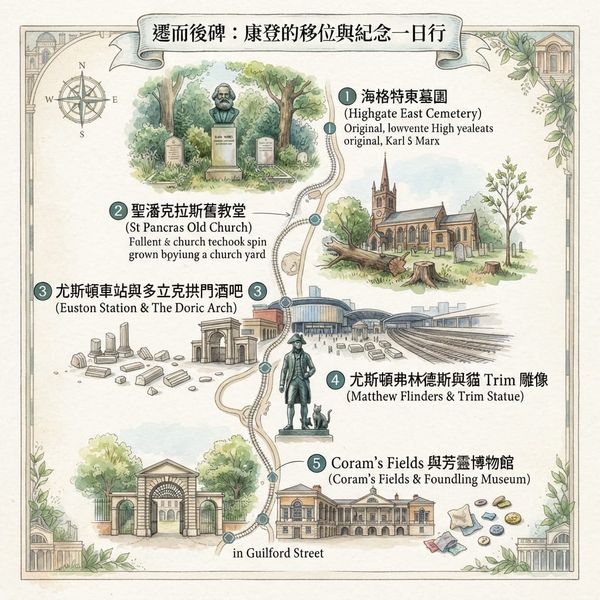
Camden holds three of London's great railway termini. Around them, graveyards were cut through, a Doric arch was pulled down and a captain's lead coffin plate came up from the ground. Five stories, one pattern: what was moved became what was remembered.

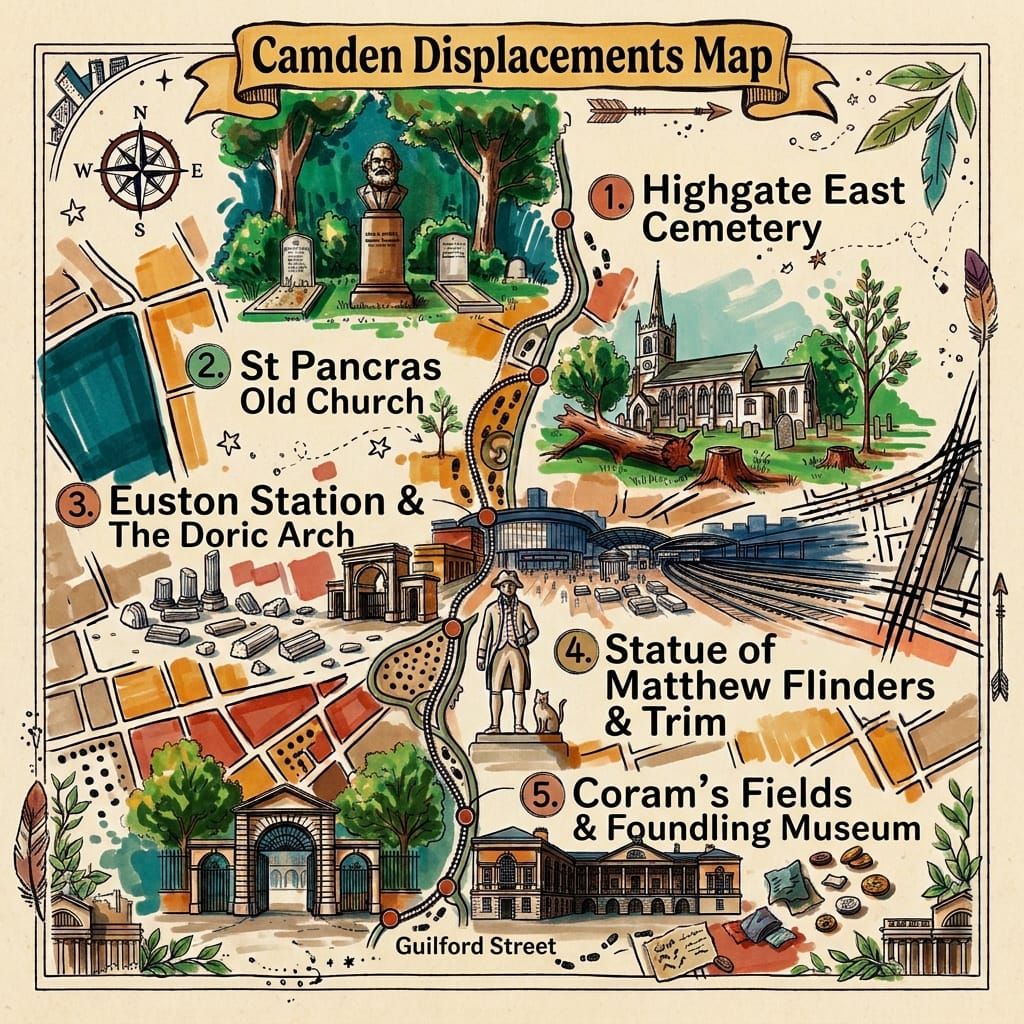
 Lawrence
During the year or so I spent in London, I never visited Camden; the closest I ever got was Regent's Park—my absolute favorite spot. It was only after doing some research that I discovered Camden’s history carries a rather heavy weight.
💡 Únete a una comunidad de viajeros exigentes. Solo tienes que introducir tu correo electrónico para acceder al instante a audioguías e itinerarios de un día, y llevar contigo nuestros exclusivos mapas históricos para recorridos a pie durante tu viaje.
St Pancras, King's Cross and Euston sit inside one London borough, and the borough's most telling stories all begin with something being taken away: gravestones from a churchyard, children from their families, a philosopher's bones from one corner of a cemetery to another, a stone arch from a station forecourt, and a navigator from beneath the railway. This article follows five physical traces, each documented, each contested at the edges, towards one question: when the removal is complete, what exactly is the memorial for?
The tree that fell
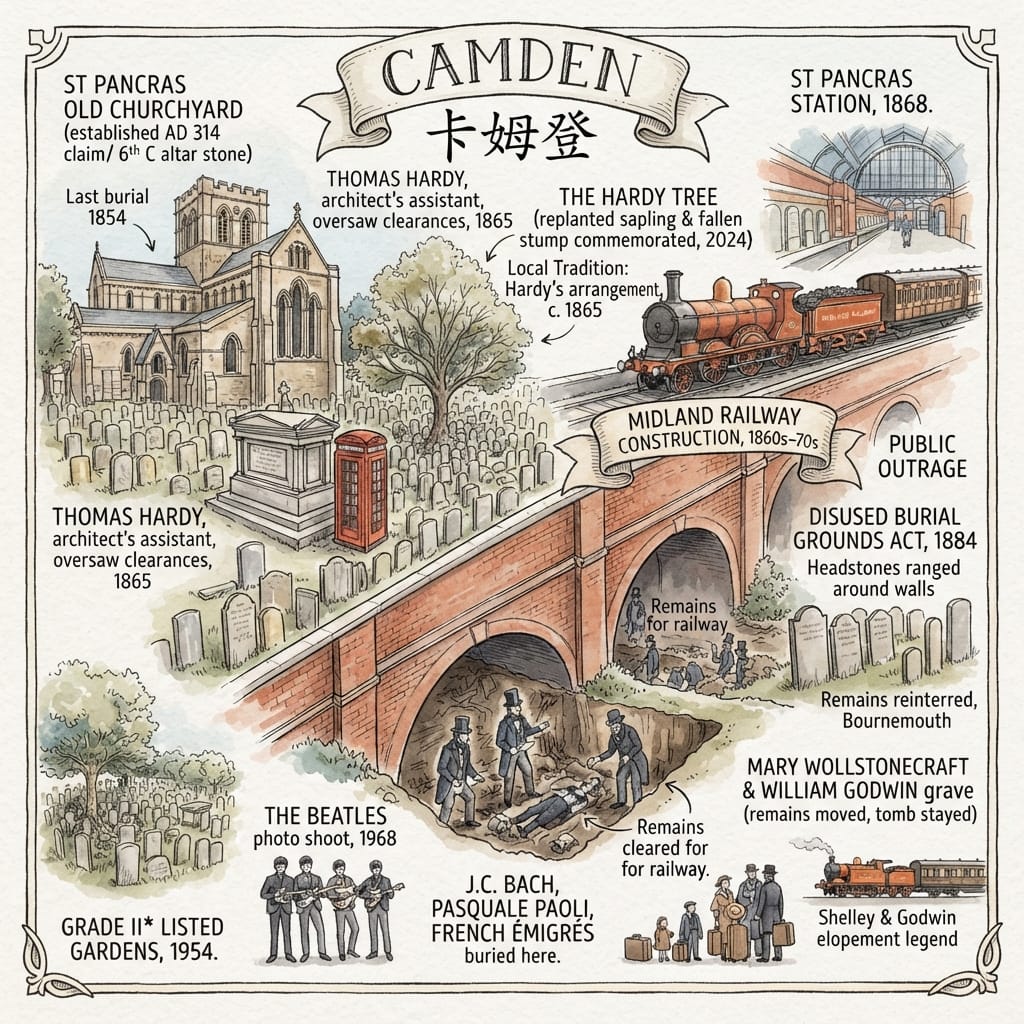
There used to be an ash tree in the burial ground beside St Pancras Old Church, and around its trunk someone had stacked a ring of gravestones, leaning inward like the spokes of a half-opened fan. Roots ran through the gaps between the stones. In places the tree had lifted the slabs a little from the ground. On 27 December 2022 it came down.
On the other side of a railing, within hearing distance, lies the platform edge. The geometry is the first puzzle: why does a graveyard stand pressed against the tracks, and why are these headstones gathered round a tree instead of standing over the people they once named? The answer does not lie in legend. It lies in the railway works of the 1860s and in an Act of Parliament of the 1880s.
1. The tree and the cutting (St Pancras, 1865)
In the mid-1860s the Midland Railway was building its new London terminus, the station building opening in 1868, and the line had to pass through the churchyard of St Pancras Old Church. The ground had seen its last burial in 1854, when the Burial Act closed London's parish graveyards, but it still held generations of the dead. The church handed the clearance to the architect Arthur Blomfield. One of Blomfield's assistants, in his mid-twenties, was Thomas Hardy, later the author of Tess of the d'Urbervilles. By the accounts we have, he was sent to supervise the removal of remains and the tidying of the stones.
The local story says that Hardy arranged the gravestones around the ash tree. The historian Gillian Tindall, who has written about the churchyard, notes that he was on site for perhaps a week and that there is little evidence he placed the stones himself. So the facts, in their plain order, are these: a young man did a hard job here, and a tradition later improved the picture. I am happy to keep the tradition in the story, provided no one mistakes it for the record.
The railway's second thought is better documented. In May 1874 the company wrote to The Times proposing to raise the level of the remaining ground by about ten feet, simply burying the graves under fill. The public reaction was fierce, and the Disused Burial Grounds Act 1884 followed, in part as a consequence. Such land could henceforth become a garden or playground, with the headstones recorded and set against the boundary walls. The company's calculation had, indirectly, produced a law protecting graveyards. The ring around the tree belongs to the years before that law, an improvised and slightly clumsy arrangement.
The Author Who Dug Up The Dead
People went their separate ways from here. The Corsican leader Pasquale Paoli was returned to his island. Mary Wollstonecraft and William Godwin lie today in Bournemouth, though their gravestone stays in the garden, and local tradition has it that in 1814 Percy Shelley and Mary Godwin planned their elopement beside Wollstonecraft's grave. That last detail is tradition, not record. None of this is a cosmology: the frame here is Anglican and recusant Catholic burial, and the Victorian argument between the sanctity of the dead and the appetite of a growing city.
What you can observe now. Standing in the garden you can hear trains from the adjacent lines, low and regular. A replacement tree was planted in April 2024. The nearby Soane family tomb is Grade I listed, and is said (a long-standing claim, not a settled one) to have influenced the shape of the red telephone box.
Resonance Node. The stump and the young sapling of the Hardy Tree, within sight of the Soane tomb. Four layers meet at this one spot: the clearance, a young architect's apprenticeship, the 1884 Act and the fall of 2022.
2. Children with numbers (the Foundling Hospital and Coram's Fields)
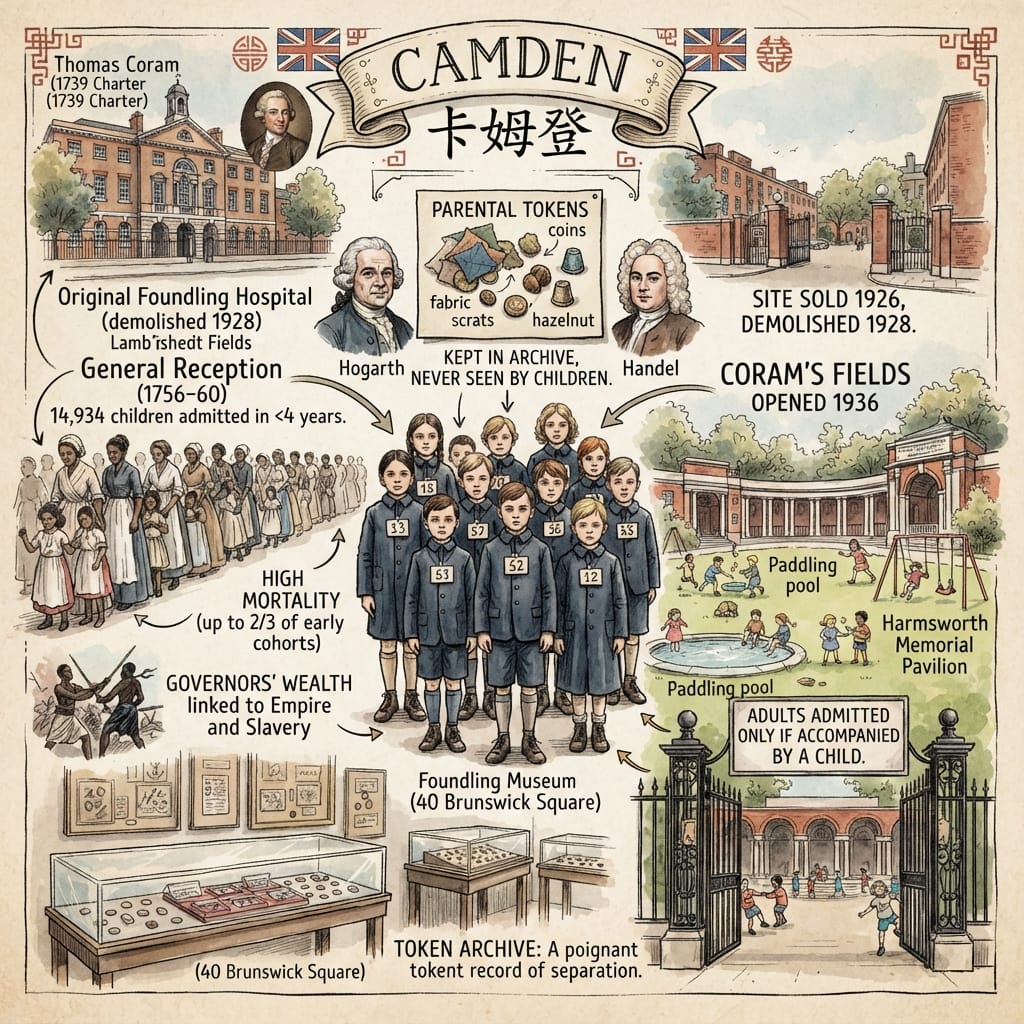
Coram's Fields, a few streets away, has a rule at its gate that adults may enter only if accompanied by a child. A traveller without one reads the sign and then looks through the railings. The rule only makes sense when you know what stood here.
Thomas Coram campaigned for seventeen years before the royal charter of 17 October 1739 created the Foundling Hospital. The first children were admitted on 25 March 1741 at Hatton Garden, and the hospital later moved to the fields near Lamb's Conduit, the first boys going in during 1745. William Hogarth and George Frideric Handel were among its supporters. Coram himself was, according to Hektoen's account, pushed off the board in 1742.
Children were renamed and numbered on arrival. The first two were called Thomas and Eunice Coram. Admission was at first by queue and later by a draw from a bag of balls. And the archive holds something much smaller than any building: the tokens that parents left with the infants, a scrap of cloth, a coin, a hazelnut shell, a written note, meant to allow the child to be identified if the parent ever returned. By the records, the children themselves did not see them.
The uncomfortable parts belong in the story. Some of the governors' wealth came from slavery and empire, a subject treated by the Foundling Museum's 2022–23 exhibition Tiny Traces, which examined African and Asian children connected with the hospital. During the Parliament-funded General Reception of 1756–60 the hospital is reported to have admitted 14,934 children in under four years (a figure drawn from encyclopaedic sources; further archival verification recommended). Mortality is stated very differently: about four in ten before leaving the hospital according to one source, two in three of an early cohort according to another. I leave the disagreement unresolved, because the disagreement is part of the history.
The hospital site was sold in 1926 and the main building demolished in 1928. After a public campaign the ground opened in 1936 as Coram's Fields, with the Harmsworth Memorial Playground. The last children are said to have left the hospital's care in 1954 (to be checked). Colonnades and a memorial pavilion survive. The frame used here is memory studies, applied without any claim beyond the evidence and without dwelling on suffering.
Resonance Node. The gate at Guilford Street, and the display of tokens at the Foundling Museum, 40 Brunswick Square. A site that once took in children nobody claimed now admits adults only if they bring one with them. The rule explains nothing, and stands there.
3. A hundred yards in the dark (Karl Marx, Highgate)
The bronze head in Highgate East Cemetery is much larger than life, set on a granite plinth, looking straight ahead. Most visitors come for it. It does not mark the place where Marx was first laid to rest.
Karl Marx died on 14 March 1883 at his home in the Haverstock Hill area and was buried on Saturday 17 March in his wife Jenny's plain family grave. Friedrich Engels spoke. At least thirteen mourners are named; one newspaper counted between twenty-five and thirty. The discrepancy has never been settled.
Seventy-one years later the arrangement changed. In 1954 the Marx Memorial Committee obtained a Home Office exhumation licence, with the consent of Marx's great-grandsons Frederick and Robert-Jean Longuet. On the night of 26–27 November the remains of Marx, Jenny, Helene Demuth and other family members were moved roughly a hundred yards to a new site. The bust, by Laurence Bradshaw and paid for by the Communist Party of Great Britain, was unveiled by Harry Pollitt in March 1956; sources give the 14th and the 15th, and the original press coverage still needs checking.
The Midnight Grave Robbery Of Karl Marx
There is a contradiction worth sitting with. A man who spent his life attacking the cult of relics was given, by his followers, the largest relic in the cemetery. His first grave was modest, close to anonymous; the second was built to be seen. Being seen came at a cost. The monument was daubed with swastikas in 1960 and, by later reports, attacked with explosives in the 1970s and with a hammer in February 2019, after which round-the-clock CCTV was installed (second-hand reporting; check before use). It is now Grade I listed, with a charge for entry to the East Cemetery, and Claudia Jones and Yusuf Dadoo are buried nearby. No cosmological frame is called for. Memory studies and cultural landscape are enough.
Resonance Node. The bust, and, about a hundred yards away, the unremarkable ground of the original grave.
4. Where the arch went (Euston, 1837–1962 and after)
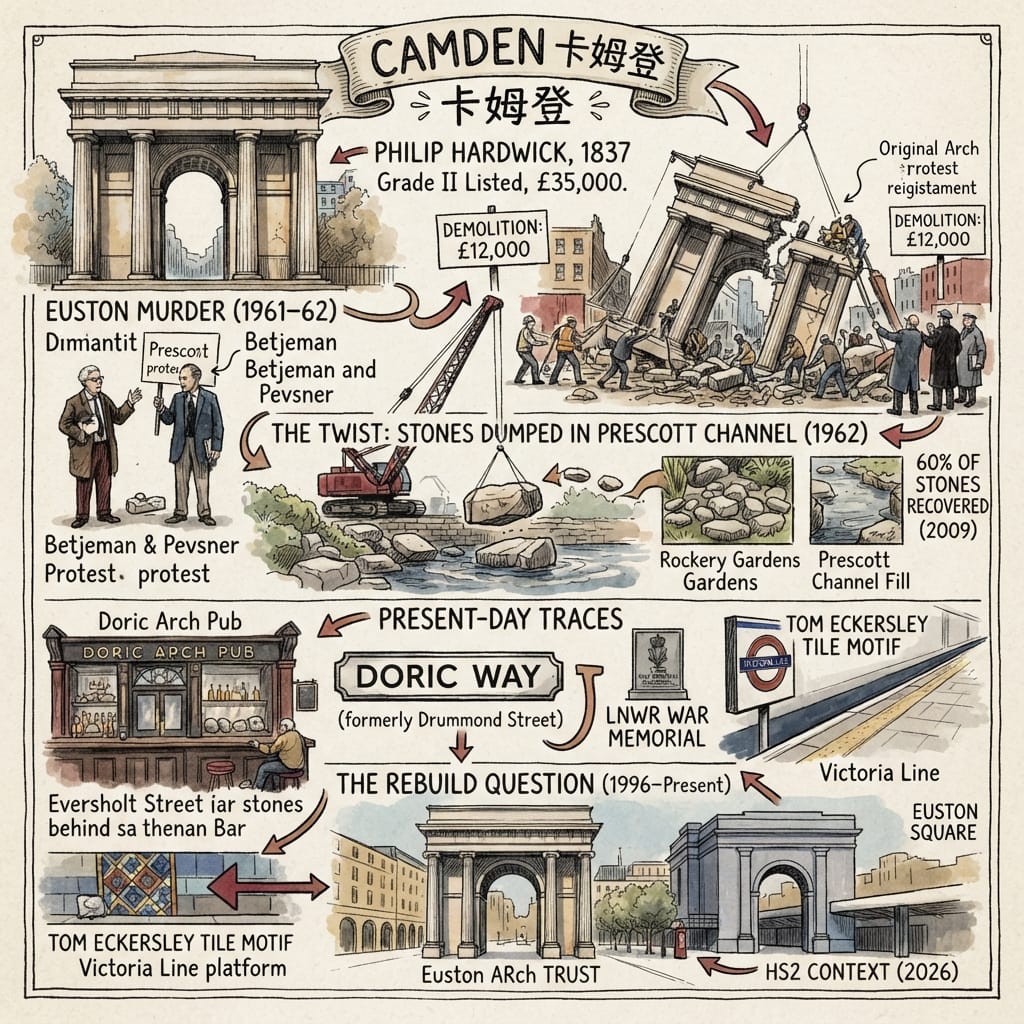
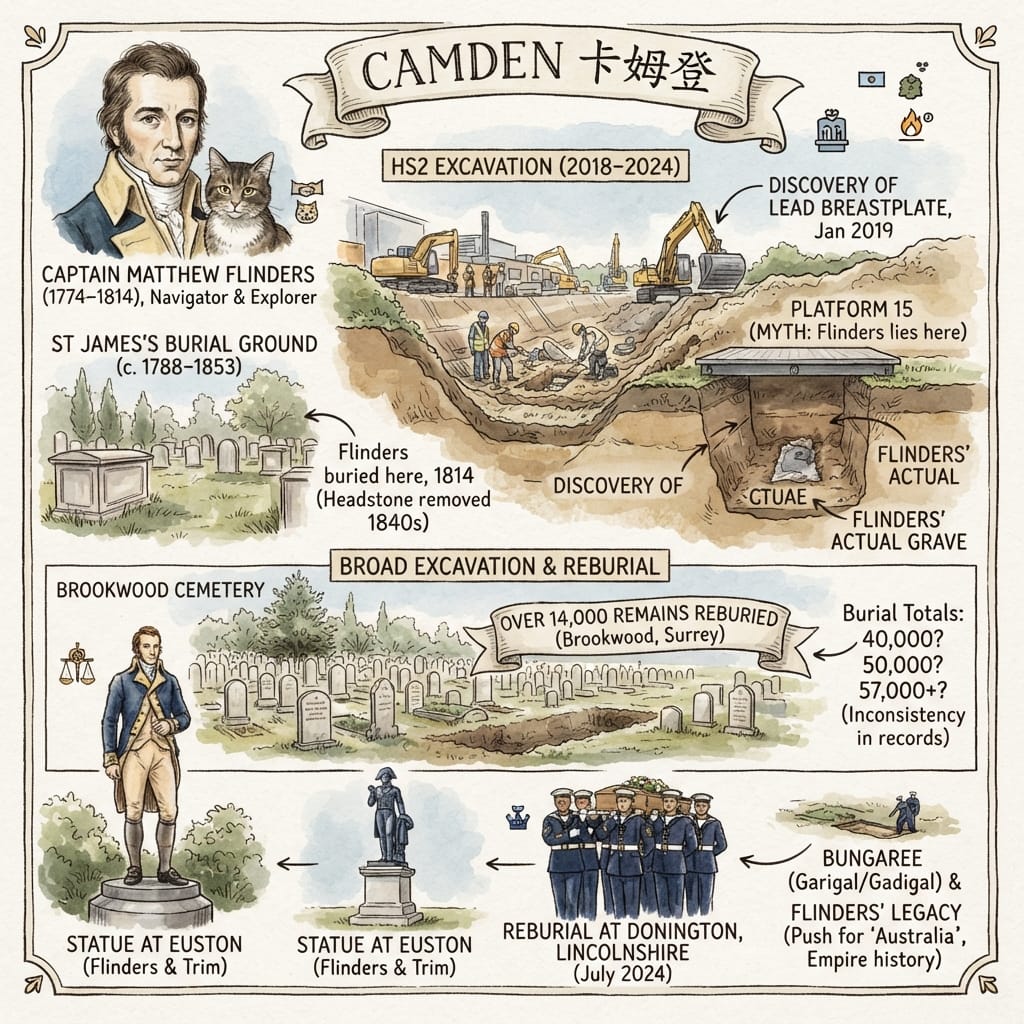
Euston Station today is low, wide and unremarkable, reworked many times since. In 1837 the London and Birmingham Railway put up a Doric arch here, designed by Philip Hardwick: about seventy feet high, in Bramley Fall stone, costing £35,000, with the word EUSTON cut into it in 1870. It was Grade II listed. It said, to anyone arriving, that departure was a solemn matter.
The London, Midland and Scottish Railway wanted to remove it in 1938; the Georgian Group objected and then the war intervened. In January 1960 the British Transport Commission served notice. The London County Council would permit removal on condition that the arch be re-erected, and the Commission would not pay. The Labour MP Woodrow Wyatt tabled a motion; the Minister, Henry Brooke, declined a preservation order in May 1960.
Then came the figure. As reported, on 12 July 1961 the Minister of Transport, Ernest Marples, told the Commons in a written answer that re-erecting the arch would cost about £190,000 against £12,000 for demolition. I have not been able to open the Hansard page itself, so treat the numbers as provisional. On 24 October 1961 a delegation from the Victorian Society and the Architectural Review met Harold Macmillan; his refusal followed some two weeks later (The Times, 4 November 1961). A Canadian firm is said to have offered to roll the entire structure two hundred yards. John Betjeman and Nikolaus Pevsner were among the best-known voices in the campaign.
The Euston Murder And The Hidden Monument
Demolition began in December 1961, largely by hand. The Architectural Review of April 1962 headlined its report "The Euston Murder". The contractor Frank Valori offered to store the stones and was turned down; he later built some into his own house in Bromley.
And then the twist. British Waterways bought the stones and used them as fill for a hole in the Prescott Channel. In 1994 the engineer Bob Cotton told the architectural historian Dan Cruickshank, and the programme One Foot in the Past broadcast the story on 7 June. At least sixty per cent of the stone was later located in the channel; some turned up as rockery in the gardens of the demolition workers; more was lifted in May 2009 during Olympic Park works. So the thing declared too expensive to preserve was used as fill in a channel, and that is where most of it was found.
The Euston Arch Trust was founded in 1996, and ministers in 2014 and 2016 voiced support for a rebuild. As of late 2026 I found no confirmed reconstruction. The National Audit Office's June 2026 report on the HS2 reset notes £46.8 billion spent by March 2026, Phase 2 closed, and Euston handed to a dedicated delivery company with private finance; the arch's future remains unresolved.
What you can observe now. Tom Eckersley's tile pattern on the Victoria Line platforms, said to be based on the arch; stones displayed behind the bar of the Doric Arch pub; Doric Way, the renamed eastern end of Drummond Street; the arch's iron gates in the National Railway Museum in York; and the surviving London and North Western Railway war memorial obelisk.
Resonance Node. The forecourt where the arch stood, and the stones behind the pub's bar.
5. The navigator under the line (Matthew Flinders and St James's Gardens)
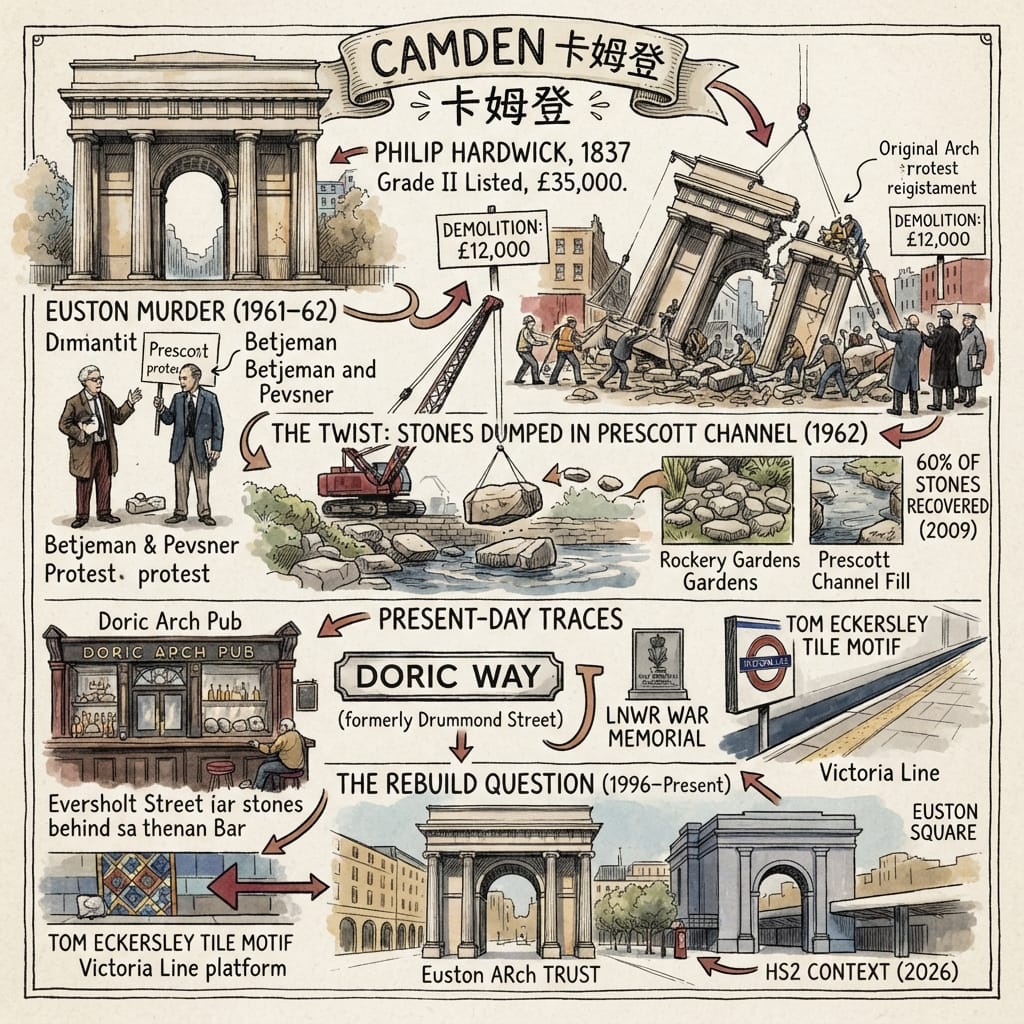
Outside Euston stands a bronze of a naval captain with a cat at his feet. He is Matthew Flinders, and the cat is Trim. Flinders completed the first circumnavigation of Australia and argued for the continent to be called Australia; on his way home he was held for years by the French on Mauritius. He died on 19 July 1814 and was buried on the 23rd in the overflow burial ground of St James's, Piccadilly, in use from about 1788 to 1853.
The railway came through that ground in the 1830s and 1840s, and Flinders's headstone was removed in the 1840s. A legend grew in its absence: he lay beneath platform 15. That is a legend, not a record.
HS2 archaeologists began digging in October 2018. On 18 January 2019 they found a lead coffin plate with his name; the find was announced on 25 January. The cemetery's population is given as 40,000, 50,000, 57,000, over 60,000, and in one HS2 table as 15,400 (about 20,000). I leave the numbers as they are, in disagreement. In June 2023 HS2 reported more than 14,000 sets of remains reburied at Brookwood Cemetery in Surrey, with around 5,500 still being analysed. The ground had been divided by what families could pay.
The Explorer Lost Under The Tracks
On 13 July 2024 Flinders was reburied at Donington in Lincolnshire, his birthplace, at St Mary and the Holy Rood, carried by Royal Navy personnel. The consistory court was satisfied that no precedent was being set, and the original coffin plate went to South Australia. Descendants of Bungaree, a man from the Sydney region who sailed with Flinders and whom Flinders called "the first Australian", were reported to have attended and placed a boomerang. I will not interpret that.
The politics are plain enough. HS2 was built on a special Act whose section 27 and Schedule 20 set ecclesiastical burial law aside; how this interacts with the 1884 Act (whose section 5 appears to save grounds disposed of under an Act of Parliament) needs checking against the statute text. The empire in which Flinders sailed and the Indigenous history he touched are not footnotes. In keeping with the Nangang Precedent, I apply no cosmological reading to the clearance of a burial ground; only trauma geography and memory.
Resonance Node. The statue of Flinders and Trim at Euston, and the lead plate that retired a two-hundred-year-old story.
The pattern
Walk the five sites in a line and the same thing happens at each. A tree and a ring of stones where graves were. A playground where a hospital was. A bust a hundred yards from the first grave. An arch that turned up in a drainage channel. A captain who came up from under a railway. Each time something was removed, and each time a memorial appeared where the removal had been. If you need a name for it, "translation" in the old sense, the moving of a relic from one place to another, comes close, though I offer it as a way of reading and not as a finding. It cannot account for the children whose stories left no trace at all.
Ending
Of the things that were moved, some went home. Paoli to Corsica. Flinders to Lincolnshire. Marx went a hundred yards. The stones of the arch are scattered. The foundling children, many of them, are known only by the names they were given there.
In April 2024 a new tree was planted in the garden at St Pancras. Its roots are shallow, and the stones around it are the old ring.
Accessing the physical node
Times, prices and access conditions change; check official sites before travelling.
- St Pancras Old Church and Gardens: Pancras Road, NW1 1UL; a short walk from King's Cross St Pancras station. The gardens are a public space; opening hours to be confirmed.
- Foundling Museum: 40 Brunswick Square; nearest Underground station usually Russell Square. Displays rotate, so check the token exhibit.
- Coram's Fields: Guilford Street area. Adults only with a child; the playground can be viewed from outside.
- Highgate Cemetery (East): Swain's Lane, N6 6PJ; Northern Line to Archway or Highgate, then walk. Paid entry; check hours.
- Euston Station: Northern and Victoria lines. The Flinders statue is outside; the Doric Arch pub is near Eversholt Street (address to be confirmed).
- National Railway Museum, York: check with the museum whether the arch's gates are on display.
- Brookwood Cemetery (Surrey) and Donington (Lincolnshire): both remote; plan separately.
💡 Q & A
Q1 | Did Thomas Hardy arrange the gravestones around Hardy's Tree at St Pancras Old Church, and how did railway works and the 1884 Act reshape the site? (St Pancras Old Churchyard and Disused Burial Grounds Act 1884)
A: There is no reliable evidence that Thomas Hardy arranged the ring of gravestones around Hardy's Tree; local tradition likely embellished a documented episode from railway clearance work. In the mid-1860s, the Midland Railway built tracks toward its 1868 terminus across St Pancras Old Church burial ground, which had closed to new burials in 1854 under the Burial Act. Architect Arthur Blomfield's assistant Hardy reportedly supervised exhumations and stone tidying, but historian Gillian Tindall notes he was on site for perhaps a week with little evidence he formed the circle. After the railway proposed raising the ground by about ten feet in May 1874, public outcry helped prompt the Disused Burial Grounds Act 1884, directing such sites toward parks or playgrounds with headstones recorded and placed along walls. The ash tree itself fell on 27 December 2022, and a replacement sapling was planted in April 2024.
Q2 | Why can adults only enter Coram's Fields in Camden if accompanied by a child, and how does the park connect to the 1739 Foundling Hospital? (Coram's Fields and Foundling Hospital)
A: The gate rule at Coram's Fields reflects the site's origins as the Foundling Hospital established to care for abandoned children. Following a seventeen-year campaign by Thomas Coram, a royal charter on 17 October 1739 created the hospital, which opened at Hatton Garden on 25 March 1741 before moving to fields near Lamb's Conduit, where the first boys entered in 1745. Supporters included William Hogarth and George Frideric Handel, while Coram was pushed off the board in 1742 according to Hektoen's account. Admitted children received new names and numbers, and parents left identifying tokens—such as cloth scraps, coins, hazelnut shells, or notes—now preserved at the Foundling Museum. The article also notes links between some governors' wealth and slavery and empire, unresolved differences over mortality and General Reception figures from 1756–60, and the site's 1926 sale, 1928 demolition, and 1936 opening as Coram's Fields.
Q3 | Why is Karl Marx's bronze bust in Highgate East Cemetery not at his original grave, and what do the 1954 exhumation and later clashes reveal? (Highgate East Cemetery and Karl Marx Memorial)
A: Karl Marx was first buried in a modest family grave in Highgate East Cemetery and moved roughly a hundred yards on the night of 26–27 November 1954 to the site of his 1956 bronze monument. Following Marx's death on 14 March 1883 at his Haverstock Hill home and his burial on 17 March beside his wife Jenny with Friedrich Engels speaking, accounts differ on attendance, citing at least thirteen named mourners or twenty-five to thirty in a newspaper report. Seventy-one years later, the Marx Memorial Committee obtained a Home Office exhumation licence with consent from Marx's great-grandsons, and Laurence Bradshaw's bust—funded by the Communist Party of Great Britain and unveiled by Harry Pollitt in March 1956—turned a critic of monument worship into a prominent political landmark, later drawing 1960 swastika daubing, reported 1970s and February 2019 attacks, Grade I listing, and paid entry debates.
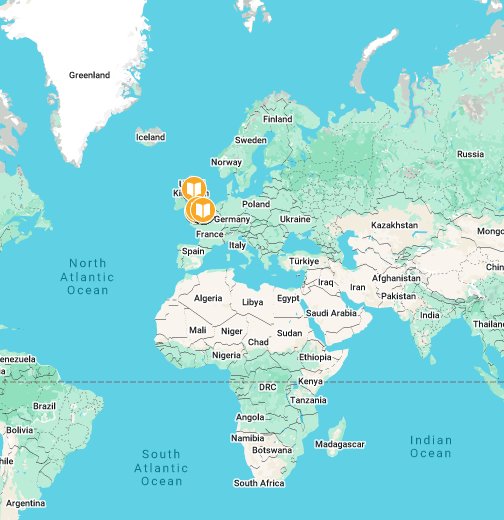
¿Quieres seguir las rutas históricas que he seleccionado directamente desde tu teléfono mientras caminas? Haz clic para unirte al mapa exclusivo de recorridos históricos en Google titulado "Historical Travel Stories": impórtalo a Google Maps en tu teléfono con un solo toque y deja que te guíe mientras visitas cada lugar histórico en persona.

📖Reference and Further reading📖
First layer – Main sources of literature and institutions:
- Hansard, Euston Station Doric Arch, written answer, 12 July 1961 (surfaced in search; figures not independently opened)
- HS2 / GOV.UK: Remains of Captain Matthew Flinders discovered at HS2 site in Euston
- National Audit Office: High Speed Two reset (June 2026)
- Disused Burial Grounds Act 1884 (47 & 48 Vict c.72) on legislation.gov.uk: Further archival verification recommended; text not opened
- Historic England List entries: St Pancras Old Church (1113246) and the Marx tomb (1378872); entries cited, pages to be re-checked
- HS2 Act 2017 (s.27, Schedule 20) and Burial Act 1857 (s.25): statute text not opened
- Foundling Museum and Coram archives (token collection); Camden Council records; contemporary 1907 press (Papers Past) for the Camden Town murder
The second layer – secondary academic materials:
- Spitalfields Life: Gillian Tindall on the Hardy Tree and the St Pancras clearances (2019) (J), site root given; locate the article before citing
- Victorian Web: Foundling Hospital and St Pancras Old Church pages
- Discovering Britain (Royal Geographical Society)
- Museum Wales / Dictionary of Welsh Biography on Iolo Morganwg
- Warwick research: Tiny Traces
- Hektoen International on Thomas Coram
- Wikipedia (E): Euston Arch, Highgate Cemetery, Foundling Hospital, Charles Pratt, 1st Earl Camden; cross-check each figure before use
- Levene, A. (2007), on foundling mortality; not opened. Further archival verification recommended
Third layer – Supplementary information:
- St Pancras Old Church: church history
- Camden New Journal (J): April 2024 Hardy Tree replanting
- London Remembers: Euston Square stone display (2015)
- Pittwater Online News: Bungaree's descendant at the 2024 reburial
- Londonist, Atlas Obscura, Kentish Towner, Fortean Times: folklore and local colour; treat as legend until sourced
 Lawrence
 Lawrence
 Lawrence