Southwark’s Hidden History: Cross Bones, the Marshalsea and the Mayflower
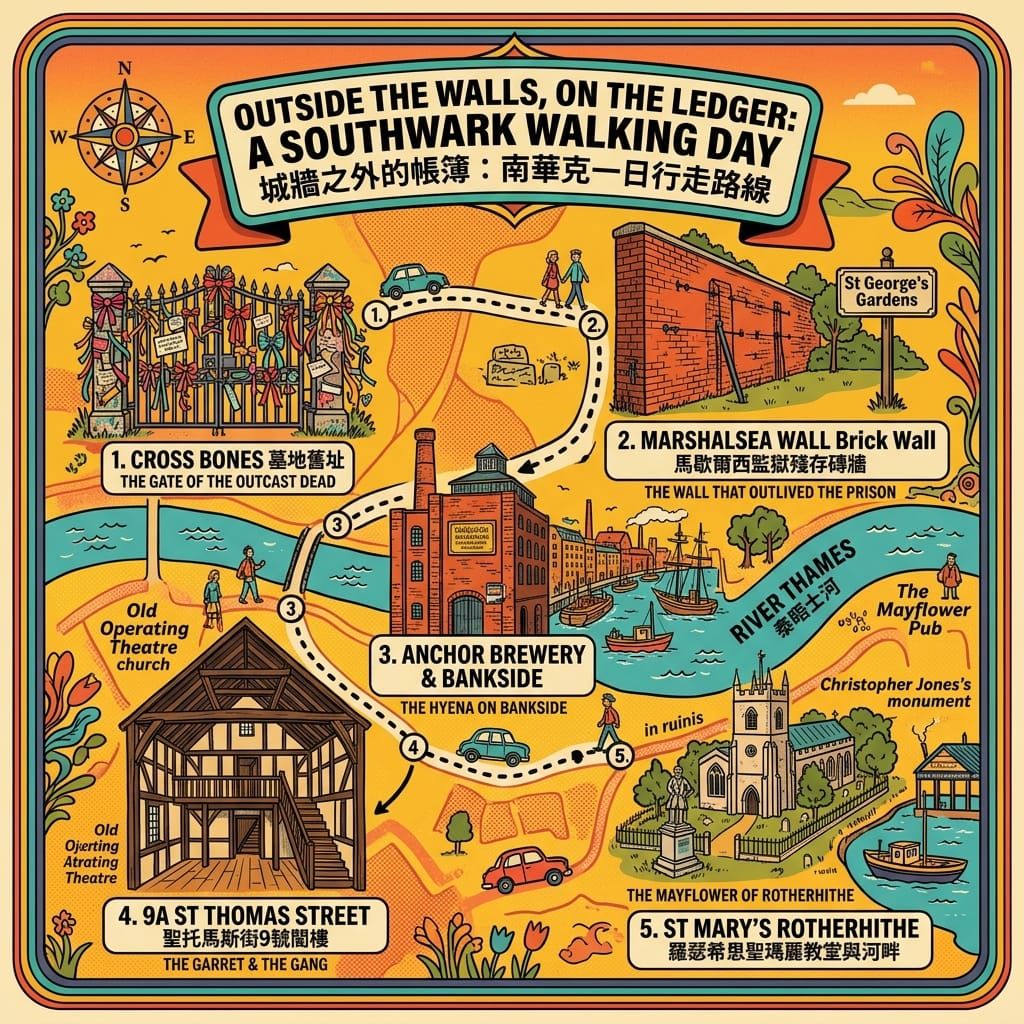
On the south bank of the Thames, London kept what it needed but would not own: women said to be refused consecrated ground, debtors behind a wall, the poor on the dissecting table, and a ship at last valued as “in ruins”. Five documented stories, each with a trace you can still touch.

Historical Travel Stories · English edition
 Lawrence
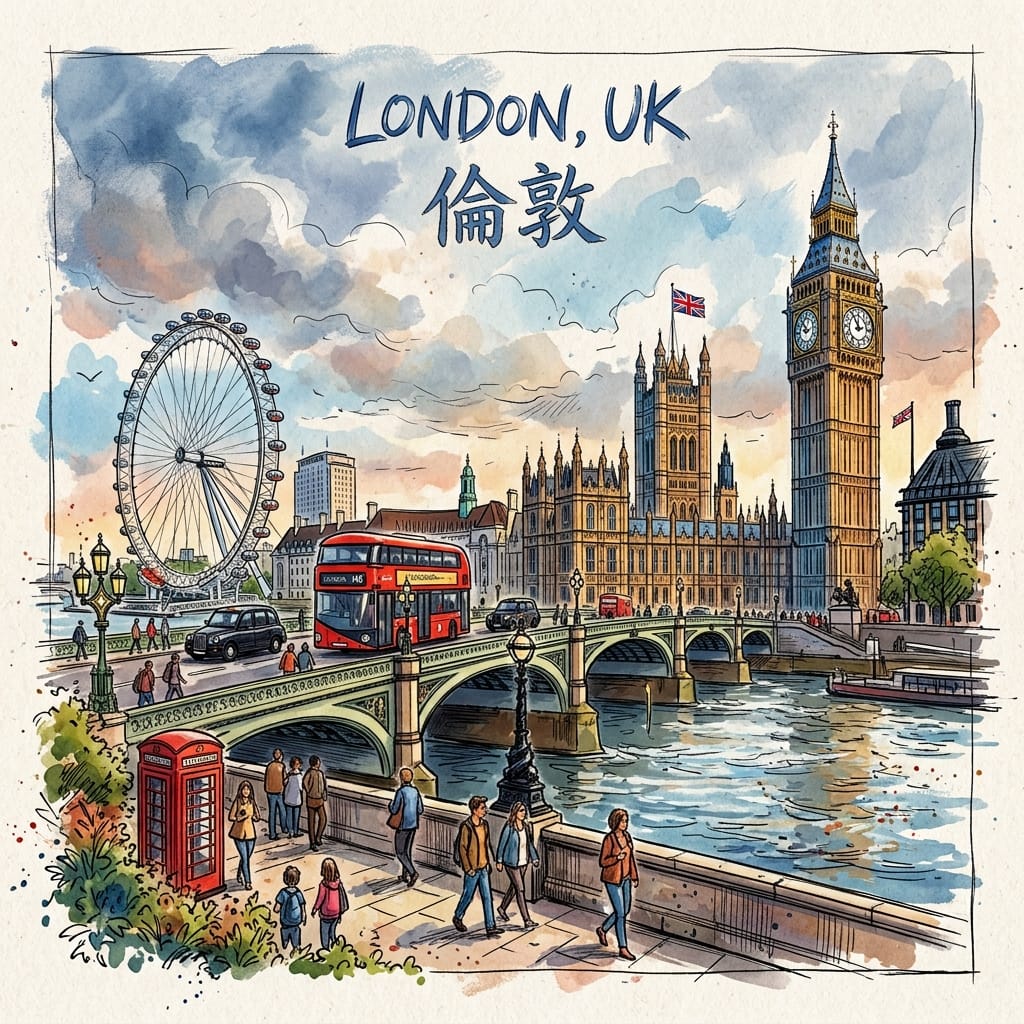
Rotherhithe—a familiar, tranquil spot within the borough of Southwark. I lived here for a year, specifically at Greenland Dock—a designated historical landmark. Rather than a mere "dock," it feels more like a lake, home to numerous houseboats and a hub for water-based activities. In this laid-back setting, you might almost imagine yourself on Greenland—the world's largest island. The fifth story in this article takes place in Rotherhithe.
💡 Join a community of discerning travelers. Simply enter your email to instantly unlock audio guides and one-day itineraries, and carry our exclusive historical walking maps with you on your journey.
Southwark has been London’s threshold since the Romans built a bridgehead here. In the Middle Ages the Bishop of Winchester ruled a Liberty outside the City’s law, and a good deal that London did not want to look at was set down on this side of the river. This article follows five stories that still have a physical trace: the gate at Cross Bones and its ribbons; the one wall left of the Marshalsea debtors’ prison; General Haynau’s flight from a Bankside brewery in 1850; an operating theatre in a church garret and the Borough resurrection men; and the Mayflower of Rotherhithe, last valued in 1624 as “in ruins”. Documented fact, scholarly interpretation and legend are kept apart throughout.
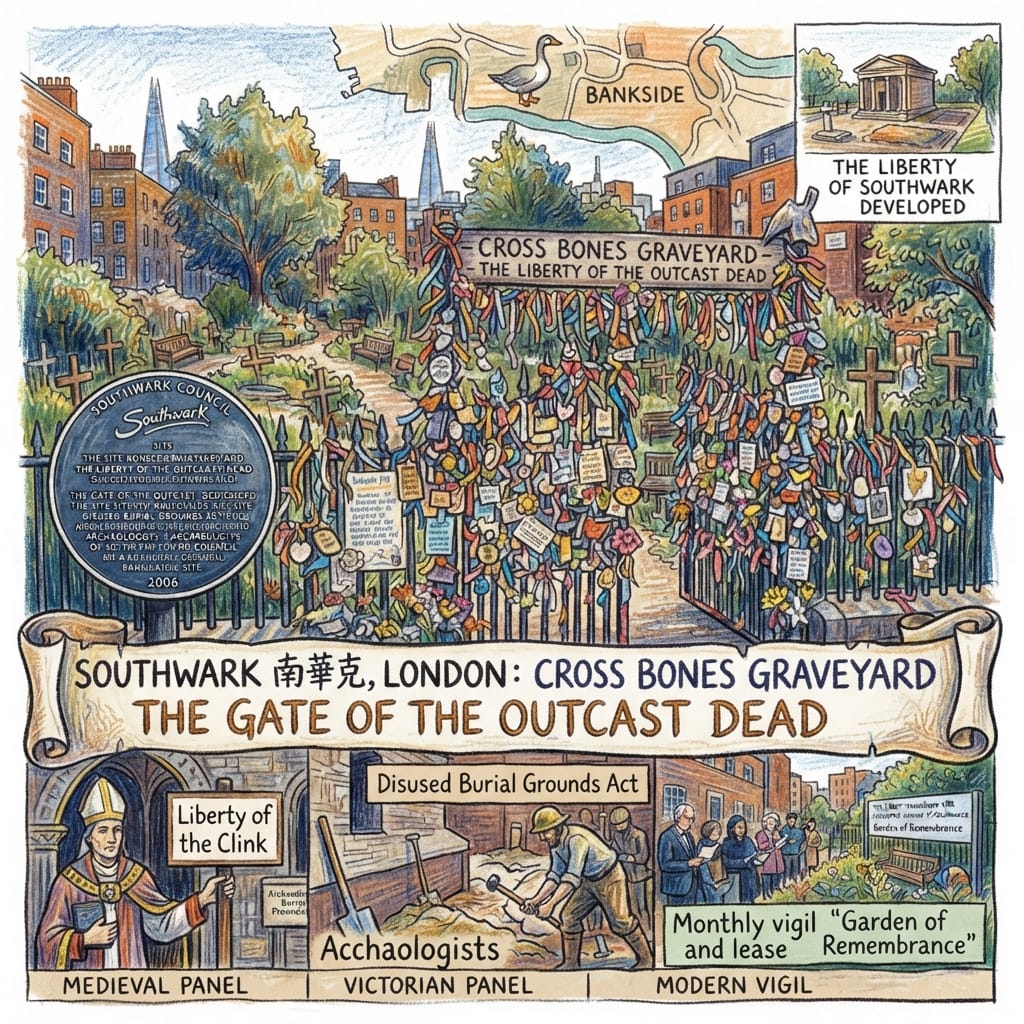
Ribbons are tied to a gate on Redcross Way, and between them there are cards, small tokens, a few lines in handwriting. A plaque beside the gate, put up in 2006, says what they are for. Behind the gate is a small garden; under it, by the best estimate, lie as many as fifteen thousand people, most of them poor.
This is Southwark, the south bank of the Thames at the end of London Bridge. The Romans used it as a bridgehead. In the Middle Ages it lay outside the authority of the City of London, and the things the City needed but would not own were set down here, one at a time, across the water.
1. The Gate and the Ribbons: Cross Bones and the Bishop’s Liberty
To see why the gate is hung with ribbons, begin with a document that lies about its age.
In the Middle Ages Bankside belonged to the Bishop of Winchester, whose Liberty of the Clink stood outside the City’s jurisdiction. Brothels, called stews, found a home here, and so in time did bear-baiting and the playhouses. The women of the stews were known as Winchester Geese. A set of rules for the stewholders presents itself as a law of Henry II, dated 1161 or 1162. It cannot be one: it cites a parliament that did not yet exist, and scholars place the text in the fifteenth century, a rulebook that backdated itself to borrow the authority of age. It is not wholly a tyrant’s paper. It forbids a stewholder to keep a woman against her will or to force her to lodge with him, and it bars a woman who is diseased from working. But it speaks in the bishop’s voice. What the women themselves said has not survived. In 1546 Henry VIII ordered the stews shut; the trade moved elsewhere and did not end.
Where the dead went is a second question. In 1598 the chronicler John Stow set down what some old men of good credit had told him: that these women, while they lived that life, were refused the rites of the Church and buried apart from the parish, in a plot called the Single Woman’s churchyard. That is hearsay from the 1590s about an earlier age. In 1833 the antiquary William Taylor became the earliest known writer to use the name Cross Bones, and the first to say outright that the ground off Redcross Way was Stow’s churchyard. Whether it was has never been settled.
What can be shown is what the ground became. By 1769 it was a general burial ground for the poor of a notorious slum, and it closed in 1853, “completely overcharged with dead”. In 1883 the land was offered for building; Lord Brabazon, later Earl of Meath, wrote to The Times against the desecration, and in 1884 the Disused Burial Grounds Act voided the sale. Warehouses went up regardless. In 1928 the demolition of a school turned up human bones. Transport for London bought the site in 1989 for the Jubilee Line Extension, and between 1991 and 1998 the Museum of London’s archaeologists dug it, removing about 148 skeletons (one source says 142), which they reckoned to be one per cent or less of the burials, implying as many as fifteen thousand in all. In a sample buried between 1800 and 1853, the excavation report records, more than a third were infants who died around the time of birth, and the adults were mostly women over thirty-six; the diseases included smallpox, tuberculosis and vitamin D deficiency. The heaviest figure in all this is the number of babies. What came out of the ground was chiefly the poor of the eighteenth and nineteenth centuries and their children. Archaeology has not shown that medieval prostitutes lie here. What it has recorded is a commoner kind of abandonment.
The Bishop S Profitable Outcasts
In 1996 the poet John Constable turned the story into The Southwark Mysteries and said it had been passed to him by the Goose, the ghost of a medieval sex worker. That is a modern devotional practice with an author and a date, not a medieval belief. The Friends of Cross Bones were founded the same year; since June 2004 they have gathered at the gate on the 23rd of every month; the anthropologist Sondra Hausner has described the rituals as a way of building a relationship between the living and an imagined past. In 2019 the Bankside Open Spaces Trust took a thirty-year lease to make a garden of remembrance.
The contradiction is hard to miss. A Church that regulated the trade, and by the record took rents and fines from it, is said to have denied its workers a consecrated grave; and a ritual from the 1990s has, almost by accident, protected a real burial ground. The memory is half new. The dead are not. Not far from the gate, archaeologists found Roman mosaics in 2022 and, announced in June 2023, a nearly intact Roman mausoleum ringed by more than eighty burials. The developer named the site The Liberty of Southwark, so the bishop’s medieval privilege became a brand. The Roman dead and the paupers of Cross Bones lie more than a thousand years apart, and nearness of place is not continuity of belief.
The people behind the gate mostly left no names. The people in front of it write on cards and tie them to the bars.
Holographic Sensory Cue: the ribbons, cards and handwritten lines on the gate; the plaque of 2006; no headstones, because after 1853 the ground was put to other uses.
Resonance Node: the gate near the corner of Redcross Way and Union Street.
2. A Wall That Outlived Its Prison: The Marshalsea and the Weight of Debt
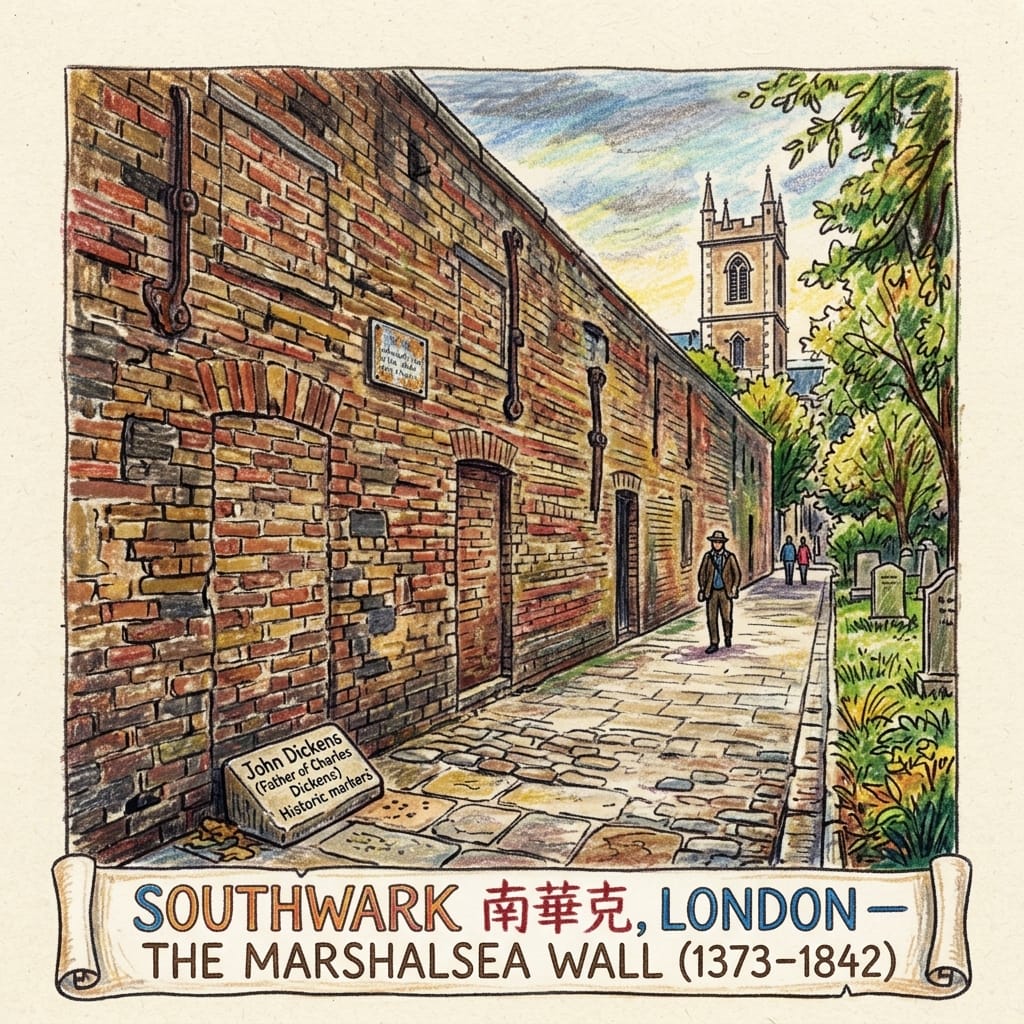
Down a narrow lane off Borough High Street stands a brick wall about four metres high. The brick is patched and uneven in colour; there are blocked openings, iron tie-rods and an enamel plaque. It is all that survives of the Marshalsea prison, its southern boundary, and on its far side lies the burial ground of St George the Martyr. The wall is listed Grade II.
The prison goes back to 1373, when the “good men” of Southwark were licensed to build a house for those held by the Marshalsea court of the royal household. Among its prisoners were Ben Jonson, jailed in 1597 over a play, The Isle of Dogs, judged seditious and slanderous, and John Selden, jailed in 1629 in the wake of the Petition of Right. But the prison’s staple was the poor debtor.
Inside, there was a master’s side and a common side. Those who could pay rented rooms; those who could not crowded into nine small wards. A long wall divided the yard so that the paying prisoners need not see the poor. Historians have read this as design rather than accident, since the plain existence of the common side kept families paying: an interpretation, not a settled fact.
One prisoner left a diary. John Baptist Grano, a trumpeter in Handel’s band, was jailed for a debt of £99 and wrote through 458 days, from 30 May 1728 to 23 September 1729. He visited the common side once, and judged that he would not have lived had he been put there.
In December 1728 the architect Robert Castell, held for debt, died of smallpox in a sponging house. His friend James Oglethorpe, an MP, chaired a Commons committee on the gaols, which visited the Fleet on 27 February 1729 and the Marshalsea on 25 March; Hogarth sketched the scene at the Fleet. The report of 14 May said that three hundred had starved in three months, and that in warm weather eight or ten died each day. That summer the Marshalsea’s chief jailer, William Acton, was tried for murder over the death of a carpenter, Thomas Bliss, who had been put in a foul “strong room” in irons. He was acquitted on every count. Some historians think the Crown wished to protect the Knight Marshal’s name; that is inference, not record.
The Prison Wall That Killed For Profit
On 20 February 1824 John Dickens entered the second Marshalsea, opened in 1811, for a debt of £40 10s to a baker. In April his wife and younger children moved in with him; on 28 May he was released. His twelve-year-old son Charles was sent to paste labels at Warren’s blacking factory and visited on Sundays. One researcher notes that John even chaired the prisoners’ committee. Thirty years later Charles wrote Little Dorrit (1855–57); returning to the site in May 1857, he told his readers that whoever came there would stand among “the crowding ghosts of many miserable years”.
In 1842 Parliament closed the prison; the inmates left on 19 November, and in July 1843 the buildings were sold to an ironmonger for £5,100. The Bankruptcy Act of 1869 largely ended imprisonment for debt. Most of the prison was pulled down in the 1870s. A library, by the record I found, now stands on the site (its present use should be checked), and beneath the wall there is a paving stone that mentions John Dickens.
A parliamentary inquiry exposed the deaths and ended in an acquittal; reform came more than a century later. People remember the prison now chiefly because of a novel, and the one thing that can be touched is, in the end, a churchyard wall.
On one side of that wall was a cell; on the other, a burial ground; today, a public garden.
Holographic Sensory Cue: the height and colour of the brick, the blocked openings, the tie-rods, the wording on the plaque; the quiet of the garden behind the wall, for anyone standing there.
Resonance Node: the surviving south wall of the Marshalsea, beside Angel Place and St George’s Gardens.
3. The Hyena in the Brewery: General Haynau on Bankside, 1850
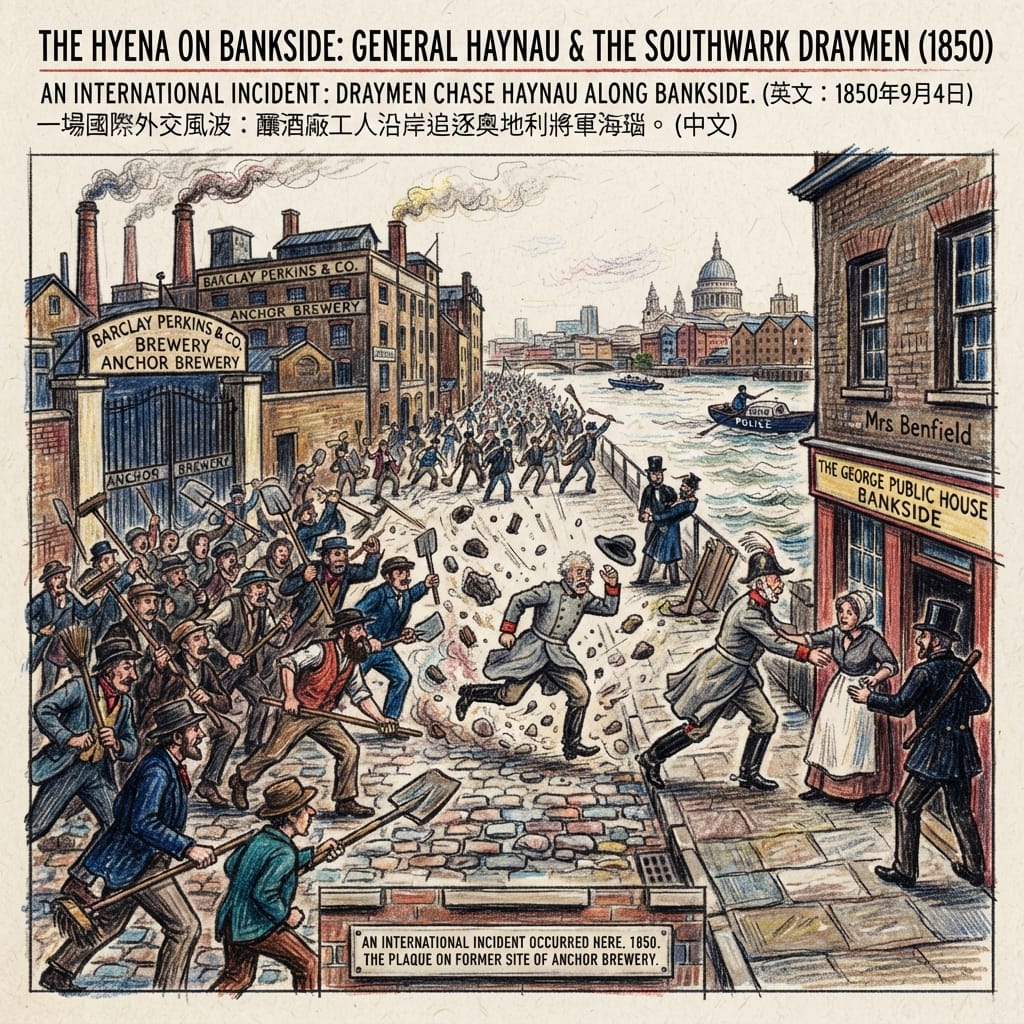
On 4 September 1850 a man of sixty-three signed a visitors’ book at the Barclay, Perkins brewery on Bankside. The brewery was a sight for distinguished foreigners; the plaque now on Park Street says as much. The signature read Julius Jacob von Haynau, Austrian general, born 1786.
He had spent 1848 and 1849 putting down revolts for the Habsburgs in Italy and Hungary. At Brescia he was accused of having women flogged, and was called the Hyena of Brescia; in October 1849 thirteen Hungarian generals were executed at Arad, and he became the Hangman of Arad. By 1850 he had lost favour at the imperial court and was travelling in Europe, where he had met hostility in Brussels before he reached London.
Clerks read the name, and word went round the yard. Draymen and brewery hands came after him with brooms, mud, horse dung and stones, shouting “Down with the Austrian butcher”, and chased him out of the gate and along Bankside. He took refuge in a pub called the George on Bankside; its landlady, Mrs Benfield, sent for the police, and he was taken across the river by boat. In some accounts he hid in a dustbin; the accounts disagree. So do the numbers: the plaque speaks of two draymen, the Whitbread archivist of hundreds.
The Brewery Mob That Sparked A Crisis
The Austrian ambassador demanded an apology. Lord Palmerston, the Foreign Secretary, replied in terms that leaned towards the draymen, without waiting for Queen Victoria to see the draft; the Queen objected and passed the matter to the Prime Minister, Lord John Russell. According to correspondence reproduced at second hand, Palmerston at one point offered to resign, and in the end withdrew his reply and sent a more apologetic one. That part needs checking in the Royal Archives and in The Times of the day. The brewery suspended men to find the ringleaders, but opinion ran with the draymen: ballads and broadsides praised them, and a public meeting at Farringdon Hall approved what they had done.
In 1852 Austria sent no one to the Duke of Wellington’s funeral. Haynau died in Vienna on 14 March 1853. In 1864 Garibaldi, visiting London, asked to see the brewery where Haynau had been humbled. The story was soon a national legend: in 1916 G. K. Chesterton wrote of the draymen as men with the straight chivalry of knights.
The morality of it is not clean. A man of sixty-three was chased through a brewery with dung thrown at him; and the men who threw it were collecting, late, a debt owed to victims who had never set foot in London. The Queen defended the dignity of diplomacy; the Foreign Secretary’s words leaned the other way; and the victims of Brescia and Arad had no seat in any of the rooms.
The brewery closed in the 1980s and the site has been rebuilt. What remains is the plaque on Park Street, and the road that runs along Bankside to the river, where, according to the record, the police boat took him across.
Where the visitors’ book is now, the sources do not say.
Holographic Sensory Cue: the wording on the plaque; the road from Bankside down to the river.
Resonance Node: the plaque on Park Street, on the site of the old Anchor Brewery.
4. The Garret and the Gang: Poor Bodies, Surgery and the Borough Resurrection Men
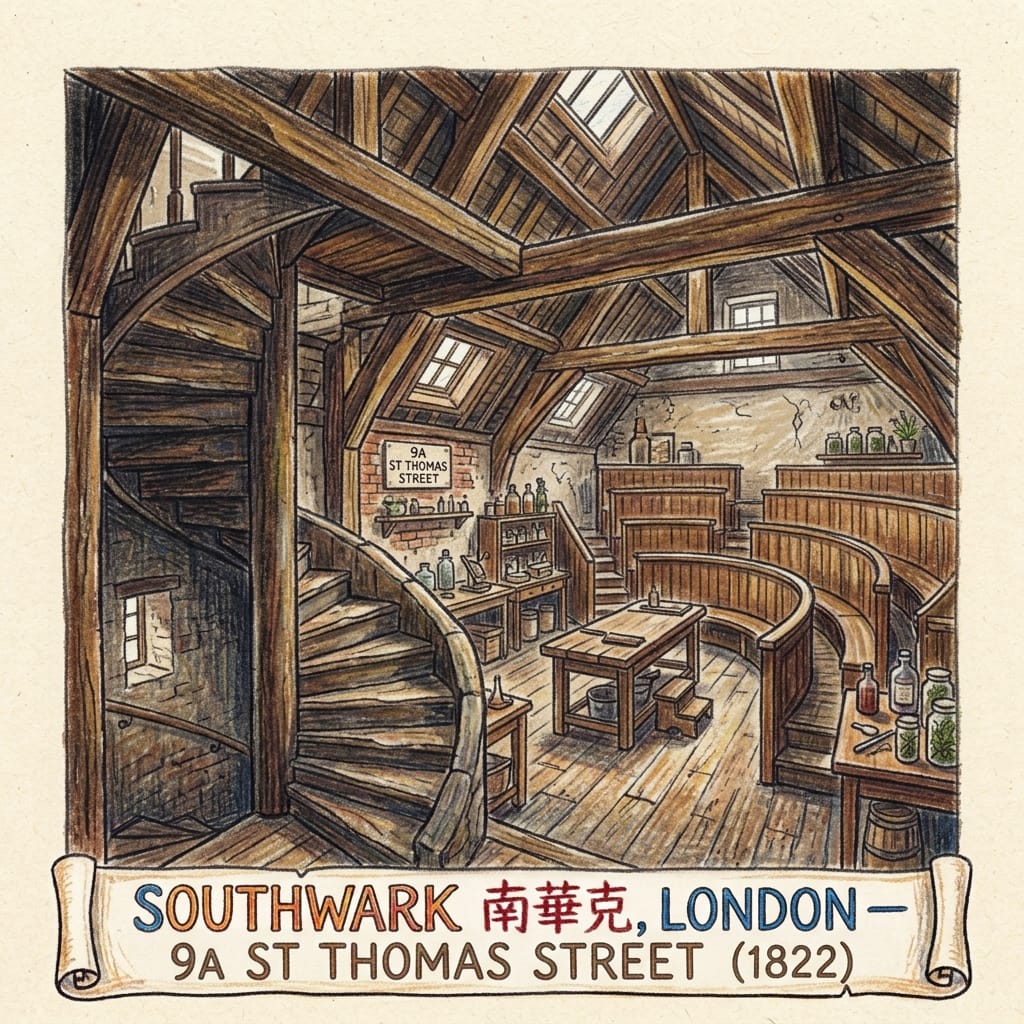
At 9a St Thomas Street a narrow stair runs up inside the tower of St Thomas’s Church to the roof space above the nave. A document of 1821 calls the space the herb garret, and dried opium-poppy heads were later found in the rafters. In 1822 part of it was fitted out as an operating theatre, beside the female surgical ward. The patients who came into that room were women, and mostly poor ones.
Anaesthesia did not arrive until 1846–47. Until then a surgeon depended on speed — a leg off in a minute or less — and on drink and opium. A box of sawdust stood under the table to take the blood; the gallery was packed with students. Florence Nightingale opened her nursing school at St Thomas’s in 1859. In 1862 the Charing Cross Railway Company bought the hospital’s ground, the hospital moved to Lambeth, and the theatre was shut and forgotten for the best part of a century. It was rediscovered in 1957 and opened as a museum in 1962.
What a teaching hospital needs, though, is bodies to dissect, and the law allowed few. The Murder Act of 1752 let the bodies of murderers go to surgeons. That was nearly the only lawful source: according to the Royal College of Surgeons, about four executed bodies a year reached the College for distribution, while one estimate puts the teaching need at more than five hundred. The gap was filled by resurrection men — body-snatchers. Southwark’s gang, the Borough gang, led by Ben Crouch, supplied St Thomas’s, St Bartholomew’s, private schools and Edinburgh.
The Ledger Of The Resurrection Men
Joseph Naples was born in Deptford in 1774 and served in the Navy, at Cape St Vincent in 1797. His diary of November 1811 to December 1812 is held at the Royal College of Surgeons and was published in 1896 by its librarian, James Blake Bailey. One researcher has counted that of the 194 nights it covers, 124 went on digging up and delivering bodies and 47 were too bright with moon to work; the expenses include bribes to custodians and watchmen. A local newspaper gives the gist of one entry: met at St Thomas’s, took two over to Guy’s.
Sir Astley Cooper, the great surgeon at Guy’s, told a parliamentary inquiry in 1828 that he could have the body of anyone he chose, were he so minded, because ready money was the key. The College records that his dealings with the resurrection men lasted from 1791 to 1825.
Two ways of seeing the dead collide here. The soul had gone from anatomy textbooks after 1672, but many ordinary people regarded dissection as a grave indignity; and the Murder Act had made dissection an added punishment for murderers, so that the table and the scaffold were joined in the public mind. The documents establish that much. That the state thereby taught people to dread the dissecting table is an interpretation.
In 1832, after public outrage over body-snatching and murder for the anatomy trade — Burke and Hare in Edinburgh, Bishop, Head and Williams in London — the Anatomy Act allowed the dissection of unclaimed bodies, which came from workhouses, prisons and hospitals. The College itself concedes that the Act fell hardest on the poor. As for Naples, he later worked in the dissecting room: as a servant at St Thomas’s, says the College; as a porter at Guy’s, says a local newspaper. The sources disagree.
One thing must be said plainly. No source I found shows that Cross Bones, or any other Southwark burial ground, was dug by this gang; setting the two stories side by side is a matter of theme, not of evidence. But the women on the ward and the poor in the burial grounds were not far apart in station.
Under the table, a box of sawdust.
Holographic Sensory Cue: the narrow stair in the tower, the rafters of the garret, and whatever the museum now shows beneath the table (to be checked). The room is the 1822 space, but the gallery and fittings, it is said, were reproduced when it reopened.
Resonance Node: the garret above 9a St Thomas Street.
5. “In Ruins”: The Mayflower of Rotherhithe
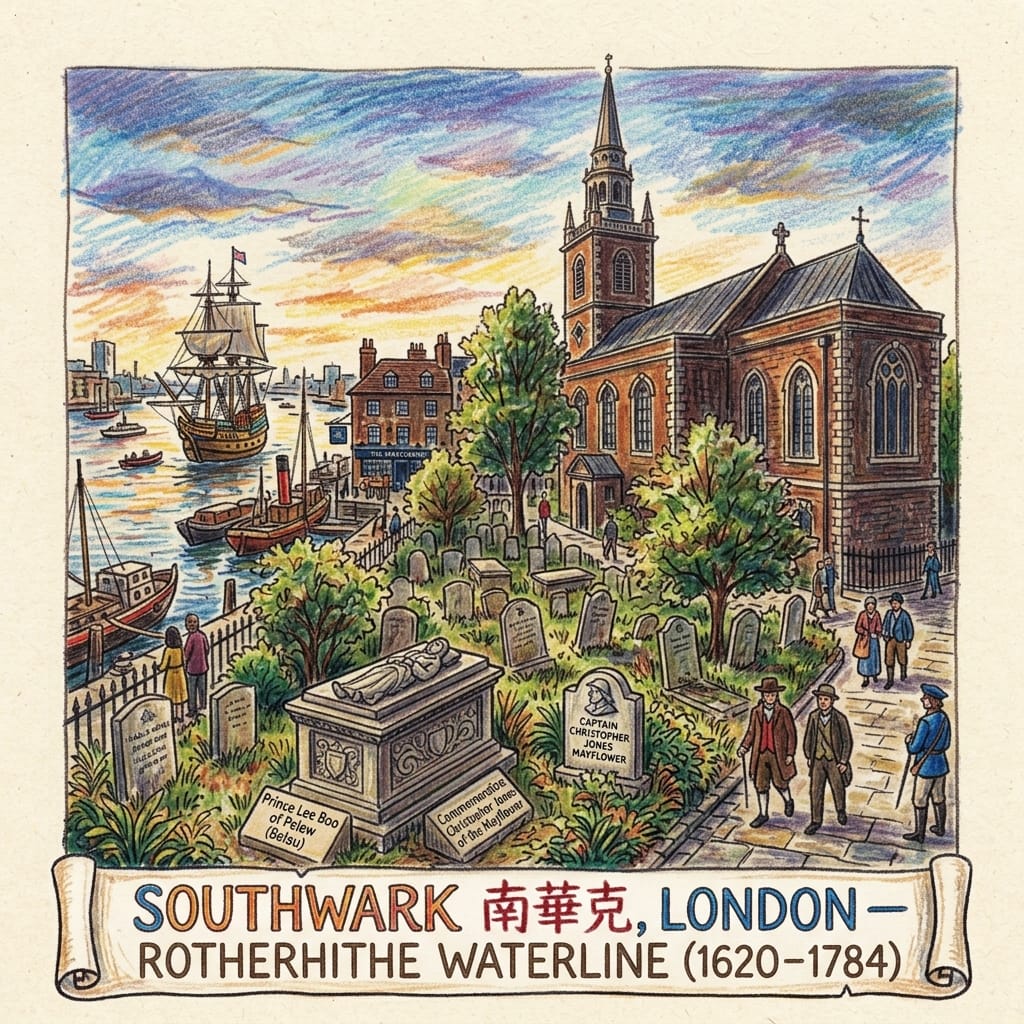
In the churchyard of St Mary’s, Rotherhithe, lies a man whose grave nobody can find.
Christopher Jones was born in Harwich and by 1611 was living in Rotherhithe, where his children were baptised at St Mary’s. It was a parish of ship masters and mariners, and the wine trade fed a good many of them. He was master of the merchant ship Mayflower and held a quarter share in her. His partner John Moore was a Rotherhithe man too, and so was his mate, John Clarke, baptised at St Mary’s in 1575, who had been a prisoner of the Spaniards from 1611 to 1616.
She was a cargo ship more used to France than to the Atlantic. In the summer of 1620 the merchant Thomas Weston chartered her from Jones and Robert Child to carry English separatists from Leiden, in Holland, across the ocean. She left London in mid-July with some sixty-five passengers and sailed down the Thames to Southampton to meet the Speedwell from the Netherlands. The Speedwell leaked and twice forced a turning back, and the Mayflower finally sailed alone from Plymouth on 6 September 1620, Old Style. Where she lay at Rotherhithe, and where her passengers boarded (probably at Blackwall), nobody can now say for certain.
Jones brought her home the following spring, and she was back at Rotherhithe on 6 May 1621. He was buried there on 5 March 1621/2; the exact place is not recorded, and nothing marks it.
The last document about the ship is dated 26 May 1624. The High Court of Admiralty received an application from her owners, Child, Moore and Jones’s widow Josian; the appraisers wrote her down as in ruinis, “in ruins”, valued her at £128 8s 4d, and listed what was aboard. After that she vanishes. The usual guess is that she was broken up. No picture of her survives.
The rector of St Mary’s from 1611 to 1654, Thomas Gataker, leaned to Puritanism. Southwark Council says Jones probably took his Puritanism from him; the National Churches Trust says Gataker may have influenced him. What Jones believed is not recorded. Of the Pilgrim Fathers only one came from Southwark; later Southwark emigrants included John Harvard.
The Junking Of The Mayflower
Then there is the barn. In 1920, as the tercentenary approached, the Quaker scholar James Rendel Harris announced that a barn at Jordans, in Buckinghamshire, was built from the Mayflower’s timbers. His case rested on a remark he said he had heard at a funeral and could not trace to its speaker; on two local farmers who, he thought, had held shares in the ship in the seventeenth century; on the letters “HAR” cut in a beam and read as Harwich; and on a mended beam he matched to Governor William Bradford’s account of a cracked main beam. J. W. Horrocks of University College Southampton argued against him in the Times Literary Supplement; in the 1960s the Pilgrim Trust and the Inspector of Ancient Monuments declined to endorse the claim; and when the barn was listed Grade II in 1982 the text said only that it was held by some to contain Mayflower timbers. Harris valued folk memory above strict history, and as a Quaker leader and Mayflower enthusiast he had reasons to want it true. None of the sources I have seen cites tree-ring dating.
A piece of the timber went to the American Quaker Samuel Hill in 1921 for the Peace Arch on the US–Canadian border; in the Second World War Churchill gave Roosevelt a Mayflower medal made from the rafters; a plan to ship the barn to America was turned down; in 2006 it was sold to a private buyer, and it is closed to the public. The Mayflower pub at Rotherhithe says she lay at its quay, and some say it holds her timbers; that too is tradition, and no one can show where she lay.
The passengers landed at Patuxet, a Wampanoag place emptied by the epidemic of 1616–19, in which the Wampanoag lost at least three-quarters of their people, perhaps nine in ten. Earlier, English ships had seized Wampanoag men and sold them into slavery in Spain; one, Tisquantum, reached England, and went home to find his village empty. The epidemic came before the Mayflower, and its cause is disputed; it cannot be laid at the ship’s door. Since 1970 the United American Indians of New England have held a National Day of Mourning on Thanksgiving; in 2026 Thanksgiving and the Day of Mourning fall on the same day, 26 November. Wampanoag cosmology lies outside Southwark’s frame and is not paraphrased here; an article that touches it should let Wampanoag voices speak.
A ship known to millions has no surviving picture, an unknown berth, an unknown end, and a master without a headstone; and so people commemorate her with memorials, a pub, a sculpture and a barn, a thing no one can point to. A commercial charter has become a sacred story of origins, and Southwark supplied the ship, the master, the mate and the quay, yet only one of the Pilgrim Fathers.
St Mary’s, rebuilt in 1715, holds many memorials to seamen from the earlier church; a memorial to Jones is said to have been unveiled near it about 1995 (to be checked), and there is a sculpture on the Thames Path.
The last document is a line in an account: in ruins, £128 8s 4d.
Holographic Sensory Cue: the river frontage at Rotherhithe; the memorials in and around St Mary’s. Her berth, and the sounds and smells of 1620, are not to be invented.
Resonance Node: St Mary’s church and churchyard, St Marychurch Street, SE16.
Southwark Today
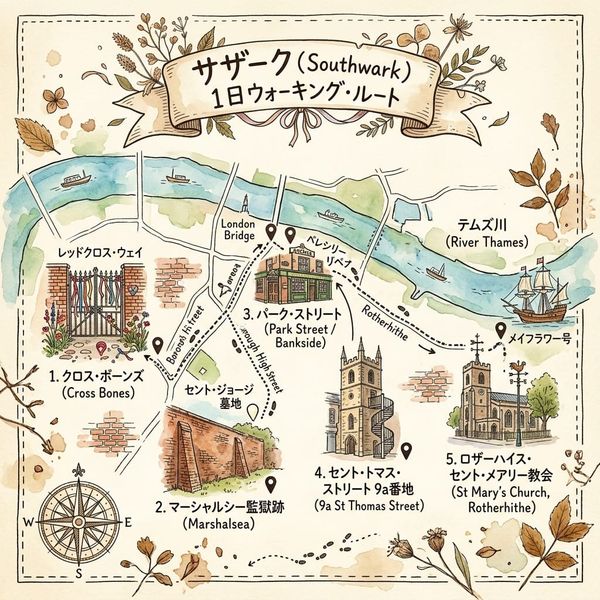
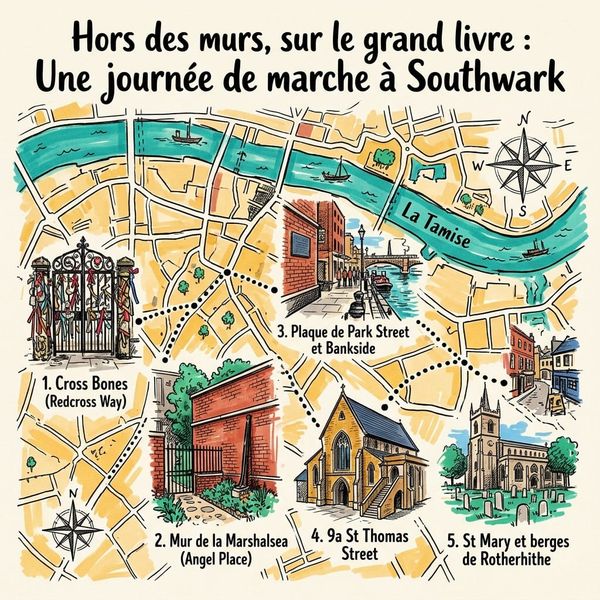
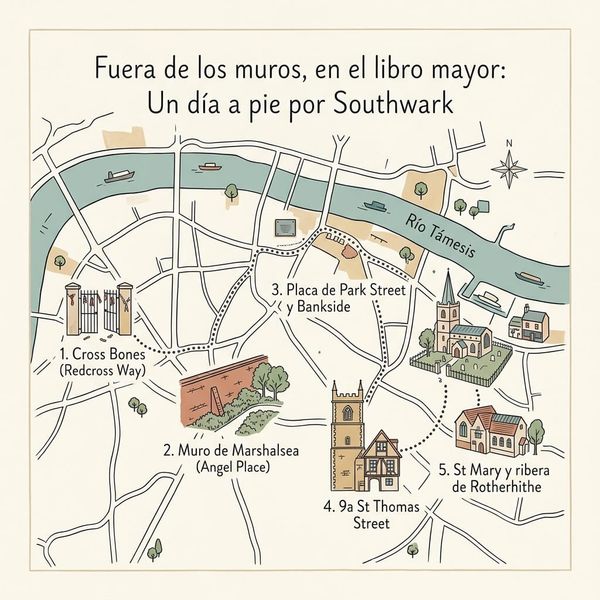
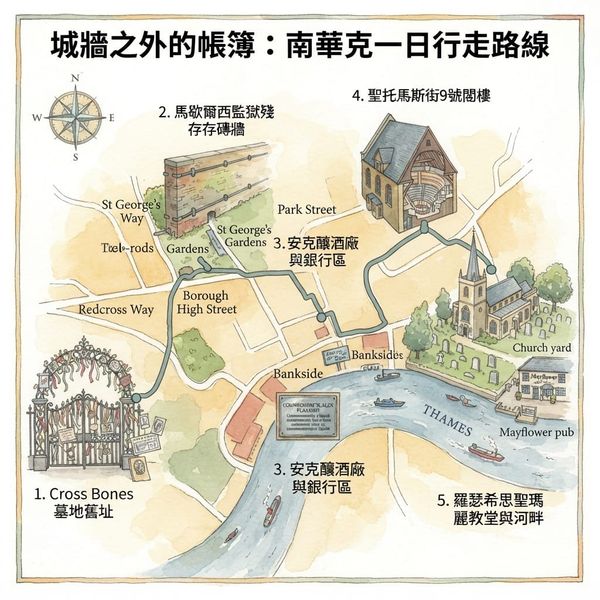
Taken together the five places make a short walk and a ride downriver: the gate on Redcross Way, the brick wall off Borough High Street, the plaque on Park Street, the garret on St Thomas Street, and at the end the churchyard at Rotherhithe. There is not much to see — a gate, a wall, a plaque, a staircase, a churchyard in which a grave cannot be found. A great deal has gone: the bounds of the Liberty, the stews, the roofs of the cells, the brewery, the crowd in the gallery of the operating theatre, the hull of the Mayflower. What has changed is use. The burial ground is a garden, the prison is a wall, the brewery has been replaced with new building, and the hospital’s theatre is a museum.
Southwark is known now for glass towers and railway viaducts, and its history lies round the corner into a lane. You have to stop, read a plaque, look up at a wall. After that these are no longer ordinary street corners.
Coda
London set its costs on the south side of the river and put the accounts away. Someone later opened the books: a rulebook with a false date, a report of three hundred starved, a diary of nights, a valuation.
In 1624 a ship was written down as in ruins, at £128 8s 4d.
Those who were never valued left a gate, and ribbons on it.
Accessing the Physical Node
The details below are approximate; check current access before you go.
- Cross Bones: Redcross Way, near Union Street, SE1. The nearest Tube stations are Borough (Northern line), London Bridge and Southwark (Jubilee line), about five to ten minutes on foot. The gate can be seen from the street at any time; opening times for the garden and details of the monthly gatherings are announced by the Friends of Cross Bones and the Bankside Open Spaces Trust.
- The Marshalsea wall: Angel Place and St George’s Gardens, off Borough High Street, a few minutes from Borough station. The wall stands in a public space and can be seen from outside; the gardens’ hours are on the notices at the entrance.
- The Haynau plaque: Park Street, near Borough Market and Bankside, on foot from London Bridge or Southwark station. It is on the street.
- The Old Operating Theatre: 9a St Thomas Street, next to London Bridge station. Entry is ticketed and opening days change, so check the museum’s own site; the stair to the garret is narrow and steep, and visitors with limited mobility should ask first.
- Rotherhithe: St Mary’s is on St Marychurch Street, SE16. The nearest station is Rotherhithe, and Canada Water is also within walking distance. Opening times vary; the Mayflower pub is a short walk away.
- Route: the first four places are within walking distance of London Bridge and Borough stations and take about half a day; Rotherhithe lies downriver and needs another half day.
💡 Q&A
Q1 | Was Cross Bones really a burial ground for medieval "Winchester Geese" sex workers, and where do today's rituals come from? (Redcross Way, John Stow and 1991–1998 MoLAS Excavation)
A:Surviving archaeological and documentary evidence does not prove that Cross Bones on Redcross Way was a burial ground for medieval "Winchester Geese" sex workers, while the spiritual rituals associated with the "Goose" date from the 1990s. Medieval Bankside lay within the Bishop of Winchester's Liberty of the Clink, and in 1598 John Stow recorded hearsay that "single women" were denied church rites and buried apart, though identifying this plot with Cross Bones remains unresolved. Excavations by the Museum of London Archaeology Service between 1991 and 1998 show the site functioned as a pauper burial ground by 1769 until closing in 1853, with recovered skeletons largely representing eighteenth- and nineteenth-century paupers and infants. By contrast, John Constable's 1996 work The Southwark Mysteries and subsequent vigils and remembrance garden belong to modern memory and ritual practice.
Q2 | How does the Marshalsea prison reflect London's history of debtors' confinement and jurisdictional boundaries, and what remains today? (Borough High Street, 1729 Gaols Committee and John Dickens)
A:The Marshalsea prison held mostly poor debtors alongside political and religious prisoners, reflecting how Southwark on the south bank of the Thames served London's confinement and jurisdictional needs. Licensed in 1373 (with another account noting existence around 1300), the prison separated paying inmates on the "master's side" from crowded wards on the "common side."A 1729 Commons committee report documented severe deaths, though chief jailer William Acton was acquitted at his murder trial that summer; John Dickens was imprisoned for debt in 1824, inspiring elements of Little Dorrit. Closed in 1842, the prison survives today primarily through a Grade II listed brick boundary wall about four metres high near Borough High Street alongside St George the Martyr's burial ground.
Q3 | What do surviving records show about Rotherhithe and the Mayflower, and is the Mayflower Barn timber tradition proven? (Christopher Jones, 1624 Admiralty Appraisal and Patuxet)
A:Documented records link Mayflower master Christopher Jones and fellow mariners to St Mary's church in Rotherhithe, whereas claims that timbers from the ship were built into the Mayflower Barn at Jordans remain an unproven tradition. Jones sailed on the chartered voyage in 1620, returned to Rotherhithe in 1621, and was buried there in March 1621/2 (Old Style) in an unmarked grave, while a 1624 High Court of Admiralty appraisal valued the vessel as "in ruinis" (in ruins) with no later record found. James Rendel Harris's 1920 argument for the Jordans barn timbers is not conclusively established, and the Wampanoag settlement of Patuxet where passengers arrived had already suffered the 1616–1619 epidemic ahead of contemporary Indigenous commemorations such as the National Day of Mourning.
Want to follow the historical routes I’ve selected right from your phone as you walk? Click to join the exclusive Google map of historical tours titled "Historical Travel Stories"—import it to Google Maps on your phone with a single tap and let it guide you as you visit each historical site in person.


📖Reference and Further reading📖
First layer – Main sources of literature and institutions:
- The Cross Bones Burial Ground, Redcross Way, Southwark, London — Brickley, Miles and Stainer, MoLAS Monograph 3 (1999); the excavation report, catalogue record. [via]
- Redcross Way archaeological evaluation report — MoLAS; Archaeology Data Service PDF. [excerpt]
- Roman mausoleum and mosaics, Liberty of Southwark — MOLA’s account of the 2022–23 discoveries. [excerpt]
- A Survey of London (1598; 1842 edition), p. 151 — John Stow’s passage on the single women’s churchyard, on the Internet Archive. [via]
- The History and Antiquities of the Parish of St. Saviour’s, Southwark (1795), p. 261 — Concanen and Morgan; the first guess at the site. [via]
- Report … relating to the Marshalsea Prison; and farther relating to the Fleet Prison — House of Commons Gaols Committee, 1729; Wellcome Collection record. [excerpt]
- Remaining wall of the Marshalsea, list entry 1378370 — Historic England listing. [via]
- 9A St Thomas Street, list entry 1385873 — Historic England listing for the church garret and operating theatre. [via]
- Diary of a resurrectionist — Royal College of Surgeons Library blog (27 May 2025) on archive item MS0024/1. [read]
- The Diary of a Resurrectionist, 1811–1812 — J. B. Bailey’s 1896 edition of Naples’s diary, on Project Gutenberg. [excerpt]
- The Mayflower and Mayflower 400 — Southwark Council heritage page on Jones, Gataker and Rotherhithe. [excerpt]
- Probate inventory of the Mayflower (1624) — transcription of the High Court of Admiralty appraisal, HCA 24/81, National Archives. [excerpt]
- The Finding of the “Mayflower” (1920) — J. R. Harris; the primary source of the Jordans barn claim, advocacy by its author. [excerpt]
- Mayflower Barn, Old Jordans (Grade II, list entry 1124977) — Buckinghamshire Council Heritage Portal record. [excerpt]
- Elephant and Castle regeneration — Southwark Council page (updated 11 April 2024), cited only in the Heygate reserve item; the council is a party to the dispute. [read]
The second layer – secondary academic materials:
- The Spirits of Crossbones Graveyard: Time, Ritual, and Sexual Commerce in London — Sondra Hausner, Indiana University Press, 2016. [via]
- “Cross Bones Graveyard: Excavating the Prostitute in Neo-Victorian Popular Culture” — Claire Nally, Journal of Victorian Culture 23(2), 2018. [via]
- The bishop’s profitable sex workers — Kate Lister, Wellcome Collection, 2018. [read]
- “Pain and Degradation in Georgian London: Life in the Marshalsea Prison” — Jerry White, History Workshop Journal 68(1), 2009. [via]
- The Publications of James Edward Oglethorpe — University of Georgia Press; edition of the gaols reports. [excerpt]
- The Companion to Little Dorrit — Trey Philpotts, Helm Information, 2003. [via]
- The Story of General Haynau — Nicholas Redman (Whitbread archivist) and J. Pudney, Brewery History Society Wiki; archive-derived but secondary, with quoted correspondence to be verified. [read]
- Rare Roman mausoleum unearthed in Southwark — Current Archaeology. [excerpt]
- The Mayflower Barn: Mystery and History in Buckinghamshire — Tom Hulme, University of Exeter, Voyaging through History project, 2019. [read]
- The End of the Mayflower — Caleb Johnson, MayflowerHistory.com. [excerpt]
- Wikipedia: Cross Bones — tertiary, used only to locate original citations; also Marshalsea, Southwark, Old Operating Theatre Museum and Herb Garret, Julius Jacob von Haynau, The 13 Martyrs of Arad, Christopher Jones (Mayflower captain), Rotherhithe and 1620. [read] for Cross Bones, Marshalsea and the Old Operating Theatre; [excerpt] for the rest.
- Body snatchers — Encyclopedia.com reference-work entry. [excerpt]
- The Great Dying — Pilgrim Hall Museum. [excerpt]
- What really happened at the first Thanksgiving — Smithsonian Magazine. [excerpt]
- Pilgrims heartland — National Churches Trust. [excerpt]
Third layer – Supplementary information:
- Friends of Cross Bones: History — the group’s own account of the site and its vigils. [via]
- Ten things about Crossbones Graveyard — Bankside Open Spaces Trust. [excerpt]
- The Southwark Mysteries — John Constable, Oberon/Bloomsbury, 1999 (also Secret Bankside, 2007); a creative work presented by its author as spiritually transmitted, so treat it as tradition. [via]
- General Haynau plaque, Park Street — London Remembers; reproduces the plaque text. [excerpt]
- The attack of General Haynau — thrale.com; local history of the Anchor brewery. [excerpt]
- The humbling of “General Hyena”, 1850 — Dawlish Chronicles; reproduces a street ballad. [excerpt]
- Diary of a bodysnatcher — Southwark News local-history feature. [excerpt]
- Native Americans share long-ignored Thanksgiving truths — Al Jazeera, 2021; testimony from Steven Peters of the Mashpee Wampanoag, keeper of the tribe’s historical narrative. [excerpt]
- Rotherhithe and the Mayflower — Thames Discovery Programme. [excerpt]
- The Mayflower Pub – Rotherhithe — Stephen Liddell, local-history blog. [excerpt]
- Article on Rotherhithe mentioning the tomb of Prince Lee Boo — Spitalfields Life. [excerpt]
- Article on identifying the Mayflower and the 1624 appraisal — Sail 1620. [excerpt]
- Heygate pages — 35% Campaign; cited only in the Heygate reserve item; campaign material, partisan by design. [excerpt]
 Lawrence
 Lawrence
 Lawrence