Sanzhi: Where the Dragon Vein Meets the Sea — and Five Hundred Years of History Refuse to Finish
Most people pass through Sanzhi for strawberries, or for photographs of ruins that no longer exist. But in the coastal wind off the Taiwan Strait, if you stand still long enough, five centuries of unfinished history begin to press through.

 Lawrence
From the extinction of the Ketagalan language to a utopian ruin on the coast, from the ghost economy of a fishing shore to the childhood of a democratic revolution — what a district nobody stops at can tell us about a country the world hasn't finished deciding what to do with.
Long-form historical travel essay | Sanzhi District (三芝區), New Taipei City, Taiwan
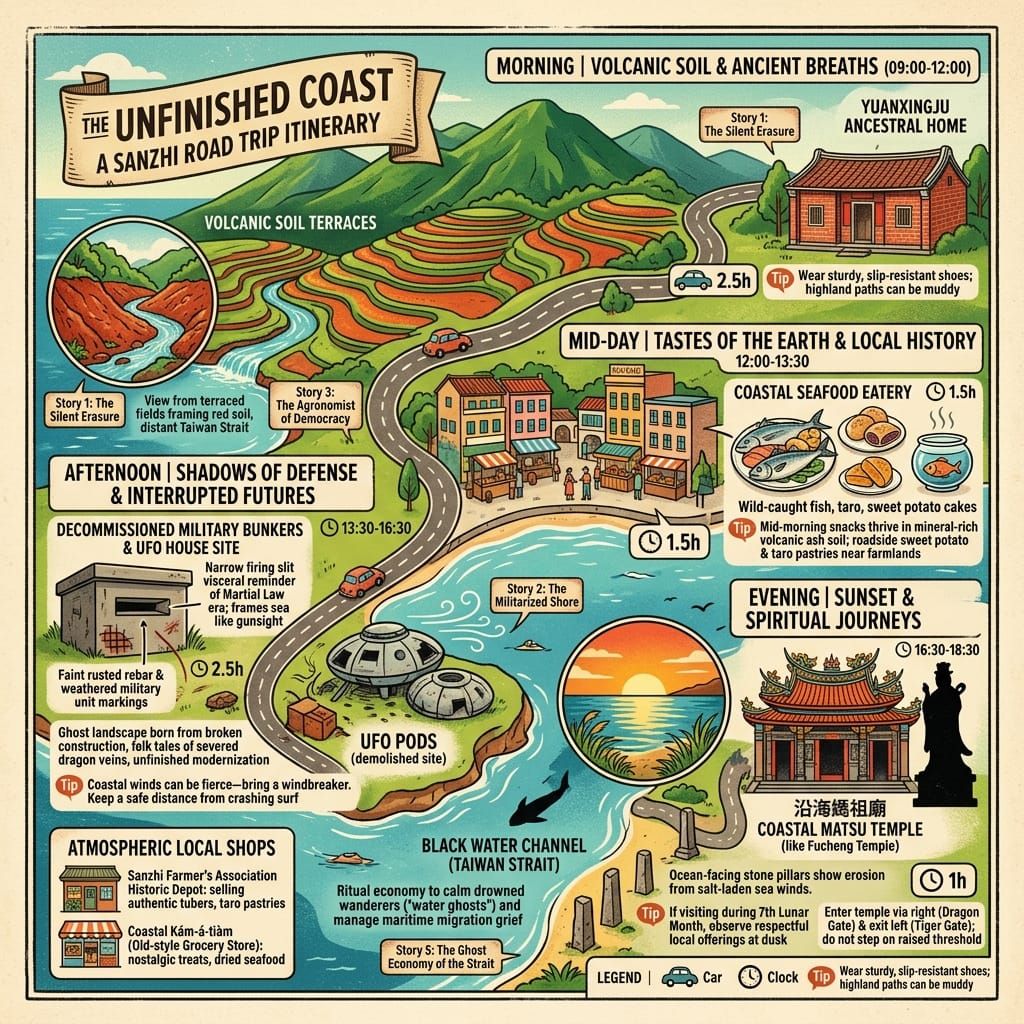
Sanzhi is a small coastal district in the northwestern corner of Taiwan's main island, thirty-five kilometres from Taipei and well outside any tourist itinerary anyone has ever written. Most visitors pass through briefly—for strawberry farms, or to photograph a cluster of famous ruins that, in fact, no longer exist. What this essay attempts instead is to read Sanzhi as a historical document, and to trace what five centuries of accumulated consequence—an indigenous civilisation silently absorbed, a fishing coast that built its economy around managing the dead, a modernist resort that never opened, a militarised border held for nearly four decades, and the childhood of the man who democratised Taiwan—have inscribed into five kilometres of volcanic coastline facing the Taiwan Strait.
Opening: The Weight of This Place
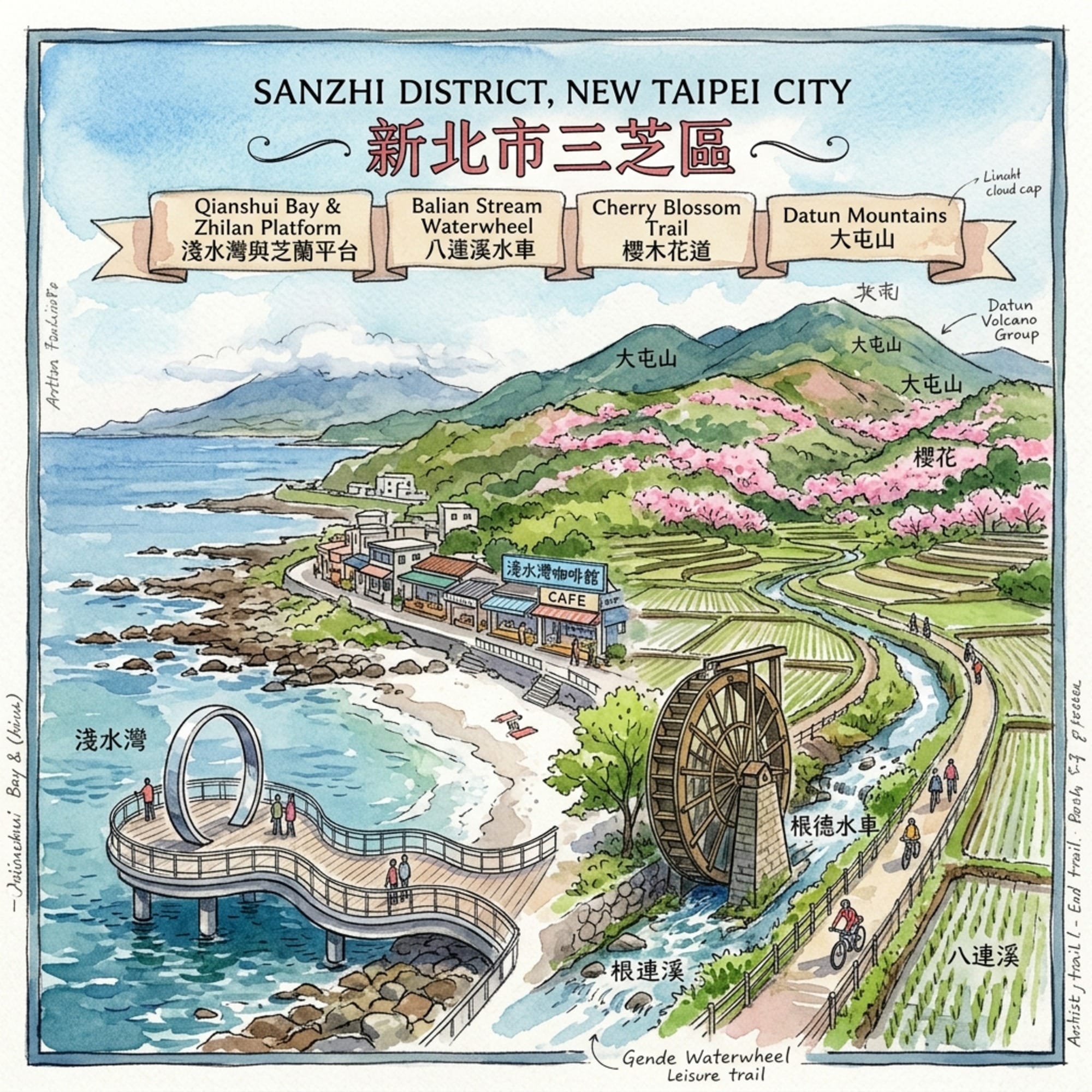
The road comes in from the east with the sea already pushing against the left-hand window, and then the mountains behind begin to thin and what remains is wind—the northeast monsoon off the Taiwan Strait, winter-steady and deliberate, carrying salt and a kind of insistence that belongs to forces that have been moving over open water for days. Sanzhi—three characters that translate, approximately, as three varieties of sacred fungus, though etymologists suspect the name may be the acoustic ghost of an indigenous word no living person can now pronounce—does not announce itself. The Datun volcanic massif rises to the south, its ridgeline in low cloud. The strait extends to the north, grey and wide and carrying within it, as every family on this coast has always known, a very long history of crossing and of not crossing, of making it and of not making it across.
What strikes the careful traveller here, standing on the coast road with the wind pressing in, is not what Sanzhi contains but what it has repeatedly failed to hold. This is a place where five centuries of consequential historical projects—a civilisation, a system of faith, an architecture, a military apparatus, a democracy—each arrived at the shoreline and dispersed into the water before they could consolidate. The record of those dispersals is what this essay is about.
Listen to the historical stories told in detail (For subscribers only)
The Ground Beneath: What Geomantic Tradition Sees Before the Archive Does
Before any human record, there is the landscape—and in the geomantic tradition native to this part of the Sinosphere, landscape is itself a form of historical analysis.
The classical Chinese practice of feng shui—the art of spatial orientation through which the vital energy of the earth (sheng qi, 生氣, living breath) is understood to move through terrain along channels called long mai (龍脈), dragon veins—offers, in Sanzhi, a geographical reading that turns out to also be a historical prediction.
The ideal configuration is yi shan mian shui: lean on the mountain, face the water. The mountain at your back accumulates the earth's vital energy and provides shelter; the water in front enables its circulation. Sanzhi, on paper, has both: the Datun volcanic group to the south, the Taiwan Strait to the north. On paper, this should be a site of exceptional force.
The problem is the specific water it faces.
The deepest, most turbulent section of the Taiwan Strait—the passage that coastal communities in Fujian and Taiwan called, for centuries, the Hak-súi-kau, the Black Water Channel—is not gentle. The northeast monsoon drives across its surface in winter with the sustained authority of a force that has covered five hundred kilometres of open sea before reaching this shore, and there is nothing on the Sanzhi coast to break it. In geomantic analysis, a site directly exposed to rushing, uncontained water from a straight angle—shui chong, water rushing—experiences what the tradition calls sha qi, killing breath: a dispersal, rather than an accumulation, of the earth's vital energy. The dragon vein flows down from the Datun massif, reaches the coast, meets no sheltering arms of flanking terrain, and scatters into the channel.
This, I want to propose, is not merely a spatial metaphor. It is the governing pattern of five hundred years of Sanzhi history—what the research dossier underlying this essay identifies as the long mai ru hai zheng hou qun: the Dragon Vein Into-Sea Syndrome. Enormous forces arrive at this coast. None of them stay. Each disperses before it can consolidate into a completed form. What follows are five manifestations of that pattern, traced in the order they arrived on this shore.
I. The Ketagalan: The Language That Went to Sea
The oldest story Sanzhi holds is the one least visible in the landscape now.
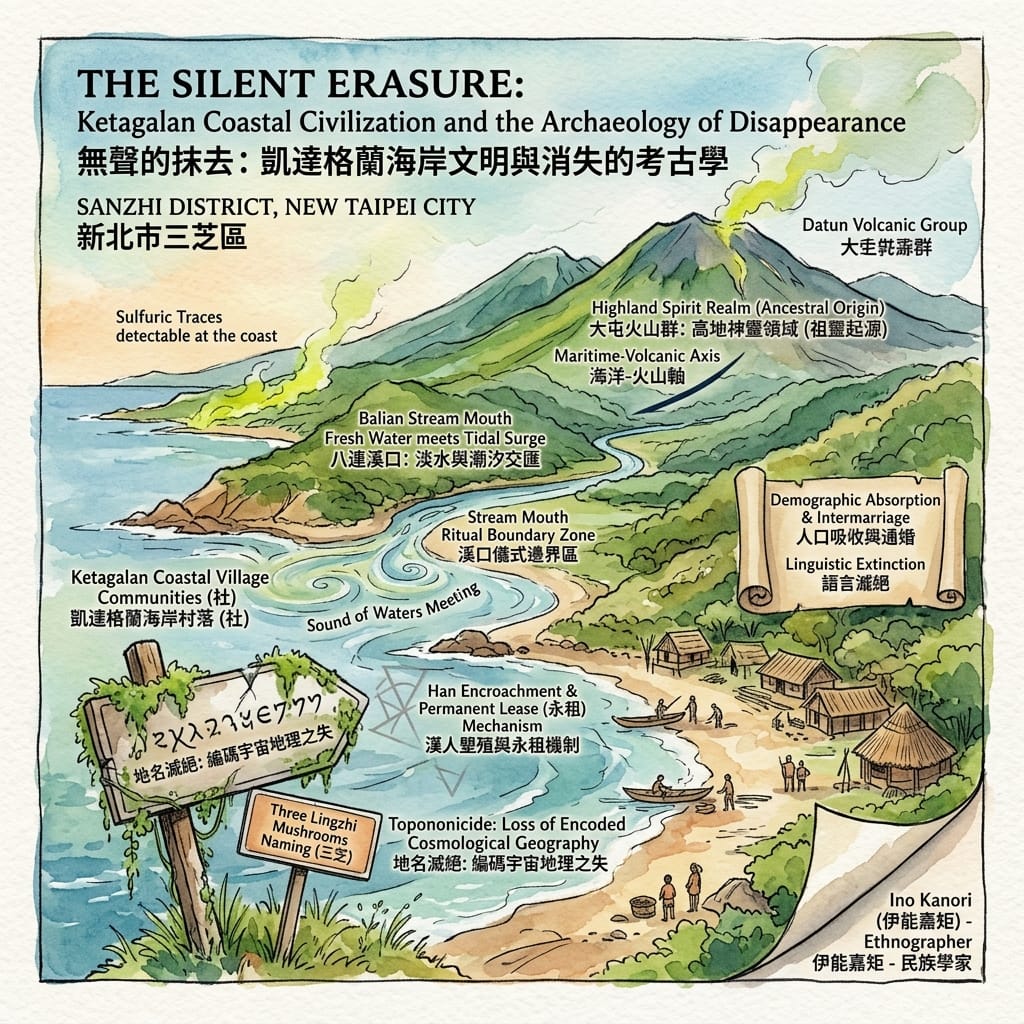
Before the Han Chinese ships came with their cargoes of settlers and seeds and deities, this coast belonged to the Ketagalan (凱達格蘭)—the Austronesian people who had inhabited northern Taiwan's coastal lowlands, in a network of semi-autonomous village communities, for somewhere between four and six thousand years. They fished the strait. They cultivated millet and taro on the coastal plain. They gathered sulphur from the Datun volcanic vents above and traded it with Chinese merchants who arrived by sea and left without settling.
Their understanding of the landscape they occupied was animist in its structure: specific rocks, river mouths, and coastal headlands were inhabited by territorial spirits; the volcanic massif at their back was a liminal zone where the human world thinned into something less negotiable. The sulphuric exhalations of the Datun vents—visible, pungent, physically present—constituted, for the communities below, direct evidence of an animate earth. The ground breathed. It had residents. Its features were not neutral geography but a cosmological map, each element holding its specific meaning.
They named everything accordingly. The names were not labels so much as knowledge: encoded records of which waters were dangerous, which sites carried spiritual weight, which approaches were not to be made without the right preparation. Those names are, now, almost entirely lost.
The process by which the Ketagalan disappeared from this landscape is—by the standards of colonial history—remarkably quiet. There were no deportations, no formal declarations, no single event that the archive records as catastrophic. The mechanism was structural: a system of land-leasing arrangements (yong zu, permanent lease) that transferred effective ownership of coastal farmland to Han settlers across the course of generations; intermarriage that produced children registered as Han Chinese in Qing administrative records; the displacement of Ketagalan language from every sphere of official life, until the language had no functional domain left. A language that cannot be used in courts, in commerce, in the recording of births and deaths, cannot sustain itself across generations. It does not, exactly, die. It runs out of reasons to be spoken.
The Quiet Erasure Of The Ketagalan
The Ketagalan language became extinct as a living tongue in the early twentieth century. The last speakers took its phonemes with them into the earth. What survived was very little: a handful of place names transcribed into Chinese characters with their meanings removed; Dutch colonial administrative records from the 1640s and 1650s that documented Ketagalan communities in the Danshui area; Japanese colonial ethnographic surveys that observed practices without, in most cases, recording the words. The name Sanzhi itself—three sacred mushrooms—is either a Han aesthetic choice or the acoustic residue of something that preceded it, and no one now can determine which.
No systematic archaeological survey of Ketagalan village sites within the present boundaries of Sanzhi District has been published. Their sacred geography has not been mapped. The volcanic soil of the Datun foothills may hold their physical record. It has not been read. This is not incidental. The absence is the archive's most significant statement.
This is the first manifestation of the pattern: a civilisation that accumulated for millennia, reached this coast, and dispersed into the Han immigration wave without leaving a completed record of what it had been.
II. The Ghost Economy: How a Fishing Shore Managed Its Dead
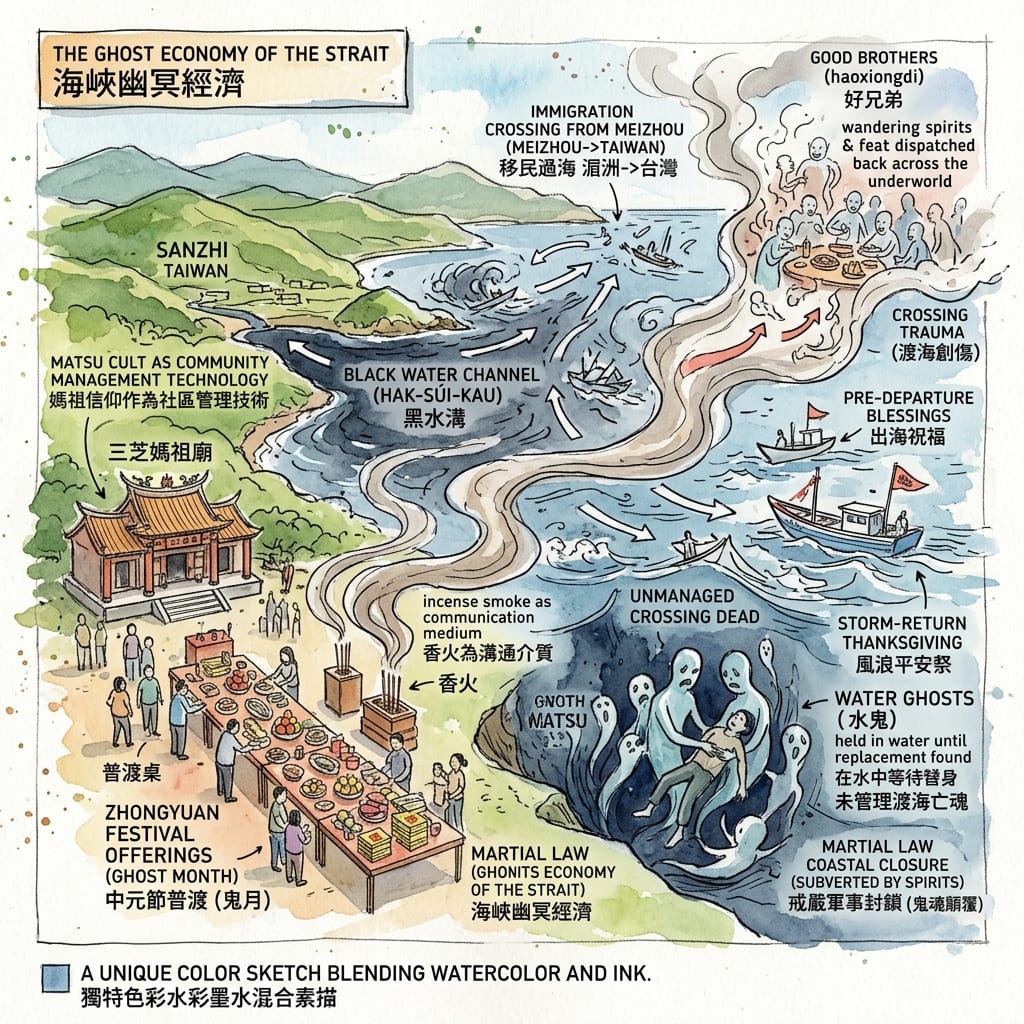
When the Han Chinese settlers arrived on what would become the Sanzhi coast—crossing the Black Water Channel from Fujian, dying in numbers that were never counted—they brought with them a complete cosmological management system for the specific problem of maritime death. Its centre was a goddess.
Mazu (媽祖) is the patron of seafarers throughout the Chinese maritime world. Her cult originated on Meizhou Island in Fujian Province—a point on the mainland coast that lies, from Sanzhi's shore, roughly on the bearing of the Taiwan Strait. Every Mazu temple on Taiwan's northern coast faces, across the water, toward this origin: a fixed orientation in stone and timber and gold paint that preserves, in architectural form, the memory of the crossing. The temple does not merely face the sea. It faces where the sea came from—the community's point of departure, encoded in the direction of prayer.
The crossing was genuinely dangerous. The Black Water Channel carries complex currents and ferocious winter seas, and the boats that traversed it in the seventeenth and eighteenth centuries were small. The toll was real: embedded in the coastal folk record by the saying six die, three stay, one turns back. Every community that settled on this shore was, in some sense, a community of survivors—and the dead were cosmologically present in ways that demanded active management rather than passive mourning.
In the folk cosmology that took root along this coast, those who drowned without recovery of their bodies became shui gui (水鬼), water ghosts: spirits anchored to the site of their death, unable to proceed to the afterlife until a replacement drowning victim freed them. This metaphysics, which reads in English like the logic of a ghost story, functions in its actual cultural context as something more practical: a system for encoding dangerous knowledge—about specific currents, specific depths, specific stretches of water where the sea had already taken people—in a form that survived translation across generations. The spot where someone drowned acquired a cosmological status that kept subsequent generations away from it. Theology as safety infrastructure. The spirit world as a map of hazards.
How Water Ghosts Map Deadly Oceans
The Mazu temple was the institution that held this system together: arranging pre-departure blessings for fishermen, organising storm-return thanksgiving rites, and—crucially—managing the annual Ghost Month ceremonies of the seventh lunar month (Zhongyuan Pudu, 中元普渡), when the gates of the afterlife were understood to open and the accumulated dead of the Black Water Channel—the drowned immigrants, the lost fishermen, the shui gui still waiting at their drowning sites—returned to the living shore for their annual meal. Food was set on tables before the temple, toward the sea. Incense smoke was understood as a medium of transmission, carrying the community's acknowledgement across the water to those who could no longer arrive in person.
During the martial law years (1949–1987), these ceremonies continued in a context that gave them an additional, unspoken dimension. The living were regulated: coastal access controlled, fishing curfews enforced, the beach a military zone requiring permits. The Taiwan Strait was, legally, a forbidden frontier. And yet the cosmological calendar—indifferent to military orders—required that the dead make their annual transit from the mainland side of the strait to the Taiwan side. The dead crossed freely in the space where the living were prohibited from crossing. The incense smoke rose from the shore, moved over the barbed wire, and crossed the water. No one had jurisdiction over it.
Holographic Sensory Cue: Seventh lunar month, Sanzhi coastal temple, late afternoon. The offshore wind carries salt and the compound smell of incense smoke—sandalwood and aged resin—that accumulates in temple walls over generations and becomes, eventually, indistinguishable from the stone itself. Paper offerings burn in a large iron cauldron near the temple gate; the smoke rises, bends in the sea wind, moves laterally across the courtyard, then lifts over the perimeter wall toward the strait. The food on the offering tables has been warm but is cooling. The sound of sutra recitation from inside the main hall is low and rhythmic, nearly geological in its repetition. Further out, the Taiwan Strait is silver and entirely flat, the way it goes when the wind drops at dusk. There is a quality of attention to the light that is difficult to name—as though the atmosphere has become temporarily permeable, as though the boundary between what is present and what is absent has thinned. Somewhere behind the chanting, the Pacific swell against the coast: steady, continuous, uninterested in the occasion.
III. The Pod Houses: A Modernist Ruin and Its Geomantic Reading
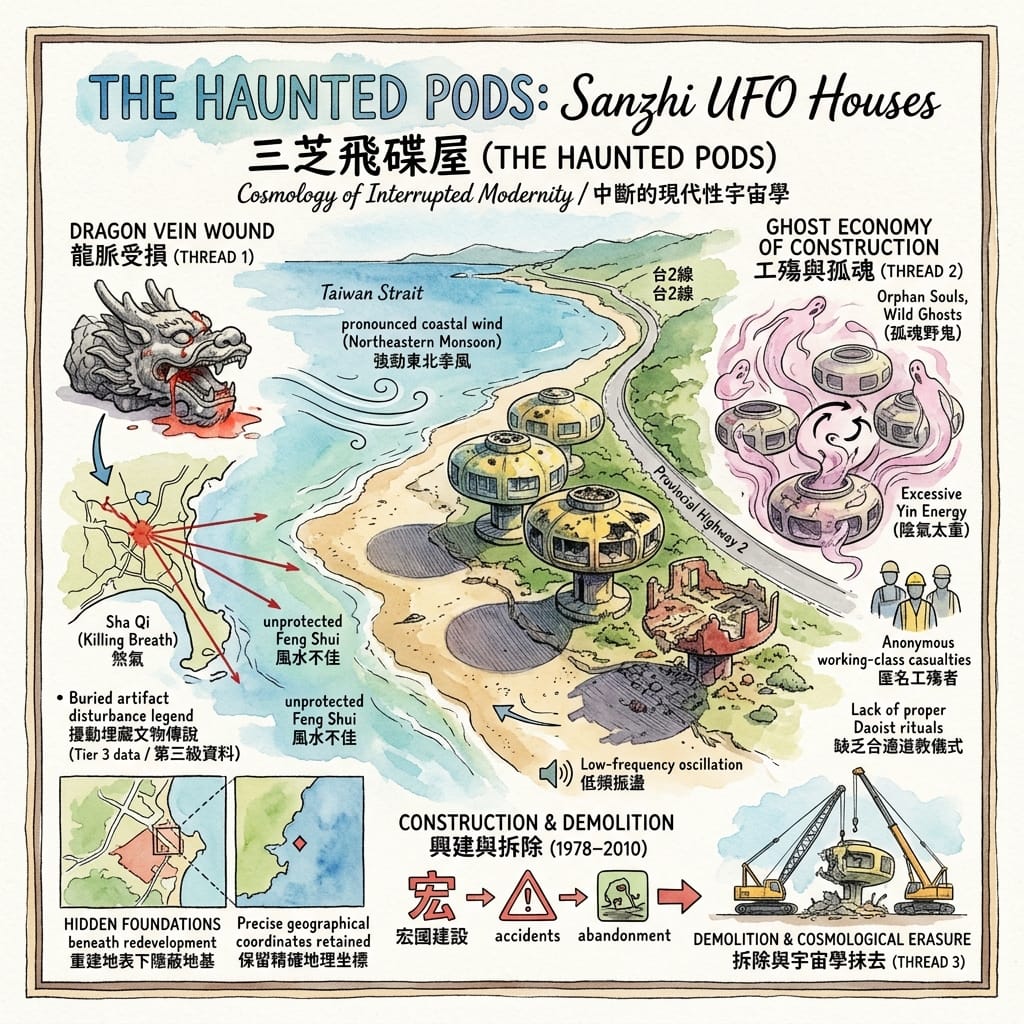
There are photographs—taken throughout the 1990s and early 2000s, by photographers who made pilgrimages to a coastal district that had no other reason to draw them—that show what used to stand here: circular, pod-shaped holiday homes elevated on pillar foundations above the Sanzhi coastline, their curved walls streaked with salt residue and monsoon rain, their porthole windows acquiring, over twenty-eight years of abandonment, the specific vacancy that a space develops when its intended purpose has been withdrawn from it. The structures had been visited by thousands of people who came to photograph them. They had been occupied by none.
The Hung Kuo Group (宏國集團) began construction in 1978, in the economic confidence of Taiwan's rapid-growth years. The design—futuristic, emphatically international in its references, speaking the architectural language of the 1960s and 1970s space-race optimism—was intended as a coastal resort for Taiwan's growing middle class: holiday homes that would look like nothing else on the north Taiwan coast, that would represent, in built form, the island's arrival at a certain kind of modernity. The pods were never occupied. Construction stopped in 1980—financial losses, the company said—and the structures stood in varying states of incompletion until they were demolished, in two phases, around 2008 to 2010.
What the company cited and what the community remembered are not quite the same thing.
The oral tradition that accumulated around the site during those twenty-eight years of abandonment converged on an incident during the original excavation: construction machinery had, in accounts that spread through the district and eventually through Taiwan's wider register of cautionary stories, struck and destroyed a carved stone dragon's head buried in the coastal terrain. A dragon's head—in the feng shui spatial tradition native to this part of the world—is not decorative. It is the focal point of the long mai, the dragon vein: the site in the landscape where the earth's vital energy concentrates before moving on. To damage it is to sever the flow—to convert the living breath (sheng qi) of the site into its opposite, killing breath (sha qi). Workers died during construction. The project failed. The explanation offered was geomantic.
The Cursed Ufos Of Sanzhi
Whether this happened in any verifiable sense is unknown. The oral tradition should be treated—as the research dossier underlying this essay explicitly flags—as cultural-interpretive material, not documented fact. No archive has confirmed the dragon's head. But the existence of the story, and the speed with which it spread, is itself analytically important: here was a community reaching for its native cosmological vocabulary to account for something that the official vocabulary of market conditions and cash-flow problems could not quite explain. The two vocabularies were operating simultaneously, in the same community, on the same events. Only one of them made it into the financial records.
What the feng shui tradition can observe without recourse to the buried-dragon narrative is this: the pod structures, elevated above the ground plane on pillar foundations, had no ground relationship. They floated above the volcanic coastal terrain rather than being embedded in it. They offered no shelter from the northeast monsoon—no courtyard, no windbreak, no flanking walls, none of the spatial devices by which coastal vernacular architecture in this region has always mediated between the human interior and the wind off the strait. They confronted the Black Water Channel directly, from an elevated and entirely exposed position, with the circular openness of structures designed for a temperate climate where open-sea exposure was a selling point rather than a structural problem. In the terms of the tradition in question, they had no huan bao—no embrace, no encircling shelter—at all. They were all opening and no hold.
The demolition, when it came, left no record of any ritual for the workers who had died on site during those two years of construction. Whether the spirits the local tradition associated with the abandoned buildings were ever formally acknowledged and released is not known. The question is not trivial, in the cosmological accounting of coastal Taiwan. Unacknowledged dead at a site of building become gu hun ye gui—orphan souls, wild ghosts—bound to the location of their dying until a ritual of acknowledgement frees them. The demolition machinery came and went. The coast holds that question open.
IV. The Militarised Shore: A Bunker as a Document
Resonance Node: Abandoned Coastal Pillboxes, Sanzhi North Shore
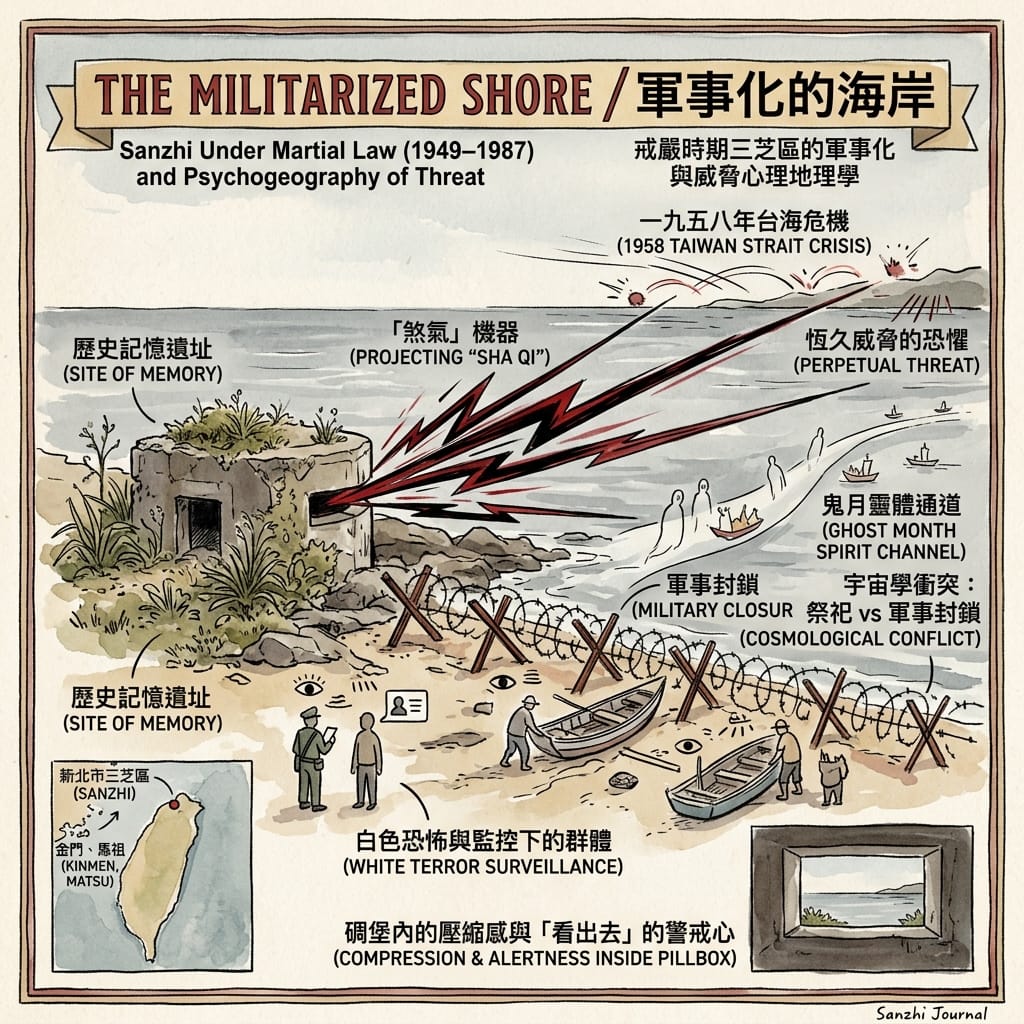
Drive slowly along the coast road and at some point, in the roadside vegetation, you will see it: a concrete hemisphere, approximately the height of a standing adult, its firing aperture facing north toward the Taiwan Strait. There is no explanatory plaque. There is no information board. The structure belongs, in the official landscape of contemporary Taiwan, to no category that demands acknowledgement. It is simply present, facing the sea that it was built to watch, still watching it.
When the Republic of China government completed its retreat to Taiwan in December 1949, the martial law it declared lasted thirty-eight years—one of the longest in the documented history of modern states. For the fishing communities of Sanzhi, living on a coast that faced directly toward Fujian Province across the Black Water Channel, this translated immediately into material constraint: fishing boats required registration and curfews; access to the beach was regulated; the sand was strung with barbed wire and the hillsides above the coast grew concrete emplacements, their apertures facing north.
This is the part of Sanzhi's history that belongs most clearly to what memory scholars and geographers call secular trauma geography—the reading of physical remnants as testimony that official archives rarely replicate, and sometimes actively suppress. The military records for the specific Sanzhi installations remain largely classified. The civilian experience of those thirty-eight years—the fishing family who could not approach their own beach after dark; the community whose annual cosmological obligations toward the dead of the strait continued while the sea was simultaneously a military exclusion zone—is held in the memories of people now in their seventies and eighties, in oral histories that have not been systematically collected. The archive here is incomplete not by accident but by design.
The Accidental Spiritual Weapon
What remains, materially, are the pillboxes.
The French historian Pierre Nora coined the phrase lieux de mémoire—sites of memory—to describe places that hold historical experience which the official record has failed or chosen not to preserve: sites where the past continues to reside not because anyone has decided to maintain it but because the material form persists. The Sanzhi coastal pillboxes are lieux de mémoire of a specific kind—memory that the state has never commemorated, that official tourism has never acknowledged, that the landscape simply continues to hold because concrete is durable and no one has decided to remove it.
To stand inside one of these structures—the smell of salt water and old concrete, the firing aperture framing a slot of grey strait, the sound of the monsoon filtered through reinforced walls to its lowest frequencies—is to inhabit a particular historical consciousness: the consciousness of threat defined and maintained for thirty-eight years, that shaped the daily life of everyone on this coast and ended not with an invasion repelled but simply with the passage of time and a political decision to stand down. The threat never came. The apparatus built to meet it persists in the grass by the road, still facing north, still watching a crossing that was never attempted.
The White Terror (白色恐怖) that accompanied the martial law period—the political arrests, military tribunals, and executions that removed an estimated 140,000 to 200,000 people from Taiwanese civil society across four decades—left no monument on this coast. The pillboxes do not carry it. They carry only their apertures and their silence.
V. Lee Teng-hui: What the Volcanic Soil Produced
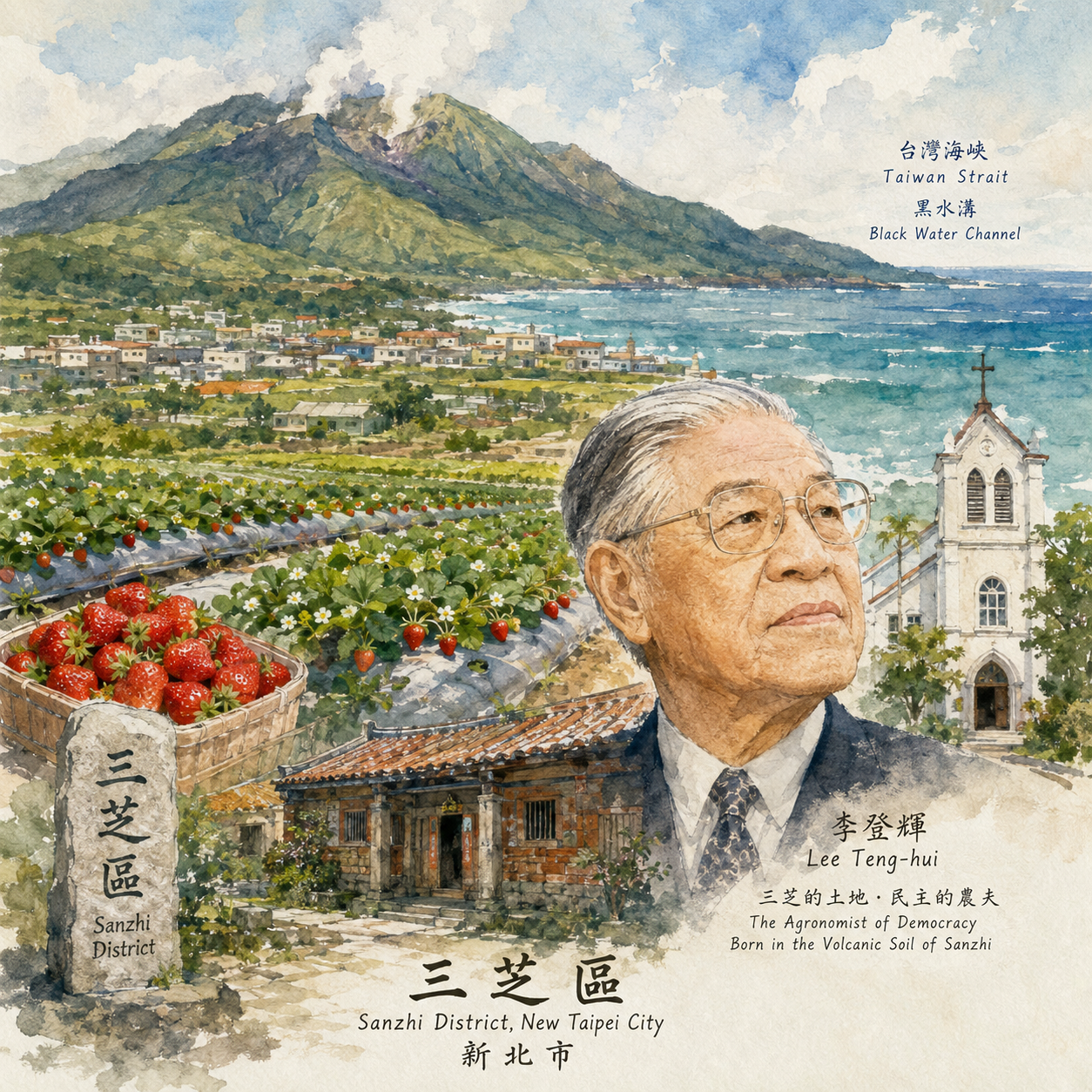
On January 15, 1923, in the Japanese colonial administrative unit of Sanzhi Township, a child was born to a Taiwanese family with generational roots in the northern coastal district. He was registered in colonial records as Iwasato Masao. History would remember him as Lee Teng-hui (李登輝).
The biographical fact of his birthplace appears in most accounts of his political career as a minor detail: placed in the opening paragraph, noted, and set aside. This essay wants to argue for it as something more structural.
Lee Teng-hui grew up on a stretch of coast that was simultaneously and without resolution several things at once: Japanese colonial territory (he was an imperial subject, expected to perform Japanese identity); ethnically Taiwanese Han (of the category the Japanese called Taiwanese bensheng ren—native Taiwanese—who would face systematic political marginalisation under the KMT government that replaced Japanese administration in 1945); and geographically positioned at the exact maritime boundary separating Taiwan from the mainland China toward which the KMT maintained, throughout his adult life, that it intended to return. He was formed, from childhood, in a landscape of irresolution. His formation was the landscape's formation.
His educational trajectory followed the full colonial sequence: local schooling in the Sanzhi and Danshui area; higher school in Taipei; Kyoto Imperial University for agricultural chemistry; a brief conscription into the Imperial Japanese Army near the war's end; then, after the identity rupture of 1945—when every person in Taiwan was required to become, overnight, something they had not been—National Taiwan University, and eventually Cornell University, where he received a doctorate in Agricultural Economics in 1968. It is worth noting that he chose, when he finally had the choice, to study the economics of the soil that had grown him: the volcanic farmland of northern Taiwan, whose red-orange earth he had walked from early childhood.
The Agronomist Who Hacked A Dictatorship
He entered politics as a technocrat and climbed through the KMT's hierarchy in the way a bensheng ren could climb through a waishengren-dominated system: slowly, through demonstrated competence, with the kind of patience that is also a form of strategic restraint. Mayor of Taipei (1978–1981). Governor of Taiwan Province (1981–1984). Vice President (1984–1988). When Chiang Ching-kuo died on January 13, 1988, Lee Teng-hui became president of the Republic of China—the first native Taiwanese to hold the office.
What followed was one of the faster and less violent democratic transitions of the twentieth century's final decade. Between 1990 and 1996, Lee dismantled the legal infrastructure of authoritarian rule: the Temporary Provisions that had kept Taiwan under formal emergency since 1948 were repealed; the legislature was opened to full competitive elections; and in March 1996, Taiwan held its first direct presidential election. The People's Republic of China responded by conducting ballistic missile tests in the Taiwan Strait—a transparent intimidation campaign. Lee Teng-hui won 54 percent of the vote. The boy from the volcanic coast facing the Black Water Channel grew up to answer missiles with ballots.
The geomantic tradition has a concept—ren di xiang ying, person-place correspondence—through which the character of a landscape is understood to shape, in deep structural ways, the character of those formed within it. Sanzhi's landscape, as this essay has established, is one in which enormous forces flow to the coast and then disperse, unable to accumulate, unable to consolidate, sent into the channel by the same geomantic conditions that prevent the dragon vein from forming its pool. Lee Teng-hui spent his political life generating democratic force and bringing it precisely to this threshold: the Taiwan Strait, which has absorbed it without resolution. The democracy he built is, in terms of formal international recognition, among the least acknowledged genuine democracies on earth. The force arrived at the shoreline. The channel remains, as it has always been, very wide.
This is the fifth manifestation of the pattern. Still in motion.
High-Dimensional Reading: Dragon Veins, Spirit Tides, and the Geomantic Logic of Sanzhi
Reading through the cosmological framework native to this location — Taiwanese Han coastal folk religion, geomantic spatial analysis
The cosmological tradition this essay has drawn on throughout—the Taiwanese Han folk religion that integrates feng shui spatial analysis, Mazu maritime theology, and the ghost cosmology of the shui gui and the Ghost Month—is not an exotic overlay. It is the primary interpretive framework through which the communities living on this coast have actually understood their relationship to the place, the sea, and the dead, across three centuries of continuous practice. To analyse Sanzhi through this tradition is not to impose a foreign vocabulary. It is to read the location in the language it has always used to read itself.
The Datun volcanic group that anchors Sanzhi's southern horizon is, in geomantic analysis, a significant source of sheng qi for the northwestern Taiwan coastal zone: the earth's vital energy, generated by continuing volcanic activity below the surface and moving through the landscape along dragon veins. This energy flows northward toward the coast. At Sanzhi, it meets the Taiwan Strait without the protecting arms of flanking terrain that would, in the ideal geomantic configuration, allow it to pool and accumulate in a sheltered node. Instead it disperses into the channel. The site is a conduit rather than a container—a place through which enormous flows of energy pass, rather than a place where they rest.
In the Mazu cult's cosmological geography, the Taiwan Strait is not a neutral body of water. It is the passage between the world of the living and the world of the dead: the corridor through which the spirits of the drowned return, in the seventh lunar month, to the shore. Every fishing community on this coast has managed, for three centuries, the traffic of that passage—receiving the dead, feeding them, releasing them, maintaining the cosmological infrastructure that allowed the living to coexist with the weight of their community's accumulated losses. The strait is not outside the social world. It is the membrane through which the social world communicates with what lies beyond it. Sanzhi faces this membrane directly, without shelter, its temples oriented toward the crossing.
Taken together, these two readings produce a portrait of a site that is perpetually receiving—receiving energy from the volcanic massif, receiving dead from the strait, receiving the force of every historical current that arrives at its shore—and perpetually unable to hold what it receives. The Ketagalan language reaches this coast and disperses into the Han immigration current. The crossing immigrants arrive and their dead require three centuries of annual propitiation. The pod houses are built and cannot stand in the unmediated wind. The military apparatus is established and never tested in the purpose for which it was built. The democratic transformation is accomplished and arrives at a geopolitical threshold that remains uncrossed.
This is the Dragon Vein Into-Sea Syndrome: the governing condition of Sanzhi, and the most precise spatial metaphor available for Taiwan's historical condition. A polity that has repeatedly generated transformative force, brought it to the shoreline, and found the channel—geopolitical, diplomatic, historical—too wide and too current-riven to carry the force across to a completed form.
The Mazu cult holds one note of what might be called theological patience. Her role is not simply to prevent drowning but to manage those who have already drowned—to receive the spirits that did not complete the crossing, to give them form and acknowledgement and the annual return, to hold them in the cosmological structure until the conditions that would release them finally arrive. The temple is not a monument to successful crossings. It is an institution for the care of crossings that are still in progress.
Sanzhi is that institution, written in volcanic rock and salt-stained concrete, facing the strait.
Conclusion: The Water Ghost Seeks Its Form
There is a phrase in Taiwanese coastal folk cosmology—shui gui zhao ti, the water ghost seeks its replacement—that describes the condition of a drowned spirit waiting to be released: present at the site of its death, unable to complete the passage to whatever comes next, not malevolent but urgent, waiting for the form of acknowledgement that would free it.
It is possible to read Taiwan's condition in these terms and have the reading be more than metaphor. The democracy is real. The society is plural and free and has a clear sense of what it is. The culture is distinct and the people have made their historical argument for recognition in every way available to them. And yet the formal acknowledgement that would allow all of this to consolidate—to cross from the world of the disputed to the world of the received—remains on the other side of a channel that is, in the current configuration of global politics, effectively uncrossable.
The dragon vein reaches the shore. The water ghost waits at its site of drowning.
What Sanzhi offers the traveller who will stop and read it—who will stand in the coastal wind and understand that the farmland behind them is volcanic, that the temples facing the sea are managing a three-century debt to the drowned, that the concrete in the roadside grass is the residue of thirty-eight years of enforced fear, that the soil underfoot is the soil of a democratic president's childhood—is a compression of the whole Taiwanese historical experience into a strip of coastline the length of an afternoon's walk.
This is what places like Sanzhi are for. Not the comfortable satisfaction of history that knows how it ends—the preserved monument, the decisive battle, the site where something was finally completed—but the more difficult and more honest record of history still in motion: the languages that went to sea, the utopias that stalled before their opening, the democracies that are real but not yet received. The forces that arrived at the shore and dispersed, not because they failed but because the channel in front of them was deeper than anything they had been prepared for.
The historical memory of a place is its most durable form of energy. Not the energy of completion—not the memorial, the archive, the signed treaty—but the energy of persistence: the water ghost that has not yet found its replacement, the dragon vein whose dispersal has not yet found its pool. These are not failures. They are the live record of forces still in motion, still seeking the landscape feature that would finally allow them to hold.
Sanzhi is that record, facing out across the Taiwan Strait toward whatever comes next.
If this essay has opened something—a way of reading a coastal district as historical document, a way of hearing in a winter wind a frequency that belongs to a longer story—we send one of these essays, about one overlooked place, each month. No algorithms, no aggregators. Just the places nobody stops at, and what they have been holding.
→ Subscribe to Historical Travel Stories
Accessing the Physical Node
Location: Sanzhi District (三芝區), New Taipei City, Taiwan. Northwestern tip of Taiwan's main island, 35 kilometres from central Taipei, west of Danshui on the provincial coastal highway.
Getting There
- By public transport: From Danshui MRT Station—the northern terminus of Taipei Metro's red line—the Taiwan Hao Xing (台灣好行) north coast bus service runs through Sanzhi. Journey time approximately 40 minutes; services are infrequent, and schedules should be confirmed in advance.
- By car or motorcycle: Provincial Highway 2 (台2線), the north coast road, runs directly through Sanzhi and is the recommended approach. The road reveals the layered historical landscape continuously: volcanic hills, coastal farmland, temple compounds, the periodic concrete pillboxes in the roadside vegetation. A motorcycle allows the most useful stopping flexibility. Allow 30–40 minutes from Danshui for the drive; considerably more if you stop.
- By taxi: Available from Danshui. Arrange a waiting time or return trip in advance; drivers unfamiliar with the north coast may not know specific sites.
When to Go
- Winter (November–February): The northeast monsoon is at full force. The Taiwan Strait is grey and wide and insistent. The volcanic ridgeline appears and disappears in low cloud. This is Sanzhi in the atmospheric register of its dominant historical experience; what you feel in the wind is the same thing every community on this coast has felt for three hundred years. Bring a wind-proof layer.
- Strawberry season (December–February): Sanzhi's volcanic soil—the red-orange, iron-rich earth of the Datun foothills—is most visible in the low-lying strawberry cultivation of the winter growing season. The agricultural landscape offers the closest sensory access to the terrain that formed Lee Teng-hui, and to the geological time-scale of which the human history is only the surface.
- Ghost Month (seventh lunar month, typically mid-July to mid-August): For direct encounter with the Mazu cult cosmology and the water ghost traditions discussed in this essay, the Zhongyuan Pudu ceremonies at Sanzhi's coastal temples are the most living form of what this essay describes. Contact temples in advance; ceremony dates vary by institution.
Nodes to Seek
| Node | Historical Layer | How to Find It |
|---|---|---|
| Coastal pillboxes (碉堡) | Martial law / White Terror (1949–1987); secular trauma geography | No markers. Drive the coast road slowly; look for concrete forms half-concealed in roadside vegetation, firing apertures facing north. The absence of signage is itself part of what you are reading. |
| Sanzhi coastal Mazu temples | Maritime ghost economy; immigration trauma; Zhongyuan Pudu ritual | Ask locally; any fishing community temple will have relevant history. Most temples hold written gazetteers (miao zhi) inside—founding records, deity lineages, ritual histories—which are usually accessible to respectful visitors. |
| Datun volcanic foothill farmland | Ketagalan landscape cosmology; Lee Teng-hui's formation; dragon vein source | The red-orange volcanic soil is most visible where cultivation is active. There are no markers indicating Ketagalan sacred sites—the absence of such markers is the primary historical document. |
| Former pod house site (north shore) | Modernist ruin; feng shui failure; unresolved ghost question | The structures are gone. Stand where they stood: the unmediated coastal exposure, the specific pressure of the monsoon at that point, the view toward the strait—these are the sensory record of why the buildings failed, and why the photographs of them were so compelling. |
| Any roadside stop, Provincial Highway 2 | Dragon Vein Into-Sea Syndrome; Sanzhi as a document of forces in transit | Stop. Face north. Let the wind make its case. |
Where to Stay
- Danshui (Tamsui): The most practical base—full accommodation options, direct road and bus access to Sanzhi. Danshui itself carries substantial historical layering (Fort San Domingo, the Tamsui River mouth, the nineteenth-century missionary buildings) that extends the historical reading begun at Sanzhi into a broader north coast itinerary.
- North coast rural guesthouses (民宿): Small guesthouses in the Sanzhi, Shimen, or Jinshan areas place you within the landscape rather than adjacent to it. Some are positioned on the volcanic hillside with views of the strait. These offer the closest sensory proximity to the geography this essay describes, and—in winter—the least mediated encounter with the northwest monsoon.
Further Reading
- Lee Teng-hui, The Road to Democracy: Taiwan's Pursuit of Identity (various editions)
- Andrade, Tonio, How Taiwan Became Chinese: Dutch, Spanish, and Han Colonization in the Seventeenth Century (Columbia University Press, 2008)
- Shepherd, John R., Statecraft and Political Economy on the Taiwan Frontier, 1600–1800 (Stanford University Press, 1993)
- Kerr, George H., Formosa Betrayed (Houghton Mifflin, 1965) — a contemporary Western account of the 1945–1949 transition and the beginning of the martial law period
- Macfarlane, Robert, Underland: A Deep Time Journey (Hamish Hamilton, 2019) — for the psychogeographic method this essay employs; Landmarks (Penguin, 2015) for the relationship between landscape language and landscape knowledge
🔍 Geospatial History & Urban Legend Dossier (FAQ)
To demystify the enduring urban legends and supernatural rumors surrounding the Sanzhi UFO Village (San-Zhi Pod City), we cross-referenced local geospatial data, archival historical records, and cultural folklore to reveal the true history behind Taiwan's most famous abandoned ruin:
Q1: Why was the Sanzhi UFO Village abandoned, and is it really haunted by fatal accident victims?
A1:
The Sanzhi UFO Village was abandoned due to economic and material engineering factors, not supernatural curses. Construction began in 1978 as a luxury seaside resort featuring futuristic fiberglass-reinforced plastic (FRP) pods. However, the project was crippled by the 1980s global oil crisis, which drove developer Amanda Town into bankruptcy. Furthermore, the harsh coastal salt air rapidly degraded the experimental FRP materials, making maintenance costs unviable. Sensational tales of fatal worker suicides, frequent car crashes, and cursed grounds were unverified urban legends popularized in the 2000s by international urban exploration (urbex) blogs.
Q2: Did destroying the dragon statue at the Sanzhi UFO Village entrance bring a Feng Shui curse upon the resort?
A2:
Local rumors allege that cutting the green dragon gate at the entrance damaged the area’s Feng Shui "dragon vein," triggering supernatural misfortune. Historical civil engineering records clarify that the concrete dragon was simply a 1970s commercial entry attraction. During the 1980s, Taiwan’s Highway Bureau partially dismantled the statue during the expansion of Provincial Highway 2 (Danjin Highway) because part of the structure encroached on public land. Because this routine infrastructure expansion coincided with the developer's financial demise, popular folklore overlaid traditional spiritual beliefs onto municipal engineering, giving rise to the dragon curse myth.
Q3: Was the Sanzhi UFO Village built over a WWII Japanese execution camp or a 17th-century Dutch battlefield?
A3:
Many ghost tourism articles claim the resort was haunted because it was constructed over a WWII Japanese POW execution camp or a Dutch colonial battlefield. However, Qing Dynasty historical texts (Tamsui Subprefecture Gazetteer), Japanese colonial military cartography, and Allied WWII surveys confirm that the area was historically an indigenous Basay (Ketagalan) fishing settlement and coastal dune terrain, with no record of war camps or mass executions. This narrative is a classic urban legend mechanism: filling the void of an unfamiliar historical site by projecting historic collective trauma onto unusual, abandoned architecture.
Reference and Further reading
First layer – Main sources of literature and institutions:
- Nationaal Archief, Den Haag: VOC administrative and census records for northern Taiwan (1624–1662)
- 國立臺灣大學圖書館: 臺灣總督府公文類纂 (Taiwan Governor-General's Office Archive)
- 國史館臺灣文獻館 (Taiwan Historica, Nantou): Primary holder of Qing and Japanese colonial records
- 新北市政府都市發展局 (New Taipei City Urban Development Department): Planning and demolition approval documents for the Sanzhi coastal parcel
- 聯合報 (United Daily News) archive, 1978–1980 and 2007–2010: Contemporary reporting on construction commencement, abandonment, demolition announcement
- 中國時報 (China Times) archive, same periods
- 地政事務所 (Land Registry Office, Sanzhi): Land parcel records for the coastal site
- 行政院勞工委員會 (Council of Labor Affairs): Labor safety incident reports, 1978–1980 (建議查證是否公開)
- 三芝區戶政事務所 (Sanzhi Household Registration Office): Birth records for 大正12年 (1923) — Japanese-era registration
- 臺灣總督府檔案 (Taiwan Governor-General Archive): Administrative records for 三芝庄
- 國史館 (Academia Historica, Xindian): Presidential archives for Lee Teng-hui's administration (1988–2000)
- 國防部史政編譯室 (Ministry of National Defense History and Translation Office): Military records for northern coastal defense installations — largely still classified (建議申請解密查閱)
- 國家人權博物館 (National Human Rights Museum, Jing-Mei White Terror Memorial Park): Holds records of White Terror political cases; Sanzhi-district specific cases require targeted research
- 三芝區主要廟宇廟誌 (Temple gazetteers of primary Sanzhi temples): Most Taiwanese temples maintain written records of founding history, deity lineage, and major ritual events — direct access required
- 新北市政府民政局宗教輔導科 (New Taipei City Civil Affairs Bureau, Religion Management Section): Registration records for Sanzhi-area temples
The second layer – secondary academic materials:
- 伊能嘉矩,《台灣文化志》(臺北:南天書局, 1994重印版) — primary Japanese-era ethnographic survey of Ketagalan
- 翁佳音,〈被遺忘的台灣原住民史:Quata(大肚番王)初探〉,《台灣風物》44卷3期 (1994)
- Shepherd, John R., Statecraft and Political Economy on the Taiwan Frontier, 1600–1800 (Stanford University Press, 1993)
- Andrade, Tonio, How Taiwan Became Chinese: Dutch, Spanish, and Han Colonization in the Seventeenth Century (Columbia University Press, 2008)
- 中村孝志,〈荷蘭時代台灣南部之鄉社與戶口〉,《台灣風物》44卷4期 (1994) — methodology applicable to northern Taiwan records
- Peer-reviewed academic literature specifically on the Sanzhi UFO houses is presently thin; the primary scholarly treatment has been through architectural history, ruin studies, and urban cultural geography. Specific peer-reviewed publications require verification. (建議進一步查證原始檔案: 臺灣建築史相關學術期刊.)
- 李登輝,《台灣的主張》(臺北:遠流, 1999)
- 李登輝,《見證台灣:蔣經國總統與我》(臺北:允晨, 2004)
- 若林正丈,《台灣:分裂國家與民主化》(東京:東京大學出版会, 1992) — significant Japanese-language scholarly analysis
- Rigger, Shelley, From Opposition to Power: Taiwan's Democratic Progressive Party (Lynne Rienner, 2001)
- Lin, Hsiao-ting, Accidental State: Chiang Kai-shek, the United States, and the Making of Taiwan (Harvard University Press, 2016)
- 陳翠蓮,《台灣人的抵抗與認同 1920–1950》(臺北:遠流, 2008)
- 林孝庭 (Lin, Hsiao-ting), Accidental State: Chiang Kai-shek, the United States, and the Making of Taiwan (Harvard University Press, 2016)
- Kerr, George H., Formosa Betrayed (Boston: Houghton Mifflin, 1965) — contemporary documentary account of the 2-28 period and its aftermath
- 林美容,〈媽祖信仰與台灣社會〉,《中央研究院民族學研究所集刊》(Academia Sinica) — primary scholarly source on Matsu cult social sociology
- 丸井圭治郎,《台灣宗教調查報告書》(臺北:臺灣總督府, 1919) — Japanese colonial religious survey; primary source
- Watson, James L., and Rawski, Evelyn S. (eds.), Death Ritual in Late Imperial and Modern China (University of California Press, 1988) — contextual framework for ghost cosmology analysis
- Weller, Robert P., work on ghost appeasement and Taiwanese folk religion — specific titles to be verified (建議進一步查證學術目錄)
Third layer – Supplementary information:
- 凱達格蘭文化館 (Ketagalan Culture Center, Beitou): Contemporary community-reconstruction efforts and oral tradition compilations — treated as cultural-interpretive data
- PTT Bulletin Board (PTT鄉民論壇): Extensive online oral tradition archives regarding the site — treated as Tier 3 folk documentation
- International photographer archives: numerous documentary photographic records of the structures pre-demolition (useful for sensory reconstruction)
- Local Sanzhi community oral histories regarding the Lee family's presence in the district (建議進行田野調查)
- 台灣基督長老教會 (Presbyterian Church in Taiwan) institutional records regarding Lee Teng-hui's religious formation and baptism
- Oral histories of Sanzhi fishing community elders regarding maritime restrictions and daily life under martial law (建議進行田野調查: 新北市文史工作者訪談)
- Local temple oral histories and founding myths (建議聯繫三芝在地廟方田野調查)
- Community elder accounts of Ghost Month practice and adaptation during the martial law period
Historical gap:
- No systematic archaeological survey of Ketagalan village sites within Sanzhi district boundaries appears in the published literature
- Ketagalan sacred site geography for the Sanzhi sub-region is entirely undocumented
- The original Ketagalan toponym for the area now called 三芝 is unknown
- Post-absorption Ketagalan descendant community history in Sanzhi requires oral history collection
- Dutch-period documentation of Sanzhi-specific (as opposed to Danshui-area) Ketagalan villages is unconfirmed — archival investigation required
- The empirical basis of the dragon head artifact narrative is undocumented; requires archival and archaeological investigation
- Construction accident records (1978–1980) are not publicly available
- No documented evidence of ritual ceremonies performed before or during demolition
- The corporate decision-making record for the 1980 abandonment is not publicly available
- Post-demolition assessment of the site's cosmological status in community memory has not been conducted
- Sanzhi's community memory of Lee Teng-hui as a local figure (as distinct from national political symbol) is underexplored in the published literature
- The specific geomantic analysis of his birthplace in traditional terms has not been the subject of scholarly inquiry
- Lee Teng-hui's own statements about his relationship to Sanzhi as a physical and emotional origin point are scattered across interviews and memoirs but not systematically compiled
- Oral histories of Sanzhi fishing community elders regarding maritime restrictions and daily life under martial law (建議進行田野調查: 新北市文史工作者訪談)
- Founding dates and histories of Sanzhi's specific Matsu temples are not available in published secondary literature — direct temple archival access required
- The intersection of military coastal restrictions and Ghost Month ritual practice (1949–1987) is entirely undocumented
- Water ghost narratives specific to the Sanzhi coastline have not been systematically documented in available folklore literature
- The ritual response (if any) of local Daoist practitioners to the UFO house deaths and subsequent abandonment has not been documented
 Lawrence
 Lawrence
 Lawrence
 Lawrence
© Historical Travel Stories | Unraveling Strange Tales Across Dimensions and Time