The Last Legible Year: 5 Hidden Histories from Tokyo, 2016
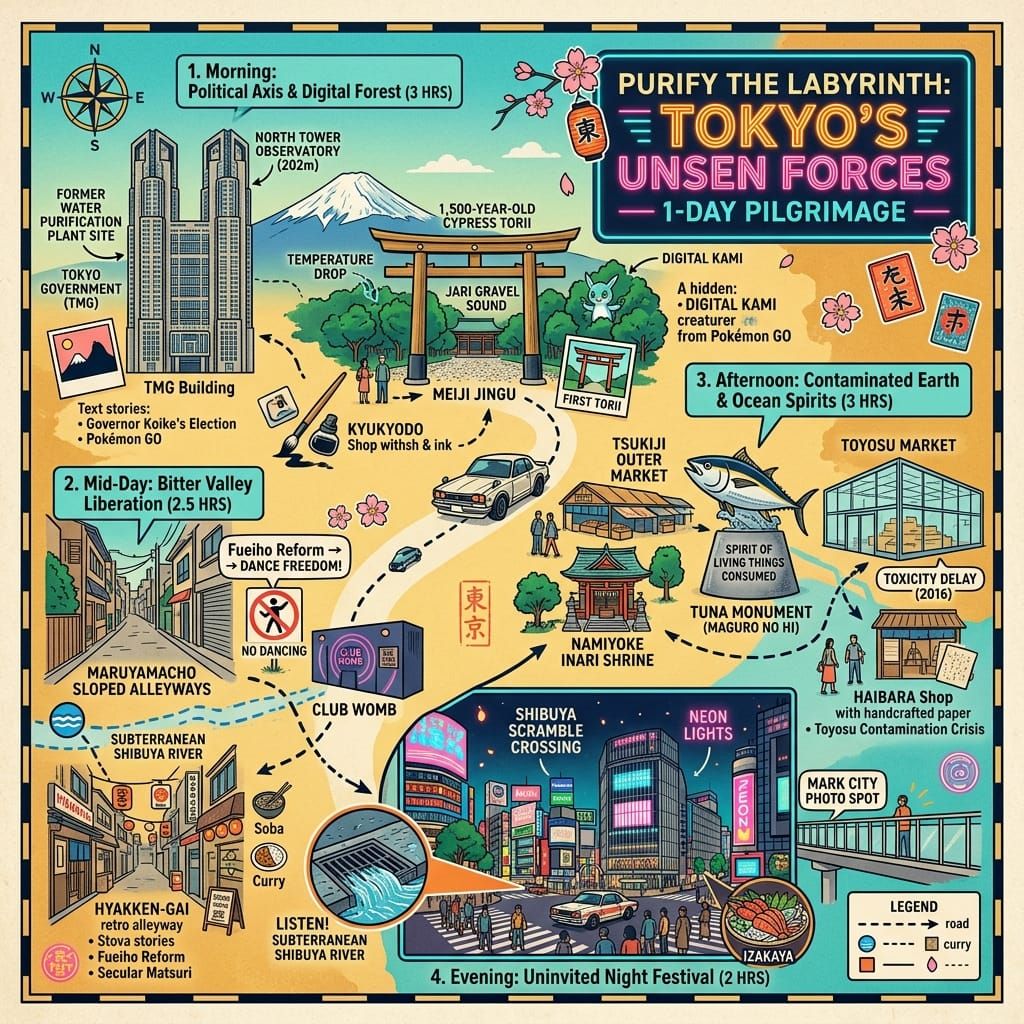
"2026 is the New 2016" Travel History Series — Tokyo: This historical travel guide explores Tokyo through the Shinto concepts of kegare (impurity) and harae (purification).

"2026 is the New 2016" Travel History Series — Tokyo
This is a historical travel story and walking guide to Tokyo through the lens of Shinto cosmology. By exploring key urban spaces like Shibuya Maruyamacho and Tsukiji, it uncovers five hidden stories from 2016 where the metropolis confronted defilement (kegare) and sought purification (harae). Readers will gain a deep, narrative perspective on Tokyo's sacred geography, legal shifts, and cultural transformations beyond standard travel guidebooks.
 Lawrence
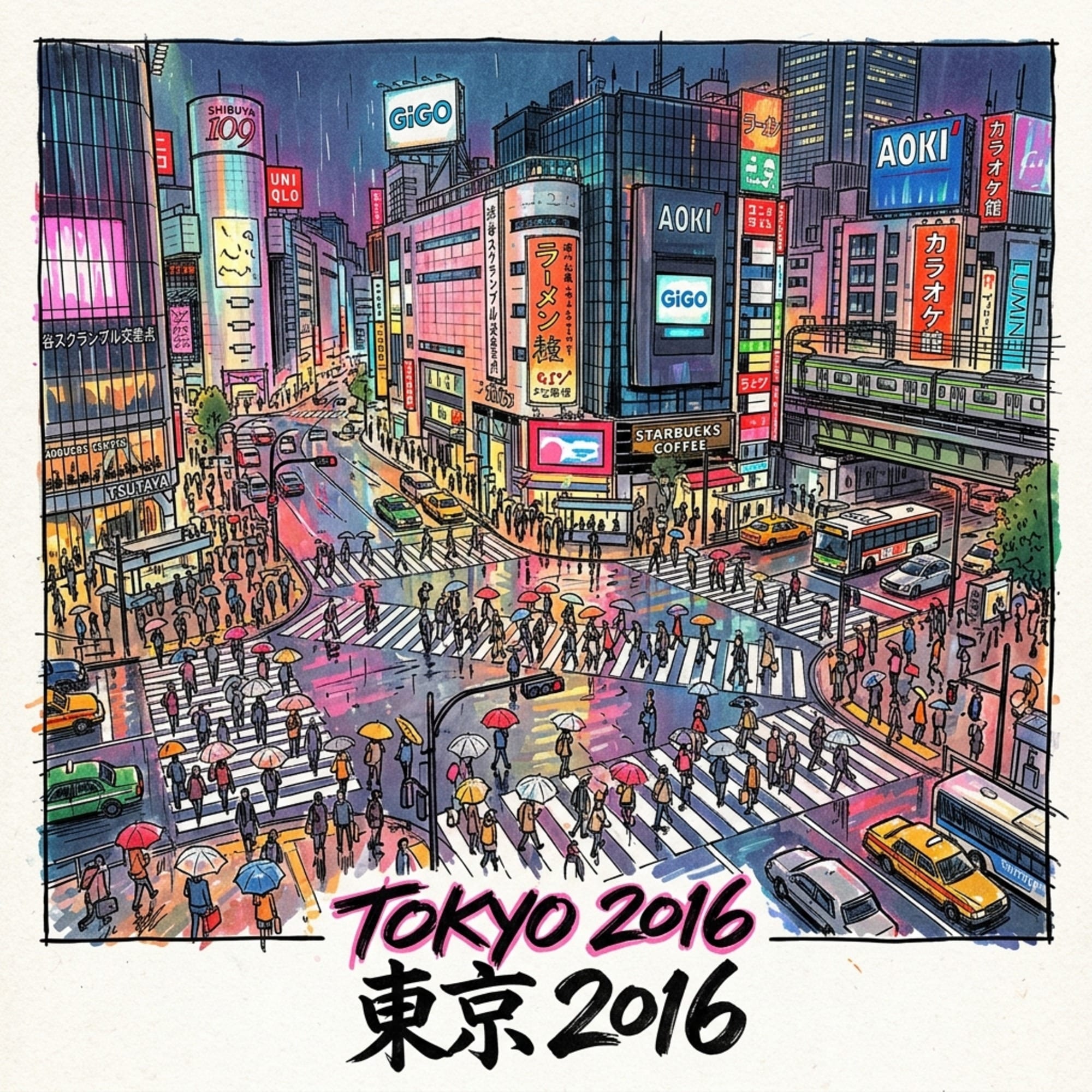
In the spring of 2026, images begin circulating on timelines alongside a phrase that manages to be both diagnosis and joke: 2026 is the new 2016. The photographs accompanying it have been retrieved from deep in the archive — phone photographs from ten years ago, slightly blurred, lit by the particular amber and blue of pre-AI lighting, before every image began arriving already corrected, already optimized, already smoothed to the temperature of a dream. People share them not, or not only, out of sentimental affection, but because they carry a quality that the present has somehow misplaced: the quality of having been seen by someone who was actually there, in a specific body, in a specific city, before the algorithmic layer settled over everything like silt.
The movement — if it can be called that, being made of nothing more solid than gesture and recognition — is partly about fashion, partly about music, partly about the specific texture of internet culture before the large models arrived and began producing content at a scale that made human-generated material feel, by comparison, rare and fugitive. But the more interesting thing about it, the thing worth sitting with, is what it diagnoses: that something changed between 2016 and now, and that the change happened at the level of perception itself. The way a city feels when you walk through it. The way history leaves marks on the physical fabric of a place. The way sacred geography operates, in the dark, beneath the screen.
I want to use this moment of looking backward to ask a different kind of question about 2016 — not about the memes or the fashion, but about what was actually happening in the subterranean layer of one particular city, in the specific year when several of its deepest histories surfaced simultaneously and briefly became readable. The city is Tokyo. The framework I want to use is its own.
Every city has a spiritual grammar — a set of inherited assumptions about how space, time, and human action are organized in relation to what is sacred. In Tokyo, this grammar is Shinto, the archipelago's oldest indigenous tradition, which is less a religion in the doctrinal sense than a spatial logic: a way of reading the relationship between the living and the divine that is inseparable from the physical landscape in which it developed, from the specific rivers and ridgelines and shorelines of the Kantō Plain.
Two concepts in particular illuminate the five stories I want to tell about 2016. The first is kegare — a word that translates imperfectly as contamination, or pollution, or spiritual impurity, but which operates less like the Western notion of sin and more like a geological deposit: accumulated, pervasive, invisible until something forces it toward the surface. Kegare encompasses death, disease, moral corruption, foreign intrusion, and — as we will see — literal soil contamination, and it is understood to accumulate in places as surely as it accumulates in people, disrupting the vital connective energy (musubi) that binds the human community to the divine presences (kami) inhabiting specific locations. The second concept is harae: the purification ritual, the act of cleansing that disperses accumulated kegare and restores musubi. The most ancient form of harae is misogi, the immersion in running water — standing in a stream until the contamination flows away downstream and the body, emerging, is clean.
Tokyo's spatial organization has been governed by this kegare-harae logic since the Edo period, when the shogunate positioned major temples at the cardinal defensive nodes of Edo Castle, placed guardian shrines at the city's energetic thresholds, and organized the seasonal festival calendar as a mechanism for communal cleansing of whatever psychic debris the year had deposited. This logic persists, mostly unconsciously, in the contemporary city, the way old riverbeds persist in the curves of streets long after the rivers themselves have been sent underground.
In 2016, Tokyo underwent a simultaneous activation of kegare across every register of its urban life at once — legal, digital, political, environmental, ritual — and lacked, as it has lacked since the postwar secularization, the infrastructure to complete the purification. What follows are five stories from that year, told in the order they occurred, and readable together as a single history: the last year in which the contamination was visible, and the cleansing was still, just barely, under way.
Listen to the historical stories told in detail (For subscribers only)
I. The Dance
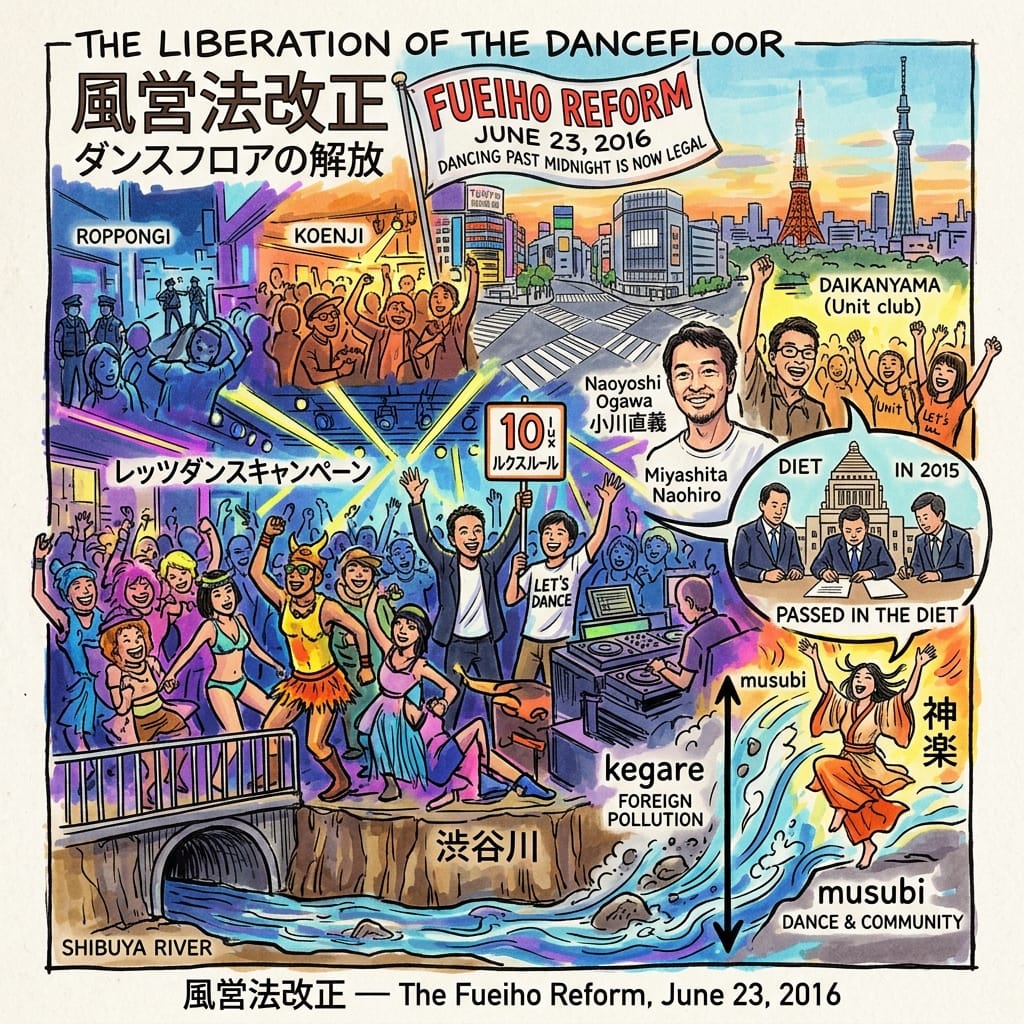
On the twenty-third of June, 2016, a law that had governed the behavior of bodies in Tokyo's nightclubs since 1948 was revised out of existence, and the first fully legal all-night dance floor in the city's postwar history opened in a basement in Maruyamachō, in the Shibuya valley.
The law in question — the Fūei-hō, the Entertainment Businesses Act — had been enacted during the American Occupation, ostensibly to regulate prostitution and gambling in the dance halls proliferating through the chaos of the postwar years. Embedded within it was a clause so counterintuitive that it sounds, at this distance, like the premise of an absurdist novel: dancing past midnight, in Japan, was illegal without a special license that was almost never granted. For sixty-eight years, this clause had existed in the statute books largely unregarded, enforced intermittently and unevenly — more aggressively in Osaka, more selectively in Tokyo — until the early 2010s, when a series of high-profile police raids on clubs in Kyushu and the Kansai region brought it suddenly back into consciousness. DJs had their equipment seized. Venue operators were arrested. And the fact emerged, with the slightly surreal quality of a legal discovery, that every person who had danced in a Japanese club after midnight for more than six decades had been, technically, breaking the law.
The 68 Year Ban On Dancing
The campaign to change this — launched in 2012 under the name Let's Dance, レッツダンス — gathered more than 150,000 signatures and eventually succeeded in persuading the Diet that dancing constituted a form of cultural expression sufficiently fundamental to warrant legal protection. The reformed law took effect on 23 June 2016, and that night, in venues across Tokyo that had operated for years in an anxious legal grey zone — Womb in Maruyamachō, Unit in Daikanyama, Ageha in Shinkiba and others further out — something shifted.
The obvious reading of this shift is straightforward enough: a repressive Occupation-era law was finally repealed, nightclub culture was normalized, good. But there is a deeper reading available if you approach it through the Shinto spatial vocabulary that has organized Tokyo's communal life for four centuries. In the Kojiki, the oldest Japanese chronicle, compiled in 712 CE, there is a passage that might be read as the origin myth of dancing itself: the sun goddess Amaterasu, retreating into a cave in grief and fury, plunges the world into darkness, until the goddess Ame-no-Uzume dances ecstatically before the cave entrance, and the laughter of eight million assembled kami at her dance — at its wildness, its abandon, its absolute refusal of the dark — lures Amaterasu back out and restores light to the world. Dancing, in this account, is not entertainment. It is kagura: the act of inviting divine presence into the human space through the embodied surrender of self-consciousness. It is one of the primary mechanisms by which the kegare-harae cycle is enacted.
The 1948 law, in this light, was itself a form of kegare: a foreign contamination introduced into Japan's body-culture by the apparatus of Occupation governance, which had its own complex anxieties about the social mixing that occurred in dance halls — anxieties that were, in the American racial politics of the 1940s, inseparable from fears about Black servicemen and Japanese women occupying the same floor. The contamination was multiple, layered, encoded in bureaucratic language, and it persisted in the statute books for sixty-eight years, pressing down on the specific urban spaces that the city's spatial logic had designated as places of communal gathering and energetic release: the valley nightclubs of Maruyamachō and Nishi-Azabu, the basement venues of Roppongi, the converted warehouses of Shinkiba.
What happened on the night of 23 June 2016, in those basements and warehouses, was a harae that had been overdue for seven decades.
Stand in Maruyamachō tonight — on the narrow rising road that climbs the wall of the Shibuya valley, the street that leads toward Womb and, up the ridge, toward Daikanyama — and you will feel, before you hear anything, a vibration in the soles of your feet. Bass frequencies operating at 40 to 60 Hz have this property: they travel through asphalt and concrete and the bones of buildings before they enter the air as sound, so that the first thing you know about the music is a tremor you feel in your ankles, in your knees. The gravel on the roadside is slightly damp. It is cold. Looking up, the commercial towers of the Shibuya plateau rim glow above the dark valley wall. Looking down, somewhere under the road, the culverted Shibuya River is running, as it has run for centuries, toward the bay.
II. The Digital Kami
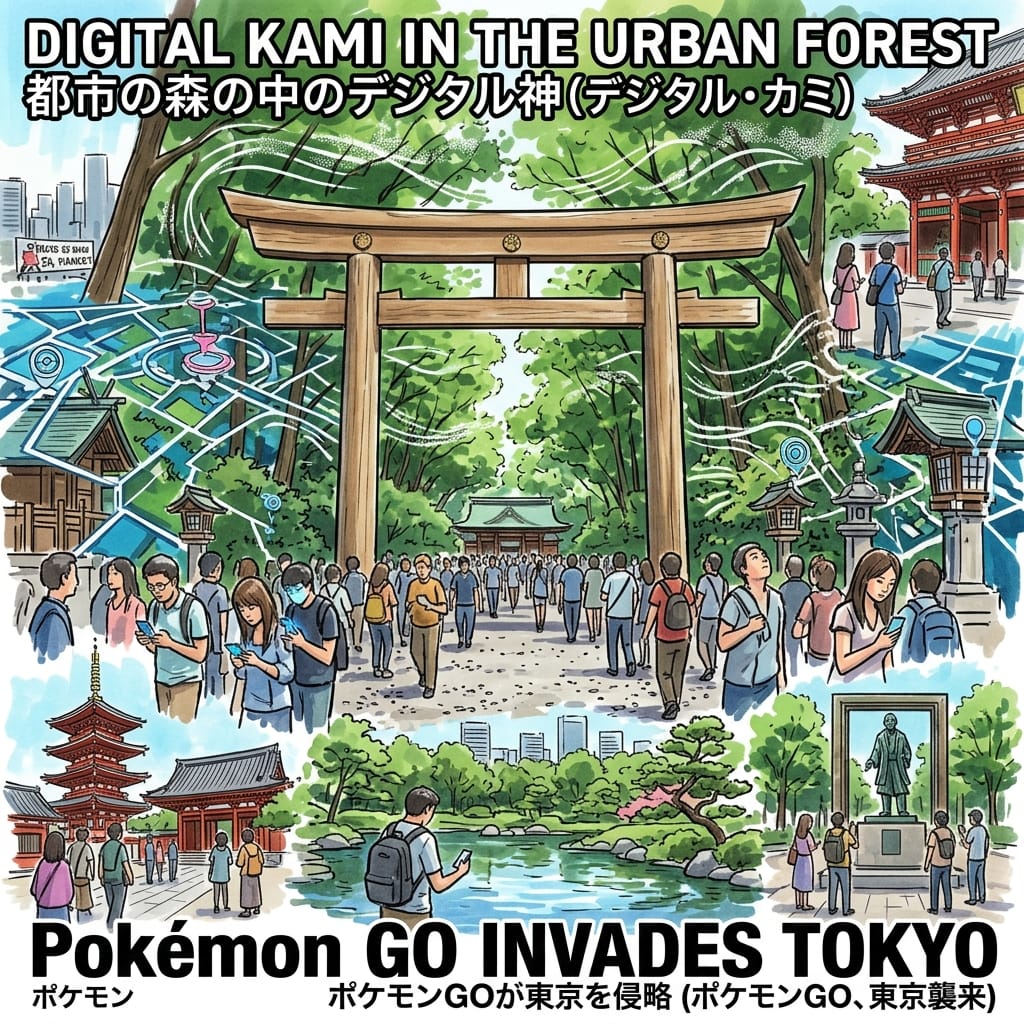
Pokémon GO launched in Japan on 22 July 2016, delayed from its American debut by two weeks because the servers had buckled under the weight of a continent going mad for it, and the scenes that followed in Tokyo — crowds converging on parks, on temple precincts, on the approaches to shrines, their phones held up like offerings to the canopy — were understood at the time as a symptom of consumer culture's appetite for novelty, or of gamification's power to colonize public space. Both interpretations were accurate. Both missed something.
The game was built on a map. Specifically, it was built on the map that Niantic, the company that made it, had developed for its previous game, Ingress — a map crowdsourced, over several years, by players who submitted locations of cultural significance to serve as the network's nodes: temples, shrines, statues, war memorials, historically marked buildings. When this map was repurposed as the geography of Pokémon GO, its nodes became Pokéstops and Gyms — the locations the game directed players toward, the coordinates around which rare Pokémon appeared. The game's sacred geography was, in other words, a crowdsourced folk map of collective cultural memory. And in Tokyo, that map overlapped with the Shinto shrine network with a precision that was, in the literal sense, uncanny.
Tajiri Satoshi, the creator of Pokémon, has spoken in multiple interviews about the image at the heart of the franchise's conception: a boy alone in the satoyama, the cultivated threshold zone between the human village and the unmapped wild, encountering living things in specific places. The satoyama in Japanese folk cosmology is precisely the marginal zone, the boundary between human order and divine unpredictability, where kami were most likely to appear — where the naturalized sacred came closest to the human world. Pokémon, at their deepest conceptual level, are creatures of this threshold. They are localized presences bound to specific habitats. They are, in the language of the tradition, kami of the natural world in miniature — and the game that contained them was structured precisely as the Shinto sacred geography of Japan had always been structured, which is to say that particular living presences inhabited particular places, and you had to go to those places, on foot, to encounter them.
What happened when Pokémon GO launched in Tokyo was therefore a strange doubling: an algorithm trained, through crowdsourced human attention, to identify places of cultural significance, directing hundreds of thousands of players to locations that the city's own four-century spiritual geography had already designated as nodes of numinous concentration. The players walked the paths of pilgrimage while looking for digital creatures. They performed miya-mairi — the act of shrine visitation — without knowing what it was called or what it meant.
The most vivid instance of this convergence was at Meiji Jingū, in the forest spreading across the heart of Harajuku. The shrine's inner precinct, constructed in 1920 and planted with more than a hundred thousand trees from across Japan — a forest engineered to maintain itself without human intervention for a century, a sacred landscape produced by modern ecological science and Meiji-era statecraft — became in July 2016 the densest Pokémon-spawning zone in the city. Players flooded the gravel paths. The algorithm had designated this particular seventy-hectare woodlot, this particular designed sacred enclosure, as a location of exceptional gamified significance, presumably because the forest's profile — large, biodiverse, ecologically stable, mapped by hundreds of Ingress players as a place of cultural importance — matched whatever parameters the system used to identify high-value nodes.
The forest did not know what the algorithm wanted. The algorithm did not know what the forest was. But the players walked the same paths that worshippers had walked for a hundred years, between the same towering camphor and cryptomeria, and their bodies performed the same movements — the slowing of pace, the lifting of the phone, the pause at the threshold — even without the ritual vocabulary that would have named what they were doing. Pilgrimage persisted in the posture of the pilgrim, even when the pilgrim had forgotten what pilgrimage was for.
How Pokemon Go Recreated Ancient Religion
Enter the first torii of Meiji Jingū and walk fifty meters into the forest and the traffic noise of Harajuku drops to something you can only just hear. Walk another fifty and it is gone entirely. The temperature falls three or four degrees. The gravel path produces, under your feet, a sound that has no equivalent in the city outside: a dry, recursive crunch that carries in the camphor-scented air. On a July afternoon, the cicadas are so numerous and so loud that they constitute a separate weather system, a wall of organic white noise that you walk through rather than past. The forest was built to produce exactly this experience of threshold, of crossing from one register of reality into another. The body, walking through it, tends to know this without being told.
III. The Twin Towers
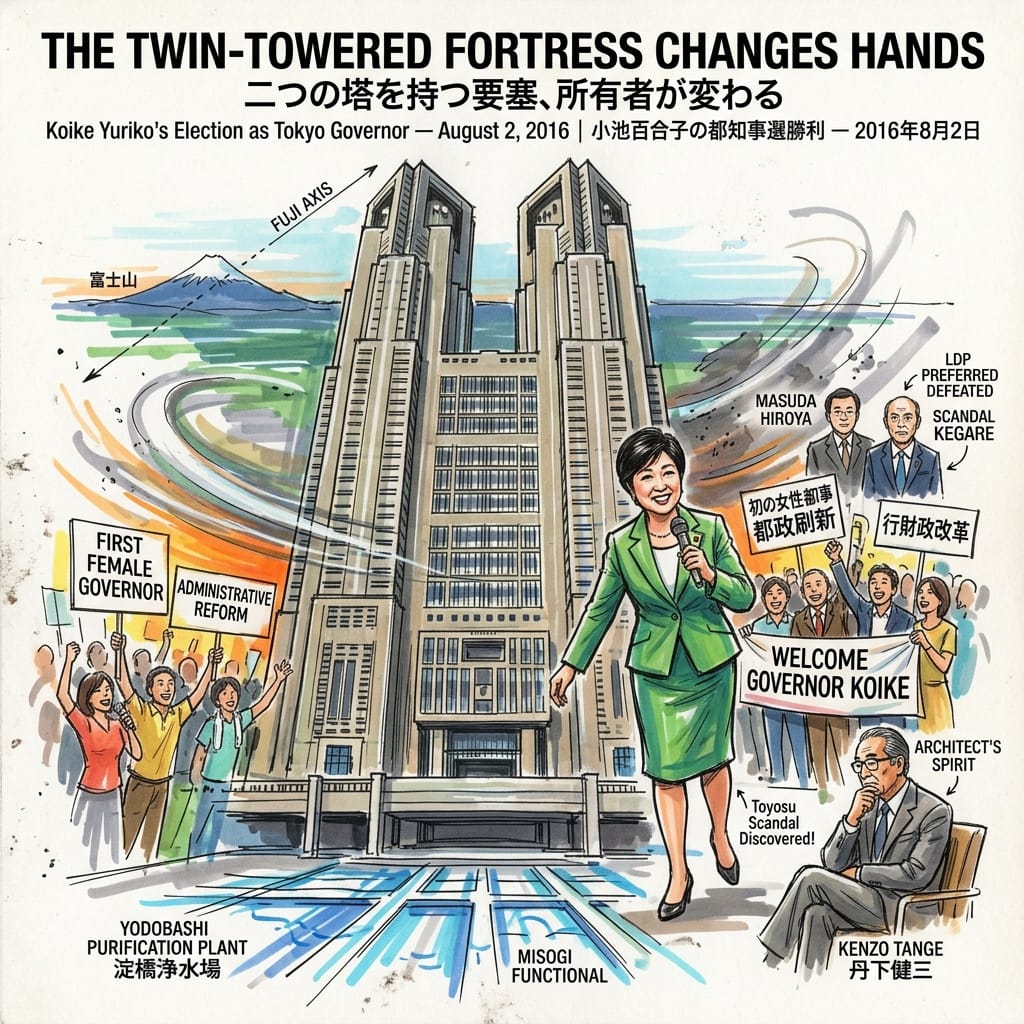
On 2 August 2016, Yuriko Koike was elected Governor of Tokyo with a margin that surprised even those who had predicted she would win, becoming the first woman in the position's 148-year history. She had run against the candidate preferred by the Liberal Democratic Party, in defiance of the party machine, following the resignation in June of her predecessor, Masuzoe Yōichi, who had departed amid revelations that he had used public funds for family holidays and personal art purchases — a contamination of office whose removal the election enacted. These are the facts of the matter as political science records them.
What interests me is the building she walked into.
The Tokyo Metropolitan Government Building — Tochōsha, in Japanese — was designed by Kenzo Tange and completed in 1991, and it is one of the most architecturally deliberate structures in the city. Tange was explicit about his intentions: the twin towers of the main block are a direct quotation of the Gothic cathedral's twin-towered west façade, which he associated with the civic-sacred ambitions of the medieval European city-state, the aspiration of a human community to build upward toward the divine. He wanted Tokyo's seat of civic power to carry that aspiration in its form. The building is, in this deliberate reading, a secular temple — the administrative axis mundi of the modern city, made of concrete and glass, haunted by the form of a cathedral.
Tokyo's Accidental Purification Ritual
The land it stands on has its own submerged history. West Shinjuku was marshland within living memory, and the site of the Tochōsha was occupied, from 1898 to 1965, by the Yodobashi Water Purification Plant — the facility that supplied drinking water to much of Tokyo for most of the twentieth century. The purification of water, in Shinto cosmology, is not a neutral technical process: it is a form of misogi, the ritual cleansing through which kegare is dispersed. The same plot of land served, in succession, as a civic apparatus for the physical purification of the city's water supply and then as the administrative center of the city's governance. The function changed; the underlying spatial meaning persisted in the place itself, in ways that no planning document recorded.
From the observation deck of the North Tower, on a clear January day — when the Kantō Plain sheds its summer haze and the air carries the crystalline quality of altitude — you can see Mount Fuji, ninety kilometers to the southwest, as a dark and irregular silhouette above the low urban sprawl of the Tama River corridor. The mountain is, and has been for centuries, the sacred center of the Kantō Plain's spiritual geography. The Edo-period Fuji-kō pilgrimage movements organized their entire spatial theology around lines of sight to the mountain from specific locations: to see Fuji was to enter into relation with it. Whether this alignment was considered in the Tochōsha's siting is unverifiable from any available source. But it is real — cartographically real, experientially real — and it connects the building, despite everything, to the same sacred geometry that the shogunate mapped four hundred years ago, when it placed its own administrative heart in relation to the same mountain.
Koike walked into this building carrying a mandate for purification. Within days, she would discover that purification was required at a more literal level than anyone had anticipated.
From the North Tower observation deck on a clear February evening, Mount Fuji appears at the lower left corner of the southwest-facing window: a dark triangle, slightly asymmetric, hovering above the illuminated sprawl. The room is carpeted in standard public-building grey, lit by fluorescent tubes, furnished with informational placards in Japanese and English about the view. It is aggressively, deliberately unheroic. And yet through the window, at ninety kilometers' distance, is the mountain that the Edo shogunate oriented its capital toward, that pilgrimage movements organized their entire cosmology around, that appears in more than ten thousand Japanese paintings and woodblock prints. The cognitive dissonance — bureaucratic interior, prehistoric sacred mountain — is precise. It is, I think, what the Shinto concept of ma, of productive threshold space, actually feels like from the inside.
IV. The Toxic Floor
In the autumn of 2016, shortly after taking office, Yuriko Koike ordered an investigation into the site where the Tokyo Metropolitan Government intended to relocate Tsukiji Fish Market. The investigation found that the ground was contaminated.
That sentence is technically accurate and almost entirely inadequate. Let me try again.
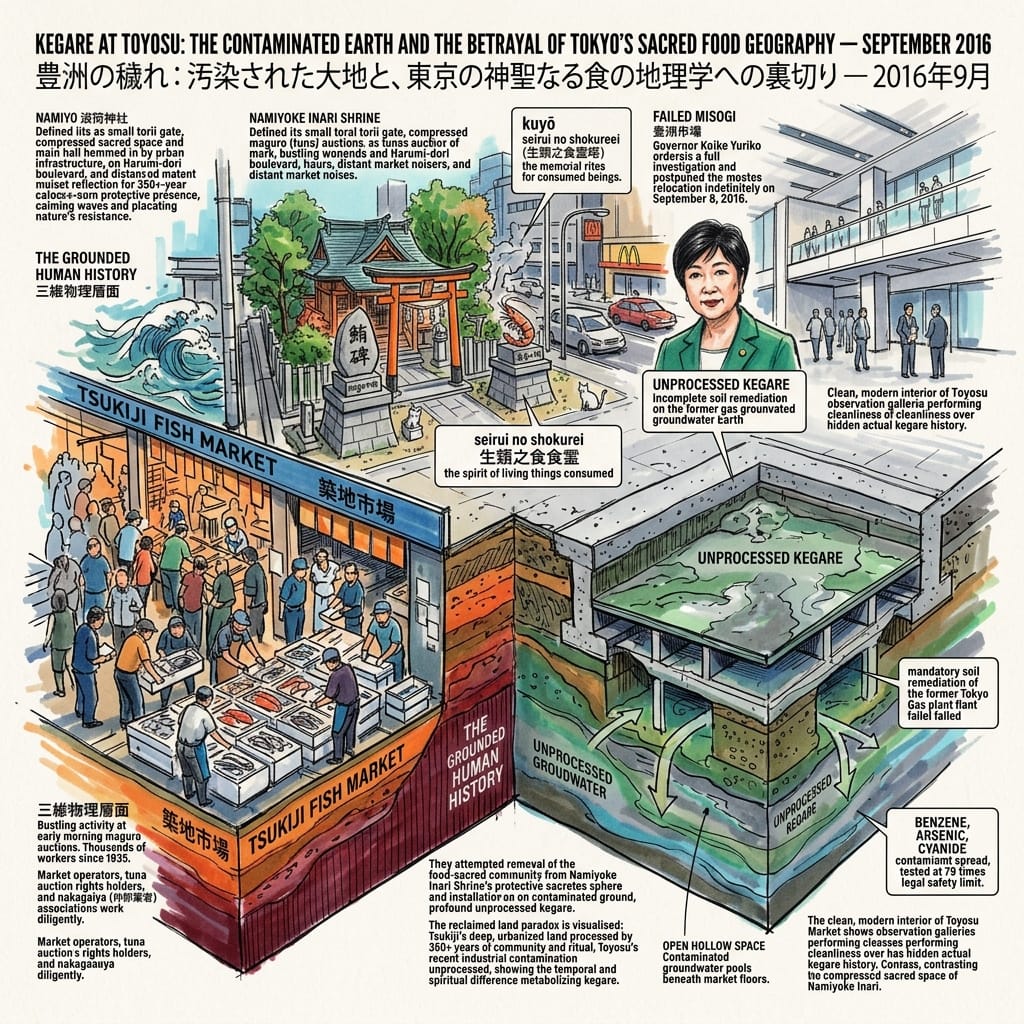
The site in question was in Toyosu, a district of landfill and reclaimed ground in the eastern bay area of Kōtō Ward. It had been the manufacturing plant of the Tokyo Gas Company, and the production of coal gas by incomplete combustion of organic materials generates, as a byproduct, benzene and arsenic compounds and cyanide and other carcinogens in quantities that saturate the soil and permeate the groundwater for decades after the plant ceases operation. The site had been transferred to the Tokyo Metropolitan Government after a soil remediation process that was legally mandated, formally certified, and — as the investigation revealed — substantively incomplete. The benzene levels in the groundwater tested at seventy-nine times the legal safety limit. In multiple locations, the concrete subfloor layer that was supposed to seal the contaminated ground from the market above had simply not been built. There was open hollow space beneath the floor — dark, damp, pooled with poisoned water that moved, invisibly, in the dark beneath where the stalls would have been.
The floor above this contamination was to become the home of Tsukiji Fish Market: one of the largest wholesale seafood markets in the world, handling more than 1,700 metric tons of sea life per day, a place whose entire moral and practical logic rests on the premise that what passes through its hands is safe to eat.
I want to stop here and say something about food and sanctity in the Shinto world, because it matters for understanding what kind of story this actually is. Inari is the kami of rice, of agriculture, of food in its broadest sense — and, by extension, of commercial prosperity and abundance. There are approximately 32,000 Inari shrines in Japan, more than any other type: a ratio that says something about how deeply the sacredness of food is embedded in Japanese cosmological life. The abundance and safety of food is not merely a practical concern in this framework; it is a continuous negotiation with the divine, an ongoing acknowledgment that human sustenance depends on forces larger than human intention.
The Toxic Secret Beneath Tokyo's Fish Market
At the edge of the Tsukiji market compound, on a strip of land between the market perimeter and the traffic of Harumi-dori, there stands a shrine that has been serving the market community for more than 350 years. It is called Namiyoke Inari Jinja — the Wave-Deflecting Inari — and it was founded, according to tradition, during the land reclamation of the Tsukiji area in the Edo period, its original function being to pacify the waves and currents that resisted the project of turning tidal mud into usable ground. The shrine contains two stone monuments that I find, each time I see them, genuinely moving: one to the tuna, maguro, and one to the shrimp, ebi, each inscribed with a phrase that might be translated, very approximately, as the spirit of living things consumed. These are not decorative. They are a market community's ongoing acknowledgment, in lapidary form, that the work they do — taking life, at scale, every day — requires some form of reciprocal recognition. The monument does not pretend that the fish does not die. It says that the death is not forgotten. Before the pre-dawn tuna auctions, workers went to the shrine. After. Between the lots.
The plan to relocate the market to Toyosu — away from the Inari shrine's protection, onto ground saturated with industrial carcinogens from the Tokyo Gas plant's decades of operation — represents, in the Shinto spatial vocabulary, a relocation from a site of established sacred protection to a site of profound unprocessed kegare. And the mandatory remediation that was supposed to prepare the Toyosu ground for habitation was, in that framework, a form of state-mandated misogi: governmental purification of contaminated earth, the bureaucratic equivalent of standing in running water until the pollution is washed away. The discovery that this purification had been certified without being performed is, in the same framework, a failed harae: the ritual form conducted in the absence of the ritual substance. The documents exist. The approvals were signed. The benzene remained. Beneath the approved floor plan, the groundwater was still poisoned.
There is a category of Shinto narrative in which the discovery that a place is kegare-contaminated comes only after some transgressive act has been committed upon it — only after the building begins, only after the first season passes, only after someone looks beneath the surface and finds what was being concealed. The Toyosu story follows this structure almost exactly. The remediation paperwork was filed. The certifications were signed. The construction proceeded. Then someone looked under the floor.
Go to Namiyoke Inari Jinja at five in the morning. The shrine is hemmed in on three sides by the infrastructure of the working city — walls, roads, the backs of commercial buildings — but the strip of ground it occupies is quiet in a way that only old sacred places are quiet: not silence exactly, but a particular quality of sound in which the surrounding noise seems to originate at some distance. The stone of the tuna monument is roughened by decades of weather and touch. In winter its surface is cold under the fingers with the specific, slightly granular coldness of outdoor stone that has been absorbing and releasing temperature for longer than anyone living can remember. The smell is brine, diesel, cold concrete, and something underneath these that is harder to name — the smell of the bay, perhaps, still present in the reclaimed land beneath. Across the road, a McDonald's. The juxtaposition is not ironic. It is simply the condition of the sacred in a working city: unremarked, unmoved, continuing.
V. The Uninvited Festival
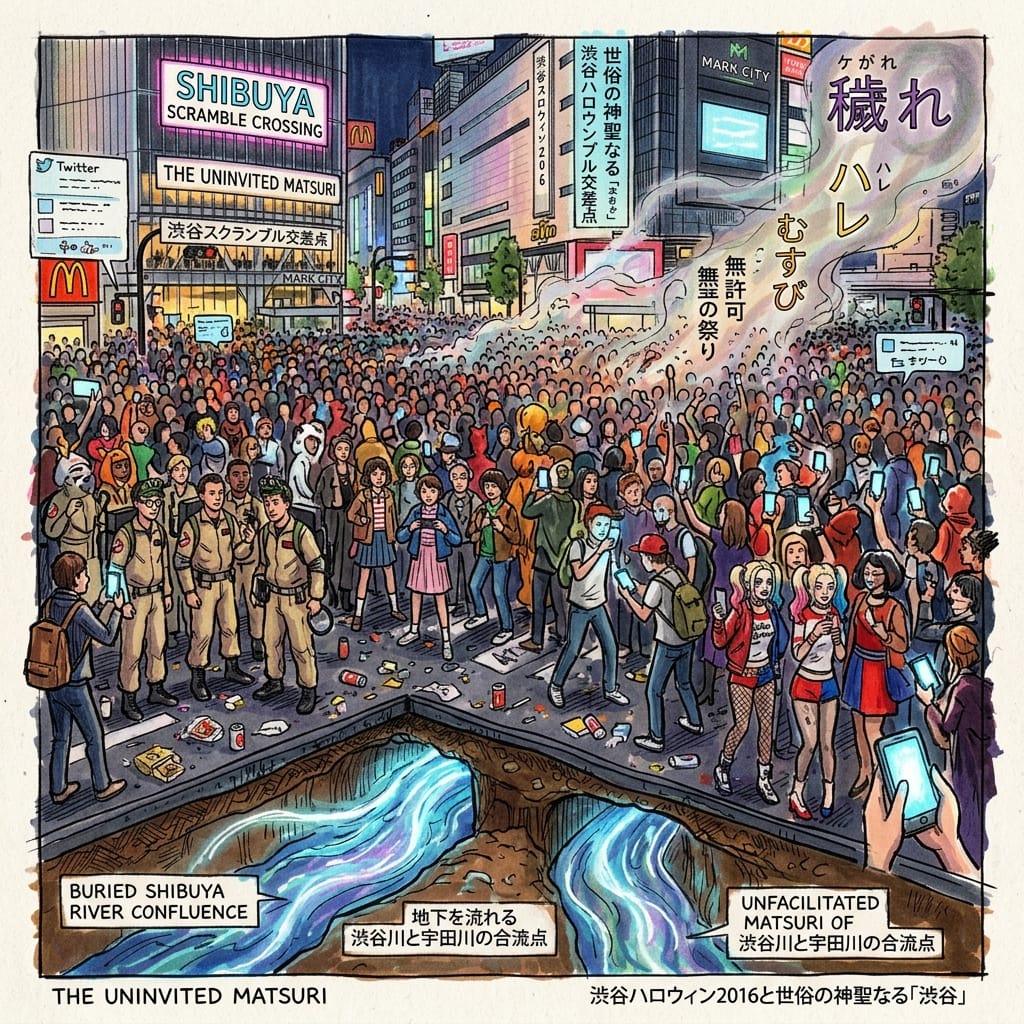
On the thirty-first of October 2016, somewhere between one hundred thousand and one hundred and thirty thousand people in costume converged on Shibuya Scramble Crossing and the surrounding streets. Nobody had organized them. No institution had given permission. No shrine had authorized the gathering. No committee had planned it. The event had been coordinated — if that is the right word for a process with no center — by the distributed activity of Twitter, which has long maintained a disproportionately large presence in Japan, combined with Instagram and the late Vine, whose final months before closure in January 2017 overlapped exactly with this gathering.
The costumes that year were a precise inventory of 2016's pop-cultural vocabulary: characters from the Paul Feig Ghostbusters reboot, from the first season of Stranger Things, zombie Pokémon GO players constituting a meta-commentary on the summer's dominant phenomenon, various superheroes from Suicide Squad. If you look at the photographs now, in the slightly overexposed style of mid-2010s smartphone cameras, you can read the whole year in the fabrics and the face paint.
I want to look at the place rather than the event, though. The name Shibuya means, roughly, bitter valley — the shibui character denoting a quality of taste that English has no precise equivalent for, something between astringent and austere, the sensation of green tea on an empty stomach or an unripe persimmon, simultaneously unpleasant and interesting. The district sits in a genuine topographic depression, the meeting point of several small rivers: the Shibuya River, the Uda River, now both culverted underground and invisible, their presence betrayed only by the slight descent of the streets as they approach the station and — if you know to listen — by the drainage grates in the pavement through which, on quiet nights, you can hear running water beneath the asphalt.
The Accidental Godless Ritual Of Shibuya
In Shinto geographic thinking, the confluence of rivers is a node of accumulated musubi — creative, binding energy — because the meeting of waters is one of the natural world's demonstrations of convergence: separate things becoming one thing. The Scramble Crossing stands above this buried confluence. The numinous energy that the rivers would have carried, in the centuries before they were sent underground, persists in the structure of the landscape even without the rivers themselves. The place is still what it always was. The water is just harder to find.
The traditional Japanese matsuri — festival — serves functions that the Shinto framework makes explicit, even as the wider culture continues to enact them without necessarily understanding their original logic. A matsuri invites kami into the human community temporarily. It releases the accumulated ke — the used-up, depleted energy of ordinary days — and replaces it with hare, the charged energy of the sacred and the festive. It marks a seasonal threshold. And it provides a socially licensed space for the temporary inversion of everyday hierarchies: the drinking, the noise, the costuming, the dissolution of ordinary social boundaries, the permission to be someone you are not on any other night of the year.
The Shibuya Halloween gathering, considered structurally, reproduced every one of these functions. Nocturnal gathering: present. Costumed transformation of identity: present. Licensed transgression: present. Temporal specialness — the sense of inhabiting an interval cut out of ordinary time: present. Collective ecstatic energy at a scale that ordinary daily life never approaches: very much present.
The kami: absent.
The absence matters more than it might seem. In the Shinto framework, the energy generated by a matsuri requires a divine recipient — the kami whose shrine is hosting the festival, receiving the community's gathered hare and transforming it, through the mechanism of musubi, into blessing returned. The energy is not supposed to simply accumulate and disperse. It is supposed to travel in a circuit: from community to kami and back. A festival without a kami is, in this framework, an incomplete circuit — a charge with nowhere to go. The energy builds in the physical space of the gathering, intensifies beyond what the social container can hold, and eventually requires external intervention rather than ritual resolution. In later years, in Shibuya, it required police barriers, alcohol bans, and the staged decommissioning of the gathering season by season, until what had been wild was domesticated into something governable. The energy was contained rather than completed. The circuit was broken rather than closed.
What happened in Shibuya in October 2016 was a hare-space without a kami-anchor: the festival instinct — ancient, social, embodied — operating perfectly, in exactly the right location, above the buried sacred geography of the valley confluence, with nothing sacred in place to receive and complete what it generated. A ritual whose architecture existed, in the structure of the place and the behaviour of the crowd, but whose roof had been removed.
From 2026, the most interesting thing about it is the mechanism of its generation. The swarm intelligence of Twitter — a hundred thousand individual actors each responding to local information and platform feedback, producing a collective spatial event of extraordinary scale with no central intention, no human organizer, no institutional authority of any kind — had replicated the form of a matsuri without having access to its meaning. The algorithm had no concept of hare. It had no concept of kami. But it produced a festival. And then, having produced it, had no idea what to do with the energy it had accumulated, or how to bring it to a close.
This is, I think, the deepest sense in which 2016 prefigures 2026: not in the content of any specific event, but in the first legible emergence of a distributed intelligence that could reproduce the forms of human ritual without being able to access their meaning. The algorithm as an accidental, incomplete kannagi — a medium through which divine energy was supposed to pass, and through which something passed, without ever arriving anywhere.
Stand in the center of the Scramble Crossing on a green light and what you will feel first is not sound but wind: the collective displacement of two or three thousand bodies moving simultaneously from five directions. Then the layered percussion of feet on asphalt — heels on the white crosswalk paint, sneakers on the textured surface between lanes. Then the faint warmth of massed bodies against October air. Then, finally, sound: traffic, voices in several languages, music from at least two sources, the specific ambient frequency of a modern city at maximum occupation. The crossing curves slightly — its geometry following the buried contour of the valley below — so that no single viewpoint can take in the whole of it at once. It resists the panoramic gaze. You are always inside it, never above it. Below the asphalt, the Shibuya River is still running.
Postscript: On Legibility
There is a habit of thought in the psychogeographic tradition — in Macfarlane's walks through the old ways and the underland, in Sebald's narrators discovering, in the surface of ordinary things, the photographic negative of what was there before — that treats the past as something recoverable, if you only know where to look. I have been practicing this habit throughout this essay, and I want to complicate it slightly before I close.
The five stories I have told about Tokyo in 2016 are not stories about recovery. They are stories about contamination that was briefly, partially visible — pushed to the surface by a particular convergence of political events, cultural phenomena, and environmental revelations — and then covered over again. The Toyosu market opened in 2018, on the same ground, subject to additional remediation that was itself subject to dispute. The club scene that June liberated found itself facing different existential pressures within four years. The Shibuya Halloween's spontaneous energy was contained by bureaucratic management and eventually domesticated into something the authorities could plan for. The digital overlay of Pokémon GO's first summer faded in novelty while the AR infrastructure it had demonstrated — the proof of concept for redirecting human movement through algorithmically designated sacred nodes — was quietly absorbed into every navigation application on every phone.
What 2016 offered was not resolution but legibility. For a specific twelve-month period, the kegare was visible: chemically measurable in the groundwater, legally demonstrable in a statute book, photographically documentable at the Scramble Crossing, spatially readable in the cathedral towers of an administrative building and their invisible line of sight to a sacred mountain ninety kilometers distant. The purification attempts the year generated — the Let's Dance reform, the gubernatorial election, the Toyosu investigation, the Halloween gathering — were responses to this legibility. They were the city trying to harae what it had recognized.
The reason the phrase 2026 is the new 2016 produces something other than mere nostalgia — something that feels, to those who engage with it, more like mourning — is that 2016 was the last year in which the sacred geography of a city like Tokyo remained readable to the ordinary body moving through it. Before the AI content layer thickened to the point of opacity. Before the algorithmic map replaced the cartography of the kami. Before the sacred nodes of the shrine network became invisible beneath the GPS overlay, not because the shrines were gone, but because the navigational intelligence that now mediates our movement through the city has no category for what a shrine is, what a river confluence means, what bass frequencies felt in the soles of the feet at two in the morning have to do with a goddess dancing before a cave in the seventh century.
There is still a buried river under Shibuya. The tuna monument still stands outside the old market. The forest at Meiji Jingū still drops the temperature three degrees in fifty meters of walking. The North Tower of the Tochōsha still faces Fuji on clear winter days. The bass still travels through the asphalt of Maruyamachō before the sound does.
The question that 2016 poses to 2026 is not whether the sacred geography of Tokyo remains. It does remain. The question is whether, having accepted the algorithmic layer as the primary interface between our bodies and the city, we have retained the perceptual equipment to feel it.
The purification, in any case, remains incomplete. It was interrupted before it could finish, the way all the harae of 2016 were interrupted before they could finish. The kegare went back underground, where it has always waited — patient, invisible, indifferent to our timelines — for the next time someone looks beneath the floor.
💡Frequently Asked Questions (FAQ)
Q1: Why was dancing in Tokyo clubs banned after midnight, and how did Fueiho law change in 2016?
Under Japan's anti-prostitution Fueiho law passed in 1948, dancing in public venues after midnight was illegal without a specific dancing license, which was rarely granted to night venues. In June 2016, landmark legal amendments allowed clubs with interior lighting of at least 10 lux to stay open 24/7. Beyond nightlife regulation, this change acted as a cultural reset—echoing the Shinto myth of Ame-no-Uzume dancing to draw out light—re-energizing nightlife districts like Shibuya and Roppongi.
Q2: How did Pokémon GO and Your Name shape anime pilgrimage and shrine geography in Tokyo?
The 2016 release of Pokémon GO combined augmented reality (AR) with real-world landmarks, turning Shinto shrines like Kanda Myojin into digital PokéStops. Simultaneously, Makoto Shinkai's hit anime 'Your Name' turned Suga Shrine into an iconic real-world pilgrimage site. By blending physical sacred spaces with digital interactions and the Shinto concept of 'Musubi' (interconnectedness), these 2016 phenomena revolutionized how tourists and locals navigate Tokyo's spatial geography.
Q3: Why was the Tsukiji to Toyosu fish market relocation delayed in 2016 over soil contamination?
In 2016, Tokyo Governor Yuriko Koike abruptly postponed moving the historic Tsukiji Market due to hazardous chemical pollution found in the groundwater at the new Toyosu site. Through a cultural lens, Tsukiji represented an 80-year-old sanctuary of life and culinary tradition, whereas Toyosu's toxicity was seen as 'Kegare' (spiritual and physical impurity). This environmental controversy underscored public anxiety over purification as Tokyo underwent massive redevelopment for the 2020 Olympics.
Reference and Further reading
First layer – Main sources of literature and institutions:
- 風俗営業等の規制及び業務の適正化等に関する法律(風営法)改正条文、2015年法律第45号、官報(2015年6月24日号)
- 「レッツダンス署名推進委員会」公式資料・署名集計報告(2012–2015年)
- 警察庁、風俗営業等に係る事件の検挙状況(年次統計、各年版)
- 株式会社ポケモン・Niantic Japan、Pokémon GO日本リリース公式発表(2016年7月22日)
- 警視庁、Pokémon GOに関する注意喚起・交通事故件数資料(2016年)
- 代々木公園管理事務所・上野恩賜公園管理所、入園者数統計(2016年7–8月)— 建議進一步查證原始檔案
- 東京都選挙管理委員会、平成28年東京都知事選挙開票結果(2016年8月2日)
- 東京都庁舎建設工事誌(東京都建設局、1991年)
- 淀橋浄水場廃止に関する記録(東京都水道局史、各版)
- 東京都環境局・産業労働局、豊洲市場予定地における土壌汚染対策等に関する報告書(2016年9月〜2017年各月版)
- 東京都中央卸売市場史(東京都市場局、各版)
- 波除稲荷神社社史・奉納記録(shrine records — 建議進一步查證原始檔案)
- 渋谷区役所、ハロウィン関連の公道使用・警備記録(2016年)— building toward the later regulatory regime
- 警視庁・渋谷署、2016年10月31日警備配置記録(建議進一步查證原始檔案)
- 東京都建設局・河川部、渋谷川・宇田川暗渠化工事記録
The second layer – secondary academic materials:
- Condry, Ian. Hip-Hop Japan: Rap and the Paths of Cultural Globalization. Durham: Duke University Press, 2006. (Essential context for underground Tokyo music scenes pre-reform)
- Manabe, Noriko. The Revolution Will Not Be Televised: Protest Music After Fukushima. New York: Oxford University Press, 2015. (Music-activism intersections in the same cultural milieu)
- 北田暁大・解体研編『東京から考える:格差・郊外・ナショナリズム』NHKブックス、2007年
- de Souza e Silva, Adriana. "From Cyber to Hybrid: Mobile Technologies as Interfaces of Hybrid Spaces." Space and Culture 9, no. 3 (2006).
- Licoppe, Christian and Inada, Yoriko. "Locating Objects: How Objects Link to Places." Mobilities 9, no. 4 (2014). (Directly relevant to Pokéstop spatial logic)
- 若林幹夫『都市の比較社会学』岩波書店、2007年
- Jinnai, Hidenobu. Tokyo: A Spatial Anthropology. Translated by Kimiko Nishimura. Berkeley: University of California Press, 1995. [Original: 陣内秀信『東京の空間人類学』筑摩書房、1985年] — foundational for Edo spatial analysis
- 鈴木博之「丹下健三の建築における伝統と近代」『建築史学』第20号、1993年
- Kultermann, Udo, ed. Kenzo Tange, 1946–1996: Architecture and Urban Design. Zurich: Artemis, 1970 (and subsequent expanded editions)
- Bestor, Theodore C. Tsukiji: The Fish Market at the Center of the World. Berkeley: University of California Press, 2004. (The definitive English-language anthropological study of Tsukiji's social and economic geography — essential)
- 神崎宣武『祭りの食文化』岩波新書、1993年
- 原田信男『和食と日本文化』小学館ライブラリー、2005年
- Schnell, Scott. The Rousing Drum: Ritual Practice in a Japanese Community. Honolulu: University of Hawaii Press, 1999. (Definitive anthropological study of Japanese matsuri structure — essential comparative framework)
- 宮田登『ハレとケの民俗』春秋社、1983年 (Foundational Japanese ethnological analysis of hare/ke)
- Allison, Anne. Millennial Monsters: Japanese Toys and the Global Imagination. Berkeley: University of California Press, 2006. (Character consumption culture applicable to Halloween costume culture)
Third layer – Supplementary information:
- Let's Dance公式ブログ・署名活動アーカイブ(wayback machine: letsdance.jp — 建議進一步查證原始檔案)
- 各種音楽メディア(ビルボードジャパン、ele-king)2016年改正施行関連記事
- Tajiri Satoshi, creator interviews documenting the satoyama design inspiration (Famitsu, Dengeki Online; 2016 retrospective coverage for Pokémon 20th anniversary)
- User-generated spatial data: Reddit r/TheSilphRoad Japan threads, LINE community coordination archives (treated as collective behavioral documentation)
- 村上重良『民衆宗教の系譜』講談社学術文庫 (Fuji-kō pilgrimage movement documentation)
- 新宿区史(各版)— Nishi-Shinjuku transformation oral civic histories
- 波除稲荷神社「鮪の碑」「えびの碑」建立趣意書(shrine dedication documents)
- Market vendor oral history accounts documented in Bestor (2004) and in Asahi/Yomiuri journalism archives (2016 coverage)
- Twitter Japan hashtag archive (#渋谷ハロウィン 2016) — as collective behavioral documentation
- Video documentation uploaded to YouTube and NicoNico Douga (2016年10月31日〜11月1日 アップロード分) — treated as participant-documentation archive
Historical gap:
- The specific spatial and economic mapping of how the reform actually changed venue distribution across Tokyo's wards post-2016 appears underresearched in both Japanese and English scholarship. More critically: the relationship between the Occupation-era origins of the law and its 2016 repeal — as a form of postwar legal decolonization — has received almost no scholarly treatment. 建議進一步查證原始檔案: GHQ/SCAP records at the National Diet Library's Constitutional and Legislative Reference Bureau (国立国会図書館) regarding the 1948 Fūei-hō's original drafting motives.
- No systematic academic mapping of the overlap between Pokémon GO's Tokyo Pokéstop distribution and the city's registered cultural heritage sites appears to exist. Such mapping would constitute a genuine contribution to both locative media studies and urban sacred geography. The franchise's own animist design philosophy — Pokémon as satoyama kami — is almost entirely unanalyzed in English-language scholarship using Shinto frameworks. 建議進一步查證原始檔案: Niantic's original Ingress portal dataset for the Tokyo Metropolitan Area.
- The relationship between the TMG Building's siting and Tokyo's pre-modern sacred geography — specifically the visual axis to Fuji and the proximity to Hie Jinja — appears entirely unexamined in published architectural history. Tange's own public statements about the building are primarily aesthetic-political; whether any sacred-geographical awareness shaped the siting decision is unverified. The reading of the Koike election as a harae event using Shinto cosmological vocabulary does not appear to exist in either political science or religious studies literature. 建議進一步查證原始檔案.
- The relationship between Namiyoke Inari Shrine's ritual practice and the Tsukiji market's daily operational culture — particularly the pre-dawn shrine visits by tuna auction workers — is documented in journalism but has received limited academic treatment from a religious studies perspective. The Shinto-cosmological analysis of the Toyosu contamination crisis presented here (kegare/harae as analytical framework for an environmental-political scandal) does not appear to exist in published form in either Japanese or English scholarship. Bestor's anthropological work is essential but explicitly avoids cosmological analysis. 建議進一步查證原始檔案: Tokyo Gas corporate records and TMG internal communications regarding the remediation certification process — likely held at the Tokyo Metropolitan Archives (公文書館).
- No published academic study appears to exist analyzing the Shibuya Halloween gatherings through the lens of Shinto matsuri structure and the hare/ke conceptual framework — a significant gap given the structural parallels' directness and completeness. The hydrology of the buried Shibuya and Uda Rivers and its relationship to the site's historical sacred geography is documented in civil engineering records but has not been connected to the contemporary social geography of the Scramble Crossing in published literature. 建議進一步查證原始檔案: Shibuya Ward urban planning archives regarding the culverting of the Shibuya and Uda Rivers, and any pre-Meiji-era ritual records for the valley confluence site.
 Lawrence
 Lawrence
 Lawrence
This is the first essay in the "2026 is the New 2016" travel history series. The next: Hong Kong, 2016. Then Taipei, 2016.