The Buildings That Learned to Wear the Rain
Choi Hung is not a backdrop. It is a paddy field that was erased, a colour system that was improvised, and a structural wound that was left unhealed for thirty years — all of it now on a countdown to demolition.

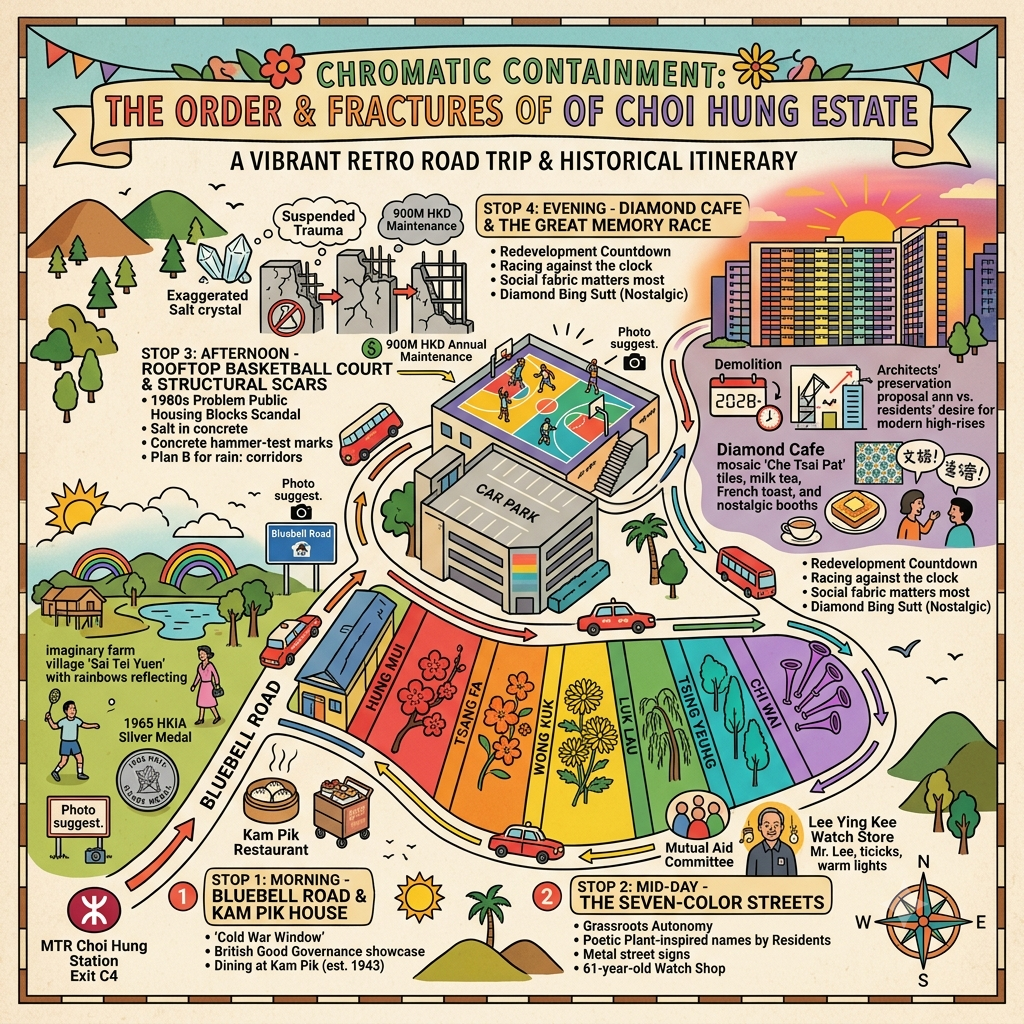
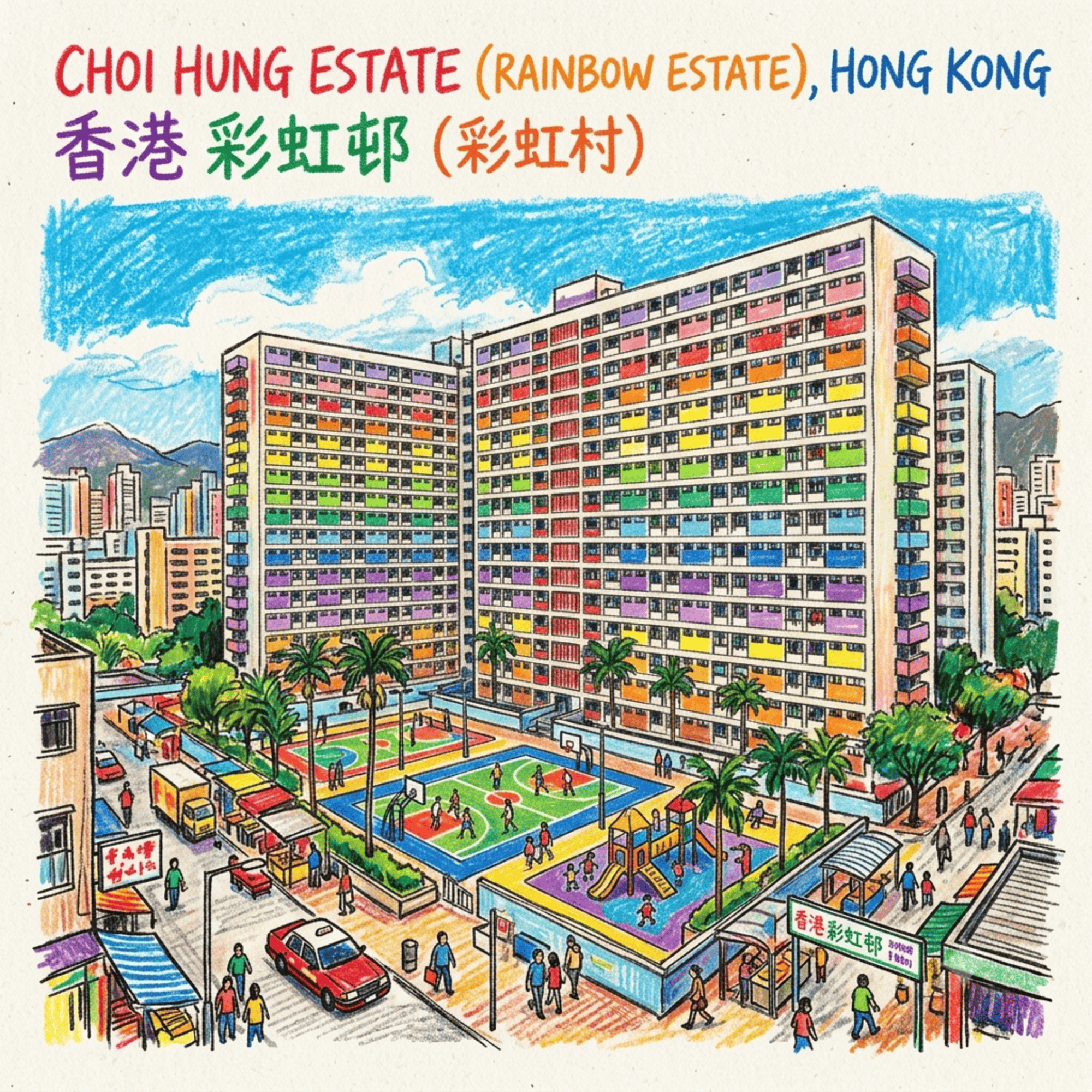
This is a historical travel story and walking guide to Choi Hung Estate, one of Hong Kong’s oldest and most iconic public housing estates. Through a nostalgic route beneath its famous rainbow facades, it explores the grassroots heritage, mid-century modern architecture, and everyday community life of an estate facing future redevelopment. Readers will gain a deeper historical perspective on how public housing shaped the identity of modern Hong Kong.
The place I'm introducing today has special significance for me because I worked here for eight years.
 Lawrence
There is a way of walking through Choi Hung Estate that has nothing to do with photographing it. You notice, instead, that the ground beneath your feet used to be called something else — Sha Tei Yuen, sand-field garden — and that nothing of that name survives except in the memory of residents old enough to have watched it disappear. What stands here now is eleven towers, painted in colours a planning committee chose to disguise an act of erasure as an act of beauty. This is the practice this essay is interested in: not the estate as spectacle, but the estate as palimpsest — a surface written and overwritten, its earlier text still legible if you know how to read the underlying ground.
To walk Choi Hung today, six years before the first demolition phase is scheduled to begin, is to walk through a structure that has already outlived the paddies it replaced, the diplomats who once photographed themselves inside it, and very nearly the scandal that quietly determined which of its neighbouring estates would live and which would be torn down. It has not yet outlived its own residents' daily, unspoken vigilance about what lies inside its concrete. This essay is an attempt to hold all of that at once, before the surface is repainted one last time — or removed altogether.
Listen to the historical stories told in detail (For subscribers only)
I. What the Rain Left Behind
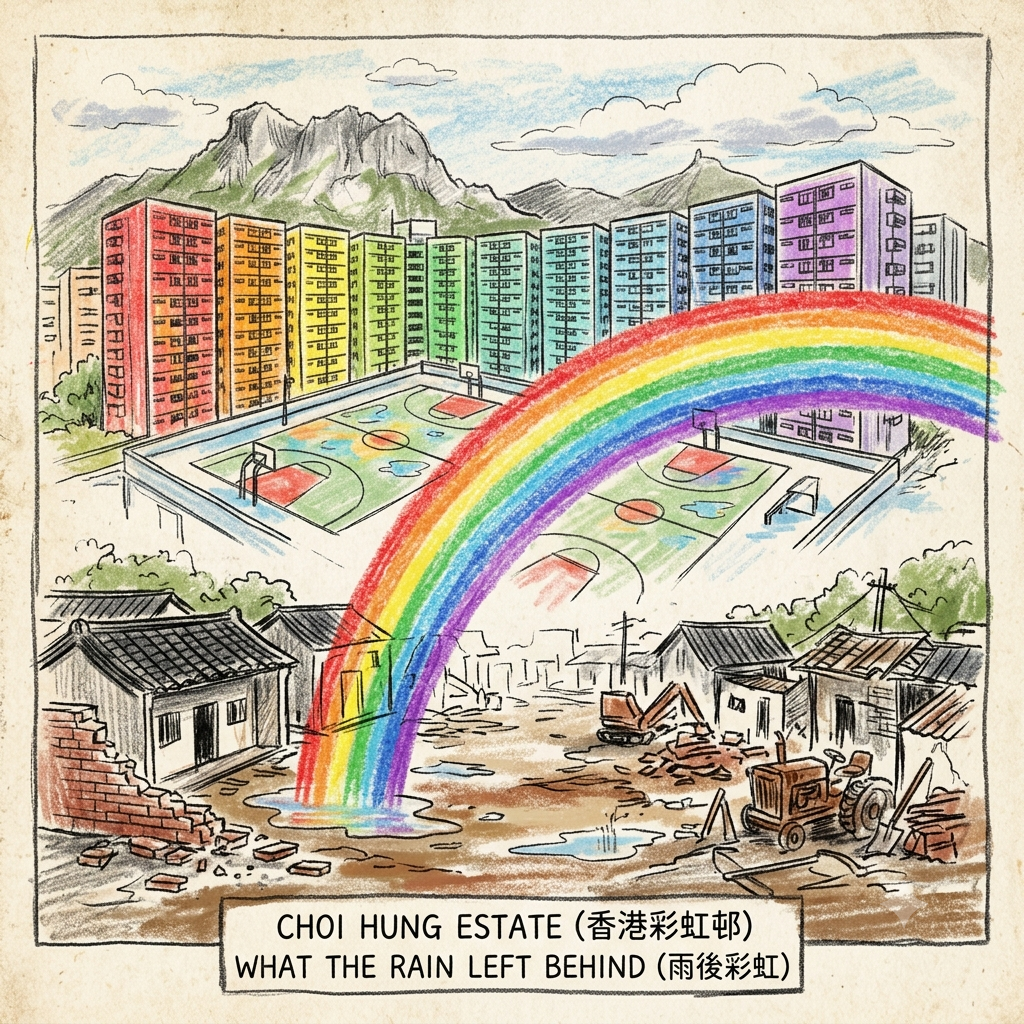
In 1957, the colonial government requisitioned land at Sha Tei Yuen, one of the Kowloon Thirteen Villages, for a housing project. By 1960 the farming settlement had been cleared entirely; its residents dispersed, their names and destinations largely unrecorded in any archive I have been able to locate. Between 1962 and 1964, eleven blocks rose in phases, housing some 43,000 people — the largest single public housing project Hong Kong had yet attempted. On 18 December 1963, Governor Robert Black presided over the opening ceremony beneath what is now Kam Bik House, and residents gathered to watch a ribbon cut over a settlement that, weeks before, had still been someone's field.
The name given to the new estate — Choi Hung, "rainbow" — is said to derive from a phenomenon older residents still describe: after rain, sunlight striking the harbour would throw a wide, unusually vivid arc across the paddies of Sha Tei Yuen. The architects painted the eleven blocks in corresponding colours. It is, in its way, a small masterstroke of administrative narrative-craft: a forced clearance rebranded, permanently, as a meteorological blessing.
Holographic Sensory Cue: the last clear sky over Sha Tei Yuen before the 1960 clearance — wet soil and rusted machinery in the same breath of air; sunlight breaking low across standing water, throwing a brief, oversized arc of colour onto roof tiles about to be pulled down; the dull knock of tools against brick somewhere out of sight, and birds breaking cover all at once.
Trapping_the_Hong_Kong_Rainbow
What the Feng Shui Register Actually Explains
I want to be careful here, because it would be easy — and wrong — to reach for a universal mysticism and call it insight. The framework native to this ground is not abstract energy in general; it is the specific Lingnan folk cosmology of the Five Elements and their five correspondent colours (wood-green, fire-red, earth-yellow, metal-white, water-black), a system in which colour has never been decorative but has always been a technology for imposing legible order on unstable ground. Choi Hung's seven-colour scheme is drawn from the Western optical spectrum, not from Five-Element doctrine — the dossier is explicit that this is not a deliberate invocation of that cosmology. And yet the estate reproduces its underlying logic with startling fidelity: a continuous chromatic scale assigning identity to each block, colour functioning as a public declaration that order has arrived on this ground.
The estate also sits, whether by design or by the simple geography of Kowloon, in the classical Lingnan arrangement of mountain at the back and water at the front — Lion Rock and Fei Ngo Shan rising behind it, the old Kai Tak runway and Victoria Harbour spread before it. This is the layout traditionally read as stable, sheltered, auspicious. It is worth sitting with the fact that this particular auspicious geometry was assembled directly on top of a landscape from which people had just been removed. Colour, here, functions less as ornament than as a kind of unconscious psychological repair — a way of making a wound look, from a distance, like a folk tale about weather.
II. The Cold War Wanted a Photograph of This
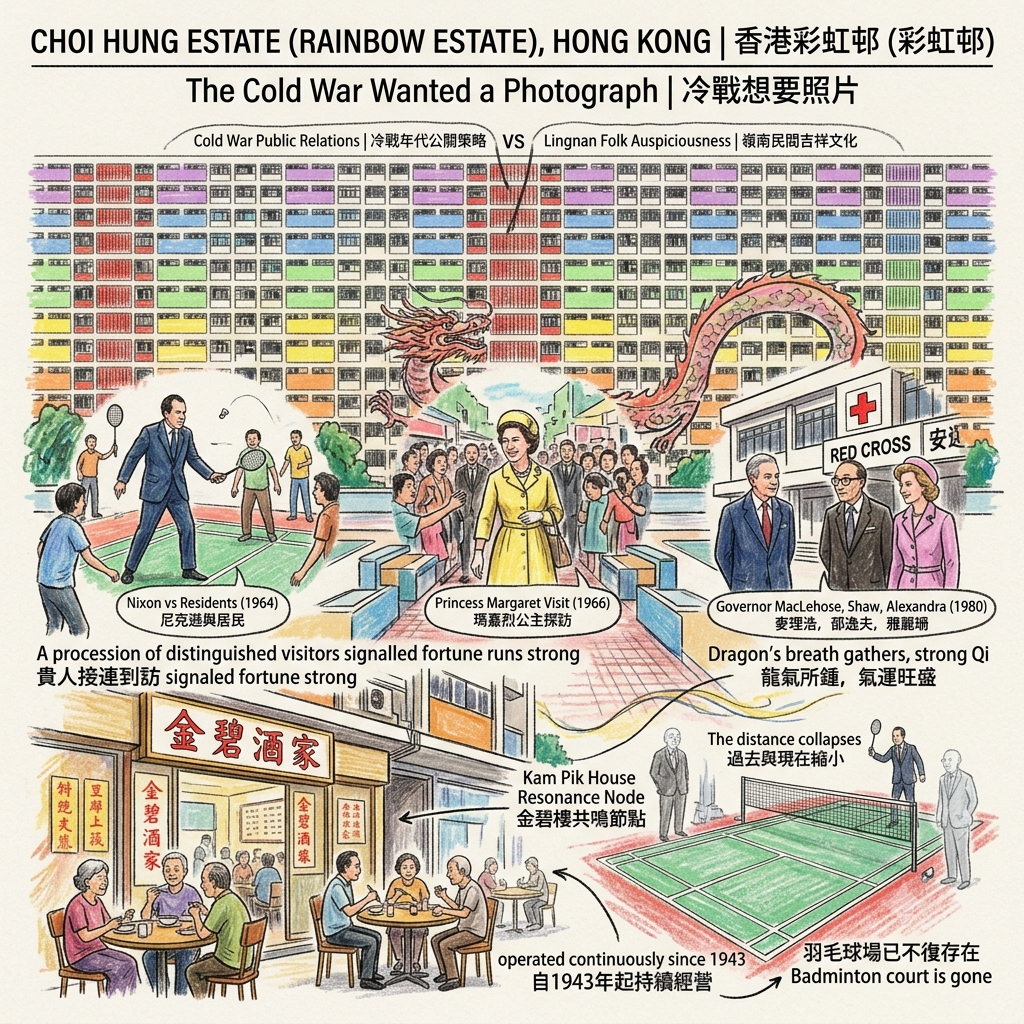
In 1964, then-US Vice President Richard Nixon walked into Choi Hung in a suit and played badminton with residents. In 1966, Princess Margaret toured the estate. In 1980, Governor Murray MacLehose, accompanied by Sir Run Run Shaw, brought Princess Alexandra to inspect the Red Cross facilities on site. In barely two decades, this housing estate for the displaced became an unlikely stage for the performance of colonial governance to a global audience.
Local memory reads this differently than the diplomatic record does. In the Lingnan folk imagination, a procession of distinguished visitors has traditionally signalled that a place's fortune — its qi — runs strong; visitors of consequence are said to be drawn to where the dragon's breath gathers. That two entirely different explanatory systems — Cold War public relations and folk auspiciousness — could produce the same observable fact, distinguished visitors arriving repeatedly at the same housing estate, without either one disproving the other, is exactly the kind of layered coexistence this ground seems built to generate.
The_Geopolitical_Chessboard_Of_Public_Housing
A Resonance Node worth finding: beneath Kam Bik House, a restaurant of the same name has operated continuously since 1943 in Ngau Chi Wan, relocating into the estate when it was built. The badminton court is gone. The dignitaries are gone. But the tables here are still laid daily for residents who were children when Nixon walked past — and it is here, more than at any painted wall, that the distance between that decade and this one collapses to almost nothing.
III. What the Sea Left in the Concrete
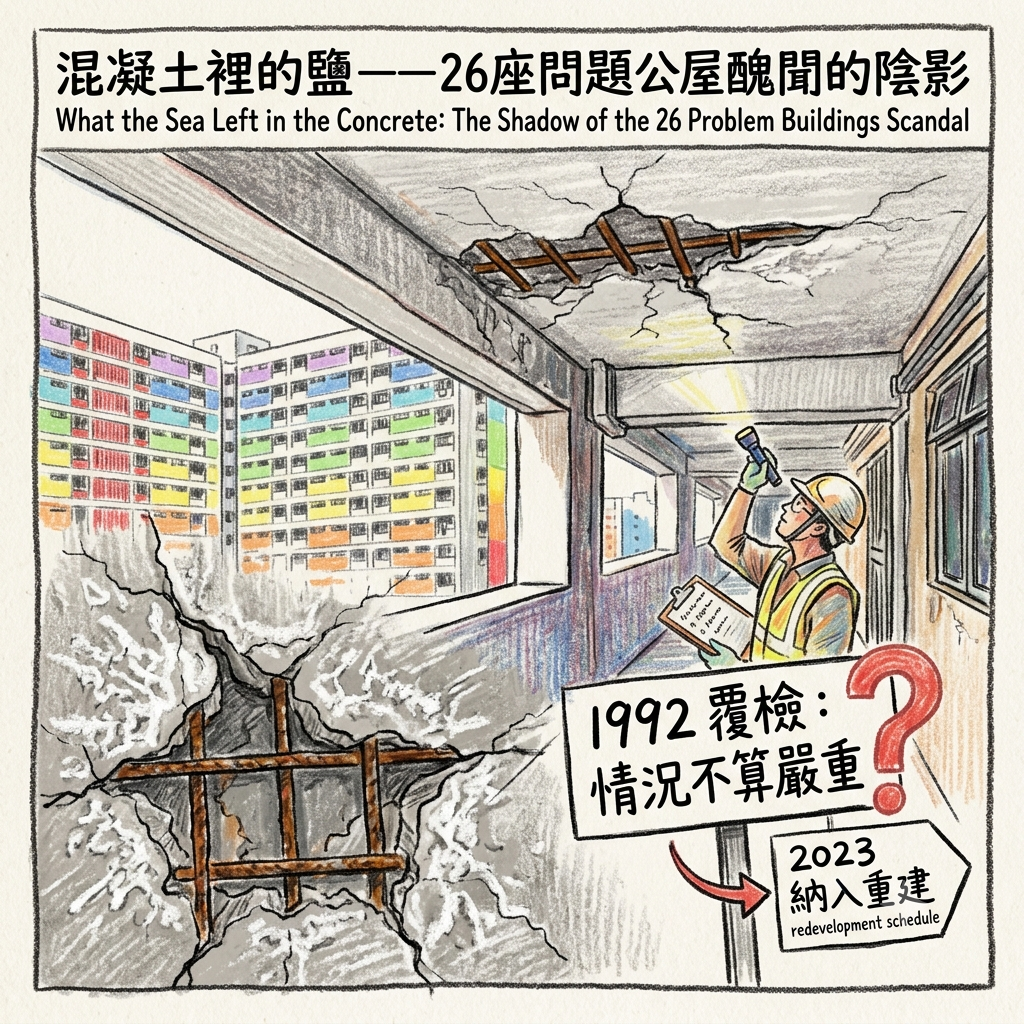
I am going to write this section without the vocabulary I have used elsewhere, because I think using it here would be a kind of evasion. In the early 1980s, public estates across Hong Kong were found to be shedding concrete from their façades. Investigations between 1983 and 1984 discovered that some contractors, cutting costs, had mixed seawater directly into the concrete; the salt accelerated corrosion of the reinforcing steel within. Some cases involved documented collusion between contractors and government officials, and the Independent Commission Against Corruption opened investigations. In 1985, 577 estates were found to be affected; twenty-six blocks were rated so far below safety standards that they were demolished outright — the case remembered in Hong Kong as the "26 Problem Buildings" scandal. A second review at the end of 1992 found 152 more affected buildings. Some blocks at Choi Hung were among them: concrete strength below the required threshold, but rated — by whatever calculus determined such things — not severe enough to warrant demolition. It has never been included in a full redevelopment programme on that basis. It has simply been left, unresolved, for over thirty years, until age itself finally forced the estate onto a redevelopment schedule in 2023.
The_Truth_Behind_Hong_Kong_s_26_Blocks
To describe this as a matter of qi out of balance would be to let the responsible parties off the hook. This was fraud, and it was corruption, and people are owed the plain naming of both. What I will say, in the register this section allows me, is that Choi Hung occupies a strange, suspended category in Hong Kong's structural memory — neither acknowledged as damaged enough to warrant the compensation and relocation given to the twenty-six demolished blocks, nor ever fully cleared of the question mark placed over it in 1992. Residents have lived for three decades inside a low, wordless vigilance about the ceiling above them and the floor beneath — a form of suspended trauma with no ritual, religious or otherwise, built to resolve it. The government now spends some HK$900 million annually maintaining the estate, a figure that is itself a kind of monument to the suspension.
IV. The Names the Residents Chose for Themselves
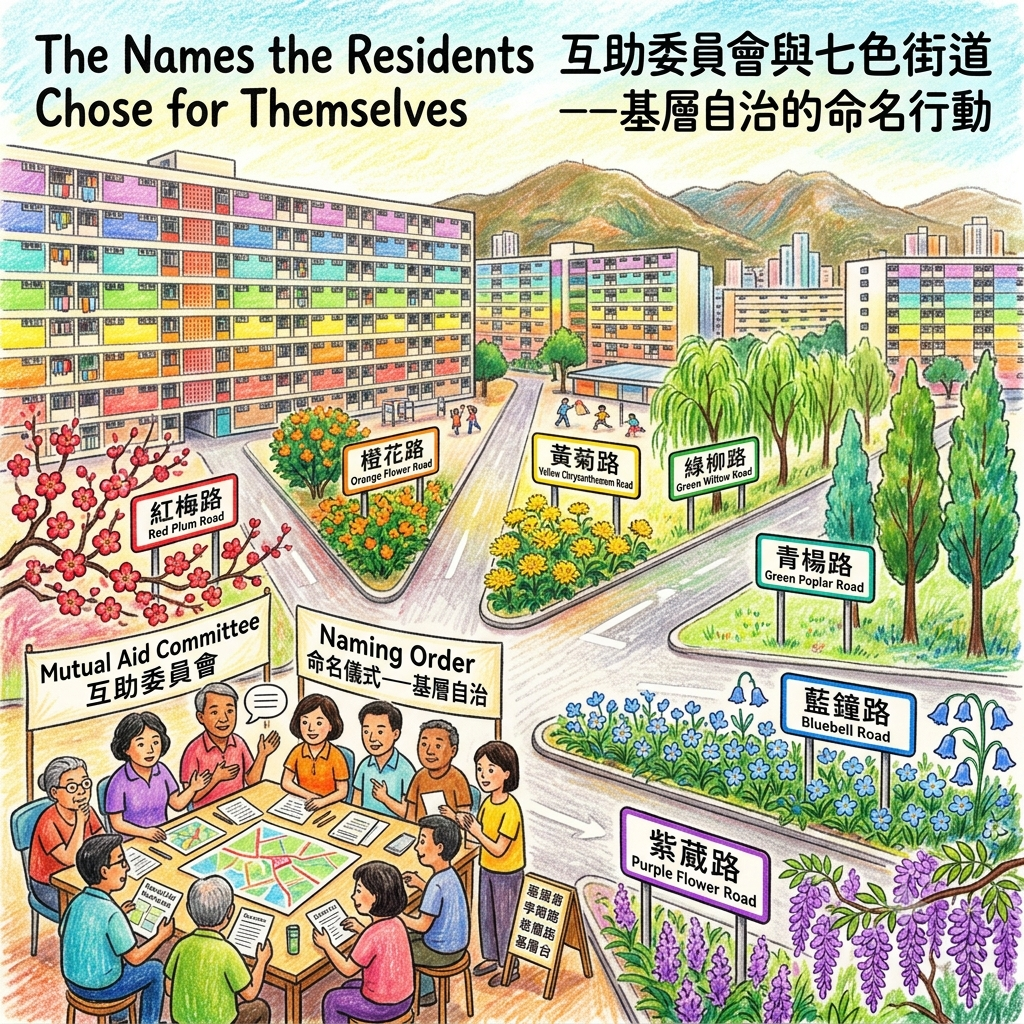
When the estate was newly occupied, residents in each block formed mutual aid committees — a grassroots form of building self-governance native to Hong Kong's postwar housing culture. The seven principal roads within the estate — named for plum blossom, orange blossom, chrysanthemum, willow, poplar, bellflower, and wisteria, each beginning with a colour character matching the spectrum — were not the product of a planning department's decision. They were negotiated among mutual aid committee members in the estate's earliest years.
The_Secret_Authors_of_Rainbow_Estate
Naming, in the folk cosmology this ground belongs to, has never been a neutral act; it is a ritual gesture that fixes order and settles the fortune of a place. What the residents did, whether or not any of them would have described it this way, was take a colour system imposed from above and translate it into a vocabulary they themselves could speak and pass on. They likely never framed it as an act of Five-Element correspondence. But in practice, in the ordinary business of self-governance, they re-enacted the deep structure of a much older Lingnan tradition — the governing of space through the imposition of colour and name — leaving a cultural signature that has outlasted the committees themselves. Those seven street names remain, unchanged, on every government map and postal address in Hong Kong today.
V. The Names That Are Closing, One by One
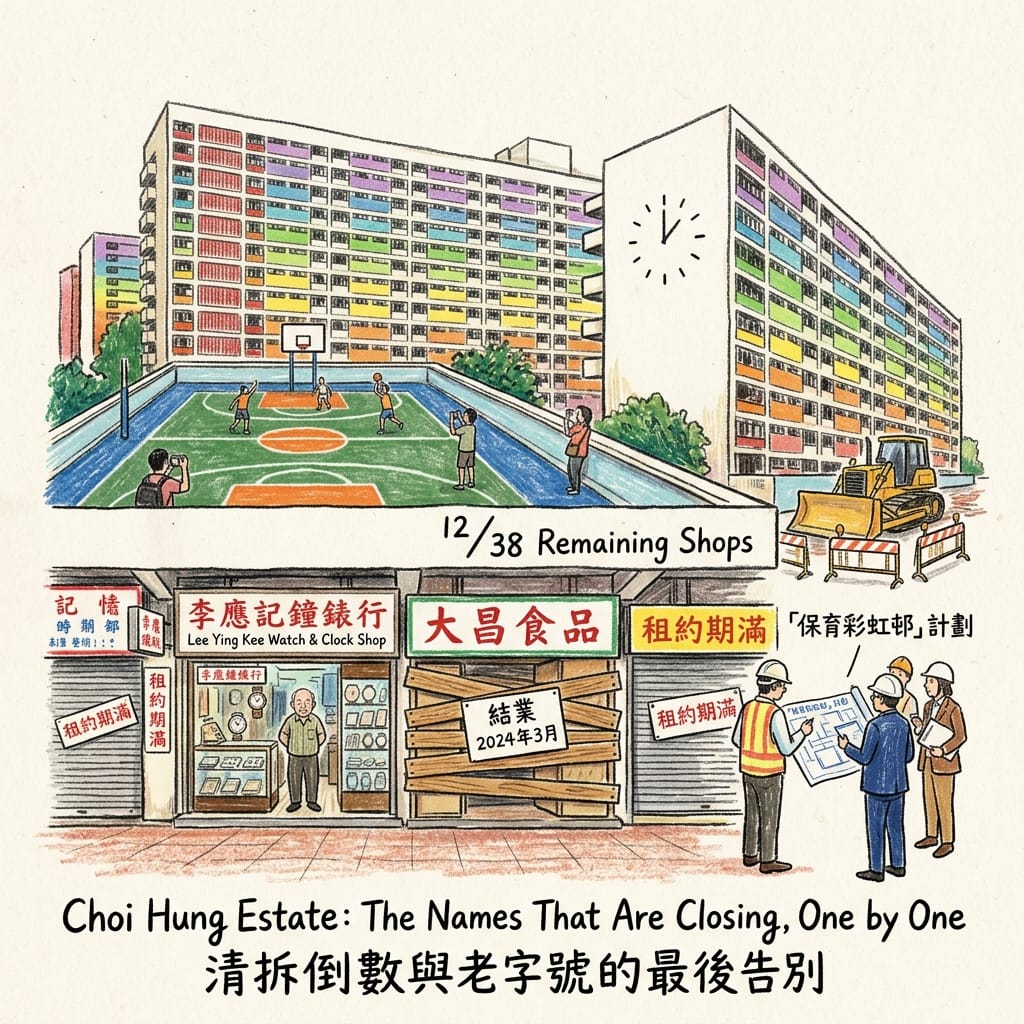
Since the 2010s, Choi Hung's painted façades and rooftop basketball court have become an unlikely global photography pilgrimage site, at times drawing more than five hundred visitors a day. Meanwhile the estate has passed sixty years of age, and maintenance costs have climbed accordingly. In December 2023, the Housing Authority formally approved a redevelopment study — demolition in three phases, the first as early as 2028, the full project not expected to conclude until 2049. A group of architecture professionals, unprompted, formed a "Conserve Choi Hung" initiative and published a seventy-six-page proposal. Resident sentiment, however, has diverged from the enthusiasm of that outside advocacy — most residents interviewed express little hope of, or particular attachment to, preservation; some say plainly that they would rather move into newer housing sooner. Of the estate's thirty-eight original shops, only twelve remain in continuous operation, including a sixty-one-year-old watch and clock shop run by a second-generation owner. A thirty-eight-year-old grocery closed in March 2024.
Choi_Hung__Fading_Names
I will not reach for cosmology here either. This is a story about the ordinary, secular collision between redevelopment policy and the preservation of community memory, and it deserves to be named as exactly that. What is happening at Choi Hung is a race between institutional forgetting and collective memory — a demolition timetable moving forward under the sole logic of safety and housing supply, and a conservation discourse, largely generated from outside the estate, attempting to secure heritage status on typological grounds. The shops are closing faster than either process can resolve.
What the Colour Was Covering
The most easily photographed surface of Choi Hung is also the one that conceals the deeper pattern running beneath five of these six stories: this is a colonial governance experiment in which a chromatic order was systematically applied over an erased agrarian memory, and never quite managed to conceal the structural fracture underneath it. From the clearance of Sha Tei Yuen and the rainbow that gave the estate its name, to the mutual aid committees who translated an imposed colour scheme into a language of their own making, Choi Hung has always used aesthetic order to cover a historical break. But that order has never fully closed the wound beneath it — from the unresolved concrete crisis of the 1980s to the current gap between departing tenants and arriving preservationists, the estate keeps demonstrating that no number of coats of paint reaches all the way down to the concrete.
When this sixty-year act of chromatic containment finally ends, what will remain are seven street names, chosen by residents no history book records by name, for roads that will very likely outlast the buildings they run beside. Historical memory may be the one asset a rapidly vanishing century cannot digitise, relocate, or repaint over — which is, perhaps, reason enough to walk here before the scaffolding goes up. If that is a walk you want to take with us again, our dispatches on the vanishing corners of this hemisphere arrive by subscription.
Accessing the Physical Node
Choi Hung Estate sits in Wong Tai Sin District, Kowloon, a short walk from Exit C4 of Choi Hung MTR station on the Kwun Tong Line, adjacent to the Choi Hung interchange. The rooftop basketball court is open daily from 7am to 11pm; afternoon light strikes the block façades most directly, producing the deepest colour saturation for anyone hoping to see the estate as its architects intended it to be read. Kam Bik House and its ground-floor restaurant remain open to visitors — photographers are asked to keep their voices low out of respect for residents going about ordinary domestic life in what is, for them, simply home. With the redevelopment study now approved, travellers hoping to document this history are advised not to wait; nearby Wong Tai Sin Temple and the Kowloon City district offer a range of guesthouses and boutique hotels suitable as a base for a longer walking itinerary through postwar Hong Kong's public housing landscape.
Reference and Further reading
First layer – Main sources of literature and institutions:
- 香港房屋委員會官方屋邨歷史資料;
- 黃大仙區議會文件(彩虹邨重建研究相關文件,2024年11月5日會議文件第51/2024號)。
- 香港房屋委員會網站歷史圖片檔案。
- 港政府1985年公佈之577座問題公屋官方文件;
- 香港房屋委員會維修工程紀錄。
- 香港政府街道命名紀錄;
- 香港房屋委員會邨務管理歷史檔案。
- 香港房屋委員會2023年12月重建研究議案文件;
- 黃大仙區議會文件第51/2024號(2024年11月5日會議,彩虹邨重建研究——清拆及遷置建議方案)。
The second layer – secondary academic materials:
- 香港公共屋邨史學研究(涉及屋建會時期公屋政策轉型之學術著作)。
- 香港殖民地時期公共關係史相關研究。
- 香港公共屋邨結構安全史學研究;廉政公署相關案例研究。
- 香港基層社區自治史(互助委員會制度研究)相關學術著作。
- 「保育彩虹邨」計劃76頁保育方案倡議書;香港戰後建築保育政策相關學術論述。
Third layer – Supplementary information:
- 街坊口述歷史(如社企「街坊帶路」社區導師湛先生自1962年入住至今之訪談記錄);
- 「雨後彩虹」命名傳說屬集體記憶範疇,非官方檔案可直接佐證。
- 街坊口述歷史及地方媒體專題報導(如香港中通社「街坊帶路」系列)。
- 受影響居民口述歷史。
- 老街坊口述歷史(如受訪街坊「湛Sir」提及互助委員會式微前後社區參與度落差之訪談)。
- 邨內老店舖經營者及居民口述歷史(如明周文化、香港中通社「街坊帶路」等媒體專題訪談)。
Historical gap:
- Existing public records offer scant detail regarding the specific relocation destinations and compensation mechanisms for the original residents of Sha Tei Yuen; it is recommended that original archives (such as clearance compensation records from the Civil Affairs or Public Works departments at the time) be consulted for further verification.
- Available public information regarding the specific diplomatic considerations and site-selection decision-making processes for each visit is largely anecdotal; further verification via original archives (such as correspondence involving Government House or records from the British Foreign Office) is recommended.
- Existing public records lack clarity regarding which specific blocks and floors of Choi Hung Estate were included in the list of 152 "problematic buildings," as well as the specific engineering rationale behind the assessment that the situation was "not serious"; it is recommended that original archives (such as the full text of the 1992 review report and internal Housing Authority grading documents) be consulted.
- No complete record exists in the public domain regarding the names of the Mutual Aid Committee members involved in the naming discussions or the specific details of those deliberations; it is recommended that original archives (such as meeting minutes from the estate management office during the 1960s) be consulted.
- At the time of writing, the specific phasing list of buildings and the final rehousing plan for the three-phase clearance and redevelopment project remain in the District Council consultation stage, with details not yet fully disclosed; it is recommended that original archives (such as the latest relocation schedule released by the Housing Department) be consulted for further verification.
 Lawrence
 Lawrence
 Lawrence
The sources for this article include primary historical records, academic papers, and public records from various levels of administrative bodies, with a commitment to historical accuracy; instances requiring further verification against primary archival materials have been noted in the text. Last updated: July 2026.