(ENG) Fortress Hill Historical Walk – 5 Surprising Stories of Military Defense and Cultural Identity
Take a deep dive into Fortress Hill, where colonial military defense, wartime heroism, and migrant cultures overlap. 5 surprising historical stories—from the vanished North Point Battery to the iconic parabolic arches of State Theatre—showing a side of Hong Kong beyond the skyscrapers.

 Lawrence
This is a historical travel story and walking guide to Fortress Hill, a former military frontier on Hong Kong Island. Through five unique historical layers, it explores the hidden batteries, elite yacht clubs, wartime resistance, and the "Little Shanghai" era to show how this quiet district evolved into a vibrant cultural hub. Readers will discover a curated route through hidden alleys and iconic architecture that reveal the city's complex social transformations.
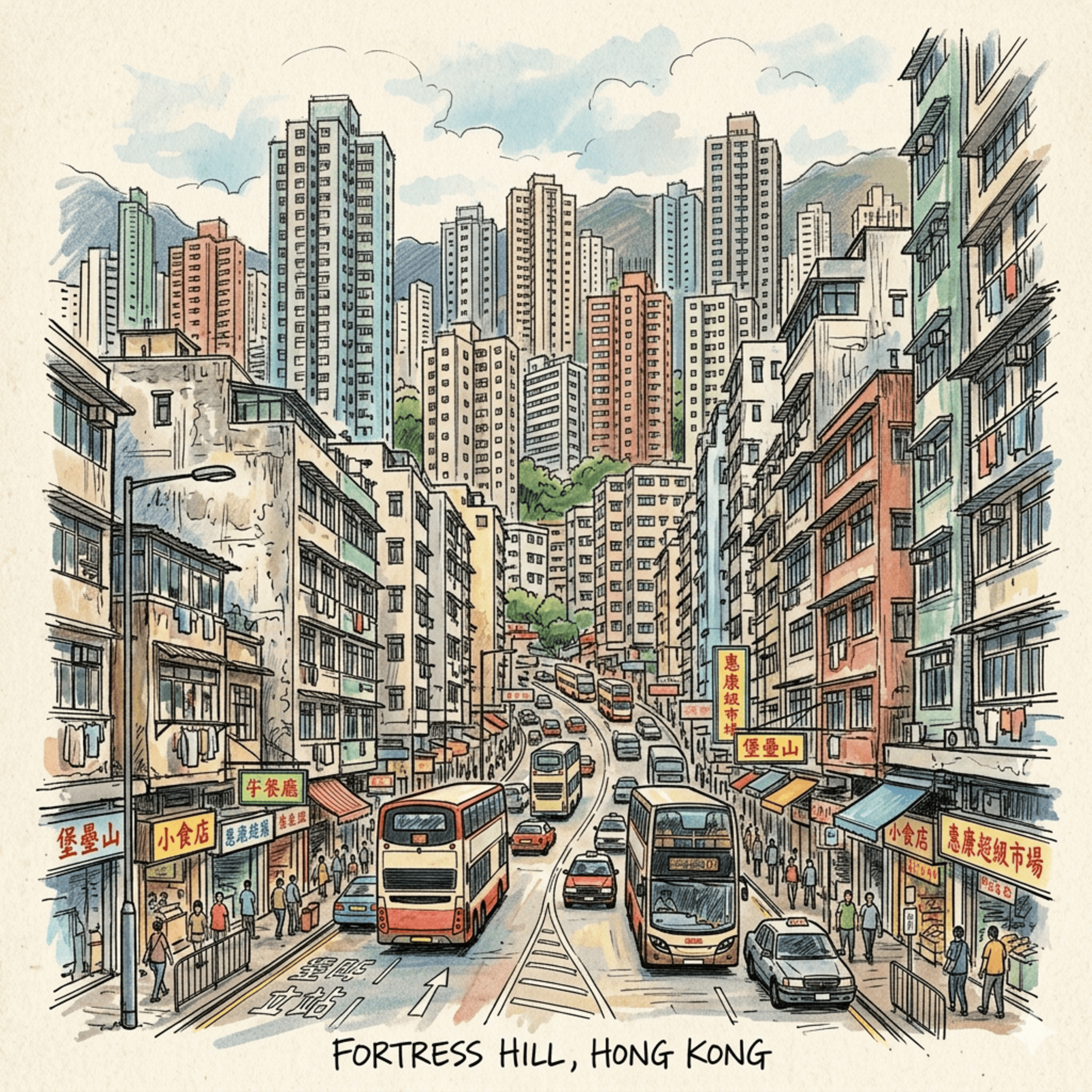
To the casual observer, the transition from Causeway Bay’s neon glow to the residential density of North Point seems like mere urban sprawl. Yet, for the historically minded traveler, this stretch—anchored by Fortress Hill—is a profound study in strategic evolution. From its 19th-century origins as a rugged military outpost protecting Victoria City’s eastern flank to its post-war rebirth as a cosmopolitan melting pot, the area serves as a physical archive of the city’s survival. By walking these streets today, one navigates a series of temporal strata where colonial defense, industrial energy, and migrant narratives are permanently etched into the pavement. This neighborhood reminds us that a city is never finished; it is a permanent work of revision, where each street corner holds a secret of the past. This journey begins at the high ground that gave the district its name: the military foundations of the North Point Battery.
Listen to the historical stories told in detail (For subscribers only)
Story One: The Ghost of the North Point Battery (Military Origins)
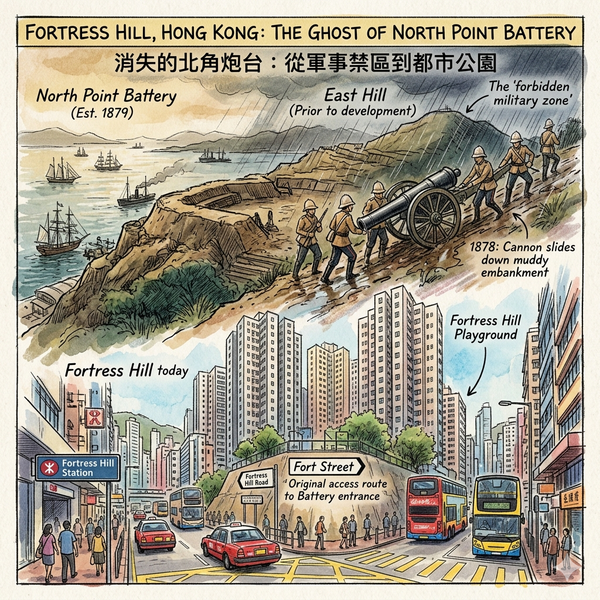
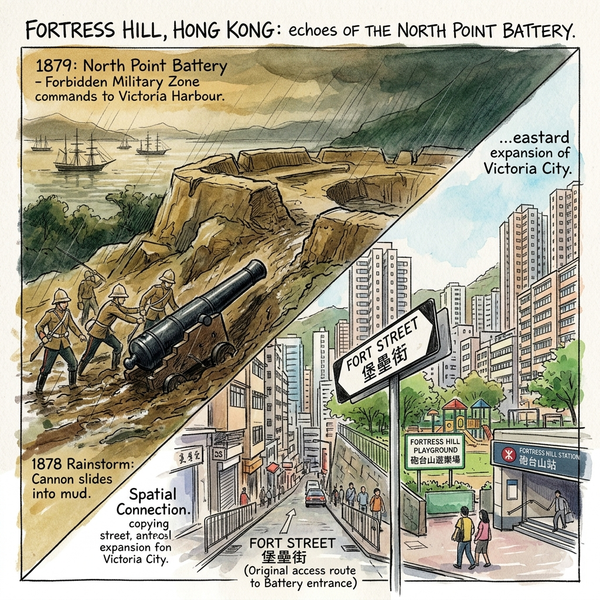
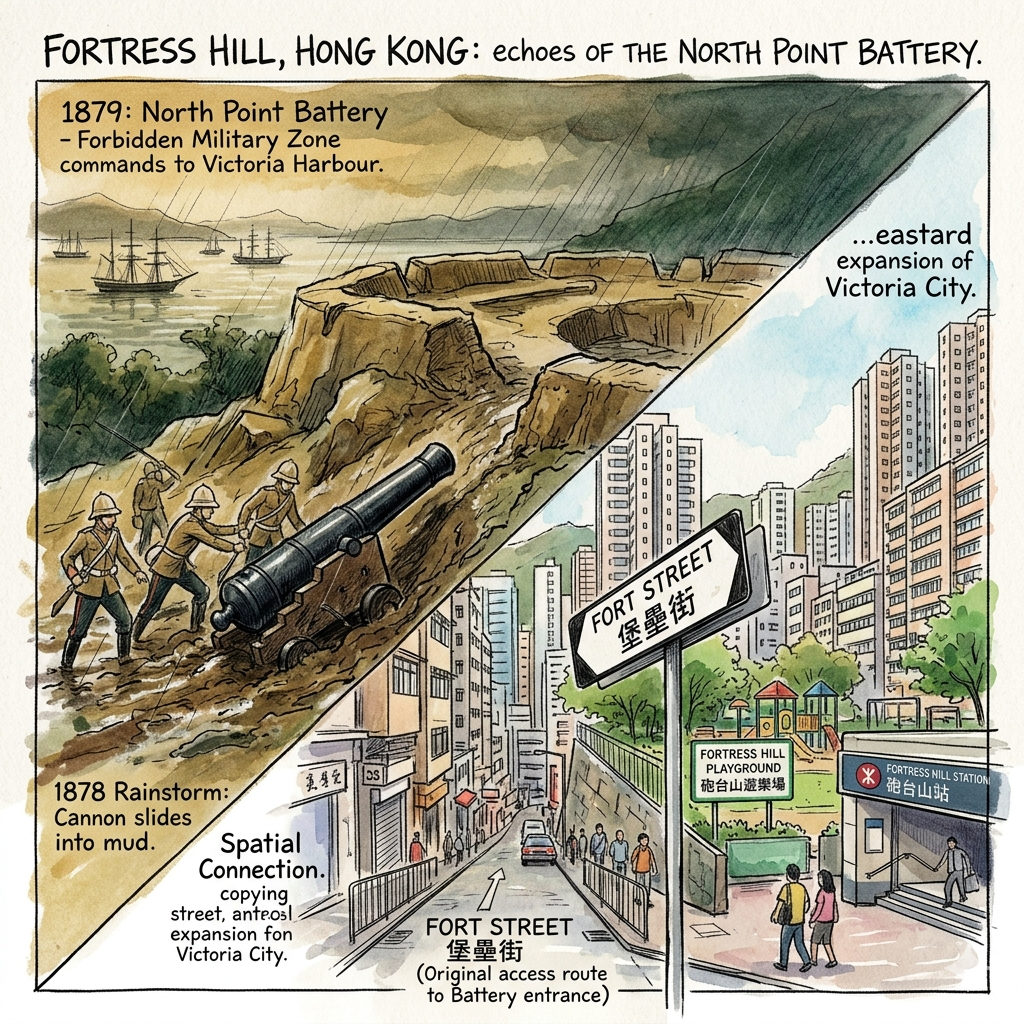
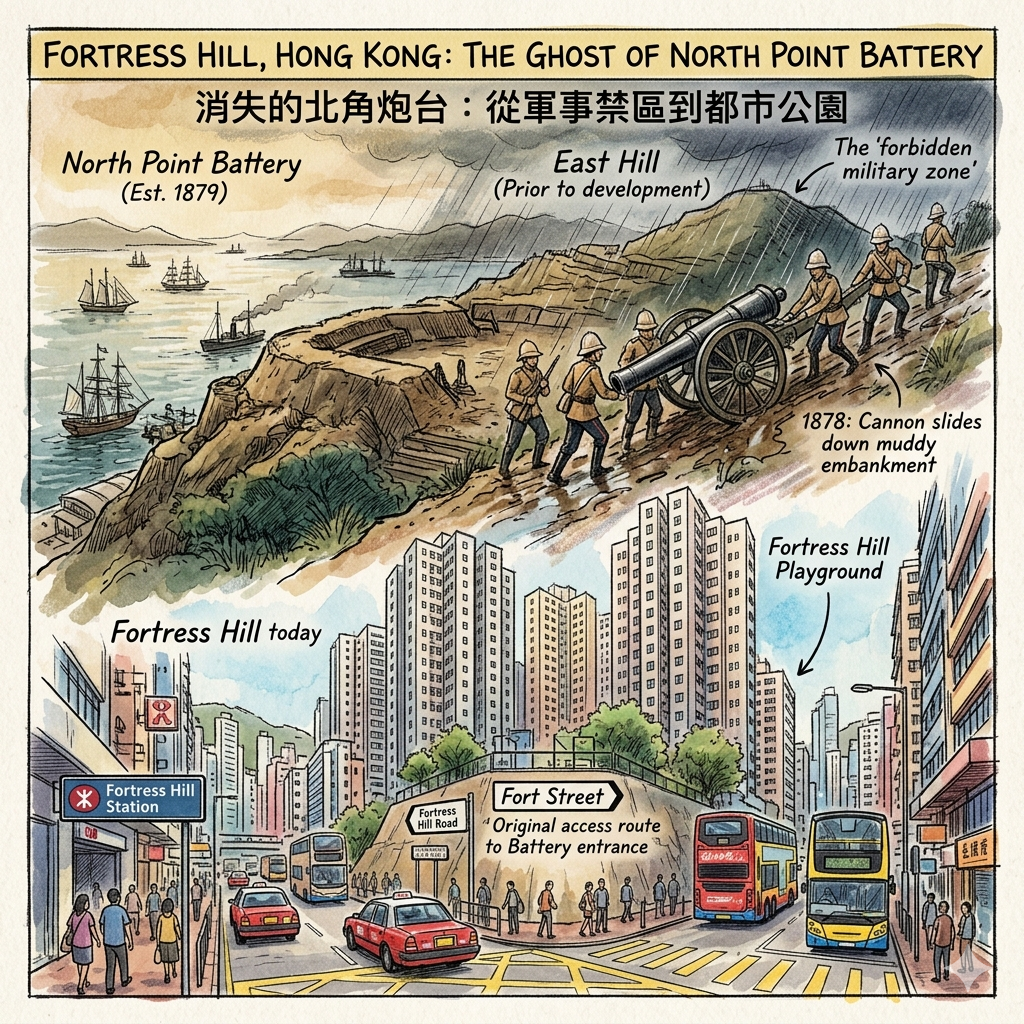
In the 1870s, the area now known as Fortress Hill was a peripheral headland referred to by the British as "East Hill." Its strategic value was immense, commanding the eastern entrance to Victoria Harbour—the "throat" of the colony’s maritime lifeblood. The construction was a grueling endeavor; in June 1878, a particularly violent rainstorm decimated the unfinished earthworks, famously causing a heavy cannon to slide down the embankment into the mud. Despite such setbacks, the North Point Battery was established by 1879, dictating the initial urban rhythm of the area by cordoning off the heights as a "forbidden military zone."
The battery’s "Military Life Cycle" illustrates a broader narrative of British global defense, evolving from stationary heavy artillery to more modern systems before eventually yielding to urban growth.
Year | Artillery Configuration | Strategic Context & Defensive Consideration |
1879 | 1 x 7-inch RML, 2 x 9-inch 12-ton RML, 1 x 8-inch Howitzer | Initial establishment of close-shore strike capability for the eastern harbour entrance. |
1886 | 1 x 9-inch 12-ton RML, 2 x 7-inch RML, 1 x 8-inch Howitzer | Fine-tuning of defensive strategy to enhance specific angles of fire coverage. |
1904 | 2 x 6-inch BL Mk VII (approved), 2 x 9-inch RML | Modernization; breech-loading technology significantly increased rate of fire and precision. |
1922 | None (Battery decommissioned and dismantled) | Shift toward the "Gin Drinkers Line"; defensive focus moved to the New Territories and outer perimeters. |
The Catalyst for Change The decommissioning of the battery in 1922 was a watershed moment. By dismantling the fortifications, the colonial government released critical land for urban expansion. This transition from a restricted military enclave to a residential core effectively pushed the boundaries of Victoria City eastward, transforming a defensive edge into a civic center.
Spatial Connection Modern travelers can find the battery’s legacy inscribed in the local nomenclature. While the physical guns are gone—the site now occupied by the Fortress Hill Playground—the names Fortress Hill Road, Fort Street, and Fortress Hill Station act as the strongest echoes of this past. Fort Street, in particular, remains as the original access route to the battery entrance.
From these high defensive grounds, we move down the slope toward the original coastline, where the focus shifted from military might to colonial leisure.
Story Two: The Red Bricks of Oil Street (Elite Seclusion to Public Art)
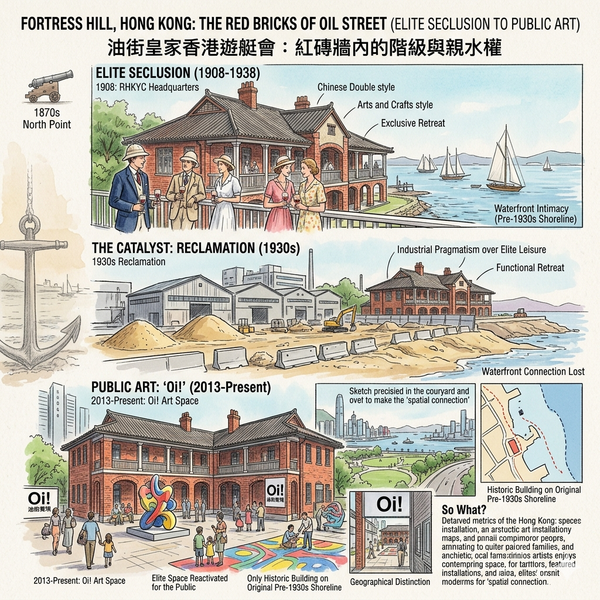
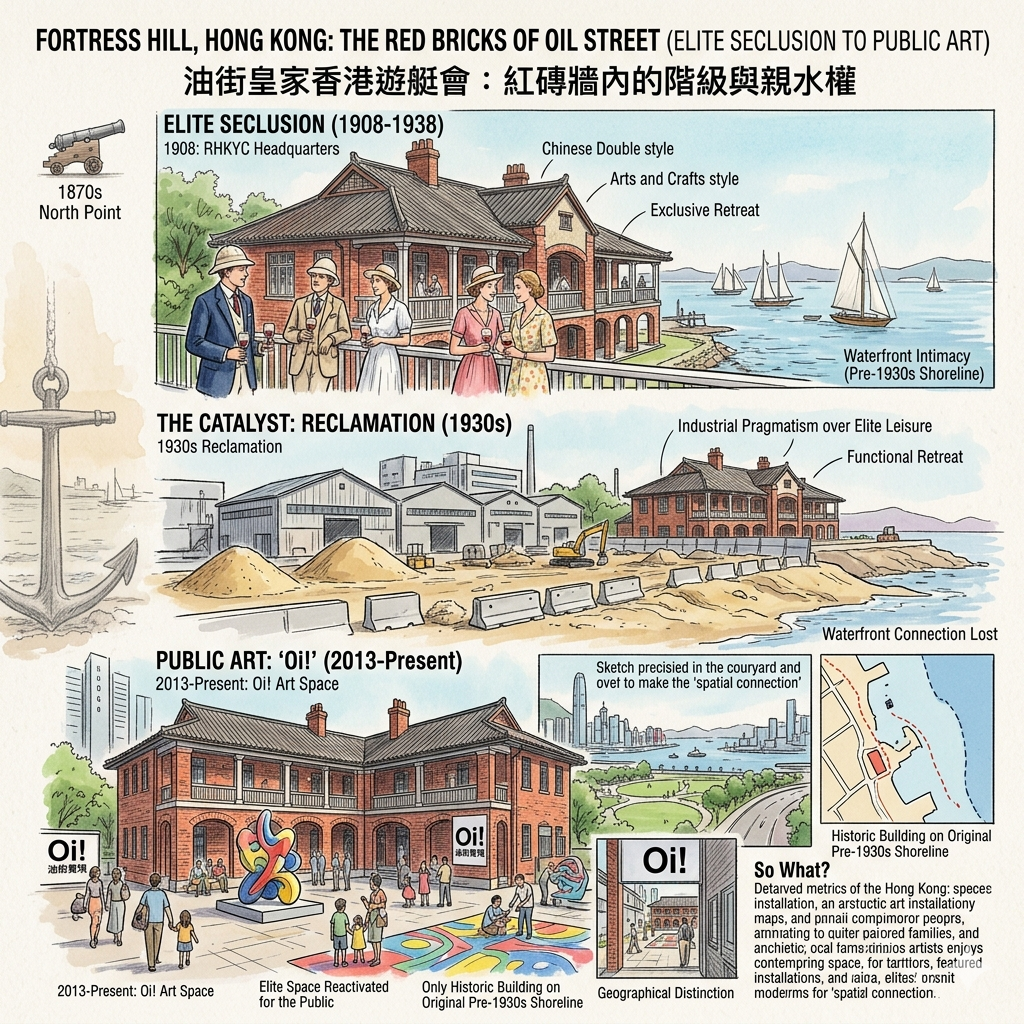
By 1908, the Royal Hong Kong Yacht Club established its first permanent headquarters at Oil Street, a location that, prior to the massive 1930s reclamations, sat directly on the tranquil waterfront. This choice of site was a clear exercise of colonial privilege, securing the most desirable natural resources for the European elite. The clubhouse was designed in the "Arts and Crafts" style, a rarity in Hong Kong, emphasizing a retreat from the industrializing city.
"The red brick exterior walls, coarse plaster, prominent chimneys, and wide verandas formed a unique visual language... a salon where gentlemen could socialize, drink wine, and look out over Victoria Harbour after racing."
The Impact of Reclamation The functional life of the club at Oil Street was ended by the government's pivot toward industrial pragmatism. In the 1930s, the administration prioritized warehousing and industrial growth over elite leisure, initiating reclamation projects that pushed the shoreline far from the clubhouse’s verandas. This "functional retreat"—forcing the club to Kellett Island in 1938—demonstrated that even the most elite colonial institutions were subject to the state's economic expansion goals, breaking their absolute monopoly over the waterfront.
Spatial Connection Direct your attention to "Oi!" at 12 Oil Street. This vibrant art space holds a unique geographical distinction: it is the only historic building in the area sitting on the original pre-1930s shoreline. Standing in its courtyard, one can still sense the "waterfront intimacy" that once defined this enclave.
The transition from the leisure of the elite to the grim reality of 1941 was swift and violent.
Story Three: The Hughesiliers’ Last Stand (The "Old Men’s Corps")
In December 1941, the North Point Power Station became the "energy heart" of the island and a primary target for invading Japanese forces. With regular forces stretched thin, the defense fell to the "Hughesiliers," a reinforced infantry platoon composed of expatriates over the age of 55. These were veterans of the Great War, many of whom were prominent "taipans" or government officials.
Led by Major John Johnston Paterson of Jardine Matheson, the group refused to retreat. In a notable display of tactical aggression, the Hughesiliers successfully destroyed a Japanese rapid-fire gun position on Fortress Hill Road. The cost was high: HKJC Chairman Pearce fell in battle, and the plant manager, Vincent Sorby, died later in a POW camp.
Challenging the Narrative The defense of the power station challenges the cynical stereotype of a fleeing colonial elite. For the Hughesiliers, Hong Kong was their adopted home. Their fierce resistance reflected a deep "local identity" and a sense of duty that transcended their merchant roles, providing crucial time for British forces to regroup in the south.
Spatial Connection The power station is now masked by the City Garden estate, but Electric Road and Power Street remain as silent markers of the site’s former life as an energy hub and a site of intense urban combat.
From the wreckage of war, the district rose again as a center for high culture and international migration.
Story Four: Harry Odell’s "Civic Hall" (The Empire Theatre)
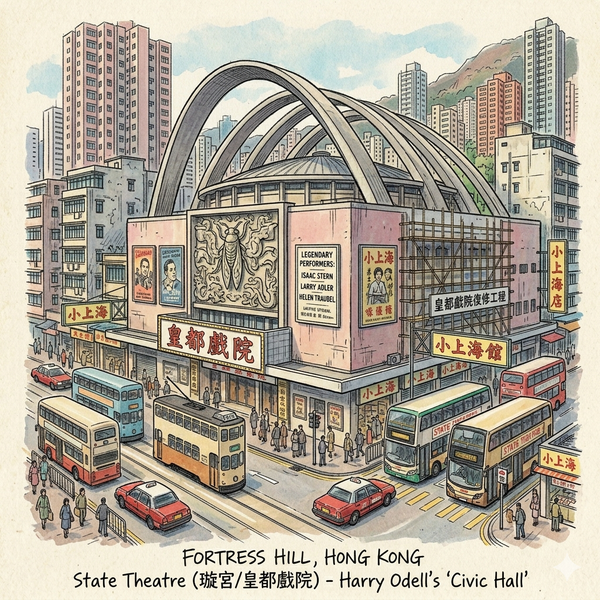
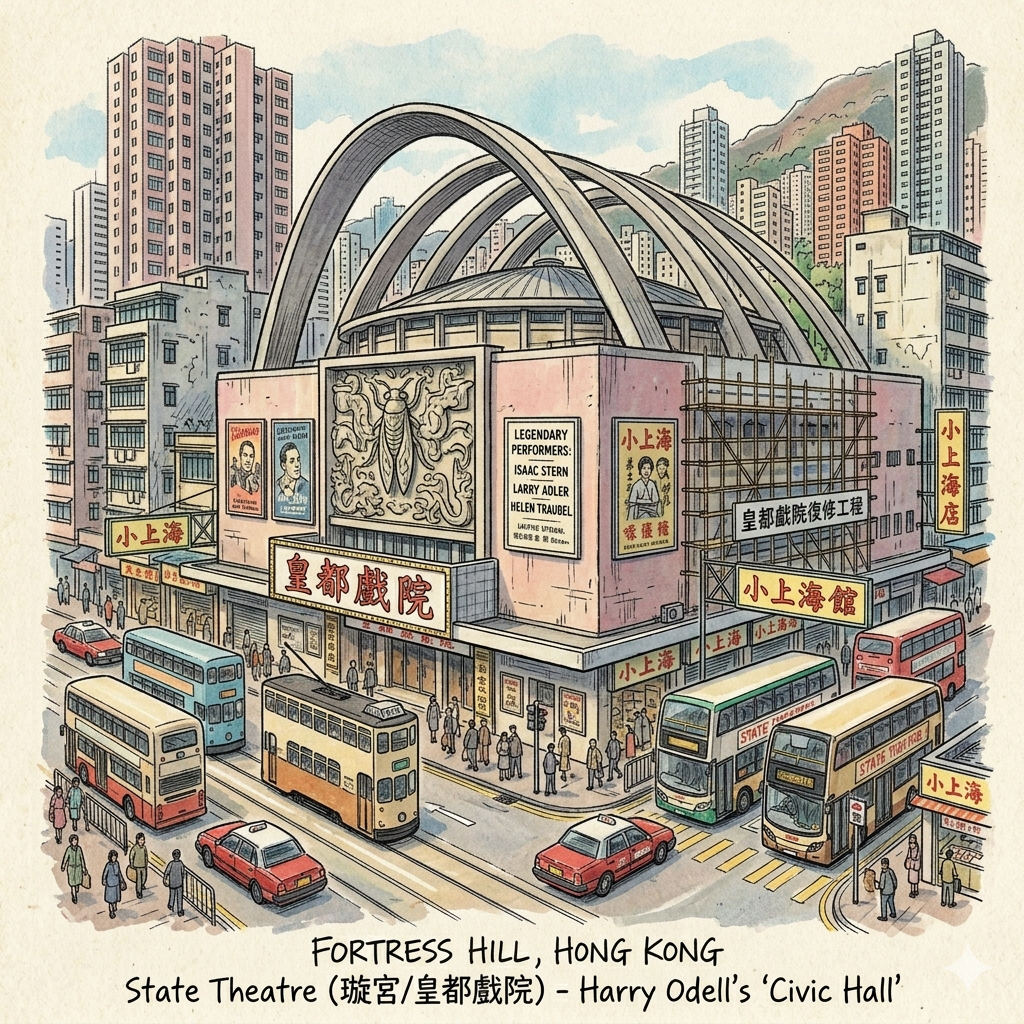
In the late 1940s, a wave of affluent migrants from Shanghai settled in North Point, earning the area the nickname "Little Shanghai." Amidst this influx, Harry Odell—a former tap dancer and war veteran—envisioned a world-class venue. In 1952, he opened the Empire Theatre (later the State Theatre) on King’s Road, operating on a "Business for Culture" model that used cinema revenue to subsidize high-tier classical performances.
World-Class Performers at the Empire:
- Helen Traubel: The renowned New York Metropolitan Opera soprano.
- The Sino-British Orchestra: Predecessor to the Hong Kong Philharmonic.
- Isaac Stern: The violin virtuoso who put Hong Kong on the global classical map.
- Larry Adler: The legendary harmonicist who later inspired local icon James Wong.
Spatial Connection The theatre served as a "cultural bridge" during the Cold War, functioning as Hong Kong’s civic hall a decade before the official City Hall opened. Its architectural significance remains visible today in the unique parabolic concrete arches—the "flying arches"—that soar over the roof on King’s Road.
While Odell brought global elite culture to the main road, a different kind of migration was transforming the ground-level streets.
Story Five: The Tram through the Market (Little Shanghai to Little Fujian)
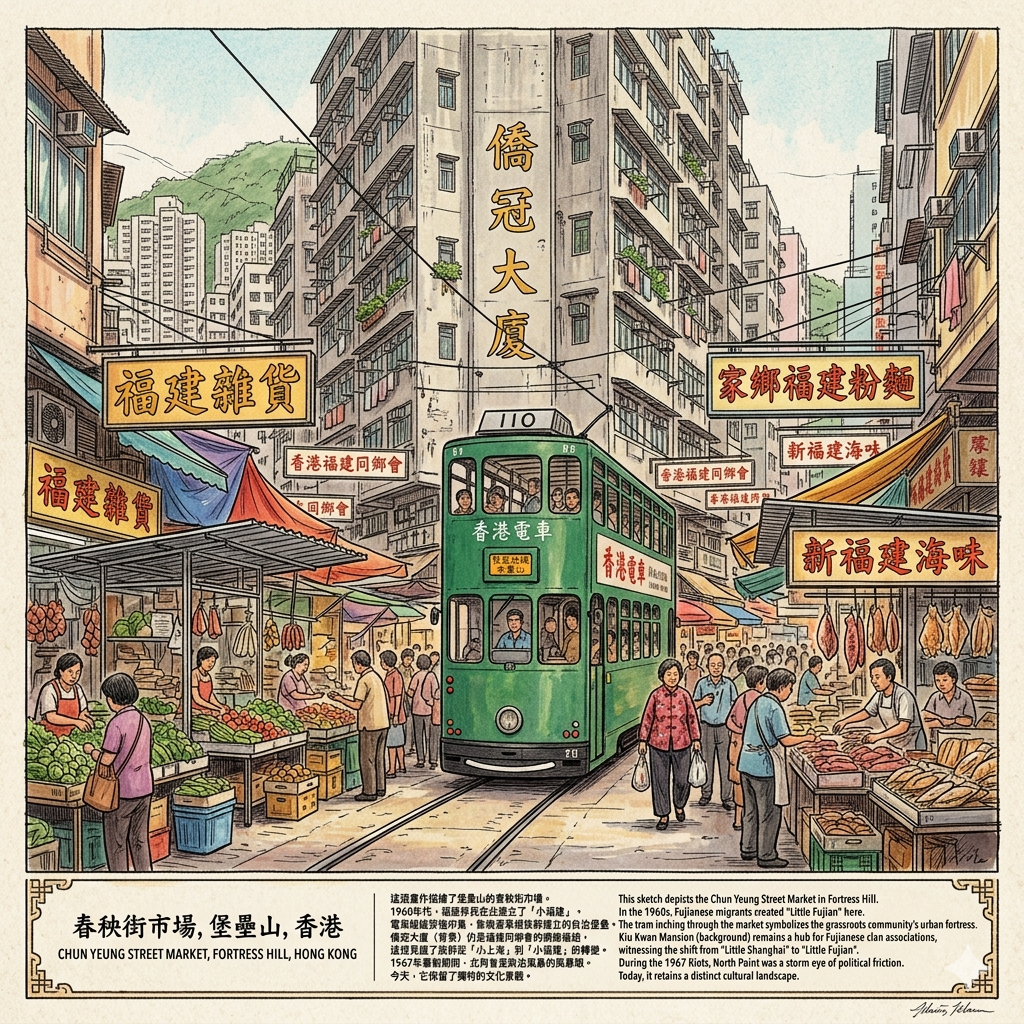
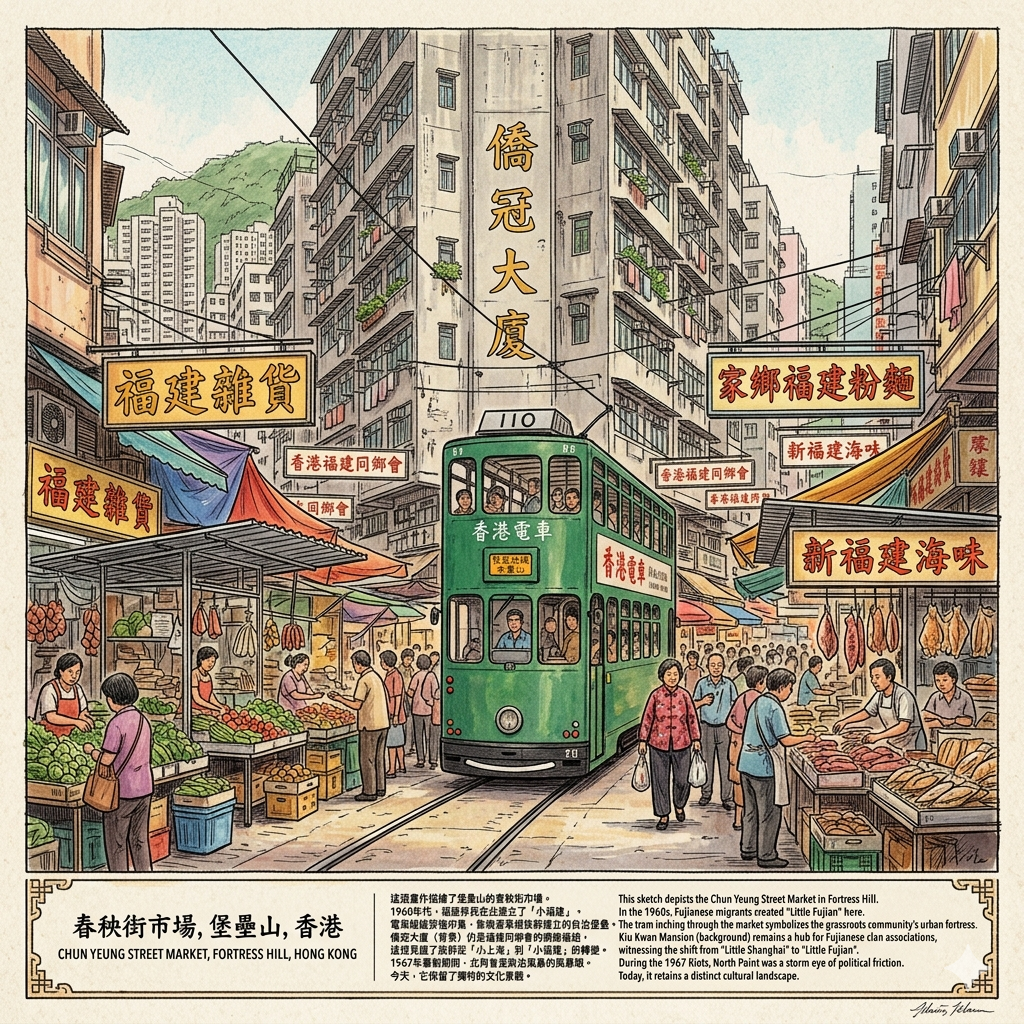
By the 1960s, the demographic character shifted from the elite "Little Shanghai" to the grassroots "Little Fujian." Migrants from Fujian province, drawn by kinship networks, created a self-governing urban fortress around Chun Yeung Street.
Culture / Period | Represented Era | Key Landmarks | Political Character |
"Little Shanghai" | 1940s–1950s | Empire Theatre, Ritz Nightclub | Elite-leaning, sophisticated, Westernized. |
"Little Fujian" | 1960s–Present | Chun Yeung Market, Kiu Kwan Mansion | Grassroots, dialect-driven, leftist stronghold. |
A Diaspora Slice During the 1967 Riots, North Point became the "storm eye" (風暴眼) of political friction. Local clan associations and department stores in the area were fortified centers of resistance against the colonial administration. Today, Chun Yeung Street remains a "diaspora slice," where Hokkien dialect and regional food stalls define the sensory experience.
Spatial Connection The most evocative way to experience this history is the "Ding Ding" tram ride through the Chun Yeung Street Market. As the tram inches through dense stalls, it passes the Kiu Kwan Mansion, which still serves as a hub for the Fujianese clan associations that maintain the area’s distinct social networks.
The Hidden Gem
For the historically minded traveler, the Oi! Art Space is the quintessential stop. Beyond its red-brick Arts and Crafts charm, it offers the rare opportunity to stand on the original pre-1930s shoreline, allowing you to physically witness where the natural harbor once met the colonial city.
Sophisticated Reflection & Conclusion
To walk through Fortress Hill and North Point is to engage in "layered observation." This neighborhood is a 立体编年史 (3D chronicle), where historical eras are not replaced, but stacked one atop the other. The military heights of the 1870s still loom over the 1941 battlefields of Electric Road; the elite verandas of Oil Street exist in the shadow of the parabolic arches where global maestros once played; and the "Ding Ding" tram continues to navigate a market defined by 1960s migration patterns.
This district reminds us that the city is a permanent work of revision. Each inhabitant and traveler adds a new, temporary layer to this dense history. As you stand amidst the bustling markets of Chun Yeung Street or under the arches of the State Theatre, one must ask: which layer of this city’s defense, culture, or energy are you walking upon at this very moment?
To continue your exploration of Hong Kong’s hidden urban narratives, subscribe to our newsletter for more Historical Travel Stories.
Planning Your Historical Walk
How to Get There: Take the MTR Island Line to Fortress Hill Station. Use Exit A for the heights (Fortress Hill Road) or Exit B for the waterfront areas (Oil Street).
Recommended Walking Path:
- Start at Oil Street (Oi! Art Space): Observe the red brick architecture and the original shoreline.
- Ascend to Fortress Hill Playground: View the site of the former North Point Battery via Fort Street.
- Walk along Electric Road: Pass the site of the former Power Station (City Garden).
- Navigate Chun Yeung Street: Experience the tram market and the "Little Fujian" atmosphere.
- End at the State Theatre: View the parabolic arches on King’s Road.
Nearby Accommodation: North Point offers several heritage-conscious hotels, such as those near the waterfront, which prioritize the area’s history while providing modern views of Victoria Harbour.
Q & A
How did Fortress Hill evolve from a military outpost to a residential hub?
The evolution of Fortress Hill from a military outpost to a residential hub was a process of strategic withdrawal and urban expansion that spanned over a century. This transition was driven by changes in military technology, large-scale land reclamation, and massive waves of immigration.
1. The Military Era: Guarding the Eastern Wing (1879–1922)The name "Fortress Hill" (砲台山) originates from the North Point Battery, established in 1879 on a headland then known as "East Hill".
- Strategic Purpose: The battery was a core defense point guarding the eastern throat of Victoria Harbour.
- Military Technology: It evolved from using muzzle-loading guns to modern breech-loading guns by 1904, reflecting the shifting naval defense needs of the British Empire.
- Obsolescence: By the 1920s, the defense strategy shifted toward a "depth defense" further out in the New Territories (the Gin Drinkers Line). Consequently, the battery was dismantled in 1922, and the land was returned to the colonial government for urban development.
2. The Industrial and Infrastructure Phase (1920s–1970s)As the military vacated, the area became an energy and logistics center for the growing city.
- North Point Power Station: This facility became the power "heart" of Hong Kong Island. During the 1941 Battle of Hong Kong, it was the site of a fierce defense by the "Hughesiliers" (a unit of older volunteers) against Japanese forces.
- Reclamation: Massive reclamation in the 1930s pushed the original coastline outward. This changed the area’s nature from a maritime social hub—evidenced by the Royal Hong Kong Yacht Club’s presence in Oil Street until 1938—to a more industrial and land-based zone.
3. Demographic Transformation: "Little Shanghai" to "Little Fujian"The mid-20th century saw Fortress Hill and North Point become a haven for refugees and immigrants, fundamentally changing its social fabric:
- "Little Shanghai" (1940s–50s): Wealthy immigrants from Shanghai settled here, bringing an elite, Westernized culture exemplified by the Empire Theatre (later State Theatre), which hosted world-class classical music performances.
- "Little Fujian" (1960s–Present): A new wave of Fujianese immigrants arrived, establishing a dense, grassroots social network centered around Chun Yeung Street. This shift transformed the area into a high-density residential and commercial stronghold.
4. Modern Residential Hub (1978–Present)The final stage of the transition occurred as industrial sites were replaced by large-scale residential developments:
- From Power to Housing: The North Point Power Station was decommissioned in 1978 and replaced by the City Garden residential complex.
- From Fortress to Community: The original site of the North Point Battery is now occupied by Fortress Hill Methodist Secondary School and the Fortress Hill Garden.
- Historical Echoes: The military past remains visible in the street names, such as Fort Street, which was once the access road to the battery.
Today, the area has completed its transformation from a "military edge" to a "core urban center," where the once-exclusive military and elite spaces have been democratized into public housing, schools, and community art spaces like "Oi!" (the former Yacht Club clubhouse).
What role did North Point landmarks play during the 1941 Battle of Hong Kong?
During the 1941 Battle of Hong Kong, North Point's landmarks transitioned from industrial and social hubs into critical frontline defensive positions against the Japanese invasion. The primary landmark involved was the North Point Power Station, which served as both a strategic military objective and a site of fierce resistance.
1. The North Point Power Station: A Strategic StrongholdThe power station was the "heart" of the island's energy supply and sat directly on the path Japanese forces needed to take to advance toward Central after landing on the north shore.
- The "Hughesiliers" (曉士兵團): Because regular forces were stretched thin, the station was defended by a unique unit of the Volunteer Defence Corps composed entirely of men over the age of 55. Despite being nicknamed the "Old Men's Corps," many were veterans of World War I or the Boer War and included high-ranking members of Hong Kong society, such as John Johnston Paterson, a Taipan of Jardine Matheson.
- The Battle (December 18–19, 1941): When Japanese troops landed on the night of December 18, they quickly surrounded the station. The Hughesiliers refused to retreat, and Paterson even led a squad to destroy a Japanese gun position on Fortress Hill Road.
- Surrender and Sacrifice: The defenders held out until the morning of December 19, when the station caught fire and was eventually overrun. Prominent figures like the Chairman of the Hong Kong Jockey Club, Pearce, were killed in action, and the station manager, Vincent Sorby, later died in a prisoner-of-war camp.
2. Strategic Impact and Historical SignificanceWhile the power station eventually fell, the resistance of the Hughesiliers is historically significant for several reasons:
- Tactical Delay: Their stubborn defense bought critical time for British forces to regroup and redeploy in the southern part of Hong Kong Island.
- Local Identity: The battle challenged the stereotype that the colonial elite would flee in a crisis; instead, these high-society figures chose to fight for what they viewed as their "second home".
- Urban Memory: Although the power station was replaced by the City Garden residential complex in 1978, the surrounding streets—Electric Road and Power Street—remain as markers of the site's former role as the city's energy core and a bloody battlefield.
3. Non-Active LandmarksIt is important to note that other landmarks associated with the area did not play an active role in the 1941 defense:
- North Point Battery: Although it gave "Fortress Hill" its name, the battery had been dismantled in 1922 and was not a functional military site during the Japanese invasion.
- Royal Hong Kong Yacht Club (Oil Street): By the time of the battle, the club had already moved to Kellett Island (1938) after land reclamation removed its access to the water.
- Empire Theatre (State Theatre): This landmark was not built until 1952, though its founder, Harry Odell, was himself a veteran who was injured and captured during the 1941 battle.
Reference and Further reading
- 炮台山社區配套、居民入息、重建升值力|細說炮台山歷史, accessed April 4, 2026,
- 《香港事‧情》香港有兩個炮台山?邊個先係真? - 思考香港, accessed April 4, 2026,
- 炮台山- accessed April 4, 2026,
- North Point Battery, North Point [1879-c.1922] - Hong Kong - Gwulo, accessed April 4, 2026,
- 香港遊艇會- accessed April 4, 2026,
- 油街12 號前香港皇家遊艇會會所, accessed April 4, 2026,
- 香港皇家遊艇會| 港文化18區, accessed April 4, 2026,
- 油街實現 - 香港自遊樂在18區, accessed April 4, 2026,
- Neighbourhood Guide: The Underrated Charm of North Point - ZOLIMA CITYMAG, accessed April 4, 2026,
- 「油街實現」藝術空間第二期發展 - 建築署, accessed April 4, 2026,
- North Point Power Station - accessed April 4, 2026,
- 香港軍事遺跡:魔鬼山炮台的過去與未來 - 知史, accessed April 4, 2026,
- 曉士兵團- accessed April 4, 2026,
- 【香港保衛戰】保衛香港的老人兵團- 曉士兵團- 港識多史|香港歷史 ..., accessed April 4, 2026,
- 曉士兵團- accessed April 4, 2026,
- 皇都戲院- accessed April 4, 2026,
- 由小上海至小福建| 港文化18區, accessed April 4, 2026,
- 把世界帶進香港的歐德禮 - 荃話題- 皇都戲院, accessed April 4, 2026,
- 從保育皇都戲院到拍攝歐德禮紀錄片重現被遺忘的香港《尚未完場》聯合導演祁凱達, accessed April 4, 2026,
- 【皇都戲院(上)】屹立69年世界唯一露天「飛拱」 見證香港電影文化, accessed April 4, 2026,
- 【北角同鄉會.上】福建人在北角命途各異情濃似舊時- 香港 - HK01, accessed April 4, 2026,
- 福建和香港,到底有多親近?, accessed April 4, 2026,
- 攻心為上:香港政府應對「六七暴動」的文宣策略, accessed April 4, 2026
 Lawrence
 Lawrence
 Lawrence