Kowloon Tong: 5 Hidden Spacetime Stories in a Stagnant Garden City
This is a historical travel story and walking guide to Hong Kong's Kowloon Tong. Through five hidden stories—from a 1920s British "Garden City" experiment to Bruce Lee's final nest—discover how an institutional seal preserved a century of memory within a geometric grid.
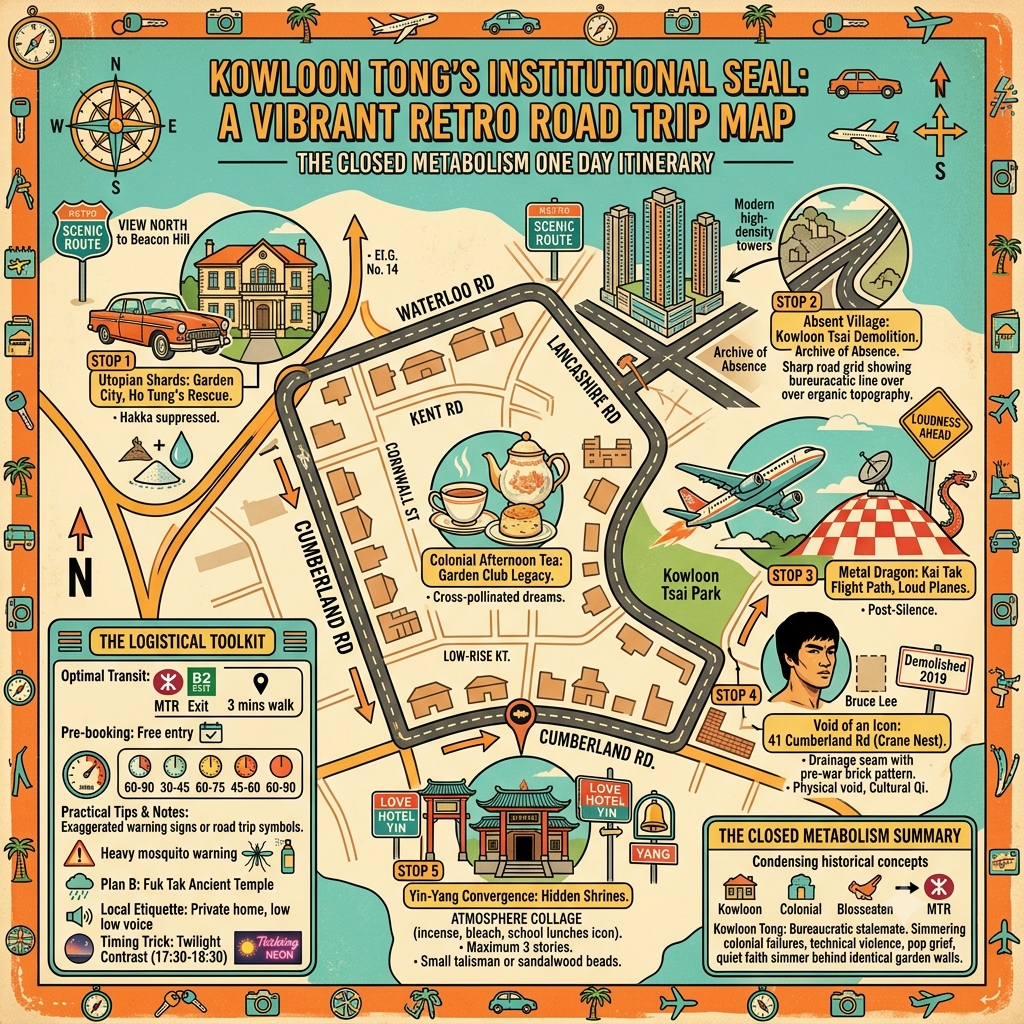
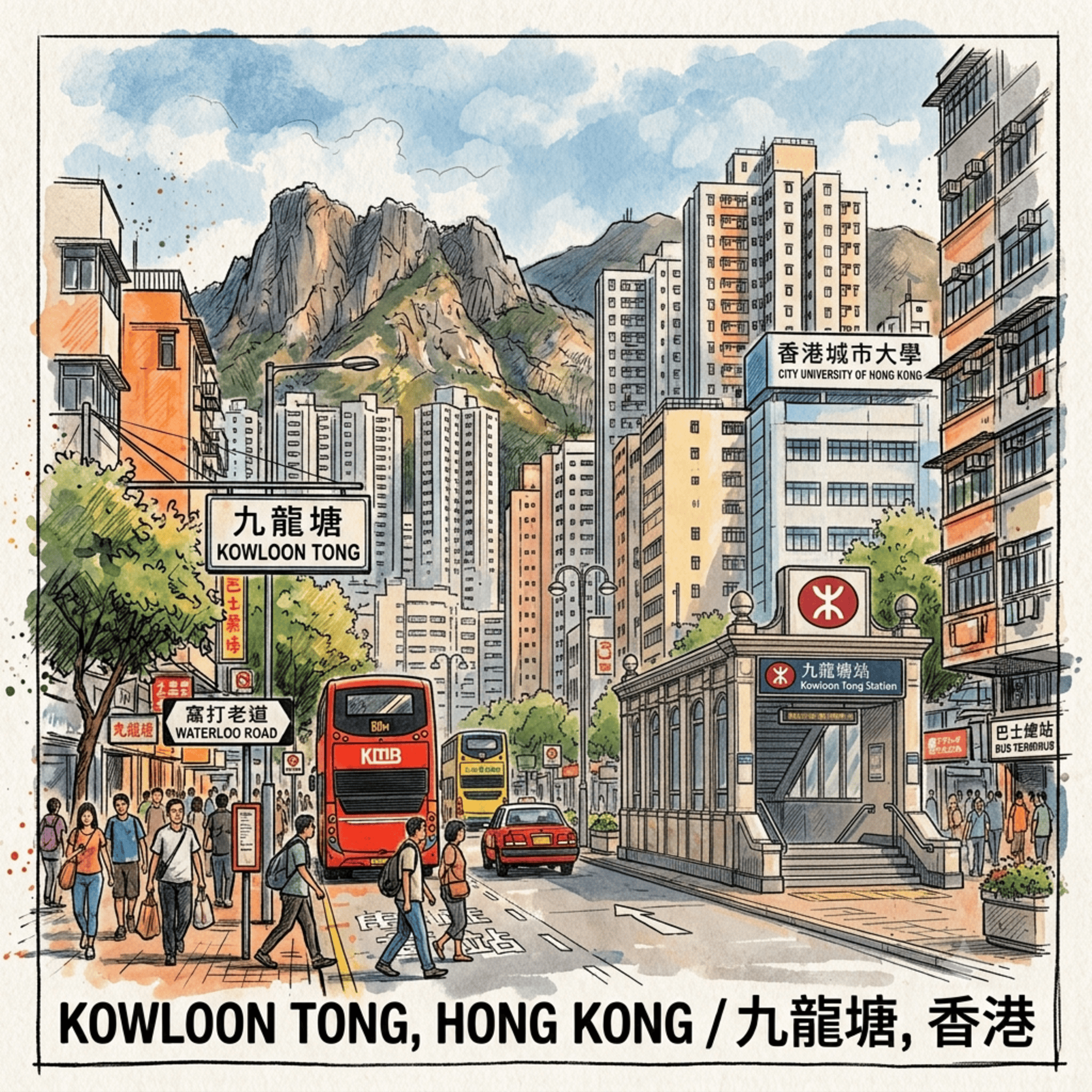
This is a historical travel story and walking guide to Kowloon Tong, a unique low-density residential enclave in Hong Kong. Through five hidden chronological echoes, it explores the 1920s British "Garden City" utopian experiment, the erased Hakka roots of Kowloon Tsai village, the roaring sensory legacy of Kai Tak airport's iron dragons, Bruce Lee's final sanctuary, and tucked-away Buddhist shrines. Readers will gain a multidimensional perspective on how administrative constraints accidentally sealed a century of urban memory within a geometric grid.
 Lawrence
The Soul Weight of the Garden
Kowloon Tong is not merely an affluent residential enclave; it is a strategically significant "closed field" of human memory. Its very name, "Tong" (Pond), whispers of its origin as a tamed, formerly aquatic landscape. To understand this space is to witness the tension between Yin and Yang: a suppressed, fluid watery past (Yin) over which a rigid, geometric British grid (Yang) was projected. Unlike the rest of Hong Kong’s relentless cycle of demolition and rebirth, Kowloon Tong remained suspended in a state of uncompleted metabolism. This "sealing" was an accidental byproduct of two unrelated administrative mandates—the 1922 plot ratio and the 1925 height limits—which acted as a geomantic stabilizer. By arresting the flow of capital-driven redevelopment, the city’s bureaucratic logic inadvertently locked a century of trauma and triumph into the mortar of its villas, creating a rare spacetime anchor where the vibration of the past remains a structural component of the present.
Listen to the historical stories told in detail (For subscribers only)
Layer 1: The Grounded Human History (The Five Chronological Echoes)
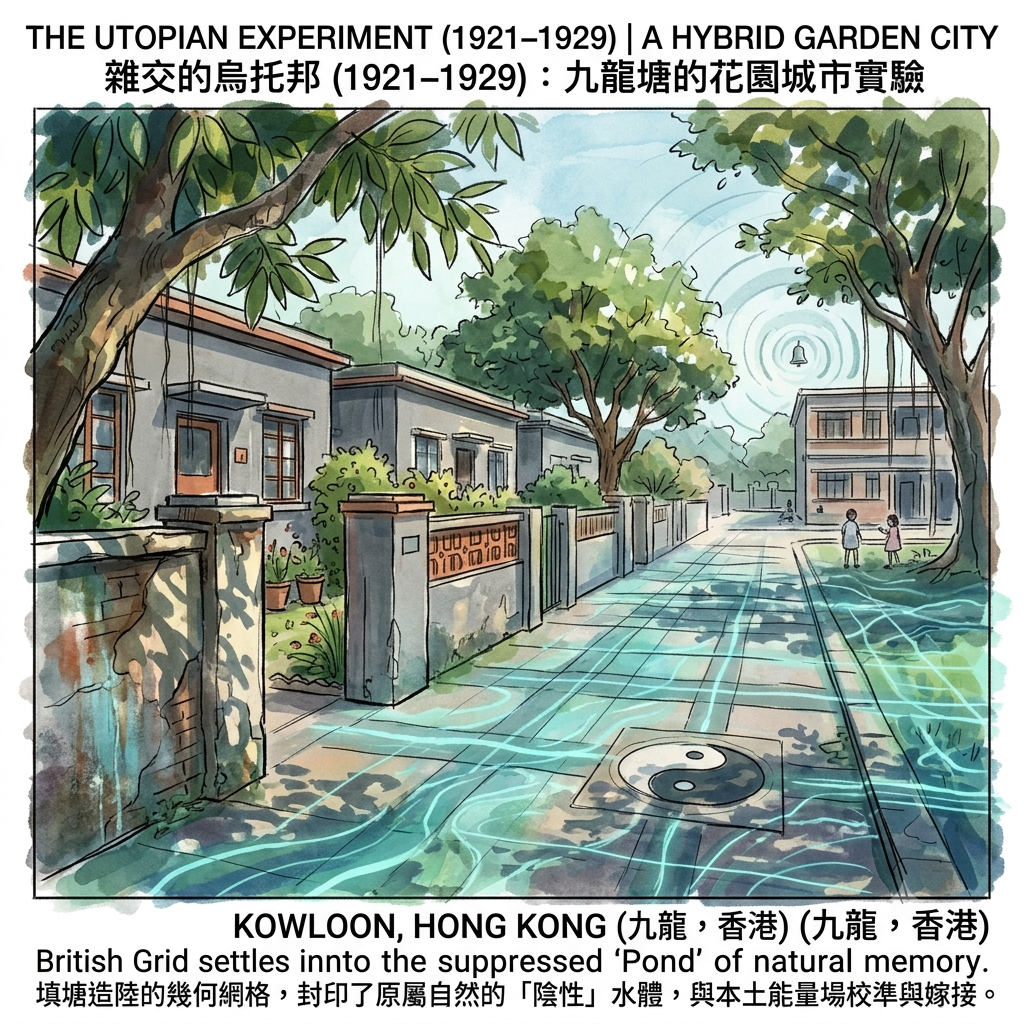
The Utopian Experiment (1921–1929) In the early 1920s, Charles Montague Ede sought to manifest a British "Garden City" upon the Kowloon foothills, a utopian effort to graft "Little England" onto the subtropics. This geometric projection was nearly derailed by Ede’s death and the General Strike of 1925. It was the intervention of Sir Robert Ho Tung—a figure whose hybrid Euro-Asian identity represented a perfect Yin-Yang balance—that saved the project from financial collapse. Ho Tung’s involvement was the moment the colonial dream calibrated with local energy fields, successfully grafting a domestic European ideal onto a formerly aquatic landscape. This transition marked the first major accumulation of "Qi" within the district, as the rigid grid of Surrey and Cornwall Roads began to settle into the suppressed "Pond" of the land’s original memory.
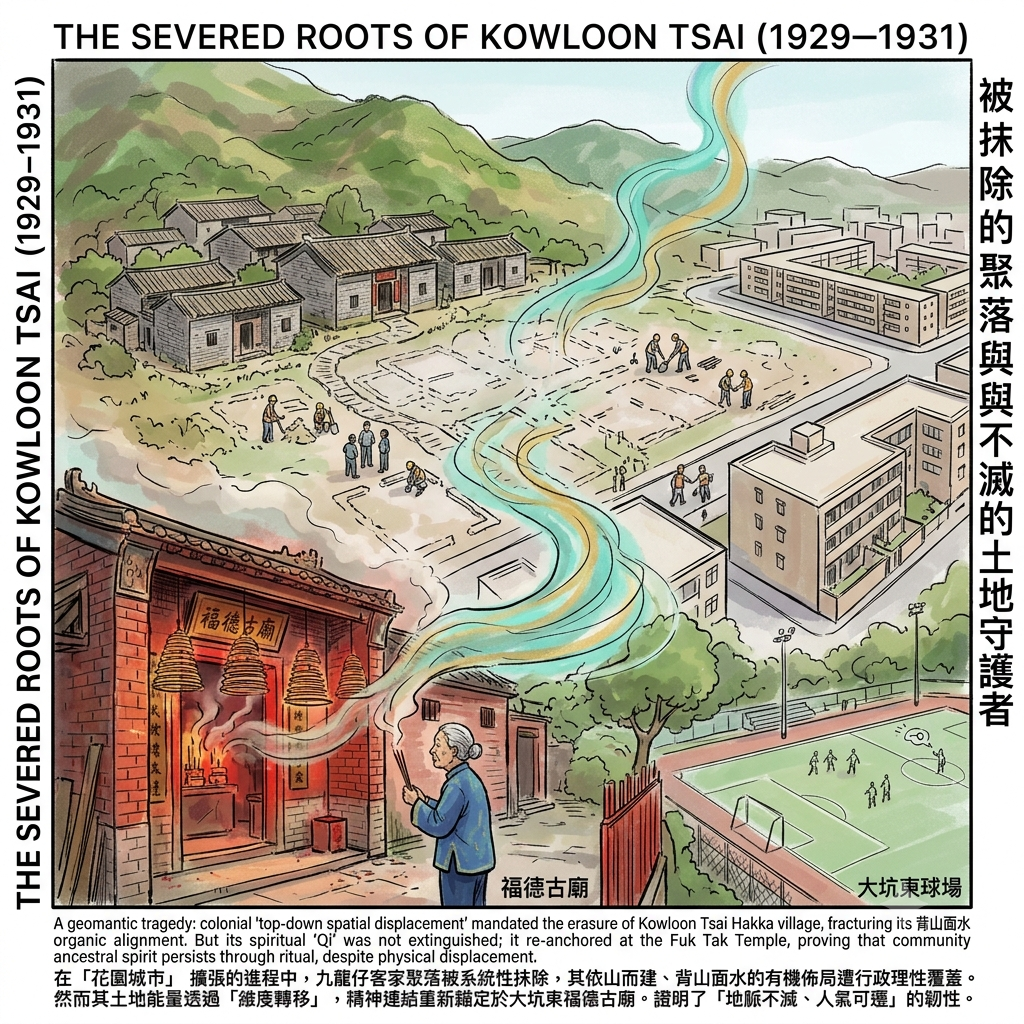
The Severed Roots of Kowloon Tsai (1929–1931) Beneath the suburban tranquility lies the erased history of Kowloon Tsai, a Hakka village documented as early as 1819. In 1929, the colonial logic of "top-down spatial displacement" mandated the village’s demolition to facilitate middle-class expansion. This was a profound geomantic tragedy; the demolition severed the village’s organic 背山面水 (back to the mountain, face to the water) alignment. While community leader Tso Seen-wan attempted to negotiate for the residents, the village was physically cleared by 1931. However, the spiritual "Qi" was not extinguished but re-anchored. The survival of the Fuk Tak Temple today serves as a residual node, proving that while physical structures are displaced by colonial geometry, the ancestral spirit of a community can persist through persistent ritual.
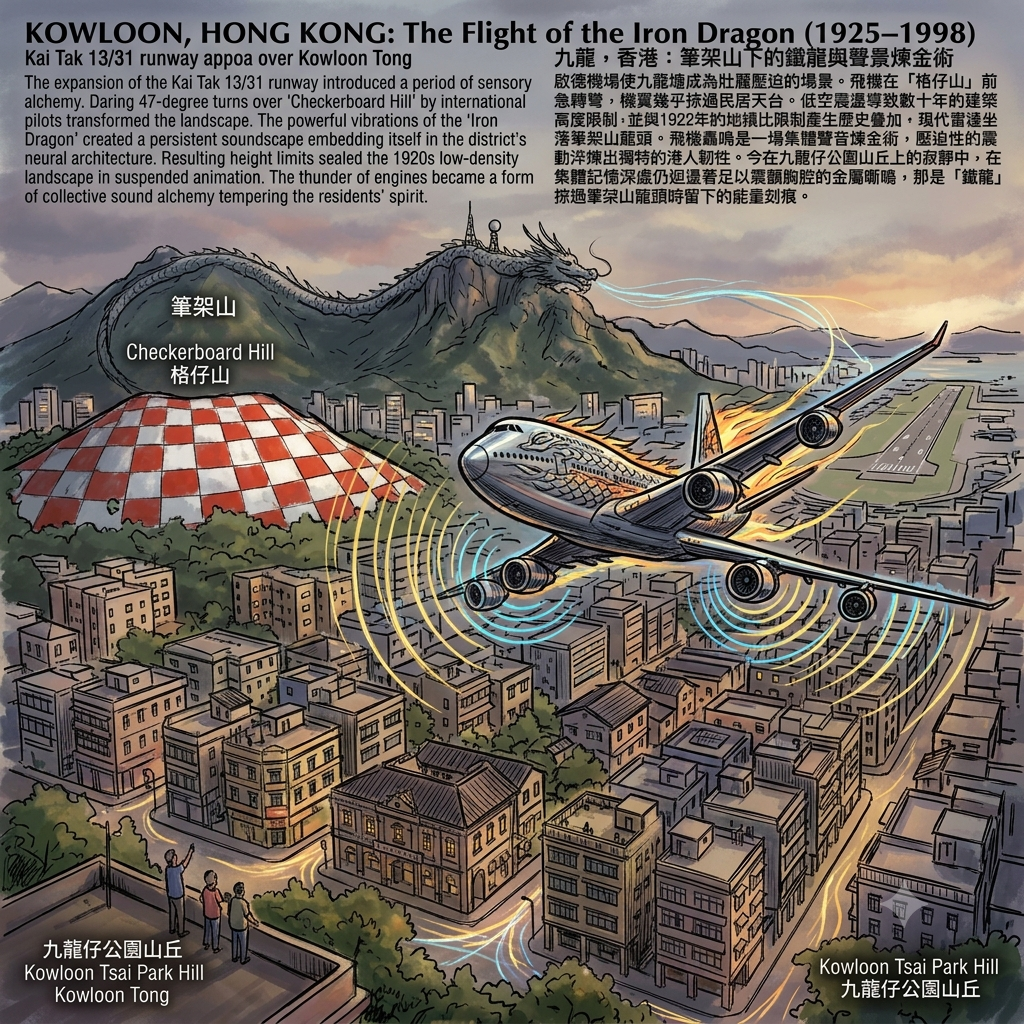
The Flight of the Iron Dragon (1925–1998) The expansion of the Kai Tak 13/31 runway introduced a period of sensory alchemy. For decades, international pilots performed a daring 47-degree turn over "Checkerboard Hill," a visual marker that transformed the landscape into a stage for "visual alchemy." This "Iron Dragon"—the modern aircraft—created a persistent soundscape of low-frequency vibrations that embedded itself into the district’s neural architecture.
The_World_s_Most_Terrifying_Landing
The resulting height restrictions acted as a "Double-Lock," preventing high-rise metabolism and sealing the 1920s low-density landscape in a state of suspended animation. The thunder of engines became a form of collective sound alchemy, tempering the spirit of the residents within their institutional seal.
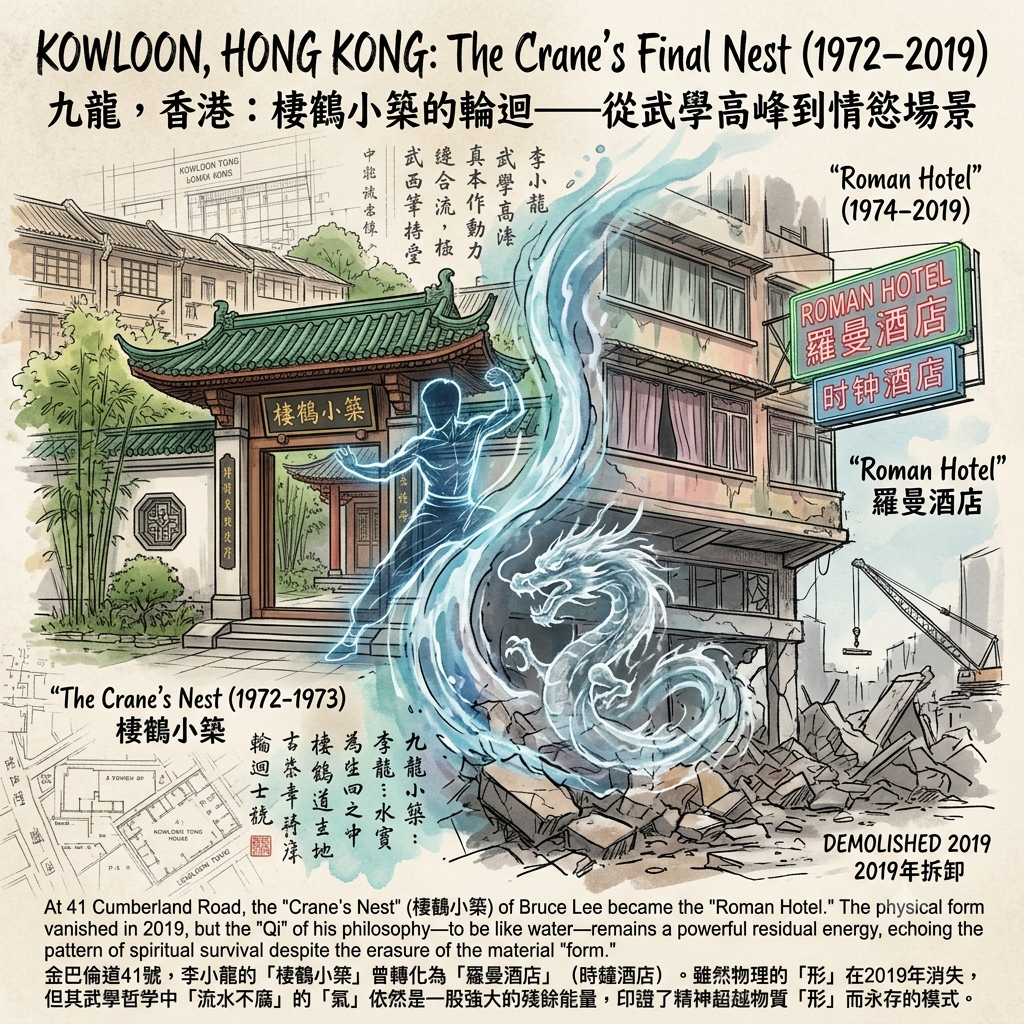
The Crane’s Final Nest (1972–2019) At 41 Cumberland Road stood 棲鶴小築 (The Crane’s Nest), the final sanctuary of Bruce Lee. Here, the "Crane"—a Daoist symbol of transcendence and longevity—became the nest for the "Dragon" (Lee). Following Lee’s sudden departure in 1973, the villa transitioned into the "Roman Hotel," a time-share love hotel.
The_Erasure_of_Bruce_Lee_s_Sanctuary
This shift represented the "profane logic" of commercial land use subsuming a sacred cultural cult. Despite global efforts to preserve this "Dragon’s" nest, the building was demolished in 2019. While the physical form has vanished, the "Qi" of Lee’s philosophy—to be like water—remains a powerful residual energy, echoing the pattern of spiritual survival despite the erasure of the material "form."
The Hidden Shrines (1920s–Present) Tucked behind the stucco walls of residential villas are "Buddhist Gratitude Halls" and "Benevolent Societies" like the Ci De Shan She. Because the 1922 zoning laws prevented vertical development, these villas became refuges for institutions requiring modest, quiet space.
The_Glitched_Neighborhood_of_Kowloon_Tong
This created a unique "Mixed Streetscape" where schools (representing the Yang of growth) and love hotels (representing the Yin of transient desire) coexist with these quiet spiritual anchors. The rhythmic, distant echo of the "wooden fish" being struck within a private shrine provides a harmonic counterpoint to the kindergarten bells, anchoring the neighborhood’s spiritual continuity amidst the surrounding flux of capital.
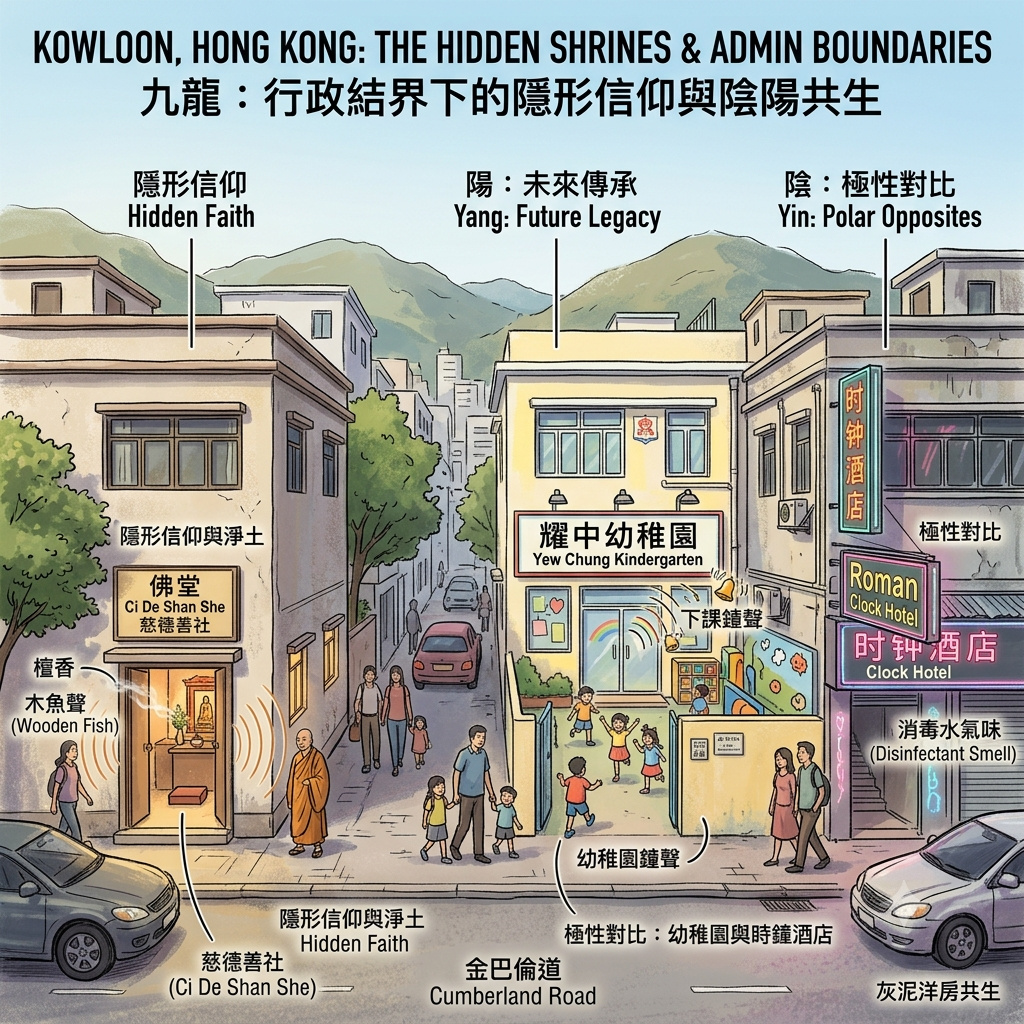
Layer 2: Historical Retrofitting—The High-Dimensional Lens
To decode Kowloon Tong is to analyze the Institutional Sealing-Field Syndrome. This phenomenon was born from the "Double-Locking" effect of the 1922 plot ratio (0.6) and the 1925 aviation height limits. Together, these bureaucratic mandates functioned as a "Geomantic Seal," arresting the natural urban metabolism that would have otherwise consumed these villas in favor of glass towers.
Through the lens of "High-Dimensional Physics," we see the modern technical rationality of the Beacon Hill radar station sitting atop the ancient "Dragon Head" of the mountain range. This creates a juxtaposition of the "Technical Dragon-Head" against the "Ancient Dragon-Vein." Because the metabolic cycle was arrested, the district did not release its energy; it compressed it. Kowloon Tong is thus a "compressed container" of colonial ambition, indigenous displacement, and celebrity mythos—a rare geographic asset where the uncompleted metabolism of the city allows multiple dimensions of history to vibrate in a single, stagnant plane.
Holographic Sensory Cue: Close your eyes and breathe in the scent of 80-year-old trees, their deep roots still drinking from the "hidden pond" beneath the pavement. The air is heavy with damp plaster and the clinical sting of old detergent from a nearby hotel. Listen for the discordant harmony: a kindergarten bell clashing with the hollow, rhythmic thud of a wooden fish from a hidden Buddhist hall. Watch as the sunlight filters through the canopy, casting flickering shadows onto the cracked red and white paint of Checkerboard Hill—a visual remnant of the Iron Dragon’s path across the sky.
The Resonance Nodes (Hidden Gems)
- The Fuk Tak Temple (Tai Hang Tung): Managed by the Kowloon Tsai Fuk Tak Tong, this shrine is a "re-anchoring" of a community that was physically erased but remains spiritually persistent. It is a location where the "veil" between the modern grid and the 1819 ancestral past is at its thinnest.
- The Remnants of Checkerboard Hill: The site of the visual marker for the 13/31 runway. This node holds the residual energy of the "Iron Dragon," serving as a monument to the technical violence and auditory trauma that defined the 20th-century experience of the district.
Conclusion: The Philosophical Anchor
The "uncompleted metabolism" of Kowloon Tong is a profound cosmic asset. In an era of infinite technological change and the rapid erasure of the past, this district serves as a rare repository of unreleased energy. It reminds us that historical memory is not always found in grand monuments, but in the stagnation caused by bureaucratic chance. As we move through multidimensional spacetime, these stories—of suppressed ponds and hidden cranes—become our most valuable currency, anchoring our collective identity against the void of the unknown.
You are invited to subscribe for further Temporal Walks, exploring the hidden grids of our shared reality.
Accessing the Physical Node (The Anchor)
Category | Description | Strategic Advice |
How to Arrive | Kowloon Tong Station (MTR Interchange). | Enter through the "Little England" grid via Kent Road to feel the immediate shift in spatial density and vibrational frequency. |
Where to Anchor | The quiet residential streets of Cumberland and Dorset. | Seek the villas that have transitioned into kindergartens or temples to observe the "Yin-Yang" balance of the district. |
Temporal Walks | A pilgrimage from Beacon Hill to the Fuk Tak Temple. | Walk Cumberland Road at dusk to witness the intersection of schools and shrines; reflect on the "auditory trauma" of the past planes versus the heavy silence of the current seal. |
Reference and Further reading
First layer – Main sources of literature and institutions:
- 香港政府1924年度《香港藍皮書》(將九龍塘村與「花園城市」基建工程分開報告);
- 古物諮詢委員會/古物古蹟辦事處歷史建築評級制度(一般性參考框架,個別洋房之具體評級記錄建議逕查 amo.gov.hk 資料庫核實)。
- 清嘉慶二十四年《新安縣志》村莊記錄(屬清代官方地方志,原件查證建議透過香港中文大學或香港大學圖書館特藏部進行核實);
- 香港政府1929年清拆公告(原始憲報文件,建議進一步查證香港歷史檔案館記錄)。
- 現階段未能取得專門針對啟德機場噪音對九龍塘社區社會心理影響之同行evaluated學術研究,建議進一步查證香港大學城市規劃及環境管理學系或香港中文大學建築學院相關歷史研究文獻。
- 屋宇署建築圖則批核記錄(2018年拆卸申請、重建為兩層高住宅之批文,建議進一步查證屋宇署公開記錄系統核實確切批核日期)。
- 1922年「九龍塘花園城市」地積比率(0.6)及層數(三層)規劃限制之原始行政條文,現有引述多轉引自二手歷史敘述,建議進一步查證香港政府地政總署或屋宇署歷史檔案以核實具體法定文件編號及全文。
The second layer – secondary academic materials:
- Cecilia Chu(2013),轄於香港大學建築學院 Built Heritage Research Collaborative 及 DOCOMOMO HK 之研究記錄,載有花園城市建築師 Adams, Little and Woods 及 E.D. Shanks 之設計資料。
- 香港城市規劃史相關研究中對「新九龍」(1937年劃定)土地徵收機制之分析,現階段未能取得專門以九龍仔村清拆事件為主題之同行evaluated學術論文,建議進一步查證原始檔案及香港大學/中文大學歷史系相關碩博士論文資料庫。
- 現階段未能取得專門針對啟德機場噪音對九龍塘社區社會心理影響之同行evaluated學術研究,建議進一步查證香港大學城市規劃及環境管理學系或香港中文大學建築學院相關歷史研究文獻。
- 「樂活灣區」〈香港百年航空史 由啟德機場起航〉專題報導;香港記憶(hkmemory.org)〈傳奇的啟德13/31跑道〉專題;
- 現階段未檢得專門以此案例作為香港「名人故居保育政策缺位」案例之同行evaluated學術論文,惟相關現象常被文化保育評論引用為對照案例(如赤柱鄧麗君故居、鑽石山喬宏故居),建議進一步查證香港大學文物建築保護課程或城市研究學者是否有相關個案研究。
- 目前未檢得專門以九龍塘「善社、佛堂、時鐘酒店與名校並存現象」作為香港都市民間宗教地理學個案的同行evaluated學術研究,此一現象似屬尚待學術界系統梳理的研究空白,建議進一步查證香港中文大學文化及宗教研究系或香港大學社會學系是否有相關都市民間信仰地理之研究計劃。
Third layer – Supplementary information:
- 思考香港(thinkhk.com)〈九龍塘小村莊蛻變〉一文;南華早報(SCMP, 2018)"Kowloon Tong history: Hong Kong's original garden city and its unusual path";
- 地方歷史部落格 Gwulo.com 及 lausoldier.blogspot.com 之街道實地考察記錄;
- 中文維基百科〈九龍塘〉條目。
- 中文維基百科〈九龍仔〉條目;
- 地方盂蘭勝會文化記錄(潮僑盂蘭活動之延續性,常見於香港非物質文化遺產相關報導)。
- 機場噪音對九龍塘(相對於更靠近機場的九龍城)居民的具體日常影響程度,現存文獻多籠統地將「深水埗、九龍塘、九龍灣、九龍城」並列為受影響地區,缺乏針對九龍塘單一行政分區的細緻量化研究;建議進一步查證香港政府1995年及1997年噪音消減措施實施報告中是否有按分區劃分之具體數據。
- 「樂活灣區」〈香港百年航空史 由啟德機場起航〉專題報導;香港記憶(hkmemory.org)〈傳奇的啟德13/31跑道〉專題;地方玄學部落格「解答人生」(Medium)對九龍山系「龍脈」走勢之民間命理論述——此一風水「龍脈」分布圖純屬地方玄學從業者之個人論述,並無學術地理學或考古學依據,讀者應明確視為民俗信仰文本,建議進一步查證是否存在更早期、更具歷史脈絡的堪輿原始文獻佐證此說法之系譜來源。
- 中文維基百科〈羅曼酒店〉條目(提供最完整時間線);蘋果日報(2018年12月15日)、香港01(2019年)、大公報、思考香港(thinkhk.com)等多篇新聞報導;The Culturist〈李小龍故居將被夷為平地〉專題;《時代》雜誌2009年亞洲體驗票選報導。
- lausoldier.blogspot.com(2014年)九龍塘街道實地考察記錄,逐街拍攝並標註各門牌之實際用途,是目前唯一可查證「慈德善社」「佛教感恩堂」等機構具體門牌位置之公開資料來源。
史學缺口:
- Various sources indicate inconsistent dates for the founding year of Yi De Company (1921 or 1922); the original plan was for 250 villas, but the actual number completed and the exact completion timeline vary slightly among different secondary sources. Further verification of the Lands Department's original land deed archives and the Hong Kong Government Gazette is recommended to confirm the precise figures. Specific financial details regarding Ho Tung's involvement (investment ratio, whether other Chinese merchants were involved) are currently only found in general secondary accounts, lacking complete original archival evidence.
- Original details regarding individual villagers' experiences, exact number of households, and compensation amounts are extremely scarce; existing accounts are mostly general in nature. The specific negotiation details of Cao Shanyun's failed negotiations are not found in original archives; the exact completion time of the village's demolition (whether the announced deadline in 1931 was actually implemented) also requires further comparison with the Public Works Bureau archives of the Hong Kong Historical Archives. This case highlights the widespread phenomenon of the structural marginalization of the voices of indigenous communities in Hong Kong colonial history—a case that deserves explicit mention in the main text as a "historical gap, or historical evidence."
- The local metaphysical blog "Answering Life" (Medium) presents a folk fortune-telling explanation of the "dragon vein" trend in the Kowloon Mountains. This map of the "dragon vein" distribution is purely the personal discourse of a local metaphysical practitioner and lacks academic geographical or archaeological basis. Readers should clearly regard it as a text of folk belief. Further investigation is recommended to verify whether there are earlier, more historically connected original geomancy documents to corroborate the genealogical origin of this claim.
- Regarding the specific daily impact of airport noise on residents of Kowloon Tong (compared to Kowloon City, which is closer to the airport), existing literature generally lists "Sham Shui Po, Kowloon Tong, Kowloon Bay, and Kowloon City" as affected areas, lacking detailed quantitative research on Kowloon Tong as a single administrative district. Further investigation is recommended to verify whether the Hong Kong government's 1995 and 1997 noise reduction implementation reports contain specific data divided by district.
- The exact year Bruce Lee moved into his former residence varies slightly across different sources (some say "mid-1972," while others explicitly state "July 29, 1972"); the specific policy reasons given by the government for refusing to support conservation during negotiations (then-Secretary for Development Carrie Lam was cited as stating that this was not within the scope of conservation) lack full official statements and are currently only found in summaries relayed by news media. It is recommended to further examine relevant Legislative Council inquiry records and official Development Bureau files to verify the complete context and legal basis of the government's position.
- The founding years, the identities of the managers, and the religious affiliations (Buddhism, Taoism, or a mixture of folk beliefs) of these charitable societies and Buddhist temples lack systematic records. This gap itself is of great research significance—it reflects that mainstream cultural heritage conservation and academic history in Hong Kong have long focused on "statutory monument-level" religious sites (such as large temples), while lacking a systematic recording mechanism for micro-folk belief spaces embedded in the fabric of daily residences. It is recommended that during field visits, oral histories from interviewees be used cautiously to supplement the records, and that the time and identity of the oral sources be clearly marked to maintain academic rigor.
 Lawrence
 Lawrence
 Lawrence
The sources for this article include primary historical records, academic papers, and public records from various levels of administrative bodies, with a commitment to historical accuracy; instances requiring further verification against primary archival materials have been noted in the text. Last updated: July 2026.