(ENG) Stanley Historical Walk – 5 Surprising Stories on Hong Kong Island’s First Capital
A deep historical walking guide to Stanley, Hong Kong. Discover the island's lost capital through 5 surprising stories—from pirate legends and Murray House to wartime cemeteries—hidden just beneath the bustling tourist market.

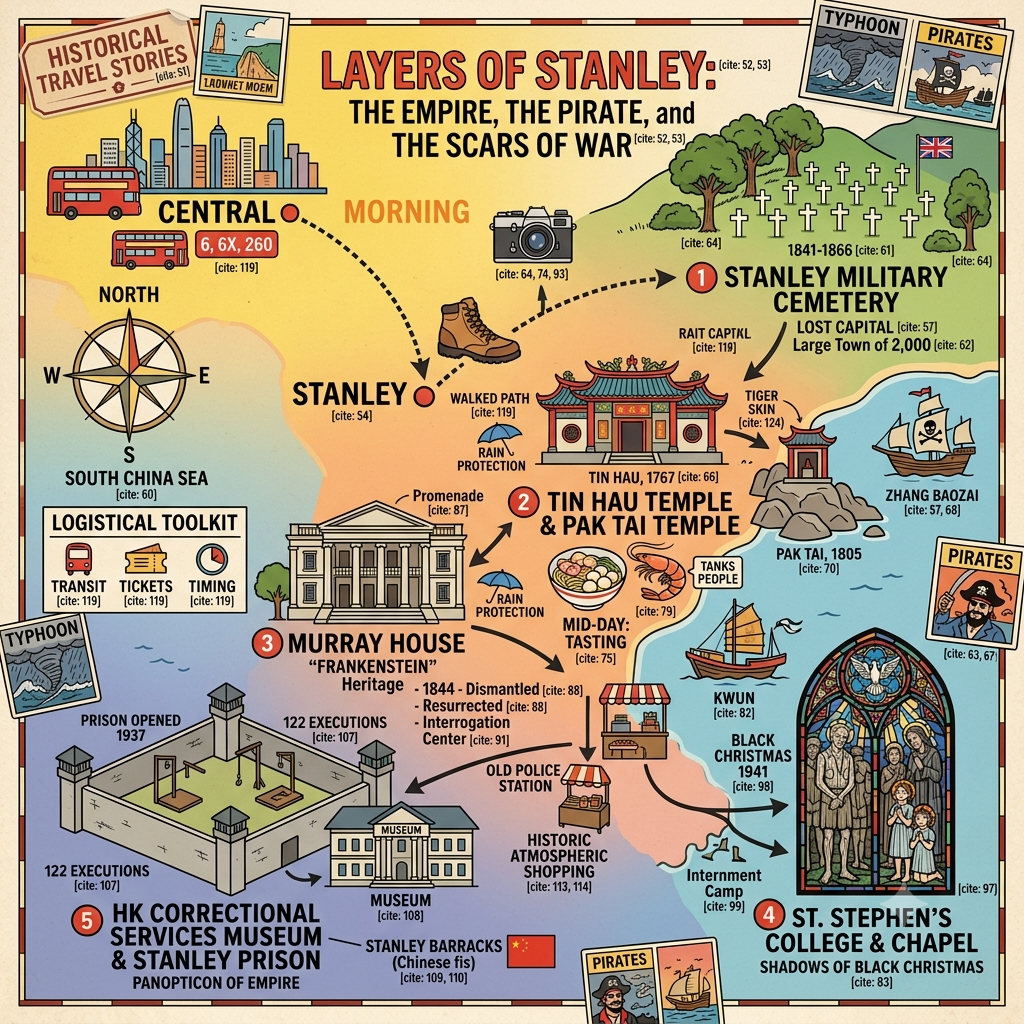
This is a historical travel story and walking guide to Stanley, a scenic coastal town on the southern peninsula of Hong Kong Island. Through five surprising histories, it explores the old police station, pirate legends at Tin Hau Temple, the relocated Murray House, and wartime military cemeteries. This slow-paced route uncovers how Hong Kong’s first colonial capital, pirate havens, and military heritage overlap beneath the modern seaside tourist market.
 Lawrence
Most people leave Stanley thinking they've seen it. They haven't.
Stanley — or Chek Chue, as locals have always called it — is easy to misread. From the outside, it looks like what it presents itself as: a breezy waterfront village on the southern tip of Hong Kong Island, known for its weekend market, its expat-friendly restaurants, and the kind of uncomplicated sea views that make the city feel briefly manageable. You take the bus over the hill, you browse the stalls, you eat something decent, you go home.
But Stanley rewards a different kind of attention. Walk past the tourist cluster and you'll find a Tin Hau temple that predates British rule by more than seventy years. Follow the road down to the Military Cemetery and you'll stand among graves dug by prisoners of war using their bare hands and borrowed granite. Look up at the walls of Stanley Prison and you'll confront the reality of 122 executions carried out behind them, the last in 1966.
This is not a place to be consumed in an afternoon. It is a place to be read — slowly, carefully, on foot.
Listen to the historical stories told in detail (For subscribers only)
The Barren Rock That Wasn't: Stanley as Hong Kong's First Capital
The founding myth of Hong Kong rests on a convenient fiction: that the British arrived in 1841 and found essentially nothing. Lord Palmerston famously dismissed the territory as "a barren rock with hardly a house upon it." It's a line that has endured for nearly two centuries, partly because it was diplomatically useful, and partly because it absolved the colonial project of having displaced anyone significant.
Stanley dismantles this story at its roots.
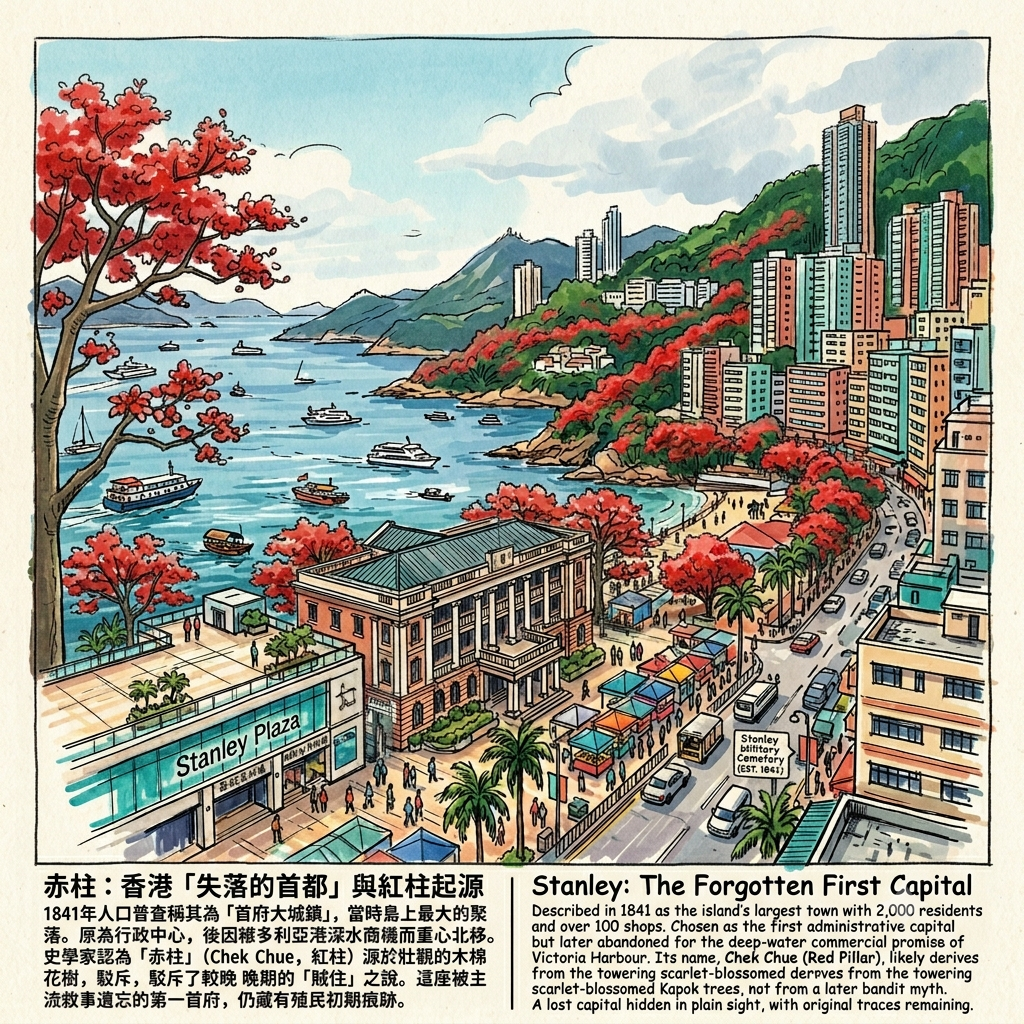
When British forces came ashore in January 1841, they did not arrive at an empty shore. The first population census issued by the new colonial government — published in the Hong Kong Gazette on May 15, 1841 — described Chek Chue, as Stanley was then known, as "the Capital, a large town," with a population of around 2,000 people. It was the largest single settlement on the island. There were over a hundred shops. There was a functioning fishing fleet. There were temples that had been standing for decades.
Chinese official records mention Chek Chue as far back as the Wanli period of the Ming Dynasty, between 1573 and 1620. The name itself predates British involvement by centuries. Linguistically, the most credible explanation for "Chek Chue" traces it to the Cantonese for "red pillar" — a reference to the towering kapok trees (Bombax ceiba) that once dominated the landscape, their scarlet blossoms visible from the water. There's a competing theory that the name derives from a Cantonese phrase meaning "bandit's residence," linking it to the pirate Cheung Po Tsai. But the timeline doesn't hold. The Hakka-speaking communities who would have used such a phrase didn't begin settling in Hong Kong until after 1668, and Chek Chue appears in Ming records long before that. The red tree explanation is the one that survives historical scrutiny.
The British chose Stanley as their initial administrative base for pragmatic reasons. The northern shore of the island — where Central stands today — was malarial and exposed. A typhoon in 1841 had wiped out the temporary structures already erected there. Stanley's sheltered southern position, its flat terrain, and its existing population made it the obvious starting point.
It didn't last. The deep anchorage of Victoria Harbour on the north shore held far greater commercial promise, and the colonial centre of gravity shifted decisively. Stanley was renamed in honour of Edward Stanley, then Secretary of State for War and the Colonies (later the 14th Earl of Derby and British Prime Minister), and the place quietly slipped out of the main narrative.
The result is a peculiar invisibility. Stanley was Hong Kong's first administrative capital. It simply stopped being one before anyone could quite register that it had been one at all.
Where to feel it today: The Stanley Military Cemetery, established in 1841 before the island was formally ceded to Britain, contains some of the earliest colonial-era graves on the island. The Old Stanley Police Station on Stanley Main Street — built in 1859 and now, with mild surrealism, converted into a supermarket — is one of the few remaining physical traces of that first administrative footprint. If you shop there, look at the tiles. They are original.
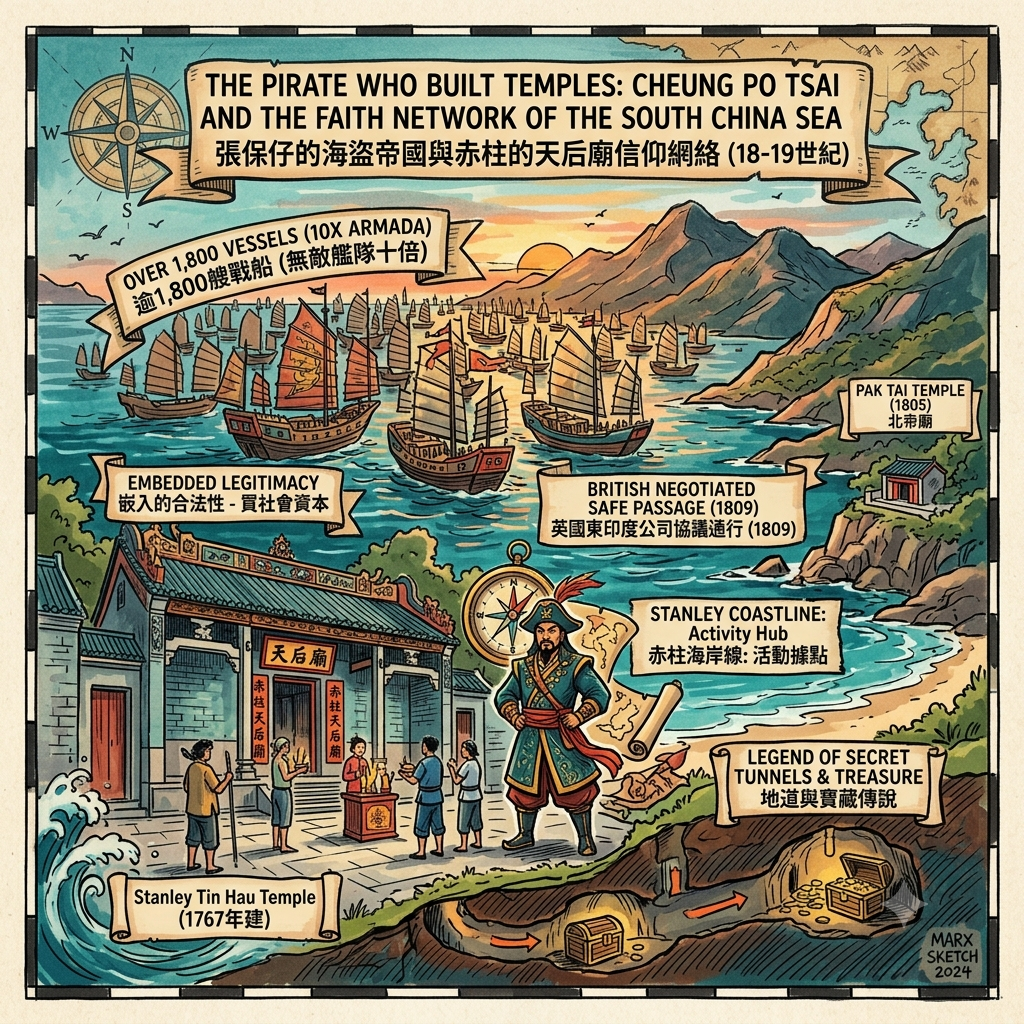
The Pirate Who Built Temples: Cheung Po Tsai and the Faith Network of the South China Sea
There is a version of piracy that lives in popular imagination, inherited largely from Hollywood and Robert Louis Stevenson: rum-soaked, chaotic, vaguely comedic. The reality of what operated along the South China coast in the early nineteenth century was something categorically different, and far more interesting.
Cheung Po Tsai was born around 1783, the son of a Tanka fisherman. Abducted at fifteen by the pirate warlord Zheng Yi, he rose through the confederation's ranks with remarkable speed, eventually becoming the primary military commander of the fleet controlled by Zheng Yi's widow, the formidable Ching Shih. At the height of their combined power, this confederation commanded an estimated 1,800 vessels — roughly ten times the size of the Spanish Armada at its peak. The Qing imperial navy repeatedly failed to suppress it. A joint Portuguese-Chinese blockade in 1809 could not break it decisively. Even the British East India Company, which would eventually colonise Hong Kong, had concluded by 1809 that negotiating a passage agreement with Ching Shih was preferable to fighting her.
Read that again: the institution that was about to become Hong Kong's colonial overlord was simultaneously paying informal tribute to a pirate confederation for the right to sail safely. The layers of irony do not get much thicker than this.
Cheung Po Tsai's connection to Stanley is partly documented, partly layered with the kind of local legend that proves impossible to fully separate from the historical record. What is known is that he constructed multiple Tin Hau temples along the Guangdong coast and Hong Kong's islands — at Ma Wan, Cheung Chau, and Stanley. These were not acts of simple piety. Tin Hau, the sea goddess of southern Chinese maritime culture, was the natural patron saint of fishermen and sailors. By funding her temples in coastal villages, Cheung Po Tsai was buying social capital: establishing himself as a community patron, building relationships of obligation and loyalty with the fishing populations on whom his operation depended for supply, shelter, and silence.
This is what historians sometimes call "embedded legitimacy" — the ability of an extralegal power structure to make itself indispensable to, and therefore protected by, the communities it operates within. It is a remarkably sophisticated strategy, and it worked.
"Within nine years, the pirates seized control of a vital stretch of coastline, repeatedly faced down the Imperial government in battle, and played a significant role in defining China's shifting global standing."
— Oxford University, Global History of Capitalism Case Study
The confederation ultimately collapsed not through military defeat but through a negotiated surrender in 1810. Cheung Po Tsai accepted imperial amnesty, was absorbed into the Qing military, and eventually rose to the rank of Colonel of the Guangdong naval forces. He died in 1822. Ching Shih retired to run a gambling house in Guangzhou and lived until 1844.
It is worth sitting with the strangeness of that ending. The most powerful maritime criminal enterprise in the history of the South China Sea was not destroyed — it was folded into the state that had failed to defeat it.
Where to feel it today: The Tin Hau Temple on Stanley Main Street was built in 1767 — more than seventy years before British administration began — and remains an active place of worship. It is the oldest of Hong Kong's seventy-odd Tin Hau temples. Hidden further along the coastline inside Stanley Ma Hang Park, the small Pak Tai Temple (built 1805) sits with its back literally built into the cliff face, staring directly out to sea. According to local tradition, a passage once connected it to Cheung Po Tsai's treasure cache. It was sealed when he surrendered. Whether that is true or not almost doesn't matter: it is the right kind of story for a place that still feels like it keeps secrets.
Black Christmas: The Massacre at St. Stephen's College and the Long Imprisonment That Followed
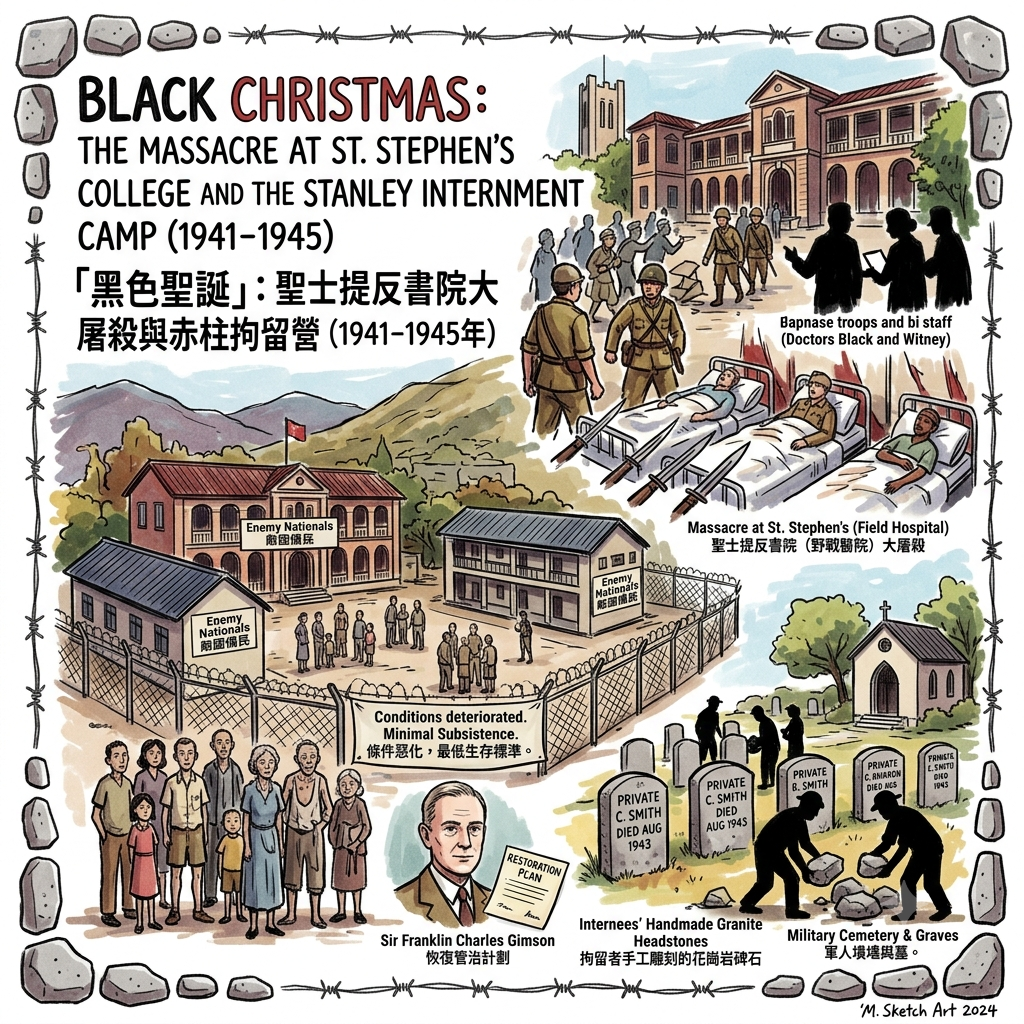
December 25, 1941. In almost every part of the world, Christmas morning. In Stanley, something else entirely.
The Battle of Hong Kong had been grinding on since December 8th — eighteen days of resistance by British, Canadian, and Indian forces against a Japanese army that had come prepared, well-supplied, and in overwhelming numbers. By the morning of the 25th, it was over. What remained was the formality of surrender, and what happened in the interval between the military reality and its official acknowledgement.
St. Stephen's College, on the Stanley peninsula, had been converted into a frontline military hospital. Japanese troops entered the building while fighting was still technically ongoing. Two British doctors — identified as Black and Witney — stepped forward to meet them. Both were taken away and subsequently found dead, their bodies mutilated. The troops then moved through the wards and bayoneted wounded soldiers — British, Canadian, Indian — who were too badly injured to move. The survivors, along with the nursing staff, were herded into rooms upstairs.
Governor Sir Mark Young surrendered Hong Kong that afternoon. The day entered collective memory as Black Christmas.
What followed was nearly four years of civilian internment. Approximately 2,800 non-Chinese "enemy nationals" — British civil servants, American journalists, Dutch businessmen, stateless Russians, women, children, elderly people — were rounded up in early January 1942 and transported by boat to the Stanley peninsula. They were held in the grounds of St. Stephen's College and the Stanley Prison wardens' quarters, in conditions that deteriorated steadily. Food rations were calculated to maintain what Japanese Prime Minister Tojo Hideki described, in documented post-war testimony, as "minimum subsistence standards." The prison building itself was used separately, by the Kempeitai — the Japanese military police — for interrogation.
Over 44 months of internment, 121 civilians died in the camp, most from illnesses compounded by malnutrition. Internees who died were buried in the Stanley Military Cemetery in graves marked by headstones that other prisoners had carved themselves, gathering granite from the ruins of nineteenth-century fortifications scattered across the peninsula.
Those handmade headstones are still there. They have not been replaced.
There is one more detail worth noting, less spoken about but historically significant. Among the internees was Sir Franklin Charles Gimson, Hong Kong's Colonial Secretary. During the final months of imprisonment, as Japan's position in the Pacific collapsed, Gimson quietly organised a shadow administrative structure — a plan for the resumption of British colonial rule that could be activated the moment the war ended. When Japan surrendered in August 1945, Gimson moved immediately, declaring the restoration of British authority before any alternative arrangement — including the possibility of American or Chinese administration — could be established. The colonial project, even in its most degraded circumstances, was already planning its own resurrection.
"The camp area consisted of St. Stephen's College and the grounds of Stanley Prison, excluding the prison itself."
— Wikipedia, Stanley Internment Camp
Where to feel it today: St. Stephen's College is still a functioning school. Most visitors pass its gates without knowing what they are looking at. The chapel on the highest point of the campus, built in 1950, contains stained glass depicting emaciated prisoners and children in prayer, with doves ascending above them. It is one of the few memorial spaces in Hong Kong where the architecture itself carries the grief of what happened on the grounds beneath it. The Military Cemetery on Wong Ma Kok Road — maintained by the Commonwealth War Graves Commission and open daily — holds 598 Second World War burials, 175 of them unidentified. A commemorative wall added in 2006 lists the names of more than 2,400 Chinese casualties from both World Wars who have no known graves, among them around 940 members of the Chinese Labour Corps who died in the First World War. For decades, their names had nowhere to go.
The Frankenstein Building: What Murray House Really Is
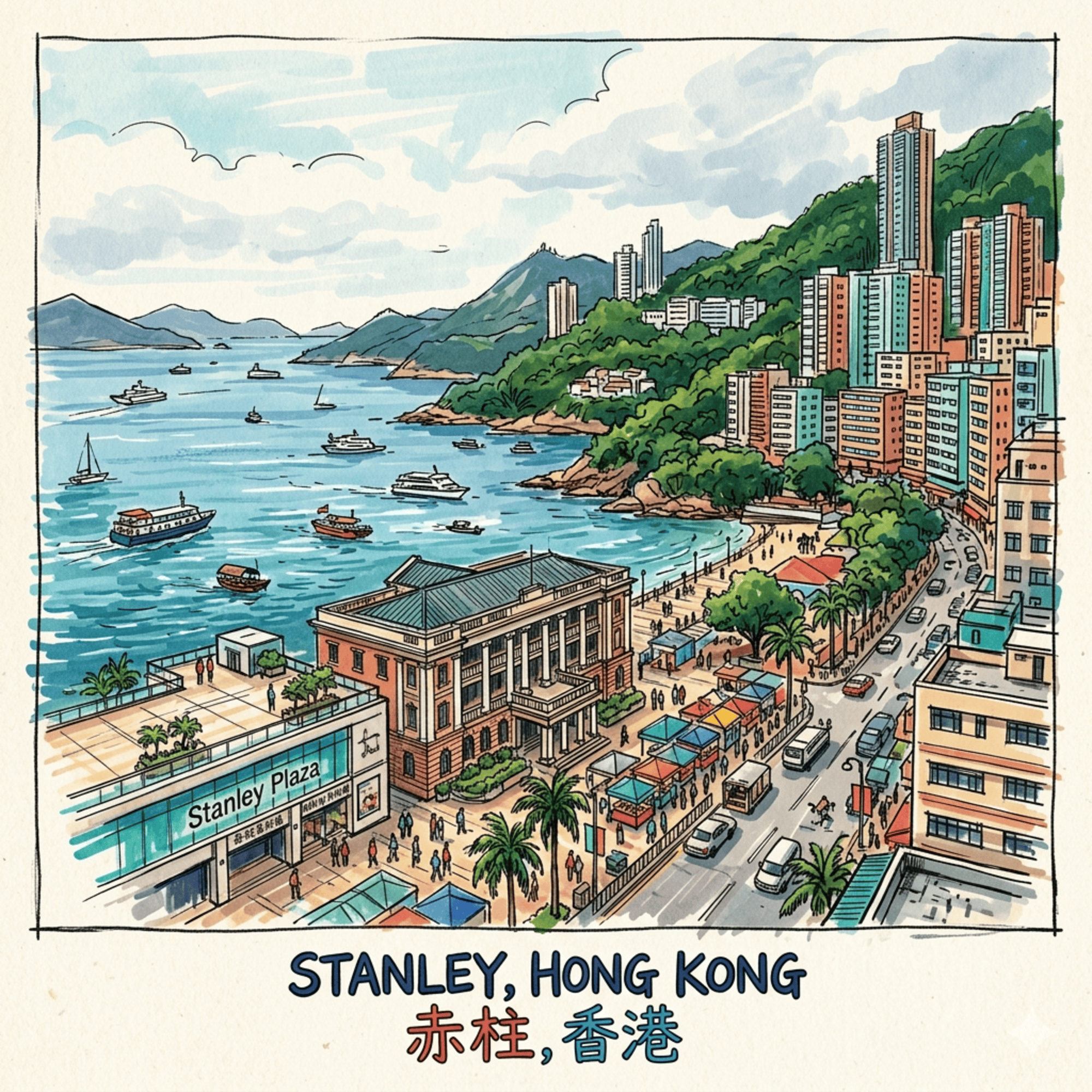
There is a handsome three-storey Victorian colonnade on the Stanley waterfront, all Doric columns and wide verandahs overlooking Stanley Bay. It is called Murray House. Visitors photograph it constantly. Almost none of them know what they are actually looking at.
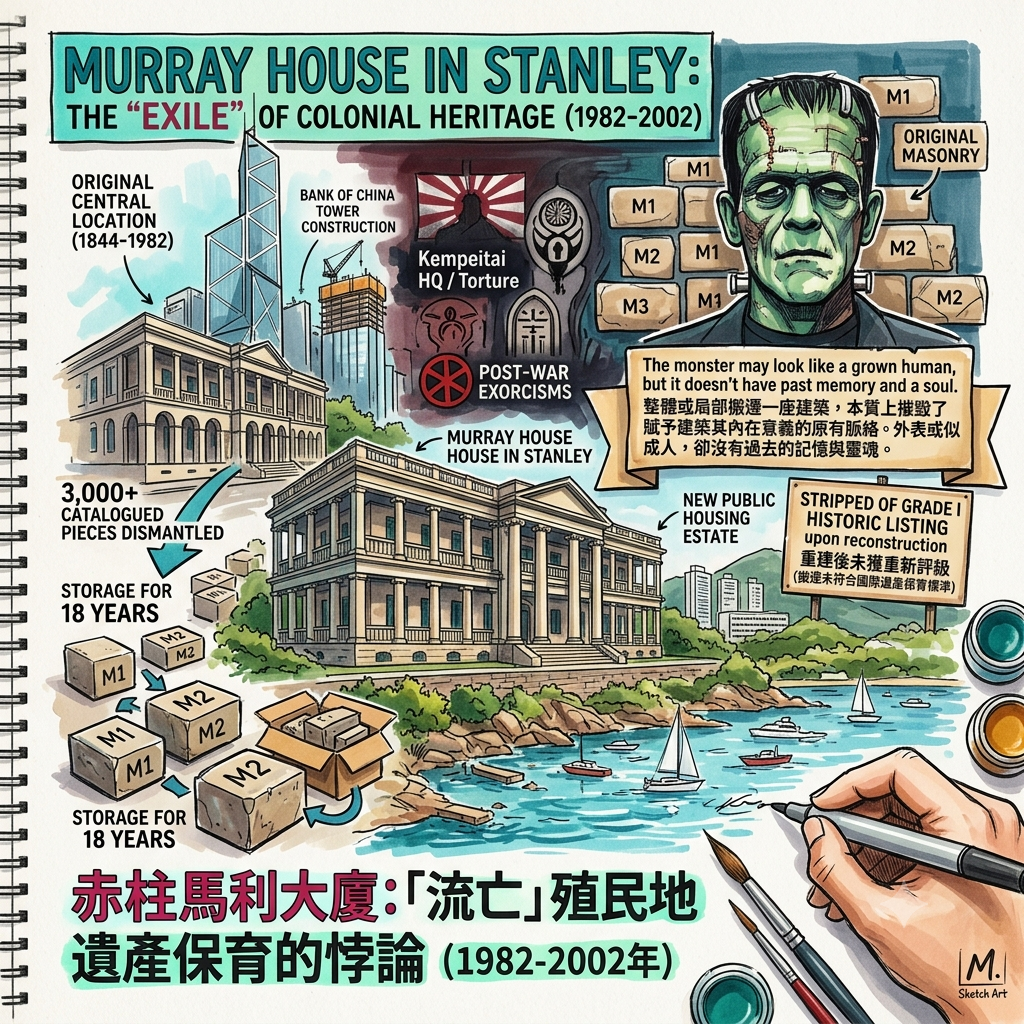
Murray House was not built in Stanley. It was built in Central — in what is now the heart of Hong Kong's financial district — in 1844, as officers' quarters for the British garrison. Named after Sir George Murray, it was one of the oldest surviving public buildings in the territory. For nearly 140 years it stood in Central, repurposed repeatedly: offices, wartime headquarters, administrative centre. During the Japanese occupation, it served as the Kempeitai's main base of operations — a fact so uncomfortable that the building required two separate exorcism ceremonies before it could be returned to normal use after the war.
In 1982, it was demolished.
Not destroyed: dismantled. The government, unwilling to simply knock it down but equally unwilling to let it stand in the way of the Bank of China Tower that was being planned for the same site, took the building apart brick by brick. More than 3,000 individual stone blocks were catalogued, numbered, and placed in storage. The intention was always to rebuild it somewhere.
It took eighteen years to decide where. In 1990, the Housing Department proposed reconstructing it in Stanley, to complement a new public housing estate being built nearby. Work began in the late 1990s. Murray House reopened in 2002.
The building standing in Stanley today is not Murray House. It is a new concrete structure dressed in the stones of Murray House — the original masonry applied like a veneer to a modern frame. Heritage specialists were unsparing in their assessments. The building was stripped of its Grade I historic listing upon reconstruction, because the relocation was determined to have failed international standards of heritage conservation.
One preservation scholar's verdict has become something of a standard reference on the subject:
"The relocation of a building in whole or in part essentially destroys the original context that gives the building a large part of its intrinsic meaning as built heritage. The monster may look like a grown human, but it doesn't have past memory and a soul."
This matters beyond the technical question of what counts as authentic restoration. Murray House's story is a compressed version of a choice that cities make constantly: when development and heritage collide, which one wins, and on whose terms? In this case, the answer was to split the difference — to preserve the appearance while evacuating the substance, and call it conservation. The building ended up in Stanley not because Stanley was the right home for it, but because there happened to be a housing project nearby that provided political cover for the decision.
By 2024, Murray House was almost entirely vacant. The last tenants — a German restaurant, a steakhouse, a fast-fashion chain — had all left. The building stands emptier now than it has at any point since its reconstruction, its columns reflecting in the harbour water, its meaning more opaque than ever.
Where to feel it today: Walk close to the walls. Look at the seams between the stones. The colour variations and texture inconsistencies are visible once you know what to look for — the evidence of a building that did not grow from this ground but was assembled here, piece by piece, from somewhere else. It is, in its way, an honest object. You just have to be willing to read it honestly.
122 Executions and a Silent Handover: The Full Story of Stanley Prison
The wall along the road in Stanley is eighteen feet high. Most people walk past it without giving it a second glance.
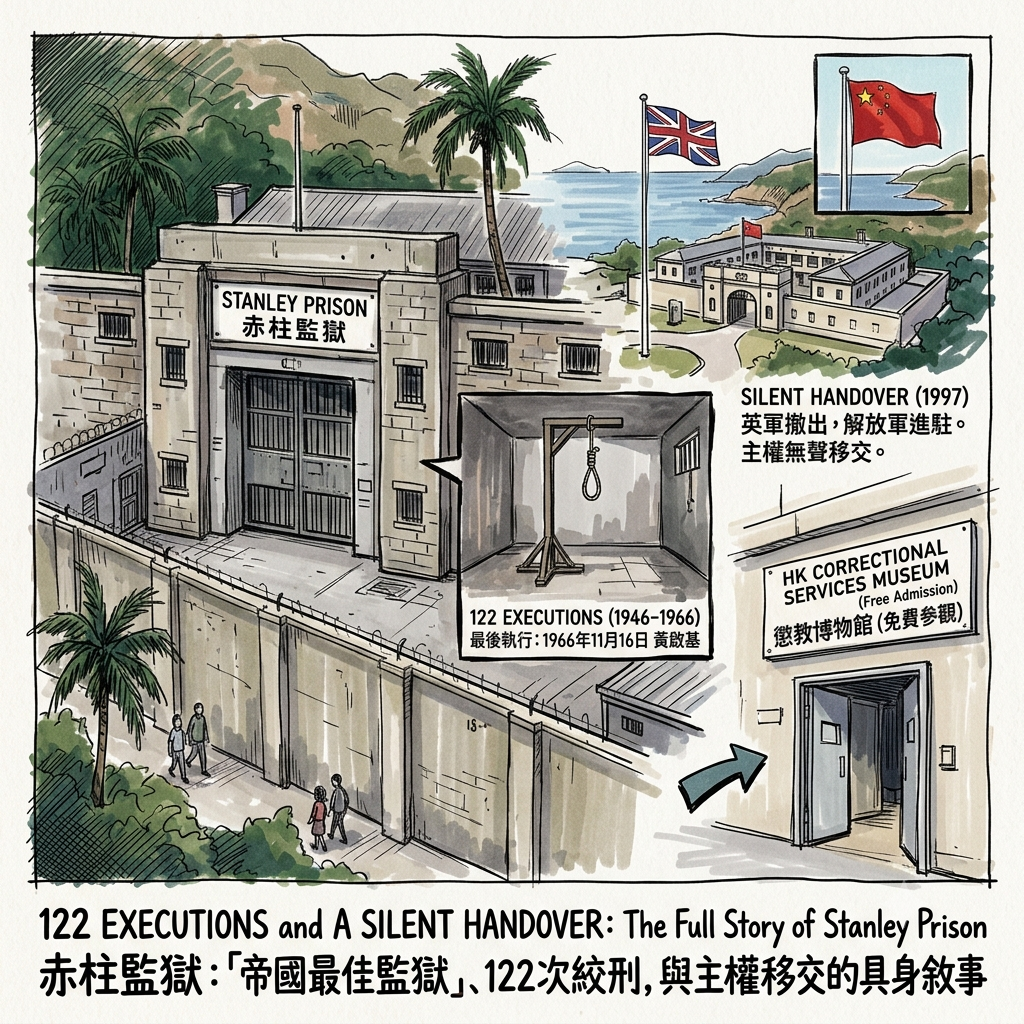
Behind that wall is Stanley Prison, opened in January 1937, and still operational today — the oldest functioning correctional facility in Hong Kong. When it was built, it was described as the most modern prison in the British Empire: six cell blocks of stone, concrete, and steel, capacity for 1,500 prisoners. It was, in the vocabulary of the day, a showpiece of colonial governance — proof that Britain could administer not just trade and territory but order and civilisation.
Four years after it opened, the Japanese military repurposed it. The prison itself became a site of Kempeitai detention and interrogation, while the surrounding grounds were converted into the civilian internment camp described in the previous chapter. The logic of the colonial prison — built to contain the colony's criminals — was immediately transferable to the containment of the colony's former rulers. The building never changes; its politics do.
After the war, the prison resumed its original function. And for nearly three decades — from 1946 to 1966 — it was also Hong Kong's place of execution. Capital punishment in the colony was applicable to murder, kidnapping resulting in death, and piracy: a list of offences that tells you something about what the colonial government most feared losing. One hundred and twenty-two people were hanged within these walls. The last was Wong Kai-kei, twenty-five years old, on November 16, 1966.
What happened after 1966 is quietly remarkable. The last execution was carried out, and then nothing. No further executions took place. But the death penalty remained on the books — legally available, simply unused — for another twenty-seven years, until formal abolition in 1993. Britain itself had abolished capital punishment in 1965. The extension of that reform to Hong Kong took an additional twenty-eight years to materialise. The gap between what a metropole permits and what it allows in its colonies is rarely discussed in polite company, but it tends to be instructive.
In 1997, Hong Kong was returned to China. The British garrison withdrew from Stanley Fort — the military installation occupying the southern tip of the peninsula — and the People's Liberation Army moved in. In 2000, the area was formally redesignated as a military zone, now known as Chek Chue Barracks, and home to part of the PLA's Hong Kong garrison.
The transition was, as these things tend to be, conducted without ceremony. No plaques were changed. No speeches were made at the gate. One flag came down and another went up, and the wall remained exactly as it was.
"Before Hong Kong officially abolished the death penalty in 1993, Stanley Prison had been a place of execution between 1946 and 1966. 122 people were executed in Stanley Prison until then."
— Wikipedia, Stanley Prison
Where to feel it today: The prison is not open to visitors. It doesn't need to be. The adjacent Hong Kong Correctional Services Museum — free admission, closed Tuesdays — holds the most candid public account available of the colony's penal history, including exhibits on the death penalty, replica cells, and historical documentation that treats this history with more directness than most official Hong Kong institutions manage. It is not a comfortable visit. It is a valuable one.
Hidden Gems Worth Finding
Most visitors to Stanley complete their circuit between the market, Murray House, and the beach, and call it done. Two sites fall consistently outside that orbit and shouldn't.
Stanley Pak Tai Temple, inside Ma Hang Park is the kind of place that requires mild commitment to reach — a downhill walk through the park, steep steps in the final stretch, the sound of the city dropping away. The temple, built in 1805, is tiny and built directly into the cliff face, its rear wall made of living rock. It faces the open South China Sea. There is nothing between you and the horizon. According to tradition, this was the site of Cheung Po Tsai's treasure passage, sealed after his surrender. Believe the legend or don't. The location alone earns the detour.
The Old Stanley Police Station on Stanley Main Street was built in 1859 and is now, in one of Hong Kong's stranger heritage outcomes, a supermarket. Go inside. Look past the shelves. The original tilework is still underfoot, the bones of the colonial structure still visible in the ceiling heights and the proportions of the rooms. It is an entirely ordinary convenience store built inside an extraordinary historical shell, and nobody seems particularly bothered by the fact.
A Walk Through the Layers
Stanley is small enough that its histories can be walked in sequence. The whole circuit takes two to three hours at a thoughtful pace, and the geography does some of the interpretive work for you.
Start at the bus terminus and walk east along Stanley Main Street: the Tin Hau Temple is on your right, its incense smoke drifting across the pavement as it has for 250 years. Continue to Murray House and Blake Pier — the pier is itself a relocated structure, moved from Central in the same spirit of geographical compromise as the building beside it. Head south along Wong Ma Kok Road to the Military Cemetery: pause here longer than you think you need to. Then cut through Ma Hang Park, dropping toward the coast, and find the Pak Tai Temple. The walk ends with the prison wall on your left as you return north.
What you are doing, physically, is moving through approximately 400 years of overlapping history — pre-colonial fishing settlement, pirate patronage networks, colonial administration, wartime atrocity, penal architecture, contested heritage, and a sovereignty transfer that reshaped the political landscape of the entire region. That these layers exist within walking distance of each other, in a peninsula small enough to cross in twenty minutes, is the kind of spatial compression that only very old, very dense places produce.
Beyond Stanley: Where to Go Next
Stanley's histories connect outward to the rest of Hong Kong Island and beyond. If this article has opened something for you, these are natural extensions.
→ Hong Kong Island Historical Travel Guide — The broader colonial and post-colonial landscape, from the former Government House to the wartime tunnels beneath Central
→ Wartime Hong Kong: A Walking Map of the Japanese Occupation — Stanley in the context of the full 1941–1945 period across the territory
→ The South China Sea Pirates: From Stanley to Cheung Chau — Following Cheung Po Tsai's temple network and the maritime culture it was embedded in
A Final Thought on What Stanley Actually Is
Five stories. Five distinct eras. And yet something connects them that isn't simply chronology.
Each of these stories is, at its core, about the question of who gets to define a place — who names it, who controls it, who decides what is remembered and what is quietly set aside. The British renamed Chek Chue after a politician who never visited it. The Japanese repurposed a prison built for criminals into a centre for interrogating bureaucrats. A colonial government dismantled a building and called the result preservation. A new sovereign moved into a fortress without a ceremony, without a plaque, without acknowledgement that anything had changed.
The Tin Hau Temple has outlasted all of them so far. It was there before the British arrived, before Cheung Po Tsai built his pirate empire, before the Japanese occupation, before the handover. It will probably be there long after the next transition, whatever form that takes.
There is something clarifying about standing in a place that has been a pirate's base, a colonial capital, a prisoner's hell, and a tourist market, all on the same small peninsula. It makes the idea of any single, stable identity for a place feel like the fiction it always was. Places do not have identities. They have layers. And the layers are only visible to those willing to look past the surface that the current moment has chosen to present.
Stanley is not a destination. It is an argument — a long, unresolved, ongoing argument about what this part of the world has been and what it might yet become. The best way to participate in that argument is to show up, walk slowly, and pay attention.
If this changed how you think about a place you thought you already knew, Historical Travel Stories publishes a new essay every week. Subscribe to the newsletter and we'll bring the next one to you.
Planning Your Visit
Getting There
By Bus (recommended)
From the Exchange Square Bus Terminus in Central, routes 6, 6A, and 6X all terminate at Stanley Market. Journey time is 35–45 minutes depending on traffic. The ride itself — over the ridgeline of Hong Kong Island, with views across both the northern harbour and the southern bays — is worth treating as part of the experience rather than an inconvenience. Alternatively, take the MTR to Admiralty and pick up the 6 or 260 from Queensway.
By Taxi
Around HK$100–130 from Central, roughly 15–20 minutes outside peak traffic. Faster, but you'll miss the views.
On Foot (partial)
The Wilson Trail and various hillside paths link Stanley to Repulse Bay and Tai Tam — useful if you are combining Stanley with a broader South Side walk. Check trail conditions before setting out in summer months.
Where to Stay
Stanley itself has no large hotels, which is part of what keeps it from being fully swallowed by mass tourism. The options nearby suit different types of travellers.
For convenience: Central or Admiralty — both within a direct 40-minute bus ride, and well-positioned for exploring the full sweep of Hong Kong Island's historical sites. This is the most practical base if Stanley is one stop among several.
For atmosphere: The Aberdeen or Ap Lei Chau areas on the South Side offer a more local feel than the northern tourist belt, with ferries and minibuses connecting to Stanley in under 20 minutes.
For something distinctive: A handful of boutique guesthouses and Airbnb properties in Deep Water Bay and Repulse Bay put you within a short ride of Stanley while offering quieter, less central surroundings — well-suited to travellers who find the pace of Kowloon or Wan Chai exhausting.
Guided Experiences Worth Booking
Stanley Heritage Walking Tours
Several local operators run historically-focused walking tours of Stanley, covering the wartime sites, the temples, and the Military Cemetery in context. Detour Hong Kong and Hong Kong Tramways (which also runs cultural programmes) are worth investigating. The quality varies; look for guides who lead with history rather than market recommendations.
Hong Kong Correctional Services Museum
No booking required. Free admission. Open Tuesday to Sunday, 10am–5pm. The museum sits immediately adjacent to Stanley Prison and covers the full arc of the colony's penal history. More substantive than its modest profile suggests.
Hong Kong Maritime Museum (Central, Pier 8)
Formerly housed in Murray House, now relocated to Central. The permanent collection on South China Sea maritime history — including exhibits on the pirate confederacies of the early nineteenth century — provides essential context for understanding Stanley's pre-colonial past. Budget 90 minutes; the admission is modest and the collection is genuinely excellent.
South Side Half-Day Historical Route
Combine Stanley with a stop at Aberdeen Typhoon Shelter (for the Tanka fishing community history) and the Repulse Bay area (wartime defensive positions). This is best done independently with a Octopus card and a willingness to ask bus drivers for help. No single tour currently covers this full circuit at a pace that does it justice — which is its own kind of recommendation.
Q & A
What was life like inside the Stanley Internment Camp?
Life inside the Stanley Internment Camp (1942–1945) was characterized by extreme hardship, deprivation, and a resilient struggle for survival under the Japanese occupation of Hong Kong. Approximately 2,800 non-Chinese "enemy nationals", including men, women, and children, were detained there for 44 months.
The following details from the sources illustrate the daily reality of the internees:
1. Minimal Survival and Deprivation
Life was dictated by a policy of "minimum survival standards" ordered by the Japanese Prime Minister Hideki Tojo, which aimed to exploit Hong Kong’s resources for Japan while providing the barest necessities to detainees.
- Food Scarcity: Food was consistently in short supply, leading to widespread hunger.
- Medical Deficiencies: Medical resources were severely lacking. However, because the internee population included professional doctors and nurses, they were able to provide enough care to prevent major disease outbreaks.
- Lack of Materials: The lack of basic materials was so severe that when fellow internees died, survivors had to scavenge granite from 19th-century fortress ruins to hand-carve tombstones for their companions.
2. Social and Psychological Pressure
The camp was not segregated by gender, but the Japanese authorities enforced strict and often cruel social controls:
- Forced Separation: Despite the presence of families, the Japanese authorities forcibly separated husbands and wives and occasionally utilized solitary confinement as a punishment or control measure.
- Constant Surveillance: The camp was located in a strategic, isolated area (including the grounds of St. Stephen’s College and Stanley Prison), utilizing the natural geography of the Stanley Peninsula as a barrier to prevent contact with the outside world.
3. Cultural Life and "Hidden Resistance"
Despite the brutal conditions, internees maintained their morale through organized community activities and secret political maneuvering:
- Community Organization: Detainees organized educational courses, theatrical performances, and religious activities to sustain their spirits.
- Political Planning: A group of British government officials, led by Colonial Secretary Sir Franklin Gimson, secretly planned for the restoration of British rule. This proved crucial when Japan surrendered, as Gimson immediately declared the resumption of British administration before other international powers (such as the United States) could intervene.
4. Resistance and Escape
The desire for freedom led to three escape attempts during the 44-month period. Two of these were successful: one group managed to reach Macau, while another disappeared into the Guangdong countryside. Those who failed were recaptured and re-interned.Today, the Stanley Military Cemetery serves as a material witness to this era, containing the graves of 96 civilian internees, including four children. The St. Stephen's College Chapel, built in 1950, also commemorates this period with stained glass windows depicting the haggard faces of prisoners and children praying for peace.
What was the significance of the 122 executions at Stanley Prison?
The execution of 122 individuals at Stanley Prison between 1946 and 1966 represents a significant and somber chapter in Hong Kong’s colonial and legal history. Beyond the raw statistics, these executions carry several layers of historical and political significance:
1. The Final Ritual of Imperial Legal Violence
Stanley Prison served as the primary site for capital punishment in Hong Kong following World War II. The 122 hangings performed during this period were the "final ritual of imperial legal violence," applied to crimes including murder, kidnapping resulting in death, and piracy. The last person to be executed was 25-year-old Wong Kai-ki on November 16, 1966.
2. The Symbolic Power of a "Dormant" Law
While active executions ceased in 1966, the death penalty was not formally abolished in Hong Kong until 1993. This created a 27-year gap where the death penalty remained on the books as a symbolic deterrent, even though it was no longer practiced. This delay reflects the "political vulnerability" of colonial criminal policy, as the government faced conflicting pressures from the UK (which abolished the death penalty in 1965) and local humanitarian or social discourses.
3. Reflection of a Racialized Penal System
From a critical historical perspective, the executions are significant because they highlight the racialized operation of the colonial penal system. Sources suggest that prison conditions and the application of capital punishment were often shadowed by racial disparities—a structural issue in colonial law that remains a subject for further academic study.
4. Contradiction of the "Civilizing Mission"
The prison was originally marketed in 1937 as the "best prison in the Empire," a symbol of "civilized" and "efficient" British rule. However, the history of these 122 executions serves as a "rare window" into the reality of colonial punishment, contradicting the "civilizing mission" narrative by showing the raw exercise of state power and lethal force.
5. Preservation of Memory
Today, the significance of these executions is preserved at the Hong Kong Correctional Services Museum, located adjacent to the prison. The museum houses the most complete official records of these executions, allowing visitors to examine the intersection of colonial history and the evolution of the Hong Kong legal system. Most tourists visiting the area are unaware that the prison walls they see were the site where these 122 individuals met their end.
Reference and Further reading
- 《香港公報》第二號(1841年5月15日)——香港第一份人口調查,收藏於香港公共檔案館
- 香港歷史檔案館——早期殖民行政紀錄及地籍文件
- 英國國家檔案館(National Archives, UK)——殖民地辦公室檔案(CO 129系列),涵蓋1841年初始行政安排紀錄
- 香港古物古蹟辦事處——赤柱舊警署及相關遺址資料
- 清代廣東省地方志(《嘉慶廣東通志》等)——涵蓋對海盜聯盟及赤柱沿岸活動的官方記載
- 香港文物古蹟辦事處——赤柱天后廟及北帝廟的登錄資料
- 廣東省檔案館——清代海盜招安相關文書
- 香港公共檔案館——日佔時期相關行政文件及拘留紀錄
- 英國國家檔案館(CO 980系列)——香港戰俘與拘留者紀錄
- 英聯邦戰爭墓地委員會(CWGC)——赤柱軍人墳場個別埋葬紀錄
- 香港古物古蹟辦事處——聖士提反書院(第812號登記紀念物)資料
- 香港古物古蹟辦事處——馬利大廈原址登錄紀錄及評級文件
- 市政局會議記錄(1980年)——涵蓋遷址提案的早期討論
- 香港房屋署——赤柱重建工程文件(1990年代)
- 香港懲教署(Correctional Services Department)——監獄官方歷史文件及年報
- 香港公共檔案館(HKRS系列)——殖民地刑事裁判及死刑執行相關行政文件
- 《香港法例》(Cap. 298,廢除死刑相關條款,1993年)
- 英國國家檔案館(CO 129系列)——殖民地刑事政策文件
- Welsh, Frank. A History of Hong Kong. HarperCollins, 1993.(第一手殖民地行政分析)
- Carroll, John M. Edge of Empires: Chinese Elites and British Colonials in Hong Kong. Harvard University Press, 2005.
- 廣東省地方志辦公室編:《廣東省志·港澳志》——清代赤柱地名紀錄的重要參照
- Murray, Dian H. Pirates of the South China Coast, 1790-1810. Stanford University Press, 1987.(至今仍為這一課題最具學術份量的英語專著)
- Antony, Robert J. Like Froth Floating on the Sea: The World of Pirates and Seafarers in Late Imperial South China. China Research Monograph 56, UC Berkeley, 2003.
- Waley-Cohen, Joanna. "The New Qing History." Radical History Review, 2004.(有助於理解清代邊疆海洋政策的史學框架)
- Banham, Tony. Not the Slightest Chance: The Defence of Hong Kong, 1941. Hong Kong University Press, 2003.(迄今最詳盡的軍事史學研究)
- Emerson, Geoffrey C. Hong Kong Internment, 1942-1945: Life in the Japanese Civilian Camp at Stanley. Hong Kong University Press, 2008.(拘留生活的權威學術記錄)
- Roland, Charles G. "Massacre and Rape in Hong Kong: Two Case Studies Involving Medical Personnel and Patients." Journal of Contemporary History 32.1 (1997): 52-61.(大屠殺的同行評審學術論文)
- Lim, Patricia Pui Huen. Discovering Hong Kong's Cultural Heritage. Oxford University Press, 2002.
- Yanne, Andrew and Heller, Gillis. Signs of a Colonial Era. Hong Kong University Press, 2009.(包含馬利大廈命名及歷史的考證)
- Law, Chi-Shing. "Heritage Conservation in Hong Kong: Issues and Problems." Asian Architecture and Building Engineering, 相關期刊文章——建議進一步核查
- 《威尼斯憲章》(1964年)——提供評估「真實性」的國際框架
- Gaylord, Mark S. and Harold Traver, eds. Introduction to the Hong Kong Criminal Justice System. Hong Kong University Press, 1997.
- Wesley-Smith, Peter. Unequal Treaty 1898-1997: China, Great Britain and Hong Kong's New Territories. Oxford University Press, 1998.(提供主權移交前後法律制度連續性的框架性分析)
- 建議進行進一步檔案核查:殖民地時期關於死刑的種族化差異適用——相關詳細研究尚待學界深入發掘
- Gwulo.com——香港歷史檔案資料庫,包含廣泛的早期殖民地文獻引用及照片存檔
- J3 Private Tours Hong Kong, "Hong Kong in 1841: The Compelling Origin Story"(有大量一手資料引用)
- Hong Kong Maritime Museum exhibition catalogue, "Pirates of the South China Sea: Chasing Cheung Po Tsai and Port Cities"
- 建議進行進一步檔案核查:英國國家檔案館東印度公司檔案(IOR系列)中關於1809年「休戰」談判的相關文件
- Wright-Nooth, George. Prisoner of the Turnipheads. 1994.(拘留者親身回憶錄)
- Gwulo.com——豐富的拘留者個人日記及照片存檔
- 《南華早報》關於馬利大廈遷建20周年的長篇報道(2021年2月)
- Zolima CityMag, "Hong Kong's Colonial Heritage, Part I: The Ghost of Murray House"(含遺產保育學者訪談)
- 香港懲教署博物館現場展覽資料
- Banham, Tony. We Shall Suffer There: Hong Kong's Defenders Imprisoned, 1942-45. Hong Kong University Press, 2009.
 Lawrence
 Lawrence
 Lawrence
Historical Travel Stories covers places through the depth of what happened in them, not the convenience of visiting them. All historical content in this article is based on publicly available documentation, institutional records, and peer-reviewed scholarship.