Magome Plateau, Tokyo: Where the Earth Remembers What the City Forgot
Hidden on a quiet plateau in Ōta Ward, Tokyo, Magome sheltered Japan's greatest Taisho writers after the 1923 earthquake. Beneath that story lies 3,000 years of accumulated memory — and a Shinto concept of sacred geography that explains why this slope keeps drawing the remarkable.

 Lawrence
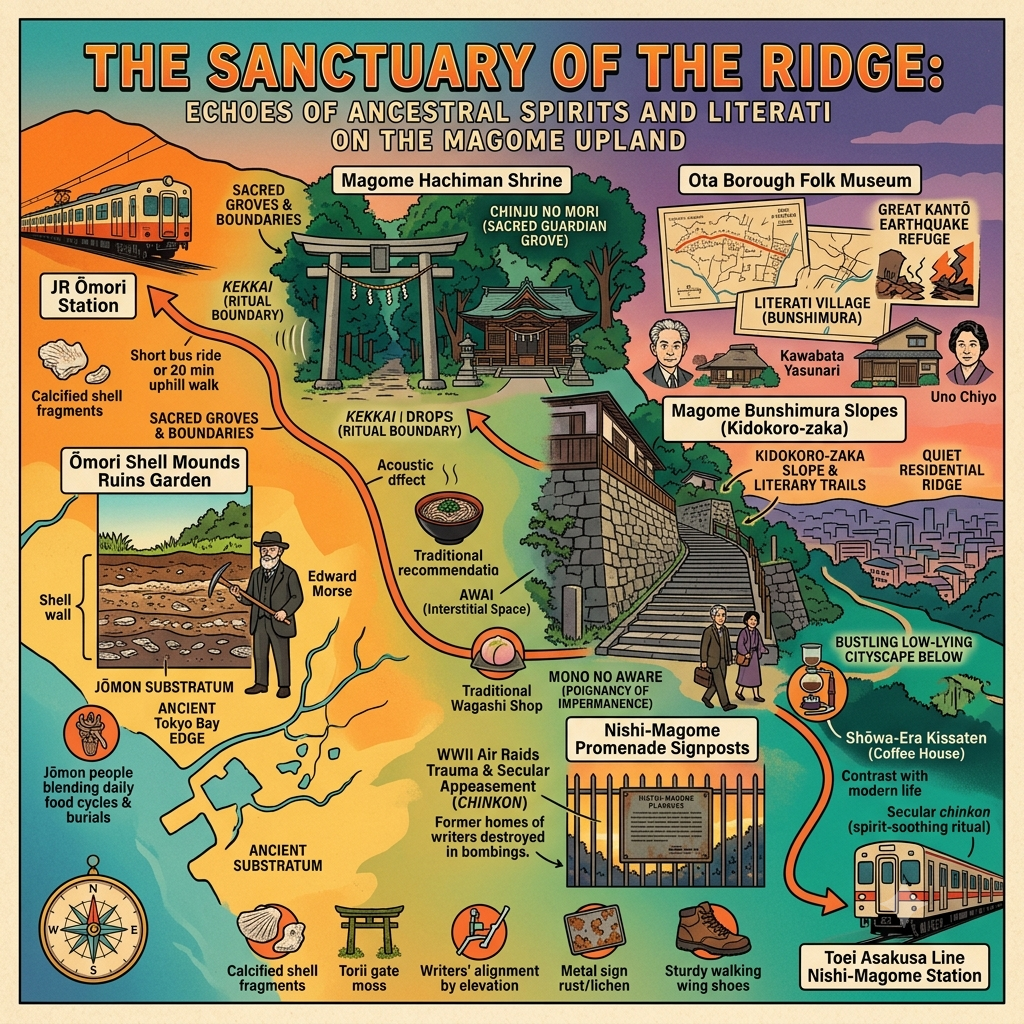
This is a historical walking guide to the Magome plateau in Tokyo's Ōta Ward — a neighborhood with one of the most quietly extraordinary literary histories in modern Japan. Beginning with the artists' colony that formed after the 1923 Kanto earthquake, and tracing backward through three thousand years of Jōmon ancestors, Shinto shrine traditions, and wartime destruction, the article decodes how a single geological feature has functioned as Tokyo's most persistently charged cultural refuge. The walk takes roughly two hours. The history takes considerably longer to absorb.
Opening: A Slope That Asks Something of You
There is a slope in southern Tokyo that pushes back when you climb it. Not in the blunt way of a steep hill, but with a subtlety that asks for attention — willingness to slow down, perhaps. You will have come from Nishi-Magome station on the Toei Asakusa line, emerging into a quiet residential neighborhood that could be almost anywhere in the city's outer rings: convenience stores, ginkgo trees shedding in autumn, elderly residents with shopping bags.
But the slope is different. At the top, something shifts. The acoustic texture of the city changes. The temperature drops a degree or two. The streets narrow into what feel like confidences. And you find yourself standing on a plateau that has, over the past hundred years, been home to a Nobel Prize winner's earliest manuscripts, a Jōmon burial mound three thousand years old, and one of the most quietly sustained traditions of Shinto sacred geography in the Kanto plain.
None of this is advertised. W. G. Sebald, who spent a lifetime writing about the weight of the past pressing through the surfaces of the present, would have found something to say about this particular slope. What he might have noted is what this article attempts to trace: that the most significant landscapes are often the ones that give no outward sign of what they carry.
Listen to the historical stories told in detail (For subscribers only)
Five Frequencies of a Plateau's Memory
I. What the Earthquake Made
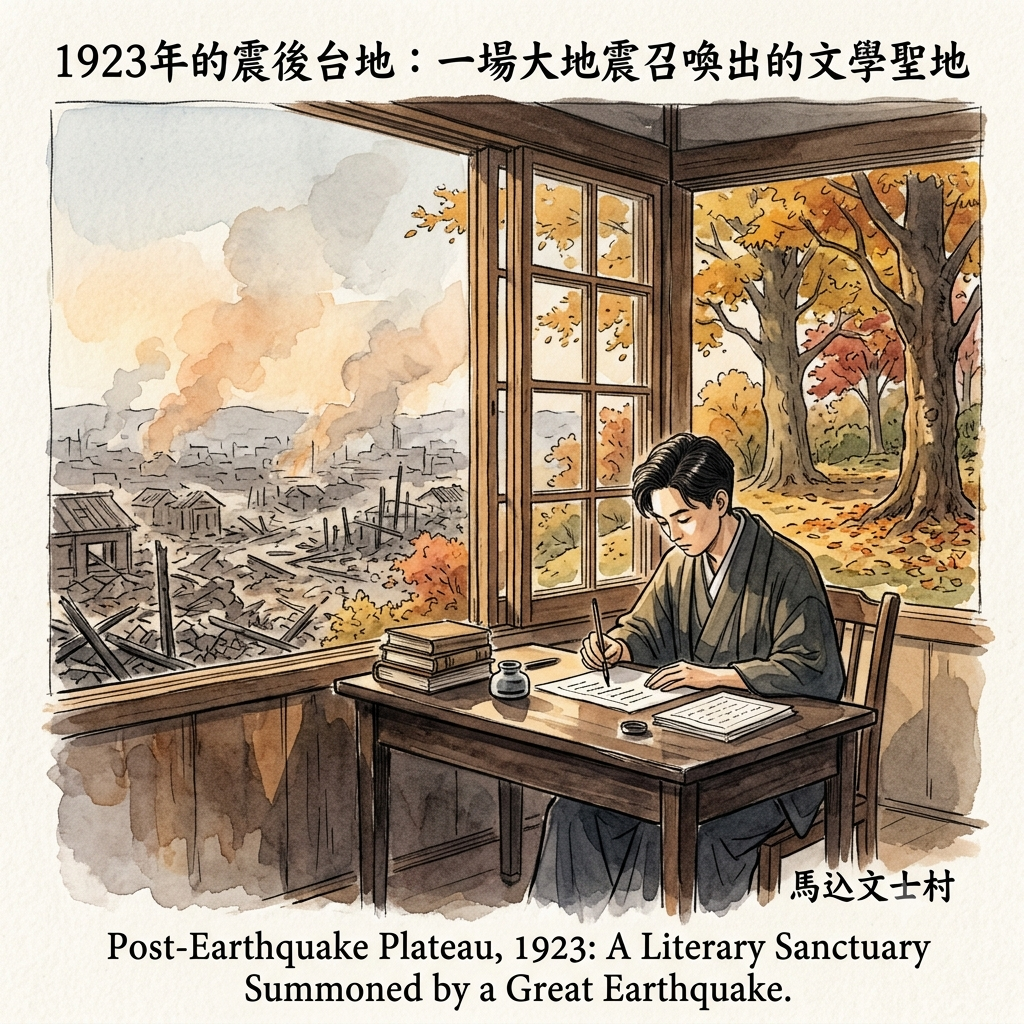
At 11:58 on the morning of September 1st, 1923, Tokyo broke.
The Kanto earthquake — magnitude 7.9 — shook the city for several minutes. The fires that followed burned for three days. When they stopped, more than a hundred thousand people were dead and the densely packed wooden shitamachi — the low city, the city of craftsmen and merchants and the ordinary continuous business of metropolitan life — was gone. Historians of modern Japan mark this as a civilizational rupture: not only a natural disaster but a reorganization of the social and cultural fabric of the nation.
What followed, in the geography of culture, was something like a diaspora. Writers, poets, and artists who had lost their homes scattered toward the city's elevated outskirts. Magome plateau, sitting twenty to thirty-five meters above the surrounding plain, received them without having invited them. Its elevation had escaped the liquefaction that destroyed the flatlands. Its lower density reduced fire risk. Rents here were cheap; the atmosphere still half-rural, still carrying the quality the Japanese call satoyama — the threshold between village and wilderness.
The Plateau That Saved Japanese Literature
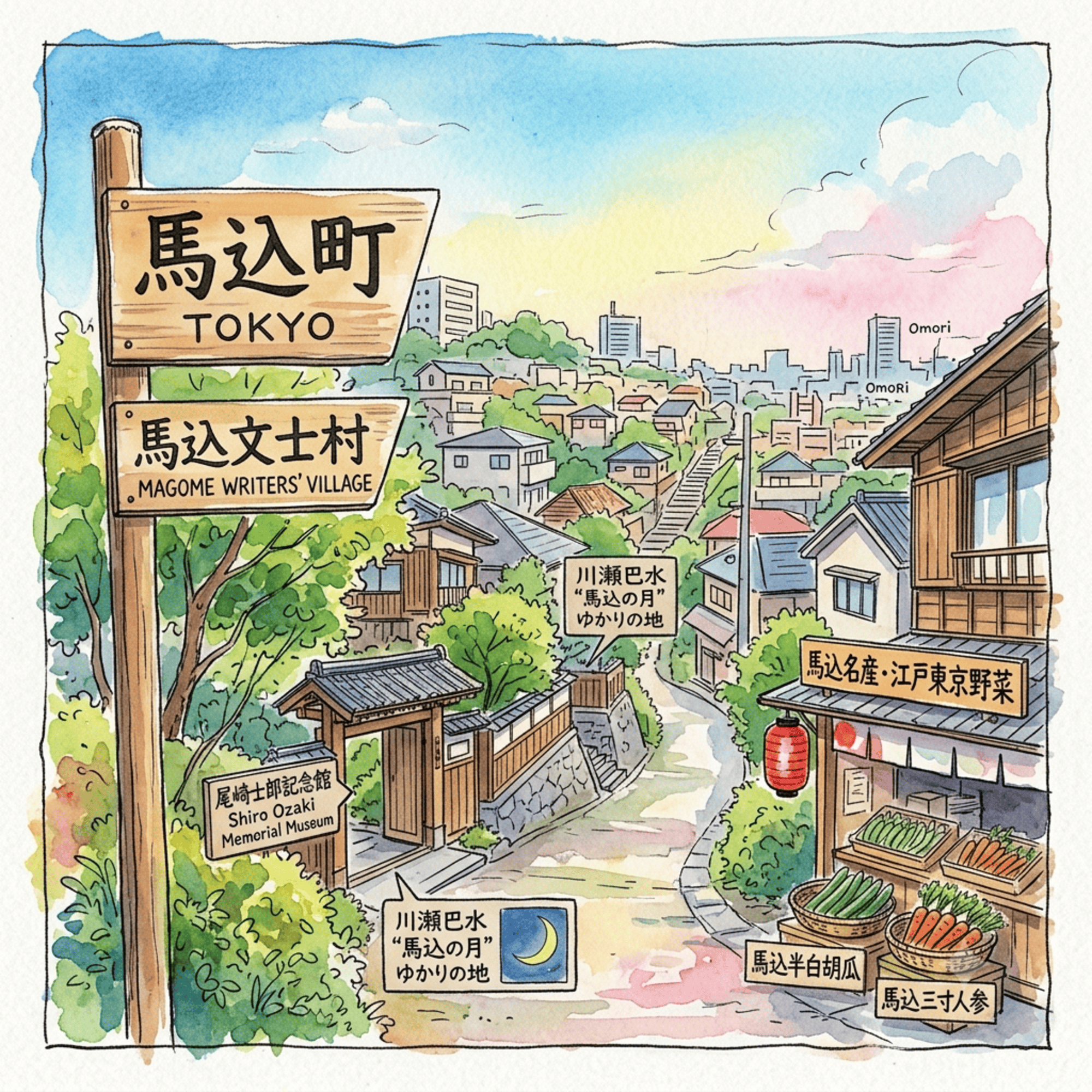
Kawabata Yasunari moved here at twenty-four, a member of the Shinkankakuha (New Sensationism) literary movement, writing with the intensity of someone who has felt that something essential just changed in the world and is searching for the language to account for it. The poet Kitahara Hakushū settled nearby. The novelist Uno Chiyo — who would refuse every conventional constraint the Taisho period placed on women, in her writing, her business ventures, her personal life — lived here during the years that defined her voice. Without organizing principles or committees or names, the Magome Bunchimura (馬込文士村, the Magome Literary Village) came into existence.
It was the largest unplanned literary geography in modern Japanese history, and a geological event made it.
Holographic Sensory Cue: A late autumn afternoon in 1923, six months after the earthquake. On the plateau's eastern edge, two smells coexist: the damp decay of ginkgo and zelkova leaves, and charcoal and construction dust rising from the lowland reconstruction sites below. The temperature on the plateau is cooler by two or three degrees than the valley — the earth's own respiration. Inside a wooden house nearby, a young man sits at a desk near an upstairs window that frames two simultaneous worlds: the quiet trees of the plateau behind him, the rubble and scaffolding ahead. His name is Kawabata. He has not yet written Snow Country. He doesn't know about the Nobel Prize. He is simply writing, in the particular quality of silence that elevated ground provides, sentences about impermanence and beauty that will still be read a century from now.
II. A Love Story Written Into the Landscape
Some landscapes are remembered not because they are beautiful, but because they contained something intense enough to outlast itself. Magome plateau, for Japanese literary history, is partly this kind of landscape.
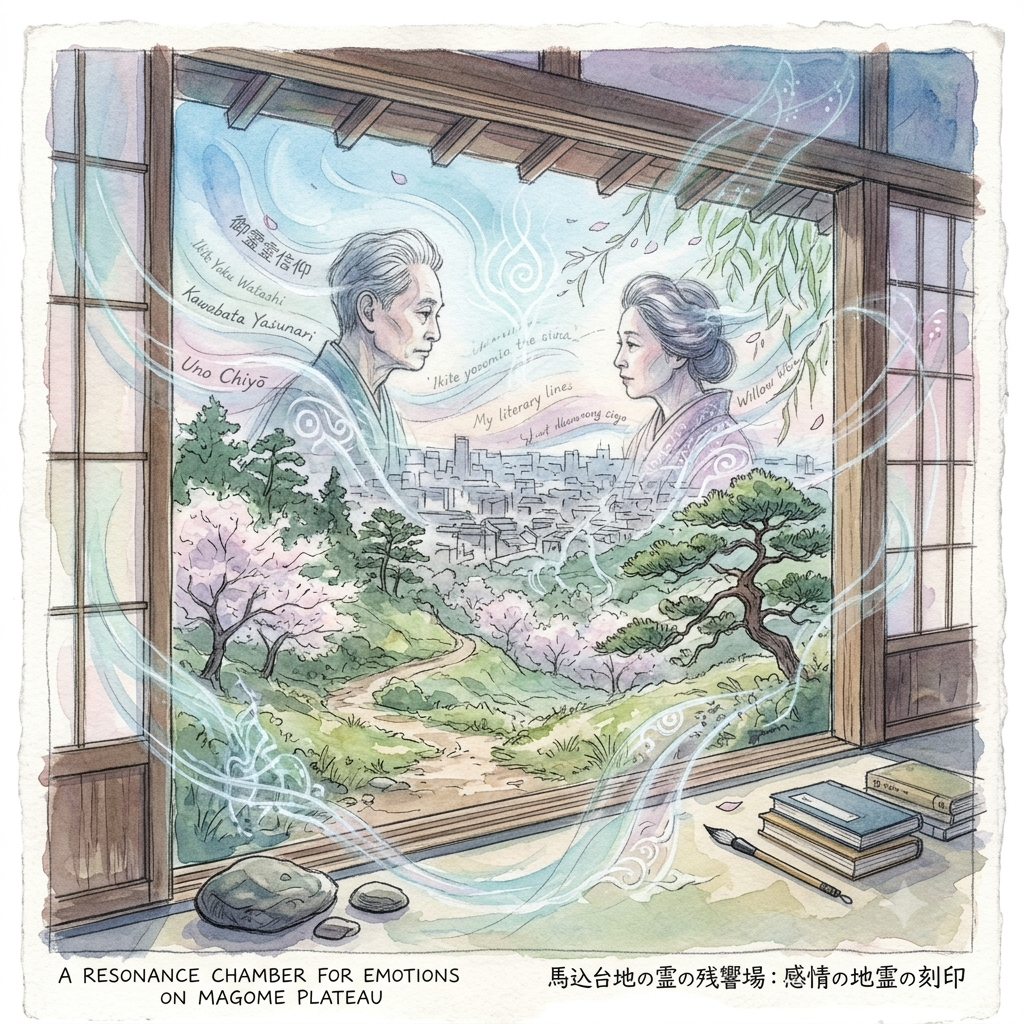
Kawabata Yasunari and Uno Chiyo shared Magome during the same formative years of their careers. Their relationship was the kind that resists simple categorization — creative recognition, personal turbulence, mutual influence, and the specific charge of two people who are both paying extremely close attention to the world. Uno Chiyo's late autobiography, Ikite Yuku Watashi (Living Onward, 1983), preserves fragments of her Magome years: a rare document of the emotional temperature of this particular terrain at this particular time.
The Romance That Haunted A Landscape
In Japan's Shinto tradition, there exists a concept that the Anglo-American literary tradition approaches obliquely through terms like "genius loci" or "haunted place," but which has in Shinto thought a more precise ontological status. The tradition of goryō shinkō — the veneration of powerful emotional residues that adhere to locations — holds that intense feeling, particularly the kind that goes unresolved, accumulates in the places where it was felt. A site that has harbored great emotional events does not return to neutral; it becomes a rei no zankyo-ba, a resonance chamber for what happened there.
This is not mysticism in the pejorative sense. It is a cultural theory of how places acquire depth — a theory that Sebald, working from a completely different tradition, approached in his writing about how the weight of the past persists in landscapes and ordinary streets. The mono no aware — the profound aesthetic awareness of impermanence — that Kawabata described in his Nobel lecture as the animating principle of Japanese literature has a specific topographic address. It was formed here, on this plateau, looking out through a wooden window frame at two worlds simultaneously.
III. Three Thousand Years Before the Writers
Before the literary colony. Before the Shinto shrine. Before the first house was built on the Magome plateau.
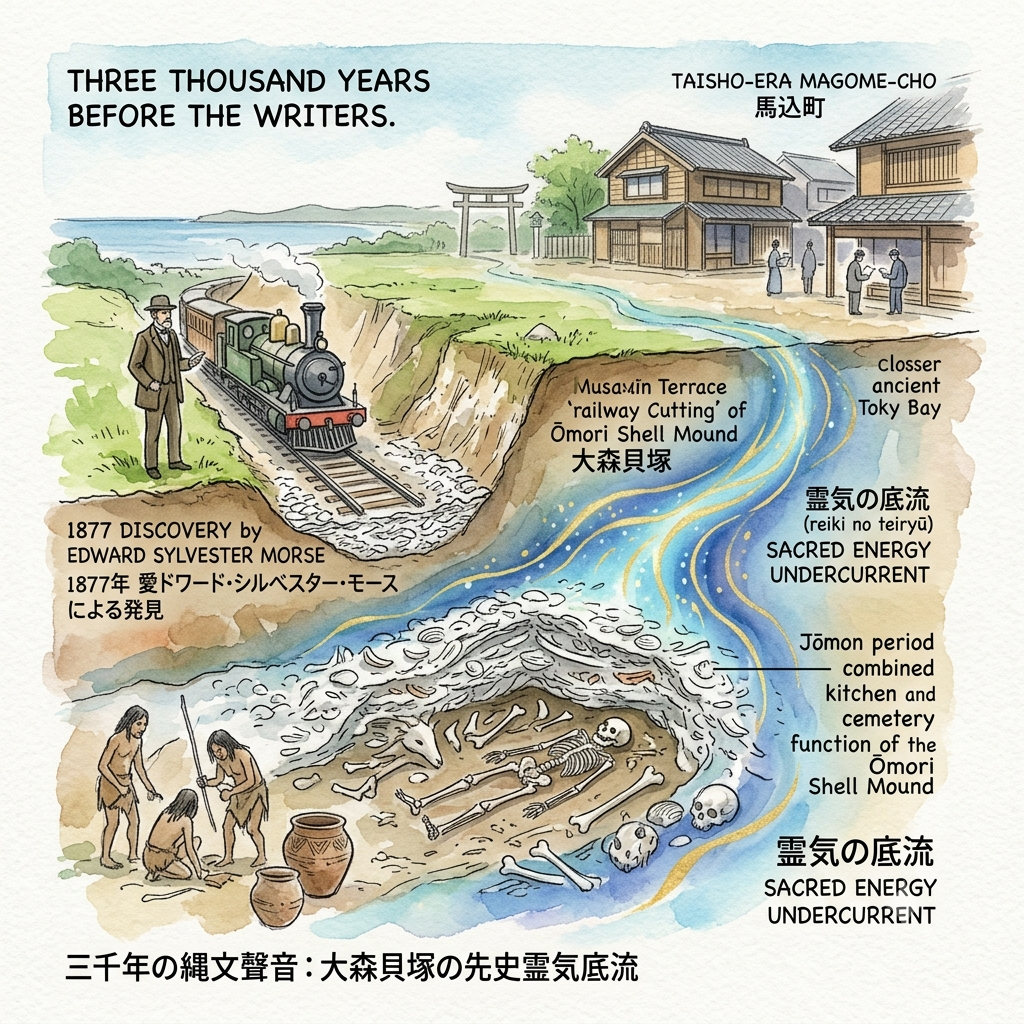
In 1877, an American zoologist named Edward Sylvester Morse was riding the new railway from Yokohama to Tokyo when he noticed something in a cutting along the track: layers of shell, white and dense, suggesting an archaeological deposit of significance. He stopped the train. He began to dig.
The result was the Ōmori Shell Mound (大森貝塚) — one of the founding sites of Japanese archaeology. The mound sits two to three kilometers from Magome plateau, on the eastern slope of the same geological terrace system. Dating placed it approximately three to five thousand years in the past, in Japan's Jōmon period — a long era of hunter-gatherer sophistication. Crucially, it contained not only food remains but human bones. The Ōmori site was not only a kitchen but a cemetery; the Jōmon people buried their dead where they also left the shells of their meals.
Tokyo S 3,000-Year-Old Secret Graveyard
In Shinto and Japanese folk cosmology, sites where generations of human dead have accumulated do not become empty or neutral over time. They acquire reiki no teiryū — an undercurrent of sacred energy, a baseline spiritual density that persists through all subsequent human uses of the land. The Jōmon people chose this plateau edge for rational ecological reasons: the elevation gave them access to both upland safety and the marine resources of what was then a much closer Tokyo Bay coastline. But in choosing it, they established something that, in Shinto spatial thought, continues to matter three millennia later.
The Taisho writers did not know about the Jōmon dead. But they came to the same elevated ground, and found it good.
IV. The Sacred Grove and the Theology of Thresholds
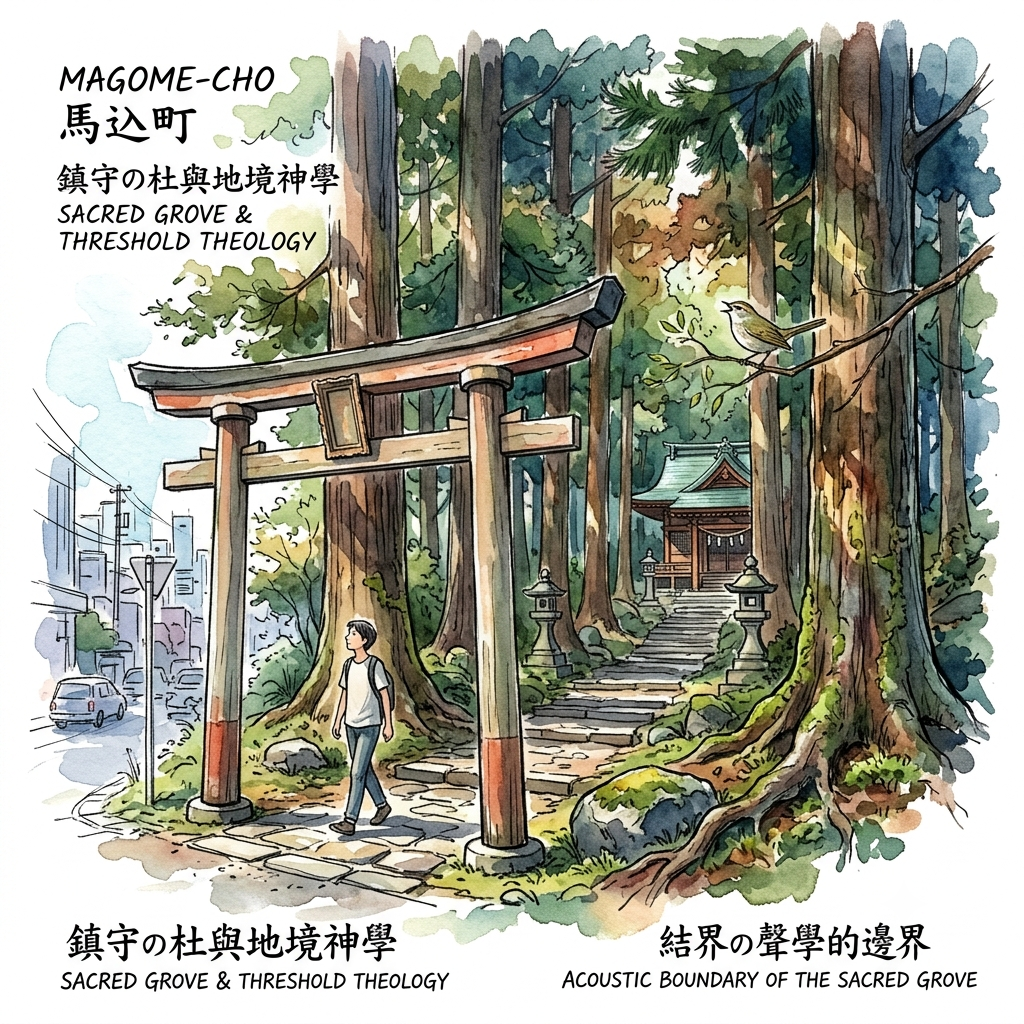
Every traditional Japanese settlement had its chinju no mori: the grove of old trees surrounding the tutelary shrine, the sacred forest that marked the spiritual center of community life. The theology of the chinju no mori is one of the more elegant achievements of Shinto spatial thought — a concept in which the spiritual and the ecological are not separate categories but aspects of a single act of protection.
The chinju no mori functioned as a ki convergence point: a location where the community's repeated ritual acts of worship concentrated and accumulated the vital energy of the land. It also functioned as an ecological reserve — the shrine grove was one of the few places in an increasingly cultivated Japanese landscape where old-growth trees could survive unmolested. The concept of mamori — protection — in Shinto encompasses both functions simultaneously. To protect a sacred space is to protect an ecosystem; the spiritual and the biological are not in tension.
How Shrines Engineer Sacred Silence
The plateau edge that defines Magome is what Shinto spatial theology calls a jizakai: a boundary space between territories, between elevated and low, between settled and wild, between human and divine. The convergence of multiple jizakai at a single point creates, in Shinto spatial analysis, the conditions most favorable to kami presence. The Taisho literary colony settled, without knowing it, in the spiritual jurisdiction of an organizing principle considerably older than any of them.
Resonance Node — The Acoustic Boundary of the Sacred Grove: Find the guardian shrine of the Magome plateau. Walk through the torii gate. Notice what happens to sound. The high-frequency noise of the surrounding city — engines, voices, the mechanical frequencies of contemporary urban life — is absorbed by the tree canopy and leaf-covered ground. What remains is a lower register: the slow friction of leaves, an occasional bird, the sound of your own breathing sharpened by sudden quiet. This "frequency drop" is, in Shinto spatial vocabulary, the acoustic expression of the kekkai — the sacred boundary the shrine grove generates and maintains without human effort. Thoreau noticed something similar in certain patches of New England woodland; Wordsworth called comparable moments "spots of time." The vocabulary differs. The experience is the same. You are now inside a space that has been doing exactly this for more than a thousand years.
V. Fire, Forgetting, and the Recovery of Memory
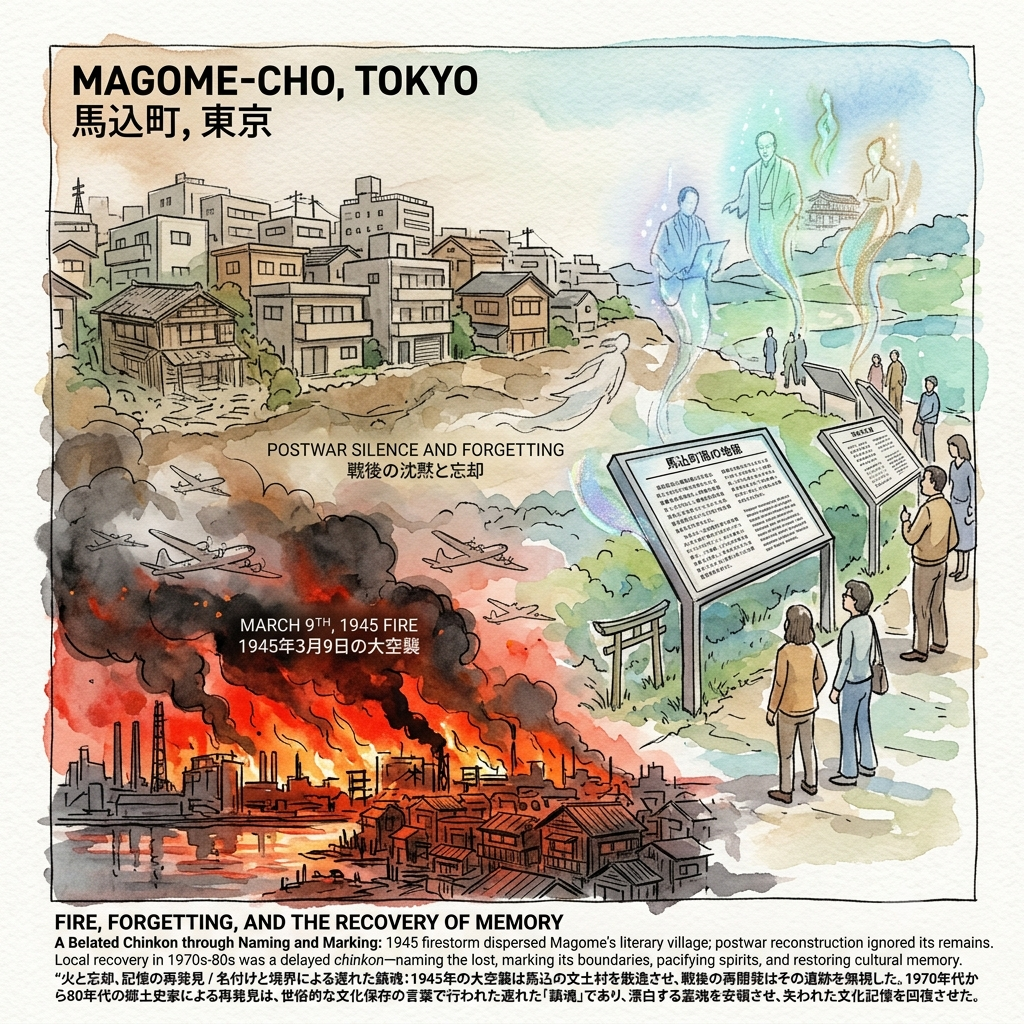
March 9th, 1945. More than three hundred B-29s. Incendiary bombs over Tokyo's eastern lowlands. The firestorm burned approximately forty square kilometers in less than six hours, killing between eighty thousand and one hundred thousand people in a single night.
The Ōta Ward area, concentrated with industrial facilities, was among the most repeatedly bombed districts in the city. The Magome plateau, elevated above the industrial lowlands, experienced the war differently from the areas below it — though a precise accounting of the plateau's damage awaits archival comparison this article can identify but not yet complete.
What is documented is the aftermath: the literary community formed on the plateau after 1923 was, by 1945, entirely dispersed. Some writers had been conscripted into the wartime propaganda apparatus; others had evacuated; others had simply gone quiet in the way that people go quiet when history becomes too loud to speak over. The physical residences of the literary village were absorbed, one by one, into the relentless reconstruction of the postwar city. The economic miracle was not interested in plaques.
Unsealing Tokyo S Buried Writers Village
For roughly three decades, the Magome literary village existed only in the memories of those who had lived in it. Then, in the 1970s and 1980s, local historians began the recovery: interpretive signs, neighborhood histories, walking routes. In the Shinto tradition of chinkon — soul-pacification, the formal acknowledgment of otherwise unhoused spirits — the act of naming a forgotten place and marking its boundary is the foundational gesture of spiritual restoration. You give the unnamed its name; the wandering spirit finds its rest.
The 1970s recovery was, in Shinto functional terms, a belated chinkon — performed in the secular language of cultural preservation, but accomplishing what religious tradition would have recognized as the same act.
The Shinto Lens: Why This Plateau, and Not Another
The standard historical explanation for the Magome literary colony — affordable post-earthquake rents, semi-rural atmosphere, appropriate distance from the city center — is accurate as far as it goes. What it cannot explain is the selectivity: why this specific elevated terrace, among all those in Tokyo's southern outskirts, repeatedly attracted people with a particular sensitivity to place.
Japan's Shinto spatial theology offers a structurally complete answer.
Chirei (地霊, earth spirit) is not metaphor in Shinto thought. It is an ontological entity of the landscape. Every significant topographic feature has its own chirei, and chirei accumulates through time — through ritual use, through intense emotional events, through the physical presence of the dead. The chirei of Magome plateau, when the Taisho writers arrived, was already loaded: three thousand years of Jōmon sacred association, centuries of Shinto shrine ritual, and the emotional freight of every generation that had stood on this high ground and looked down at the plain below.
The Tama River, flowing to the southwest, functions in Japanese spatial tradition as the primary ki-myaku of the region — the main energy meridian, analogous to but distinct from the Chinese concept of dragon veins, rooted in Shinto land theology rather than Daoist cosmology. The plateau edge, where this corridor meets the concentrated ki of the elevated ground, is the configuration that Shinto spatial wisdom consistently identified as sacred — usually long before it could explain why.
The earthquake of 1923 did not create Magome's significance. It revealed it — by driving people of extraordinary sensitivity to find a place that had been quietly charged for millennia.
The Philosophical Anchor
Walking on Magome plateau today, you will find that the deepest history hides behind the most ordinary surfaces. A small, weathering sign marks the location where, in what is now a parking lot, a future Nobel laureate wrote sentences that would last a century. A convenience store occupies a corner near where ki-currents from converging jizakai once made poets feel, without knowing why, that they were in the right place.
This is not the disappearance of history. It is history's completed form.
In Shinto thought, chirei does not require a monument to persist. It exists in the physical properties of the terrain — in the slight resistance of the uphill slope, in the temperature differential between plateau and valley, in the acoustic change at the shrine grove's boundary. These are measurable phenomena. They were here before the first writer arrived, and they will be here after the last tourist leaves.
Magome plateau has absorbed three waves of Tokyo's maximum trauma — earthquake, firebombing, urban erasure — and each time preserved something that outlasted the destruction. That pattern is not coincidence. In the framework of the culture whose sacred ground this is, it is the earth itself doing what the earth, at certain elevated places, has always done.
The slope still pushes back when you climb it. Pay attention to that.
Subscribe to our newsletter to discover more overlooked nodes of human memory.
Accessing the Physical Node
Getting There: Toei Asakusa Line, Nishi-Magome Station (西馬込駅). The plateau begins immediately at the exit.
The Literary Village Walk: Ōta Ward Board of Education publishes the Bunchimura Meguri map, available at Ōta Ward Local History Museum (大田区立郷土博物館, Minami-Magome 5-11-13). Allow two hours for the full route.
Nearby: Ōmori Shell Mound Ruins Garden (大森貝塚遺跡庭園), Ōi 6-chōme, Shinagawa Ward — ten minutes on foot from JR Ōmori Station. The Jōmon prehistoric substrate of the entire region, small, atmospheric, and almost entirely overlooked.
Accommodation: Hotels near Ōmori and Kamata stations, five to ten minutes from Nishi-Magome by train.
Best Season: Late October through November for the ginkgo color; early March for plum blossom near the shrine groves.
💡 Frequently Asked Questions: Tokyo Oi Racecourse & Magome
Q1: Is Oi Racecourse worth visiting in Tokyo? How to place bets and what foods to try?
Answer: Oi Racecourse (Tokyo City Keiba) is highly worth visiting for travelers seeking a unique Tokyo nightlife and horse racing experience. The vibrant atmosphere differs greatly from traditional tracks, featuring festive illuminations and modern amenities. Beginners can easily place bets using multilingual automated ticket machines, with minimum bets starting at just 100 yen for Win (Single) or Place tickets. Food highlights include iconic red ginger tempura, slow-cooked beef tendon stew (dote-ni), and local craft beers. Additionally, the winter TOKYO MEGA ILLUMI event transforms the venue into one of Japan's top-rated light shows, offering an unforgettable evening of entertainment.
Q2: What are Tokyo Oi Racecourse hours, ticket prices, and best ways to get there?
Answer: Oi Racecourse hosts its famous 'Twinkle Race' night events from April through December. Gates usually open around 2:00 PM to 3:00 PM, with the first race starting around 3:00 PM–3:30 PM and the final race concluding near 8:50 PM. General admission costs just 100 yen, with reserved seating options available at higher tiers. Transportation is straightforward: take the Tokyo Monorail directly to Oi-keibajo-mae Station, which is only a 2-minute walk from the main entrance. Alternatively, you can take the Keikyu Main Line to Tachiwagawa Station (12-minute walk) or catch the free shuttle bus operating from Shinagawa Station on select race days.
Q3: How to plan a day trip to Oi Racecourse and Magome area from central Tokyo?
Answer: Combine local neighborhood exploration with evening racing for an authentic half-day Tokyo itinerary. Spend your afternoon strolling through the peaceful Magome residential area or nearby Togoshi-ginza shopping street to experience traditional shitamachi (old town) charm, local snacks, and retro coffee shops. As evening approaches, head over to Oi Racecourse to grab outdoor grandstand seats and feel the thunderous energy of horse racing under neon lights. You can enjoy dinner at the trackside restaurants while watching the illumination shows. If time permits, pair this trip with nearby attractions like Shinagawa Aquarium or Tennozu Isle's art district for a rich off-the-beaten-path experience.
Reference and Further reading
First layer – Main sources of literature and institutions:
- 大田区立郷土博物館;大田区史(官方區史);各文士全集的居住年表注記
- 川端康成記念館(鎌倉市)藏書簡與手稿;大田区立郷土博物館文士村資料
- Edward S. Morse,《Shell Mounds of Omori》(1879,Memoirs of the Science Department, University of Tokio);東京国立博物館大森貝塚藏品目錄
- 大田区神社台帳;神奈川・東京地區神社誌;地籍圖(地所境界の歷史記錄)
- 美軍戰略轟炸調查局(USSBS)東京空襲航拍圖(1945年);大田区戦災記錄;東京都公文書館戰時資料
The second layer – secondary academic materials:
- 大正文學地理學相關學術論文;關東大震災與文化人離散的社會史研究
- 川端康成傳記研究;新感覺派の研究(學術論文);宇野千代研究論著
- 日本繩文時代考古學學術論著;大田區・品川區聯合文化財調查報告
- 日本における鎮守の杜の文化史研究;関東八幡信仰分布研究
- 東京大空襲の地域差異研究;大田區現代史;戦時体制下の日本文学研究
Third layer – Supplementary information:
- 宇野千代自傳《生きて行く私》(1983)中的馬込記述;川端康成書簡集
- 宇野千代《生きて行く私》(自傳)相關章節
- 日本各地與貝塚相關的民間祭祀傳統記錄(類比性資料)
- 地域住民による祭祀記錄(氏子会の記録等)
- 地域住民口述歷史記錄(如存在);区史編纂過程中的採訪記錄
Historical gap:
- To date, no academic monograph has conducted a systematic "psychogeographical analysis" of the Magome Writers' Village.
- GIS spatial mapping of the precise residential addresses of the various writers has not yet been completed.
- Regarding the writers' subjective motivations for choosing the Magome Heights, no primary source explicitly records "geomantic energy" (diqi) as a reason; the extent to which they possessed a specific consciousness of the terrain remains an open historical question.
- Existing documentation regarding the overlap between the timelines of Kawabata’s and Uno Chiyo’s residencies in Magome lacks precision; this information is crucial for establishing the geographical context of their relationship. Further verification of original archives is recommended.
- There are no publicly available records of systematic archaeological surveys of the Jōmon-period strata within the Magome-machi area (likely due to the difficulty of conducting subsurface excavations in a highly urbanized environment).
- The "spatial connectivity" between the Ōmori Shell Mound and the Magome Writers' Village has never been the subject of analysis in existing academic literature.
- No published specialized studies exist that systematically compile the founding dates and historical records (shrine registers) of shrines in the Magome area. Further examination of the original collections at the Ota City Folk Museum is recommended.
- Visual evidence of specific damage to the Magome Plateau during air raids (requiring cross-referencing with USSBS aerial photographs) has not yet been formally incorporated into research on the Writers' Village.
- There is no systematic record of the specific timelines regarding the disappearance of individual former residences in the Writers' Village (whether destroyed in air raids, demolished post-war, or rebuilt during the era of rapid economic growth).
- The social history behind the "rediscovery" of the Writers' Village—specifically, who drove the documentation efforts in the 1970s, as well as their motivations and the context of their historiographical ideologies—requires in-depth investigation.
 Lawrence
 Lawrence
 Lawrence
The sources for this article include primary historical records, academic papers, and public records from various levels of administrative bodies, with a commitment to historical accuracy; instances requiring further verification against primary archival materials have been noted in the text. Last updated: July 2026.