(ENG) Kanamachi Tokyo Walk – Discovering the Quiet Nostalgia of a Shitamachi Border Town
Take a slow walk through Kanamachi, a hidden gem on the edge of Tokyo. From its nostalgic shopping streets to the serene waters of Mizumoto Park, discover a side of the city where time slows down and the everyday beauty of Shitamachi life takes center stage.

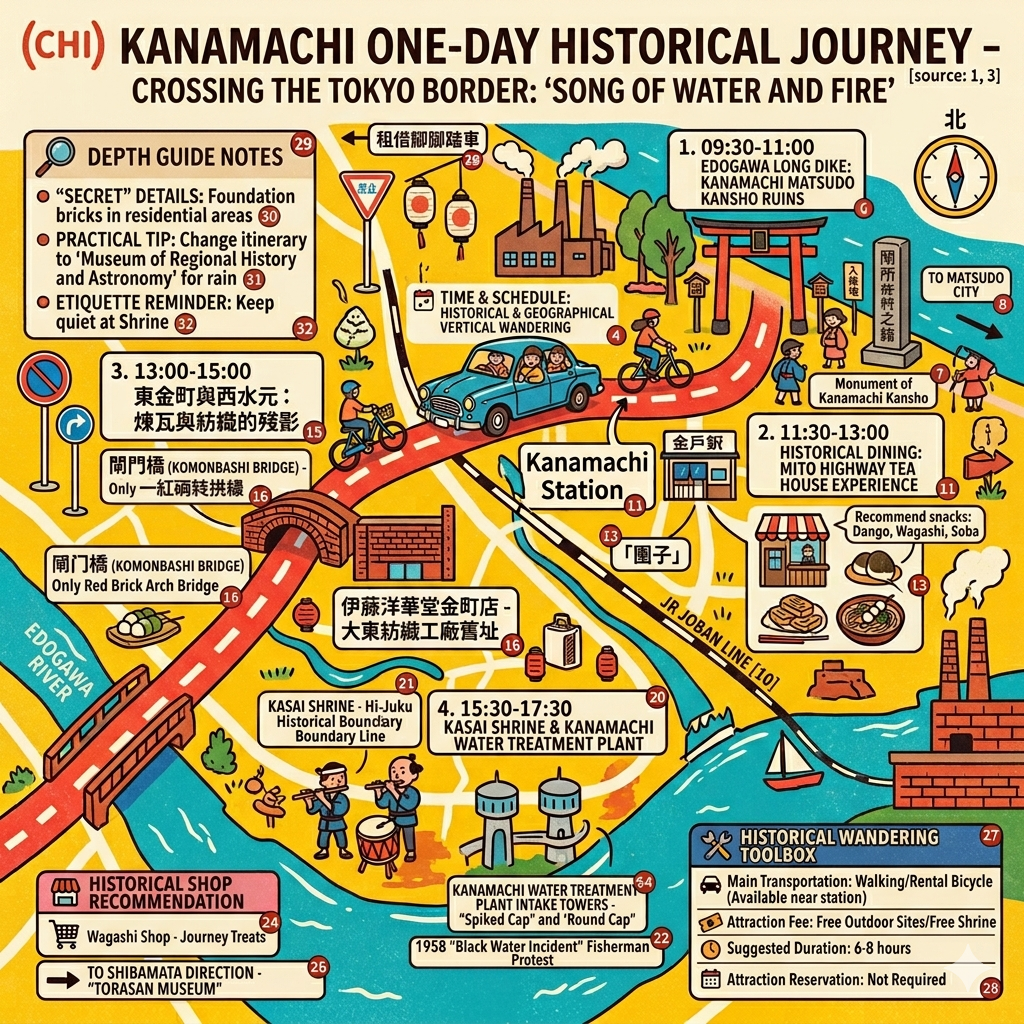
This is a travel story and walking guide to Kanamachi, a nostalgic neighborhood on the edge of Tokyo’s Katsushika Ward. Through a stroll from the local shopping streets to the serene Mizumoto Park, it explores the everyday charm of Shitamachi life and offers a peaceful perspective on the city’s periphery.
 Lawrence
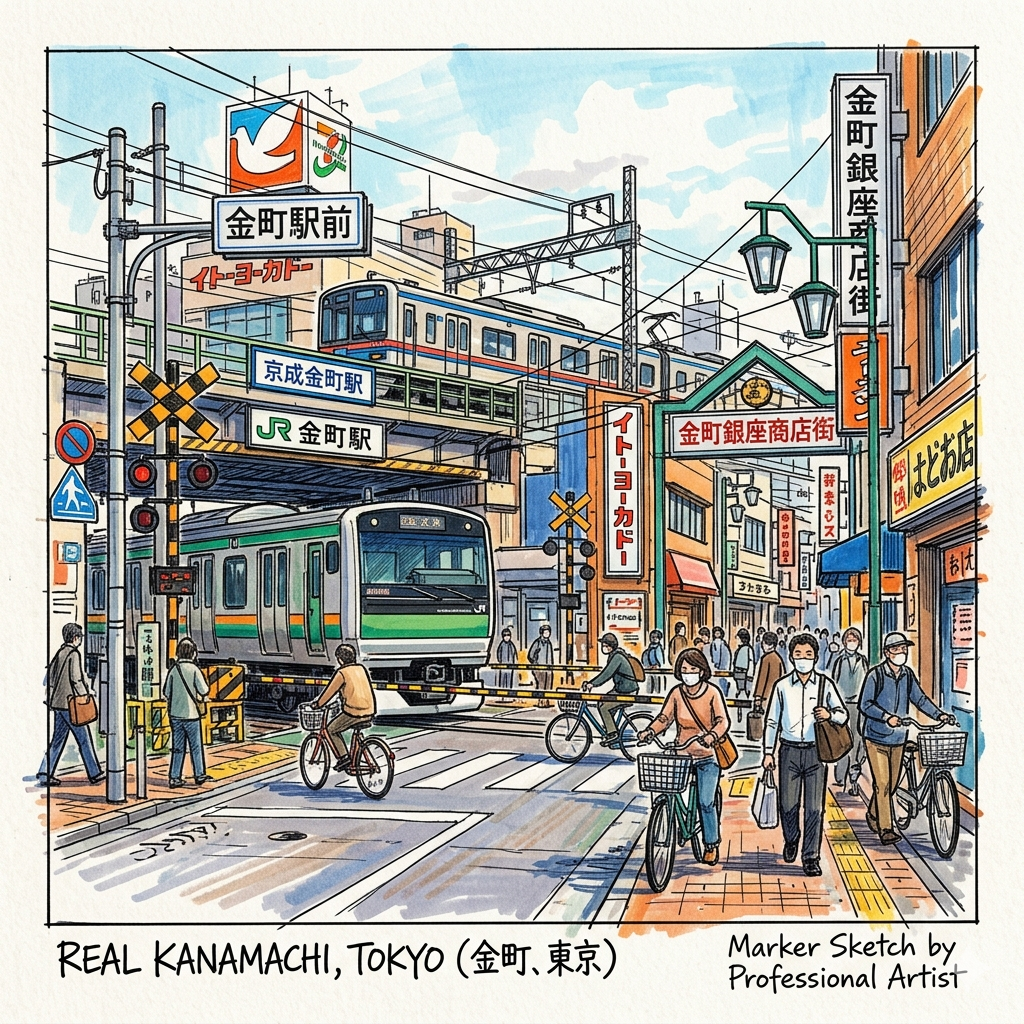
Kanamachi sits at the northeastern frontier of Tokyo’s Katsushika Ward, a place where the city’s concrete sprawl meets the reflective expanse of the Edogawa River. To the casual observer, it is a quiet residential hub, but the historian sees it as a palimpsest—a landscape where the past is etched into the very curvature of the streets. The name itself, Kane, refers to a sharp bend in the river or a deep pool, a topographical reality that dictated the area’s strategic value for centuries. Here, the Edogawa has functioned as a defensive barrier for the Shogunate, a source of alluvial clay for the capital’s modernization, and a lifeline for its thirst. To walk Kanamachi today is to cross invisible thresholds of time, moving from the rigid political filters of the samurai era to the industrial scars that paved the way for modern environmentalism.
Listen to the historical stories told in detail (For subscribers only)
The Political Chokepoint: A Fortress of Water and Waiting
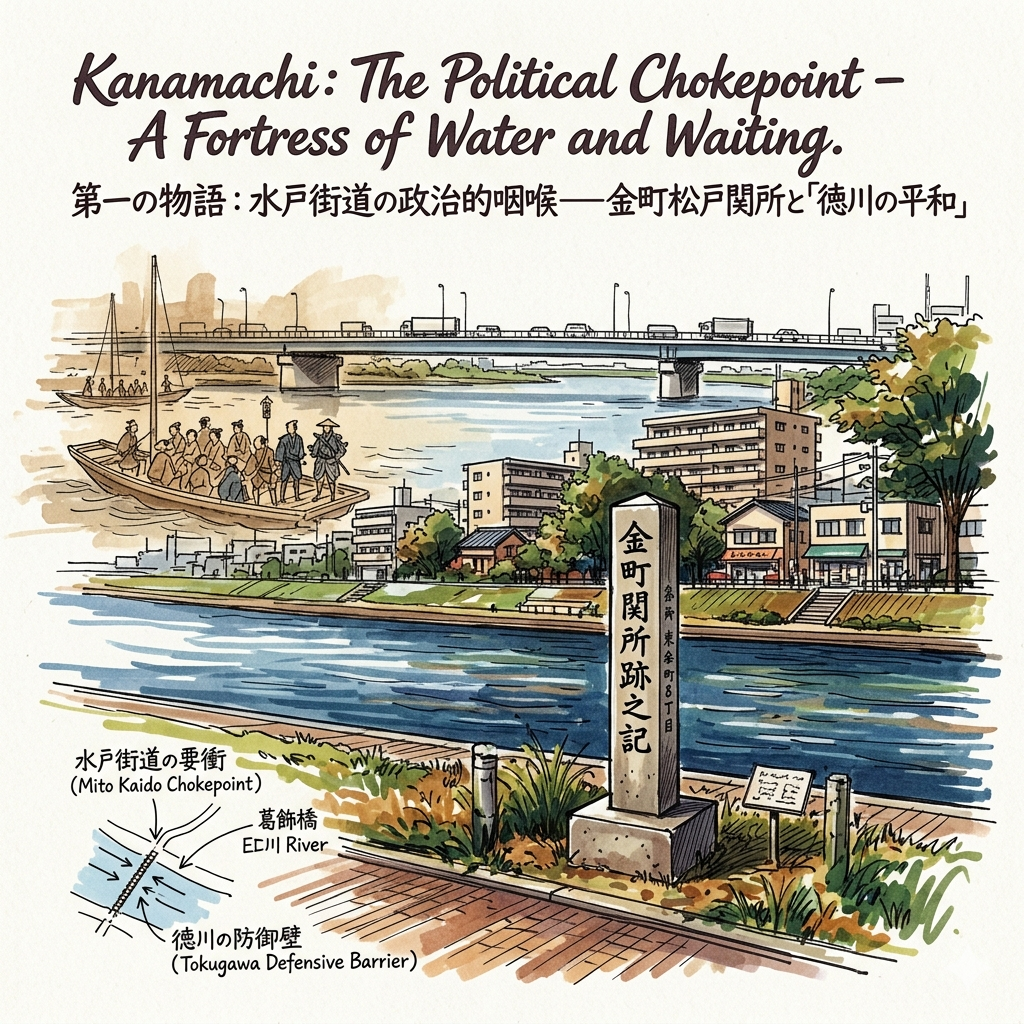
In the statecraft of the Tokugawa Shogunate, the Edogawa River was less a waterway and more a tool of spatial control. The Kanamachi-Matsudo Checkpoint (Sekisho), established in the early 17th century, was the cornerstone of this logic. Situated at a site known as "Shitte"—a natural water fortress where the Kogyagawa and Edogawa converged—the checkpoint functioned as a physical filter for the Mito Kaido, the strategic highway connecting the capital to the northern territories.
The checkpoint enforced the "Enter Guns, Exit Women" (iri-teppo, de-onna) policy, a system designed to prevent weapons from destabilizing Edo and to stop the wives of feudal lords from escaping their state-mandated hostage status. Because the Shogunate prohibited the construction of bridges for over 200 years to maintain defensive superiority, travelers were forced onto government-operated ferries.
"The Kanamachi-Matsudo Sekisho was not merely a gate, but a physical manifestation of the 'Pax Tokugawa.' By forcing all movement into a controlled state of suspension, the Shogunate transformed this riverbank into a permanent 'Wait Space,' shaping a town that existed solely for the pause."
This policy birthed a social structure of "checkpoint towns" (Goshon-machi), filled with tea houses and laborers who thrived on the friction of delay. Today, the original gates are lost to river realignments, but the "Kanamachi Sekisho-ato" monument near the embankment in Higashi-Kanamachi 8-chome marks the spot. Nearby, the Katsushika Bridge stands as the modern successor to the 1911 wooden bridge that finally broke the ferry monopoly, signaling the transition from feudal isolation to a unified nation.
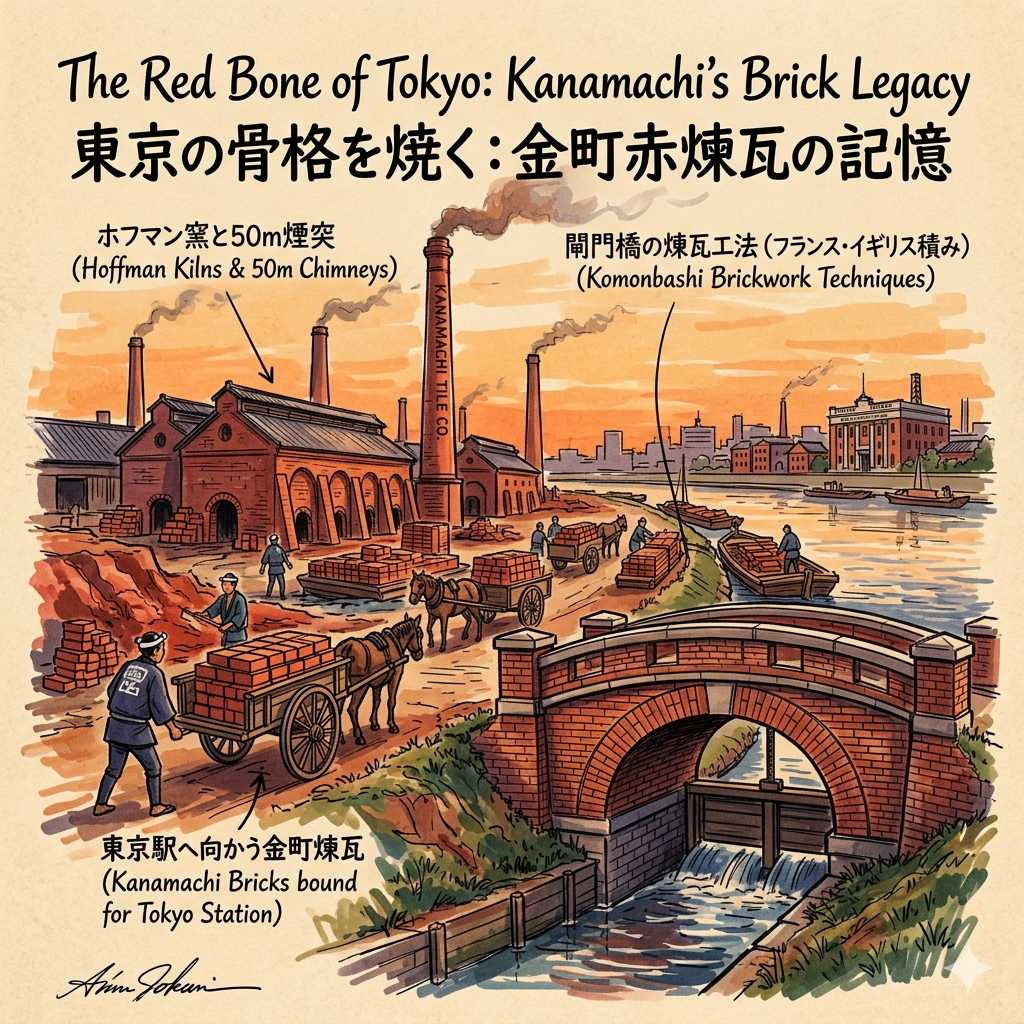
The Red Bone of Tokyo: The Clay of Capital
As the Meiji era dawned, Tokyo sought to shed its wooden skin for the fire-resistant permanence of red brick—a move known as "disaster prevention politics" (bōsai seiji). Under the capitalistic vision of Shibusawa Eiichi, Kanamachi was transformed into a primary production hub. The rich alluvial clay of the Edogawa provided the raw materials for these "modern bones."
Utilizing the German-designed Hoffman Kiln, which allowed for 24-hour continuous production, factories like the Kanamachi Tile Company produced the bricks that built the First National Bank and the iconic facade of Tokyo Station. Kanamachi’s skyline was once dominated by 50-meter chimneys, totems of a town that had ceased to be a periphery and had become the physical source of the capital’s soul.
To find the sensory remnants of this era, one must visit the Komonbashi (Sluice Bridge) in Nishimizumoto. Built in 1909, it is Tokyo’s only surviving brick arch bridge. Observe the texture of the masonry; you can still see the French and German stacking techniques, where the alternating orientation of the bricks speaks to a time when Kanamachi's earth was being fired into the foundation of a global metropolis.
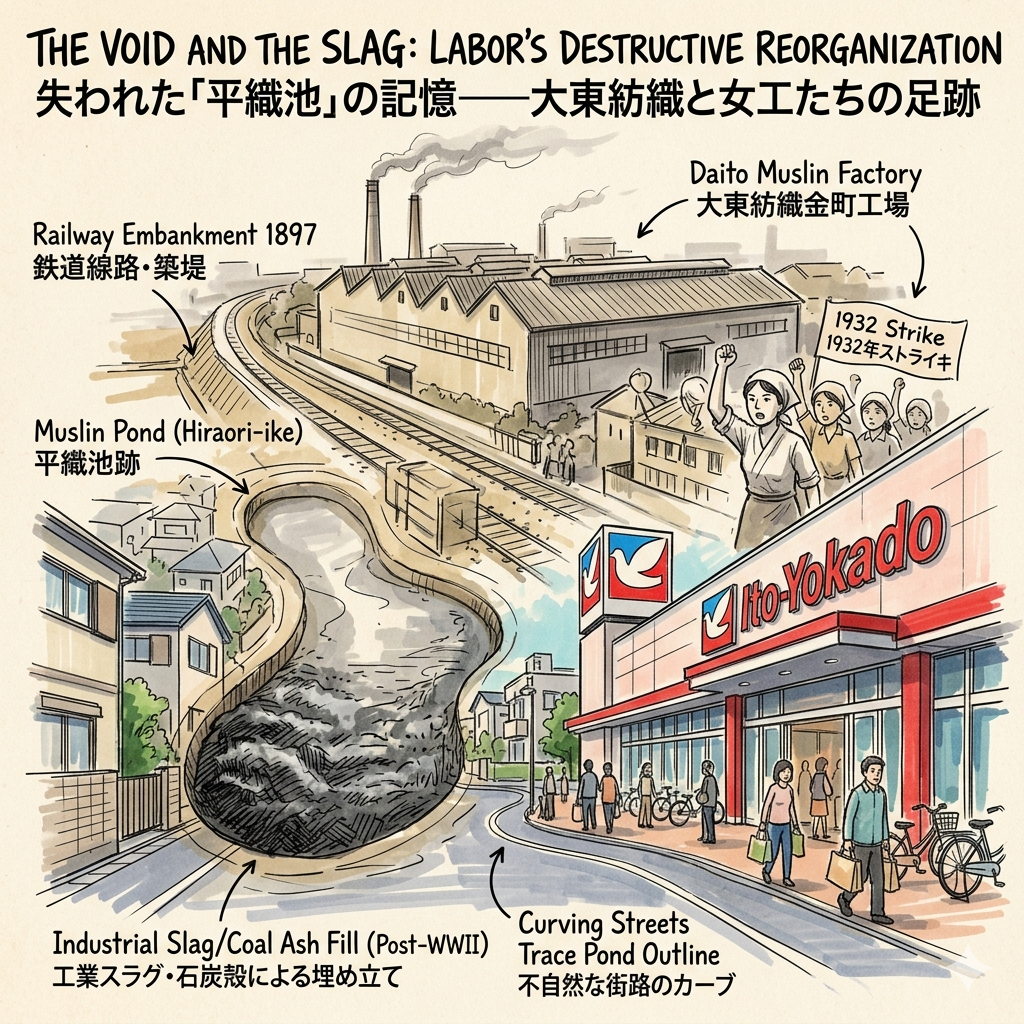
The Void and the Slag: Labor’s Destructive Reorganization
The arrival of the railway in 1897 brought a new kind of "destructive reorganization" to the landscape. Large-scale factories like the Daito Muslin Factory replaced the quiet rice fields. This era left behind the "Muslin Pond" (Hiraori-ike), an artificial void created by extracting massive amounts of soil to build factory dormitories and railway embankments.
Life here was defined by struggle. In 1932, the site became a flashpoint for labor unrest as female workers, living in "prison-like" dormitories, revolted against wage cuts during the Great Depression. There is a deep irony in the "So What?" of this landscape: after years of being a site of labor exploitation, the Muslin Pond was filled with industrial slag—the coal ash byproduct of the factories—after World War II. It was eventually paved over to create residential land.
Today, the bustling Ito-Yokado Kanamachi supermarket sits atop this history. As you walk the supermarket’s perimeter, notice the subtle, unusual curves of the surrounding streets; they still trace the outline of that vanished "Pond of Tears," a silent testimony to the sweat of the textile workers and the industrial waste that eventually filled their void.
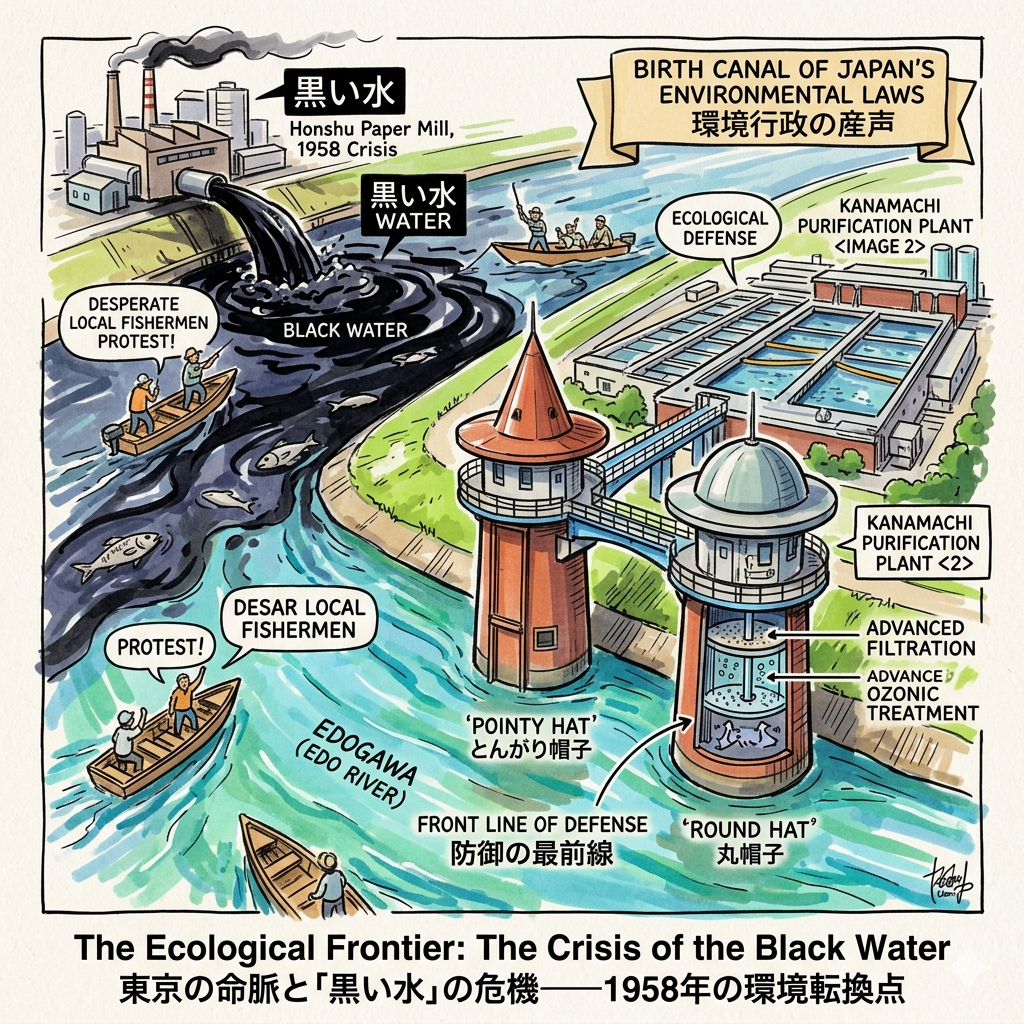
The Ecological Frontier: The Crisis of the Black Water
By the mid-20th century, Kanamachi’s role shifted to sustaining Tokyo’s post-war population boom through the Kanamachi Purification Plant. However, in 1958, this lifeline was nearly severed by the "Black Water Incident." The Honshu Paper Mill, located upstream, discharged high concentrations of chemical waste, turning the Edogawa into a toxic, obsidian flow.
"The crisis reached a chilling crescendo when researchers placed fish in the diluted discharge; they died within 15 minutes. This evidence triggered a riotous surge as over a thousand local fishermen stormed the factory, a desperate bid by the borderland to protect the city's very lifeblood."
This crisis was the "birth canal" of Japan’s environmental laws. It forced a realization that industrial output could not exist without ecological defense. Kanamachi’s iconic "Pointy Hat" and "Round Hat" intake towers, often seen in cinematic shots, are not mere whimsical landmarks. They are the front line of defense, equipped with advanced filtration systems born directly from the trauma of 1958.
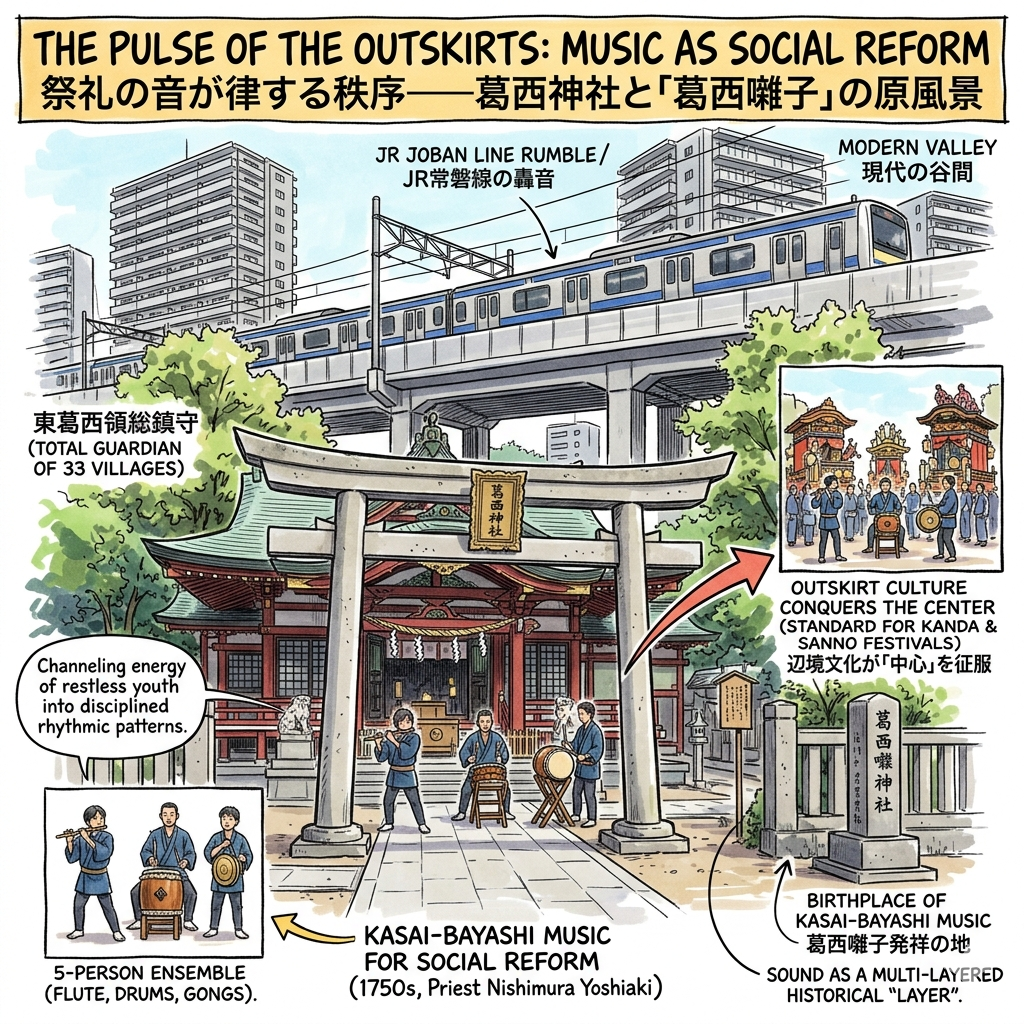
The Pulse of the Outskirts: Music as Social Reform
Beneath the industrial and political layers lies the spiritual foundation of Kasai Shrine, the "Total Guardian" of 33 local villages. In the 1750s, a priest named Nishimura Yoshiaki created Kasai-bayashi music here. It was intended as a tool for "social reform," a way to channel the energy of restless local youth into disciplined rhythmic patterns.
This "outskirt culture" eventually conquered the center. The five-person ensemble—flutes, drums, and gongs—became the standard for Tokyo’s grandest festivals, including the Kanda and Sanno festivals. It is a rare example of a suburban space exerting cultural dominance over the metropolitan core. Near the shrine, a stone monument marks the birthplace of the music. If you visit on the third Sunday of the month, the sharp trill of the flutes still pierces the modern rumble of the JR Joban Line, proving that the spiritual pulse of the borderland remains unbroken.
The Hidden Gem: The Human-Powered Link
For a tangible connection between Kanamachi’s labor and the neighboring spiritual relief of the Tora-san heartland, a visit to the 柴又寅さん記念館 (Tora-san Museum) is essential. Here, you will find a restored Human-Powered Railway (Jinsha). This low-cost transportation system, once pushed by laborers, linked Kanamachi Station to the temple town of Shibamata. It serves as a poignant physical link between the industrial sweat of Kanamachi and the solace of the shrine. It is a reminder that in the history of [Shibamata: The Temple Town], Kanamachi was always the industrial engine that made the spiritual escape possible.
Synthesis: The Palimpsest of Sacrifice
The history of Kanamachi is not a linear narrative but a geological layering: the Red Brick of infrastructure, the Black Water of industrial crisis, and the Golden Music of the shrine. To understand Tokyo is to look beyond the highlights of the center and into these layered peripheries. Kanamachi—historically a boundary and a chokepoint—actually defines the "center" through its outputs and its sacrifices. The capital survived and modernized only because this borderland gave its soil for bricks, its river for water, and its youth for culture.
For more explorations into the stories behind the map, consider subscribing to our [Tokyo Historical Travel Guide] for deeper dives into the city's stratified past.
Navigating the Borderland
Access: Kanamachi Station is easily reached via the JR Joban Line and the Chiyoda Line.
Walking Route: Begin at Kanamachi Station and walk east toward the Edogawa embankment to see the Sekisho-ato monument and the Intake Towers. From there, follow the subtle curves of the streets toward the Ito-Yokado site before ending your journey at Kasai Shrine.
Accommodation & Tours: For those seeking an immersive stay, look for traditional guesthouses in the nearby Shibamata area, which offers historical walking tours that bridge the industrial history of Kanamachi with the cinematic heritage of the Tora-san series.
Q & A
How did Kanamachi transform from a military checkpoint to an industrial hub?
Kanamachi’s transformation from a military checkpoint to a modern industrial hub is a story of how Japan’s modernization efforts fundamentally repurposed geographic boundaries and natural resources. This transition occurred through several critical stages of political, technological, and logistical shifts.
1. The Feudal Anchor: Military Surveillance (1596–1869)
During the Edo period, Kanamachi functioned primarily as a strategic military barrier. The Kanamachi-Matsudo Checkpoint (Sekisho), established between 1596 and 1615, was a cornerstone of the Shogunate’s security system.
- Strategic Control: To maintain "Pax Tokugawa," the Shogunate prohibited the construction of bridges over the Edogawa River, forcing all traffic onto official ferries.
- The Surveillance Logic: As a "heavy checkpoint," it strictly enforced the policy of "guns in, women out" (iriteppo deonna) to prevent weapons from entering Edo and to keep the families of regional lords (daimyos) from fleeing the capital.
- Administrative Society: This created a unique social structure called "O-bansho-machi," a village entirely dependent on the checkpoint’s administrative needs, such as providing ferry labor and operating teahouses for waiting travelers.
2. The Great Pivot: Abolition and Infrastructure (Late 19th Century)
The transformation began in 1869 (Meiji 2) when the new Meiji government abolished the checkpoint system, signaling a shift from feudal localism to centralized national development.
- Ending the Ferry Mandate: The 200-year-old ban on bridges finally ended with the construction of the first wooden Katsushika Bridge in 1911, physically reintegrating Kanamachi into the regional transport network.
- Railway Integration: The opening of Kanamachi Station in 1897 was a decisive moment. It shifted the area's logistical focus from slow water-based movement to rapid rail transport, attracting heavy industry to the riverbanks.
3. Red Bricks and Modernization: The Shibusawa Influence
In the late 19th century, Kanamachi leveraged its natural resources—specifically the high-quality alluvial clay from the Edogawa River—to become a production site for Tokyo’s western-style modernization.
- Industrial Scale: Led by Shibusawa Eiichi (the father of Japanese capitalism), the Kanamachi Brick Company introduced the Hoffman Kiln, a revolutionary German technology that allowed for 24-hour continuous production.
- Building a New Capital: The red bricks produced here provided the "modern skeleton" for iconic structures like Tokyo Station and the First National Bank. Kanamachi’s landscape was soon dominated by 50-meter-tall industrial chimneys, symbols of technological progress.
4. The Textile Boom and Landscape Engineering
By the early 20th century, the industrial transformation reached its peak with the establishment of large-scale textile factories, such as Daito Spinning (Daito Muslin).
- Reshaping the Land: The factory’s construction was so massive that it physically altered the topography. To acquire soil for building factory foundations and railway sidings, developers dug out vast areas of farmland, creating the man-made "Muslin Pond" (平織池).
- Social Change: This era introduced a new industrial social class—thousands of female textile workers from across Japan—and turned Kanamachi into a site of modern labor movements and class struggle, such as the major strikes of 1932.
Summary of Transformation
The river, which once served as a defense ditch to isolate the Shogunate’s capital, was reimagined as a resource carrier and a source of clay for industry. Kanamachi evolved from a "waiting space" where movement was filtered and restricted by the state into a productive powerhouse that supplied the physical materials (bricks) and products (textiles) required for Japan's emergence as a modern nation.
How did local culture like Kasai-bayashi music influence Tokyo's identity?
Kasai-bayashi music, which originated in the Kanamachi area, played a transformative role in shaping Tokyo’s identity by bridging the gap between rural religious traditions and the metropolitan festival culture of Edo. Its influence can be understood through its origins as a tool for social order and its eventual "reverse output" into the heart of the capital.
1. Origins as a Tool for Social Order
Kasai-bayashi was born during the Horeki era (1751–1764) at the Katori Shrine (now Kasai Shrine) in Kanamachi. The shrine’s priest, Nishimura Yoshiaki, created this rhythmic music as a form of "social education" to discipline local village youth who were perceived as idle.
- The Structure: He adapted ancient den-gaku rhythms into a powerful "five-person group" ensemble consisting of a flute, a large drum (o-daiko), two small drums (shime-daiko), and a gong (shō).
- The Purpose: By requiring group synchronization, the music was intended to foster a sense of self-discipline and community order among the youth.
2. From Periphery to the Shogun’s Capital
While most cultural trends typically flowed from the capital (Edo) to the countryside, Kasai-bayashi represented a rare "reverse output" of culture.
- Shogunal Recognition: The Shogunate was so impressed by the music that they invited musicians from the Kasai Shrine to perform during the Shogun’s official processions.
- Setting the Standard: This high-level endorsement led to Kasai-bayashi becoming the standard accompaniment for Tokyo’s most prestigious festivals, including the Kanda Matsuri and the Sanno Matsuri. Today, the energetic rhythm commonly associated with "Edo-style" festivals is actually rooted in this specific tradition from Kanamachi.
3. Shaping Tokyo's Metropolitan Identity
The adoption of Kasai-bayashi by the urban core synchronized the aesthetics of rural and urban areas, creating a unified cultural matrix for the growing metropolis.
- Cultural Matrix: It provided a shared auditory identity for the people of Edo, regardless of their social class or location.
- Living Tradition: The music remains a vital part of Tokyo's identity today as a designated Intangible Folk Cultural Property. Even as the landscape of Kanamachi changed from agricultural to industrial and then to modern residential, the sounds of Kasai-bayashi continue to be practiced and performed, maintaining a thread of continuity between modern Tokyo and its Edo-period roots.
In summary, Kasai-bayashi influenced Tokyo's identity by proving that the city's "soul"—its festive energy and rhythmic pulse—was not just created in the center of power but was significantly informed by the religious and social innovations of its eastern borderlands.
Reference and Further reading
- 金町・水元・新宿の地名の由来, accessed April 28, 2026,
- 【葛飾区】金町 - 旧町名をさがす会 - はてなブログ, accessed April 28, 2026,
- 地名の由来① - 葛飾区史|第2章 葛飾の成り立ち(古代~近世), accessed April 28, 2026,
- 金町 - accessed April 28, 2026,
- 金町松戸関所跡 - 歴史探訪と温泉 - FC2, accessed April 28, 2026,
- 金町松戸関所(金町関所)(東京都葛飾区指定文化財)(東京都葛飾区東金町), accessed April 28, 2026,
- 関所をひかえた宿駅として、たいそう栄えた「松戸宿」 - UKIUKIPLUS(ウキウキプラス), accessed April 28, 2026,
- 金町 - - 街道の行く先へ - FC2, accessed April 28, 2026,
- 葛飾区史|第2章 葛飾の歴史, accessed April 28, 2026,
- 正門レンガと渋沢栄一!? - 東京藝術大学正門再生プロジェクト, accessed April 28, 2026,
- 渋沢栄一と埼玉の近代 -創業期の日本煉瓦製造株式会社, accessed April 28, 2026,
- 「兜町ビルの歴史ー銀行発祥の地ー」渋沢栄一翁と歴史建物 | 清和綜合建物株式会社, accessed April 28, 2026,
- 「晩香廬・青淵文庫」旧渋沢栄一邸跡に遺された名建築を訪ねて - SMILE LOG, accessed April 28, 2026,
- 100年前の心温まるプレゼント 渋沢栄一が愛した青淵文庫へ - 広報東京都, accessed April 28, 2026,
- 【レトロの美】金町浄水場取水塔 東京都葛飾区とんがり帽子と丸帽子 - アートの森, accessed April 28, 2026,
- 葛飾区史編さんだより Vol.1, accessed April 28, 2026,
- 廃線探索 帝釈人車鉄道 - 柴又 - 歩鉄の達人, accessed April 28, 2026,
- 葛飾柴又寅さん記念館 (東京都) - 軽探団, accessed April 28, 2026,
- 治安維持法に負けなかった、輝かしい生涯描く、玉川寛治著『飯島喜美の不屈の青春』, accessed April 28, 2026,
- よみがえる帝釈人車(たいしゃくじんしゃ)鉄道展 | イベント | 葛飾区郷土と天文の博物館|Katsushika City Museum, accessed April 28, 2026,
- 帝釈人車鉄道への旅 | 葛飾区観光サイト|寅さん記念館 - かつまるガイド, accessed April 28, 2026,
- 葛飾区史|第2章 葛飾の歴史, accessed April 28, 2026,
- 江戸川漁業被害 - accessed April 28, 2026,
- 本州製紙水質汚染と水俣病 - 三番瀬, accessed April 28, 2026,
- 本州製紙工場事件|浦安市公式サイト, accessed April 28, 2026,
- 水道新聞 第12回 水質汚濁防止問題と上下水道 本州製紙工場排水事件 ..., accessed April 28, 2026,
- 東京都葛飾区の歴史 金町浄水場・取水塔, accessed April 28, 2026,
- 東京葛飾区 三十三郷の総鎮守の杜|葛西神社 公式サイト|葛西囃子, accessed April 28, 2026,
- 葛西囃子 江戸川区 文化財・史跡, accessed April 28, 2026,
- 江戸時代、現在の江戸川区一帯には田畑が広がり、海では - 漁が盛んに行われていました。 そこで暮らす庶民にとって、「祭礼」, accessed April 28, 2026,
- 葛西囃子の発祥と歴史, accessed April 28, 2026
 Lawrence
 Lawrence
 Lawrence