(ENG) Kohoku Village Heritage Walk – Discovering the Origin of Tokyo’s Five-Colored Cherry Blossoms
Explore the hidden history of Kohoku Village, once the world-famous source of Tokyo's five-colored cherry blossoms. This walk traces the impact of the Arakawa Floodway on local life and uncovers the enduring spiritual and natural landmarks of this unique Adachi neighborhood.

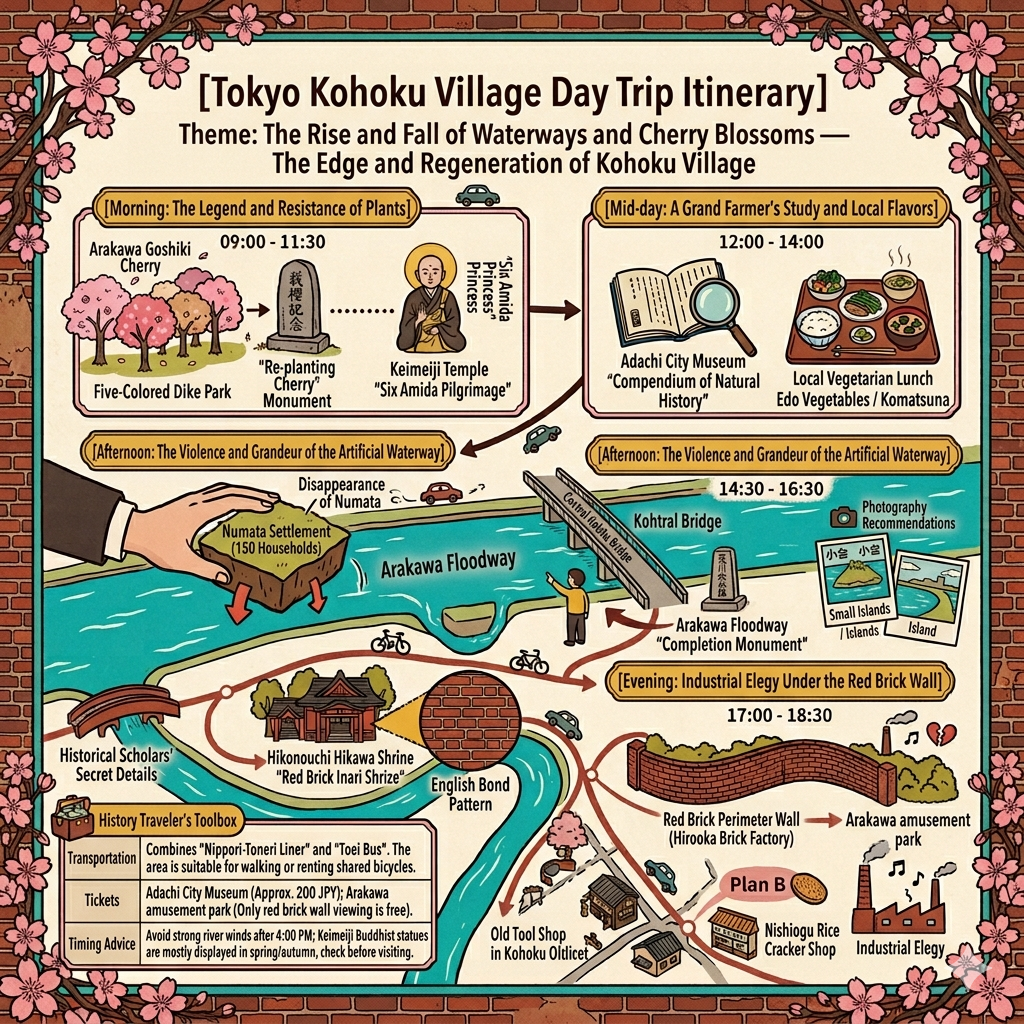
This is a historical travel story and walking guide to Kohoku Village in Adachi, Tokyo. By visiting historic temples and the scenic banks of the Arakawa River, it explores the legacy of the legendary "Five-Colored Cherry Blossoms" and how the village was reshaped by grand engineering projects. Readers will gain a deep understanding of how this rural landscape transformed into a modern community while preserving its floral and cultural heritage.
 Lawrence
To the discerning traveler, the western reaches of Tokyo’s Adachi Ward do not offer the neon spectacle of Shibuya or the manicured elegance of Ginza. Instead, they present a landscape of "archival ghosts." For the cultural historian, Kōhoku is a profound palimpsest—a site where the past has been violently scraped away, only to be overwritten by the utilitarian demands of a modernizing metropolis. This is where Tokyo’s transition from an Edo-period "Water Capital" to a Meiji-era "Modern Metropolis" is physically etched into the topography. To walk through Kōhoku is to witness a specific historical lacuna: a place where Tokyo’s survival was bought at the cost of a village’s soul, a transformation from a lush agrarian enclave into the industrial and hydraulic machinery of a nation.
This journey explores five distinct layers of time: from 12th-century tragic legends to the "theodicy of the landscape" found in Meiji-era engineering. Our primary witness to this upheaval is also its most fragile: the cherry blossom.
Listen to the historical stories told in detail (For subscribers only)
The Goshiki-zakura: A Botanical Act of Resistance
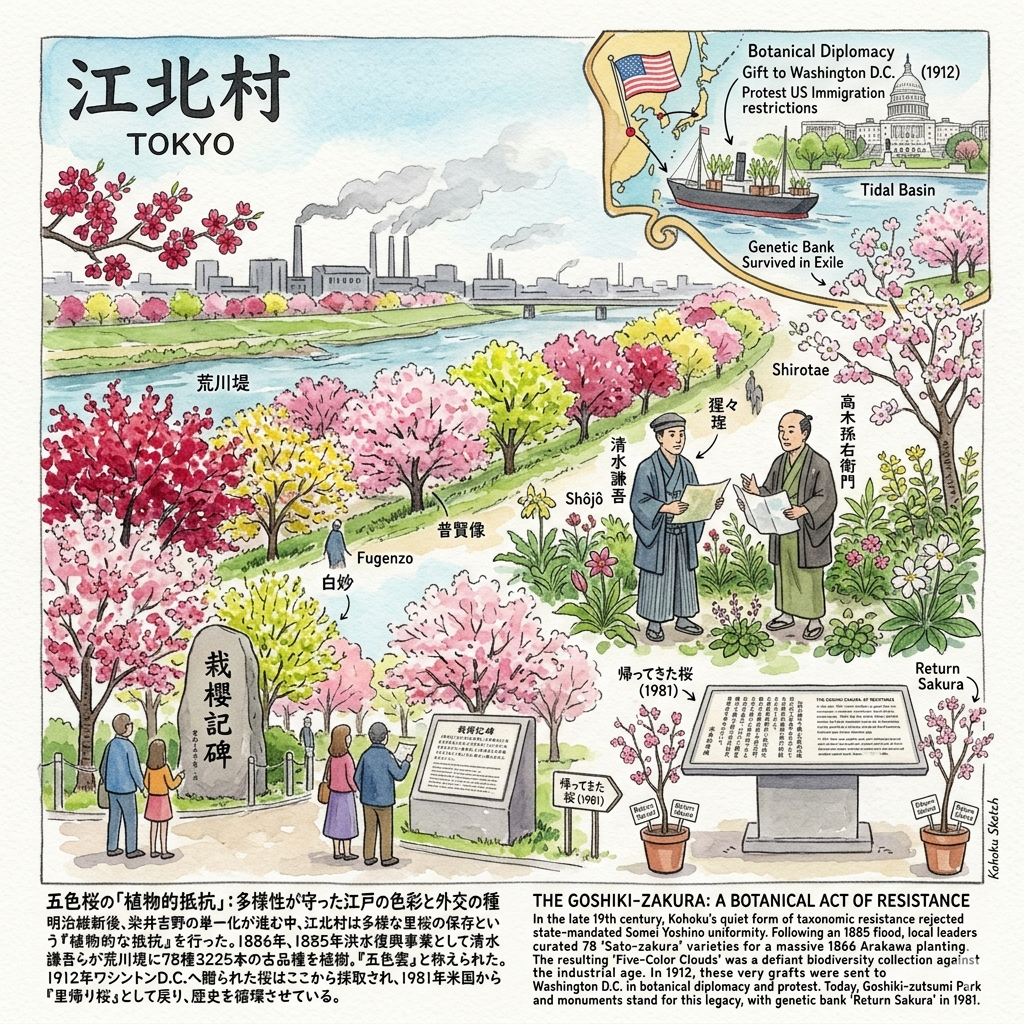
In the late 19th century, the Meiji government’s drive for uniformity manifested in the landscape through the "Somei Yoshino" monoculture. In Kōhoku, however, a quiet form of taxonomic resistance took root. Following a catastrophic flood in 1885, local leaders—including the first village head Shirasu Kengo and the expert Takagi Magoemon—initiated a massive planting project along the 5.8-kilometer Arakawa embankment in 1886.
Rejecting the state-mandated uniformity of the era, they curated 78 varieties of "Sato-zakura" (village cherries), ancient cultivars preserved from Edo-period estates. This was not merely an aesthetic choice; it was a deliberate preservation of biodiversity. The 3,225 trees bloomed in a riot of crimson, pale pink, yellow, and yellow-green.
"The 'Five-Color Clouds' (五色雲) of the Arakawa embankment represented a defiant collection of the rare and the ancient, a botanical diversity that once defined the great estates of Edo and sought to survive the encroaching industrial age."
This act of local preservation reached global significance in 1912. To protest U.S. immigration restrictions and perform a masterstroke of "botanical diplomacy," grafts from these very trees were sent to Washington D.C. Today, the Goshiki-zutsumi Park and the "Sai-ou-ki" monument serve as spatial anchors for this legacy. The "Return Sakura" (genetic descendants brought back from the U.S. in 1981) reminds us that while the river was rewritten, the village’s genetic bank survived in exile.
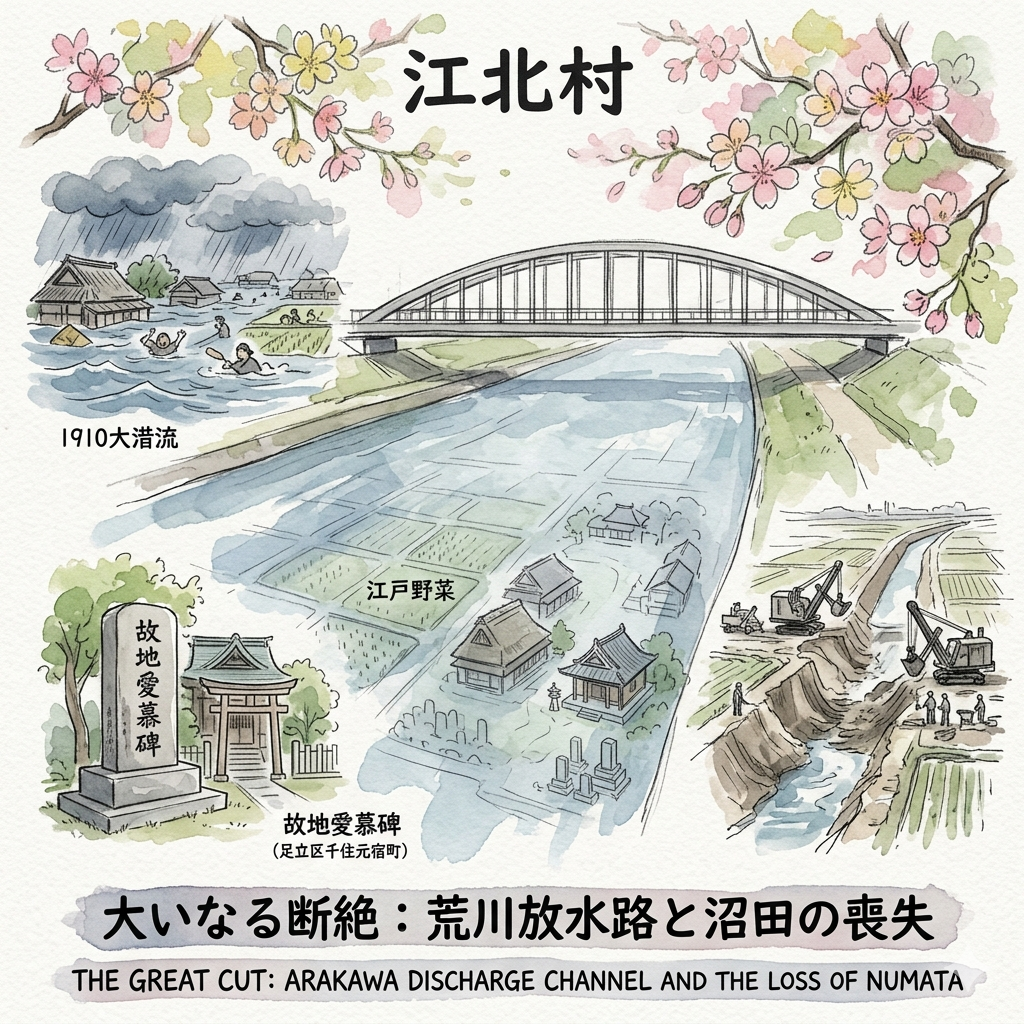
The Great Cut: The Arakawa Discharge Channel and the Loss of Numata
If the cherry blossoms were the village’s spirit, the 1910 flood was the catalyst for its physical dismemberment. To protect the Imperial center, the state executed a "surgical" transformation: the carving of the 22km Arakawa Discharge Channel.
The most violent removal occurred at the Numata settlement. Once the most prosperous part of Kōhoku, famous for its "Edo Vegetables," Numata was literally bisected. The sacrifice narrative is chillingly clear: 150 households and ancestral lands were surrendered to create a 500-meter-wide artificial river.
The Cost of Modernity: The Arakawa Project (Kōhoku Sector)
Data Point | Historical Details |
Construction Period | 1911 – 1930 (Meiji 44 to Showa 5) |
Displacement | 150+ households in Numata and Miyagi |
Canal Width | ~500 meters (Tokyo’s largest artificial waterway) |
Human Cost | 22 fatalities recorded during construction |
Lost Assets | Entirety of Numata settlement, fertile vegetable gardens, original cherry embankments |
Standing on the Kōhoku Bridge, one must look past the water to the submerged village beneath. The "Kōchi Aibo-hi" (Monument of Love for the Homeland) at Senju Motoshuku Shrine, authored by Suzuki Yokichi, captures this atavistic grief, noting how ancestral fields "transformed into waves overnight."
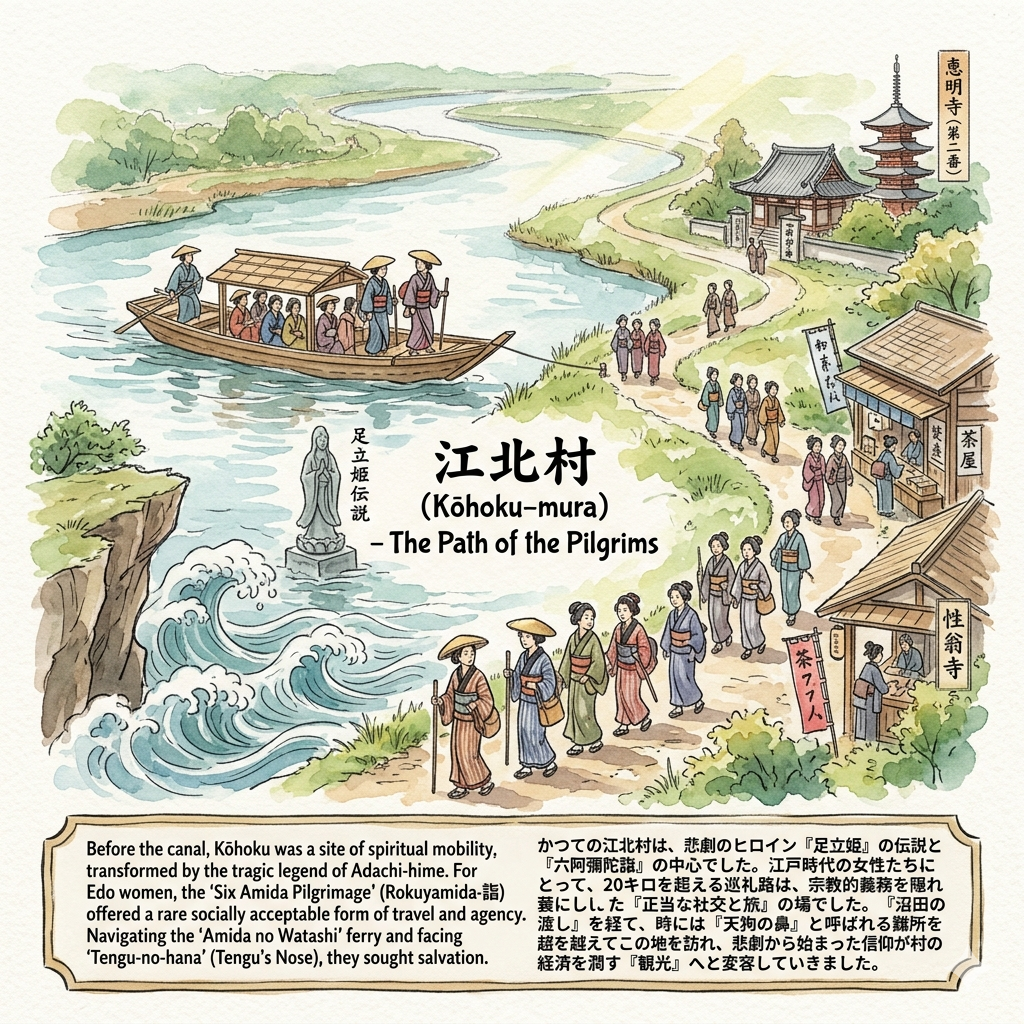
The Path of the Pilgrims: Adachi-hime and the Six Amida Faith
Before the canal carved the land, Kōhoku was a site of spiritual mobility. The tragic legend of Adachi-hime—a 12th-century (late Heian period) noblewoman who drowned herself in the Arakawa to escape a cruel mother-in-law—transformed the region into a destination for the "Six Amida Pilgrimage" (Rokuyamida-詣).
For Edo-era women, this religious route offered a rare form of "gendered mobility" (性別化的閒暇活動), a socially acceptable excuse for travel and agency. Kōhoku’s Keimei-ji Temple (the 2nd stop) and Sho-o-ji Temple became vital nodes in this sacred geography.
"Navigating the 'Amida no Watashi' (Amida ferry crossing), pilgrims faced the 'Tengu-no-hana' (Tengu’s Nose), where the Arakawa’s waters turned notoriously turbulent—a physical manifestation of the perilous journey toward salvation."
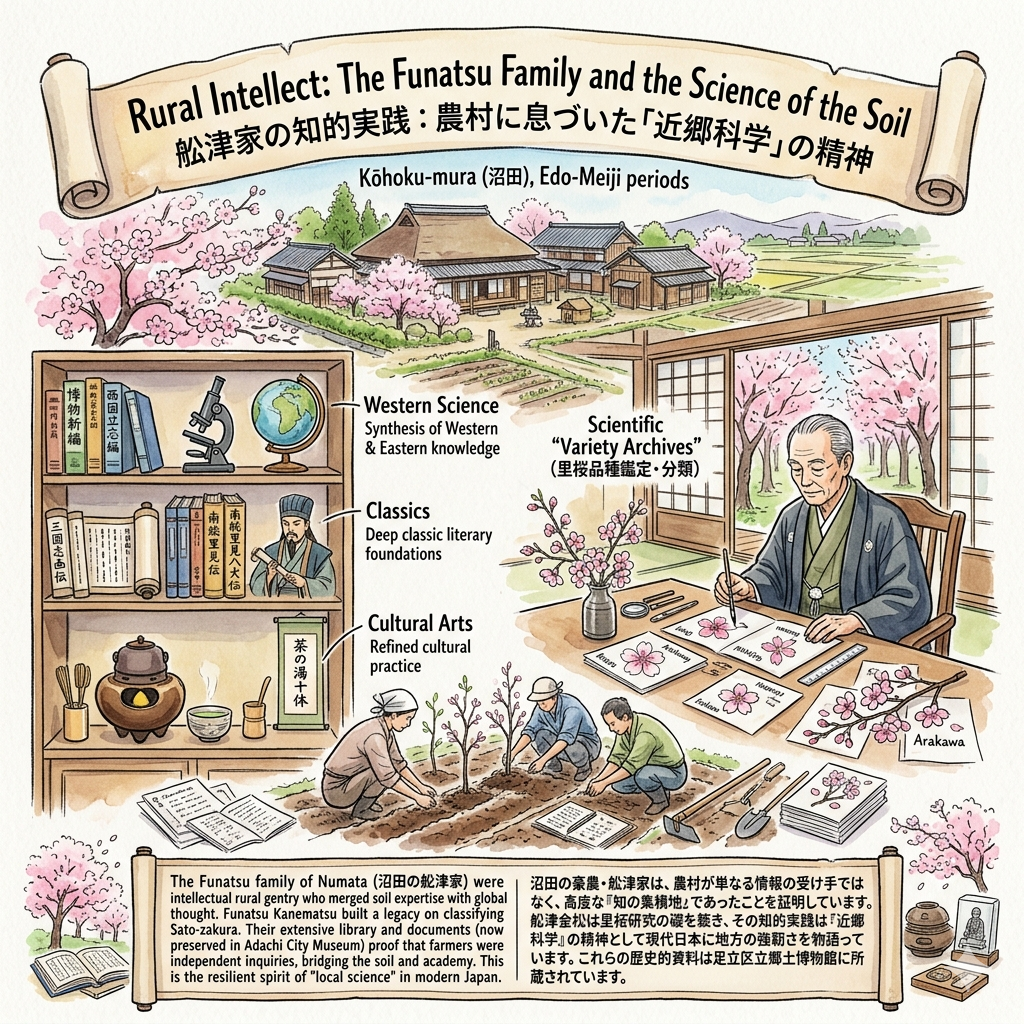
Rural Intellect: The Funatsu Family and the Science of the Soil
The history of Tokyo is often told as a top-down narrative of urban elites, but the Funatsu family of Numata proves Kōhoku was a hub of independent inquiry. The Funatsu were "cultural filters," wealthy farmers who synthesized Western science with traditional classics.
Funatsu Kanematsu emerged as a world-renowned authority on Sato-zakura, establishing scientific "variety archives" that categorized the very trees the state wished to ignore. The family’s library demonstrated an intellectual range that bridged the gap between the soil and the academy. They studied the soil to grow blossoms, just as the coming factories would excavate it to fire bricks.
The Funatsu Intellectual Range:
- Western Science: Hakubutsu Shinpen (Natural History), Saigoku Risshi-hen.
- Classics: Sangokushi Gaden (Romance of the Three Kingdoms), Nansō Satomi Hakkenden.
- Cultural Arts: Cha-no-yu Juttai (Tea Ceremony documents).
Today, the Adachi City Museum houses 138 Funatsu documents, preserving the voice of the intellectual rural gentry.
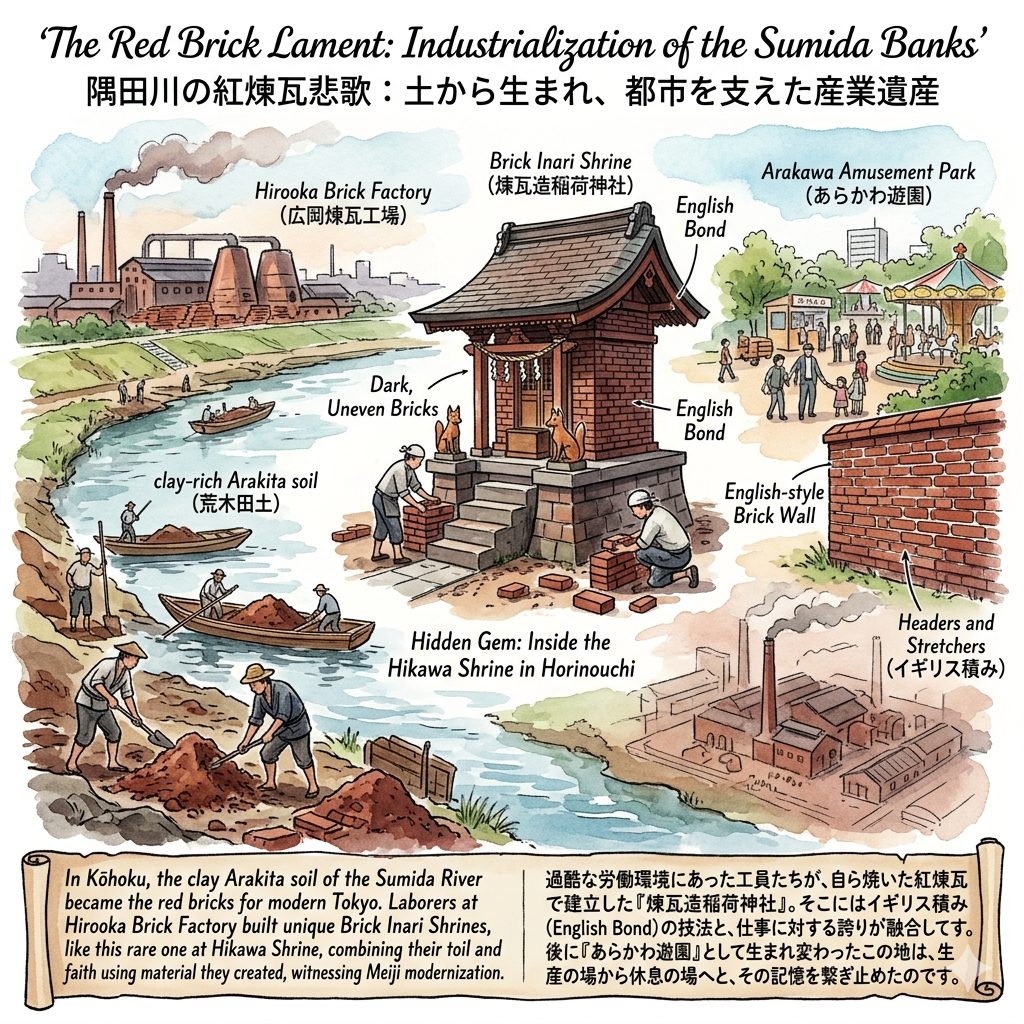
The Red Brick Lament: Industrialization of the Sumida Banks
The final layer of Kōhoku’s transformation is written in red brick. As Tokyo hungered for modern materials, the clay-rich Arakita soil (荒木田土) of the Sumida riverbed was no longer used for vegetables, but for firing the bricks that built Tokyo Station and the Ginza.
The Hirooka Brick Factory and its peers transformed the landscape into an industrial engine. This era birthed a unique religious synthesis: the Brick Inari Shrines. Built by laborers from the very material they produced, these shrines represent a material witness to Meiji-era toil.
Hidden Gem: Inside the Hikawa Shrine in Horinouchi, you will find a rare Brick Inari Shrine. Its dark red, unevenly fired bricks are a testament to the artisan labor of the era.
Nearby, the Arakawa Amusement Park (Arakawa Yuen) stands on the site of a former brick factory. Its English-style brick wall, showcasing the alternating patterns of "headers" and "stretchers," is a physical reminder that the ground Kōhoku residents once walked upon was repurposed to build the landmarks of the metropolis.
Conclusion: The Philosophy of Layered Observation
Understanding a city requires "layered observation"—the ability to see the beauty of the "Return Sakura" and the violence of the Arakawa Cut simultaneously. Kōhoku is a reminder that the "modern" is always built upon the "lost." It is a site where the sacrifice of a village bought the safety of a capital, and where the intellectual rigor of a farmer preserved the biodiversity of a nation.
As we traverse these embankments, we must ask: what are we currently sacrificing for today’s version of modernity, and what lost villages are we creating in our wake?
Logistics: The Traveler’s Toolkit
How to Get There Take the Nippori-Toneri Liner to Kōhoku Station. Ensure you look out the windows; the elevated line provides a "God's eye view" of the massive artificial cut of the Arakawa channel, illustrating the sheer scale of the 1911 engineering project.
Recommended Walking Route
- Keimei-ji Temple: View the 2nd Amida Buddha and reflect on the pilgrimage history.
- Goshiki-zutsumi Park: See the "Return Sakura" and the "Sai-ou-ki" monument.
- Kōhoku Bridge: Walk to the center for a view of the submerged Numata settlement.
- Hikawa Shrine (Horinouchi): Locate the hidden Brick Inari Shrine.
- Arakawa Yuen: Inspect the English-style brick wall at the park's edge.
Nearby Accommodation Stay near Nippori or Ueno for direct access to the Nippori-Toneri Liner and easy exploration of Tokyo's eastern historical districts.
Recommended Tours Inquire at the Adachi City Museum for guided "Historical Waterway" walks or "Adachi Cultural Heritage" tours to see the Funatsu archives first-hand.
Q & A
What is the history behind the Five-Colored Cherry Blossoms?
The history of the Five-Colored Cherry Blossoms (Goshiki-zakura) is a story of scientific preservation, local resistance to modernization, and international diplomacy centered in the former Kōhoku-mura (now part of Adachi Ward, Tokyo).
1. Origins as "Planting Resistance" (1886)
Following a devastating flood in 1885, the Governor of Tokyo suggested strengthening the embankments and beautifying the area. In 1886, Kengo Shimizu (the first village head of Kōhoku-mura), local merchant Shizusaku Funatsu, and cherry blossom expert Magouemon Takagi initiated a massive planting project along a 5.8 km stretch of the Arakawa bank (Kumagaya Embankment).
While the Meiji government was promoting the Somei Yoshino variety for its uniform appearance, the leaders of Kōhoku-mura chose a different path:
- Biodiversity over Monoculture: Magouemon Takagi intentionally avoided Somei Yoshino to prevent mass die-offs from pests or diseases.
- Collection of "Sato-zakura": They collected over 78 varieties of "Sato-zakura" (village cherries) traditionally found in the estates of Edo-period lords (Daimyō).
- The "Five-Colored" Name: Because these varieties bloomed in shades of deep red, pale pink, white, yellow, and yellow-green, the sight was described by the press as "five-colored clouds" (Goshiki-gumo), which gave rise to the name Goshiki-zakura.
2. A Symbol of International Diplomacy (1912)
By the late Meiji era, the fame of the Goshiki-zakura had grown such that it became a tool for national diplomacy. In 1912, the City of Tokyo decided to gift cherry trees to Washington, D.C. as a gesture of peace and a protest against U.S. restrictions on Japanese immigration. Because of their superior quality and variety, the vast majority of the scions sent to the United States were collected from the Goshiki-zakura of Kōhoku-mura.
3. Decline and the "Return Sakura"
The original landscape faced tragic setbacks in the 20th century:
- The Arakawa Floodway: The massive engineering project to create the Arakawa Floodway (Arakawa Housuiro) physically cut through Kōhoku-mura, destroying much of the original embankment and the famous cherry trees.
- Industrialization: Smoke and pollution from nearby factories further damaged the remaining trees.
The legacy was revived in 1981 when Adachi Ward initiated the "Return Sakura" (Sato-gaeri Sakura) project. They took scions from the descendants of the original trees in Washington, D.C., and replanted them in Kōhoku. Today, the Goshiki-zutsumi Park stands as a memorial to this history, housing the "Saiou-ki" monument which details the original technical and philosophical intentions of the 1886 planting.
What are some of the 78 varieties of Sato-zakura?
Based on the sources, while there were more than 78 varieties of Sato-zakura (village cherries) planted along the Arakawa bank in 1886, the specific examples mentioned include:
- 猩々 (Shōjō)
- 普賢像 (Fugenzo)
- 白妙 (Shirotae)
These varieties were carefully selected and preserved through the following historical and scientific context:
- Origin: These ancient varieties were collected from various Daimyō estates (feudal lord residences) dating back to the Edo period.
- Scientific Preservation: The expert Magouemon Takagi intentionally chose these diverse varieties to avoid the risks associated with monocultures (like the "Somei Yoshino"). By planting a wide range of genetic profiles, he ensured that the entire grove would not be wiped out simultaneously by a single pest or disease.
- The "Five-Colored" Effect: These different varieties bloomed at various times and in a spectrum of colors, including deep red, pale pink, white, yellow, and yellow-green. This diversity created a visual effect described as "five-colored clouds" (Goshiki-gumo), which gave the Goshiki-zakura its name.
Although many of the original trees were lost due to the construction of the Arakawa Floodway and industrial pollution, many varieties were reintroduced to the area in 1981 through the "Return Sakura" (Sato-gaeri Sakura) project, using scions taken from the trees previously gifted to Washington, D.C.
Reference and Further reading
- 江北村 - accessed May 13, 2026,
- 江北の五色桜(江北村の歴史を伝える会資料より)|yumiパンダ, accessed May 13, 2026,
- 五色桜 - 足立区, accessed May 13, 2026,
- 荒川堤の五色桜 - 歴史探訪と温泉 - FC2, accessed May 13, 2026,
- 江北 - 足立区観光交流協会, accessed May 13, 2026,
- 足立区都市農業公園の桜, accessed May 13, 2026,
- NPO 法人あらかわ学会による東京都足立区の「里帰り桜」に関する調査結果報告, accessed May 13, 2026,
- 足立史談 - 足立区, accessed May 13, 2026,
- 『足立史談』605号, accessed May 13, 2026,
- 明治・大正・昭和期に行われた荒川放水路開削工事と 市民の生活, accessed May 13, 2026,
- 人の手により開削された「荒川放水路」, accessed May 13, 2026,
- 江北村の歴史を伝える会 - 足立朝日, accessed May 13, 2026,
- 恵明寺 | 足立区江北地域学習センター, accessed May 13, 2026,
- 伝説の悲運の女性、足立姫のお墓へ…|WAGNAS-都内アドベンチャーサークル- - note, accessed May 13, 2026,
- 江戸の 3 つの「六阿弥陀参」における 「武州六阿弥陀参」の特徴 - 歴史地理学会 |, accessed May 13, 2026,
- 六阿弥陀の渡し~豊島の渡し・沼田の渡し - 歴史探訪と温泉, accessed May 13, 2026,
- 渡し碑コレクション/小台の渡し, accessed May 13, 2026,
- 六阿弥陀詣 -1-, accessed May 13, 2026,
- 荒川の歴史 - 日本の川 - 関東 - 荒川 - 国土交通省水管理・国土保全局, accessed May 13, 2026,
- 知っていますか?荒川放水路のこと「荒川放水路通水100周年」 - 足立区, accessed May 13, 2026,
- 江北地區農業變質, accessed May 13, 2026,
- 舩津家文書|足立区, accessed May 13, 2026,
- 舩津家文書目録 名称 差出人 受取人 年代 西暦 分類 形態 員数 備考 1 (偐紫源氏悌)(美人, accessed May 13, 2026,
- 足立を学ぶ|足立区立郷土博物館|足立区, accessed May 13, 2026,
- 荒川遊園煉瓦塀(荒川区) - 戦跡紀行ネット, accessed May 13, 2026,
- 令和4年度新登録の文化財 - 足立区, accessed May 13, 2026,
- 荒川遊園煉瓦塀 - 荒川区立図書館, accessed May 13, 2026,
- 足立小台, accessed May 13, 2026
 Lawrence
 Lawrence
 Lawrence