(ENG) Setagaya Historical Walk – 5 Hidden Stories in Tokyo’s Quiet Suburb
A historical walking guide to Setagaya, Tokyo. Discover five hidden stories of old temples, retro tramlines, and peaceful neighborhood life to experience a nostalgic, slower side of the bustling metropolis.
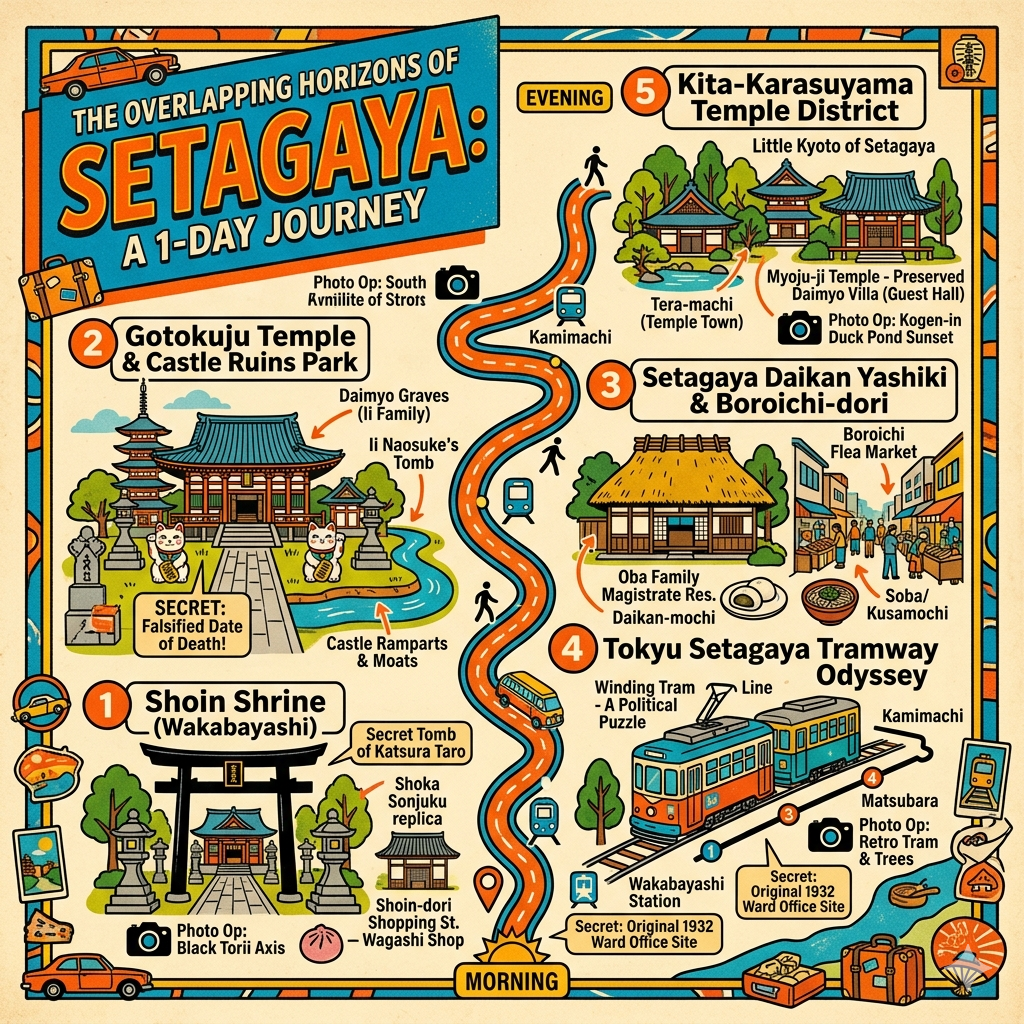
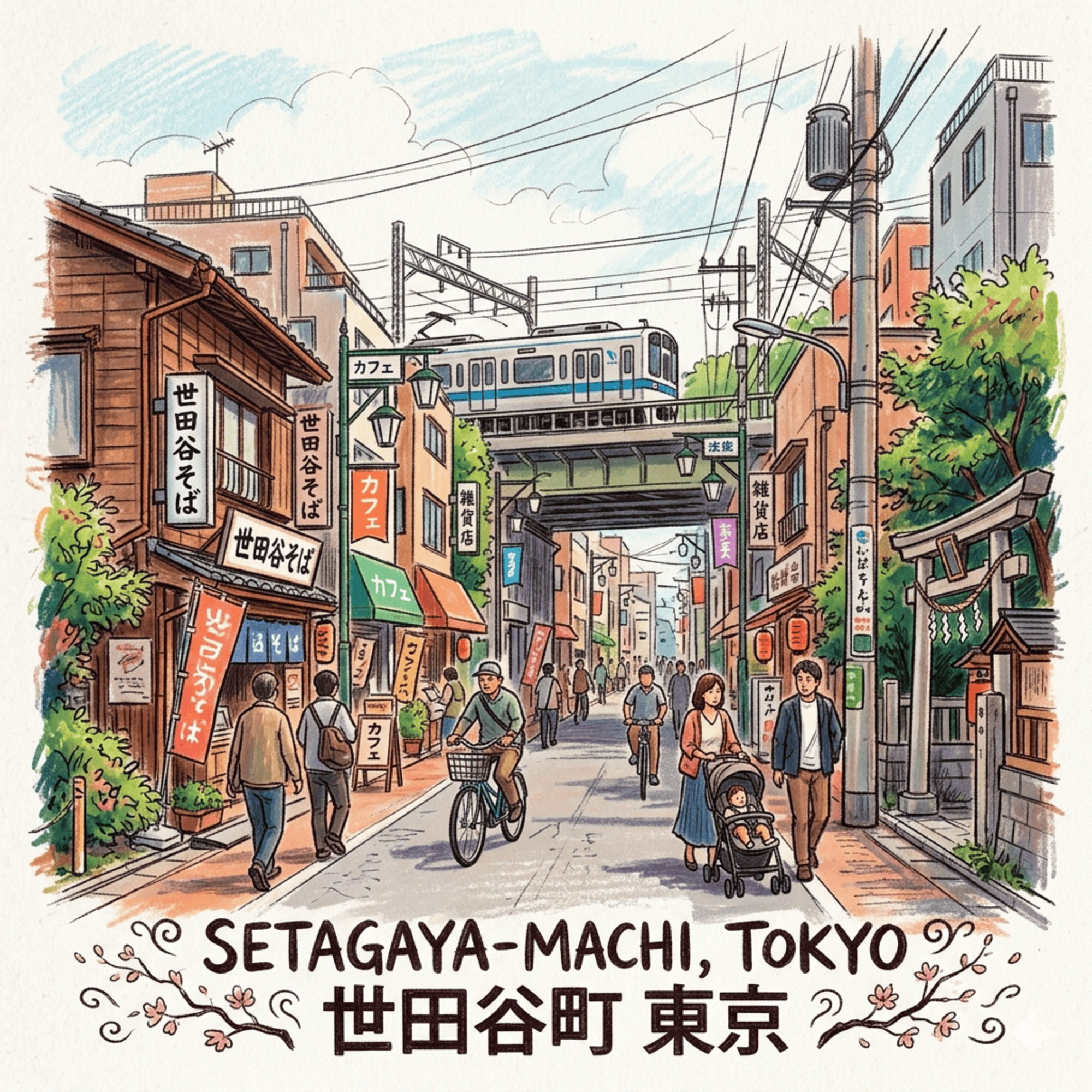
This is a historical travel story and neighborhood walking guide to Setagaya, a peaceful and nostalgic residential district in Tokyo. Through five hidden local histories, it explores heritage temples, retro tramlines, and quiet alleys to show how Edo‑period legacy and modern suburban life gently intertwine. Readers will discover a slower side of Tokyo, complete with an atmospheric route through its everyday streets.
 Lawrence
Setagaya is frequently characterized as a tranquil residential enclave, yet beneath its modern surface lies a complex "peripheral translation"—a site on the edge of central power where history was repeatedly rewritten and repurposed. From its origins as a strategic medieval military outpost to its evolution into a hallmark of the 20th-century suburban dream, Setagaya has served as a spatial buffer where the administrative and spiritual needs of Tokyo were negotiated. Today, this history is not found in dusty archives alone but is inscribed directly into the urban fabric. To walk through Setagaya is to peel back layers of defense, commerce, and political resistance that have been meticulously preserved amidst the residential sprawl. This journey begins at the edge of the Musashino Plateau, where a medieval fortress once stood, eventually transforming into a sanctuary of silence and memory.
Listen to the historical stories told in detail (For subscribers only)
Layer I: The Fortress and the Cat—From Setagaya Castle to Gotokuji
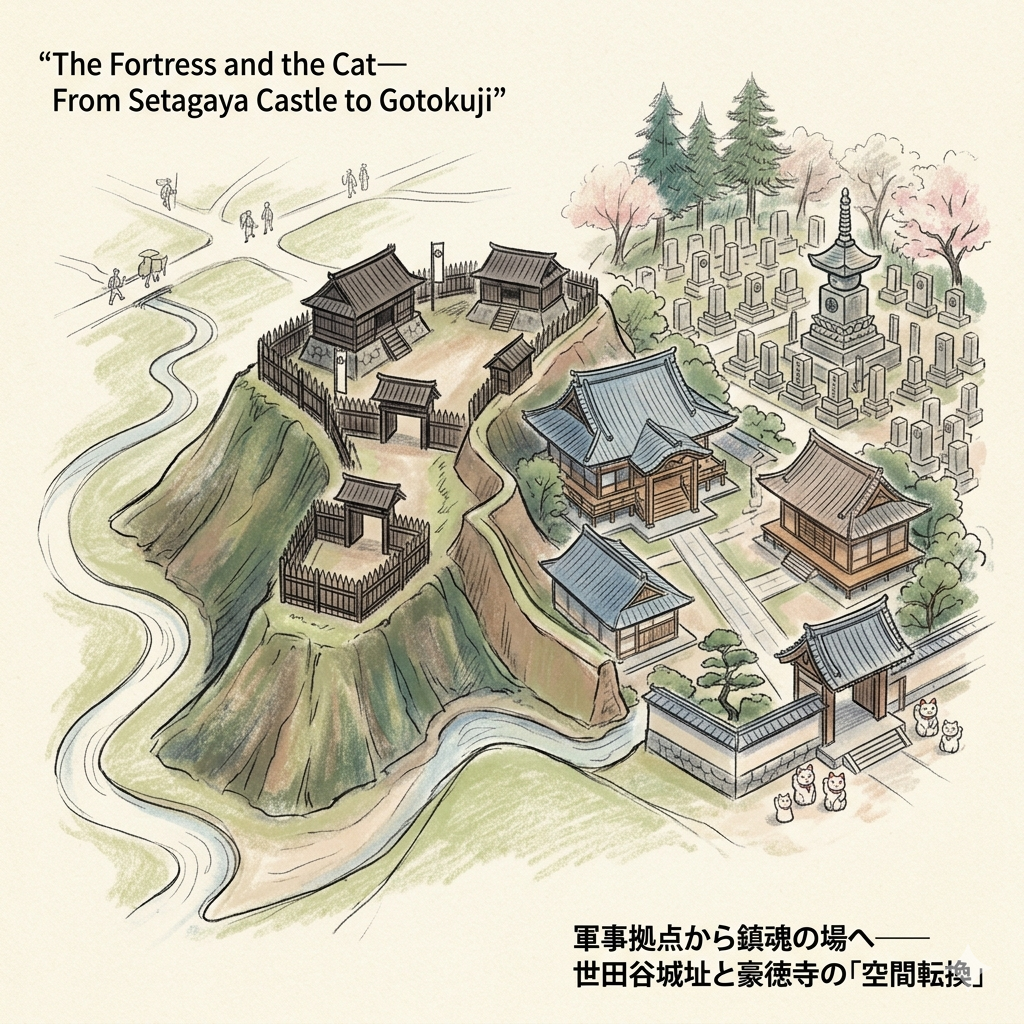
The spatial logic of Setagaya was first defined by the rugged topography of the Musashino Plateau. In the 14th century, the Kira clan recognized the strategic value of a tongue-shaped plateau (haridashi) protruding toward the southeast, naturally protected by the meandering Karasuyama River. Here, they established Setagaya Castle, a military stronghold designed to control the vital traffic of the Takasaka-do and Kamakura-do roads.
This space underwent a radical transformation following the fall of the Hojo clan in 1590. The castle was abandoned, its stones reportedly repurposed for the repairs of Edo Castle. In 1633, the Tokugawa Shogunate granted the area to the Ii clan of the Hikone Domain. This led to a sophisticated instance of "religious co-option": the Ii clan adopted a derelict hermitage, the Kotoku-in, on the former castle grounds, transforming it into their official funerary temple, Gotokuji. By establishing their ancestral graves upon the ruins of the previous rulers’ stronghold, the Ii clan stabilized their authority and effectively translated a site of military violence into one of spiritual and administrative legitimacy.
"This spatial flow reveals the evolution from a medieval military fortress to a daimyo’s center of ancestral ritual and administrative control. The site was not extinguished with the new regime but was re-appropriated through 'religious co-option' by the Ii clan, the head of the Shogunate’s hereditary lords."
Spatial Detail: Visitors to Setagaya Castle Park can still observe the dorui (earthen walls) and karabori (dry moats) that characterize medieval Kanto hill castles. These defensive ridges lead directly into the grounds of Gotokuji, where the layout of the Ii family’s sprawling cemetery—a National Historic Site—rests upon the original footprint of the Kira clan’s inner citadel.
Layer II: The Law of the Market—The Boro-ichi and the Daikan Yashiki
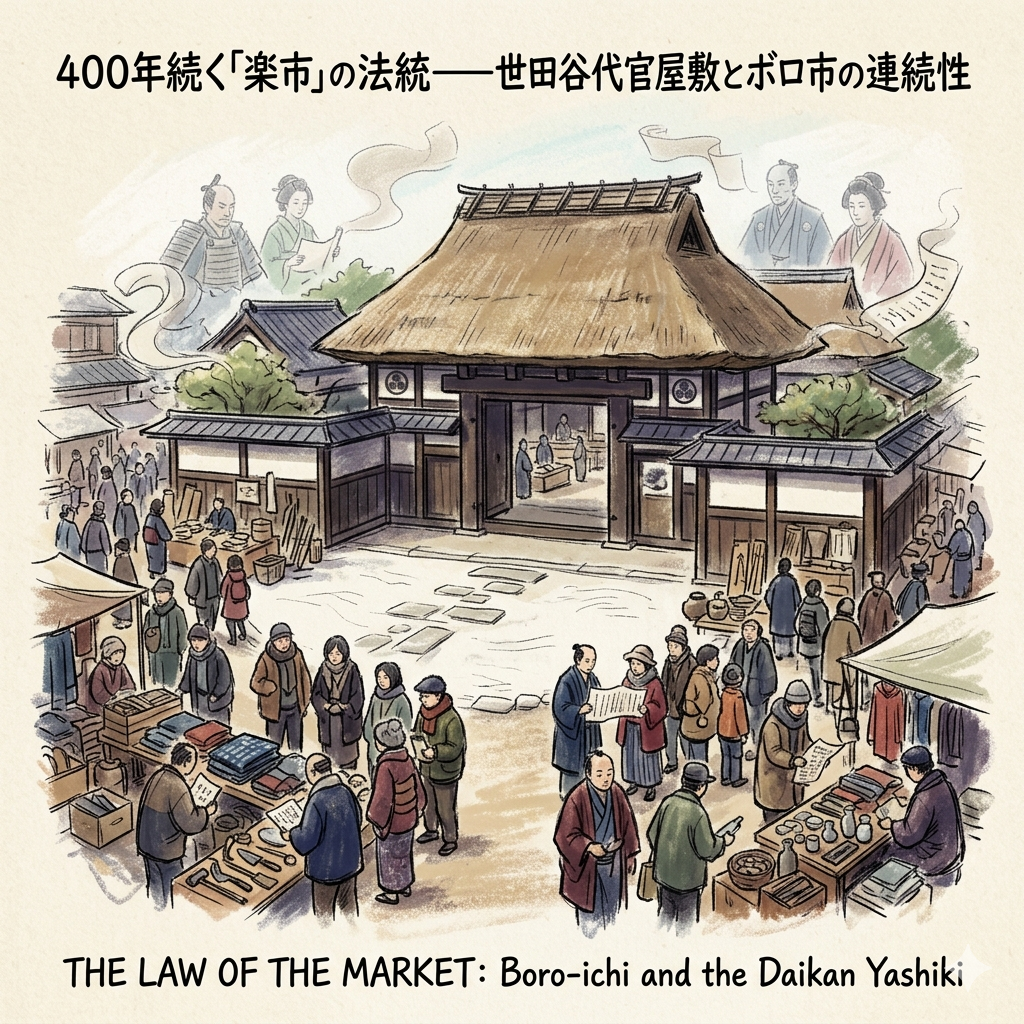
While the ruling clans changed, the economic life of Setagaya maintained a remarkable continuity. In 1578, Hojo Ujimasa established a Rakuichi (Free Market) in the "New Post Town" of Setagaya to stimulate local trade. Despite the subsequent collapse of the Hojo regime, the market survived through the stewardship of the Oba family. Former samurai retainers of the Kira clan who chose to remain on the land, the Oba were eventually appointed as Daikan (Magistrates) by the Ii clan, overseeing twenty local villages.
The Oba family ensured that the 16th-century commercial decrees remained in force, preserving the market’s legal status against centralizing forces. This autonomy allowed the market to evolve from a daily necessity into the Setagaya Boro-ichi, a massive seasonal gathering that remains a cornerstone of local identity.
Period | Governance | Core Commodity | Legal Status |
1578 (Late Warring States) | Hojo Clan (Ujimasa) | Daily necessities and tax-free items | Rakuichi (Free Market) decree |
Modern Era | Local Associations / Oba Family | Farm tools, old cloth (boro), folk crafts | Seasonal privileged market |
Spatial Detail: The Daikan Yashiki (Magistrate’s Residence) serves as the primary physical anchor for this history. As the only surviving example of a daimyo’s local administrative office in Tokyo, the thatched-roof main building and the "White Sand Area" (shirasu-ato)—where trials were once held—offer a tangible link to the 18th-century governance of the Oba family.
Layer III: The Neighborhood of Rivals—Shoin Shrine and the Ii Grave
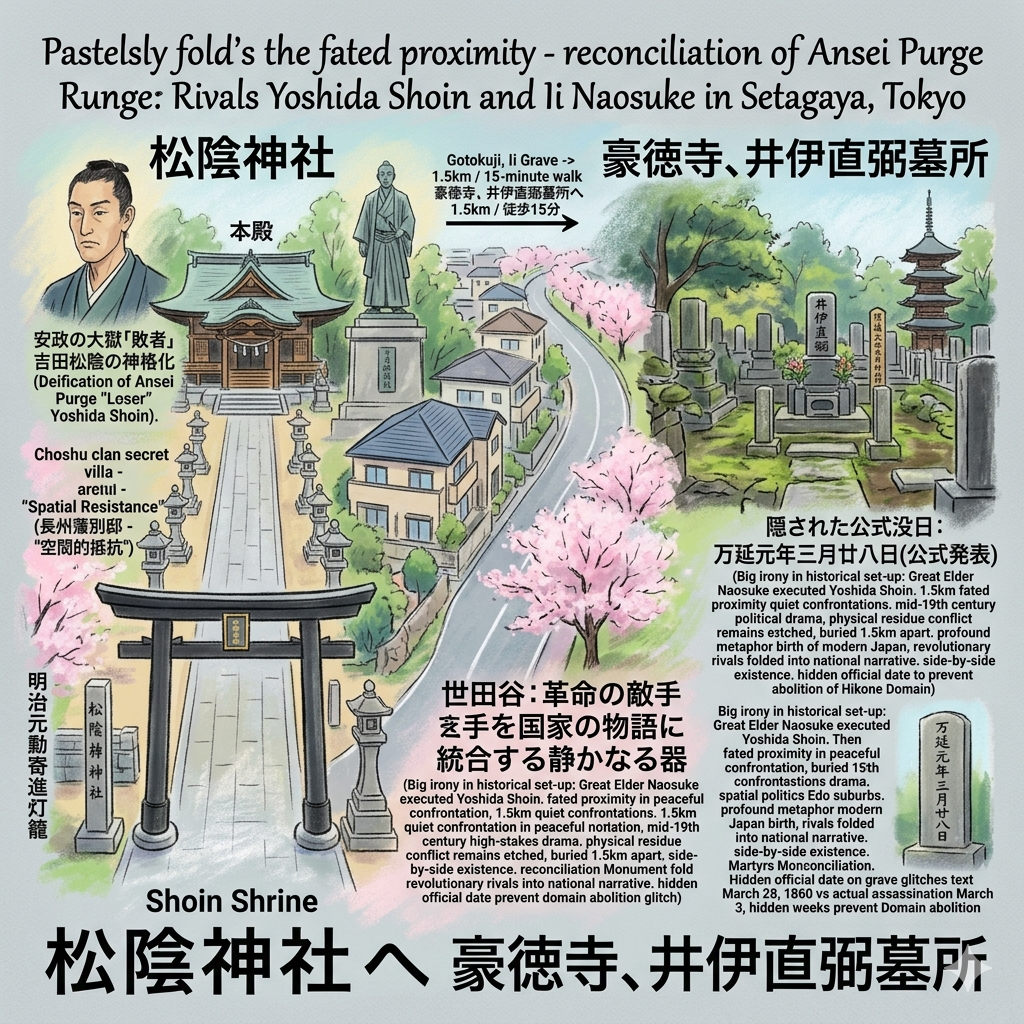
The mid-19th century brought a high-stakes political drama to Setagaya’s doorstep. During the Ansei Purge, the Shogunate’s Great Elder, Ii Naosuke, executed the visionary thinker Yoshida Shoin. The physical residue of this conflict remains etched into the landscape, with the executioner and the executed buried a mere 1.5 kilometers apart.
In 1863, Shoin’s disciples secretly moved his remains from a common execution ground to a private villa (Daifu-yama) owned by the Choshu clan in Setagaya. This "spatial resistance" allowed the Choshu clan to honor their mentor in a space that functioned with a degree of extraterritoriality from the Shogunate.
The "So What?" Layer: This proximity acts as a profound metaphor for the birth of modern Japan. The "losers" of the Ansei Purge were eventually deified at Shoin Shrine, while the "winner," Ii Naosuke, lies in the quietude of Gotokuji. This tension eventually resolved into reconciliation; in 1886, the Meiji government allowed the construction of the Sakurada Martyrs Monument at Gotokuji to honor the Ii retainers who died defending their lord. Their side-by-side existence reflects a nation that folded revolutionary rivals into a single national narrative.
Spatial Detail: At Gotokuji, Ii Naosuke’s grave bears a burial date of March 28, 1860—a deliberate discrepancy from his actual assassination on March 3. This archival "glitch" in stone marks the political crisis where his death was hidden for weeks to prevent the immediate abolition of the Hikone Domain.
Layer IV: The Great Migration—The Birth of Karasuyama Temple Town
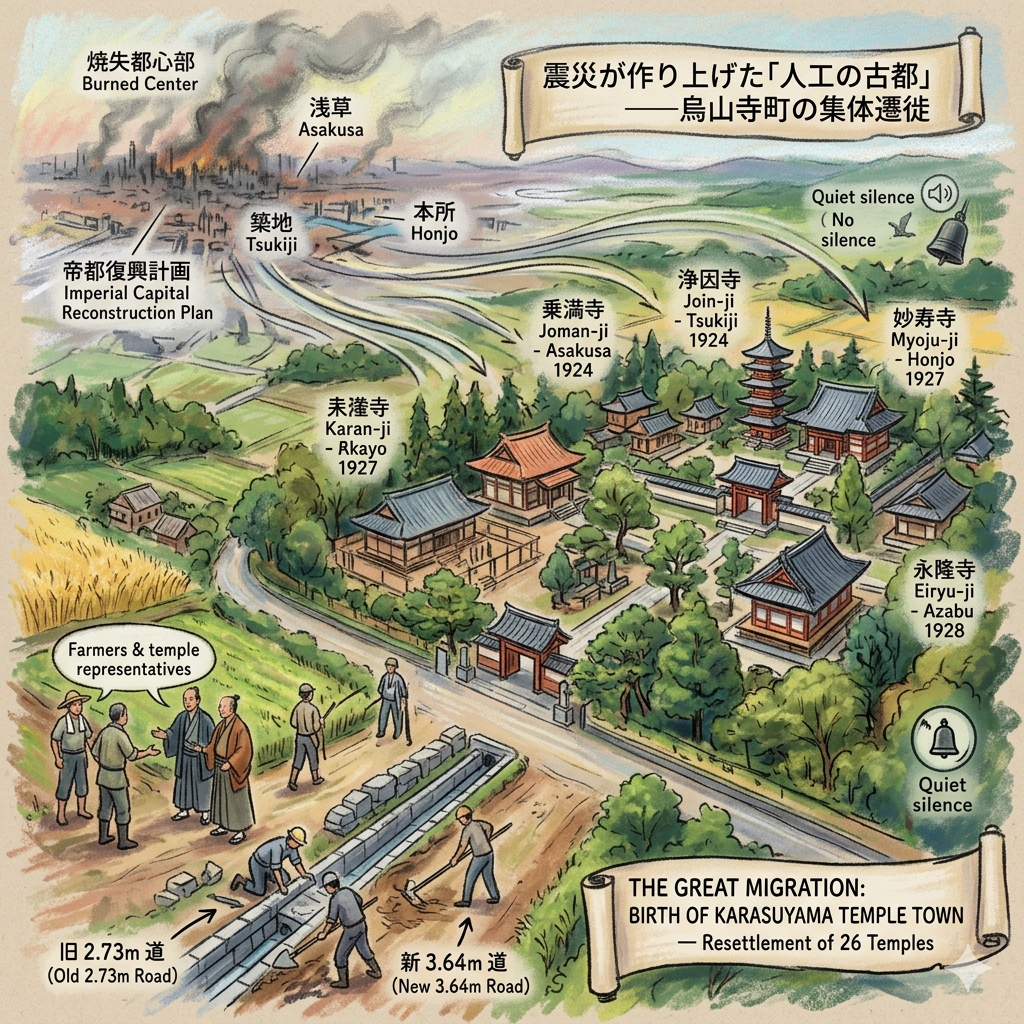
The 1923 Kanto Earthquake acted as a catalyst for a "sacred decentralization." As central Tokyo lay in ruins, the Imperial Capital Reconstruction Plan prohibited many temples from rebuilding in their cramped original locations. This forced a massive migration of ritual spaces to the suburban periphery, transforming the wooded fields of Kita-Karasuyama into a concentrated religious district.
This relocation was a "rationalization" of the city, pushing the spaces of death and memory outward to clear land for modern infrastructure like Showa-dori. This migration involved 26 temples moving in a collective effort of urban resettlement, negotiating with local farmers for land in exchange for building modern drainage and wider roads.
- Joman-ji: Relocated from Asakusa in 1924.
- Join-ji: Relocated from the Tsukiji area in 1924.
- Myoju-ji: Relocated from Honjo in 1927.
- Eiryu-ji: Relocated from Azabu in 1928.
Spatial Detail: Known today as the "Little Kyoto of Setagaya," the Karasuyama Environmental Agreement (signed in 1975) is a modern extension of the community spirit that built this district. It remains one of Japan's first resident-led environmental pacts, ensuring the preservation of the temple town’s unique greenery and silence.
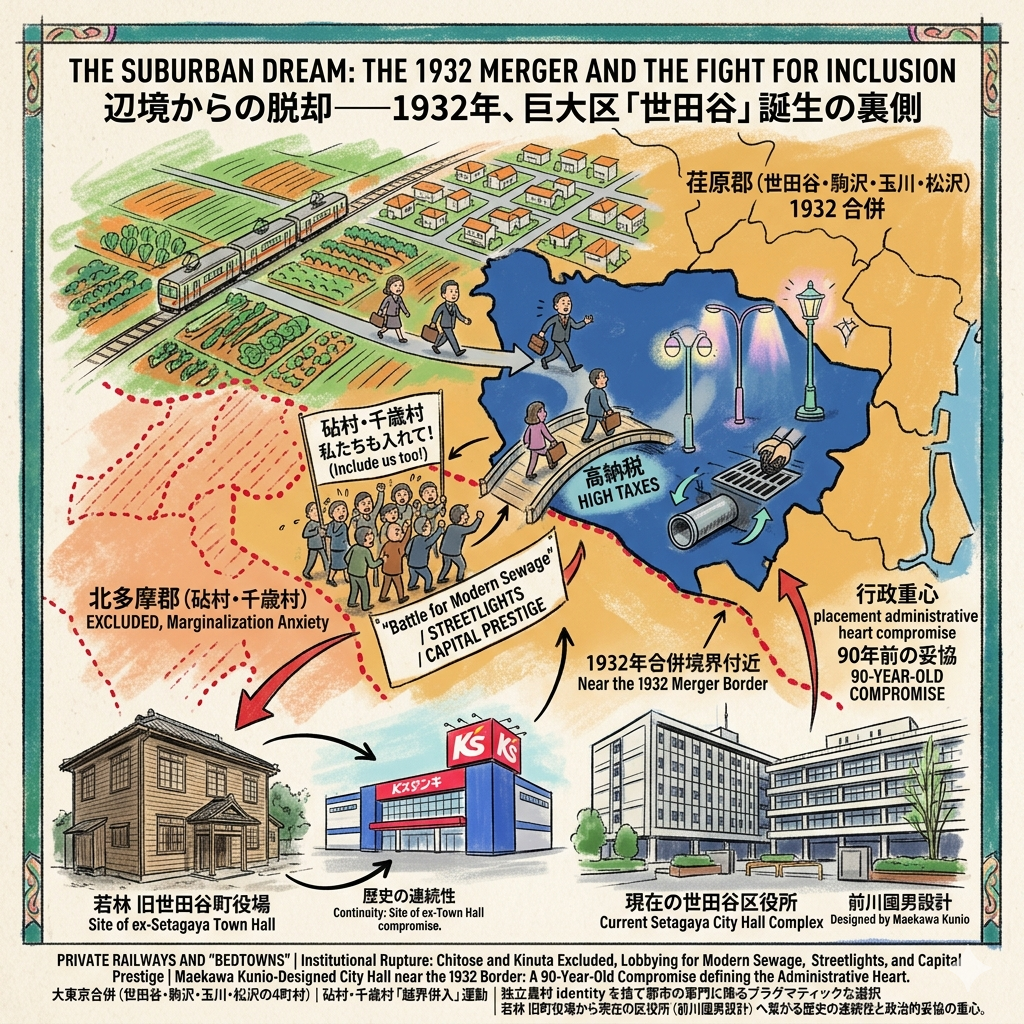
Layer V: The Suburban Dream—The 1932 Merger and the Fight for Inclusion
By the early 20th century, the expansion of private railways began converting Setagaya’s vegetable patches into "Bedtowns." This culminated in the "Great Tokyo" merger of 1932, but the birth of Setagaya City was marked by a deep institutional rupture.
While the core districts of the Ebara District (including Setagaya and Tamagawa) merged in 1932, the villages of Chitose and Kinuta in the North Tama District were initially excluded. This sparked a "marginalization anxiety," leading to a four-year lobby for inclusion. It was a calculated economic trade-off: residents were willing to pay the higher taxes of the city system in exchange for a "battle for modern sewage," streetlights, and the prestige of the capital.
Spatial Detail: The current Setagaya City Hall complex, designed by Maekawa Kunio, stands near the border of the original 1932 districts. Its location is a direct historical result of a 90-year-old compromise between the competing towns regarding the placement of the district’s administrative heart.
Philosophical Reflection: The Palimpsest of the Periphery
The identity of Setagaya is not defined by singular highlights, but by these five layers of "Peripheral Translation." It is a landscape that has served as a shield for medieval clans, a sanctuary for political martyrs, and a refuge for displaced temples. Setagaya’s history is a story of how a city "digests" its past; the earthen walls of a fortress become a park, and the secret burial ground of a rebel becomes a national shrine. As you walk these residential streets, consider the invisible boundaries and sacrifices that lie beneath your feet. What layers of defense or migration might be hidden beneath the pavement of your own neighborhood?
Join the Journey To uncover more hidden narratives of the world's great urban landscapes, subscribe to the Historical Travel Stories newsletter.
The Historically Minded Traveler’s Guide
Hidden Gems
One of the district’s most evocative sites is the Karasuyama Duck Pond (located within the grounds of Kougen-in). This serene water feature is a remnant of the original landscape that greeted the migrating temples in the 1920s. For those exploring the Bakumatsu era, the Sakurada Martyrs Monument at Gotokuji honors the eight retainers who died defending Ii Naosuke; their 1886 restoration to honor marks the final reconciliation of the rivals mentioned in this guide.
Logistics
- Transportation: The most atmospheric way to travel between these sites is the Tokyu Setagaya Line, a charming light rail that follows the historical contours of the old villages. Access the district via the Odakyu Line (Gotokuji Station) or the Keio Line (Chitose-Karasuyama Station).
- Recommended Walking Route:
- Start at Gotokuji Station, visit the Ii Family Graves and the Setagaya Castle Ruins.
- Walk 15 minutes to Shoin Shrine to experience the "Rivalry of the Martyrs."
- Continue to the Daikan Yashiki to see the magistrate’s residence.
- Take the Setagaya Line to the northern edge to explore the Karasuyama Temple Town.
Q & A
Explain the surprising link between Yoshida Shoin and Ii Naosuke.
The surprising link between Yoshida Shoin and Ii Naosuke is rooted in a "fate-like overlap" within the physical landscape of Setagaya, where these two bitter political enemies now lie in eternal rest just 1.5 kilometers apart.While they were the central figures of the Ansei Purge—with Ii Naosuke acting as the executioner and Yoshida Shoin as the executed—their proximity in Setagaya serves as a profound metaphor for the formation of the modern Japanese state.
1. Spatial Proximity of Political Rivals
Despite their deadly conflict, their burial sites are a mere 15-minute walk from one another:
- Yoshida Shoin (Shoin Shrine): After his execution in 1859, his disciples (including future leaders like Ito Hirobumi) secretly moved his remains in 1863 to a Choshu Domain suburban villa in Setagaya’s Wakabayashi district.
- Ii Naosuke (Gotokuji Temple): Following his assassination in 1860 at the Sakuradamon Incident, Naosuke was buried at Gotokuji, the ancestral temple of the Ii clan and the Hikone Domain.
2. Setagaya as a "Buffer Zone" for Resistance
The choice of these locations was not accidental but reflected the spatial politics of the Bakumatsu period. The Choshu Domain chose the Wakabayashi site because it was far from the eyes of the Shogunate in central Edo and possessed a degree of "extraterritorial" protection as a private domain villa. This made the act of burying a "state criminal" like Shoin a form of implicit spatial resistance against the Shogunate’s authority.
3. The Inversion of "Winner" and "Loser"
The two sites represent a dramatic shift in historical narrative after the Meiji Restoration:
- The Deified "Loser": Shoin, once a criminal of the state, was deified at Shoin Shrine, which became a sacred site for the Meiji government. The shrine is lined with stone lanterns donated by the very men (the "winners" of the Restoration) who were his students.
- The Preserved "Winner": Naosuke, despite being on the "losing" side of the Restoration's ideological battle, had his family’s burial grounds at Gotokuji preserved by the new government. A silent testament to his political crisis remains on his tombstone: the date of death is carved as March 28, 1860, instead of the actual date of his assassination (March 3). This discrepancy was a desperate political ruse by the Hikone Domain to hide his death until a successor was confirmed, thereby avoiding the risk of the domain being abolished by the Shogunate.
4. Historical Reconciliation
The ultimate historical significance of this link is the eventual reconciliation within this shared space. In 1886, under a government dominated by Shoin's former pupils from Choshu, the Hikone Domain was permitted to erect a monument at Gotokuji for the eight retainers who died trying to protect Naosuke. This act signaled that the fierce blood feuds of the Bakumatsu era had been integrated into a single national history, allowing former enemies to coexist as neighbors in the landscape of modern Tokyo.
Why did Choshu choose Setagaya for Yoshida Shoin's burial?
The Choshu Domain chose Setagaya for the reburial of Yoshida Shoin due to the specific political and spatial characteristics of the area during the late Edo period.According to the sources, the primary reasons for this choice include:
- Utilization of Private Domain Land: In 1863, Shoin’s disciples—including high-profile figures like Takasugi Shinsaku and Ito Hirobumi—secretly moved his remains from the execution grounds at Kotsukahara to a site in Wakabayashi, Setagaya. This land was the "dakiyashiki" (suburban villa) belonging to Mori Daizen no Daifu, the Lord of the Choshu Domain.
- A "Semi-Autonomous" Buffer Zone: Setagaya was strategically located "outside" the inner city of Edo (gofunai) but "inside" the private territory of a powerful domain. This peripheral location provided a degree of "extraterritorial" protection and a buffer from the immediate oversight of the Shogunate.
- Implicit Spatial Resistance: Burying a state criminal in a private domain residence far from the Shogunate's administrative center was a form of implicit political resistance. It was a deliberate act by the Choshu Domain to honor their teacher and counter the Shogunate's attempt to ideologically erase him after his execution during the Ansei Purge.
- Historical Legacy and Symbolism: By placing Shoin’s remains in this semi-autonomous space, the Choshu Domain established a site of "sacred resistance" that eventually evolved into the Shoin Shrine after the Meiji Restoration, when the "loser" of the Bakumatsu era was transformed into a deified spiritual pioneer of the new Japanese state.
This location in Setagaya eventually became the site for the burial of other loyalists and even the Meiji-era Prime Minister Katsura Taro, who requested to be buried next to the teacher he admired.
Reference and Further reading
- 世田谷区基本構想(案) 世田谷区は、1932(昭和7)年に世田谷、駒沢、玉川、松沢の, accessed June 6, 2026,
- 世田谷区歴史探訪①『世田谷代官屋敷編』|jaco - note, accessed June 6, 2026,
- 世田谷区制 90周年 - 東京, accessed June 6, 2026,
- 吉良家の世田谷城~居館跡地に井伊家菩提寺の豪徳寺を創建, accessed June 6, 2026,
- 烏山寺町 - accessed June 6, 2026,
- 17 吉良家の城館から井伊家の菩提寺へ・世田谷城|sugaT - note, accessed June 6, 2026,
- 東京都指定旧跡 世田谷城跡, accessed June 6, 2026,
- 豪徳寺(井伊直弼墓) |地域資源紹介記事 - TOKYOイチオシナビ, accessed June 6, 2026,
- 豪徳寺 - 見どころ、アクセス、口コミ & 周辺情報 | GOOD LUCK TRIP, accessed June 6, 2026,
- 世田谷城阯公園/住宅街に残る城の跡で歴史を訪ね歩く - 東急電鉄, accessed June 6, 2026,
- 国指定史跡 彦根藩主井伊家墓所 豪徳寺井伊家墓所 - 世田谷区, accessed June 6, 2026,
- 世田谷区立郷土資料館 - 東京, accessed June 6, 2026,
- はじめに - 世田谷区, accessed June 6, 2026,
- 440年以上続く冬の風物詩「世田谷のボロ市」へ。暮らしの文化が息づく、年に4日間の特別なにぎわい【2026年1月16日 体験レポート】|このまちnote |小田急の仲介, accessed June 6, 2026,
- 楽市・楽座 - accessed June 6, 2026,
- 世田谷代官屋敷 - agatajapan, accessed June 6, 2026,
- 彦根藩世田谷領の痕跡を訪ねて|埋木 - note, accessed June 6, 2026,
- No.1409 『ブラタモリクイズ!東京・世田谷~なぜ人は世田谷に住みたくなる?~編』, accessed June 6, 2026,
- 世田谷代官屋敷 - ASA田園調布の【小さな散歩道】, accessed June 6, 2026,
- 世田谷代官屋敷 - accessed June 6, 2026,
- ボロ市の名の由来, accessed June 6, 2026,
- ボロ市 - 下北沢百科, accessed June 6, 2026,
- せたがや百景No.23 ボロ市と代官屋敷 / せたがやボロ市が開催される大山道 <世田谷散策記(風の旅人)>, accessed June 6, 2026,
- 世田谷区立郷土資料館本館1階の事務室で販売しています。 ・本の代金は現金でお支払いください。お買い求めの際には、おつりがいらないよう、小銭のご準備をお願いいたします。, accessed June 6, 2026,
- 【井伊直弼墓】アクセス・営業時間・料金情報 - じゃらんnet, accessed June 6, 2026,
- 幕末の思想家・教育家吉田松陰を祀る「松陰神社」。志を胸に世田谷の歴史を歩く - 東急電鉄, accessed June 6, 2026,
- 国士舘と松陰神社のおはなし - 国士舘大学, accessed June 6, 2026,
- 吉田松陰墓(松陰神社) - 東京都世田谷区の歴史 - SHINOBI.JP, accessed June 6, 2026,
- 回向院(小塚原回向院) - 荒川区立図書館, accessed June 6, 2026,
- 【世田谷区】松陰神社|nama - note, accessed June 6, 2026,
- 世田谷区にある松陰神社周辺の高級住宅街|学問の神さまが見守る地はオシャレでどこか懐かしい雰囲気がありました - Precious.jp, accessed June 6, 2026,
- Precious.jp: 【東京“彩”発見】住みたい場所を探す旅【第33回】accessed June 6, 2026,
- 桜田門外の変で殉職した彦根藩士八人の石碑(世田谷区)豪徳寺 - 城 ..., accessed June 6, 2026,
- はなしの名どころ-世田谷区, accessed June 6, 2026,
- 松陰神社|世田谷区若林の神社、吉田松陰先生を祀る社 - 猫の足あと, accessed June 6, 2026,
- 世田谷 松陰神社 墓地探訪 - 万遊歩撮2 - FC2, accessed June 6, 2026,
- 寺町ドットコム[世田谷区 千歳烏山]ちとせからすやま寺町案内, accessed June 6, 2026,
- 烏山寺町について, accessed June 6, 2026,
- 烏山寺町 - 世田谷区, accessed June 6, 2026,
- ぶらり烏山寺町(1) - TEIONE BLOG - 平山 貞一 - エキサイトブログ, accessed June 6, 2026,
- 寺院案内 - 烏山寺町の寺院紹介, accessed June 6, 2026,
- 烏山寺町 - accessed June 6, 2026,
- せたがや百景No.42 烏山寺町 <世田谷散策記(風の旅人)>, accessed June 6, 2026,
- 小京都の情緒を伝える、世田谷区烏山寺町 - JONAN MAGAZINE, accessed June 6, 2026,
- (8)市街地形成の沿革 - 世田谷区, accessed June 6, 2026,
- 3:鉄道開通と沿線の発展 ~ 世田谷・経堂(小田急沿線) - 三井住友トラスト不動産, accessed June 6, 2026
 Lawrence
 Lawrence
 Lawrence