(ENG) Shinozaki Riverside Walk – Ancient Shrines and Timeless Stories by the Edogawa River
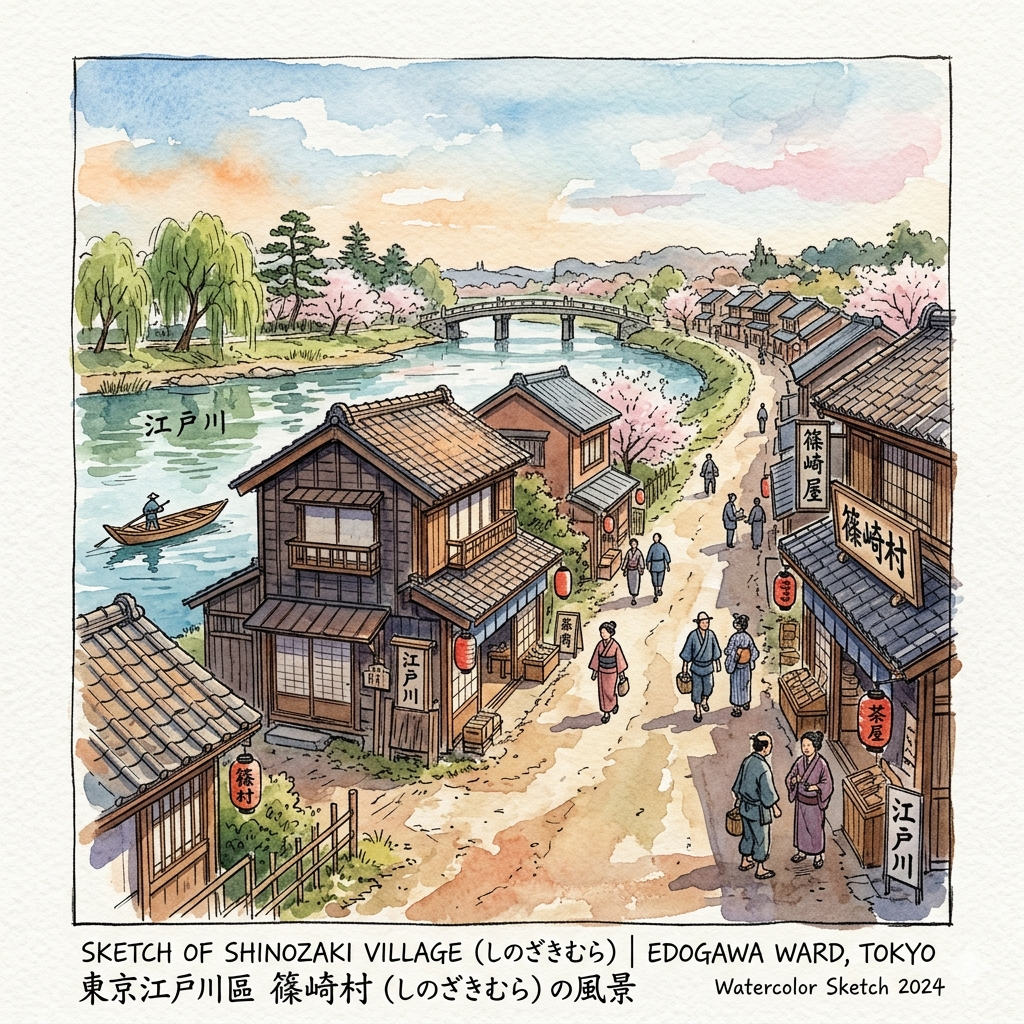
Escape to Shinozaki, where Tokyo’s ancient history meets the open sky of the Edogawa River. This guide explores the sacred Sengen Shrine and the peaceful riverbanks, offering a deep dive into the neighborhood’s enduring traditions and quiet charm away from the city crowds.

This is a historical travel story and walking guide to Shinozaki, a tranquil neighborhood located along the Edogawa River in Tokyo. By visiting the ancient Shinozaki Sengen Shrine and exploring the vast riverside greenery, this journey reveals how centuries-old traditions and natural landscapes coexist within the modern city. Readers will discover a unique walking route that connects Tokyo’s spiritual heritage with the peaceful rhythm of local riverside life.
 Lawrence
The Palimpsest of Shinozaki
To the casual observer, Shinozaki is a quiet residential enclave at the easternmost edge of Tokyo’s Edogawa Ward. Yet, to the cultural cartographer, this landscape is a profound palimpsest—a strategic borderland where the ancient provinces of Musashi and Shimosa once converged. Its identity has never been static; rather, it has been defined by a process of alluvial accretion and state-mandated erosion, perpetually shaped by a volatile relationship with the Edo River. This watercourse has served as both a vital artery for transport and a destructive force necessitating radical reinvention.
To walk through Shinozaki is to witness a physical record of human resilience. Here, the earth has been reshaped by the hands of engineers, the prayers of the faithful, and the mandates of Shoguns. We will explore this frontier on foot, peeling back the layers of modern development to reveal how spiritual mobilization and state-led engineering have physically carved the Shinozaki we see today, moving from the sacred heights of ancient forests to the submerged ghosts of lost towns.
Listen to the historical stories told in detail (For subscribers only)
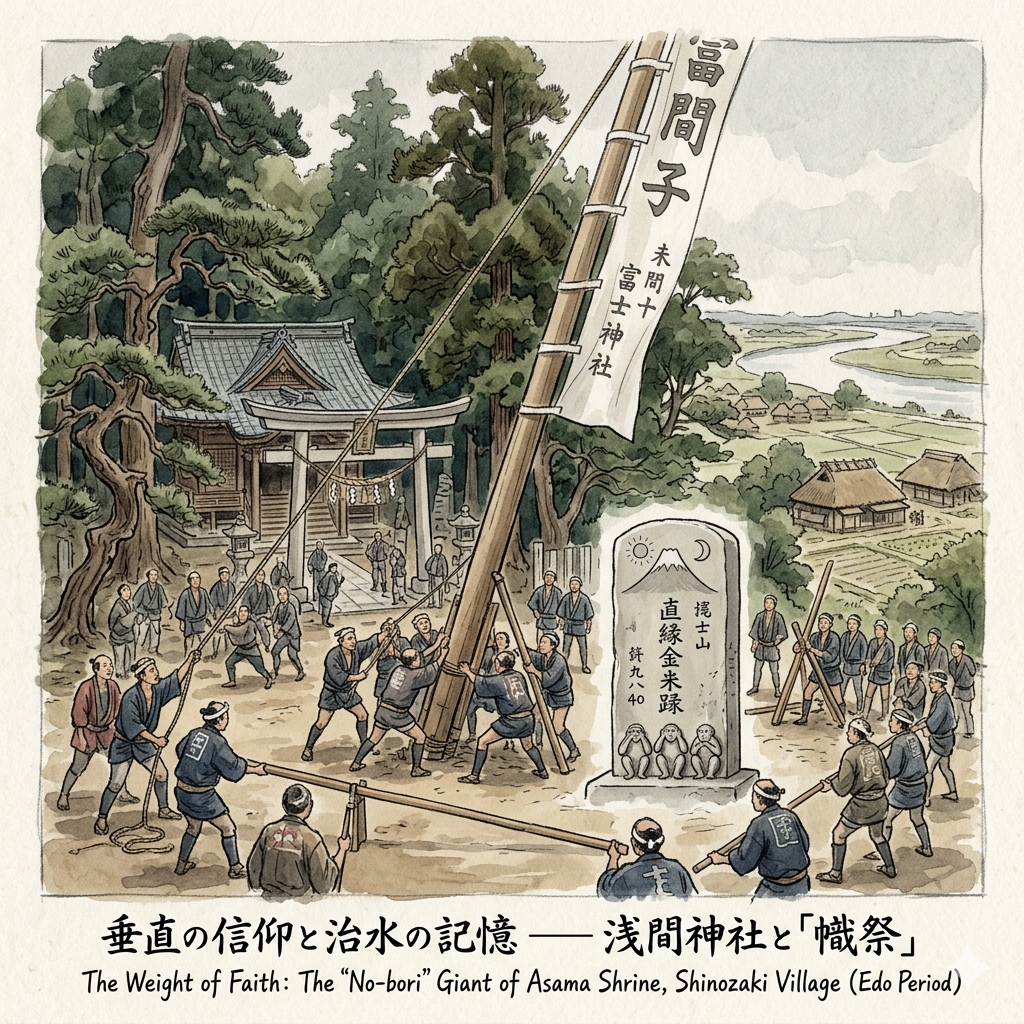
The Weight of Faith: The "No-bori" Giant of Asama Shrine
In the rural fringes of Edo, the "Fuji-ko" (Fuji faith) was far more than a religious movement; it was a sophisticated mechanism for social mobilization and environmental resilience. In communities like Shinozaki, constantly threatened by the instability of the lowlands, this faith provided the organizational infrastructure necessary for survival. The shrine became a sanctuary where spiritual devotion and civic duty blurred into a single collective effort.
The material culture of Asama Shrine offers a window into this mutual-aid network. A primary artifact is the 1840 Jiki-gyo Miroku monument. Dedicated a century after the death of the Fuji-ko leader, the stone features intricate carvings: a majestic Mount Fuji at the summit, flanked by the sun and moon, and the "three monkeys" at the base. Interestingly, the monument contains a notable character error—"緣" (en) instead of "祿" (roku) for Miroku—a detail that underscores the grassroots, perhaps unpolished, nature of rural faith.
This community unity is best exemplified by the biennial Nobori-matsuri (flag festival). While appearing as a ritual, the raising of ton-heavy flagpoles was effectively a "labor drill" for flood management. The extreme physical coordination, the use of traditional levers and thick hemp ropes, and the teamwork required to erect these giants mirrored the exact skills needed for emergency levee repair.
"The 'Asama-no-Mori' (Asama Forest), composed of ancient pines and cypresses designated as protected trees, serves as a rare remnant of the original lowland landscape, offering a glimpse of the primordial floodplains before the onset of modern urban development."
Today, the massive flag-pole sockets stand as markers of a time when religious ritual and civil engineering were inseparable. From these spiritual heights, however, the gaze must eventually turn toward the river—the force that would demand the erasure of entire neighborhoods.
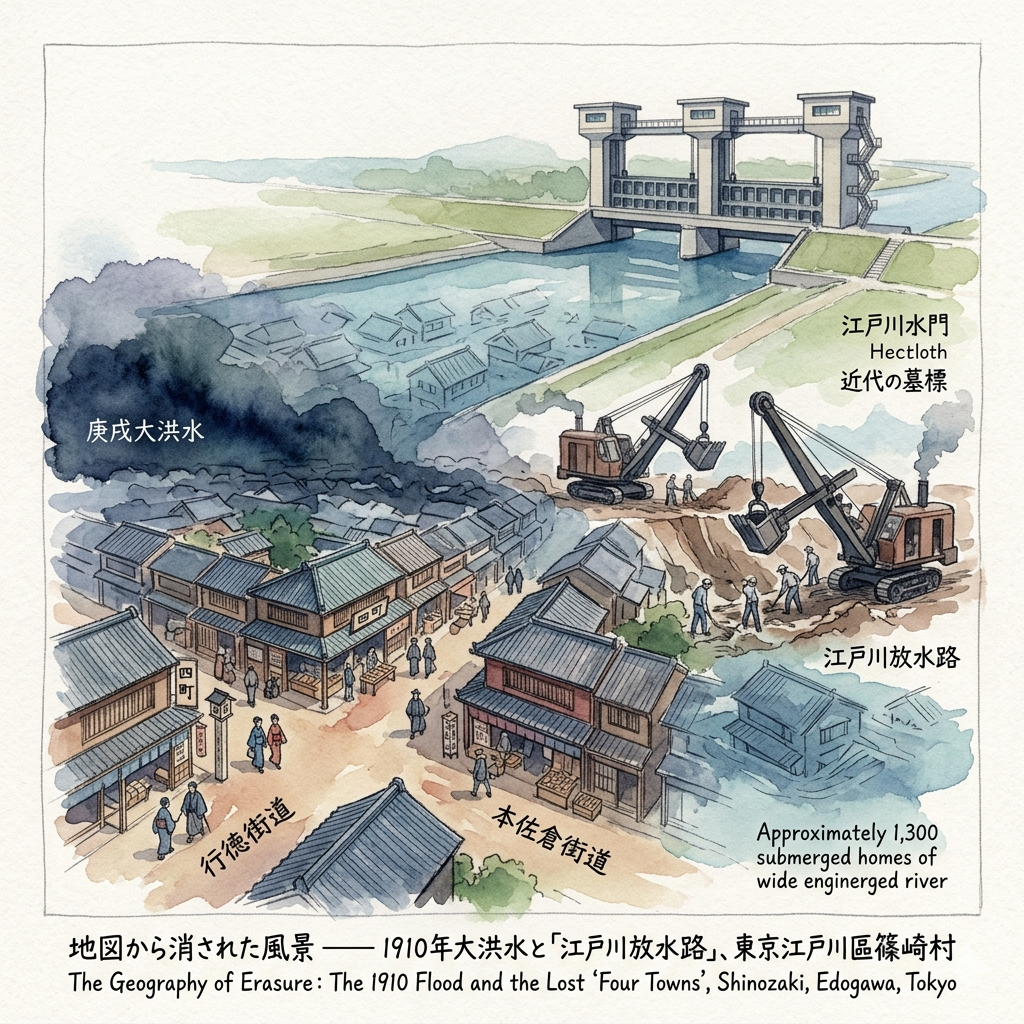
The Geography of Erasure: The 1910 Flood and the Lost "Four Towns"
During the Meiji and Taisho eras, the perception of the Edo River underwent a fundamental shift: it was no longer viewed as a "lifeblood" for transport, but as a "threat" to the imperial capital. The transition from a maritime economy to a railway-based one allowed the state to prioritize flood control over navigation.
The catalyst for this change was the "Gengyu Great Flood" of 1910. In response, the government implemented a "Politics of Flow," a plan to protect central Tokyo by sacrificing its periphery. Engineering data from the era reveals the scale of this intervention: the planned flow of the Edo River was increased from 3,570 m³/min to a staggering 5,570 m³/min. This required the creation of the Edo River Discharge Channel, a massive artificial waterway.
The cost of this safety was the total erasure of the prosperous "Yotsu-machi" (Four Towns) junction. Once a thriving economic hub where the Gyotoku and Moto-Sakura highways met, the vibrant "post-town culture" of Yotsu-machi was submerged. Approximately 1,300 homes were relocated to make way for the channel. Standing at the Shinozaki Sluice Gate today, one must visualize these drowned streets beneath the current water level. This legacy of water management is central to the [Edogawa River History].
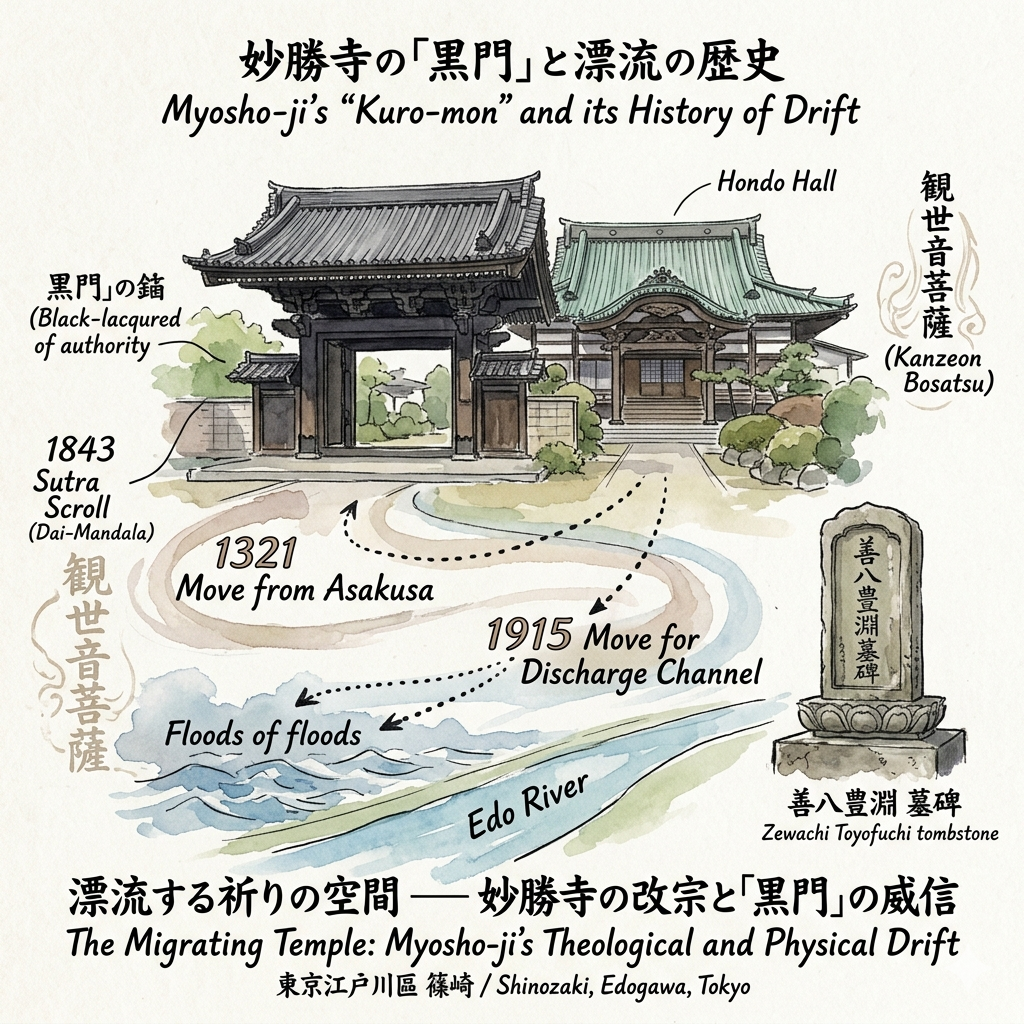
The Migrating Temple: Myosho-ji’s Theological and Physical Drift
In the flood-prone lowlands of the Edo frontier, Nichiren Buddhism emerged as a religion of the "frontier," offering salvation to those in unstable environments. Myosho-ji temple stands as a testament to this endurance, its history marked by geographical drift and a significant theological shift.
Originally founded in 1278 as a Tendai institution by a priest from Asakusa, the temple converted to Nichiren Buddhism after a doctrinal debate—a move signaling a geopolitical shift in religious power from the center to the eastern borders. The temple was never static; it moved in 1321 following flood damage, and again in 1915 during the construction of the discharge channel. Despite these migrations, Myosho-ji maintained its status as a "Black Gate" (Kuro-mon) institution, holding administrative authority over fourteen subordinate temples.
Spatial markers of this history remain: the 1843 Sutra Scroll (Dai-Mandala) and the Zewachi Toyofuchi tombstone, a registered tangible cultural property. The layout of the streets still radiates from the temple, which served as a geographic anchor for a community in flux.
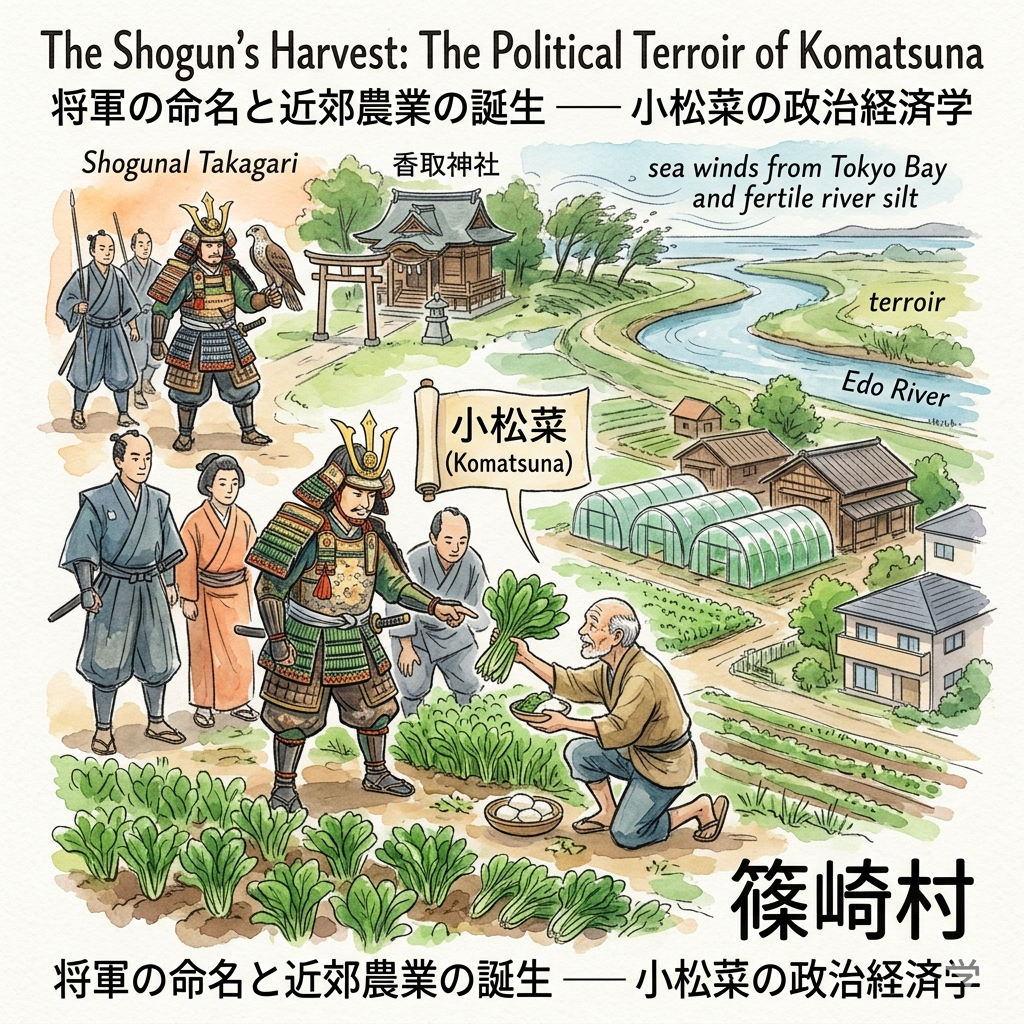
The Shogun’s Harvest: The Political Terroir of Komatsuna
The relationship between the Edo center and the Shinozaki hinterland was cemented by the Shogun’s hunting trips, or Takagari. These were administrative inspections that created lasting regional brands.
The most famous legacy is Komatsuna. Legend holds that Shogun Yoshimune stopped at Katori Shrine during a hunt. Presented with a meal of rice cakes and a nameless local green, the Shogun was so impressed he dubbed the vegetable "Komatsuna," after the nearby Shinkomatsugawa. This "royal branding" was made possible by the unique terroir: mineral-rich sea winds from Tokyo Bay and the fertile river silt created a vegetable high in calcium and nutrients. Today, green glasshouses nestled between modern residences serve as living artifacts of this 300-year-old supply chain, representing the transition to the "Urban Agriculture" that defines the ward’s modern identity.
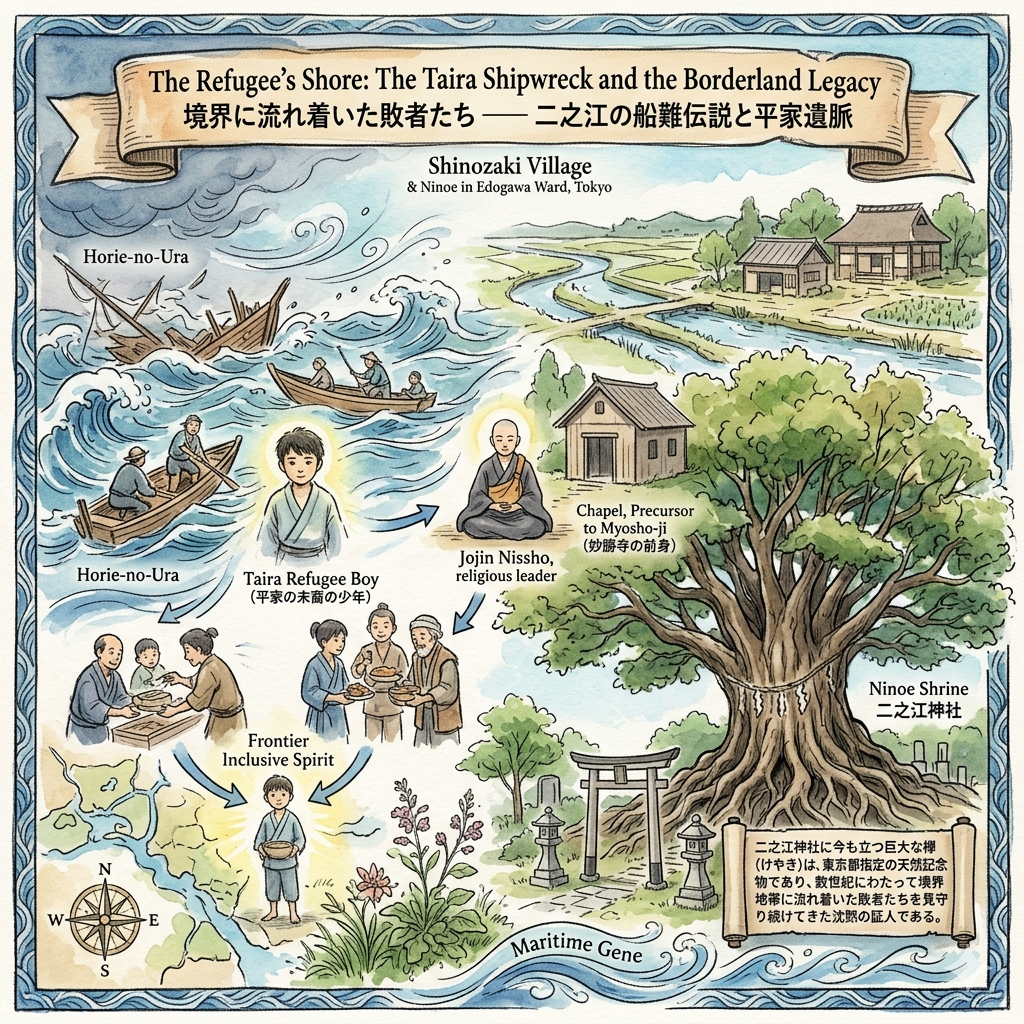
The Refugee’s Shore: The Taira Shipwreck and the Borderland Legacy
Long before it was a suburb, Shinozaki and Ninoe functioned as a "buffer zone"—a maritime fringe for those fleeing political centers. The local history is haunted by the 1284 shipwreck at "Horie-no-Ura." Local fishermen rescued a survivor from the wreckage: a young boy whispered to be of the defeated Taira clan.
In the inclusive spirit of the frontier, the boy was protected and eventually became the religious leader Jojin Nissho (成就院日尚), a disciple of Nissho, the second head of Nakayama Hokekyo-ji. He founded a small chapel that became the precursor to Myosho-ji. This narrative of the "political refugee turned religious leader" highlights the social permeability of the borderlands. For those following this [Shinozaki Historical Guide], the maritime gene is most visible at Ninoe Shrine.
The Hidden Gem: Ninoe Shrine
For a moment of quiet synthesis, visit Ninoe Shrine and its Natural Monument Zelkova. This is a space where the merger of Shinto and Buddhist histories is manifest—the shrine incorporates a Hachiman shrine formerly on Myosho-ji’s grounds. The ancient Zelkova tree stands as a silent witness to a time when this was a treacherous "Kasai-oki" coastline of lagoons, welcoming those cast out by the tides of war.
Conclusion: The Philosophy of the Layered Landscape
Shinozaki demonstrates that "place" is a process of constant negotiation between human faith, state engineering, and natural forces. To truly understand Tokyo, one must practice "layered observation"—the ability to see the drowned village beneath the river and the Shogun’s footprint in a vegetable patch.
In a city that perpetually erases its past to build its future, what are the "invisible flags" we must learn to see to truly know where we stand? By looking closely at the sluice gates, the greenhouses, and the ancient temple gates, we begin to find the answer.
To uncover more of the hidden geographies and deep histories of Japan’s changing landscapes, subscribe to Historical Travel Stories.
Logistics: The Traveler's Toolkit
Navigating Shinozaki's Layers
- Access: Shinozaki Station (Toei Shinjuku Line).
- Recommended Walking Route: Start at Asama Shrine (Fuji-ko monuments), walk to the Edo River Sluice Gate (Lost Yotsu-machi visualization), and conclude at Myosho-ji and Ninoe Shrine.
- Accommodation/Tours: Stay in nearby Kinshicho or Mizue. Look for local "Edo-Tokyo Vegetable" culinary tours to experience the legacy of the Shogun’s Komatsuna.
Q & A
How did a Shogun's lunch create the Komatsuna vegetable brand?
The creation of the Komatsuna vegetable brand is rooted in a legendary lunch encounter involving a Tokugawa Shogun during a hawk-hunting expedition (Takagari) in the Shinozaki and Komatsukawa areas.The Shogun's Lunch at Katori ShrineDuring the Edo period, Shoguns frequently visited the vast "Kasai territory," which included Shinozaki, for administrative inspections and hunting. According to historical narrative:
- The Event: The 8th Shogun, Tokugawa Yoshimune (though some accounts attribute this to the 3rd Shogun, Iemitsu), stopped for lunch at the local Katori Shrine while hunting.
- The Meal: Lacking any gourmet delicacies, the villagers served the Shogun a simple soup with rice cakes (Zoni) that featured a nameless local green leaf vegetable.
- The Naming: Yoshimune was so impressed by the vegetable's sweet flavor and crunchy texture that he inquired about its name. Upon learning it had none, he commanded that it be named "Komatsuna" after the nearby Komatsukawa area.
From Local Vegetable to "Edokko" StapleThis random act of naming by a high authority transformed a peripheral wild green into a prestigious "regional brand".
- Technical Refinement: Following the Shogun's recognition, Shinozaki farmers refined their cultivation techniques. They discovered that letting the vegetables experience the "first frost" increased their sweetness, eventually making Komatsuna an essential ingredient for the traditional New Year's soup of Edo residents (Edokko).
- Economic Impact: The branding led to a significant economic shift in the region. Shinozaki transitioned from a single-crop rice economy to highly specialized vegetable farming, laying the groundwork for modern Japanese urban agriculture. By the late Edo period, historical records like the Shinpen Musashi Fudoki Ko officially recognized the high quality of greens produced near Komatsukawa.
Environmental FactorsThe success of the brand was also tied to the unique geography of Shinozaki. The area’s location near the ocean provided sea breezes rich in minerals, while its position on the downstream alluvial plain of the Edogawa River offered soft, fertile soil perfect for leaf vegetables. These factors contributed to the high calcium and mineral content that defines the Komatsuna brand today.
What is the legend of the shipwrecked Taira clan survivor?
The legend of the shipwrecked Taira clan survivor is a story of hidden identity, rescue, and religious transformation centered in the Ninoe (二之江) area of Shinozaki.
The Rescue of the Taira Descendant
According to the sources, the legend dates back to 1284 (the 7th year of the Koan era), a time when the area near the current Edogawa River was still part of the Tokyo Bay coastline known as "Kasai-oki". A shipwrecked boat drifted to the shores of "Horie-no-ura," where local fishermen from Ninoe Village discovered a dying young boy among the wreckage.
Temple tradition maintains that this boy was a descendant of the Taira clan (Heike), a group that had been defeated in the Genpei War and whose members were being hunted and scattered across Japan. Despite the political risks of harboring a member of the Taira family, the villagers and local monks chose to protect and save him.
Transformation into "Jojin-in Nissho"
The survivor did not remain a political fugitive but instead sought a religious life. He became a disciple of Nichitaka Shonin, the second head of Nakayama Hokekyo-ji Temple, and took the dharma name "Jojin-in Nissho" (成就院日尚).
Grateful to the community that saved his life, he returned to Ninoe to establish a small hall that eventually became the predecessor of Myosho-ji Temple. His religious title, "Jojin-in," remains physically inscribed in the history of the region as the temple’s official secondary name.
Historical and Social Significance
This legend highlights several key aspects of the region's history:
- A Sanctuary for Refugees: The narrative suggests that the Shinozaki and Ninoe areas served as a "buffer zone" or a remote frontier where political outcasts from the power centers of Kyoto or Kamakura could find safety due to the area's high social tolerance.
- Maritime Identity: The "shipwreck" element of the story emphasizes that Shinozaki was once a coastal maritime hub, serving as a transit point for cultural and human movement via the sea.
- Cultural Preservation: Today, the legacy of this survivor is still visible at Myosho-ji Temple (known locally as the "Black Gate Temple"), which serves as a spiritual link to this 13th-century tale of survival and redemption.
Reference and Further reading
- 浅間神社(社叢、富士講碑、幟祭り) 江戸川区ホームページ, accessed April 17, 2026,
- 第1章 葛飾の風土と自然 - 葛飾区, accessed April 17, 2026,
- 江戸川区 水との闘いの歴史 明治~昭和 - 江戸川フォトライブラリー, accessed April 17, 2026,
- 明治43年大洪水 - 関東地方整備局, accessed April 17, 2026,
- 妙勝寺 (江戸川区上篠崎町) - accessed April 17, 2026,
- 弘安2(1279)年に浅草に創建されました。寂海法印は、もと金龍山浅草寺の別当であり北方の能化と称せられていました。日常上人と法義を論じ - 日蓮宗 石歴山 妙勝寺, accessed April 17, 2026,
- 石歴山 妙勝寺 - 日蓮宗ポータルサイト, accessed April 17, 2026,
- 妙勝寺|東京都江戸川区の歴史, accessed April 17, 2026,
- 本覚山成就院妙勝寺は四季折々の花々の咲く日蓮宗の古刹 - Nakayama is a small area between Narita And Haneda Airport, accessed April 17, 2026,
- 江戸川区発祥~全国有数の小松菜の産地, accessed April 17, 2026,
- 江戸川区と小松菜の ホットな関係, accessed April 17, 2026,
- 江戸川区発祥の「小松菜」のこと, accessed April 17, 2026,
- 江戸川の小松菜力を発信! - までいマーケット, accessed April 17, 2026,
- 小松菜のルーツを知ろう! 江戸川区ホームページ, accessed April 17, 2026
 Lawrence
 Lawrence
 Lawrence