Hong Kong’s Monsoon Calendar: Five Hidden Stories of Wind, Ice and Rain
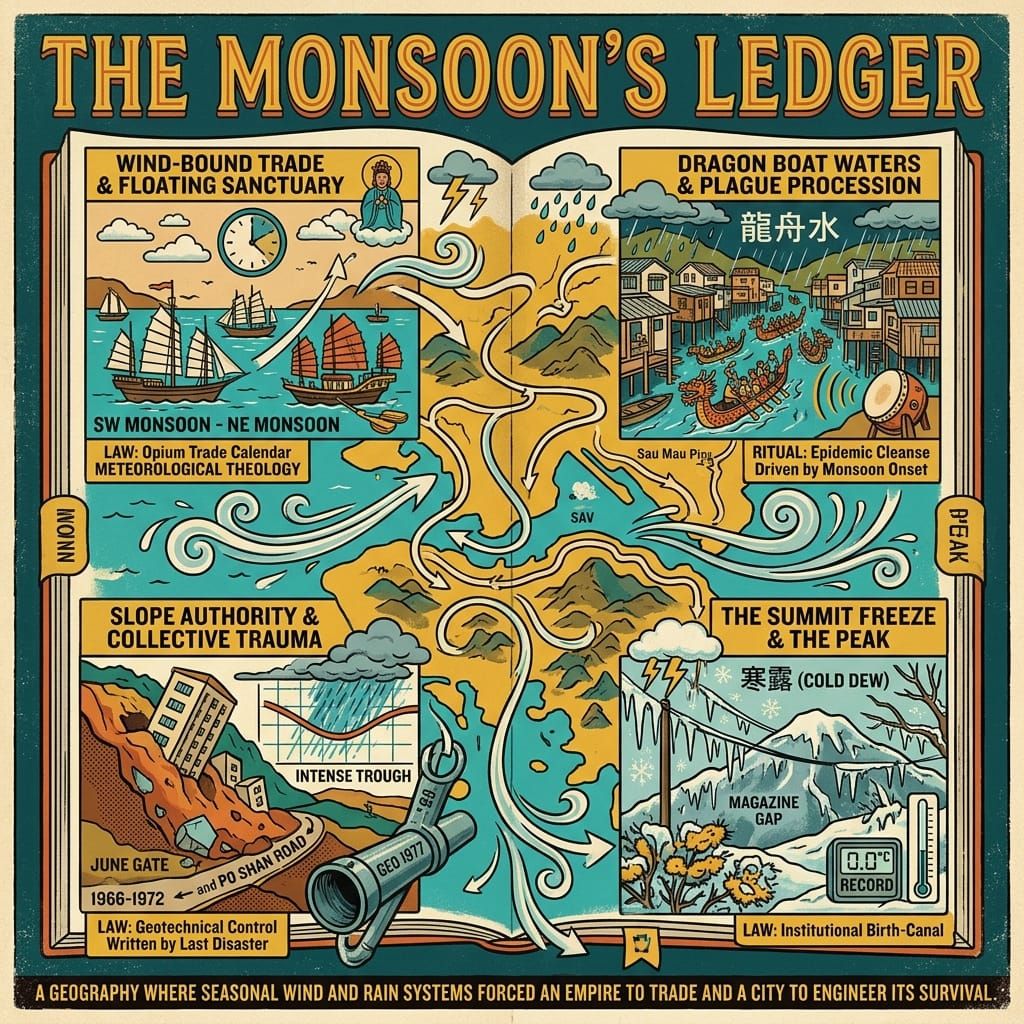
Hong Kong’s monsoon is more than weather. It set the sailing calendar, froze the Peak, helped create a government office and gave a fishing town a ritual for driving out plague. Five lesser-known stories, with the records and where they disagree.

 Lawrence
💡 Join a community of discerning travelers. Simply enter your email to instantly unlock audio guides and one-day itineraries, and carry our exclusive historical walking maps with you on your journey.
The article originated
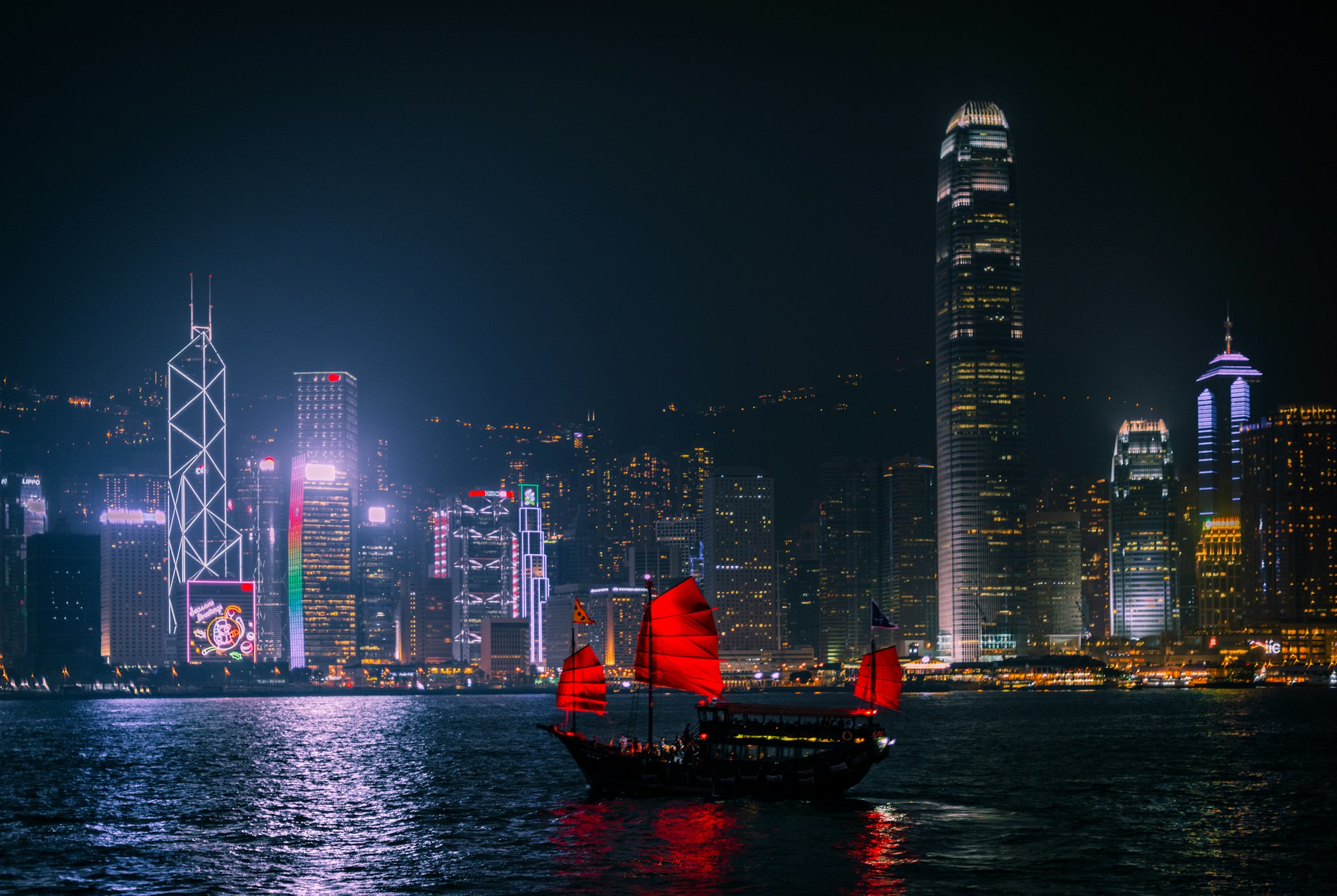
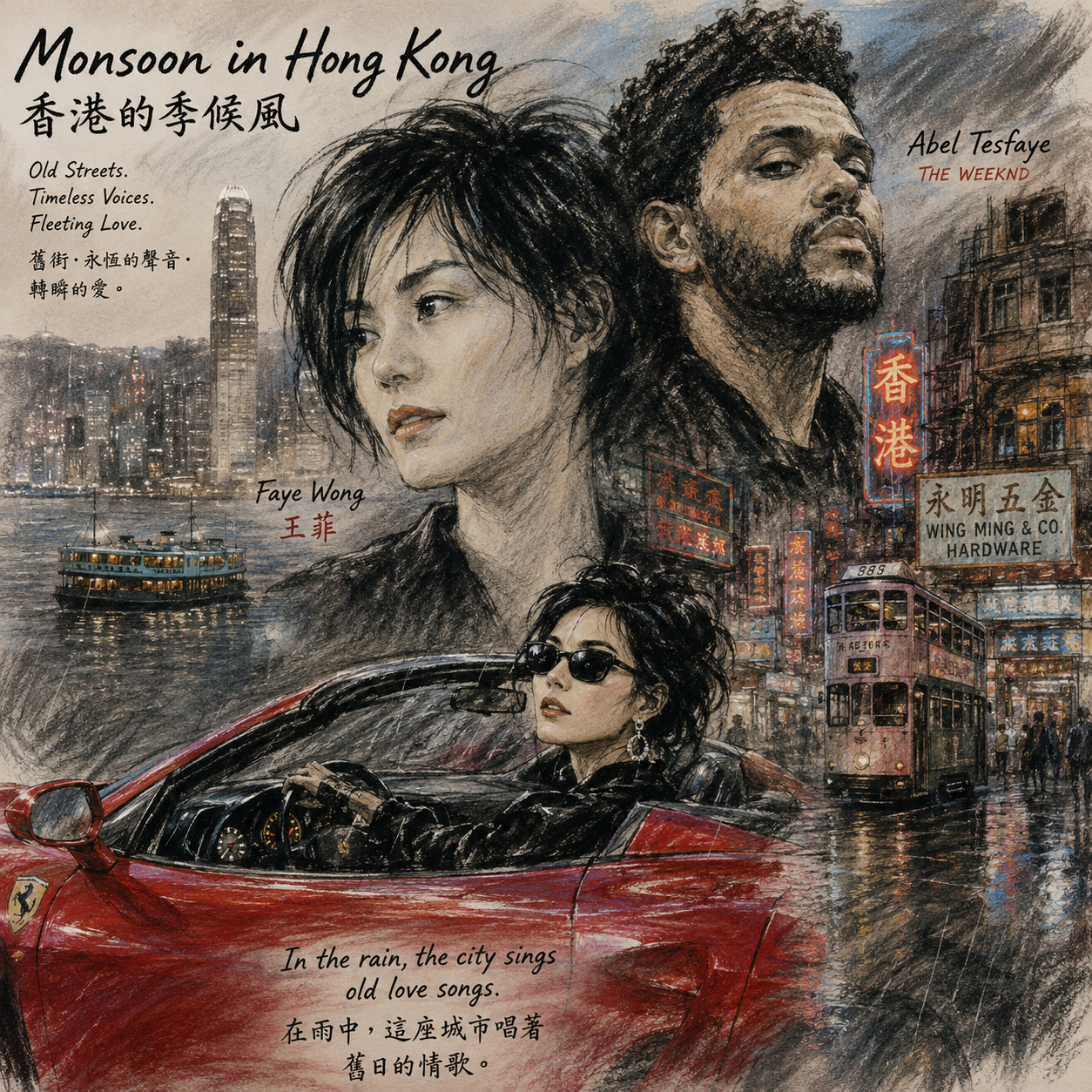
The Weeknd performed in Hong Kong on October 24, 2026. Abel wrote a song for the city—a track that stirs the soul once more, titled "Hong Kong." Beyond the concert visuals—which captured both the city’s high-speed, neon-lit energy and the gritty decadence of its urban underbelly—the song features a clever, deliberate choice for its chorus: a snippet from Faye Wong’s "Monsoon" (季候風). When woven together with Abel’s own lyrics, the meaning resonates deeply with the people of Hong Kong. Inspired by this reference to the "monsoon," I’ve gathered information to piece together a historical account of Hong Kong’s monsoons—a narrative intended to engage in a dialogue with this song.
[Verse 1: Abel Tesfaye ]
There was something in the air
I knew that in that moment
I would burn the world to keep you warm
But my life won't let me stay
So if we never speak again
At least we still have soul
And only God could separate us
On my skin, you left your mark the night you held me close
And in the morning, we turned to strangers
But don't you hesitate to call
I'm posted in Hong Kong
[Chorus: 王菲]
那次季候風 吹得那樣空
彷彿世上一切 也將消失所蹤
你似季候風 抵擋計劃全也無用
然後是場空 加上不死的心痛
This is a historical travel story in five parts about the winds and rains that shaped Hong Kong: a trading calendar, a morning of ice on the Peak, two Junes of landslides, a plague procession on the water at Tai O, and a goddess who lives on boats. It tells you what the records say, where they disagree, and where to stand if you want to see the place for yourself.
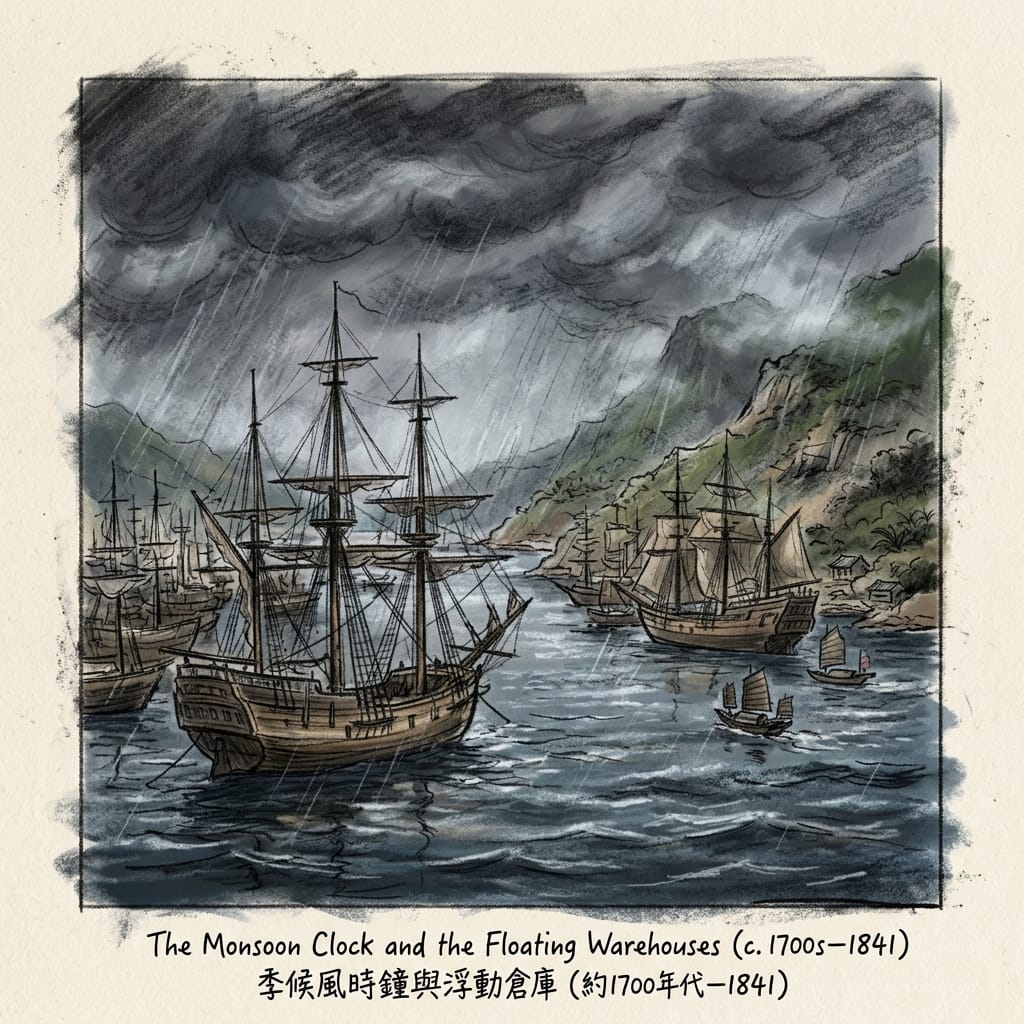
In old Canton, a contract could be cancelled by the weather. The trading year had two doors, and the wind decided which one was open. Ships came when the summer monsoon was ending; they left when the winter one began; anyone who missed the turn waited out the season somewhere else.
Hong Kong was built by people who learned to live inside that arrangement and then forgot they had learned it. We still speak of the monsoon as a forecast: a cold front, a wet week, a signal on a mast. But look at the records long enough and the wind starts to resemble something older and plainer. A clerk. It keeps the calendar, and it keeps the accounts of what each season cost.
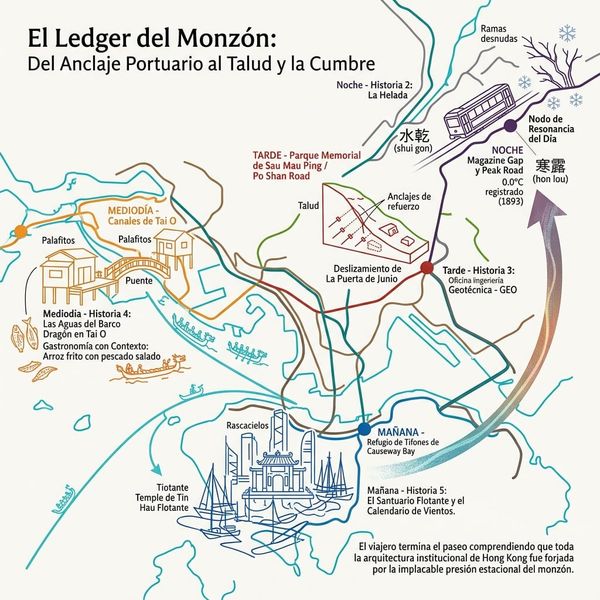
1. The wind had the last word: Canton, Lintin and a sheltered bay (to 1841)
Out in the Pearl River estuary there used to be ships that never docked. They were opium receiving ships, floating warehouses, moored off Lintin Island. In typhoon season, according to Hong Kong’s heritage record, they moved into Kumsing Moon and into Hong Kong’s waters for shelter. Exactly which passage Kumsing Moon was is still debated by local historians. I would not put a pin on a map yet.
The year around them ran on wind. Ships tended to arrive between June and September, towards the end of the south-west monsoon, and to leave on the north-east monsoon. Foreign merchants who missed the departure had to spend the off-season at Macau. Nobody wrote this as law. It was simply what the sea allowed.
The Wind That Built Hong Kong
In late August 1839, more than sixty ships and some two thousand people were crowded into Hong Kong harbour without fresh food or water. On 4 September there was a clash off Kowloon. In January 1841, Qishan offered the British either Hong Kong Island or Kowloon, not both. Charles Elliot replied the next day, choosing Hong Kong, and on 26 January Commodore Gordon Bremer took formal possession. That July a typhoon very nearly killed both men.
So the same bay was a refuge and a danger. The link between the monsoon calendar and the choice of Hong Kong is my reading, not a finding: none of the sources I have seen states it, and the trading archives should test it. What can be said is smaller and harder to dismiss. A harbour that shelters ships also shelters whatever is in their holds.
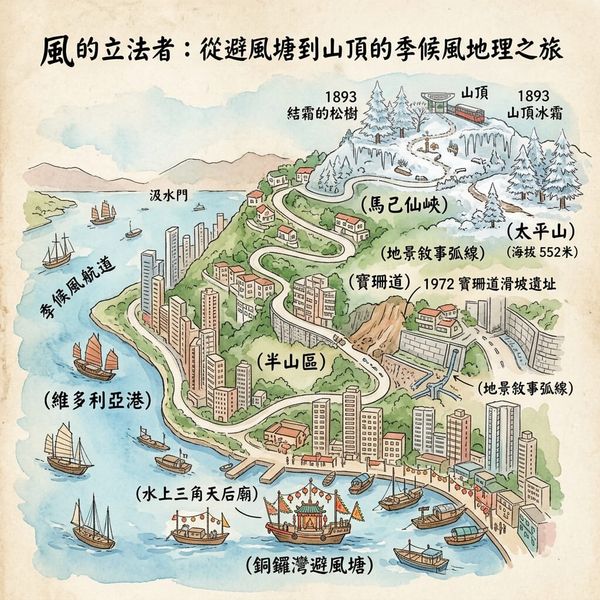
2. The coat that froze: January 1893
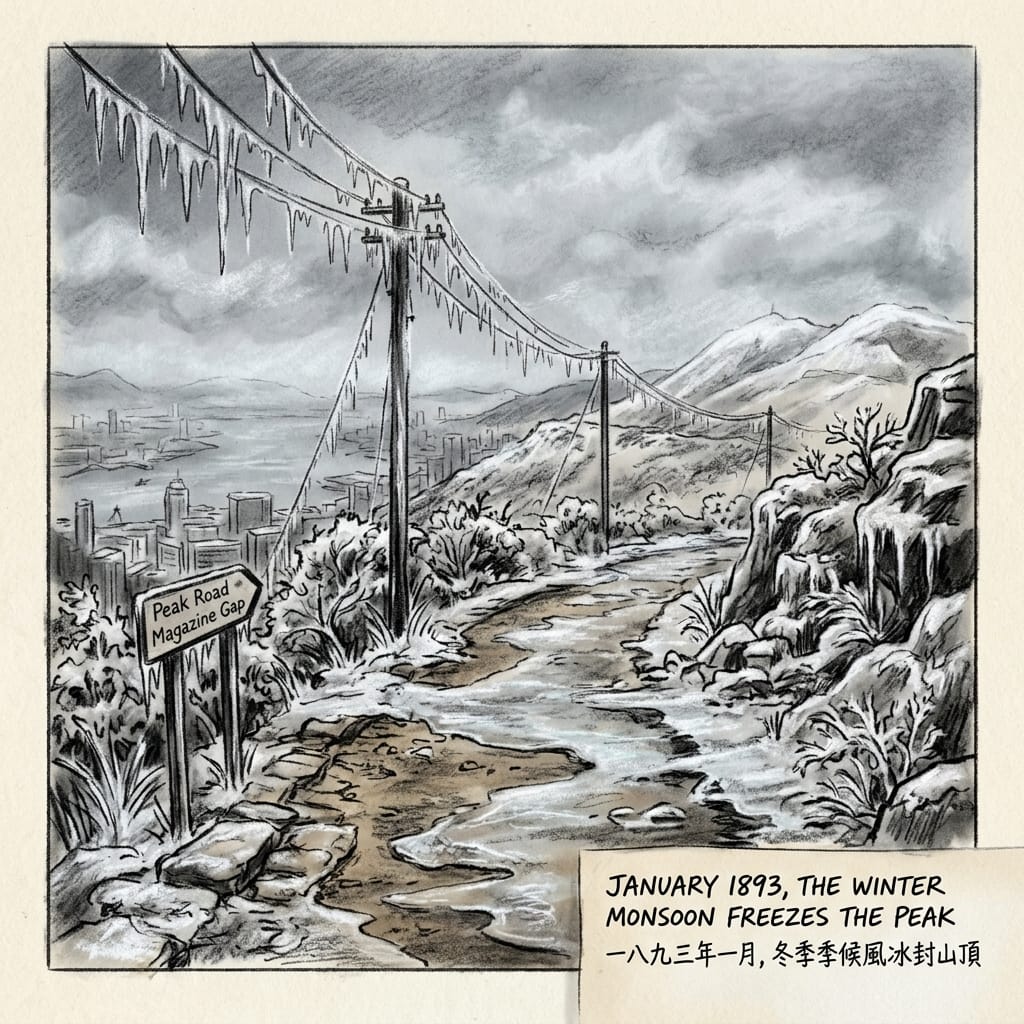
On 16 January 1893 the roads on the Peak turned to ice.
The China Mail reported a coating on the roads so slick that walking was dangerous, and icicles weighing down the telegraph wires. A man named L. Gibbs, writing afterwards in the Hong Kong Naturalist, remembered that the rain froze as it fell, and that by the time he reached Magazine Gap the heavy ulster he was wearing had stiffened into a board in front of him. The Observatory reads this as freezing rain.
On the morning of 18 January the Observatory’s thermometer touched 0.0°C, the lowest reading since records began in 1884. It has not been matched since. Readings on the Peak and at the Botanical Gardens went below freezing. Charles Ford, who ran the Botanical and Afforestation Department, noted that the summit of Tai Mo Shan looked white on the evening of 15 January, and that a Lantau peak seemed to carry snow for a few hundred feet. William Doberck, the Observatory’s first director, wrote the episode up for Nature that April.
The Day Hong Kong Froze Over
A famous photograph of snowy streets and a sign reading Foochow Club is often offered as proof of snow in Hong Kong in 1883. The Observatory has checked: it shows Fuzhou. Its own reports for 1883 record no snow. Since 1948 there have been only four reports of snow in the territory, in 1967 (twice), 1971 and 1975, nearly all on Tai Mo Shan.
The cold was the winter monsoon at its extreme. The latest figures come from the other end of the range: the winter of 2025–26 was the warmest on record, 19.3°C on average and about two degrees above normal, which the Observatory attributes to a weak north-east monsoon.
Holographic Sensory Cue: Rain lands on the shoulders and stiffens as it lands. The road is glazed, and every step is tested before it is trusted. Overhead, telegraph wires sag under their icicles. The front of the coat has set hard. Far off, the top of Tai Mo Shan holds a faint white in the failing light. Sounds and smells are not in the records and will have to be recorded on site.
3. Two Junes: 1966, 1972 and the office that came after
The hills were here before the buildings. Hong Kong keeps forgetting this.
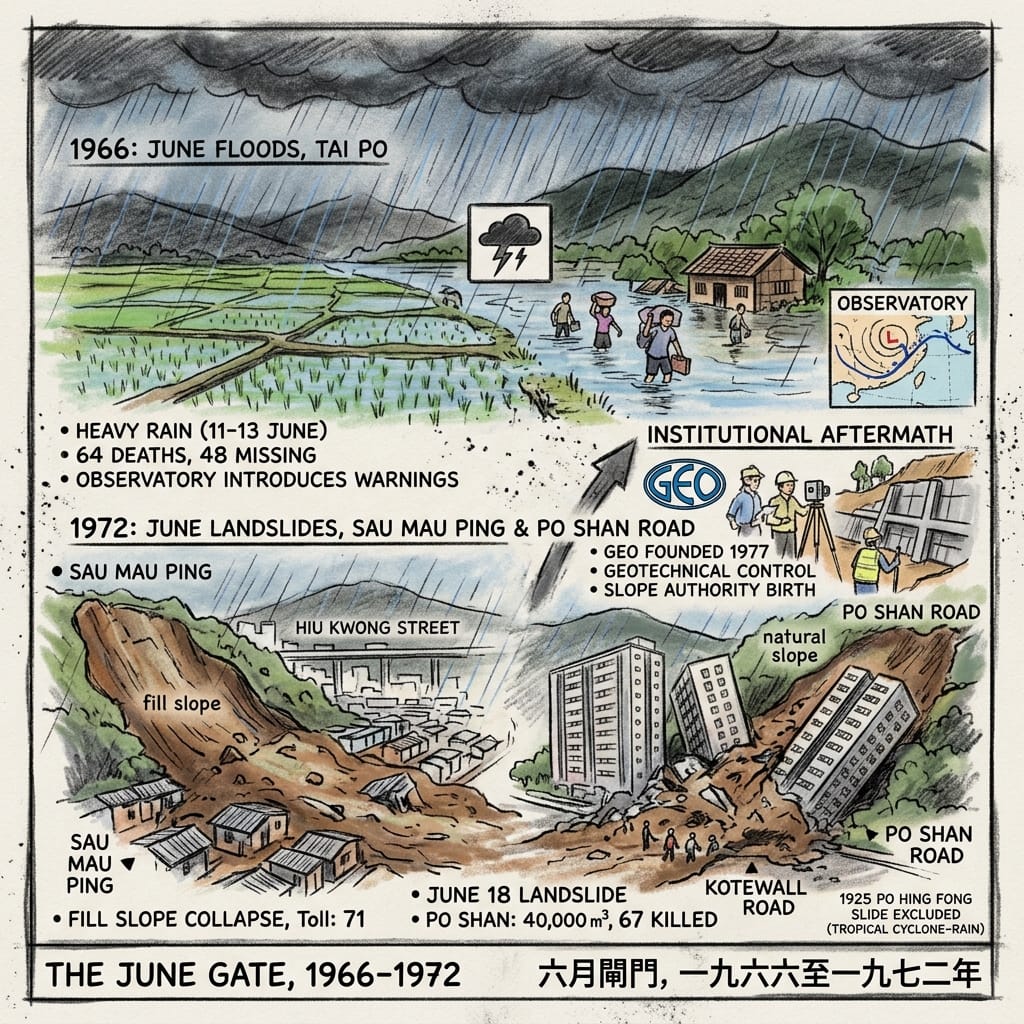
Between 11 and 13 June 1966 a rainstorm killed 64 people, left 48 missing and injured 29; in Tai Po, around 95 per cent of the paddy fields were flooded. The Observatory’s weather chart for 12 June shows an active trough of low pressure lying along the south China coast. The following year it introduced its thunderstorm and heavy rain warnings.
Six years later, in June, it rained again. From 16 June 1972 there was almost no break. At 12.45 pm on the 18th a fill slope supporting Hiu Kwong Street in Sau Mau Ping gave way and buried part of a squatter area below it; 71 people died. At about 9 pm the same day the natural slope above Po Shan Road in the Mid-Levels came down. About 40,000 cubic metres of earth took out two large buildings on Kotewall Road, and at least 67 died. In 1977 the Geotechnical Control Office was set up to regulate slopes. A fill slope at Sau Mau Ping had failed again in August 1976, before it existed.
The totals do not agree. Some sources give 138 dead for the two sites, some 156 for the year, and an Observatory-authored table gives 150 for the event including other locations. I have quoted only the figures with a clear source, and the 1972 Commission of Inquiry report should be checked.
One name has to be set aside. At Po Hing Fong in July 1925 a retaining wall collapsed and seven four-storey houses were swept away; 75 people died, still the highest toll from a single landslide in Hong Kong. But the Observatory ties that storm to a tropical cyclone, not the monsoon, and a table on the web that lists it as June is simply wrong. It does not belong in this story.
The Rain That Rewrote Hong Kong
Resonance Node: Sau Mau Ping Memorial Park
You do not need to go to the Mid-Levels to find the place where the veil is thinnest. The old disaster site is now a small park: a few benches against a hillside, ringed by public housing towers, according to reports. The benches are ordinary. So is the slope. According to one account, a boy of thirteen that afternoon had planned to play table tennis outside, and the rain was too heavy.
Later the government held memorial exhibitions in Central and led groups through the drainage tunnel below Po Shan Road. What people left behind was less a list of names than a set of rules for slopes.
4. Dragon boat water: a plague procession at Tai O
In May and June, around the Dragon Boat Festival, cold air from the north withdraws just as the south-west monsoon breaks over the South China Sea. Warm, wet air meets the last of the cool, and rain falls. Hong Kong calls it lung chau seui (龍舟水), Dragon Boat Water, and the Observatory still uses the name. Spring and summer deliver about 80 per cent of the year’s rain.
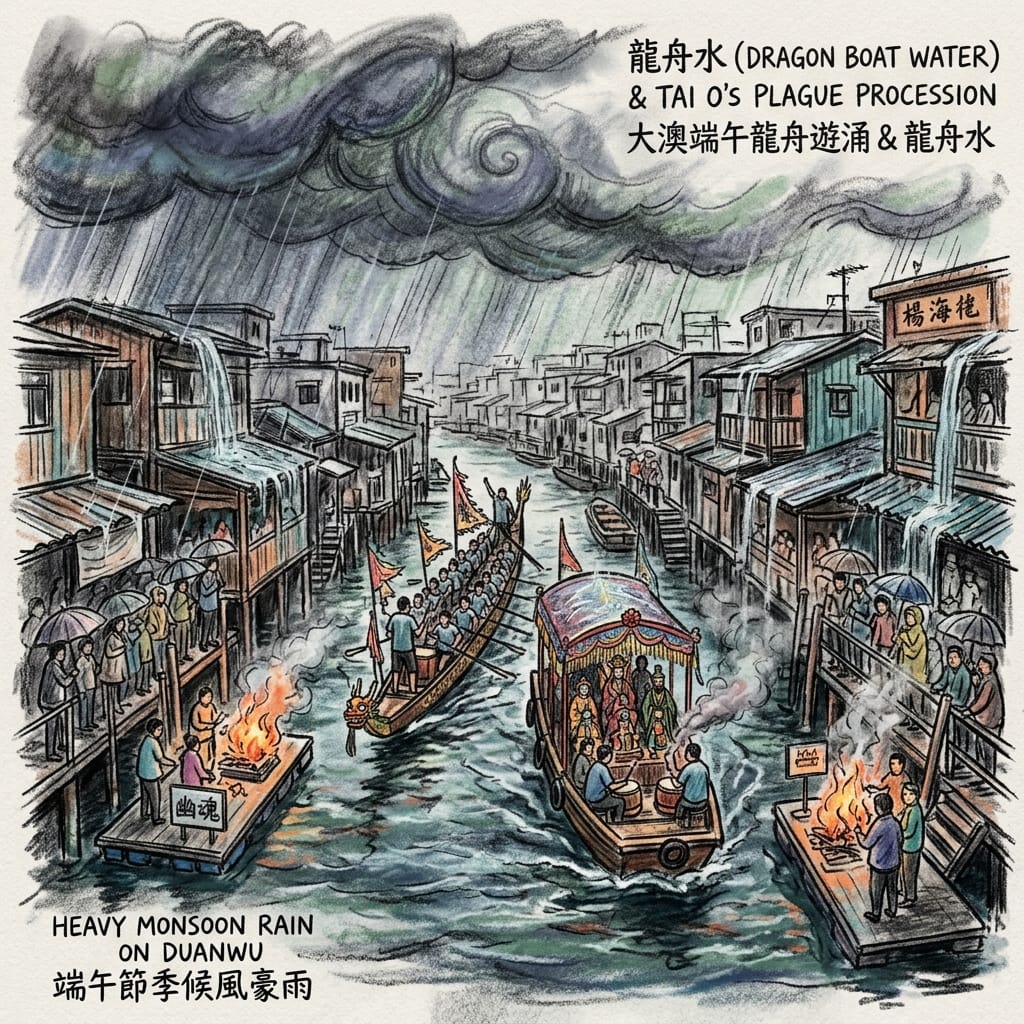
At Tai O, on Lantau, the festival comes with a custom. According to local tradition, more than a century ago a plague broke out. The fishing people took small statues of deities from four temples (Yeung Hau, Tin Hau, Kwan Tai and Hung Shing), put them on boats, and towed them through the waterways behind dragon boats to drive the sickness out. The plague passed. The procession stayed.
Today three fishermen’s guilds collect the statues the day before the festival. On the day, the sacred boats go out along every channel, paper offerings are burned for the wandering spirits of the drowned, and people in the stilt houses burn incense at their doors. Only then do the dragon boats race. The tradition is on both the national and the Hong Kong intangible heritage lists.
No document I have found names the year, or the epidemic. The suggestion that it echoes a memory of disease in the wet season is a hypothesis, not a finding.
The Monsoon Plague Fleet Of Tai O
In June 2026 the custom met the weather head on. The south-west monsoon reached the coast on 13 June; on the 15th and 16th many places had about 100 mm of rain a day, some more than 200 mm. On 18 June the Observatory issued the year’s second and third black rainstorm warnings. On the 19th, the festival day, the procession went ahead, watched by more than a thousand people, and passed through two new bridges that open for the boats. The Observatory had forecast a southerly wind of force 4 to 5.
Holographic Sensory Cue: Drums first, quick and dense, carrying from the dragon boats into the timber posts of the stilt houses. A south wind, force 4 to 5, on the water and on clothes. Smoke from burning paper offerings lies low over the channel and mixes with incense. Small statues sit in their boat and sway as the dragon boat tows them. Temperature, tide and exact smells are not in my sources and need to be gathered on site.
5. The goddess who moved onto the water
In Causeway Bay Typhoon Shelter there was, for many years, a temple that floated.
The Tin Hau temple on the water is the only boat-temple in Hong Kong. According to a news report, it began on a small island in the Pearl River estuary. In the 1960s, fearing the Cultural Revolution, fishermen took the statue onto a boat and sailed to Hong Kong.
Tin Hau protects fishermen and sailors. Local accounts say she could foresee the weather and appear to save people from wrecks. Hong Kong has at least forty of her temples. Her festival falls on the 23rd day of the third lunar month everywhere except Cheung Chau, which celebrates on the 18th; the story goes that the date was moved earlier to use the moon, so that people could walk an unlit road.
The Goddess Who Fled To Sea
Fishing people kept their own speech. Sui gon (水乾) is the ebb tide; hoi san (開新) is to go out and fish. An old fisherman told a reporter that when the sea turns the first word is Ah Ma, the grandmother’s name for the goddess, and when you are safe you burn incense.
The link to the monsoon here is thematic, not documentary. I found no source that ties Tin Hau’s rituals to monsoon winds. But a temple that travels with its worshippers and anchors where the wind allows is a sacred place without foundations. A news report says the boat-temple was to go ashore at the end of the year; I could not date the report, so check before you go.
The Goddess Who Fled To Sea
Reading the monsoon in Hong Kong’s own terms: solar terms, dragon boat water and Tin Hau
If these stories need a cosmology, it has to be the one Hong Kong actually used: the lunisolar calendar of its Cantonese, Hakka and boat-dwelling communities, the goddess of the sea, and a view of epidemic as pollution that must be carried away over water.
Time is not a clock but a series of solar terms. When the Observatory explains the north-east monsoon in Chinese, it still uses the autumn equinox (秋分) and Cold Dew (寒露) to mark the cold air’s approach, and it keeps a folk phrase for the moment cold air meets tropical moisture: wet Cold Dew wind (濕寒露風). The rain itself has a festival’s name. Tin Hau is a kind of meteorological theology: a goddess of foresight and rescue, which is what a life at sea most needs. And the Tai O procession treats plague as something spiritual and watery, to be washed out by gods and settled by gifts to the dead.
The limits matter. I found no local source that makes the monsoon itself a god, and nothing that justifies reading dragon-vein geomancy onto the landslide sites. For 1966 and 1972 I use a different language, that of memory geography: how land holds a catastrophe, and how a city turns grief into regulation.
The silent legislator
Put the five stories side by side and a pattern appears. Hong Kong’s monsoon works like a legislator who never stood for office. Each turn of the season has been converted into an institution: a sailing calendar, a temperature record, a set of rain warnings and a slope authority after 1966 and 1972, a rainstorm warning system from 1992, and a ritual that names the wet season and tries to wash it clean.
A caution. Only two of those links are directly supported as cause and effect in my sources: 1966 to the 1967 warnings, and 1972 to the 1977 office. The rest is my synthesis.
Every May the south wind comes back. The Observatory issues its warnings. At Tai O the dragon boats go into the water. On a hillside in Kwun Tong, the benches face the slope.
Nobody reads out the names.
Beyond the five "monsoon" stories mentioned above, a sixth—and particularly formidable—"monsoon" swept through Hong Kong in 2019. Like the others, this "monsoon" scattered us, leaving Hong Kong feeling profoundly "empty." It acted as an unofficial legislator for the city; yet, just as the southerly winds return each year, the true spirit of Hong Kong remains quietly held within the hearts of its people.
No one speaks those names anymore. Even though the monsoon has left this place feeling hollow, the name "Hong Kong" still endures in our hearts. Though we ache, our spirit remains alive. "So if we never speak again, at least we still have soul... So if you ever change your mind, I'm waiting in Hong Kong."
If you would like more hidden histories of Hong Kong, subscribe to our email letter, and we will send you the next place slowly.
Accessing the Physical Node
- Tai O: From Tung Chung bus terminus take the Lantau 11 bus (about 45 to 50 minutes). Alternatives are the 21 bus from Ngong Ping, the Tuen Mun–Tung Chung–Sha Lo Wan–Tai O ferry, and a water taxi from Central. On holidays and on Dragon Boat Festival day the queue to leave Tai O can be long, so go early or stay the night.
- Where to stay: Tai O Heritage Hotel, converted from the old Tai O police station, sits inside the village.
- Guided walks: The Business Environment Council and Tai O Heritage Hotel have run a Tai O fishing-village culture tour that includes the stilt houses, temples and a boat ride. Confirm current dates with the organisers.
- Sau Mau Ping and Po Shan Road: Both are residential areas, so be considerate. Check routes and timetables before you leave.
- Causeway Bay Typhoon Shelter: Confirm that the boat-temple is still afloat.
- Cold-surge days: If a strong cold surge is forecast, conditions on the Peak and Tai Mo Shan will differ sharply from the city. Check the Observatory forecast before climbing.
💡 Q&A
Q1 | How did the Pearl River monsoon dictate early Hong Kong maritime history and opium receiving ships? (Lintin Island and Kumsing Moon Anchorage Context)
Ans: Before Hong Kong was formally claimed in 1841, maritime trade across the Pearl River Estuary was completely governed by the seasonal monsoons. Opium receiving ships and foreign merchant vessels anchored off Lintin Island during the summer and retreated to protected waters like Kumsing Moon and Hong Kong harbour during typhoon season. Traders relied on the southwest monsoon to arrive between June and September and the northeast monsoon to depart. This seasonal maritime vulnerability directly shaped regional trade patterns, geopolitical tensions, and the eventual British selection of Hong Kong's deep sheltered harbour.
Q2 | What caused the historic 1893 Peak freezing weather event in Hong Kong? (The China Mail Archives and Freezing Rain Historical Record)
Ans: Between January 16 and 18, 1893, an extraordinarily severe winter monsoon pushed freezing arctic air into subtropical Hong Kong. Contemporary reports from The China Mail recorded ice-coated roads on Victoria Peak, sagging telegraph wires laden with icicles, and freezing rain that stiffened pedestrians' overcoats near Magazine Gap. The Hong Kong Observatory recorded an all-time official low of 0.0°C on January 18, while sub-zero temperatures atop the Peak destroyed introduced tropical plant species documented by Botanical and Afforestation Department superintendent Charles Ford.
Q3 | What is the historical origin of Hong Kong's Dragon Boat Water rain and Tanka epidemics? (Tai O Dragon Boat Water Parade and Monsoon Folk Memory)
Ans: The traditional term "Dragon Boat Water" refers to the heavy torrential rains occurring around the Fifth Lunar Month, caused by the onset of the East Asian summer monsoon. Historically, this hot, humid, and rain-heavy period coincided with widespread seasonal epidemics and cholera outbreaks among local maritime communities. In places like Tai O, the Tanka fishing community established the annual Dragon Boat Water Parade (Deities Parade) as a collective ritual to cleanse water channels, ward off pestilence, and maintain spiritual protection against seasonal disease.
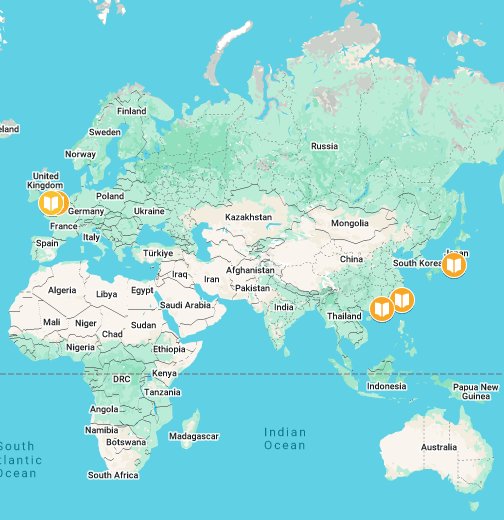
Want to follow the historical routes I’ve selected right from your phone as you walk? Click to join the exclusive Google map of historical tours titled "Historical Travel Stories"—import it to Google Maps on your phone with a single tap and let it guide you as you visit each historical site in person.

📖Reference and Further reading📖
First layer – Main sources of literature and institutions:
- R1. 香港天文台:〈端午節前的「龍舟水」〉(2025年5月26日)
- R2. 香港天文台:〈梅雨槽,龍舟水?〉(2026年6月11日)
- R3. 香港天文台:〈暴雨後迎端「陽」?〉(2026年6月18日)
- R4. 何柏勝:〈東北季候風及其在秋季對華南天氣的影響〉(香港天文台,2010年12月)
- R5. Hong Kong Observatory, "Winter monsoon – from the perspective of strong monsoon signal"
- R6. Hong Kong Observatory, "The Strong Monsoon Signal" (leaflet)
- R7. Hong Kong Observatory, "Hong Kong at Freezing Point – Historical Perspective" (2014)
- R8. Hong Kong Observatory, "Last time it snowed in Hong Kong"
- R9. Hong Kong Observatory, "Report on Severe Typhoon Haikui (2311)"
- R10. HKO, "Under the Same Sky 130 Years", Display Area 8, Exhibit 2 (1966 weather chart)
- R11. HKO, "Under the Same Sky 130 Years", Display Area 8, Exhibit 3 (1966 rainstorm supplement; 1967 warnings)
- R12. Hong Kong Observatory blog, "The Po Hing Fong Disaster in 1925"
- R13. 唐恒偉、陳永鏗、李細明:〈以共識方法預測香港春季和夏季雨量〉(香港天文台)
- R14. Geotechnical Engineering Office, Rainstorm Disasters 1972 (reprint of the 1972 Commission of Inquiry report)
- R15. GEO, Weathering the Elements Together
- R16. Hong Kong Slope Safety, "Past Notable Landslides"
- R17. GEO, "Remembrance and Reflection: 50 years after the Tragic Landslides on 18 June 1972"
- R18. DEVB blog, "On 40 years of landslip prevention by four current and former heads of the GEO"
- R19. HKSAR Government Information Services, "Exhibition takes visitors back to Canton of old" (2009)
- R20. 香港非物質文化遺產代表作名錄(2024年12月更新版)
The second layer – secondary academic materials:
- R21. Chan, "Challenges in Slope Engineering in Hong Kong" (GEO technical paper, 2007)
- R22. Sino-French Trade at Canton, 1698–1842 (Hong Kong University Press, preview)
- R23. D. Petley, "New, remarkable animation video of the Po Shan Road landslide" (AGU Landslide Blog)
Third layer – Supplementary information:
- R24. Gwulo, "Hong Kong's most lethal landslide: The Po Hing Fong Disaster in 1925"
- R25. Gwulo, "1966 Rainstorm"
- R26. Gwulo, "Rainstorms in Hong Kong" (timeline)
- R27. Gwulo, "金星門 – Cumsingmoon"
- R28. 香港中國文化資源庫 (Hong Kong Chinese Culture): "Why did Hong Kong become a hub of opium smuggling before the First Opium War?"
- R29. Christie's lot note (Canton trade season quotation)
- R30. Wikipedia, "Convention of Chuenpi"
- R31. Wikipedia, "Battle of Kowloon"
- R32. 長春社文化古蹟資源中心:〈大澳龍舟遊涌〉
- R33. Our China Story:〈端午節鼓聲響 大澳龍舟遊涌為何入「非遺」?〉
- R34. 香港01:〈端午節看龍舟比賽注意|天文台料明下午驟雨減少〉
- R35. 香港01:〈端午節|大澳辦逾百年龍舟遊涌 為水陸居民求平安〉
- R36. 香港教育大學中國文化中心:〈天后誕〉(引何志平《天上人間:香港民間信仰文化札記》,2008)
- R37. 公視新聞:〈漁民精神寄託 港唯一水上船廟年底上岸〉
- R38. 長春社文化古蹟資源中心:〈漁民話〉非遺情報
- R39. South China Morning Post, "Hong Kong logs warmest winter on record" (2026)
- R40. Hong Kong Free Press, "Intense cold surge: HK hit by coldest temperatures in nearly 60 years" (2016)
- R41. SCMP archive, "1966 Hong Kong rainstorm leaves 64 dead"
- R42. 綠色力量:〈梅子林村〉(風水林)導賞資料
Priority archive visits before drafting
- Hong Kong Observatory Meteorological Results for 1966 and 1972.
- The 1972 Commission of Inquiry report.
- Doberck's 1893 Nature note.
- Tai O guild records.
- Van Dyke's The Canton Trade.
 Lawrence
 Lawrence
 Lawrence