(ENG) Deep Water Bay - The Quietest Bay in Hong Kong Is Hiding Five Bodies
Discover the hidden layers of Deep Water Bay, Hong Kong. This historical travel story and walking guide uncovers 5 forgotten histories behind the serene beach, exploring WWII battles, elite colonial golf clubs, and vanished Tanka boat culture beneath the modern luxury facade.

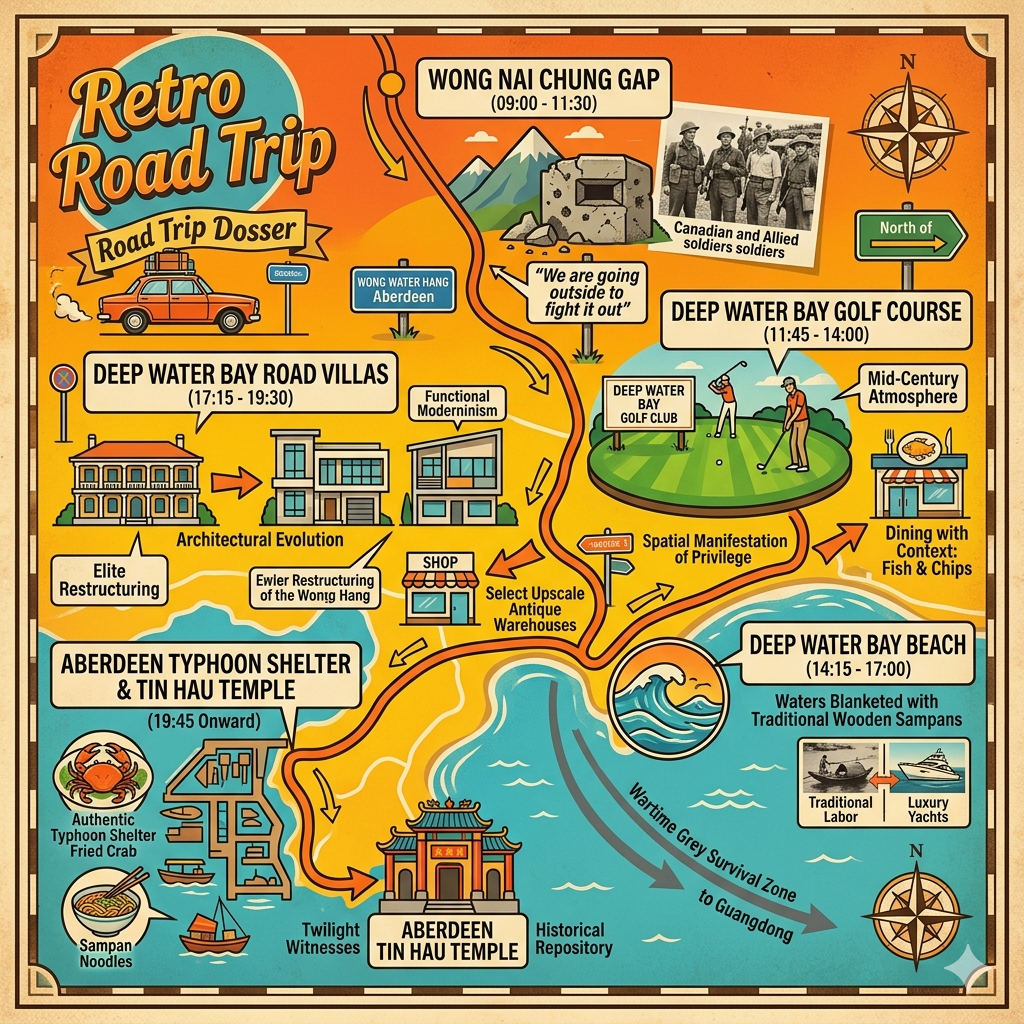
This is a historical travel story and deep walking guide to Deep Water Bay, a seemingly serene coastal paradise in Southern Hong Kong Island. Through five hidden histories—from the crucial World War II defense lines and colonial elite golf politics to the shifting lives of the indigenous Tanka boat people—this slow walk explores how empire, capital, and collective amnesia shaped this exclusive neighborhood. It offers a unique lens to see beyond the modern luxury and rediscover the true historical evolution of the bay.
 Lawrence
A field dispatch on what the water doesn't talk about
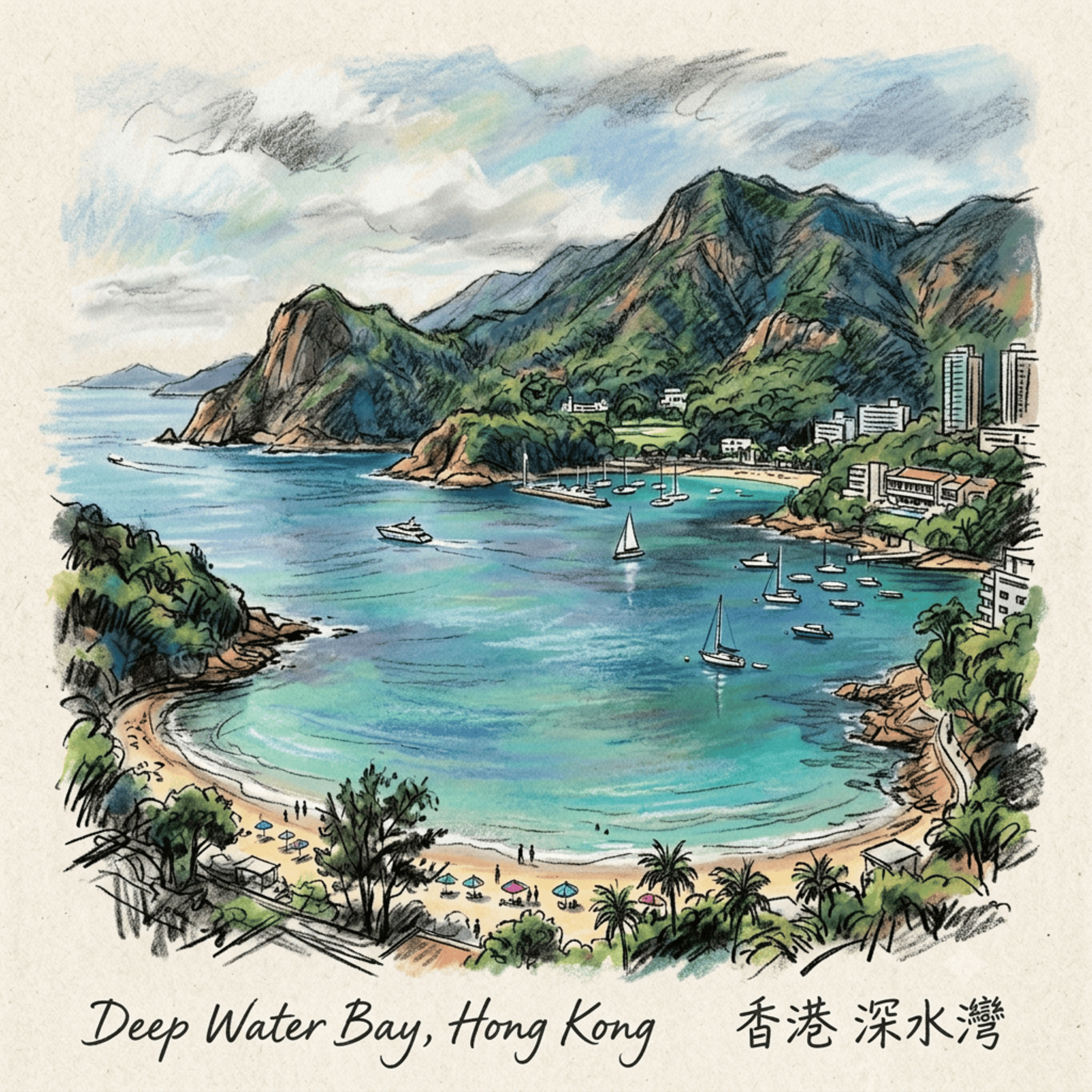
There's a particular kind of silence that wealthy real estate produces. You've felt it before, even if you've never set foot in Hong Kong — the hush of a place that has been landscaped, gated, and insured into stillness. Deep Water Bay has that silence in spades. Drive down from Repulse Bay Road and the city falls away behind a ridge; what's left is a crescent of sand, a marina full of yachts that never seem to actually go anywhere, and the kind of real estate that doesn't need to advertise itself.
It's the sort of place that invites you to stop thinking. Which is exactly the problem.
Because Deep Water Bay isn't quiet by accident. It's quiet the way a renovated crime scene is quiet — the mess has been cleared, the furniture rearranged, and the new owners would really rather you admired the view. Underneath the golf course and the gated villas is a five-act drama involving a doomed Canadian brigadier, a colonial country club run like a Masonic lodge, an entire maritime civilization that was legislated out of existence, a wartime occupation nobody wants to fully account for, and a slow-motion class swap dressed up as decolonization.
This is the unauthorized version of Deep Water Bay. Think of it as the director's commentary nobody asked the developers to include.
Listen to the historical stories told in detail (For subscribers only)
The Hill That Decided Hong Kong's War
If you've ever read about Pearl Harbor, you know the broad strokes of December 1941 — Japan moves fast, the Allies are caught flat-footed, colonial confidence collapses in a matter of days. What gets less attention is that Hong Kong had its own version of this story, and the hinge point happened on a hillside about a ten-minute drive from where the Deep Water Bay golf carts now putter along manicured fairways.
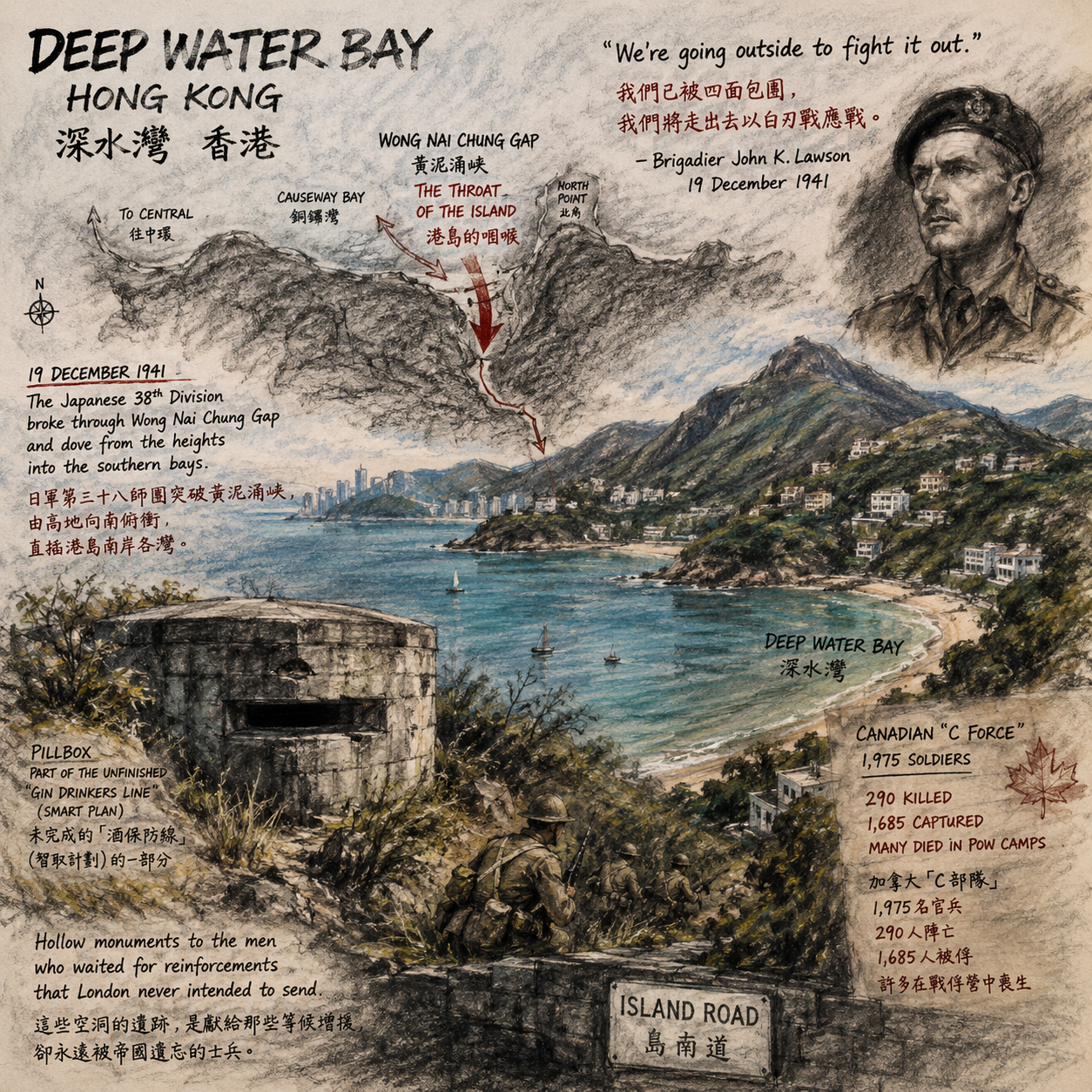
The place is called Wong Nai Chung Gap. On a map it looks like nothing — a notch in the ridgeline that splits Hong Kong Island roughly down the middle. But geography is destiny in a siege, and that gap was the only practical road connecting the island's north shore to its south, including Deep Water Bay itself. Lose the gap, and the whole southern half of the island — the part where the British had quietly built their version of the Hamptons — goes undefended.
On the night of December 18, 1941, Japanese forces under Lieutenant General Sano Tadayoshi pulled off something close to a tactical magic trick: they landed where the British didn't expect them, moved faster than anyone had planned for, and by the next morning had Wong Nai Chung Gap surrounded. The Canadian commander there, Brigadier John Kelburne Lawson, sent back a radio message that has since become one of the more quietly devastating lines in Commonwealth military history: "We're going outside to fight it out." Minutes later he was dead, the highest-ranking Canadian officer killed in action in the entire Pacific theater.
Here's the part that should sting a little more than it usually does in the tourist literature: Canada's "C Force," the unit Lawson commanded, had arrived in Hong Kong barely a month earlier. Nearly two thousand men, shipped across the Pacific as what military historians now describe — with the bluntness of hindsight — as a political gesture more than a serious defensive reinforcement. London and Ottawa both understood, at some level, that Hong Kong was not defensible against a determined Japanese assault. They sent the troops anyway, for reasons having more to do with signaling resolve to allies than with any realistic war plan. Lawson and the men under him paid for that signal with their lives, and the survivors paid for it in Japanese POW camps for the next three and a half years.
Once the gap fell, Japanese forces pushed south along what's now Island Road — straight through Deep Water Bay. What was left of the British defense tried to fall back west toward Aberdeen. Six days later, on Christmas Day, the garrison surrendered. The British call it Black Christmas. It's not a phrase you'll find on any plaque in Deep Water Bay itself, but you can still find the gun emplacements — small concrete pillboxes half-swallowed by ferns on the hillsides above the bay, facing out toward a sea that long ago stopped being a threat.
Historian Tony Banham, whose 2003 book Not the Slightest Chance remains the gold standard on this battle, spent years cross-referencing British, Canadian, and Japanese accounts — and found them disagreeing on basic facts like troop positions and casualty counts. Even Japan's own wartime archives don't fully square with Allied records. The fog of war, it turns out, settles permanently over some hillsides.
What's still there: A memorial park at Wong Nai Chung Gap, the pillboxes scattered through the hills above the bay, and — fifteen minutes south — Stanley Military Cemetery, where rows of identical white headstones do the talking that the bay itself never does.
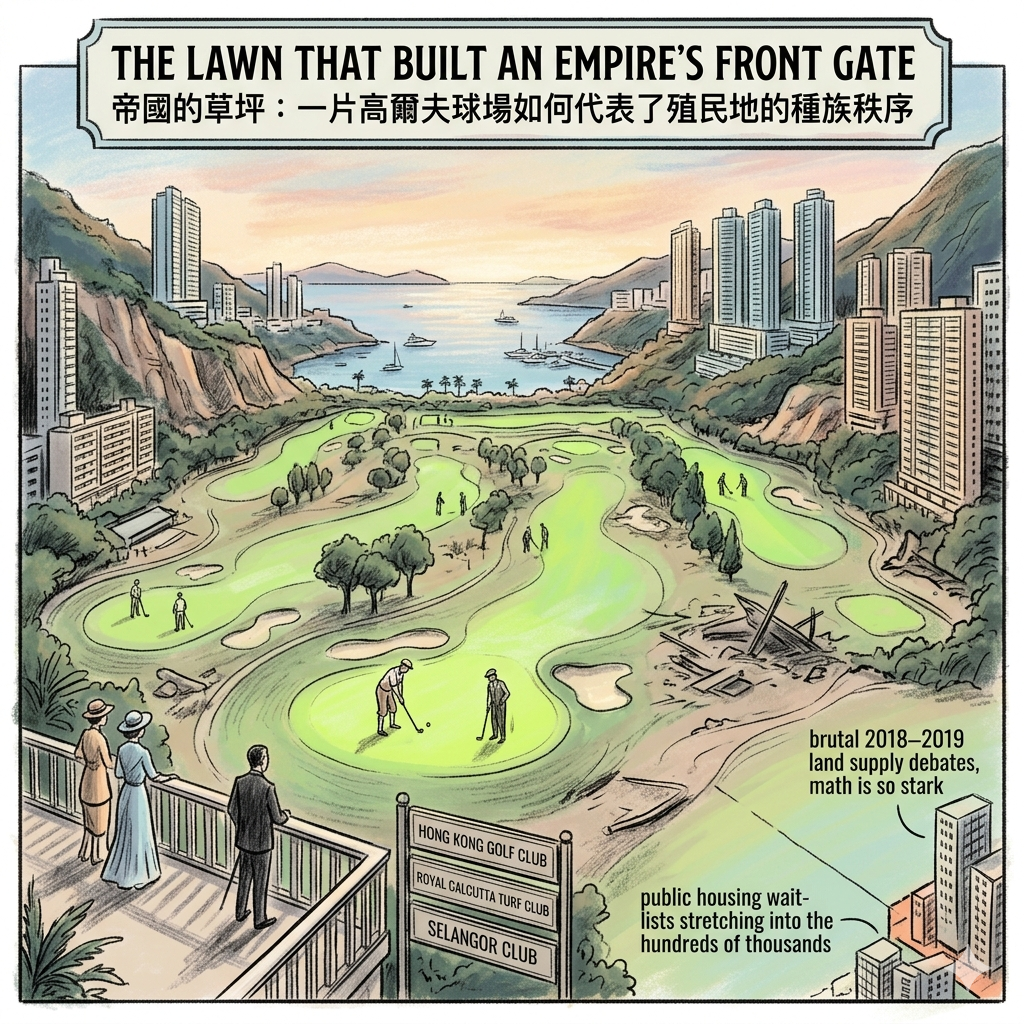
The Lawn That Built an Empire's Front Gate
Now picture something less dramatic but, in its own bureaucratic way, just as revealing: a nine-hole golf course on some of the flattest, most valuable real estate left in Hong Kong, owned and operated since the colonial era by a private club most people will never set foot inside.
The Hong Kong Golf Club was founded in 1889 — older than the Eiffel Tower, for context — making it one of the oldest golf institutions in Asia. Its Deep Water Bay course is the smallest and arguably the quietest of its holdings, but it's also the most architecturally honest piece of colonial social engineering still standing in the neighborhood.
Here's the thing about colonial exclusion: it rarely needed to write itself into law. The Hong Kong Golf Club, like its sister institutions — the Hong Kong Cricket Club, the Hong Kong Club, the Royal Hong Kong Yacht Club — ran on a softer technology of exclusion. Steep membership fees. A blackballing system that let existing (almost entirely European) members veto new applicants without explanation. An entirely English-language social world that made Chinese applicants feel, by design, like guests who'd wandered into the wrong room. Nothing on paper said "no Chinese members." Nothing needed to.
It's worth sitting with how familiar this playbook is to anyone who's studied other corners of the British Empire. Swap "Hong Kong Golf Club" for "Royal Calcutta Turf Club" or "Selangor Club" in Kuala Lumpur, and you're describing the exact same institutional architecture — leisure clubs functioning as the social control rooms of empire, where the deals that actually mattered got made on a veranda, not in an office.
The land itself tells a parallel story. The colonial government leased some of the South Side's flattest, most desirable terrain to the club at peanut rents, while low-density zoning rules protected the whole neighborhood from the kind of high-rise development reshaping the rest of the city. This wasn't urban planning in any neutral sense. It was a permanent reservation, carved out of the most valuable land in one of the world's most expensive cities, for a small membership that didn't need the housing and wasn't going to be asked to share it.
Japan's occupying forces damaged the course badly during the war — a mix of ideological hostility toward a symbol of Western imperialism and straightforward military requisitioning. After 1945, rebuilding the golf course was treated by the colonial administration as part of restoring "normal order." Worth pausing on that phrase. Restoring the golf course, ahead of any systematic accounting for what ordinary residents had just survived, says something about whose normal the colony was actually built to protect.
And here's the punchline nobody planned: the club outlived the empire that built it. The land-lease terms that gave the Hong Kong Golf Club its sweetheart deal are still, in essence, intact today — which means a piece of nineteenth-century colonial real estate policy survived two changes of sovereignty (1997 included) almost completely unscathed. During Hong Kong's brutal 2018–2019 land supply debates, with public housing waitlists stretching into the hundreds of thousands, this golf course became a flashpoint precisely because the math is so stark: some of the city's most land-starved residents versus a few hundred members teeing off on land they're paying historical, not market, rates for.
What's still there: The course itself, visible from Island Road, its green flatness sitting in almost surreal contrast to the cliffside towers stacked above it. The contrast is the point. You're not looking at nature. You're looking at a policy decision with very good landscaping.
The People the Water Forgot
Every guidebook mentions, in passing, that Hong Kong used to have "boat people." It's usually one sentence, often in a sidebar, frequently past tense, as if describing a species that simply migrated elsewhere.
That sentence is doing a lot of quiet erasure.
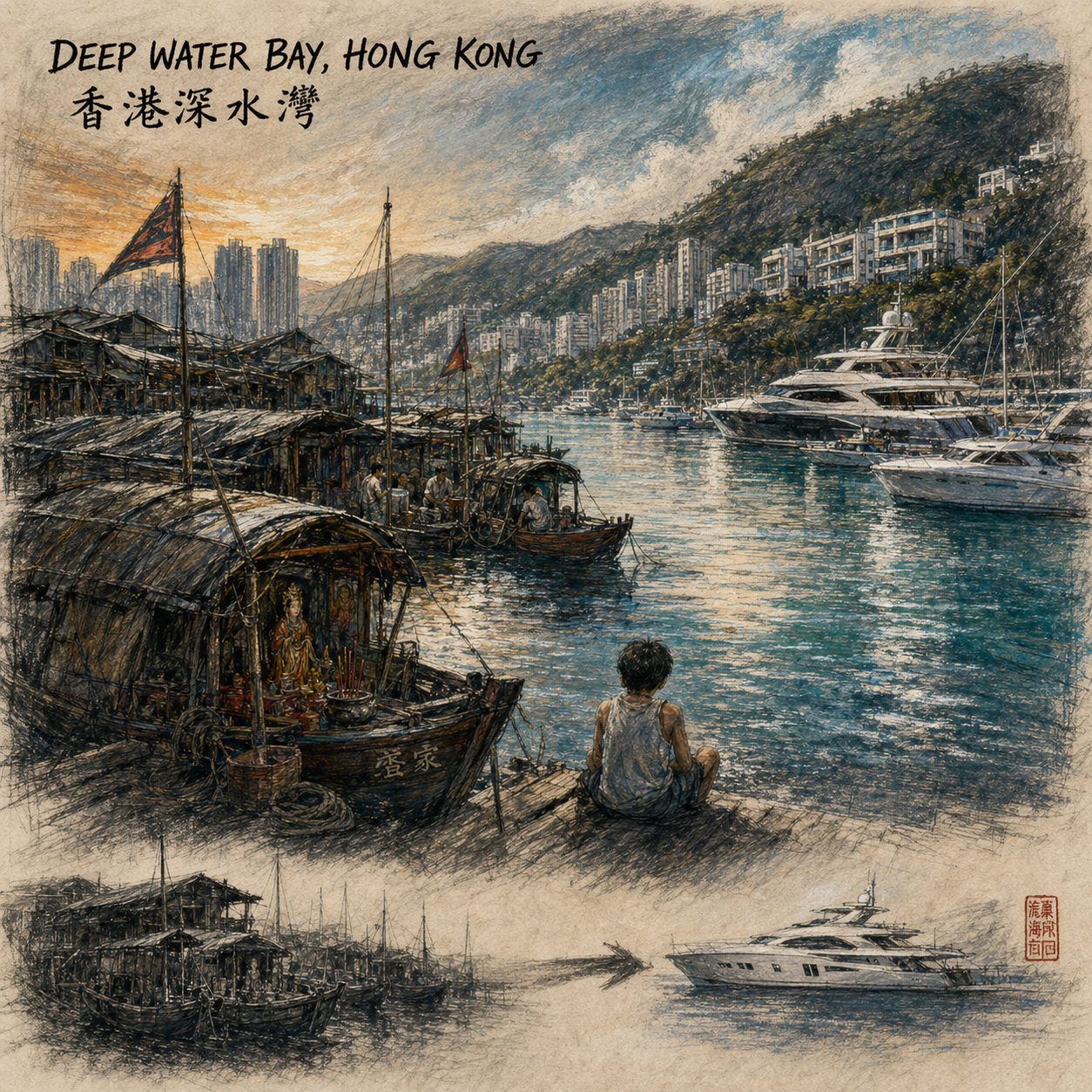
The Tanka — sometimes romanized as "Tankai," more commonly just "boat people" in English-language sources — lived on these waters for centuries, with Aberdeen, right next door to Deep Water Bay, as one of their major settlements. They fished, ran water taxis, did the unglamorous physical labor of a working harbor, and maintained an entire floating culture: their own dialect, their own funeral and wedding rites conducted at the bow of a boat, their own devotion to Tin Hau, the sea goddess better known in the Western imagination (if at all) by her Taiwanese name, Mazu.
Under imperial Chinese law, the Tanka were historically classified among the so-called "mean people" (jianmin) — a legal underclass barred from things like civil service exams and intermarriage with land-based families. Historians today caution against treating this classification too neatly; local practice was messier and more variable than the official law codes suggest. But British colonial rule, whatever else it changed, did not meaningfully change the basic fact of Tanka marginalization. The British needed the fish, the ferry labor, and the harbor muscle. They had considerably less use for keeping records about who was providing it.
Anthropologist Barbara E. Ward conducted the most systematic fieldwork on Hong Kong's water-dwelling communities in the 1950s and '60s — essentially the only sustained scholarly attention this entire civilization ever received before it effectively disappeared.
And disappear it did, with a kind of administrative tidiness that should make anyone uneasy. Starting in the 1960s and accelerating through the '70s, the Hong Kong government rolled out resettlement programs that moved Tanka families into public housing on land, framed in the official language of the day as modernization and improved living standards. The intentions may have been genuinely paternalistic rather than malicious. The effect was something closer to cultural extinction.
A boat isn't just a house. For the Tanka, it was the entire physical infrastructure of an identity — weddings performed on deck, funerals conducted on the water, songs (Tanka dange) passed down across generations of close-quarters family life, incense burning continuously before a Tin Hau shrine in the cabin. Take away the boat, put the next generation through Cantonese-language land schools, and within one generation the dialect, the songs, and the rituals were largely gone. By the 1980s, traditional Tanka fishing activity in the waters around Deep Water Bay had essentially vanished. The same water now holds private yachts — a different population entirely, living a completely different version of "life on the water."
It's worth naming the pattern here, because it's not unique to Hong Kong. The same forced-settlement pressure has hit the Bajau sea nomads of the Philippines and Malaysia, riverine and coastal fishing communities across Vietnam — basically anywhere a modern nation-state has looked at a population that doesn't fit neatly into a property registry and decided that mobility itself was the problem to be solved.
What's still there: A short drive to Aberdeen gets you to the harbor, where a handful of old wooden fishing boats remain — mostly photo props for tourists now, not working vessels. More important is the Aberdeen Tin Hau Temple, where Qing-dynasty stone inscriptions on the temple walls still record the names of generations of Tanka donors. It's some of the only writing this community ever left behind. Most visitors walk past it without knowing what they're looking at.
The Three Years and Eight Months Nobody Wants to Fully Tell
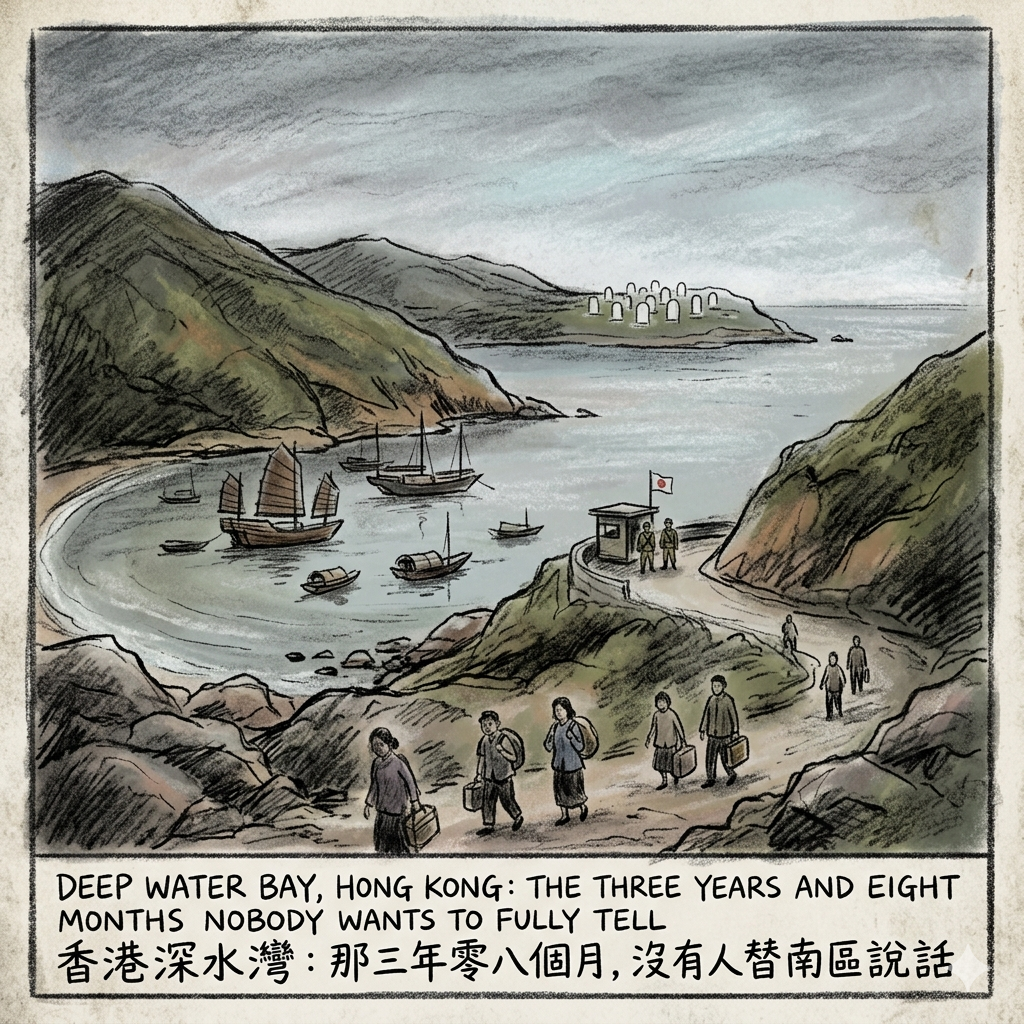
In January 1942, Japanese occupation authorities ordered all British and Allied civilians in Hong Kong to report for internment at Stanley. The European families living around Deep Water Bay packed what they could carry and walked away from villas that, within weeks, were being requisitioned by Japanese military officials or simply left to rot.
What followed — locally remembered as "three years and eight months" — is one of the least fully reckoned-with chapters in Hong Kong's modern history, and English-language sources on it remain comparatively thin.
The broad facts are brutal enough on their own. Japanese military currency triggered runaway inflation. A forced "return to villages" policy expelled what the occupiers deemed "surplus" population back into Guangdong to ease the food burden on the colony. Hong Kong's population collapsed from roughly 1.6 million before the war to an estimated 600,000 by the end of the occupation — a demographic catastrophe driven by starvation, disease, forced labor, and direct violence.
The South Side's geography — cut off from the urban core by a mountain ridge — made it a comparatively low-priority zone for Japanese administrative control, which created some genuine gray areas. Fishing communities, including the remaining Tanka, were partly insulated from the worst of the urban food crisis by their access to the sea, even as they faced their own dangers: confiscated catches, forced labor conscription, sporadic violence.
Some of that geographic isolation cut the other way too. Colonel Lindsay Ride's British Army Aid Group — a resistance network that worked with Guangdong's East River guerrillas — used covert routes along the southern coastline to help Allied soldiers and escaped POWs slip out toward the mainland. Whether Deep Water Bay specifically played a role in those operations is something the historical record doesn't fully settle; it's a gap that calls for more archival digging than this dossier was able to do.
What's clearer is the asymmetry of memory that followed. Hong Kong's wartime commemoration has, for decades, run on two parallel tracks: the military history of Commonwealth soldiers, and the internment memoirs of European civilians at Stanley. Both deserve to be remembered. But the tens of thousands of ordinary Hong Kong residents — overwhelmingly ethnic Chinese — who died of starvation, forced labor, and occupation violence during those three years and eight months have no commemorative space remotely proportionate to what they endured. Their names aren't carved into the memorial at Wong Nai Chung Gap. They're not carved anywhere in particular.
That, too, is a historical fact about Deep Water Bay — not what happened there, but who got remembered for it afterward.
What's still there: Stanley Military Cemetery, fifteen minutes from the bay, where row after row of white headstones — 1941, 1942, 1943, 1944 — do more honest talking than most plaques in the area manage.
How a Cold War Made a Postcode
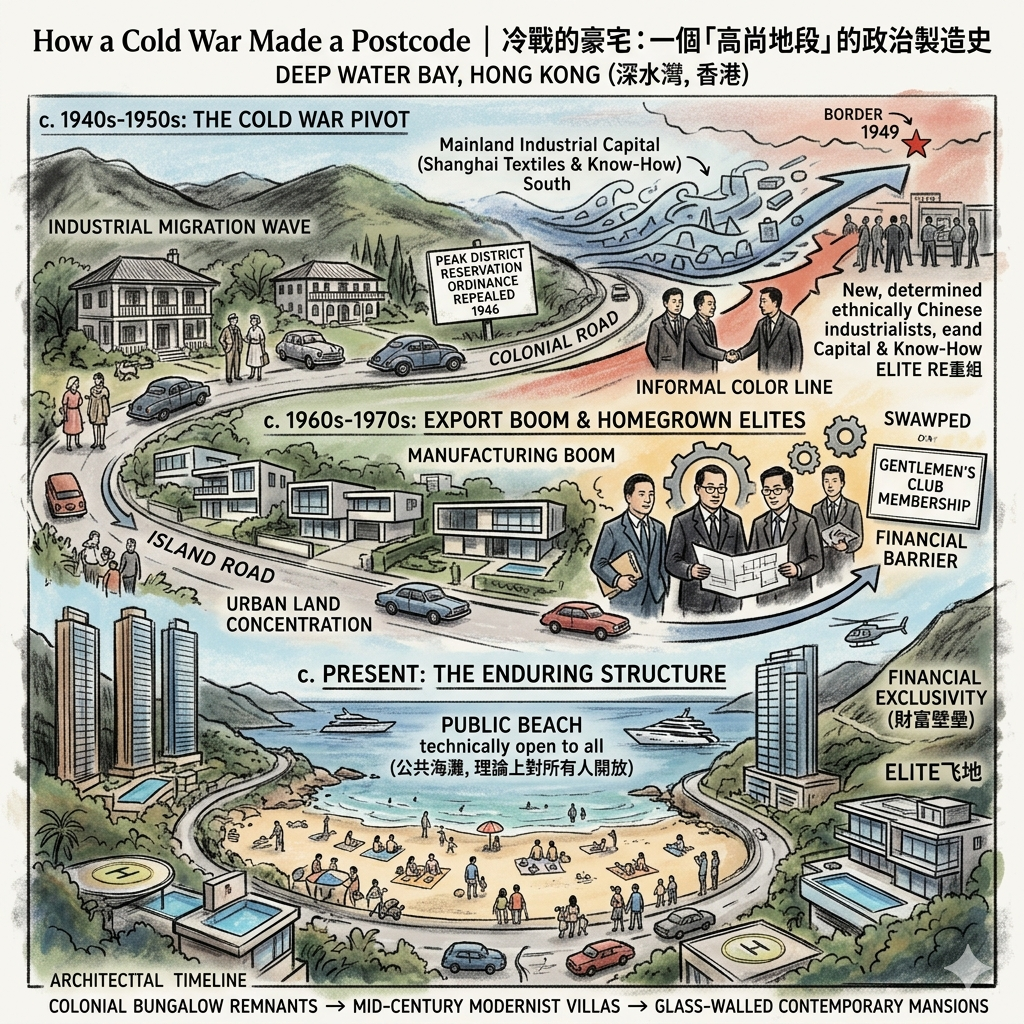
Hong Kong residents have a way of talking about Deep Water Bay's exclusivity as though it were a fact of nature — like the bay simply emerged from the geology already wealthy. It didn't. Somebody built that, on a fairly specific timeline, for fairly specific Cold War reasons.
The pivot point is 1949. When the Chinese Communist Party took power on the mainland, a wave of industrialists — most famously Shanghai's textile magnates — fled south with their capital and their know-how, landing in Hong Kong almost overnight. Sociologist Wong Siu-lun's landmark study, Emigrant Entrepreneurs (1988), remains the definitive account of how this single migration wave reshaped Hong Kong's economy from the ground up.
These were people with serious money and very specific taste in real estate, and they were also the first cohort of ethnically Chinese residents with the financial firepower to crack open a neighborhood that had, until then, functioned as an almost entirely European preserve. The formal racial restriction on the Peak — the colonial-era Peak District Reservation Ordinance — was repealed in 1946. But repealing a law and actually opening a neighborhood are two very different processes, and the South Side's informal color line took market forces, not legislation, to dissolve.
By the 1960s and '70s, Hong Kong's own export manufacturing boom — textiles, garments, toys, electronics — had minted a second wave of homegrown Chinese business elites, wealthy enough and fast enough to start buying into Deep Water Bay in serious numbers. The villa developments that line Island Road today date largely from this period, and they're worth reading as a kind of architectural sediment: pre-war colonial bungalows giving way to 1960s modernist low-rises, eventually giving way to the ultra-luxury towers of the 2000s.
Here's the part worth resisting, though: it's tempting to read this transition as a happy ending — colonial exclusion giving way to a more open, meritocratic Hong Kong. It wasn't quite that. What actually happened looks more like an elite changing of the guard than a democratization. The old racial barrier didn't get torn down so much as quietly swapped for a financial one. The people who got through the new gate weren't "Hong Kong people" in any broad sense — they were the wealthiest sliver of Hong Kong people, full stop. Sociologist Lui Tai-lok's research on Hong Kong's social stratification makes the point bluntly: behind the city's celebrated growth statistics, ownership of the best urban land stayed remarkably concentrated at the top the entire time.
This isn't a uniquely Hong Kong story, either. Run the same tape in Singapore's Goodwood Hill, Kuala Lumpur's Ampang district, or Manila's Makati, and you get nearly identical plots: former colonial enclaves, abandoned by the departing colonial power, absorbed almost seamlessly by new local or transnational elites. Decolonization changed the passport colors. It rarely changed who got to live on the good streets.
What's still there: A visible architectural timeline along Island Road, from colonial-era bungalow remnants through mid-century modernist villas to glass-walled contemporary mansions — a class history you can literally walk past. And the public beach itself, technically open to every Hong Kong resident, sitting at the foot of hillsides that quietly belong to nobody who needs that beach to be free.
What the Water Actually Holds
Stand on the sand at Deep Water Bay long enough and you start to notice the name does some honest work that almost nothing else around it does. The water here is genuinely deeper than at the neighboring bays — that's the literal etymology. It's also, it turns out, a pretty good metaphor for everything sitting just out of sight beneath the surface calm.
Five stories, five different mechanisms of forgetting: a military collapse, because an empire's promises were thinner than its rhetoric. A private golf course, because colonial order needed land itself to do the work of sorting people by race and class. A maritime civilization, because "modernization" required a tidier, more legible population than houseboats could provide. A wartime occupation, because the historical record only really preserves the suffering of people who had the language and institutions to write it down. A luxury enclave, because decolonization, in practice, rarely opens a door — it usually just installs a new doorman.
None of this is unique to Hong Kong, exactly. Every former colonial port city on earth is carrying some version of this same weight — Singapore, Mumbai, Lagos, Havana — places where the prettiest waterfront real estate is almost never innocent of how it got that way. What makes Deep Water Bay worth the detour isn't that its history is unusual. It's that the history is unusually well-preserved by the very forces that would rather you didn't go looking for it: the pillboxes still standing on the hillside, the golf course still leased at historical rates, the temple still holding the only written record of a vanished community, the cemetery still keeping score of one kind of casualty while staying silent about another.
Next time you're at Deep Water Bay, give it the long look instead of the postcard glance. Let your eye travel from the pillboxes on the ridge down to the golf course's manicured green, from the smoke curling off the incense at the Tin Hau temple across the water to the private yachts riding at anchor, from the unmarked luxury villas out toward the empty horizon.
You're not looking at scenery. You're looking at about a century of decisions — about who gets remembered, who gets housed, who gets to stay, and who quietly doesn't — and the water, characteristically, isn't saying a word about any of it.
Q & A
How did global conflicts shape this small Hong Kong bay?
Global conflicts transformed Deep Water Bay from a marginal fishing area into a strategic battlefield, a site of imperial transition, and eventually a capitalist enclave shaped by Cold War dynamics. The sources describe the bay as a "receptor site" where the micro-history of the area reflects the macro-forces of the 20th century.
1. The Pacific War and the Battle of Hong Kong (1941)
Deep Water Bay served as a critical strategic hub during the Japanese invasion in December 1941.
- Strategic "Throat" and "Backcountry": The bay was the backcountry to Wong Nai Chung Gap, the island's most vital mountain pass. When the Gap fell on December 19, 1941, the Japanese 38th Division surged south toward Deep Water Bay, cutting off British and Canadian defenders from their supply lines and retreat routes.
- Global Military Presence: The conflict brought the Canadian "C Force" to the area—a deployment that was more a symbolic diplomatic gesture from London and Ottawa than a viable defense. The bay became a site of scattered resistance and retreat for the Hong Kong Volunteer Defence Corps and British remnants.
- Imperial Collapse: The fall of the bay and the wider territory on "Black Christmas" signaled the end of British imperial prestige in Asia, fueling post-war decolonization movements.
2. The Japanese Occupation (1941–1945)
During the occupation, the bay’s social fabric was forcibly reordered by Japanese military administration:
- Displacement of Elites: European residents of Deep Water Bay were forcibly moved to the Stanley Internment Camp, and their luxury villas were repurposed as official residences or dormitories for Japanese military personnel.
- Underground Resistance: The bay’s rugged coastline became a "grey zone" for underground networks. The British Army Aid Group (BAAG) and the East River Column (communist guerrillas) utilized the southern coast’s hidden geography to facilitate escapes to mainland China.
3. The Cold War and the Rise of Capitalist Enclaves
After 1945, and specifically following the 1949 Chinese Communist Revolution, the bay became a sanctuary for global capital:
- Shanghai Industrialist Migration: The closure of mainland China drove a massive wave of Shanghai cotton spinning magnates and other industrial capitalists to Hong Kong. These elites sought refuge in Deep Water Bay, transforming it from a "European preserve" into a multi-ethnic elite enclave.
- Capital as the New Barrier: The Cold War era saw the formal end of racial segregation (the abolition of the Peak District Reservation Ordinance in 1946), but it was replaced by a capital-based exclusion. The bay’s mansions were essentially "built with the bricks of the global political landscape".
4. Impact of Regional Turmoil on Local Communities
The influx of refugees from the Chinese Civil War led to a population surge in Hong Kong, which eventually prompted the government to implement "modernization" schemes:
- The "Onshore Policy": To bring "order" to the territory's mobile populations, the government pushed the Tanka (water people) to settle on land in the 1960s and 70s. This policy, driven by the modern state's need to make its citizens "legible," systematically erased the seafaring culture that had existed in Deep Water Bay for centuries.
- Elite Land Politics: The colonial legacy of granting land for elite leisure, such as the Hong Kong Golf Club, persists today as a point of political tension, showing how imperial-era land use persists despite shifts in global and local sovereignty.
How did Shanghai industrialists change the bay's social landscape after 1949?
After 1949, Shanghai industrialists fundamentally transformed Deep Water Bay by initiating its transition from an exclusive European preserve into a multi-ethnic elite enclave. Their arrival was driven by the establishment of the People's Republic of China, which caused a massive wave of industrial capitalists—particularly Shanghai cotton spinning magnates—to flee to Hong Kong with significant capital and technology.
According to the sources, the social landscape changed in the following ways:
1. The "Chinese-ization" of Elite Space
Before this period, the South District was largely a "European preserve," maintained through high rents and social club memberships rather than explicit laws. The influx of Shanghai industrialists created the first powerful Chinese elite residential market in the area. Their demand for high-quality housing provided the first major push toward diversifying the bay’s ethnic composition, effectively breaking the colonial monopoly on the district.
2. Transition from Racial to Capital Barriers
This period coincided with the 1946 repeal of the Peak District Reservation Ordinance, which had formally banned non-Europeans from certain areas. However, the Shanghai industrialists' arrival represented an "elite replacement" rather than a true opening of society. The "ticket" to entry in Deep Water Bay shifted from European ethnicity to vast capital. The old racial barriers were replaced by economic ones, ensuring that the bay remained a segregated "enclave" for the ultra-wealthy, regardless of their race.
3. A Reflection of Cold War Geopolitics
The settlement of these industrialists was a direct micro-geographical reflection of the Cold War. The political closure of mainland China forced these elites to anchor their lives and assets in Hong Kong. In this sense, the luxury mansions of Deep Water Bay were "built with the bricks of the global political landscape," serving as a capitalist sanctuary at the edge of a closed communist state.
4. Catalyst for Further Elite Accumulation
The presence of these industrialists set a precedent for the "Hong Kong-made" business elites (in manufacturing, electronics, and finance) who emerged in the 1960s and 1970s. These newer elites followed the path carved by the Shanghai magnates, further cementing Deep Water Bay’s identity as a "capitalist enclave".In summary, the Shanghai industrialists did not democratize the bay; instead, they restructured its elite hierarchy, replacing colonial racial exclusivity with a new form of wealth-based exclusion that persists to this day.
Reference and Further reading
First layer – Main sources of literature and institutions:
- 英國國家檔案館(The National Archives, UK)—— WO 172系列(英聯邦陸軍作戰日誌);CO 129系列(殖民地部香港檔案);WO 325系列(香港戰爭罪行法庭記錄)
- 加拿大圖書館及檔案館(Library and Archives Canada)—— RG 24系列(加拿大國防部檔案,含「C部隊」相關作戰報告)
- 日本防衛省防衛研究所(防衛研究所戦史室)—— 第38師團作戰詳報(建議委託日文研究員協助查閱)
- 英聯邦戰爭墓地委員會(Commonwealth War Graves Commission)—— 黃泥涌峽及香港地區陣亡者記錄(可線上查閱)
- 香港歷史博物館(Hong Kong Museum of History)—— 香港保衛戰相關文物、文獻及照片藏品
- 香港公共檔案館(Hong Kong Public Records Office)—— HKRS系列:土地批租記錄、殖民地土地政策文件
- 香港地政總署(Lands Department)—— 相關土地批租歷史記錄
- 香港政府憲報(Hong Kong Government Gazette)—— 土地條例修訂及批租公告歷史記錄
- 香港哥爾夫球會(Hong Kong Golf Club)—— 球會官方歷史存檔(需申請查閱)
- 香港公共檔案館(Hong Kong Public Records Office)—— 1921、1931、1961年香港人口普查中水上居民的分類數據記錄
- 香港歷史博物館(Hong Kong Museum of History)—— 疍家生活相關文物藏品
- 香港仔天后廟碑刻記錄——現場田野一手資料(部分已由個別研究者整理,但系統性工作仍不足)
- 香港大學圖書館特藏部(Special Collections, HKU Libraries)—— 殖民地時期漁業人口記錄
- 英國國家檔案館(The National Archives, UK)—— WO 325系列(香港戰爭罪行法庭記錄);WO 361系列(戰俘及失蹤人員記錄)
- 香港公共檔案館(Hong Kong Public Records Office)—— HKRS 41等系列(戰後香港行政恢復記錄)
- 澳洲戰爭紀念館(Australian War Memorial)—— 香港相關戰俘記錄
- 日本外務省外交史料館——佔領時期香港相關行政記錄(建議委託日文研究者協助查閱)
- 香港公共檔案館(Hong Kong Public Records Office)—— 戰後住宅政策記錄、建築物條例文件、土地發展及批租檔案
- 香港政府憲報(Hong Kong Government Gazette)—— 戰後建築法規修訂及土地發展公告
- 香港大學亞洲研究中心(Centre of Asian Studies, HKU)—— 戰後香港工業精英相關藏品及研究資料
The second layer – secondary academic materials:
- Banham, Tony. Not the Slightest Chance: The Defence of Hong Kong, 1941. Hong Kong: Hong Kong University Press, 2003.(迄今最嚴謹的香港保衛戰英文學術研究,對各方文獻進行了細緻的交叉核實)
- Snow, Philip. The Fall of Hong Kong: Britain, China and the Japanese Occupation. New Haven: Yale University Press, 2003.(保衛戰及佔領時期最全面的英文敘述)
- Lindsay, Oliver. The Lasting Honour: The Fall of Hong Kong 1941. London: Hamish Hamilton, 1978.(偏向英聯邦軍事史視角,可與班漢研究對照閱讀)
- Berger, Carl. Maple Leaf Against the Sun: Canada in the Pacific War(建議核實具體版本細節)
- Munn, Christopher. Anglo-China: Chinese People and British Rule in Hong Kong, 1841-1880. Richmond: Curzon, 2001.(殖民地種族政治及機構排斥機制的基礎研究)
- Carroll, John M. A Concise History of Hong Kong. Lanham: Rowman & Littlefield, 2007.(殖民地社會階層的整體框架)
- Empson, Hal. Mapping Hong Kong: A Historical Atlas. Hong Kong: Government Information Services, 1992.(空間與土地使用歷史地圖)
- Abbas, Ackbar. Hong Kong: Culture and the Politics of Disappearance. Hong Kong: Hong Kong University Press, 1997.(文化政治分析框架)
- Lefebvre, Henri. The Production of Space. Trans. Donald Nicholson-Smith. Oxford: Blackwell, 1991.(理論框架:殖民地空間的政治性生產)
- Ward, Barbara E. "Varieties of the Conscious Model: The Fishermen of South China." In The Relevance of Models for Social Anthropology, ed. M. Banton. London: Tavistock, 1965.(疍家社群民族志研究的奠基性文獻)
- Anderson, Eugene N. Essays on South China's Boat People. Taipei: Orient Cultural Service, 1972.(對香港水上社群的早期人類學系統研究)
- Hayes, James W. The Hong Kong Region, 1850-1911: Institutions and Leadership in Town and Countryside. Hamden: Archon Books, 1977.(香港南區傳統社群的歷史背景)
- Faure, David. "The Common People in Hong Kong History: Their Livelihood and Aspirations Until the 1930s." In Hong Kong's History: State and Society Under Colonial Rule, ed. Tak-Wing Ngo. London: Routledge, 1999.(平民史視角,提供底層社群分析框架)
- Scott, James C. Seeing Like a State: How Certain Schemes to Improve the Human Condition Have Failed. New Haven: Yale University Press, 1998.(理論框架:現代國家對「流動性生活方式」的整齊化壓力)
- Snow, Philip. The Fall of Hong Kong: Britain, China and the Japanese Occupation. New Haven: Yale University Press, 2003.(迄今對佔領時期香港社會複雜性分析最為深入的英文研究)
- Ride, Edwin. BAAG: Hong Kong Resistance, 1942-1945. Hong Kong: Oxford University Press, 1981.(英軍服務團的抵抗記錄,涉及南區相關活動的背景)
- Endacott, George Beer, and Alan Birch. Hong Kong Eclipse. Hong Kong: Oxford University Press, 1978.(佔領時期香港社會史的早期學術研究)
- Hsiung, James C., ed. Hong Kong the Super Paradox: Life After Return to China. New York: St. Martin's Press, 2000.(背景框架:香港身份認同的歷史塑造)
- Wong Siu-lun (黃紹倫). Emigrant Entrepreneurs: Shanghai Industrialists in Hong Kong. Hong Kong: Oxford University Press, 1988.(上海資本家遷港史的奠基性研究)
- Smart, Alan. The Shek Kip Mei Myth: Squatters, Fires and Colonial Rule in Hong Kong, 1950-1963. Hong Kong: Hong Kong University Press, 2006.(戰後香港住宅政治的批判性分析)
- Lui Tai-lok (呂大樂). 《四代香港人》. 香港:進一步多媒體有限公司,2007.(香港社會階層與精英空間政治的重要本地研究)
- Castells, Manuel, Lee Goh, and R.Y.W. Kwok. The Shek Kip Mei Syndrome: Economic Development and Public Housing in Hong Kong and Singapore. London: Pion, 1990.(比較城市政治框架)
- Carroll, John M. A Concise History of Hong Kong. Lanham: Rowman & Littlefield, 2007.
Third layer – Supplementary information:
- 香港電台(RTHK)「香港保衛戰」系列紀錄片——包含倖存老兵口述訪問
- 東尼·班漢創辦之「hongkongwardiary.com」——收錄大量一手戰俘回憶及交叉核實資料,為公開可及的重要補充資源
- 《南華早報》(South China Morning Post)2018至2019年「土地供應專責小組」公眾諮詢期間關於高爾夫球場土地問題的系列報道
- 進一步核實建議:香港大學圖書館特藏部(Special Collections, HKU Libraries)中殖民地時期社交俱樂部相關史料
- 香港電台(RTHK)口述歷史項目中涉及水上人社群的錄音記錄
- 蕭國健等本地歷史學者關於香港傳統社群的相關著述(建議核實具體書目)
- 香港記憶數位平台(HKMemory.org)—— 部分收錄日佔時期口述歷史記錄
- 黃紹倫(Wong Siu-lun)等香港社會學者的佔領時期口述歷史研究資料
- 《南華早報》(South China Morning Post)1950至1980年代南區住宅市場的歷史報道存檔
- 香港房屋協會及地產商歷史文獻(部分存於香港大學圖書館特藏部)
 Lawrence
 Lawrence
 Lawrence
This piece draws on an extended historical research dossier prepared for in-depth travel and history coverage. Readers with further interest in any of the five episodes are encouraged to consult primary sources directly — several details, particularly around the wartime occupation period, remain genuinely contested in the scholarly literature.