Hibusuma: Five Funerals in Meguro, Tokyo
Explore Hibusuma in Tokyo’s Meguro Ward on a historical walking guide through ancient shrines, forgotten village roots, and quiet neighborhood streets.
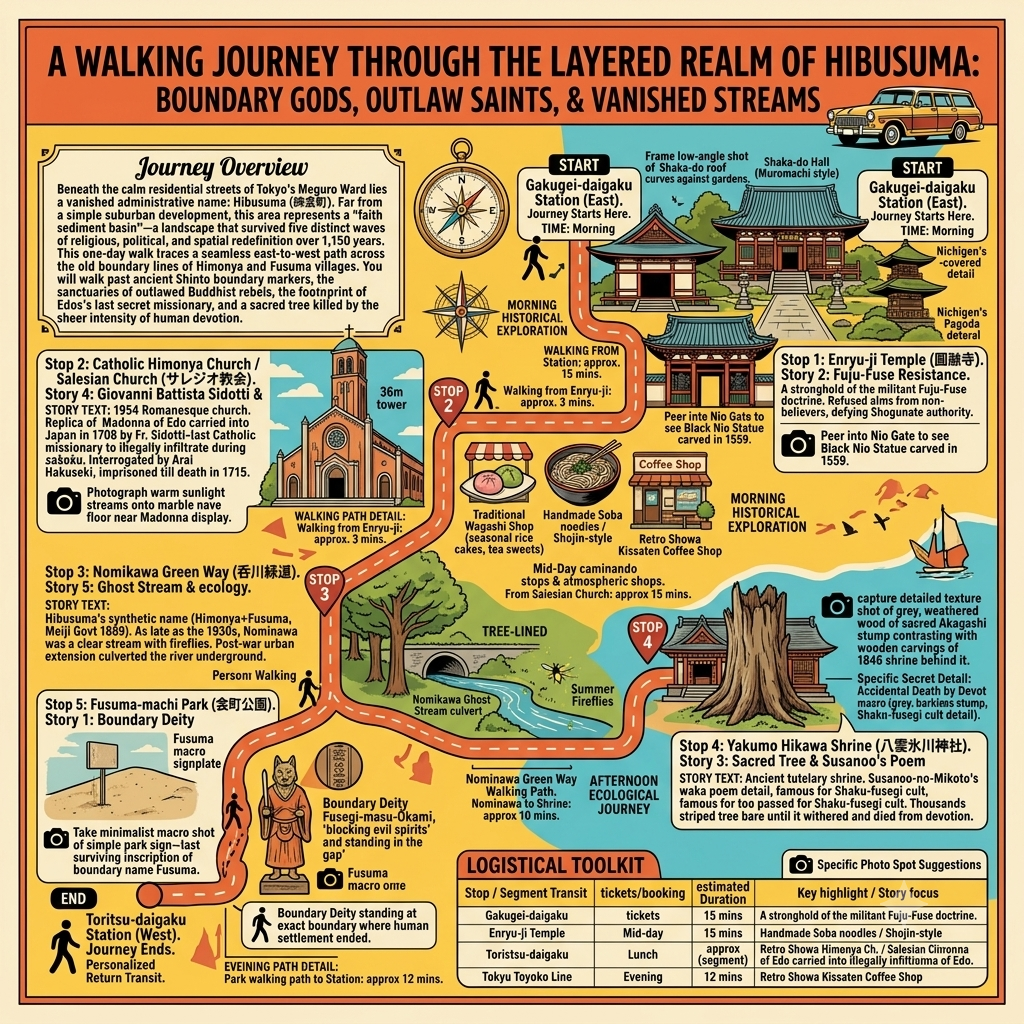
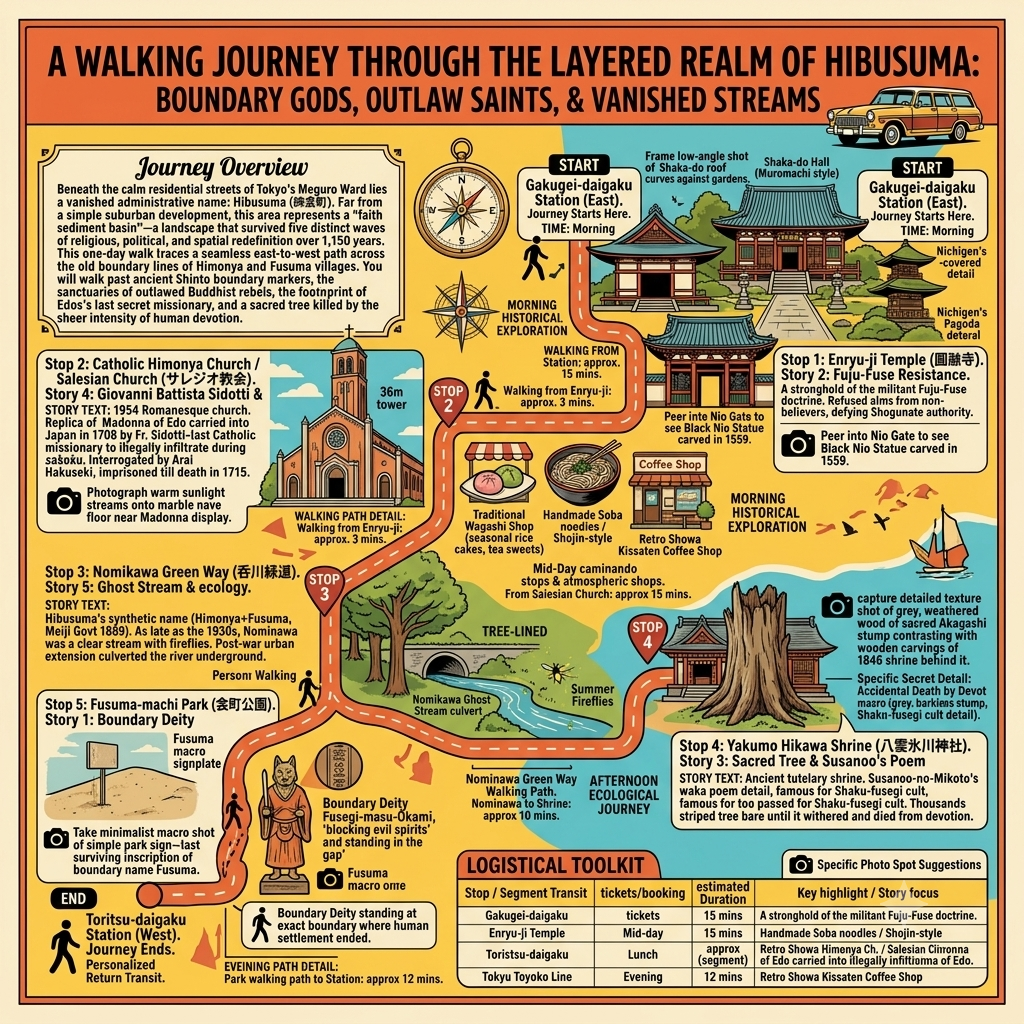
This is a historical travel story and walking guide to Hibusuma, a quiet residential area in Meguro, Tokyo. Through its ancient shrines, forgotten village borders, and peaceful tree-lined streets, this guide reveals how the historic villages of Himonya and Fusuma merged into modern Tokyo. Readers will discover a slower side of Meguro filled with local heritage, tranquil atmosphere, and centuries of layered suburban history.
 Lawrence
In a quiet corner of Tokyo where nothing appears to have happened, a thousand years of suppressed history lies just beneath the surface
By Historical Travel Stories | The Multidimensional Spacetime Series
There is a persistent myth about Tokyo, and Roland Barthes started it.
In his 1970 essay collection Empire of Signs, Barthes called Tokyo a city built around an empty centre — the Imperial Palace, visible yet unreachable, around which the rest of the metropolis endlessly orbits. He meant it admiringly. But somewhere between then and now, the observation calcified into a different kind of cliché: that Tokyo is a city without a centre, without memory, without depth. The hypermodern surface, so the story goes, is all there is.
Anyone who has spent real time in this city knows this is rubbish.
The memory is there. It's just buried differently than it is in Rome or Kyoto or Jerusalem — not in monuments and ruins that stand proud in the landscape, but in the strata beneath ordinary streets, encoded in place names that most people can no longer read, in the positioning of a shrine gate that hasn't moved in three centuries, in a municipal park whose name no one quite knows how to explain.
I want to take you to one of those places today.
It doesn't appear on any map in its original form. It no longer exists as an administrative entity. Its name was erased from official records in 1964. But the history it contains — five distinct civilisational upheavals, layered one on top of the other over twelve centuries — is among the densest and most instructive I've encountered anywhere in the Japanese archipelago.
The place is called Hibusuma (碑衾). The southern district of Meguro Ward, a few train stops from Shibuya. Now all residential streets, independent coffee shops, the occasional shrine gate glimpsed between apartment buildings.
Nothing, at first glance, appears to have happened here.
Listen to the historical stories told in detail (For subscribers only)
The Name Itself Is the First Mystery
Before anything else, there is the question of what Hibusuma actually means — and the answer is stranger than you might expect.
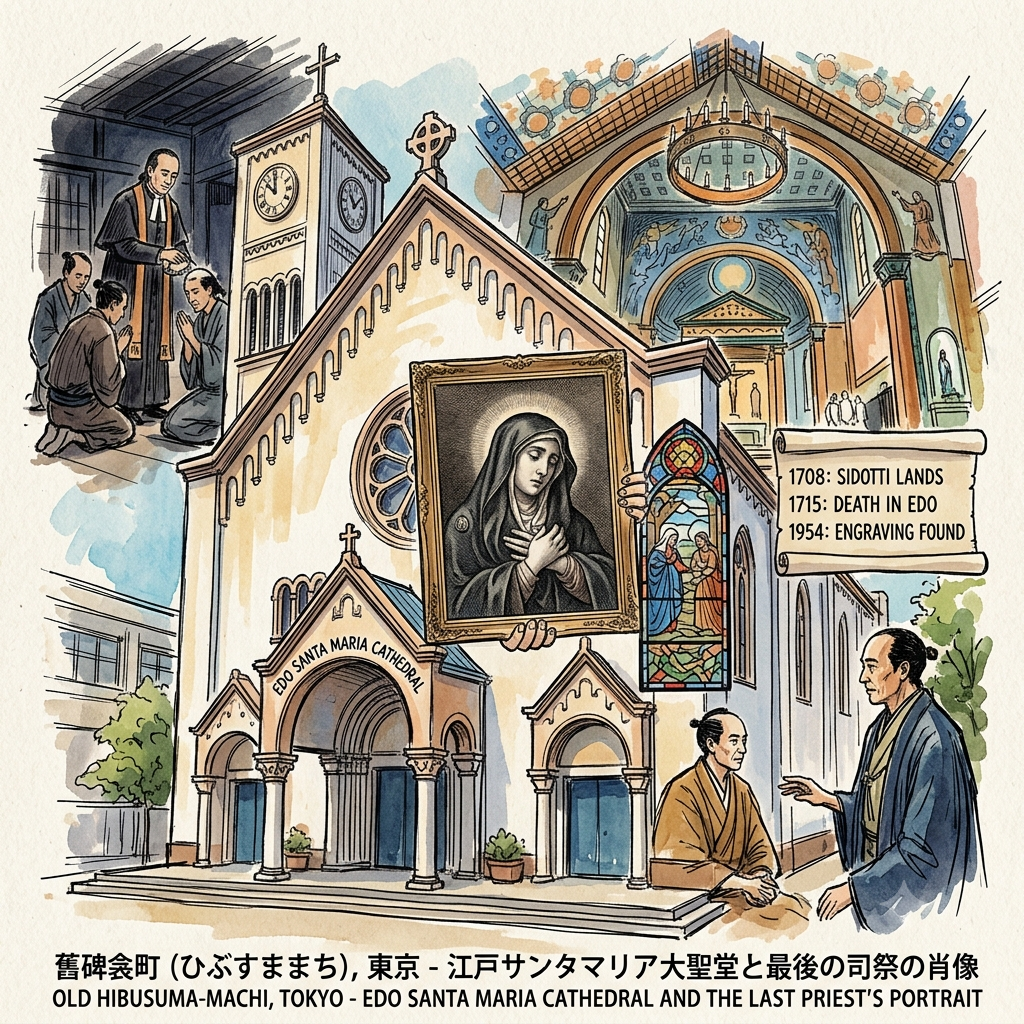
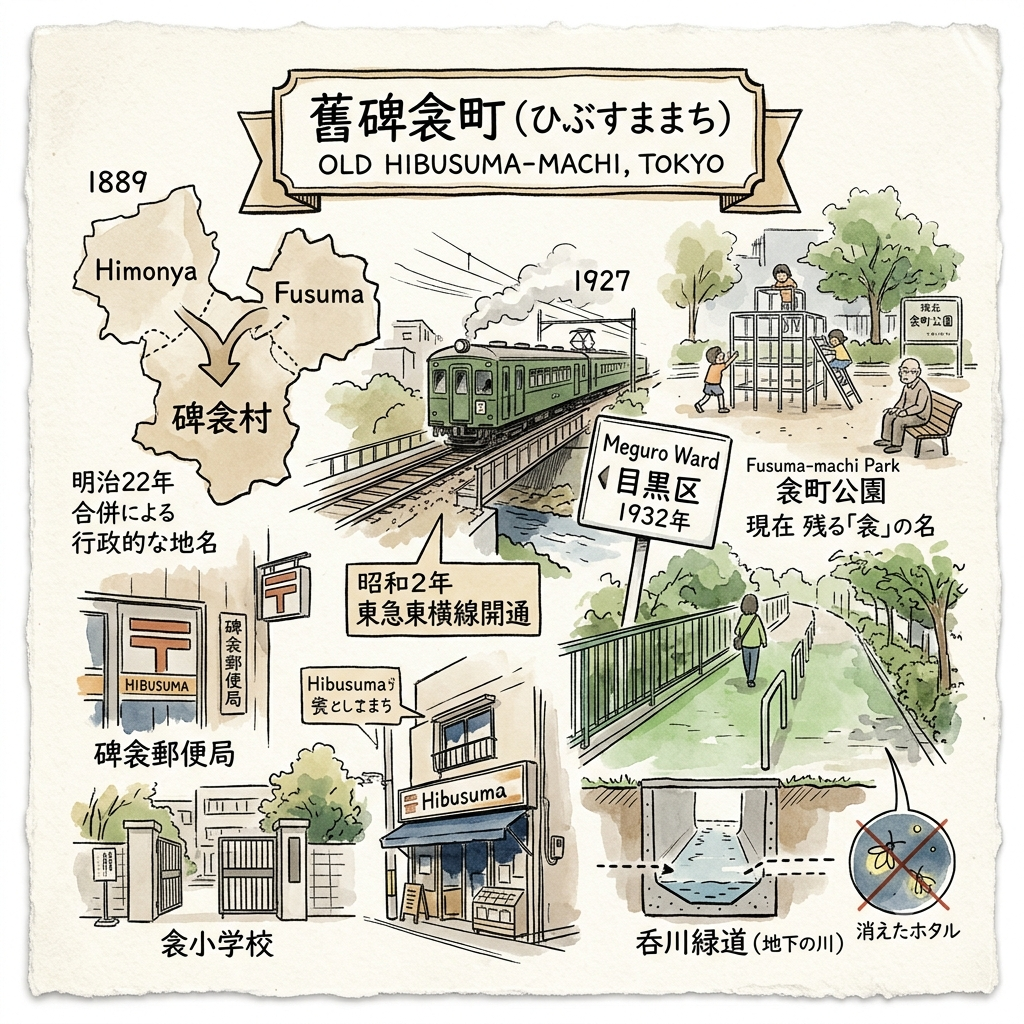
"Hibusuma" is a compound word, half-artificial, manufactured in 1889 when the Meiji government merged two ancient villages: Himonya (碑文谷) and Fusuma (衾). One character from each, pressed together into an administrative portmanteau that no one had ever used before and that no one particularly loved. That compound survived until 1932, when Hibusuma itself was absorbed into the newly created Meguro Ward, and the name began its long fade from the map.
But the Fusuma part — the western of the two old villages, occupying the Nomi River basin where fireflies still filled the summer air as late as the 1930s — that name is genuinely ancient, and genuinely mysterious.
Tokyo's Invisible Spiritual Firewall
Written in kanji, 衾 means "futon" or "bedding." No historian has ever produced a satisfactory explanation for why an agricultural village on the southern edge of the Ebara District would be named after bed linen. Which is why scholars of local history have spent considerable energy on alternative etymologies.
The most intriguing theory holds that the name derives from a deity: Fusegi-masu-Ōkami (塞坐大神) — literally, the Great God Who Blocks, who Holds Back, who Stands in the Gap. This is one of the oldest categories of protective spirit in the Shinto cosmological system, pre-dating the formal mythology codified in the Kojiki and Nihon Shoki by centuries. Boundary gods. Guardian spirits stationed at the edges of inhabited space, at crossroads and river confluences and the margins where the known world gives way to everything that might come from outside.
Think of it this way: if you were mapping the sacred geography of an ancient agricultural community, you would need to mark the places where the protection of the settlement ended and the unpredictable outside began. Those places became shrines. Their guardian deity accumulated a name. Over generations, the name became the place itself. And Fusegi-masu — "the one who blocks" — contracted over centuries into Fusuma.
The village, on this reading, was not named after bedding. It was named after the god stationed at its gate.
This theory, I should note, has no definitive documentary support — the Meguro Ward Office's own heritage documents list it alongside four other competing etymologies with cheerful agnosticism. But consider what it would mean if it's correct. It would mean that the place name "Hibusuma" — a name that vanished from official records in 1964 — contains, in its second syllable, the memory of a spiritual guardian that predates every building, every temple, every administrative boundary in the area by an unknowable span of time.
The only physical remnant of the name today is a small municipal park: Fusuma-machi Park, in Yakumo 5-chome. No historical information board. No ceremony around its naming. Residents walk their dogs there without knowing that they are standing on the last fragment of a word that may have once meant here is where the god stands watch.
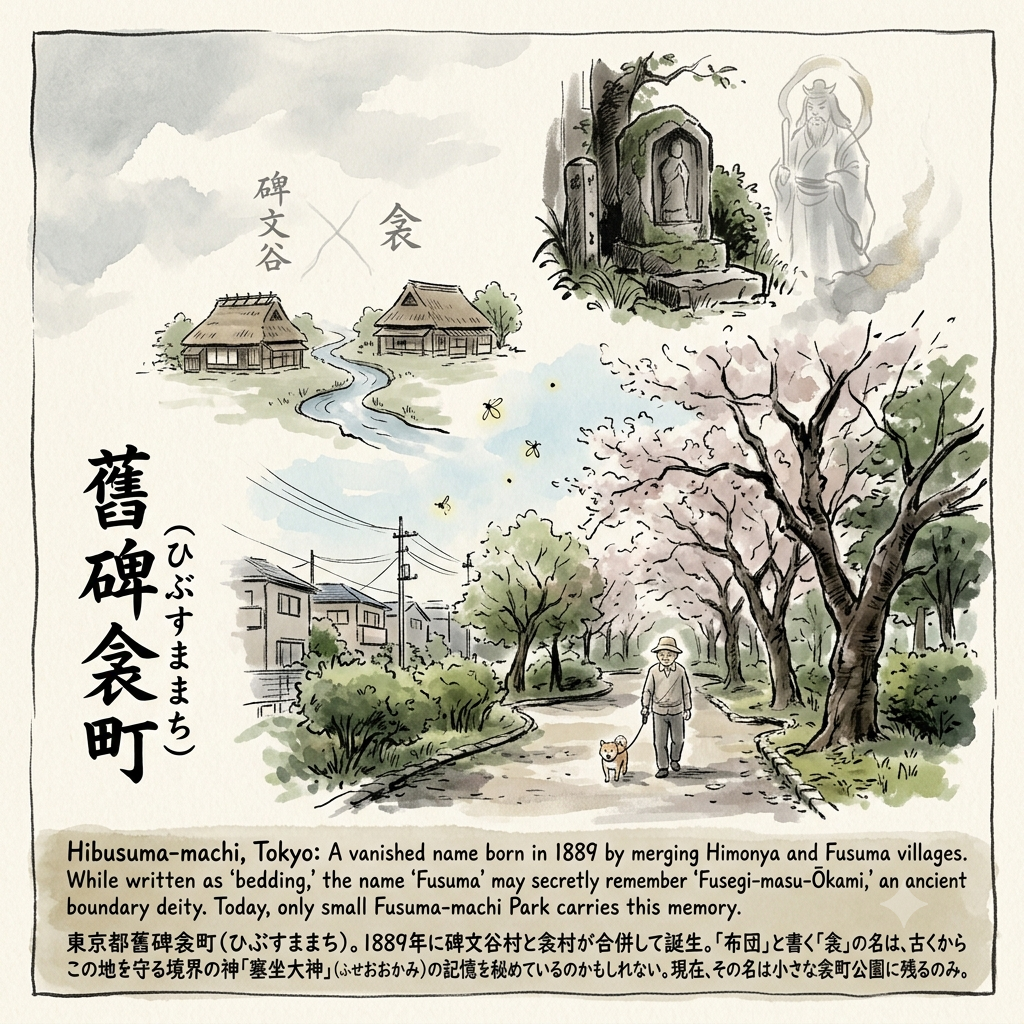
The Temple That Refused, For Four Hundred Years
In 853 CE, a monk named Ennin — known posthumously as Jikaku Daishi, one of the great evangelists of Japanese Tendai Buddhism, a man who had spent nine years studying in Tang Dynasty China — established a small temple in the valley that would eventually become Himonya. He called it Hoshukuji.
For the next four centuries, almost nothing of note happened there.
Then, in 1283, the year after the death of Nichiren — founder of the most doctrinally aggressive school of Japanese Buddhism, a figure who once compared other Buddhist traditions to poisonous weeds and who predicted that Japan would be destroyed for its failure to adopt his teachings — one of Nichiren's senior disciples arrived at Hoshukuji and converted it wholesale.
The temple was renamed Hokkuji (法華寺). Its medieval patrons were the Kira clan (吉良氏), one of the most powerful aristocratic families in the Musashino region — lateral relatives of the Ashikaga shogunate, lords of Setagaya Castle, the kind of family whose protection made things possible and whose displeasure made things end. Under their sponsorship, Hokkuji grew into something remarkable: 18 residential halls, 75 subsidiary temples, a marketplace at its gates busy enough to attract travelers from across the region, a regional hub that would not have looked out of place in descriptions of significant provincial temples anywhere in medieval East Asia.
But Hokkuji had committed itself to a principle that would eventually undo it.
The principle was called Fuju Fuse (不受不施). It means, roughly: from non-believers, receive nothing; to non-believers, give nothing.
This was not extreme in the abstract. Nichiren had articulated it as a logical extension of Lotus Sutra devotion: if you believe the Lotus Sutra is the final and complete expression of Buddhist teaching, then mingling the merit economy of that tradition with the merit economy of any other tradition contaminates the former. It's an argument about spiritual integrity. Various minority religious movements in the Western tradition have made structurally identical arguments — the early Quakers refusing to tithe to the Church of England, the Donatists insisting that sacraments administered by corrupt clergy were invalid, any number of separatist communities who believed that the act of compromise with corrupt institutions was itself a form of contamination.
The problem, for Hokkuji, was the Tokugawa shogunate.
Japan's early modern government had constructed a system called the terauke-seido — a compulsory parish registration system that required every household in Japan to be registered with a local temple, which in turn required those temples to accept dues and support from anyone in their catchment area, regardless of sectarian affiliation. If you were a Buddhist temple under this system, you were going to receive offerings from farmers who also prayed at Shinto shrines, from merchants who observed no particular doctrine, from officials who may have had no personal religious commitments at all.
For a Fuju Fuse temple, every such offering was a theological crisis.
The shogunate, increasingly impatient with this position, called a formal debate in 1630 — the so-called Shin-ike Tairon — and ruled against Hokkuji's position. Enforcement tightened through the mid-17th century. Then, in 1698, the final blow: the 19th abbot, Nichifuku, presiding over a temple that had now resisted government religious policy for nearly seven decades since the formal ruling, was removed. The temple was forcibly reconverted to Tendai Buddhism. The abbot was reportedly exiled to the remote island of Hachijojima, a seven-hour crossing from the mainland even today.
The temple that now occupies the site is called Enyuji (圓融寺). It is serene, beautiful, and well worth visiting. Its main hall, the Shakado — built in the early Muromachi period and designated a National Important Cultural Property — is the oldest surviving wooden structure in Tokyo's 23 wards, a fact that tends to stop people mid-sentence. The 1559 wooden guardian figures in the Nio Gate, painted black (unusual; most such figures are red or unpainted), attracted dedicated pilgrims through the 18th century. The stone pagoda in the temple garden marks the grave of Nissho, the monk who converted the temple to Nichiren doctrine seven centuries ago.
What makes this story worth lingering over, however, is something that comes after the suppression.
Treason by efusal
Once Hokkuji had been shut down, a legend began circulating in the streets of Edo. It held that the temple had been destroyed because of a practice called Renge Ojo (蓮華往生): monks would invite devout elderly believers to ascend a large bronze lotus throne, promising them that if enough followers chanted the Lotus Sutra around them, they would ascend peacefully to paradise. In reality — so the legend went — a monk concealed beneath the lotus throne would drive a spear upward through the seat, killing the believer. The body would be cremated before relatives could examine it. The family, overjoyed that their loved one had achieved enlightened death, would donate generously to the temple.
The folk hero who exposed this practice was Isshin Tasuke, a fishmonger-turned-vigilante from the shitamachi who placed a bronze mirror beneath him when he volunteered for the lotus throne, foiling the spear, and burst out of the structure to arrest the monks.
It is, in its way, a perfect narrative. Vivid, morally satisfying, with a working-class hero and a crooked religious establishment.
The problem is that Meguro Ward's own heritage documentation — the official record published by the city government — states plainly that this story almost certainly never happened at Hokkuji. Similar accounts are documented in archives from Shimosa and Kazusa provinces (modern-day Chiba Prefecture), but their association with Himonya appears to have been a later transfer. The ward historians' conclusion is direct: the story was probably fabricated and circulated as propaganda, to provide public evidence that the Fuju Fuse sect was worthy of suppression.
A government creates a legend to justify what it has already decided to do. The legend outlives everyone who knew it was a legend. This is not an unusual story in the history of political power — but it is unusual to find it so clearly annotated in the official records of the municipality where it occurred.
Worth finding your way to Enyuji: The Shakado sits at the back of a quiet residential precinct. There is no queue. Go early enough and you may have the courtyard to yourself. The roof curve — karahafu, Chinese-style, adapted into something distinctly Japanese over centuries — is the kind of detail that looks simple at a photograph's distance and increasingly intricate the closer you stand.
The Oak That Was Loved to Death
About ten minutes' walk west, through streets that become progressively quieter as you cross the Nomi River drainage into what was once the heart of Fusuma village, there is a shrine.
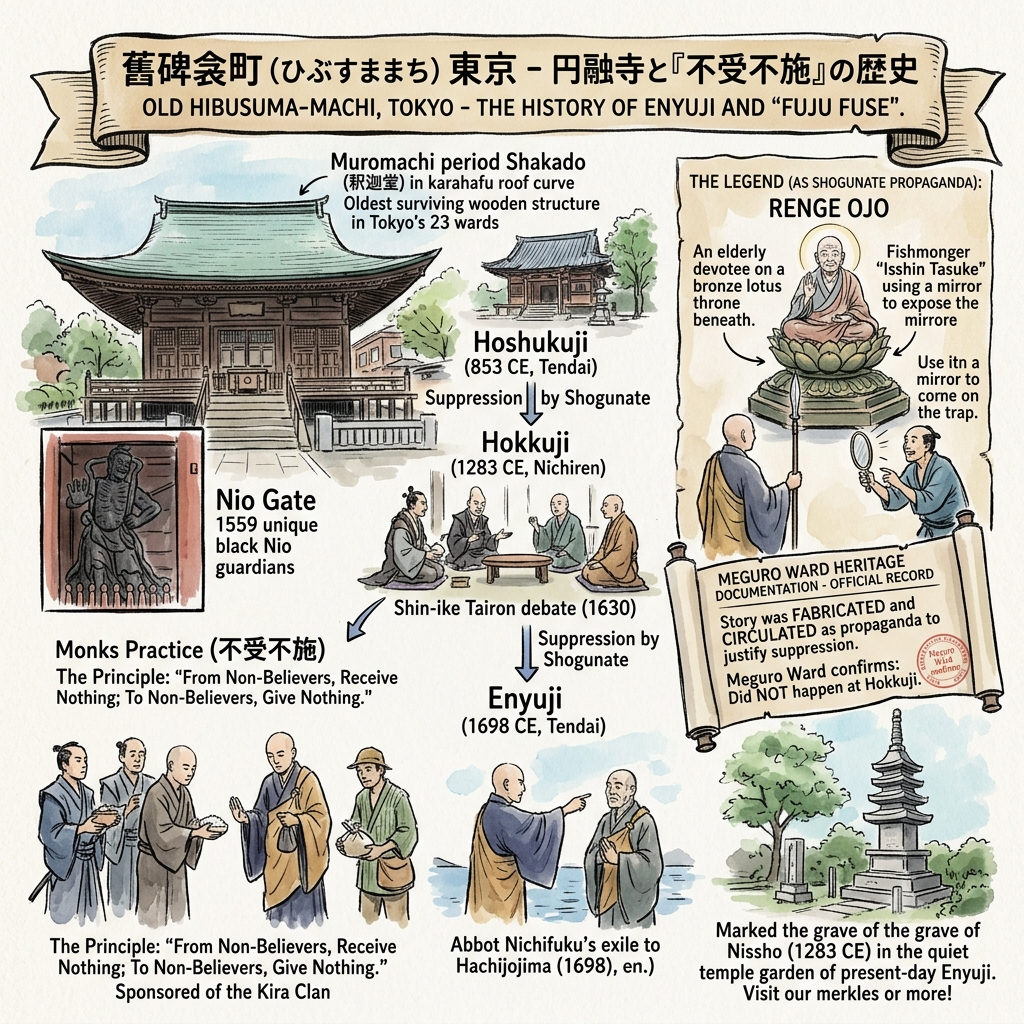
Yakumo Hikawa Jinja (八雲氷川神社) is the ancestral guardian shrine of old Fusuma village. Its principal deity is Susanoo-no-Mikoto — the storm god, the dragon-slayer, the exile from heaven who became the patron of ocean crossing, of violent weather, and of purification. Hikawa shrines dedicated to Susanoo are distributed across the Kanto plain in a network centered on the great Hikawa Shrine at Omiya in Saitama Prefecture, which once stood at the spiritual north of the Musashi Province agricultural region. Yakumo Hikawa is a local node of that network.
The shrine's founding date is unknown. The earliest confirmed document is a 1757 record of a new torii gate being erected, which implies the shrine itself is older, perhaps considerably. One tradition holds that it was established in 707 CE, though this is the kind of precise early date that appears in shrine records across Japan with a regularity that historians treat with gentle scepticism.
What is documented is the shrine's more recent history — and specifically, the story of its sacred tree.
In the shrine precinct there grew a Japanese blue oak (Quercus salicina) of exceptional age and girth. At some point in the Edo period, a belief emerged that the bark of this particular tree, when boiled and drunk as a decoction, could cure shaku — a category of ailment that in traditional Japanese medicine encompassed violent abdominal cramping, chest pain, and related spasms. Think of it as the era's catch-all category for what we might now call gallstones, muscular spasms, or acute gastrointestinal episodes: genuinely debilitating, frequently frightening, and in the 18th century essentially untreatable by mainstream medicine.
The tree became famous. Pilgrims came from outside the immediate area, then from further afield, then from other prefectures entirely. The shrine established overnight accommodation for out-of-town visitors. For a village that was, by all accounts, a quiet agricultural settlement notable mainly for not being particularly notable, this was a transformation of some significance.
And then everyone began stripping the bark.
Each pilgrim took a little. Each one believed — correctly, within the logic of the tradition — that the healing power resided in the tree's connection to the deity of the shrine, and that to possess some portion of the tree was to possess some portion of that connection. No individual act of bark removal was unreasonable within the framework that produced it. The cumulative effect of all those individually reasonable acts was the death of the tree.
By the Meiji period, the oak was dying. In the years after its death, stories began circulating — documented in contemporary newspapers, though the precise titles and dates remain difficult to confirm from secondary sources — of a groaning sound rising from the shrine grove between midnight and 3 AM. The dead oak was given a name: Hikawa-sama no Unari-gashi — the Groaning Oak of the Hikawa Shrine. Whether this was misidentified wind through the remaining branches, the kind of auditory experience that happens when communities know a sacred space has been wounded, or something else entirely, I'll leave to the reader.
The stump of the tree is still there. The shrine doesn't make much of it — there's no interpretive sign, no framing narrative. It sits to the left of the main hall, the wood long since bleached and cracked, the bark entirely absent. You could walk past it without registering its significance.
Murdered By Devotion
The annual autumn festival at Yakumo Hikawa includes a ritual sword dance — the Tsurugi-no-Mai, performed for over 200 years — depicting Susanoo's battle against the eight-headed serpent Yamata-no-Orochi, the slaying that won him the sword that would become one of the three imperial treasures of Japan. The dance is the shrine's way of periodically reasserting its sacred legitimacy, of re-confirming that the protective deity is still in residence and still operative. It runs every September, a few minutes' walk from a Tokyu train station, to a small crowd of local worshippers and the occasional confused tourist.
One more thing about this shrine worth knowing: the neighbourhood around it is called Yakumo (八雲), and that name comes from the first poem in the Japanese literary tradition. When Susanoo, after his exile from heaven and after slaying the dragon, took a wife and settled in Izumo Province, he looked at the clouds rising above his new home and composed:
Yakumo tatsu / Izumo yaegaki / tsuma-gomi ni / yaegaki tsukuru / sono yaegaki wo
The eightfold clouds rise / Over Izumo's eightfold fence / Within it, my wife / The eightfold fence encloses / That eightfold fence.
It is generally considered the oldest extant waka poem in the Japanese language. The first three syllables — ya-ku-mo — became the name of a modern Tokyo residential district, home to apartment blocks and convenience stores and a very good ramen restaurant near the station. The storm god's first poem, preserved in the name of a postal code.
The Last Priest's Portrait
Now we turn to a story that requires a slight detour through cinema.
If you saw Martin Scorsese's 2016 film Silence, adapted from Shusaku Endo's 1966 novel, you know the broad outline: Portuguese Jesuit missionaries in 17th-century Japan, the ferocity of the Tokugawa government's campaign to exterminate Christianity, the impossible question of whether apostasy under torture is a spiritual failure or an act of mercy toward those whose suffering you might otherwise prolong. Endo's novel is one of the great works of Japanese literature and one of the most searching treatments of religious conscience I know of in any language.
Silence ends in the 1650s. But the story of Christianity's engagement with Japan has a postscript that most accounts don't tell.
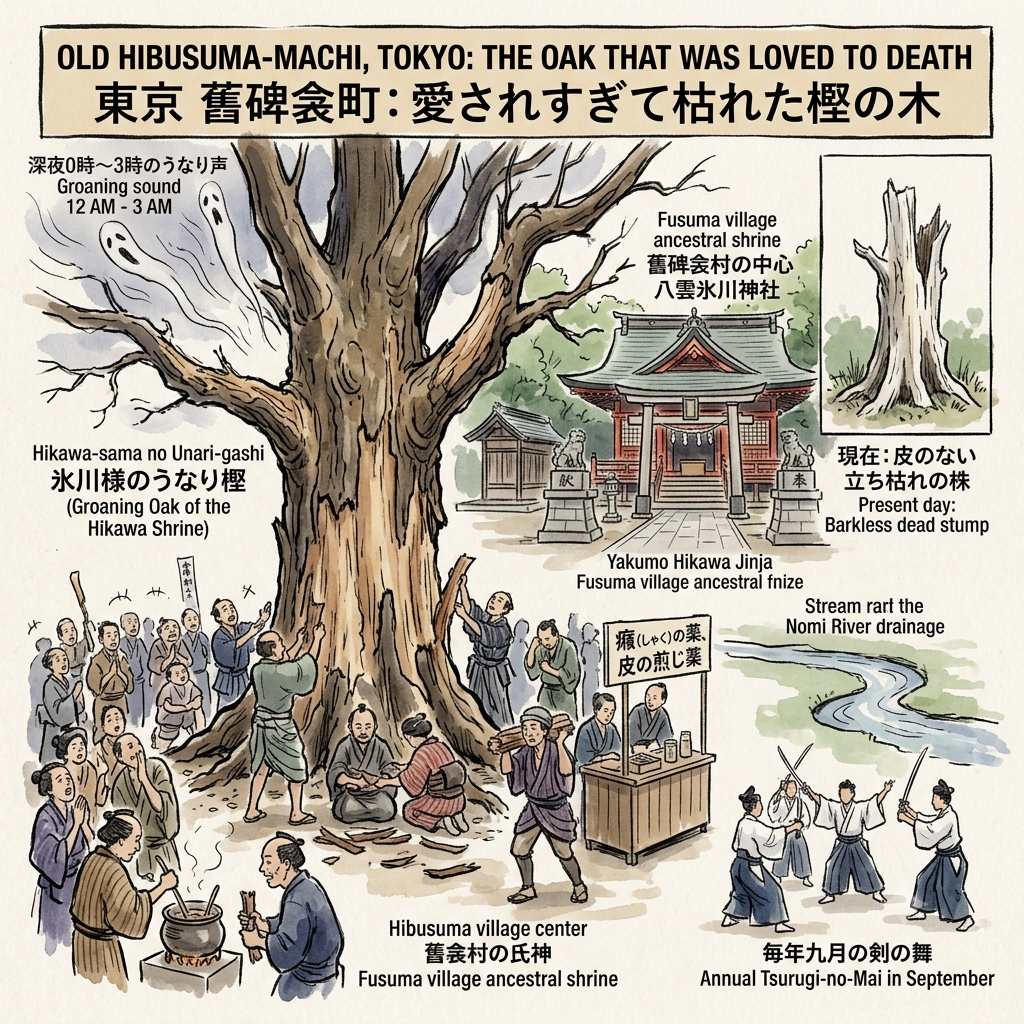
In 1708 — fifty years after the events of the novel, when the prohibition on Christianity had been in force for decades, when the religion's existence in Japan had been reduced to small communities of secret believers in rural Kyushu who kept their faith alive through oral transmission and household icons disguised as Buddhist objects — a Sicilian-born Jesuit priest named Giovanni Battista Sidotti sailed from Batavia (modern-day Jakarta) and landed on the island of Yakushima.
He was arrested the following day.
Sidotti was the last Western missionary to attempt entry into Edo-period Japan. He had prepared for years, learned Japanese, understood what he was walking into. He landed in samurai-period Japan the way someone might today make a solo journey into a deeply hostile environment — not with the assumption of success, but with the kind of conviction that makes success irrelevant to the decision.
He was brought to Edo and housed in the Kirishitan Yashiki — the "Christian Mansion," the city's dedicated facility for the detention of foreign Christians and Japanese apostates. There, over a period of months, he was interviewed repeatedly by a man who represents something close to an intellectual ideal: Arai Hakuseki, possibly the finest scholar-administrator of the early 18th century, fluent in Chinese, deeply read in history, the kind of mind that appears in every culture in every era for whom inquiry is genuinely an end in itself rather than a means to a predetermined conclusion.
Japan's Last Underground Missionary
Arai's interviews with Sidotti produced two major works — Seiyō Kibun and Sairanigon — that became the most comprehensive Japanese accounts of Western geography, history, and religion available in the early Edo period. In the text, Arai writes about Sidotti with notable warmth. He found the priest to be a man of genuine learning and moral seriousness. He recommended to the shogunate that Sidotti be treated humanely.
The shogunate chose lifelong imprisonment.
Sidotti died in 1715, in the Kirishitan Yashiki, apparently of the conditions of his confinement. Before he died, he secretly baptised the two Japanese servants assigned to look after him — an act that violated his agreement with his captors and resulted in considerably worse conditions for everyone involved, including the servants. This was not a prudent decision. Whether it was a right one is the kind of question that Endo spent his career trying to answer.
Among his possessions when he arrived in Japan was a small copper-plate engraving: a reproduction of a painting of the Virgin Mary by the Florentine artist Carlo Dolci — a Mater Dolorosa, the sorrowful mother. This image had accompanied him across the Pacific, through his arrest, through his years of imprisonment.
After his death, it disappeared into the shogunate's records, then into various subsequent archives, then into a museum storage system.
In 1954, it was found.
The discovery was made in the collection of the Tokyo National Museum, in a catalogue of objects associated with the Christian prohibition era. It was a small thing — a copper-plate reproduction, not even an original painting. But the provenance was clear. This was the image Sidotti had carried.
The same year the engraving was identified, a Catholic church was being completed in Himonya. The Salesian Society — the order founded in 19th-century Turin by John Bosco for the education of impoverished youth — had established a mission in the neighbourhood in 1948, three years after the end of a war that had left much of this part of Tokyo destroyed. By 1954, they had completed a proper church building: Romanesque in style, its bell tower visible above the rooflines for some distance, its bell donated by Catholics in Milan and tuned to sound three notes.
When the Salesian priests learned about the Sidotti engraving, they named their new church after it: the Edo Santa Maria Cathedral. The image — or rather a high-quality reproduction of it, the original being too significant to loan permanently — now hangs in the entrance of the church, above a small altar, where you can see it on any day you choose to visit.
The church itself is worth entering regardless of your relationship to Catholicism. The interior feels genuinely Italian — marble throughout, fresco ceilings, stained-glass windows depicting scenes from the Jesuit missions in Asia and the 1865 rediscovery of Japan's hidden Christians. One of the windows shows the moment in March 1865 when a small group of villagers from Urakami — descendants of communities that had kept Christian faith secret for over two centuries, through every wave of persecution, without priests or formal teaching, using only oral tradition and hidden devotional objects — approached the French priest Bernard Petitjean at the newly opened Ōura Cathedral in Nagasaki and whispered to him that they too shared his beliefs.
That window, in a church in a Tokyo suburb that was once the stronghold of a Buddhist sect suppressed for its refusal to compromise its doctrine, is doing a great deal of historical work in a very small space.
Practical note: The church is at 1-26-24 Himonya, Meguro-ku, a short walk from the Salesiokyo bus stop on the Meguro Station line. The replica of the Sidotti image is in the side chapel at the entrance. The main nave is open during daylight hours.
The Death of a Name
The last thing to understand about Hibusuma is how it disappeared.
In 1889, the Meiji government's rationalization of local administration produced the village of Hibusuma (碑衾村) from the merger of Himonya and Fusuma. The name was a bureaucratic splice — one character from each village, joined into a compound that neither community had ever used before and that neither, by all available evidence, felt particularly attached to. This is a pattern that appears wherever administrative centralisation runs headlong into older, more organic territorial identities: the names that survive longest are not the ones imposed from above, but the ones that grew from below. Hibusuma was always going to be temporary.
The Tokyu Toyoko railway line reached the area in 1927. By 1932, the population had grown enough that the merged village became a ward of the expanded Tokyo municipality, and its distinct name disappeared again — this time into the newly created Meguro Ward (目黒区). The Hibusuma Town Council fought, characteristically, over the placement of the ward office. They wanted it in the geographical centre of the new ward, not in the old Meguro town core. They petitioned twice. They won, eventually, in 1936, when the ward office relocated to the compromise position. Then the war came, and the reconstruction, and the 1964 address reform that regularised Tokyo's entire postal geography, and with that final bureaucratic pass the word "Fusuma" vanished from official records.
What remains:
A municipal park, Fusuma-machi Park, in Yakumo 5-chome. No sign explaining the name. On a weekday afternoon, a handful of children use the climbing frame. Elderly residents move through on the path that cuts across to the next street.
The Ghost Town That Hijacked Tokyo
The Nomi River — the Nomi-gawa — runs below the pavement of what is now a pleasant pedestrian greenway between Jiyugaoka and Yakumo. The river was channelled underground in the postwar period. Before that, in the 1930s, it was clear enough for fireflies in summer, and prosperous families built tuberculosis sanatoriums on the sunny slopes of its valley. The fireflies did not survive the concrete. The river does not know it has been buried.
There are a few elementary school names. A post office. The occasional local business.
The Irish have a word for this kind of phenomenon — the study of it, at least: Dinnseanchas, the lore of place names, the idea that every name in a landscape is a fossil of something that happened there, and that the loss of a name is a specific kind of loss, not equivalent to the loss of a road sign but closer to the loss of a word in a language. When the British Ordnance Survey mapped Ireland in the 19th century and anglicised thousands of Gaelic place names into phonetic approximations of sounds in a language the surveyors didn't speak, they were not merely changing addresses. They were severing the connection between a landscape and the accumulated human experience that had named it.
Hibusuma is not exactly the same story. But it is recognisably related.
The Pattern Beneath the Pattern
Here is what I think is true about this small corner of Meguro Ward, and what I don't see articulated anywhere in the conventional histories.
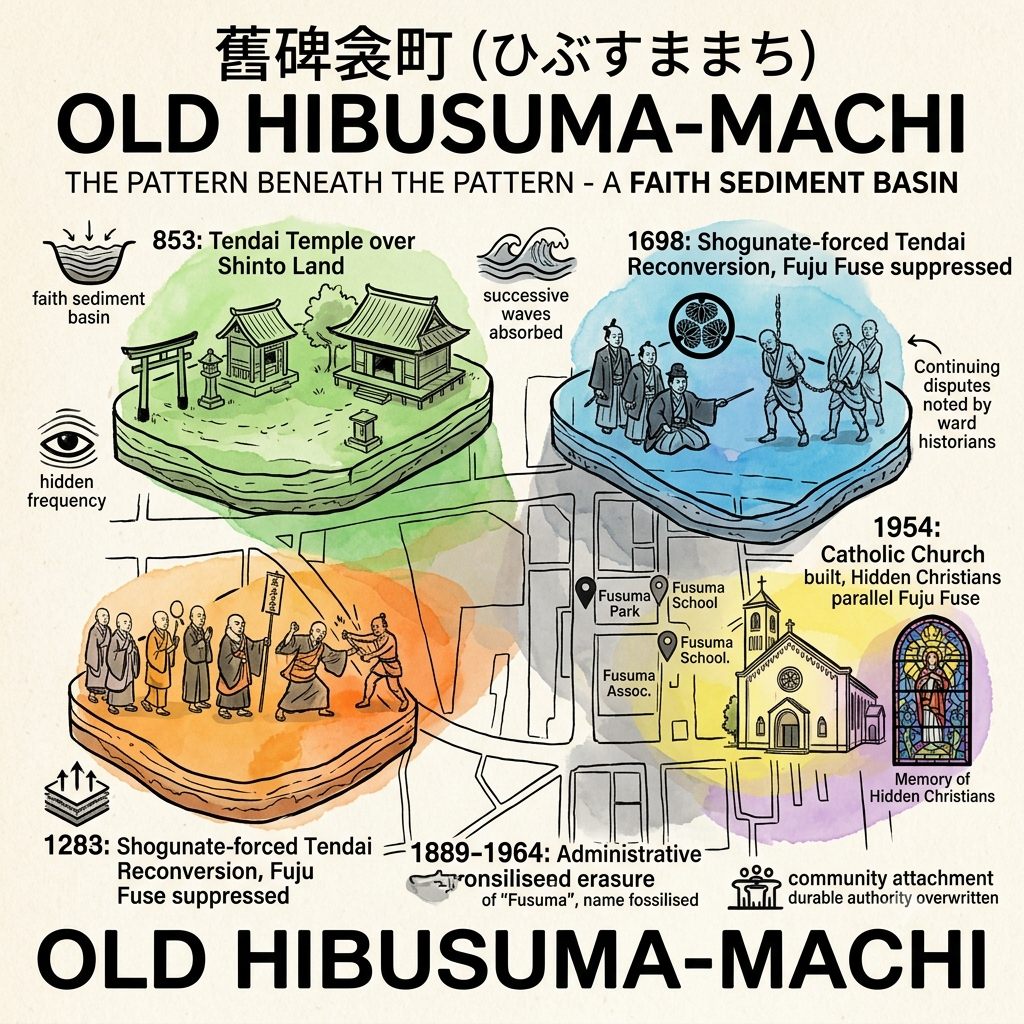
In the space of roughly twelve centuries, this area absorbed five distinct, externally imposed identity changes:
In 853, a Tendai Buddhist temple was established, overlaying an existing Shinto landscape without erasing it.
In 1283, that temple was converted by force to Nichiren doctrine, which overlaid the Tendai one without erasing it.
In 1698, the shogunate forcibly reconverted the temple back to Tendai, destroying the Fuju Fuse community — but the village's relationship to that doctrine lived on in the "various disputes" that the ward's own historians note followed the conversion for decades.
Between 1889 and 1964, a sequence of administrative impositions erased the name "Fusuma" from official records — but left it fossilised in a park, a school, a neighbourhood association.
In 1954, a Catholic church dedicated to the most dramatic episode of Christian persecution in Japanese history was built on land that had been, for centuries, the spiritual domain of a Buddhist sect suppressed for analogous reasons.
None of these transformations succeeded completely. Each one left the previous layer damaged but not destroyed. The Shinto shrine is still there. The Buddhist temple is still there — reconverted twice but still standing on the same ground, its oldest structures intact. The name "Fusuma" persists in the park. The Catholic church carries, in its stained glass, the memory of the hidden Christian communities whose spiritual stubbornness is formally parallel to the Fuju Fuse monks who were suppressed on the same terrain two and a half centuries earlier.
I'd call this place a faith sediment basin — a landscape where successive waves of ideological force have been absorbed without complete dissolution of what came before. The mechanism is not active resistance. Nobody is fighting. It is something closer to structural resilience: a community's attachment to the forms of its sacred landscape proves, over time, more durable than the authority of whoever is currently trying to overwrite those forms.
This is, I think, the hidden frequency of Hibusuma — and it is one that historians working in any single discipline (religious history, urban history, local government history, art history) will tend to miss, because each of the five episodes belongs to a different professional conversation. You have to be willing to read them together, in the same place, to see the pattern.
How to Spend a Day Here
The area covered by old Hibusuma is walkable in half a day, and more rewarding than that if you follow a few specific threads.
Begin at Enyuji (1-22-22 Himonya, Meguro-ku) — find the Shakado at the back of the precinct, spend a few minutes with the Nio Gate's black guardian figures, look for the Nissho stone pagoda. The temple's main hall is the oldest wooden structure in the 23 wards. Let that settle for a moment before moving on.
Walk west toward Yakumo Hikawa Jinja (2-4-16 Yakumo, Meguro-ku), following the Nomi River greenway where it appears. At the shrine, look for the remains of the sacred oak to the left of the main hall — the stripped root section, bleached and cracked. Come back in September if you can: the sword-dance festival happens mid-month.
Continue through the Yakumo residential streets until you reach Fusuma-machi Park in Yakumo 5-chome. It requires no time — a glance is enough. What matters is knowing why you stopped.
Double back toward Himonya for the Salesian Church (1-26-24 Himonya, Meguro-ku). The chapel entrance is accessible; the Sidotti image reproduction is immediately to the right as you enter. Stand with it for a moment. This copper-plate image crossed an ocean in 1708 in the pocket of a man who had been explicitly told he would be arrested the moment he arrived. Think about the distance that kind of conviction puts between a person and common sense, and whether that distance is admirable or alarming — it probably depends on the day.
The walk between these four sites is about forty minutes at a gentle pace. None of them is crowded. In aggregate, they span twelve centuries of Japanese religious history, two waves of foreign cultural contact, five episodes of political suppression, and one of the most interesting place-name etymologies in the metropolitan area.
There is a sentence in W.G. Sebald's The Rings of Saturn — that extraordinarily strange book about walking and history and the way the past accumulates in landscapes — where Sebald observes that every visit to a site of historical weight is also a kind of excavation: you are not simply seeing the place as it is, you are calling up the sediment of everything that happened there, whether or not those events left any visible trace.
Hibusuma has left traces. You just have to know what you're looking for.
The municipal park with the unexplained name. The oak stump without a sign. The oldest building in twenty-three wards, standing at the back of a quiet courtyard. The portrait of a woman who traveled inside a priest's coat from Sicily to Tokyo and ended up in a museum storage room for two centuries before a Catholic order found her in time to name their new church after her.
Nothing, at first glance, appears to have happened here.
Look again.
💡Frequently Asked Questions
What was the historical origin of Jiyugaoka in Tokyo, and how does it relate to Hibusuma Village?
Before becoming a modern commercial hub, Jiyugaoka was part of Hibusuma Village (Hibusuma-mura), established in 1889 by merging the agricultural hamlets of Himonya and Fusuma. The area remained predominantly farmland and bamboo groves until the late 1920s. In 1927, the opening of the Toyoko Line's Kuhombutsu-mae Station brought rapid infrastructure growth. Inspired by the nearby liberal arts institution Jiyugaoka Gakuen, the surrounding neighborhood was officially renamed Jiyugaoka in 1932 during the administrative creation of Meguro Ward, marking its complete evolution from a quiet rural village into a celebrated suburban center.
What is the origin and historical significance of Himonya Hachiman Shrine in Meguro?
Himonya Hachiman Shrine served as the primary tutelary shrine for the historic Hibusuma Village. Dating back to the Kamakura period, its name "Himonya" originates from a sacred natural stone preserved on the grounds engraved with Sanskrit seed-syllables (bonji) associated with Amitabha Buddha. The shrine preserves medieval agricultural rituals that reflected the local farming community's spiritual life. Over centuries, it transitioned into a sanctuary honored by samurai warlords during the Edo period before becoming a preserved historical emblem within Meguro's contemporary residential landscape.
How did Hibusuma transform from a rural village into an upscale residential district in Tokyo?
Hibusuma's urbanization was accelerated by the 1923 Great Kanto Earthquake, which prompted Tokyo residents to relocate from damaged central districts to geologically stable southern suburbs. Suburban private railways—including the Ikegami, Toyoko, and Oimachi lines—connected Hibusuma directly to central Tokyo. Private railway operators spearheaded suburban development under the "Garden City" movement, introducing modern town planning, educational institutions, and cultured housing projects. These efforts attracted middle-class families, artists, and intellectuals, establishing Meguro Ward as one of Tokyo's premier upscale residential destinations.
Reference and Further reading
First layer – Main sources of literature and institutions:
- 目黑区教育委員会地名資料(《月刊めぐろ》昭和55–58年系列);
- 《新編武蔵風土記稿》荏原郡衾村条;
- 目黑区立図書館所蔵1762年村絵図;
- 目黒区教育委員会〈歴史を訪ねて 円融寺〉;
- 天台宗圓融寺公式歷史記錄;
- 圓融寺所藏「圓融寺板碑」(区指定文化財);
- 氷川神社(目黒区八雲)社蔵文書(栗山家寄託文書);
- 《新編武蔵風土記稿》荏原郡衾村条;
- 東京国立博物館キリシタン遺物コレクション目録;
- 新井白石《西洋紀聞》(国立国会図書館デジタルコレクション);
- カトリック碑文谷教会公式史料;
- 《市郡合併記念 碑衾町誌》(碑衾町役場,1932年10月1日)——国立国会図書館デジタルコレクション可線上查閲(NDL Digital Collection,請查閱);
- 東京市臨時市域擴張部『荏原郡碑衾町現状調査』(1931年);目黒区史(目黒区教育委員会)
The second layer – secondary academic materials:
- 重藤魯『東京町名沿革史』(吉川弘文館,1967年);山本和夫『目黒区史跡散歩』(学生社,1992年)
- 山本和夫『目黒区史跡散歩』(学生社,1992年);
- 宮澤正典《不受不施派弾圧の歴史》(大法輪閣,1984年,建議查閱);井上智勝『近世の神社と朝廷権威』(吉川弘文館,2007年);
- 東京都神社名鑑八雲氷川神社条;目黒区郷土研究会誌
- 松田毅一《バテレンの世紀》(研究社,1986年);
- Elison, George. Deus Destroyed: The Image of Christianity in Early Modern Japan. Harvard University Press, 1988;
- 東京都目黒区史研究会編『目黒区五十年史』(1985年);人文社編集『昭和三十年代東京散歩』(古地図ライブラリー別冊,2004年)。
Third layer – Supplementary information:
- 五種語源說均屬民俗傳承性質,視為文化解釋性資料。
- 「蓮華往生」故事屬民俗說話性質;
- 区教育委員会已明確揭示其政治宣傳可能性,然宣傳的具體行為人及流布機制至今是史料缺口。
- 「怪談氷川の森」——需進一步查明具體刊名及年份;
- 社傳「707年創建」屬慣用古代授権敘事,不具獨立考古佐証。
- 「剣の舞200年」的起源文書亦未見學術獨立考証。建議進一步查證原始檔案。
- 聖堂落成時「神意之顯(共時性)」的敘述屬教會傳述,視為宗教社群集體記憶資料。
- 「昭和初期呑川蛍」相關描述出自地域誌記述,需進一步核查確認原始記錄者及年份。
Historical gap:
- There is a complete lack of written records regarding the specific worship of the "Saiza-no-Ōkami" (Deity of the Boundary) at this location; the current theory is merely speculative. Further verification of original archives is recommended.
- No archaeological excavation records exist for the border area between Fusuma Village and Himonoya Village. Further verification of original archives is recommended.
- Primary source documents (other than temple records) detailing the relationship between the Kira clan and Hokke-ji Temple are scarce; consulting the archives of the Setagaya Castle ruins is recommended. Further verification of original archives is recommended.
- The original government document regarding the exile of the monk Nippu Shōnin to Hachijō-jima has yet to be located. Further verification of original archives is recommended.
- Complete records regarding disputes among villagers following their religious conversion are unavailable. Further verification of original archives is recommended.
- There is still room for further research into primary source documents concerning the living conditions of Giovanni Battista Sidotti at the Kirishitan Yashiki (Detention House for Christians). Further verification of original archives is recommended.
- Internal meeting minutes regarding the Salesians' decision to select the Himonoya site have not been made public. Further verification of original archives is recommended.
- egarding the complete provenance of the "Kirishitan artifacts" in the Tokyo National Museum's collection, consulting the museum's internal archives is recommended. Further verification of original archives is recommended.
- The complete set of petition documents regarding the controversy over relocating the Himofusuma Town Office (1932–1936) requires detailed examination. Further verification of original archives is recommended.
- Existing literature is insufficient for a comparative study between the 1945 air-raid damage map of Meguro Ward and the pre-war agricultural landscape. Further verification of original archives is recommended.
- For the chronology and decision-making documents regarding the channelization project of the Nomigawa River, consulting the archives of the Tokyo Metropolitan Government Bureau of Construction or historical civil engineering records of Meguro Ward is recommended. Further verification of original archives is recommended.
 Lawrence
 Lawrence
 Lawrence