Ping Shan Historical Walk – The Feng Shui, Crab Legend and Clan Wars of a Hong Kong Heritage Trail
An alternative historical travel guide to Hong Kong’s Ping Shan Heritage Trail. Discover the star-catching pagoda built to save a bloodline, the colonial police station that "crushed" a sacred feng shui crab, and a drowned anti-colonial shrine that outlasted generations of political flags.
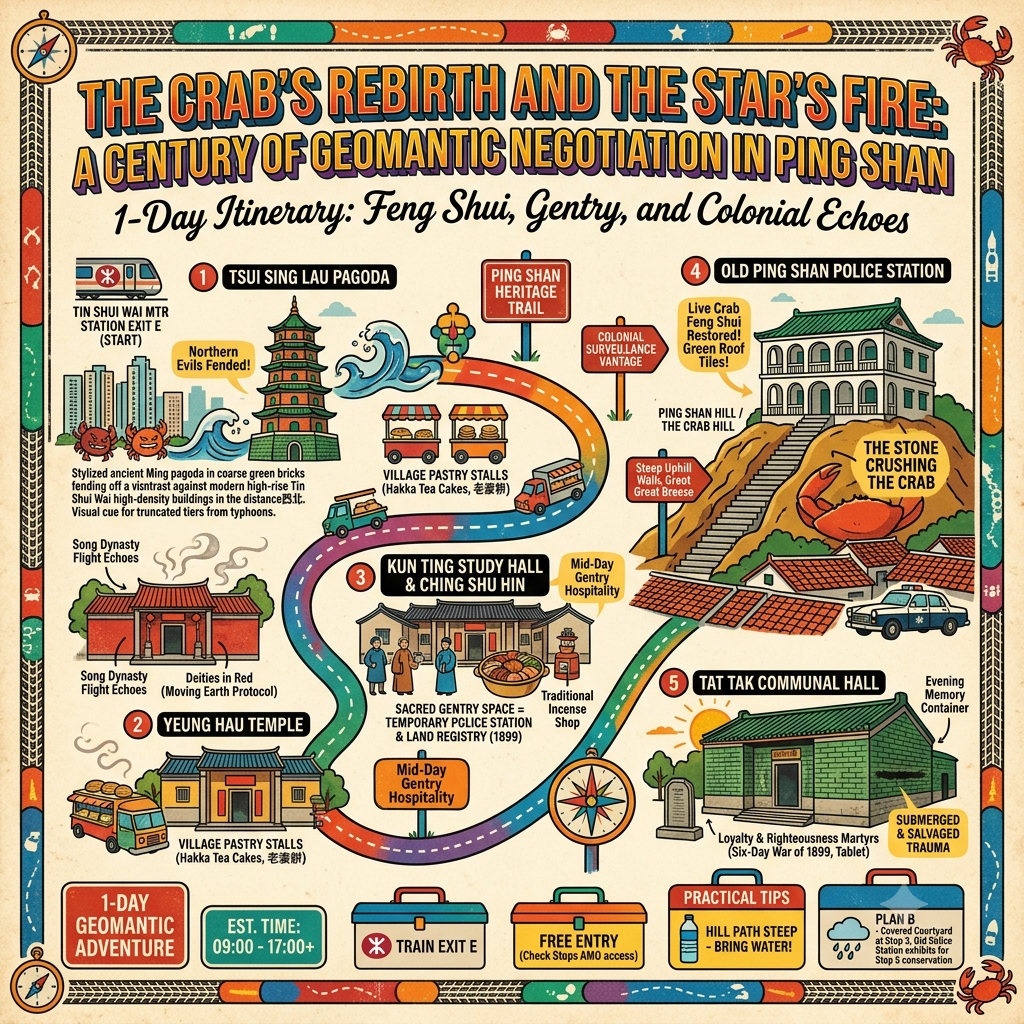
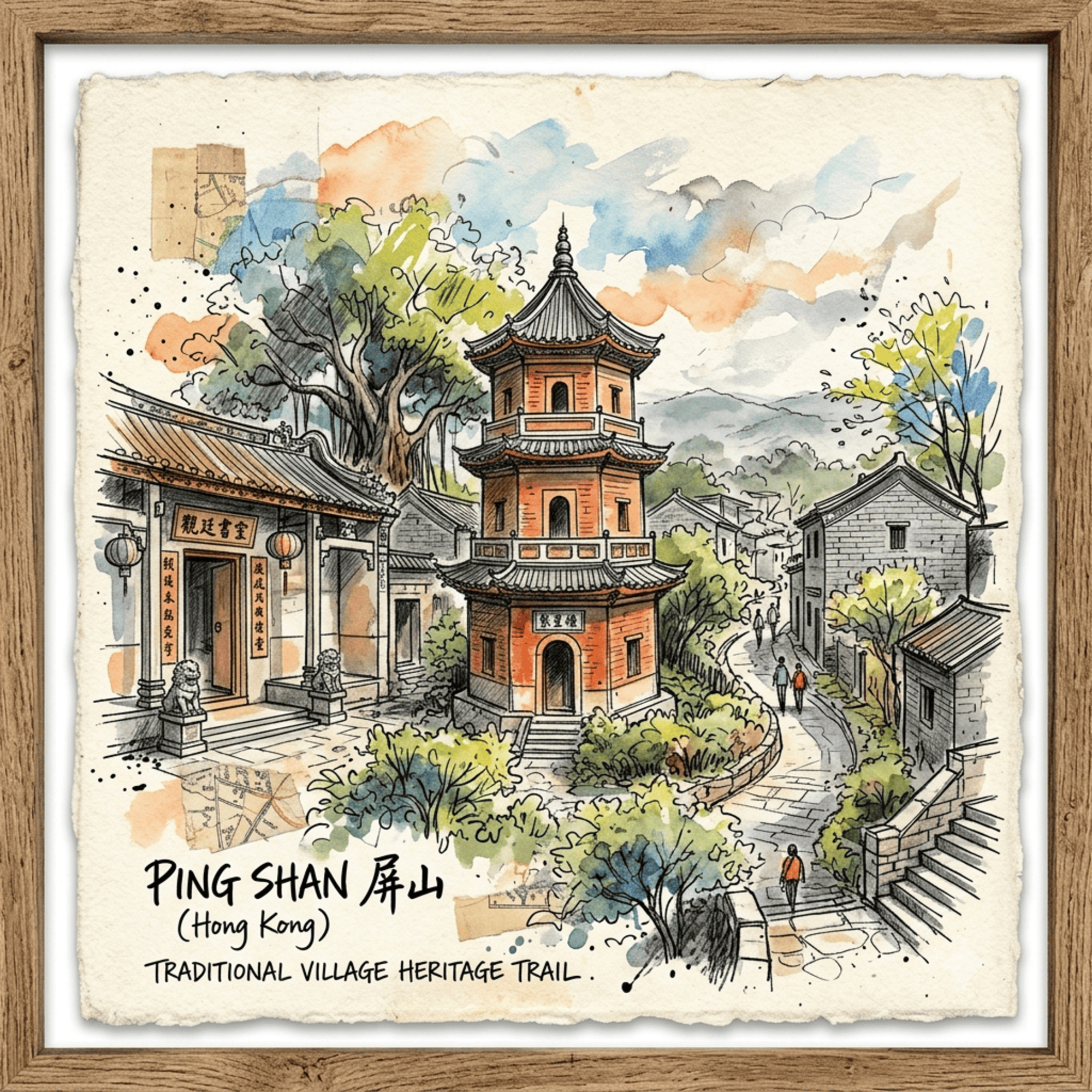
This is a historical travel story and walking guide to Ping Shan, a cultural heartland in the western New Territories of Hong Kong. Through three profound historical episodes—including the star-gathering Tsui Sing Lau Pagoda, the "crushed crab" feng shui negotiation of the old police station, and the drowned Tat Tak Kung So shrine—it explores how the eight-hundred-year-old Tang clan outlasted empires, colonial flags, and modern town planners. Readers will gain a deep, alternative perspective on Hong Kong's first heritage trail, uncovering a recursive history where local geomancy and imperial politics constantly collide.
 Lawrence
There is a low ridge in the western New Territories that the Tang clan has called, for the better part of eight hundred years, the body of a crab. Beneath that ridge runs a configuration of pond, creek and distant peak which, in the vocabulary the clan still uses without irony, constitutes not scenery but circulatory anatomy — a thing capable of being wounded, starved, or made to flourish, depending on what is built upon it. No regime that has passed through this stretch of land — not the Ming court, not the Qing magistrates, not the British Crown, not the government that succeeded it in 1997 — has been permitted simply to occupy it. Each, in turn, has had to learn to read the crab, and in some small way apologise to it, before being allowed to govern. This is the record of a lineage that lost almost every confrontation that mattered, and somehow kept winning anyway.
Listen to the historical stories told in detail (For subscribers only)
The Pagoda and the Dream of a Dying Lineage
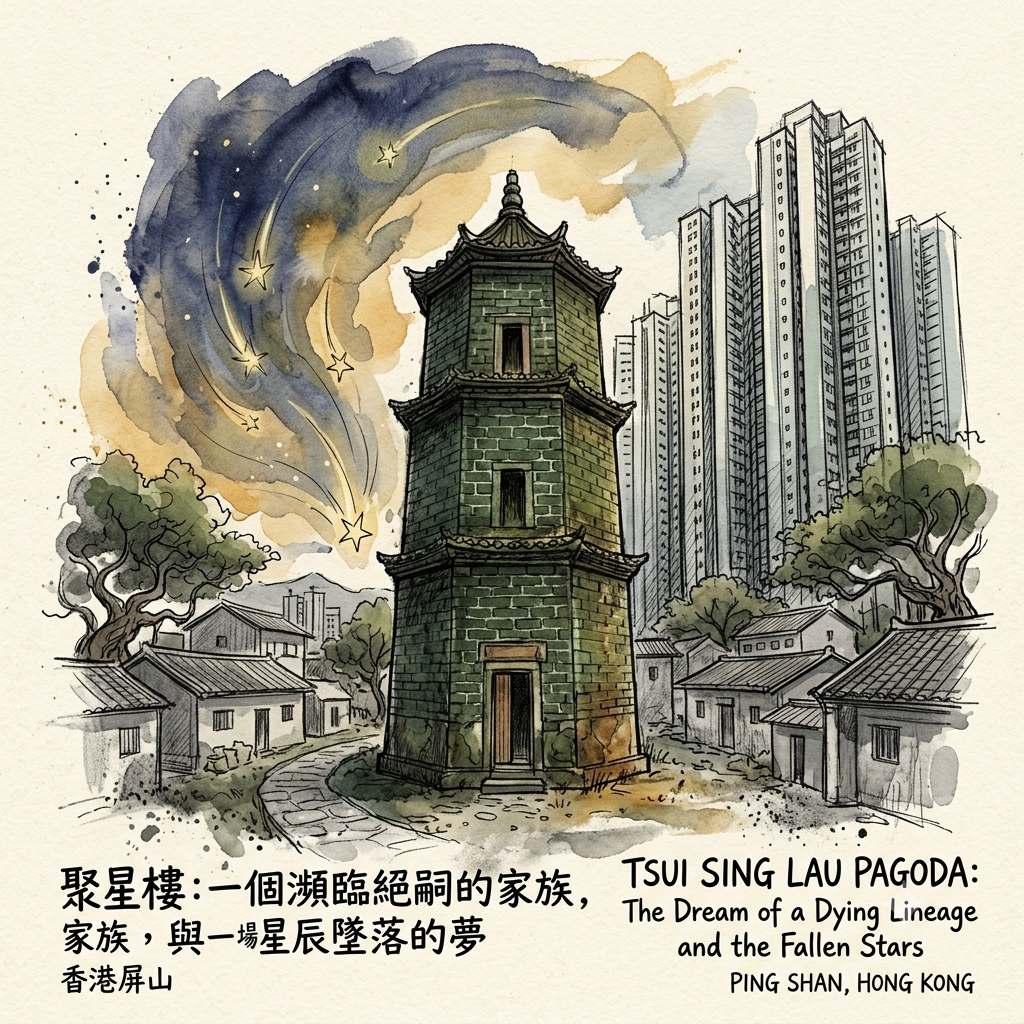
In the fifteenth year of the Hongwu reign — 1382 by the calendar that would eventually govern this harbour too — a man named Tang Yin-tung was appointed magistrate of Ningguo Prefecture. To the court that promoted him, this was an unremarkable provincial posting. To his clan, it was the end of a long and quiet emergency: across seven generations the Tang lineage at Ping Shan had produced only twelve adult men, four of whom had died young. A lineage organised entirely around the perpetuation of a patriline, on a coastal plain where land tenure and ancestral ritual were the same instrument, was watching itself run out.
On the night he took office, Tang is said to have dreamed of his home village's northwestern sky catching fire with stars, which then fell and gathered at the mouth of the river below the settlement. He woke remembering a warning given by a geomancer at the village's founding — that the gap in the hills to the northwest left the place exposed to a malign northern current — and sent for a geomancer of his own. The advice he received was architectural: build a tower at the river mouth to gather the fallen stars, and let it stand between the village and the open water. What rose there was a seven-storey pagoda housing shrines to Kuixing and Wenchang, the patron deities of literary success in the imperial examinations — the single mechanism, short of having more sons, by which a minor lineage could convert ambition into rank. Within seven generations the male line had grown to twenty-two; ten descendants went on to found new walled villages of their own.
The Pagoda That Saved A Bloodline
What survives today is three storeys, the upper four having been taken, at different points, by typhoons that the written record cannot quite agree on — some accounts say the tower lost four floors at once, others two separate storms, an uncertainty that is itself worth dwelling on, since it means that even the structure's original shape now exists only as a disputed memory held in slightly different versions by people who never saw it whole. Stand inside it and the brick is cool against the hand in a way that modern construction rarely achieves; the stair is narrow enough that three or four visitors fill it entirely; light falls through small apertures in lozenge-shaped patches across the floor. The tower was built to face an open river mouth and the wide grey expanse of Deep Bay beyond it. That sightline is now entirely obscured by the residential towers of Tin Shui Wai — a six-hundred-year-old instrument for gathering stars, quietly defeated by twentieth-century housing policy.
The Crab Beneath the Police Station
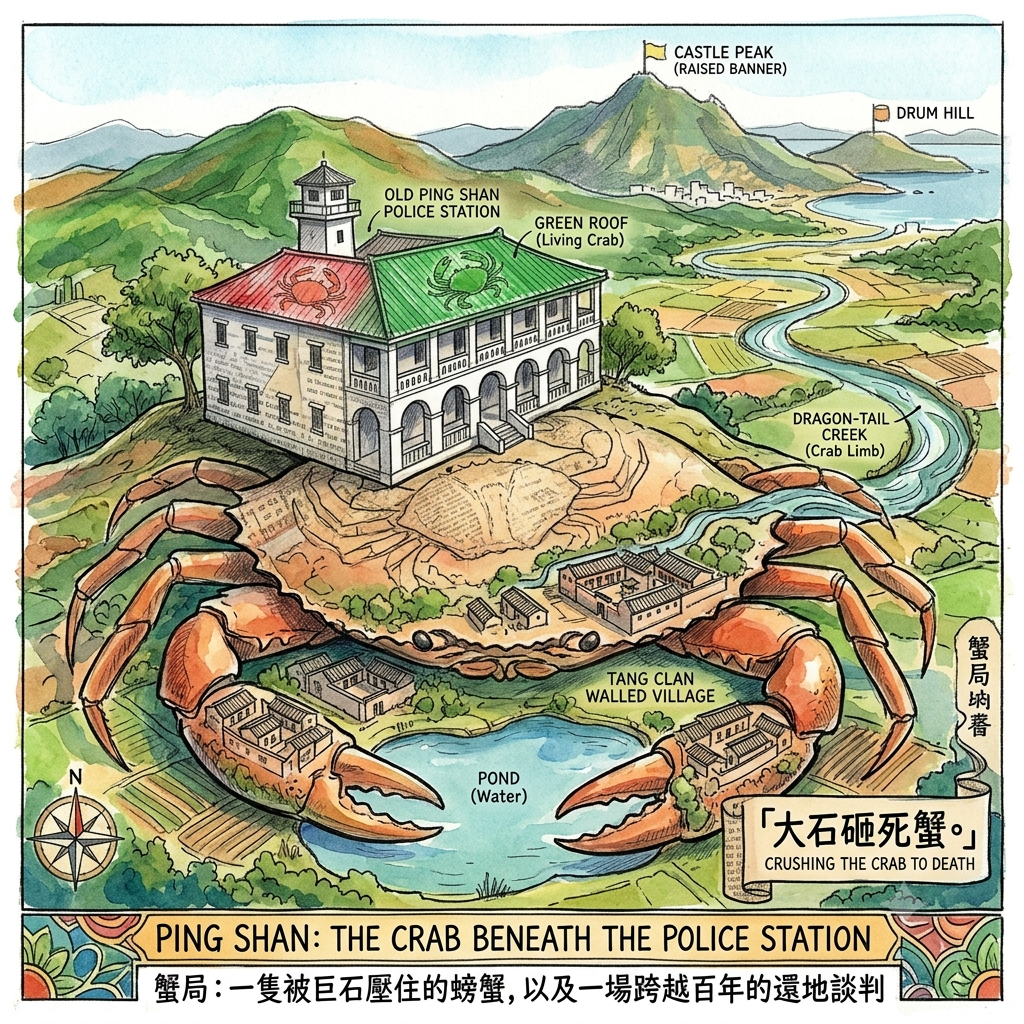
The clan's own cartography of Ping Shan describes the entire settlement as a crab: the ridge as the body, the distant peak of Castle Peak as a raised banner, a nearer hill as a drum, the pond before the villages as the creature's water, and a winding stream — locally the "dragon-tail creek" — as a limb reaching toward the bay. It is, by the clan's own account, the geomantic infrastructure beneath eight centuries of relative prosperity. In 1900, the year after Britain formally took possession of the New Territories, colonial administrators built a police station on a knoll at the centre of that body, from which officers could watch the movements of every walled village below.
"A great stone, crushing the crab to death." — a saying still repeated by Ping Shan villagers
Resurrecting_the_Crushed_Crab
The saying does more work than folklore is usually given credit for. It does not describe colonial rule as an abstraction of law and revenue; it describes it as a specific, locatable wound — a weight set down on a living thing's back. The dispute over that weight ran for nearly a century. It was not resolved by appeal to any court, but by a real-estate negotiation in the 1990s, when the government needed the clan's cooperation to relocate ancestral graves at Nam Wan, Tuen Mun, for a landfill extension. The clan's price, agreed in 1996 and finalised the following year, included a building. Once the station's police functions had relocated, the entire structure — including its dog-training compound — would be returned to the Tang clan as a heritage gallery. The roof, by clan request, was recoloured at the moment of handover: from red, the colour the villagers associated with a boiled, dead crab, to green, the colour of a living one. A colonial watchtower, after ninety-seven years, was finally required to heal itself according to the geomantic terms of the people it had been built to watch.
Visitors today climb the same slope, on the same knoll, toward the same view down onto the same rooflines — except that the act of climbing has been quietly converted from surveillance into pilgrimage.
The Drowned Shrine: Six Days of War and Forty Years Underwater
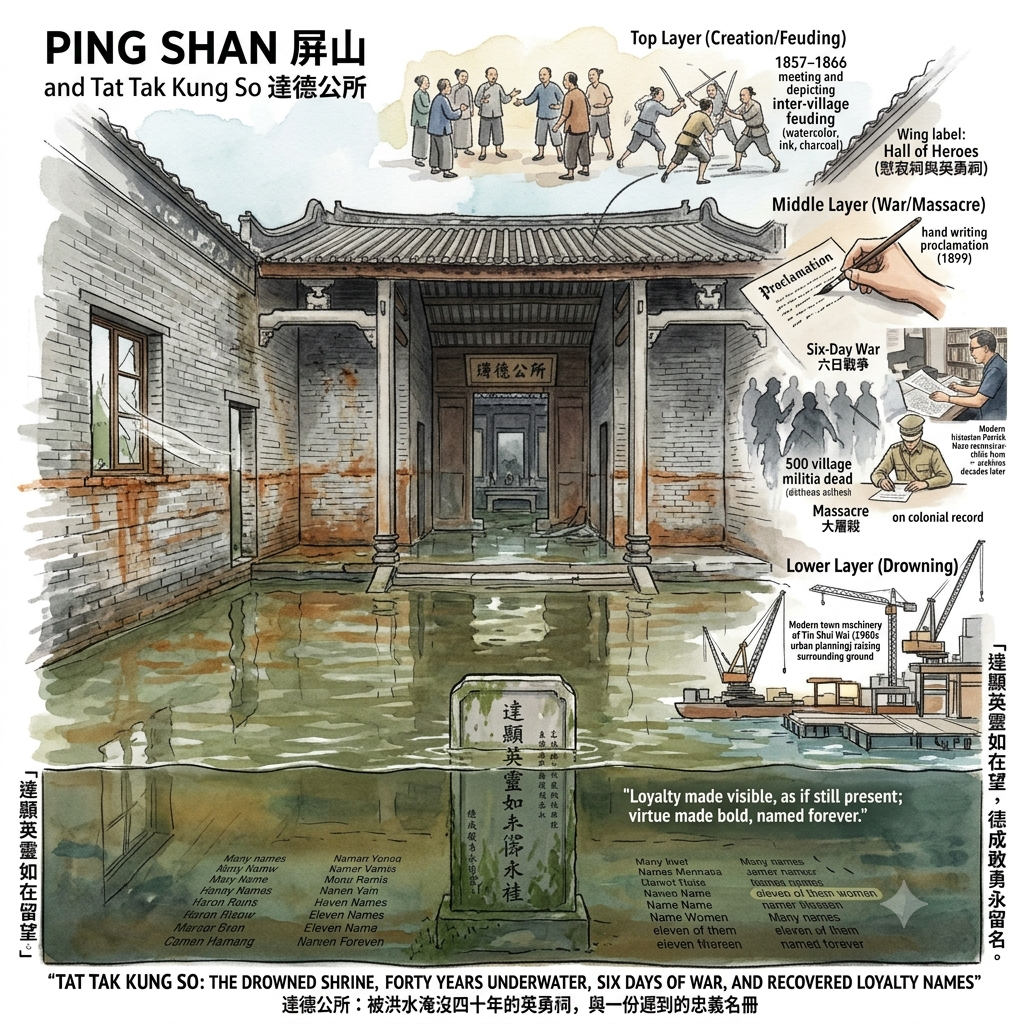
Tat Tak Kung So was built in 1857 as the meeting hall of the Tat Tak Alliance, thirty-nine villages spanning Yuen Long and Tuen Mun who used the building to administer the local market and settle disputes. Nine years later, two wings were added — a hall of condolence and a Hall of Heroes, the latter intended for men killed in the inter-village feuding that was, at the time, an ordinary feature of rural life in this corner of the delta. The building was, from its very design, a vessel for absorbing violent death into something the lineage could continue to live with.
On 28 March 1899, the gentry of Ping Shan gathered in that hall and issued the proclamation that committed the New Territories' rural militias to armed resistance against the imminent British takeover. What followed, over six days in April, has come to be called the Six-Day War — a conflict the colonial record long minimised as a minor disturbance, but which the historian Patrick Hase, working from archival sources decades later, reconstructed as something closer to a massacre: something near five hundred village militia dead against one or two British wounded. Governor Blake, to his credit, chose reconciliation over reprisal afterward, and several resistance leaders were folded into the new rural advisory committees within months — a settlement that suited the colonial administration's need for stability rather better than it suited anyone's appetite for justice.
The Drowned Memorial of Ping Shan
After the war, the hall passed through a series of secular afterlives: overflow classrooms, an orphanage run by a Christian children's welfare society, and finally a private primary school that closed sometime in the 1970s. Then, in the 1980s, the construction of the new town of Tin Shui Wai raised the surrounding ground level and rerouted the local drainage. The hall, sitting lower than its newly elevated neighbours, began to flood, and kept flooding, for decades, until it stood abandoned and waterlogged — a monument to anti-colonial resistance, quietly drowned by the colonial-adjacent machinery of late-twentieth-century urban planning. A commemorative stele installed in 1938, bearing more than 170 names — eleven of them women — sat through all of this submerged in silence and standing water before villagers' advocacy finally won the building Grade One listing and, in 2013, declared-monument status.
"Loyalty made visible, as if still present; virtue made bold, named forever." — the paired inscription flanking the Tat Tak Kung So memorial stele
Holographic Sensory Cue: stepping into the unrestored hall, the brick walls carry distinct horizontal tide-lines, like growth rings recording each season's flood height; the air holds the particular iron-tinged dampness of waterlogged masonry that has dried and flooded again many times over; the courtyard is quiet enough to hear one's own footsteps return off the empty walls — a stillness specific to a space that has held no ritual in decades, where even wind through a broken window seems to enter hesitantly, as though uncertain it is allowed.
What this building teaches is that commemoration is not a single completed act but a cycle — forgotten, submerged, and occasionally, with enough insistence from the living, recovered. It remains, even now, a work in progress, which feels appropriate: Ping Shan's relationship to its own history has never been linear. It is recursive, a constant going-back-under and resurfacing.
From Lecture Hall to Land Registry, Overnight
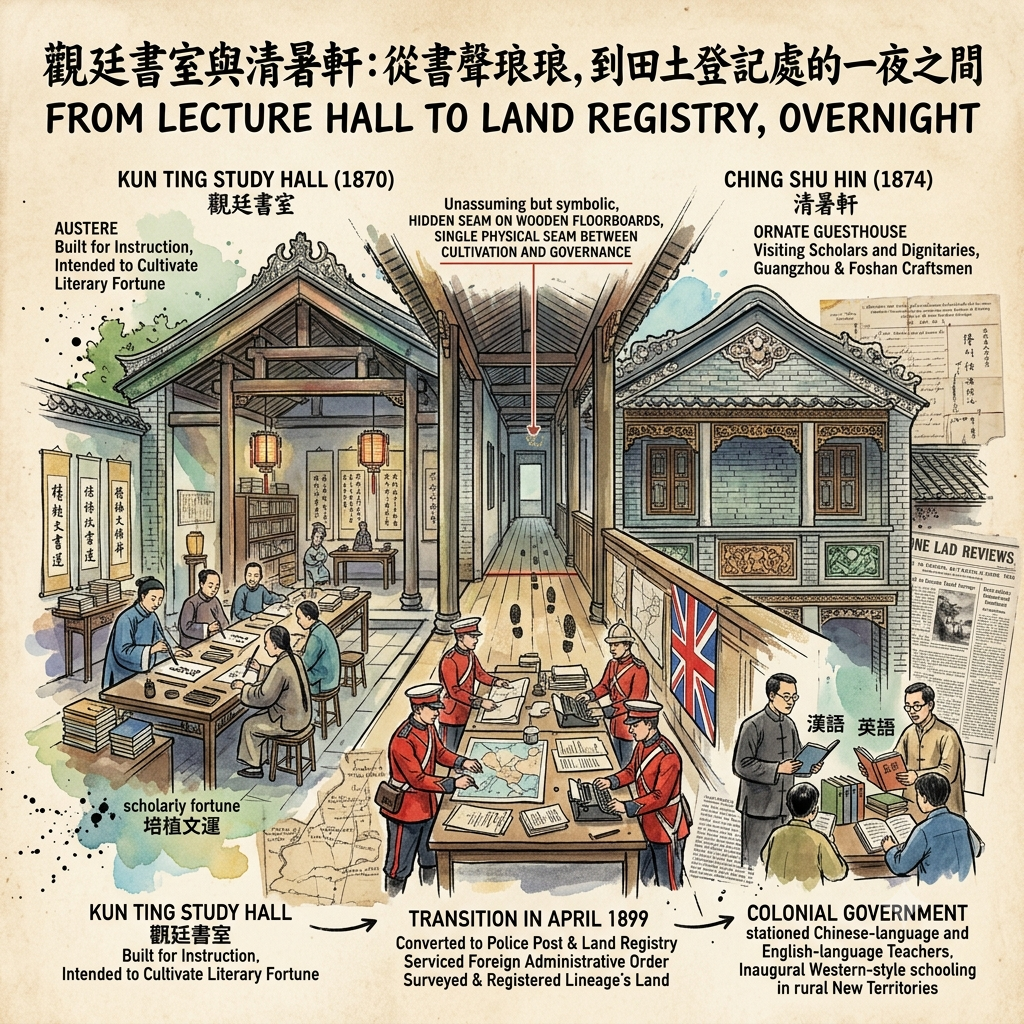
Kun Ting Study Hall was completed in 1870; four years later, the adjoining guesthouse, Ching Shu Hin, was finished beside it — the former austere and built for instruction, intended to cultivate the literary fortune of the clan's sons toward the imperial examinations; the latter ornate, commissioned to host visiting scholars and dignitaries in a style elaborate enough that the clan brought craftsmen from Guangzhou and Foshan specifically for the work.
The Stolen Academy of Ping Shan
In April 1899, within days of the British military's entry into the New Territories, Kun Ting Study Hall was requisitioned as a temporary police post and land-registration office. A space built to cultivate loyalty to an imperial examination order became, without a single physical alteration, the instrument by which a foreign administrative order surveyed and registered the same lineage's land. Once the fighting ended, the colonial government stationed a Chinese-language and an English-language teacher in the same building — by local account, the inaugural instance of Western-style schooling in this part of the rural New Territories. The lecture hall, having briefly served as an outpost of conquest, returned to being a lecture hall; only the curriculum had changed languages.
The upper-floor corridor connecting the study hall to the guesthouse is easy to walk past without noticing. It is, in fact, the single physical seam between two entirely opposed functions — cultivation and governance — that briefly shared the same floorboards in the same month of the same year.
The Marquis Who May Not Exist
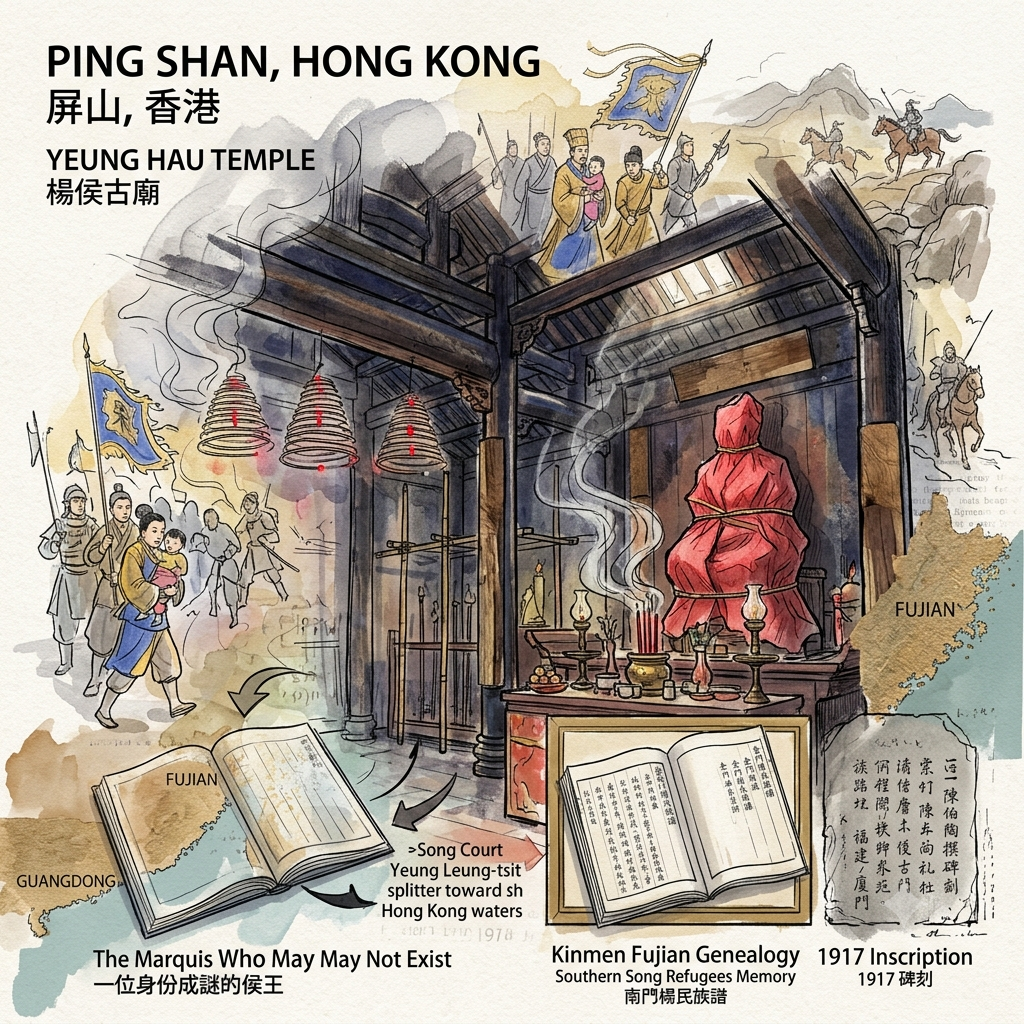
Local tradition holds that the deity enshrined at the Yeung Hau Temple in Hang Tau Tsuen is Yeung Leung-tsit, a loyal minister of the collapsing Southern Song court said to have died of exhaustion while escorting the boy-emperors south, fleeing the Mongol advance. This is not an isolated legend; it is one local instance of a much larger story that the so-called Five Great Clans of the New Territories tell collectively about their own arrival — refugees of a fallen dynasty, carrying its legitimacy south with them into a frontier that the next regime had not yet reached.
The Phantom Bodyguard of Ping Shan
The identification, however, rests on relatively recent and contested ground: it traces to a 1917 inscription composed by the Qing-dynasty scholar Chan Pak-to for the Hau Wang Temple in Kowloon City, an attribution that genealogical records kept by Yeung Leung-tsit's own documented descendants in Kinmen, Fujian, directly contradict. Those records describe him losing contact with the fleeing Song court, retreating instead through Xiamen to Kinmen, where he lived out his life in quiet exile and was buried behind his clan's ancestral hall — with no mention anywhere of having reached the waters of Hong Kong at all. What survives at Ping Shan, in other words, may not be the historical record of a man so much as the record of a need: a rural society's recurring desire to attach itself to a narrative of loyal, displaced legitimacy, regardless of which regime happened to be asking for its allegiance at the time.
The temple itself has burned more than once from its own devotion — the beams are smoked nearly black from decades of incense — and during renovation the deity's statue is wrapped in red paper and left to wait out the disturbance of the work around it, an oddly domestic gesture set against the formality of the ancestral halls nearby.
The High-Dimensional Lens: A Geomantic Regime-Legitimation Syndrome
Laid side by side, these five accounts describe something that conventional political history at Ping Shan has consistently underweighted: no outside authority here has ever been able to govern by force or decree alone. Each has had to be processed — symbolically, sometimes literally — through the Tang clan's own geomantic and ancestral register before its rule could take hold at all.
A demographic crisis under the Ming was resolved by building a tower, not by petitioning the throne. A colonial watchtower spent the better part of a century being negotiated down to a repainted roof and an eventual surrender of the building itself. A study hall was occupied rather than replaced, because occupying an existing sacred space evidently did more administrative work, in 1899, than constructing a new one would have. The dead of a failed armed uprising were absorbed into the clan's own ancestral accounting of loyalty and virtue — a memory that then spent forty years underwater before resurfacing. And a temple to a "loyal Song minister" whose presence here cannot actually be verified persists anyway, because what it offers the lineage — a claim to displaced, righteous legitimacy under successive regimes — matters more than whether the man in question ever set foot on this coast.
The mechanism has not stopped operating. In 2021, when the clan objected to a social-housing development proposed beside the heritage trail, they closed the trail themselves and posted notices accusing the government of leading the destruction of its own heritage protections — the same eight-hundred-year-old grammar, restated for a planning dispute in the twenty-first century: any outside power wishing to alter this land still has to learn, first, how to address the crab.
Resonance Node: the gatehouse of Shut Hing Study Hall
Among the ordinary houses of Tong Fong Tsuen stands an unremarkable blue-brick gateway — the surviving fragment of Shut Hing Study Hall, built in 1874 by a son in memory of his father, once a place where the clan's children were taught to read for examinations they might one day pass. The main hall behind it was demolished in 1977 for want of repair; only this gate remains, and behind it now is simply somebody's home. Most people walk past without registering that they are standing at the threshold of a vanished academy. History here has not been preserved so much as quietly absorbed back into the texture of daily life — which may be exactly why this corner, more than any of the formally listed monuments along the trail, is where the membrane between past and present feels thinnest.
Memory as Humanity's Last Stable Asset
When a tower's sightline is swallowed by housing blocks, when a watchtower's roof must be repainted before it can be forgiven, when a roll of the war dead spends forty years under standing water before anyone reads it again — Ping Shan keeps insisting, in its own quiet way, that no space is ever neutral. It remembers who once stood over it, and who, eventually, had to bow. In an age whose technologies replace themselves faster than human memory can keep pace, this older insistence — that power must first learn the land's own language before it is allowed to exercise itself — may be one of the few assets left that no algorithm can simply compute its way around. What it asks for, after all, is not processing speed. It asks for humility.
If this crab-shaped corner of the New Territories has stayed with you, consider subscribing — there is another anchor point waiting, somewhere else on the map, still negotiating its own legitimacy one regime at a time.
Accessing the Physical Node
The trail begins at Tsui Sing Lau Pagoda, a three-minute walk from Exit E3 of the MTR/Light Rail Tin Shui Wai station. Opened in 1993 as Hong Kong's first heritage trail, the route runs roughly 1.6 kilometres on level ground, linking the pagoda with Sheung Cheung Wai, the Yeung Hau Temple, the Tang Ancestral Hall, Yu Kiu Ancestral Hall, Kun Ting Study Hall, Ching Shu Hin, and the Tang Clan Gallery housed in the former police station. Several structures, including Tat Tak Kung So, remain at various stages of restoration; checking the Antiquities and Monuments Office's current notices before setting out is worth the minute it takes.
For those wishing to extend this into a fuller weekend of temporal reckoning, Tin Shui Wai or central Yuen Long make a reasonable overnight base, with onward routes the next day toward Kam Tin's Kat Hing Wai, Ha Tsuen, or Pat Heung — all sites implicated in the same six days of 1899. Local heritage groups also run periodic guided walks led by people who carry the clan's oral history rather than its official plaques, and it is usually in what they mention in passing, rather than what is engraved anywhere, that the texture of the crab beneath the ground comes through most clearly.
Answer customer questions
How did the Tang people in Pingshan engage in power negotiations with the British colonial government through "feng shui logic"?
Simply put, the Tang people in Pingshan actually used "feng shui" as a set of translation tools to slowly negotiate terms and space with the British colonial government. To sum it up in one sentence: The Deng did not simply rebel, but used the “set of worldview of feng shui” to repackage political issues and force the government to use their language and rules to negotiate, thereby holding on to their ground and interests.
What is the significance of the specific modification of "cooked crab to raw crab" for feng shui?
Simply put, “cooked crab to raw crab” is the change of the original red sky of the police station to green, symbolizing the transition from “dead/pressed” back to “live/alive”. “Cooked Crab Turned into Raw Crab” actually uses the ritual of changing colors to repackage a colonial building that is seen as breaking feng shui into a lively, community-acceptable space.
What is the connection between the "Wen Tower" function of Juxing Building and the feng shui of Crab Bureau?
The Juxing Tower is not just a tower, but a tool for the Deng clan to use feng shui to "repair the land, urge the cultural movement, and protect the clan". The Juxing Building is a feng shui project used by the Deng clan to repair the feng shui of the "crab bureau", ward off evil spirits, encourage cultural luck, and preserve the continuation of the clan.
Reference and Further reading
First layer – Main sources of literature and institutions:
- 古物古蹟辦事處「屏山文物徑」官方網頁,聚星樓於2001年12月列為香港法定古蹟之記錄。
- 古物古蹟辦事處「屏山鄧族文物館暨文物徑訪客中心」官方歷史說明;
- 維基百科「屏山鄧氏」條目所載1994–1997年遷墳談判時間線。
- 古物古蹟辦事處法定古蹟名錄(達德公所,2013年列為法定古蹟);
- 公所內「忠義留芳」石碑碑文(1938年重修時嵌入,現存原物)。
- 古物古蹟辦事處「屏山文物徑」官方說明,記錄覲廷書室於1899年英軍接管期間用作臨時警署及田土辦公室。
- 古物古蹟辦事處「屏山文物徑」官方說明(楊侯古廟條目);
- 陳伯陶《侯王廟聖史碑記》(1917年,碑刻原物現存九龍城侯王古廟,作為歷史文獻本身屬第一層原始材料,但其「考證結論」應視為第二層待商権之學術論斷)。
The second layer – secondary academic materials:
- 粵港澳文旅資訊網及相關地方建築史資料,對明清嶺南「文塔」科舉建築功能的一般性學術描述。
- 灼見名家(陳天權)「屏山文物徑的獨特景點」一文;
- 香港山澗足印(GoHikingHK)部落格所載受訪者童年家族口述,提及「大石砸死蟹」之說——此說雖經二級媒體刊載,性質仍屬第三層口傳資料。
- 夏思義(Patrick Hase)《被遺忘的六日戰爭:1899年新界鄉民與英軍之戰》——關於六日戰傷亡數字、政治背景的權威學術專著;灼見名家(陳天權)相關報導;
- 香港01歷史專題,引述歷史學者鄺智文對殖民政府選址警署作監視策略之分析。
- 灼見名家(陳天權)報導,佐證覲廷書室徵用歷史及戰後中英文教師駐校教學之說。
- 香港商報〈楊亮節終老金門 侯王信仰疑點重重〉一文,引述金門楊氏宗族族譜文獻,對陳伯陶說法提出系統性質疑。
Third layer – Supplementary information:
- 鄧氏族譜及父老相傳的「鄧彥通夢星」傳說。
- 屏山「蟹局」風水格局之具體描述(屏山嶺為身、青山為旗、雞柏嶺為鼓、龍尾坑為足),屬族人世代口傳的風水詮釋,非經正式測繪或史料證實。
- 「大石砸死蟹」之村民口傳(與故事二交叉引用)。
- 金文泰、何東到訪清暑軒之說;
- 日佔時期清暑軒收容難民之說——兩者均屬地方文史及旅遊資料層面的傳述,建議進一步查證原始檔案。
- 屏山村民相傳「侯王即楊亮節」之說。
Historical gap:
- There are inconsistencies in various sources regarding the original number of floors of Juxing Tower (five or seven) and whether it collapsed once or twice due to typhoons. There are also significant contradictions in the exact construction year (between the genealogy's record of "during the Hongwu reign of the Ming Dynasty" and various folk accounts of "over 600 years" and "over 1000 years"). Further verification of original archives is recommended.
- The earliest formal written record (rather than oral transmission) of the "Crab Formation" feng shui theory is uncertain based on existing data. Further verification of original genealogies or local feng shui literature is recommended.
- There is a significant discrepancy between early official records and Xia Siyi's revised estimate (nearly 500 people) regarding the total number of casualties in the Six-Day Battle of the New Territories. Whether the restoration project of the Tat Tak Association was completed and reopened as of the time of writing (2026) cannot be confirmed by currently available public information. Further verification of the latest announcements from the Ping Shan Township Office or the Antiquities and Monuments Office is recommended.
- The true historical identity of "Hou Wang" remains unresolved, and scholars generally acknowledge that this is an unsolved historical mystery. This document explicitly treats "Hou Wang = Yang Liangjie" as a widely accepted local religious narrative, rather than a verified historical fact. Further verification of the original Kinmen Yang clan genealogy and rubbings of the Hou Wang Temple stele in Kowloon City is recommended for comparison.
 Lawrence
 Lawrence
 Lawrence
The sources for this article include primary historical records, academic papers, and public records from various levels of administrative bodies, with a commitment to historical accuracy; instances requiring further verification against primary archival materials have been noted in the text. Last updated: July 2026.