(ENG) Tin Hau and Tai Hang Historical Walk – Lanterns, Alleys, and the Fire Dragon Legend on Hong Kong Island
A historical travel story and walking guide to Hong Kong's Tin Hau and Tai Hang. Explore ancient temples, cozy labyrinthine alleys, and the legendary Fire Dragon folklore to discover how century-old traditions and modern urban life overlap in this hidden enclave.

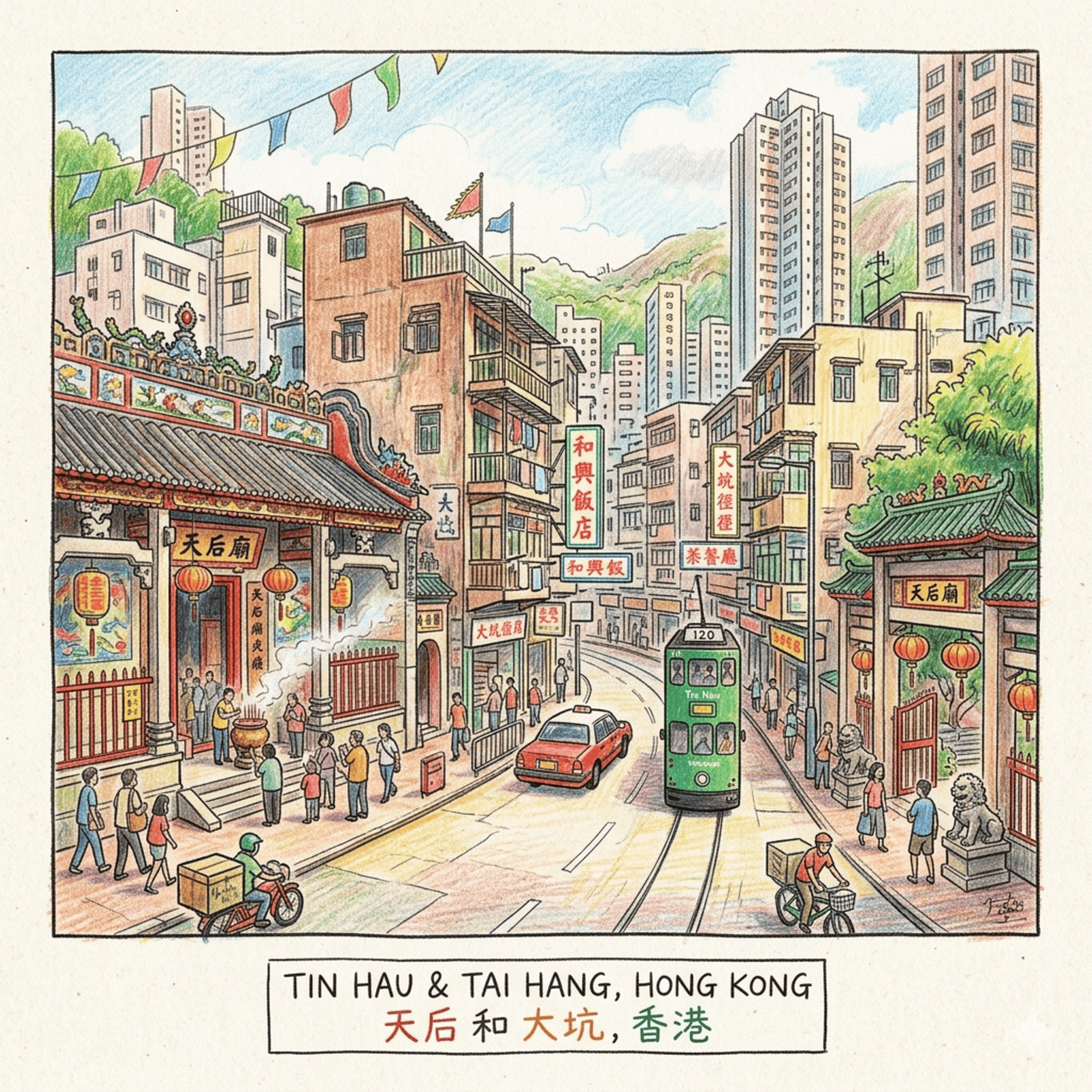
This is a historical travel story and walking guide to Tin Hau and Tai Hang, two vibrant neighborhood layers of Hong Kong Island. Through a journey past centuries-old temples and labyrinthine alleys, it explores the origins of the legendary Tai Hang Fire Dragon Dance and local coastal folklore. Readers will discover how ancient maritime beliefs, Hakka heritage, and modern hipster cafes seamlessly overlap in this enchanting urban enclave.
 Lawrence
The Shoreline of Shifting Identities
To the casual commuter, the districts of Tin Hau and Tai Hang appear as a seamless blend of mid-century residential blocks and modern culinary hotspots. Yet, for the cultural historian, this area represents a profound palimpsest—a landscape where layers of urban evolution are written over one another. Beneath the asphalt of modern Causeway Bay lies a critical "historical slice" of Hong Kong’s identity. This was once a volatile frontier, a jagged edge where the maritime defense systems of the Qing Dynasty met the rigid, colonial urban planning of the British.
As you navigate these streets, you are traversing a spatial practice of reclamation. What is now a dense urban grid was once a topography of mudflats and mountain slopes tumbling into the sea. This journey is best experienced on foot, moving through the spatial continuity of the modern environment to find the "ghosts" of the old coastline. To understand Hong Kong’s present, one must look at the literal object that gave the island its name and the liminal boundaries between faith and the state.
Listen to the historical stories told in detail (For subscribers only)
The Driftwood Deity—How an Incense Burner Named an Island
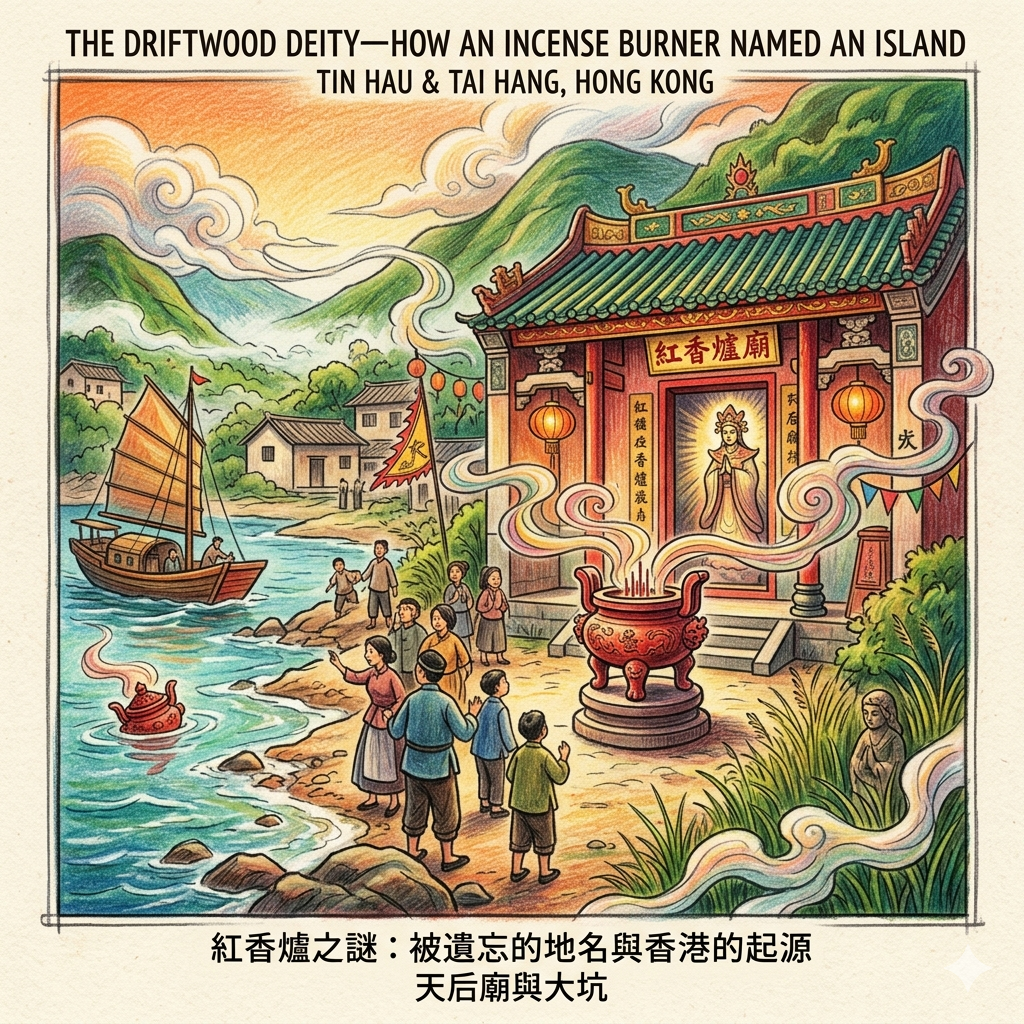
Toponymy—the study of place-naming—is rarely an objective exercise; it is a strategic tool for establishing political and cultural authority. In the case of Hong Kong, the island’s early identity was tied to a specific religious object: the Hung Heung Lo (Red Incense Burner). Long before "Hong Kong" became the standard nomenclature, Qing military records and maritime maps used this name to define the entire island.
The legend of the Red Incense Burner survives in two primary traditions. The most pervasive tells of a stone incense burner that miraculously drifted to the shores of Causeway Bay, discovered by villagers who viewed it as a divine gift from the goddess Tin Hau. Conversely, descendants of the Tai family—Hakka migrants from Huizhou—recount the discovery of a Tin Hau statue hidden within the tall grass. They eventually established the "Salt Vessel Bay Red Incense Burner Temple."
There is a significant toponymic power struggle here. While the Qing saw a strategic military outpost, the migrants established a sacred anchor. Notably, early British maps preferred the name "Hung Heung Lo," suggesting it was a geographical marker of higher regional authority than the localized trade-name "Hong Kong" at the time.
Guangdong Annals (1822): "Red Incense Burner Water Station: To the west of the main camp... consisting of one thousand-strong commander and one foreign official, with troops allocated for patrolling the seas."
While the colonial administration eventually standardized "Hong Kong," the temple itself became the site of a different kind of power struggle: a resistance against institutionalization.
The Clan vs. The Crown—The 1928 Legal Resistance of the Tai Family
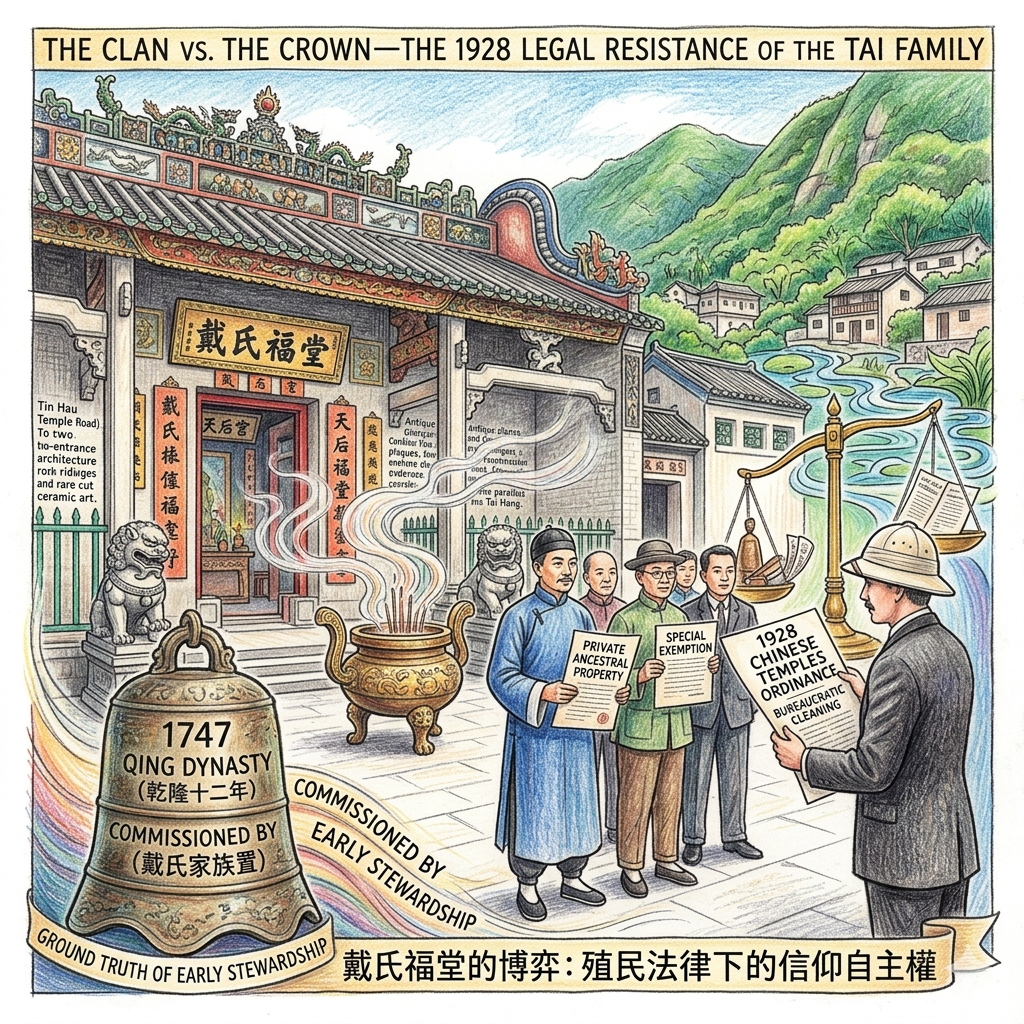
By the early 20th century, the British colonial government sought to "regularize" Chinese society through what could be termed "bureaucratic cleaning." A primary instrument for this was the 1928 Chinese Temples Ordinance, which mandated that all public temples be managed by a government-appointed committee. This was a move to bring the assets and religious networks of the Chinese community under colonial administrative control.
However, the Tai family, operating as the Tai Fuk Tong Co. Ltd., mounted a sophisticated legal defense of their ontological security. They argued that the Tin Hau Temple was not a public institution but a private ancestral property founded by their forebear, Tai Shi-fan. In a rare historical anomaly, the Tai family secured a "special exemption" from the Ordinance. This was a landmark instance of a Chinese clan leveraging Western private property rights to maintain religious autonomy against the state.
Physical Proof of Continuous Clan Management:
- The 1747 (Qing Dynasty) Bell: The absolute ground truth of the temple’s age and the family’s early stewardship.
- Plaques and Couplets: Antique inscriptions dating back to the Qing era.
- Stone Lions and Incense Burners: Markers of the clan’s long-term investment in the site.
This preservation of private legal boundaries in Tin Hau finds an architectural parallel in the nearby "Water Lotus" of Tai Hang, where the design was dictated by the environment.
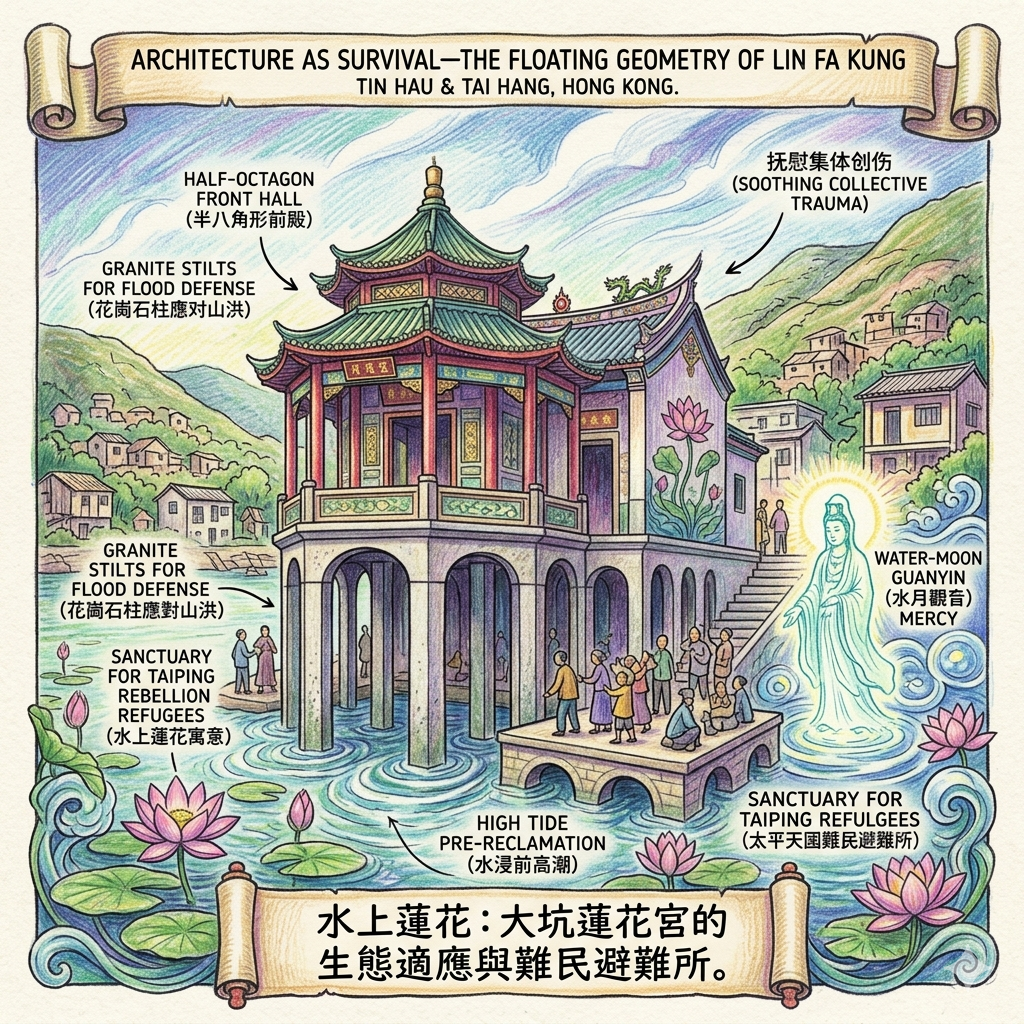
Architecture as Survival—The Floating Geometry of Lin Fa Kung
In urban history, "Ecological Adaptation" describes how sacred spaces are designed to withstand environmental threats. The Lin Fa Kung (Lotus Palace) in Tai Hang is a striking example. Reconstructed in 1863, its unique architectural features—a half-octagon pagoda-style front hall and a lack of a central front door—were functional necessities.
The design is "dual-coded." Functionally, the hall was built on ten-to-twelve-foot granite stilts to survive mountain floods. Symbolically, it manifested the "Water-Moon" mercy of Guanyin. Furthermore, the 1863 reconstruction served a vital social function: it became a public sanctuary for refugees fleeing the Taiping Rebellion. The temple transitioned from a private clan altar into a space for "抚慰集体创伤" (soothing collective trauma), providing spiritual refuge for a displaced population.
Spatial Note: Before the massive reclamation that created Electric Road (where the tram once ran alongside the water until 1929), the temple was so close to the shore that during high tide, the water rushed beneath the granite stilts. To the 19th-century observer, the entire structure appeared to float on the sea like a lotus flower.
While the temple was built to survive water and war, the community itself soon had to survive a deadlier foe: pestilence.
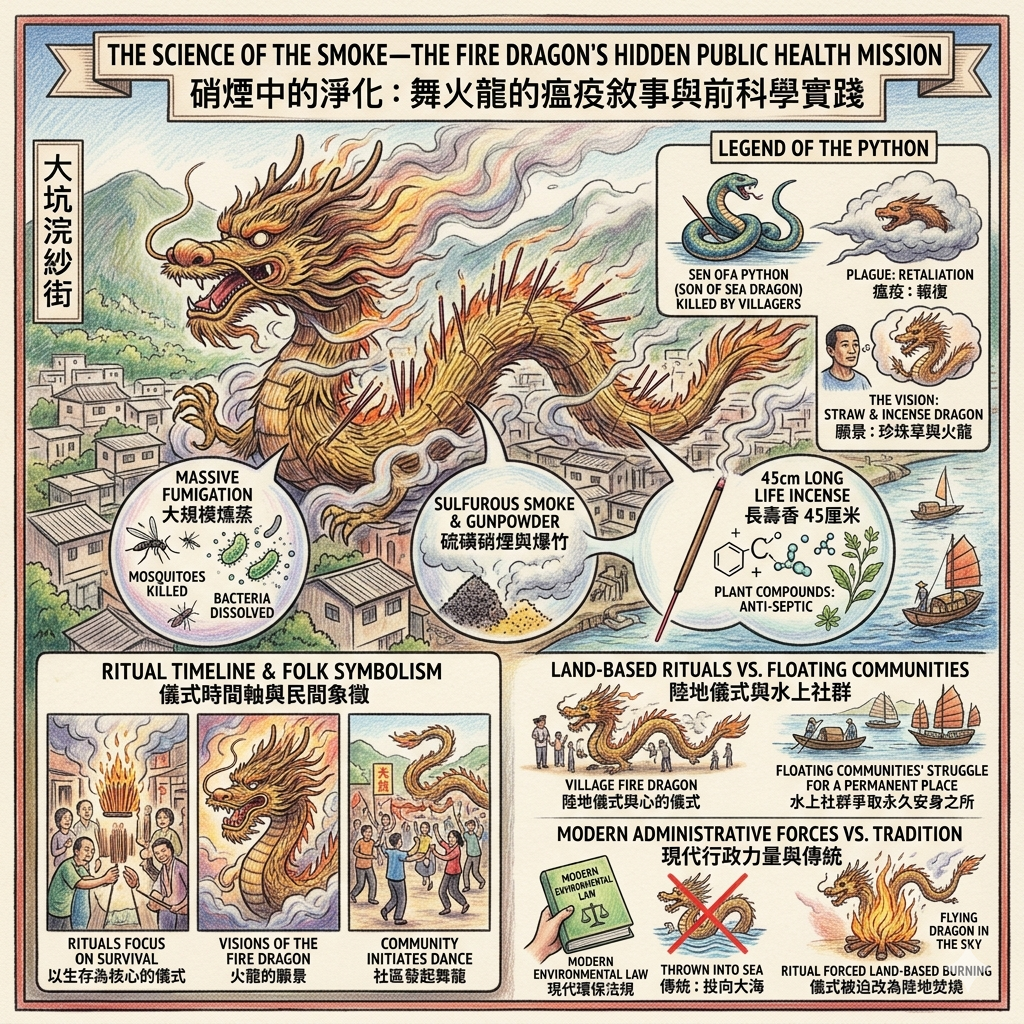
The Science of the Smoke—The Fire Dragon’s Hidden Public Health Mission
Rituals are often dismissed as mere folklore, but for marginalized 19th-century communities, they served as "pre-scientific" survival mechanisms. In 1880, following a typhoon, a plague broke out in Tai Hang. Folklore attributes this to a python (the son of the Sea Dragon) that was killed by villagers, prompting the Sea Dragon to retaliate with disease. The community’s response was a "vision": a massive dragon made of straw and incense.
From an epidemiological perspective, the "Fire Dragon" was a massive environmental disinfection exercise. The dragon was covered in thousands of 45cm "Long Life" incense sticks. The sulfurous smoke and the gunpowder from firecrackers acted as a massive fumigation, killing mosquitoes and purifying the air in a flood-prone valley.
Ritual Timeline and Folk Symbolism
Date (Lunar) | Ritual Stage | Core Activity | Symbolic Meaning |
8th Day | Blessing & Construction | Starting the dragon's frame; up-keeping incense. | Establishing sanctity; protection from evil spirits. |
10th Day | Awakening the Eyes | Adding flashlights ("eyes") and pomelos ("pearls"). | Symbolizing vitality, light, and fertility. |
11th Day | Securing the Body | Finalizing the supports for the dancers. | Structural stability for the collective effort. |
14th Day | Consecration | "Eye-dotting" at Lin Fa Kung; the parade begins. | Invoking Guanyin's power to drive out the plague. |
15th Day | Mid-Autumn Peak | The dragon weaves through the narrow village streets. | Maximum community cohesion and purification. |
16th Day | Returning to the Sea | The dragon is traditionally cast into the harbor. | "Dragon returning to the sea" to carry away misfortune. |
While these land-based rituals focused on survival, the city’s floating communities were engaged in their own struggle for a permanent place.
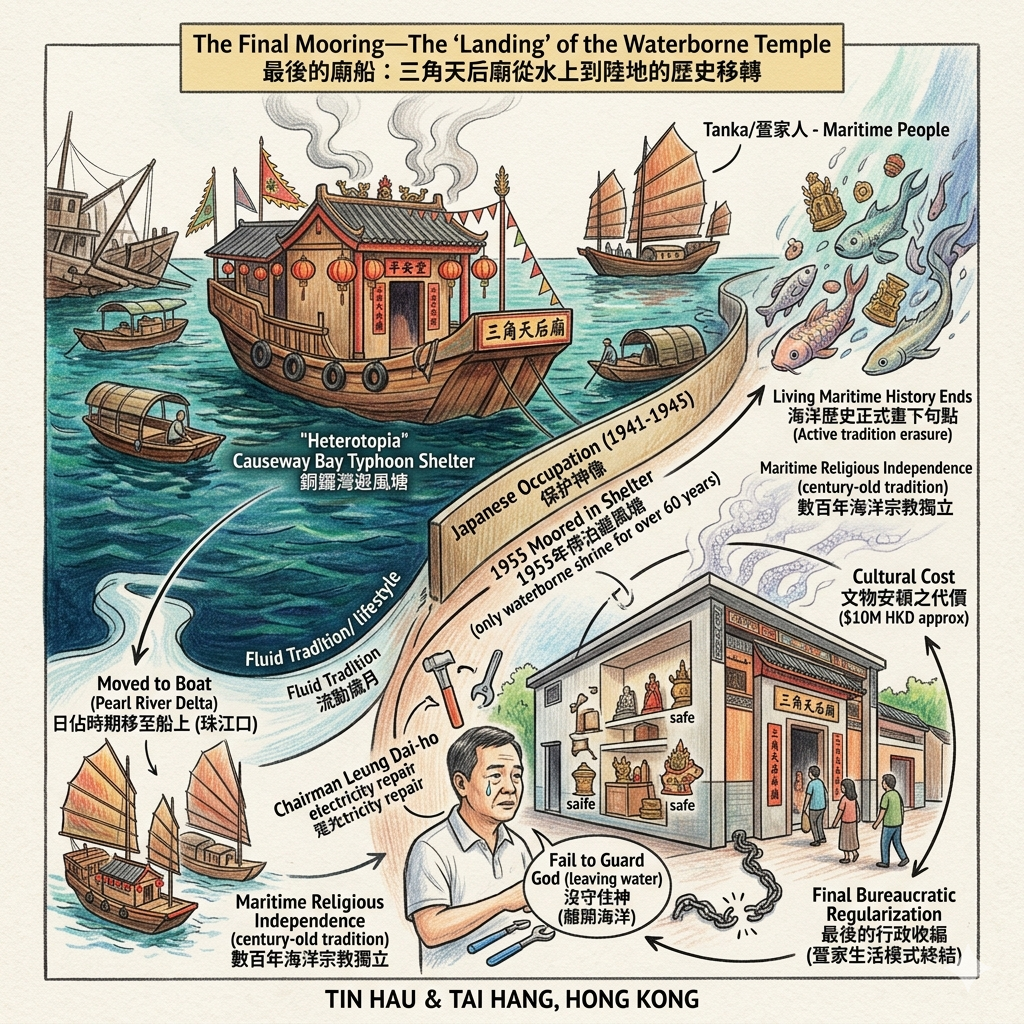
The Final Mooring—The "Landing" of the Waterborne Temple
Sociologists use the term "Heterotopia" to describe spaces like the Triangular Tin Hau Temple—shrine boats that existed outside standard land-based laws. Originating in the Pearl River Delta, this temple was moved to a boat during the Japanese occupation to protect it. By 1955, it was moored in the Causeway Bay Typhoon Shelter, serving as the only waterborne shrine in Hong Kong for over 60 years.
The temple's move to land in 2023 represents a significant "cultural cost," involving a total project value of approximately $10 million HKD. While this move ensures the safety of the artifacts, it marks the final "bureaucratic regularization" of the Tanka water-people’s lifestyle. The Chairman’s nostalgia—feeling he had "failed to guard the god" by leaving the water—reflects the erasure of a centuries-old tradition of maritime religious independence.
Hidden Gems for the Historically Minded: Lau Li Street
Tucked near the Tin Hau MTR is Lau Li Street (Glass Street). In the early 20th century, this was an industrial hub. It was the site of the Ming Sun Company, Hong Kong’s first glass factory, founded in collaboration with British merchant Robert Corney. The factory produced the kerosene lamps that lit the city’s grand theaters and hotels, such as the Queen’s Theatre, before electricity became ubiquitous. This industrial layer reminds us that Tin Hau was a place of innovation and labor, not just faith.
Conclusion: A City Built in Layers
Tin Hau and Tai Hang are more than just transit points; they are a "layered observation" of a city that was fought for, prayed over, and scientifically scrubbed. Whether it was the Tai clan defending its property rights or a village using sulfurous smoke to fight a plague, the history of this area is a testament to the survival tactics of 19th-century migrants.
As we walk these streets today, we must ask: how much of our "modern" city is still shaped by the fears and tactical responses of our ancestors? The curve of a road might still follow the ghost of a 19th-century seawall, and the smoke of the Mid-Autumn festival still carries the memory of a community that refused to succumb to the mud.
To uncover more of the hidden street-level histories of Hong Kong, subscribe to our newsletter or explore our guide to the historical layers of Central.
Traveler’s Appendix: Practicalities
How to Experience Tin Hau & Tai Hang Today
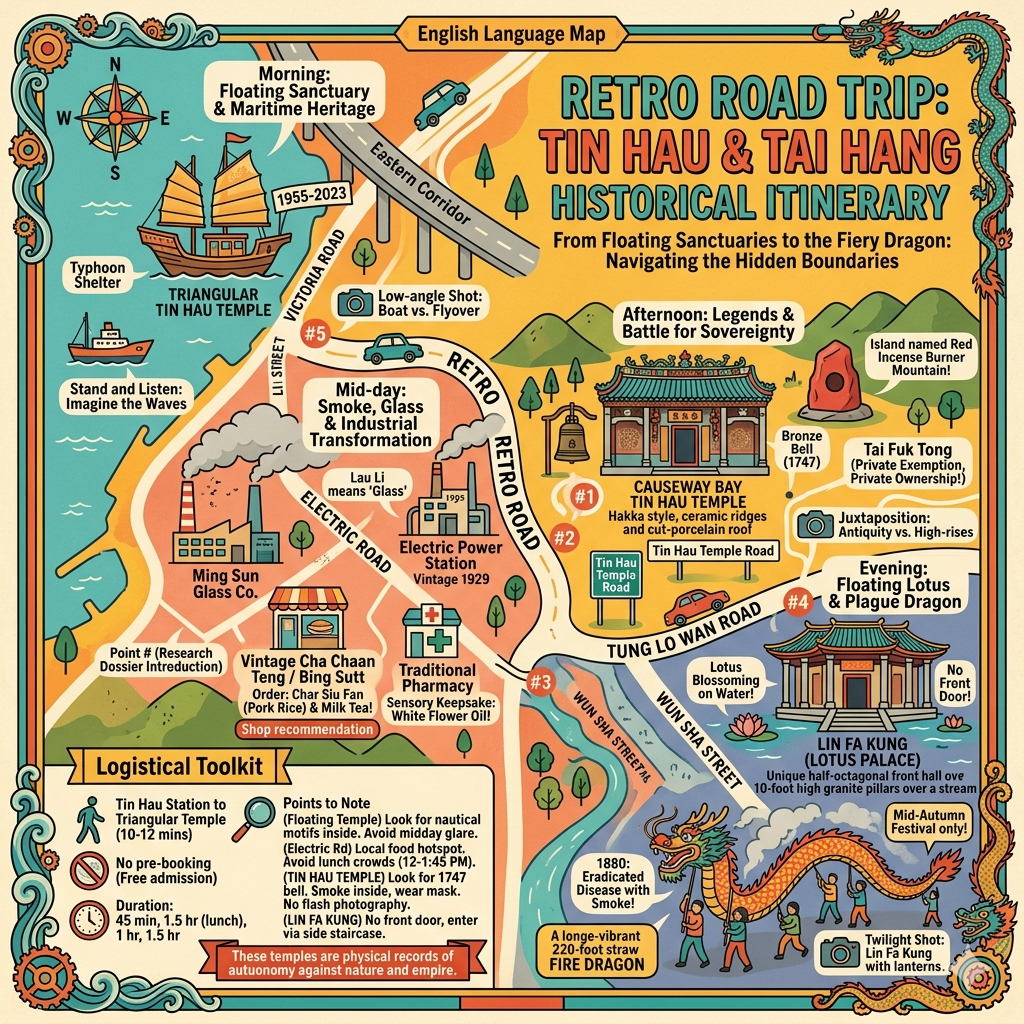
- Getting There: Take the MTR Island Line to Tin Hau Station (Exit A1).
- Recommended Walking Route:
- Tin Hau Temple: Start at 10 Tin Hau Temple Road to see the 1747 bell and the Tai family’s heritage.
- Lau Li Street: Walk through the former glass-making district and imagine the glow of kerosene lamps.
- Tai Hang Backstreets: Head into the narrow alleys of Tai Hang, following the path of the Fire Dragon.
- Lin Fa Kung: Visit the "Lotus Palace" to see the granite stilts and the "Lotus Rock" foundation.
- The New Triangular Tin Hau Temple: End at the new land-based site on Victoria Park Road to witness the final "landing" and the end of Hong Kong's maritime temple era.
Q & A
Explain the scientific reason why fire dragon dancing stopped plagues.
From a scientific and epidemiological perspective, the Tai Hang Fire Dragon Dance—originally performed to combat a devastating plague in 1880—functioned as a highly effective pre-scientific public health intervention and large-scale environmental disinfection.
The effectiveness of the ritual in stopping the plague (likely cholera or malaria) can be explained through several scientific mechanisms described in the sources:
1. Chemical Disinfection (Sulfur and Sulfur Dioxide)
The most significant scientific factor was the massive amount of smoke generated during the three-day ritual.
- Medicinal Incense: The fire dragon is covered in thousands of "long-life incense" sticks, each 45 cm long, which contain herbal ingredients and sulfur.
- Firecracker Smoke: The ceremony involves the continuous lighting of firecrackers, which release sulfur dioxide (SO2).
- Sterilization: When combined, the high concentrations of herbal smoke and sulfur dioxide act as powerful disinfectants and air purifiers, capable of killing airborne bacteria and pathogens.
2. Pest Control and Vector Suppression
History suggests the 1880 plague occurred after a major typhoon. The Tai Hang valley’s low-lying topography and poor drainage created stagnant water pools, which became breeding grounds for mosquitoes.
- Repellent Effect: The thick, sulfurous smoke produced by the dragon’s "fire" served as a massive fumigation exercise, effectively driving away or killing the mosquitoes responsible for spreading diseases like malaria.
3. Systematic Environmental Cleansing
Rather than a stationary ritual, the dragon (measuring 220 feet) is paraded through every narrow street and alleyway of the village for three consecutive nights. This movement ensured that the disinfecting smoke and heat reached every corner of the community, performing what modern health officials would recognize as a systematic spatial巡檢 (巡視與檢查) and cleansing of the living environment.
4. Waste Isolation (The "Sending Off" Ceremony)
The final stage of the ritual, known as "Sending Off the Dragon" (or Yau Tai Wan), traditionally involved throwing the dragon—now laden with spent incense, toxic ash, and soot—into the sea at Causeway Bay. In public health terms, this act represented the physical removal and isolation of contaminated materials from the residential area, effectively "cleansing" the land of the physical remnants of the disinfection process.In summary, while the villagers viewed the dance as a "sacred metaphor" to appease the Dragon King, it was in practice a sophisticated engineering defense that used heat and chemical smoke to sanitize a village suffering from post-disaster environmental contamination.
Why is the Lin Fa Temple's architecture so unique?
The Lin Fa Temple (Lin Fa Kung) in Tai Hang is considered "the most peculiar temple in Hong Kong" due to its distinctive architectural fusion of engineering necessity and religious symbolism. Its uniqueness stems from several specific design features that deviate sharply from traditional Chinese temple layouts:
1. Hybrid Geometric Structure
Unlike the traditional "two-hall, one-courtyard" (兩進一天井) layout common in Southern China, the Lin Fa Temple features a unique half-octagonal front hall shaped like a pagoda. This front hall is topped with a double-eave pyramidal roof, while the rectangular rear hall features a more conventional gabled roof. Notably, there is no courtyard between the two sections.
2. Integration with "Lotus Rock"
The temple’s rear hall is built directly into a massive granite outcropping known as "Lin Fa Shek" (Lotus Rock). The altar for Guanyin is situated on a platform built atop this natural rock formation.
3. The "Floating Lotus" Effect
Before extensive land reclamation, the temple sat directly on the coast at the mouth of the Tai Hang valley. To adapt to the steep, muddy terrain and frequent flooding, the front hall was constructed on an arched platform supported by 10 to 12-foot granite pillars.
- Visual Symbolism: During high tide, seawater would flow beneath these pillars, making the temple appear like a lotus blossom floating on water. This architectural choice perfectly embodies the Buddhist metaphor of Guanyin’s "Water-Moon Palace"—a pure lotus rising from the mud.
- Ecological Adaptation: From a functional standpoint, this semi-suspended structure was a clever engineering solution to avoid the mountain floods and swampy conditions of the valley.
4. Unusual Entrance and Western Influence
The temple lacks a traditional central main door. Instead, the front facade features a Western-style arched opening protected by iron railings. To enter, worshipers must use wooden or stone staircases located on the left and right sides of the front hall to reach the raised platform.
5. Symbolism in the "Hanging Dragon"
The interior of the temple's octagonal ceiling is also unique, featuring a "hanging dragon" (crouching dragon) mural. This design is closely linked to the local culture of the Tai Hang Fire Dragon Dance; traditionally, the fire dragon must visit Lin Fa Temple for a "consecration" ceremony before its parade, maintaining a symbolic bond between the temple's architecture and the community's rituals.
Reference and Further reading
- 琉璃街- accessed June 2, 2026,
- 1959年的铜锣湾道|城市景昔AR - CITY IN TIME, accessed June 2, 2026,
- 電氣道 - 香港道路大典, accessed June 2, 2026,
- 香港歷史博物館- 紅香爐與紅香爐天侯寺 - 香港歷史博物館, accessed June 2, 2026,
- 銅鑼灣天后廟攻略及週邊必遊景點推薦 - 雄獅旅遊, accessed June 2, 2026,
- 紅香爐港-天后廟 - L J 的光影紀錄, accessed June 2, 2026,
- 古物古蹟辦事處- 香港法定古蹟- 香港島(124), accessed June 2, 2026,
- 2026 銅鑼灣天后廟寺廟推薦| Trip Moments, accessed June 2, 2026,
- 【銅鑼灣天后廟參觀攻略2026】門票優惠 - 永安旅遊, accessed June 2, 2026,
- 大坑蓮花宮 - L J 的光影紀錄, accessed June 2, 2026,
- 香港大坑蓮花宮西街蓮花宮, accessed June 2, 2026,
- 舞火龍由來 - 香港記憶, accessed June 2, 2026,
- 《 2014 年古物及古蹟(歷史建築物的宣布)》公告, accessed June 2, 2026,
- 蓮花宮(香港法定古蹟) - YouTube, accessed June 2, 2026,
- 蓮花宮- accessed June 2, 2026,
- 大坑蓮花宮 - 香港自遊樂在18區, accessed June 2, 2026,
- 蓮花宮攻略及週邊必遊景點推薦 - 雄獅旅遊, accessed June 2, 2026,
- 大坑蓮花宮 全港最古怪廟宇、舞火龍的出發點 - 《我家》Homemory, accessed June 2, 2026,
- 古物古蹟辦事處- 香港法定古蹟- 香港島(215), accessed June 2, 2026,
- 大坑舞火龍 - 香港非物質文化遺產資料庫, accessed June 2, 2026,
- [通識.現代中國] 大坑舞火龍 - 公民· 好學, accessed June 2, 2026,
- 漁民精神寄託港唯一水上船廟年底上岸 - 公視新聞, accessed June 2, 2026,
- 水上三角天后廟- accessed June 2, 2026,
- 三角天后廟船遷移上岸佑香江 - 《我家》Homemory, accessed June 2, 2026
Lawrence Lawrence
 Lawrence