Wong Tai Sin Temple: A God in Exile on the Dragon's Vein
Wong Tai Sin Temple wasn't born of spiritual serenity. It was built from exile, forged by crisis, and sustained by the sincerity of people with nowhere else to turn. Five stories that rewrite what you thought you knew about Hong Kong's most visited temple.
 Lawrence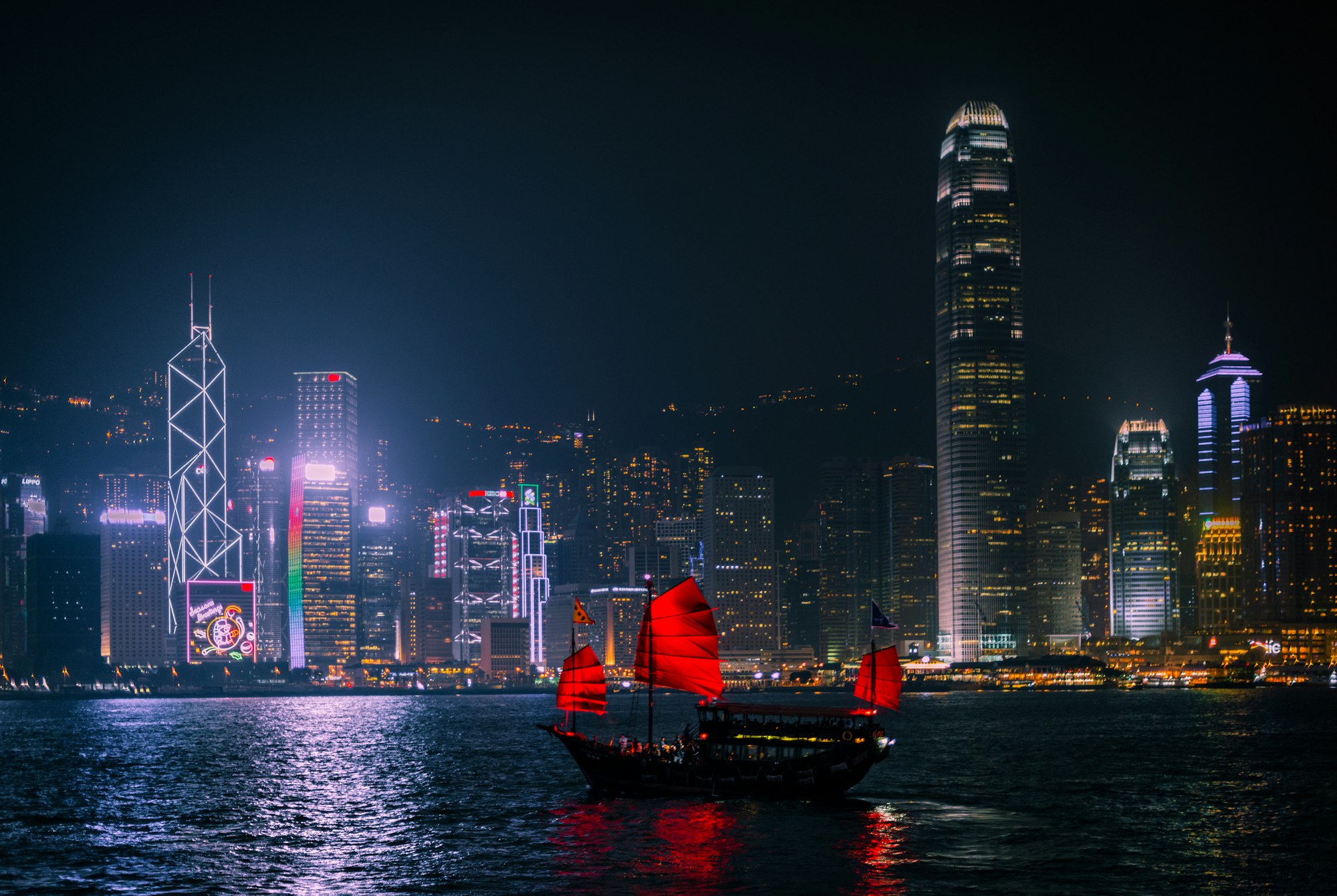
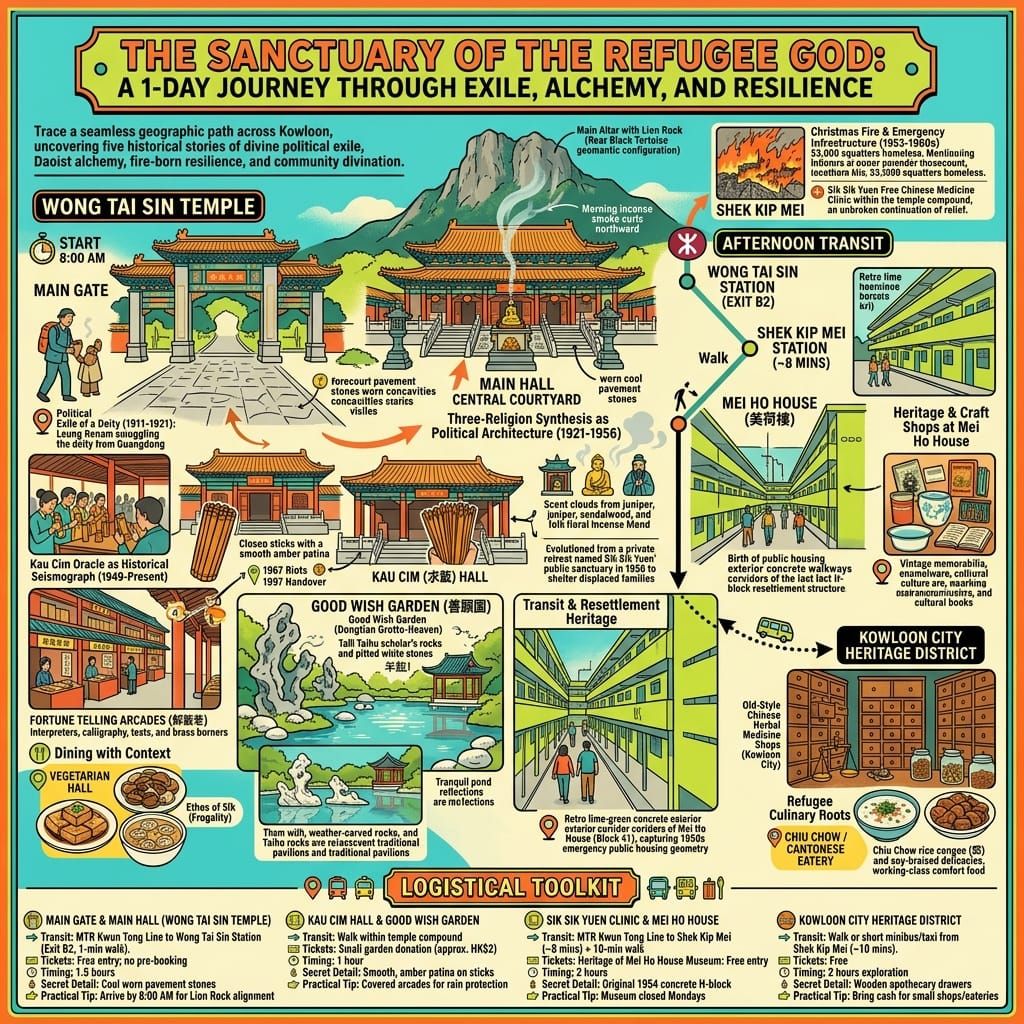
This is a deep-dive historical travel essay about Wong Tai Sin Temple (黃大仙祠) in Kowloon, Hong Kong — one of Asia's most visited religious sites and one of its most consistently misread. Across five rarely told stories, we trace how a Taoist deity arrived in Hong Kong as a political refugee, how a Christmas night fire transformed a private Daoist retreat into an emergency lifeline for fifty-three thousand homeless people, and why a set of bamboo divination sticks became the most reliable barometer of collective anxiety in the modern Chinese world. What you will gain: a framework for understanding not just this temple but the layered logic of how cities under perpetual pressure build their spiritual lives. Practical visiting guidance follows.
The Weight of This Place
What does a god do when his country turns against him?
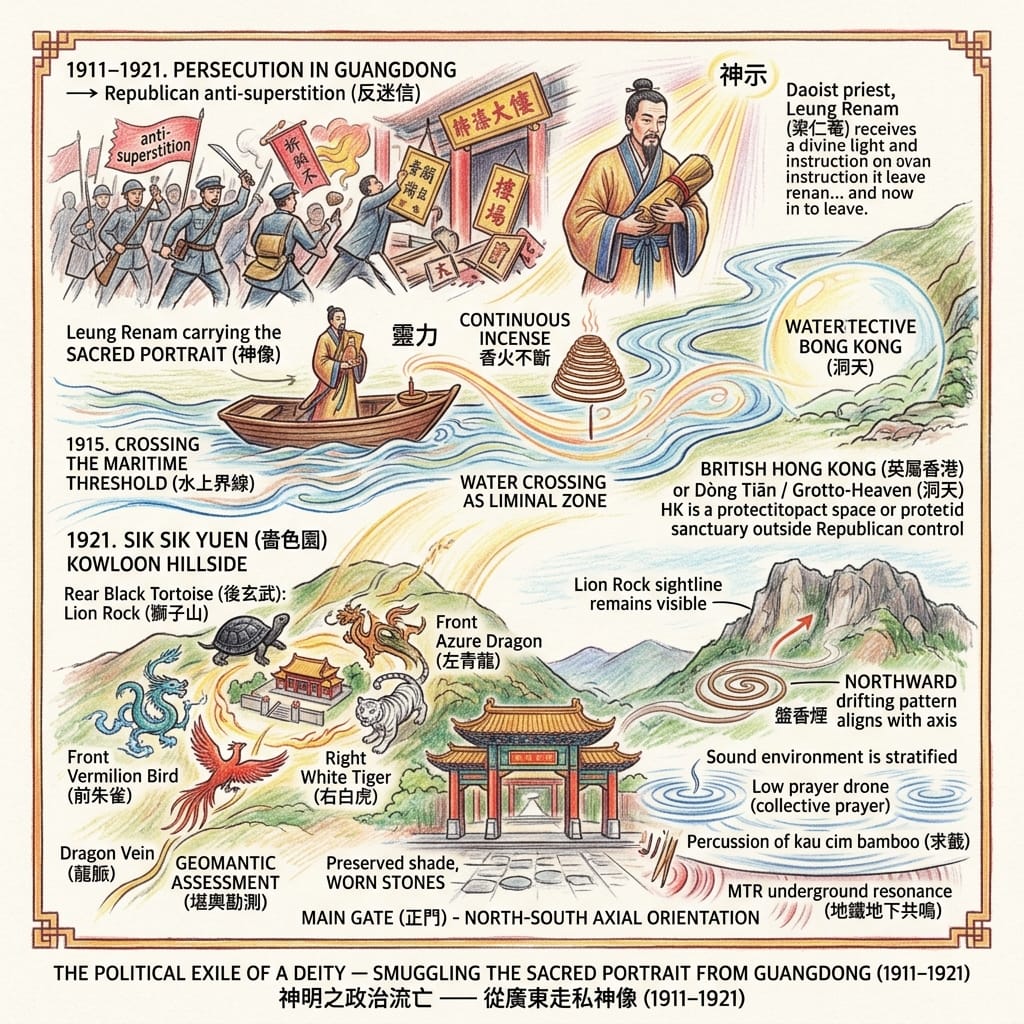
In 1915, China's new Republican government supplied an answer it didn't intend to give. Across Guangdong province, temples were being systematically seized and converted into schools and barracks. The reformist agenda was aggressively secular; the sacred was being administratively erased. A Taoist priest with a deity to protect was running out of options.
So he did what displaced people have always done. He packed what mattered most — a painting — and crossed the water.
That crossing, made across Victoria Harbour into the British Crown Colony of Hong Kong, is the founding act of one of Asia's most visited temples. It is also a story almost never told correctly: not as religious exile, not as flight from state persecution, but as divine appointment — a miraculous selection of the site by the deity himself. The miraculous frame is more comfortable. The historical frame is more interesting.
Wong Tai Sin Temple was built from exile. It was forged by crisis. And it has been sustained, across a century of upheaval, by the sincerity of people with nowhere else to turn. That is what makes it remarkable. And that is what most accounts of it consistently miss.
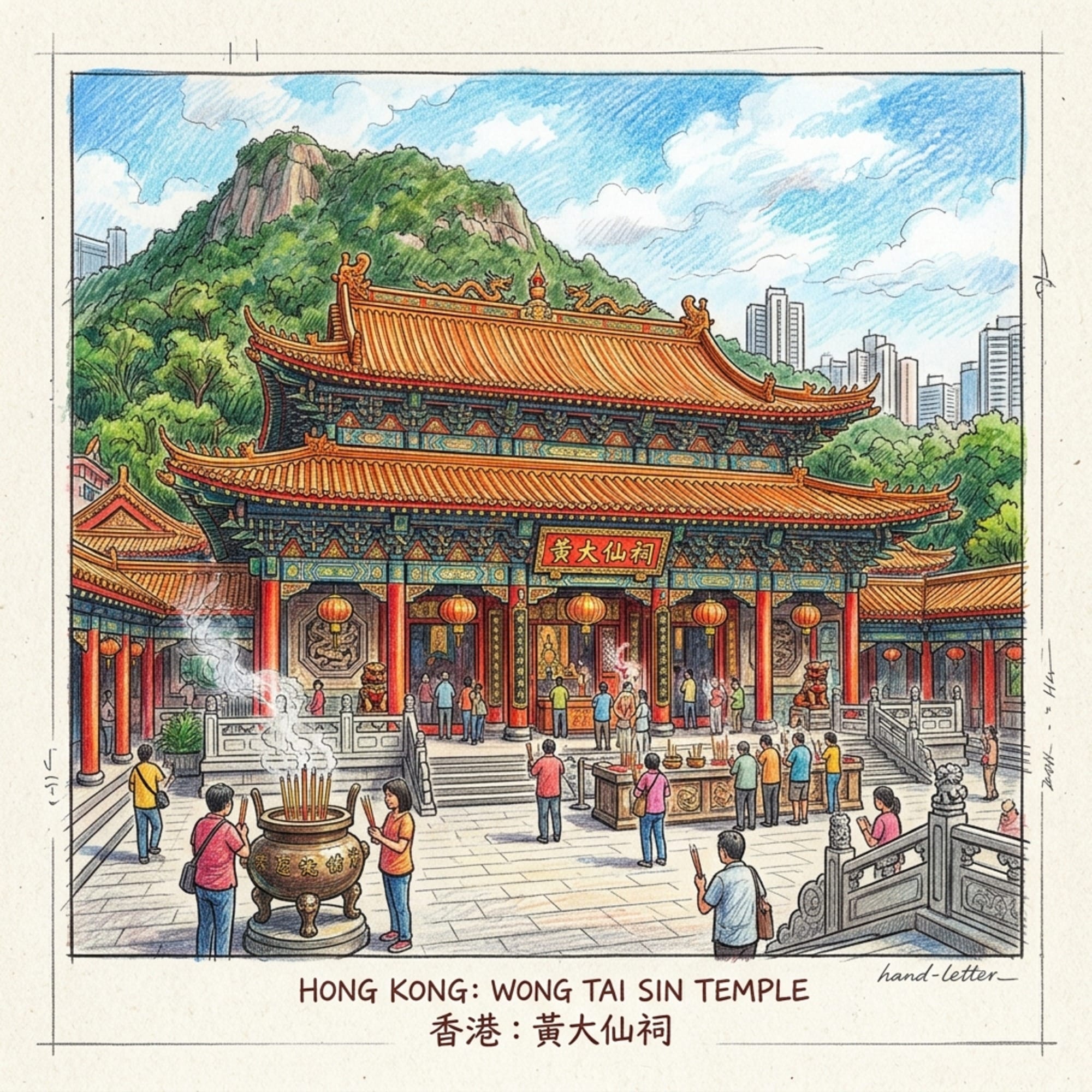
Listen to the historical stories told in detail (For subscribers only)
Story One: The God Who Arrived as a Refugee (1911–1921)
The Republican Revolution of 1911 was, among other things, a declaration of institutional war on traditional Chinese religious culture. The modernizing ideology of the new government — inflected by Social Darwinist anxieties about whether China's "backward" religious practices were impeding national development — translated directly into policy. In Guangdong province, the dismantling of temples was organized and systematic. Daoist organizations lost legal standing; sacred assets were confiscated; practitioners were pressured to conform or disperse.
Leung Renam (梁仁菴) had been operating a private Daoist altar, the Puqing Altar (普慶壇), dedicated to the deity Wong Tai Sin in Guangdong. When political pressure made continuation impossible, what his organization's records frame as divine instruction — a command from the deity to relocate — was also, in the plain language of history, a rational response to institutional collapse. British colonial Hong Kong, governed by administrative law that was indifferent to Chinese religious practice in ways that Republican nationalism simply was not, provided an exit.
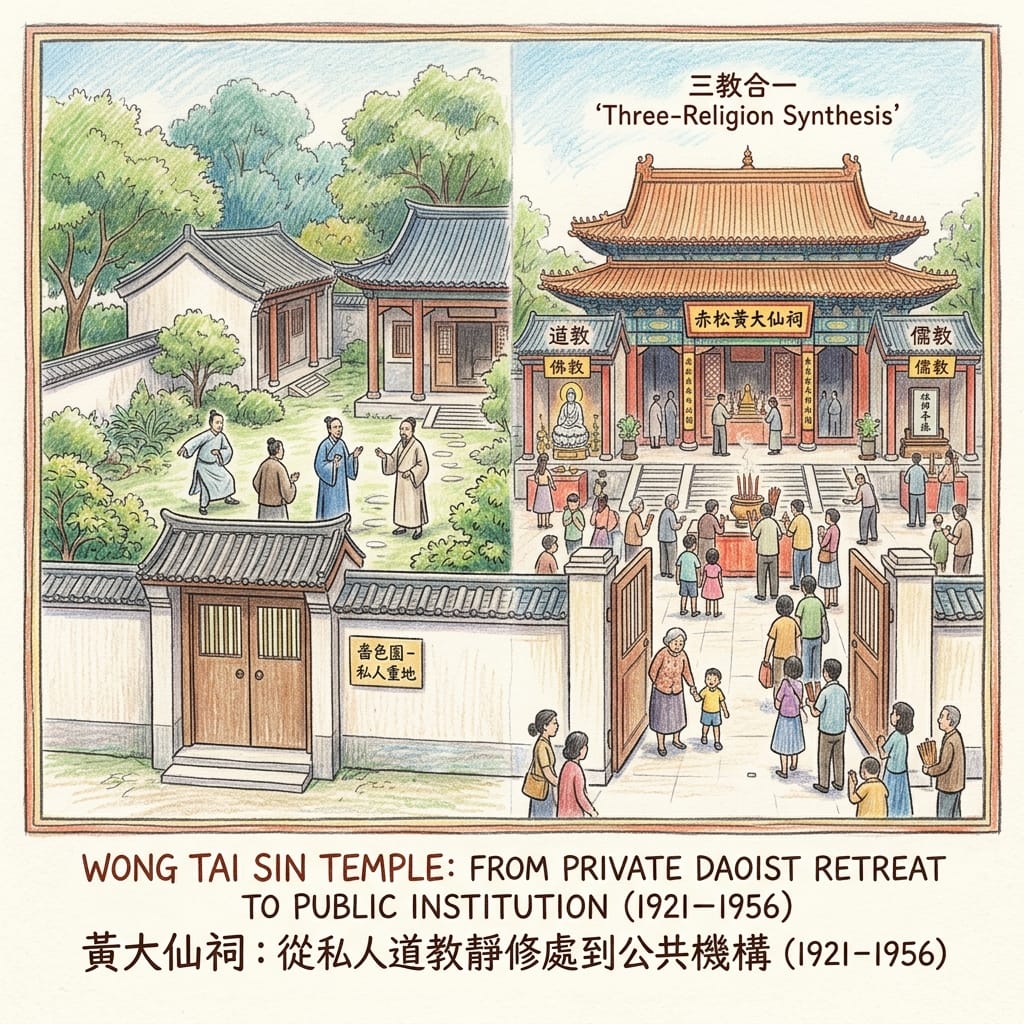
He arrived in Hong Kong in 1915. A temporary altar was established in the Wan Chai district — modest, private, serving a small circle of Cantonese Daoist devotees. In 1921, the Sik Sik Yuen (嗇色園) organization was formally constituted and the temple relocated to its current site on the Kowloon hillside, chosen through geomantic consultation beneath the ridge of Lion Rock.
The organization's name is itself a doctrinal statement drawn from Chapter 59 of the Tao Te Ching: 嗇 (sè) refers to the Daoist discipline of conserving one's vital energy rather than dissipating it — being frugal with the self, in the deepest sense. Sik Sik Yuen: Garden of Careful Cultivation. This is not the name of a public religious institution. It is the name of a private ascetic community. For thirty-five years — from 1921 to 1956 — the temple would remain exactly that: restricted, un-announced, not open to the city surrounding it.
Smuggling The Refugee God
This is the detail that rewrites the standard account of Wong Tai Sin Temple: for more than three decades after its founding, it did not welcome visitors. Its current identity as one of Hong Kong's great public spaces — crowded, loud, miraculous in its accessibility — was not its founding design. It was forced open by history. What history did, and how, is the rest of this story.
Holographic Sensory Cue:
Victoria Harbour, 1915. A winter morning. The water is grey and unremarkable; the light is flat. A man stands at the rail of a ferry, holding something wrapped in old cloth — a painting, kept close against the damp. The ferry smells of engine oil and brine. He has no temple to deliver it to, no consecration date, no congregation waiting. He has a deity, a painting, and a British stamp in his papers. The Kowloon hills ahead of him are green and unbuilt — forty years before the concrete estates will wall the hillside in. He steps off the ferry onto a wooden dock into a city that does not yet know his name. The painting is warm from being held. The harbor closes behind him.
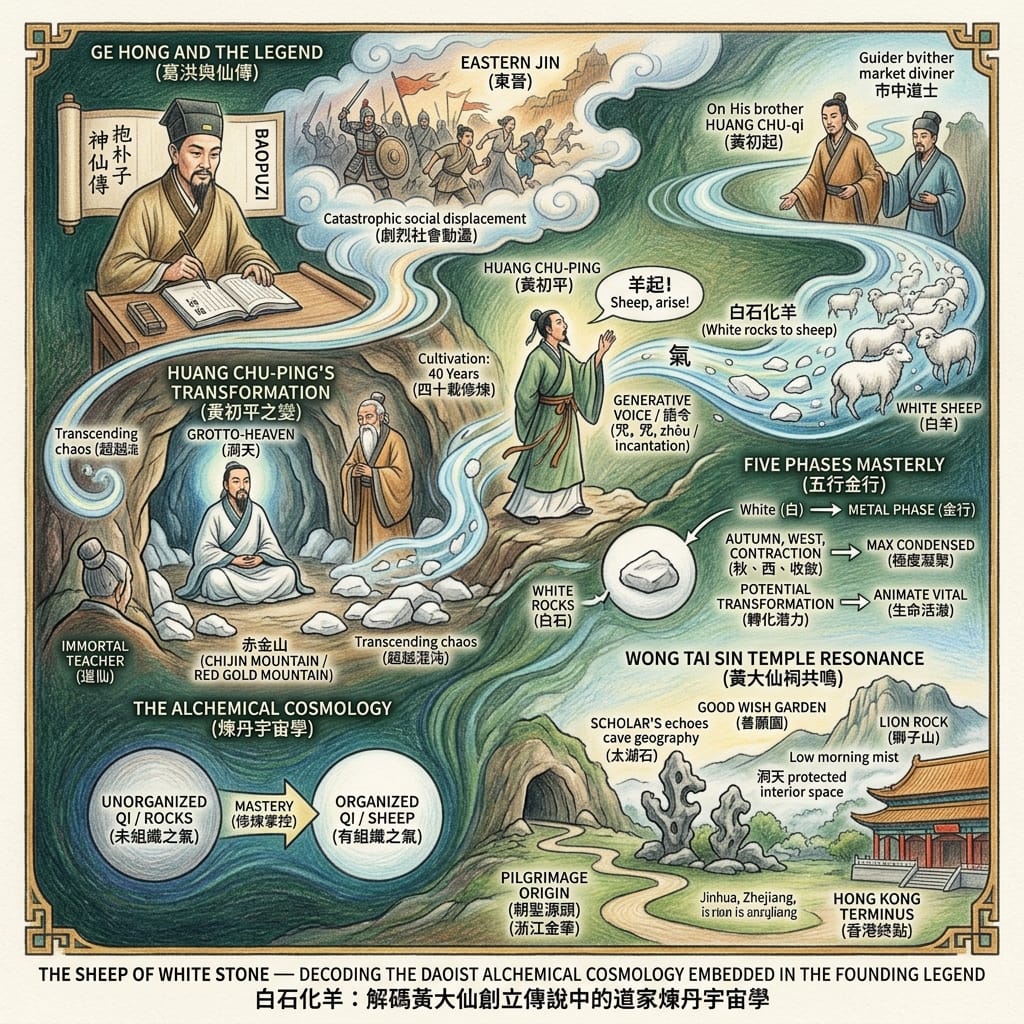
Story Two: What the White Rocks Are Really Saying — The Cosmological Code Inside the Founding Legend
Before you can understand what Wong Tai Sin Temple is doing, you need to understand who Wong Tai Sin is — not the version that appears on temple pamphlets, but the cosmological one.
The deity's mortal identity is Huang Chu-ping (黃初平), a shepherd boy from Jinhua in Zhejiang province. His story is recorded in the Shénxiān Zhuàn (神仙傳 / Biographies of Divine Immortals), compiled in the early fourth century CE by Ge Hong (葛洪) — one of the most systematic thinkers in the history of Daoist alchemy, and an official of the Eastern Jin court. The narrative runs as follows: at the age of fifteen, while tending sheep on a mountain, Huang Chu-ping was led by a Daoist immortal into a cave. There he cultivated — without eating, without drinking, outside ordinary time — for forty years. His elder brother searched for him across the decades, finally located him, and asked: what happened to the sheep? Huang Chu-ping answered that they were to the east of the mountain. The brother looked. He saw only white rocks. Huang Chu-ping raised his voice: "Sheep, arise!" — and the white rocks became tens of thousands of living sheep.
Every account of Wong Tai Sin Temple tells this story. Almost none of them explain what it means.
Ge Hong was not a storyteller of spectacle. He was a theorist, and every element of this narrative is doing analytical work within a framework that the popular framing entirely discards. In Daoist cosmological understanding, matter is not inert substance. Everything — rock, sheep, human, mountain — is a configuration of qì (氣 / vital breath), differing in degree of organization and dynamism, not in fundamental material. The difference between a white rock and a white sheep is a difference of qì organization within the same phase of the Five Phases (五行 / wǔxíng) cosmological system. Both are Metal phase (金行) — the phase associated with the color white, the west, autumn, and transformation through compression. A white rock is Metal phase qì at maximum contraction and inertia. A white sheep is Metal phase qì in vital animation. What separates them is the qì field of the practitioner who has spent forty years refining his own vital energy to the point where he can, through voiced intention, reorganize external matter.
"Sheep, arise!" is not magic. Within the framework Ge Hong represents, it is a demonstration of mastery — the practitioner's cultivated voice as a carrier of qì, applying a refined internal field to a less organized external one. Think of it less as miraculous and more as extremely advanced, in the terms the culture used to understand advanced.
Two further details resist casual reading. The forty years are numerologically deliberate in Daoist cosmology: a period marking the completion of a major transformative cycle, not simply "a long time." The cave is a dòng tiān (洞天 / Grotto-Heaven) — a Daoist technical term for a spatially liminal enclosure, typically a mountain cave or valley hollow, where normal time and the normal reach of political authority are suspended. Ge Hong's Daoist texts identify dozens of such sites across China. They share a defining quality: the ordinary world cannot enter them. They are, in the most literal sense, outside.
Now place this back in its historical context. Ge Hong was writing in the early fourth century for the refugee court of the Eastern Jin — a Chinese imperial government that had been driven southward from its northern capital by non-Han kingdoms. He was composing Shénxiān Zhuàn for an audience that knew displacement not as metaphor but as recent memory. Into this context he placed a story in which exile is not an obstacle to cosmological mastery but its enabling condition. The miracle does not happen in the ordinary world. It happens inside the displacement — in the Grotto-Heaven, the space that only exile creates. Without forty years in the cave, there is no transformation of stone to sheep.
This cosmological position — that uprootedness creates the conditions for the deepest cultivation — runs as a subterranean current through everything that happens at Wong Tai Sin Temple across the following seventeen centuries.
How Daoist Alchemy Turns Rocks Into Sheep
The Daoist Physics of This Place: Dragon Veins, Celestial Animals, and the Logic of Sacred Space
Framework note: the entire analysis below operates within Daoist cosmology (道教宇宙觀) — the tradition natively associated with this site, its founders, its deity, and its devotee community. No external framework is applied.
This section exists because the people who built Wong Tai Sin Temple understood their world through a specific cosmological system, and that system has genuine explanatory power for understanding what this site is doing spatially and historically. It deserves to be explained on its own terms.
The foundational concept is lóng mài (龍脈 / dragon veins). In Daoist geomantic practice — the discipline known as kānyú (堪輿), popularly rendered as Feng Shui — mountain ranges are understood as channels through which the earth's vital energy (qì) flows and concentrates. The analogy the tradition itself offers is precise: dragon veins are to the earth what meridians are to the body in traditional Chinese medicine. They carry qì; they can be assessed; they can be blocked or supported; they have specific sites of accumulation. The practice of kānyú is the discipline of identifying where qì concentrates most favorably — a geographic xué (穴 / acupoint) — for the placing of a temple, a home, or a grave.
When the Sik Sik Yuen selected its Kowloon hillside location in 1921, they were working within a specific classical configuration: the Four Celestial Animals (四神獸) formation, the most auspicious geomantic arrangement in the canon.
| Direction | Animal | Function | Wong Tai Sin |
|---|---|---|---|
| North (rear) | Black Tortoise (玄武) | Protective rear mountain | Lion Rock (獅子山) — directly north |
| South (front) | Vermilion Bird (朱雀) | Open vista, qì gathering space | Kowloon valley, pre-1953 |
| East (left flank) | Azure Dragon (青龍) | Left-side protection | Eastern ridge |
| West (right flank) | White Tiger (白虎) | Right-side containment | Western slope |
The site in 1921 fit this formation precisely. The location was not chosen for its views or its convenience. It was chosen because it fit a spatial diagram of energy management — because Lion Rock behind it functioned as the protective northern anchor of a formation the geomancers could read clearly.
What makes this analytically interesting is what happened next.
After the 1953 Shek Kip Mei fire — the event described in Story Three — Hong Kong's colonial government built its first public housing estates. Concrete residential towers rose directly to the south of the temple, closing the Vermilion Bird opening. The open valley that had constituted the front of the geomantic formation was filled with high-rises. The dragon vein channels flowing through open land were buried under concrete infrastructure. By the internal logic of the geomantic system, this should have been a serious blow to the temple's líng (靈 / numinous efficacy) — the specific quality, in Daoist understanding, that makes a sacred site responsive.
Instead, the temple's líng surged. Visitor numbers increased dramatically. The queues for divination extended into the streets outside.
The Daoist framework offers only one interpretation: the temple's operating principle was never primarily geographical. The core mechanism is gǎnyìng (感應 / sympathetic resonance) — the cosmological principle that sincere human petition (gǎn 感, "to move, to activate") generates a responsive signal from the universe (yìng 應, "to answer, to resonate") channeled through the deity's numinous power. You can disrupt dragon veins with concrete. The gǎnyìng circuit between sincere need and divine response cannot be disrupted by anything material.
The words engraved above the main entrance — 有求必應 (yǒu qiú bì yìng / "all requests answered") — are a condensed statement of this principle. They are not a service guarantee. They are a cosmological position: sincere petition (qiú 求) invariably generates divine response (yìng 應). The condition is not doctrinal alignment. The condition is chéng (誠 / sincerity) — the quality of genuine engagement. The implications of that condition, applied to a city of refugees, are enormous.
Story Three: The Christmas Night That Changed Everything (1953)
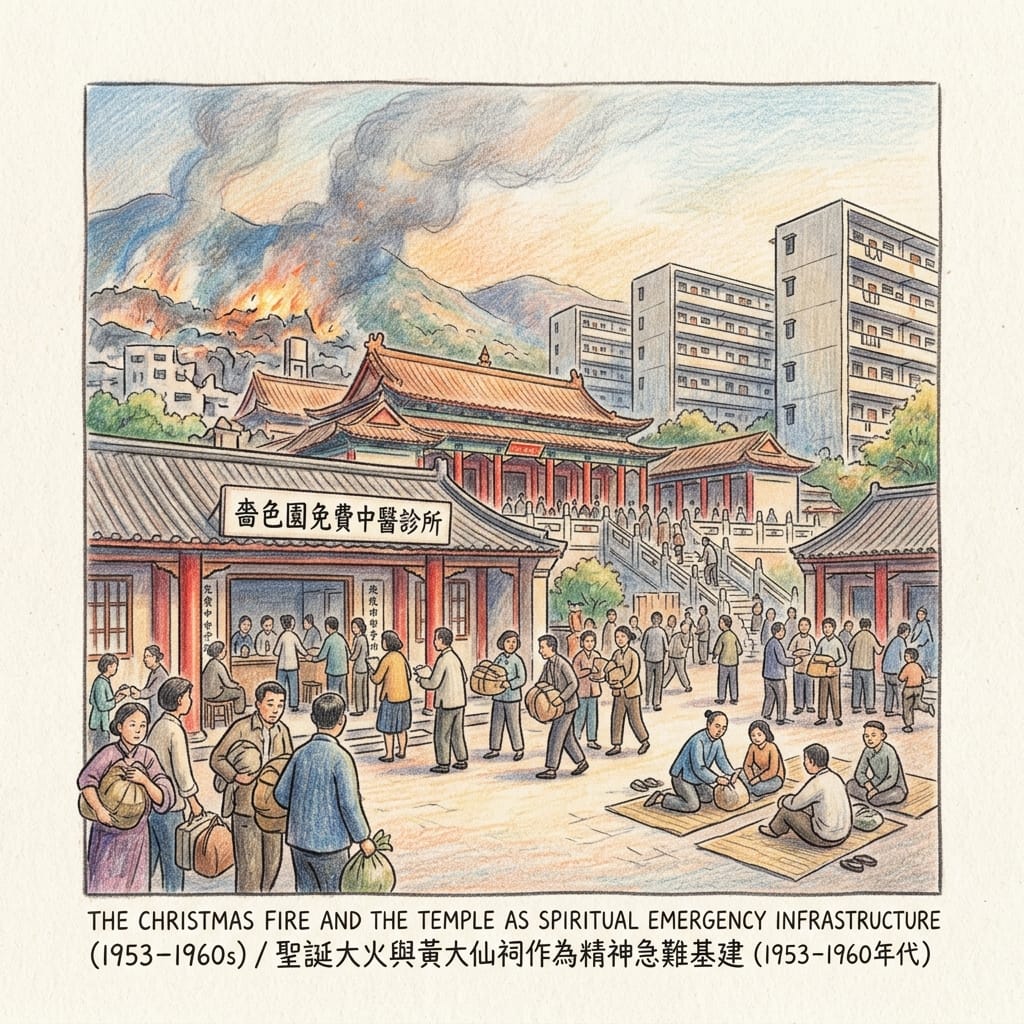
At some point during the night of December 25, 1953, a fire started in the Shek Kip Mei squatter settlement on the Kowloon hillside — approximately five hundred meters from the Wong Tai Sin temple precinct.
Hong Kong in 1953 was a city in the middle of a demographic emergency it had no real infrastructure to manage. In the four years since the Communist Party's victory on the mainland, approximately one million refugees had arrived — people who had left everything to cross the border into a British colony that had not anticipated receiving them at this scale. The hillsides of Kowloon were covered with the inevitable result: timber-and-corrugated-iron shanties, built close together on steep ground, creating the conditions that produce catastrophic fires.
That night, driven by winter winds, the fire destroyed roughly forty-five acres of settlement before it was contained. By morning, an estimated 53,000 people were homeless. They had already lost one home when they fled the mainland. They had now lost another.
The colonial emergency system was not built for this. Hospitals filled. Administrative capacity was overwhelmed. Fifty-three thousand people needed somewhere to go.
Wong Tai Sin Temple had been operating a free traditional Chinese medicine clinic since at least the late 1940s, funded through the Sik Sik Yuen's charitable programs. This is worth pausing on, because the clinic is often described as evidence of the organization's philanthropy — a good deed layered onto a religious institution. That misses something important. In Daoist tradition, Wong Tai Sin is specifically a healing deity. The cultivation narrative of Huang Chu-ping emphasizes his mastery of alchemical medicine (dānyào 丹藥). The free clinic was not charity decoration added to the temple's margins. It was the institutional expression of the deity's core cosmological attribute — the theological claim made physical. Healing is what this deity does. The clinic is what that means in practice.
The Christmas Fire That Forged A Temple
On December 26 and the days immediately following, the clinic extended its reach to fire victims. What had been a private Daoist retreat for an educated Cantonese professional community became, in the emergency, welfare infrastructure for the city's most vulnerable people.
The political aftermath reshaped the temple's physical world permanently. The Shek Kip Mei fire directly triggered Hong Kong's first systematic public housing program: the rapid construction of the Resettlement Estates — utilitarian concrete blocks, H-shaped in floor plan, raised with colonial administrative speed across the Kowloon hillsides, including the Wong Tai Sin district. The semi-rural hillside that had sheltered a private Daoist enclave since 1921 was transformed, within a decade, into one of the most densely populated urban districts on earth.
The temple did not move. Hong Kong grew around it, changed its skyline, buried its dragon veins in concrete — and increased its congregation a hundredfold.
The decision to open the gates, formalized by the Sik Sik Yuen in 1956, was not purely theological. It was also demographic, political, and moral: you cannot maintain a private sanctuary when fifty-three thousand people have just lost their homes within audible distance of your walls. History had delivered the temple a congregation it hadn't planned for. The temple, to its institutional credit, received it.
Story Four: The Most Calculated Ecumenism in Hong Kong (1921–1956)
The Sik Sik Yuen's Three Teachings synthesis (三教合一 / sān jiào hé yī) — the explicit institutionalization of Taoism, Buddhism, and Confucianism within a single organizational and architectural structure — is frequently presented as evidence of Chinese religious open-mindedness: a cultural predisposition toward theological pluralism, the East's comfortable relationship with multiple frameworks simultaneously.
This characterization is accurate but incomplete to the point of being misleading. The Three Teachings framework at Wong Tai Sin was also a deliberate structural decision made under specific historical pressure. Understanding which is which matters for understanding what the institution actually is.
The philosophical case for the Three Teachings' fundamental unity has genuine intellectual roots in Chinese thought. Song Dynasty Neo-Confucians theorized it rigorously from the eleventh century onward, and the tradition of 三教合一 thinking runs deep in Chinese intellectual history. But theory is not architecture. What the Sik Sik Yuen did was materialize the concept: a separate shrine for Buddhism with its own liturgical integrity; a Confucian hall with its own observances; a charitable program organized across all three frameworks; a calendar of practice that honored each. This level of institutional elaboration does not happen through cultural disposition alone. It is a decision.
The strategic logic becomes clear when you map it against the population the temple was serving after 1949. Refugees from across China arrived in Hong Kong carrying religious and folk-religious traditions from dozens of different provincial contexts — varied degrees of Buddhist, Confucian, Daoist, and local folk-religious emphasis, often seamlessly intermingled in lived practice. A strictly Daoist institution could serve its founding community of Cantonese Daoist practitioners. Only a Three Teachings institution could serve everyone who knocked.
In Daoist spatial terms, the design is theoretically coherent. The main hall (大殿), dedicated to Wong Tai Sin, functions as the líng center — the primary node of numinous efficacy. Buddhist and Confucian spaces orbit it as institutionally dignified satellites: not subordinate in prestige but cosmologically organized around a Daoist axis. The arrangement approximates a mandala-like diagram of the teachings' relationship, with the central deity's gǎnyìng responsiveness as the organizing principle.
The operative cosmological concept that holds the whole structure together is chéng (誠 / sincerity). Because the Daoist framework specifies that the deity's response is triggered by the sincerity of the supplicant rather than their doctrinal affiliation, the Three Teachings architecture creates a universal interface. You arrive with Buddhist prayers or Confucian ethics or pure need and no theological language at all — and the deity responds equally. This is not spiritual vagueness. It is a specific cosmological position that happens to have excellent demographic reach.
The 1956 public opening was the culmination of this logic: a private cultivation community, comprehensively remade by refugee crisis, demographic pressure, and the systematic theology of gǎnyìng, into a comprehensive spiritual infrastructure for a city that displacement had built.
How Wong Tai Sin Blends Three Religions
★ Resonance Node ★
The Yuk Yat Tong Free Clinic Waiting Room (毓日堂)
Walk past the main hall. Past the incense coils, the fortune-teller stalls, the tour groups photographing the bright glazed temple roofs. Find the Yuk Yat Tong Traditional Chinese Medicine Clinic.
Sit in the waiting room.
The people around you are mostly elderly — residents of the surrounding estates whose parents or grandparents may have been among the 53,000 made homeless in December 1953, or their children, or their children's children. The free clinic has operated here without interruption for more than seventy years. The sound is domestic: quiet Cantonese, the administrative rhythms of a working medical practice, the soft rustle of paper prescription bags. One courtyard separates you from the bamboo percussion of the divination hall.
This is the place where the temple's theology becomes social reality. Not in the gilded main hall, but here, in a room that smells like medicinal herbs and serves people who need it. Wong Tai Sin is a healing deity. This waiting room is what that means, rendered into the concrete of an institution that has refused to close for seven decades.
Sit here for ten minutes. Let the doctors and their patients conduct their business. You are inside the oldest continuously operating act of the temple's theology.
Story Five: The Bamboo Sticks That Recorded a City's Fear (1949–Present)
There is no quieter way to take a city's temperature than to listen to the sound of bamboo cylinders being shaken in a Kowloon temple.
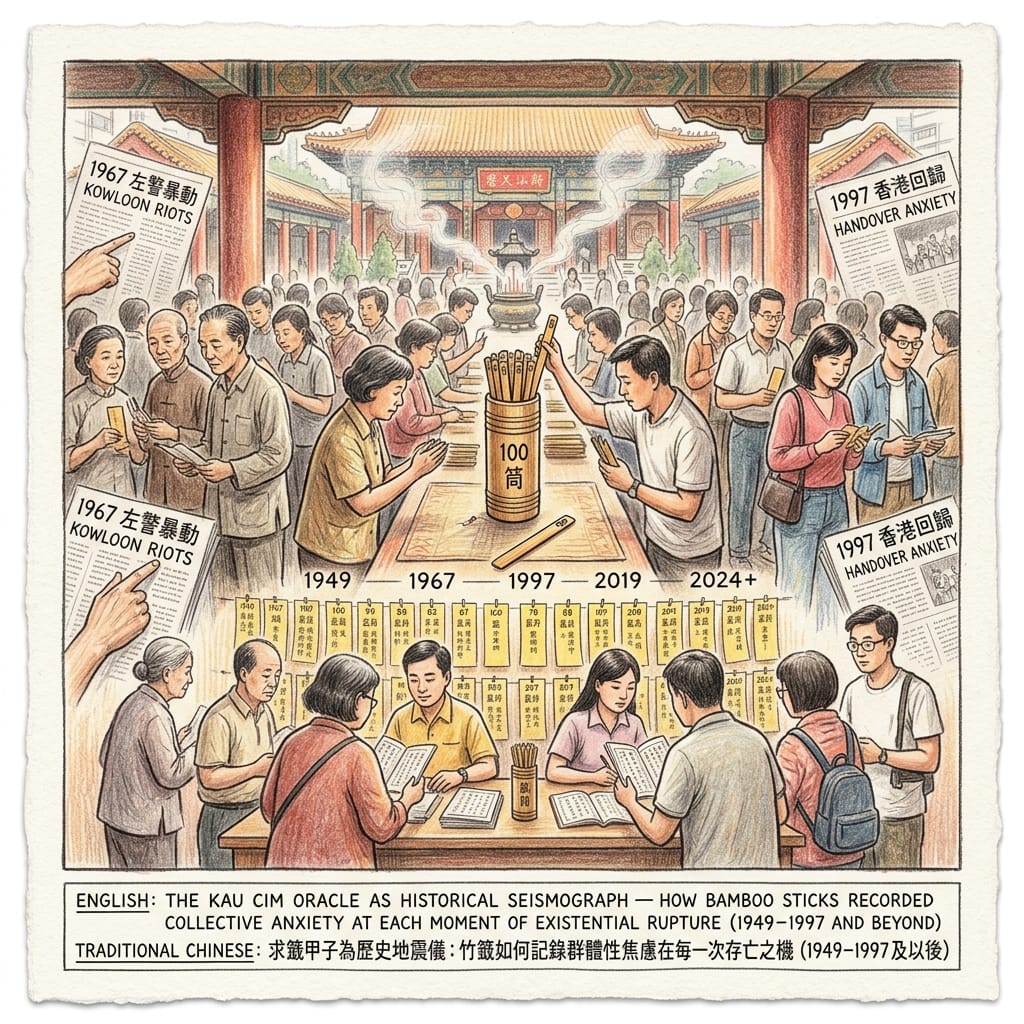
Kau cim (求籤 / seeking the oracle sticks) is a divination practice found across Chinese religious sites throughout East and Southeast Asia. The mechanics are accessible to anyone: you take a cylindrical container holding one hundred numbered bamboo sticks, hold it in both hands, kneel before the deity's altar, and shake it — gently, rhythmically — until one stick falls. The number on that stick corresponds to a verse, written in classical Chinese, from a corpus of oracle poems. The verse's language is deliberately polyphonic, capable of multiple readings; a trained interpreter applies it to your specific circumstances.
The system is not unique to Wong Tai Sin. What is unusual here is both the volume and the pattern — the observable relationship between that volume and the history of collective crisis in Hong Kong.
Sociological research conducted in the 1990s documented a clear relationship between oracle consultation intensity and periods of social uncertainty. In 1967, Hong Kong's pro-Communist labor movement — ignited by mainland China's Cultural Revolution — organized strikes, planted real and improvised bombs across the city, fought pitched battles with colonial police, and generated a period during which ordinary predictive reasoning about daily life became genuinely useless. You could not calculate what would happen next. The logic of normal decision-making had broken down. The kau cim queues lengthened.
In 1997, in the weeks preceding the handover of Hong Kong's sovereignty to the People's Republic of China on July 1st, the queues extended beyond the temple gates into the street. Journalists documented it; temple interpreters reported that the overwhelming subjects of consultation during those weeks were emigration, property, and the futures of children — the existential arithmetic of a population navigating sovereign discontinuity for the first time in a century and a half.
The pattern across these and other crisis periods is legible as a sociological phenomenon quite independently of any metaphysical claims about oracles. When rational information systems fail — when the future becomes genuinely opaque — divination consultation intensifies. The oracle system provides a decision-making framework for conditions of radical uncertainty. It allows action when the ordinary tools of prediction have dissolved. Its social function operates regardless of whether its cosmological claims are true.
How Kau Cim Solves Radical Uncertainty
Within Daoist understanding, of course, the analysis goes further. The gǎnyìng principle holds that sincere petition (gǎn) generates a cosmic response (yìng) mediated by the deity's líng. The bamboo stick's fall is not random; it is the universe's answer to a sincere question, filtered through divine responsiveness. The 有求必應 ("all requests answered") principle operating at population scale means a city in crisis speaks simultaneously to the deity — through tens of thousands of sincere individual petitions — and the deity responds. One stick at a time, into one pair of hands at a time, the cosmic dialogue runs.
Read the one hundred oracle verses closely. Their thematic concentration is striking: long journeys of uncertain outcome; family separated across distance; the importance of patience when resolution is delayed; the value of inner cultivation when external circumstances are disordered. This is not a corpus designed for settled, prosperous times. It is a manual for people in transit — written, in all likelihood, for a migratory civilization that had already experienced displacement as a recurring condition of existence, not an aberration. The fact that Hong Kong's post-1949 population arrived carrying exactly these questions, and found a corpus that had been addressing them for centuries, is not coincidence. It is institutional memory that outlasted the institutional context that generated it.
Conclusion: The Portable God
Conventional accounts of sacred sites tend to root their authority in permanence. The temple endures across centuries. The mountain stays. The pilgrim route wears its groove into the stone over a thousand years. The site's power derives from its rootedness, its continuity, its ability to be the thing that does not move when everything else does.
Wong Tai Sin Temple dismantles this framework entirely. And not accidentally.
The deity's own founding narrative is a story of exile as the precondition for transformation. Forty years in a cave — outside ordinary society, outside ordinary time, outside the reach of ordinary politics — is not the price Huang Chu-ping pays for his power. It is the mechanism through which that power is generated. The Grotto-Heaven works because the ordinary world cannot enter it. The displacement creates the conditions; the miracle emerges from the conditions. Without the cave, the white rocks stay white rocks.
The deity's arrival in Hong Kong was itself an act of exile. A painting, carried across a harbor by a priest under political pressure, with no fixed destination. The institution that grew from that crossing was a refugee institution from the moment of its founding — the first Hong Kong temple established not by a local community choosing to build but by a displaced practitioner choosing to run.
The temple's public opening in 1956 was forced open by surrounding displacement — by the moral weight of tens of thousands of homeless people whose condition the founding legend had, in some deep structural sense, already addressed.
And every crisis since — 1967, 1997, and the years that have followed — has seen the temple's oracle queues lengthen, its healing clinic fill, its deity's efficacy intensify in direct proportion to the community's need. Not diminish. Intensify.
有求必應 is not a promise of stability. The four characters do not say: come here and things will remain as they are. They say: come here when things are falling apart, sincerely, and I will answer. The deity's authority rests not on permanence but on responsiveness — not on being unmoved but on moving with whoever needs accompaniment. And the temple has been delivering on exactly that promise, in exactly that mode, for a hundred years.
This is why the temple thrives embedded in one of the world's most densely built public housing districts — its classical geomantic formation long since compromised by concrete estates, its southern vista walled by towers, its hillside geomancy buried under urban infrastructure. Fixed sacred geography was never the operating principle. The operating principle was always the deity's responsiveness to sincere need, regardless of location, regardless of political configuration, regardless of how much concrete has been poured over the dragon veins.
Wong Tai Sin does not anchor a place. It anchors a people — wherever they find themselves, in whatever crisis has found them. And in a city that has been finding itself in crisis — political, colonial, revolutionary, epidemiological, existential — for the better part of a century, a deity who specializes in crisis accompaniment is not a niche theological offering. It is the only theology that fits.
Every civilization builds its cosmology from its most recurring experience. Hong Kong's most recurring experience has been displacement. And from that experience, over a hundred years of accumulated practice, it built a god who understands it from the inside.
The past is not behind us. It lives beneath our feet — in the stone worn smooth by a million supplicants, in the bamboo stick warm from a hand that held it in fear in 1967 and another hand in 1997 and another hand this morning. Historical memory is not heritage preservation. It is the most precise instrument available for understanding where we actually are. Walk into Wong Tai Sin Temple knowing this, and the incense smoke becomes something more than atmosphere. It becomes testimony — the accumulated evidence of a hundred years of sincere need, and the responses it received.
If this essay has deepened your engagement with Hong Kong's layered history, subscribe to our newsletter for more dispatches from the Spiritual Anchor in Multidimensional Spacetime series.
Accessing the Physical Node
Address: 2 Chuk Yuen Village, Wong Tai Sin, Kowloon, Hong Kong (Sik Sik Yuen Wong Tai Sin Temple / 嗇色園黃大仙祠)
Getting There:
- MTR: Wong Tai Sin Station (Kwun Tong Line), Exit B2. The temple entrance is a three-minute walk — one of the most direct public transit connections of any major Hong Kong religious site. No taxi or complex navigation required.
- By bus: Multiple routes from across Kowloon stop near the MTR station.
When to Visit:
- Early morning — opening time to around 8:00 AM: The forecourt is near-empty. Incense smoke and flat morning light cross the worn stone in a way photographs don't capture. The axial alignment with Lion Rock's ridge — the geomantic north-south axis the founders established in 1921 — is most legible at this hour, before heat haze obscures the mountain. This is the time to understand the spatial reasoning of the site.
- Pre-Chinese New Year (late January / early February): Oracle consultation queues reach their annual peak. If you want to understand the kau cim system as a sociological phenomenon rather than a tourist curiosity — to understand what the journalists were watching in 1997 — stand in this space at this time. The bamboo percussion is overwhelming. It is the sound of a city thinking out loud.
What Not to Miss:
- The Main Hall (大殿): The architectural center of the Daoist líng field. Look north from the main entrance; Lion Rock's ridge should be visible above the rear boundary — the Black Tortoise formation that the 1921 geomancers identified. The sight line has not been completely closed.
- The Yuk Yat Tong Free Clinic Waiting Room: See the Resonance Node above. This is the place where the temple's theology becomes legible as social history. Go here deliberately. Most visitors don't.
- The Good Wish Garden (善願園): A classical Chinese garden adjoining the temple compound. Early morning mist around the upright scholar's rocks — tài hú shí (太湖石), the pitted limestone pieces central to classical Chinese garden aesthetics — creates a visual register that echoes, without reproducing, the mountain-cave landscape of the founding legend. Worth ten minutes if the main temple is already crowded.
- The Kau Cim Hall: Even if consulting the oracle feels inappropriate for a visitor, stand in this space and listen. The aggregate percussion of dozens of bamboo cylinders being simultaneously shaken by dozens of different hands, each at their own rhythm — it produces a white-noise percussion that is unique to this experience. It is the sound of the gǎnyìng principle operating at scale: the city speaking to the deity, simultaneously, in a hundred different voices.
Reading the Urban Context: The streets immediately around the temple — particularly the Resettlement Estate buildings in the Shek Kip Mei and Wong Tai Sin areas, some now under heritage conservation consideration — give the temple's history its physical scale. The concrete towers that closed the Vermilion Bird opening are not background noise. They are the material evidence of the 1953 fire and the demographic crisis that forced a private sanctuary open. Walking between the estates and the temple gates, you can see the geomantic disruption and the human reason for it simultaneously. This is the context that makes the temple make sense.
Staying Nearby: The Wong Tai Sin district is predominantly residential; boutique accommodation is limited. Use Kowloon City or Mong Kok as a base — both are 15–20 minutes by MTR. For visitors who want the fuller colonial-era Hong Kong experience, The Peninsula Hong Kong in Tsim Sha Tsui (opened 1928, the harbor-front landmark that was already there when Leung Renam arrived) offers both comfort and period context that amplifies a visit to the temple.
Guided Context: Local history walking tours led by independent Hong Kong historians provide the kind of layered contextual analysis — covering the Resettlement Estates, the 1967 riots, the 1997 transition, and the urban development history of the Kowloon hillsides — that makes a visit to Wong Tai Sin fully legible as the historical site it is, rather than simply a religious experience. The Sik Sik Yuen's own publications, available at the temple, provide the institutional perspective. Both are worth having; neither replaces the other.
💡 Frequently Asked Questions (Historical Insights & Visitor Guide)
Q1: Why is Wong Tai Sin Temple so famous in Hong Kong, and what is its history as a refugee deity?
Wong Tai Sin Temple is world-renowned for its reputation of "making every wish come true" (有求必應). Historically, its origins trace back to 1915 when Taoist master Leung Yan-an brought the sacred portrait of Wong Tai Sin (Wong Chuping) from Guangdong to Hong Kong to escape anti-religious campaigns following the 1911 Revolution. Functioning essentially as a "refugee deity," the temple established its permanent site at Sik Sik Yuen in 1921. During the mid-20th-century influx of Chinese refugees, Wong Tai Sin became an indispensable spiritual sanctuary, absorbing collective anxieties and transforming displacement trauma into hope for generations of Hong Kong residents.
Q2: How does Kau Chim fortune telling work at Wong Tai Sin, and how is it connected to Taoist cosmology?
Fortune telling at Wong Tai Sin Temple uses Kau Chim—shaking a bamboo cylinder until a single numbered stick falls out. Philosophically, this practice is rooted in Taoist cosmology and inner alchemy, exemplified by Wong Tai Sin's legend of turning white stones into sheep. In Taoist thought, "Qi" (vital energy) transforms static matter (stones) into dynamic life (sheep). In 1921, geomancers aligned the temple along a feng shui axis linked to Lion Rock's dragon vein. Through sincere intention, worshippers channel this cosmic energy field, allowing the bamboo sticks to reveal divine insights through harmonic resonance.
Q3: How do you visit Wong Tai Sin Temple, and how did it survive under British colonial rule?
Wong Tai Sin Temple is situated in Chuk Yuen, Kowloon, immediately outside MTR Wong Tai Sin Station (Exit B2 or B3). Admission is free, and it is open daily from 7:30 AM to 4:30 PM. Managed by Sik Sik Yuen, the temple secured its unique official status under British colonial rule in the 1930s by pioneering charitable services, including free herbal medicine clinics. Visitors can pray at the Main Altar, Three Saints Hall, and Taisui Underground Palace, followed by stick fortune interpretation at the adjacent two-story fortune-telling arcade.
Reference and Further reading
First layer – Main sources of literature and institutions:
- Sik Sik Yuen institutional records (嗇色園歷史檔案) — the organization maintains founding-era documents; access typically restricted to institutional researchers
- Hong Kong Government Records Service (HKGRS) / Public Records Office: colonial administrative records relating to the temple's formal registration and land tenure, 1921–1956
- Republican-era Guangdong Provincial Archives (廣東省檔案館): records of anti-superstition campaigns and temple asset confiscations, 1912–1920 — essential context not yet integrated into English-language scholarship on this temple
- 葛洪:《神仙傳》(東晉,約4世紀初)— canonical primary source for the Huang Chu-ping legend; critical editions available through the Zhonghua Shuju (中華書局) corpus
- 葛洪:《抱朴子》(東晉,約4世紀初)— foundational Daoist alchemical-philosophical framework; provides the theoretical apparatus for the Five Elements / Qi reading of the legend
- 金華市地方志(浙江省)— Jinhua local gazetteers documenting the Chijin Mountain site and regional variants of the legend; may preserve versions of the narrative not recorded in 神仙傳
- Hong Kong Government Records Service (HKGRS): Colonial Secretariat files relating to the Shek Kip Mei fire, December 1953, and the subsequent Resettlement Ordinance and construction program
- Sik Sik Yuen charitable work annual reports (嗇色園年報) — documents clinic activity by year; some issues available through the temple's own library
- Hong Kong Housing Authority historical archives — original documentation of the Resettlement Estate construction program
- Sik Sik Yuen constitutional documents and committee meeting minutes (嗇色園章程及理事會會議記錄) — primary source for the 1956 public opening decision and the three-religion structural choices
- Hong Kong colonial administrative records relating to the registration and regulation of religious organizations and charitable bodies, 1921–1956
- Sik Sik Yuen visitor attendance statistics — if released, would allow systematic correlation of temple attendance with Hong Kong's major crisis events
- Hong Kong colonial police and administrative records relating to the 1967 riots (available through HKGRS) — contextual documentation for the social environment of the divination surge
- South China Morning Post digital archive — journalistic documentation of 1997 pre-handover temple attendance surge
The second layer – secondary academic materials:
- Lang, Graeme and Lars Ragvald. The Rise of a Refugee God: Hong Kong's Wong Tai Sin. Hong Kong: Oxford University Press, 1993. — The foundational academic monograph; the "refugee god" framing directly informs Story 1, though the political-institutional dimension of the Republican religious persecution is underanalyzed in this work.
- Johnson, David, Andrew J. Nathan, and Evelyn S. Rawski (eds.). Popular Culture in Late Imperial China. Berkeley: University of California Press, 1985. — Context for the broader Republican anti-superstition campaigns.
- Campany, Robert Ford. To Live as Long as Heaven and Earth: A Translation and Study of Ge Hong's Traditions of Divine Transcendents. Berkeley: University of California Press, 2002. — The standard English-language scholarly translation of 神仙傳; essential for any source-critical engagement with the legend.
- Pregadio, Fabrizio (ed.). The Encyclopedia of Taoism. 2 vols. London: Routledge, 2008. — Framework verification for inner alchemy (內丹), Five Phases, and Grotto-Heaven (洞天) concepts.
- Robinet, Isabelle. Taoism: Growth of a Religion. Stanford: Stanford University Press, 1997. — Contextualizes the 神仙 tradition within the broader Daoist historical development.
- Smart, Alan. The Shek Kip Mei Myth: Squatters, Fires and Colonial Rule in Hong Kong, 1950–1963. Hong Kong: Hong Kong University Press, 2006. — Directly interrogates the official narrative of the fire's role in shaping housing policy; essential context.
- Lang, Graeme and Lars Ragvald. The Rise of a Refugee God (1993) — contains analysis of the temple's charitable infrastructure and its role in refugee community formation.
- Faure, David and Selina Ching Chan (eds.). Down to Earth: The Territorial Bond in South China. Stanford: Stanford University Press, 1995.
- Lang, Graeme and Lars Ragvald. The Rise of a Refugee God (1993) — most detailed English-language account of institutional history; somewhat underanalyzes the political theology dimension
- Topley, Marjorie. "The Great Way of Former Heaven: A Group of Chinese Secret Religious Sects." Bulletin of the School of Oriental and African Studies 26, no. 2 (1963): 362–392. — Essential context for Daoist lay organizations in Hong Kong
- Feuchtwang, Stephan. Popular Religion in China: The Imperial Metaphor. London: Routledge, 2001.
- Goossaert, Vincent and David A. Palmer. The Religious Question in Modern China. Chicago: University of Chicago Press, 2011. — Frames the Republican anti-superstition campaign and its effects on Chinese religious institutions
- Lang, Graeme and Lars Ragvald. The Rise of a Refugee God (1993) — Chapter on divination practice constitutes the key sociological analysis; data on questioners' self-reported topics of inquiry
- Smith, Richard J. Fortune-tellers and Philosophers: Divination in Traditional Chinese Society. Boulder: Westview Press, 1991. — Contextualizes the kau cim system within Chinese divination epistemology
- Jordan, David K. and Daniel L. Overmyer. The Flying Phoenix: Aspects of Chinese Sectarianism in Taiwan. Princeton: Princeton University Press, 1986. — Comparative context for Chinese oracular practice
Third layer – Supplementary information:
- Sik Sik Yuen commemorative publications (善書 / 紀念特刊) — treat as institutional self-narrative; cross-reference against independent archival sources for factual claims
- Oral history collections: Hong Kong Museum of History; CUHK Oral History Project — survivor testimonies from the 1953 fire population; systematic collection of accounts of temple welfare use has apparently not been published separately
Historical gap:
- The precise mechanics of the portrait's physical transport — the route, whether other devotees participated, the specific Republican-era pressures at the Guangdong end — are not documented in available secondary literature. The "divine instruction" framing in all temple-produced narratives forecloses inquiry into the political calculation involved. A systematic comparison with documented cases of Daoist temple asset relocation during the Republican period in Guangdong would provide essential analytical context. 建議進一步查證廣東省民國時代宗教政策原始檔案。
- Variant versions of the Huang Chu-ping legend in Zhejiang and Guangdong oral traditions have not been systematically compared with the Ge Hong textual version; regional variations may encode local cosmological inflections not present in the canonical text. The alchemical-cosmological reading proposed in Section B above has not been developed in published Wong Tai Sin scholarship. 建議進一步查證原始典籍及地方志異文版本。
- The specific mechanics of the temple's emergency welfare function in December 1953 — the coordination of clinic services, the number of persons assisted, the institutional decision-making process — are not documented in published secondary literature with the specificity this event warrants. The temple's institutional narrative, predictably, emphasizes the deity's miraculous protection of the temple precincts themselves (an unverifiable claim). Systematic oral history research focused specifically on the 1953 fire–temple welfare nexus does not appear to have been published. 建議進一步查證原始年報及倖存者口述歷史。
- The internal deliberations of the Sik Sik Yuen committee around the 1956 public opening — the arguments made, the resistances encountered, the precise political calculation — are not available in published secondary literature. The framing of the three-religion synthesis as a deliberate political theology (rather than organic theological development) has not been systematically argued in scholarly publication. The name 嗇色園's Daoist etymological significance has not been developed in English-language scholarship. 建議進一步查證嗇色園理事會原始文件。
- No systematic longitudinal study correlating kau cim consultation volume with Hong Kong's major social-anxiety events (1949 influx; 1967 riots; 1984 Sino-British Joint Declaration; 1989 Tiananmen; 1997 handover; 2003 SARS; 2019–2020 social unrest) has been published. Such a study would constitute a significant contribution to the sociology of religion literature and to the historical study of collective anxiety management. The oracle verse corpus (籤詩全集) has not, to my knowledge, been subjected to systematic thematic and linguistic analysis as a historical archive of Chinese diaspora anxieties. 建議進一步查證嗇色園入廟人次統計及求籤記錄。
 Lawrence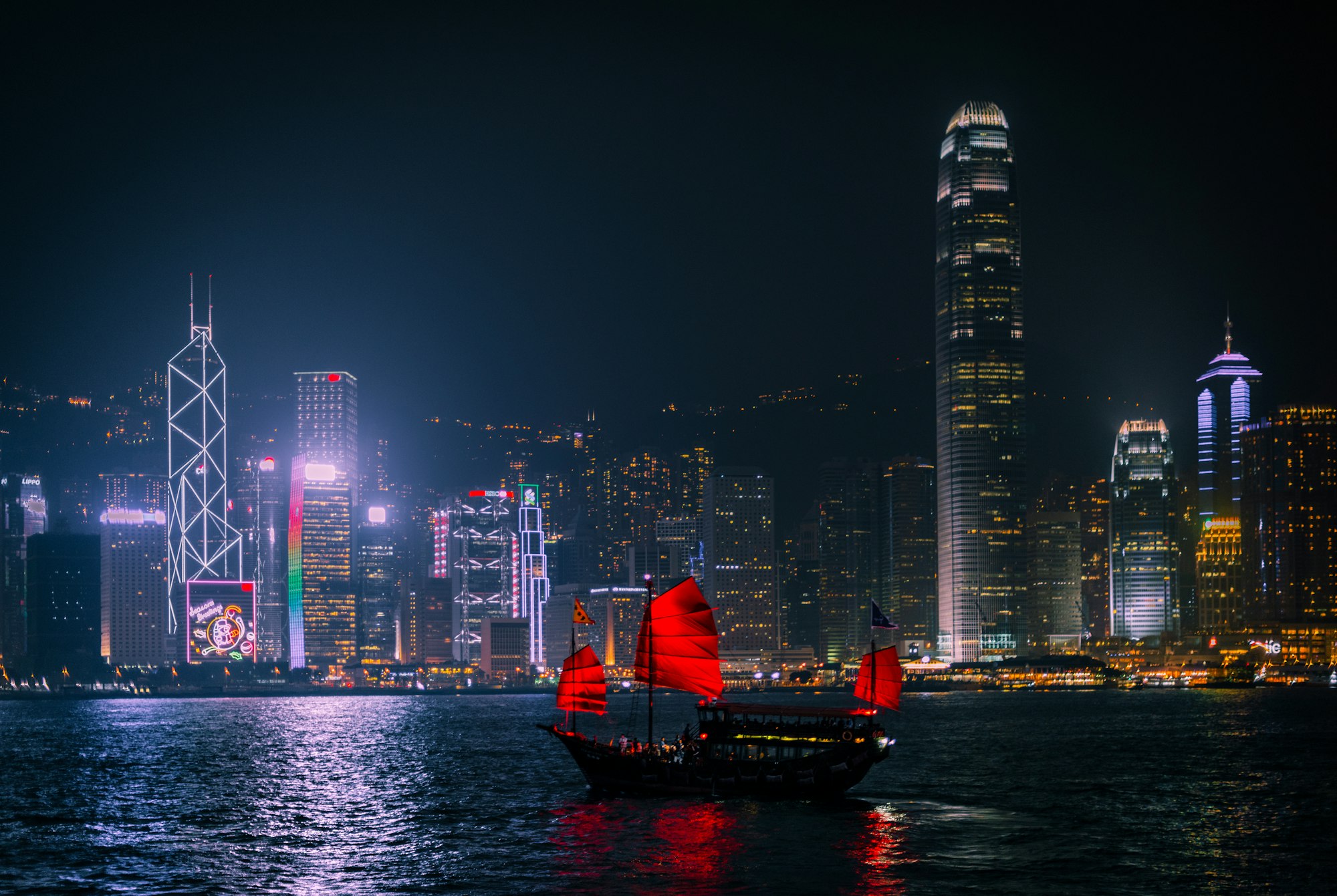
 Lawrence
© Historical Travel Stories | Spiritual Anchor in Multidimensional Spacetime Series