Wanhua: A Sunken Port's Unexpected Holiness
Taipei's most visited temple stands in its most marginal district. What the city calls its decline, its folk religion calls its consecration. These are not two interpretations of the same story. They are two different stories about the same place — and only one of them is true.
 Lawrence
Wanhua, Taipei: The Port That Sank Into Sanctity
In the beginning, there was the river, and the river had a name no one in Taipei now remembers how to say.
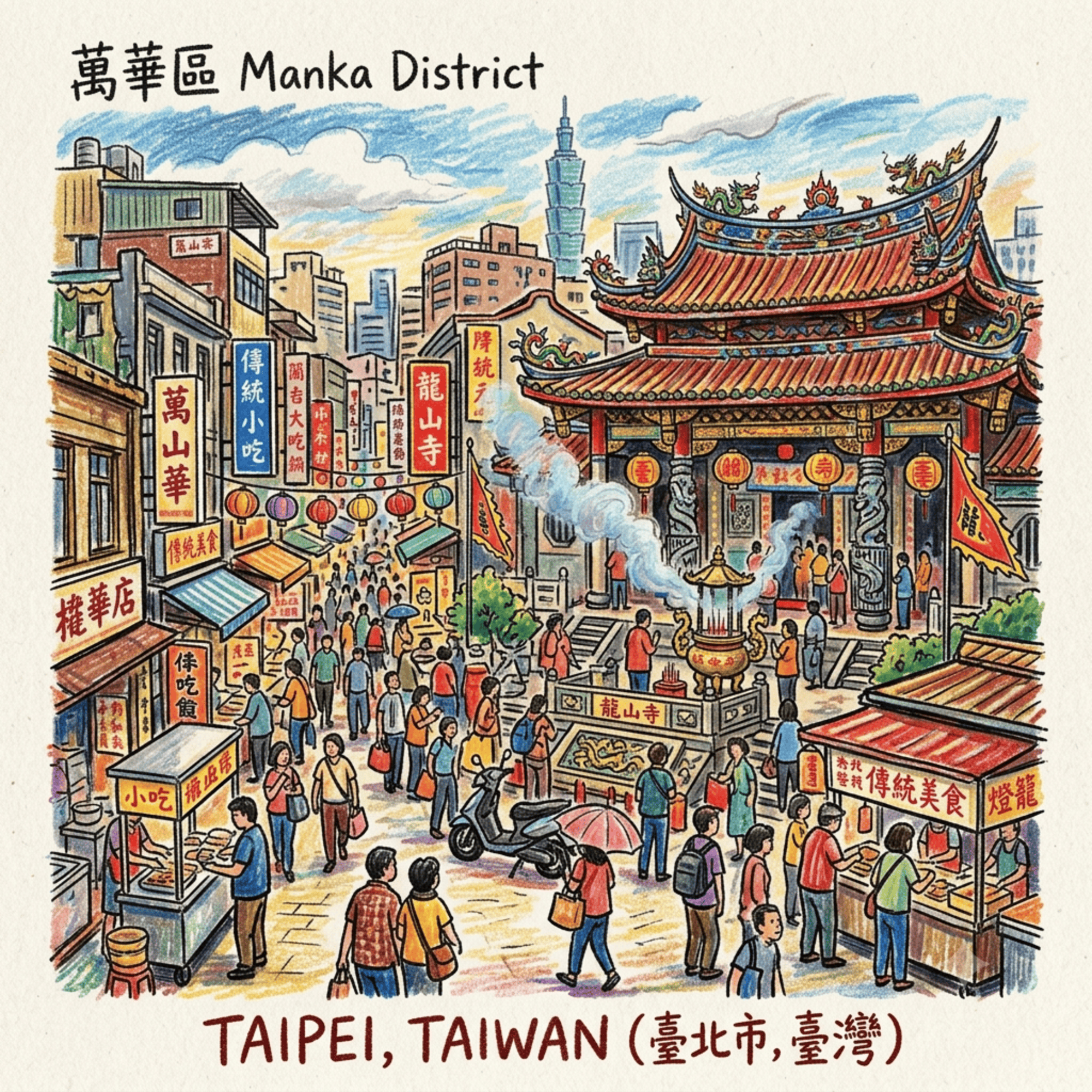
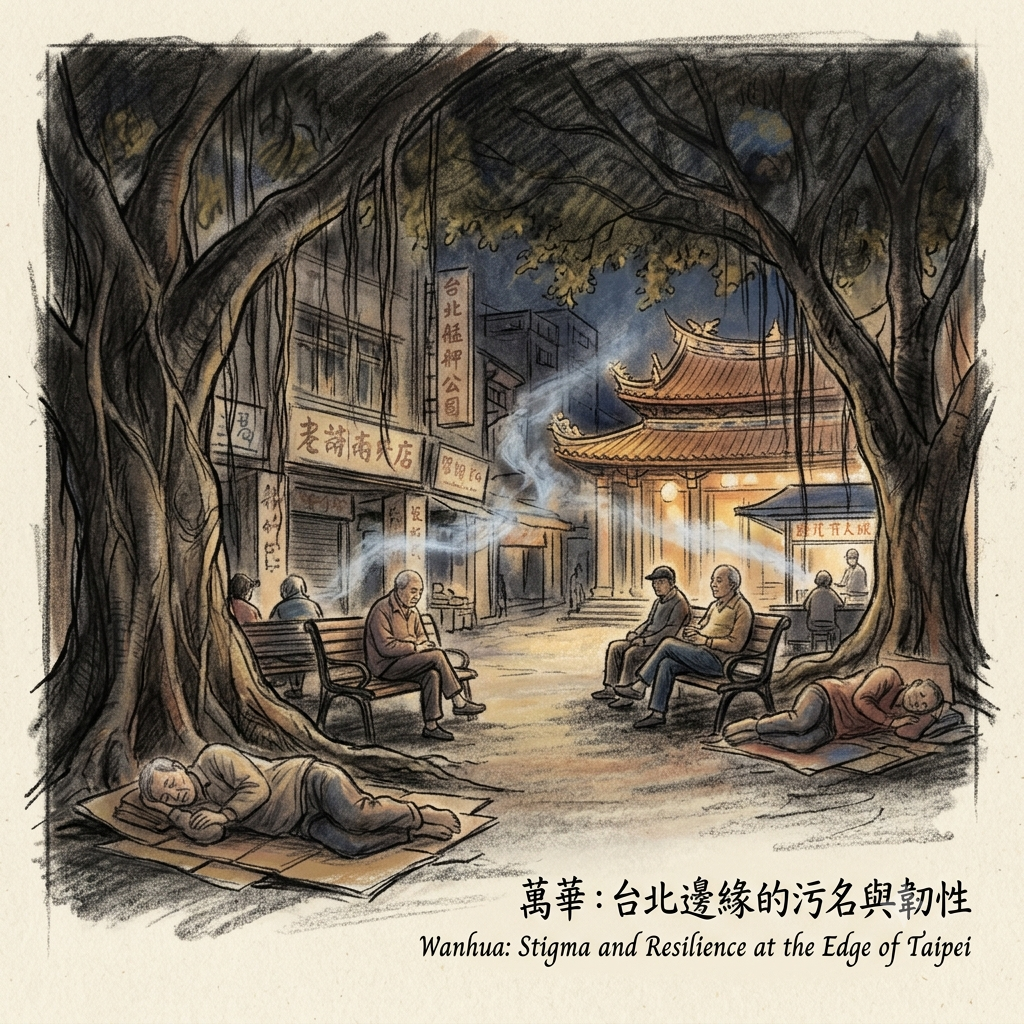
Stand tonight at the edge of Longshan Temple's courtyard and look east — past the low roofline of the city's oldest streets, past the banyan trees of Mengjia Park where men sleep on flattened cardboard, past the smell of grass-herb soup and joss ash that is specific to this corner of Taipei and nowhere else — and you will see, if you know how to read a city, the ghost of a port. Not a dramatic ruin. Not an archaeological excavation. Something more eerie than either: an intact urban neighborhood that has survived three colonial regimes, a founding act of ethnic violence, an Allied bombing raid, and a twenty-first-century media stigmatization campaign, and arrived in the present day with its sacred architecture wholly intact, its folk religion more alive than ever, and its community of marginalized elderly poor sleeping in the shadow of Taiwan's most visited temple.
This arrangement is not coincidence. It is the spatial logic of a cosmological system that most urban historians, development planners, and travel writers have entirely missed.
Listen to the historical stories told in detail (For subscribers only)
I. The Name That Outlasted a Civilization
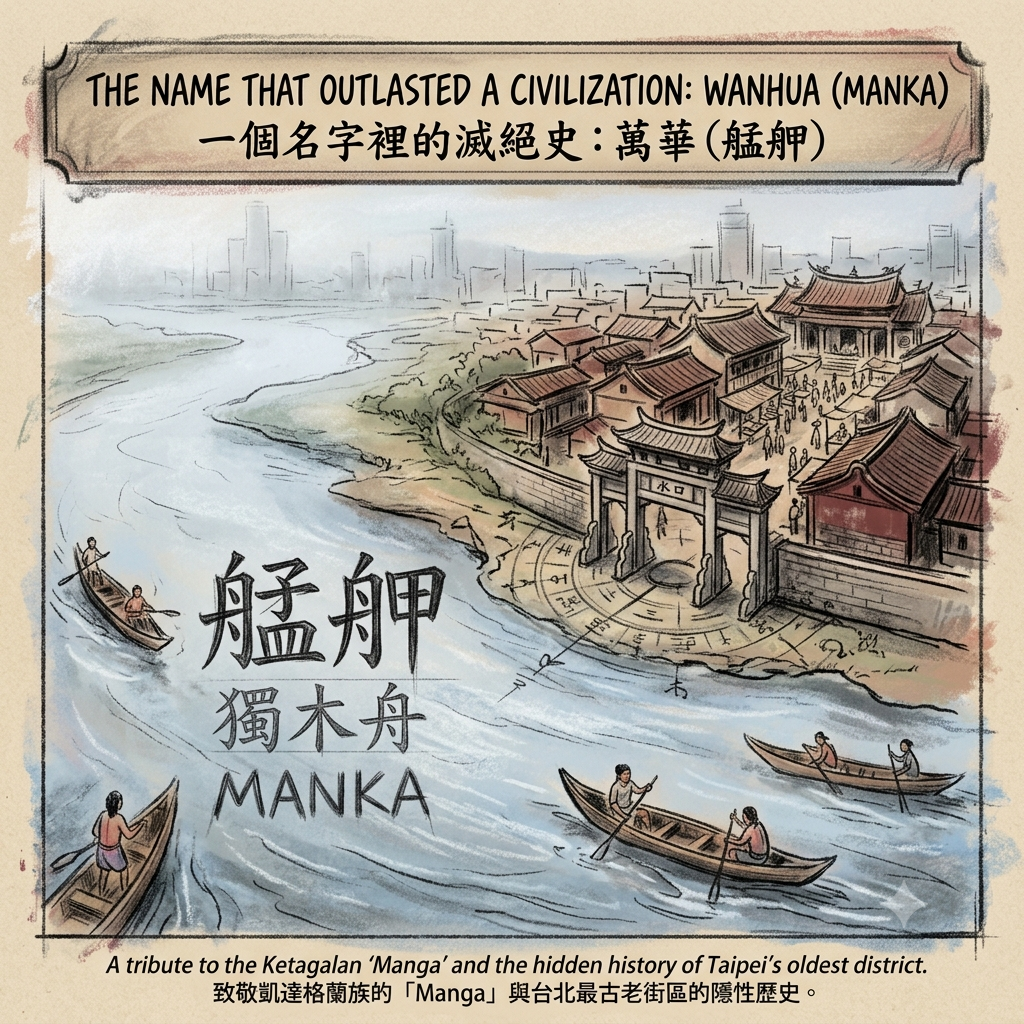
Every serious walk through a city begins with etymology, because the name of a place is its oldest surviving artifact. The neighborhood now called Wanhua carries a prior name: Manka. The romanization derives from the Hoklo Chinese characters 艋舺, which are themselves a phonetic transcription of the Ketagalan indigenous word Manga — meaning canoe, or more precisely, the place where people paddle canoes.
Before Han Chinese settlers arrived from Fujian's Quanzhou prefecture in the early eighteenth century, this confluence of the Danshui and Xindian Rivers was Ketagalan territory. These were Austronesian-speaking plains peoples who oriented their world around water. For them, the river was not simply a geographic feature but a cosmological axis. Comparative research into related Austronesian traditions suggests that rivers functioned as passages for souls in transit — the dead traveled by canoe into the world of ancestors. The canoe was a cosmic vehicle as much as a practical tool, crossing the threshold between living and dead.
The Ghost Word_of Taipei's Oldest District
Then the smallpox came. Then the land purchases. Then the population pressures that colonial migration always brings. Within a few generations, what the Dutch East India Company recorded in its 1654 surveys as a network of Ketagalan villages had been absorbed, linguistically and culturally, into the expanding Han Chinese settler society. No Ketagalan buildings survive. No inscriptions. No place names in the original language remain in common use except, buried inside a pair of Chinese characters, the word for canoe.
The name is the only gravestone. Every time a Taipei resident says Manka — and many older residents still do — they are unknowingly pronouncing a memorial to a river civilization that considered this confluence a point where the living and the dead could cross in either direction.
The feng shui practitioners who came later with the Han settlers read this same river confluence as a shuikou — a water-mouth, the critical threshold through which a site's vital energy enters and exits. Different cosmological vocabulary, identical spatial intuition: the place where rivers meet is where worlds touch.
II. 1853: The Act of Violence That Built Modern Taipei
Urban psychogeography is partly a forensics practice. Walk the streets around Longshan Temple and you are walking through the aftermath of an event that most Taipei guidebooks condense into a sentence, if they mention it at all.
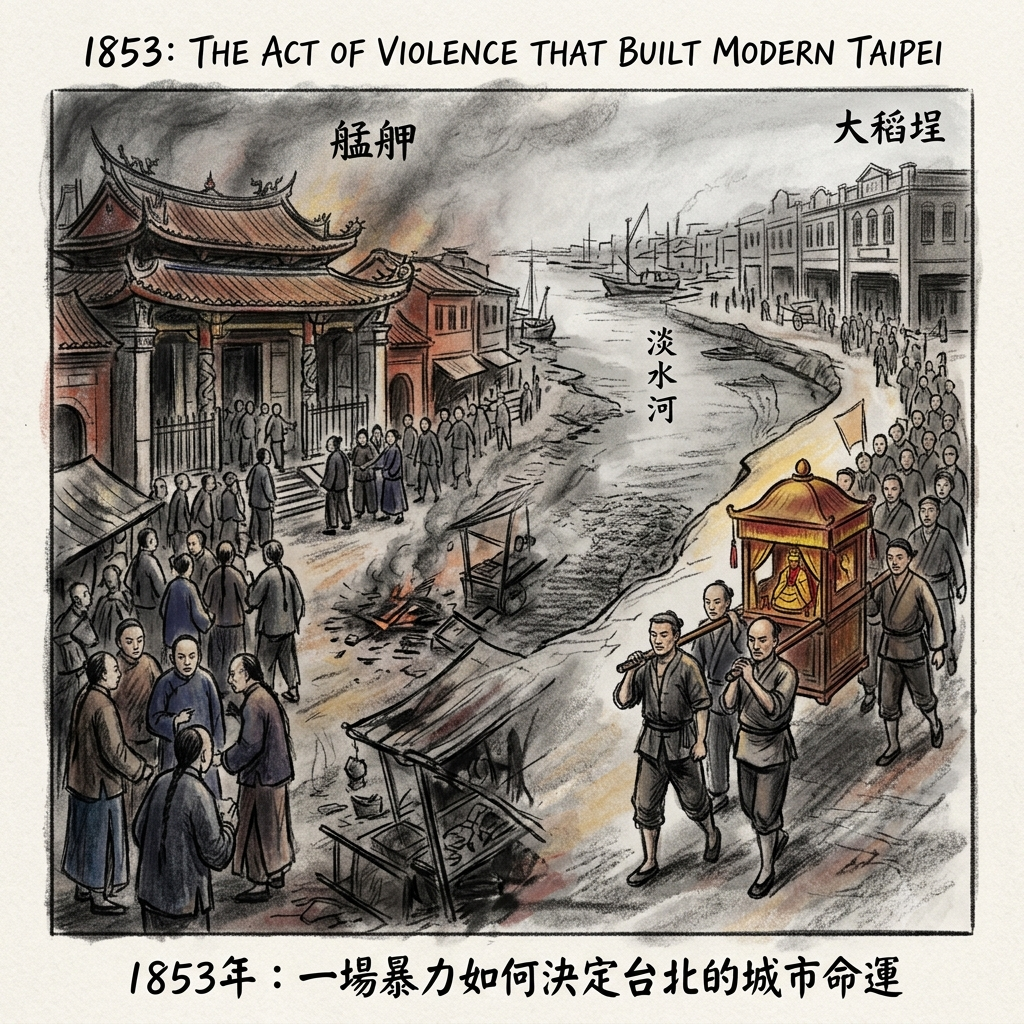
In 1853, a violent conflict known as the Ding-Xia Feud erupted between two groups of Quanzhou settlers who had been sharing — and competing for — the Manka commercial district for decades. The Sanhui people, from Jinjiang, Nan'an, and Huian counties, and the Tong'an people, from Tong'an county, had been accumulating grievances and commercial rivalries across several decades. The specific trigger is disputed by historians; the structural cause is not: the port's limited commercial territory could not permanently sustain two parallel communities with overlapping economic interests and no institutional mechanism for resolving conflict.
The Sanhui prevailed. The Tong'an homes were burned. The community fled northward along the Danshui River, carrying the icon of their patron deity — the Xiahai City God — to found a new settlement at Dadaocheng, where they built the Xiahai City God Temple in 1859. That temple still stands today, on Dihua Street, as one of Taipei's most beloved shrines.
The Gang War That Built Taipei
The spatial consequences took decades to fully emerge, but they were decisive. When Taiwan opened to international trade after 1858, and Tamsui became a treaty port in 1860, Dadaocheng — not Manka — was positioned to capture the lucrative oolong and pouchong tea export trade. The expelled community had, without knowing it, been forced into the location that would give them commercial dominance within a generation.
The victors stayed at the port and watched the river silt up. The commercial center migrated northward. Manka's long decline had begun.
What the contemporary walker notices, moving between the two neighborhoods, is that the violence of 1853 is still legible in the city's sacred geography. Longshan Temple anchors the Wanhua end of the story; the Xiahai City God Temple anchors the Dadaocheng end. The two communities' religious footprints still define two distinct nodes of Taipei's spiritual landscape, a forced cartography of communal rupture that the city has never officially acknowledged or fully reckoned with.
III. The Theology of Ruins: Longshan Temple, June 8, 1945
Holographic Sensory Cue:
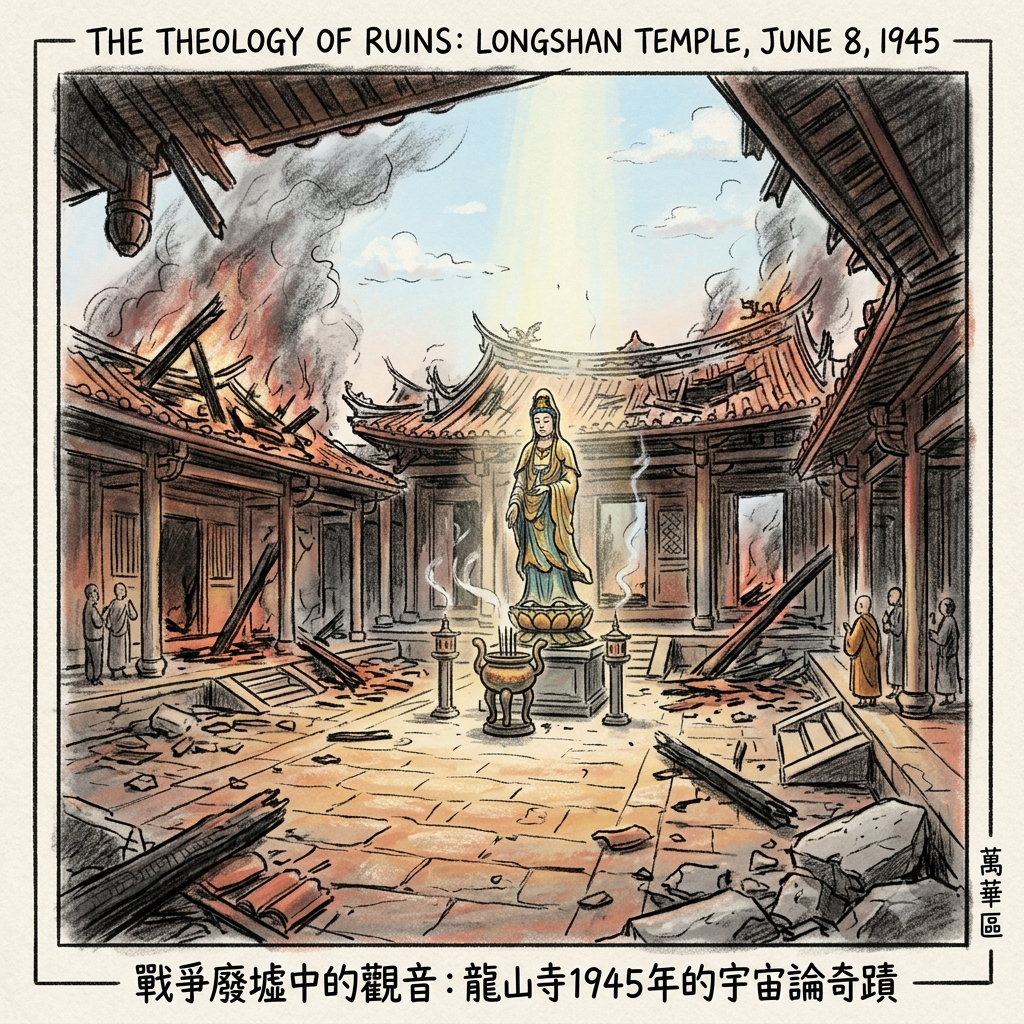
Longshan Temple's inner courtyard, afternoon, June 1945. The wooden roof is burning. The air carries the smell of charred cedar and burning lacquer, beneath it the flat mineral smell of bombed concrete. The bells and drums are silent. The stone pavement of the courtyard is warm underfoot. And at the center of the open-air space — the geometric aperture in the building's cosmological architecture, the point where heaven meets earth in its structural logic — the Guanyin figure stands intact. Her painted surface is undamaged. Her expression is, as ever, composed entirely beyond human affect.
When American B-29 bombers struck Taipei on June 8, 1945, targeting the railway yards and their surrounding industrial infrastructure, Longshan Temple was caught in the blast radius. The halls, roofs, and bell tower were nearly all destroyed. In the open-air courtyard, however, the Guanyin Bodhisattva figure was found standing intact.
This story is repeated by every guide, printed on every temple pamphlet, recounted by grandmothers lighting incense at the main altar. It needs to be read not as a simple miracle narrative — which it may also be — but as a document of a theological system's internal logic.
In Taiwanese folk religion, the temple building is the deity's dwelling, not the deity's power. Ling-li — sacred efficacy, the dynamic force that makes prayers answered, that makes a temple spiritually alive — resides in the consecrated icon, not the walls surrounding it. The icon is ritually linked to the divine through an eye-opening ceremony; it is the antenna through which the sacred signal passes. A destroyed building can be rebuilt. A destroyed icon severs the connection entirely and collapses the community's cosmological anchor point.
The Impossible Survivor of the Taipei Air Raid
What the 1945 bombing demonstrated, in this theological vocabulary, was not that the goddess had protected her house — the house was gone — but that she had protected the center of her own power. The outer shell was expendable. The ling-li was not.
And there is the geometry of what survived. The courtyard — in Taiwanese folk-religious temple architecture, the qi aperture, the passage through which heaven and earth communicate vertically — was the one structural element that a collapsed roof cannot obstruct. When the buildings fell away, what remained was the Guanyin figure standing precisely at the most cosmologically significant point in the entire structure: the direct, unimpeded channel between sky and stone. The bombing, read through the belief system it attacked, had created a more perfect sacred node by stripping away the architectural intermediary entirely.
Resonance Node: The Inner Courtyard, Longshan Temple, 3:00 PM
On a clear afternoon, sunlight falls through the courtyard aperture in a near-vertical column that shifts its angle slowly as the hour passes. Stand inside it for three minutes. The incense smoke rising from the burners below traces the column's changing edge. You are standing in the geometric position where, in June 1945, the Guanyin figure stood alone in open air. The sensation — cooler stone below, warmer sunlit air above — is the closest physical analogue available to the theological idea the temple was built to embody: the point where two orders of reality touch without merging.
IV. Bopiliao: The City's Honest Wound
Five minutes' walk from Longshan Temple, on Kangding Road, stands what may be Taipei's most honest building: the Bopiliao Historic Block.
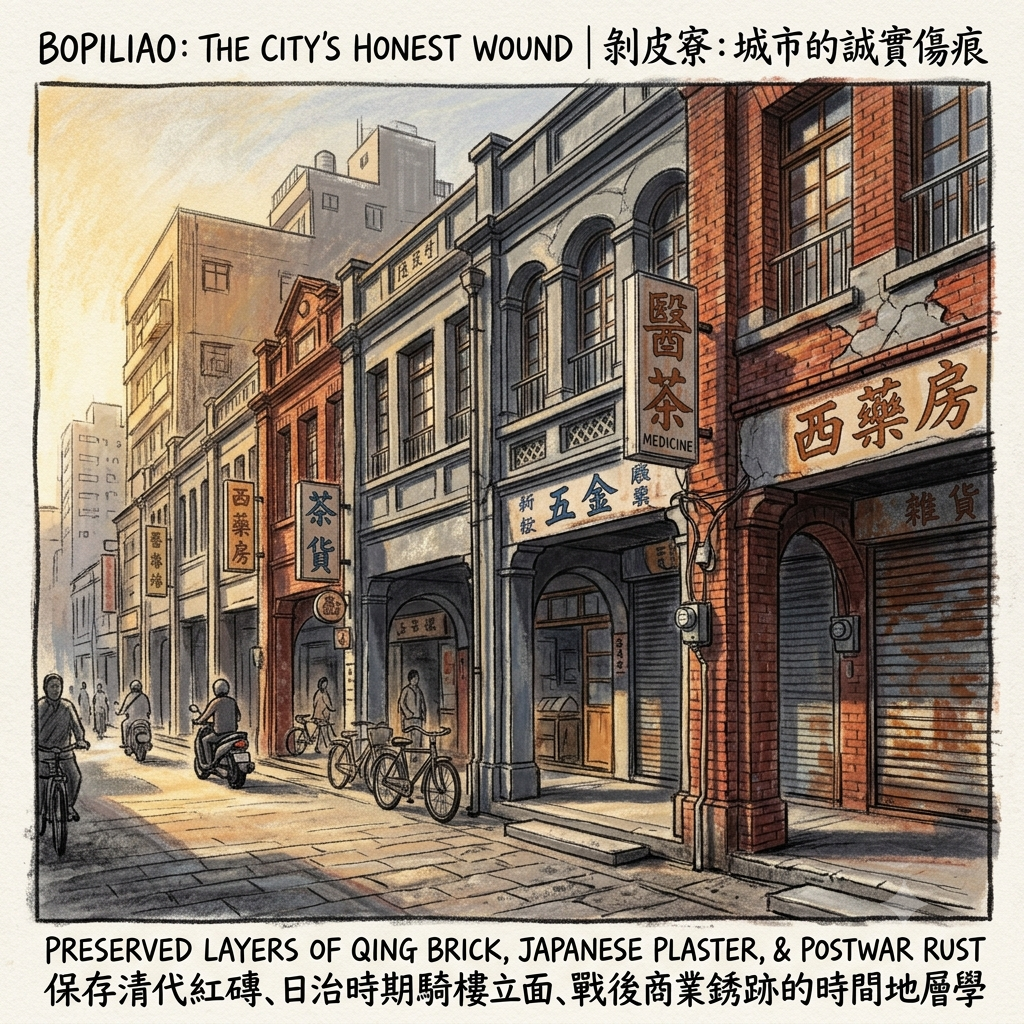
Bopiliao is a preserved segment of late-Qing commercial streetscape whose survival was entirely accidental. The Japanese colonial government's shi-ku kaisei urban reform plan called for its demolition and replacement with modern arcaded storefronts. The plan was partially executed: Japanese-era concrete and plaster arcade facades were attached to the existing brick structures beneath. Then administrative priorities shifted, the demolition plan stalled repeatedly, the area was repurposed as school grounds and low-rent commercial space. The nineteenth century survived underneath the twentieth century because the twentieth century never quite finished the job it had started.
Walk slowly along Bopiliao's remaining street front and you can read three distinct material registers simultaneously. The deep red brick of the Qing-era structures — fired in Fujian, almost certainly, and shipped across as cargo. The grey plaster of Japanese colonial arcades — the empire's attempt to impose its architectural vocabulary on a preexisting city fabric. The rust-stained iron shutters and improvised signage of the postwar commercial decades, neither restoring nor replacing what came before, only layering over it.
How Architecture Hides Clashin Empires
The seam between Qing brick and Japanese plaster is the city's most important architectural scar. It marks the precise moment where one civilization's self-image was applied, like a mask, over another's — not replacing it, because replacement requires demolition, but covering it, while the original structure continued holding the new face from below. The colonial project at Bopiliao was never completed. The covering never became replacement. What remains is the joint, permanently visible, where the two vocabularies meet and refuse to reconcile.
The ground level difference is also instructive: the Qing-era stone pavement sits five to fifteen centimeters below the Japanese-era concrete beside it. Walk through Bopiliao and your feet register this shift before your eyes do. The city's historical layers are vertical as well as temporal, and the body is a more sensitive instrument for reading them than the eye alone.
V. The Permanent Margin: Wanhua's Long Geography of Exclusion
The psychogeography of Wanhua cannot be completed without confronting what this neighborhood has been required to contain across every era of its history.
Under Japanese colonial rule, the district immediately adjacent to Longshan Temple was designated a government-licensed yūkaku — a pleasure district. The colonial administration's rationale was sanitary control and commercial regulation; the spatial consequence was the permanent inscription of sexual marginality onto the neighborhood's identity, an inscription that subsequent regimes inherited and reinforced without examining its origins or its costs.
The decades after 1945 brought Huaxi Street, its snake restaurants, its unlicensed but widely tolerated sex trade, and its reputation as Taipei's nocturnal economy. When Taipei City Government abolished licensed prostitution in 1997, the workers who had operated legally in Wanhua were among those who organized some of Taiwan's most significant labor-rights demonstrations, insisting in the face of official moral reasoning that dignity was not the exclusive property of the city's respectable quarters.
Why Taipei's Holiest Temple is in its Red Light District
In May 2021, when COVID-19 broke through Taiwan's previously successful containment defenses — originating in transmission chains connected to Wanhua teahouses — the neighborhood was subjected to a stigmatization campaign that echoed, in the contemporary vocabulary of social media, the same pattern of projected moral contamination it had absorbed across its entire modern history. Wanhua people became, briefly, a phrase carrying connotations its residents had not asked to carry and could not escape.
And in the same weeks: Longshan Temple became a community distribution center for masks and protective equipment. The network of temples, neighborhood organizations, and street-social-work services that holds Wanhua's most marginal residents together — the elderly poor, the unhoused, the addicted — activated itself without governmental direction, moving faster and more effectively than administrative channels. The neighborhood the city had designated as its margin had developed, precisely because of that designation, the densest mutual-aid infrastructure in Taipei.
Resonance Node: Mengjia Park, 11:00 PM
Under the banyans along the park's western edge, aerial roots hang to within a foot of the ground, forming a series of near-enclosed spaces. On most nights these spaces are occupied. The smell here — banyan leaf mold, joss ash drifting from the nearby temple, night-time river dampness — is entirely unlike any other part of Taipei. This is the place where the ling-li of the temple and the material reality of extreme poverty are closest to each other: a hundred meters apart, visible to each other across the park's open center, connected by the same community support network that has kept both operating through every crisis the city has chosen to concentrate in this corner.
The Sunken-Port Sacred-Accumulation Syndrome
There is a concept I find myself reaching for when I try to understand Wanhua's trajectory across two centuries. I call it the Sunken-Port Sacred-Accumulation Syndrome.
It describes the pattern by which Manka and Wanhua's progressive commercial and political marginalization — from premier port to backwater to stigmatized district — paradoxically intensified rather than diminished its cosmological density. As the traders and money moved northward and eastward into newer districts with modern grid streets and department stores, the temples stayed. The rituals continued, the ling-li accumulated in the daily practice of a community with nowhere else to go and an exceptional reliance on the sacred networks that temples provide.
The logic of this accumulation is internal to the belief system itself. In Taiwanese folk religion, ling-li concentrates where need concentrates, because the deities work hardest where the work is hardest — in the margins, at the boundaries, in the places the official city would rather not look at directly. Sacred efficacy and economic marginality are, in this cosmological frame, not opposites but collaborators.
The most visited temple in Taipei is in the most marginalized district in Taipei. This is not an anomaly requiring explanation or an accident of urban history. It is the clearest possible demonstration of how Taiwanese folk religion's spatial logic operates at urban scale. And it makes visible something that purely economic or political readings of the city cannot see: that Wanhua's two centuries have not been a story of decline, but a story of transformation — from commercial port to liminal sacred city, from the city's economic center to its cosmological core.
The Ketagalan people who paddled their canoes through this river confluence understood it as a crossing point between worlds. The feng shui practitioners who came after them read the same confluence as a node where energy gathers. The tens of thousands of people who light incense at Longshan Temple each week are working within the same spatial intuition, in a vocabulary specific to their own tradition. Different cosmological systems; the same recognition. Some places are where worlds meet. Wanhua is one of them.
Come to this neighborhood. Walk slowly. Let the seams show.
To follow this ongoing inquiry into the sacred geographies hidden inside the world's oldest cities — from Taipei's sunken port to Kyoto's kami-field, Hong Kong's feng shui fault lines, and the Andean huaca lines that still govern modern Lima — subscribe to our newsletter below.
Accessing the Physical Node
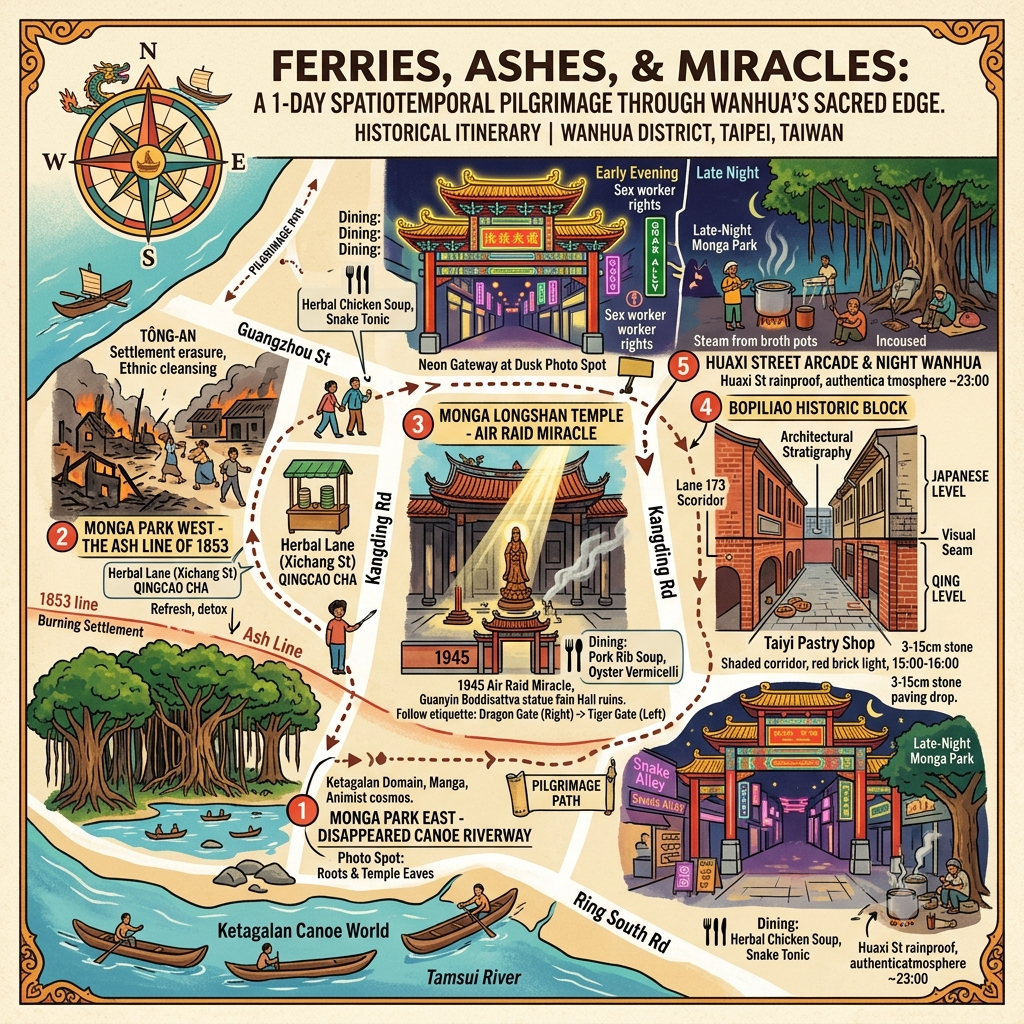
Longshan Temple (211 Guangzhou Street, Wanhua District): MRT Bannan Line to Longshan Temple Station (BL12), Exit 1, one minute on foot. Open year-round, no admission fee. Arrive at 7:00 AM for morning ritual, or 6:00 PM for the evening incense hour, to observe the full register of daily devotional practice.
Bopiliao Historic Block (near 173, Lane 1, Kangding Road): Five minutes on foot from Longshan Temple. Free entry. Visit between 3:00 and 5:00 PM for optimal light on the architectural stratigraphy. Pay attention to the ground-level difference between Qing and Japanese-era sections — it is most legible near the junction at the western end of the preserved block.
Mengjia Park (intersection of Guangzhou Street and Xichang Street): Best visited in the late evening for the full sensory complexity of the neighborhood. The park is safe; standard urban awareness applies.
Accommodation: Wanhua has several long-established commercial hotels. The Ximending area (10–15 minutes on foot) offers a wider range of options at various price points. Taipei Main Station hotels (5 minutes by MRT) are practically well-situated; all are connected to Wanhua by the Bannan Line.
Guided walks: Several Taipei-based heritage and cultural organizations offer guided Manka historical walks in English and Chinese. Advance booking is recommended for walks with specialist historical depth.
💡 Frequently Asked Questions About Visiting Wanhua (Bangka)
Q1: What is Wanhua District in Taipei known for, and what should I see first?
Answer: Wanhua, historically known as Bangka, is Taipei’s oldest district, renowned for its rich cultural history, historic temples, and vibrant street markets. First-time visitors should begin at Mengjia Longshan Temple, an 18th-century landmark serving as the area's spiritual heart. Right next door, explore the Bopiliao Historical Block, featuring preserved Qing-dynasty and Japanese-era red-brick architecture. Conclude your tour at nearby Herb Lane and Huaxi Street Night Market. Wanhua offers an authentic look into old-world Taipei, seamlessly blending spiritual traditions, heritage crafts, and iconic local street food.
Q2: What are the must-try local street foods near Longshan Temple and Huaxi Street Night Market?
Answer: The neighborhood surrounding Longshan Temple and Huaxi Street Night Market is a famous hub for traditional Taiwanese eats. Must-try dishes include Wang’s Broth for its Michelin-recommended black gold braised pork rice (lu rou fan), Liang Xi Hao for traditional thick squid soup, and crispy charcoal-baked black pepper cakes (hu jiao bing). Don't miss a refreshing cup of traditional herbal tea from Herb Lane to balance the savory flavors. Most family-run stalls here have operated for decades, offering budget-friendly, highly authentic culinary heritage.
Q3: Is Wanhua safe for tourists at night, and what precautions should I take?
Answer: Yes, Wanhua is generally safe for international tourists at night. While parts of Wanhua around Longshan Temple have a gritty reputation due to historic red-light pockets and an older demographic, violent crime is extremely rare in Taipei. Standard precautions apply: stick to well-lit main thoroughfares, remain inside active night market zones, and avoid wandering alone down dark, quiet alleyways late at night. With basic travel awareness, visitors can comfortably and safely enjoy Wanhua’s rich cultural night atmosphere.
Reference and Further reading
First layer – Main sources of literature and institutions:
- 荷蘭東印度公司VOC檔案(1624–1662),存於荷蘭國立檔案館(Nationaal Archief)——含台北盆地原住民戶口調查記錄
- 清代《諸羅縣志》(1717年)及《台灣府志》(1744年)中的土著篇
- 清代《淡水廳志》(同治年間修訂版)中的族群衝突相關記載
- 台灣省文獻委員會(現改制)歷史檔案——艋舺地方志相關記錄
- 台北市文化局龍山寺古蹟調查報告
- 日本總督府文書(1895–1945)中關於台北廟宇管理的相關記載
- 1945年美軍對台空襲作戰記錄(美國戰略轟炸調查報告 US Strategic Bombing Survey 相關文件,存於美國國家檔案館 NARA)
- 台北市政府都市發展局剝皮寮修復計畫工程報告(2003–2009)
- 日本總督府「市區改正」相關地籍圖(1900年代–1910年代,存於台灣國史館台灣文獻館)
- 台灣國史館日治時期「遊廓」設置相關公文
- 台北市議會1997年廢娼決議相關公文及辯論記錄
- 中央流行疫情指揮中心(CECC)2021年萬華群聚事件官方報告
The second layer – secondary academic materials:
- 翁佳音《大台北古地圖考釋》(1998)——凱達格蘭族地名與地理的重要學術研究
- 詹素娟、潘英海編《平埔研究論文集》(1995)——平埔族研究的學術基礎文獻
- 李壬癸(Paul Jen-kuei Li)凱達格蘭語言學研究——族語重建的核心語言學資料
- 陳其南《台灣的傳統中國社會》(1987)——台灣祖籍認同與族群衝突的重要學術框架
- 林美容〈艋舺龍山寺的組織與境域〉——龍山寺與三邑人社群結構的學術研究
- 戴炎輝《清代台灣的鄉治》——清代台灣社會組織基礎文獻
- 李乾朗《台灣古建築圖解事典》中關於龍山寺建築史的學術分析
- 張珣《文化媽祖》(2003)——台灣民間信仰神像靈力觀念的學術研究(類比框架)
- 夏鑄九〈殖民的現代性營造——重寫日本殖民時期台灣建築與城市的歷史〉——日本殖民建築政策的重要學術框架
- 台灣建築史學會相關期刊論文
- 剝皮寮歷史街區管理單位出版之修復調查報告
- 王芝芝〈日治時期台灣的公娼制度〉——日治性產業地理的學術研究
- 社團法人台灣性別人權協會關於廢娼運動的文獻記錄
Third layer – Supplementary information:
- 日治時期地方耆老口述(部分收錄於《台灣慣習記事》),涉及凱達格蘭族地名傳說
- 艋舺地方耆老口述(日治時期收集),部分見於《台灣日日新報》相關報道
- 龍山寺廟方口傳神跡記錄(多見於廟宇出版品,屬社群集體記憶,非實證文獻)
- 地方耆老口述(收錄於剝皮寮館方出版品),涉及街道商業生活記憶
- 《報導者》萬華系列報導(2021年)——疫情中的社區觀點紀錄
- 人安基金會、芒草心協會關於萬華街友社群的田野記錄
Historiographical Discontinuities and Contradictions:
- The ritual system, cosmological structure, and spiritual geography of the Ketagalan people are almost entirely devoid of primary source documents. Their language is nearly extinct, with very few speakers remaining, and linguistic reconstruction is incomplete. The complete semantic field of the word "Manga" (whether it truly carries ritual or cosmological connotations) requires further confirmation through linguistic anthropological research. All inferences in Section B of this story are speculative reconstructions within the framework of comparative studies of Austronesian languages; further verification of original archives is recommended.
- The exact trigger for the suburban conflict remains unresolved in academia. The community decision-making process of the Tong'an people on the eve of their evacuation (who made the decision to "leave with the gods"? How long did the decision-making process take?) is not documented. The scale of the violence (number of dead and injured, number of buildings burned) lacks reliable one-time figures. Further verification of original archives (especially immigration history materials from Xiamen and Quanzhou, and memorials from Qing Dynasty local officials) is recommended.
- High-resolution spatial documents are lacking regarding the specific bomb impact points of the 1945 air raids and the precise extent of damage to Longshan Temple. Multiple accounts exist regarding the "intact" state of the statues, with varying details; the earliest written record likely dates back several years after the war, rather than being an immediate observation. Further verification of original archives is recommended (especially records of US bombing missions and wartime building damage survey documents from the Japanese Governor-General's Office).
- The exact origin of the place name "Bopiliao" remains inconclusive, requiring a systematic review of Qing Dynasty land registration archives. Complete original design plans for the "Urban Redevelopment" project during the Japanese occupation (if held in the Taiwan Archives or the Archives of Japan) need further investigation. There is very little existing documentation regarding whether this street block served a special military or administrative purpose during World War II. Further verification of original archives is recommended.
- There is a significant academic gap in the study of the history of Wanhua's sex industry—detailed land registration data and management documents for the Japanese-occupied pleasure quarters require a systematic review of colonial administrative documents from the Archives of Japan. The long-term socio-spatial impacts of the 2021 COVID-19 cluster events (the lasting effects of stigma, post-traumatic coping strategies) currently lack almost any sociological or geographical academic research. It is recommended to further verify the original files.
 Lawrence
 Lawrence
 Lawrence
The sources for this article include primary historical records, academic papers, and public records from various levels of administrative bodies, with a commitment to historical accuracy; instances requiring further verification against primary archival materials have been noted in the text. Last updated: August 2026.