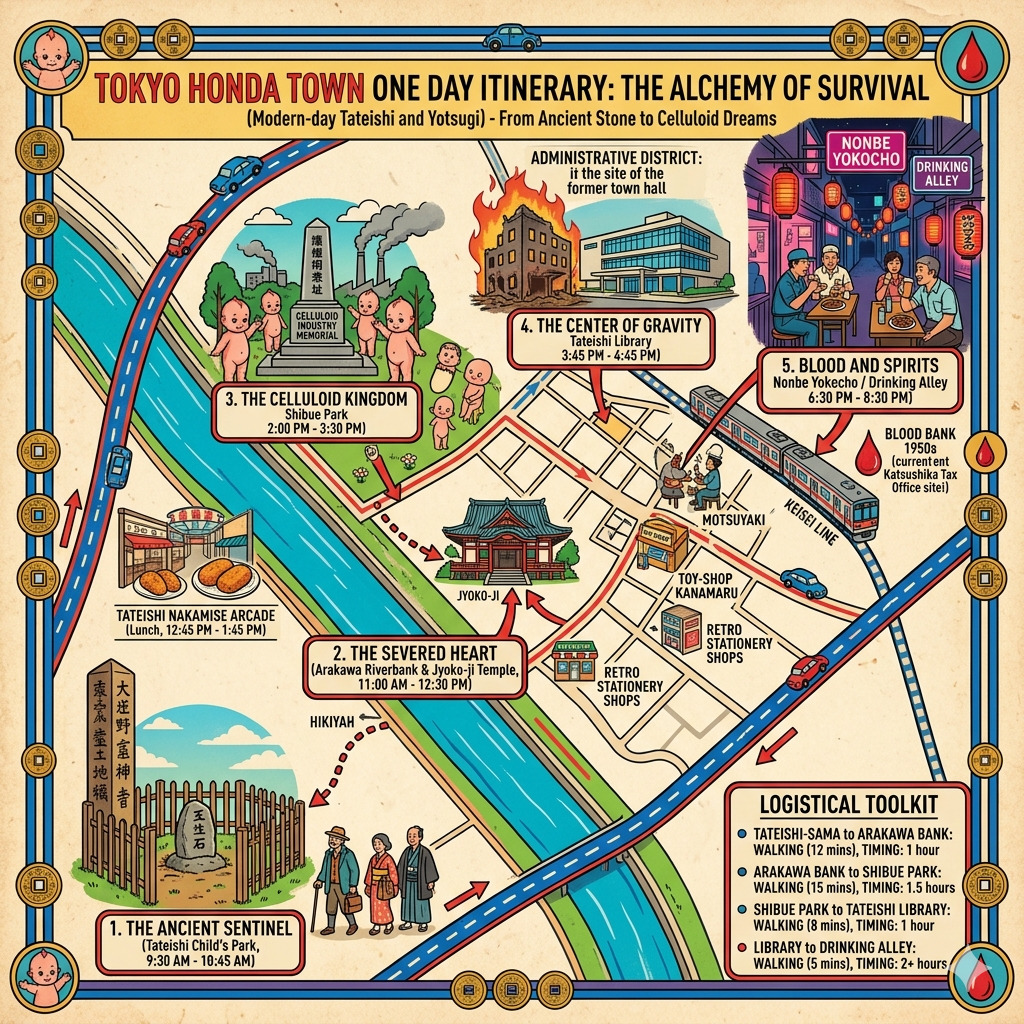
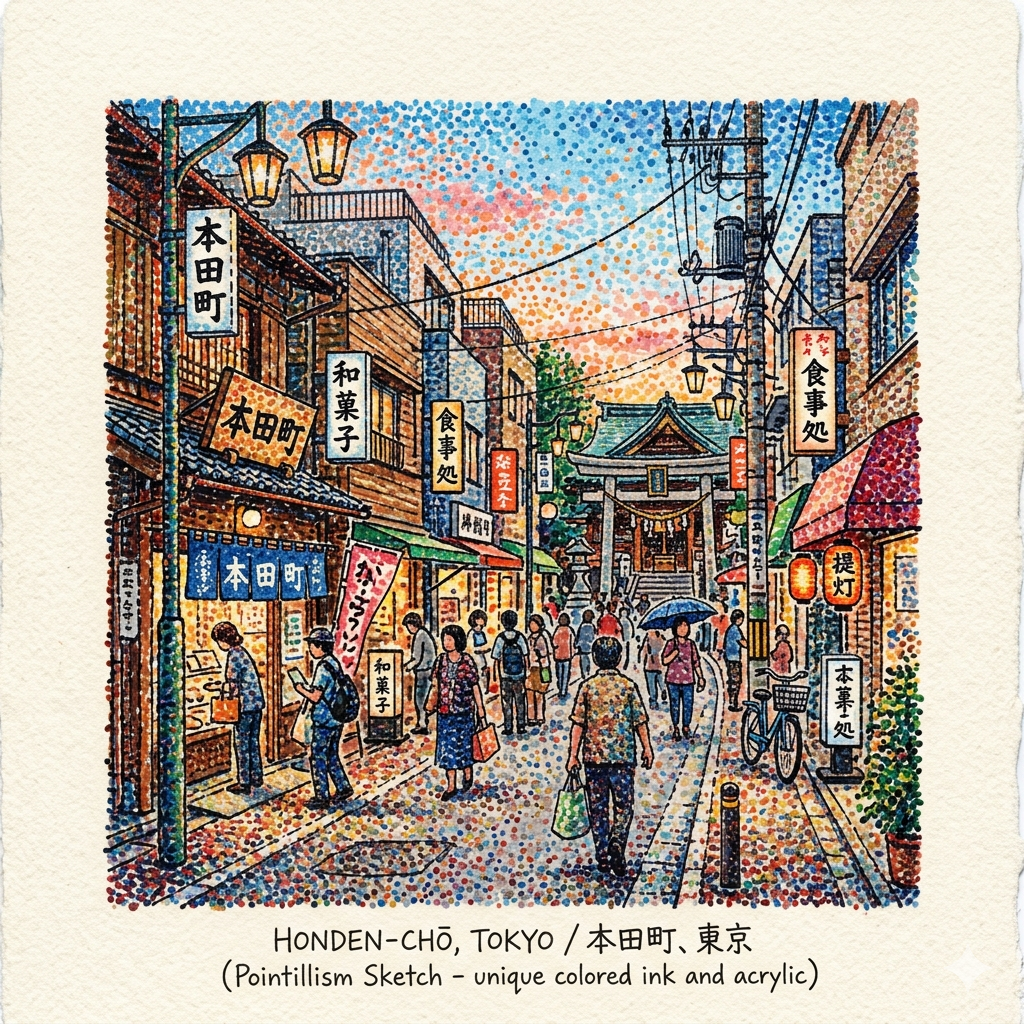
(ENG) Honden-cho Historical Walk: Industrial Echoes and Shitamachi Stories in Katsushika, Tokyo
Discover the forgotten industrial soul of Tokyo in Honden-cho, Katsushika. This historical guide takes you through the quiet alleys of a former factory town to find beauty in its canals, shrines, and the resilient spirit of its people.

 Lawrence
This is a historical travel story and walking guide to Honden-cho in Tokyo’s Katsushika District, a neighborhood shaped by its industrial past and traditional Shitamachi spirit. Through a curated walk, it explores hidden shrines, local canals, and the evolution of a village-turned-factory hub, offering readers a unique perspective on Tokyo’s working-class heritage and urban transformation.
On modern Tokyo maps, the name "Honden-chō" is a phantom, officially excised from the administrative record in 1966. Yet, to the narrative architect, Honden-chō remains a vivid presence inhabiting the urban morphology of Tateishi and Yotsugi. This narrative reconstructs the skeletal remains of a district defined by its capacity to process societal bypass. Situated at the precarious confluence of the Nakagawa and Arakawa rivers, Honden-chō served as the primary site where Japan’s agrarian past was forcibly metabolized by the violent pressures of industrial modernization. Understanding this landscape requires more than a checklist; it demands a study of urban stratigraphy. We are walking through layers of "biological surplus"—where the city’s margins were sacrificed to protect its center, and where the resulting scars produced one of Tokyo’s most resilient cultural identities.
Listen to the historical stories told in detail (For subscribers only)
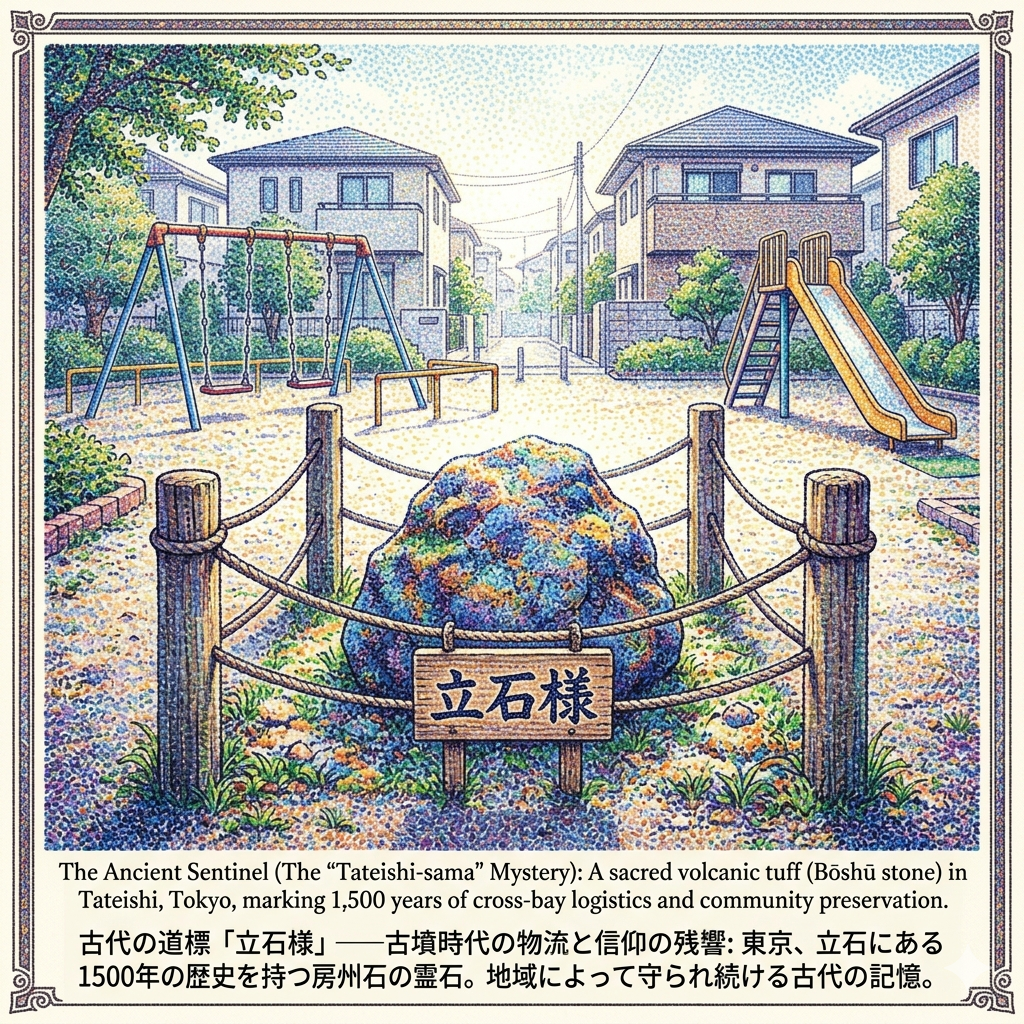
The Ancient Sentinel (The "Tateishi-sama" Mystery)
The foundational DNA of this neighborhood is anchored by a point of geological fixity: the "Tateishi-sama." Protruding a mere few centimeters above the soil in a quiet residential park, this volcanic tuff (Bōshū stone) represents a temporal rupture. Originating from the Bōsō Peninsula in Chiba, its presence here 1,500 years ago suggests a sophisticated level of ancient cross-bay logistics and territorial marking.
Historical Identity | Era | Functional Context |
Ancient Construction Material | Kofun Period | Likely transported as high-value material for stone burial chambers. |
Imperial Road Marker | Ritsuryō Period | A "milestone" for the Ancient East Kaido, marking the intersection of land and water routes. |
Sacred "Growing" Stone | Edo Period | Reimagined as the "Living Stone" (Kassō-seki); believed to physically expand and contract with the seasons. |
The Preservation of Heritage The transformation of a functional road marker into a spiritual guardian was a masterstroke of cultural preservation. By imbuing the stone with divinity—claiming it could cure illness or serve as an amulet—the local community protected this piece of [Tokyo’s Industrial Heritage] from the erasure of urban development. It remains a "historical gap" in the dense grid of Tateishi 8-chome, a silent witness to the area's original role as a strategic transit hub long before the concrete arrived.
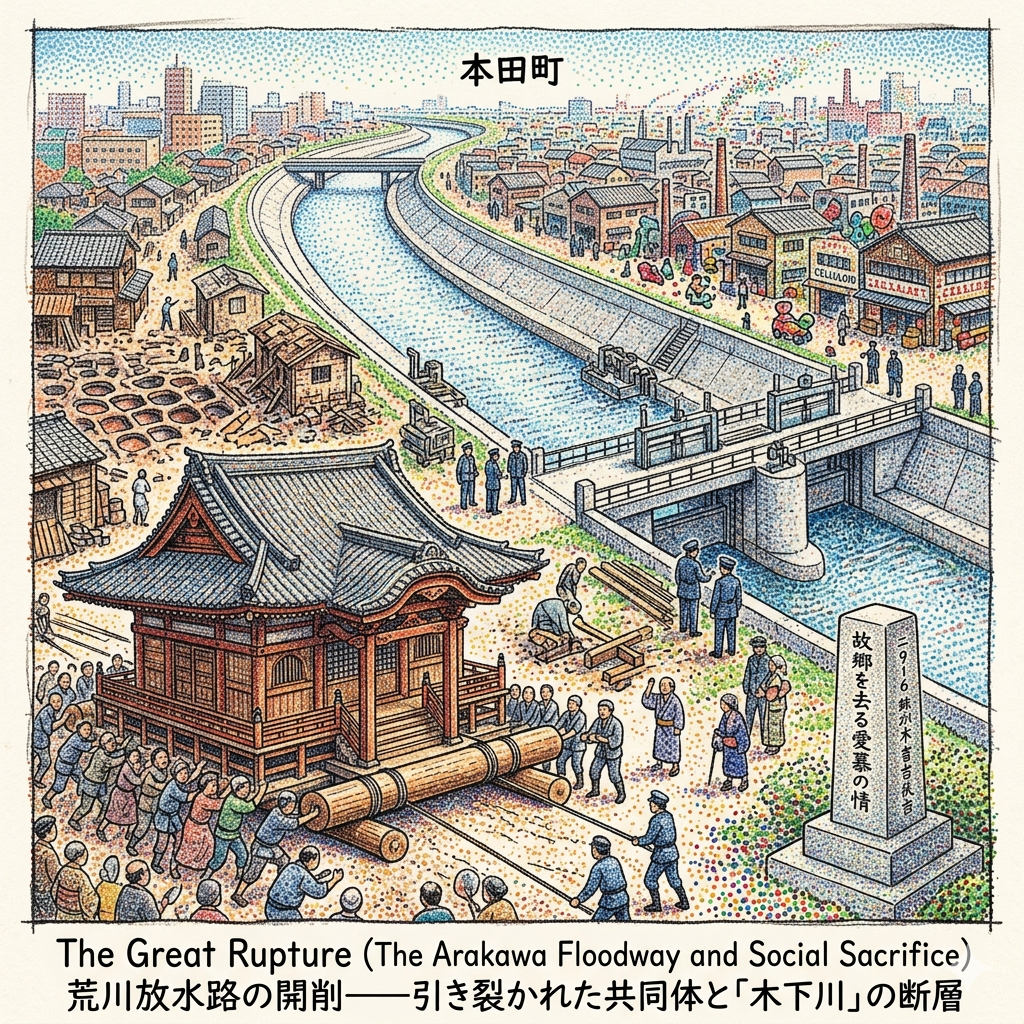
The Great Rupture (The Arakawa Floodway and Social Sacrifice)
The modern geography of Honden-chō was forged through a profound act of spatial violence. Following the 1910 Great Flood, which decimated 1.7% of Japan’s national income, the Meiji government initiated the Arakawa Floodway—a 22-kilometer artificial artery. This engineering marvel required the forced displacement of 1,300 households and the physical bisection of the Kinegawa district.
The displacement was not merely residential; it was industrial. The project targeted the "marginalized" center of the local economy: the leather industry and slaughterhouses, which had been relegated to these flood-prone lowlands. The physical toll was immense; even sacred spaces were not spared. The Jōkō-ji (Kinegawa Yakushi) temple had to be moved entirely using the Yukiya technique—an arduous process of sliding massive structures on wooden rollers (koro) to new ground.
"A record of the 'affection' for ancestral lands left by resident Suzuki Yoshikichi in a 1916 monument serves as a poignant testament to this forced modernization."
The Logic of the Center The Floodway reflects the cold logic of "Sacrificing the Edge to Save the Center." By severing Honden-chō to protect the capital's heart, the state created a permanent barrier. Paradoxically, this rupture forced the remaining districts to develop an autarkic commercial energy, eventually giving rise to the "shitamachi" independence that characterizes Tateishi today.
The Celluloid Spark (From Camphor to Global Toys)
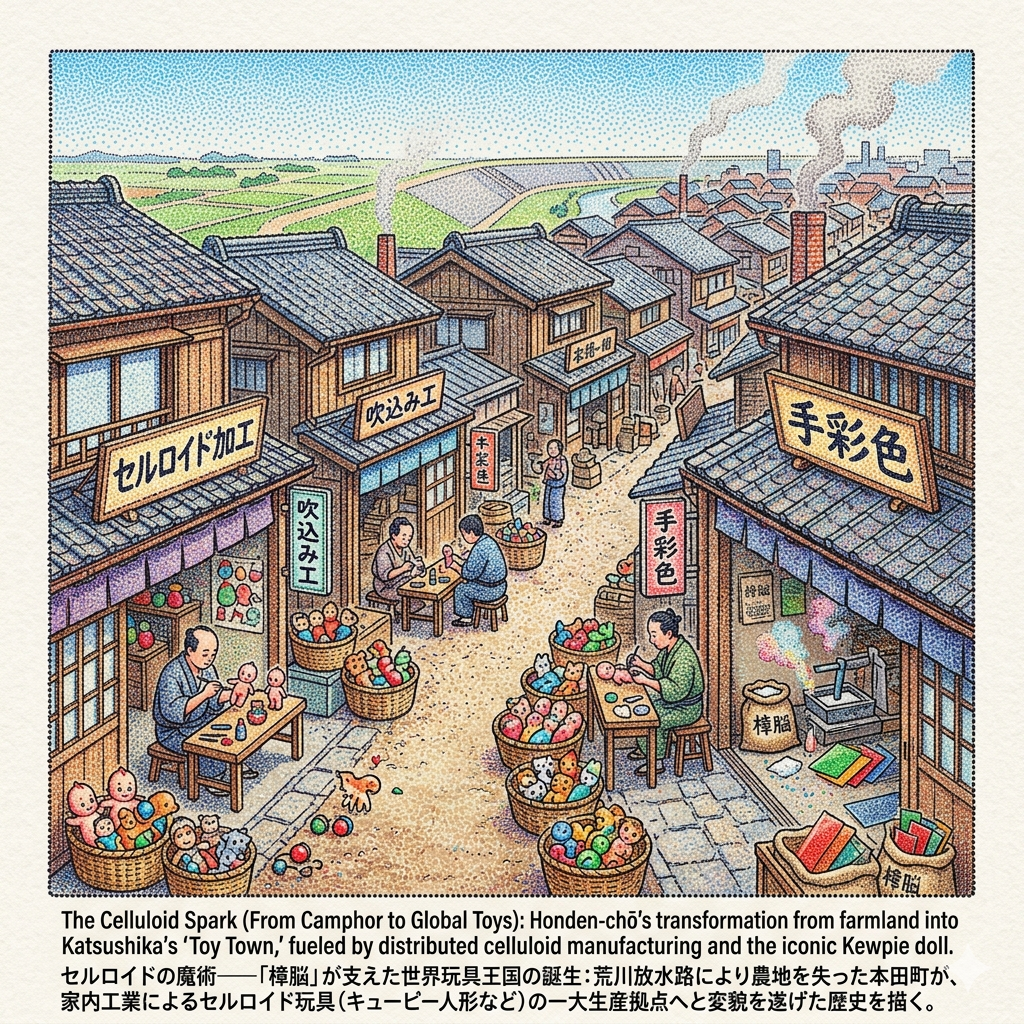
As the floodway drowned the traditional farms, the area underwent a metabolic shift toward high-tech chemical processing. The 1914 establishment of the Chigusa Celluloid Factory marked the birth of Katsushika's identity as "Toy Town." This industry was built on the dangerous volatility of camphor and nitrocellulose, materials that smelled of the future.
Features of Celluloid | Social Re-skilling & Impact |
Volatility & Danger | Required extreme artisanal discipline and fire-safe "clean rooms" in tiny workshops. |
Global Export Value | Filled the WWI vacuum left by German toy manufacturers; exported millions of "Kewpie" dolls. |
Distributed Production | Converted displaced farmers into a network of thousands of skilled home-workshops. |
The "So What?" Layer: This "distributed production" model—where every narrow alley housed a specialist in blow-molding or hand-painting—is the direct ancestor of the sophisticated supply chain that sustains modern industry giants like Takara Tomy. The loss of land mandated the gain of a trade, transforming Honden-chō from an agrarian fringe into a global manufacturing node.
The Shifting Seat of Power (The Administrative Tug-of-War)
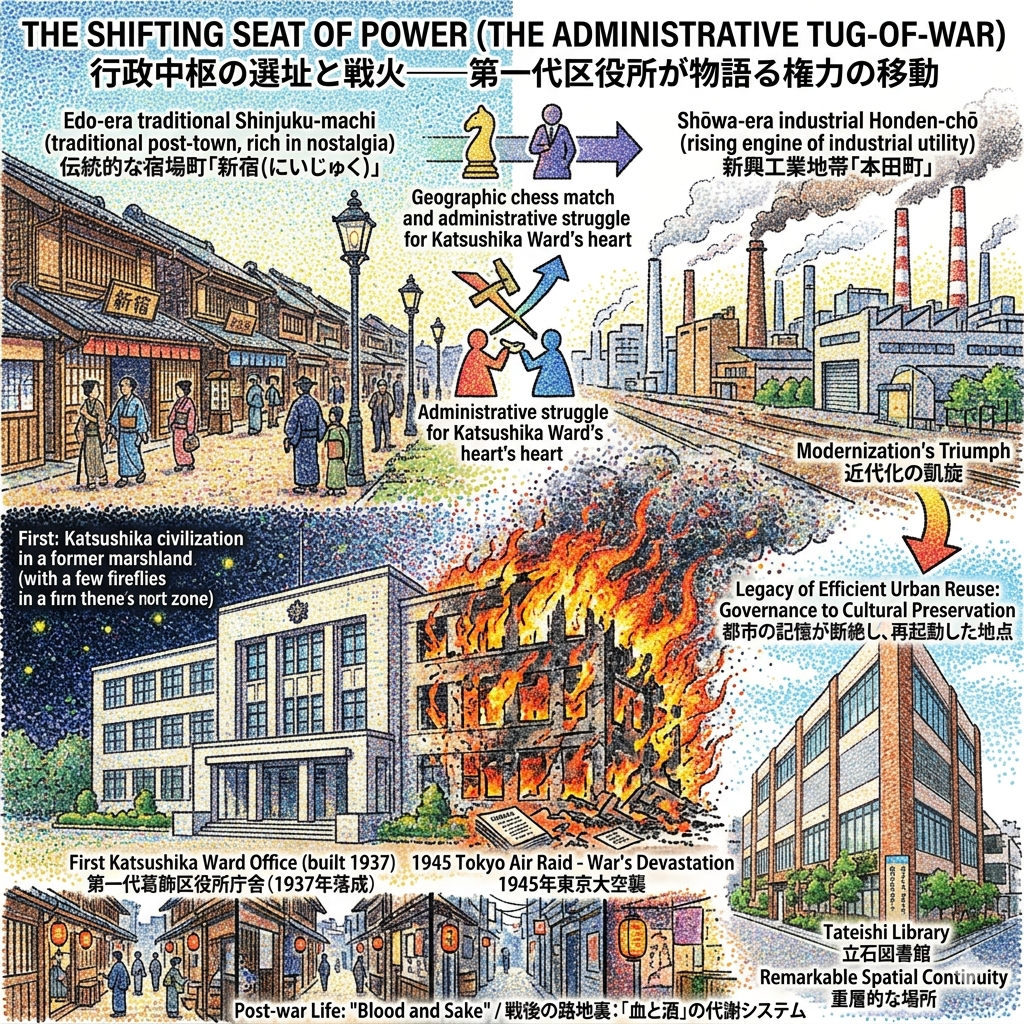
In 1932, during the "Great Tokyo" expansion, a geographic chess match occurred to determine the heart of the new Katsushika Ward. The candidates were Shinjuku-machi—a traditional Edo-era post-town rich in nostalgia—and Honden-chō, the rising engine of industrial utility.
The selection of Honden-chō represented a decisive pivot from Edo-era tradition to Shōwa-era industrial energy. The administrative center was established at the current site of the Tateishi Library. This site demonstrates a remarkable spatial continuity: it evolved from a town hall to the first ward office, and finally into a public library. It is a legacy of efficient urban reuse where the seat of power remained constant even as its function transitioned from governance to cultural preservation.
Blood and Spirits (The Metabolic History of the Drinker’s Alley)
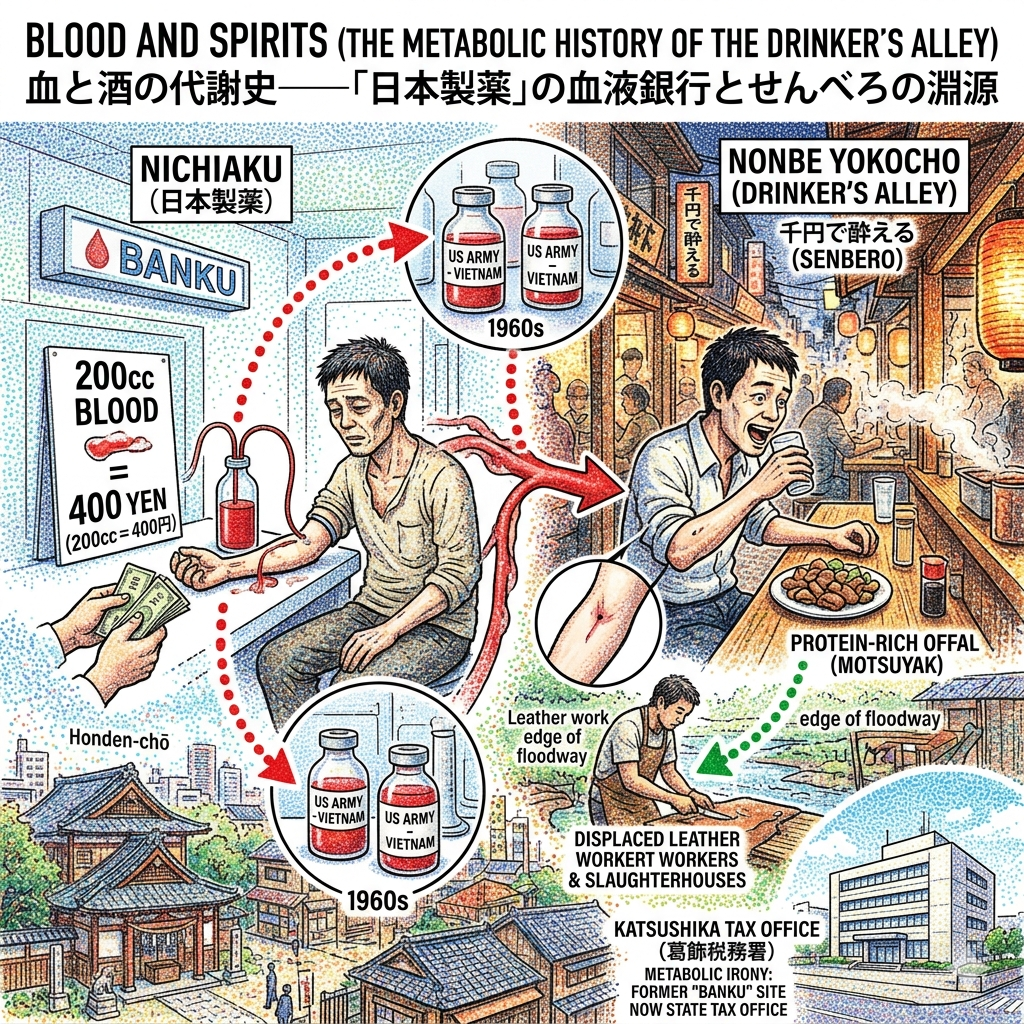
The post-war era saw Tateishi enter its most "野性的" (wild) metabolic phase, where human biology and the survival economy intertwined. In the 1950s, the "日本製藥" (Nichiyaku) blood bank, known as the "Banku," became the neighborhood's grim economic heart.
Impoverished laborers would sell 200cc of blood for 400 yen. Seeking to replace the physical drain, they would immediately spend that cash at the nearby "Nonbe Yokocho" (Drinker’s Alley). There, they consumed cheap, protein-rich offal (motsuyaki)—a direct byproduct of the leather slaughterhouses displaced to the district's edge by the floodway.
The Metabolic Irony This "blood-for-protein" cycle was the birth of the "Senbero" (1,000-yen intoxication) culture. The connection was even global: in the 1960s, it was revealed that blood sold by Tateishi’s poor was processed into Gamma Globulin for use by the American military in the Vietnam War. Today, in a final metabolic irony, the site of the former "Banku"—where blood was once commodified for survival—is occupied by the Katsushika Tax Office, where the state now collects its fiscal dues.
The Hidden Gem: Shibue Park
To feel the industrial pulse of the past, visit Shibue Park, the former site of the Chigusa Celluloid Factory. Amidst the cherry blossoms, find the "Celluloid Industry Birthplace Monument." It stands as a quiet reminder of when this park was the chemical heart of a global toy empire, and the air was thick with the scent of camphor.
Sophisticated Philosophical Reflection
The history of Honden-chō and Tateishi is a masterclass in Urban Metabolism. This landscape has survived by taking in what society deemed waste or danger—floodwaters, volatile chemicals, the "animal waste" of the leather industry, and even the discarded blood of the marginalized—and transforming them into a resilient, vibrant culture.
To understand a city, one must look at its scars rather than its polished skin. The jagged line of the Arakawa Floodway, the fire-gutted remnants of the original ward office, and the site of the old blood bank are not just historical footnotes; they are the marks of a community that refuses to be cleared. Tateishi’s beauty lies in this pastiche of survival—a future built meticulously out of the very materials that were meant to be its end.
To explore more deep-dives into the resilient geography of Japan, subscribe to our series on [Tokyo’s Industrial Heritage].
Planning Your Historical Walk
- How to get there: Take the Keisei Line to Keisei Tateishi Station. The historic "Nonbe Yokocho" is located immediately at the North Exit.
- Where to stay nearby: Opt for local neighborhood stays or small guesthouses in the Katsushika area to experience the true shitamachi scale rather than corporate hotels.
- Recommended tours: Look for guided walks focusing on the [Historical Travel Guide to Katsushika] to understand the nuances of offal-snack architecture and the Kinegawa legacy.
- Key Site: Visit the Tateishi Library to view markers of the original administrative heart and the evolution of the ward office site.
Q & A
How did the celluloid industry transform Honden into a toy capital?
The transformation of Honden (本田町) from an agricultural village into a global celluloid toy capital was driven by a combination of entrepreneurial initiative, global geopolitical shifts, and local environmental changes.
According to the sources, the following factors were instrumental in this metamorphosis:
- Establishment of the Chigusa Factory (1914): The industrialization of Honden began in 1914 when entrepreneur Minoru Chigusa established the Chigusa Celluloid Factory. This facility served as the cornerstone for the region's future identity as a "toy capital".
- Raw Material Advantage: Celluloid production at the time relied heavily on camphor. Because Taiwan was a Japanese colony and provided the world's largest supply of cheap camphor, Japanese factories like those in Honden enjoyed a significant cost advantage over international competitors.
- The World War I "Order Shift": During World War I, European toy manufacturing (particularly in Germany) was halted by the conflict. This caused a massive influx of global orders to flood into Japan, allowing the Chigusa factory to expand rapidly, eventually employing over 250 workers to produce dolls, ornaments, and household items.
- Labor Force Transition via the Arakawa Floodway: The construction of the Arakawa Floodway (1911–1930) was a turning point for the local population. The project submerged vast amounts of fertile farmland, effectively destroying the traditional agricultural livelihoods of the residents and forcing them to transition into the industrial workforce as celluloid craftsmen.
- The "Subcontracting" (Shitauke) Production Model: After the Chigusa factory closed in 1920 due to a post-war recession, its skilled technicians did not leave the area. Instead, they established their own micro-workshops using a decentralized subcontracting system. By the 1930s, the area was densely packed with thousands of these small home-based businesses, each specializing in a specific part of the process—such as cutting, blowing, coloring, or assembly.
- Global Market Success: This network of small factories successfully supported a global supply chain, most famously producing "Kewpie" dolls for export to the United States. This industry became a vital source of foreign exchange for Japan in both the pre-war and early post-war eras.
- Technological Legacy: While celluloid was eventually replaced by modern plastics like PVC due to its high flammability, the precision mold development and painting techniques perfected by Honden’s craftsmen remained. This technical expertise is the fundamental reason why modern toy giants, such as Takara Tomy, chose to establish their roots in the area.
Today, this history is commemorated by the "Katsushika Celluloid Industry Birthplace Monument" located in Shibue Park, the former site of the Chigusa factory.
How did the celluloid industry transform Honden into a toy capital?
The transformation of Honden from an agricultural village into a global celluloid toy capital was a "magical rise" driven by industrial entrepreneurship, geopolitical shifts, and a massive transition of the local labor force. According to the sources, several key factors converged to create this industrial hub:
1. The Foundation: Chigusa Celluloid Factory (1914)
The industrialization of Honden began in 1914 when entrepreneur Minoru Chigusa established the Chigusa Celluloid Factory in what was then Honden Village (now Higashi-Tateishi). This factory was the starting point for Honden’s industrial identity and laid the groundwork for Katsushika City’s future as a "Toy Capital".
2. Geopolitical and Economic Advantages
Honden’s industry benefited from two major external factors:
- The Taiwan Connection: Celluloid production required large amounts of camphor. Since Taiwan was a Japanese colony at the time and the world’s leading producer of cheap camphor, Japanese factories like Chigusa’s had a significant cost advantage over international competitors.
- World War I Market Vacuum: During the war, European toy manufacturers (especially in Germany) were forced to stop production. Global orders flooded into Japan, allowing the Chigusa factory to expand rapidly, eventually employing over 250 workers to produce dolls, ornaments, and household goods.
3. Labor Force Transition: From Farmers to Craftsmen
A critical internal factor was the construction of the Arakawa Floodway (1911–1930). This massive public works project submerged a significant amount of fertile farmland in the Honden area, essentially destroying the traditional agricultural livelihood of the residents. These displaced farmers were forced to find new ways to survive and transitioned into the industrial workforce as celluloid craftsmen.
4. The "Subcontracting" (Shitauke) Production Model
In 1920, the Chigusa factory closed due to a post-war recession, but its skilled technicians did not abandon the trade. Instead, they established a decentralized subcontracting system, opening thousands of micro-workshops throughout Honden and the neighboring Okudo Village.
- Specialization: Production was split into highly specific steps—cutting, blowing, coloring, and assembly—with different small shops handling each stage.
- Scale: By the mid-1950s, there were approximately 2,000 home-based workshops in the area, and the distinct scent of camphor from the celluloid processing filled nearly every alley.
5. Global Reach and Cultural Legacy
The most famous product of this industrial network was the "Kewpie" doll, which was exported in massive quantities to the United States. These toys were a vital source of foreign exchange for Japan during both the pre-war and early post-war eras.
6. Long-term Impact on Modern Toy Industry
Although celluloid was eventually replaced by safer plastics like PVC, the precision mold development and painting techniques perfected by Honden’s craftsmen remained in the region. This concentration of specialized technical skill is the reason why modern toy giants, such as Takara Tomy, established their roots in this area.Today, this history is commemorated by the "Katsushika Celluloid Industry Birthplace Monument" in Shibue Park, which sits on the former site of the original Chigusa factory.
Reference and Further reading
- 本田町 - accessed April 24, 2026,
- 葛飾区史 - 東京 - 葛飾区史|第2章 葛飾の歴史, accessed April 24, 2026,
- 香取神社【三社明神】 - 東京都神社庁, accessed April 24, 2026,
- 葛飾区の町名 - accessed April 24, 2026,
- 第2章 葛飾区の歴史, accessed April 24, 2026,
- 葛飾区史|第3章 近代化への道(明治~戦前), accessed April 24, 2026,
- 11 立石 - 葛飾区史|第3章 地域の歴史, accessed April 24, 2026,
- 葛飾区の立石様 - 日本実業出版社, accessed April 24, 2026,
- 立石様|立石地名の由来となった奇石 - 葛飾区の名所旧跡 - 猫の足あと, accessed April 24, 2026,
- 【こ】 古代では 立石様が 道しるべ|葛飾区公式サイト, accessed April 24, 2026,
- 明治・大正・昭和期に行われた荒川放水路開削工事と 市民の生活, accessed April 24, 2026,
- 荒川放水路変遷誌[PDF - 関東地方整備局, accessed April 24, 2026,
- 皮革関連産業の歴史と木下川小学校 - FC2, accessed April 24, 2026,
- 葛飾区史|第2章 葛飾の歴史, accessed April 24, 2026,
- 下町労働史 89 - 下町ユニオンニュース - FC2, accessed April 24, 2026,
- 知っていますか?荒川放水路のこと「荒川放水路通水100周年」 - 足立区, accessed April 24, 2026,
- 戦前戦後の葛飾区で盛んだったセルロイド玩具製造 | 郷土と天文の博物館ブログ, accessed April 24, 2026,
- 葛飾区史|第4章 現代へのあゆみ(戦後~平成), accessed April 24, 2026,
- 第2章 葛飾区の歴史, accessed April 24, 2026,
- 葛飾のセルロイドの歴史に迫る!!(#カツシカデシカ) - YouTube, accessed April 24, 2026,
- 葛飾区セルロイド工業発祥記念碑 - 発祥の地コレクション, accessed April 24, 2026,
- 葛飾区郷土と天文の博物館 - 東京 - ジャパンナレッジ, accessed April 24, 2026,
- 【え】 笑顔生む おもちゃ育てた セルロイド|葛飾区公式サイト, accessed April 24, 2026,
- 葛飾区史|第3章 地域の歴史, accessed April 24, 2026,
- 葛飾区立立石図書館 - accessed April 24, 2026,
- 7 図書館のあゆみ - 葛飾区立図書館, accessed April 24, 2026,
- 【 わがまち原動力】 戦後栄えた血液銀行の証言者たち(下)=郡山 ..., accessed April 24, 2026,
- 横丁に通いつめて集めた、「今しか聞けない」話|社会 - 中央公論.jp, accessed April 24, 2026,
- 早稲田大学教授に聞いた! 闇市起源の横丁の歴史とは? | Dig-it [ディグ・イット], accessed April 24, 2026,
- 五木寛之氏のエッセイに「立石か青砥の製薬会
- 血したことがある」と書かれていました。その ... - レファレンス協同データベース, accessed April 24, 2026,
- 京成立石駅前…まもなく消えてなくなる〝せんべろ〟の聖地 - 戦国ヒストリー, accessed April 24, 2026
 Lawrence
 Lawrence
 Lawrence