(ENG) Tokyo's Forgotten Village: A Walking History of Setagaya's Matsuzawa District
A historical travel guide to Tokyo’s former Matsuzawa Village in Setagaya. Walk through hidden urban alleys to discover how this area evolved from a famous Edo-period cucumber farm into a peaceful haven for Meiji-era writers and intellectuals.

 Lawrence
This is a historical travel story and walking guide to the former Matsuzawa Village in Setagaya, Tokyo. By tracing forgotten rural roots and modern urban shifts, this self-guided tour leads you through historic streets and hidden landmarks. Readers will discover how this quiet neighborhood transformed from a prominent Edo-period cucumber farming hub into a peaceful retreat for Meiji-era writers and intellectuals.
Location: Setagaya Ward, Tokyo Metropolitan Area | Historical Period: Meiji–Showa | Walking Difficulty: Easy
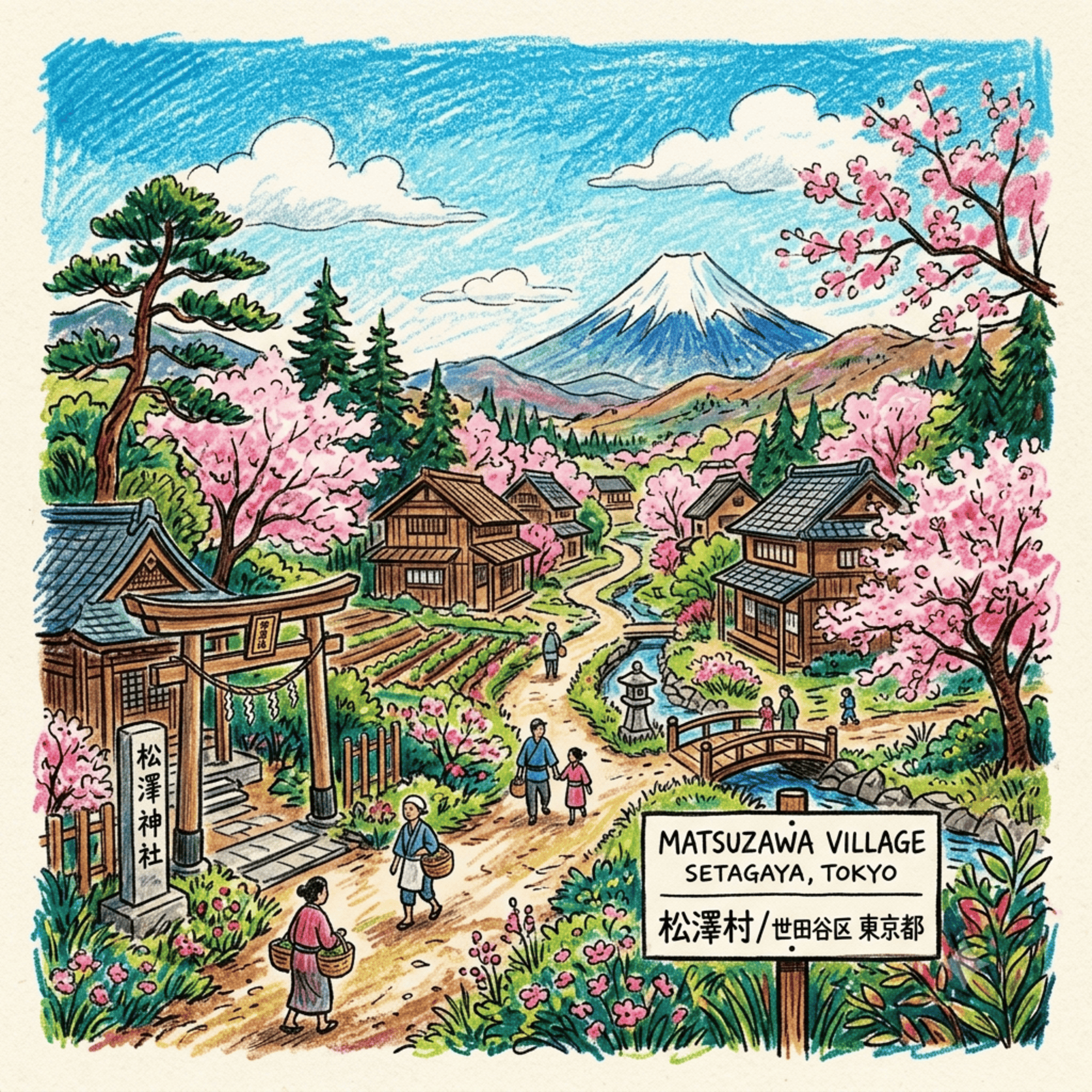
Matsuzawa Village no longer appears on any map of Tokyo. It was erased by administrative decree on October 1, 1932, when the expanding Tokyo metropolitan government absorbed it into the newly created Setagaya Ward. No commemorative marker was placed. No official recognition followed.
Yet the village never truly disappeared. Today's Matsubara, Akatsuchi, and Kamikitazawa neighborhoods are the surviving footprints of those dissolved hamlets. The Tokyo Metropolitan Matsuzawa Hospital, standing where it has since 1919, preserves over a century of Japan's most contested psychiatric history. Crooked alleyways trace the routes of a 17th-century irrigation canal. And a small, almost unknown museum holds the memory of one of modern Japan's most consequential social reformers.
This is a walking guide to five histories that Matsuzawa Village left behind — layers that reward slow, careful attention far more than any tourist checklist.
Listen to the historical stories told in detail (For subscribers only)
1. "The Misfortune of Being Born in This Country" — A Doctor's Challenge That Reshaped Japanese Psychiatry
The 140-Year-Old Hospital Hidden Behind Hanegi Park Has a Story Most Visitors Never Hear
A short walk from Kamikitazawa Station, behind a stretch of quiet residential streets, sits a campus of aging buildings that doesn't announce itself.
This is the Tokyo Metropolitan Matsuzawa Hospital — Japan's oldest public psychiatric institution, tracing its origins to 1879.
Its founding name, Tōkyō-fu Tenkyōin, translates roughly as "Tokyo Prefecture Institution for the Mad." The word choices are telling. This was not a place built for care so much as for containment — a state response to the uncomfortable presence of mentally ill people in a rapidly modernizing city.
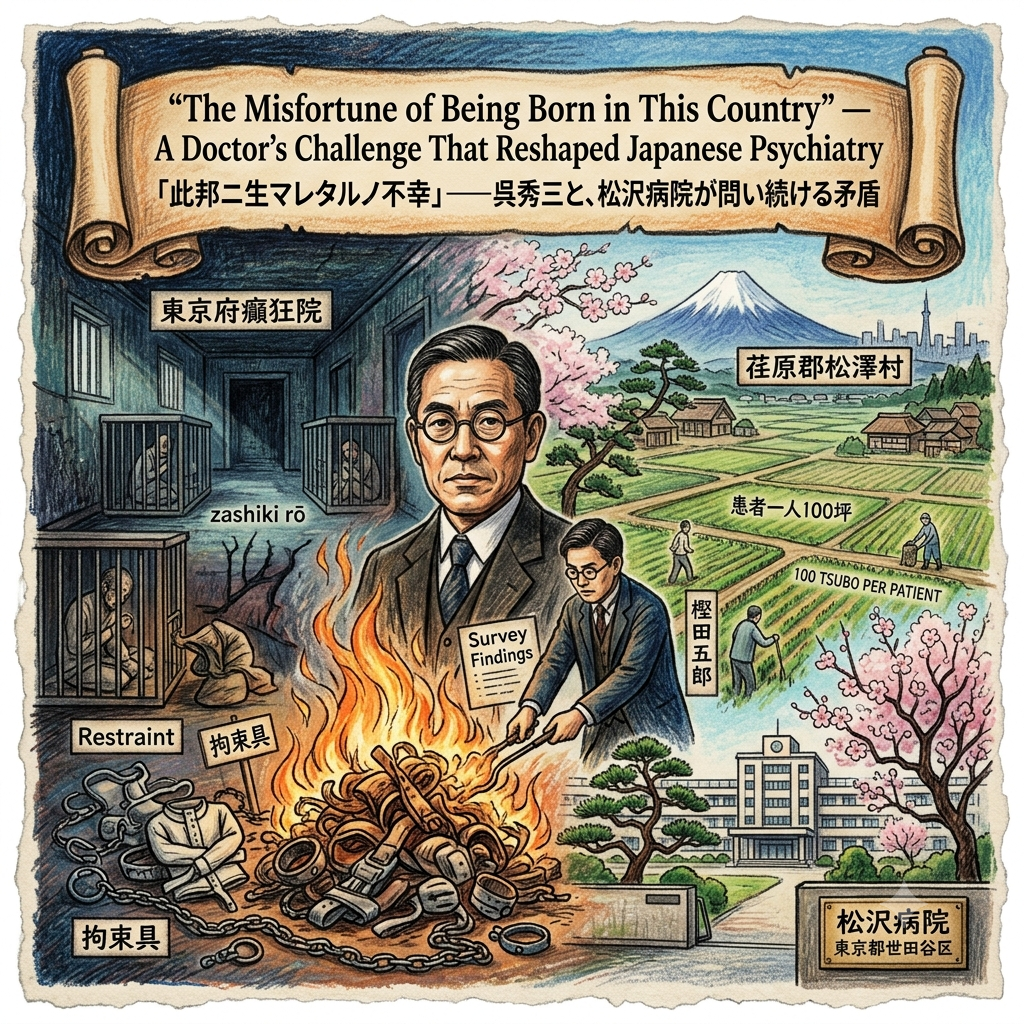
For its first two decades, the institution moved between locations and struggled for resources. The breakthrough came in 1901, when psychiatrist Kure Shūzō (1865–1932) was appointed director while simultaneously holding the chair of psychiatry at Tokyo Imperial University. He arrived and immediately did something radical for its time: he confiscated every restraint device in the building and burned them.
But Kure's most lasting act came in 1918, when he and his student Kashida Gorō published a survey of mentally ill patients confined in private homes across Japan. The document recorded in precise, devastating detail the conditions inside zashiki rō — literally "sitting-room cages" — where families were permitted by law to lock away ill relatives indefinitely.
The conclusion, written in formal Meiji-era Japanese, carried a quiet fury:
"The many hundreds of thousands of mentally ill people in our country suffer not only from the misfortune of their illness — they suffer from the second misfortune of having been born in Japan."
The following year, the Mental Hospital Law of 1919 was passed. The institution moved to its current location in Matsuzawa Village, occupying 60,000 tsubo (nearly 50 acres) of what was then rural farmland. Kure insisted on a minimum of 100 tsubo per patient — a spatial generosity almost unthinkable in the institution's previous urban iterations.
Here is the tension that makes this history worth sitting with: Kure's reforms were genuine and courageous. But the choice to build a progressive psychiatric hospital on isolated agricultural land didn't just reflect humanitarian ideals — it also reflected a logic of removal. The distance from the city was both liberation and segregation. Placing the mentally ill where they could breathe and move freely also meant placing them where they could be easily forgotten.
This ambiguity runs through the entire history of this site, and it doesn't resolve neatly.
Today, Hanegi Park's famous plum grove draws thousands of visitors each February. Almost none of them know they're walking the perimeter of one of the most historically charged pieces of ground in modern Japanese social history.
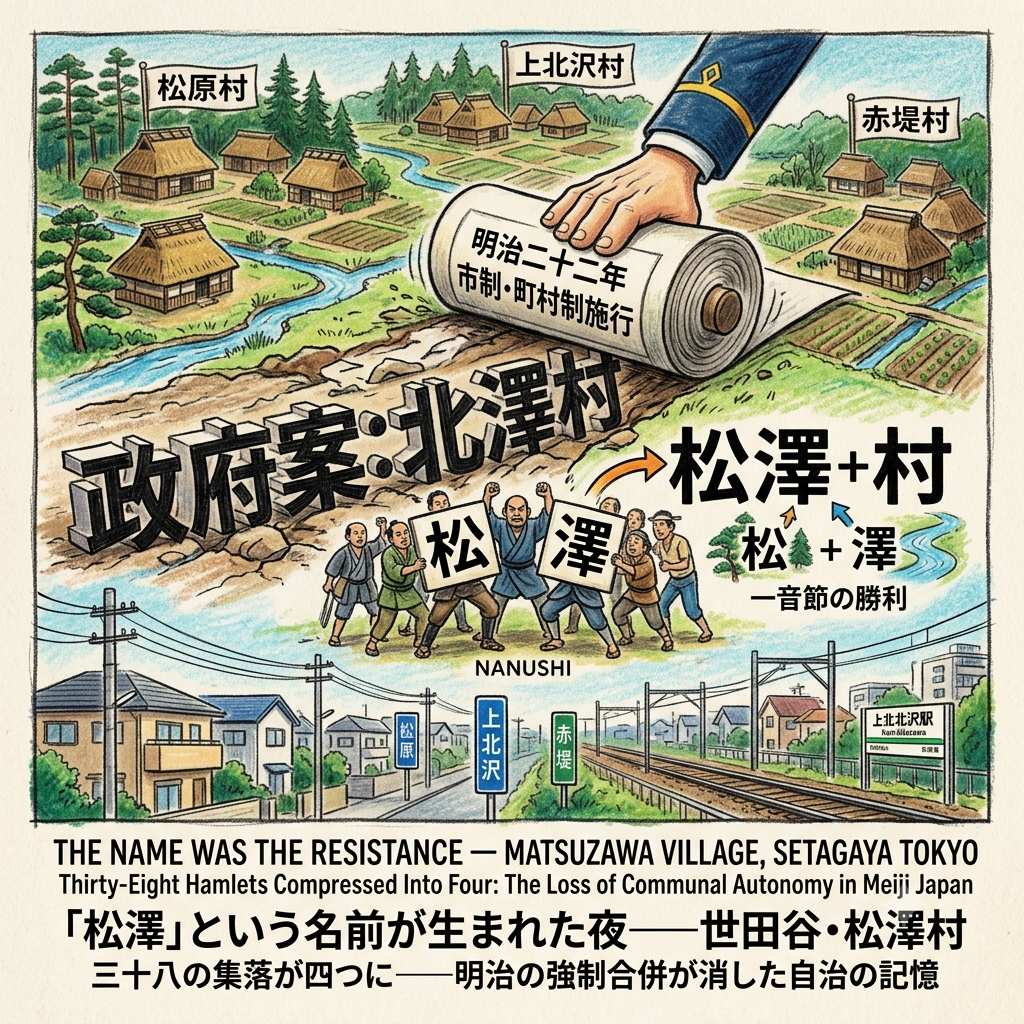
2. The Name Was the Resistance — How Farmers Fought an Empire's Administrative Bulldozer
Thirty-Eight Communities Were Compressed Into Four. What Was Lost in Translation?
In 1889, the Meiji government issued the Municipal and Town-Village Code — a nationwide order to consolidate Japan's thousands of small rural communities into larger, more governable administrative units.
The logic was coldly rational. The feudal-era system of village governance, built around hereditary headmen (nanushi) who mediated disputes, allocated water rights, and negotiated tax assessments with feudal lords, was incompatible with a modern centralized state. It had to go.
In what is now Setagaya Ward, approximately 38 distinct hamlets — each with its own identity, its own water agreements, its own social fabric — were compressed into just four villages. One of these was Matsuzawa Village, formed from the merger of Kamikitazawa, Matsubara, and Akatsuchi communities, plus a small exclave of Setagaya Village.
But the name itself tells a story of resistance.
The government's original plan called the new village "Kitazawa Village." Communities that would become Matsuzawa Village immediately objected. Calling the merged unit "Kitazawa" effectively erased the names — and by extension, the identities — of Matsubara, Akatsuchi, and Kamikitazawa. The protest was fierce enough that the Home Minister granted a rare exception, allowing a compromise name: Matsuzawa, a portmanteau of Matsu from Matsubara and Zawa from Kamikitazawa.
It was, by any measure, a small victory. A name. A syllable from each side of an argument.
But what surrounded it was not small at all.
The Meiji consolidation didn't just redraw administrative lines. It dismantled an entire system of communal self-governance. The traditional arrangements by which farmers had managed land, water, and conflict resolution for generations were replaced by appointed officials, centralized budgets, and bureaucratic uniformity. Farmers who had been self-governing hyakushō — holders of a specific identity tied to a specific place — became "residents of Matsuzawa Village," a category defined from above.
What the historian Yasumaru Yoshio called "the state's consumption of community space" is visible here in microcosm. The Meiji village reform, promoted in official histories as the birth of modern local self-governance, was in practice the systematic substitution of state authority for communal autonomy.
The neighborhood names that remain today — Matsubara, Akatsuchi, Kamikitazawa — are the last syllables of communities that fought, in their modest way, to keep something of themselves alive inside an administrative merger they could not prevent.
Explore more in our guide to Walking the History of Setagaya, which traces the old hamlet boundaries on foot.
3. The Road That Doesn't Make Sense — Reading Three Centuries of Water History in a Crooked Alley
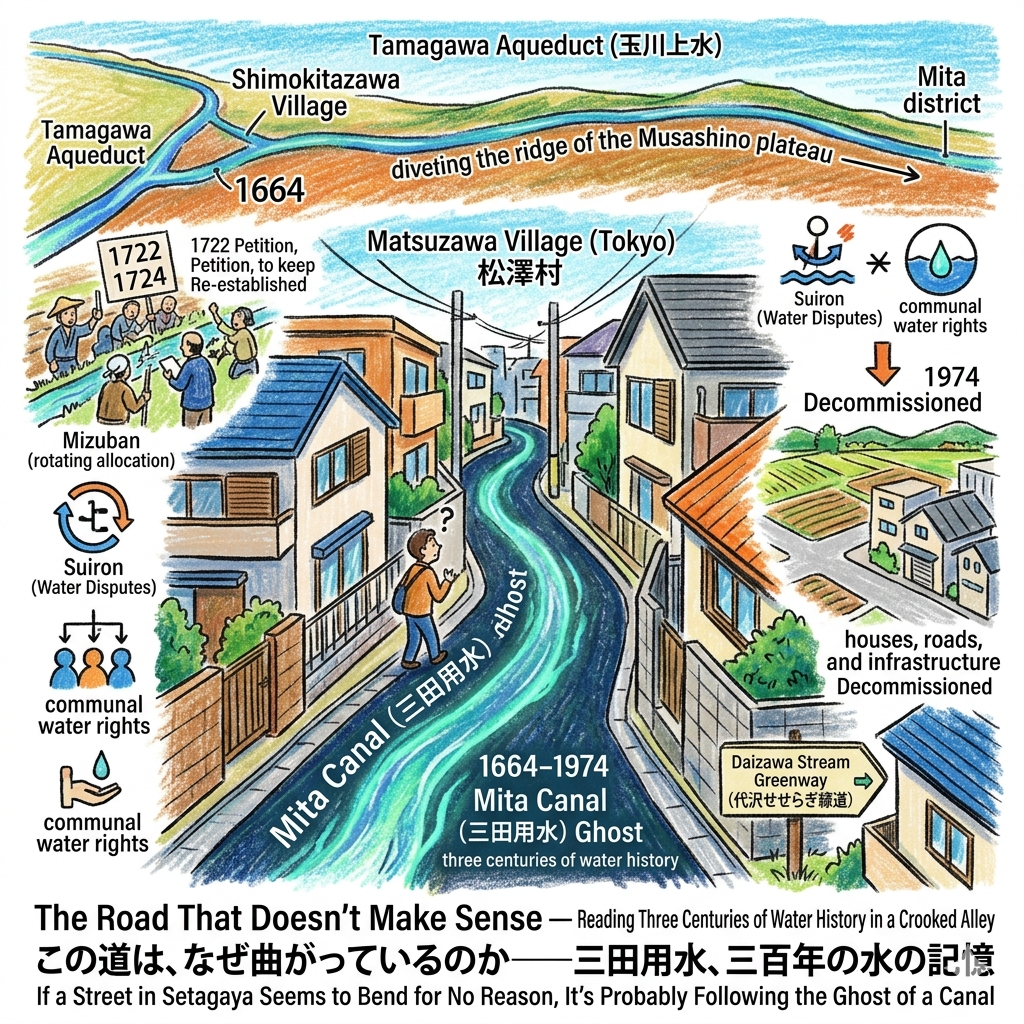
If a Street in Setagaya Seems to Bend for No Reason, It's Probably Following the Ghost of a Canal
Here is a simple test you can apply almost anywhere in the older parts of Setagaya: if a narrow path bends away from the grid for no obvious reason, or if a long, thin strip of greenery appears between two rows of houses going nowhere in particular, you are almost certainly standing on the course of a historical water channel.
The most significant of these is the Mita Canal (三田用水), whose history stretches from 1664 to 1974 — three centuries of agricultural life embedded in the topography of what is now a densely residential ward.
The canal began as a branch of the Tamagawa Aqueduct, the great 1654 engineering project that supplied drinking water to Edo Castle. In 1664, the Tokugawa shogunate diverted a branch at the village of Shimokitazawa — immediately adjacent to what would become Matsuzawa Village — and sent it running south and east along the ridge of the Musashino plateau, supplying farmland along the route down to the Mita district of what is now central Tokyo.
When the government tried to close the channel in 1722, the farmers downstream did something that tells you everything about how essential this water was: they petitioned immediately, collectively, and persistently until permission was granted to keep it open as an agricultural waterway. Two years later, in 1724, the canal was officially re-established for irrigation purposes.
It ran without interruption for another 250 years.
The management of the canal was governed by a system called mizuban — a rotating schedule of water allocation that each village community negotiated, maintained, and defended. Arguments over water timing, water volume, and maintenance responsibilities were some of the most politically charged moments in rural community life. A violation of water custom could ignite what period documents call a suiron — a water dispute — which could escalate to violence.
What happened to this system under the Meiji reforms is a precise case study in the privatization of the commons. The communal water rights that had been managed collectively by farmers for centuries were gradually redefined as state infrastructure assets. The farmers' customary rights to the water they had built their communities around were replaced by bureaucratic management and eventually by urban utility functions the canal had never been designed for.
By the time the Mita Canal was finally decommissioned in 1974, the agricultural land it had once served had been replaced by houses, roads, and the infrastructure of a Tokyo suburb.
The canal's course is still readable in Setagaya's geography. The Daizawa Stream Greenway (代沢せせらぎ緑道) follows part of the old route, threading between buildings in a way that makes immediate sense only if you understand the three-century history beneath your feet.
There is also a practical insight here for any visitor who finds themselves reading a map and wondering why certain streets in this part of Tokyo seem to curve against all logic: the city's history is written in its topography, and the topography was written first by water.
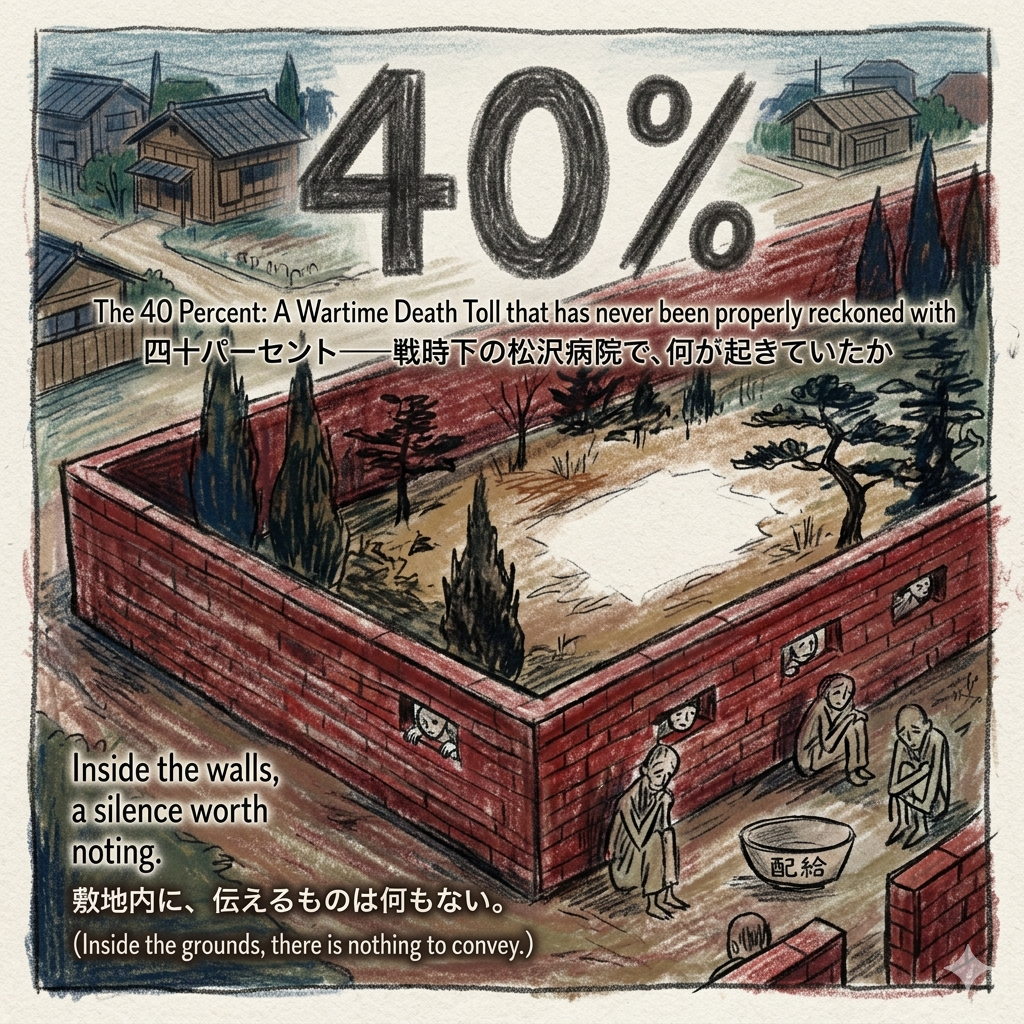
4. The 40 Percent — A Wartime Death Toll That Has Never Been Properly Reckoned With
Inside the Walls of Matsuzawa Hospital, One of the Most Uncomfortable Chapters of Japan's War History Went Almost Unrecorded
There are silences in the landscape of Matsuzawa that are worth noting.
Inside the grounds of the Tokyo Metropolitan Matsuzawa Hospital, there is no public monument to what happened there between 1943 and 1945. There is no explanatory plaque. There is no formal acknowledgment in the hospital's public-facing presence.
What happened was this: the patients starved.
In 1940, the Japanese government passed the National Eugenics Law, which classified certain categories of mental illness as heritable defects and authorized compulsory sterilization. The law codified what had been an ideological tendency into statute: psychiatric patients were "non-productive" members of the national body. Their value to the wartime state was, by definition, negative.
As the Pacific War intensified and food rationing tightened, the logic of this categorization was applied to caloric allocation. Psychiatric hospitals — whose residents could not contribute to industrial or agricultural production — received progressively reduced food rations. In some periods, daily intake at Matsuzawa fell below 1,000 calories. The minimum for basic adult survival is roughly twice that.
Post-war research by physician Tachitsu Masanao revealed what happened next: in 1945 alone, the mortality rate at Matsuzawa Hospital exceeded 40 percent. Historian Okada Yasuo, who spent decades researching Matsuzawa's history, later wrote that this statistic was the thing that made him devote his career to understanding how it had been possible. A 40 percent mortality rate, he observed, is not possible in a normally functioning medical institution. It requires a decision — even if that decision is never written down anywhere as such.
The broader national picture is even more difficult to absorb. Historians estimate that across Japan's psychiatric institutions during the war years, more than 100,000 patients died from hunger and medical neglect — a figure that has never entered the mainstream of Japanese war memory, public commemoration, or school curriculum.
The absence of a memorial at Matsuzawa Hospital is itself a historical document. Japan's postwar reckoning with the war centered on the suffering of soldiers and civilians who died in combat or bombing. The deaths of people institutionalized as mentally ill — deaths that required not violence but only indifference, not orders but only the quiet withdrawal of food — fell outside the frame of acknowledged tragedy.
For the historically minded visitor, this absence is the site. Standing outside the hospital's perimeter and knowing that there is nothing to mark what happened here tells you something precise and important about which lives a society chooses to memorialize and which it chooses to let disappear a second time.
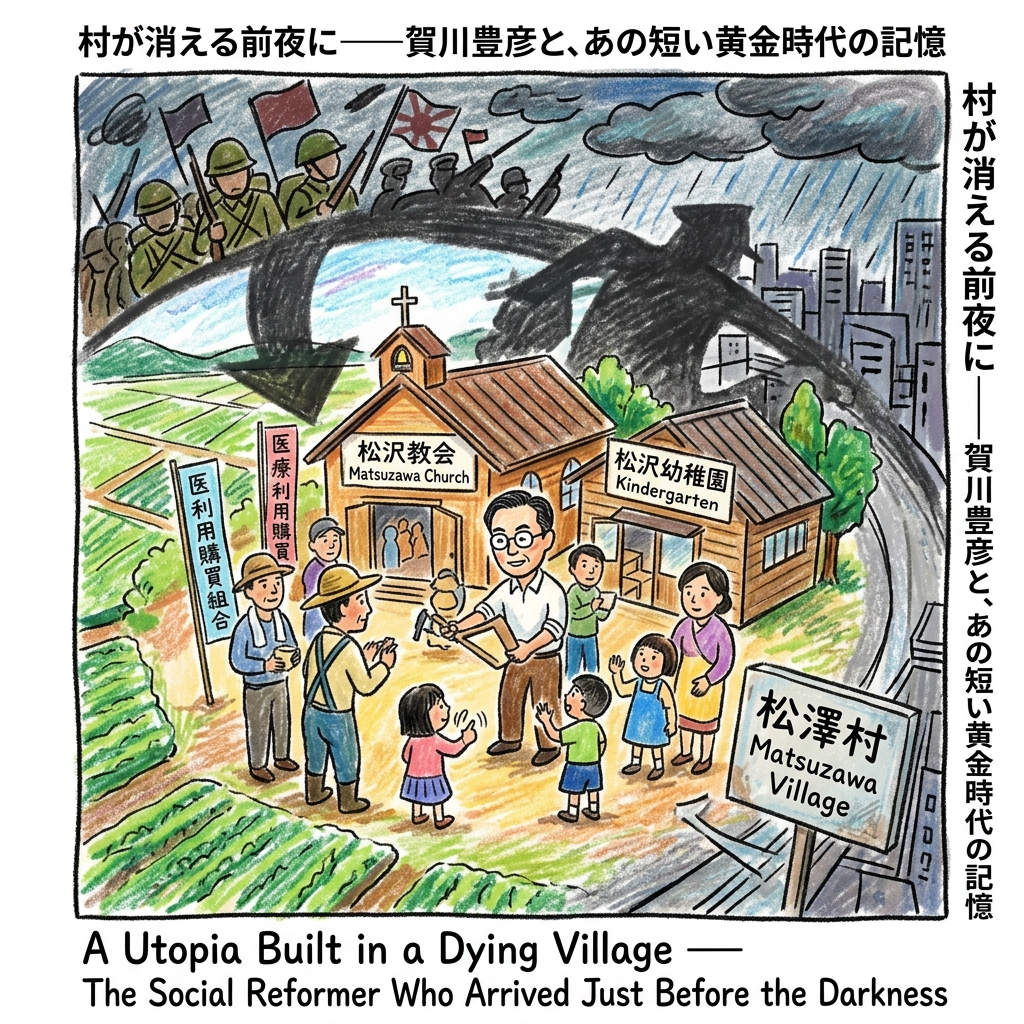
5. A Utopia Built in a Dying Village — The Social Reformer Who Arrived Just Before the Darkness
Why Did One of the World's Most Famous Christian Activists Choose a Disappearing Tokyo Farming Village as His Base?
The last chapter of Matsuzawa Village's existence as an independent community was, against all odds, one of its most internationally significant.
In 1926, the Reverend Robert Karl Reischauer — an American Presbyterian missionary and the father of Edwin O. Reischauer, who would later serve as U.S. Ambassador to Japan under President Kennedy — relocated his Japan School for the Deaf to Kamikitazawa, within the bounds of Matsuzawa Village. A foreign scholar bringing modern special education methods to a Tokyo farming community: the detail is easily overlooked and quietly remarkable.
Then, in 1929, Kagawa Toyohiko moved from Nishinomiya to Matsuzawa Village.
Kagawa is a figure who deserves more international recognition than he receives. He was a Christian socialist, a bestselling novelist (his 1920 book Crossing the Death Line sold over a million copies), a founder of Japan's first consumer cooperatives, a labor organizer, and a figure who had worked in the slums of Kobe before his activism became globally recognized. He was nominated for the Nobel Peace Prize multiple times. At the height of his fame, he was as well known internationally as Gandhi or Jane Addams.
And he chose a disappearing agricultural village on the western edge of Tokyo as his base.
In 1931, Kagawa founded the Matsuzawa Church (松沢教会) and the Matsuzawa Kindergarten in what is now the Kitazawa 1-chōme area of Setagaya. The following year, he organized the precursor to Japan's first cooperative medical association.
The timing creates one of history's more poignant ironies.
In 1931, the year Kagawa built his church, the Manchurian Incident began. Militarism was tightening its grip on Japanese public life. The village he had chosen as his base had exactly one more year of independent existence. In October 1932 — the same month that Matsuzawa Village ceased to exist as an administrative entity — Japan's political trajectory toward total war was becoming irreversible.
A social reformer building a community institution in a village that was simultaneously being administratively dissolved, while the country was moving toward a war that would eventually make his pacifism dangerous: this is not a story that fits easily into any single narrative about modern Japan.
Kagawa himself is not without historical complications. Some scholars have noted that his thinking was not entirely free from the eugenic currents of his era — a reminder that progressive idealism and ideological contradiction frequently coexist in the same individual. History, as always, resists clean heroism.
What remains is the Kagawa Toyohiko Memorial Matsuzawa Museum, housed within the still-active Matsuzawa Church at 1-6-7 Kitazawa, Setagaya Ward. It is one of the most overlooked historical sites in Tokyo — a small room in a working church, holding the documents of a man whose ambitions once reached across the world from this quiet corner of a village that no longer exists.
Hidden Gems: What You Won't Find in Any Travel Guide
These are the places in the former Matsuzawa Village that reward visitors precisely because they ask nothing of you — no admission fee for the best ones, no crowds, no performance of heritage. Just places where history sits close to the surface if you know to look.
Kagawa Toyohiko Memorial Matsuzawa Museum (賀川豊彦記念・松澤資料館): Inside the Matsuzawa Church at 1-6-7 Kitazawa, Setagaya. Free admission. Houses letters, manuscripts, and artifacts from Kagawa's decades of social activism. Check opening hours in advance — this is a working church, not a managed heritage site, which is precisely what makes it worth visiting.
Daizawa Stream Greenway (代沢せせらぎ緑道): A narrow pedestrian path that threads through residential blocks, following the route of the filled-in Mita Canal. There are no historical explanations anywhere along it. The history is in the shape of the path itself — the way it bends where a canal once bent, the way it narrows where the water once ran between plots of farmland. Best explored slowly, with a historical map in hand.
Hanegi Park Plum Grove (羽根木公園梅林): Deservedly popular in February for its plum blossoms, but the historical layer — the park's immediate adjacency to the Matsuzawa Hospital and its century of contested history — is invisible without context. Walking here knowing what you know changes what you see.
Kamikitazawa Station area (Keio Line): The station opened in April 1913, when this land was still farmland in Matsuzawa Village. Standing at the station's small plaza, it is possible to hold two images simultaneously — the quiet suburban street of today and the agricultural community whose gradual dissolution this railway's arrival set in motion. Nothing marks this history. That is exactly the point.
For a broader orientation, see our guide to Walking the History of Setagaya, which places Matsuzawa within the full sweep of the ward's historical development.
Conclusion: Every Crooked Road Is a Story Someone Decided Not to Tell
Five histories, five forms of disappearance.
Kure Shūzō's hospital teaches us that reform and control are not opposites — they are frequent companions. The most well-intentioned institutional improvements often reproduce, in more sophisticated form, the exclusionary logic they set out to dismantle.
The story of the village merger teaches us that the state's most effective tool is not violence but administrative language — the quiet power to rename, consolidate, and reclassify until what was particular becomes general, and what was rooted becomes interchangeable.
The Mita Canal teaches us that the landscape of a city is a palimpsest, and that reading it requires willingness to see past what is there to what was there before — the agricultural logic that once organized a community, now readable only in a road's unexpected curve or an alley's inexplicable narrowness.
The wartime deaths at Matsuzawa teach us something harder: that the most catastrophic decisions in history are often not decisions at all, in the conventional sense. They are withdrawals, omissions, reclassifications that allow people to die without anyone needing to issue an order. The absence of a memorial is not an oversight. It is a continuation of the same logic.
And Kagawa Toyohiko's final, improbable act of institution-building in a village on the verge of administrative extinction teaches us that human beings have a persistent, irrational tendency to build even as the ground is shifting beneath them — to plant something, establish something, claim a small piece of the future, even when the evidence suggests the future belongs to something else entirely.
Walking through Setagaya today — past the hospital perimeter, along the green corridor of a filled-in canal, into the quiet courtyard of a church that holds a museum almost no one knows about — does not feel like a journey into the past. It feels like a more accurate version of the present.
Every city contains villages it has consumed. The question that Matsuzawa leaves you with is not "what happened here?" You can read that. The question is harder: What is being consumed right now, in the name of what kind of progress, that future visitors will someday try to find in the shape of the roads?
If this article opened something for you about the way history lives in cities, we'd encourage you to explore our Tokyo Historical Travel Guide. Subscribe to our newsletter for new articles on the places history forgot to explain.
Getting There: Planning Your Matsuzawa Village Walk
Transport
The former Matsuzawa Village is straightforward to reach from central Tokyo on two lines:
Keio Line (京王線) from Shinjuku Station
| Destination | Nearest Station | Journey from Shinjuku |
|---|---|---|
| Kamikitazawa Station area (historical walk start) | Kamikitazawa (上北沢) | ~20 min |
| Matsuzawa Church / Kagawa Museum | Meidaimae (明大前), then Tokyu Setagaya Line | ~15 min |
| Hanegi Park / Matsuzawa Hospital perimeter | Kamikitazawa (上北沢) | ~20 min |
Odakyu Line (小田急線) from Shinjuku Station
- Alight at Umegaoka (梅ヶ丘) for Hanegi Park: approximately 10 minutes' walk.
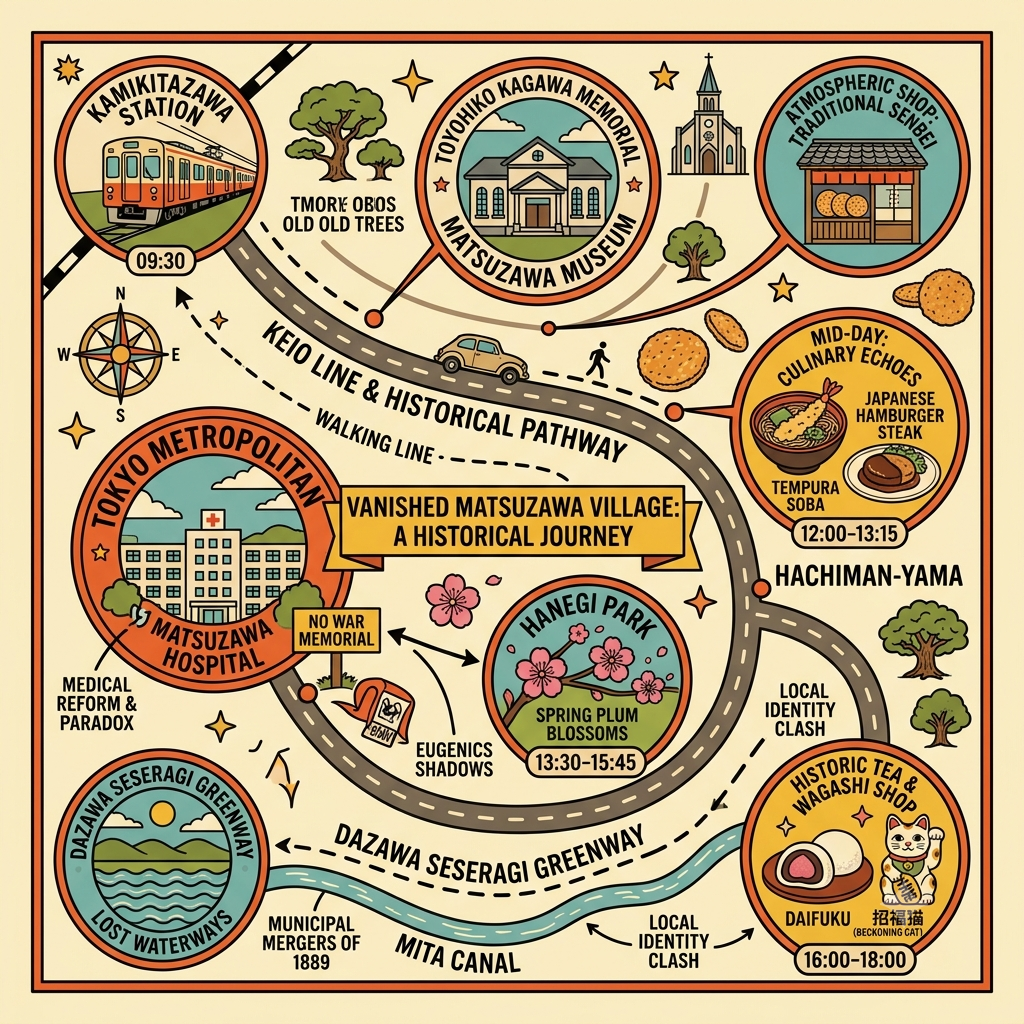
Practical note: The full historical walk — Kamikitazawa Station to Kagawa Museum to Hanegi Park to the Matsuzawa Hospital perimeter — covers roughly 3 to 4 kilometers on level ground, with no significant elevation changes. Allow 2.5 to 3.5 hours including time at each site.
Where to Stay
Shimokitazawa area (10–15 minutes' walk from most sites)
Shimokitazawa is Setagaya's most characterful neighborhood — dense with independent bookshops, vinyl record stores, and small live music venues. It sits immediately east of the former Matsuzawa Village boundary and provides an atmospheric base for exploring the area.
- MUSTARD HOTEL SHIMOKITAZAWA — A well-designed boutique hotel that fits naturally into the neighborhood's independent spirit. Walking distance from Shimokitazawa Station (Odakyu and Tokyu Setagaya lines).
- Guesthouse Shimokitazawa — A smaller, more sociable option for travelers who prefer less isolation and more conversation.
Shinjuku area (if prioritizing transport access over neighborhood character)
For visitors planning day trips to multiple parts of Tokyo, staying near Shinjuku Station offers the fastest access to the Keio Line and the Matsuzawa Village walking route while maintaining connections to the rest of the city.
Recommended Experiences Nearby
Setagaya Ward Local History Museum (世田谷区立郷土資料館) Address: 1-29-18 Setagaya, Setagaya Ward Free admission. Houses historical maps, cadastral surveys, and administrative documents from the Meiji and Taisho periods. The museum holds materials that document the 1889 village merger directly. Open Wednesday–Sunday, 9:00–17:00.
Tokyo Waterworks Historical Museum (東京都水道歴史館) Address: 2-7-1 Hongo, Bunkyo Ward Free admission. If the Mita Canal history captured your attention, this museum holds the original engineering maps and historical documents for the Tamagawa Aqueduct system, including its branching canals. Bunkyo Ward, approximately 40 minutes from Setagaya by train — worth a separate half-day.
Self-Guided Historical Walk A suggested order: begin at Kamikitazawa Station (1913 opening, within old Matsuzawa Village) → walk south to the Matsuzawa Church and Kagawa Toyohiko Memorial Museum → continue to Hanegi Park → circle the Matsuzawa Hospital perimeter → pick up the Daizawa Stream Greenway toward Shimokitazawa for a final walk along the ghost of the Mita Canal. End with coffee in Shimokitazawa.
No tour guide required. The places are quiet enough that the history has room to reach you.
Q & A
What is the darker history of Matsuzawa Hospital during the Pacific War?
The darker history of Matsuzawa Hospital during the Pacific War (1940–1945) is defined by a period of systemic abandonment and extreme mortality driven by wartime eugenics and resource scarcity.
Ideological Devaluation of Patients
Under the political climate of extreme nationalism, the 1940 National Eugenics Law provided a legal and ideological framework that categorized the mentally ill and those with hereditary disabilities as "inferior". During the total war mobilization, hospital patients were reclassified by the military state as "non-productive populations" (非生産人口). Because they were viewed as a "consumable population" that contributed nothing to the war victory, their lives were deprioritized in the national distribution of resources.
Policy-Driven Starvation and Neglect
The most harrowing aspect of this period was the systematic slashing of food rations.
- Caloric Deprivation: Daily food intake for patients was reduced to less than 1,000 calories, a level far below what is required for basic survival.
- Nutritional Disorders: Records indicate that 62.3% of patient deaths during this time were directly attributable to nutritional disorders (starvation).
- Resource Requisition: Beyond food, the hospital's medical personnel, drugs, and equipment were heavily requisitioned for military use, leaving the remaining staff and patients in a state of terminal neglect.
Shocking Mortality Rates
The result of these policies was a catastrophic spike in deaths that some scholars describe as "policy-driven starvation".
- 40% Death Rate: In 1945, the final year of the war, the mortality rate at Matsuzawa Hospital exceeded 40%.
- National Context: This was not an isolated incident; it is estimated that over 100,000 patients in psychiatric hospitals across Japan died during the Pacific War due to similar systemic neglect.
Historical Silence and Erasure
Despite the scale of this tragedy, this chapter of history remains largely "hidden" or "silent".
- Lack of Memorials: There are no public monuments, memorial markers, or plaques at Matsuzawa Hospital today to commemorate the thousands of patients who died during the war.
- Selective Memory: This "absence" of a memorial is noted in the sources as a powerful form of historical erasure, as the hospital continues to function today without a visible acknowledgement of this dark period.
- Academic Debate: Historians continue to debate whether this should be classified as "intentional murder" (comparable to Nazi Germany's T4 program) or "negligent death" caused by wartime hardship, though the ideological framework of the time clearly permitted the sacrifice of these lives.
How did Shuzo Kure's reforms impact patient rights initially?
Shuzo Kure's reforms, beginning in the early 20th century and peaking with the relocation of Matsuzawa Hospital in 1919, represented a revolutionary shift toward humanistic psychiatry in Japan. His impact on patient rights can be understood through his efforts to abolish physical confinement, his advocacy for legal protections, and his implementation of spatial humanism.
Abolition of Physical Restraints
Immediately upon becoming the director of the predecessor Sugamo Hospital in 1901, Kure took the symbolic and practical step of abolishing all physical restraints, famously ordering that these devices be gathered and burned. In their place, he introduced occupational therapy as a means of treatment, viewing patients as medical subjects rather than dangerous threats to be bound.
Advocacy Against Private Detention
Kure was a vocal critic of the state of mental healthcare in Japan. In 1918, he published a groundbreaking report exposing the horrific conditions of "zashikirou" (private family detention cages). He famously lamented that mentally ill individuals in Japan suffered not only from their disease but also from the "misfortune of being born in this country," a statement that became a landmark in the history of Japanese human rights. His advocacy directly influenced the passage of the 1919 Mental Hospital Law, which mandated the establishment of public psychiatric institutions.
Spatial and Architectural Humanism
When Matsuzawa Hospital moved to its rural site in 1919, Kure implemented a "pavilion-style" (分棟式) design. This architectural reform impacted patient rights by:
- Providing Outdoor Access: Unlike the cramped urban quarters in Sugamo, the new design featured central courtyards, ensuring that even patients in closed wards could spend time outdoors.
- Expanding Personal Space: Kure secured a standard of roughly 100 tsubo of space per patient within the hospital's expansive grounds, a level of environmental dignity previously unheard of in Japanese psychiatric care.
The Paradox of Initial Reforms
While Kure's reforms significantly improved the immediate physical treatment and dignity of patients, historical scholars note a complex paradox regarding their rights:
- Visibility vs. Invisibility: His reforms replaced the "invisibility" of private family cages with "state visibility" through official institutionalization.
- Social Exclusion: Moving the hospital to the then-remote "borderland" of Matsuzawa Village effectively isolated the mentally ill from the visible fabric of Tokyo, establishing a system of geographic exclusion that removed them from the broader social consciousness.
In summary, Kure's initial reforms granted patients the right to a life without physical bonds and a more humane living environment, though these gains were inextricably linked to a new system of state-managed institutionalization and social isolation.
Reference and Further reading
- 国立国会図書館デジタルコレクション——呉秀三・樫田五郎「精神病者私宅監置ノ実況及ビ其統計的観察」(東京医学会雑誌 第32巻第10–13号、大正7年, 1918年)——原典數位化版本,可公開查閱
- 東京都公文書館(Tokyo Metropolitan Archives)——東京府立松沢病院関連行政文書
- 東京都立松沢病院史料室——大正・昭和期の院内文書(現地申請必要)
- 日本精神神経学会——「歩み:呉秀三の生涯とその門下生」公開記錄
- 世田谷区立郷土資料館——明治期地籍図、行政文書コレクション
- 東京都公文書館——《市制・町村制》施行関連文書、荏原郡関係記録
- 国立国会図書館デジタルコレクション——明治22年東京府告示・布達類
- XWIN II Weblog(歷史研究部落格,作者為明治期行政史專家)——「東京府荏原郡における明治期の町村制施行時の変遷過程」(2013年2月)
- 東京都水道歴史館——玉川上水・三田用水関連古文書・設計図(含「目黒筋御場絵図」等江戸時代絵図)
- 東京都公文書館——明治期水利行政関連文書
- 国立国会図書館デジタルコレクション——三田用水關係古文書(部分已數位化)
- 目黒区教育委員会——「歴史を訪ねて 三田用水」シリーズ(目黒区公式刊行物)
- 国立公文書館——「国民優生法」関連行政文書(昭和15年、可查閱)
- 東京都立松沢病院史料室——戦時期患者統計資料(需訪問許可申請)
- 国立国会図書館——立津政順「戦争中の松沢病院入院患者死亡率」(進一步核實發表刊物與年份建議)
- 賀川豊彦記念・松澤資料館——生平史料、書信、大正昭和期活動記録
- 明治学院歴史資料館——「賀川豊彦」関連デジタルアーカイブ(線上公開)
- 京王電鉄社史——「上北沢駅」開設(大正2年、1913年)関連記録
- 鳴門市賀川豊彦記念館——公式歷史記錄
- 岡田靖雄『私説松沢病院史 1879~1980』岩崎学術出版社、1981年
- 岡田靖雄『呉秀三 その生涯と業績』思文閣出版、1982年
- 金川英雄訳・解説『現代語訳 呉秀三・樫田五郎 精神病者私宅監置の実況』医学書院、2012年
- 松沢病院120周年記念誌刊行会編『松沢病院120年』星和書店、2001年
- Akihito Suzuki, "Framing Psychiatric Subjectivity: Doctor, Patient and Record-keeping in Twentieth-century Japan," in Cultures of Psychiatry (Amsterdam University Press, 2002)(進一步核實出版細節建議)
- 安丸良夫『日本の近代化と民衆思想』青木書店、1974年
- 大石慎三郎『近世村落の構造と家制度』吉川弘文館(進一步核實出版年份建議)
- 世田谷区史編纂委員会『世田谷区史』(各巻、世田谷区刊行)
- 鈴木理生『江戸の川・東京の川』井上書院、1989年
- 東京都水道局編『東京の水道の歴史』(東京都水道局刊行)
- 進一步核實建議:三田用水流域各村の水論関係文書の現存状況
- 岡田靖雄『日本精神科医療史』医学書院、2002年
- 岡田靖雄『私説松沢病院史 1879~1980』岩崎学術出版社、1981年
- 松沢病院120周年記念誌刊行会編『松沢病院120年』星和書店、2001年
- 八木剛平・田辺英『日本精神病治療史』金原出版、2002年(平成14年刊)
- 武藤富男『評伝賀川豊彦』キリスト教新聞社、1981年
- 藤野豊「近代日本のキリスト教と優生思想」『キリスト教史学』第49号、1995年
- 金井新二「賀川豊彦と軍国主義」『雲の柱』第32号、賀川豊彦記念松沢資料館、2018年
- Robert Karl Reischauer(萊肖爾父子)相關研究:進一步學術文獻核實建議
- NHK「福祉の時代:ある医局日誌〜戦時下の精神障害者」(初回放映1981年8月14日)——NHKアーカイブズ収録、全国番組公開ライブラリー端末にて視聴可能
- 近代日本精神医療史研究会(研究者ブログ・文書資料)
- 進一步檔案核實建議:松澤村役場関係文書(現存於世田谷区立郷土資料館之完整程度與分類狀況,建議研究者進行現場查核)
- ミズベリング(Mizbering)プロジェクト——「水のない水辺から:三田用水跡をたどる」(地形分析記事、2019年、筆者:吉村生)
- NHK「ある医局日誌〜戦時下の精神障害者」(1981年放映、NHKアーカイブズ所収)——含多名戦時関係者の証言
- 日本精神障害者権利協会(JCPD)関連報告書(進一步核實建議)
- 進一步重要核實建議:戦時の患者死亡記録の詳細な公開状況、及び院内史料室の訪問申請手続き
- NHK「ある医局日誌〜戦時下の精神障害者」(1981年放映、NHKアーカイブズ所収)——含多名戦時関係者の証言
- 日本精神障害者権利協会(JCPD)関連報告書(進一步核實建議)
- 進一步重要核實建議:戦時の患者死亡記録の詳細な公開状況、及び院内史料室の訪問申請手続き
 Lawrence
 Lawrence
 Lawrence
Historical sources referenced in this article include Kure Shūzō and Kashida Gorō's 1918 survey published in the Tokyo Medical Society Journal; Okada Yasuo's Shisetsu Matsuzawa Byōin-shi, 1879–1980 (Iwasaki Gakujutsu Shuppansha, 1981); and materials held at the Setagaya Ward Local History Museum and the Tokyo Metropolitan Archives. Further research recommendations are available in the full archival dossier.