Peng Chau, Hong Kong: The Dying-House, the Match Factory and an Island That Took In What Others Left
Discover the hidden history of Peng Chau, a small Hong Kong island, through five fascinating stories of dying-houses, lime kilns, and old industrial heritage on a slow walking tour.
 Lawrence
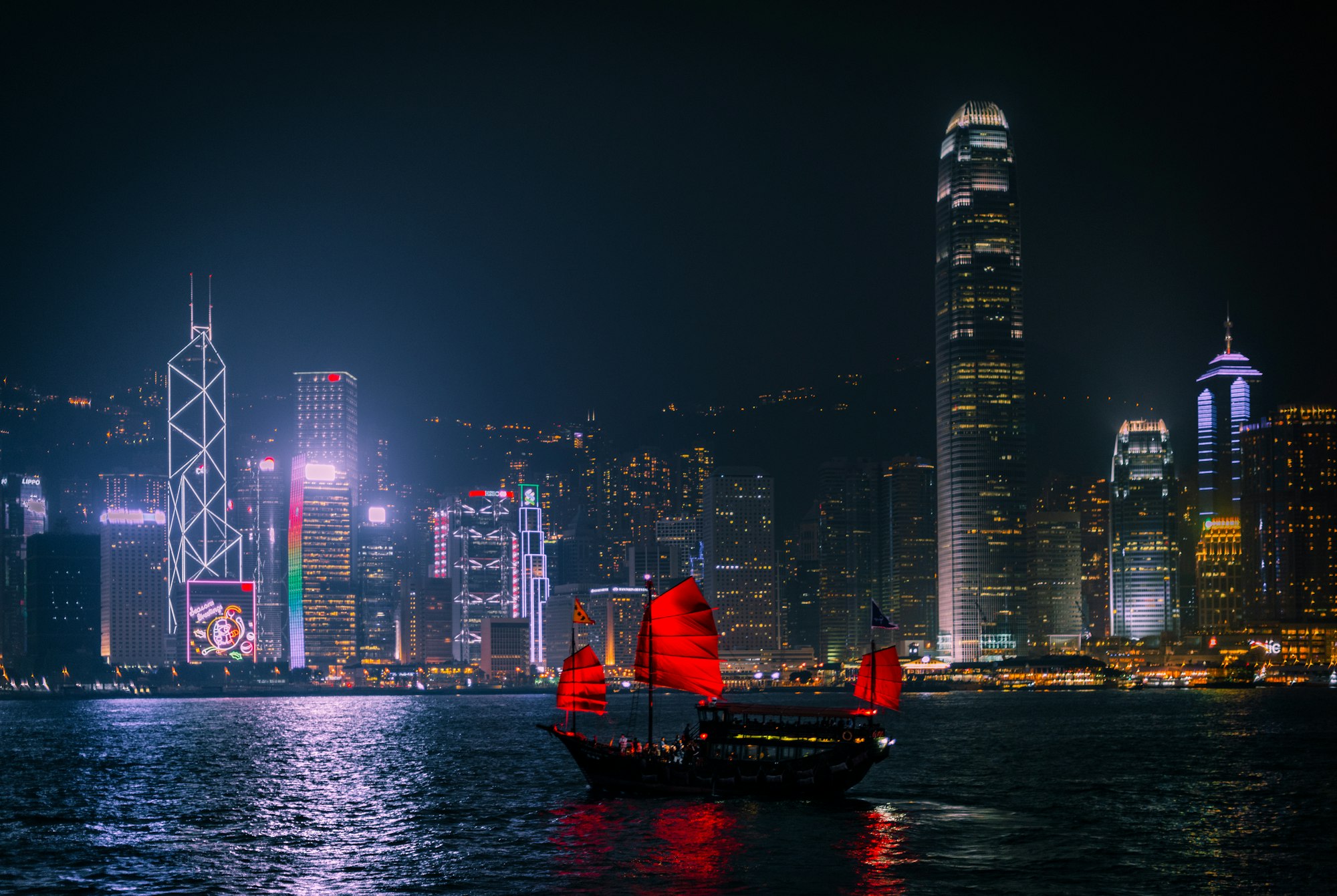
This is a historical travel story and walking guide to Peng Chau, a quiet outlying island of Hong Kong. Through five surprising histories—including grey-brick dying-houses, historical lime kilns, and the legacy of the Match King—it explores old alleys, industrial ruins, and everyday island life to show how traditional trades and local resilience shaped this small community.
💡 Join a community of discerning travelers. Simply enter your email to instantly unlock audio guides and one-day itineraries, and carry our exclusive historical walking maps with you on your journey.
On Peng Chau (坪洲), a small island off the north-eastern coast of Lantau, there is a house of grey-blue brick that looks like a temple and is not one. It is close to collapse.
It had three rooms. One was for the sick. One was for the dying. One was for the man who looked after both.
In an article published in 1964, the historian James Hayes (許舒) set down the single rule the islanders attached to the place: anyone with relatives able to keep him would never allow himself to be carried through its door.
So who was carried in?
I. A Quarry Under the Water
Limehouse, in east London, takes its name from the kilns that once burned lime beside the Thames. On Peng Chau the kilns left no place-name. They left a few ruins and a shoreline.
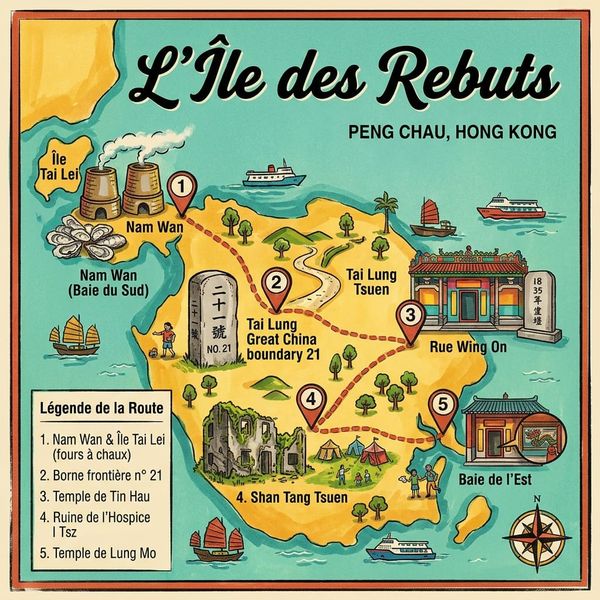
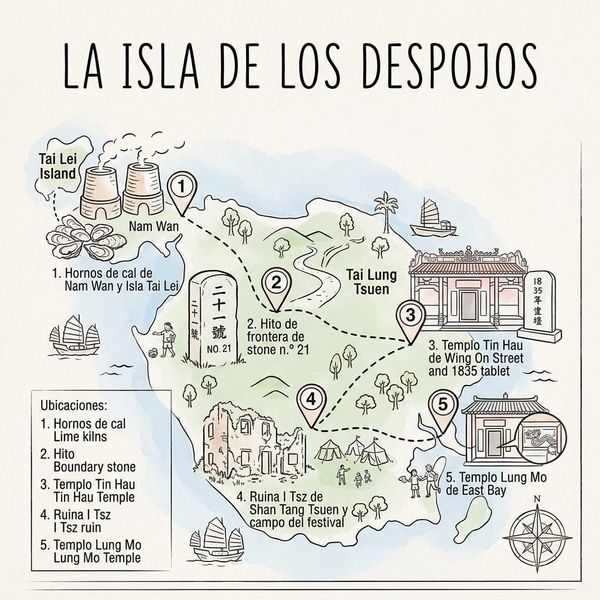
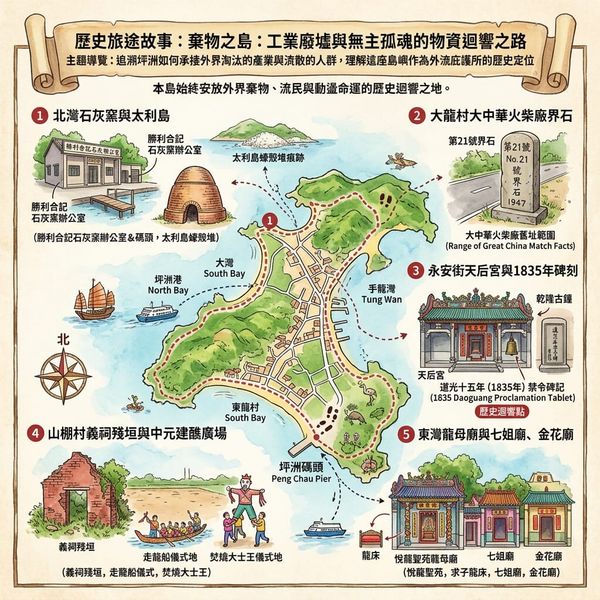
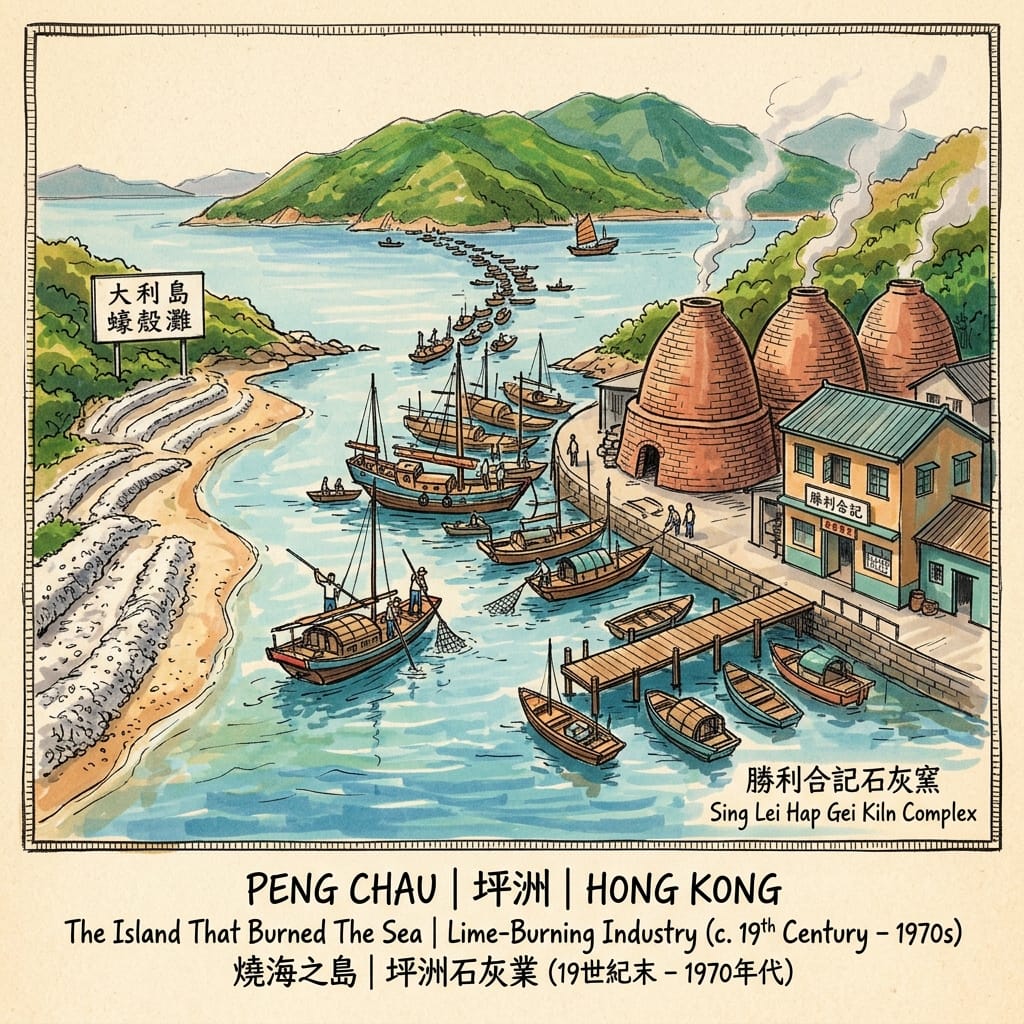
At Nam Wan (南灣) stands a derelict factory building that belonged to the Sing Lei Hap Gei Lime Kiln Factory (勝利合記石灰窰廠), graded a Grade III historic building in 2010. The Antiquities Advisory Board’s appraisal says it was built in the 1920s by a syndicate of a family from Xinhui (新會), who also held interests in a hotel in Central. It was one of the island’s three largest kilns and had its own private jetty. It kept burning through the Japanese occupation, then declined against imported lime and reinforced concrete, and closed in the 1970s.
What fed the kilns was not stone. It was oyster shell, clam shell and coral lifted from the sea bed. Hayes, citing a Government Gazette notice of 1901, reports that twenty junks carrying eighteen men each, and sixty boats carrying six each, 720 men in all, worked the coral across about three square miles of water between Peng Chau and Nei Kwu Chau, today’s Hei Ling Chau (喜靈洲). It was the largest operation of its kind in the New Territories. By 1904 the island had almost a dozen kilns, according to the Block Crown Lease schedules he consulted.
The old men told Hayes something stranger. In their youth, they said, the water was so thick with boats that a person could walk across them to the Lantau shore, nearly a mile away. That is oral testimony, not a record. But it says what the island thought of its sea: a quarry with fish in it.
The Island That Burned The Ocean
The 1911 census counted 642 people living on the island’s land, 434 men and 208 women. Hayes wondered whether single men employed in the kilns explained part of the gap. He offered it as a guess and no more.
Lime did not stay in one trade. According to the Hong Kong Resource Centre for Heritage, the island’s tanneries, which opened in the 1930s, bought their lime from the kilns. The by-product of one industry became the raw material of the next. It is worth remembering when the next section begins.
Holographic Sensory Cue. A guide from the Resource Centre, speaking in 2015, said oyster shells can still be seen along the shore of Tai Lei (大利島), the raw material of the old trade. That is a present-site observation with a source behind it. The smell and sound of the kilns at work are not documented well enough to reconstruct, and I will not invent them.
Resonance Node. The old kiln building at Nam Wan, among the better-preserved kiln remains on the island.
Lime is a material whose job is to vanish. Mixed with sand and water, it sets into a wall and is never seen again.
II. The Match King and the Island That Said Yes
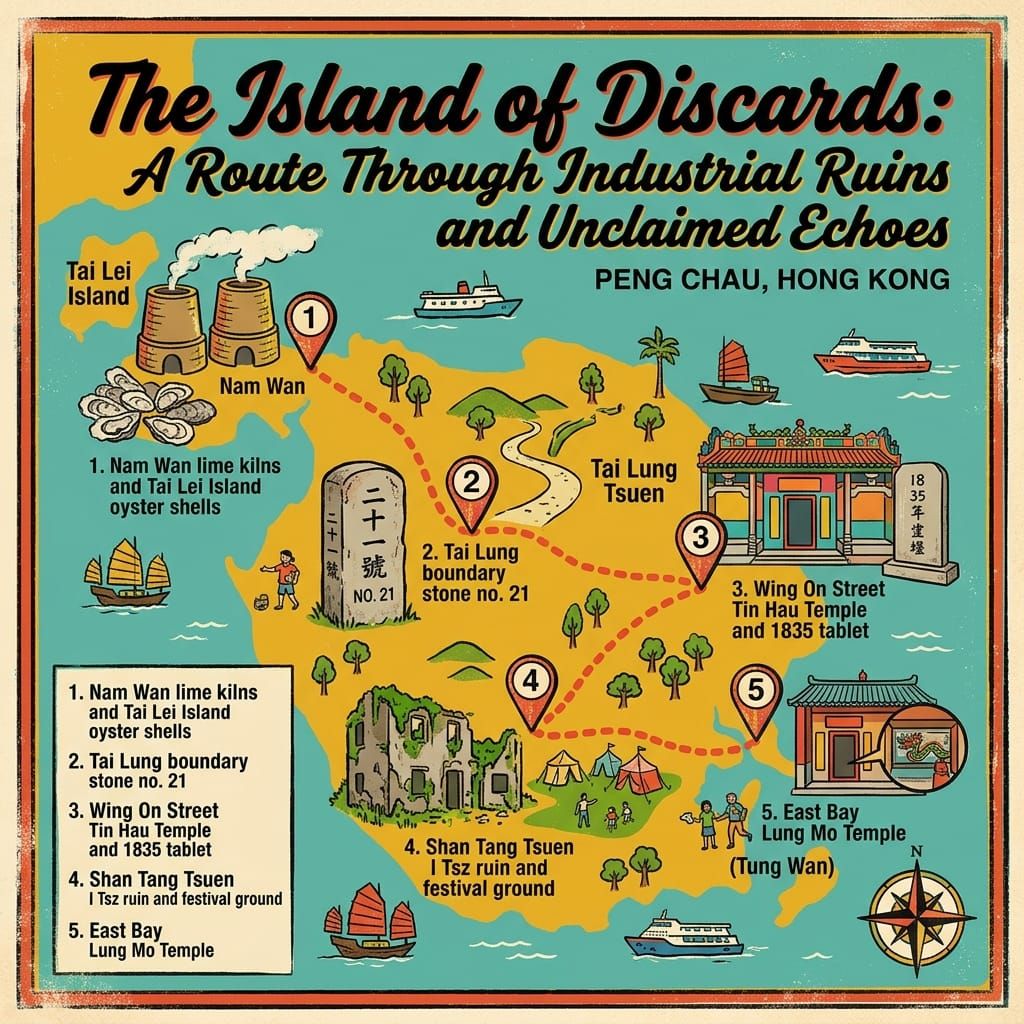
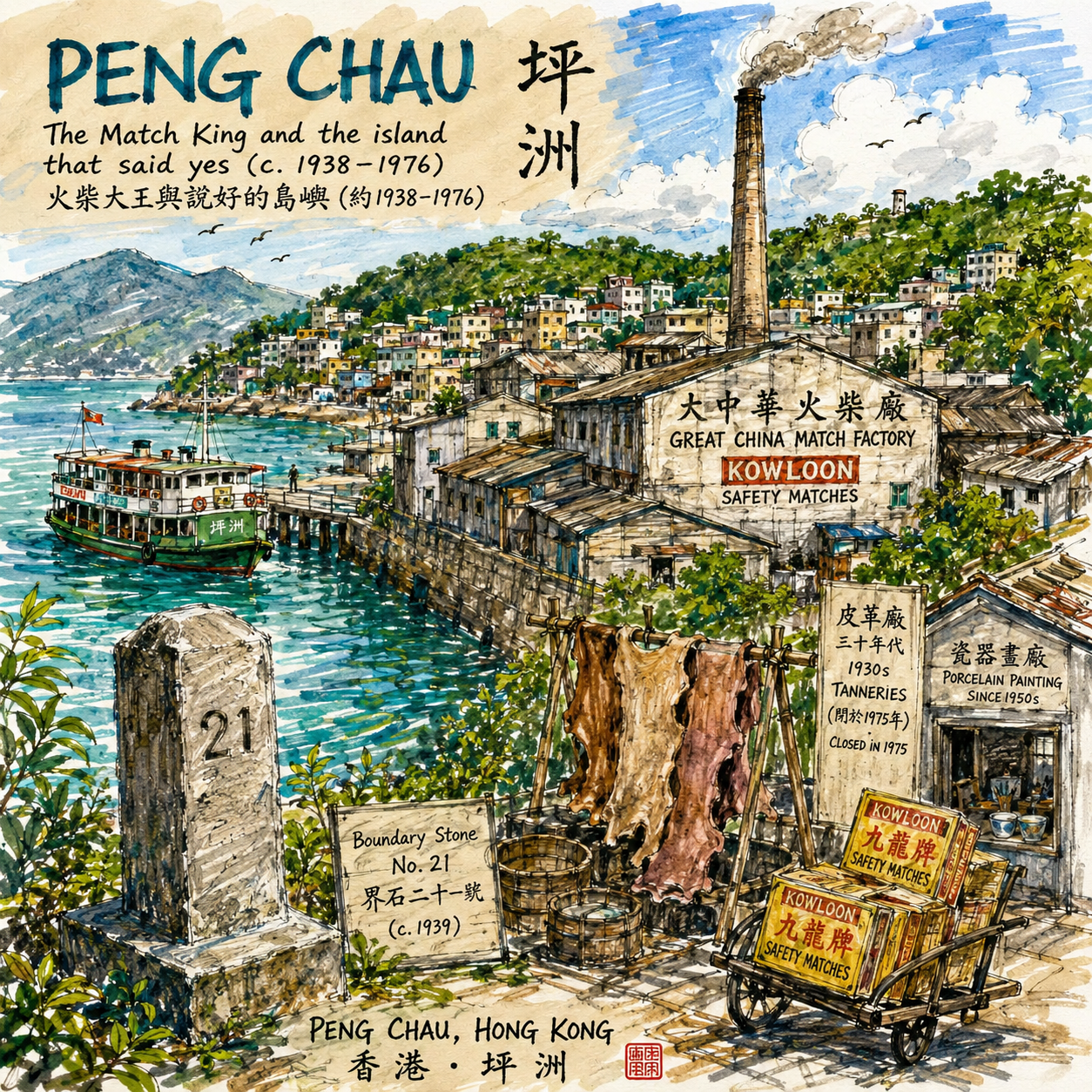
Somewhere on the island’s north-east side stood a line of boundary stones marking the edge of a factory. The heritage site Homemory records one of them, number 21, beside a roadside.
The factory was the Great China Match Factory (大中國火柴廠). Its founder was a Shanghai industrialist, Liu Hongsheng (劉鴻生, 1888–1956), known as the “Match King”. The Antiquities Advisory Board says he came to Hong Kong in 1938 and founded the factory in 1939. War was pushing capital and people south, land on Peng Chau was cheap, and the island’s northern part became the site. The Industrial History of Hong Kong Group adds that the company was incorporated in June 1939 with HK$300,000 and sold “Kowloon” brand safety matches across Southeast Asia and beyond.
An older story explains why it landed here. Liu, so it is said, first looked at Cheung Chau (長洲), whose residents objected to a factory handling flammable material, and so it went to Peng Chau, where it promised work to the lime-kiln hands then losing theirs. A local association adds that nobody on Peng Chau objected. Both versions are tradition. I found no document behind them. What they show is how the island remembers the arrangement: as a place that said yes to what a neighbour refused.
The Island Built On A Fire Hazard
The numbers do not agree. Wikipedia gives 580 workers when production began in 1940. The Industrial History group says over 1,000 by the late 1940s. Other sources say 700, and one says 2,000. The decline is better documented: by 1951, the group records, the factory was running only three days a week. Matches have a political history in English memory, the Bow match girls’ strike of 1888 among it. Peng Chau’s product was the safety kind, and I found no comparable record of its workers.
The factory was not the island’s only trade. The Resource Centre records two tanneries, the last closing in 1975. A resident living beside one remembered raw hides piled like a hill, blood seeping into the ground, and children using the pile as a slide. The South China Morning Post quotes a woman from the 1950s who recalled the air as smoky and acrid all year round. These are memories, not measurements. Along Wing On Street (永安街), shops painted porcelain by hand, the Resource Centre says “all along the street”, until reform on the mainland moved the factories across the border in the early 1980s.
How the factory ended depends on who is asked. Some islanders say a fire put an end to production. Others say the cigarette lighter replaced the match. The closure year is given as 1975, 1976 or about 1981, and archival verification is still needed. The island that lived on the match factory could not agree on its last day.
Present trace. On a 2015 visit the Resource Centre looked for a boundary stone at East Bay and found the ground paved over. The stone houses along Wing On Street, said to have lodged factory workers, are Grade III, though part of one has recently been demolished. The factory site is private and most of its buildings are gone. Whether the stones survive must be checked on the ground.
A match is made to be used up. A boundary stone is set so that it will not be moved. One of them was covered with concrete.
III. A Notice in Stone
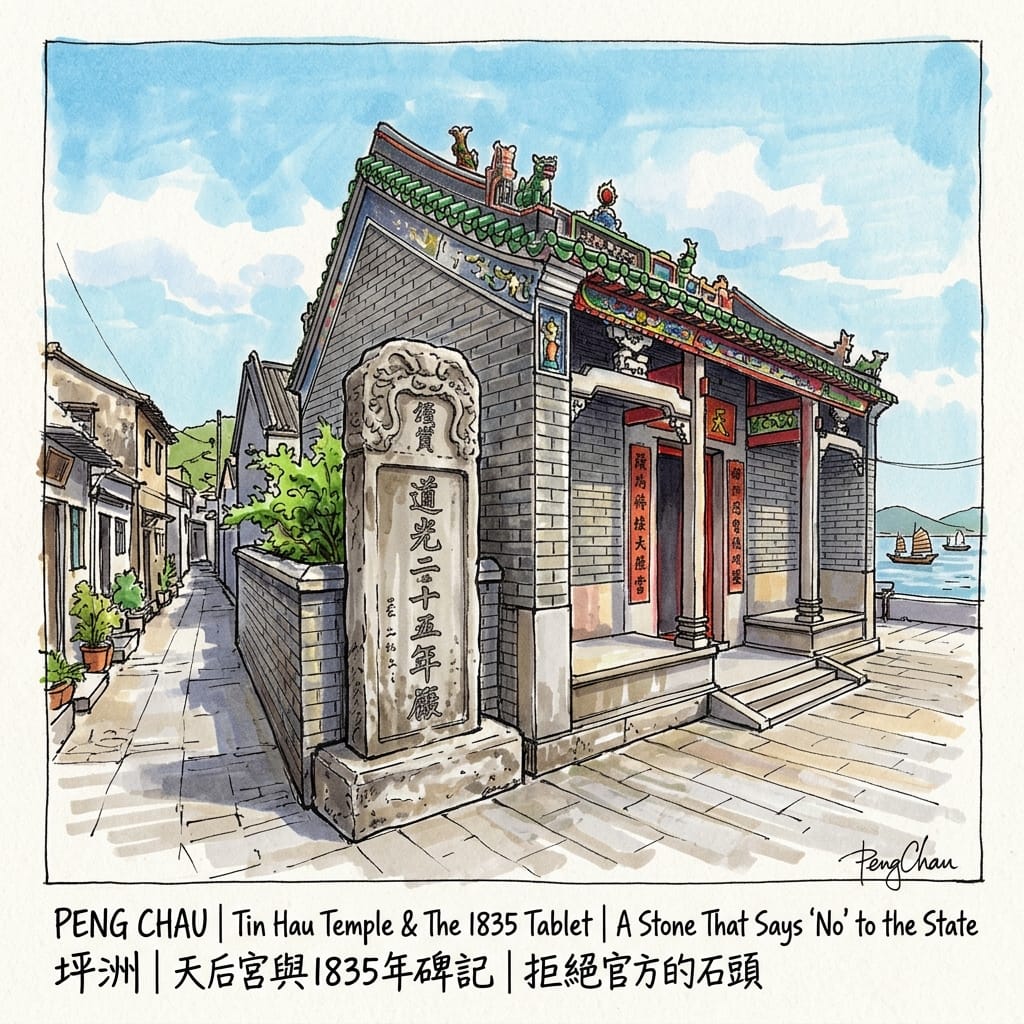
Inside the Tin Hau temple hangs a bell dated to the 57th year of Qianlong, 1792. Six years later, in 1798, a subscription tablet was set into the wall. It lists 218 names, 26 of them shops and 192 individuals, from the districts of Dongguan (東莞, Tung Kwun) and Xin’an (新安, San On). It carries no preamble, and Hayes could not say whether it marks the temple’s founding or a repair.
He noticed one thing. The bell’s six donors were all surnamed Chan (陳), all related. The two principal donors on the tablet bear the same names as two of them. The earliest dated grave on the island, of 1749, is also a Chan’s. From this Hayes tentatively reasons that the Chans may have been absentee landlords living across the water, collecting island rents to educate their sons for the examinations. He is frank that it is conjecture.
Outside the temple stands a second stone. Hayes reports that in the Daoguang period the Xin’an magistrate ordered tablets set up wherever fishermen gathered. The Peng Chau tablet records a petition that went as high as the Viceroy of Liangguang (兩廣總督) and produced a ruling: fishing boats were no longer to be commandeered to catch pirates, and purpose-built craft were to be provided instead. Its date, by Hayes’s own footnote, is the 15th year of Daoguang, 1835.
It looks like a victory for the weak. On inspection it is a government notice, posted by the state. Hayes cautions that he cannot be sure the petitioners were local men. The suggestion that officials used pirate-hunting as a pretext to abuse the fishermen is the reading of a heritage guide, not the tablet’s text. English has an old word for what was done to the boats: impressment.
The Fishermen Who Sued An Empire
The temple holds a second kind of memory. It is told that the pirate Cheung Po Tsai (張保仔) planned to sack the island, that a gale snapped the flag on his mast, and that he took it for the goddess’s warning, prayed in the temple, and spared the island. Cheung Po Tsai was real. The link to Peng Chau appears only in guide literature. A legend is evidence of cultural memory, not of the event.
The tablet’s names point to a more ordinary life. A fisherman who came ashore borrowed from a fish dealer (laan, 欄), and the dealer who lent expected the catch. Hayes quotes a 1946–47 fisheries report saying such dealers often saw to it that the debt was never cleared. Hayes adds that the island’s trawlermen are said to have formed an association, the Peng Wo Tong, in 1857, and that it headed the 1878 donor list with 140 taels out of roughly 640. He warns that the date and the figure of 200 boats come from an anonymous local manuscript and cannot be confirmed. His guess is that the association was meant to keep more of the profit in the fishermen’s hands.
The trawlers’ year had a rhythm. After the Tin Hau festival in the third moon, they returned to Peng Chau for a quiet stretch, overhauled their boats, took a rare holiday ashore, and watched about five weeks of opera. On 18 September 1906 a typhoon is said to have hit the fleet hard. Across the colony, 1,796 native craft were sunk and about 5,000 people died. Hayes found no Peng Chau figure, so those numbers are context, not local fact.
Holographic Sensory Cue. The Islands District Council’s heritage text says the view from the temple forecourt is open to the sea. It can be checked on site. The sounds of the opera are not documented and are not reconstructed here.
Resonance Node. The temple wall, where the 1798 tablet is set into the masonry, and the stone outside the wall, dated 1835.
Hayes warns that tablets like these are often thrown out when a temple is repaired, and that children and cooks have been known to use them as chopping boards. Early tablets are rare. These two are still there.
IV. The Dying-House and the Feast for the Unclaimed
To understand who built the house, one has to stand beside the temple.
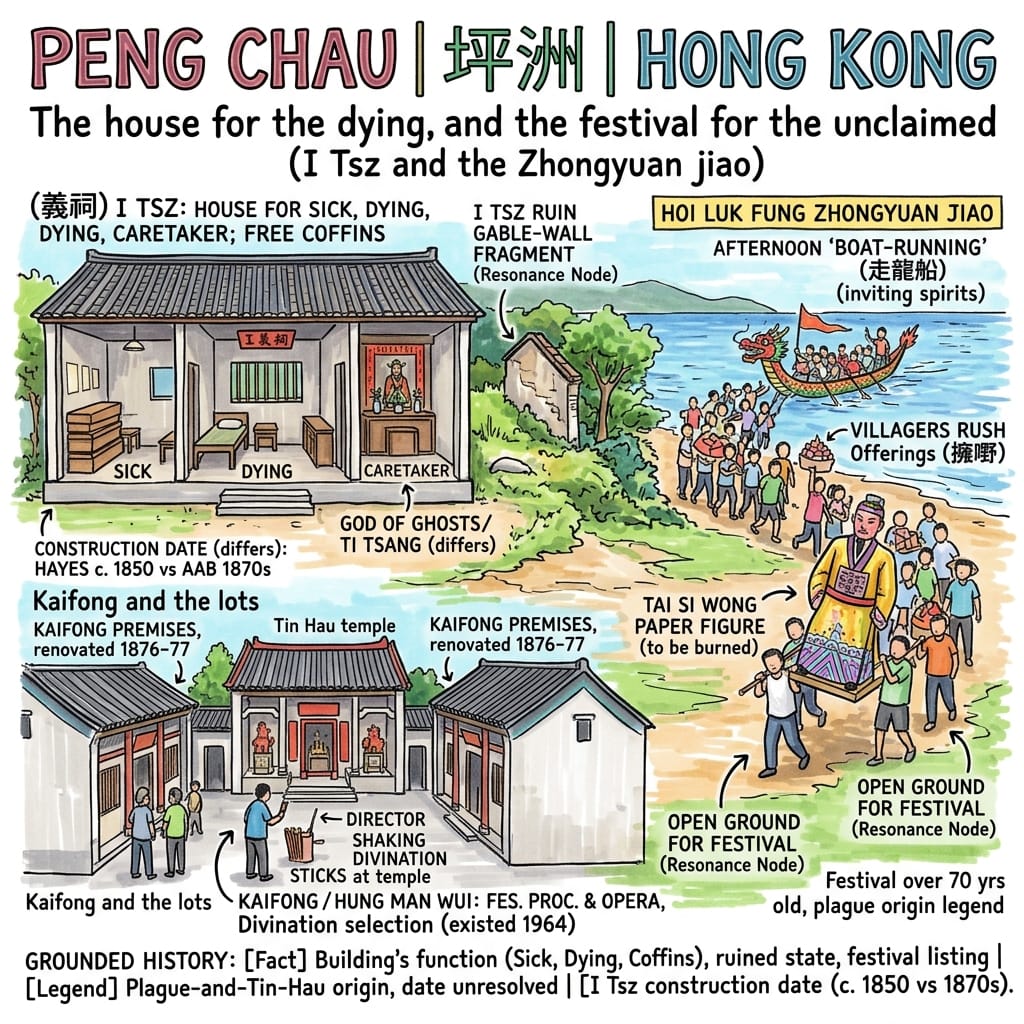
Hayes records that on each side of the Tin Hau temple stood premises of the island’s kaifong (街坊), the neighbourhood association. One side was the office. The other, an annex, served as a school or a guest house as needed. Both were renovated in 1876–77, at about the time of the temple. The kaifong began among the Cantonese shopkeepers and house-owners of Wing On Street and later became the island’s common body. It did not meet on a schedule. It acted when it was asked to advise, arbitrate or organise. The poorhouse, the island’s I Tsz (義祠), is said to have been built from money it raised and kept up by it.
Its date is disputed. Hayes was told by an elder born in 1876 that the building was already in poor repair when the man was a boy, and concludes that it dates from 1850 or earlier. The Antiquities Advisory Board’s appraisal says the 1870s. They also disagree about its chief god. Hayes names the “God of Ghosts”. The appraisal gives Ti Tsang (地藏王). Both are recorded here because neither can yet be set aside.
What is certain is its purpose. Beyond its three rooms, the kaifong supplied free coffins. It took in land dwellers and boat people alike. The rule Hayes recorded made it a house of the unclaimed, a mirror turned the other way. The appraisal says that after the Second World War the dying were sent to hospital instead.
The kaifong had a sister body. A religious society called the Hung Man Wui (Chinese characters to be confirmed) ran festivals, processions and opera or puppet shows. Its directors were chosen each year by shaking divination sticks before the temple. Hayes says anyone could join, and in theory anyone might be picked by the gods. In 1964 he was told it still existed.
The Island That Adopted The Dead
A second rite for the unclaimed belongs to a different people and a later age. The island’s Ghost Festival, the Zhongyuan jiao (中元建醮), follows the tradition of the Hoi Luk Fung (海陸豐) community and is listed in Hong Kong’s inventory of intangible cultural heritage. One report puts it at more than seventy years old. The island’s story is that after a bad epidemic the residents received instruction from Tin Hau to hold a rite for the dead nobody tended, and the island was spared thereafter. It is tradition, and I have found nothing to confirm it. In the rite the “dragon boat run” (走龍船) is said to call wandering spirits to the feast. Afterwards the offerings are carried off by neighbours, and a paper figure of Tai Si Wong (大士王) is taken to the shore and burned. English readers may recognise the shape, a night when the living make room for the dead, as something like All Souls. The comparison is mine, not the tradition’s.
The two do not belong together by date. One is a Cantonese shopkeepers’ institution of the mid-nineteenth century, the other a Hoi Luk Fung rite of a later time. They share a question: who sees to the dead that no one claims?
Holographic Sensory Cue. Hayes describes the poorhouse as built of dark grey-blue local brick. The heritage appraisal records that the building is near collapse, with part of a gable wall still standing. Both can be checked against a documented source. The rooms’ smells and sounds are not recorded, and I have not supplied them.
Resonance Node. The ruin of the I Tsz, and the shoreline open ground used for the festival’s closing rites.
V. Goddesses Who Arrived by Dream
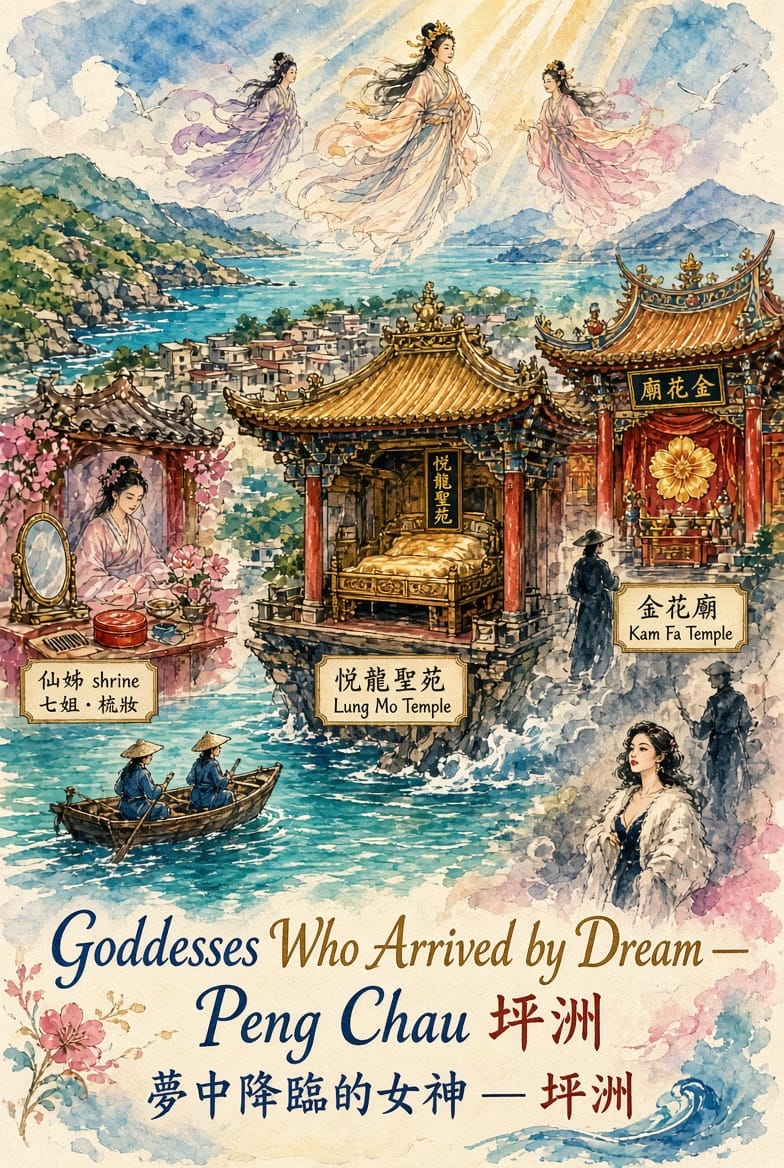
The smallest of the temples is the Seven Sisters’ (仙姊廟, also 七姐廟). A heritage guide of the Resource Centre explains it this way: many women lived on boats, where meeting a husband was hard, so they came ashore to the temple to ask the Seventh Sister for a match. It was a place for women to meet and trade news, kept up by women, with mirrors, combs and rouge among the offerings. This is the guide’s reading. Hayes warns against dividing the island too neatly into sea people and land people, so the shrine is better thought of as shared.
People had been arriving on Peng Chau by chance and by fate long before the goddesses. Hayes records a family tradition from the Lam clan. Three brothers kept a pawnshop at Shum Chun Market (深圳墟). When a murder took place outside it, runners from the magistrate’s office squeezed them for money. Two left for Jamaica. The third came to Peng Chau, because a go-between in Yuen Long had arranged a match with a girl of an island family whose horoscope agreed with his. It is family tradition, and Hayes does not vouch for it.
In 1941 a woman named Chung Yuk-ming (鍾玉明), known as Chung Chat-ku (鍾七姑), attended the Dragon Mother’s birthday rites at the ancestral temple at Yuecheng (悅城) in Deqing (德慶). She was moved, the story goes, to carry home the goddess’s image, divination sticks, wooden blocks, command flags and brush. After the war the altar stood in Kowloon City (九龍城). In the late 1960s reclamation at To Kwa Wan (土瓜灣) and the building of the MTR forced it out, and it moved to Kwai Chung (葵涌). Accounts differ on how many moves there were.
The Goddess Evicted By The City
The Islands District Council’s heritage text tells the rest. The Dragon Mother appeared to Chung in a dream and told her to buy land on Peng Chau. She had never been there and knew no one. One day she went with relatives and walked to East Bay (東灣). The hills and water reminded her of the temple at Yuecheng, and she bought the plot at once for HK$105,000. In 1971 the Lung Mo Temple (悅龍聖苑) stood on the site. This is the temple’s own account, and the guide literature repeats it.
It is now the island’s largest temple and the largest Dragon Mother temple in Hong Kong. In its loft stands a “dragon bed” that worshippers touch for luck and children. On the eve of the Dragon Mother’s birthday, the eighth day of the fifth lunar month, an attendant bathes and dresses the goddess’s image at midnight before the faithful make their first offering of incense. The festival is on Hong Kong’s intangible heritage inventory.
Kam Fa Temple (金花廟) has another origin. Tradition dates it to 1762, when a man is said to have founded it after his sick wife recovered. The date is tradition. The Cantonese opera and film star Kwan Tak-hing (關德興, 1905–1996) is said to have dreamt of the goddess, Lady Golden Flower, and Wen Wei Po quotes the rural committee chairman as saying he led a rebuilding in 1978. After he died in 1996, his portrait was placed beside hers as a guardian general.
Each of the island’s goddesses comes with a dream and with someone displaced: women brought ashore by the water, a temple evicted by a railway, a film star. The dream is the form these accounts take, not evidence of anything beyond them.
The pattern, put plainly, is this. Lime came from the delta, the match company’s capital from Shanghai, a goddess from a compulsory purchase of land in Kowloon. Peng Chau took in what others could not hold: a trade, a fund, a deity. The trades left. The temples stayed.
Resonance Node. The Seven Sisters’ shrine, and the dragon bed in the loft of the Lung Mo Temple.
The Island Today
It is a small island. By the Resource Centre’s account, one can cycle round it in about half an hour.
The Tin Hau temple stands, and so do its two stones. The kiln building has been derelict for years, the tannery is a shell, the match factory is mostly demolished, and at least one boundary stone lies under concrete. The two hundred trawlers Hayes was told about are gone. Of the thirty-odd trades the Resource Centre counted, a few hand-painted porcelain shops remain. New houses have gone up in recent years, around what was once the factory district.
What a visitor can still read is the religious map: the temples, and the annual Dragon Mother’s birthday and Ghost Festival. Ruined factories and living festivals stand in the same streets, and they are seldom read together.
The Third Room
A bell in the Tin Hau temple was cast in 1792 with six names on it, all Chan. The tablet beside it adds two hundred and eighteen more.
The poorhouse had a third room, for the caretaker. He was fed from the neighbourhood’s collections and allowed to farm a plot under its control. Hayes did not record his name. In his account the man is only a post.
The dying were later sent to hospital. The lime, the matches and the hides left the island one by one. The records do not say in what year the caretaker’s room stood empty.
Accessing the Physical Node
- Getting there: Take the ferry from Central Pier to Peng Chau. There are also services linking other outlying islands. Check the operator’s current timetable.
- On the island: Ordinary motor vehicles are not permitted, apart from emergency, construction and village vehicles. Walk or cycle. The Resource Centre put a circuit at about half an hour in 2015.
- Open to visitors: The Tin Hau temple, the Seven Sisters’ temple, the Lung Mo Temple (15 Chi Yan Street, East Bay) and Kam Fa Temple. Be mindful of rites in progress.
- View from outside only: The kiln building is derelict, the match factory site is private land, and the I Tsz is close to collapse. Do not enter any of the three. Confirm before travelling whether the boundary stone survives.
- Festivals: The Dragon Mother’s birthday is on the eighth day of the fifth lunar month, with celebrations the evening before. The Ghost Festival falls in the seventh lunar month; dates change each year.
- Guided walks: Look for tours run by the Hong Kong Resource Centre for Heritage and the Islands District Council.
Sources of the five stories
- Part I: Antiquities Advisory Board, Sing Lei Hap Gei appraisal; Hayes (1964), full text; CACHe, Ming Pao feature
- Part II: Antiquities Advisory Board, Great China Match Factory appraisal; Industrial History of Hong Kong Group; Homemory; Green Peng Chau Association; SCMP; Great China Match Company Factory (Wikipedia); HK01 on the seven historic buildings
- Part III: Hayes (1964), full text; Islands District Council heritage text, Tin Hau Temple; Ecotour.hk
- Part IV: Antiquities Advisory Board, I Tze appraisal; Hayes (1964), full text; The Collective HK; The Voice HK; HKSAR Government, LegCo question on ghost-festival heritage
- Part V: Islands District Council heritage text, Lung Mo Temple; HK01 on the Dragon Mother festival; Kam Fa Temple (Cantonese Wikipedia); Wen Wei Po (2021)
💡 Q&A
Q1 | What was the true historical function of the Peng Chau Dying-House (I Tsz)? (Historical Reality Behind the Sub-Lantau Refuge and James Hayes' Research)
A: The Peng Chau I Tsz (義祠), constructed in the nineteenth century, was a three-room grey-brick structure designed for the sick, the dying, and a caretaker. Historical research by James Hayes in 1964 confirmed that a strict local social taboo governed the site: individuals with surviving family able to support them refused to enter. It functioned as a solemn community refuge for destitute laborers, single lime-kiln workers, and impoverished migrants who lacked family support in the New Territories.
Q2 | How extensive was the lime-burning industry at Nam Wan, Peng Chau? (Sing Lei Hap Gei Lime Kiln Factory and Marine Coral Mining)
A: The Sing Lei Hap Gei Lime Kiln Factory (勝利合記石灰窰廠) at Nam Wan, built in the 1920s and graded Grade III in 2010, represents an industrial peak when Peng Chau housed nearly a dozen kilns. Official records from 1901 show over 700 workers on 80 vessels extracting coral and shells across three square miles between Peng Chau and Hei Ling Chau. Operation continued through the Japanese occupation before imported lime and concrete led to its closure in the 1970s.
Q3 | Why did Liu Hongsheng locate the Great China Match Factory on Peng Chau? (Popular Cheung Chau Rejection Legend vs. Documented Industrial Migration)
A: Shanghai industrialist Liu Hongsheng established the Great China Match Factory (大中國火柴廠) on Peng Chau in 1939 with HK$300,000 capital, manufacturing 'Kowloon' brand safety matches for export. Local oral tradition holds that Cheung Chau residents rejected the hazardous facility, leading Peng Chau to accept it in exchange for employing displaced lime workers. While the Cheung Chau refusal lacks documentary proof, land records confirm cheap, available space drove this wartime industrial shift.
Want to follow the historical routes I’ve selected right from your phone as you walk? Click to join the exclusive Google map of historical tours titled "Historical Travel Stories"—import it to Google Maps on your phone with a single tap and let it guide you as you visit each historical site in person.

📖Reference and Further reading📖
First layer – Main sources of literature and institutions:
- AAB Historic Building Appraisal: Great China Match Factory
- AAB Historic Building Appraisal: Sing Lei Hap Gei Lime Kiln Factory
- AAB Historic Building Appraisal: I Tze, Shan Tang Tsuen
- HKSAR Government: Legislative Council Q15, ghost-festival heritage
The second layer – secondary academic materials:
- Hayes, J. W. (1964), “Peng Chau between 1798 and 1899,” JRASHKB 4: 71–96. Full text read via SlideShare re-upload (OCR)
- Hayes (1964): official HKU Hong Kong Journals Online PDF (not opened in this session; listed from Hayes’s bibliography page)
- James Hayes (historian): bibliography, for cross-checking
- Industrial History of Hong Kong Group: Great China Match Co.
- Industrial History of Hong Kong Group: Peng Chau Island industry
- CACHe: Ming Pao feature, “Peng Chau before the calm” (2015)
- Islands District heritage text: Tin Hau Temple
- Islands District heritage text: Lung Mo Temple (悅龍聖苑)
- Islands District heritage text: Peng Chau history
- Phillumeny: Chinese match industry online exhibit
Third layer – Supplementary information:
- Green Peng Chau Association: culture and festivals
- SCMP: “A Hong Kong island, sleepy today, that was hub of industry from matches to porcelain”
- The Collective HK: Peng Chau ghost festival photo essay
- The Voice HK: Peng Chau Zhongyuan jiao report
- HK01: Lung Mo festival report and temple history
- HK01: Peng Chau’s seven historic buildings
- Homemory: Great China Match Factory boundary stones
- Wen Wei Po (2021): Kam Fa temple report (PDF)
- Ecotour.hk: Peng Chau history tour notes (source of the Cheung Po Tsai legend)
- On.cc: Kam Fa temple
- Hidden HK: Abandoned Match Factory
Background (Wikipedia, for cross-checking only)
 Lawrence
 Lawrence
 Lawrence