Westminster's Five Thresholds: A Lost River, a Sanctuary, a Gallows, a Burned Ledger and a Cupboard
A historical walking story of Westminster’s five thresholds — lost river, sanctuary, gallows, burned ledger and cupboard — showing how small surviving traces still mark who was allowed to stay, be protected or be counted.

💡 Join a community of discerning travelers. Simply enter your email to instantly unlock audio guides and one-day itineraries, and carry our exclusive historical walking maps with you on your journey.
 Lawrence
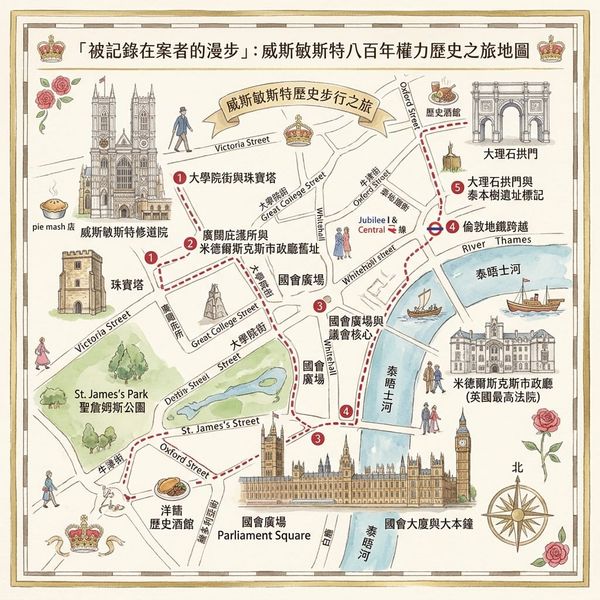
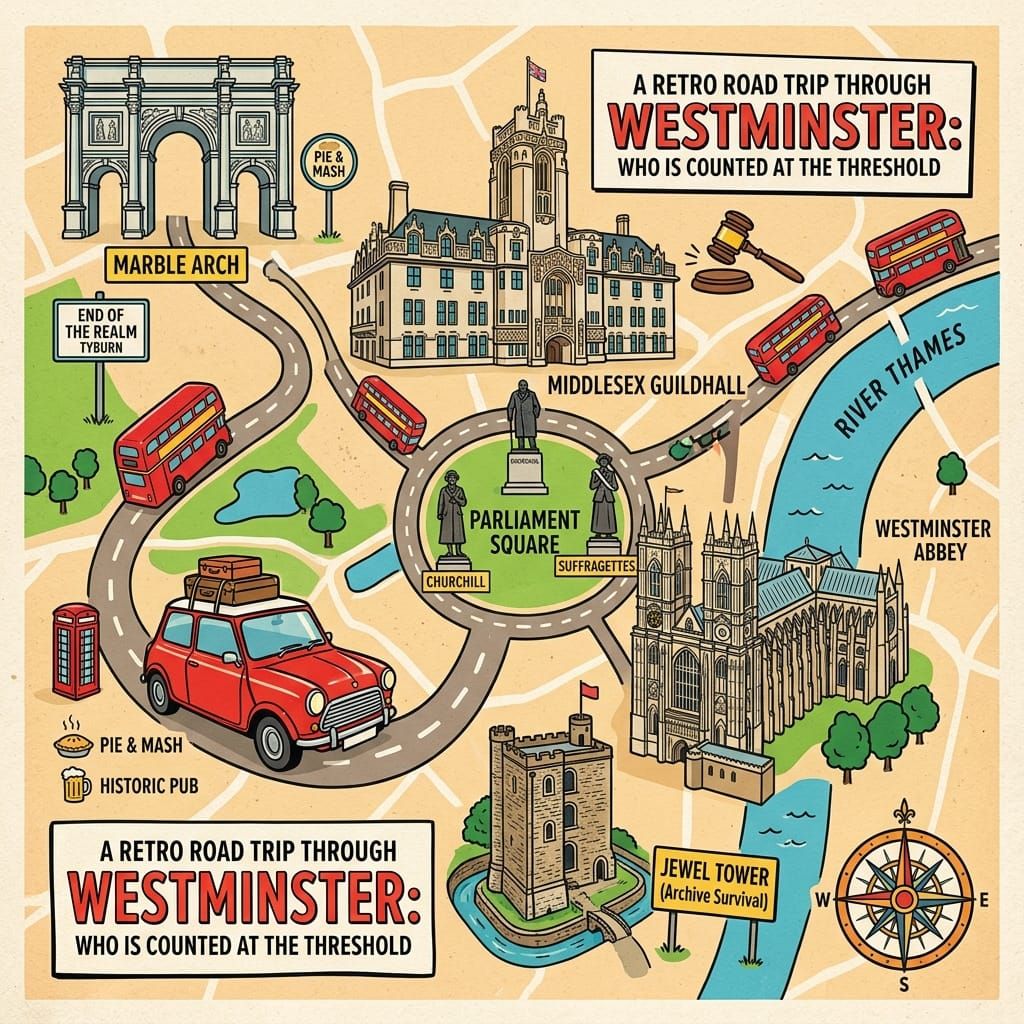
This is a historical travel story and walking guide to Westminster, London. Through five quiet thresholds — a vanished river, a medieval sanctuary, the Tyburn gallows, a burned ledger that nearly destroyed Parliament, and a cupboard used by a suffragette — it traces how power once decided who could stay, who was protected, and who was counted. The piece offers a slow, on-the-ground route that links these small surviving traces to the larger questions still running under the Abbey and Palace.
Where the traffic splits at the north-east corner of Hyde Park, there is a stone in the road. It is a circle set into a traffic island, and buses pass on both sides of it. A visitor has to stand with their back to the shops of Oxford Street and look down to read it. The words say that here stood the Tyburn Tree.
Most people walk past without breaking step, because the island offers nothing to look at. That is the first thing to notice. For centuries this was among the busiest places in London, and a crowd gathered here on execution days. Now it is a place for waiting at traffic lights.
This is not the Westminster of the postcard. It is the same borough, though, and the same question runs through it: who may stay, and who is counted?
1. The river under the street
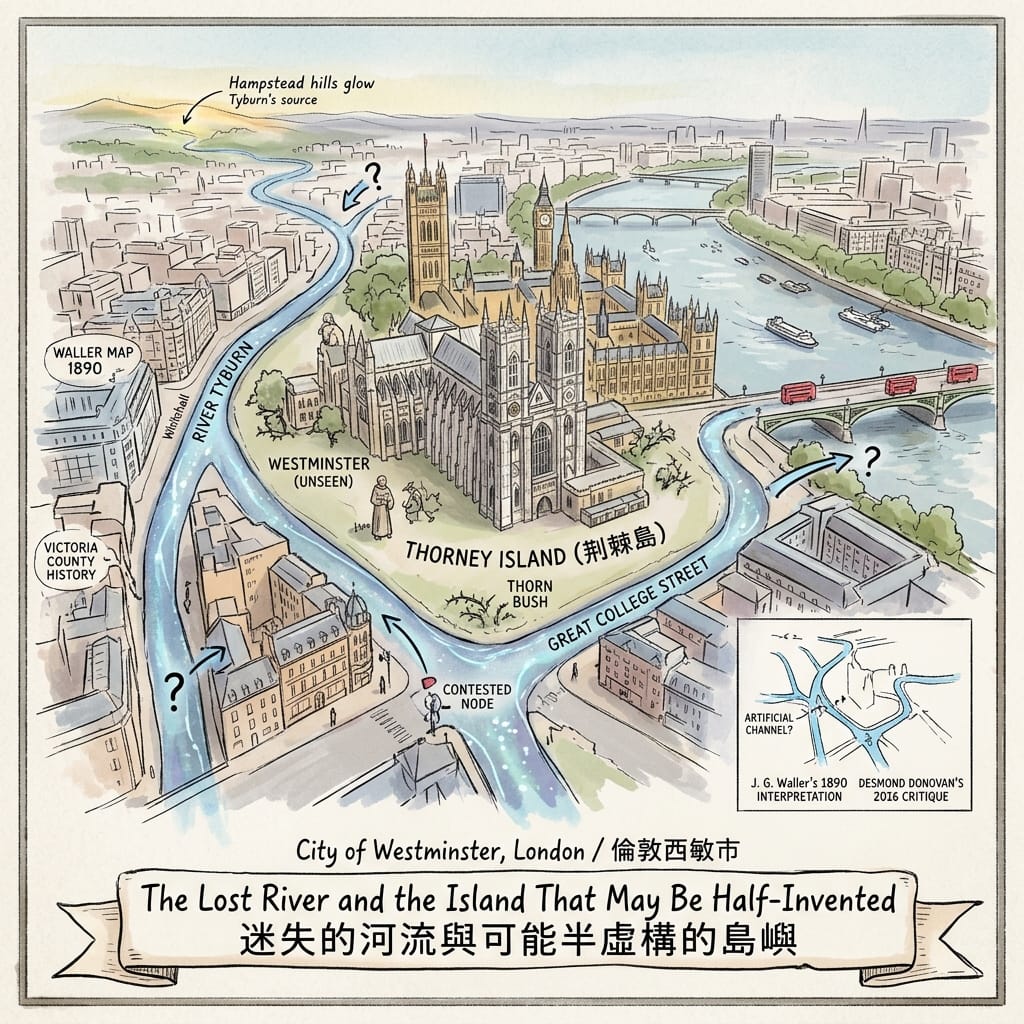
Begin with water. The Abbey and the Palace stand on ground once called Thorney, a thorn island. UK Parliament's own history says two branches of the River Tyburn, flowing down towards a wider and shallower Thames, made the island. The Tyburn rises in the Hampstead hills and now runs unseen.
The tidy story has a weak joint. In 2016 the researcher Desmond Donovan pointed out that the "Westminster branch" of the river is thinly supported. The Victoria County History had already called it an unsubstantiated watercourse. J. G. Waller's map of 1890 made the arrangement look settled, and a later reading may have turned a channel dug to bring water to the Abbey into a natural river. Nobody can yet say how much of the island was nature and how much was a way of drawing it.
The Fake Island Under Westminster
What survives is a street. Great College Street runs south of the Abbey along the line where, by one account, a channel once ran. It is an honest ambiguity. A boundary was drawn here very early, and the evidence for its exact shape is thinner than its reputation.
Sensory cue (observable today): the Thames at Westminster is tidal, and its level rises and falls against the embankment wall whether or not anyone is watching.
2. The queen who went behind the door
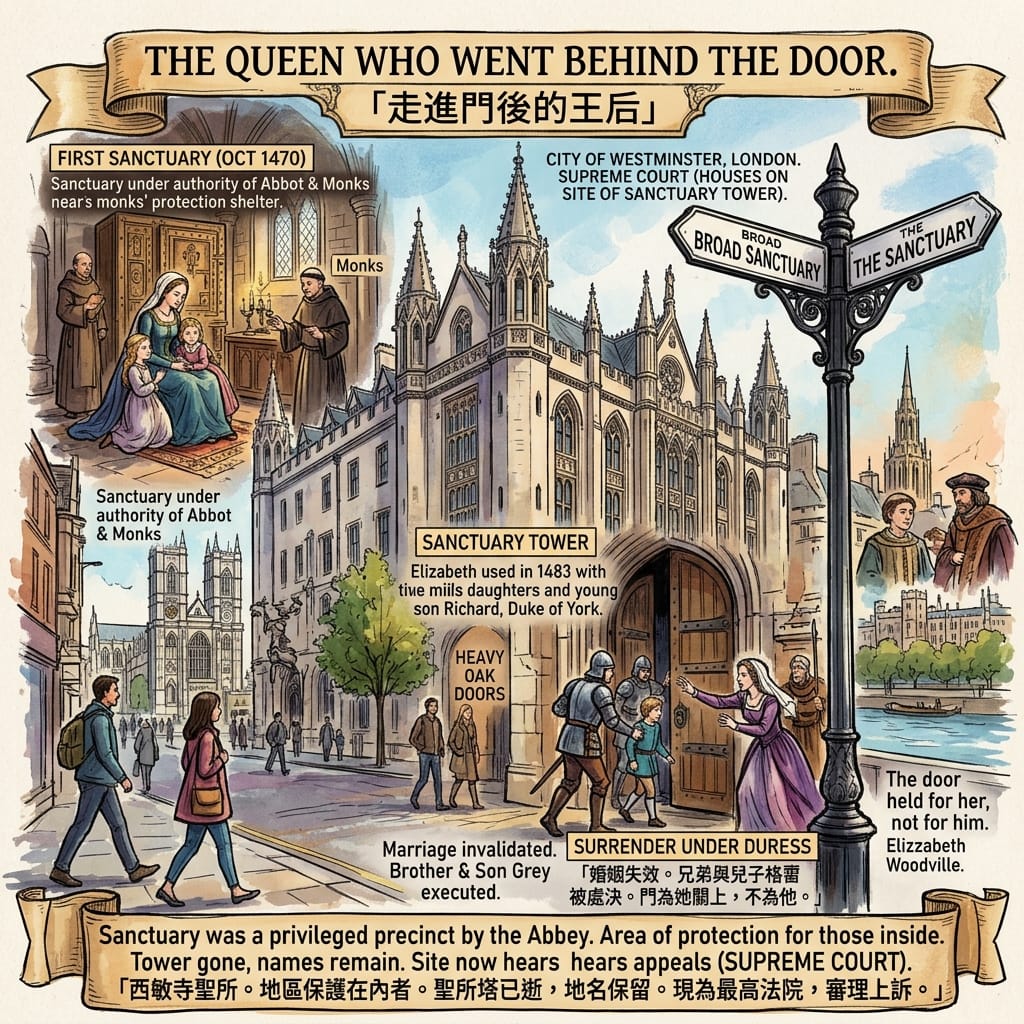
The Abbey's precinct had a legal property that few buildings possess. Anyone who reached its protection could not easily be taken out of it. Westminster's sanctuary lay under the authority of the abbot and monks and extended round the church's west and north sides.
Elizabeth Woodville used it twice. In October 1470, with her mother and three daughters, she took refuge there. In April 1483, after Edward IV died on the 9th, she went back in the night of 29 to 30 April with her daughters and her younger son, Richard, Duke of York.
The Queen S Untouchable Fortress
Then the protection narrowed. On 22 June 1483 her marriage was declared invalid. On 25 June her brother Anthony Woodville and her son Richard Grey were executed on the Duke of Gloucester's orders. Under duress, she eventually agreed to give up the younger boy. The door had held for her, and not for him. The daughters remained about ten months in sanctuary and then returned to court under Richard III.
The gatehouse where such people waited was the Sanctuary Tower, two storeys high with heavy oak doors. It stood where the Middlesex Guildhall now stands, and the building now houses the Supreme Court. The tower is gone; the names remain on the map as Broad Sanctuary and The Sanctuary. A place that once decided who could be handed over now hears appeals.
3. The stream that named the gallows
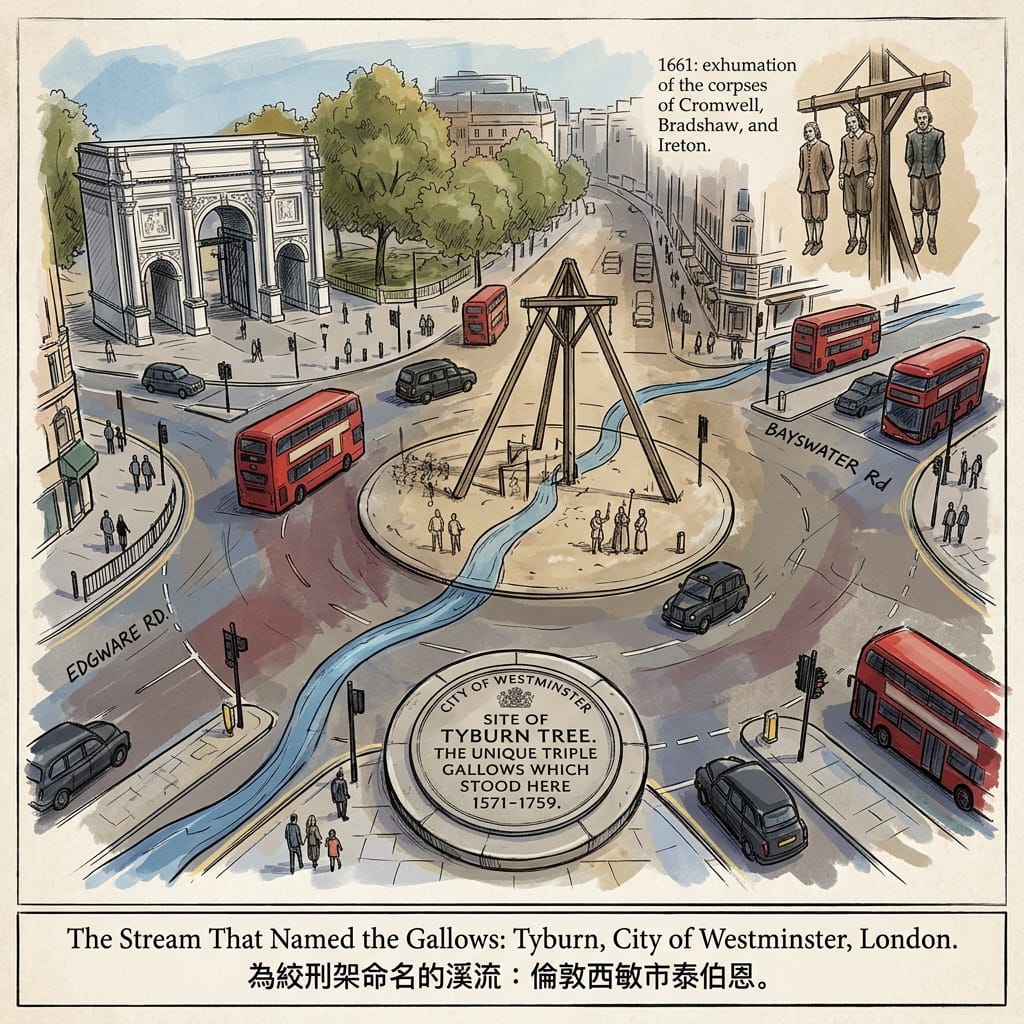
The river reappears further west, and this time as a name. The place where London hanged its condemned took its name from the Tyburn stream. A first recorded execution beside the stream dates from 1196. In 1571 the triple gallows known as the Tyburn Tree went up near the junction of today's Edgware Road, Bayswater Road and Oxford Street. Its first victim was John Story, a Catholic convicted of treason.
Catholic memory has made this the best-documented corner of the story. A Westminster plaque records 105 Catholic martyrs who died here between 1535 and 1681. The larger number of more than 350 belongs to England and Wales as a whole, not to this one spot. The Tyburn Convent at 8 Hyde Park Place keeps a shrine to them. Oliver Plunkett, hanged in 1681, belongs to that list.
The Traffic Island Of Death
The same gallows also served a different purpose. In January 1661 the corpses of Cromwell, Bradshaw and Ireton were dug up and hanged here. Even the dead could be moved across this threshold. Estimates that tens of thousands died here between 1196 and 1783 circulate widely, but they are estimates.
The point is easy to miss. The stream that once helped make a protected island also named the place where the state ended a dispute about who could remain.
4. The ledger that burned the house
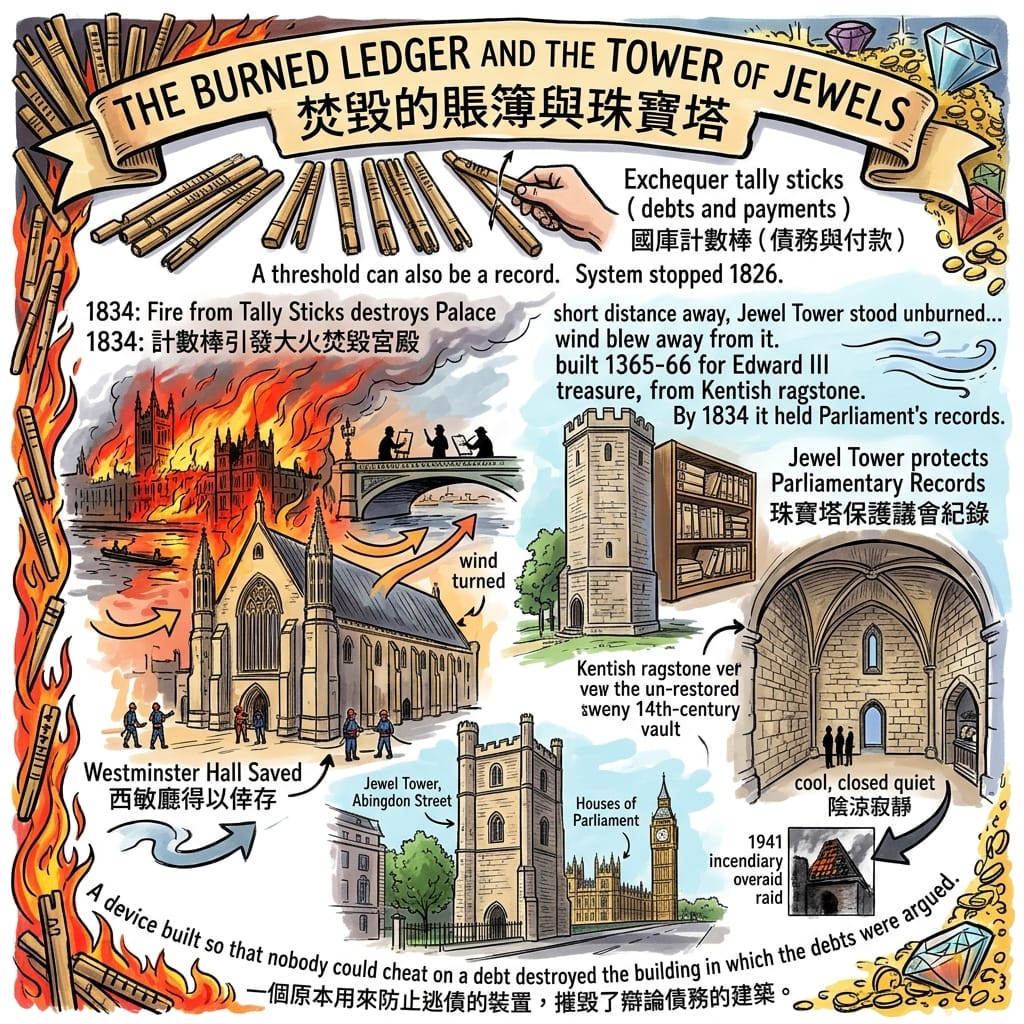
A threshold can also be a record. For centuries the Exchequer tallied debts on notched sticks of willow or elm. Each stick was split lengthwise, so that the creditor held one half and the Exchequer the other, and the two had to match. The system stopped in 1826.
By 1834 a surplus of obsolete sticks remained. Two cartloads were burned in the furnaces beneath the House of Lords. On the evening of 16 October the fire spread through the Palace, and it was the largest in London between the Great Fire and the Blitz. Turner and Constable watched it. Westminster Hall was saved, partly through firefighting and partly because the wind turned.
The Sticks That Burned Parliament
A short distance away, the Jewel Tower stood unburned, and the wind blew away from it. It was built in 1365–66 for Edward III's personal treasure, from stone brought in 98 boatloads from Maidstone. By 1834 it held Parliament's records. A tower made for gold and plate, kept intact by a change of wind, became the reason some of the documents survive.
The contradiction needs no comment. A device built so that nobody could cheat on a debt destroyed the building in which the debts were argued.
Sensory cue (observable today): inside the Jewel Tower the 14th-century ribbed vault has not been restored, and the thick Kentish ragstone walls hold a cool, closed quiet.
5. The woman in the cupboard
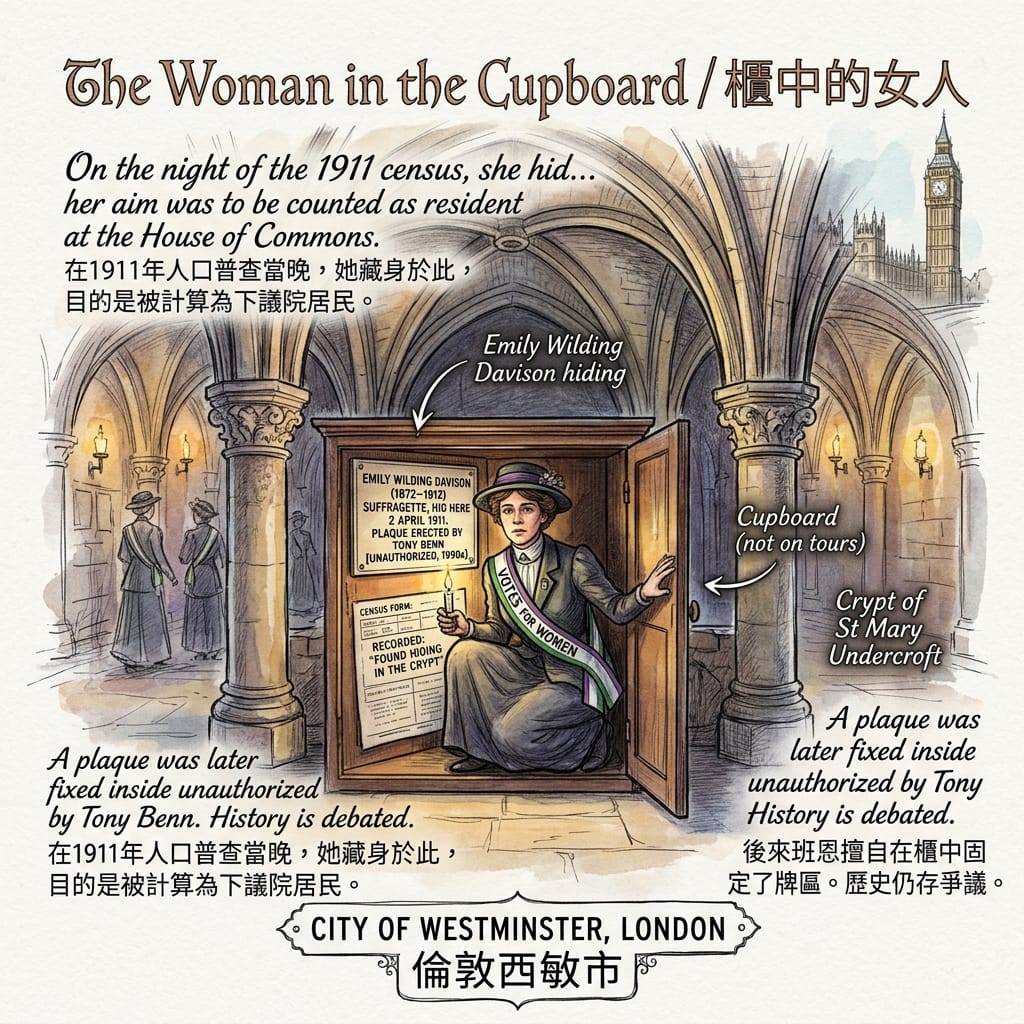
On the night of the 1911 census, 2 April, the suffragette Emily Wilding Davison hid in a cupboard in the crypt chapel of St Mary Undercroft, beneath the Palace. Her aim was to be recorded as resident at the House of Commons, a building whose doors were closed to women as members and as voters. A later blog says the return recorded her as found "hiding in the crypt"; that wording still needs checking against the original.
Other suffragettes evaded the count that night. She did the opposite: she made sure she was counted, in the one place that refused to count her as a citizen.
The Woman In The Cupboard
A plaque was later fixed inside the cupboard by Tony Benn. The accounts disagree about when. One says it went up unauthorised in 1991 with Jeremy Corbyn, another says 1999, and English Heritage says only the 1990s. Parliament says the cupboard's position means it cannot be part of tours.
Davison died in 1913 after being struck by the king's horse at the Derby. Historians still argue about what she intended.
What the borough keeps
Taken together, the five places leave very little. A street that may follow a river. Two street names where a tower stood. A stone on a traffic island. A medieval tower beside the Palace. A brass plaque on the back of a door.
None of these is a monument in the usual sense, and that is why they carry the pattern. Each marks a moment when someone decided who was inside, who was protected, who was recorded and who was not. The state kept its large buildings and let the small evidence fade.
Someone standing beside the Abbey now can see the queues, the cameras, the flags. Under it runs a question that was settled differently each time.
Accessing the physical nodes
- Tyburn stone (traffic island, Edgware Road/Bayswater Road, W2): about 140 m from Marble Arch Underground station. It is a pavement plaque on an island, with no opening hours. Tyburn Convent and Shrine of the Martyrs, 8 Hyde Park Place, W2 2LJ, is about 250 m west along Bayswater Road; one source gives daily shrine tours at 3.30 pm, so check the convent's own information before going.
- Jewel Tower, Abingdon Street, SW1P 3JX, opposite the Palace of Westminster and managed by English Heritage. Opening days and hours are reported inconsistently, so check English Heritage before travelling.
- Broad Sanctuary and the Supreme Court building are on the public street beside the Abbey; Westminster Underground station is nearby. Great College Street runs south of the Abbey.
- The Davison cupboard in St Mary Undercroft is not part of public tours, according to Parliament. Check parliament.uk for the visits that are offered.
- London Martyrs Way ends at Tyburn for those who want a walking route.
💡 Core Historical and Geographical Entities Q&A
Q1 | Was Thorney Island in Westminster a purely natural formation, or is the River Tyburn branch a historical misconception? (Geographical Evidence vs. Modern Scholarly Debate)
Answer: Early accounts and UK Parliament records state that Thorney Island was formed by two branches of the River Tyburn. However, contemporary geographical research challenges this narrative. In 2016, researcher Desmond Donovan argued in Geoscientist that evidence for the "Westminster branch" is exceptionally thin, aligning with the Victoria County History, which classified it as an unsubstantiated watercourse. It is possible the channel was artificially dug to supply water to the abbey rather than being a natural river. Therefore, the precise natural boundaries of early Westminster remain subject to historical uncertainty.
Q2 | Why did Queen Elizabeth Woodville take sanctuary in Westminster, and how did medieval sanctuary laws protect royal figures? (The Sanctuary of Westminster & Elizabeth Woodville's Refuge)
Answer: Medieval Westminster Abbey possessed special legal immunity granted to the abbot and monks, making those inside safe from immediate arrest or abduction. Queen Elizabeth Woodville famously took refuge there twice—first in October 1470, and again in late April 1483 following the sudden death of Edward IV. Although the heavy doors protected her and her daughters during intense political instability under Richard III, the sanctuary's power had limits. Following political pressure and the declaration of her marriage as invalid, she was eventually forced to surrender her younger son, highlighting the collision between religious sanctuary and raw political power.
Q3 | How did the Jewel Tower miraculously survive the 1834 fire that destroyed the Old Palace of Westminster? (Edward III's Jewel Tower & The Great Fire of 1834)
Answer: Built between 1365 and 1366 by Edward III to store his private valuables, the Jewel Tower is a heavy stone structure located near the Palace of Westminster. On October 16, 1834, a catastrophic fire consumed almost the entirety of the old parliamentary palace. However, historical records indicate that the wind direction fortuitously blew the flames and intense heat away from the Jewel Tower, allowing it to escape destruction. Rather than perishing in the blaze, the surviving medieval tower transitioned into a secure repository for parliamentary records and archives, standing today as a rare surviving relic of the medieval palace.
Want to follow the historical routes I’ve selected right from your phone as you walk? Click to join the exclusive Google map of historical tours titled "Historical Travel Stories"—import it to Google Maps on your phone with a single tap and let it guide you as you visit each historical site in person.

📖Reference and Further reading📖
First layer – Main sources of literature and institutions:
- UK Parliament, "Anglo-Saxon royal palace". Link. Used for: Thorney Island, the two Tyburn branches, Benedictine abbey, Edward the Confessor (S1, Step 0).
- UK Parliament, "Destruction by fire, 1834". Link. Used for: the 16 October 1834 fire, Turner and Constable, the wind sparing the Jewel Tower (S4).
- UK Parliament, "The Great Fire of 1834". Link. Used for: the two cartloads of tally sticks, 1826 end of use, surviving parts of the Palace (S4).
- UK Parliament, "Jewel Tower". Link. Used for: 98 boatloads of stone from Maidstone, Henry Yevele, Lords records from 1621, the pike-bone anecdote (flagged as anecdote) (S4).
- English Heritage, "History of the Jewel Tower" (Jeremy Ashbee). Link. Used for: 1365–66 construction, survival of Barry's rebuilding, May 1941 incendiary damage (S4).
- English Heritage, Blue Plaque: Emily Wilding Davison. Link. Used for: the census-night cupboard, the Tony Benn plaque dated only to "the 1990s", the cited biographies (S5).
- Tyburn Convent official site, www.tyburnconvent.org.uk. Named in a retrieved source but not itself fetched. Consult it for the shrine, relics and visiting details (S3).
- The National Archives, 1911 census (RG 14) for Davison's return; Parliamentary Archives for 1834 fire papers. (not yet consulted)
The second layer – secondary academic materials:
- Desmond Donovan, "Thorney problem", Geoscientist (September 2016). Link. Used for: doubt over the "Westminster branch" and Waller's 1890 map (S1).
Books cited by the sources above (no URL retrieved; check the originals):
- Caroline Shenton, The Day Parliament Burned Down (2012) (S4).
- Lucy Fisher, Emily Wilding Davison: The Martyr Suffragette (2018) (S5).
- A. Morley and L. Stanley, The Life and Death of Emily Wilding Davison (1988) (S5).
- Jeremy Ashbee, Jewel Tower, English Heritage Red Guide (2013); A. J. Taylor, The Jewel Tower guidebook, rev. edn (1996) (S4).
- Desmond Donovan, "The River Tyburn and Thorney Island" (PDF hosted by the Archaeology Data Service). Link. Used for: fuller argument for the same point. The journal title is not confirmed in the retrieved text, so verify the full citation (S1).
- Naomi Clifford, historian's blog post on the 1834 fire (draws on Shenton). Link. Used for: Exchequer tally system, 1826 abolition, Soane's warnings, Braidwood's firefighting. Treat as a pointer to Shenton (S4).
- Grub Street Project, "Broad Sanctuary" (compiled topographical descriptions). Link. Used for: sanctuary precinct under the abbot and monks, the old chronicle wording on Elizabeth Woodville (S2).
Third layer – Supplementary information:
- Exploring London, "Lost London: Westminster Abbey's Sanctuary Tower". Link. Used for: Sanctuary Tower, Middlesex Guildhall site, Broad Sanctuary and The Sanctuary street names, the Duke of Exeter, 1623 abolition (S2). The demolition date in this text is unclear, so verify.
- Exploring London, same article, John Skelton tag. Link. Used for: corroboration of the sanctuary residents (S2).
- Exploring London, "Lost London: The Tyburn Tree". Link. Used for: 1196–1783 span, the 60,000 estimate (flagged as a guess), 105 versus 350 martyrs (S3).
- Exploring London, "10 notable blue plaques: a notorious tree recalled". Link. Used for: 1964 LCC plaque replacing the 1909 plaque, last gallows removed 1759 (S3).
- Exploring London, "Thorney Island". Link. Used for: the outlets in Whitehall and Great College Street (S1).
- London Remembers, Tyburn Convent. Link. Used for: convent memorials, the point that the Marble Arch pavement plaque marks the actual site (S3).
- London Remembers, memorial 5741. Link. Used for: same, plus the "105 martyrs" board wording (S3).
- British Pilgrimage Trust, "Tyburn Tree monument and monastery". Link. Used for: London Martyrs Way, distances from Marble Arch station, the 3.30 pm shrine tour claim (S3).
- Cunnan wiki, "Westminster Abbey". Link. Used for: the fisherman and St Peter vision and the 604 date, as founding legend only (S1, Step 0). A hobbyist wiki, so verify against the abbey's own scholarship.
- EnglandCast, "Sanctuary in Medieval England: Elizabeth Woodville". Link. Used for: the 1 October 1470 sanctuary with her mother and three daughters (S2).
- Morning Star, "SNP MP: preserve Davison plaque". Link. Used for: the 1991 date and the unauthorised placing with Corbyn, Parliament's statement on tours (S5).
- Wikipedia, "Tyburn". Link. Used for: 1571 gallows, John Story, 1661 posthumous hangings (S3).
- Wikipedia, "Elizabeth of York". Link. Used for: the 1483 sequence, 22 and 25 June dates (S2).
- Wikipedia, "Bridget of York". Link. Used for: the night of 29–30 April 1483 flight (S2).
- Wikipedia, "Jewel Tower". Link. Used for: background on the tower (S4).
- Amusing Planet, "The Burning of The Parliament, 1834". Link. Used for: general retelling of the fire (S4).
- Bad Reputation blog, "Deeds Not Words: Emily Wilding Davison". Link. Used for: the claimed census wording "hiding in the crypt", which must be checked against the original return (S5).
- Stephen Wadds blog, "Suffragette Emily Wilding Davison's last great campaign". Link. Used for: the conflicting 1999 date for the plaque (S5).
- Lancashire Evening Post column, "A tale of two Emilys". Link. Used for: a visitor's account of the cupboard in the crypt (S5).
- Ianvisits venue page, "Jewel Tower". Link. Used for: ticket and opening information as of October 2025; opening hours conflict between sources (S4).
- London Guided Walks, "The Jewel Tower: Exploring Its Unique Architecture". Link. Used for: the Jewel Tower's later uses (S4).
- Parliamentary Archives visit blog (dbbd.sg). Link. Used for: the claim that earliest holdings are affected by the fire (S4). Low reliability.
 Lawrence
 Lawrence
 Lawrence