Edinburgh: The City That Never Let Its Ghosts Lie Down
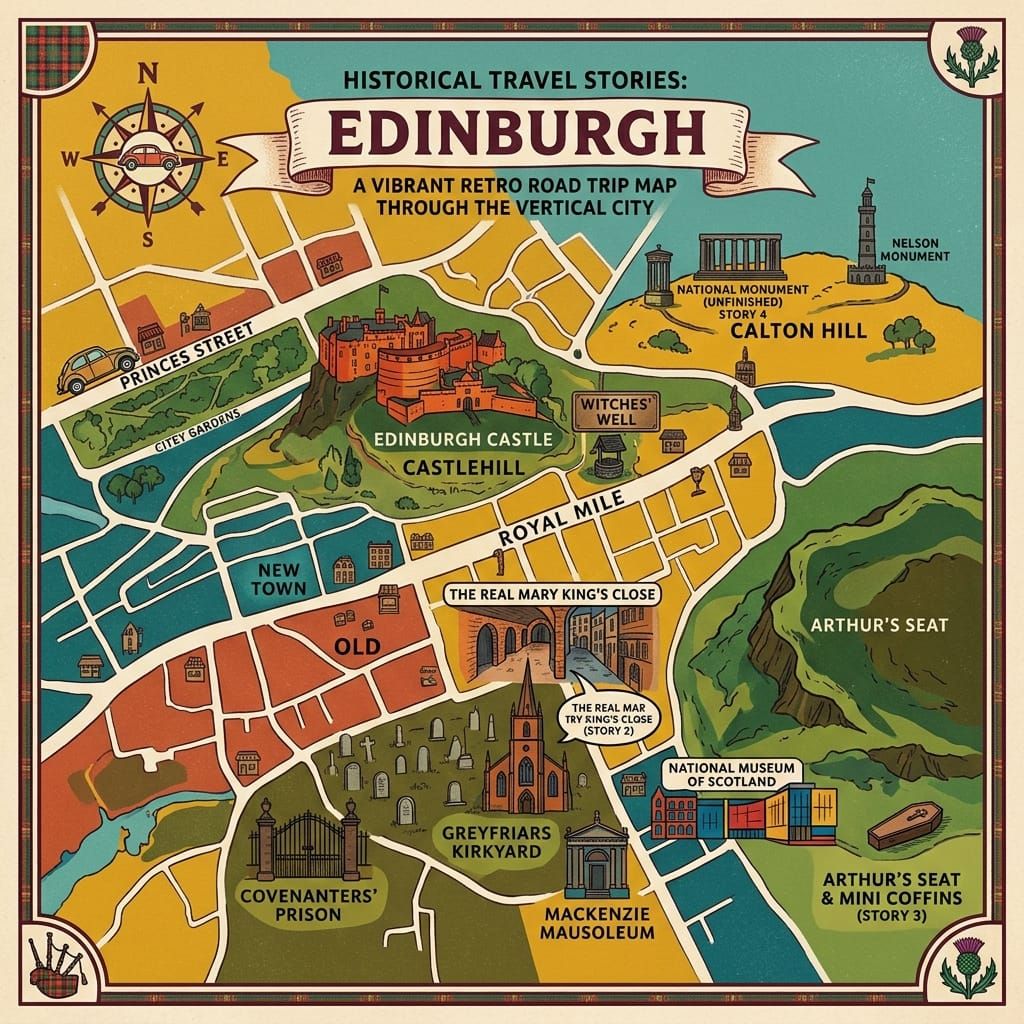
Edinburgh doesn't bury its history so much as build directly on top of it, layer after unresolved layer. This walk through the Nor Loch, Mary King's Close, Arthur's Seat, Calton Hill and Greyfriars reads the city through its own theology and reason — not borrowed mysticism.

 Lawrence
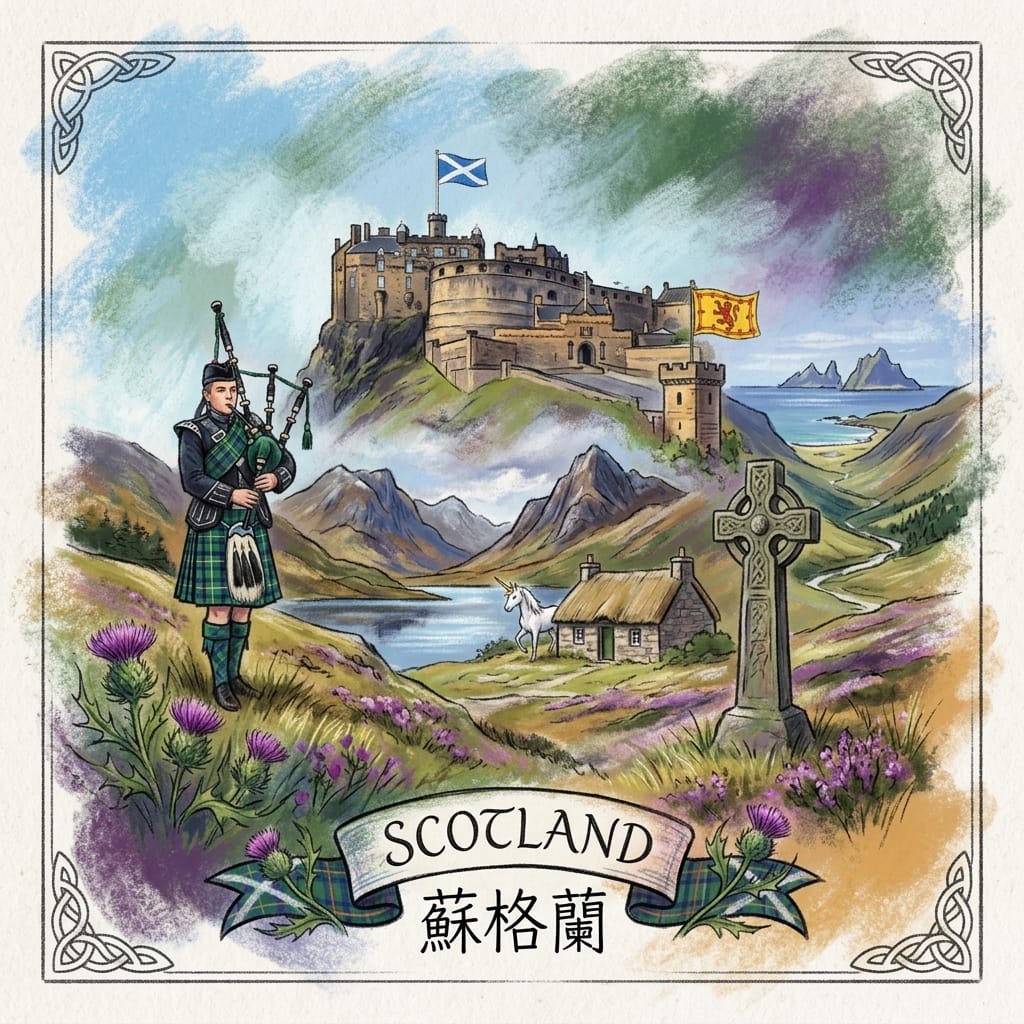
Edinburgh doesn't bury its history so much as build directly on top of it, layer after unresolved layer. This walk through the Nor Loch, Mary King's Close, Arthur's Seat, Calton Hill and Greyfriars reads the city through its own theology and reason — not borrowed mysticism.
💡 Join a community of discerning travelers. Simply enter your email to instantly unlock audio guides and one-day itineraries, and carry our exclusive historical walking maps with you on your journey.
The Weight of the Place
Some cities bury their dead and move on. Edinburgh builds on top of them and keeps going — which is a different thing entirely, and a stranger one. Walk the Royal Mile and you are not walking over history so much as walking on its uppermost storey, with several older storeys still standing, unevacuated, directly beneath your boots. Castle Rock and Arthur's Seat, two dead volcanoes, were the city's first courts and its first altars. For thirteen centuries afterward, each new Edinburgh — Calvinist, then rational, then Victorian, then merely modern — chose not to demolish what came before it but to build directly on top of the wound, still warm. Nothing here was ever quite forgiven. Nothing was quite forgotten either. It was simply built over.
Layer One: The Human History, Unvarnished
Before any framework can be applied to this city, five stories need to be told plainly — the ones the tartan-and-shortbread version of Edinburgh tends to leave out.
I. The Nor Loch: Trial by Water
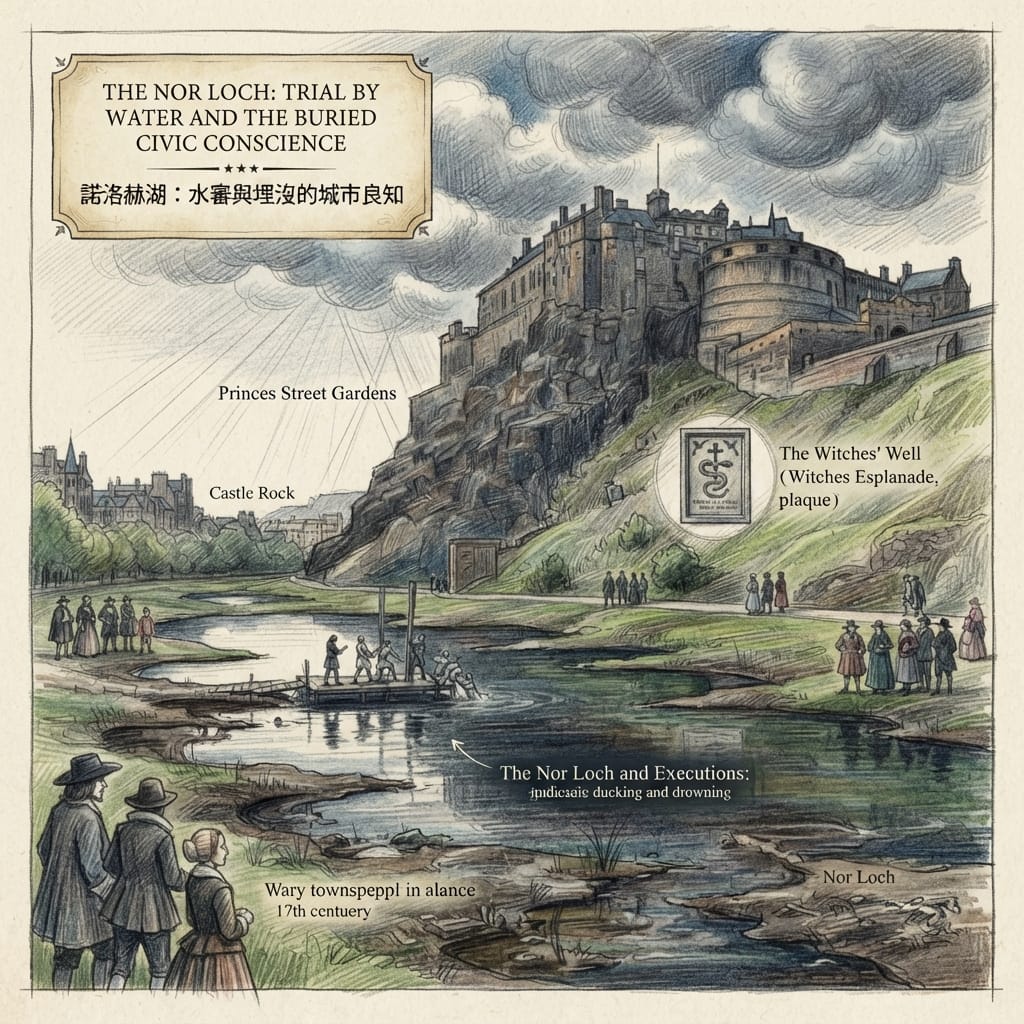
Before it was a dammed hollow beneath the Castle, before it was Edinburgh's principal sewer and knacker's yard, the Nor Loch was simply a glacial scar in the rock — cold, ordinary, indifferent. It became none of those things by accident. From 1562 onward, the accused were "ducked" here, although the historical record is considerably thinner than the ghost tours suggest: there's little hard evidence that ducking ever functioned as Scotland's actual courtroom test for witchcraft, as opposed to a more general European folk motif that later attached itself to this specific water. What the record does support, unambiguously, is scale. Edinburgh University's Survey of Scottish Witchcraft has named 3,837 individuals accused between 1563 and 1736, roughly two in three of whom were executed — a persecution rate that dwarfs England's, driven into overdrive after James VI convinced himself that a storm on his crossing from Denmark in 1590 was aimed personally at him, and personally presided over the North Berwick trials that followed. More than three hundred people were tried at or near the loch itself. Judicial drowning wasn't outlawed until 1685; the loch itself was drained only in the later eighteenth century, its bed becoming, of all things, a public garden.
Edinburgh S Buried Lake Of Execution
Who was there: James VI, the frightened king who wrote a treatise justifying what came next; eleven women drowned in a single day in 1624, none of whose names survive in common memory; the Sinclair family, whose triple skeleton was dredged up in 1820, tangled in a two-hundred-year-old incest-and-execution case nobody can now fully reconstruct.
II. Mary King's Close: The Quarantine That Wasn't What You Think
Mary King's Close was named for a fabric merchant who ran her own business in the 1630s, which was itself an unusual thing for a widow to do. The close she gave her name to was one of dozens of stacked wynds forced upward by Edinburgh's defensive walls — the wealthy at the top where the air was better, the poor crammed into the lightless lower floors beside the open sewer channels. The plague of 1644–45 hit it hard. When the Royal Exchange was built over the close's lower storeys in the 1750s, an entire slice of seventeenth-century Edinburgh was entombed rather than demolished, and has survived, more or less intact, ever since — soot, hearths, and all.
The Myth Of Edinburgh S Buried Plague Street
The story everyone tells — that plague victims were bricked in alive and left to die — is not, in fact, what the record shows. The close was quarantined, yes, but the documented practice was for the city to keep supplying food and water to those inside, not to abandon them behind a wall. It is a less gothic story than the legend, and a considerably more interesting one about how a seventeenth-century city actually tried to manage catastrophe. This dossier treats the "bricked in alive" version as folklore that has calcified into false fact, and corrects it accordingly — while still taking seriously why the myth won't die.
III. The Arthur's Seat Coffins: A Funeral With No Congregation
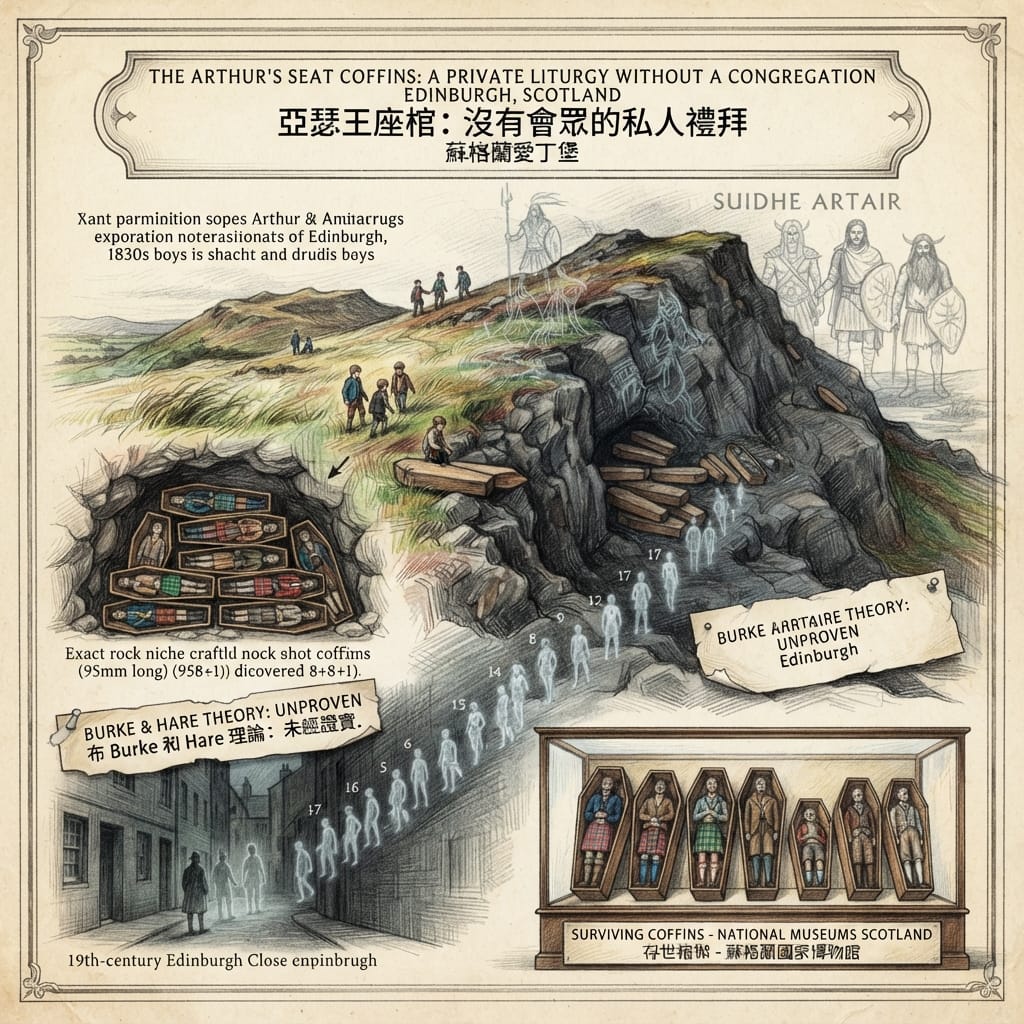
In June 1836, boys out rabbiting on the northeastern flank of Arthur's Seat found a slate-hidden niche containing seventeen miniature wooden coffins, each just under four inches long, each holding a small carved figure — repurposed toy soldiers, dressed individually in stitched cloth. They had clearly not been placed there all at once: the lowest tier had rotted far more than the upper ones, suggesting the collection had been built up, one coffin at a time, over years. Only eight survive; the rest were thrown at each other by the boys who found them, "as unmeaning and contemptible trifles," as one contemporary newspaper sniffed. Whoever made them, and why, has never been established. The leading theory ties the coffins to the seventeen-odd victims of Burke and Hare, murdered in 1828 to be sold to the anatomists — a suggestive number, and nothing more than that; no document connects maker to murderer.
The Secret Tombs Of Arthur S Seat
Who was there: an anonymous craftsman, never identified, with what must have been considerable patience and grief; the boys who broke the collection apart without understanding what they'd found; Burke and Hare, whose crimes haunt the leading theory without ever quite confirming it.
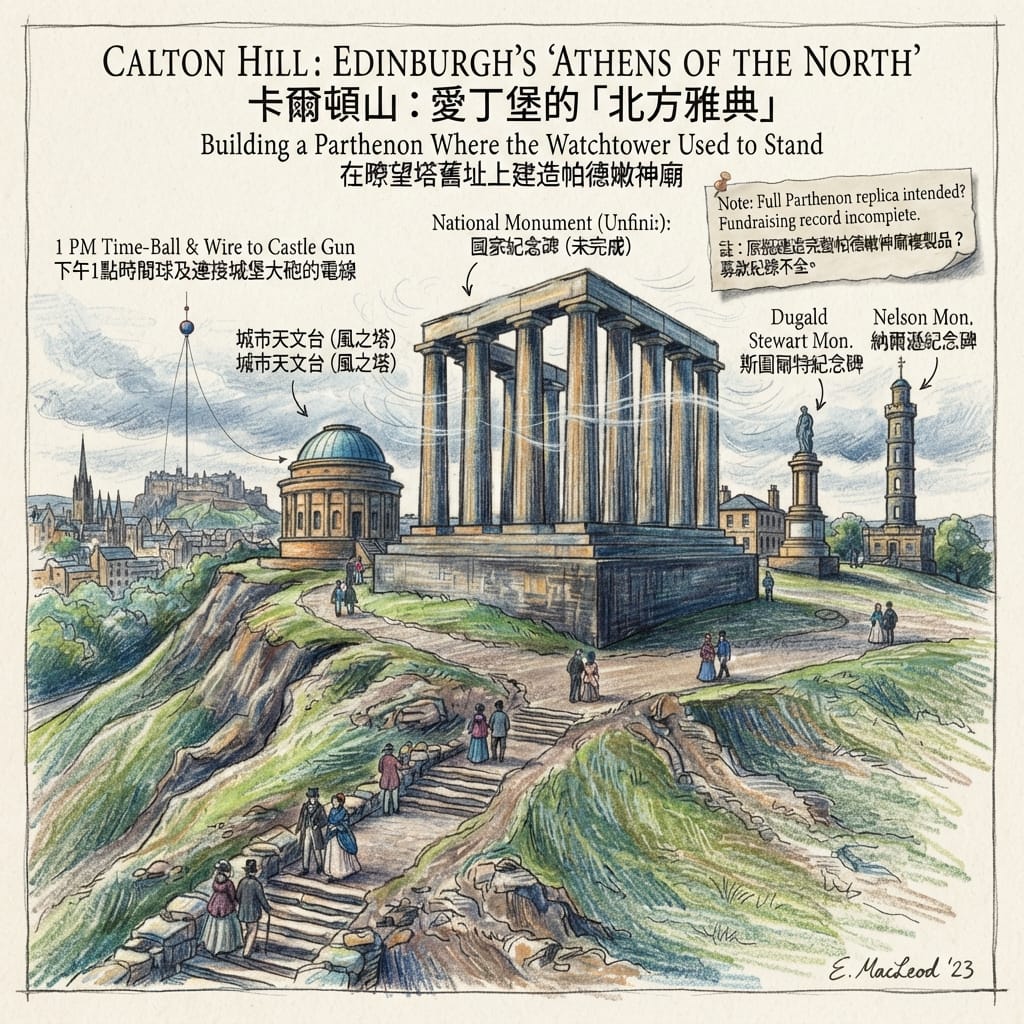
IV. Calton Hill: Building Athens Where the Watchtower Stood
Calton Hill's observatory tradition began in 1777, with a building by the New Town's own planner, James Craig; it was replaced in 1818 by William Playfair's new City Observatory, modelled directly on the Tower of the Winds in Athens. That borrowing became civic policy: to honour the dead of the Napoleonic Wars, and to make good on Edinburgh's half-ironic nickname "the Athens of the North," the city resolved to build an actual Parthenon on the hilltop. Work began in 1822. Money ran out in 1829, leaving twelve columns standing and nothing behind them — a facade the city itself came to call, with a certain fondness, "Edinburgh's Disgrace." Nearby, the Dugald Stewart Monument, commissioned in 1830 to honour the Enlightenment philosopher who held Edinburgh's chair of moral philosophy until 1828, borrowed its shape from the Choragic Monument of Lysicrates — another piece of Athens, correctly quoted, standing on a Scottish hill.
The Fake Greek Ruin Of Scotland
Who was there: James Craig, the New Town's original grid-maker; William Playfair, chief architect of Edinburgh's Greek Revival ambitions; Dugald Stewart, the philosopher the city chose to memorialise in classical stone; and the unnamed subscribers whose money ran out before the temple did.
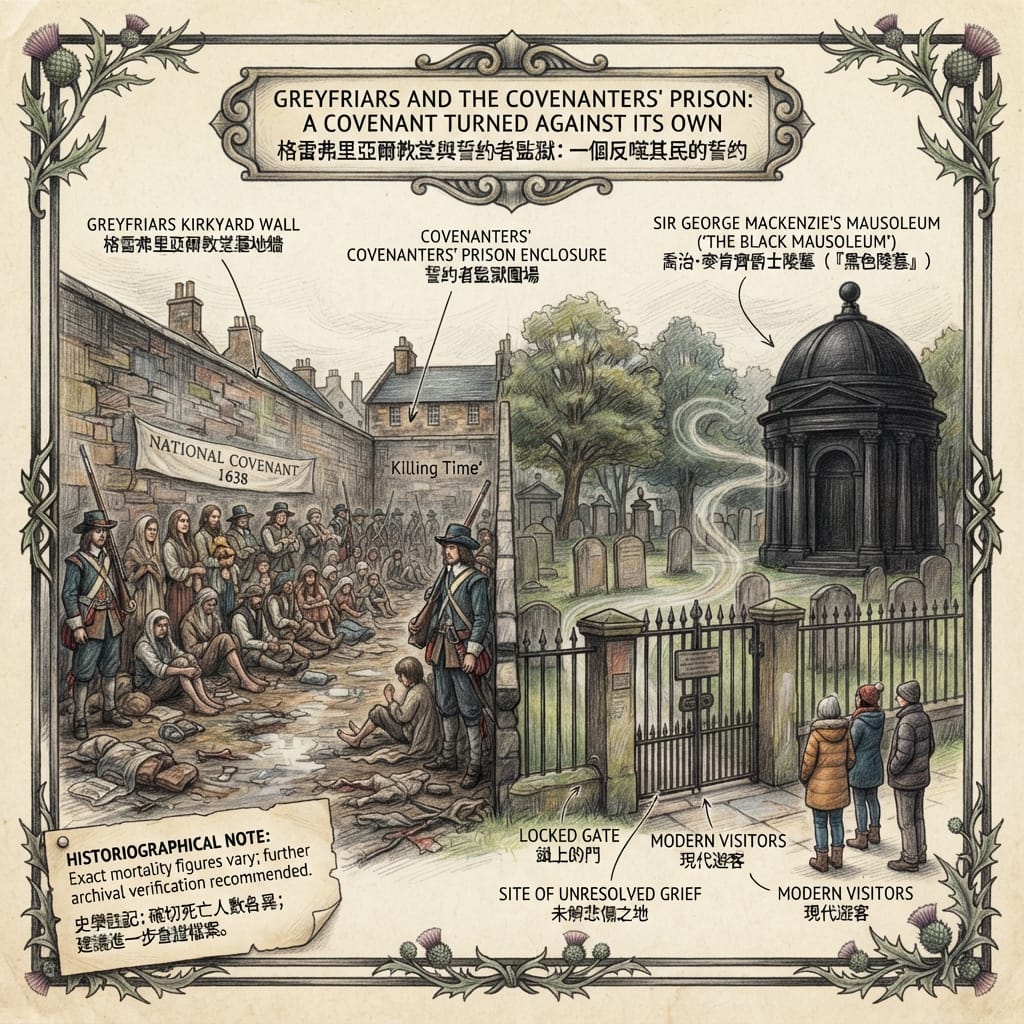
V. Greyfriars and the Covenanters' Prison: A Covenant Turned on Itself
Greyfriars Kirkyard is where the National Covenant was signed in 1638 — the founding document of Scotland's Presbyterian resistance. Forty-one years later, the same ground became the prison of that resistance's defeated remnant. After the Covenanters' rout at Bothwell Bridge in 1679, the Lord Advocate, Sir George Mackenzie of Rosehaugh, had roughly 1,200 of them penned into an open, unroofed enclosure at the kirkyard's southern edge — no shelter, minimal food, through a Scottish winter. Most died there. By November only 257 remained; most of those sentenced to transportation drowned when their ship broke up off Orkney. By year's end, forty-eight were left alive. Historians have called it one of Europe's earliest examples of systematic mass detention.
The Death Camp In Edinburgh S Sacred Graveyard
Mackenzie himself had started his career defending Covenanters in court, before switching sides entirely. When William of Orange restored the Presbyterian settlement in 1688, Mackenzie's power collapsed; he died in exile in England in 1691, but was brought home for burial — in a domed mausoleum inside Greyfriars, a few dozen paces from the enclosure he built.
Who was there: Mackenzie, "Bloody Mackenzie," prosecutor and, before that, defender; roughly 1,200 named and unnamed prisoners; William of Orange, whose accession undid in a year what Mackenzie had spent a decade enforcing.
Layer Two: Reading the City Through Its Own Theology and Reason
This dossier does not read Edinburgh through feng shui, or ley lines borrowed wholesale from a different island's folklore, or any framework not documented on this ground. What is documented is a genuine layering of three native traditions: a Brythonic-Celtic sense of hills and water as thresholds between worlds; Reformed Calvinist covenant theology, in which physical fate is read as a visible sign of invisible election or damnation; and the Scottish Enlightenment's own civic rationalism, which built its "sacred geometry" out of classical proportion rather than scripture. None of the three ever fully displaced the others. Edinburgh simply kept building.
The Nor Loch is Calvinist theology at its most literal and its most municipal. Water, which ought to signify baptismal cleansing, was inverted here into a verdict-delivering machine: what your body did in the water was read as what God had already decided about your soul. That the same loch then became the city's rubbish tip is not incidental — this was a culture that saw moral and physical contamination as points on a single continuous scale, and the loch as the drain for both.
The Arthur's Seat coffins call for the older, thinner Celtic layer instead. Arthur's Seat carried ritual and territorial weight — hillfort, threshold, boundary — long before the Reformation arrived to argue with it. To hide a private burial rite in a slate niche on that specific hill, for bodies the Church and the anatomists between them had denied proper burial, is to reach past the official theology entirely and back toward an older grammar of liminal ground — a private funeral held on unconsecrated but symbolically charged earth, because consecrated ground had already refused the dead in question.
Greyfriars is where the Calvinist framework turns on itself most completely. The Covenanters swore their oath on consecrated Kirk ground precisely because it was consecrated; Mackenzie then used the same church-state machinery to let their survivors die on that same ground, a few dozen paces from where he would later be buried among them. His grave sits, as locals still put it, on the doorstep of his own victims — not coincidence so much as an enforced, permanent proximity that keeps the moral account of the Killing Time open rather than closed. The modern reports of the "Mackenzie Poltergeist" — cold spots, unexplained bruising, the sensation of being shoved by something unseen inside the locked enclosure — are better read as collective trauma geography than as haunting in any literal sense: ground that absorbed this much documented suffering appears to go on generating a bodily response in visitors, independent of anyone's belief in ghosts.
Calton Hill, by contrast, is where Reformed theology gives way almost entirely to Enlightenment reason, and the "sacred geometry" on offer is deliberately, self-consciously classical rather than scriptural. Where the Nor Loch and Arthur's Seat accumulated meaning slowly, through centuries of use and grief, Calton Hill's meaning was engineered in a single generation, by architects quoting Athens directly and on purpose. It is a genuine sacred geometry all the same — its god is Reason, and its liturgical calendar was astronomical rather than ecclesiastical: the observatory's time-ball still drops at one o'clock Greenwich Mean Time, for decades wired four thousand feet across the city to trigger the Castle's One O'Clock Gun in the same instant — a daily civic rite, precise to the second, that replaced the pre-Reformation church bell with something science could vouch for. The unfinished National Monument doesn't undermine this reading; it completes it. Twelve columns going nowhere became, in the public imagination, as much a monument to the failure of Enlightenment ambition as to its reach — a rare case of a city's own founding myth visibly stumbling, and being folded, self-mockingly, into local identity rather than being quietly demolished.
Holographic Sensory Cue: Stand at the locked iron gate of the Covenanters' Prison enclosure in Greyfriars. The flagstones underfoot carry a thin, slick skin of moss; the air holds a specific mineral dampness — old lime mortar and turned earth that has not seen direct sun in generations. There is very little sound: no traffic hum, just the occasional call of a bird and the low, dragging note of wind moving across centuries-old stonework. The gate itself is cold to the touch, its ironwork pitted and rough under the fingers. Step across the threshold and the temperature drops noticeably — not imagination, but the measurable effect of high walls and old mausoleums cutting off the sun. The stillness above ground and the documented starvation below it sit in open contradiction, and that contradiction is the entire feeling of the place.
A Resonance Node: Where the Veil Runs Thinnest
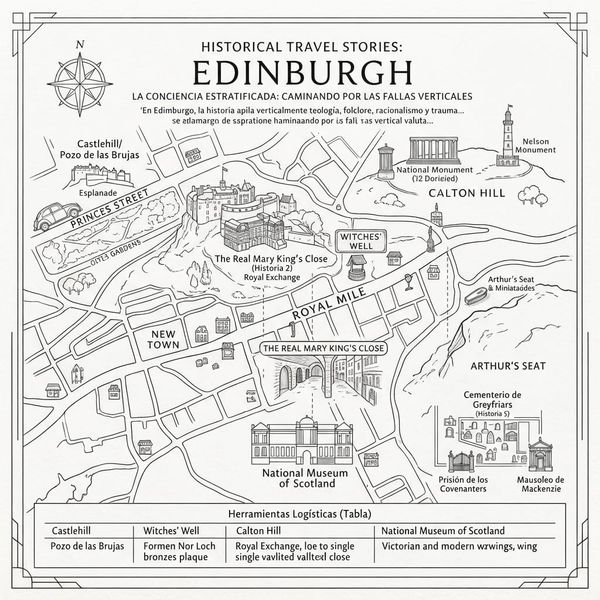
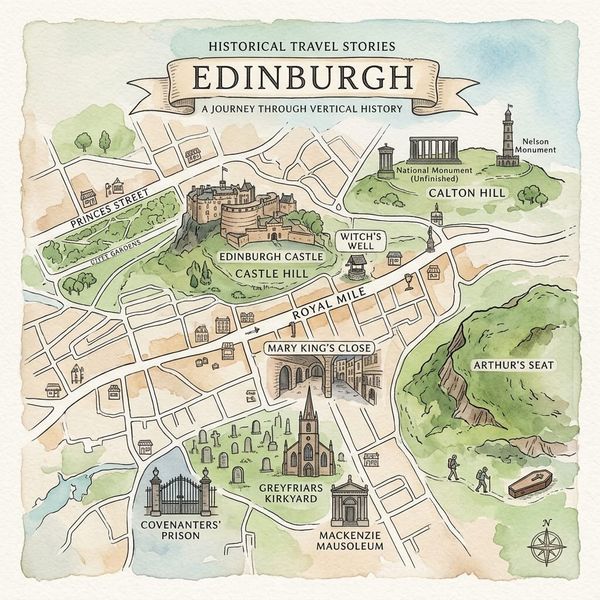
At the western end of Princes Street Gardens, tourists usually walk straight past the Witches' Well — a modest bronze plaque and fountain, easy to miss. The Witches' Well is exactly the kind of quiet threshold this dossier means by a resonance node: it stands at the precise boundary between the execution ground above, on the Castle esplanade, and the drowning-loch below, now grassed over and pleasant. To stand there is to feel a rare piece of geographic honesty — one of the only places in the city that names its own persecution outright, and yet does so in miniature, almost apologetically, as though even confessing the wrong still embarrasses the place that committed it.
Conclusion: Memory as the City's Oldest Asset
The frequency Edinburgh actually runs on has nothing occult about it. It is a structural habit: this city never lets its theological and rational selves settle their differences — it simply builds the next one directly on top of the last one's unhealed wound. A patch of consecrated Covenanting ground becomes a death camp for Covenanters, then a modern ghost-tour revenue line, with none of those three meanings ever formally retired. A loch used to drown women becomes an ornamental garden with no monument to speak of. A private funeral, performed in secret on ground the church had already half-displaced, gets displaced again — this time into a museum case, unsolved. Most tellingly of all: when eighteenth-century Edinburgh needed a new sacred geometry, it didn't grow one out of its own layered past. It imported one wholesale from classical Athens and built it, half-finished, directly on top of a hill whose older meanings it simply wrote over.
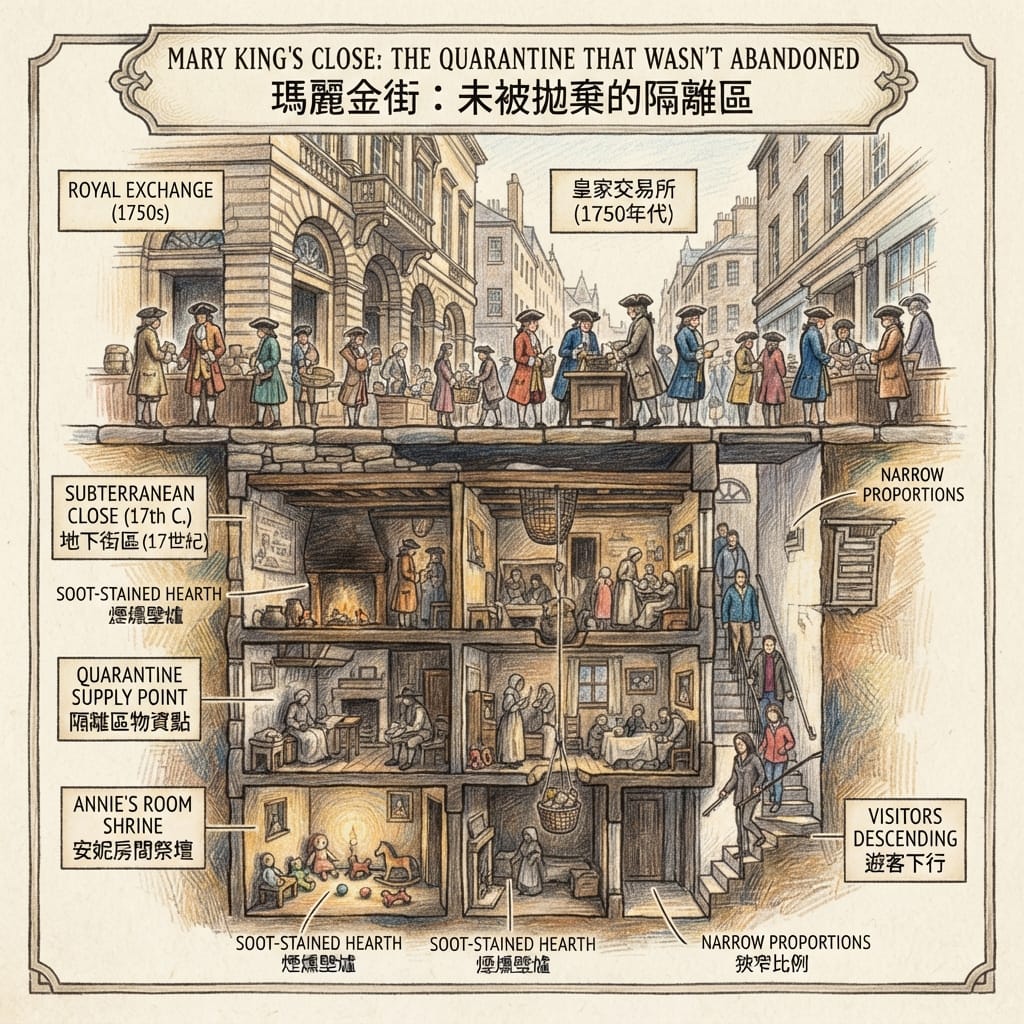
Historians tend to file these episodes separately — legal history here, epidemiology there, folklore somewhere else, architectural history in its own room. What that filing system misses is the geography: a city that habitually stacks its next self-image on top of its last self-image's open wound, rather than either healing it or letting it go. The Old Town's vertical architecture — a close buried under an exchange, a prison beside a philosopher's memorial, an Enlightenment temple written over an Iron Age fort — is not simply what happens when a walled city runs out of room. It is the city's own method of remembering, made permanent in stone: an unreconciled, load-bearing conscience, in which each era's dead keep quietly holding up the era that comes after, whether or not anyone looks down to notice.
If a place like this can still ask that much of a visitor, memory may be the one asset no amount of technology makes obsolete. If you'd like company on the next descent into a city's unhealed floor, consider subscribing — we go looking for these places so you don't have to find them by accident.
Accessing the Physical Node
Getting there: Edinburgh Waverley sits at the foot of the Old Town, within walking distance of the Royal Mile, Greyfriars Kirkyard, and Princes Street Gardens; Edinburgh Airport connects to the centre by tram and express bus.
Where to anchor overnight: For the fullest sense of the city's stacked history, stay within the Old Town itself — the Royal Mile or the Cowgate — in one of the many guesthouses converted from centuries-old stone buildings, where the walls still carry the thickness and shadow of the original city.
Guided passage: The Real Mary King's Close runs official tours into the buried street itself; the Covenanters' Prison at Greyfriars is accessible only with a guide, never on your own. Arthur's Seat and Calton Hill are open for unaccompanied walking — go an hour before sunset if you want to feel, rather than just read about, the shifts in light and temperature this dossier describes.
💡 Q&A
Q1 | Were plague victims in Mary King’s Close really bricked up alive and left to die? (Mary King’s Close Historical Records and the 1644–1645 Plague Quarantine Reality [Mary King's Close & 1644 Plague Quarantine])
A: Historical records do not support the popular legend that plague victims in Mary King’s Close were bricked up alive and left to starve. During the devastating 1644–1645 plague outbreak in Edinburgh's Old Town, the close was indeed placed under strict quarantine due to its dense, multi-story tenement housing and open sewer conditions. However, municipal records indicate that quarantined residents consistently received state-provided food, water, and necessities rather than being abandoned to cruel executions. The enduring myth of live burial stems from sensationalized ghost lore and later urban legends, generated after the lower storeys of the close were entombed beneath the Royal Exchange in the 1750s, transforming an administrative quarantine into a theater of supernatural horror.
Q2 | Was the Nor Loch truly used as a systemic judicial execution site for drowning witches? (Nor Loch History and the 1563–1736 Scottish Witch Trials [Nor Loch & Scottish Witch Trials])
A: Surviving historical evidence does not substantiate the claim that the Nor Loch was systematically used as a courtroom drowning test to identify witches. Although early modern Edinburgh was a major epicenter of Scottish witch-hunting—with the University of Edinburgh's Survey of Scottish Witchcraft documenting 3,837 named accused individuals and roughly two-thirds executed between 1563 and 1736 under statutes spurred by King James VI—formal judicial records rarely mention ducking or drowning as an official trial method. In reality, the Nor Loch functioned primarily as a defensive glacial hollow, the city's main sewage canal, and a knacker's yard. Romanticized folklore and ghost tours later attached dramatic drowning narratives to the loch, exaggerating the tangible horrors of Scotland's actual judicial persecutions.
Q3 | What is the historical truth behind the seventeen mysterious miniature coffins found on Arthur’s Seat in 1836? (Arthur’s Seat Miniature Wooden Coffins and Nineteenth-Century Body-Snatching Suspicions [Arthur's Seat Miniature Coffins & Burke and Hare Murders])
A: The precise origin and historical purpose of the seventeen miniature wooden coffins discovered by schoolboys on the slopes of Arthur’s Seat in 1836 remain formally unproven. Measuring only about nine centimeters and containing carved wooden human figurines, the find immediately sparked intense contemporary speculation linking the artifacts to the infamous Burke and Hare anatomy murders or witchcraft substitution rituals. However, modern historical and archaeological analysis suggests the coffins may have been crafted prior to those notorious crimes, with alternative theories pointing toward sailors' memorial customs or folk apotropaic charms. This silent, unaccompanied burial remains one of Edinburgh's most compelling unsolved historical mysteries, reflecting nineteenth-century anxieties surrounding urban crime and the occult.
Want to follow the historical routes I’ve selected right from your phone as you walk? Click to join the exclusive Google map of historical tours titled "Historical Travel Stories"—import it to Google Maps on your phone with a single tap and let it guide you as you visit each historical site in person.


📖Reference and Further reading📖
First layer – Main sources of literature and institutions:
- An unsolved mystery: The coffins found on Arthur's Seat — National Museums Scotland, collections catalogue.
The second layer – secondary academic materials:
- The Archaeology of Edinburgh's Lost Loch — Dig It! Scotland, 2021.
- Nor Loch — Wikipedia (note on the limited evidence for "witch ducking" in Scotland).
- Arthur's Seat coffins — Wikipedia (summarises the Menefee & Simpson 1994 argument).
- Edinburgh's Mysterious Miniature Coffins — Smithsonian Magazine, 2013.
Third layer – Supplementary information:
- Edinburgh's Nor Loch | Its surprising dark history — My Macabre Road Trip.
- Edinburgh's witches and wizards — Forever Edinburgh.
- The Witches' Well — CityDays.
- Witches Well (Edinburgh) — Secret Scotland.
- Mary King's Close – Edinburgh's Plague Infested Underground Street — Wandering Crystal, 2024.
- Mary King's Close: Underground Edinburgh's buried street — On the Luce, 2026.
- Calton Hill and its monuments — Tales of one city, 2018.
- Calton Hill Feature Page — Undiscovered Scotland.
- Calton Hill: Edinburgh's Hill of Monuments and the Scottish Enlightenment — Andrea Martin, 2025.
- Meet the Mackenzie Poltergeist of Greyfriars Kirkyard — Icy Sedgwick, 2021.
- The Mackenzie Poltergeist Terrorizes Visitors in Greyfriars Cemetery — History Collection, 2021.
- The MacKenzie Poltergeist at Greyfriars Kirkyard — Auld Reekie Tours.
 Lawrence
 Lawrence
 Lawrence