Nogata: The Neighborhood Tokyo Built to Hold Things
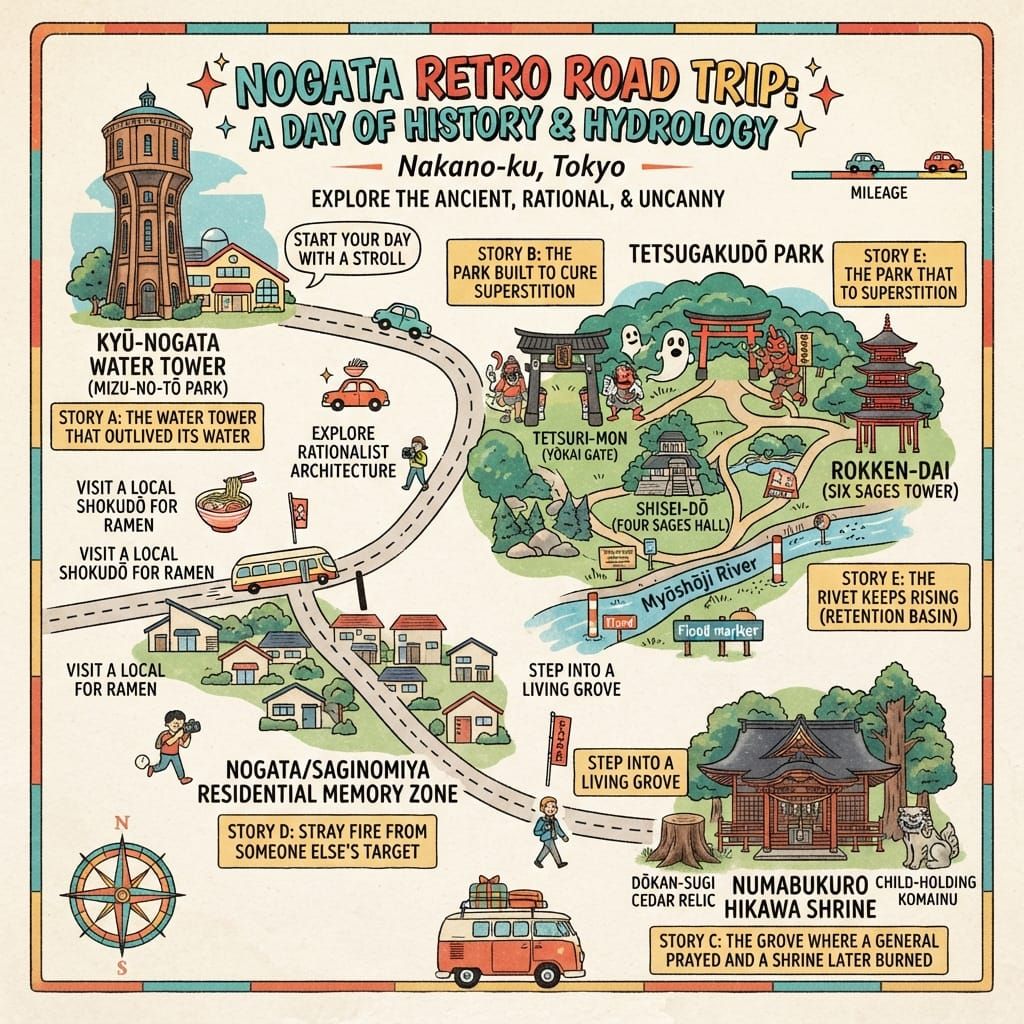
Nogata never got a headline. It got five quiet vessels instead — for water, for war, for thought, for grief, for flood. This is the walk that finds them.
 Lawrence
There is a particular kind of place that history skips over not because nothing happened there, but because everything that happened there was ordinary — a flood, a fire, a war memorial, a water tower. Nogata, a modest quarter in Tokyo's Nakano Ward, is that kind of place. No shrine here draws international pilgrims. No structure appears on a postcard rack. And yet, walk its streets slowly enough, and a pattern begins to surface that no single monument could tell you on its own: this is a neighborhood that has spent a century building containers. Vessels for water. Vessels for ideas. Vessels for grief. Vessels for the river when it rises too fast. Nogata doesn't announce its history. It holds it.
Listen to the historical stories told in detail (For subscribers only)
The Weight Beneath the Ordinary Street
Most sacred geography announces itself — a torii gate, a mountain silhouette, an axis aligned to the solstice sun. Nogata offers none of that. What it offers instead is stranger and, in its way, more honest: a concrete cylinder wearing the face of a European church, built to hold drinking water rather than divinity. A public park shaped like a pilgrimage route, built by a philosopher whose life's work was debunking ghosts. A shrine that keeps burning and keeps rebuilding itself across five and a half centuries. A river that still remembers exactly where it used to run free before the city paved over it. None of this is grand. All of it is real. And underneath Nogata's unremarkable grid of residential streets and convenience stores, that accumulated weight of ordinary, repeated human struggle is still, quite literally, structurally present — poured into concrete, planted as trees, buried as tunnels, rebuilt as timber halls. You are not walking through a museum here. You are walking on top of five different centuries that never fully left.
First Vessel: The Tower That Forgot How to Hold Water
The Grounded History
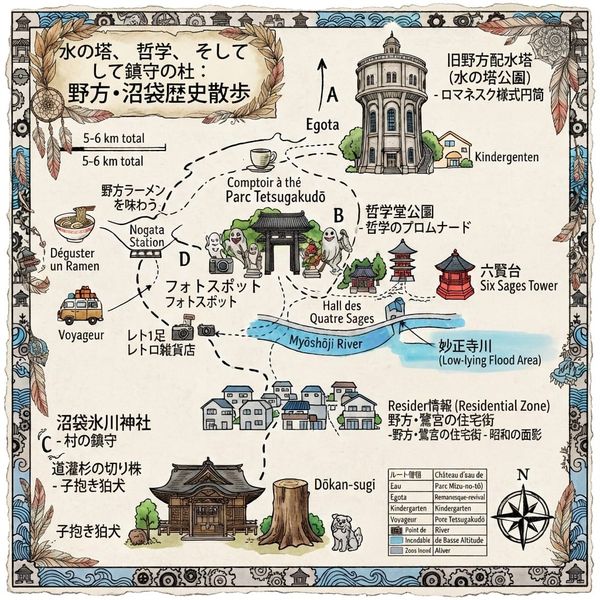
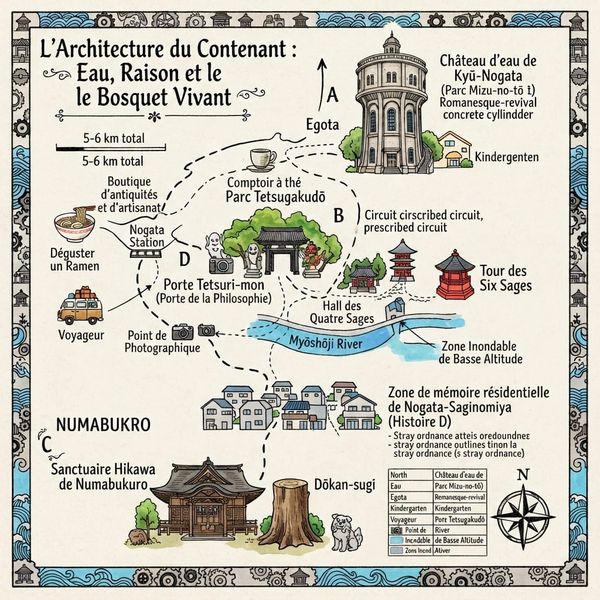
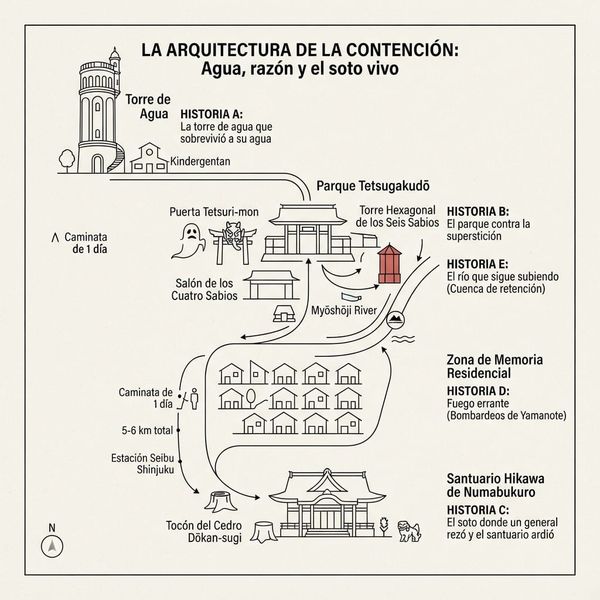
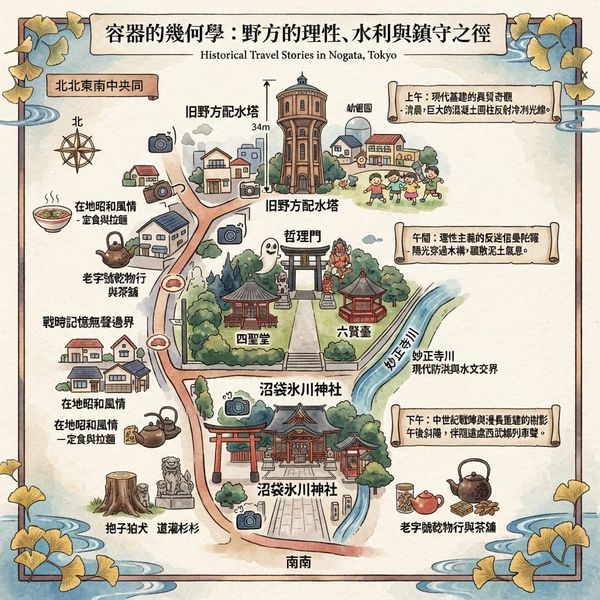
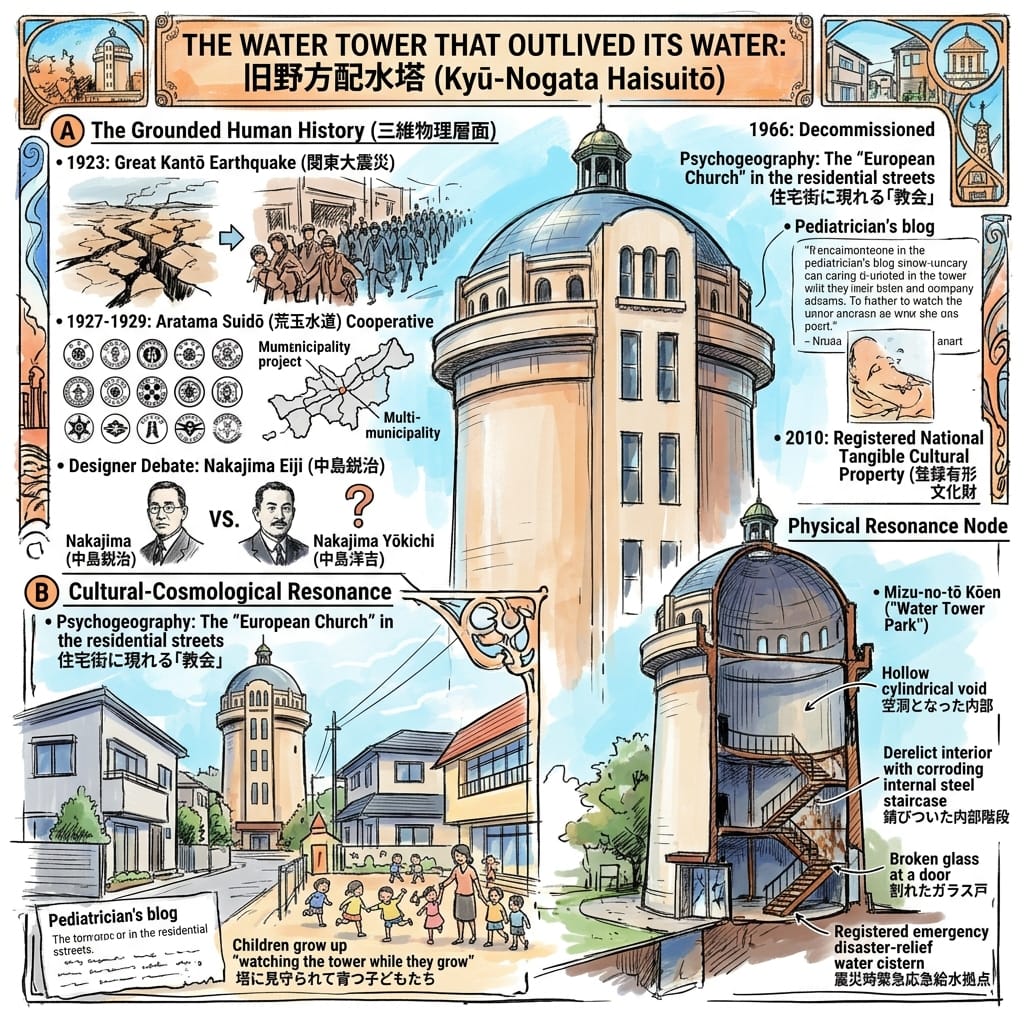
In 1923, the Great Kantō Earthquake tore through Tokyo's water infrastructure and sent a wave of displaced residents fanning out into the still-rural Musashino uplands. Thirteen neighboring town and village governments — Nogata among them — did something unusual for the period: they pooled their resources into a joint water utility, the Aratama Waterworks, rather than waiting for the capital to rebuild itself first. Two matching standpipe towers rose out of this cooperative effort, one at Ōyaguchi (demolished in 2005) and one here in Nogata, completed in 1929. For decades, credit for the design went to Nakajima Eiji, celebrated as the father of Japan's modern waterworks — until historians of civil engineering noticed a problem: Nakajima died in February 1925, two years before ground was even broken. The likelier architect, current scholarship suggests, was a different engineer entirely, Nakajima Yōkichi — a case of mistaken authorship that has never been formally corrected in the popular record.
Tokyo S Accidental Concrete Cathedral
Reading It Through the Land's Own Lens
Nogata has no documented indigenous cosmology of its own to lend this structure meaning, and inventing one here would be exactly the kind of borrowed mysticism this land doesn't need. What actually happened at this water tower is a more interesting, entirely secular phenomenon: a Romanesque silhouette — arched windows, a domed roof, a stair turret — rising without warning out of a flat residential street, doing a purely bureaucratic job. Multiple residents, unconnected to one another, have independently described the same jolt of recognition on first encountering it: the instinct to read it as a church. That repeated, spontaneous misreading is the actual ghost story here — not a haunting, but a kind of architectural déjà vu, a collective reflex to mistake anything tall, curved, and old for something sacred. The tower stopped supplying water in 1966. It is, today, both a protected cultural property and a still-active emergency cistern for the ward — a monument and a piece of working infrastructure occupying the same concrete at once.
Holographic Sensory Cue: Step through the tower's door before its restoration — rusted hinges, broken glass underfoot. Inside, nothing but a hollow cylindrical shaft rising thirty-four meters into shadow. A steel staircase spirals up the inner wall, shedding flakes of corrosion at every footstep, the sound ringing off bare concrete. The air is cold, damp, mineral — the smell of standing water long since drained away. Far above, daylight leaks through a cracked seam in the dome, a single pale column falling through drifting dust, the only clock in a room that otherwise forgot what year it is.
Second Vessel: The Park Built to Cure You of Ghosts
The Grounded History
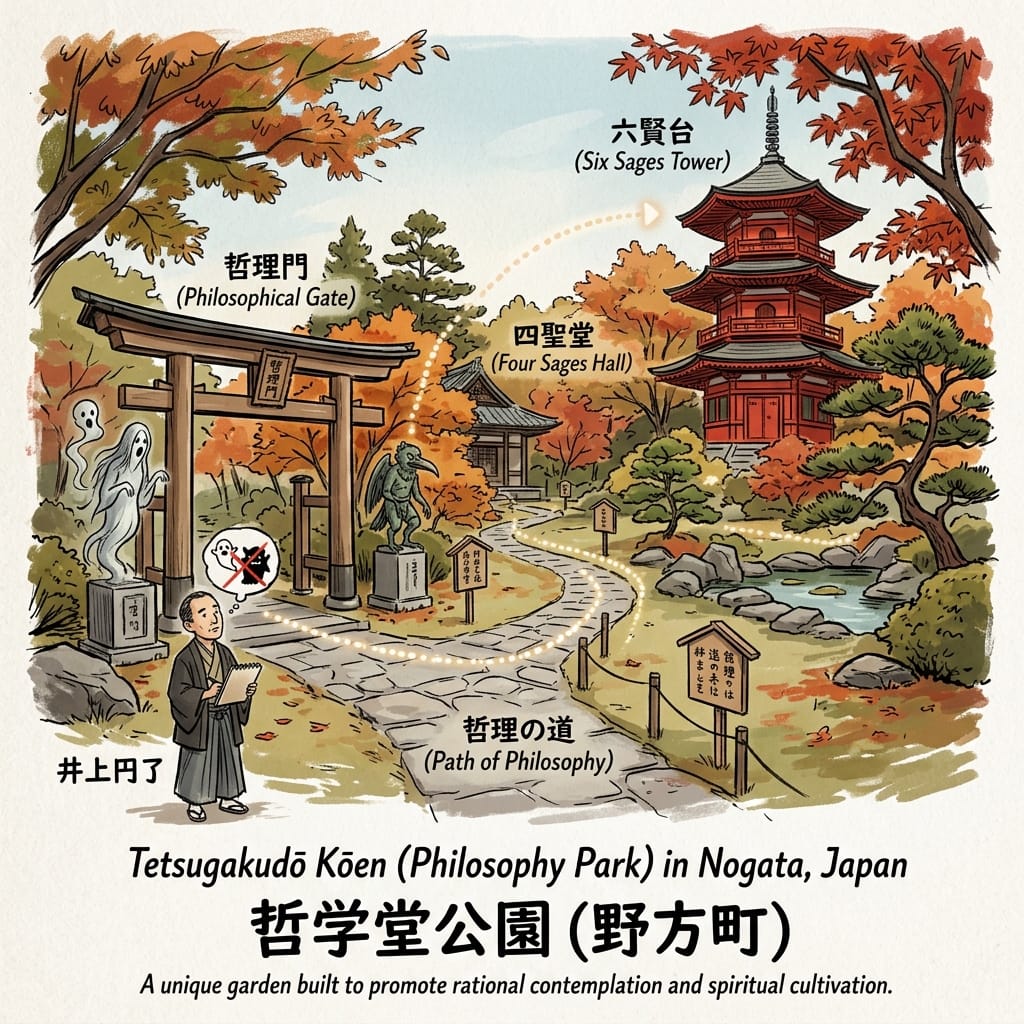
Inoue Enryō — philosopher, Buddhist scholar, and founder of what became Tōyō University — spent his career doing something almost nobody else in his field was doing: methodically investigating Japan's ghost and monster folklore in order to disprove it. His contemporaries called him "Dr. Ghost," a nickname earned entirely through debunking rather than believing. In 1904, on land in what was then rural Nogata village, he built a small hall enshrining four sages — Socrates, Kant, Confucius, and the Buddha — originally intending to found a university on the site. The plan changed. Instead, the land became a public park for what he called "spiritual cultivation," growing between then and 1912 to include a gate flanked by statues of a ghost and a tengu, a hexagonal tower enshrining six more East Asian philosophers, and seventy-seven named stops laid along a deliberate walking route.
The Ghost Hunter S Shrine To Logic
Reading It Through the Land's Own Lens
This is the one place in Nogata with a genuinely native cosmology — not borrowed from anywhere, built by one specific person, for one specific purpose. And its logic runs almost exactly backward from what you'd expect. Enryō's layout has all the architectural grammar of a pilgrimage circuit: a threshold gate, a shrine hall pairing East and West, a tower for the honored dead, a fixed sequence of named bridges and rest-stops meant to move a visitor's body — and mind — toward a specific state. But the content poured into that grammar is aggressively rational. The ghost statue at the gate represents "the mysteries of the spirit world"; the tengu beside it represents "the mysteries of the material world" — and the entire route exists to walk a visitor calmly past both, out the other side, into clear thinking. Japan's most rigorous debunker of the supernatural ended up building something that functions, structurally, exactly like a shrine. That's not irony for its own sake — it's a genuine finding about how deeply the shape of sacred space is wired into how humans move toward an idea, even an idea that despises superstition. Nothing in the historical record supports any solstice or equinox alignment for the site; that claim, wherever it surfaces online, is a later embellishment and should be treated as such.
Third Vessel: The Shrine That Keeps Getting Burned Down and Rebuilding Itself
The Grounded History
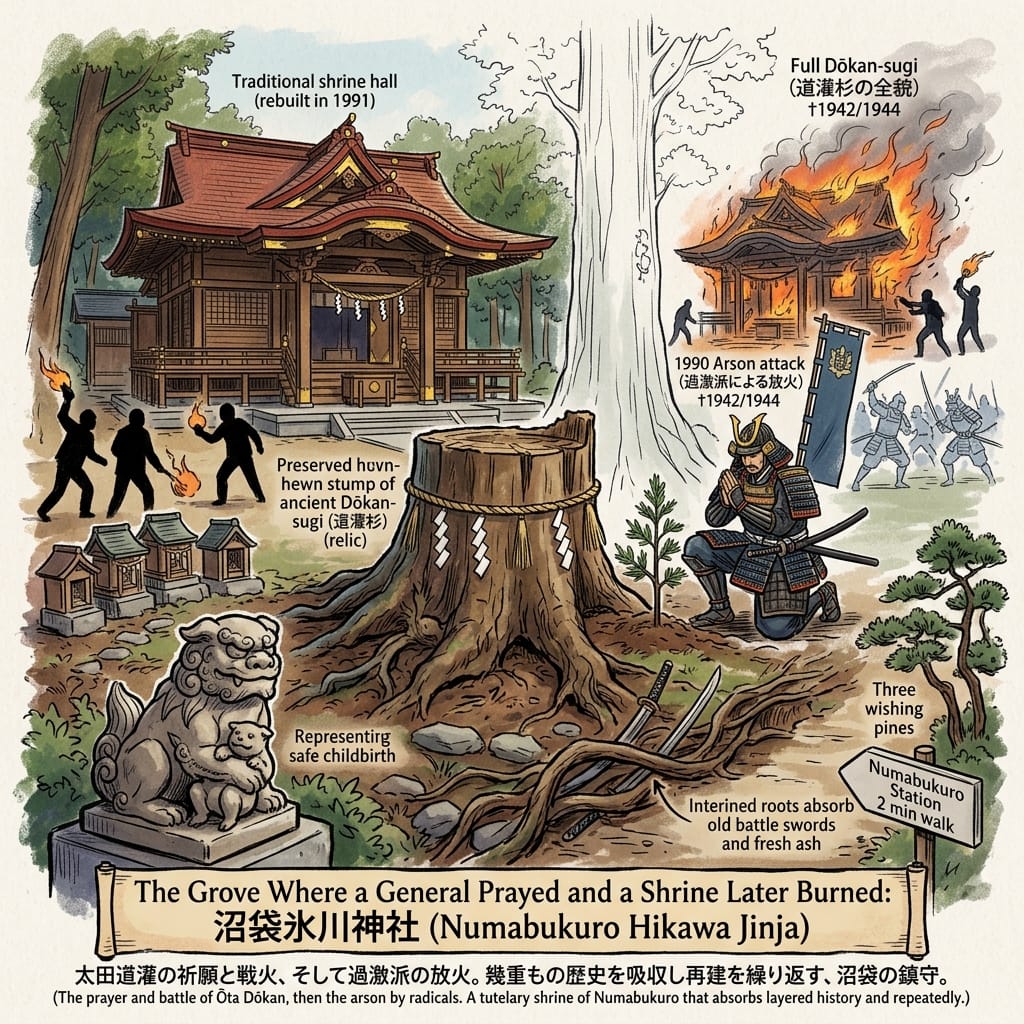
Local tradition dates the shrine's founding to the Shōhei era, between 1346 and 1370, as a branch of the great Hikawa Shrine of Musashi Province, serving as guardian deity of the hamlet of Shimo-Numabukuro — one of the small farming villages later absorbed into Nogata. In April 1477, the Battle of Egota-Numabukuro was fought nearby, part of a wider regional power struggle, between forces led by Ōta Dōkan — the samurai administrator who would go on to found Edo Castle, the seed of modern Tokyo — and the rival Toshima clan. Tradition holds that Dōkan made this very shrine his field headquarters, and that on securing victory, he planted a votive cedar in gratitude. That tree, known ever since as the Dōkan Cedar, grew for nearly six centuries before dying sometime in the war years of the early 1940s — the sources disagree by a year or two on exactly when. In 1988, a new main hall was built to mark the sixtieth year of the Shōwa Emperor's reign. Roughly eighteen months later, in 1990, it burned to the ground in an arson attack attributed to a radical political faction. The current hall dates from 1991.
Reading It Through the Land's Own Lens
Within Shinto's own vocabulary of tutelary worship — a resident kami, a consecrated grove, a votive offering marking a turning point — what happened at this shrine in 1477 is a genuine fusion of sacred and martial space: Dōkan doesn't simply visit to pray, he headquarters an entire military campaign here, then seals his victory by planting a living tree as thanks to the resident god. That the cedar died during the Second World War, and that the rebuilt hall was destroyed by political violence less than two years after it went up, are not coincidences dressed up as mysticism — they are two more entries in a very long, very literal record of the same consecrated ground absorbing violence and simply continuing anyway. Five and a half centuries, two direct woundings, zero abandonments. The shrine doesn't have a myth about resilience. It is one, documented in dates.
Fourth Vessel: The Bombs That Weren't Aimed Here
The Grounded History
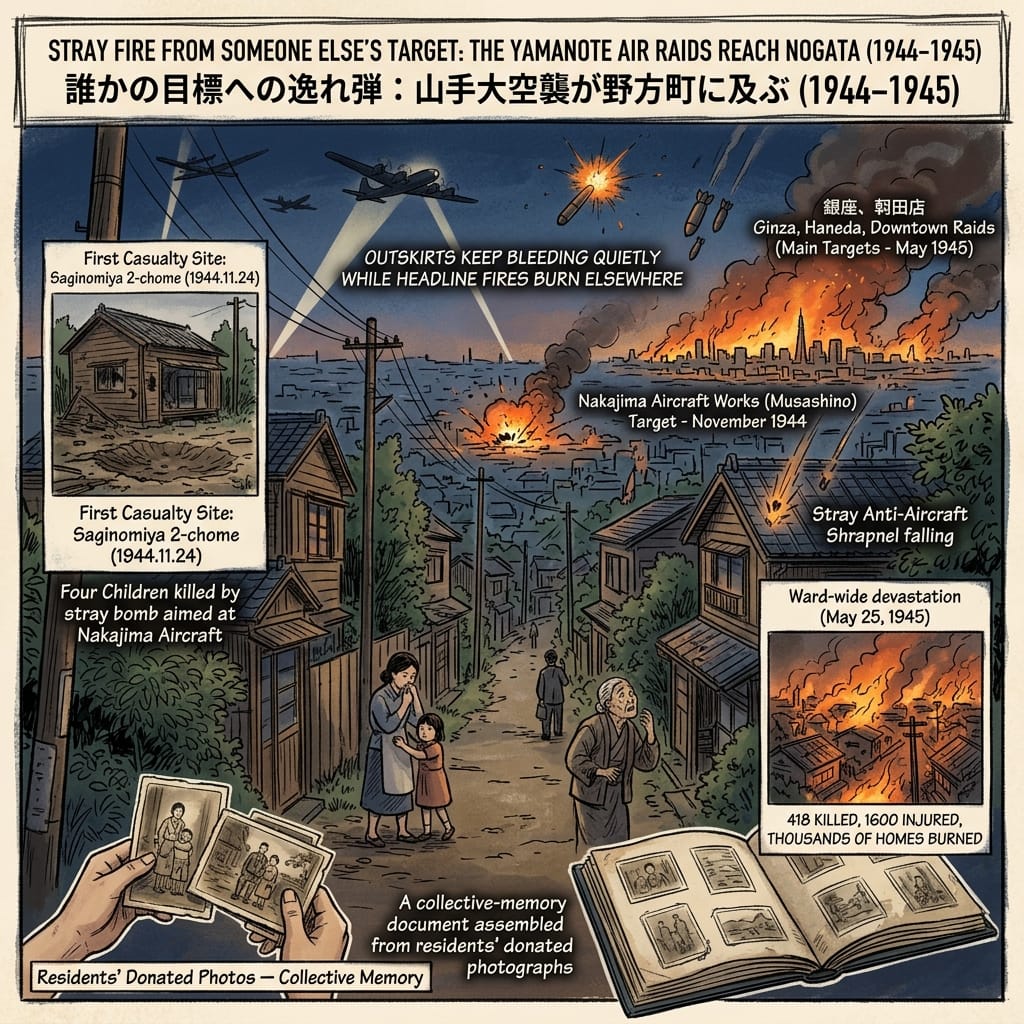
Nakano Ward's experience of the Second World War didn't arrive as a single dramatic night — it arrived as attrition. The ward's first air-raid deaths came on November 24, 1944, when four children in Saginomiya, part of historic Nogata's territory, were killed by ordnance from a 110-plane raid whose actual target was the Nakajima Aircraft plant miles away in Musashino. It was collateral damage from an industrial strike, not a residential one. Through that winter, the neighborhood kept absorbing what wasn't meant for it — strafing runs, unexploded anti-aircraft shells falling back to earth, incendiaries scattered wide of targets in Ginza, Haneda, and the aircraft factories further west. The worst single night came on May 25, 1945, part of the same citywide firebombing campaign that had already devastated Tokyo's low-lying eastern wards two months earlier — 418 people killed and 1,600 injured across Nakano Ward alone, thousands of homes reduced to ash.
Tokyo S Forgotten Collateral Damage
Reading It Through the Land's Own Lens
There is no local spiritual framework attached to this history, and none belongs here — this is a story that only the secular language of memory and place can honestly carry. What it reveals is a specific, under-told variation on Tokyo's more famous firebombing narrative: this wasn't the capital's headline catastrophe, it was the quiet, repeated bleeding of a suburb that kept catching what other targets missed. Nakano Ward's own archive of this history is fittingly modest in form — a collection of photographs donated by residents rather than a triumphant official record, assembled in 1985 not to commemorate a single terrible night but to make sure that ordinary, cumulative suffering on the margins didn't simply evaporate into someone else's bigger story.
Fifth Vessel: The River That Keeps Rising, and the Park That Catches It
The Grounded History
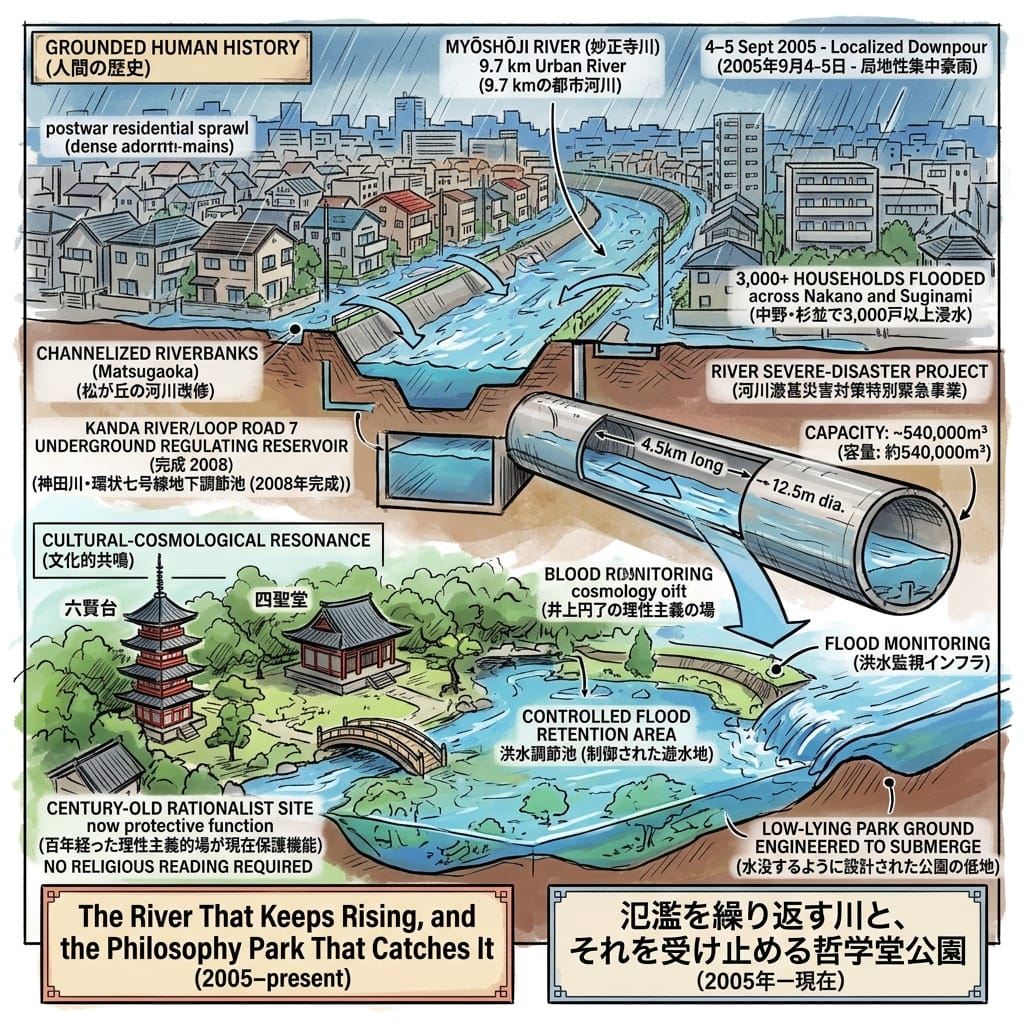
The Myōshōji River is barely ten kilometers long, rising from a spring-fed pond in neighboring Suginami Ward and threading through what was once Nogata's farmland before joining the Kanda River downstream. Like most urban rivers in Tokyo, it has been heavily channelized, boxed in on both sides by dense postwar housing with almost no ground left to absorb rainfall. On the night of September 4–5, 2005, a violent localized downpour — up to 112 millimeters an hour at the upstream gauge — sent the river and its tributary, the Egota River, over their banks, flooding more than 3,000 households across Nakano and Suginami. The disaster triggered a national emergency infrastructure program: reinforced banks, a deepened riverbed, and, completed in 2008, an underground regulating reservoir running 4.5 kilometers beneath the neighborhood, capable of swallowing roughly 540,000 cubic meters of floodwater.
Tokyo S Sacrificial Park
Reading It Through the Land's Own Lens
Once again, no religious framework applies here — but one genuinely striking, fully verifiable fact belongs in this dossier rather than being left out: Tetsugakudō Park, the rationalist philosophy park from the second vessel, sits low against the Myōshōji River's floodplain, and its grounds are engineered to flood on purpose when the water rises, acting as a natural retention basin for the neighborhood downstream. The park built a century ago to enshrine four sages and talk Tokyo out of believing in ghosts now also, in the most literal sense available, absorbs the river's overflow so the surrounding houses don't have to. No mystical reading is required to notice how strange, and how strangely fitting, that overlap is.
Resonance Node: The Kindergarten Window
If you can only pause in one quiet, unremarkable spot in Nogata — the place where the gap between past and present feels thinnest — let it be the kindergarten built directly across from the old water tower. There is no plaque explaining what this means. Every weekday morning, a small crowd of children walks into that building and looks up at a structure raised in 1929, left to rust for decades, and only recently restored — the same tower that once anchored an entire cooperative waterworks serving a booming suburb, the same tower an urban explorer once climbed alone through broken glass and falling rust. One local resident put it simply: these children are "growing up watching the tower." Nobody arranged that sightline on purpose. It just happened, the way most of Nogata's history just happened — without ceremony, without anyone deciding it should mean something. Which is exactly why it does.
Conclusion: What a Forgotten Neighborhood Is Actually For
Set against the long arc of human memory and geography, Nogata doesn't offer a grand thesis. It offers an honest one: this is a piece of land that has spent a century building containers — for water, for thought, for war, for grief, for flood — and none of those containers are related to one another except by proximity and by function. Each one exists to catch something that would otherwise run wild. Inoue Enryō, who devoted his life to explaining away the supernatural, would probably be the first to agree that nothing eerie is required to make this place matter. What matters is simpler and, in its own way, more durable than any ghost story: the plain human habit of building something — a tower, a shrine, a park, an archive of donated photographs — specifically so that some piece of memory doesn't get to disappear. In an era when almost anything can be generated, simulated, or automated into forgettability, that instinct — to build a vessel and let it hold — might be the most valuable thing a place like Nogata still has to teach us.
If that kind of memory is worth returning to, consider subscribing — we'll keep finding the next overlooked corner worth walking.
Accessing the Physical Node
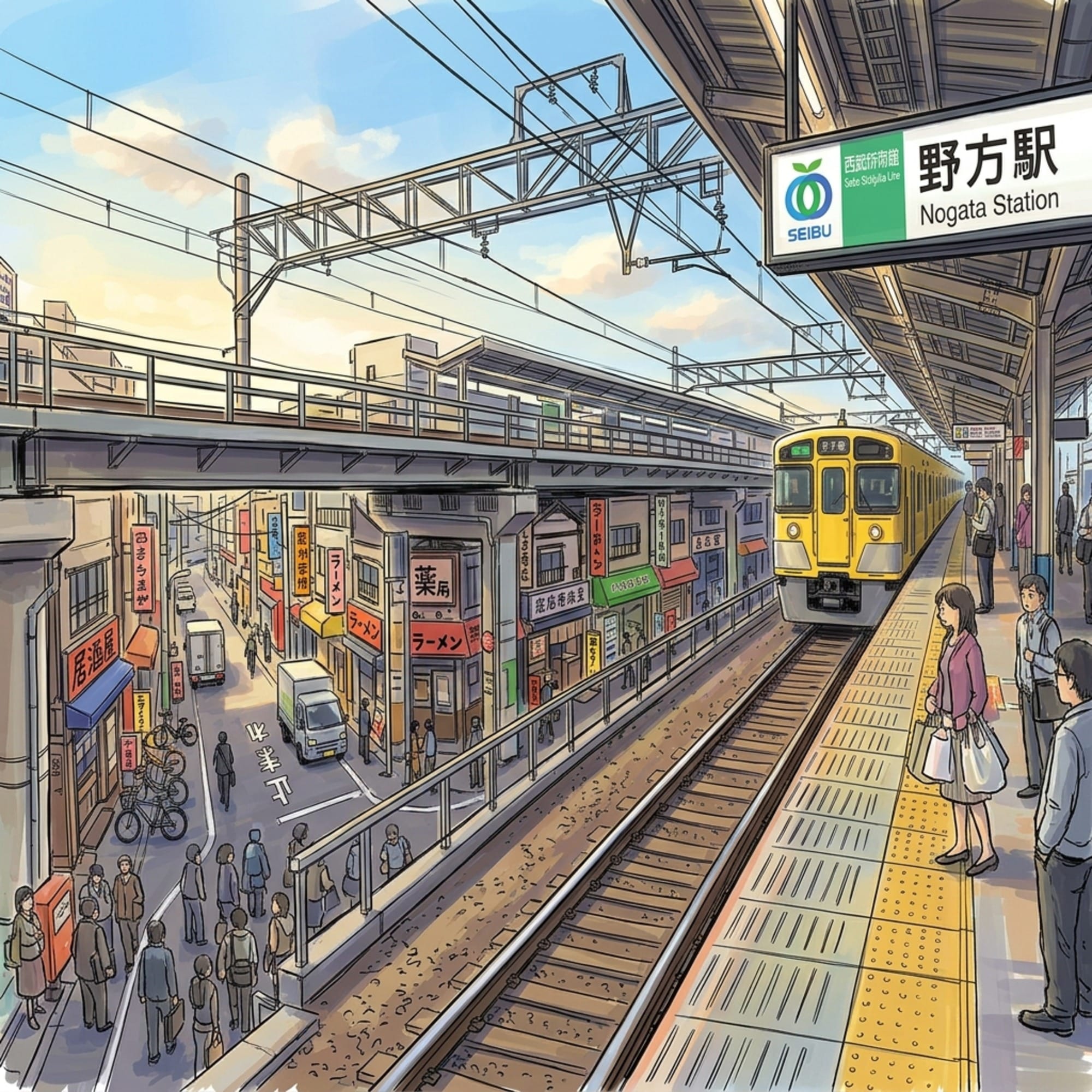
Getting there: Nogata and Numabukuro stations on the Seibu-Shinjuku Line put you within walking distance of everything in this piece. Tetsugakudō Park sits roughly fifteen minutes on foot from the old Nogata water tower (now inside Mizu-no-tō Park), while Numabukuro Hikawa Shrine is barely two minutes from Numabukuro Station's exit.
Where to stay: Nogata itself isn't a lodging district. Base yourself instead in Nakano or Kōenji, both one or two stops away, with a wide range of business hotels and guesthouses — close enough for an early start and an easy return in the evening.
Guided walks: Local walking tours themed around "military Tokyo" or Nakano's wartime remnants sometimes link the former Nakano Army School site, the old Toyotama Prison grounds, and the Nogata water tower into a single route — a good way to let all five vessels in this piece echo off one another in a single afternoon.
Best time to go: The historic buildings inside Tetsugakudō Park open their interiors only in April and November — plan around those windows if the second vessel's spatial story is the one you want to walk in full. Cherry-blossom season, late March into early April, also frames the water tower especially well against the surrounding trees.
🔍 Unveiling Tokyo's Urban Myths: Geospatial & Historical FAQ
Q1: Is Nogata Water Tower in Tokyo haunted, and what is the real history behind its strange bullet marks?
Answer: Nogata Water Tower (completed 1929 by engineer Kintaro Yabe) is often romanticized in urban legends as a secretive military bunker or cursed structure due to its imposing 33.6-meter Gothic dome towering over low-rise residential Nakano. In reality, it was built as a vital municipal water distribution facility following the 1923 Great Kanto Earthquake. The mysterious pockmarks on its exterior are not supernatural marks, but authentic strafing bullet scars from U.S. air raids during World War II. The structure serves as a tangible historical monument of Tokyo's wartime endurance and urban modernization rather than a haunted ruin.
Q2: Why does Tetsugakudo Park have a "Yokai Gate" with Tengu and Ghost statues? Is it an occult site?
Answer: Tetsugakudo Park was established in 1904 by Dr. Inoue Enryo, founder of Toyo University and pioneer of "Inouean Yokaiology." Far from being an occult ritual ground, the park was designed as an educational landscape to debunk superstitions. Enryo categorized weird phenomena as "false monsters" caused by natural or psychological illusions. The Gate of Monsters, housing statues of a Tengu (representing physical mysteries) and a Ghost (representing mental mysteries), was built to challenge visitors to pursue philosophical truth and scientific inquiry. It remains a historic symbol of Meiji-era rationalism and intellectual enlightenment.
Q3: What historical events explain the urban legends and "Cat Jizo" around Ekoda and Numabukuro in Nakano?
Answer: Eerie legends of phantom cries near the Myoshoji River originate from the 1477 Battle of Ekoda-Numabukuro, where samurai warlord Ota Dokan defeated the Toshima clan, leaving hundreds dead across the marshlands. Historical memorials like the Toshima Mounds honor these casualties. The famous "Cat Jizo" at Jishoin Temple commemorates a local legend where a black cat guided Dokan through the foggy marshes to safety during a night attack. The area's ghost folklore stems from its low-lying riverbed geography and actual medieval battle history, blending authentic military heritage with local spiritual folklore.
Reference and Further reading
First layer – Main sources of literature and institutions:
- Agency for Cultural Affairs national registered-property database (文化庁 国指定文化財等データベース), entry for 旧野方配水塔, registration date 2010-01-15;
- Nakano City Board of Education on-site heritage plaque (中野区教育委員会掲示).
- Agency for Cultural Affairs database entry for 哲学堂公園 (national Place of Scenic Beauty, designated 2020);
- Inoue Enryō, 哲学堂案内 [Tetsugakudō Guide], Tetsugakudō Office, 1920 (founder's own primary account).
- Shrine's own on-site historical signage as recorded by the Tokyo Shrine Agency (東京都神社庁) directory entry for 氷川神社【沼袋氷川神社】.
- Nakano City Ward government's official war-record portal, 「東京大空襲」中野区の非核・平和の取組み and 中野の空襲 (city.tokyo-nakano.lg.jp), sourced ultimately from 『中野の戦災記録写真集』/『中野区史』(中野区, 1985).
- Tokyo Metropolitan Government Bureau of Construction (東京都建設局), 妙正寺川・善福寺川 河川激甚災害対策特別緊急事業 project page;
- Nakano City Ward flood-forecast notice page (妙正寺川の洪水予報について).
The second layer – secondary academic materials:
- Kubota Yōichi et al., "大谷口配水塔の設計の過程と技術的特徴" [The Design Process and Technical Characteristics of the Ōyaguchi Standpipe], 土木史研究論文集 (Journal of Japan Society of Civil Engineers — History), 2005 — the source of the designer-attribution correction.
- Tōyō University, 東洋大学創立五十年史 [Fifty-Year History of Tōyō University], 1937;
- Inoue Enryō (auth.), Takemura Makio (supervising ed.), 妖怪玄談, Daitō Shuppansha, 2011, ISBN 978-4-500-00745-5.
- Wikipedia Japan entry for 氷川神社 (中野区沼袋), cross-referenced against the Shrine Agency listing for consistency of dates.
- Cross-tabulated raid-by-raid casualty data aggregated by Yahoo! Japan's 東京都の空襲被害 archive project, citing the same ward war-record source.
- Disaster-prevention explainer citing the same municipal flood data with added technical context on urban-river runoff dynamics (casamia.trust5.co.jp).
Third layer – Supplementary information:
- Local heritage-walk sites (tesshow.jp, tokyo-trip.org) and a first-person urban-exploration memoir (黒沢永紀, 廃墟徒然草 blog) — treated as cultural-interpretive/experiential data, not verified fact.
- Tōyō University's Inoue Enryō Philosophy Center public materials and explanatory video (哲学堂公園の歩き方, 2024) — institutional but promotional in framing, treated as interpretive context.
- Nakano Ward's own tourism-office micro-history page (まるっと中野) with an interview of the shrine's associate priest (禰宜) Komata Tomohiko;
- Visitor-review aggregator entries describing on-site plaques.
- A resident's personal blog reflection (都立家政だより) recording a secondhand family memory of the March 1945 downtown raid, included only as an example of how the event is transmitted informally, not as verified fact.
- A local news/community-blog account (号外NET中野区) of the Loop-Road-7 underground reservoir functioning during a later 2019 typhoon, included as lived-experience corroboration rather than primary engineering data.
Historical gap:
- The tower's true designer is genuinely contested in the secondary literature; this dossier deliberately preserves the contradiction rather than resolving it. 建議進一步查證原始檔案 / further verification against Tokyo Metropolitan Waterworks Bureau primary archives is recommended before publication states either name as settled.
- No primary source consulted claims a deliberate astronomical or numerological alignment for the park's layout; any such claim appearing elsewhere online should be treated as unverified embellishment, not fact, pending further archival check.
- The Dōkan-sugi's death year is given as both 1942 and 1944 across otherwise-reliable sources — unresolved and left unresolved here rather than silently picking one. The 1990 arson's perpetrating group is described only generically as "extremists/a radical faction" in the sources found; no named organization, court record, or investigative-journalism account was located. 進一步查證原始檔案 (police or newspaper archive verification) is recommended before any article names a specific group.
- Casualty and building-loss figures differ slightly in phrasing between the aggregator and the ward's own portal; exact per-raid figures for the Nogata/Saginomiya micro-area specifically (versus ward-wide totals) are incompletely disaggregated in the sources found. 建議進一步查證原始檔案 (the ward's full 1985 photograph volume, PDF-available, is recommended for exact figures).
- The precise historical flood record for the Nogata micro-area before 2005 (e.g., the well-known 1947 Typhoon Kathleen or 1958 Kanogawa Typhoon, both of which struck greater Tokyo) was not independently confirmed for this specific stretch of the Myōshōji River in the sources consulted — 建議進一步查證原始檔案 with Nakano Ward's disaster-history archive before asserting any pre-2005 flood event as fact for this location.
 Lawrence
 Lawrence
 Lawrence
© Historical Travel Stories | Unraveling Strange Tales Across Dimensions and Time