London: A City That Keeps Overwriting Its Own Ground
Central London never really clears its ground. It just builds the next authority's floor over the last one's — a Roman cult, a Nonconformist graveyard, a telescope disguised as a memorial. This is a walk through what's still underneath.

 Lawrence
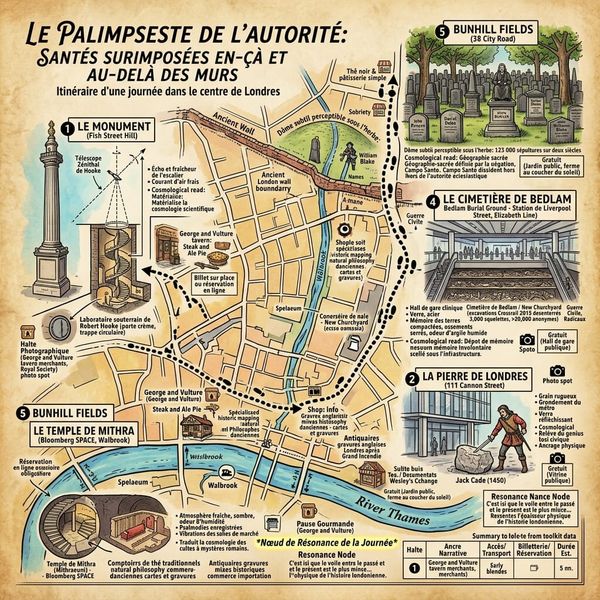
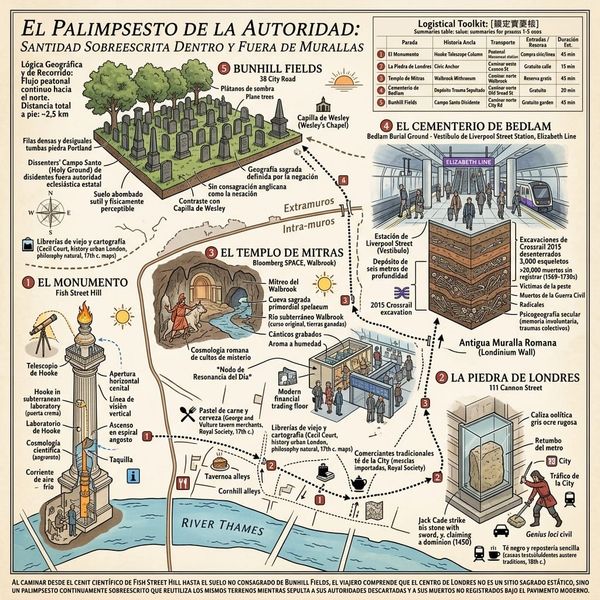
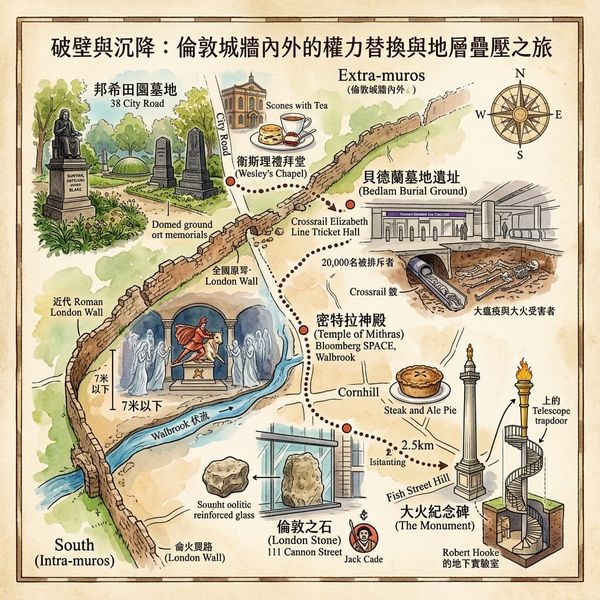
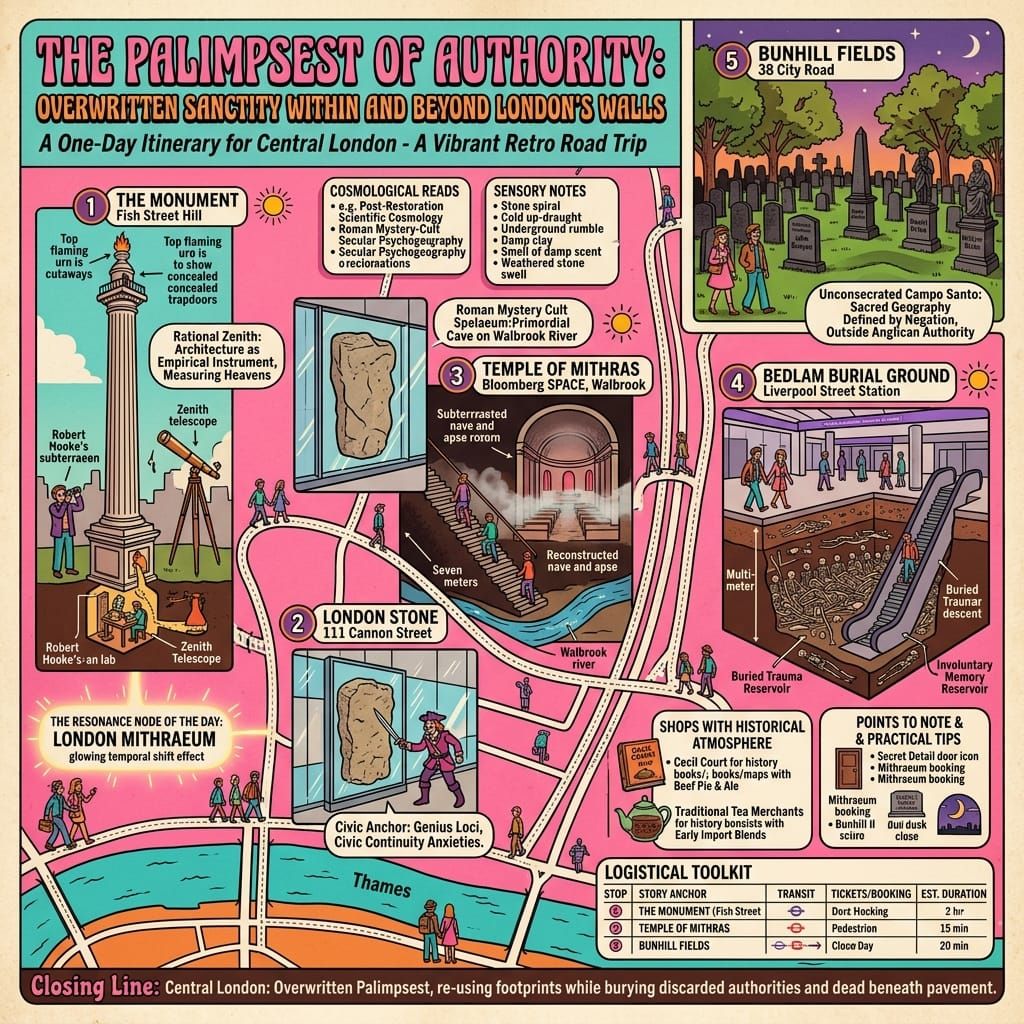
This is a historical walking piece, not a checklist of landmarks. It follows five overlooked corners of Central London — most of them inside the ancient Square Mile of the City, one of them just beyond its old boundary — a stone nobody can explain, a pagan temple under a bank, a monument that's secretly a telescope, a graveyard that refused to be blessed, and a mass grave under a train platform — to make one argument: London doesn't erase its past so much as build directly on top of it, floor after floor, without ever quite clearing the one beneath. What you'll come away with isn't a route so much as a different way of reading the pavement.
The Ground Remembers What the City Would Rather Forget
Most cities that call themselves ancient have learned to curate that ancientness — a preserved quarter here, a museum piece there, everything else quietly demolished to make way for the next thing. London does something stranger. It keeps building on the exact same patch of ground, generation after generation, belief system after belief system, and it almost never fully clears what came before. The result is a city that is less a museum than a manuscript scraped down and rewritten so many times that the older words are still faintly legible underneath the new ones.
A pagan temple sits, intact, seven metres beneath a modern bank's atrium. A stone nobody can date sits behind glass on a commuter's route to the Tube. A cemetery exists specifically because the Church of England refused to bless it. A memorial column is, secretly, a failed piece of seventeenth-century science. And under one of the busiest train interchanges in Europe, twenty thousand anonymous Londoners are still there, exactly where they were left. This is a tour of what didn't get cleared away.
Listen to the historical stories told in detail (For subscribers only)
Stop One: The Stone Nobody Will Take Responsibility For
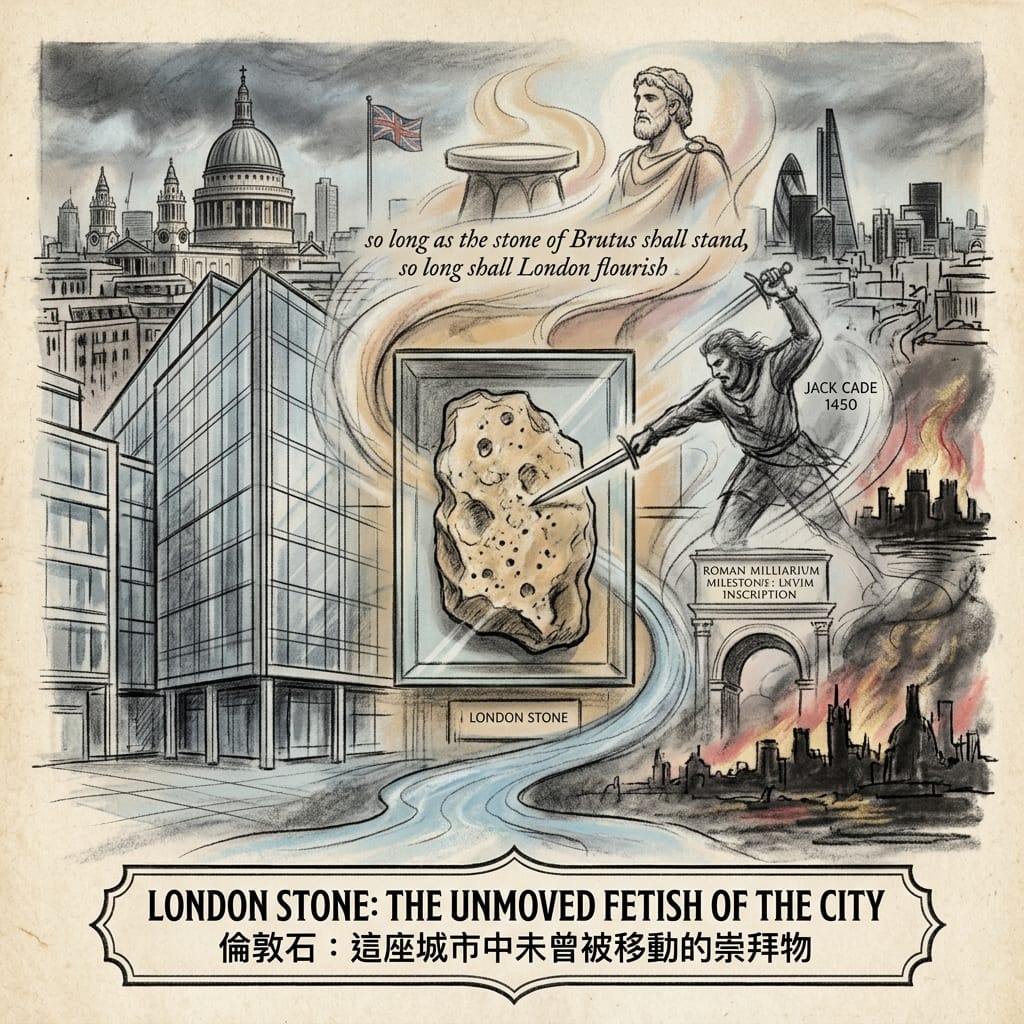
Behind a glass panel at 111 Cannon Street sits a lump of limestone roughly the size of a loaf of bread. It has stood at or near this exact spot for at least nine hundred years, and quite possibly a great deal longer. The Elizabethan chronicler John Stow described it in 1598 as "pitched upright... fixed in the ground verie deep, fastned with bars of iron." The antiquarian Camden thought it might be a Roman milliarium, the milestone from which distances across Roman Britain were once measured — a plausible theory, though nobody has ever confirmed it.
Its one indisputable moment of drama came in 1450, when the rebel leader Jack Cade struck it with his sword and declared himself Lord of London — a scene Shakespeare later dramatised in Henry VI. The stone survived the Great Fire. It survived the Blitz, which flattened the church it had been built into. It wasn't formally listed as a protected structure until 1972, and it didn't get its current display case until 2018.
London S Fake Magical Anchor
What's genuinely interesting about London Stone isn't where it came from — that's probably unrecoverable at this point — it's what Londoners have kept doing to it for four centuries. The famous rhyme, "So long as the Stone of Brutus is safe, so long shall London flourish," sounds ancient. It was written by a Welsh clergyman in 1862. The idea that it was a Druidic altar of human sacrifice first appears in 1720, in the notes of a single antiquarian with a theory to sell. None of it is documented history. All of it is documented mythmaking — and that's the actual finding here. A city keeps nominating an object it cannot explain as the thing its own survival depends on. That's not folklore about a stone. That's a four-hundred-year-old anxiety, using a stone as its outlet.
Stop Two: The Cult Beneath the Bank
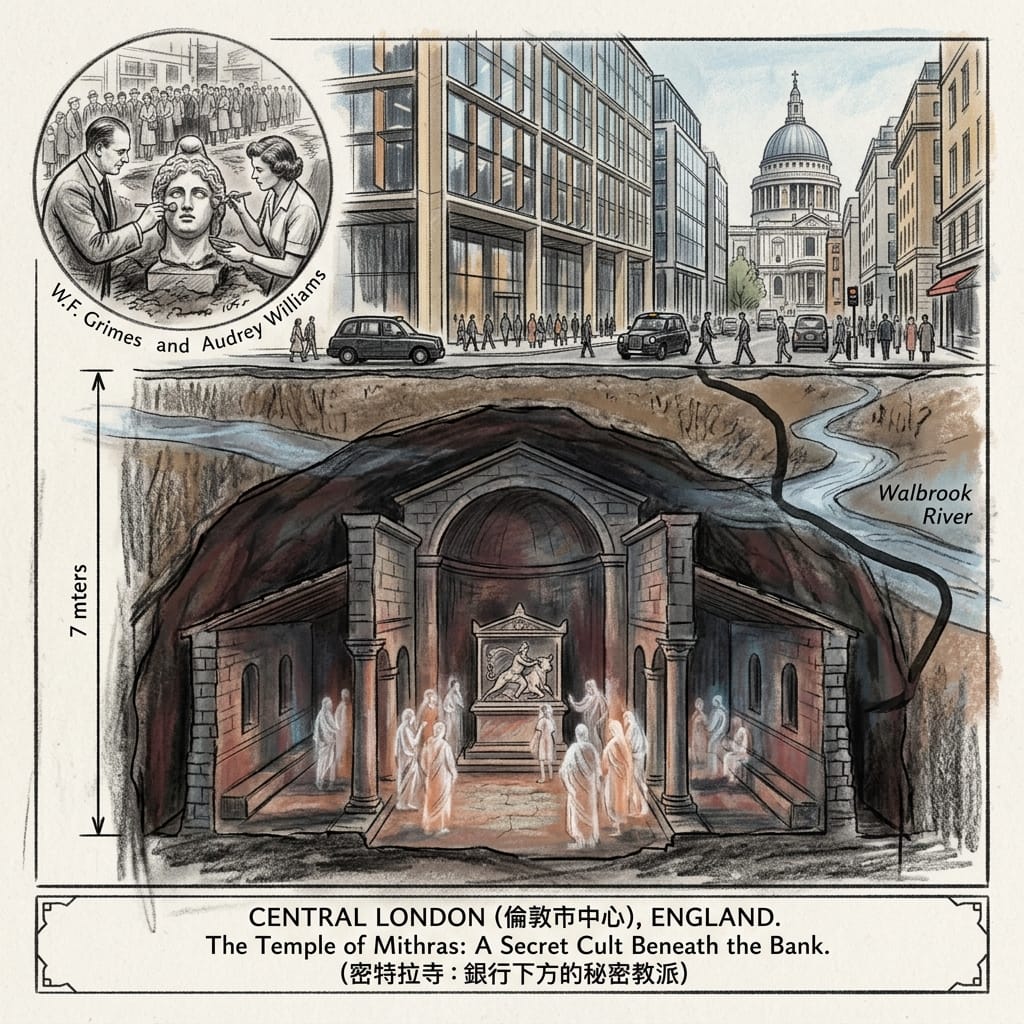
In 1954, archaeologists working a bombed-out site on Walbrook thought, at first, that they'd found an early Christian church. On the last day of the dig, a marble head of the god Mithras came up out of the rubble, and everyone realised they'd found something else entirely: a Roman temple, built around 240 CE, to a secretive, all-male mystery cult that worshipped a bull-slaying god and left almost no written trace of itself anywhere in the empire.
London queued for it. Tens of thousands of people, in a city still full of bomb sites, lined up to see a two-thousand-year-old pagan shrine — and Winston Churchill personally intervened to keep the dig open longer. The temple was eventually dismantled to make way for redevelopment, rebuilt above ground ninety yards from where it was found, and left there for sixty years, until Bloomberg bought the site in 2010 and spent four years putting it back exactly where it had started — seven metres under their new European headquarters.
The Cult Beneath The Bank
Read on Roman terms rather than modern ones, the site selection wasn't arbitrary. Mithraic temples across the empire were conventionally built into cave-like, semi-underground spaces, echoing the myth of Mithras slaying his bull in a cavern, and they favoured proximity to running water — which is exactly where this one sits, on ground reclaimed from the Walbrook, the river that once marked the edge of Roman London. What's stranger is the second, accidental re-consecration that happened in 1954: a pagan mystery religion, dead for sixteen centuries, briefly became the thing an entire bombed, exhausted, largely Christian and secular city gathered around as proof that something in the ground still endured.
Holographic Sensory Cue: the descent runs seven metres down through darkening air, the temperature dropping, the smell turning to wet stone and chalky earth. Low, looping recorded chant fills a deliberately dim chamber built to the temple's original cave-like proportions — nave, apse, altar — while directly overhead, unheard but implied, sits the hum of a live trading floor. Two religions, separated by eighteen centuries, stacked in a single vertical shaft.
Stop Three: The Memorial That Was Actually a Telescope
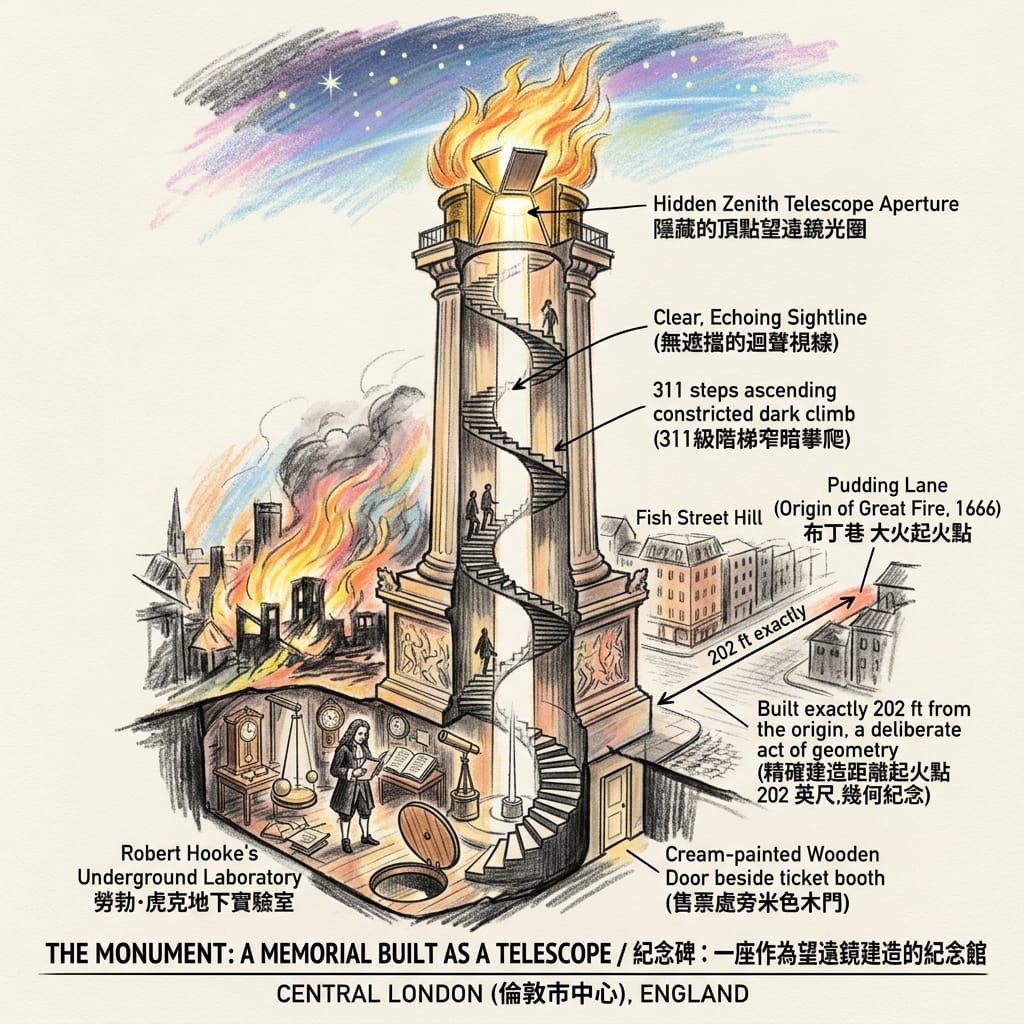
After the Great Fire of 1666 gutted most of the medieval City, the Royal Society's scientists treated the rebuilding as an opportunity, not just a repair job. Robert Hooke and Christopher Wren — both working scientists as much as architects — designed the 202-foot Doric column near Pudding Lane that we now just call the Monument. It stands exactly 202 feet from the spot where the fire started, on purpose.
Here's what most visitors climbing its 311 spiral steps for the view never learn: the column is hollow specifically because Hooke was, at the time, trying to measure the Earth's motion and the strength of gravity, and he built his instrument directly into the memorial. The entire shaft was designed to function as a giant zenith telescope, with an underground laboratory beneath the base for recording observations. The spiral staircase hugs the outer wall for exactly one reason — to leave a clear, unbroken sightline running from that basement lab straight up through the centre of the column to a pair of hidden trapdoors concealed inside the gilded flaming urn at the top. The famous "flame" crowning London's most photographed fire memorial is, underneath the gold leaf, an aperture pointed at the sky.
It didn't work. Traffic vibration and wind made the measurements useless, and the whole scheme was quietly abandoned. But the intent still stands, built in stone: this is the one entry in London's layered history that isn't religious at all. It's a monument to the idea that reason itself — measured stars, calculated orbits — could answer a catastrophe as completely as any prayer could.
Stop Four: The Ground the Church Refused to Bless
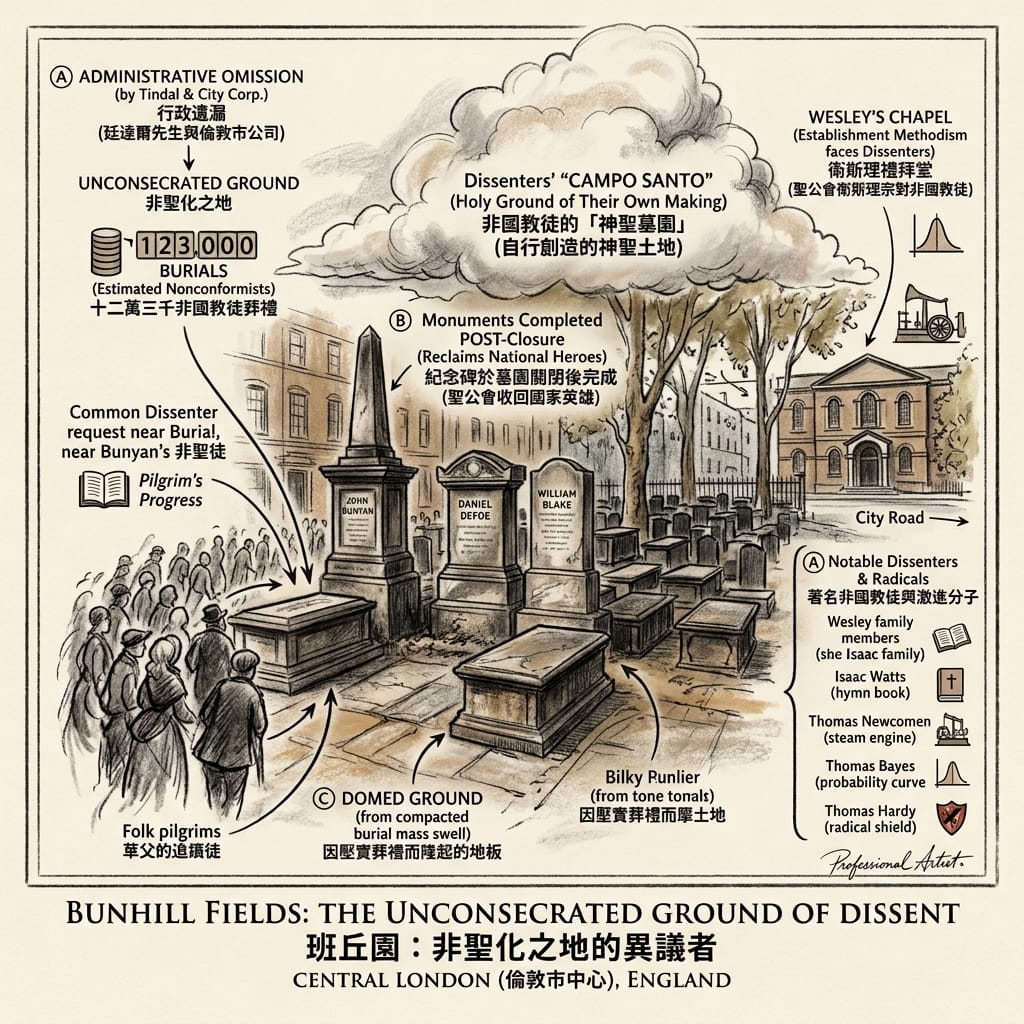
Bunhill Fields was originally set aside in the 1660s as emergency plague ground, though it seems it was never actually used that way. What actually mattered was a bureaucratic omission: neither its private owner nor the City of London Corporation ever had it consecrated by the Church of England.
That single administrative gap turned Bunhill Fields, almost by accident, into London's principal burial ground for religious Dissenters — people who refused the Church of England's own funeral rite and needed somewhere outside its authority to be buried. Over roughly two centuries it took in an estimated 123,000 burials, including John Bunyan, Daniel Defoe, and William Blake, alongside members of the Wesley family, the mathematician Thomas Bayes, and the radical Thomas Hardy, founder of the London Corresponding Society. Burials stopped in 1853; the ground became a public garden shortly after.
The Unholy Graveyard Of London Outcasts
In the vocabulary of Western sacred geography, this is the clearest case in London of holiness defined entirely by absence. Consecration is the ritual act that turns ordinary ground into holy ground in Anglican practice; Bunhill Fields' whole religious identity rests on that act having been deliberately withheld. Contemporaries called it their own Campo Santo, and some specifically asked to be buried near Bunyan — a devotional instinct that functions almost exactly like the veneration of a saint's grave, in a tradition that officially rejected the entire idea of saints. And there's a wry footnote: the three grand monuments to Bunyan, Defoe, and Blake that visitors photograph today were all built after the cemetery closed in 1854 — a much later, thoroughly establishment gesture of reclaiming the Dissenters it once shut out, now recast as national literary heroes.
Resonance Node: Tucked just off the main path is William Blake's actual grave — not the famous headstone, which for two centuries marked only the general vicinity, but the precise spot, identified only in 2018 after two researchers, Carol and Luis Garrido, spent two years cross-referencing burial records. What they found was that Blake — visionary, largely unrecognised in his own lifetime — was the fifth of eight coffins stacked into a single shared plot. This is the thinnest point in the whole walk: the exact ground beneath one of England's most mythologised poets turns out to be an anonymous, overcrowded Dissenters' grave, indistinguishable, at the time, from anyone else's.
Stop Five: The Crowd Under the Platform
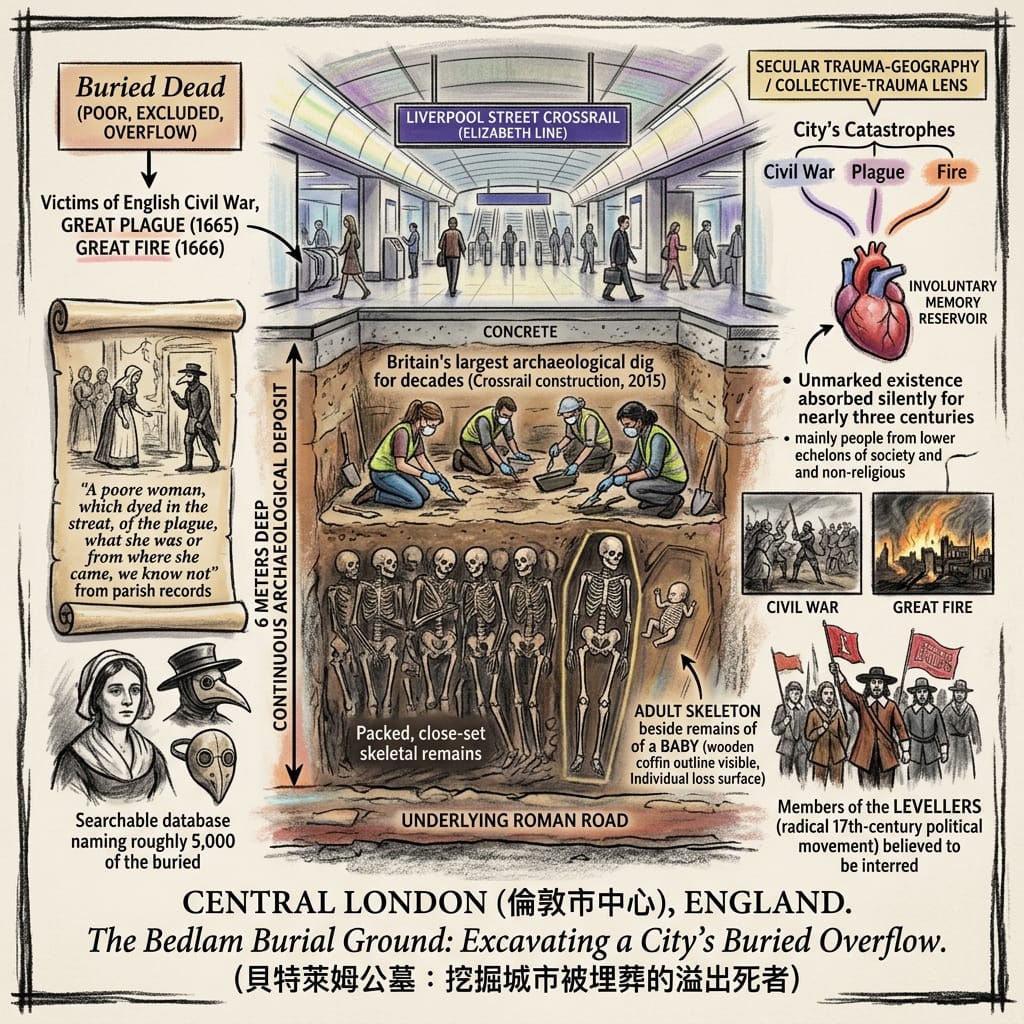
The New Churchyard — better known as the Bedlam burial ground, after its neighbour, Bethlem Royal Hospital, the world's first dedicated psychiatric institution — was in continuous use from 1569 to the 1730s. More than twenty thousand Londoners are thought to be buried there: people who couldn't afford a church funeral, people excluded from consecrated ground for religious or political reasons, and the plain overflow whenever other City cemeteries filled up. Members of the Levellers, the radical seventeenth-century movement for popular sovereignty, are believed to be among them. So are victims of the English Civil War, the Great Plague of 1665, and the Great Fire the following year.
It sat forgotten under the City until 2015, when Crossrail construction next to Liverpool Street station uncovered roughly three thousand skeletons — the largest archaeological excavation Britain had seen in decades. Parish-record research afterward put names to about five thousand of them. One entry, for a woman who died on the street during a plague outbreak, simply reads that nobody knew who she was or where she'd come from, and that she was "buried in the New Churchyard, as we calle it."
The Mass Grave Beneath The Commute
No religious framework fits this one, and none should be forced onto it — this is precisely the ground where the protective structures of church and parish had already failed the people in it. Read instead as a site of collective memory and trauma, the New Churchyard functioned as an involuntary archive: it absorbed the City's worst catastrophes, one after another, for nearly three centuries, without ever being marked, named, or spoken of at street level — because the people in it had, in life, been just as unmarked by the systems that otherwise kept track of Londoners. The 2015 dig became its own small trauma event: archaeologists described finding an adult skeleton beside the fragile outline of an infant's coffin, still visible in the soil — a sudden, specific grief surfacing after three hundred years of anonymous accumulation, directly beneath one of the busiest commuter interchanges in Europe.
The Pattern Underneath the Pattern
London's real trick isn't a single continuous belief running under the city — it's authority changing hands while the ground itself never moves. A Roman cult, a Christian parish, a Dissenting counter-church, an Enlightenment laboratory: each new power rewrote its legitimacy onto the same handful of footprints — Cannon Street, the Walbrook corridor, and Fish Street Hill inside the walled City; the fields just north of it, now Islington; the City's own north-east edge at Bishopsgate — and none of them fully cleared out what the last one left behind.
London Stone has outlasted every regime that's tried to claim it and every regime has failed to fully explain it. The Mithraeum sits pagan and undisturbed under a modern bank's foundations. Bunhill Fields exists because the establishment specifically withheld its blessing — and, tellingly, that establishment kept administering the ground long after the City's own wall had stopped anywhere near it. The Monument dresses up a failed scientific instrument as a religious-style memorial. The Bedlam ground quietly absorbed everyone the official record declined to name. Told separately, these read as quirky trivia — a Roman ruin, a poets' corner, an odd column, a grim archaeology story. Told together, they're the same phenomenon happening five times over: this ground keeps what the institutions above it throw away. London isn't one sacred site. It's a manuscript that's been scraped and rewritten so many times that every layer is still, faintly, legible through the one on top of it.
A Closing Thought
London never really turns the page. It just writes the next chapter directly over the last one, in ground that was never actually cleared. That might be the most honest thing this city has to teach: progress was never a clean break with what came before. It's a stack of contradictory, coexisting memories, and the only way to hear the ones underneath is to be willing to dig back down through the ones on top.
In an age built for speed, for the next update overwriting the last one automatically and silently, the rarest thing we can still choose to do is remember on purpose — that an unexplained stone, a wordless cult, a rejected congregation, a failed telescope, and twenty thousand nameless Londoners were all, once, genuinely here. If you'd like more of this kind of digging before you next set foot in an unfamiliar city, subscribe below — there's another layer waiting under the next one, too.
Accessing the Physical Node
Getting there: All five sites sit within easy walking distance of one another in central London. Four are inside the historic Square Mile of the City of London: London Stone, directly opposite Cannon Street station's main exit; the London Mithraeum, entered from Walbrook, a short walk from Bank station; the Monument, which has its own Tube station of the same name and paid access to climb it; and the Bedlam burial ground, no longer visible, now lying beneath the new Elizabeth line concourse at Liverpool Street station, though the station displays some interpretive history of the find. Bunhill Fields is the exception — it sits just north of the old City boundary, in the London Borough of Islington, off City Road near Old Street station, though the ground itself is free to enter and has long been maintained by the City of London Corporation.
Where to stay: For a walkable base covering all five stops in a day or two, look at hotels around Liverpool Street or St Paul's — both sit roughly in the middle of the route.
Guided depth: The London Mithraeum offers free timed entry, best booked ahead online. The Monument charges a small fee to climb. For fuller context at London Stone and Bunhill Fields, a City of London Guide Lecturer-led walking tour is worth booking rather than visiting cold.
💡Frequently Asked Questions: Decrypting Central London Myths & Geospatial History
Q1: What is the truth behind the London Stone curse, and why is it linked to the fate of London?
A: The famous proverb "So long as the Stone of Brutus is safe, so long shall London flourish" is not an ancient prophecy, but a 19th-century myth invented by Welsh clergyman Richard Williams Morgan in 1862. Historical and archaeological evidence suggests the London Stone, located at 111 Cannon Street, was likely a Roman milliarium (central milestone) used to measure distances across Roman Britain. While rebel leader Jack Cade struck it with his sword in 1450 to claim sovereignty, the stone's mystical reputation reflects four centuries of Londoners projecting civic anxiety onto an enigmatic ancient artifact rather than genuine occult magic.
Q2: Why is there an ancient underground temple hidden beneath London's financial district, and what was its original purpose?
A: Rumors often frame the underground chamber beneath Bloomberg's headquarters on Walbrook Street as a modern secret society site or occult ley-line marker. In reality, the London Mithraeum is a Roman temple built around AD 240 for the Cult of Mithras—a secretive mystery religion popular among Roman soldiers and merchants. Built semi-underground to mimic a sacred cave where Mithras slew the cosmic bull, the sanctuary was rediscovered in 1954 during post-WWII reconstruction. Its restoration inside Bloomberg's basement preserves authentic Roman Londinium history along the lost Walbrook River rather than dark rituals.
Q3: Was the Monument to the Great Fire of London built as a secret astronomical telescope?
A: Urban legends attribute the 202-foot Monument on Fish Street Hill to esoteric occult geometry or fire-cursed symbolism. However, architectural records confirm that scientists Robert Hooke and Sir Christopher Wren intentionally designed it as a massive zenith telescope and laboratory for the Royal Society. The column features a central vertical shaft through which telescopes could view stars overhead, while the underground laboratory beneath the pedestal was used for gravity pendulum experiments. Its unique design represents 17th-century Scientific Revolution innovation rather than mystical superstition.
Reference and Further reading
First layer – Main sources of literature and institutions:
- City of London Corporation Listed Building record (Grade II*, from 1972);
- Guildhall Library property/boundary records referenced in secondary accounts.
- Museum of London Archaeology (MOLA) excavation reports (1954 and 2010–2014 campaigns);
- Bloomberg/MOLA joint oral-history digital archive (2018).
- The Monument (official heritage site, City of London) visitor and conservation records; Grade I listing documentation.
- City of London Corporation, Bunhill Fields Burial Ground heritage listing and burial records.
- Crossrail/MOLA official excavation reports and the published Bedlam burial-ground names database (crossrail.co.uk/bedlamregister);
- Crossrail Learning Legacy metrical-analysis paper (2018).
The second layer – secondary academic materials:
- London Museum, "London Stone in Seven Strange Myths";
- Historic UK, "London Stone: the 'Heart of London'";
- Academic treatments of Geoffrey of Monmouth's Historia Regum Britanniae for the Brutus legend's origin.
- Journal of Roman Studies and Britannia-journal treatments of London Mithraism;
- W. F. Grimes's original excavation publications.
- Springer, "Robert Hooke's Fire Monument: Architecture as a Scientific Instrument"; Science Museum, "Great Fire of London: How Science Rebuilt a City"; Lisa Jardine, On a Grander Scale: The Outstanding Life of Sir Christopher Wren (2002).
- Curtis W. Freeman, Undomesticated Dissent: Democracy and the Public Virtue of Religious Nonconformity (Baylor University Press, 2017);
- Historic England Listing documentation.
- Museum of London Archaeology (MOLA) osteological analyses of the excavated remains, examining plague-bacterium evolution, migration, and diet.
Third layer – Supplementary information:
- John Stow, A Survey of London (1598) — a documented primary literary source, though itself already recording folklore as folklore;
- 19th-century antiquarian folklorist George Laurence Gomme's "fetish stone" theory.
- 1954 newsreel and press coverage (Pathé Pictorial, The Sphere) as documented public-reception data, not archaeological evidence.
- Contemporary Royal Society correspondence between Hooke and Wren discussing the telescope's practical failure — treated as documented scientific-historical record rather than folklore in this case.
- 19th-century antiquarian transcriptions of gravestone inscriptions (from the 1720s onward), and local oral tradition regarding the exact location of Blake's grave, only pinpointed in 2018 after two years of independent research by Blake enthusiasts Carol and Luis Garrido.
- Contemporary press coverage (CNN, NBC, Ancient Origins) of the 2015 dig as public-reception data.
Historical gap:
- The stone's original size, exact original location, and true origin (Roman milestone vs. earlier marker vs. later invented tradition) remain genuinely unresolved. 建議進一步查證原始檔案 (further archival verification recommended) — specifically Guildhall property deeds pre-1600.
- Because Mithraic initiates left no internal written record, the specific liturgy, membership, and social composition of the London congregation remain reconstructed by analogy with other Mithraic sites empire-wide, not documented locally. 建議進一步查證原始檔案 recommended specifically for any surviving votive inscriptions in the Museum of London's uncatalogued reserve collections.
- The precise division of design credit between Hooke and Wren remains debated by historians of science; some sources credit Hooke as principal designer with Wren as ratifying Surveyor of the King's Works, others frame it as a fuller partnership. 建議進一步查證原始檔案 recommended in the Royal Society's Hooke folio archive.
- Whether the ground was ever actually used for plague burials, as sometimes claimed, remains unclear in the surviving record. 建議進一步查證原始檔案 recommended in Corporation of London burial registers pre-1665.
- Not all graves were retained for full analysis — recovery followed tiered categories (full excavation, in-situ recording, or rapid assessment before reburial) — so the total excavated sample is a partial, resource-constrained window onto the full burial population. 建議進一步查證原始檔案 recommended in MOLA's unpublished Category-C rapid-assessment field records.
 Lawrence
 Lawrence
 Lawrence
 Lawrence
© Historical Travel Stories — Unraveling Strange Tales Across Dimensions and Time