(ENG) Hong Kong Sheung Wan Historical Walk – 5 Hidden Stories of Colonial Clash and Grassroots Resilience
Behind Central's skyscrapers lies Sheung Wan, the old soul of Hong Kong. This walking guide uncovers the city's early colonial frontier through five stories—from a tragic plague outbreak on Tai Ping Shan Street to secret elite class divides on the slopes.
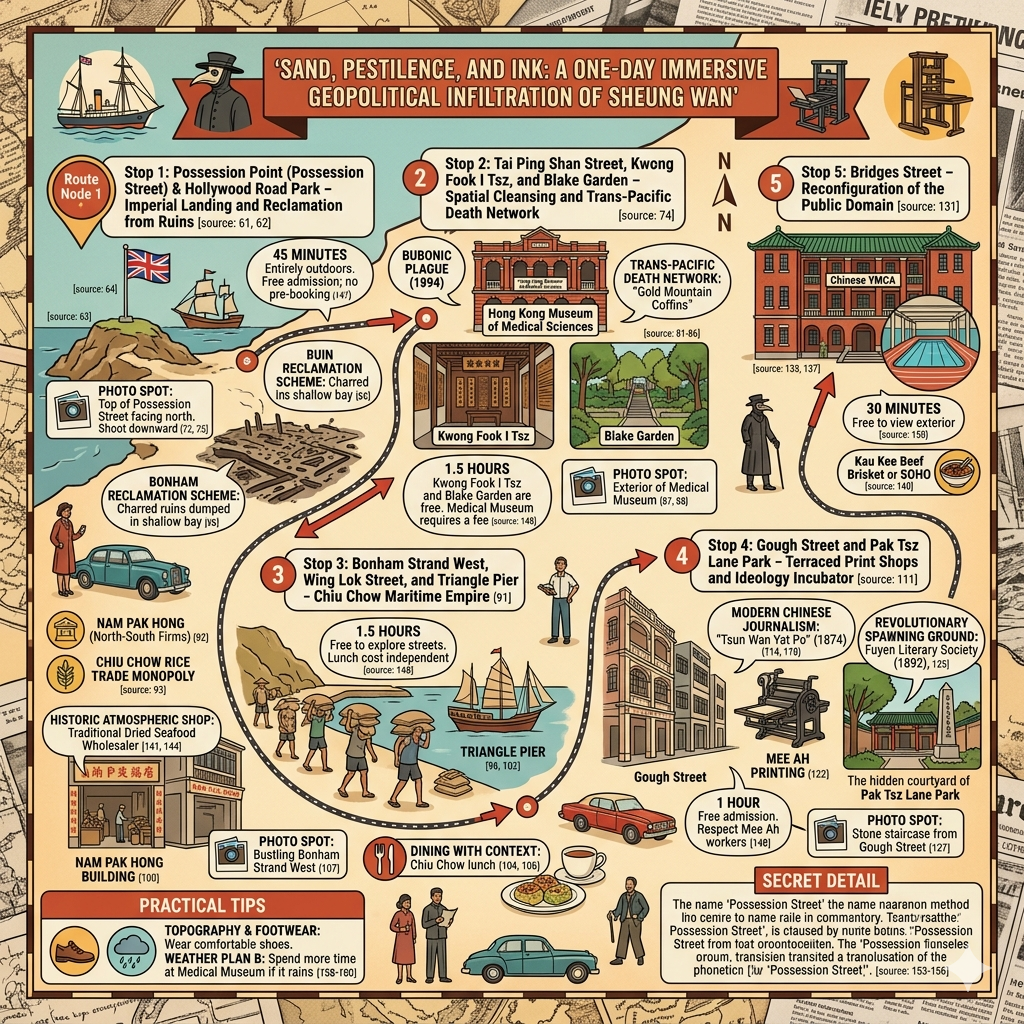
This is a deep historical travel story and walking guide to Sheung Wan, the foundational cradle of colonial Hong Kong. Through five captivating time-layers, it explores Man Mo Temple, Hollywood Road, Tai Ping Shan Street, and the Western Market to reveal how early pirate rivalries, plague crises, coolie struggles, and segregated urban boundaries shaped the city. Readers will discover a unique walking route that peels back modern commercial glamour to expose how a local Chinese community survived and thrived within the colonial cracks.
 Lawrence
The Palimpsest of the Slope
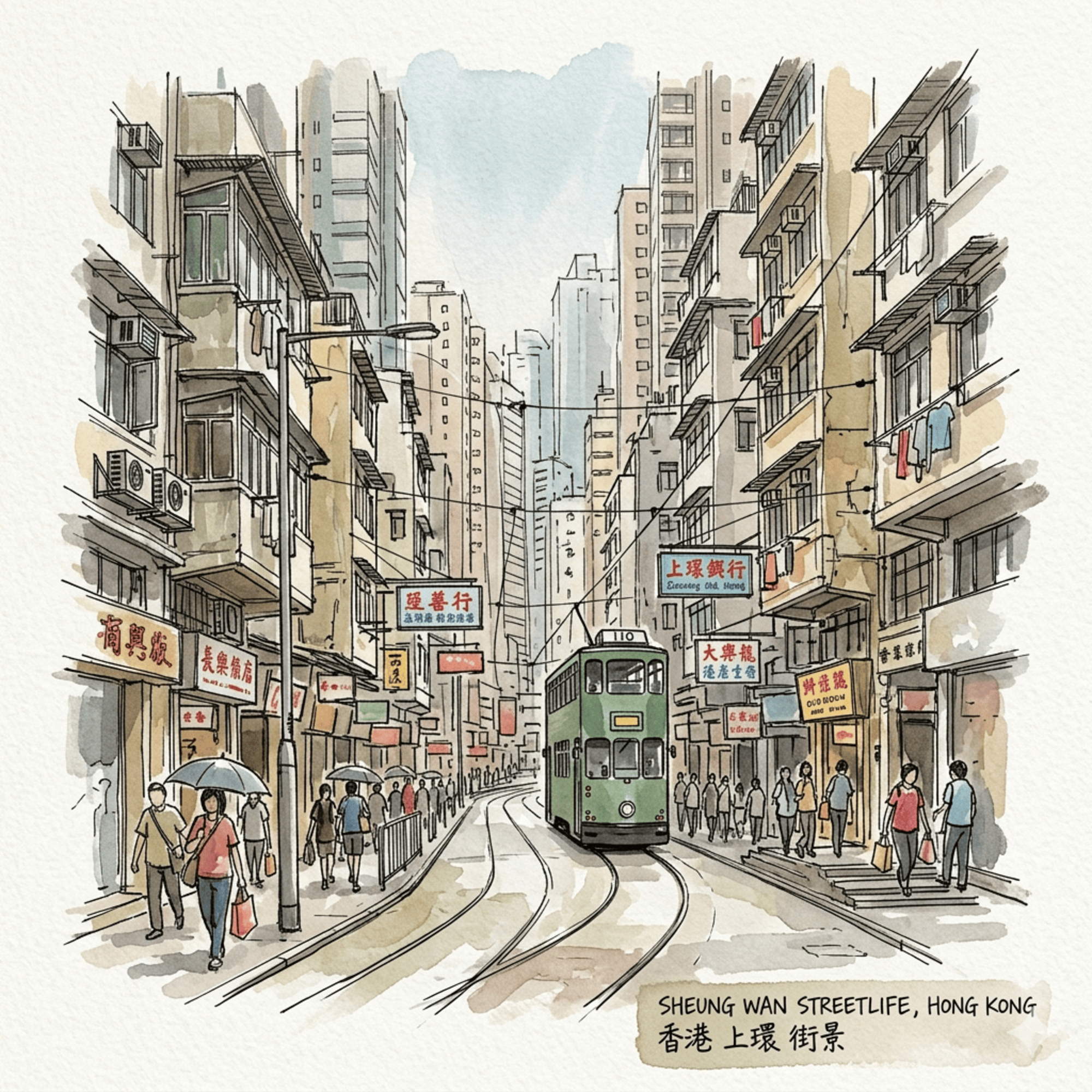
To the casual visitor, Sheung Wan is a district of curated boutiques, artisanal coffee shops, and the fragrant haze of dried seafood stalls. However, to the historical geographer, this neighborhood is a living palimpsest—a surface where the city’s foundational history is written, erased, and overwritten. As the primary site of colonial Hong Kong’s inception, Sheung Wan’s urban fabric was forged not by aesthetic whim, but through the pressures of British imperial landing, catastrophic urban fires, and the requirements of global trade. Its steep inclines and narrow, dead-end alleys are the physical records of these transitions. By walking the spatial shifts from the reclaimed shoreline up to the "cleansed" hills of Tai Ping Shan, one can read the history of a city defined by its ability to transform disaster into commercial expansion and turn marginal spaces into the birthplaces of revolution.
Listen to the historical stories told in detail (For subscribers only)
The Shoreline of Empire: Possession Point and the Birth of "Chinese Town"
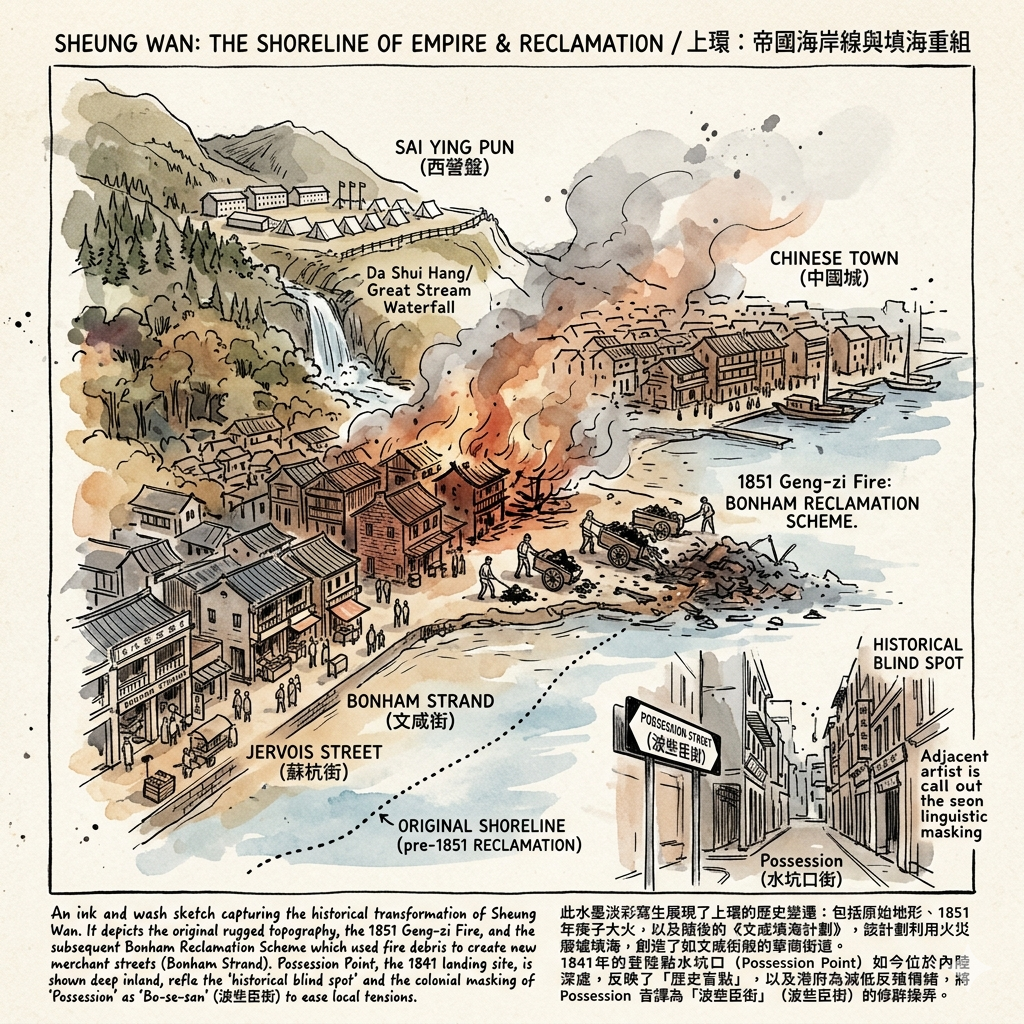
The physical topography of Sheung Wan dictated the British military’s first footsteps. In 1841, the search for a strategic foothold led the Royal Navy to a specific promontory—a flat, elevated cape overlooking the harbor, blessed with a "Great Stream" waterfall (Da Shui Hang) for fresh water. While this served military needs, it also established the dual nature of early Hong Kong: a high-ground British military camp known as "Sai Ying Pun" and a low-lying, overcrowded "Chinese Town" ghetto for the migrant labor force. This precarious urban arrangement was fundamentally altered by the 1851 "Geng-zi Fire," which leveled 472 buildings. Rather than a setback, the fire became a catalyst for the Bonham Reclamation Scheme, the first major urban expansion in the territory’s history.
By dumping the fire’s debris and charred ruins into the shallow bay, the colonial government transformed "waste" into "new land." This reclamation created the economic engine of the burgeoning Chinese merchant class, establishing streets like Bonham Strand and Jervois Street. It effectively pushed the shoreline north from Queen’s Road, providing the flat terrain necessary for the rise of the trans-shipment trade. Today, a significant "historical blind spot" exists for the modern tourist; the original landing point at Possession Street now sits hundreds of meters inland, a victim of the very reclamation it inaugurated.
Historical Discrepancy: The Landing Date British official accounts emphasize January 25, 1841, focusing on Edward Belcher’s survey. Conversely, Chinese records focus on January 26, the formal flag-raising ceremony. Tellingly, the Chinese name for Possession Street was phonetically transliterated as Bo-se-san (波些臣街)—a linguistic mask designed by the colonial government to hide the word "Possession" and avoid inflaming anti-colonial sentiment among the local population.
While fire and reclamation reshaped the physical coast, a deadlier invisible force would soon reshape the hills above.
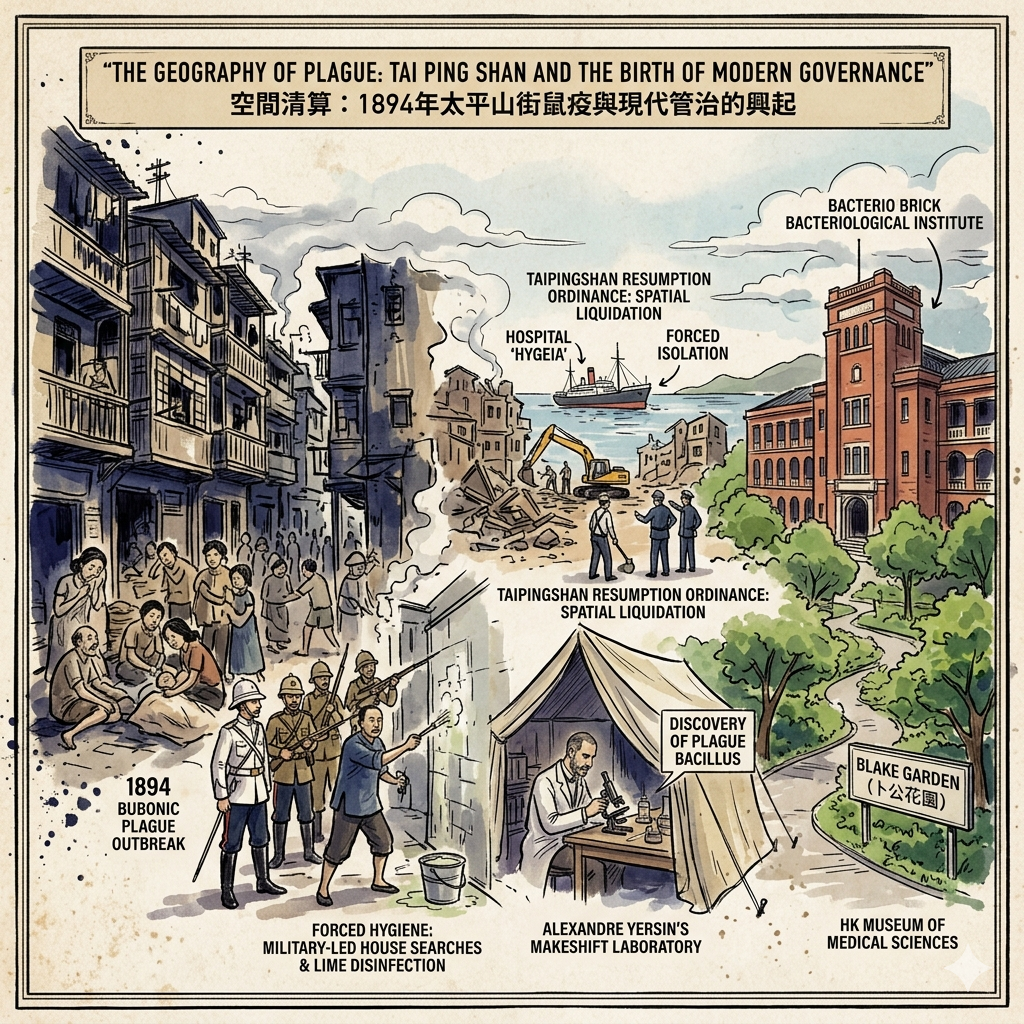
The Geography of Plague: Tai Ping Shan and the Birth of Modern Governance
The 1894 Bubonic Plague was more than a health crisis; it was a turning point in how the colonial state asserted control over the bodies and homes of its subjects. By the late 19th century, the Tai Ping Shan district had become a densely populated slum. The outbreak forced the state to transition from "laissez-faire" neglect to modern institutional surveillance through an act of "spatial liquidation."
Under the Taipingshan Resumption Ordinance, the government forcibly acquired 384 houses and leveled the neighborhood. This resulted in the creation of Blake Garden, a public park that effectively buried the site of the outbreak. Before the arrival of the permanent red-brick Bacteriological Institute (now the Hong Kong Museum of Medical Sciences) in 1906, the grit of the crisis was captured in a "makeshift laboratory" where Alexandre Yersin first discovered the plague bacillus, a stark contrast to the institutionalized science that followed.
The state’s "forced hygiene" measures to control the outbreak sparked significant Chinese resistance:
- Military-led house searches: Armed soldiers entering private residences to locate the sick.
- Forced isolations: Removing patients to hospital ships like the "Hygeia."
- Lime disinfection: A radical physical scouring of Chinese homes with caustic lime to "purify" the environment.
This era of physical cleansing of the living necessitated a parallel system for the spiritual and logistical management of the dead.
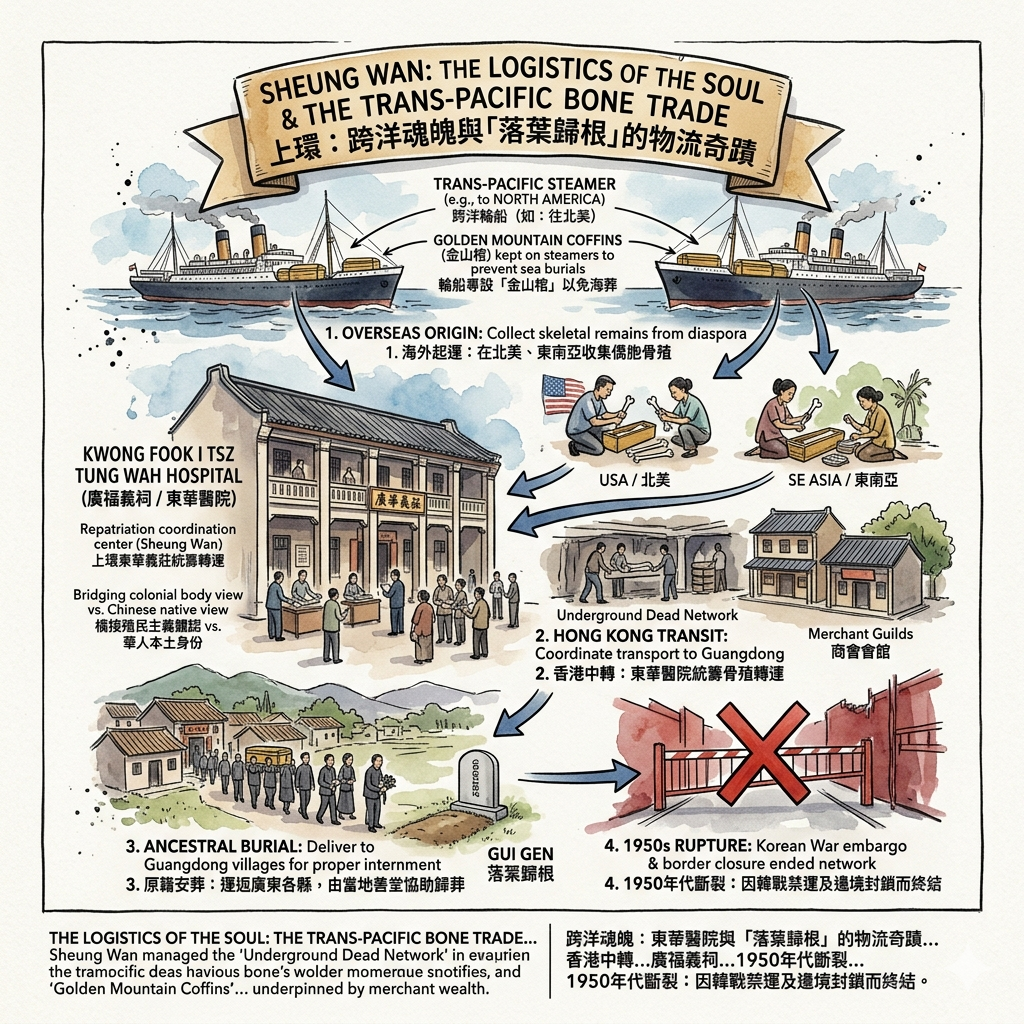
The Logistics of the Soul: The Trans-Pacific Bone Trade
In Chinese tradition, "falling leaves returning to their roots" (gui gen) dictates that a person be buried in their ancestral home. Sheung Wan became the "brain" of a global mortuary network centered at the Kwong Fook I Tsz (the "Temple of the Common People"). This site evolved from a squalid hospice into the Tung Wah Hospital system, bridging the gap between the colonial state’s view of the Chinese body—as a biological threat to be "limed" and "disinfected"—and the Chinese view of the body as a sacred vessel requiring repatriation.
Sheung Wan managed the "Underground Dead Network," coordinating the transport of skeletal remains from the diaspora in North America and Southeast Asia back to Guangdong.
The "Golden Mountain Coffins" To prevent "sea burials" by Western captains who feared disease, the Tung Wah Hospital provided "Golden Mountain Coffins" kept permanently on trans-Pacific steamers, ensuring that even those who died at sea could eventually reach the soil of their ancestors.
This sense of native identity and mutual aid was underpinned by the immense wealth of the merchant guilds nearby.
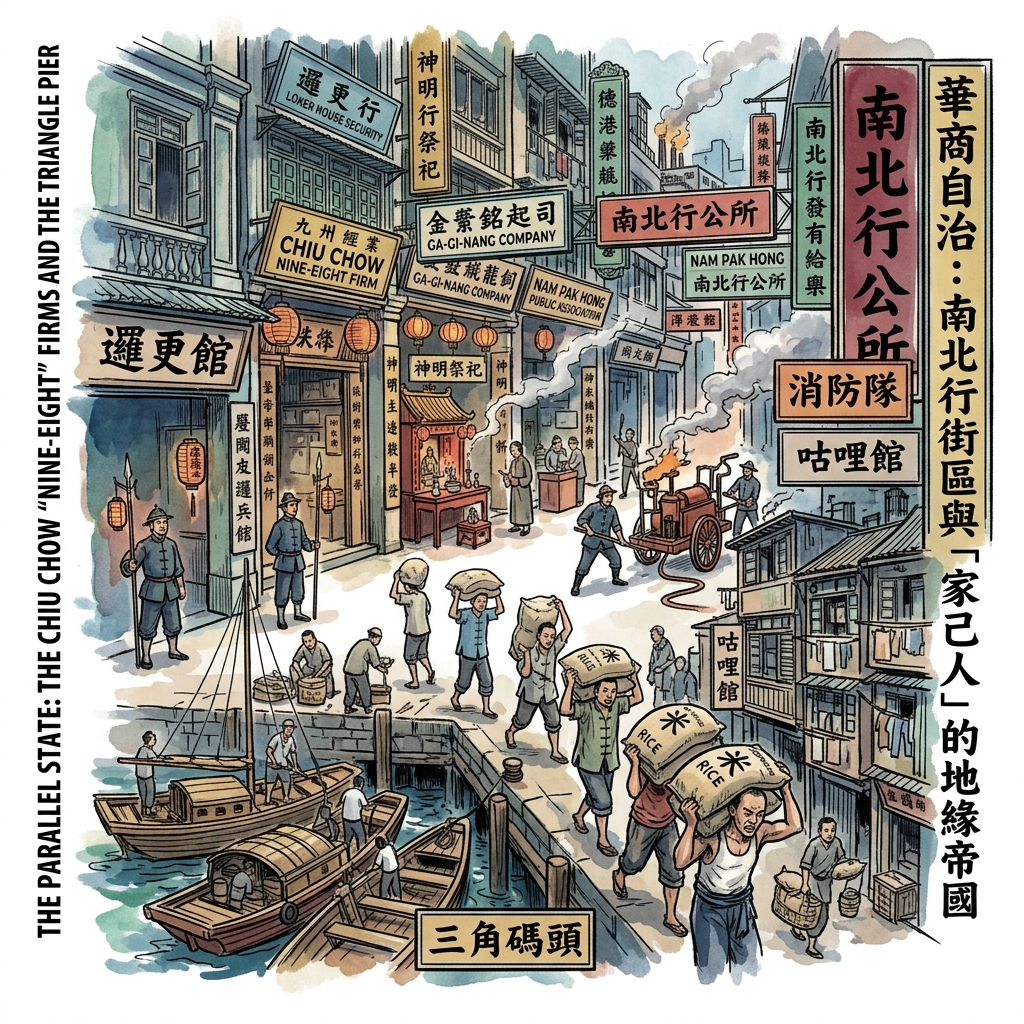
The Parallel State: The Chiu Chow "Nine-Eight" Firms and the Triangle Pier
A self-governing "state within a state" emerged along Bonham Strand West and Wing Lok Street through the Nam Pak Hong (North-South Lines). These firms, dominated by the Chiu Chow "Ga-gi-nang" (our own people) network, created a parallel power structure that managed everything from trade to "Spring and Autumn sacrifices" and divine rituals, filling the vacuum of colonial governance with spiritual and civil authority.
These firms operated on the "98" commission system (a 2% fee), monopolizing the rice trade. To maintain order, the guilds funded their own infrastructure:
- Loker Houses: Private security and armed guards who patrolled merchant streets.
- Guild-funded Fire Brigades: The district’s first organized firefighting units, protecting merchant capital.
The Triangle Pier The physical heart of this empire was the Triangle Pier. While the merchants managed global accounts, the "Coolie" underclass—often the same "Ga-gi-nang" people—labored in brutal conditions, carrying 100-pound rice bags from the pier to cramped "Coolie Houses" in Sai Ying Pun.
This transition from the physical weight of rice to the intellectual weight of the printed word provided the final layer of Sheung Wan’s identity.
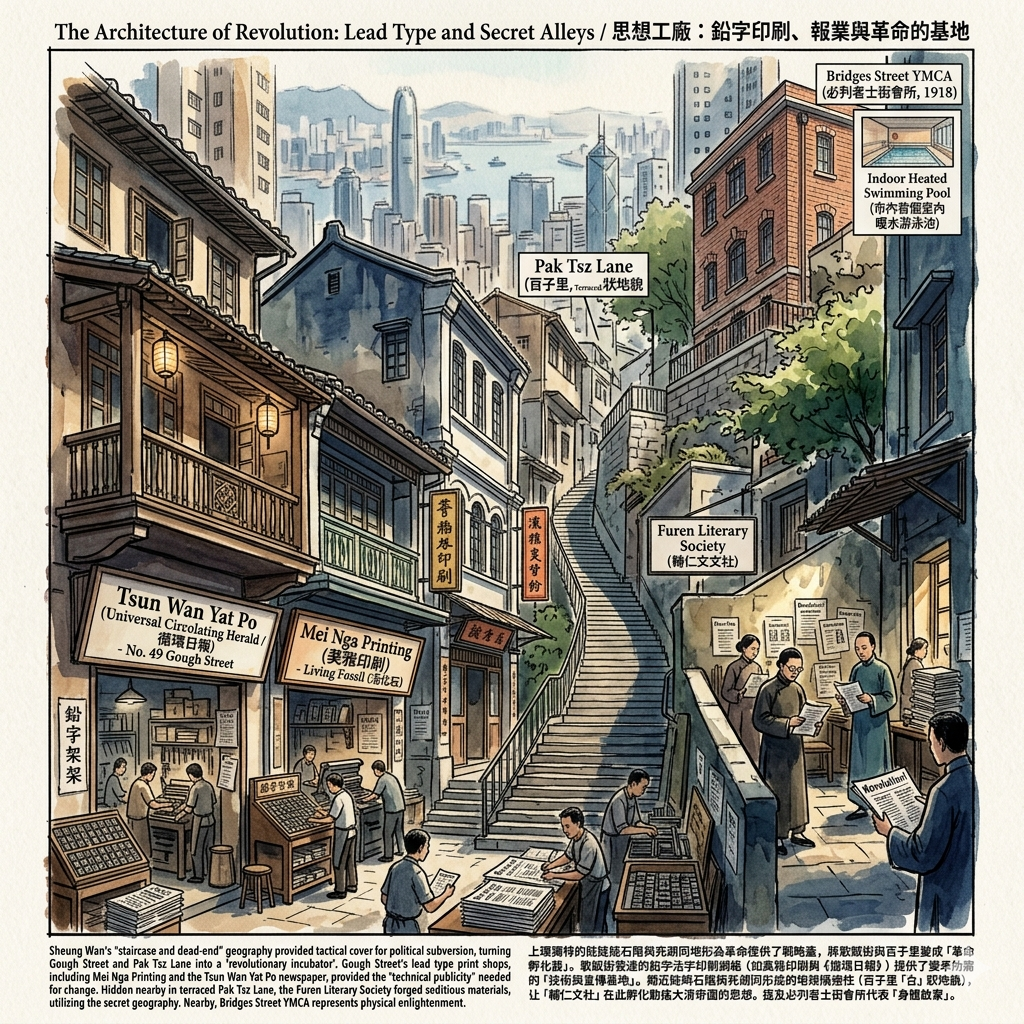
The Architecture of Revolution: Lead Type and Secret Alleys
Sheung Wan’s unique "staircase and dead-end" geography provided tactical cover for political subversion. Here, the "technical publicity" of the printing press met the "geographic secrecy" of the hillside, turning Gough Street and Pak Tsz Lane into a "revolutionary incubator."
In 1874, the Tsun Wan Yat Po (Universal Circulating Herald) was founded at 49 Gough Street—the first daily run entirely by Chinese editors. The lead-type printing technology used here was the physical weapon of a new generation. This concentration allowed the Furen Literary Society at Pak Tsz Lane to print seditious materials while staying hidden from Qing spies.
Bridges Street YMCA Nearby, the Bridges Street YMCA (1918) represented "physical enlightenment" for the Chinese middle class, featuring the city’s first indoor heated swimming pool.
Hidden Gem: Mei Nga Printing Located on Gough Street, Mei Nga Printing serves as a "living fossil," preserving the lead-type cabinets once used to forge the revolutionary word.
Conclusion: The Layered Observation of a City
The history of Sheung Wan reveals recurring meta-patterns: the cycle of disaster followed by state-led spatial cleansing, the persistence of alternative Chinese governance in the vacuum of colonial neglect, and the strategic use of borderline spaces to foster political change. These streets are not merely thoroughfares; they are a complex "sedimentary rock" composed of imperial violence, merchant capital, and the sweat of nameless laborers who built the city’s foundations.
As one navigates these slopes, the true identity of Hong Kong emerges—not in the glass towers of the modern skyline, but in the invisible, underground networks that persist. It lives in the spirits of the diaspora being returned home through the Tung Wah network, the echoes of secret revolutionary pamphlets passed in dead-end alleys, and the memory of merchant guilds that provided their own fire brigades and divine sacrifices. Does the city's essence lie in the boutiques of the present, or in these enduring networks of trade, spirits, and survival that built the very ground beneath them? To walk Sheung Wan is to realize that the "underground" city is the only one that truly lasts.
To explore more "layered" histories of the world’s most complex cities, subscribe to our "Historical Travel Stories" newsletter.
Travel Affiliate: Practical Continuity
- How to Get There: Begin your "shoreline to hill" walk by taking the MTR to Sheung Wan Station, Exit A2.
- Recommended Tours: Follow the Sun Yat-sen Historical Trail, a self-guided route highlighting revolutionary meeting spots.
- Nearby Accommodation: For proximity to the historical stairs and alleys, seek accommodation near Hollywood Road.
Q & A
Explain the global bone-transfer network managed by Tung Wah Hospital.
The global bone-transfer network managed by Tung Wah Hospital was a sophisticated, cross-border charitable and logistical operation that connected the Chinese diaspora across the Pacific and Southeast Asia back to their ancestral homes in Guangdong.
This "underground network of the dead" was driven by the deep-seated cultural belief of "falling leaves returning to their roots" (落葉歸根), ensuring that even those who died in poverty abroad could achieve a proper burial in their native soil.
1. The Origin: From Crisis to Global Service
The network’s roots lie in the Kwong Fook Tsz (or Pak Shing Temple) on Tai Ping Shan Street, established in 1856 to house ancestral tablets and the remains of Chinese workers who died in Hong Kong. After poor conditions at the temple sparked a public health crisis, Tung Wah Hospital was founded in 1872 to take over these functions, eventually expanding the service to include Chinese communities worldwide.
2. The Logistics of the Global Network
The transfer process involved a highly organized chain of events:
- Overseas Exhumation: Years after a worker was buried in places like California, Vancouver, or Australia, local Chinese charitable associations (known as shantang) would perform "bone-picking" (撿骨) ceremonies, cleaning the remains and placing them in specialized bone pots.
- The "Golden Mountain Coffin" (金山棺): To prevent western ship captains from performing burials at sea if a passenger died during the voyage, Tung Wah Hospital provided "Golden Mountain Coffins" (lucky coffins) to be kept on ships traveling between Hong Kong and the Americas.
- The Sheung Wan Hub: Once the remains reached Hong Kong, Tung Wah Hospital acted as the "brain" of the operation. Staff would register the deceased’s name and ancestral village before transferring the remains to the Tung Wah Coffin Home (built in 1900) for temporary storage.
- Final Repatriation: From the Coffin Home, the remains were shipped via land or sea to local charitable halls in Guangdong, where they were finally handed over to family members for burial.
3. Scale and Significance
- Unprecedented Scale: This network was a global logistical miracle. In 1899 alone, over 150 shipments of remains arrived in Hong Kong, and it is estimated that tens of thousands of remains were processed before World War II.
- Commercial Symbiosis: While charitable in nature, the network was closely tied to the "Golden Mountain Firms" (跨國華商網絡), which managed the shipping contracts. This created a complex relationship where charity and commercial interests coexisted.
- Cultural Autonomy: The network allowed the Chinese community to maintain their spiritual and social order within a colonial system that often marginalized them. It effectively used Hong Kong’s status as a free port to bypass geopolitical boundaries for a humanitarian cause.
4. The End of the Network
The service was interrupted during the Japanese occupation in the 1940s and ultimately ceased in the 1950s. The outbreak of the Korean War and subsequent trade embargos led to the closure of the border between Hong Kong and mainland China, making the repatriation of remains impossible. Many unclaimed remains from this final period were eventually buried at Sandy Ridge Cemetery near the border.
How did Golden Mountain Firms profit from transferring human remains?
While the bone-transfer network is often remembered for its humanitarian and cultural significance, historical research indicates it was also a lucrative commercial industry chain where charity and capital were deeply intertwined. Golden Mountain Firms (金山莊), which specialized in trade, remittances, and passenger transport between Hong Kong and the Americas or Australia, profited from this network through several key mechanisms:
- Shipping and Logistics Contracts: The transportation of remains from overseas to Hong Kong involved complex commercial contracts. Firms like Li Sing’s Wo Hing Company (和興號金山莊) managed these large-scale logistics, acting as "chartered ship brokers" for the bone-picking associations (shantang) abroad.
- Clan-Monopoly Interests: The operation of the network was often tied to clan and regional monopolies. By leveraging their specific kinship networks in Guangdong and overseas, certain Golden Mountain Firms were able to control the transport routes and service agreements for members of their own clans, ensuring a steady stream of business.
- Symbiosis with Passenger Transport: Providing for the "return of the dead" supported the "transport of the living." Golden Mountain Firms managed the ocean-going vessels that carried Chinese workers. By coordinating with Tung Wah Hospital to carry "Golden Mountain Coffins" (吉棺) on their ships, these firms provided a vital "insurance" that attracted Chinese passengers who feared being buried at sea.
- Integrated Business Model: The transfer of remains was part of a broader suite of services. These firms handled remittances, mail, and cargo for the same workers whose bones they would eventually repatriate. This integration allowed them to extract value at every stage of a worker’s life and death.
In summary, scholars suggest that the "Golden Mountain Firms" utilized the cultural imperative of "falling leaves returning to their roots" to create a highly profitable, non-official social and logistical system that functioned within the gaps of the colonial administration.
Reference and Further reading
- 水坑口街原名波些臣?曾淪風月區獲《胭脂扣》翻拍證香港島百年歷史 - am730, accessed May 27, 2026,
- 水坑口和上環, accessed May 27, 2026,
- 水坑口-, accessed May 27, 2026,
- Sheung Wan - accessed May 27, 2026,
- 第十四課南北行, accessed May 27, 2026,
- 本週特寫- 香港有關疫症歷史及醫學發展的實地考察可觀自然教育中心暨天文館, accessed May 27, 2026,
- 1894年香港鼠疫- accessed May 27, 2026,
- 遊太平山區尋找香港百年抗疫故事| JMHF, accessed May 27, 2026,
- 暢遊樓梯店舖品味港島情懷- 香港文匯報, accessed May 27, 2026,
- 香港上環太平山街40號廣福祠Kwong Fook Tsz, No. 40 Tai Ping Shan ..., accessed May 27, 2026,
- 金山莊(香港) - accessed May 27, 2026,
- Hong Kong's place in South East Asia - Scholarly Publications Leiden University, accessed May 27, 2026,
- Pacific Crossing - HKU Press, accessed May 27, 2026,
- 東華義莊與《東風破》 - 東華三院, accessed May 27, 2026,
- The Hong Kong Chinese Community in the Mid-19th Century - 香港記憶, accessed May 27, 2026,
- 東華義莊- accessed May 27, 2026,
- 壹街故事Archives - 頁2,共3 - 香港舊照片, accessed May 27, 2026,
- What's Left of Hong Kong's Once-Powerful Chiu Chow ..., accessed May 27, 2026,
- 文咸西街百昌堂 - 香港記憶, accessed May 27, 2026,
- 歌賦街- accessed May 27, 2026,
- 歌賦街的前世今生| 鄭明仁 - 灼見名家, accessed May 27, 2026,
- 古物古蹟辦事處- 中西區文物徑(525), accessed May 27, 2026,
- Heritage Fiesta 2025 (2491) - Conserve and Revitalise Hong Kong Heritage, accessed May 27, 2026
Lawrence Lawrence
 Lawrence