(ENG) Beitou Hot Spring Walk – 5 Historical Stories in a Misty Japanese-Era Town
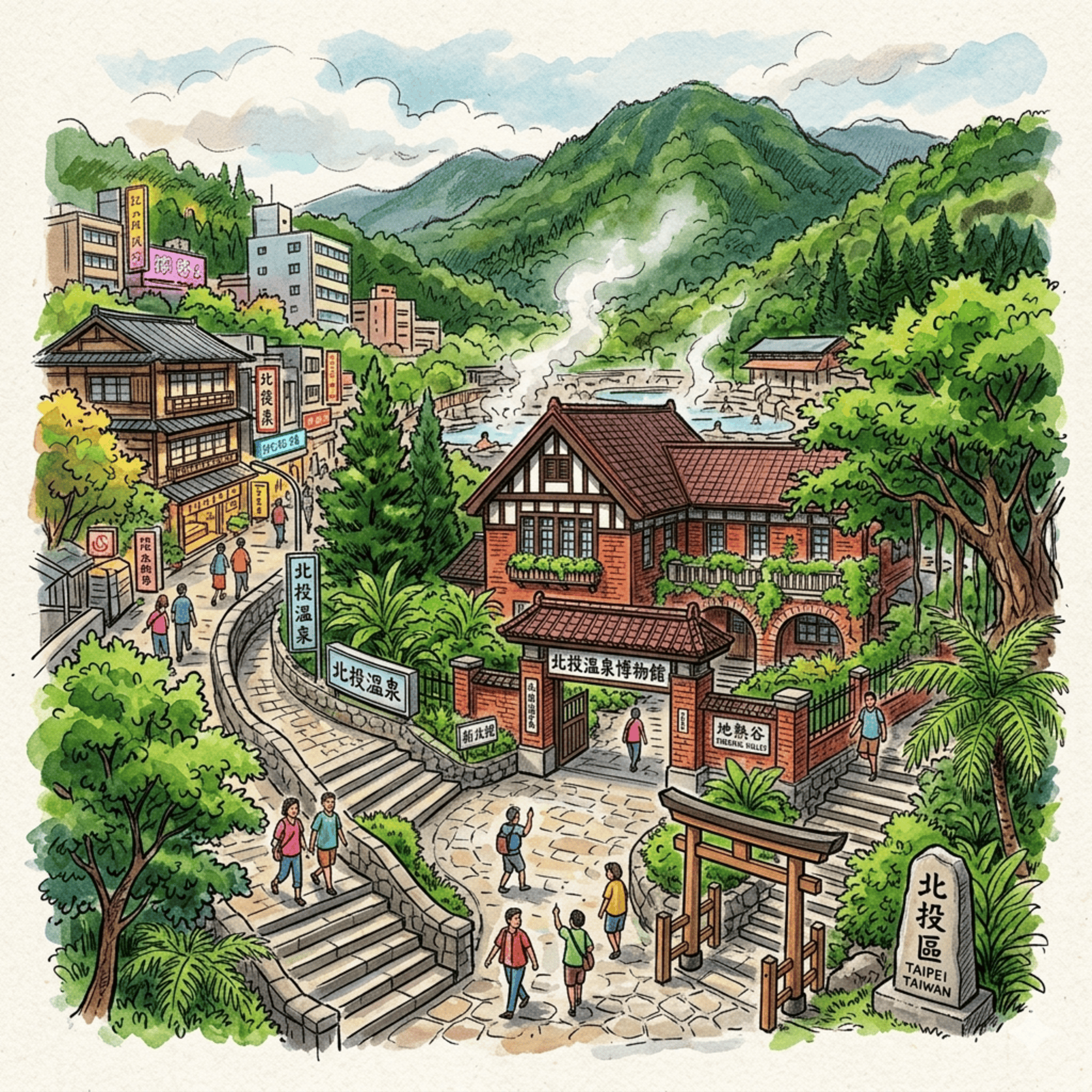
Walk through the misty streets of Beitou with this historical guide. From the sulfur-scented Thermal Valley to colonial-era wooden stations, discover five stories that reveal the layers of history hidden within Taipei’s famous hot spring resort.
 Lawrence
This is a historical travel story and walking guide to Beitou, a famous hot spring district in Taipei. Through five evocative histories, it explores the Xinbeitou Station, Beitou Park, and the Thermal Valley to show how Japanese colonial heritage and the scent of sulfur shaped this unique hillside community. Readers will discover a slow-paced route that connects architectural relics with the nostalgic soul of Taiwan’s premier spa town.
The Gateway to the Witch’s Mist
To the indigenous Ketagalan people, the landscape at the foot of the Datun Volcano Group was Patauw—the "Witch’s Land." It was a terrain defined by the sensory overload of the volcanic: the persistent, sulfurous odor of the earth’s breath and the thick mists rising from geothermal vents. Walking through Beitou today, one does not merely traverse a scenic spa district; one walks across a palimpsest of imperial ambition and human experience. The transition from a feared indigenous territory to a prized imperial resource remains palpable to those who move through its topography. For the cultural historian, history here is not confined to the museum; it is etched into the very soil, where the "poisonous" vapors of the past were eventually reclassified as the "healing" waters of the modern era through a process of territorialization and bureaucratic capture.
Listen to the historical stories told in detail (For subscribers only)
Story I: Imperial Alchemy—The Frontier of Sulfur and Gunpowder
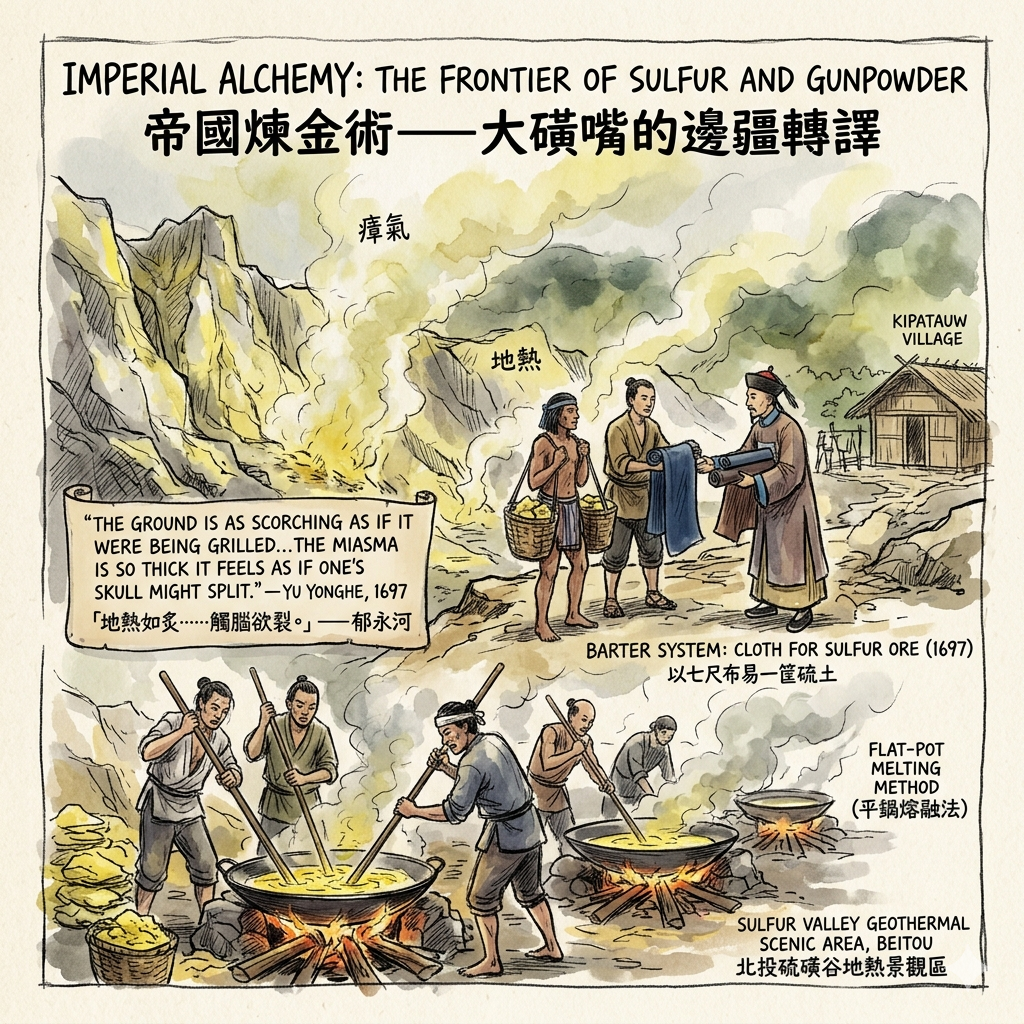
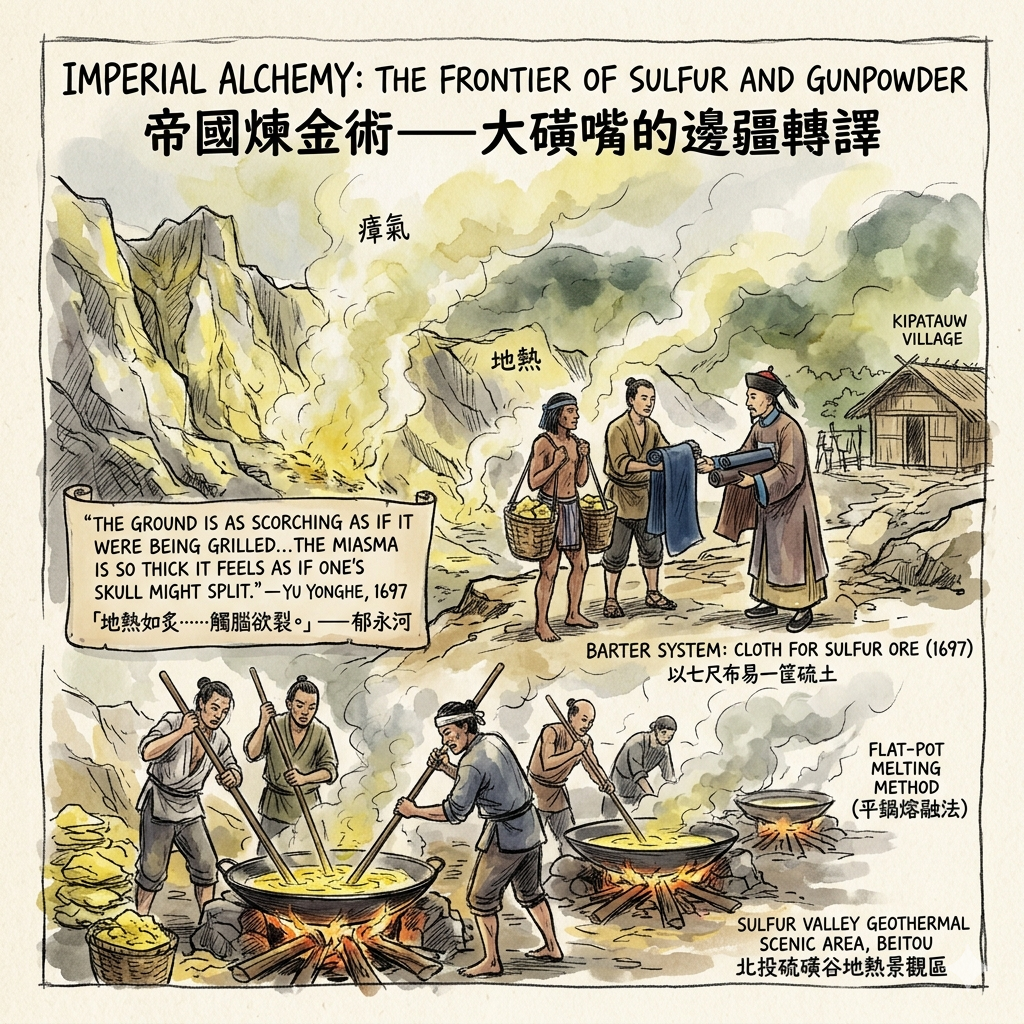
In the 17th century, sulfur was a cornerstone of global trade and the essential ingredient for black gunpowder. For the Qing Empire, northern Taiwan was a "forbidden frontier," a wild space governed by strict "closed-border" policies intended to keep strategic minerals out of rebel hands. This isolation was shattered in 1696 when a catastrophic fire destroyed the Fuzhou gunpowder storehouse. Faced with a sudden military deficit, the Qing administration was forced to gaze into the "barbarian" mists of Beitou to replenish its reserves.
The 1697 expedition led by Yu Yonghe epitomizes this era of "imperial alchemy." Navigating the treacherous terrain of what is now Sulfur Valley (Dahuangzui), Yu established a complex barter system with the village of Kipatauw, trading seven feet of cloth for every 100 catties of sulfur ore. The labor was grueling, utilizing a "flat-pot melting method" where sulfur was extracted by stirring ore with oil over open flames. This early industry reveals a profound dependency: the Han administration provided the capital, but they relied entirely on indigenous labor and local geological knowledge to survive the "miasma." To maintain control over this volatile landscape, the state later implemented a policy of "periodic mountain burning" (定期燒山), a deliberate act of environmental destruction to prevent "illegal" private extraction.
"The ground is as scorching as if it were being grilled (地熱如炙)... the miasma (瘴氣) is so thick it feels as if one’s skull might split." — Yu Yonghe, Pihai Jiyou (1697)
The "So What?" Layer: This era demonstrates how global military competition dictated the development of local frontiers. It highlights a pre-modern perception of Beitou’s geology; before it was a site of leisure, it was a site of "poison" and "death," where the state actively scorched the earth to maintain a monopoly on violence.
Site Connection: Visit the Sulfur Valley Geothermal Scenic Area (Dahuangzui). Near the Longfenggu Visitor Center, the "Yu Yonghe Sulfur Extraction" monument marks the site of these early struggles.
The "poisonous" mists of the Qing era would eventually be tamed and "sanitized" by the Japanese colonial administration, shifting the narrative from raw extraction to spiritual hygiene.
Story II: Spiritual Hygiene—The Railway Soul and the Hot Spring Deity
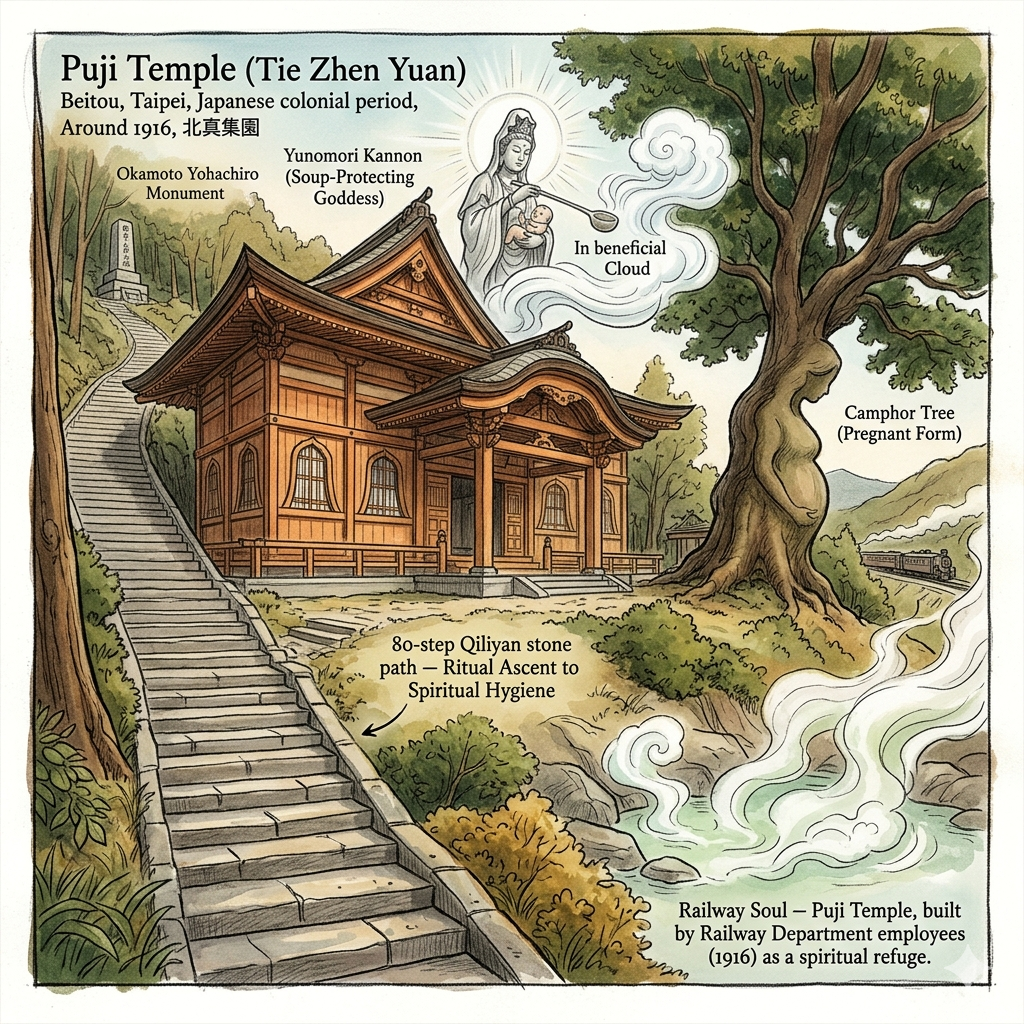
During the Japanese colonial period, "Modern Spa Hygiene" was introduced as a tool for consolidating imperial power. Infrastructure and health were intertwined, and the expansion of the railway system necessitated a parallel development of "mental infrastructure." The colonial state implemented a system of "stratified access," where the springs were mapped and allocated according to social rank—officials, public citizens, and railway elites each occupied distinct tiers of the geothermal landscape.
In 1916, employees of the Taiwan Governor-General's Railway Department funded the construction of Tie Zhen Yuan (now Puji Temple). This was a spiritual refuge for colonial workers dealing with the physical and mental toll of industrial labor, reinforcing the cultural identity of the Japanese elite through high-grade hinoki (cypress) construction and bell-shaped "fire-light" windows. Central to the temple is the Yunomori Kannon (Soup-Protecting Goddess). In a poignant example of the landscape’s layers, a camphor tree on the grounds resembles a pregnant woman, mirroring the Kannon’s own post-war transformation from a hot spring protector into a "child-sending" deity—a survival mechanism of religious icons during political transitions.
The "So What?" Layer: The temple represents the "spiritualization" of colonial labor, where industrial progress (railways) met Japanese Buddhist tradition. It served as a sanctified node in the colonial network, ensuring that those who maintained the empire’s physical connections remained spiritually tethered to the metropole.
Site Connection: Climb the 80-step Qiliyan stone path to No. 112, Wenquan Road. Look for the Okamoto Yohachiro Monument on the mountain path nearby, linking spiritual refuge with geological science.
While the colonial elite found comfort in the temples of the lower slopes, the upper reaches were being prepared as a space for both terminal rituals and political disappearance.
Story III: The Space of Exile—Kamikazes and the Young Marshal’s Long Silence
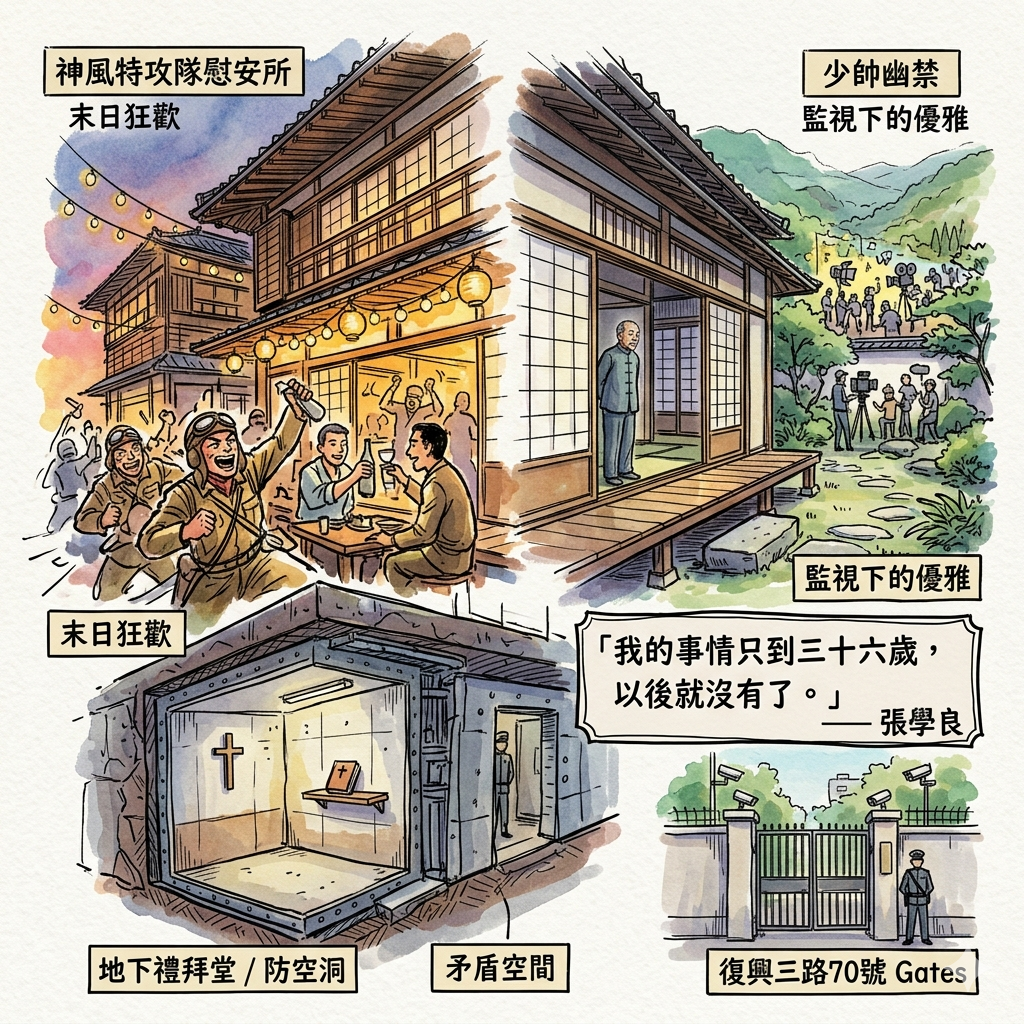
Beitou’s high elevation and secluded geography eventually marked it as a "political periphery." The site known today as Marshals Garden (formerly the Shingao Inn) holds a chilling dual history. In the final months of World War II, it served as a "comfort station" for Kamikaze pilots, young men celebrating their final nights before their suicide missions.
Later, this space of "endings" became the site of house arrest for Zhang Xueliang, the "Young Marshal." From 1960 to 1993, Zhang was an "embodied fossil" of a lost political era, living in a state of "understated elegance" and total surveillance. While the Marshals Garden is the public face of this exile, the fortress-like residence at No. 70, Fuxing 3rd Road is where he spent the majority of his confinement. On the grounds, the underground chapel served a dual function as an air-raid shelter, a stark reminder of the intersection between spiritual refuge and physical survival in a state of perpetual vigilance.
"My life ended at thirty-six; there was nothing after." — Zhang Xueliang
The "So What?" Layer: The irony is profound: a building that hosted the ultimate sacrifice for Japanese militarism eventually became the "living tomb" for the man who had famously resisted it. Beitou’s tranquility served as a tool of the state to mask the harshness of political erasure.
Site Connection: Explore No. 34, Youya Road, and the gates of the former residence at No. 70, Fuxing 3rd Road.
As the silence of political exile dominated the upper slopes, the valleys below erupted into the vibrant, noisy world of the Taiwanese film industry.
Story IV: The Celluloid Mirage—The "Hollywood of the East"
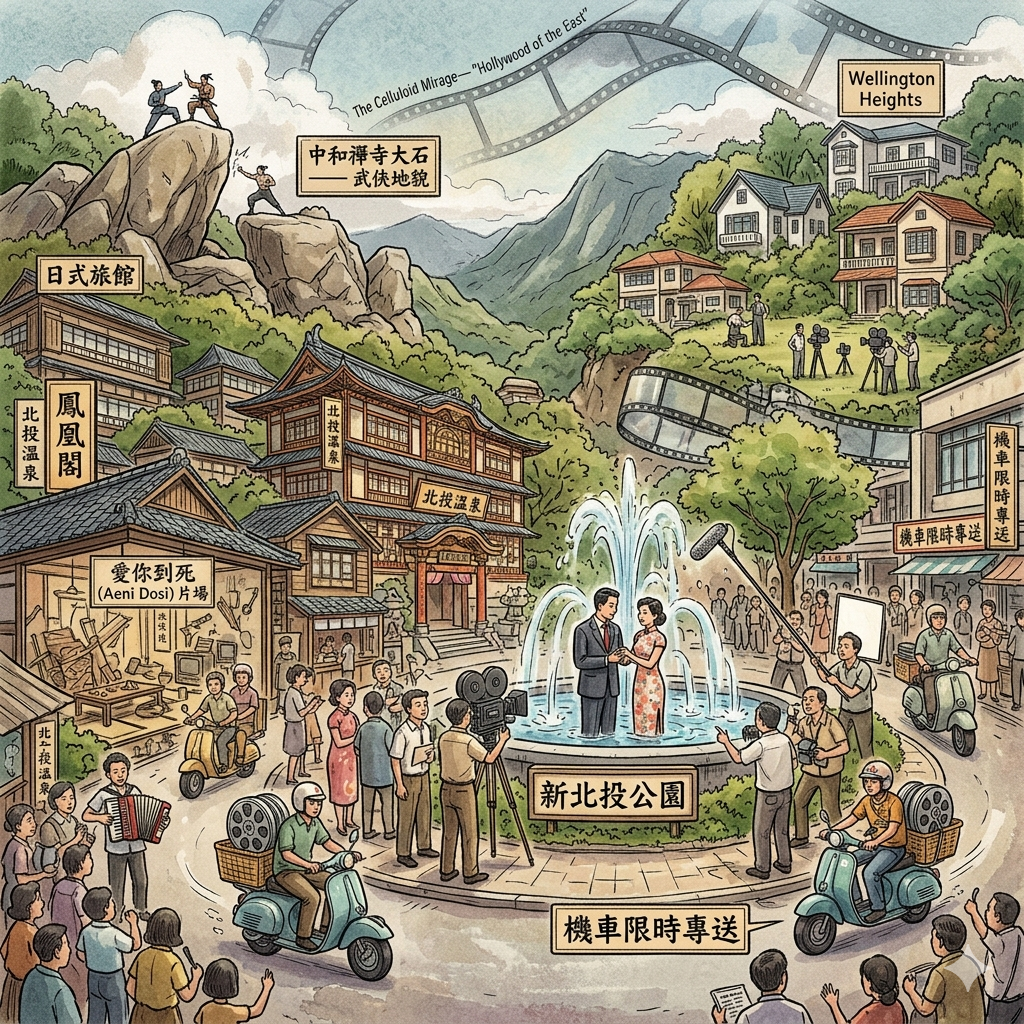
In the 1950s and 60s, Beitou’s Japanese-style architecture provided a ready-made "open-air studio" for Taiwanese-language cinema. This was the era of "guerrilla filmmaking," characterized by a frantic labor pace where movies like Aeni Dosi (愛你到死) were completed in just 15 to 20 days.
The industry relied on a unique symbiotic economy: the Nagasi music culture provided the atmosphere, while the Motorcycle Express system—originally for spa guests—ferried actors, film reels, and props between sets. The Phoenix Pavilion (Fenghuangge) and the Western-style villas of Wellington Heights became iconic backdrops for martial arts and "Time Literary" films.
The "So What?" Layer: These films represented a search for local cultural identity during a period of strict language policies. Beitou’s transformation into a film set shows how a colonial leisure space can be creatively re-appropriated to build a new, post-colonial cultural narrative.
Site Connection: The fountain in New Beitou Park remains the most recognizable backdrop in the history of Taiwanese cinema.
Story V: From Poison Water to Global Treasure—The Discovery of Hokutolite
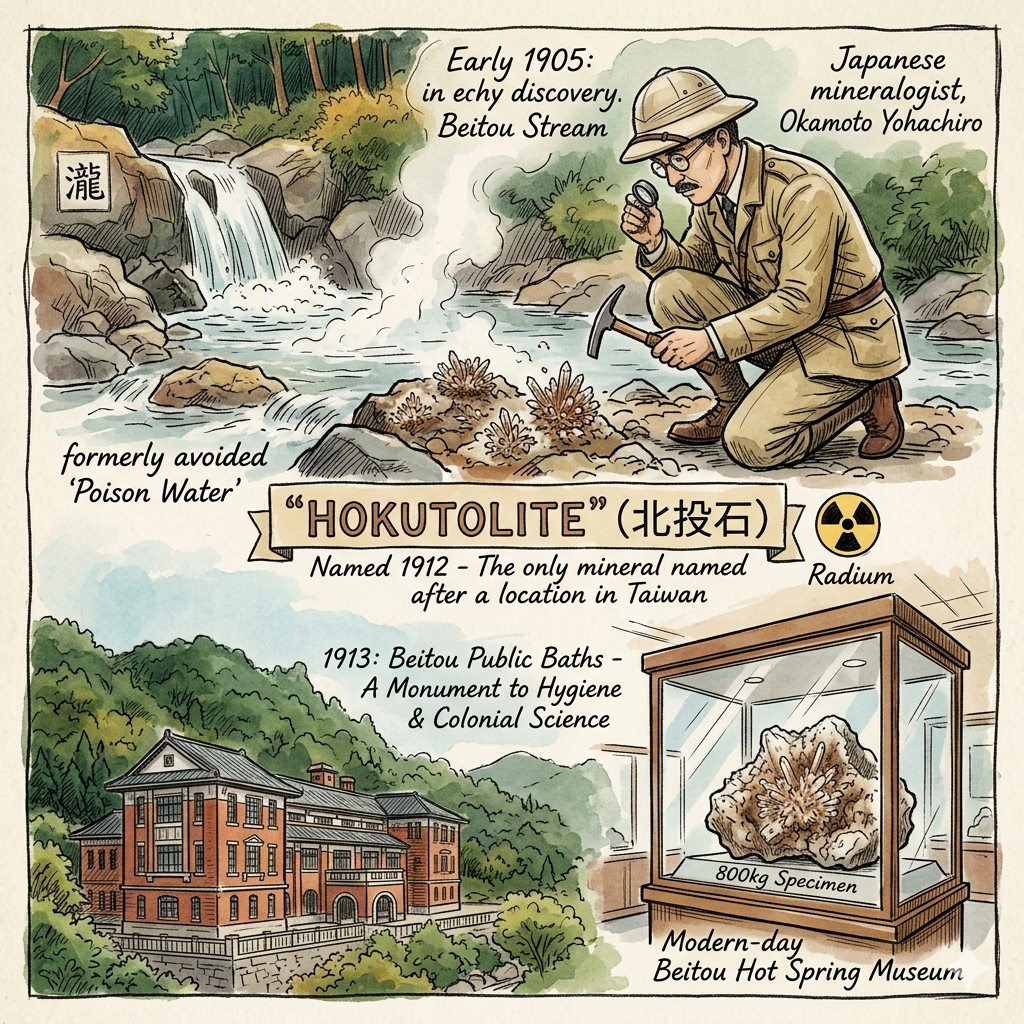
The Japanese colonial era brought a shift from "sensory perception" to "scientific classification." For centuries, the acidic waters of the Beitou Stream were avoided by farmers as "poison water." In 1905, government mineralogist Okamoto Yohachiro changed this forever when he discovered a rare, radioactive mineral forming on the riverbed near the "瀧" (small waterfalls).
By 1912, the mineral was officially named Hokutolite, the only mineral in the world named after a location in Taiwan. This discovery coincided with early 20th-century "Radium Worship," and the "poison water" was rebranded as "Radium Springs"—a scientific marvel with healing properties.
The "So What?" Layer: Colonial science "legitimized" nature, turning a rural nuisance into a "civilizing" resource. The construction of the grand Beitou Public Baths in 1913 was a monument to this new hygiene, demonstrating the empire’s mastery over the natural world.
Site Connection: Visit the Beitou Stream (瀧) near the museum to see the unique micro-environment where the crystals form, and view the 800kg specimen of Hokutolite preserved inside.
Hidden Gems for the Mindful Traveler
For those seeking the intersection of cinema and nature, visit the Zhonghe Zen Temple on Qiyan Road. This site is famed for the massive rock formations in its courtyard, which served as a natural stage for early martial arts films where actors performed daring "wire-flying" (吊鋼絲) stunts among the stones.
Conclusion: The Layered Observation of the Volcanic Soul
Beitou is a laboratory where the raw energy of geology has been channeled into various forms of power—military, spiritual, and political. To understand it requires "layered observation": seeing the strategic sulfur mine beneath the spa and the political prison within the villa. The steam rising today is the same steam that Yu Yonghe feared and Okamoto studied, reminding us that modern leisure is often a mask for the power networks of the past. As you explore, consider: what modern narratives are currently masking the next layer of Beitou's history?
For a broader perspective on these spatial transformations, consult our [Comprehensive Guide to Taipei's Historical Districts].
For more untold histories of the world, subscribe to our monthly dispatch.
Logistics: Navigating the Layers
- Access: MRT Xinbeitou Station is the primary gateway to the district’s spatial narrative.
- Stay: The Phoenix Pavilion (Fenghuangge) preserves the original Taisho-era architecture and serves as a direct link to the golden age of Taiwanese cinema.
- Walking Route: Walk from the Hot Spring Museum in the valley, up Wenquan Road to Puji Temple, and finally to the Marshals Garden. This ascent mirrors the historical shift from public science to private, political seclusion.
Q & A
How did Beitou's sulfuric 'poison water' become a modern health resource?
The transformation of Beitou’s sulfuric waters from "poison water" into a modern health resource was driven by a fundamental shift in scientific understanding, colonial infrastructure, and the rebranding of natural resources during the Japanese colonial period.The following factors detail this historical evolution:1. From "Poison Water" to "Scientific Miracle"Before the late 19th century, Han Chinese farmers viewed the highly acidic, sulfuric waters of Beitou Creek as "poison water" (毒水) because they were useless for irrigation. The environment was characterized by "miasma" and "evil gases" (惡氣), perceived primarily as a dangerous borderland rather than a place for healing.The narrative flipped in 1905, when Japanese technician Yohachiro Okamoto discovered a radioactive mineral in Beitou Creek. By 1912, this mineral was internationally named "Hokutolite" (北投石). The discovery of Radium within the stones allowed the "poison water" to be relabeled as "Radium Springs" (鐳溫泉), which was suddenly endowed with "modern scientific effects" such as promoting metabolism and bodily maintenance.2. Infrastructure and the "Sanitary Space"The transition required physical infrastructure to turn a raw natural phenomenon into a manageable resource:
- The Tamsui Railway (1901): The opening of the railway acted as a catalyst, connecting the remote volcanic area to the urban center of Taipei and making it accessible for development.
- Beitou Public Bathhouse (1913): Built by the Taipei Prefecture, this grand facility (now the Hot Spring Museum) was designed specifically to demonstrate the scientific and sanitary benefits of hot springs to the public.
- Imperial Endorsement: The 1923 visit by Prince Hirohito, who inspected the Hokutolite stones, linked these natural resources with the "enlightened" and "civilized" image of the Japanese empire, solidifying Beitou's status as a high-class health destination.
3. Functional Translation of Natural ResourcesThe sources describe a "layering" of spatial functions where the same geography was repurposed over time:
- Military to Leisure: During the Qing Dynasty, areas like Sulfur Valley (Dahuangzui) were strictly controlled for the production of gunpowder—a strategic military material.
- Artificial Innovation: Today, these same volcanic vents are no longer used for mining but are used to heat surface water with geothermal steam, creating "White Sulfur Springs". This "artificial hot spring" technology represents the final stage of turning a harsh volcanic environment into a stable, commercialized health resource.
In summary, the transition was a "scientific reconstruction of nature." By applying Western scientific classification (mineralogy and chemistry) to the landscape, the colonial government transformed a "threat" into "cultural capital," effectively inventing the modern hot spring culture that defines Beitou today.
What role did Beitou play in the golden age of Taiwanese cinema?
During the "Golden Age of Taiyupian" (Taiwanese-language cinema) from the mid-1950s to the 1960s, Beitou served as the industry's most vital production hub, earning the nickname "The Hollywood of Taiwan". Due to a lack of professional film studios and limited budgets, filmmakers utilized Beitou's unique landscape—featuring Japanese-style inns, Western villas, and scenic mountain roads—as a massive, ready-made "open-air film studio".Beitou's role was defined by several key factors:
- Guerrilla-Style Production: Film crews practiced "guerrilla tactics," typically completing a movie in just 15 to 20 days. They would move into local hotels, filming exterior scenes in the mountains or parks by day and converting hotel rooms into indoor sets (such as offices or bedrooms) by night.
- Iconic Filming Locations:
- Phoenix Pavilion (鳳凰閣): Known for its traditional Japanese architecture and stairs, it was a classic backdrop for films like Love You to Death.
- Wellington Heights: This Western-style villa area was frequently used for "literary" films or martial arts chases requiring an exotic atmosphere.
- Chung-he Temple: The large rocks in front of this temple were popular for filming martial arts stunts and "wire-flying" action.
- Beitou Park Fountain: This became a legendary site for filming romantic encounters and farewells.
- A Specialized Support Ecosystem: The film industry drove a unique local economy, including the "Motorcycle Limited Express" (機車限時專送) system, where riders transported actors, film reels, and props between sets, and the Nagasi (那卡西) musical culture, which entertained film crews and stars.
Historically, Beitou’s cinematic era represents a "creative translation" of space, where leisure facilities from the colonial period were repurposed to build a local cultural identity during a time of resource scarcity. This "Golden Age" eventually declined as the government began strictly promoting Mandarin-language policies and the television industry emerged, causing Beitou's status as a film capital to fade into memory.
Reference and Further reading
- 北投社- 平埔族群 - 臺灣原住民族文化知識網, accessed March 29, 2026,
- 740 臺灣史蹟研究會九十一年會友年會實錄 - 北投國小, accessed March 29, 2026,
- 日治時代北投地區的區域發展與社會網絡 - 國立臺灣圖書館, accessed March 29, 2026,
- 人工溫泉發源地:硫磺谷<採硫篇> - 生活多寶格, accessed March 29, 2026,
- 北投的硫磺礦業|國家文化記憶庫, accessed March 29, 2026,
- 探訪歷史點位~郁永河採硫碑 - 陽明山國家公園全球資訊網, accessed March 29, 2026,
- 人文歷史 - 打開火山-大屯火山觀測站, accessed March 29, 2026,
- 自然生態特色-硫磺谷(大磺嘴) - 北投區公所, accessed March 29, 2026,
- 湯守觀音鎮守北投區,研究日式典型廟宇建築物與觀光聖地 - 方格子, accessed March 29, 2026,
- 古蹟導覽-北投普濟寺 - 臺北市北投區公所, accessed March 29, 2026,
- 少帥展館- 少帥禪園, accessed March 29, 2026,
- 人生36歲就停止北投算是半個家 - 中時新聞網, accessed March 29, 2026,
- 文化及歷史建築-少帥禪園 - 臺北市北投區公所, accessed March 29, 2026,
- 文化及歷史建築-張學良故居 - 臺北市北投區公所, accessed March 29, 2026,
- 張學良故居 - 國家文化資產網, accessed March 29, 2026,
- 軍情局解密:張學良與228 命懸一線可予擊斃 - 風傳媒, accessed March 29, 2026,
- 北投溫泉博物館,accessed March 29, 2026,
- 薛惠玲黃秀如:尋找台語片的北投溫泉鄉裡的斷簡殘篇- 從北投府城到 ..., accessed March 29, 2026,
- 廢娼影響北投繁華 - 國家文化記憶庫, accessed March 29, 2026
 Lawrence
 Lawrence
 Lawrence