Ikegami, Tokyo: The Sacred Hill That Couldn't Be Suppressed
In Tokyo's Ōta Ward, a hill named Ikegami has spent seven hundred years absorbing governments that tried to suppress, control, and reshape it. Each attempt deepened the site rather than diminishing it. This is the story of how suppression became sanctity.

 Lawrence
How a hillside in south Tokyo became one of Japan's most spiritually dense sites — not despite the political pressure it absorbed, but because of it
This is a historical travel essay about Ikegami Honmonji, a major Nichiren Buddhist temple complex on a hillside in the Ōta Ward of south Tokyo. In October 1282, the monk Nichiren died here. In the seven centuries since, the site has been targeted by a medieval shogunate, repurposed by a Tokugawa shogun, and surgically altered by Meiji reformers — and emerged from each encounter more significant than before. Visitors who know what happened here will find the grounds read like a stratigraphic record of Japanese religious and political history, with each era's attempts at control visible in the landscape. This essay tells five of those layered stories.
What History Does to Holy Places
History is not kind to sacred sites. Empires raze them, reformers purge them, developers pave them over, and when none of that works, administrators simply reclassify them until the meaning drains away. The hillside at Ikegami, in the residential south of Tokyo, has been subjected to most of these treatments — two government exiles, a shogunal architectural intervention, a Meiji-era religious surgery — and has emerged from every encounter more itself than before.
This is the counterintuitive thing about Ikegami: it does not merely survive pressure. It converts it. Seven hundred and forty years of institutional hostility, and the site's spiritual authority has done nothing but deepen. Somewhere in that pattern is a lesson about how sacred places actually accumulate power — and about what makes certain locations refuse, regardless of what history throws at them, to stop meaning something.
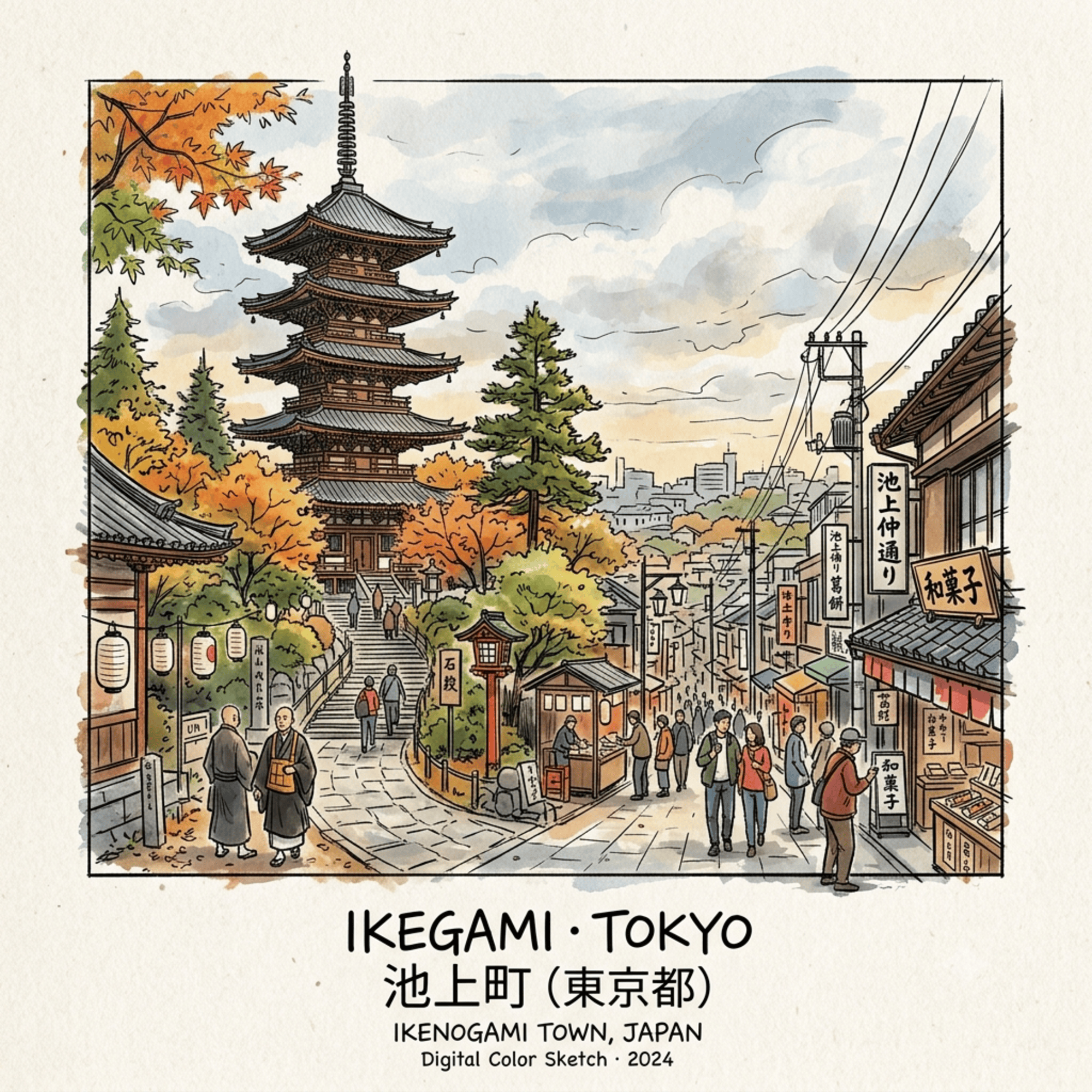
The hill is thirty meters above the surrounding flatlands, which in Tokyo's relentlessly horizontal geography is enough to lift you clear. Follow the stone-paved path up through the moss-bearded lanterns, and the city disappears. By the time you reach the main gate, you are already somewhere else, in the way that matters.
Listen to the historical stories told in detail (For subscribers only)
Five Layers of History: The Human Stories of Ikegami
Story I: The Prophet Who Died in a Borrowed House (1282)
Nichiren knew he was dying, and he left anyway.
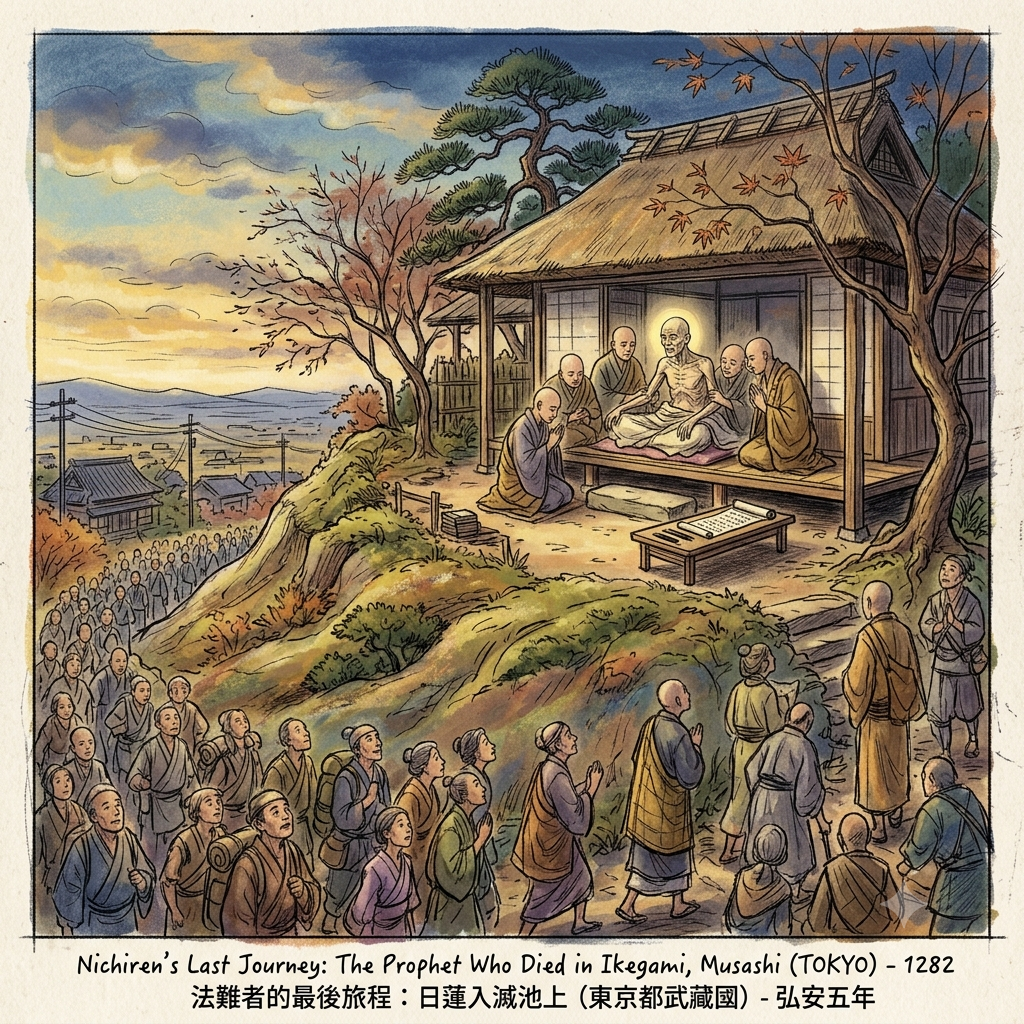
He had spent nine years in mountain retreat at Minobu, in what is now Yamanashi Prefecture, and his body had given out entirely. His disciples arranged a journey to hot springs in the province of Hitachi — a journey everyone understood was more last rite than cure. On October 3rd, 1282, Nichiren left Minobu for the last time. He made it as far as Ikegami, in the province of Musashi, to the estate of a disciple named Ikegami Munenaka. On October 13th, he died there. He was sixty-one.
At his deathbed were the six senior disciples he had personally designated as successors — later called the Six Elder Monks — and, by tradition, several hundred more followers who had converged from across the country. In the political climate of Kamakura-period Japan, a gathering of that size around a man the government had twice exiled was not a trivial matter.
The Rebel Monk Who Claimed Tokyo
Understanding Nichiren requires understanding the specific quality of his danger. He was not simply a reformer. He was a monk who had accused the Kamakura shogunate of patronizing the wrong schools of Buddhism, predicted the Mongol invasions in writing, survived a death sentence — the executioner's nerve reportedly failed at the moment of execution, and the sentence was commuted to exile — and continued writing on the remote island of Sado. When the Mongols invaded in 1274, as he had predicted, and were repelled by the typhoon that Japanese tradition would name the kamikaze, his popular standing became untouchable. His relations with the government never recovered.
What Nichiren built across those thirty years of official hostility was a theology in which persecution was evidence of correctness. The Lotus Sutra, the text at the center of his entire system, explicitly predicted that those who spread it in the age of degeneration would face opposition. Every exile, every condemnation, every death threat became, within his own framework, a confirmation. The system had been designed, from the beginning, to metabolize opposition into authority.
Then he died in Munenaka's house, on this hill, and the hill inherited the design.
The Kamakura shogunate's official history, the Azuma Kagami, records Nichiren's death with complete silence. A man the government had considered dangerous enough to exile twice was erased from the record at his death. That silence is itself a historical document: the authorities understood that Ikegami had just become something they preferred not to acknowledge.
Story II: The Civil Servant's Secret (1260–1282)
Ikegami Munenaka and his brother Munenaga held positions in the Kamakura government's administrative apparatus. Their family estate at Ikegami was a hereditary holding, and their careers depended on not creating problems for their superiors. Being publicly associated with Nichiren — the government's most inconvenient religious critic — was precisely the kind of problem that could end careers.
The brothers' solution was to be devoted disciples in private and unremarkable bureaucrats in public. They received Nichiren at their estate, supplied him with resources and protection, and carefully avoided the kind of open defiance that would have brought consequences. Their reward for this calibrated loyalty was a family crisis that, by the evidence of Nichiren's surviving letters to them, lasted more than a decade.
The Samurai Who Erased His Own Estate
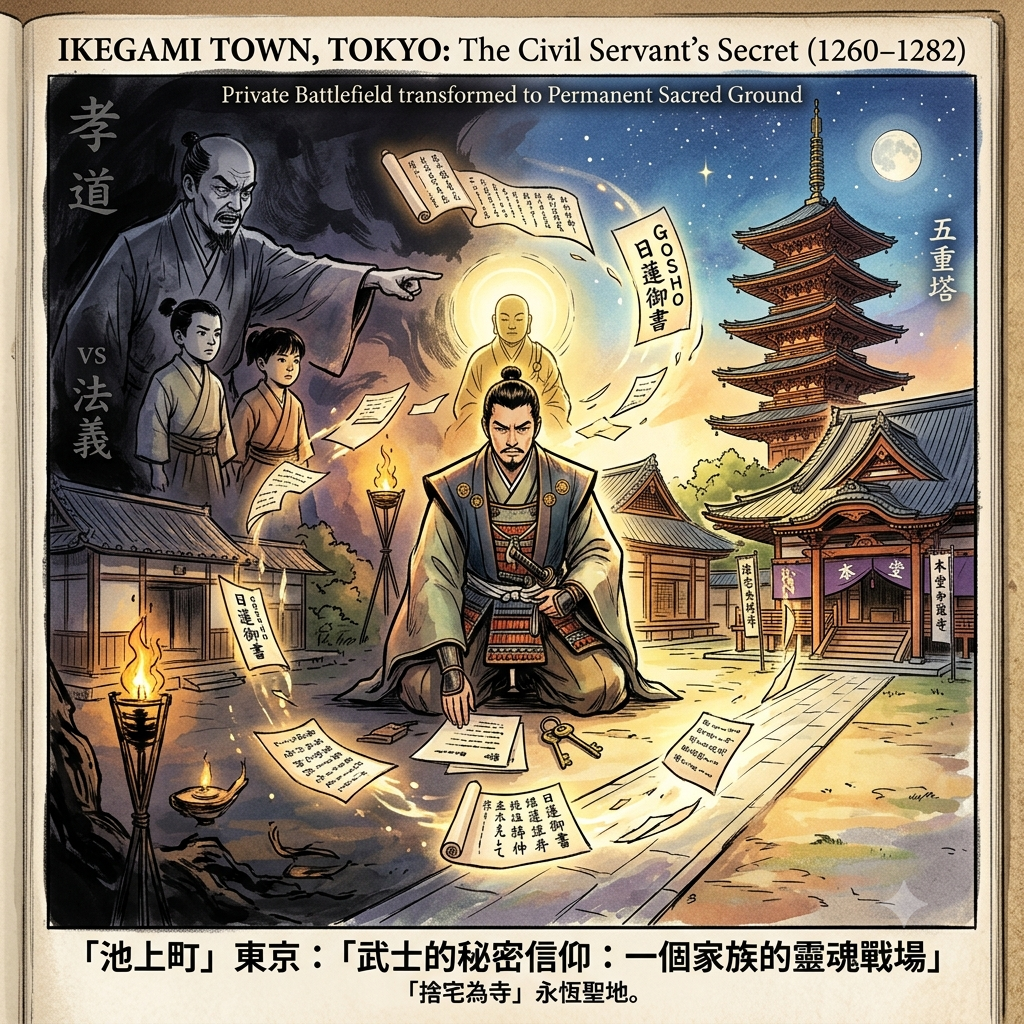
The letters — known collectively as the Ikegami Kyōdai Gosho — reveal that the brothers' father was demanding they renounce their faith and threatening to disinherit them if they refused. Nichiren pushed back, repeatedly, asking Munenaka to choose the Dharma over his inheritance if forced to choose. This was asking a great deal. In medieval Japan, filial obligation was not a value among other values — it was the structural foundation of the social order. Demanding that a son publicly defy his father on religious grounds placed the deepest loyalty available against the most fundamental institution of the culture.
The resolution has the clean, almost too-tidy quality of a story that has been refined over centuries of retelling. The father, it is recorded, converted to Nichiren Buddhism shortly before his death in 1281 — one year before Nichiren himself died at the same estate. Munenaka then donated the family property in its entirety to establish the temple.
The land where the argument had been fought became the territory of what the argument had been about. A private estate — site of a generational battle over faith — was converted, by a single act of donation, into the permanent public sacred space it remains today. In the cosmology of Nichiren Buddhism, no act carried more weight: private ground surrendered to the Dharma was ground that became, in the tradition's understanding, permanently transformed.
Story III: Cherry Blossoms in October (1282 – Present)
The tradition holds that on the night Nichiren died — October 13th, 1282, by the modern calendar — the cherry trees on the hill bloomed.
In October. Six months outside their season.
Japanese cherry trees flower in spring, typically March or April. In October they have been bare for months and will remain so until the following year. What the tradition describes is botanically impossible: spring inserted into autumn to mark that something irreversible had just occurred.
The sensible response is to file this under pious legend, which is almost certainly what it is — a miraculous embellishment added to the saint's biography sometime after the fact, refined across generations until it became inseparable from the founding narrative. Religious traditions produce these stories reliably, and the Nichiren tradition is no different.
But the more interesting question is not whether it happened. It is why this particular impossibility has persisted for seven hundred and forty years without any political system succeeding in washing it out.
The Impossible Autumn Cherry Blossoms
In Japanese aesthetics, cherry blossoms carry a specific symbolic burden: they are the canonical image of mono no aware, the bittersweet awareness of impermanence. Their meaning depends on their brevity. They fall in days; that is the point. But the October blossoms reverse this entirely — they bloom in the dying season rather than the living one, turning the symbol of impermanence into evidence of something that refuses to be temporary.
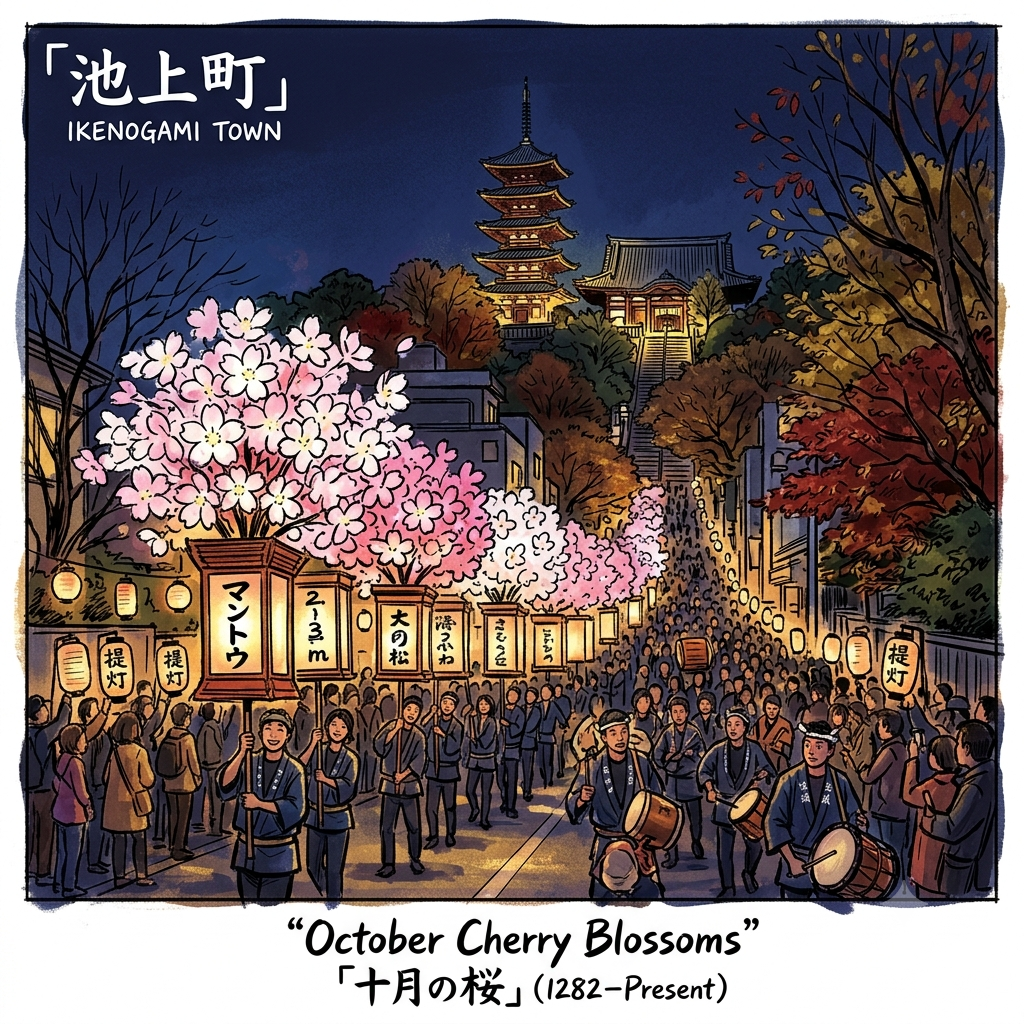
Every year, between October 11th and 13th, this reversal is collectively re-enacted. The festival called the Oeshiki fills the streets around Ikegami Honmonji with hundreds of thousands of people carrying mantō — bamboo constructions two to three meters tall, crowned with handmade paper cherry blossoms in white and pink. The processions move through the neighborhood in columns, drum-led, lantern-lit, the paper flowers trembling in the October night air. The participants are not commemorating the event in the way a commemoration works. They are recreating it — making paper spring in the middle of autumn, collectively insisting that October 13th, 1282 is not past but recurring.
This is one of the oldest continuous urban religious processions in the world. It has outlasted the governments that tried to shape it, the reforms that tried to redirect it, and the modernization that has erased almost everything else in the surrounding city. The paper blossoms have proved more durable than the political systems that worked against them.
Story IV: The Shogun's Loaded Gift (1608)
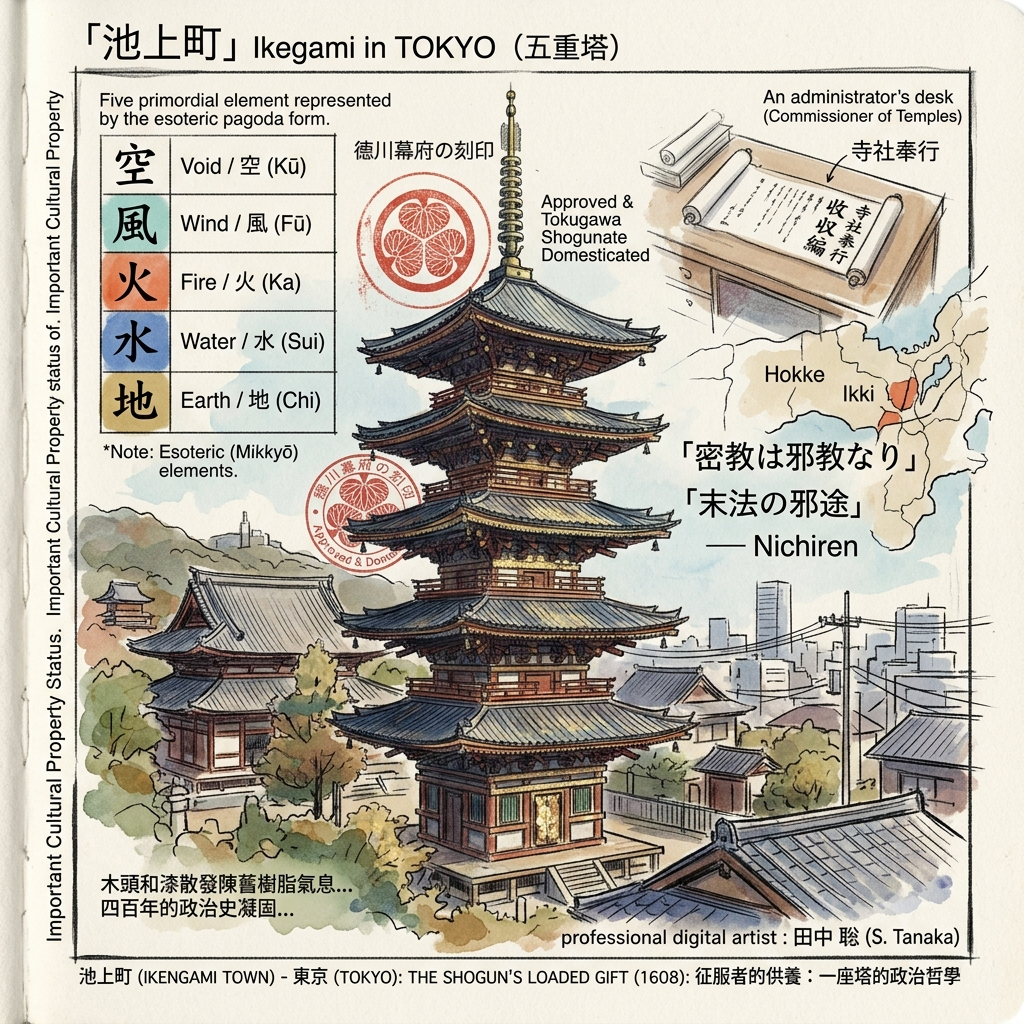
In 1608, the second Tokugawa shogun, Hidetada — son of the more famous Ieyasu, who had unified Japan under the Tokugawa house five years earlier — commissioned a five-story pagoda for the grounds of Ikegami Honmonji. It still stands. It is one of the oldest surviving wooden structures in the greater Tokyo area, designated an Important Cultural Property by the Japanese government.
It was also a political operation dressed as an act of piety.
The Tokugawa shogunate had reason to be attentive to Nichiren Buddhism specifically. In the Sengoku period of civil war that preceded the Tokugawa peace, Nichiren Buddhist communities had demonstrated a capacity for organized political action that made any governing authority pay close attention: the Hokke Ikki in sixteenth-century Kyoto had at its peak effectively run the city's townspeople. The Tokugawa response to religious organizations with political mobilization potential was characteristically sophisticated. Direct suppression was avoided — it produces martyrs, and martyrs produce pilgrimage sites and grievances that outlast the suppressor by generations. Instead: incorporation. Bring religious institutions into a government-supervised hierarchy, grant them official status and resources, accept their compliance in exchange.
The five-story pagoda was the architectural expression of this arrangement — a magnificent gift that simultaneously marked the temple as something the shogunate had approved, endorsed, and could monitor. Think of it less as religious devotion and more as the Tokugawa brand being placed on a site too significant to leave unbranded.
The Trojan Horse Pagoda
Here is the detail that anyone fluent in Nichiren theology would immediately notice: the five-story pagoda is an esoteric Buddhist form. Its five stories represent the five primordial elements — earth, water, fire, wind, and void — as understood in the esoteric traditions that Nichiren had spent his entire life denouncing as the false teachings of a corrupt religious establishment. The shogunate built, at the most sacred site in the Nichiren tradition, a monument expressed in the cosmological vocabulary that Nichiren most strenuously rejected.
Whether this was deliberate irony, institutional indifference to theological nuance, or simply the default visual language of Buddhist patronage — the government's functionaries commissioning the pagoda were administrators rather than monks — is a question the historical record leaves open. What it does not leave open is the outcome: the pagoda has stood for four hundred years, has become inseparable from the site's identity, and is now one of its most photographed features. The shogunate's attempt to brand the hill is now part of what makes the hill significant.
The domestication became part of the sacred geography. The incorporation is incorporated.
Story V: The Government That Tried to Purify It (1868)
The Meiji Restoration of 1868 brought what should, in theory, have been the most serious structural threat Ikegami had faced.
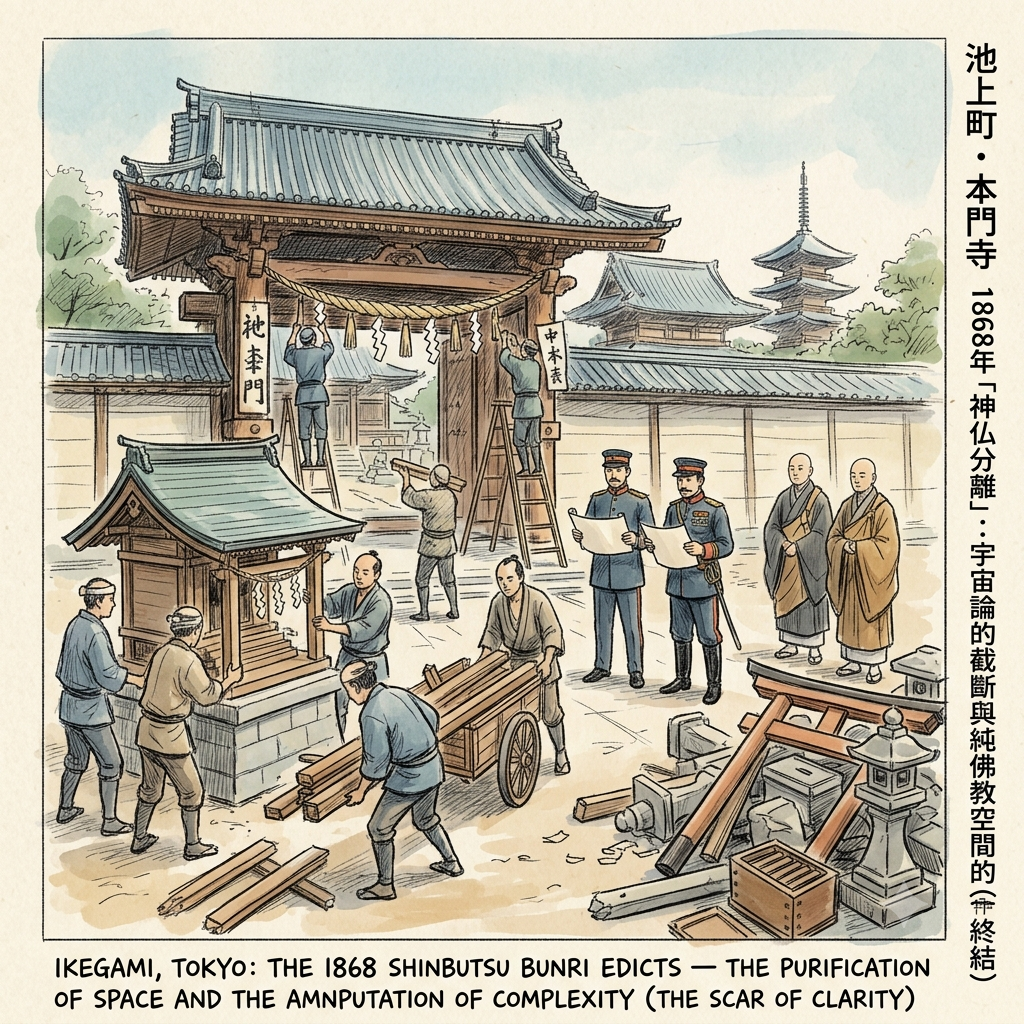
The new government — reorganizing Japan around imperial authority and a clarified Shinto nationalism — issued the shinbutsu bunri edicts, requiring the formal separation of Shinto and Buddhism. These two traditions had coexisted, interwoven and mutually reinforcing, in Japanese religious culture for more than twelve centuries. The movement that followed, haibutsu kishaku — "abolish Buddhism and destroy its images" — resulted in widespread destruction of temples, statues, and sacred objects across the country. In domains with strong loyalist commitments to the new imperial order, the destruction was catastrophic. Thousands of years of accumulated religious material were lost.
At Ikegami Honmonji, the damage was, by comparison, contained.
The reason is structurally elegant and almost comic in its irony: Nichiren Buddhism had always been, by deliberate design, a system resistant to religious mixing. Nichiren's theology placed the Lotus Sutra above all other texts and traditions, and his tradition had consistently and aggressively resisted syncretism — the blending of Buddhist practice with other religious frameworks. The twelve centuries of Buddhist-Shinto interweaving that Meiji reformers were now legally dissolving had, at Ikegami, never fully taken hold. Nichiren's own theological exclusivism had prevented it.
The Temple Saved By Intolerance
The tradition's most doctrinally divisive characteristic — the intransigence that had earned its founder two government exiles — turned out to be its immunological defense against a government-mandated religious surgery performed seven hundred years after his death.
What Meiji did accomplish was subtler and more permanent: the grounds were formally redesignated as purely Buddhist space, residual Shinto elements removed, the site's syncretic history officially ended. Walk through the grounds today and you find a space of striking visual and religious coherence — no torii gates, no shimenawa rope-and-paper markers, none of the layered sensory signals that characterize shared Buddhist-Shinto space elsewhere in Japan. The space feels complete.
What it may not immediately announce is that this completeness was produced in 1868 by the removal of a thousand years of accumulated complexity. The clarity is the scar. What reads as integrity is the record of an amputation. The reform that intended to diminish the site instead gave it a sharper, more unified identity — one that has proved easier to defend in the centuries since.
The High-Dimensional Lens: Reading Ikegami Through Nichiren Buddhist Cosmology
Framework note: This section applies exclusively the Nichiren Buddhist cosmological framework confirmed in the source research dossier. No Daoist, independent Shinto, or other external cosmological system is applied here.
The pattern across these five stories — suppression producing sanctity rather than erasure — is not a coincidence or a historical accident. It is the direct consequence of the cosmological system that Nichiren embedded in this site when he died here.
Nichiren's theology holds that land itself can achieve the nature of Buddha. The concept of kokudo jōbutsu — the enlightenment of the territory — maintains that when a being of full realization lives, practices, or dies in a specific location, that location is permanently altered, impressed with what the tradition calls hōshō, the essential nature of the Dharma. This is not metaphor. In Nichiren Buddhist cosmology, October 13th, 1282 was not the day a monk died at Ikegami. It was the day Ikegami ceased to be ordinary ground.
Hōnan — the persecution of the Dharma — adds the crucial structural layer. The Lotus Sutra's explicit prediction that those who propagate it in the age of mappō (the degenerate final era) will face opposition means that opposition, within the system, becomes confirmation rather than refutation. Each time Ikegami was targeted — by the Kamakura government's silence, by the Tokugawa incorporation, by the Meiji surgery — the tradition's own interpretive framework absorbed the event as further proof that the site was what it claimed to be. Persecution was not damage. Persecution was fuel.
The reichi — the sacred energy field of a reijō, a designated sacred site — accumulates through the density of spiritually intense experience concentrated in a place over time. Centuries of annual pilgrimage, collective grief rituals, and faith maintained against sustained political pressure have generated what practitioners would recognize as an exceptionally high-density field: a node in the living spiritual geography of Japan, whose charge increases rather than diminishes with each historical attempt to redirect it.
This is the cosmological logic that the history of Ikegami demonstrates: the hill was built, at its theological foundation, to feed on resistance. Hōnan was not a threat to the tradition. Hōnan was its operating principle. Every generation of interference — from the Kamakura officials who erased Nichiren from the record to the Meiji bureaucrats who reclassified the space — donated another layer to what the tradition understands as reichi. The accumulation is measurable now in centuries. Seven of them, and counting.
Holographic Sensory Cue:
The evening of October 12th, approaching ten o'clock. The residential streets around Ikegami Honmonji have become a slow river of light. The October air in this part of Tokyo carries the specific character of a maritime city in transition: coastal humidity from Tokyo Bay pressing in from the south, layered with incense smoke from the temple grounds, cut through with the dry coolness that signals the true onset of autumn. The mantō are two to three meters tall, their paper cherry blossoms catching the candlelight from inside — white and pale pink panels glowing amber at the centers, trembling in the intermittent wind off the bay. The taiko drums deliver sound at a frequency the body registers before the ears do, a bass pulse that arrives in the chest rather than through the air. Over it rides the horagai — the conch-shell horn used in Japanese mountain asceticism — a long, tonally indefinite sound with no clear beginning or end, more exhalation than note. If you put your hand on the trunk of one of the zelkova trees as the procession passes, the bark is rough and cold and carries its own age in the texture. Somewhere between the light of the lanterns and the low frequency of the drums, the year becomes ambiguous. The distinction between 1282 and now is a matter of emphasis rather than fact.
Resonance Node: The Ōbō — The Room Where the Hill's Weight Concentrates
Within the temple complex, a short distance from the main public routes and rarely mentioned in the standard visitor materials, sits the Ōbō — formally known as Hongyōji — the location where Nichiren is traditionally held to have died. It is not the main hall. It is not the five-story pagoda that appears in every photograph of the site. It is a smaller, quieter structure without the visual authority that draws cameras and crowds. This, precisely, is the point. In the court of the Ōbō on a morning outside the Oeshiki season, the gap between the silence of this space and the noise of the surrounding city becomes audible in itself. There is a compression here that does not have a secular name — the way certain rooms in very old buildings carry a quality that exceeds their physical dimensions. Seven hundred and forty years of concentrated attention on one spot produces something perceptible. Whether the tradition's word for it, reichi, is the right word is a question each visitor can settle for themselves. That the quality exists is harder to argue with than to accept.
The Archaeology of the Sacred: A Closing Reflection
The standard description of Ikegami Honmonji is that it is the place where Nichiren died, preserved as a memorial. This is accurate and entirely insufficient.
What the history of this site actually demonstrates, across seven centuries and five distinct waves of political interference, is something more structurally interesting: that the sacred geography of a place is not a static property that can be protected or erased, but a dynamic one that responds to the forces applied against it, and that the response — when the founding cosmological system is as precisely designed as Nichiren's — is accumulation rather than attrition.
The Kamakura shogunate's silence made the site more significant than acknowledgment would have. The Tokugawa pagoda made it more architecturally layered than untouched purity would have. The Meiji incision gave it a sharper, more focused identity than the previous complexity had. Each act of political interference donated a stratum. The stratigraphic record is visible now in the grounds themselves, for anyone who arrives knowing what to look for.
The third-century theologian Tertullian wrote that the blood of the martyrs is the seed of the church — that persecution, historically, has produced the opposite of what persecutors intend. Ikegami is a seven-century demonstration of this principle in a non-Christian key. The system Nichiren built predicted its own persecution, incorporated that prediction into its cosmological logic, and then proved the prediction correct every time a government tried to manage it. The design was self-reinforcing in precisely the direction that made it hardest to dismantle.
In a world that erases places faster than it builds them — where cities demolish neighborhoods for development, where collective memory competes with industrial-scale forgetting — this hill in south Tokyo stands as a specific and instructive counter-example. The places that last are not the ones most carefully protected. They are the ones most deeply rooted. The ones whose foundations go down further than the patience of the forces arrayed against them.
Nichiren did not change the Kamakura government. He did not expel the Buddhist schools he spent thirty years criticizing. He died in a borrowed house, old and sick, without winning a single institutional battle. The hill where he died has outlasted every political system that tried to contain what happened there.
If this way of reading a place — its history as a stratigraphy rather than a surface — matters to you, subscribe to our list for new historical travel essays each day.
Accessing the Physical Node
Getting There
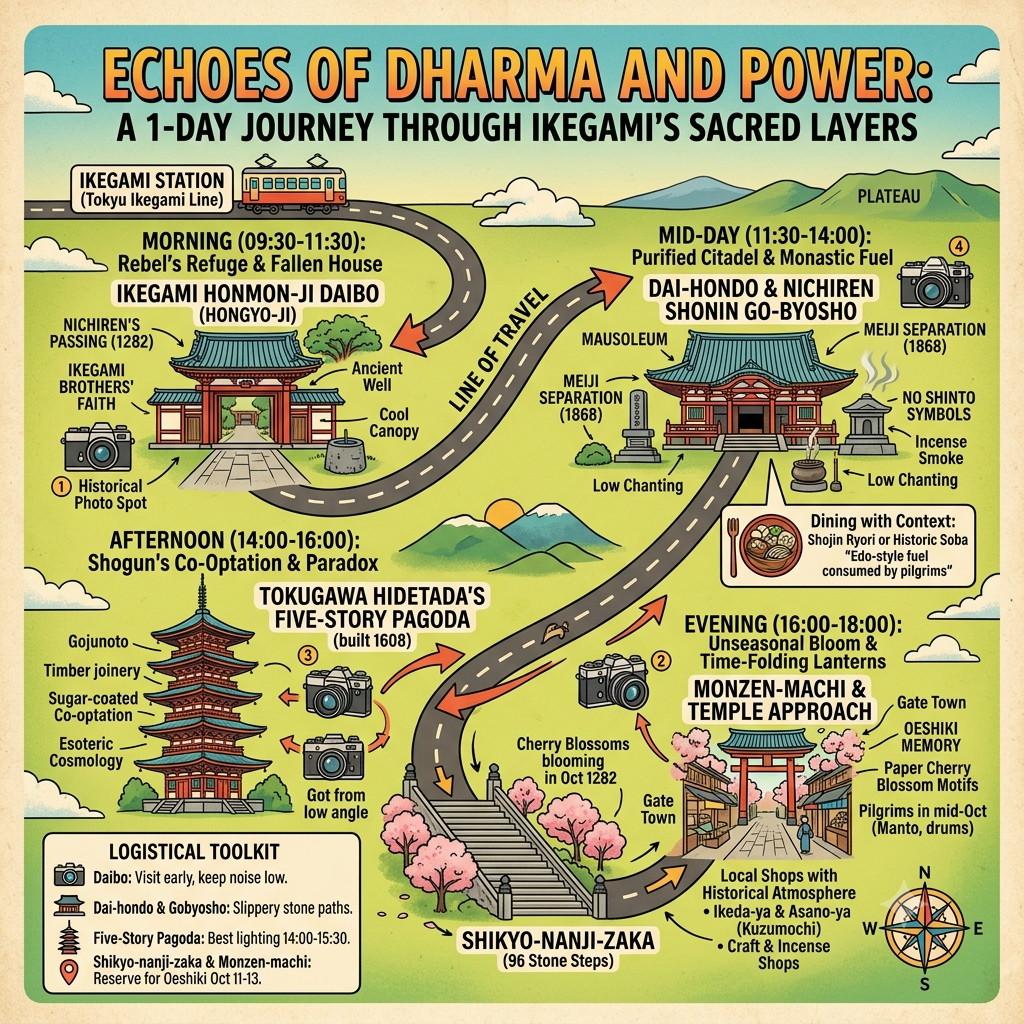
Take the Tōkyū Ikegami Line from Gotanda Station to Ikegami Station — approximately twelve minutes on a single-track commuter branch that runs through residential neighborhoods where tourist infrastructure has never arrived. From Ikegami Station, walk north along the covered shopping street for ten minutes until the street gives way to a stone-paved slope flanked by lanterns. The walk up is five minutes more and is not optional: the incline and the transition it produces are part of how the site works. Arrive on foot.
The Oeshiki
The Oeshiki festival runs annually October 11th–13th, with the principal lantern processions on the evenings of the 12th and 13th and the formal memorial service on the 13th. Attendance across the three days regularly reaches 300,000. Admission to the temple grounds is free at all times. If you can attend on only one evening, the 12th is the better choice: the processions are in full movement, and the surrounding neighborhood becomes a single living installation of light and memory.
Key Sites Within the Grounds
The Five-Story Pagoda (1608) stands on a raised platform in the western precincts. As a National Important Cultural Property and the most visually dominant structure on the hill, it is impossible to miss. It is also the most legible evidence of how political power leaves its mark on sacred space. Look at it knowing what it is.
The Ōbō (Hongyōji) sits off the main visitor route and receives a fraction of the traffic directed to the pagoda and main hall. This is the traditional site of Nichiren's death. It is the right place to spend the most time.
The Nichiren Mausoleum (日蓮聖人御廟所) is located uphill from the main hall, in the quieter rear section of the grounds. Relics of Nichiren are held here. The approach is quieter than the front precincts.
The Kono Kyō Nanjiji-zaka — the main entrance stairway — takes its name from a passage in the Lotus Sutra about the difficulty of upholding the teaching. The name is carved into the site's geography. Walk down it on the way out, slowly enough to read what it says.
Where to Stay
Ikegami has no accommodation of its own, but central Tokyo is under thirty minutes by train. For the Oeshiki, base yourself in Shinagawa or Gotanda — both are ten minutes or less from the Ikegami Line. Book early for October 12th–13th; the festival is not obscure.
Before You Go
The site rewards preparation. The grounds read differently — read deeper — when you arrive already knowing what the pagoda is doing there, what the Ōbō is, and why the cherry blossoms matter in October. The five stories in this essay are a start. The letters Nichiren wrote to the Ikegami brothers, available in English translation in Philip Yampolsky's Selected Writings of Nichiren, will tell you the rest of Story II in Nichiren's own voice.
💡 Frequently Asked Questions: Tokyo Ikegami Honmonji Guide
Q1: Is Ikegami Honmonji Temple in Tokyo worth visiting, and what are the main attractions?
Ikegami Honmonji Temple in Tokyo’s Ota City is highly recommended for travelers seeking deep Japanese history, sacred Buddhist heritage, and a peaceful escape from crowded tourist spots. As the site where Nichiren Shonin, founder of Nichiren Buddhism, passed away in 1282, it holds profound spiritual significance. Key highlights include Kanto’s oldest five-story pagoda built in 1608 (an Important Cultural Property), the impressive 96-step Shikyo-nanji-zaka stone staircase, and historic grounds that hosted the pivotal Edo Castle peace negotiations between Katsu Kaishu and Saigo Takamori in 1868. Visitors can also enjoy vibrant autumn foliage, early spring plum blossoms, and serene historic temple grounds.
Q2: When is the Ikegami Honmonji Oeshiki Festival held, and what makes Mando Neri-Koyo special?
The Oeshiki Festival at Ikegami Honmonji takes place annually from October 11 to 13, honoring the memorial of Nichiren Shonin. The absolute highlight occurs on the night of October 12 during the Mando Neri-Koyo parade. Over 30 massive, illuminated 'Mando' lanterns decorated with thousands of handmade cherry blossom paper flowers are carried along the temple approach. Accompanied by traditional flutes, energetic taiko drumming, and dramatic Matoi (firemen's banner) spinning performances, the festival draws over 300,000 attendees. Flanked by lively street food stalls (yatai), it offers an unforgettable opportunity to experience authentic Edo-style festival culture in autumn.
Q3: How do you get to Ikegami Honmonji, and what food or hidden spots are nearby?
Ikegami Honmonji is easily reachable via a 10-minute walk from Ikegami Station on the Tokyu Ikegami Line, or a 12-minute walk from Nishi-magome Station (Exit South) on the Toei Asakusa Line. Right next to the temple lies Ikegami Plum Garden (Ikegami Bainen), famous for over 300 plum trees blooming in February and March. For local cuisine, the historic temple approach features traditional shops serving 'Kuzumochi' (fermented wheat starch cake served with toasted soybean powder and black sugar syrup), a local delicacy enjoyed for centuries. The surrounding neighborhood also offers charming Retro-style streets and quiet local cafes for an authentic day trip.
Reference and Further reading
First layer – Main sources of literature and institutions:
- 池上本門寺藏古文書(部分已指定重要文化財);身延山久遠寺(山梨縣)藏日蓮御真蹟及弘安末期書簡群(可作池上事件的第一手補充材料);「建議查證」東京都立図書館近世以降的寺社文書目錄。
- 池上本門寺藏「池上文書」(部分已有翻刻本);「建議查證」東京国立博物館收藏的相關文書及圖像材料。
- 池上本門寺藏御会式関連文書;東京都無形民俗文化財指定記錄
- 文化庁指定重要文化財調查記録(五重塔関連);江戸幕府正史《徳川実紀》(国立国会図書館数字コレクションで閲覧可能)
- 国立公文書館デジタルアーカイブ所蔵の神仏分離関連太政官布告(部分已數位化);大田区立郷土博物館蔵資料(原大森区の地域史料);「建議查證」東京都立図書館近代史料部門的相關行政文書。
The second layer – secondary academic materials:
- Jacqueline I. Stone, Original Enlightenment and the Transformation of Medieval Japanese Buddhism (University of Hawaii Press, 1999)
- 佐藤弘夫,《日蓮 闘う仏教者》(山川出版社,2003年)
- 高木豊,《日蓮 その行動と思想》(評論社,1965年)
- Philip Yampolsky, trans., Selected Writings of Nichiren (Columbia University Press, 1990)
- 日蓮宗宗典編纂会編,《日蓮聖人遺文集》(身延山大学出版部)——池上兄弟御書的一次文本
- 佐々木馨,《中世仏教と鎌倉幕府》(吉川弘文館,1987年)——政治背景
- 圭室諦成,《葬式仏教》(大法輪閣,1963年),第八章
- 桜井徳太郎,《民間信仰》(塙書房,1966年)
- George J. Tanabe, Jr. & Willa Jane Tanabe, eds., The Lotus Sutra in Japanese Culture (University of Hawaii Press, 1989)
- 辻善之助,《日本仏教史》第七卷(江戸時代),岩波書店
- Tamamuro Fumio, "Japan," in Buddhism and Politics in Twentieth Century Asia, ed. Ian Harris (Continuum, 1999)
- James Ketelaar, Of Heretics and Martyrs in Meiji Japan (Princeton University Press, 1990),第一章
- 安丸良夫,《神々の明治維新——神仏分離と廃仏毀釈》(岩波新書,1979年)——本故事最重要的學術參考
- 圭室文雄,《神仏分離》(教育社歴史新書,1977年)
- James Ketelaar, Of Heretics and Martyrs in Meiji Japan (Princeton University Press, 1990)——英文學術參考
Third layer – Supplementary information:
- 御会式縁起各版本(需比較年代與文本傳統,作為文化詮釋資料,非實證史料)
- 池上家傳記(真偽與年代有爭議,「建議進一步查證」)
- 各版本「御会式縁起」(起源傳說文本),年代與文本系統需比較分析
- 池上本門寺寺院年誌(年代不一,真偽需甄別)
- 池上本門寺的内部寺院年史及口傳記錄
Historical gap:
- The Kamakura Shogunate's official history, Azuma Kagami, is almost entirely silent on Nichiren's death. A religious figure deemed dangerous enough by the shogunate to warrant exile was completely erased from official records after his death—this gap itself is historical data, revealing the specific attitude of Kamakura politics towards Nichiren Buddhism: not direct suppression, but administrative silencing. This "politics of documentary gaps" deserves in-depth analysis as an independent research topic.
- The specific positions and ranks of Ikegami Munenaka within the Kamakura Shogunate are inconsistently described in publicly available academic materials, requiring a more rigorous examination of the documents. A more fundamental problem is that the Ikegami Brothers' Official Documents, as historical material, are entirely from Nichiren's perspective, lacking independent corroboration from shogunate documents or the Ikegami family's own stance. The possibility that existing Nichiren Buddhist documents were selectively presented for religious purposes is the most important historical critique and warning in this story.
- The specific historical origin of the Manto procession is currently unclear—did it begin in the Kamakura period, or did it gradually take shape in its current form during the Muromachi or Edo periods? "It is recommended to systematically verify" whether there are relevant records in travelogues and local chronicles from the Edo period (such as the Edo Meisho Zue and similar documents) to determine the historical stratification of the Manto tradition. This is currently the biggest documentary gap in this story.
- The specific political background and internal decision-making process of Tokugawa Hidetada's order to build the five-story pagoda are scarcely described in currently available academic literature. "It is recommended to prioritize verification" of the Keicho 13th year entry in the Tokugawa Jiki and temple administration documents related to the shogunate's religious policies to clarify the actual motivation and negotiation process of this political donation.
- The specific experiences of Ikegami Honmon-ji Temple during the period of Buddhist abolition and destruction of temples currently lack case-specific academic research, representing the biggest documentary gap in this archive. "It is recommended to prioritize verification" of historical materials from Ota Ward (especially the religious administration section in the early Meiji period) and the former Omori Ward to determine the specific spatial changes of Honmon-ji Temple between 1868 and 1874.
 Lawrence
 Lawrence
 Lawrence
Research for this article draws on Jacqueline I. Stone's Original Enlightenment and the Transformation of Medieval Japanese Buddhism (University of Hawaii Press, 1999); James Ketelaar's Of Heretics and Martyrs in Meiji Japan (Princeton University Press, 1990); Satō Hiroo's Nichiren: Tatakaū Bukkyōsha (Yamakawa Shuppansha, 2003); Philip Yampolsky's Selected Writings of Nichiren (Columbia University Press, 1990); Yasumaru Yoshio's Kamigami no Meiji Ishin (Iwanami Shoten, 1979); and primary archive materials held at Ikegami Honmonji and the Kuonji at Minobusan.