Meguro, Tokyo: The Sacred Black Eye at the Heart of Edo's Forgotten City Plan
The name Meguro means "Black Eye." That eye belongs to Fudō Myōō — the Immovable One — whose blue-black gaze has watched over Tokyo from this hillside for more than a thousand years. This is the story of the city's most consequential sacred geography, and why it still hasn't moved.
 Lawrence
This is a historical travel piece about Meguro — a Tokyo neighborhood better known today for its riverside cafés and spring tunnel of cherry blossoms than for its extraordinary place in the spiritual cartography of Edo. Walking from the ancient temple of Ryūsen-ji (瀧泉寺 / 目黒不動尊) through the medieval slope of Gyōnin-zaka and into the layers of esoteric Buddhist sacred geography beneath the modern city, this article traces five stories that no guidebook has assembled in one place: the founding of Tokyo's oldest esoteric stronghold, the city-wide sacred mandala installed around Edo's perimeter, the 1772 fire that burned from the wrong temple, the Shogunal hunting grounds that accidentally preserved a sacred landscape, and the Meiji purge that nearly erased a thousand years of religious history. What the reader gains: a completely different Meguro, operating at an entirely different depth.
The Eye That Never Closed
There is a name in Tokyo that has never been fully explained, and it sits in plain sight.
Meguro — 目黒 — translates literally as "Black Eye." Most walkers through the neighborhood's riverside café scene or its spring tunnel of cherry blossoms do not pause at this. It reads as atmospheric, perhaps poetic, the kind of evocative place-name that ancient geography tends to produce. But in the precise vocabulary of Tendai esoteric Buddhism — the intellectual tradition that shaped this hilltop for more than a millennium before Tokyo existed — the phrase "black eye" is not atmosphere. It is a theological statement about the nature of a specific deity, encoded into the name of a place.
Fudō Myōō (不動明王), "The Immovable One," is the wrathful emanation of the central Buddha in esoteric Buddhist cosmology. In every painted and sculpted rendering of this deity across twelve centuries of Japanese religious art, his most iconic feature is his eyes: one gazing upward toward the realm of enlightened mind, one gazing downward toward the realm of human suffering, and both rendered in a deep, characteristic blue-black — the color the Japanese iconographic tradition calls konjō, the color of the sky at its highest altitude. The color, precisely, of black.
The name Meguro may be an accident of geography — a dark spring, a mineral-colored stream. It may be a straightforward place-name that predates the Buddhist settlement. Or it may be something more intentional: a sacred site that named itself after the deity's most theologically charged feature, so that anyone who asked what is this place called? would receive an answer that was also an answer to whose gaze watches over it?
That question has been tested five times in Meguro's documented history. What follows is the record of those five tests.
Listen to the historical stories told in detail (For subscribers only)
Part One: The Naming of the Black Eye
A Platform's Edge and the Vajra Waterfall | Early-to-Mid Heian Period, 794–1185 CE
The geography of western Tokyo is defined by a geological accident that most residents never consciously register. The Musashino Plateau — the elevated tableland on which much of the city's western neighborhoods sit — has a ragged eastern edge, where the platform drops away toward the lower river valleys. This edge is not dramatic in any Alpine sense, but it is real and consistent: a declivity that produces, along its length, a particular topographic condition. Groundwater moves laterally through the plateau's porous subsoil until it reaches this edge, and then it emerges — in springs, in seeps, in the small waterfalls that make certain hillside sites in Tokyo inexplicably wet and cool even in midsummer.
One of these emergence points is at Meguro. And someone, at some point in the early Heian period, understood what this meant.
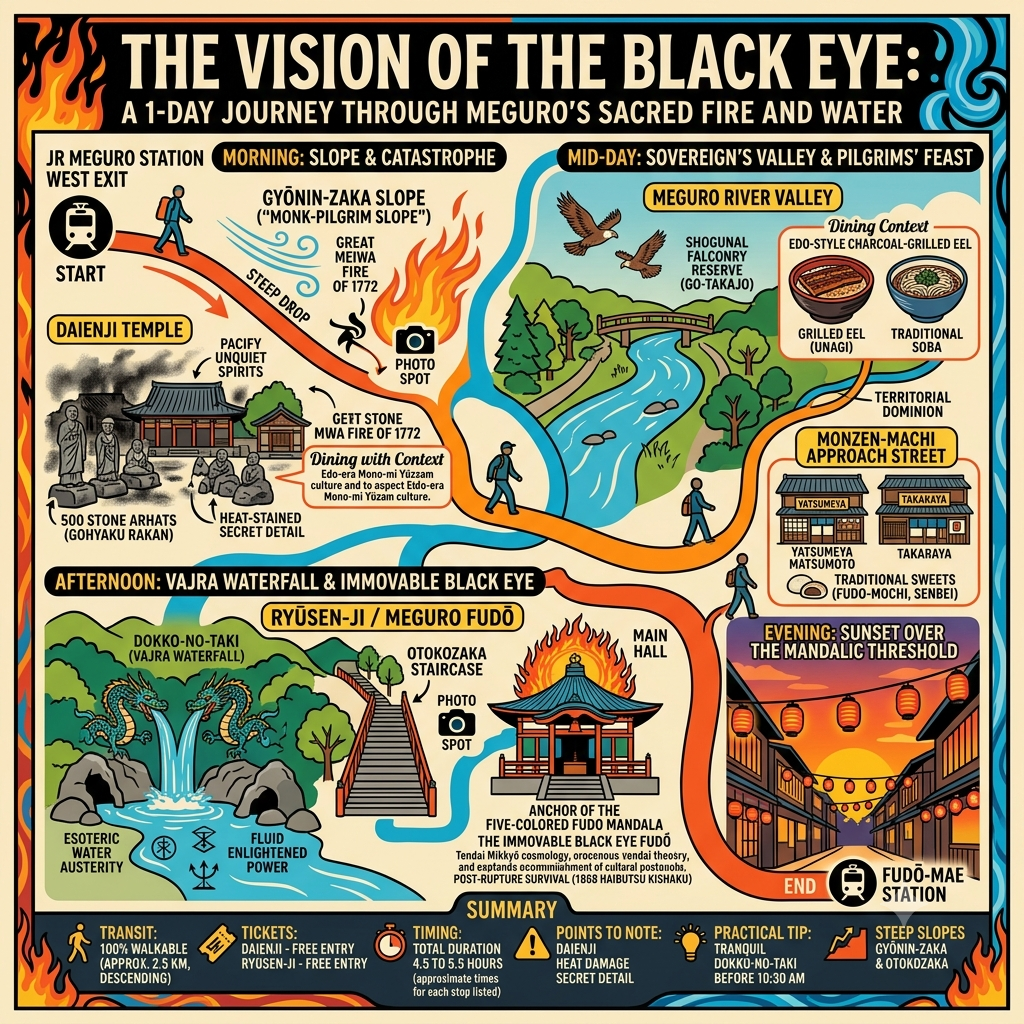
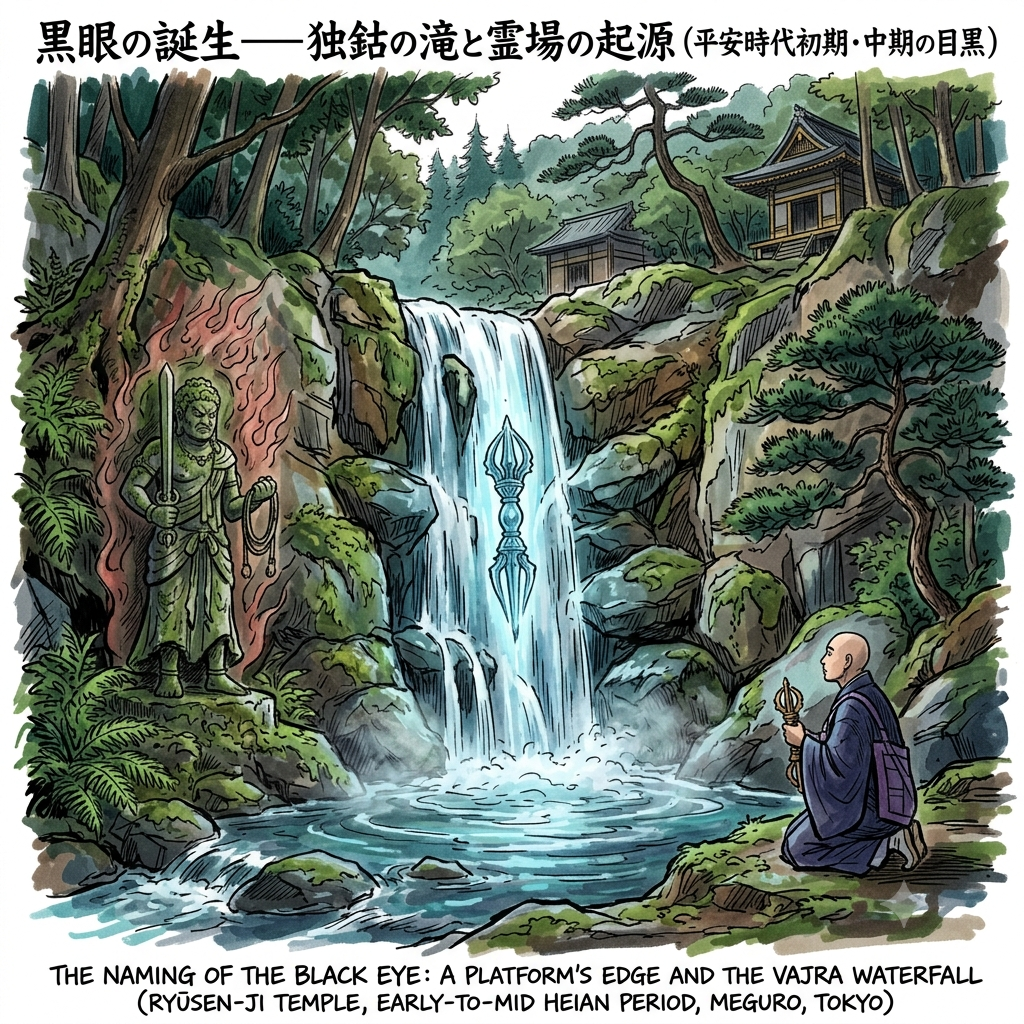
The temple established here — Ryūsen-ji (瀧泉寺), later known across Edo as Meguro Fudōson (目黒不動尊) — carries its founding intention in its name. Ryūsen means "waterfall-spring": a spring of water that falls. The deity installed to preside over it was Fudō Myōō. And the waterfall in the temple's precincts was given a name of such cosmological specificity that it repays close reading: 独鈷の滝, Dokko-no-Taki — the Vajra Waterfall.
The Wrathful Black Eye Of Tokyo
In the Sanskrit that underlies Japanese esoteric Buddhist terminology, vajra means something difficult to translate cleanly: the quality of being indestructible, capable of penetrating all phenomena without being altered by any of them. The dokko — the ritual single-pointed vajra scepter — is the foundational implement of esoteric practice, the physical object that symbolizes awakened mind's inability to be modified by contact with the world. To name a waterfall after this implement is to make a specific claim about what this water is: not water that happens to flow near a sacred site, but water that enacts the vajra's essential property in fluid form. It descends from the hidden interior of the plateau, breaks through stone, and falls — changing nothing about the stone it contacts, penetrating it entirely.
Temple tradition attributes the site's establishment to the Tendai monk Ennin (圓仁, 794–864 CE), one of the most significant figures in the history of Buddhism's transmission from Tang China to Japan. Ennin spent nine years in China between 838 and 847 CE — documenting the journey in the diary now known in English as Record of a Pilgrimage to China in Search of the Dharma — and returned carrying the fullest form of esoteric Tendai teaching yet brought to these islands. His association with the Meguro site is plausible on institutional grounds. The specific founding date assigned by popular temple literature (sometimes 808 CE) creates a chronological inconsistency with Ennin's known biography, and the original temple records require more careful archival study than they have yet received. But the founding logic is impeccable: a water-emergence site at a plateau edge, installed with the deity most specifically associated with waterfall austerity practice, accessible to the ritual practitioners who used waterfalls as sites of embodied contact with sacred power. This site was not chosen at random.
The Vajra Waterfall named itself.
Part Two: Edo's Sacred City Map
Five Temples, Five Colors, One Mandala | Early Edo Period, attributed to Shogun Iemitsu, r. 1623–1651
When the Tokugawa shogunate established itself at Edo in 1603, it inherited a tidal-flat fishing settlement and was expected to turn it into the capital of a unified Japan within a generation. The engineering challenge was extraordinary: canal networks, land reclamation, water management for a city that would eventually hold close to a million people. But for a political culture that understood space as simultaneously physical and cosmological, there was a second challenge of equal weight. How do you sanctify a city that doesn't exist yet? How do you install the spiritual infrastructure of a metropolis before the metropolis has built its streets?
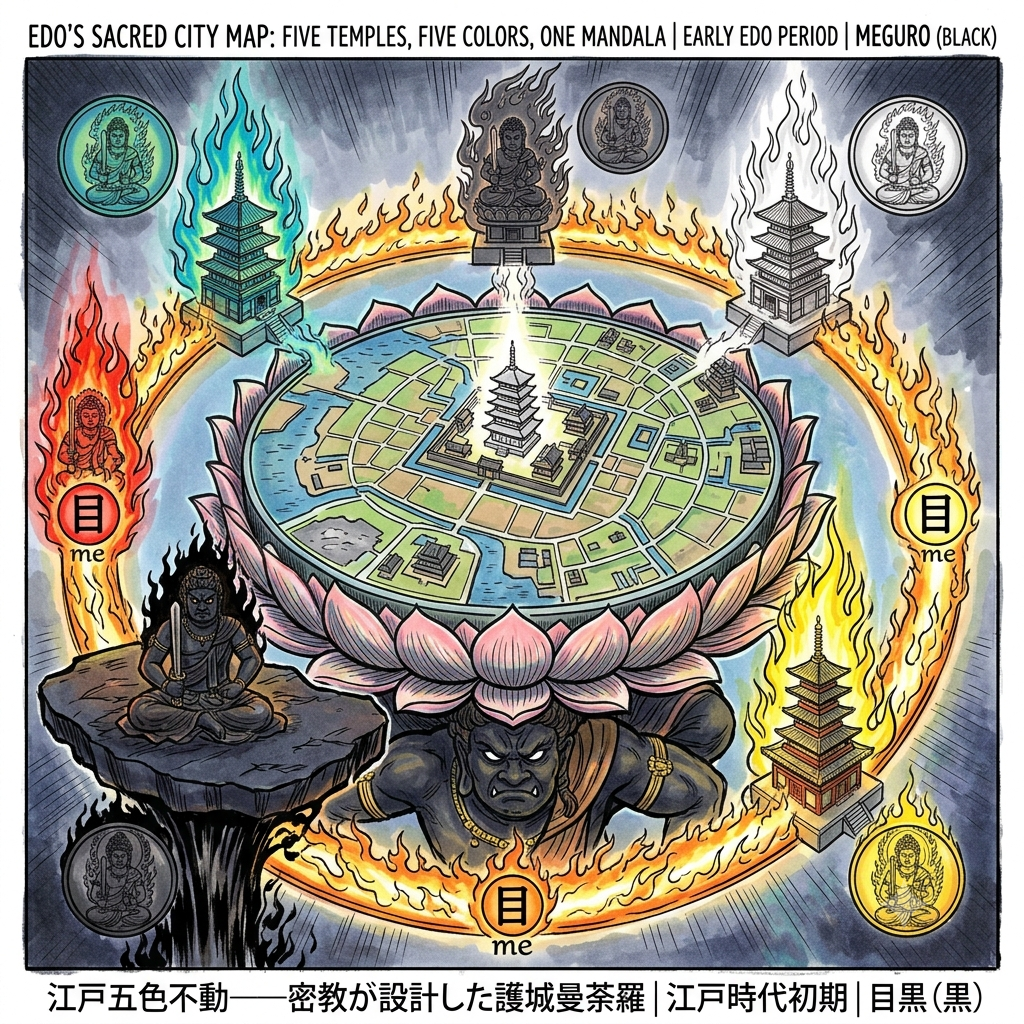
The answer attributed to the third Tokugawa Shogun, Iemitsu (徳川家光, r. 1623–1651), is one of the most remarkable acts of urban sacred geometry in East Asian history. According to temple tradition — reflected throughout Edo-period travel literature, pilgrimage maps, and woodblock print series — Iemitsu established five Fudō Myōō temples at key points around Edo's perimeter, assigning each a color from the esoteric Buddhist five-color system:
| Color | Temple | Location |
|---|---|---|
| Black (黒) | Meguro Fudō / Ryūsen-ji | Meguro Ward |
| White (白) | Mejiro Fudō / Kongōin (金乗院) | Toshima Ward |
| Red (赤) | Meaka Fudō / Nankoku-ji (南谷寺) | Bunkyō Ward |
| Blue-Green (青) | Meao Fudō / Kyōsen-in (教学院) | Setagaya Ward |
| Yellow (黄) | Meki Fudō (two temples claim this: Saikōji & Enshō-in) | Edogawa / Adachi Wards |
The Japanese word for each "eye" temple uses the character 目 — me — which means both "eye" (the organ) and, in older usage, the "source" of a spring. Five eyes. Five colors. Distributed across the city's cardinal directions. Watching.
How The Five-Colored Fudō Protected Edo
In esoteric Buddhist cosmology, these five colors are not aesthetic categories. They are the five transformative wisdoms of the Five Wisdom Buddhas (五智如来, Gochi Nyorai) — five modes by which the undifferentiated ground of reality manifests itself as specific forms of enlightened awareness. Yellow transforms pride into the wisdom of equality. Red transforms desire into discriminating awareness. White transforms ignorance into mirror-like clarity. Blue-green transforms envy into all-accomplishing action. Black — the position assigned to Meguro — represents the pre-manifestation state: the undifferentiated energy from which all the other colors and all the other wisdoms emerge. In the cosmological logic of the system, Meguro is not one node among five equals. It is the root from which the other four proceed.
Each of these five temples conducted regular goma (護摩) ceremonies — the central ritual of Fudō Myōō worship, in which offerings representing afflictions and obstacles are consumed in a sacred fire presided over by the deity's own surrounding flames. What this means, extrapolated to urban scale: Edo maintained five simultaneously burning sacred fires distributed around its perimeter. The city was, from an esoteric Buddhist perspective, perpetually enclosed within an active fire ritual. Five protective fires, held open in five directions, transforming the city's accumulated spiritual disturbance into purified energy. A living mandala, maintained by institutional religious practice across the entire capital.
Whether Iemitsu planned this as a unified act of cosmological city design, or whether the system crystallized gradually and the mandala interpretation was retrospectively unified, is a question that primary archival research has not yet definitively resolved. What is not in question: by the mid-Edo period, the Five-Colored Fudō system was culturally real — documented in travel literature, embedded in popular pilgrimage practice, and understood by Edo's residents as the sacred architecture of their city. Meguro's role in that architecture was specific, not generic. It held the Black position. The pre-manifestation ground. The root.
Part Three: The Fire That Started at the Wrong Temple
The Meiwa Conflagration | 1772 CE
Of all the ways history could have chosen to test Meguro's cosmological claim, it chose the most cosmologically precise.
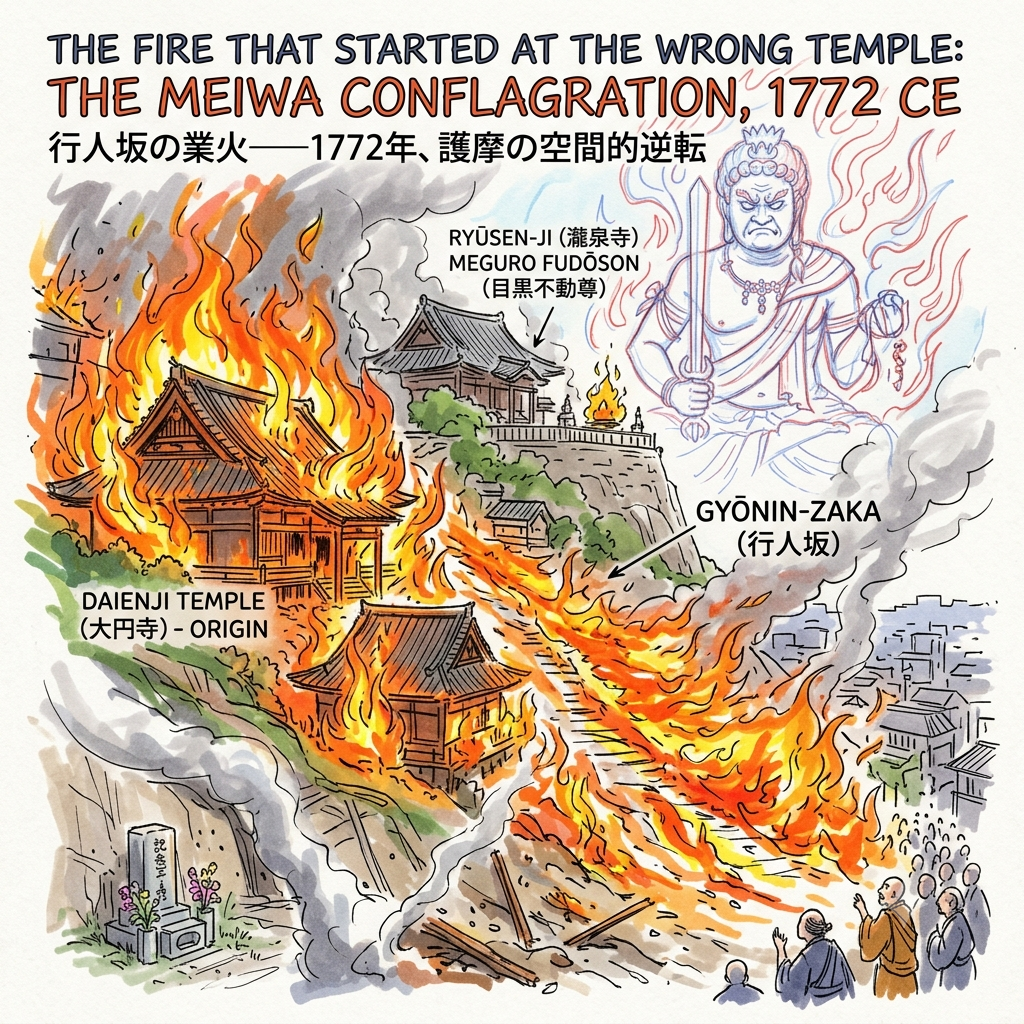
In 1772 — the ninth year of the Meiwa era — a fire broke out at 大円寺 (Daienji), a Buddhist temple situated on the slope called 行人坂 (Gyōnin-zaka), meaning "Monk-Pilgrim's Slope": the hillside path used by itinerant ascetics and pilgrims making their way to Meguro Fudō from the northern approach. Daienji sat less than a kilometer from Ryūsen-ji, below the Fudō temple, on the descending side of the plateau edge, at the point where the sacred landscape gave way to the lower districts of the city.
The fire burned for two to three days. It swept northeast across Edo in one of the city's most destructive conflagrations — recorded in history as the 明和の大火, the Great Meiwa Fire, or the Great Fire of Gyōnin-zaka. Temple records and period documentation associate the fire's origin with a monk connected to Daienji. The specific circumstances — whether this was deliberate arson, a ritual act gone catastrophically wrong, or accident — and the individual's precise identity and judicial fate require verification from the Edo city magistrate's archive records, which are the essential primary source for the story's factual core. Daienji maintains a memorial to the fire's victims to this day, continuously tended for more than two and a half centuries.
The Sacred Fire That Burned Tokyo
The cosmological problem embedded in this event is not subtle.
Fudō Myōō is the deity of transformative fire. His iconographic form is surrounded by Karurafunen — Garuḍa-flames — the cosmological fire that burns away delusion without consuming the immovable deity at its center. The goma ceremony, performed regularly at Ryūsen-ji, is the ritual enactment of this same fire: controlled, intentional, purifying. Meguro was installed as Edo's Black node partly to anchor this purifying-fire tradition at the city's southwestern threshold.
And from the slope leading toward that very node, Edo's most destructive secular fire began.
This is not a theological contradiction. In the Mikkyō interpretive framework, it is a cosmological demonstration. Fudō Myōō does not prevent fire. He is fire — fire in its disciplined form, fire subjected to the practitioner's intention, fire that transforms rather than destroys. The catastrophe of 1772 was the precise inversion of that model: fire without intention, fire that originated inside the very institutional container (a Buddhist temple) designed to house its ritual management. When the container itself becomes the source of uncontrolled destruction, the protective cosmological system is not merely tested. It is reversed from within.
The people of Edo who survived the Meiwa Fire and continued to make pilgrimages to Meguro Fudō in its aftermath were, knowingly or not, re-enacting a theological argument: that the solution to uncontrolled fire is more controlled fire — more goma, more intentional engagement with the transformative energy that turns catastrophic when left unmanaged. Daienji's ongoing memorial practice — the continuous ritual care of the victims' memory across two and a half centuries — is, in the same framework, a technology of containment: transforming the potentially dangerous energy of thousands of suddenly-dead into something that can coexist with the living landscape.
The memorial stone still receives flowers. The argument is still being made.
Part Four: The Hawk and the Immovable One
The Shogunal Falconry Reserve and the Paradox of Preservation | Edo Period, 1603–1868
For most of the Edo period, Meguro existed in a state of involuntary conservation.
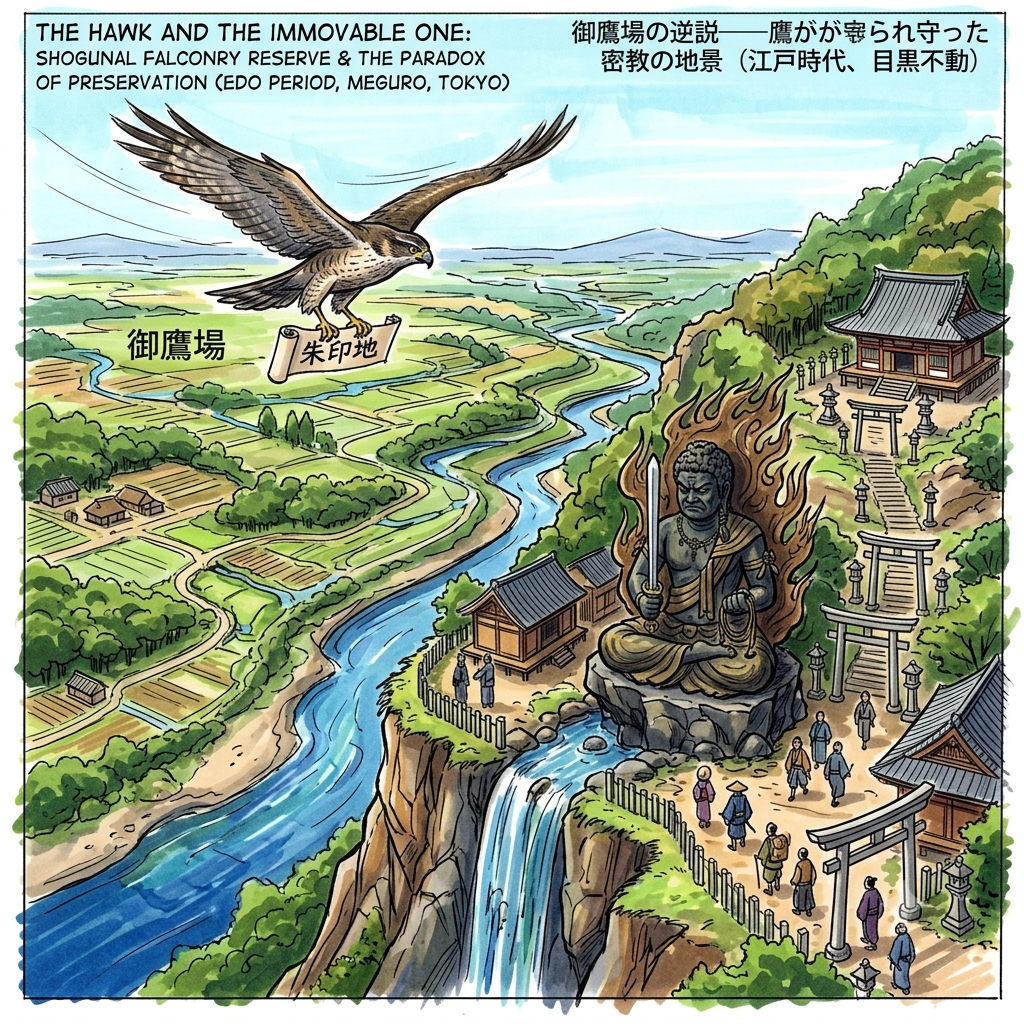
The Tokugawa shogunate maintained extensive 御鷹場 (go-takajō) — Shogunal falconry reserves — across the territory surrounding the capital. These were not recreational parks in any modern sense. They were instruments of sovereign territory-management: legally enforced zones where restrictions on agricultural intensification, construction, and land modification preserved the semi-wild character that the practice of falconry required. The area around Meguro fell within or directly adjacent to this system. Farmers in the affected areas faced limits on certain crops, prohibitions on unlicensed dog-keeping, and bans on bird-trapping outside authorized channels — all to maintain the open, vegetated landscape conditions that the Shogun's hawks needed to hunt.
Falconry in Tokugawa Japan was less a sport than a ritual of sovereignty. When the Shogun flew a hawk across a territory, he was performing, in the most physical possible terms, a claim that this land answered to his authority. The bird was the sovereign's sight extended into the air, his will made aerodynamic. Maintaining the falconry grounds required maintaining the landscape — and maintaining the landscape, unintentionally, preserved the semi-wild approach to Meguro Fudō that made it one of Edo's most attractive pilgrimage destinations.
How A Hawk Saved A Temple
The spatial theology that emerges from placing these two systems in the same landscape is quietly remarkable. The Shogun's territorial claim was dynamic, mobile, aerial — the hawk as moving sovereign extension across the terrain. The deity's territorial claim was static, rooted, ground-anchored — the Immovable One as the permanent cosmological anchor of the site. These two logics operated simultaneously in the same space, and they legitimated each other. The Shogunate issued red-seal land grants (朱印地, shuinchi) to Ryūsen-ji, formally protecting the temple's land. In return, the temple's cosmological authority — its claim to be the Black node of Edo's sacred mandala — gave the Shogunal landscape around it a depth that a falconry reserve alone could never provide.
The hawk needed open sky and maintained terrain. The Immovable One needed the plateau edge and the spring. They shared a geography, and each made the other's claim more legible. In this reading, the falconry ground was the Shogun's own mandala of territorial sovereignty — and the temple within it was the mandala's cosmological center, holding still while the hawk moved.
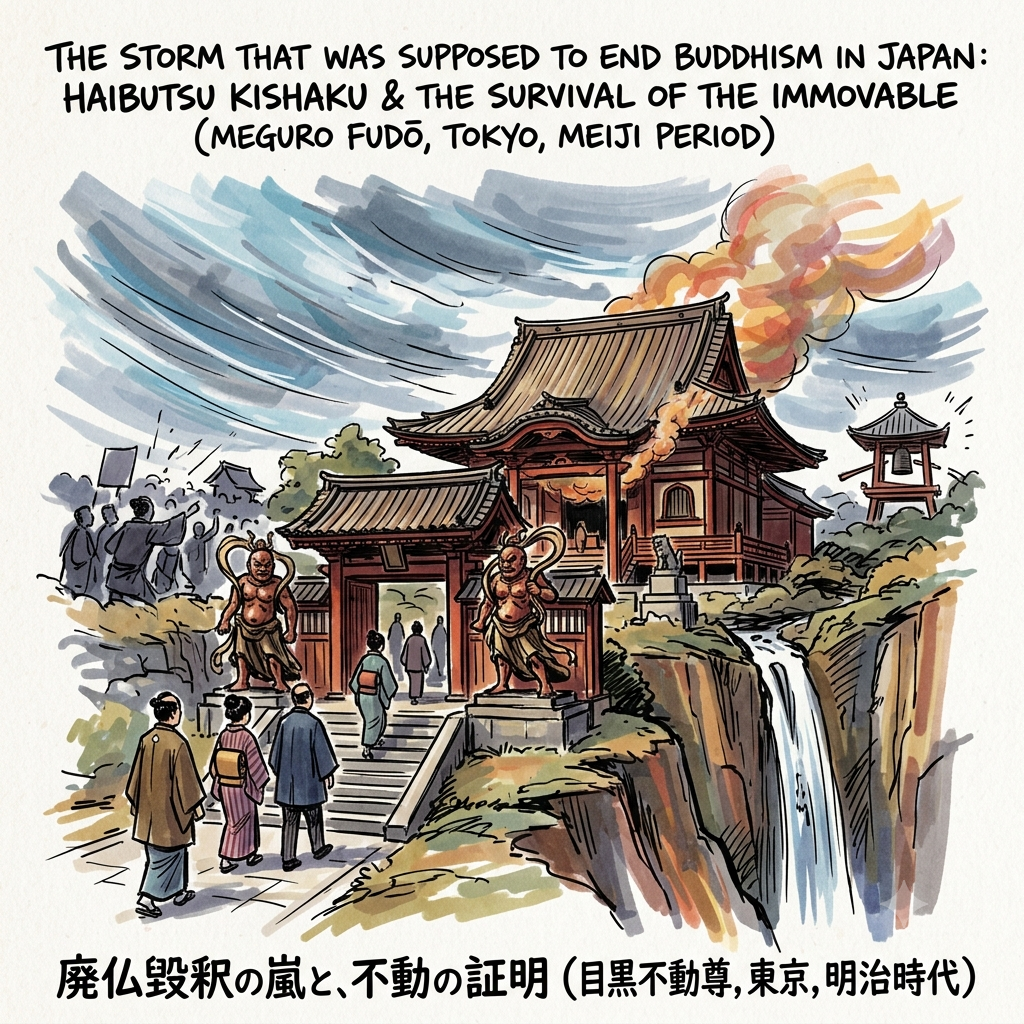
Part Five: The Storm That Was Supposed to End Buddhism in Japan
The Haibutsu Kishaku and the Survival of the Immovable | Meiji Period, from 1868
In 1868, the Meiji government issued the decrees implementing 神仏分離 (shinbutsu bunri) — the forced separation of Shinto and Buddhism. In bureaucratic terms, this sounds like an administrative reorganization. In practice, it detonated a social movement — 廃仏毀釈 (haibutsu kishaku), literally "abandonment of Buddhism, destruction of Śākyamuni's teachings" — that destroyed thousands of Buddhist temples across Japan, melted down bronze Buddha statues for coins, forced tens of thousands of monks to laicize, and systematically dismantled the 神仏習合 (shinbutsu shūgō) synthesis — the millennium-old fusion of Shinto and Buddhist frameworks — that had been the operating system of Japanese religious life since the Nara period.
The policy's logic was Meiji state-building: the Emperor's restored divine status required a "pure" Shinto, uncontaminated by Buddhist doctrinal mixing. The cosmological framework that had governed Japanese sacred space for a thousand years was to be overwritten by a state-mandated alternative. In some regions — Shimane, Kagoshima, parts of Tōhoku — the destruction was systematic and irreversible. Irreplaceable objects were gone within months.
The Temple That Survived A National Purge
Ryūsen-ji survived. Meguro Fudō still stands, still conducting goma ceremonies.
This is, in the simplest possible terms, the most remarkable fact in Meguro's documented history — and it carries specific cosmological weight that should not be dissolved into generic commentary about Buddhist resilience. The deity enshrined here is called 不動 — Fudō, "The Immovable One." The Meiji state's ideological machinery — which displaced Buddhist institutions across the entire country, which restructured the legal and social framework that had protected temples for centuries — applied its full force to exactly the kind of institution that Ryūsen-ji represented: a major syncretic site, a popular pilgrimage center, a temple embedded in the shinbutsu shūgō tradition that the new state was explicitly dismantling.
The Immovable One was not moved.
This outcome was not supernatural. It was the result of dense lay organizational roots — the confraternities, neighborhood associations, and devotional guilds (講, kō) of Meguro Fudō's long-established community — that gave the temple a social thickness that purely monastic or politically dependent institutions could not replicate. It was also a function of the Meiji government's own inconsistency: enforcement was harsher in some regions than others, and a major temple embedded in a large urban population presented political costs that rural temples did not.
But the theological name of the site turns out to be an accurate description of its spatial behavior. Fudō Myōō's essential quality — the quality encoded in his name, his iconography, and his cosmological function — is resistance to displacement by any force, however powerful. Meguro's sacred infrastructure was tested in 1868 by the most systematic assault on Buddhist institutions Japan had ever produced. It remains in place.
The site today is a post-rupture sacred space. The formal shinbutsu shūgō synthesis that characterized it through most of its history was institutionally severed in 1868; what you encounter at contemporary Ryūsen-ji is a Buddhist temple operating within Meiji-mandated categorical boundaries that would have been foreign to its pre-1868 character. But the material landscape — the waterfall, the stones, the spatial logic of the plateau edge — retains the imprint of the older synthesis in ways that institutional policy could not efficiently address. The rupture is real. So is the continuity that persisted through it.
Reading the Landscape: Esoteric Buddhist Geometry in Tokyo's Urban Fabric
Traditional histories of Meguro treat the area as a well-documented Edo pilgrimage destination: famous, well-visited, adequately described. The interpretation offered here is different, and it is worth stating directly before unpacking it.
Meguro is the location where an esoteric Buddhist civilization installed Tokyo's cosmological immune system — before Tokyo existed.
The argument has four components.
First: the toponym. "Black Eye" is not geographic accident. In esoteric Buddhist iconography, Fudō Myōō's defining visual feature is his characteristic dark gaze — the konjō blue-black that signals the most concentrated, least-differentiated form of the deity's transformative power. If the place-name predates the temple (possible), it named a sacred water-source that the Fudō cult then appropriated and deepened through iconographic resonance. If the place-name was generated by the cult (also possible), the site named itself after the deity's most theologically charged feature. In either reading, the landscape became the deity's face: a black eye, watching from the plateau edge.
Second: the waterfall. The naming of Ryūsen-ji's sacred spring as the Vajra Waterfall (Dokko-no-Taki) encodes a specific theological claim about this site's sacred energy: this is not water adjacent to a sacred object but water that is a sacred force in liquid form, descending from the hidden realm of the plateau's interior to the visible surface. The choice of this particular water-emergence point for a Fudō installation places the deity at exactly the geological boundary his cosmological function describes: the threshold between hidden and manifest.
Third: the Five-Colored Fudō mandala. The placement of Meguro as the Black node of the city-wide protective grid is cosmologically precise, not directionally convenient. Black in the Mikkyō five-color system is the pre-manifestation state — the undifferentiated energy that precedes the differentiation of all the other transformative wisdoms. Meguro as Black does not occupy one position among five equals; it occupies the cosmological ground from which the other four proceed. The five goma fires burning simultaneously around Edo's perimeter constituted, in esoteric Buddhist terms, a city-scale fire ritual: a living protective mandala of the Garbhadhātu (womb-realm) type, with Meguro as its deepest anchor.
Fourth: the historical record of immovability. The sacred geography of Meguro has been subjected to five distinct pressures over its documented history: a catastrophic fire originating within its own neighborhood (1772); a city-wide campaign to destroy the Buddhist institutions that constituted the protective mandala system (post-1868); wave after wave of urban modernization pressure; wartime reconstruction; and the contemporary hyper-development of one of the world's most compressed metropolitan areas. In each case, the sacred coordinates of Meguro — the waterfall, the plateau edge, the Fudō temple, the slope — have survived. Diminished, sometimes. Altered, certainly. But spatially continuous.
This pattern has a name in the tradition's own vocabulary: 不動 — Fudō, the quality of not being moved. It is the spatial behavior of this site across a millennium of documented history.
Holographic Sensory Cue:
Enter Ryūsen-ji through the stone gate and climb the worn steps. Before you hear the water, you feel the temperature change — several degrees cooler than the street outside, produced by the combination of shade, stone, and the continuous water movement ahead. The Dokko-no-Taki falls in a modest continuous curtain into a stone pool; its sound is low and constant, a sustained baseline frequency that masks the city's background noise without fully replacing it, creating an acoustic pocket in which ambient urban sound becomes a distant texture rather than an immediate presence. The stone at the pool's edge is smooth under your hand — not polished, but worn, the edge-softening of stone that has been touched continuously over a very long period. The smell is specific and layered: mineral-cold water over moss-colonized stone, incense from the adjacent structures, and a vegetal undertone from the damp and shaded rock face. Three layers of smell, superimposed. The same three layers — the same approximate proportions — that a Heian-period ascetic would have encountered here performing waterfall austerity a thousand years ago.
Resonance Node: Gyōnin-zaka — The Slope That Connects Two Kinds of Fire
Of all the physical coordinates in Meguro's history, the slope of Gyōnin-zaka is the most difficult to experience without an awareness of what happened here.
The slope descends steeply from the Musashino Plateau edge — the same geological feature that produces the Vajra Waterfall at Ryūsen-ji above it — toward the Meguro River valley below. Its name, "Monk-Pilgrim's Slope," records its function: this was the approach path from the north for ascetics and pilgrims traveling to Meguro Fudō. The temple Daienji sits on this slope. And it was from this slope, in 1772, that one of Edo's most destructive fires began.
The spatial argument is vertical: controlled sacred fire (the goma ceremony at Ryūsen-ji) above, on the plateau; catastrophic secular fire (the Meiwa conflagration) below, on the slope; the river that eventually contained the fire's spread at the bottom. Stand at the midpoint of Gyōnin-zaka and the gradient is physically present in your legs — the body registers the topographic fact that fire accelerates downhill. Daienji's memorial to the fire's victims is still maintained, still receiving offerings, still being tended more than two and a half centuries later. It is one of the quietest historical sites in Tokyo: not a museum, not a reconstruction, just a cemetery stone in a temple courtyard, absorbing the accumulated grief of an event the landscape has never fully resolved.
The veil between past and present is thinnest here not because the place is dramatic, but because the ground has a gradient that makes the physics of the catastrophe legible. You can feel the slope. You can calculate the fire. You can touch the stone.
Why This Place Still Hasn't Moved
Meguro delivers a thought that is rarely available from a Tokyo neighborhood that also has good coffee shops.
The name 不動 — "The Immovable One" — was not invented to describe a geographic location. It was applied to a deity as a theological description of his essential nature: the quality of remaining exactly what he is regardless of what surrounds him, the fire that burns without being consumed. But over more than a millennium at this specific set of coordinates on the southwestern edge of what would become Tokyo, the name has turned out to be an accurate description of the place itself.
This is not mysticism. It is a precise historical observation. The sacred infrastructure of Meguro — the waterfall, the plateau edge, the Fudō temple and its goma fires — has been subjected to fire, political revolution, institutional dismantling, and the most intensive urban compression in modern history. It has survived each of these pressures. Not because a deity protected it. Because generations of people chose, repeatedly, to maintain it. To repair the fire damage. To resist the institutional dissolution. To continue the pilgrimage. To keep placing flowers on the memorial stone at Daienji.
The quality of immovability, in this reading, is not what a deity does to a place. It is what people choose to do with a place, continuously, across time. The cosmological claim of Meguro Fudō — that this is the Black node of Tokyo's sacred mandala, the pre-manifestation ground from which the city's protective system proceeds — is not a claim about supernatural architecture. It is a claim about human choice: the choice to treat a specific set of coordinates as something that cannot be moved, and to keep making that choice generation after generation until the accumulation of choices becomes indistinguishable from the property of the place itself.
That is, finally, what a sacred site is: not a location where something supernatural happened, but a location where human beings have repeatedly chosen to concentrate their intention and their care, until the concentration becomes geographical fact.
Meguro has been receiving that concentration for over a thousand years. The cherry blossoms along the Meguro River are beautiful. But the Black Eye on the plateau above them has been watching a great deal longer, and it has seen things the river walk does not remember.
If this kind of depth is what you want from travel — the layer beneath the guidebook layer — subscribe to our newsletter. One location per week. Decoded.
Accessing the Physical Node
Getting to Meguro Fudō (Ryūsen-ji)
The most evocative approach is also the historically resonant one: take the Tōkyū Tōyoko or Meguro Line to Fudōmae Station (不動前駅) and walk five minutes directly to the temple. Alternatively, from Meguro Station (served by the JR Yamanote Line, Tōkyū Lines, Tokyo Metro Namboku Line, and Toei Mita Line), the 15–20 minute walk down Gyōnin-zaka allows you to experience the slope itself — the gradient, the historical approach, and the Daienji memorial en route — before arriving at Ryūsen-ji from the lower direction. This downhill approach inverts the pilgrim's historical direction (which came uphill from the north) and gives you the fire's perspective rather than the pilgrim's.
The Five-Colored Fudō Circuit
A full circuit visiting all five Edo Fudō temples makes for a half-day to full-day walk across Tokyo, connecting Meguro (Black / 目黒), Mejiro (White / 目白, Toshima Ward), Meaka (Red / 目赤, Bunkyō Ward), and Meao (Blue-Green / 目青, Setagaya Ward). The Yellow Fudō (目黄) designation is contested between two temples — Saikōji in Edogawa Ward and Enshō-in in Adachi Ward — and visiting both is an optional extension. Start at Meguro Fudō for the cosmological logic of beginning at the root of the system.
Where to Stay
The Nakameguro and Daikanyama areas, a short walk from the temple, offer a range of accommodation from boutique hotels along the Meguro River to smaller design-oriented properties suited to travelers who want to move between the historical and contemporary layers of the neighborhood. Staying on the Meguro River side allows for early morning access to Ryūsen-ji before the day's visitors arrive — the sensory quality of the precincts before 9 a.m. is substantially different from midday.
Practical Notes
Ryūsen-ji is an active religious site, not a museum. Goma fire ceremonies are conducted regularly — observing one is the single most direct experiential access to the cosmological framework this article describes: the fire, the chanting, the ritual structure of esoteric Buddhist practice in its living contemporary form. Confirm the current schedule directly with the temple before planning your visit around it. Daienji and Gyōnin-zaka are self-guided and require no admission; the memorial stone in the Daienji cemetery asks for quiet rather than photography.
💡 Frequently Asked Questions: Meguro & Naka-Meguro Travel Guide
Q1: What is the best Meguro River walking route for cherry blossom viewing in Tokyo?
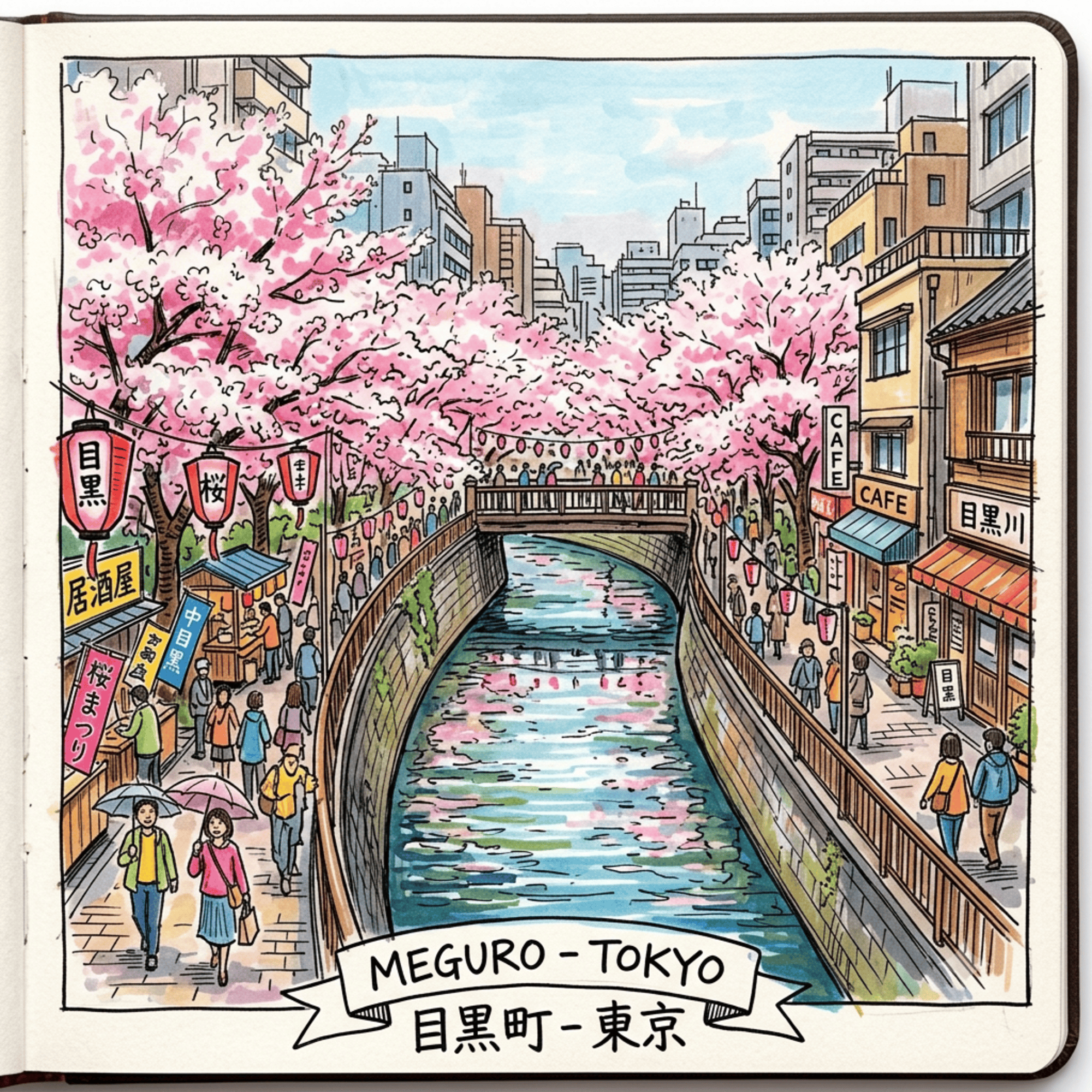
A1: The ideal Meguro River walking route starts at Naka-Meguro Station and leads south toward Meguro Station along the paved canal promenade. This path passes iconic photo spots like Bessho Bridge and the panoramic terrace at Starbucks Reserve Roastery Tokyo. Visitors can marvel at the dense pink sakura canopy forming a natural tunnel over the water, which transforms into a breathtaking floor of floating petals during full bloom. The walk balances scenic photo opportunities with stylish cafes, boutique shops, and vibrant evening lantern illuminations.
Q2: Is Meguro Tokyo worth visiting outside the cherry blossom season?
A2: Yes, Meguro is well worth visiting year-round. Outside the spring peak, Meguro offers a peaceful look into local Tokyo life without the heavy tourist crowds. Visitors can explore quiet greenery, architectural hidden gems like the Tokyo Metropolitan Teien Art Museum, and historic spiritual sites like Ryusenji Temple (Meguro Fudo). The surrounding neighborhood features independent coffee roasters, vintage design shops, and tranquil canal walkways, making it a perfect spot for relaxed urban exploration and experiencing authentic local Japanese culture.
Q3: What are the top things to do in Naka-Meguro and Meguro neighborhood?
A3: Top activities in Naka-Meguro and Meguro include strolling along the scenic canal, visiting local artisan craft shops, and relaxing in neighborhood cafes. Culture enthusiasts can visit the historic Meguro Fudo Temple and the Art Deco Teien Art Museum. At night, the area comes alive with traditional izakayas and contemporary dining options. During spring, watching the illuminated evening cherry blossoms (Yozakura) paired with festival food stall snacks like pink sparkling wine offers one of Tokyo's most enchanting neighborhood experiences.
Reference and Further reading
First layer – Main sources of literature and institutions:
- Agency for Cultural Affairs (文化庁) registration records for Ryūsen-ji's designated cultural properties; Meguro Ward Board of Education historical survey records; National Archives (国立公文書館) holdings of 朱印状 (shuinjō — red-seal patronage documents) issued to Ryūsen-ji by the Tokugawa shogunate.
- Tokugawa-period 朱印状 (shuinjō) for each of the five temples — held in temple archives and potentially in National Archives holdings. Dated cross-referencing of all five documents would resolve the question of simultaneous versus sequential establishment.
- Edo machi bugyō records for Meiwa 9 — official accounts of the fire, casualty estimates, and judicial proceedings related to the fire's origin; 火事絵図 (kaji ezu — fire incident maps) depicting the Meiwa Fire's geographic extent.
- Edo-period 御鷹場 registers recording the falconry ground boundaries, restrictions, and enforcement actions — potentially held in Tokyo Metropolitan Archives or the National Archives; land survey records (地図絵図) showing go-takajō boundaries in the Meguro area.
- Meiji government records on shinbutsu bunri enforcement in Tokyo Prefecture (Daijō-kan 太政官 directives and their implementation); individual temple records of response to Meiji directives (few survive intact; most were destroyed, suppressed, or never generated in formal written form).
The second layer – secondary academic materials:
- Paul Groner, Ryōgen and Mount Hiei: Japanese Tendai in the Tenth Century (2002) — Tendai institutional context relevant to the temple's founding tradition; Allan Grapard, "Institution, Ritual, and Ideology: The Twenty-Two Shrine-Temple Multiplexes of Heian Japan," History of Religions 27/3 (1988) — the shinbutsu shūgō institutional context of the founding; Fabio Rambelli, Buddhist Materiality: A Cultural History of Objects in Japanese Buddhism (2007) — relevant to the sacred-image founding tradition.
- Nam-lin Hur, Prayer and Play in Late Tokugawa Japan: Asakusa Sensōji and Edo Society (2000) — contextual framing for popular religious practice around Edo temples; Bernard Faure, The Fluid Pantheon: Gods of Medieval Japan, Volume 1 (2016) — Fudō Myōō's multi-tradition significance; Robert Sharf and Elizabeth Horton Sharf, eds., Living Images: Japanese Buddhist Icons in Context (2001).
- Nishiyama Matsunosuke, Edo Culture: Daily Life and Diversions in Urban Japan, 1600–1868, trans. Gerald Groemer (1997) — context on Edo's relationship to fire; Jordan Sand, Tokyo Vernacular: Common Spaces, Local Histories, Found Objects (2013) — spatial and memory-geography framework; scholarship in Edo no Kenkyū (江戸の研究) on specific fire-history documentation.
- Constantine Vaporis, Tour of Duty: Samurai, Military Service in Edo, and the Culture of Early Modern Japan (2008) — Shogunal territorial practice context; Conrad Totman, Early Modern Japan (1993) — land use and Shogunal authority.
- James Ketelaar, Of Heretics and Martyrs in Meiji Japan: Buddhism and Its Persecution (1990) — the definitive English-language account of haibutsu kishaku; Tamamuro Fumio (圭室文雄), various works on Meiji Buddhism — primary Japanese-language scholarship; Martin Collcutt, "Buddhism: The Threat of Eradication," in Jansen and Rozman, eds., Japan in Transition: From Tokugawa to Meiji (1986).
Third layer – Supplementary information:
- Ryūsen-ji's own 縁起 (engi) document — available at the temple but must be treated as hagiographic charter rather than empirical source; Edo-period meisho guides (名所図会) describing Meguro Fudō.
- Edo-period meisho guides depicting Five-Colored Fudō pilgrimage; Hiroshige woodblock print series including Meguro views from Meisho Edo Hyakkei (名所江戸百景).
- Daienji's own memorial records; Edo kawaraban (瓦版 — broadsheet news publications) covering the Meiwa Fire, multiple examples of which likely survive in institutional collections.
- Local village records (村明細帳 — mura meisaichō) from Edo-period Meguro area settlements, if extant, would preserve complaints or accommodation strategies related to go-takajō restrictions — primary material for the human-cost dimension of this story.
- Local Buddhist association (仏教会) records in the Meguro Ward area; oral history materials from families of long-term Meguro residents, if available through community archive programs.
Historical gap:
- The chronological discrepancy between the 808 CE founding date and Ennin's biography has not, to this researcher's knowledge, been subject to focused peer-reviewed historical analysis. Original Ryūsen-ji archive materials — if accessible to outside scholars — represent a genuine primary research opportunity. This gap, properly framed, is itself a research finding worth noting in the article's sourcing apparatus.
- The core historiographical question — deliberate Shogunal mandala project versus emergent cultural construction — remains open and constitutes a publishable research question in its own right. The answer would substantially reshape how we understand the Tokugawa shogunate's engagement with Mikkyō spatial theology as a tool of political legitimation.
- (1) The specific identity and judicial outcome of the individual connected to the fire's origin requires direct machi bugyō archival verification — this is the single most important factual gap in this story. (2) Whether the fire's origin was intentional arson, ritual self-immolation, or accident is a key interpretive question with major cosmological implications: the three readings produce entirely different B-section analyses, and the distinction matters enormously for the article.
- The precise go-takajō boundary in the Meguro area is the critical unverified claim in this story. General Shogunal falconry-ground history around Edo is established; Meguro-specific archival confirmation is essential before the article makes geographic precision claims.
- The specific institutional response of Ryūsen-ji to the shinbutsu bunri directives — what decisions were made, by whom, over what period, and what was lost in the process — is not documented in published scholarship to this researcher's knowledge. Temple administrative records from 1868–1880, if they survive at Ryūsen-ji, represent primary historical material of significant value. This is a genuine research opportunity.
 Lawrence
 Lawrence
 Lawrence
Cosmological framework: Tendai-Shingon Esoteric Buddhism (密教 / Mikkyō), Fudō Myōō cult, Five-Colored Fudō mandala system. No Daoist or feng shui frameworks applied — this site operates within Japanese Mikkyō spatial theology exclusively.
Research basis: Universal Spiritual-Geospatial Historical Dossier, 目黒町(Meguro-chō), Tokyo. Factual claims flagged for primary source verification in the source dossier are not presented as settled history in this article.