(ENG) Shinjuku Historical Walk – 5 Hidden Layers Beyond Tokyo’s Neon Lights
Walk through Shinjuku’s layered history, from Edo post towns and Meiji gardens to modern skyscrapers, exploring the hidden stories behind the neon.

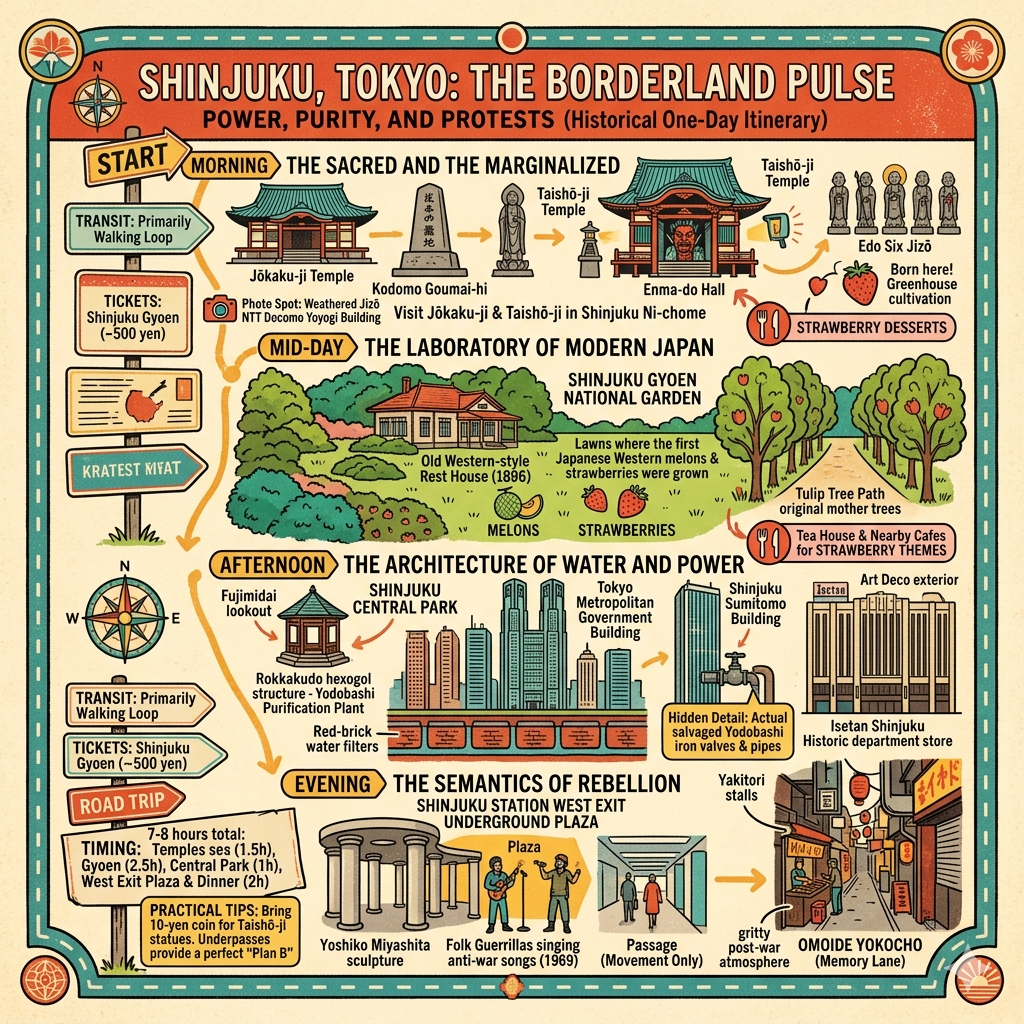
This is a historical travel story and psychogeographic walking guide to Shinjuku, Tokyo’s bustling "West Gate." By unearthing five distinct historical ruptures—from Edo-period post towns and Meiji scientific laboratories to the vertical skyscrapers of the modern "Vice-Center"—this guide explores how power, labor, and ideology have shaped the soil beneath the world's busiest station. Readers will discover hidden temples, botanical legacies, and the silent political battles embedded in Shinjuku's urban landscape.
 Lawrence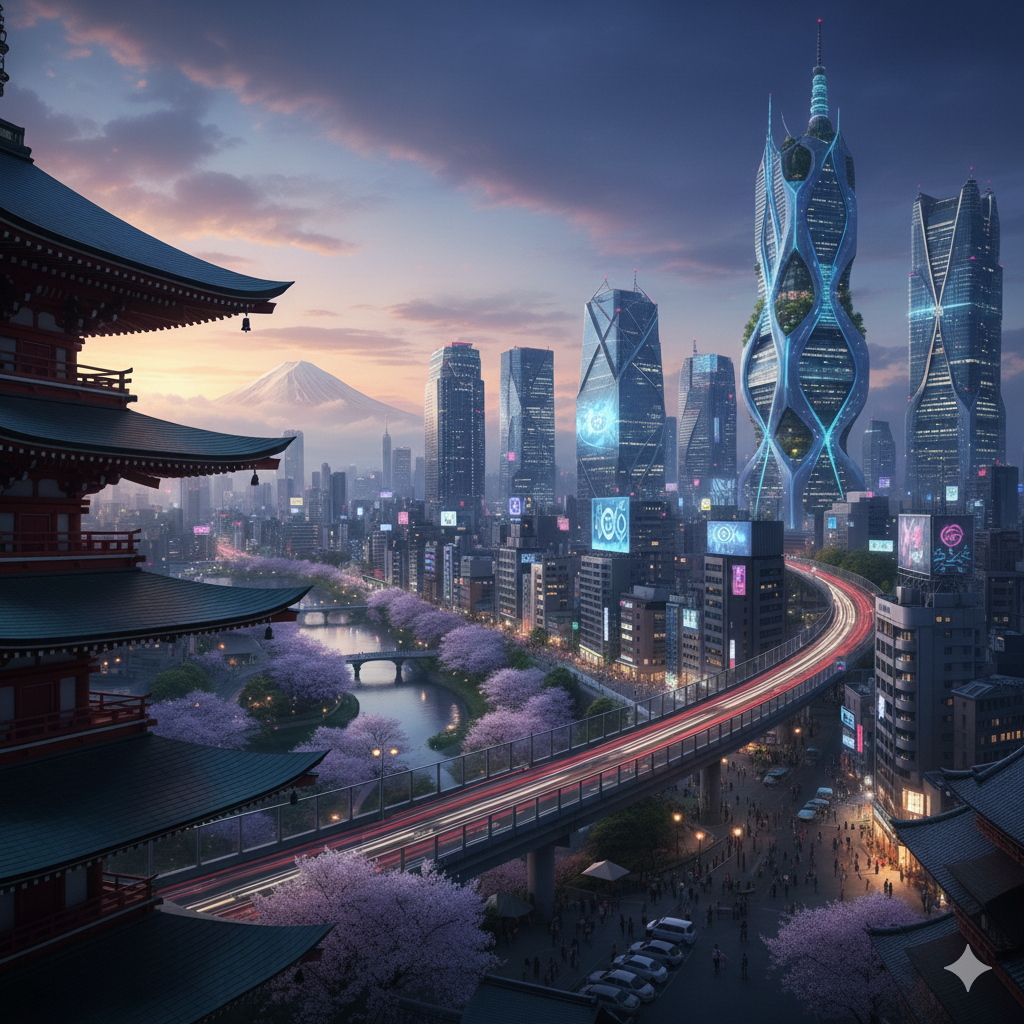
To the modern traveler, Shinjuku is a sensory bombardment—a kinetic storm of towering glass, subterranean labyrinths, and the relentless hum of the world’s busiest railway station. Yet, to the psychogeographer, Shinjuku exists as a liminal palimpsest, where each era’s ambitions are scrawled over the erasures of the last. It is not merely a commercial hub, but the historic "West Gate" of Edo. Originally established in 1698 as Naitō Shinjuku, it served as the strategic first stop on the Kōshū Kaidō road, a vital artery connecting the Shogun’s capital to the mountain fastness of Kōfu.
Shinjuku has always been a borderland—a site where the city exhales its waste and inhales its progress. To understand its soul is to look past the neon and unearth five distinct historical "ruptures." By walking through these layers, we find that the ghosts of the past are not merely memories; they are the very stone and soil upon which the modern megalopolis stands. Let us begin our journey at the edge of the neon, where the shadows of the post town still cling to the sanctuary of the temple.
Listen to the historical stories told in detail (For subscribers only)
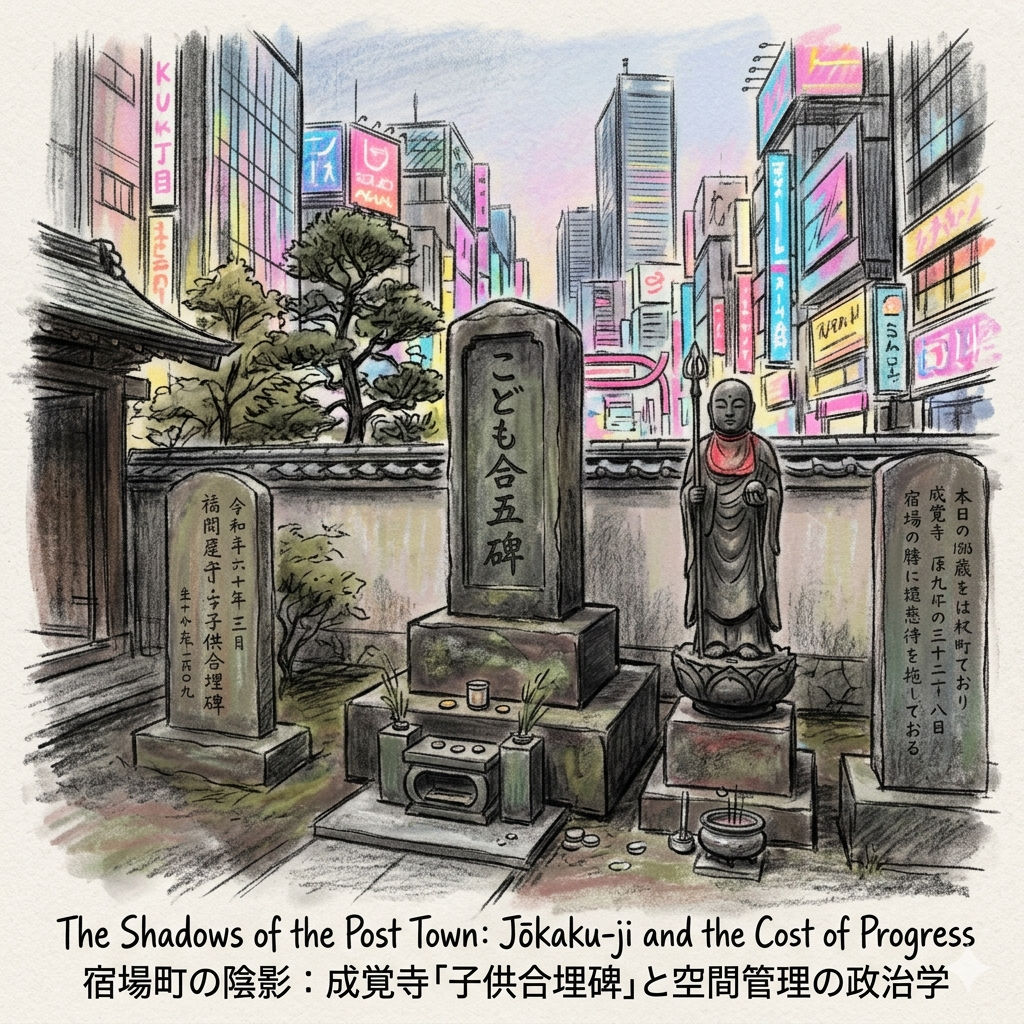
The Shadows of the Post Town: Jōkaku-ji and the Cost of Progress
In the Edo period, Naitō Shinjuku functioned as a specialized economic zone. Its prosperity was engineered by Shogunal permission to serve the logistical needs of travelers, but this economic engine relied heavily on the extraction of marginalized labor. Specifically, the district’s many inns (hatagoya) competed for patronage by offering the services of Meshi-mori Onna—"serving women" who provided food, yet whose primary role was sex work within a legal gray area.
The dark underbelly of this trade is preserved at Jōkaku-ji, a temple that functioned as a Nagekomi-dera (throwing-in temple). When these women died—often from tuberculosis, exhaustion, or despair—their bodies were frequently discarded here without individual ceremony. Within the temple grounds stands the Kodomo-Gōmai-hi (Children’s Mass Grave). Records from the Shinjuku Historical Museum and Naitō family documents reveal a harrowing reality: between 1718 and 1860, approximately 1,600 women were buried here, with 85% of deaths occurring between the ages of 19 and 24.
The linguistic choice of the term "Kodomo" (child) to describe these women serves as a chilling marker of their status. It codified their total powerlessness, rendering them legal minors and commodities regardless of their actual age. This layer of Shinjuku is one of immense emotional cost, reflected also in the temple’s Asahi Jizō, which records the names of seven pairs of lovers who committed shinju (double suicide), unable to navigate the district's rigid social constraints. The tension between exploitation and religious duty is captured in the 1860 monument erected by the innkeepers:
"In the first year of Man'en, the innkeepers of Naitō Shinjuku collectively funded this monument to pacify the spirits of the deceased and fulfill their formal religious obligations."
This was less an act of mourning and more an administrative clearing of the spiritual debt accrued by the district’s success. As the Edo period collapsed, this site of marginal labor gave way to a new kind of light: the cold, calculating soil of Meiji-era science.
The Laboratory of Modernity: Shinjuku Gyoen’s Scientific Roots
With the Meiji Restoration of 1868, Shinjuku’s spatial identity shifted from a borderland of outcasts to a laboratory for Western science. The new government, driven by the policy of Shokusan Kōgyō (Industrial Promotion), sought to transform private daimyo estates into public national assets. The Naitō family’s estate was repurposed into the Naitō Shinjuku Experimental Station in 1872.
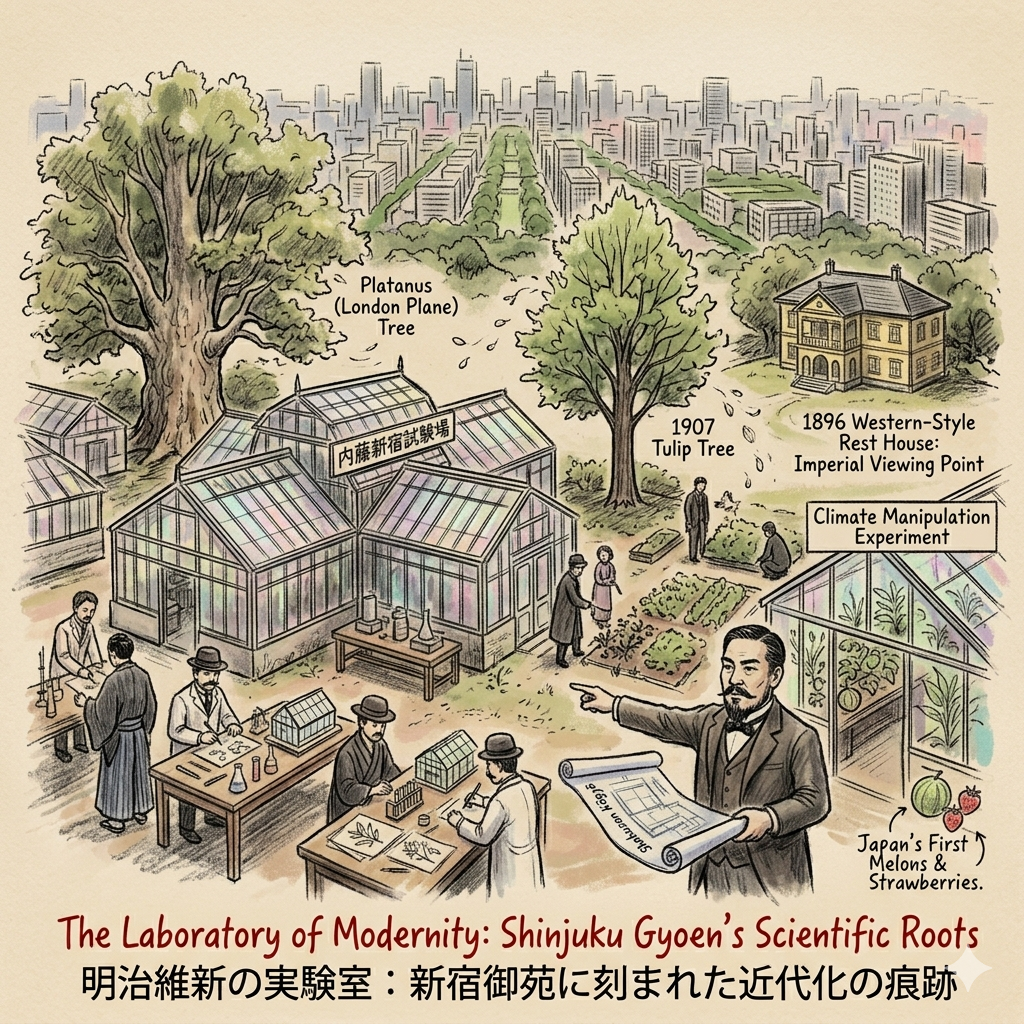
This was the "cradle for modern farmers," a vision championed by political architect Okubo Toshimichi. Under the horticultural mastery of Hayato Fukuba, the station became the gateway for Western botany, producing Japan’s first homegrown strawberries and melons. This site eventually birthed the Tokyo University Faculty of Agriculture, marking the transition from the "private garden" of the past to the "public laboratory" of the modern state.
Today, Shinjuku Gyoen is the "mother" of Japan’s urban flora. The seeds nurtured here formed the genetic blueprint for Tokyo’s streetscapes. When you walk the park, look for the following botanical remnants:
- 1907 Tulip Trees: These original specimens provided the seeds that defined the city’s green corridors.
- Platanus (London Plane) Trees: Iconic giants that transformed the visual language of the Japanese street.
- The 1896 Western-Style Rest House: A viewing point for the Imperial family to inspect the progress of the greenhouses, where the climate was first manipulated to support foreign species.
As the Gyoen’s soil was being mastered, the water flowing beneath the district was being harnessed to support a rising skyline.
The Water Palace to the Sky: Yodobashi and the Birth of the "Vice-Center"
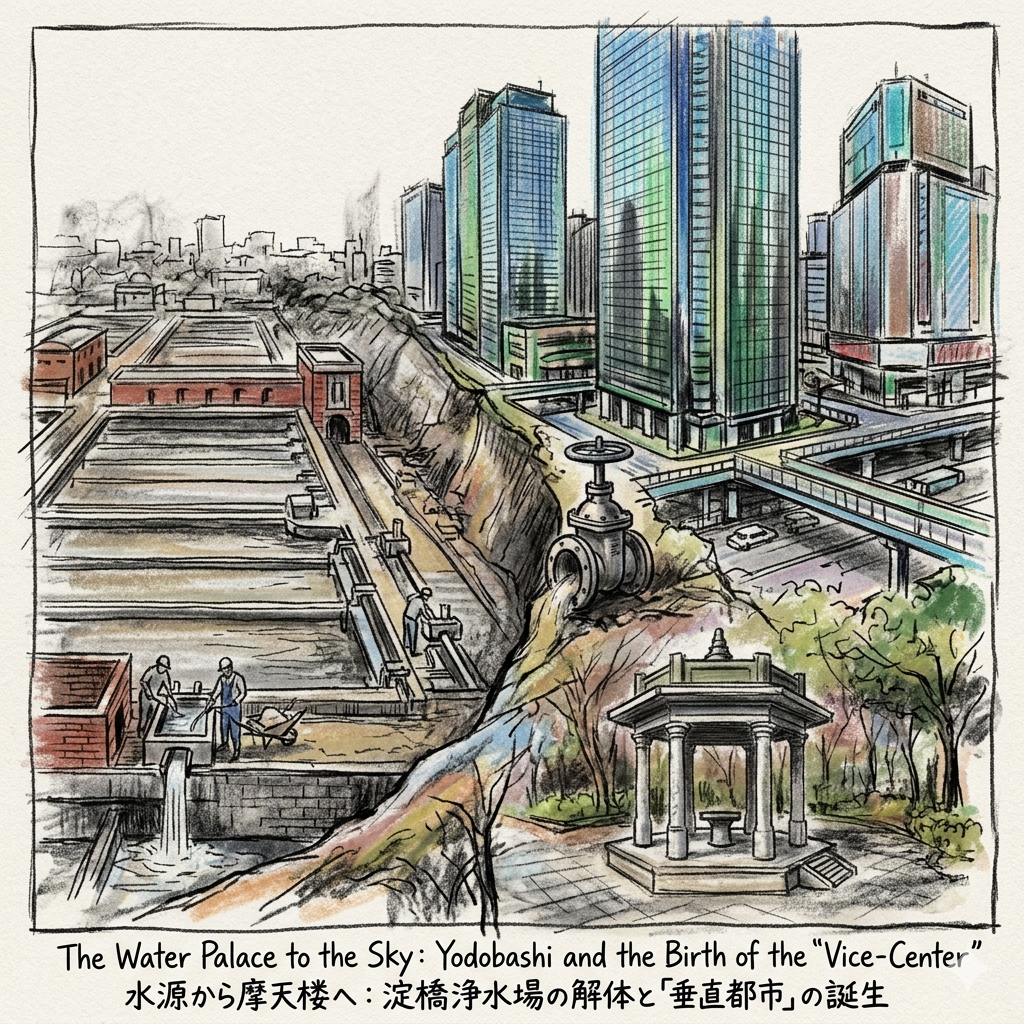
For decades, Shinjuku’s west side remained an undeveloped logistical backyard. This changed with the construction of the Yodobashi Purification Plant (1898–1965). Built to combat the cholera and dysentery outbreaks of an industrializing Tokyo, this "water palace" of red brick and granite utilized gravity to send life-giving water to the city's core.
The 1960s marked a fundamental shift from infrastructure-driven urbanism to capital-driven verticality. Urban planner Masao Yamada pioneered a revolutionary financial model, selling the plant's land to private banks to fund the relocation of the facility and the construction of the Fukudoshin (Sub-center). This move broke the traditional Edo-centric power structure—centered on the Imperial Palace—to create a multi-core, technocratic city.
The massive horizontal settling basins were replaced by vertical glass monoliths, but the ghost of the water palace remains. In Shinjuku Central Park, travelers can find the Fujimidai Hexagonal Pavilion, the last original structure from 1898. The dramatic topography—the steep drop from the station to the skyscraper district—is a structural remnant of the gravity-flow design. This verticality was managed through "3-D traffic separation," a symbol of a city designed for efficiency, yet as the skyline rose, the ground level became a site of fierce ideological battle.
The Politics of Language: The 1969 "Plaza to Passage" Conflict
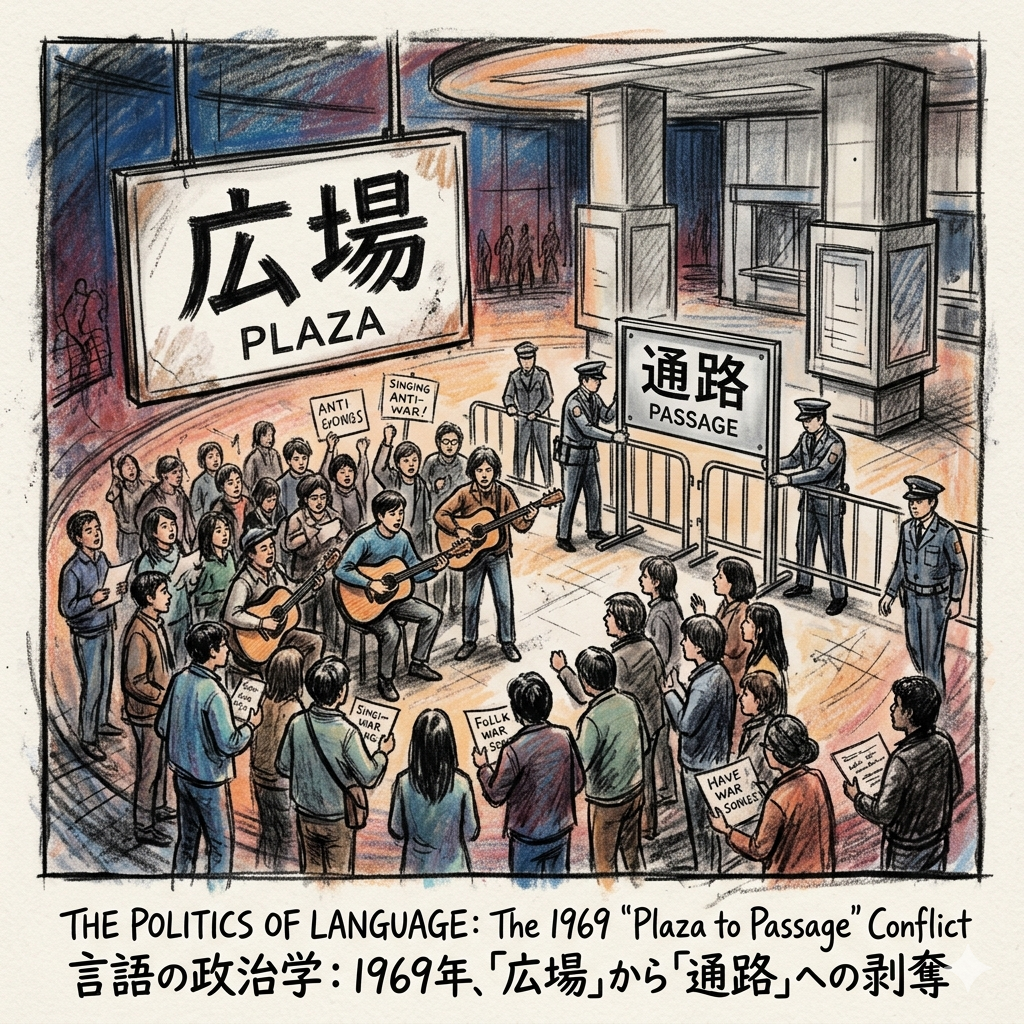
In the late 1960s, Shinjuku’s underground became a "liberated zone" for counterculture. The West Exit Underground Plaza, with its circular, democratic stage, was the heart of the "Folk Guerrilla" movement. Thousands gathered here to sing anti-war songs and debate the Vietnam War, turning a transit point into a site of political discourse.
To reclaim control, authorities deployed a linguistic weapon: they officially renamed the "Plaza" (Hiroba) to a "Passage" (Tsūro). Under Japanese law, a plaza is a public asset where assembly is protected; a passage is transportation infrastructure where standing still is an act of obstruction. By changing a word, the state criminalized gathering, turning "citizens" into "pedestrians."
This was the birth of Shinjuku’s Defensive Architecture. Physical barriers, large columns, and commercial displays were added to the space to prevent people from congregating. Today, the Yoshiko Miyashita sculpture stands as a silent witness to this lost plaza. Surrounded by commercial displays that scream for your attention, it marks the spot where the right to stand still was revoked. To find a different kind of resilience, one must move from the modern underground back to the spiritual gatekeeper of the district.
The Dual Gatekeeper: Taishō-ji and the Resilience of Folk Belief
Shinjuku’s history is a constant reconciliation between elite authority and gritty street-level faith. Taishō-ji, established in 1628 as the burial ground for the Naitō Clan, perfectly encapsulates this duality. It is a place where the elite layer of samurai history meets the visceral belief of the marginalized.
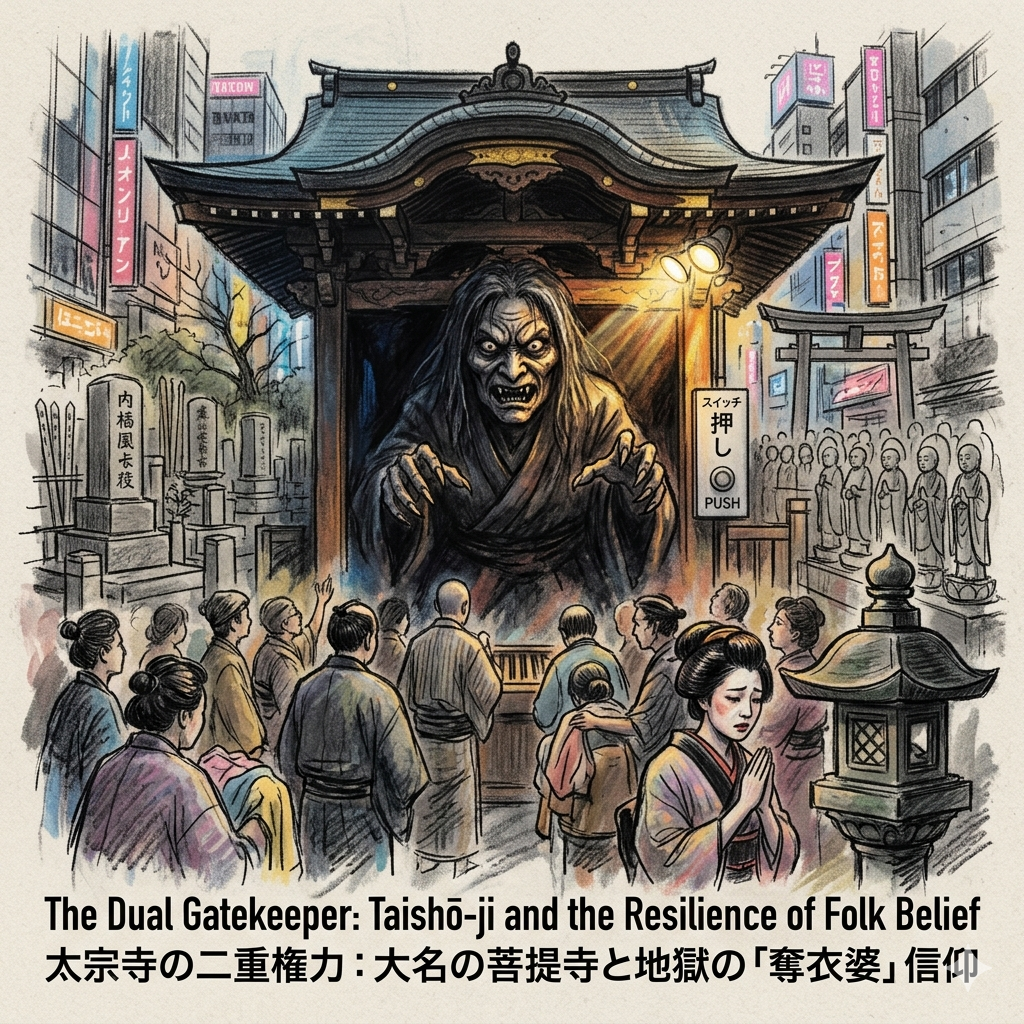
While the local lords rested in prestige, the commoners—and the Meshi-mori Onna—flocked to the Enma-do to worship the Datsueba (The Hag of Hell). Traditionally a figure who strips clothes from the dead, the residents of Shinjuku repurposed her. In a display of cultural creativity, they transformed her terrifying, realistic gaze into a patron of the clothing trade and a protector of sex workers. Even the great novelist Natsume Soseki played on these Jizo statues as a child, weaving the temple into the literary psychogeography of the city.
The spatial details of Taishō-ji today bridge the centuries:
- The Sensor Lights: When you approach the Enma-do, motion sensors suddenly illuminate the terrifying figures—a modern replication of the Edo-era Gokai-hi, the dramatic "opening of the hidden" religious images.
- The Oribe Lantern: Tucked in a corner, this "Christian Lantern" hints at the hidden history of forbidden faiths that once sought refuge in this borderland.
Practical Pilgrimage: Shinjuku Through History
To experience these layers, one must embrace the district’s labyrinthine nature—a physical remnant of 1960s attempts to manage human flow.
- Navigating the Labyrinth: Approach the West Exit not as a commuter, but as a student of the "Passage vs. Plaza" conflict. Notice the columns and displays designed to keep you moving.
- Recommended Stay: Seek the quieter streets near Shinjuku Gyoen for a contemplative, historic atmosphere that contrasts with the station’s frenzy.
- Historical Routes: Follow the path of the original Kōshū Kaidō from the station toward Shinjuku-sanchōme, stopping at Taishō-ji and Jōkaku-ji to witness the transition from the sacred to the profane.
Philosophical Reflection: Shinjuku as a Borderland
Shinjuku’s identity is not defined by its glossy center, but by its nature as a borderland—a perpetual edge where the state’s desire for management meets the individual’s impulse for chaos. It is a place where power meets resistance, and where the "water palace" of the past informs the "sky palace" of the present.
From the nameless women of the Edo period to the folk guerrillas of 1969, Shinjuku has been a site of rupture. In a city that constantly renames and rebuilds its spaces to ensure the flow of capital, what remains of the individual’s right to stand still? To walk Shinjuku is to realize that the most important parts of a city are often the ones they tried to rename, pave over, or hide behind a sensor light.
For more deep-dives into urban psychogeography and the hidden layers of the world’s great cities, subscribe to Historical Travel Stories.
Reference and Further reading
- 施設及び歴史的背景|新宿御苑|国民公園|環境省, accessed April 23, 2026,
- 新宿公園と太宗寺で発見した旧町名の痕跡 - 歩・探・見・感, accessed April 23, 2026,
- 9月1日(木)日本橋→内藤新宿→高井戸へ 25.5km | ちょっと寄り道・甲州街道ひとり旅, accessed April 23, 2026,
- 四ツ谷から新宿へ|内藤新宿を歩く歴史散歩|ましゅまろ - note, accessed April 23, 2026,
- 新宿區Shinjuku city, accessed January 1, 1970,
- 内藤新宿、 新宿2,3丁目、 歌舞伎町, accessed April 23, 2026,
- うさぎの気まぐれまちあるき「新宿DeepZone&歴史探訪」, accessed April 23, 2026,
- 内藤新宿コース(約6.0km、所要時間約5時間40分)新宿駅周辺エリア ..., accessed April 23, 2026,
- 江戸きっての宿場町に漂う悲哀「新宿二丁目の地獄と極楽」を2つの寺から考察する|裏・東京の不思議 | 男の隠れ家デジタル, accessed April 23, 2026,
- 江戸時代の内藤新宿ー遊女と飯盛女ー - 六部塾・小金井風土知, accessed April 23, 2026,
- 『新宿の歴史を歩く』新宿(東京)の旅行記・ブログ by 愛吉さん【フォートラベル】, accessed April 23, 2026,
- 新宿歴史博物館 - 【公益財団法人新宿未来創造財団】, accessed April 23, 2026,
- 江戸開幕から400年の時を刻んだ内藤家の中屋敷跡地 新宿御苑に抱かれる、緑豊かな住空間が広がる – Geo Plat - 阪急阪神の住まい〈ジオ〉, accessed April 23, 2026,
- 新宿御苑 | 出かける | 連載コラム「エコレポ」|| EICネット『エコナビ』, accessed April 23, 2026,
- 1 新宿御苑とその使命(1590 年~) 上野 攻 1.新宿御苑が現存する僥倖 (1)徳川家康と内藤, accessed April 23, 2026,
- 新宿副都心の整備, accessed April 23, 2026,
- 西新宿地域情報紙 第41号, accessed April 23, 2026,
- 7:江戸・東京の生活を支えた「玉川上水」と「淀橋浄水場」 ~ 新宿, accessed April 23, 2026,
- 淀橋浄水場 - accessed April 23, 2026,
- 国立公文書館所蔵資料, accessed April 23, 2026,
- 新宿騒乱 - accessed April 23, 2026,
- 『ノルウェイの森』で描かれた新宿駅西口の地下通路は、副都心計画のカギだった。【速水健朗の文化的東京案内。西新宿篇③】 - Pen Online, accessed April 23, 2026,
- 通行人の交流による都市空間の公共性の創出過程 - CiNii Research, accessed April 23, 2026,
- フォークゲリラWORD|大人のMusic Calendar|大人のミュージック ..., accessed April 23, 2026,
- 「新宿駅西口地下広場」は、誰も気づかないまま50年前に消滅していた | 戦国ヒストリー, accessed April 23, 2026,
- 鬼、地蔵、閻魔、怨霊とディープな伝承を探して新宿~四谷散歩!成覚寺、太宗寺編, accessed April 23, 2026,
- 検索結果詳細 | 温故知しん!じゅく散歩 新宿文化観光資源案内サイト, accessed April 23, 2026
 Lawrence
 Lawrence
 Lawrence