
Commercial Hong Kong 商業香港
Hong Kong became commercially powerful because several systems reinforced one another: a strategic harbour + free-port policy + Chinese and international merchants + migration + transport infrastructure + finance + manufacturing + global trade networks
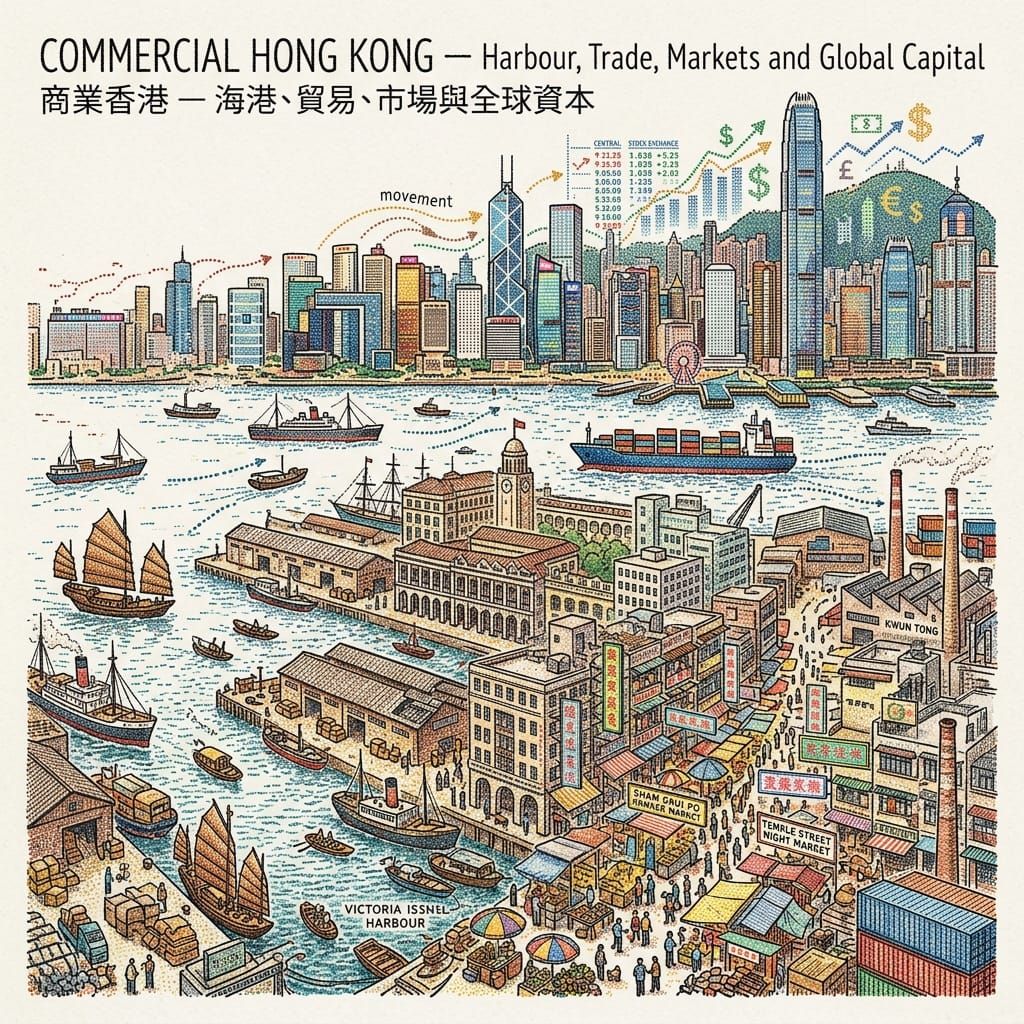
Commercial Hong Kong — From Harbour Trade to Global Capital
How a Harbour Became an Economic System
Hong Kong is often described as a city built by trade.
That is true.
But the deeper story is not simply that ships arrived at Victoria Harbour and made the city prosperous.
Hong Kong became commercially powerful because several systems reinforced one another:
a strategic harbour + free-port policy + Chinese and international merchants + migration + transport infrastructure + finance + manufacturing + global trade networks
The harbour was the starting point.
It was not the entire story.
From the nineteenth-century entrepôt to the factories of postwar Kowloon, from street hawkers to international banks, Hong Kong's commercial history is a story of continual transformation.
The city's economy repeatedly changed form:
maritime trade → entrepôt economy → manufacturing → re-export economy → finance and professional services → global logistics and services
And throughout these transitions, one principle remained remarkably consistent:
Hong Kong's greatest commercial asset was its ability to connect different worlds.
1. Before the Commercial City — The Harbour Was Already an Economic Landscape
Hong Kong was not an empty harbour when British forces arrived.
The territory contained fishing and farming communities, villages and maritime networks.
The Hong Kong Government's historical account describes an early population scattered among villages and hamlets, alongside thousands of fishermen living on boats in the harbour. The territory's greatest natural economic advantage was its sheltered deep-water anchorage. (yearbook.gov.hk)
This matters because commercial Hong Kong did not begin with European merchants.
It began with geography.
The harbour connected:
- South China
- Coastal China
- The South China Sea
- Southeast Asia
- International shipping routes
The sea was already an economic highway.
Colonial policy would later transform that maritime geography into something much larger.
2. 1841 — The Free Port That Changed Everything
Why Hong Kong Became a Commercial City
The British established Hong Kong as a free port in 1841.
This was crucial.
The harbour was strategically located.
But policy turned geography into commercial advantage.
Under the free-port system, merchants could trade with relatively few tariff barriers, making Hong Kong attractive to international shipping and commercial houses.
The Academy of Chinese Studies notes that after British settlement, Hong Kong's free-trade policy allowed merchants from different countries access to the port with zero tariffs, helping the entrepôt economy expand rapidly. (chiculture.org.hk)
Hong Kong therefore became something more than a destination.
It became a middle place.
Goods did not necessarily originate here.
They passed through here.
Money did not necessarily remain here.
It was mobilized here.
Ships did not necessarily belong here.
They used the harbour because the harbour connected them to larger markets.
This intermediary role became one of the defining characteristics of Hong Kong's economy.
3. Victoria Harbour — The Commercial Machine at the Centre of the City
The Harbour Was Infrastructure, Not Scenery
Today's Victoria Harbour is one of Hong Kong's most recognizable views.
Historically, it was something far more practical.
It was a working machine.
Ships arrived.
Cargo was unloaded.
Warehouses stored goods.
Merchants arranged transactions.
Workers handled cargo.
Boats moved goods between ships and shore.
Banks financed trade.
Insurance companies managed risk.
Railways and roads redistributed cargo inland.
The Government Records Service preserves extensive historical photographs showing the changing harbour and waterfront across the late nineteenth and early twentieth centuries. (grs.gov.hk)
Recent official port data still demonstrates the harbour's continuing economic significance: in 2024 Hong Kong handled about 13.7 million TEUs of containers, with the Kwai Chung–Tsing Yi terminals handling around 10.4 million TEUs. (hkmpb.gov.hk)
The technology has changed completely.
The principle has not.
Hong Kong remains a city organized around movement.
4. Central — Where Commerce Became Institutional Power
From Waterfront Trading District to Financial Centre
Central began as the administrative core of colonial Hong Kong.
But government attracted commerce.
Traders arrived.
Banks followed.
Insurance companies developed.
Warehouses and offices expanded.
Commercial firms established themselves near the harbour.
The Hong Kong Government's Development Bureau describes Central as a district that evolved from the colonial administrative centre into an entrepôt, then a manufacturing-supporting economy and ultimately a modern global financial centre. (devb.gov.hk)
This transformation is visible in Central's architecture.
Government buildings.
Banks.
Trading houses.
Hotels.
Markets.
Railways.
Piers.
Modern skyscrapers.
All occupy successive layers of the same commercial landscape.
Central is therefore not merely Hong Kong's financial district.
It is a physical timeline of the city's economic history.

Central in an earlier era, when the harbour, colonial buildings and small vessels formed a much more intimate commercial landscape.
5. Chinese Merchants — The Other Engine of Commercial Hong Kong
Empire Created the Framework; Merchants Built the Economy
It would be misleading to describe colonial Hong Kong's commercial development as purely British.
Chinese merchants were central to the city's economic expansion.
They operated businesses across:
- Shipping
- Trade
- Banking
- Warehousing
- Retail
- Manufacturing
- Real estate
Chinese commercial networks connected Hong Kong to Guangdong and the wider Chinese diaspora.
This created a distinctive economic structure.
British and European firms brought international capital and shipping networks.
Chinese merchants brought local knowledge, family networks and connections across southern China and Southeast Asia.
The city grew through the interaction between these networks.
This is one of the most important distinctions between Colonial Hong Kong and Commercial Hong Kong.
Colonial Hong Kong explains who governed.
Commercial Hong Kong explains who moved the goods, organized the markets and created the economic relationships that made the city function.
6. Sheung Wan — Where Chinese Commerce Became Visible
The Commercial City Beside the Colonial City
Central represented institutional and international commerce.
Sheung Wan represented another side.
Chinese merchants, traders, shopkeepers and residents established businesses and communities in the district.
Traditional trades developed around:
- Chinese medicine
- Dried seafood
- Tea
- Religious goods
- Food
- Household products
The Hong Kong Museum of History records that Chinese residents were concentrated heavily in areas such as Sai Wan and Sheung Wan during the early development of the City of Victoria. (hk.history.museum)
The physical environment reveals the economic structure.
Small shops.
Tenement buildings.
Warehouses.
Temples.
Wholesale businesses.
Street markets.
This was commerce at neighbourhood scale.
And it was just as important to the development of Hong Kong as the international firms operating in Central.
Explore Further
→ Sheung Wan historical story
→ Sacred Hong Kong Theme Pillar
→ Colonial Hong Kong Theme Pillar
7. Central Market — The Everyday Economy of the Colonial City
Where Ordinary People Bought the City
Hong Kong's commercial history cannot be written only through banks and shipping companies.
Markets were equally important.
The history of Central Market reaches back to the earliest years of colonial Hong Kong.
Development Bureau documentation traces the market's origins to the Canton Bazaar and emphasizes its role as a place where "East met West" and where old and new Hong Kong interacted. (devb.gov.hk)
The market's later physical building became one of the territory's best-known examples of modernist market architecture.
It also reveals an important economic transition.
Markets once organized the everyday supply of the population.
Modern supermarkets and commercial centres later changed consumer behaviour.
The market eventually lost its original role.
But its heritage value increased.
This creates a fascinating commercial cycle:
market → decline → heritage → adaptive reuse
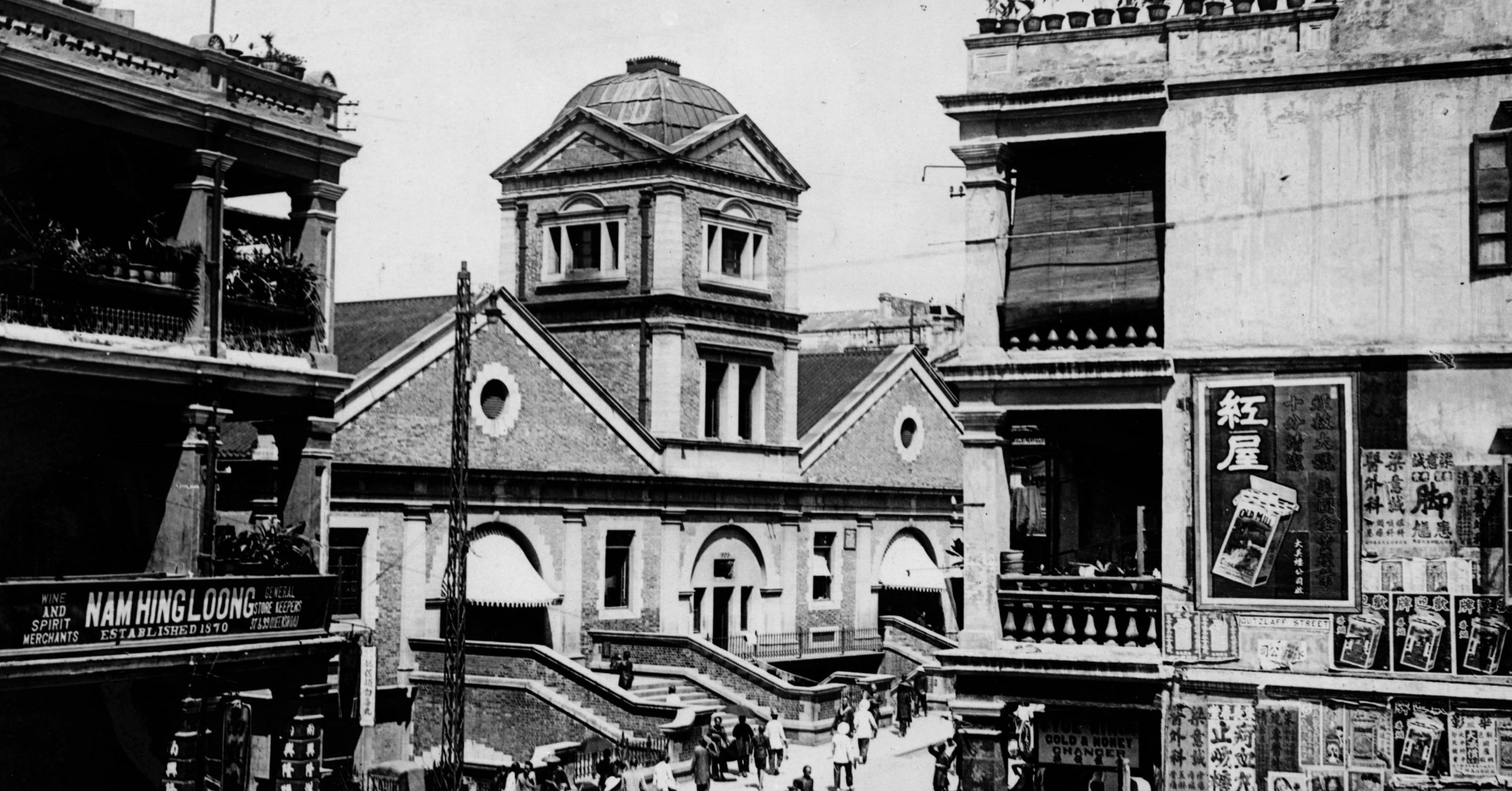
Central Market in an earlier era. The market's history illustrates how everyday food distribution sat directly inside Hong Kong's developing commercial core. (ourchinastory.com)
8. Reclamation — The Commercial City Expands Into the Harbour
When Land Became Economic Infrastructure
Hong Kong's commercial growth repeatedly ran into a physical problem:
there was not enough flat land.
The solution was reclamation.
Water became land.
The shoreline moved.
Roads expanded.
Commercial districts gained more space.
Railways and transport infrastructure could be constructed.
Reclamation therefore was not simply an engineering project.
It was an economic strategy.
Every new piece of reclaimed land created the possibility of:
- Offices
- Warehouses
- Roads
- Railways
- Housing
- Markets
- Piers
- Commercial development
The modern Central waterfront is the product of successive rounds of this process.
Hong Kong's commercial geography is therefore partly a history of turning water into economic space.
Explore Further
→ Victoria Harbour historical story
→ Colonial Hong Kong Theme Pillar
→ Modern Hong Kong Theme Pillar
9. Kowloon — The Commercial City Crosses the Harbour
Tsim Sha Tsui and the New Gateway
The commercial geography of Hong Kong changed dramatically once development expanded across the harbour.
Kowloon became increasingly important for transport and trade.
Tsim Sha Tsui developed into a major gateway.
The Kowloon-Canton Railway connected Hong Kong with the mainland from 1911, strengthening land transport and trade connections. Historical research on pre-war entrepôt trade emphasizes the railway's importance to Hong Kong's connection with the South China market. (chiculture.org.hk)
Hotels, warehouses, offices, passenger facilities and commercial businesses clustered around the transport system.
The lesson is fundamental:
commercial cities grow where different transport systems meet.
Hong Kong's geography increasingly linked:
ship + railway + road + warehouse + market
into one economic system.
Explore Further
→ Tsim Sha Tsui historical story
→ Kowloon historical stories
→ Colonial Hong Kong Theme Pillar
10. The Entrepôt Economy — Hong Kong as the Middleman
The City Did Not Need to Produce Everything
Hong Kong's early commercial strength depended heavily on entrepôt trade.
Goods moved through the territory between:
- China
- Britain
- Southeast Asia
- India
- Europe
- North America
The city provided services that made trade possible.
Storage.
Shipping.
Insurance.
Banking.
Brokerage.
Re-export.
Transport.
This intermediary role allowed Hong Kong to become commercially powerful despite its limited natural resources.
The government's historical accounts describe the harbour as a hub of entrepôt trade with China, while research on pre-war Hong Kong shows the development of extensive trading and warehousing networks around both sides of Victoria Harbour. (yearbook.gov.hk; chiculture.org.hk)
Hong Kong's greatest commodity was therefore not a natural resource.
It was connectivity.
11. From Trade to Manufacturing
When Hong Kong Began Making Things
Hong Kong's economy eventually moved beyond pure entrepôt trade.
After the Second World War, manufacturing became increasingly important.
Factories expanded rapidly in districts including:
- Sham Shui Po
- Cheung Sha Wan
- Kwun Tong
- Tsuen Wan
- Kwai Chung
Textiles.
Garments.
Plastic products.
Electronics.
Small household goods.
The commercial city became a productive city.
This was a decisive transformation.
Hong Kong was no longer simply moving products between markets.
It was producing products for global markets.
Explore Further
→ Modern Hong Kong Theme Pillar
→ Working-class Hong Kong stories
→ Sham Shui Po
→ Kwun Tong
→ Tsuen Wan
12. Sham Shui Po — Commerce From the Street Up
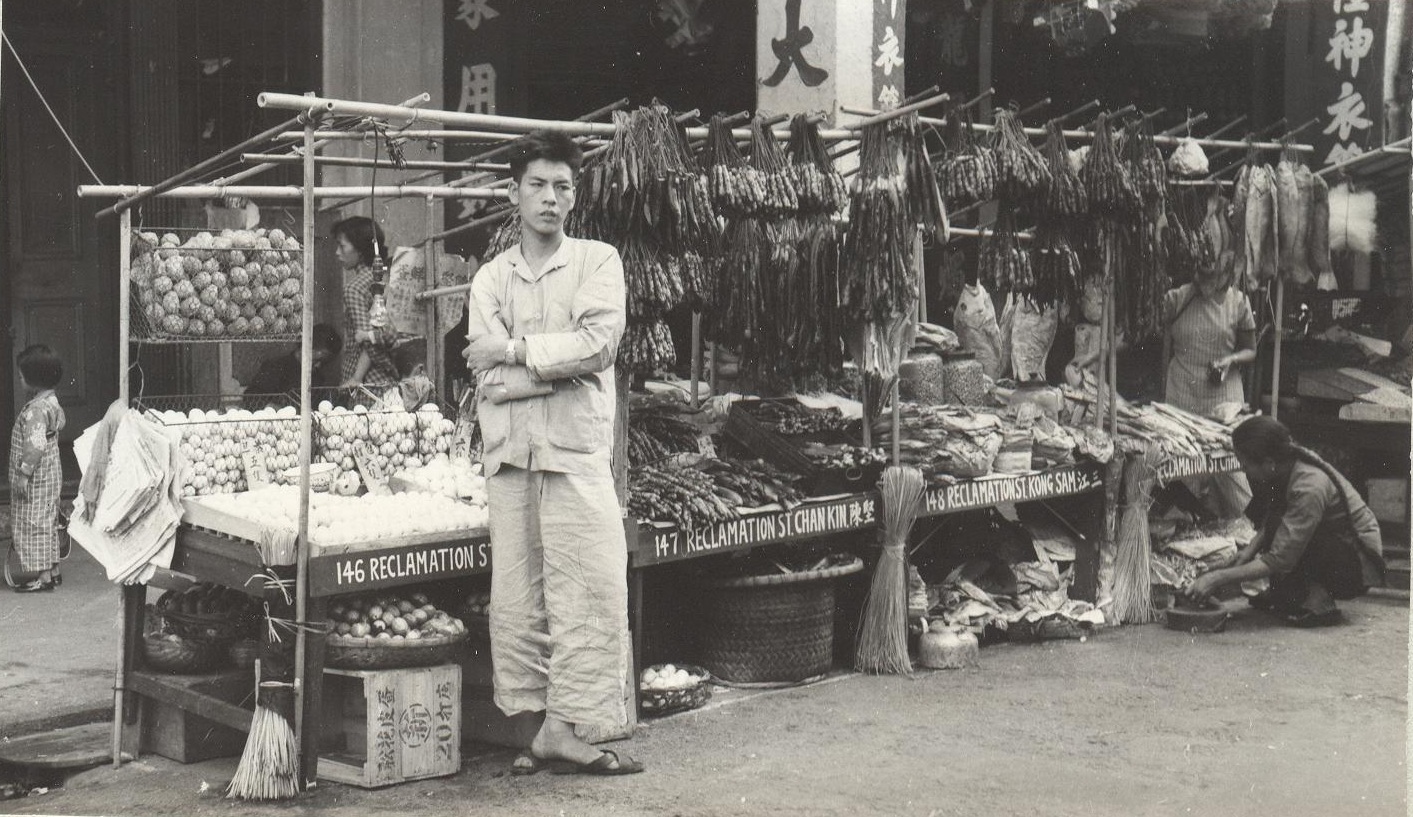
Hawkers, Small Businesses and the Everyday Economy
Sham Shui Po provides an essential counterweight to the international image of Hong Kong commerce.
The district's economic life was deeply connected to small businesses, factories and street vendors.
Government Records Service photographs from 1957 document hawker-control operations in Yu Chau Street and Pei Ho Street, showing the extraordinary density of street-level commercial activity. (grs.gov.hk)
These images reveal something that corporate histories often miss.
Hong Kong's economic success depended on thousands of small transactions.
A hawker.
A market stall.
A family shop.
A workshop.
A tailor.
A small factory.
A wholesaler.
Together they created the everyday commercial economy.
This was not peripheral to Hong Kong's rise.
It was part of the mechanism that made the rise possible.
13. The Kwun Tong Experiment
Industry on Reclaimed Land
The development of Kwun Tong illustrates the relationship between land, industry and government planning.
Reclaimed land provided space for factories, workers and industrial infrastructure.
The district became one of Hong Kong's major manufacturing centres.
Its industrial buildings later acquired new lives as offices, studios, restaurants and creative spaces.
This transformation is particularly revealing.
Industrial Hong Kong did not simply disappear.
Parts of its physical landscape were recycled.
The economic function changed.
The buildings remained.
That creates a bridge between:
Commercial Hong Kong → Modern Hong Kong → Hidden Hong Kong
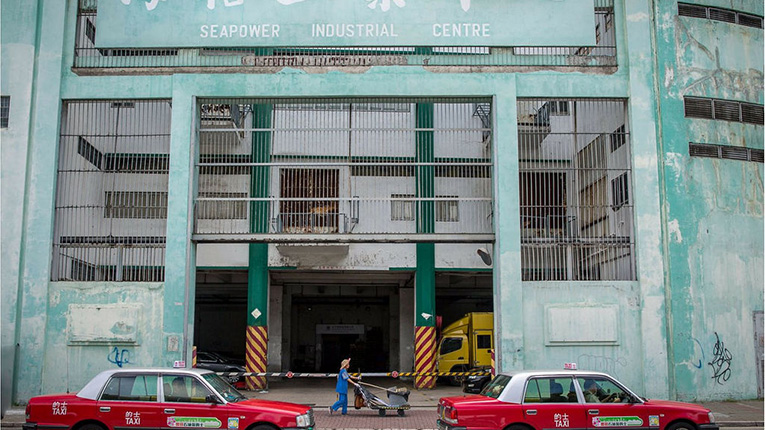
Kwun Tong's surviving industrial architecture provides a visual reminder of Hong Kong's manufacturing era and its subsequent transformation. (cinra.net)
14. The Container Revolution
When Hong Kong Learned to Move Cargo Faster
By the late twentieth century, Hong Kong's port economy entered another transformation.
Containerization changed global shipping.
Cargo that had once been loaded piece by piece could now move through standardized containers.
Hong Kong responded by developing the Kwai Chung container-port complex.
The new system transformed the geography of maritime logistics.
The port moved westward.
Industrial land and transport infrastructure developed around it.
Kwai Tsing became a major logistics landscape.
The Hong Kong Maritime and Port Board reports that in 2024 the port handled about 13.7 million TEUs, with the Kwai Chung–Tsing Yi terminals accounting for nearly 10.4 million TEUs. (hkmpb.gov.hk)
The physical landscape is radically different from the nineteenth-century harbour.
But the underlying principle remains unchanged:
Hong Kong's economic power depends on moving things between places.
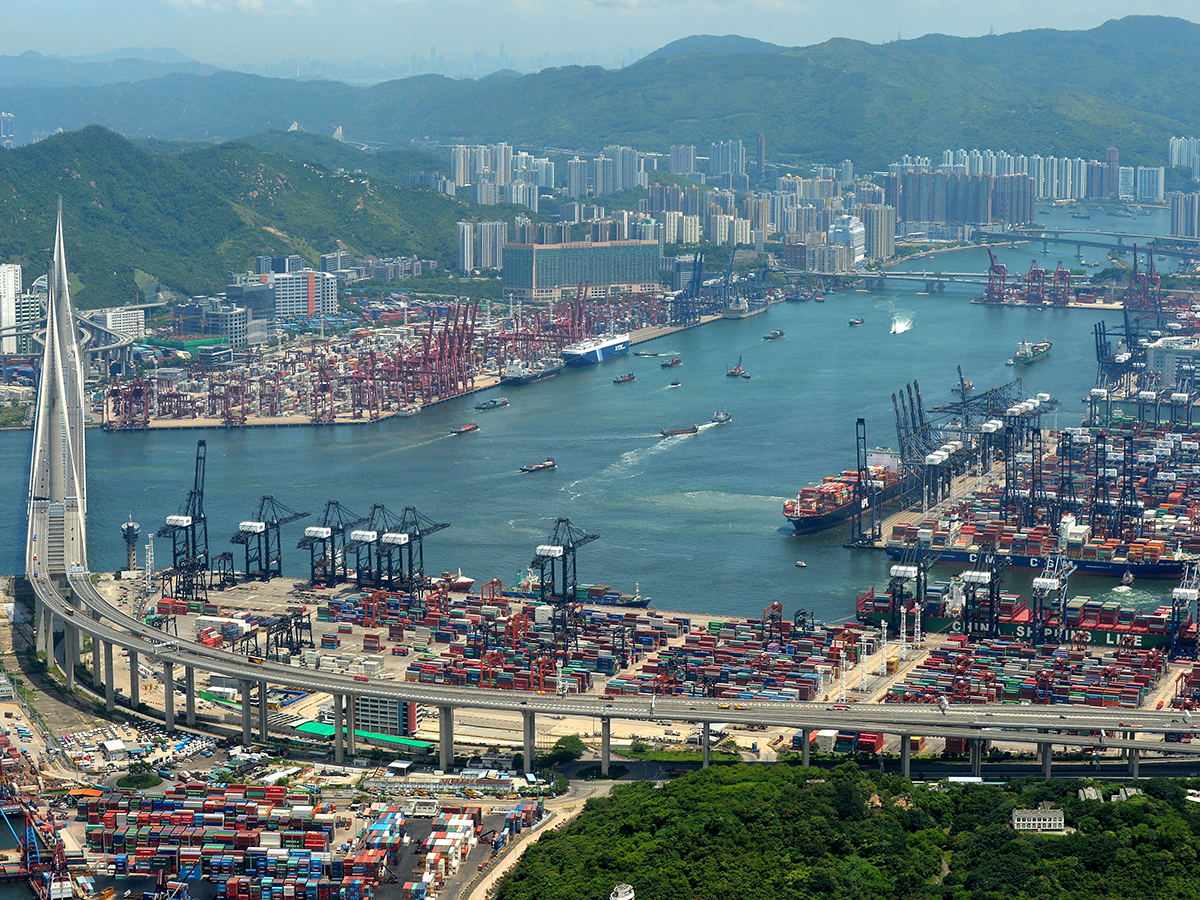
The Kwai Tsing container-port landscape represents the modern logistics phase of Hong Kong's commercial history. (hkmpb.gov.hk)
15. Finance — When Hong Kong Began Moving Money Instead of Cargo
From Physical Trade to Financial Services
Hong Kong's economy increasingly shifted toward finance and services.
Banks, insurers, trading firms and professional services became more important.
Central's skyline changed accordingly.
Warehouses and low-rise commercial buildings gave way to increasingly vertical corporate architecture.
Yet finance did not replace trade completely.
The two systems remained interconnected.
A global port requires:
- Banks
- Insurance
- Legal services
- Currency exchange
- Corporate management
- Logistics
- Professional expertise
Commercial Hong Kong therefore evolved from moving goods to coordinating capital and information, while continuing to manage physical trade.
16. Hong Kong's Commercial Geography Today
A City of Specialized Economic Landscapes
Modern Hong Kong's commercial system is geographically differentiated.
Central
Finance and corporate power
Banks, professional services, international companies and government.
Sheung Wan
Chinese commerce and specialist trades
Traditional medicine, dried goods, food and cultural businesses.
Tsim Sha Tsui
International gateway and tourism
Hotels, retail, transport and visitor economy.
Mong Kok
Dense retail and street commerce
Markets, specialist shops, small businesses and popular consumption.
Sham Shui Po
Working-class commerce and small enterprise
Street markets, electronics, textiles and local businesses.
Kwun Tong
Industrial transformation
Manufacturing heritage, offices and creative reuse.
Kwai Tsing
Modern logistics
Container terminals and global shipping.
These districts are not unrelated.
They form a single commercial system.
17. Commercial Hong Kong Is Also a History of Labour
Who Actually Made the Economy Work?
It is tempting to tell Hong Kong's commercial history through:
- Banks
- Shipping companies
- Trading houses
- Developers
But the economy depended equally on:
- Dock workers
- Factory workers
- Hawkers
- Porters
- Fishermen
- Shopkeepers
- Transport workers
- Domestic workers
- Small entrepreneurs
Commercial Hong Kong is therefore also working Hong Kong.
The Government Records Service's 1950s hawker photographs are valuable precisely because they capture the economic activity of people who rarely appear in corporate histories. (grs.gov.hk)
The commercial city was built from thousands of small acts of buying, selling, carrying, making and moving.
18. Commerce and Migration
People Created Markets
Commercial Hong Kong has always depended on migration.
People arriving from mainland China brought:
- Skills
- Capital
- Trade networks
- Food traditions
- Family businesses
- Regional connections
Later migrants and overseas communities expanded Hong Kong's commercial reach.
Migration therefore helped produce:
new markets + new businesses + new consumers + new international connections
This is one of the strongest connections between Commercial Hong Kong and Modern Hong Kong.
Hong Kong's commercial identity cannot be separated from the movement of people.
19. Commercial Hong Kong and Sacred Hong Kong
Why Temples Often Stand Inside Commercial Districts
The commercial city and the sacred city overlap.
Man Mo Temple developed within Sheung Wan's Chinese commercial environment.
Markets developed around temples.
Festivals brought customers into commercial streets.
Religious communities supported charity and social welfare.
The relationship was not accidental.
Commerce and religion both depended on community concentration.
Where large communities gathered, both markets and temples could flourish.
Explore Further
→ Sacred Hong Kong Theme Pillar
→ Man Mo Temple
→ Wong Tai Sin
→ Temple Street
→ Traditional market stories
20. Commercial Hong Kong and Hidden Hong Kong
The Economy Has Left Behind Invisible Landscapes
Some of Hong Kong's most important commercial history is now hidden.
Old factory buildings.
Former warehouses.
Disappeared markets.
Reclaimed shorelines.
Old railway corridors.
Fishing harbours.
Historic shop streets.
The physical landscape changes faster than memory.
This makes Commercial Hong Kong an important partner to Hidden Hong Kong.
The hidden place often contains the commercial story that explains why the neighbourhood exists.
Explore Further
→ Hidden Hong Kong Theme Pillar
→ Industrial Hong Kong stories
→ Old market stories
→ Fishing-community stories
21. Commercial Hong Kong and Modern Hong Kong
When the Economic Model Changes, the City Changes With It
Hong Kong's economic history can be understood through several major transformations:
First Phase
Port and entrepôt
Hong Kong connects China with global markets.
Second Phase
Industrial economy
Factories produce goods for export.
Third Phase
Re-export and logistics
Manufacturing becomes increasingly regionalized.
Fourth Phase
Finance and services
Central becomes a global financial centre.
Fifth Phase
Integrated global and regional economy
Hong Kong combines finance, professional services, logistics, tourism, trade and its role within the Greater Bay Area.
Each phase changed:
- Land values
- Employment
- Housing
- Transport
- Architecture
- Neighbourhood identities
Commercial history is therefore also urban history.
22. Commercial Hong Kong Walking Routes
Route 1 — The Birth of the Commercial City
Central → Queen's Road → Sheung Wan → Man Mo Temple
Historical focus:
colonial port development, Chinese merchants, finance and community commerce.
→ Related pillars: Colonial + Sacred Hong Kong
Route 2 — From Market to Finance
Central Market → Central → IFC waterfront
Historical focus:
everyday commerce, reclamation, banking and corporate Hong Kong.
Route 3 — The Working Commercial City
Sham Shui Po → Yu Chau Street → Pei Ho Street → Cheung Sha Wan
Historical focus:
hawkers, small businesses, factories and working-class commerce.
→ Related pillars: Modern + Hidden Hong Kong
Route 4 — Industrial Hong Kong
Kwun Tong → former industrial buildings → modern redevelopment
Historical focus:
manufacturing, reclaimed land, labour and adaptive reuse.
→ Related pillars: Modern + Hidden Hong Kong
Route 5 — The Global Logistics City
Kwai Tsing → container-port landscape → Tsing Yi
Historical focus:
containerization, maritime logistics and the modern commercial port.
→ Related pillars: Modern + Hidden Hong Kong
23. What Commercial Hong Kong Really Explains
The economic history of Hong Kong explains far more than its wealth.
It explains:
- Why Central became Central
- Why the harbour became so important
- Why Kowloon developed rapidly
- Why railways shaped commercial geography
- Why factories concentrated in particular districts
- Why public housing developed where it did
- Why Kwai Tsing became a logistics landscape
- Why finance dominates parts of the skyline
- Why traditional markets continue to matter
Commerce is therefore not one layer of Hong Kong.
It is one of the forces that physically produced the city.
Final Reflection — The City That Learned to Connect the World
Hong Kong did not become economically powerful because it possessed enormous natural resources.
Its great advantage was connection.
It connected:
China and the world.
Sea and land.
Merchants and markets.
Capital and labour.
Industry and finance.
Old communities and new economies.
The harbour created the opportunity.
Free-port policy expanded it.
Merchants built networks around it.
Workers made those networks function.
Factories transformed them.
Railways accelerated them.
Containerization modernized them.
Finance expanded them into a global system.
And the city itself kept changing around them.
That is why Commercial Hong Kong should not be reduced to Central's skyscrapers or Mong Kok's markets.
Those are only visible expressions of a much deeper system.
Look at the harbour.
Look at the markets.
Look at the factories.
Look at the railway.
Look at the old shop.
Look at the container terminal.
They are all telling the same story in different languages.
Hong Kong's commercial history is the history of movement.
Goods moved.
People moved.
Money moved.
Ideas moved.
And Hong Kong was built in the spaces where those movements met.
Historical Sources & Further Reading
For a research-led Commercial Hong Kong collection, prioritize:
Government and Institutional Sources
- Hong Kong Government Records Service
- Hong Kong Maritime and Port Board
- Hong Kong Museum of History
- Hong Kong Memory
- Development Bureau
- Hong Kong Public Records Office
- Hong Kong University commercial-history and GIS projects
The Hong Kong Historical GIS project at the University of Hong Kong is especially valuable for future articles because it maps the geographical distribution of commercial entities between 1900 and 1933 using historical directories and block plans, including banks, merchants, traders, shipping firms, hotels and other organizations. (hkh-gis.lib.hku.hk)
Research Themes
Future Commercial Hong Kong articles can develop around:
- Entrepôt trade
- Free-port policy
- Chinese merchant networks
- Victoria Harbour
- Reclamation
- Central and Sheung Wan commerce
- Markets and hawkers
- Shipping and logistics
- Industrialization
- Sham Shui Po manufacturing
- Kwun Tong industrial history
- Kwai Tsing containerization
- Banking and finance
- Migration and commerce
- Re-export trade
- Transformation from manufacturing to services
The historical record is particularly strong for Victoria Harbour and early trade. Contemporary scholarship notes the rapid growth of shipping during the nineteenth century and records that nearly 40,000 merchant vessels reportedly used Victoria Harbour in 1891. (cambridge.org)
For current port context, the Hong Kong Maritime and Port Board reports 2024 port throughput and the continuing importance of Kwai Chung–Tsing Yi. (hkmpb.gov.hk)
For Historical Travel Stories, major historical claims should be supported with contextual citations beside the relevant claims, while this section provides the broader research trail.
Continue Exploring Hong Kong
HONG KONG — The Complete Authority Guide
→ Colonial Hong Kong — Empire, administration and the foundations of the modern city
 Lawrence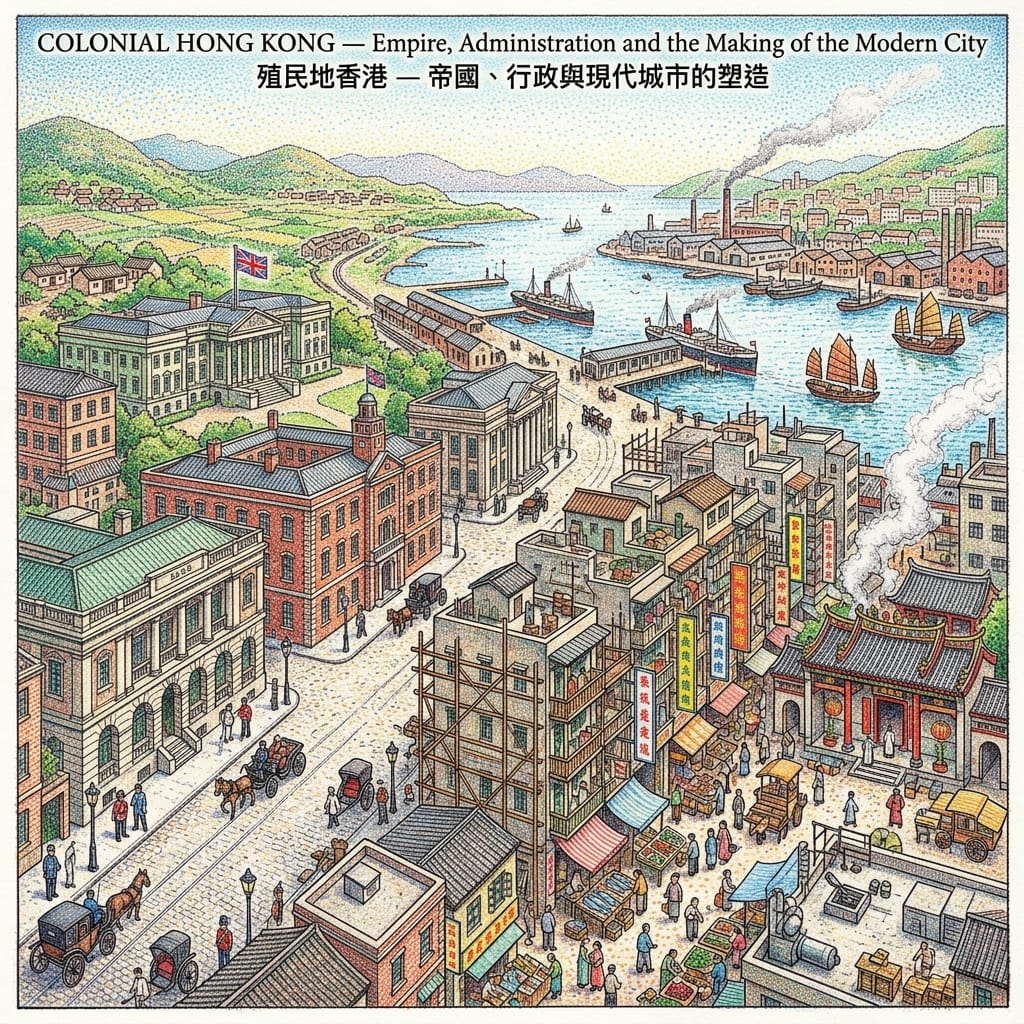
→ Sacred Hong Kong — Temples, belief and community identity
 Lawrence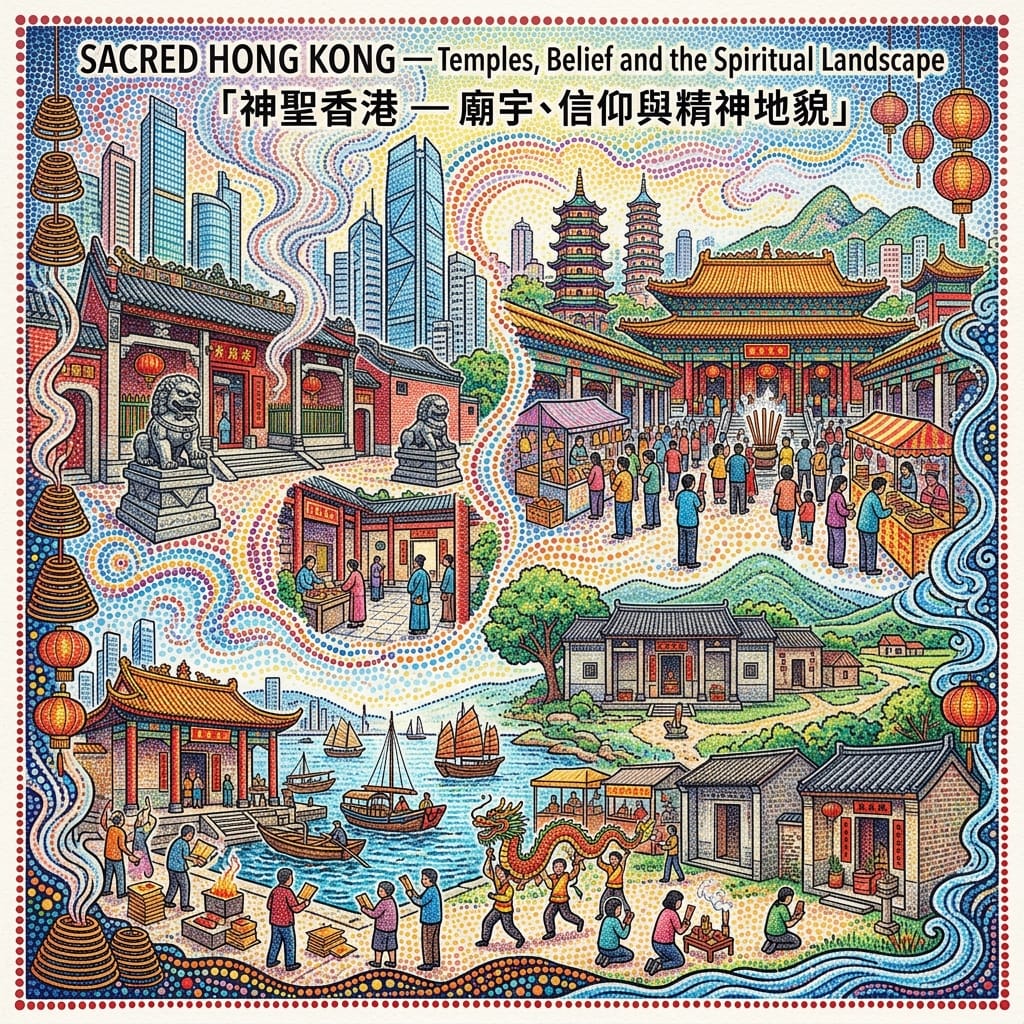
→ Commercial Hong Kong — Harbour, trade, markets, industry and global capital
 Lawrence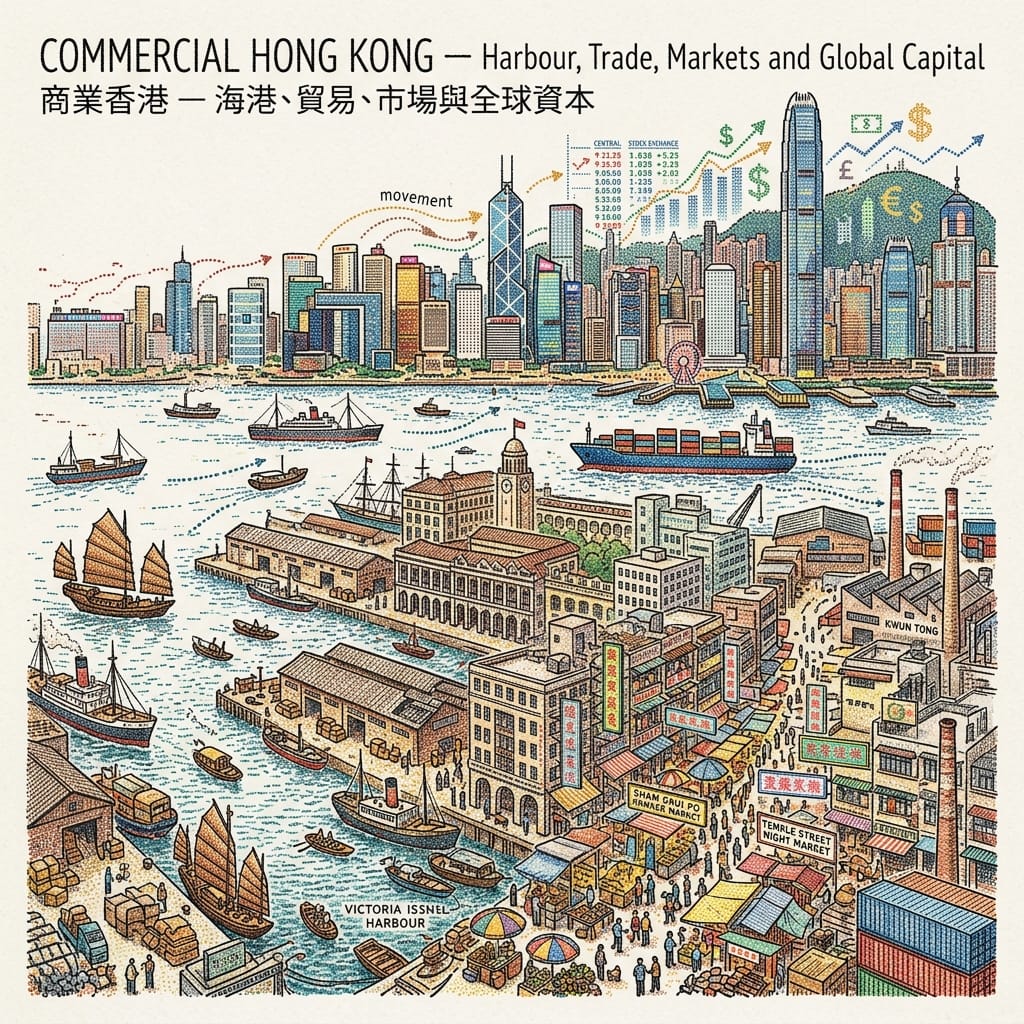
→ Modern Hong Kong — Migration, housing, infrastructure and reinvention
 Lawrence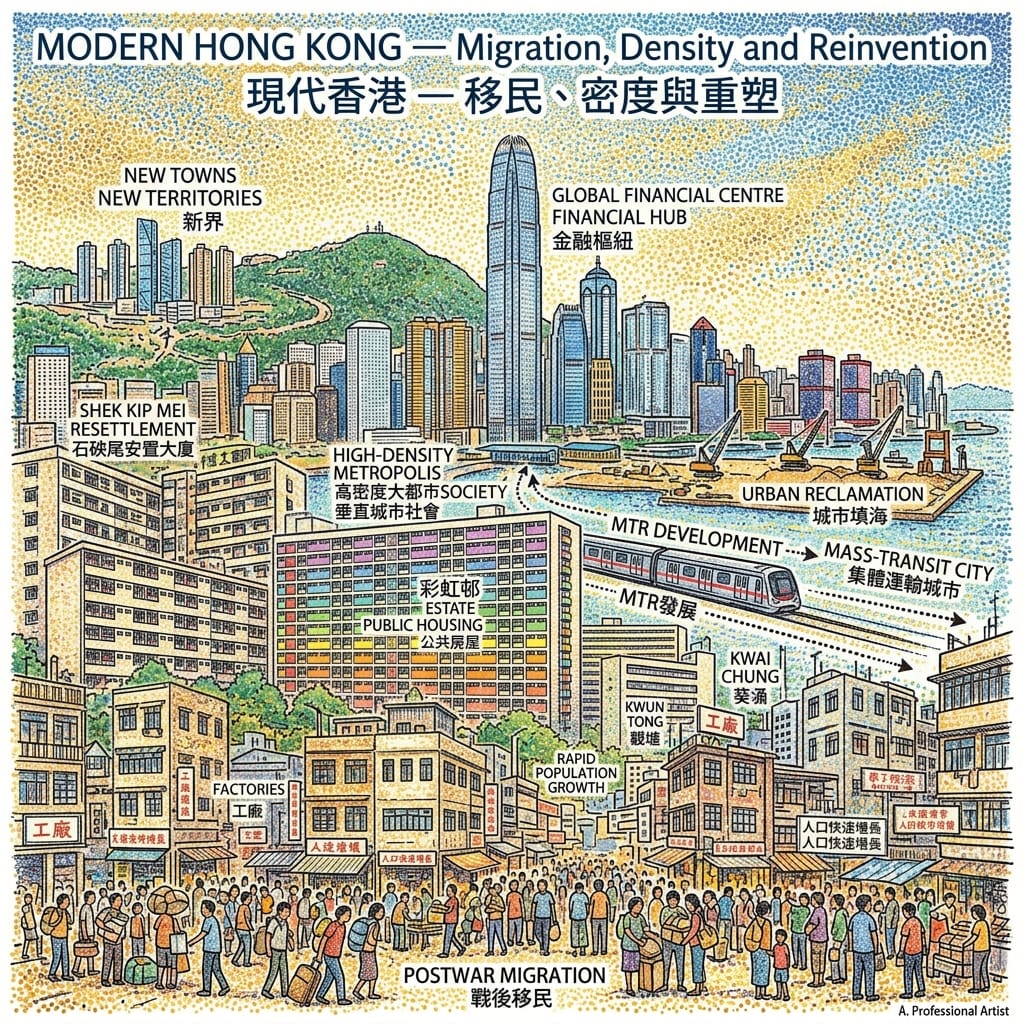
→ Hidden Hong Kong — Forgotten communities and surviving commercial landscapes
 Lawrence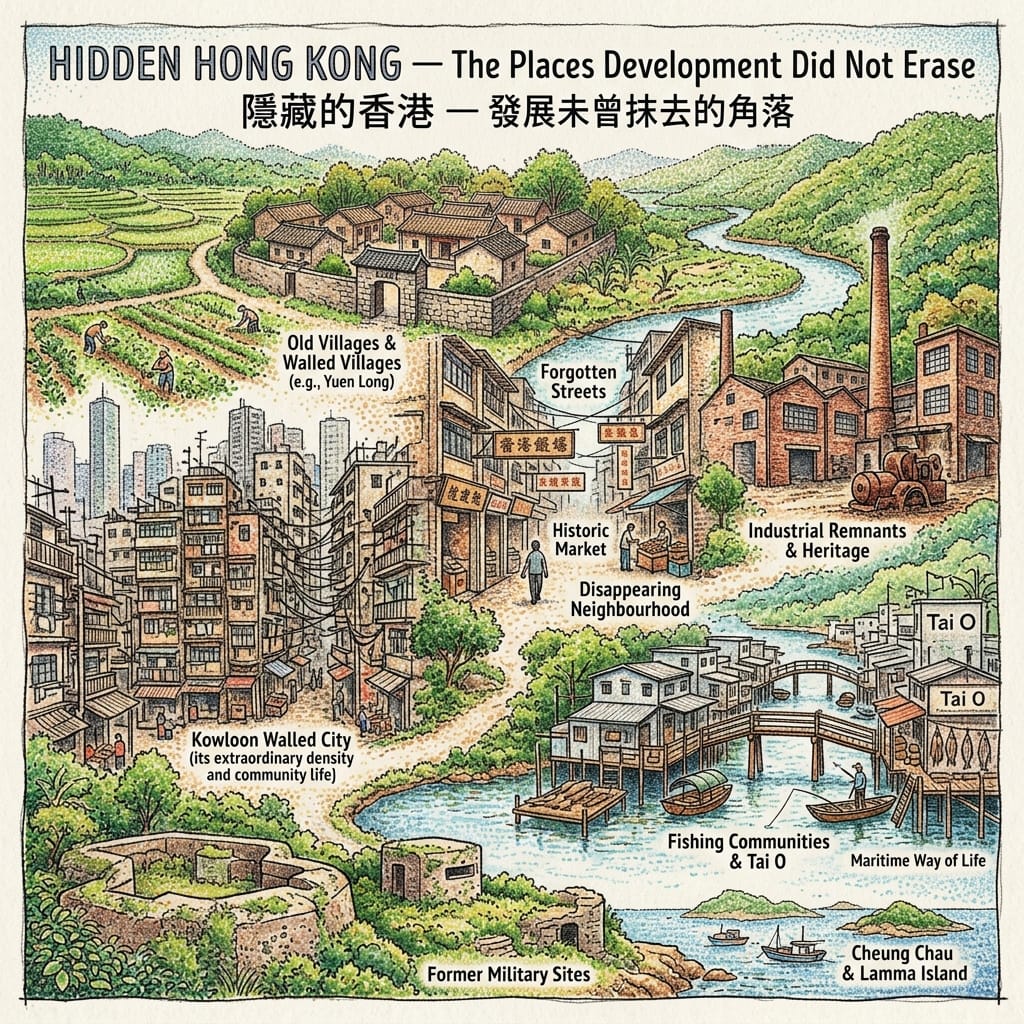
Commercial Hong Kong is not simply where Hong Kong makes money.
It is the economic system that explains why the territory's geography, neighbourhoods and people developed the way they did.
 Lawrence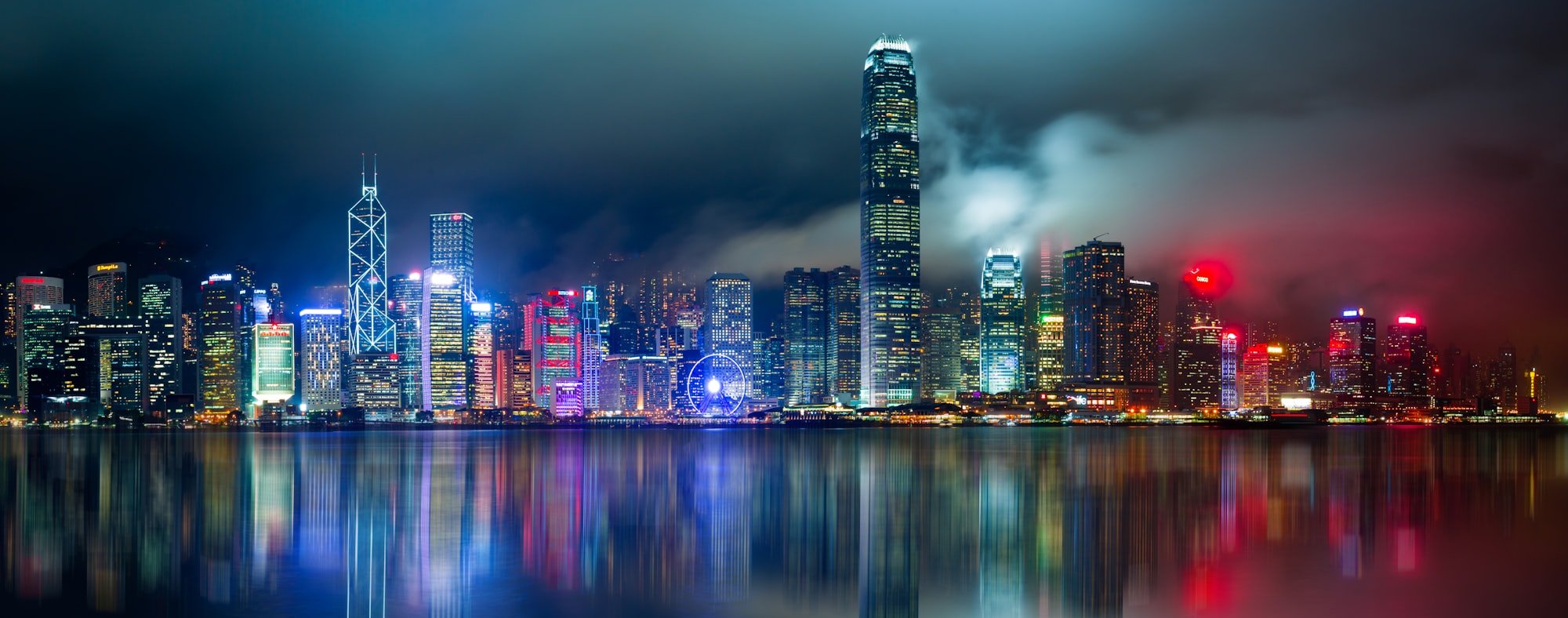
 Lawrence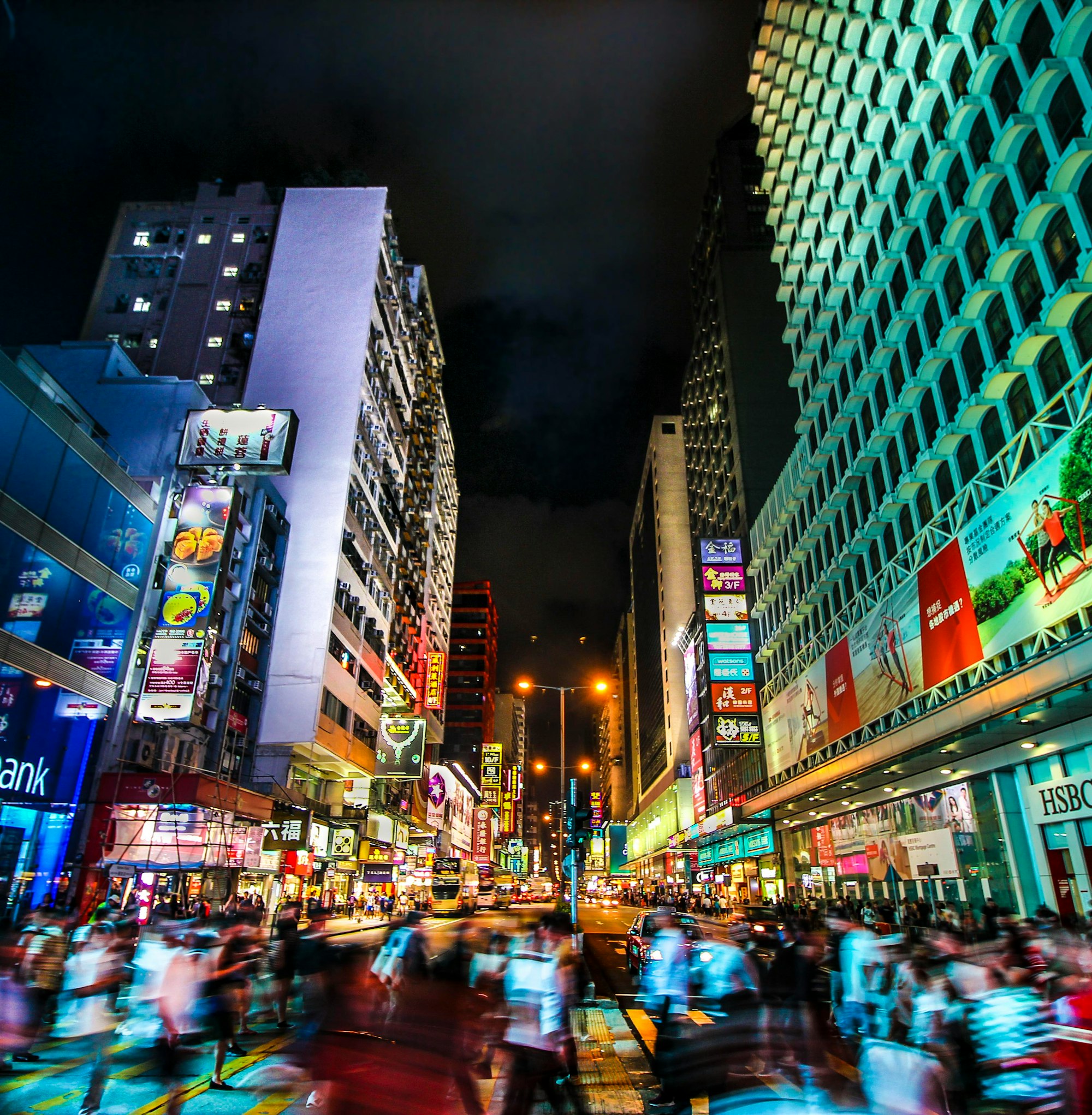
 Lawrence
 Lawrence
 Lawrence