Sacred Hong Kong 神聖香港
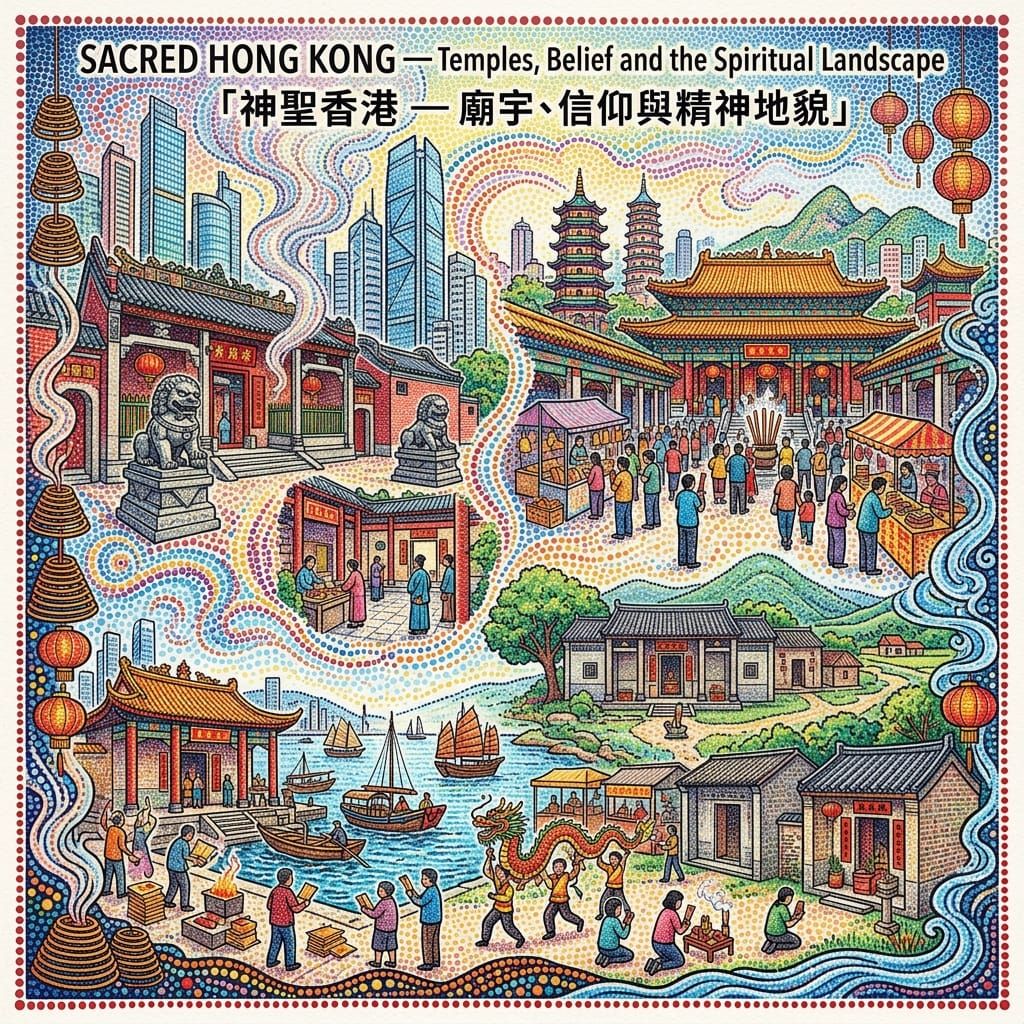
Beneath this modern landscape exists another Hong Kong — one shaped by temples, ancestral halls, village gods, festivals, rituals and beliefs about the relationship between people, land and the sea.
Sacred Hong Kong — The Spiritual Geography of a City Built Between Land and Sea
Temples, Gods, Villages and the Beliefs That Held Communities Together
Hong Kong is usually understood through its harbour.
Its skyline.
Its financial markets.
Its transport system.
Its extraordinary density.
But beneath this modern landscape exists another Hong Kong — one shaped by temples, ancestral halls, village gods, festivals, rituals and beliefs about the relationship between people, land and the sea.
A temple in Hong Kong was rarely simply a place to pray.
It could also be:
- A community meeting place
- A centre of charity
- A place for resolving disputes
- A guardian of a village
- A gathering point for merchants
- A symbol of lineage
- A place where people sought protection from disease, storms or uncertainty
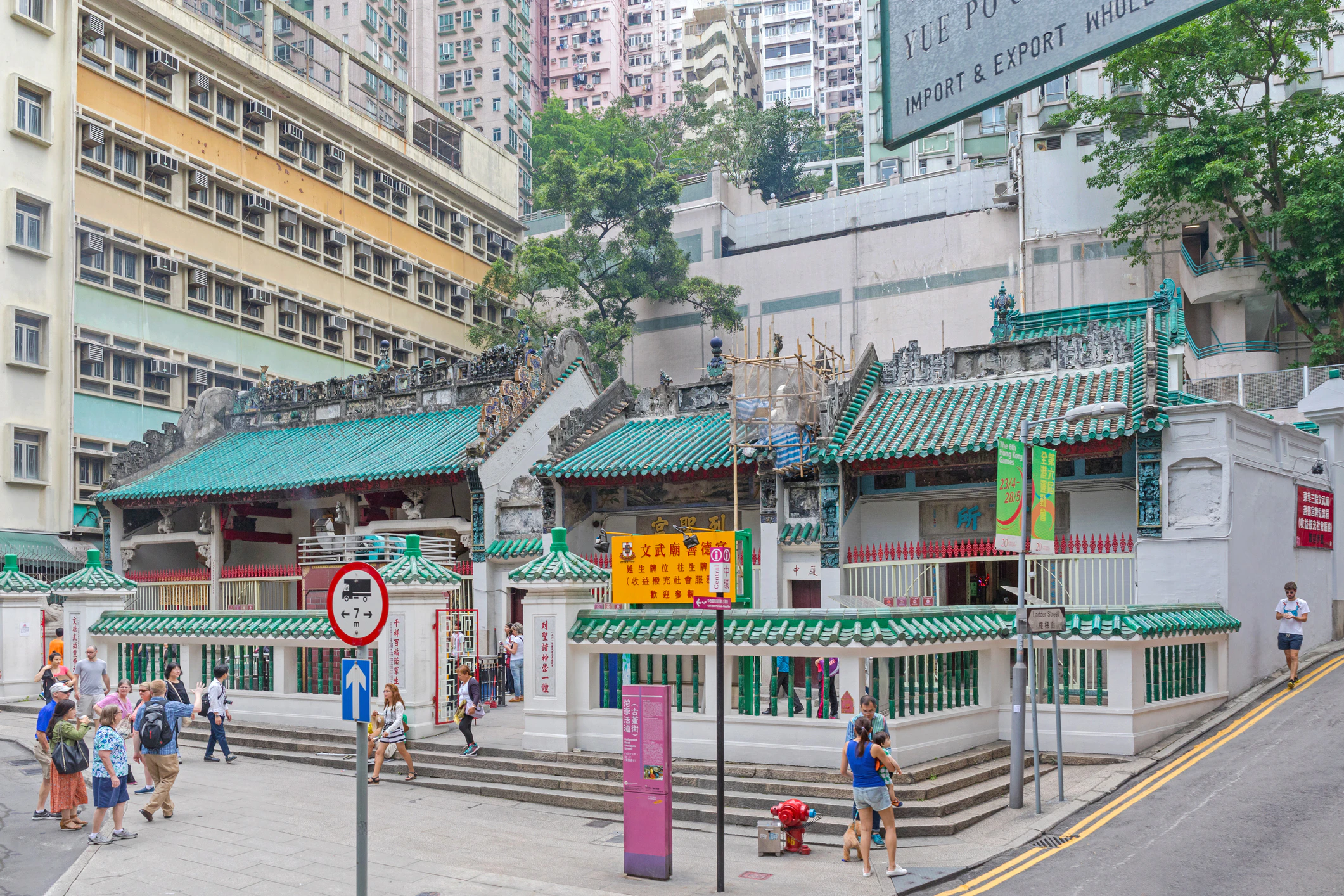
The Man Mo Temple Compound in Sheung Wan provides a particularly clear example. Built between 1847 and 1862, it includes Man Mo Temple, Lit Shing Kung and Kung Sor; the latter served as a meeting place for Chinese community affairs and disputes. The Antiquities and Monuments Office identifies the complex as an important representation of the traditional social organization and religious practices of Chinese communities in old Hong Kong.
This reveals something fundamental about Hong Kong.
Sacred space was also social space.
And that relationship continued as Hong Kong changed from a collection of coastal communities into a colonial port, an industrial city and a global metropolis.
This is Sacred Hong Kong.
1. Hong Kong's Sacred Landscape Began Before the Skyline
Religion Before the Modern City
The religious landscape of Hong Kong did not begin with the colonial period.
Long before skyscrapers appeared around Victoria Harbour, communities across the territory established temples and shrines dedicated to deities associated with:
- The sea
- Agriculture
- Warfare
- Literature
- Health
- Protection
- Prosperity
- Ancestry
These traditions were particularly important in a territory where daily life was shaped by uncertainty.
Fishing communities depended on the sea.
Farmers depended on weather and water.
Villages depended on land and lineage.
Merchants depended on trade.
For many communities, religion provided a framework through which uncertainty could be interpreted and managed.
The result was a sacred landscape spread across:
harbours + villages + markets + mountains + islands + urban neighbourhoods
That geography survives today.
2. Man Mo Temple — Religion and Community in Colonial Hong Kong
More Than a Temple on Hollywood Road
Man Mo Temple is one of the most important places for understanding Sacred Hong Kong.
Built between 1847 and 1862, the compound consists of three interconnected institutions:
- Man Mo Temple
- Lit Shing Kung
- Kung Sor
Man Mo Temple was dedicated primarily to Man Cheong, the God of Literature, and Kwan Tai, the God of Martial Arts.
Lit Shing Kung served a wider pantheon of Chinese gods.
Kung Sor was especially revealing because it functioned as a meeting place where community affairs and disputes could be addressed.
The temple therefore demonstrates that religion and community governance could occupy the same space.
The institution's relationship with the Tung Wah Group of Hospitals also developed into an important part of its modern history; Tung Wah has managed the temple since 1908.
This makes Man Mo Temple an unusually rich historical site.
It represents:
religion + community + Chinese merchant society + colonial Hong Kong
Explore Further
→ Your Man Mo Temple historical story
→ Colonial Hong Kong Theme Pillar
→ Commercial Hong Kong Theme Pillar
3. Wong Tai Sin — When Folk Religion Became a Metropolitan Institution

From Imported Deity to Hong Kong Institution
Wong Tai Sin is one of Hong Kong's best-known religious institutions.
Yet its popularity is relatively modern.
The Wong Tai Sin tradition was introduced to Hong Kong from Guangdong in the early twentieth century. Sik Sik Yuen was established in 1921, while the temple later became accessible to the wider public in the 1950s. The Hong Kong Government's official cultural guide records the site's continuing importance as a place of Taoist devotion and popular religious practice.
The temple became famous for its reputation for granting wishes and for kau cim, the practice of drawing fortune sticks.
The significance goes beyond fortune telling.
Wong Tai Sin reveals how religious institutions adapted to the rapidly changing social environment of twentieth-century Hong Kong.
A deity associated with a particular tradition became part of the spiritual life of a vast modern metropolis.
The temple therefore illustrates a recurring pattern in Hong Kong:
migration → religious adaptation → community growth → metropolitan institution
4. Tin Hau — The Goddess of the Sea and Maritime Hong Kong
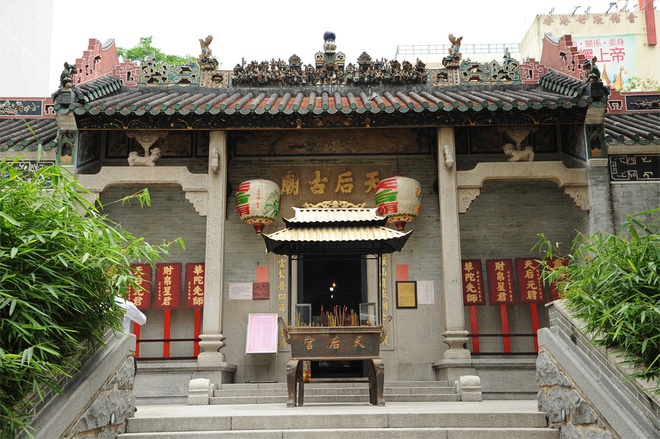
Before Hong Kong Became a Port, People Already Trusted the Sea
Perhaps no deity is more closely connected with Hong Kong's maritime identity than Tin Hau, the Goddess of the Sea.
Temples dedicated to Tin Hau appear throughout the territory, especially in areas with long associations with fishing and coastal communities.
One of the most historically significant examples is the Tin Hau Temple at Joss House Bay in Sai Kung, traditionally dated to 1266 and widely regarded as Hong Kong's oldest existing Tin Hau temple. The site is closely associated with Hong Kong's long maritime history.
This is more than religious history.
It is economic history.
For coastal communities, the sea could provide:
- Food
- Employment
- Trade
- Transportation
But it could also bring:
- Typhoons
- Shipwrecks
- Sudden loss
- Uncertainty
Tin Hau represented protection within that uncertain environment.
This explains why Tin Hau temples are so geographically revealing.
Follow the temples and you can often map the old maritime communities of Hong Kong.
Explore Further
→ Deep Water Bay / maritime stories
→ Cheung Chau
→ Tai O
→ Commercial Hong Kong Theme Pillar
→ Hidden Hong Kong Theme Pillar
5. Sacred Hong Kong and the Sea
Why Maritime Communities Needed More Than Boats
Hong Kong's fishing communities developed distinctive combinations of religion, ritual and community organization.
The sea was not simply an economic resource.
It shaped identity.
Fishing communities developed traditions that connected:
- Boats
- Temples
- Festivals
- Deities
- Kinship
- Markets
This is why places such as Tai O, Cheung Chau and other island communities should be read through Sacred Hong Kong as well as Commercial Hong Kong.
The religious landscape preserves evidence of an economy that has otherwise become increasingly difficult to see.
When the fishing fleet declines, the temple remains.
The temple therefore becomes an archive of the community.
6. Temple as Community Institution
When Religion Became Local Government of Another Kind
One of the most important aspects of Hong Kong's traditional religious institutions is their social function.
Man Mo Temple's Kung Sor provides a documented urban example of this.
In the New Territories, temples could also play significant community roles.
Tai Po's Man Mo Temple, for example, was established in the late nineteenth century and served as a venue for meetings, arbitration and worship in Tai Wo Market Town. The Antiquities and Monuments Office describes the temple as a significant institution within the local rural community.
The meaning is profound.
Before modern government institutions reached every corner of the territory, communities had to organize themselves.
Temples could provide a physical place where people met, negotiated and maintained social relationships.
That means Sacred Hong Kong is also a history of community governance.
7. The Gods of the Village
Religion as a Map of Settlement
The New Territories preserve a particularly rich sacred landscape.
Villages were organized around:
- Lineage
- Ancestral halls
- Temples
- Land
- Agriculture
- Water
- Community boundaries
A village temple could protect the settlement.
An ancestral hall could preserve lineage identity.
A deity could become associated with a particular community for generations.
This means sacred geography can help us reconstruct the social geography of historical Hong Kong.
A temple is not merely located somewhere.
It is connected to:
who lived there + how they organized themselves + what they feared + what they valued
Explore Further
→ Tuen Mun historical story
→ Yuen Long historical stories
→ Ping Shan
→ Hidden Hong Kong Theme Pillar
8. Man Mo Beyond Sheung Wan — Tai Po and the Rural Sacred Landscape
The Same Gods, a Different Society
The Man Mo tradition appears in both urban and rural Hong Kong.
But the social meaning changes with geography.
The Tai Po Man Mo Temple was opened in 1892 and served Tai Wo Market Town as a place for worship, meetings and arbitration. It is a declared monument.
Compare this with the Man Mo Temple in Sheung Wan.
The urban temple served Chinese merchants and residents within the colonial city.
The Tai Po temple served a rural market-town community.
Same broad religious tradition.
Different social environment.
This is precisely why a cross-regional Sacred Hong Kong pillar is more valuable than separate temple articles.
It allows readers to compare how similar religious traditions functioned differently across Hong Kong.
9. Sacred Space and Commerce
When Worship Created Economic Geography
Religion and commerce were never completely separate.
A major temple attracts people.
People create demand.
Demand supports businesses.
Markets form around the flow of visitors.
The relationship can be seen around Man Mo Temple, Wong Tai Sin and numerous village and island temples.
Food stalls.
Incense shops.
Traditional medicine.
Fortune tellers.
Festival vendors.
Transport services.
Small restaurants.
The sacred landscape therefore creates its own economic ecosystem.
This makes Sacred Hong Kong one of the strongest cross-links to Commercial Hong Kong.
The relationship should not be understood as commercialization destroying religion.
Historically, commerce and worship often developed together.
10. Festivals — When Hong Kong's Streets Become Sacred
The Temple Does Not End at Its Door
Hong Kong's sacred geography expands dramatically during festivals.
A road can temporarily become a processional route.
A market street can become a ritual space.
A village can become a gathering point for thousands of people.
The Cheung Chau Bun Festival is an especially powerful example.
Its traditions are closely associated with Pak Tai Temple and the island's religious community, while the contemporary festival has become one of Hong Kong's best-known cultural events.
But the important historical question is not simply why tourists find the festival fascinating.
It is:
What does the festival do for the community that performs it?
Ritual can preserve:
- Collective memory
- Local identity
- Community relationships
- Religious traditions
- Intergenerational knowledge
Explore Further
→ Cheung Chau historical stories
→ Hidden Hong Kong Theme Pillar
11. Religion and the Protection of the Community
Why People Prayed
It is easy to reduce traditional Chinese religion to "good luck."
The historical picture is much broader.
People prayed for:
- Health
- Safe childbirth
- Good harvests
- Protection at sea
- Examination success
- Business prosperity
- Family stability
- Protection from disaster
These prayers reflect the real uncertainties of historical life.
For fishermen, the sea was dangerous.
For farmers, harvests were uncertain.
For merchants, business could fail.
For families, disease could be catastrophic.
Religion provided both symbolic protection and social solidarity.
This is one reason traditional temples survived the arrival of modern medicine, modern government and modern finance.
They responded to needs that were not purely material.
12. Sacred Hong Kong Under Colonial Rule
How Did Traditional Religion Survive Empire?
Colonial Hong Kong introduced a new political system.
Yet Chinese religious institutions continued to operate.
This created a distinctive coexistence.
The colonial government controlled:
- Law
- Land
- Administration
- Policing
- Public infrastructure
But communities continued to maintain:
- Temples
- Festivals
- Ancestor traditions
- Local associations
- Religious networks
Man Mo Temple is a particularly useful example because of its formal relationship with the Tung Wah Group of Hospitals, which became responsible for the temple and its properties in 1908.
Sacred Hong Kong therefore reveals a broader truth about colonialism:
political control did not mean complete cultural control.
Local religious institutions remained important spaces through which communities maintained their own identities.
Explore Further
→ Colonial Hong Kong Theme Pillar
→ Man Mo Temple
→ Central and Sheung Wan stories
13. Religion, Charity and Social Welfare
The Sacred City Also Cared for the Living
Hong Kong's temple history intersects with the history of Chinese charity.
The Tung Wah Group of Hospitals provides a particularly important example.
Its institutional relationship with Man Mo Temple connected religious tradition with charitable activity.
This matters because traditional community organizations often addressed practical social needs alongside spiritual ones.
The boundaries between:
religion + charity + medicine + community organization
were not always as clear as they appear today.
Sacred Hong Kong therefore belongs within the social history of the territory.
It is not an isolated study of belief.
14. Feng Shui — Reading the Relationship Between People and Landscape
Sacred Hong Kong Is Also a Geography of Place
Feng Shui is often presented to visitors as an exotic explanation for Hong Kong's skyline.
That approach is too simplistic.
Historically, ideas about landscape, direction, mountains, water and spatial relationships formed part of how many communities understood place.
In rural Hong Kong, settlement location and landscape were often interpreted through relationships between:
- Mountains
- Water
- Village orientation
- Ancestral sites
- Temples
- Agricultural land
In urban Hong Kong, these ideas continued to influence some aspects of popular culture and the interpretation of buildings and spaces.
The important point is not to claim that every building in Hong Kong was designed according to Feng Shui.
Rather:
Feng Shui belongs to the broader cultural history of how people interpreted landscape and place.
That distinction keeps Sacred Hong Kong historically credible rather than mystical for its own sake.
15. Sacred Hong Kong and the Urban Skyline
How an Ancient Cultural Layer Survives in a Modern City
One of Hong Kong's most striking visual characteristics is the juxtaposition of temples and skyscrapers.
A temple may stand beneath towers.
A village shrine may sit beside a new housing estate.
An ancient religious tradition may continue inside one of the world's most globalized cities.
This is not simply picturesque contrast.
It reveals a deeper cultural process.
Modernization did not eliminate traditional religious institutions.
Instead, they were incorporated into an increasingly dense urban landscape.
That makes Hong Kong an unusually powerful case study in cultural continuity under extreme urbanization.
16. Hidden Sacred Hong Kong
The Small Temples That the Tourist Map Ignores
The famous temples attract attention.
The smaller temples preserve local history.
A village shrine can tell us about a clan.
A Tin Hau temple can reveal the maritime history of a fishing community.
A small Pak Tai temple can reveal island identity.
A Man Mo temple can reveal the social organization of a market town.
These places are particularly important for your website because they allow Sacred Hong Kong to connect directly to the Hidden Hong Kong layer.
The temple is visible.
Its historical network is hidden.
17. Sacred Hong Kong Walking Routes
Route 1 — Colonial and Chinese Sacred Hong Kong
Man Mo Temple → Hollywood Road → Sheung Wan → Western District
Historical focus:
Chinese community life, merchant society, colonial urban development and religious institutions.
→ Related pillars: Colonial + Commercial Hong Kong
Route 2 — Kowloon's Popular Religion
Wong Tai Sin → surrounding neighbourhoods → old Kowloon communities
Historical focus:
migration, popular religion, divination and metropolitan religious culture.
→ Related pillars: Modern + Hidden Hong Kong
Route 3 — Rural Sacred Hong Kong
Tai Po Man Mo Temple → historic market area → surrounding village landscapes
Historical focus:
market-town development, rural administration, community arbitration and temple life.
→ Related pillars: Hidden + Commercial Hong Kong
Route 4 — Maritime Sacred Hong Kong
Tai O → village temple traditions → waterfront
Historical focus:
fishing communities, maritime uncertainty, local religion and economic change.
→ Related pillars: Hidden + Commercial Hong Kong
Route 5 — Island Sacred Hong Kong
Cheung Chau → Pak Tai Temple → harbour and old settlement
Historical focus:
island identity, maritime religion, community ritual and the Bun Festival.
→ Related pillars: Hidden + Commercial Hong Kong
18. What Sacred Hong Kong Reveals About the Territory
Study Hong Kong's religious places carefully and they reveal much more than faith.
They reveal:
- Migration
- Settlement
- Maritime culture
- Trade
- Village organization
- Social hierarchy
- Charity
- Health concerns
- Political change
- Community identity
- Relationships with landscape
A temple is therefore a historical document.
But unlike a document in an archive, it remains embedded in the community that created it.
That is why sacred places are such valuable historical travel destinations.
19. Why Sacred Hong Kong Matters
Hong Kong's modern identity is often associated with speed, finance and globalization.
Sacred Hong Kong reveals the opposite qualities:
- Continuity
- Ritual
- Memory
- Community
- Place
- Belonging
These forces did not disappear when Hong Kong became modern.
They adapted.
The temple remained.
The deity remained.
The festival changed.
The neighbourhood changed.
The community changed.
But the underlying cultural relationship survived.
This is one of the most important stories Hong Kong can tell about itself.
Final Reflection — The Hong Kong That Still Believes
Hong Kong is one of the world's most modern cities.
Yet incense still rises from temple courtyards.
Fishermen still remember sea gods.
Families still seek protection.
Students still pray for success.
Communities still organize festivals.
Villagers still honour their temples and ancestors.
People still walk into old temples surrounded by towers and traffic.
This is not simply a survival of the past.
It is adaptation.
Sacred traditions have moved through colonialism, migration, industrialization, globalization and urban redevelopment.
Some temples have been rebuilt.
Some communities have disappeared.
Some rituals have become tourist attractions.
Others remain deeply local.
But the sacred landscape continues to provide something modern infrastructure cannot completely replace:
a sense of continuity.
That is why Sacred Hong Kong matters.
It reveals a Hong Kong that cannot be measured only by GDP, buildings or population density.
It reveals the Hong Kong of memory, belief and belonging.
The skyline tells us how Hong Kong grew.
Its temples tell us what many communities wanted to preserve while it grew.
Historical Sources & Further Reading
For the Sacred Hong Kong collection, prioritize:
Government and Heritage Sources
- Antiquities and Monuments Office
- Hong Kong Museum of History
- Hong Kong Government Records Service
- Leisure and Cultural Services Department
- Tung Wah Group of Hospitals
- District heritage programmes
- Temple and community archives
The Antiquities and Monuments Office provides particularly useful primary-level documentation on Man Mo Temple Compound, including its dates, architecture, community role and relationship with Tung Wah.
For Tai Po, the Antiquities and Monuments Office documents Man Mo Temple's role in meetings, arbitration and worship in Tai Wo Market Town.
For deeper research, useful themes include:
- Chinese folk religion in Hong Kong
- Tin Hau worship and maritime communities
- Temple networks
- Village religion
- Ancestor worship
- Man Mo traditions
- Religious festivals
- Temple charity
- Feng Shui and cultural geography
- Religion under colonial rule
- Postwar religious transformation
For Historical Travel Stories, major historical claims should be supported with contextual citations beside the relevant statements, rather than relying solely on a reference list at the bottom.
Continue Exploring Hong Kong
HONG KONG — The Complete Authority Guide
→ Colonial Hong Kong — Empire, administration and the making of the modern city
→ Sacred Hong Kong — Temples, gods, communities and spiritual geography
→ Commercial Hong Kong — Harbour, trade, markets and global capital
→ Modern Hong Kong — Migration, housing, infrastructure and reinvention
→ Hidden Hong Kong — Forgotten communities and surviving landscapes
Sacred Hong Kong is not a collection of temples.
It is the spiritual and social geography through which generations of Hong Kong communities understood where they belonged.
 Lawrence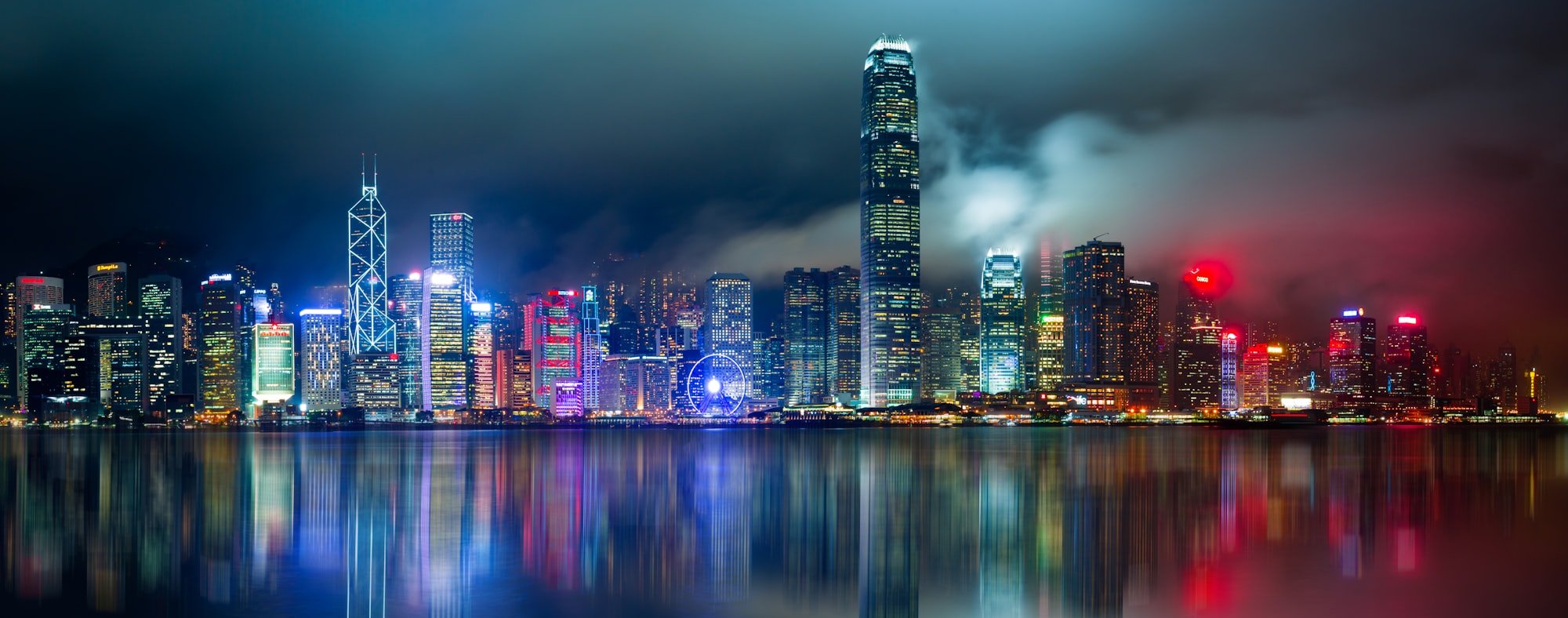
 Lawrence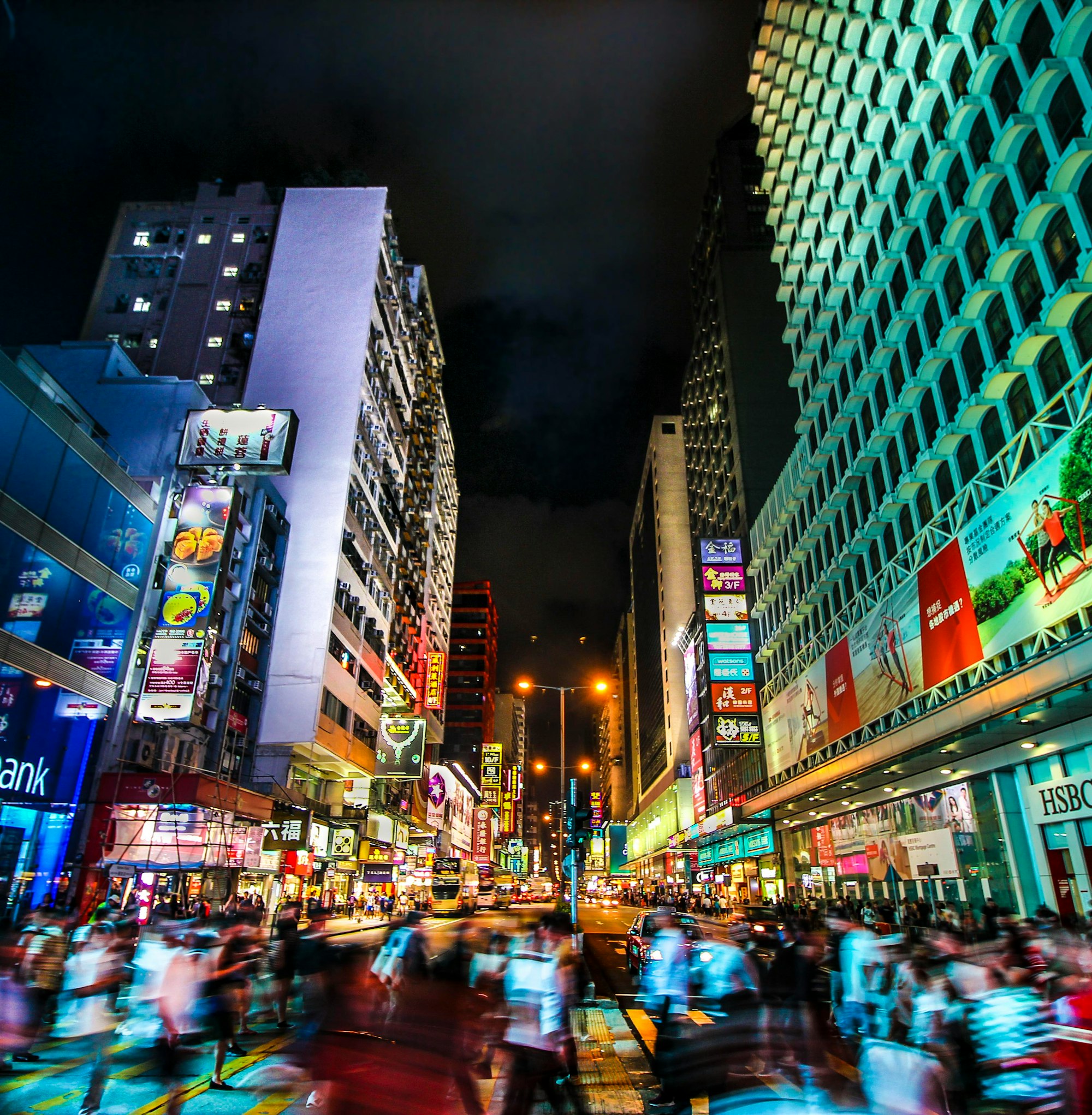
 Lawrence
 Lawrence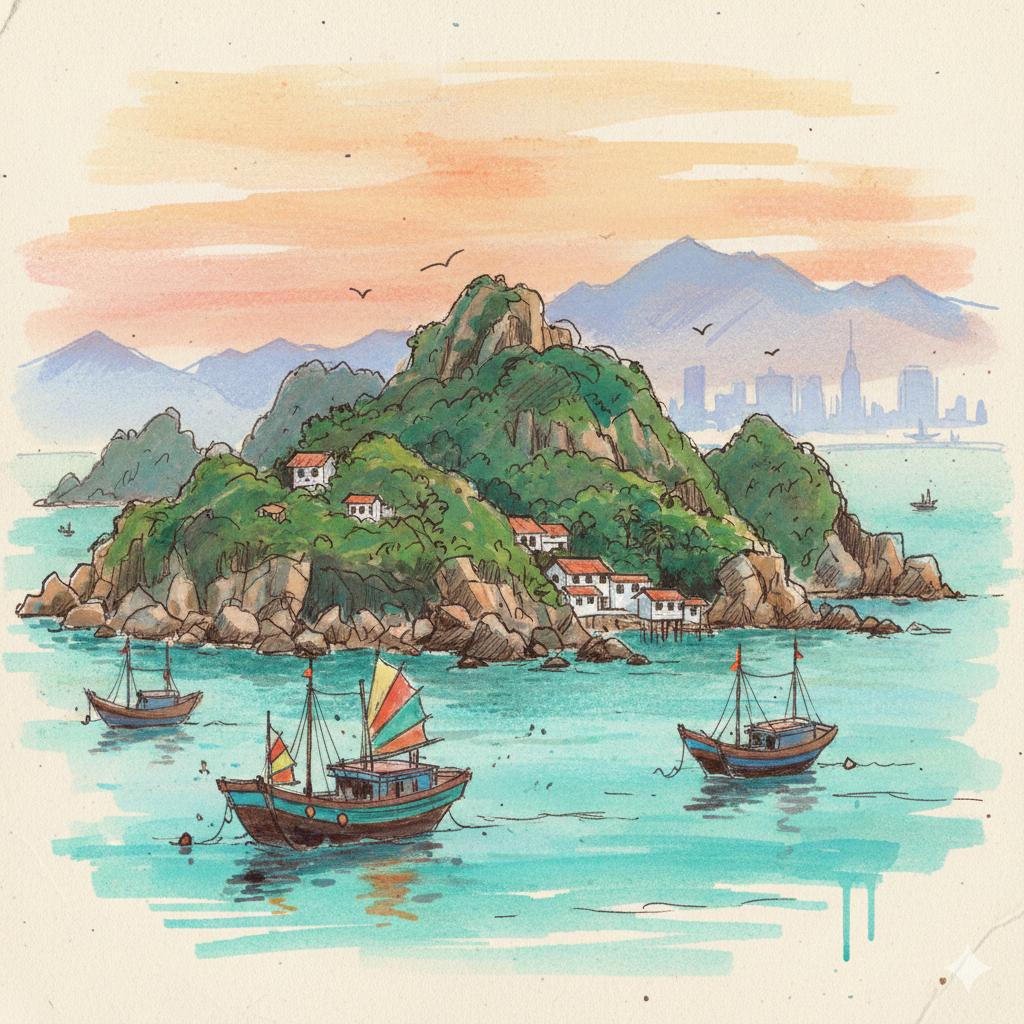
 Lawrence