
Modern Hong Kong 現代香港
Hong Kong's modern identity was not created by skyscrapers. The skyscrapers came later. The deeper transformation began after the Second World War, when population growth, migration, housing shortages and economic upheaval forced Hong Kong to reinvent itself at extraordinary speed.
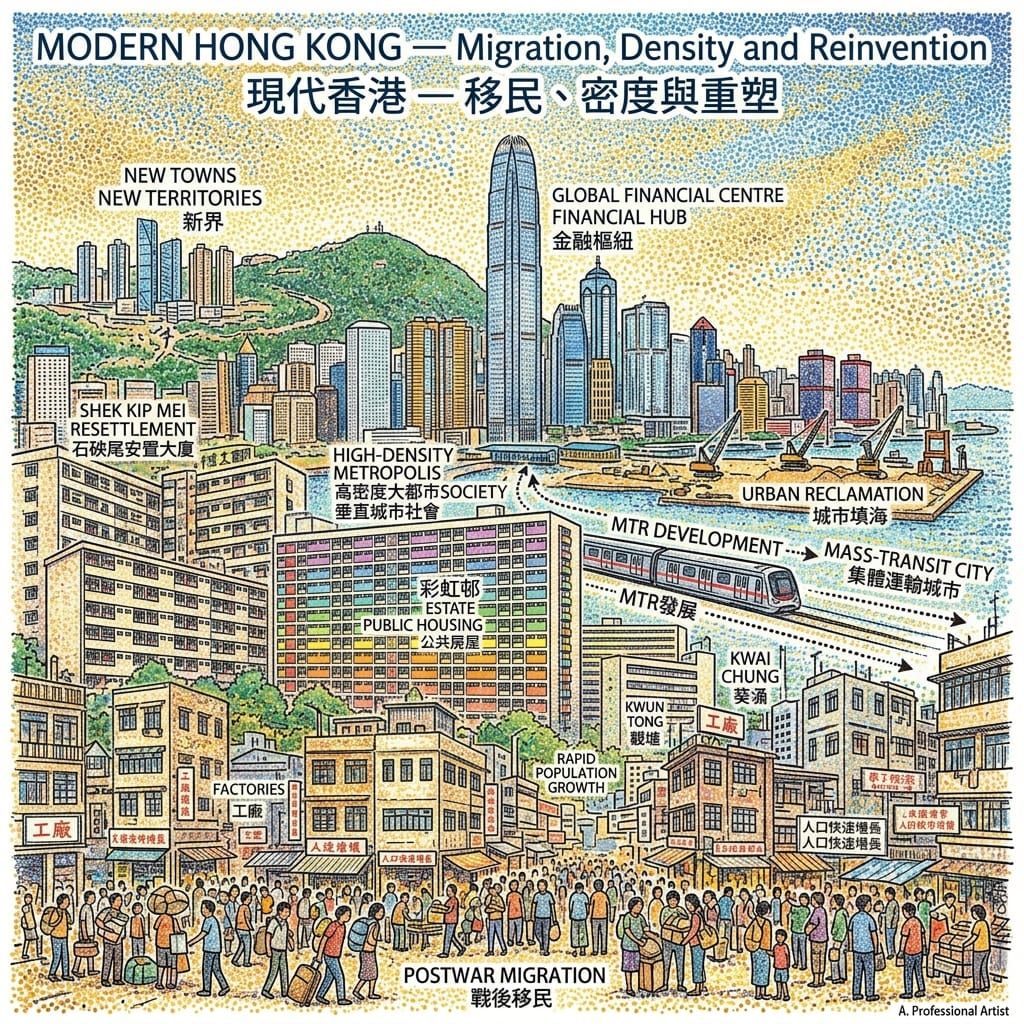
Modern Hong Kong — From Refugee City to Vertical Metropolis
How Migration, Housing, Industry, Infrastructure and Globalization Rebuilt Hong Kong
Hong Kong's modern identity was not created by skyscrapers.
The skyscrapers came later.
The deeper transformation began after the Second World War, when population growth, migration, housing shortages and economic upheaval forced Hong Kong to reinvent itself at extraordinary speed.
The city that emerged was radically different from the colonial port of the nineteenth century.
It became:
- A mass-housing city
- A manufacturing centre
- A container-port economy
- A railway metropolis
- A network of planned new towns
- A global financial centre
- A highly vertical urban society
But Modern Hong Kong is not simply a story of economic success.
It is also a story of overcrowding, displacement, public housing, industrial labour, land reclamation, social planning and communities adapting to enormous pressure.
This is what makes modern Hong Kong historically distinctive:
the city repeatedly solved one problem by creating another, then redesigned itself again.
The result is the Hong Kong of today.
1. The Turning Point — Hong Kong After 1945
A City Entering a New Era
The end of the Second World War marked a fundamental break.
Hong Kong emerged from Japanese Occupation physically damaged, economically disrupted and demographically transformed.
The postwar population rapidly increased as migrants arrived from mainland China.
Housing became one of the territory's most urgent problems.
By the early 1950s, large squatter settlements had appeared on hillsides and undeveloped land.
The Hong Kong Housing Authority's historical record notes that the influx of migrants produced a squatter population of around 300,000 in the early 1950s, while major fires in squatter areas left tens of thousands homeless. (housingauthority.gov.hk)
This was the beginning of a completely new urban logic.
Hong Kong could no longer depend on the old colonial city alone.
It needed to house a mass population.
2. Shek Kip Mei — When Housing Became Government Policy
The Fire That Changed Hong Kong's Urban History
On Christmas night in 1953, a devastating fire destroyed the squatter settlement at Shek Kip Mei.
More than 50,000 people were left homeless.
The disaster forced the government to take direct responsibility for large-scale housing provision. The first resettlement blocks were completed in 1954, marking the beginning of Hong Kong's major public-housing programme. (housingauthority.gov.hk
The original Mark I resettlement blocks were basic.
Small domestic units.
Shared facilities.
Open corridors.
No lifts.
But they represented something historically revolutionary:
the state was now physically building the city in which ordinary people would live.
Housing had become urban infrastructure.
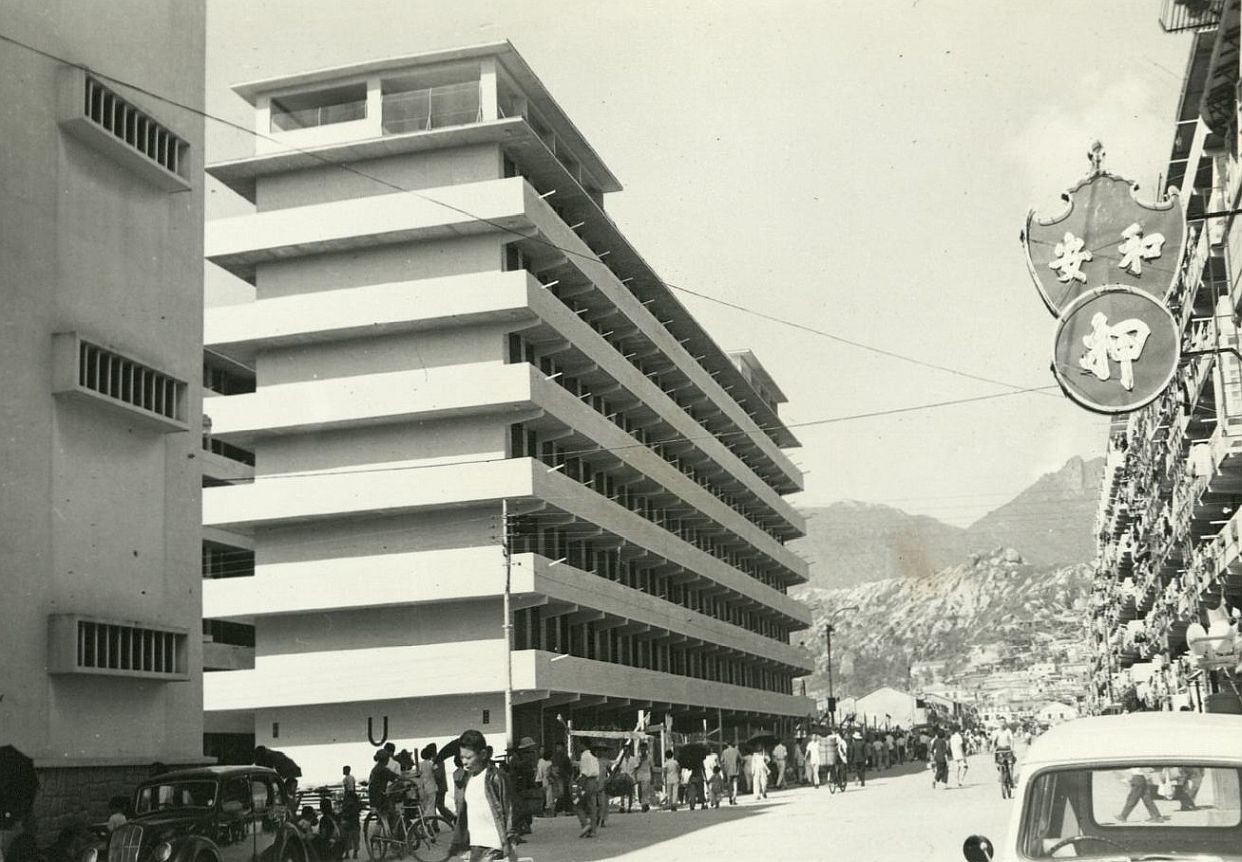
Shek Kip Mei Resettlement Estate in 1957. The Government Records Service image captures the early modern housing city taking shape around residents' everyday lives. (grs.gov.hk)
3. Public Housing — The Architecture of Mass Society
Hong Kong Begins to Build Upward
Public housing gradually transformed from emergency resettlement into a much larger urban system.
The Housing Authority's historical timeline records the progression from the early resettlement blocks of the 1950s to taller and better-equipped housing during the 1960s and 1970s. By 1965, improved high-rise blocks included private lavatories, while public-housing populations had reached around one million. (housingauthority.gov.hk
The architectural evolution tells the story:
six-storey resettlement block → slab block → high-rise estate → self-contained community
Housing estates increasingly incorporated:
- Schools
- Shops
- Markets
- Clinics
- Transport
- Recreation facilities
- Community services
Wah Fu Estate, completed in 1971, was an important example of the self-contained community model. (housingauthority.gov.hk
The housing estate therefore became more than a collection of flats.
It became a new form of urban society.
Explore Further
→ Choi Hung Estate
→ Sham Shui Po
→ Public housing history
→ Modern Hong Kong Theme stories
4. Mei Ho House — When Housing Becomes Heritage
The Surviving Evidence of the First Housing City
Most early resettlement buildings did not survive.
That makes Mei Ho House particularly significant.
Built in 1954 as one of the original Mark I resettlement blocks, it is the only surviving H-shaped block of its type in Hong Kong. It was later revitalized rather than demolished. (heritage.gov.hk
Its importance goes beyond architecture.
It preserves the physical environment of the first mass-housing generation.
The corridors.
The compact units.
The circulation system.
The building scale.
All reveal a social reality that is difficult to reconstruct through statistics alone.
Modern Hong Kong therefore leaves behind an interesting historical question:
When does ordinary housing become heritage?
Mei Ho House suggests an answer.
When the building becomes evidence of a transformation experienced by an entire society.
5. From Refugee Settlement to Industrial Economy
The Factories That Gave Hong Kong Its Next Life
Housing solved only one problem.
People also needed work.
During the postwar decades, Hong Kong developed rapidly as a manufacturing centre.
Factories expanded in districts such as:
- Kwun Tong
- Sham Shui Po
- Cheung Sha Wan
- Tsuen Wan
- Kwai Chung
Textiles.
Garments.
Plastics.
Electronics.
Household goods.
Hong Kong's commercial identity therefore changed fundamentally.
The nineteenth-century colony had been primarily an entrepôt.
The postwar territory became a producer.
This industrial economy transformed the social landscape.
Factories needed workers.
Workers needed housing.
Housing needed transport.
Transport encouraged new town development.
Industry therefore became part of a much wider urban system.
6. Kwun Tong — The Factory City
From Reclaimed Land to Manufacturing Powerhouse
Kwun Tong is one of the clearest physical expressions of industrial Hong Kong.
Reclaimed land south of Kwun Tong Road became the basis for an industrial zone and one of Hong Kong's earliest planned satellite-town developments.
Historical material from the Hong Kong 18 Districts project documents the mid-twentieth-century landscape of factories, trucks, workers and rapidly developing roads, illustrating how the area evolved from former squatter and reclaimed-land environments into a manufacturing centre. (had18.huluhk.org)
Later, manufacturing declined.
Factories closed or moved.
Industrial buildings acquired new uses.
Offices, studios, restaurants and creative businesses occupied some of the old buildings.
Kwun Tong therefore contains several generations of Modern Hong Kong within the same landscape:
reclamation → industry → redevelopment → creative economy
Explore Further
→ Kwun Tong historical story
→ Commercial Hong Kong Theme Pillar
→ Hidden Hong Kong Theme Pillar
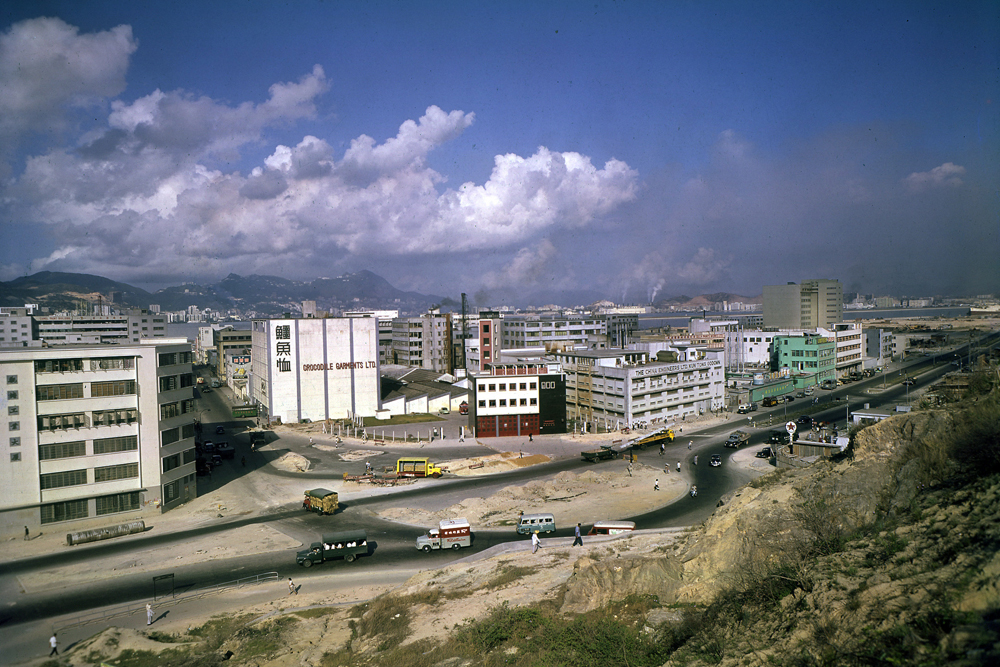
Kwun Tong's early industrial landscape, showing factories, workers' transport and the developing road network. (had18.huluhk.org)
7. New Towns — Hong Kong Moves Beyond the Old Urban Core
The Most Ambitious Spatial Experiment in Hong Kong's History
By the early 1970s, the old urban areas could no longer accommodate population growth efficiently.
The government launched the New Town Development Programme in 1973.
The first generation consisted of:
- Tsuen Wan
- Sha Tin
- Tuen Mun
Later generations expanded to:
- Tai Po
- Fanling / Sheung Shui
- Yuen Long
- Tseung Kwan O
- Tin Shui Wai
- Tung Chung
Hong Kong's Civil Engineering and Development Department records that the original target for the first three new towns was to provide housing for about 1.8 million people. (cedd.gov.hk)
The new-town concept was ambitious.
Each town was intended to provide a relatively balanced combination of:
- Housing
- Employment
- Schools
- Shopping
- Community facilities
- Transport
- Recreation
This was not simply suburban expansion.
Hong Kong was deliberately creating new urban centres.
8. Tuen Mun — A New Town Built Over an Older Landscape
Modern Planning Meets Ancient Hong Kong
Tuen Mun illustrates the complexity of New Town development.
The modern town was planned as one of Hong Kong's first-generation new towns, with housing, industry, community facilities and integrated transport forming part of a planned urban system. (pland.gov.hk)
But Tuen Mun was not a blank site.
Older settlement, religious and maritime histories existed long before the modern new town.
This creates an important historical tension:
planned city versus inherited landscape
The New Town transformed Tuen Mun.
It did not erase everything that came before.
That makes Tuen Mun a particularly strong cross-link between:
→ Modern Hong Kong
→ Hidden Hong Kong
→ Sacred Hong Kong
→ Colonial Hong Kong
Explore Further
→ Tuen Mun historical story
→ Hidden Hong Kong Theme Pillar
→ Sacred Hong Kong Theme Pillar
9. Sha Tin — Turning a Rural Valley into a New City
Planning at Metropolitan Scale
Sha Tin represents another form of transformation.
The valley that had once contained villages, agricultural land and waterways was reshaped into a major planned urban district.
Large-scale engineering altered the landscape.
Residential towers appeared.
Roads and railways connected the new town with the urban core.
Community facilities were built alongside housing.
Historical aerial photographs show the scale of the transformation as roads, towers and reclaimed land progressively replaced the earlier landscape. (photorator.com)
Sha Tin reveals one of the defining characteristics of modern Hong Kong:
urban development was not merely filling existing spaces—it was actively manufacturing new urban geography.
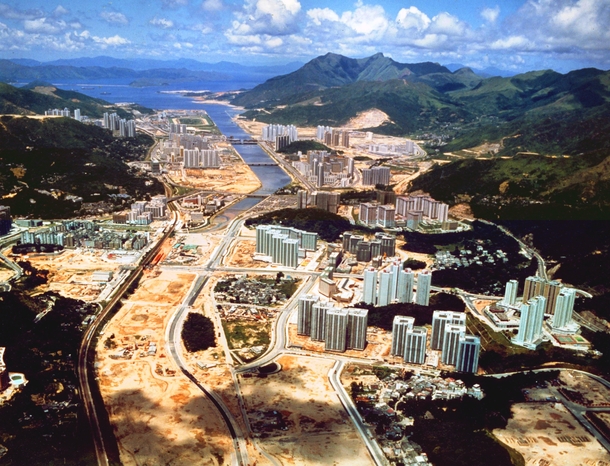
An aerial view of Sha Tin during New Town construction, showing roads, housing towers and major changes to the valley landscape.
10. Choi Hung Estate — When Housing Became an Identity
Architecture, Community and the Image of Modern Hong Kong
Public housing estates became much more than solutions to population pressure.
They became cultural environments.
Choi Hung Estate, completed in the early 1960s, became particularly famous for its architectural design and later its distinctive colours.
But the historical significance lies beyond the image.
The estate represented a new generation of public housing with more complete domestic facilities and community infrastructure. Housing Authority historical material identifies Choi Hung as an example of the 1960s slab-block design. (housingauthority.gov.hk)
Its popularity also reveals something fascinating about modern Hong Kong:
infrastructure can eventually become cultural heritage.
A housing estate built to solve an urgent social problem can later become an icon of the city's visual identity.
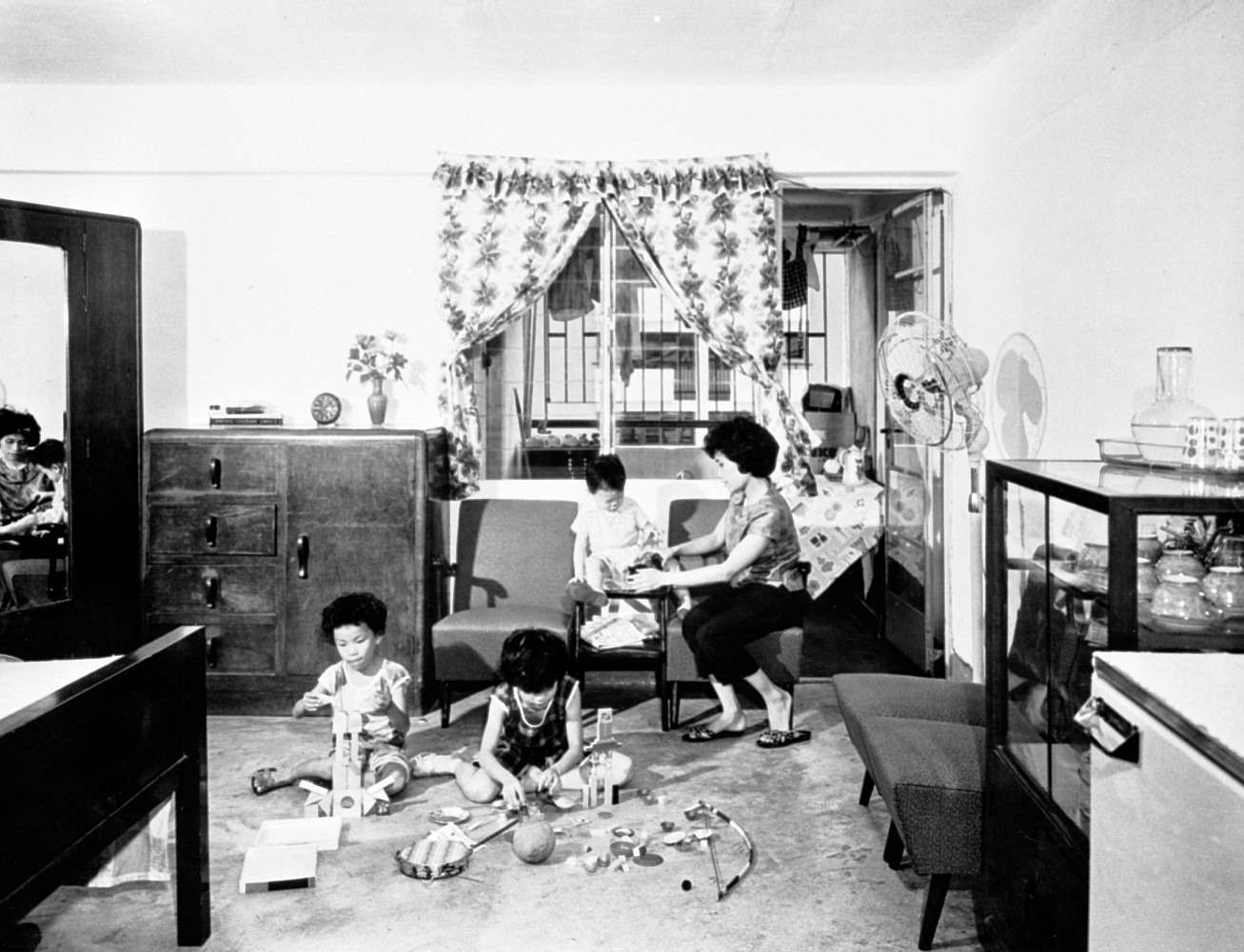
An early domestic interior at Choi Hung Estate, showing the everyday life behind the architecture. (ourchinastory.com)
Editorial note: Choi Hung Estate's redevelopment and demolition have become part of the estate's latest historical chapter, making preservation and redevelopment an important future topic for this pillar.
11. The MTR — When Mobility Became the City's Skeleton
The Railway That Changed Where Hong Kong Could Live
The New Town strategy required transport.
The Mass Transit Railway became one of the defining infrastructures of modern Hong Kong.
The first MTR passenger service opened on 1 October 1979, initially connecting Shek Kip Mei and Kwun Tong. Around 230,000 passengers used the system on its first day. (scmp.com)
This was more than a transport achievement.
The MTR changed urban geography.
It made it practical for people to:
- Live farther from the traditional urban core
- Commute across districts
- Connect new towns to jobs
- Develop station-centred commercial areas
- Intensify land use around transport nodes
Hong Kong became increasingly integrated.
The city was no longer a collection of disconnected districts.
It was becoming a networked metropolis.
Explore Further
→ Commercial Hong Kong Theme Pillar
→ Tuen Mun
→ Sha Tin
→ Kwun Tong
→ Modern transport stories
12. Highways, Tunnels and Rebuilding the Geography of Distance
When Engineering Shrunk Hong Kong
Railways were only part of the transformation.
Roads, tunnels and bridges changed the territory just as dramatically.
The 1970s and 1980s saw a major construction boom involving:
- Highways
- Tunnels
- Bridges
- Waterworks
- Reclamation
- New railway infrastructure
The University of Hong Kong has documented this period through an archival exhibition covering the MTR, highways and tunnels, electricity networks and water works. (hku.hk)
The meaning is profound.
Hong Kong's physical geography had always been constrained by mountains and water.
Modern infrastructure began to overcome those constraints.
Engineering became one of the forces shaping the city.
13. Kai Tak — The Airport That Became a Landmark of an Era
Aviation and the Metropolis
Kai Tak was more than an airport.
It was part of Hong Kong's modern identity.
Its dramatic approach over Kowloon became one of the world's most recognizable aviation experiences.
But its historical significance lies deeper.
The airport represented:
- International connectivity
- Tourism
- Trade
- Business travel
- Engineering
- Metropolitan growth
Historical photographs from the 1960s show Kai Tak operating within a rapidly urbanizing Kowloon landscape. (gwulo.com)
The airport eventually closed in 1998.
Yet the Kai Tak site continued to evolve into a new phase of urban development.
This is another recurring Hong Kong pattern:
infrastructure rarely disappears without leaving a new urban geography behind.
14. Containerisation — Hong Kong Becomes a Logistics Metropolis
The Port Changes, But the Commercial Logic Remains
Container shipping transformed global trade.
Hong Kong adapted by developing the Kwai Chung container-port complex.
The geography of the port shifted.
Large-scale terminals replaced older waterfront operations.
Logistics became increasingly standardized.
The economy became more deeply integrated into international supply chains.
This transformation connected Modern Hong Kong directly to Commercial Hong Kong.
The city was no longer simply an entrepôt where ships arrived and goods were stored.
It became a highly sophisticated logistics system.
15. From Factories to Finance
The Economic Reinvention of Hong Kong
Hong Kong's manufacturing boom eventually faced rising costs and regional competition.
Factories increasingly relocated outside the territory.
The economy shifted toward:
- Finance
- Property
- Logistics
- Tourism
- Professional services
- Trade
- Corporate services
Central's skyline reflected the change.
Industrial landscapes remained in parts of Kowloon and the New Territories, but the economic centre increasingly became one of capital and services.
Commercial Hong Kong had entered another phase:
from making things to managing money, information and global networks.
Explore Further
→ Commercial Hong Kong Theme Pillar
→ Central
→ Kwun Tong
→ Kwai Tsing
16. The 1990s — A City Preparing for Another Political Transition
Modern Hong Kong Before 1997
By the 1990s, Hong Kong had become one of Asia's major international economic centres.
But another transition was approaching.
On 1 July 1997, British administration ended and Hong Kong became a Special Administrative Region of the People's Republic of China.
The official Hong Kong Yearbook records the handover as the end of 156 years of British administration and the beginning of the SAR era. (yearbook.gov.hk)
The significance extends beyond politics.
The handover represented another major transition in Hong Kong's modern history.
The political framework changed.
But the built city remained.
The harbour remained.
The housing estates remained.
The MTR remained.
The villages remained.
The commercial networks remained.
Modern Hong Kong once again demonstrated a characteristic feature:
political systems can change faster than urban landscapes.
17. After 1997 — A New Chapter, Not a Blank Page
Continuity Within Transformation
The post-1997 Hong Kong story is sometimes presented as a clean historical break.
Urban history is rarely so simple.
Much of the city's economic and physical infrastructure continued.
The MTR expanded.
New towns continued developing.
New commercial districts emerged.
Reclamation continued in selected areas.
Old industrial land was redeveloped.
Historic neighbourhoods became heritage and cultural destinations.
The city increasingly faced a new set of challenges:
- Global competition
- Regional integration
- Rising land values
- Heritage preservation
- Population ageing
- Economic restructuring
- Changing industrial geography
The modern city was therefore entering another cycle of reinvention.
18. Heritage in the Modern City
When Modern Hong Kong Begins to Preserve Its Own Past
One of the most interesting developments of modern Hong Kong is the changing attitude toward heritage.
Older buildings that once represented outdated infrastructure could become:
- Museums
- Cultural centres
- Creative spaces
- Heritage hotels
- Community institutions
Former industrial buildings could be reused.
Old public housing could become heritage.
Historic markets could be revitalized.
This represents a major conceptual shift.
For much of Hong Kong's history, development often meant replacing the old with the new.
Increasingly, the question became:
Can the old become part of the new?
This creates a direct connection between Modern Hong Kong and Hidden Hong Kong.
19. The Modern Hong Kong Contradiction
Density Created Both Opportunity and Pressure
Hong Kong's high-density model generated enormous advantages.
Compact infrastructure.
Efficient transport.
Short travel distances.
Large labour markets.
Strong commercial networks.
But density also produced:
- Housing pressure
- Congestion
- Limited private space
- High land costs
- Intense redevelopment
- Environmental challenges
Modern Hong Kong therefore cannot be understood simply as an urban success story.
It is a continuing negotiation between:
efficiency and livability
development and heritage
density and space
growth and memory
These tensions continue to shape the city.
20. Modern Hong Kong as a Vertical Civilization
Why Hong Kong Had to Build Up
Land is scarce.
The territory is mountainous.
Water occupies a large proportion of its geography.
Population and economic activity became highly concentrated.
The response was verticality.
Housing towers.
Office towers.
Shopping podiums.
Railway stations.
Elevated roads.
Multi-level pedestrian networks.
Hong Kong became a city where different urban functions stack on top of one another.
A single building can contain:
transport + shopping + offices + restaurants + housing
This vertical urbanism is not simply an architectural style.
It is a response to geography.
And it has become one of the city's defining cultural characteristics.
21. Modern Hong Kong Walking Routes
Route 1 — The Birth of Public Housing
Shek Kip Mei → Mei Ho House → Sham Shui Po
Historical focus:
squatter settlements, the 1953 fire, resettlement and the emergence of the public-housing city.
→ Related pillars: Hidden + Commercial Hong Kong
Route 2 — The Industrial Metropolis
Kwun Tong → former factories → modern redevelopment
Historical focus:
reclamation, manufacturing, labour and economic transformation.
→ Related pillars: Commercial + Hidden Hong Kong
Route 3 — The New Town Experiment
Sha Tin → planned residential districts → railway infrastructure
Historical focus:
population decentralization, new-town planning, transport and modern urban geography.
→ Related pillars: Hidden + Commercial Hong Kong
Route 4 — Aviation and Urban Transformation
Kai Tak → Kowloon City → former airport landscape
Historical focus:
aviation, postwar expansion and the transformation of former infrastructure.
→ Related pillars: Colonial + Hidden Hong Kong
Route 5 — The Networked Metropolis
Central → MTR → Kowloon → New Territories
Historical focus:
the infrastructure that turned separate districts into one metropolitan system.
→ Related pillars: Commercial + Colonial Hong Kong
22. The Five Transformations That Made Modern Hong Kong
Modern Hong Kong can be understood through five major transformations.
Demographic Transformation
Colonial population → postwar migration → mass metropolitan society
Housing Transformation
Squatter settlements → resettlement estates → public housing → vertical city
Economic Transformation
Entrepôt → manufacturing → logistics and finance
Spatial Transformation
Old urban core → new towns → metropolitan network
Mobility Transformation
Walkable port city → roads and tunnels → MTR-connected metropolis
These transformations are interconnected.
One could not occur without the others.
Housing required land.
Land required infrastructure.
Infrastructure connected workers.
Workers powered industry.
Industry created economic growth.
Economic growth funded further development.
The modern city was therefore created through a feedback loop.
23. Why Modern Hong Kong Matters
Modern Hong Kong is not simply the newest chapter of the city's history.
It explains why the territory looks the way it does today.
It explains:
- Why public housing is so important
- Why new towns dominate parts of the New Territories
- Why MTR stations shape commercial geography
- Why industrial districts exist where they do
- Why Hong Kong is so vertically organized
- Why reclamation has been historically significant
- Why former industrial buildings are now heritage
- Why old villages remain surrounded by new development
Modern Hong Kong is therefore the bridge between history and the city you actually experience today.
Final Reflection — The City That Rebuilt Itself Again and Again
Hong Kong has changed almost beyond recognition within a few generations.
The harbour city became an industrial city.
The industrial city became a financial city.
The colonial city became a Special Administrative Region.
The old urban core expanded into a territory-wide metropolitan network.
Villages became new towns.
Squatter settlements became public housing estates.
Factories became creative spaces.
Airports disappeared and left behind new urban districts.
Railways transformed distance.
Skyscrapers transformed the meaning of land.
Yet each transformation carried something forward.
A road.
A neighbourhood.
A temple.
A market.
A railway.
A community.
A memory.
This is the central paradox of Modern Hong Kong:
the city is famous for changing faster than almost anywhere else, yet much of its identity comes from the layers left behind by those changes.
The modern skyline is therefore not the end of Hong Kong's history.
It is simply its latest physical expression.
To understand modern Hong Kong, look at the towers.
But then look at the housing estates, railways, factories, villages and reclaimed land beneath them.
That is where the modern city was actually built.
Historical Sources & Further Reading
For a research-led Modern Hong Kong collection, prioritize:
Official and Institutional Sources
- Hong Kong Housing Authority
- Housing Department
- Civil Engineering and Development Department
- Planning Department
- Hong Kong Government Records Service
- Leisure and Cultural Services Department
- MTR historical archives
- Hong Kong Museum of History
- Hong Kong Maritime and Port Board
The Housing Authority's historical material provides a particularly strong primary source for the development of public housing from Shek Kip Mei in 1954 onward. (housingauthority.gov.hk)
The Civil Engineering and Development Department provides authoritative documentation of the nine new towns and their three generations beginning in the 1970s. (cedd.gov.hk)
The Planning Department provides detailed historical material on individual new towns, including Tuen Mun, Sha Tin, Tsuen Wan and Yuen Long. (pland.gov.hk)
MTR's own historical archive records the introduction of the first single-journey tickets on the system's opening in October 1979. (mtr.com.hk)
Research Themes
For future Modern Hong Kong articles, particularly valuable subjects include:
- Postwar migration
- Squatter settlements
- Public housing
- Shek Kip Mei
- Choi Hung Estate
- Industrialization
- Kwun Tong
- Tsuen Wan
- Tuen Mun
- Sha Tin
- New Town planning
- MTR development
- Kai Tak
- Containerization
- Reclamation
- Post-1997 transformation
- Heritage preservation
- Urban density
- Vertical urbanism
Continue Exploring Hong Kong
HONG KONG — The Complete Authority Guide
→ Colonial Hong Kong — Empire, administration and the foundations of the modern city
 Lawrence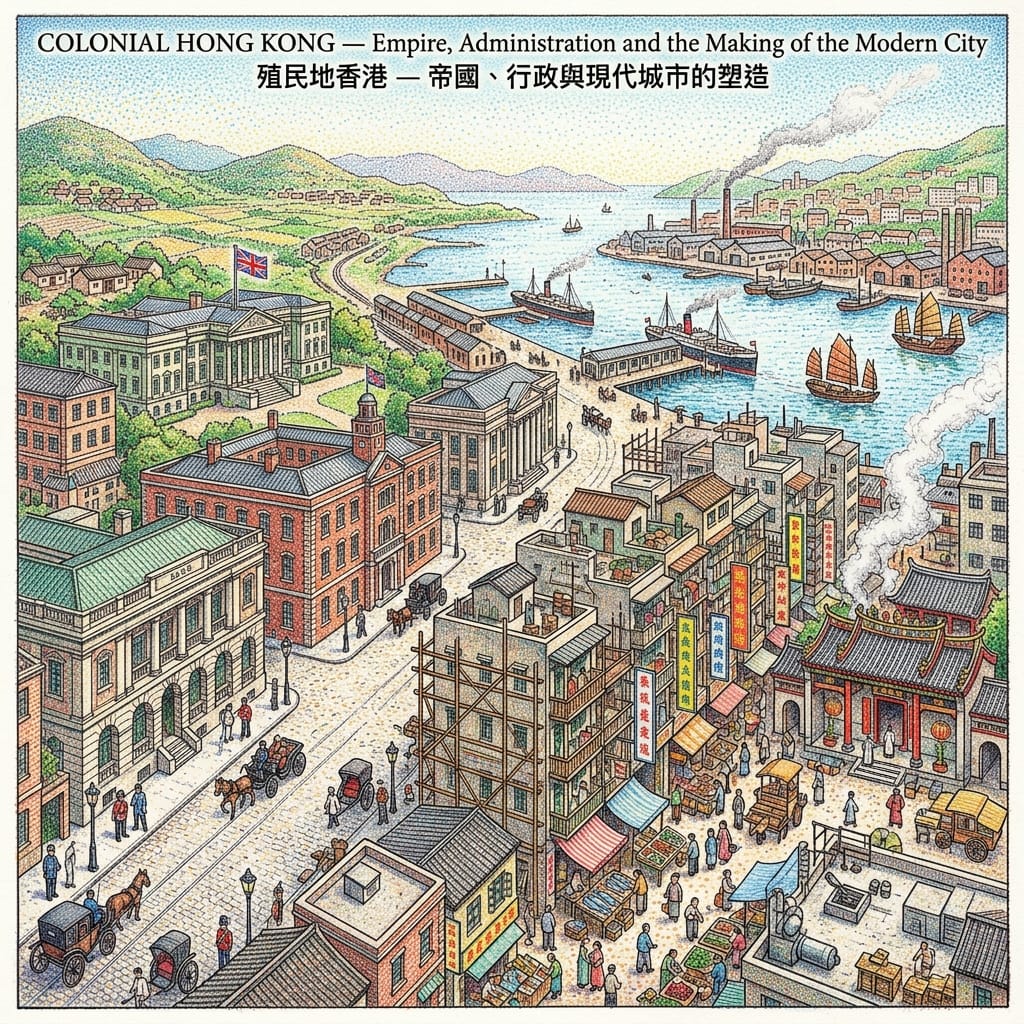
→ Sacred Hong Kong — Temples, belief and community identity
 Lawrence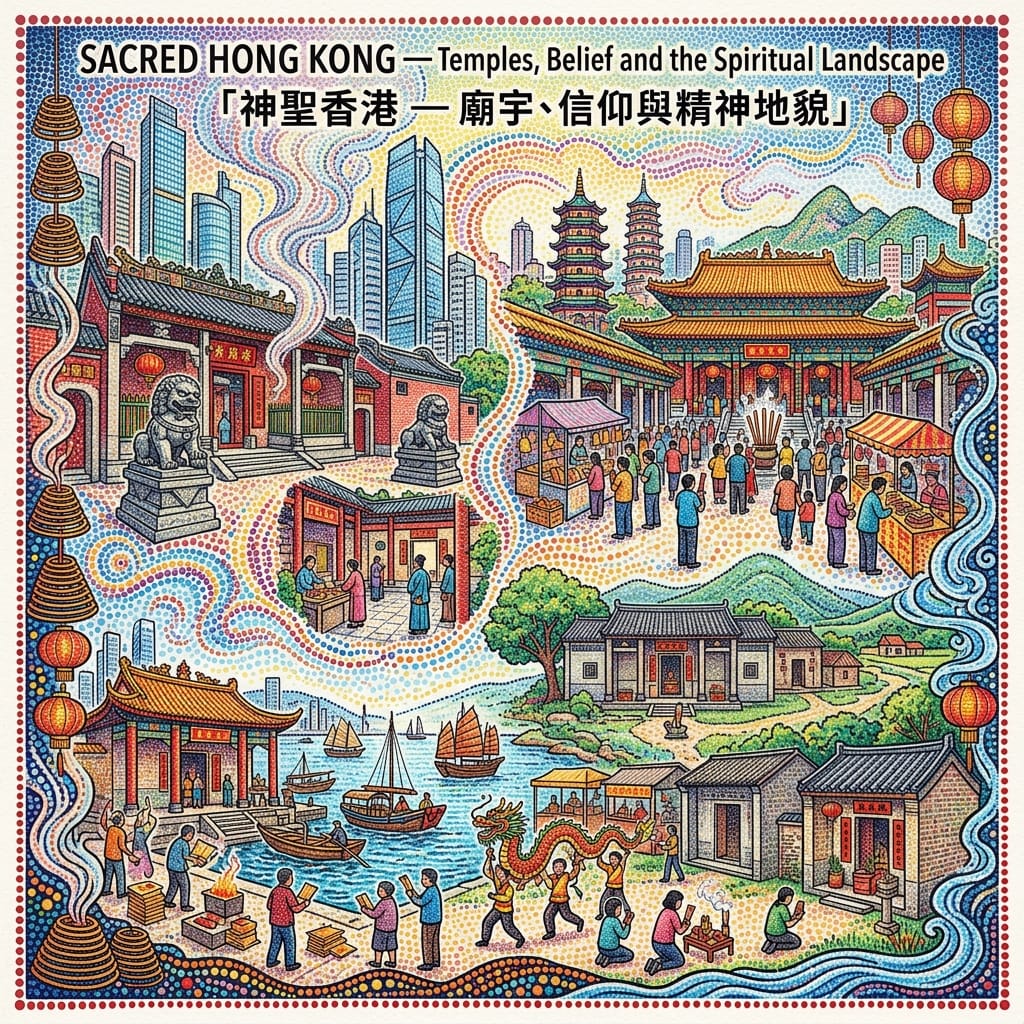
→ Commercial Hong Kong — Harbour, trade, industry and global capital
 Lawrence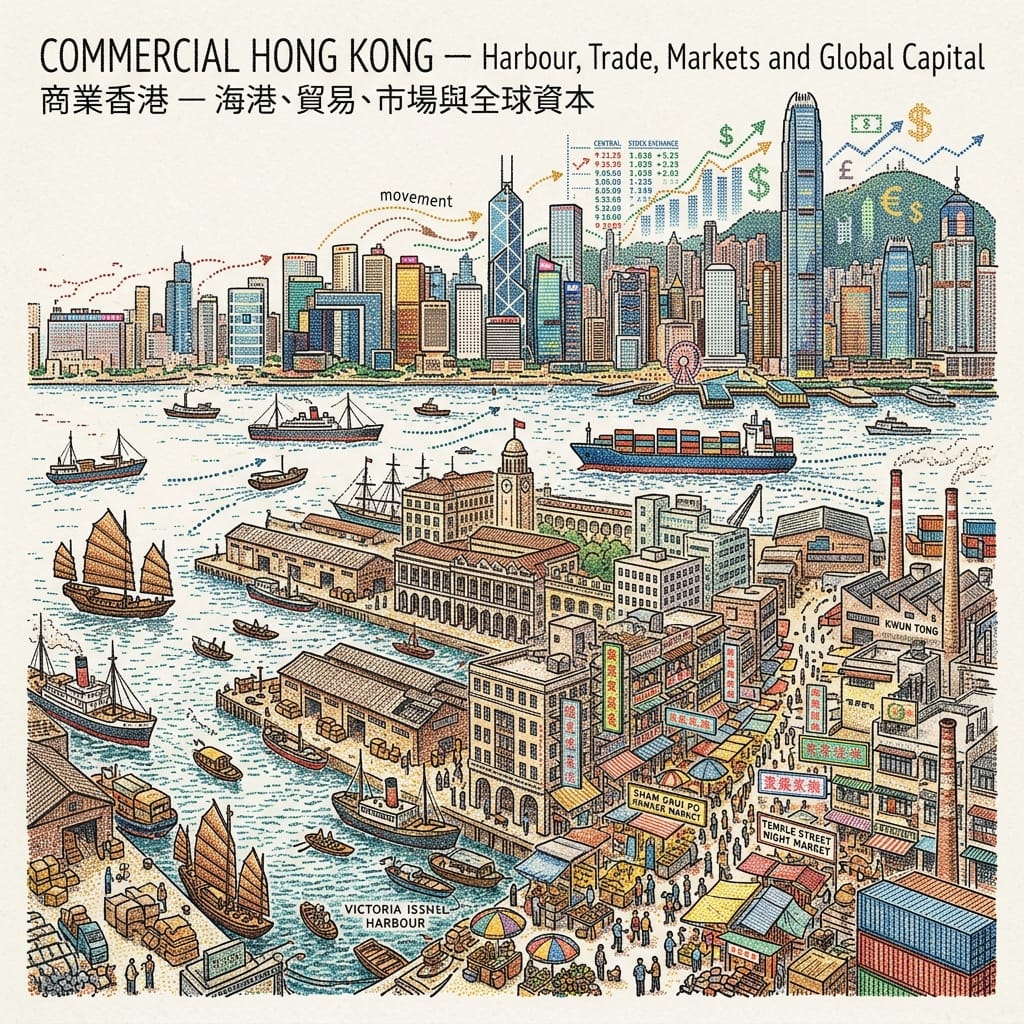
→ Modern Hong Kong — Migration, housing, infrastructure and urban reinvention
 Lawrence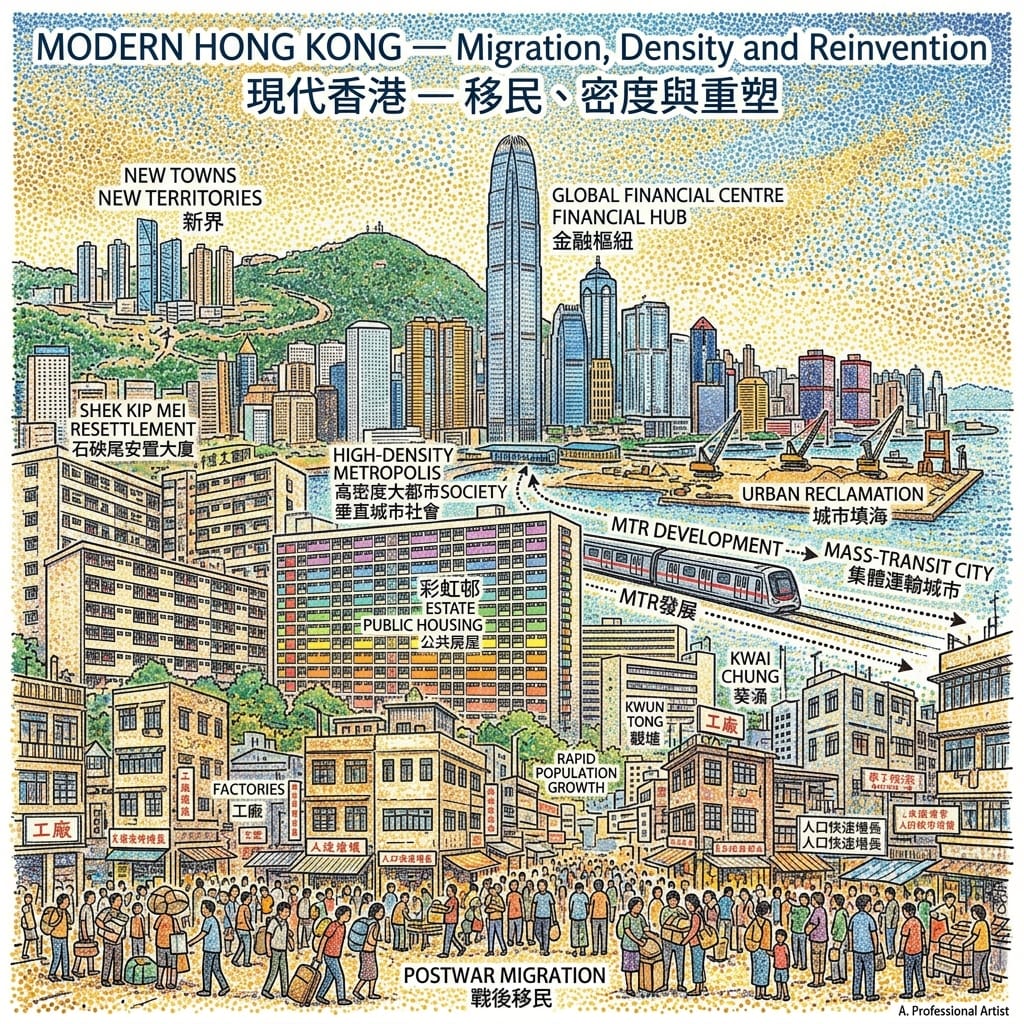
→ Hidden Hong Kong — Forgotten communities and surviving landscapes
 Lawrence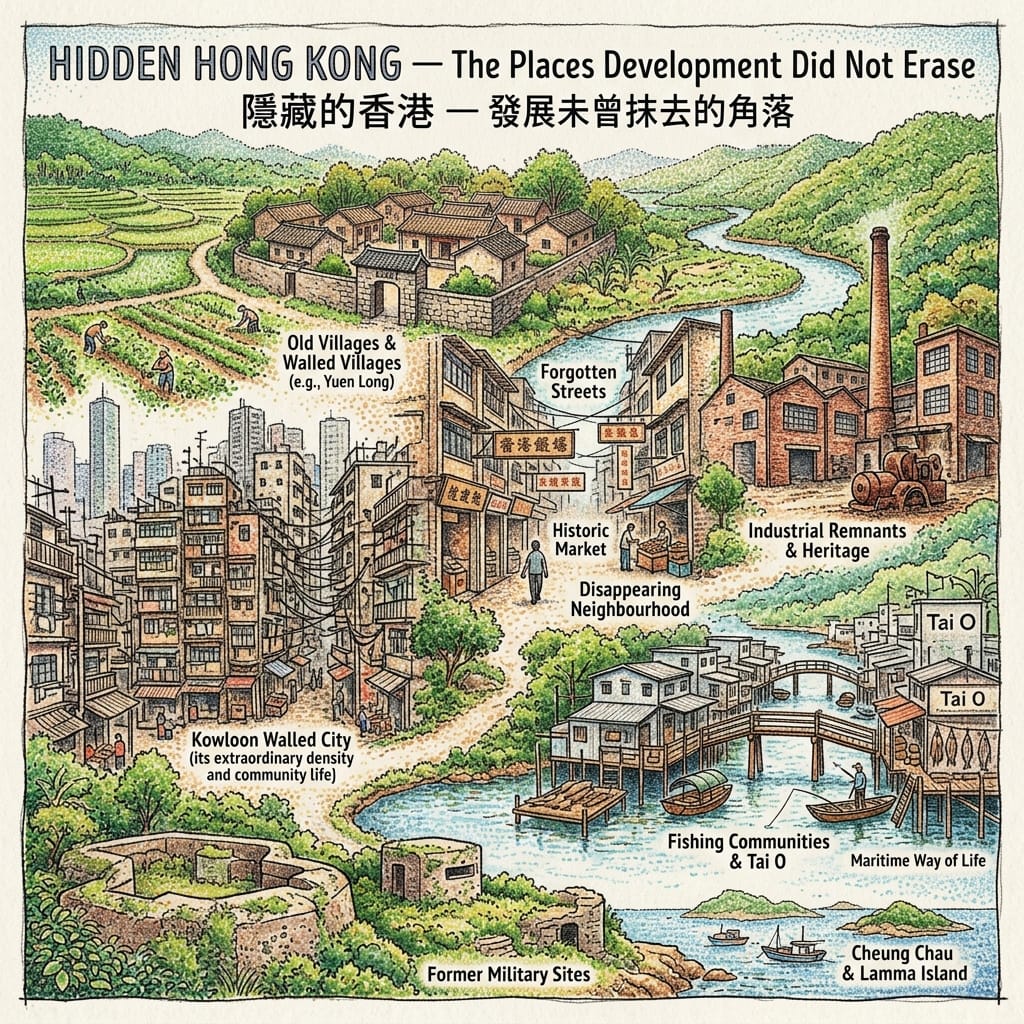
Modern Hong Kong is not simply the Hong Kong of today.
It is the accumulated result of every housing decision, railway, factory, new town, reclamation project and community that transformed the territory after the war.
 Lawrence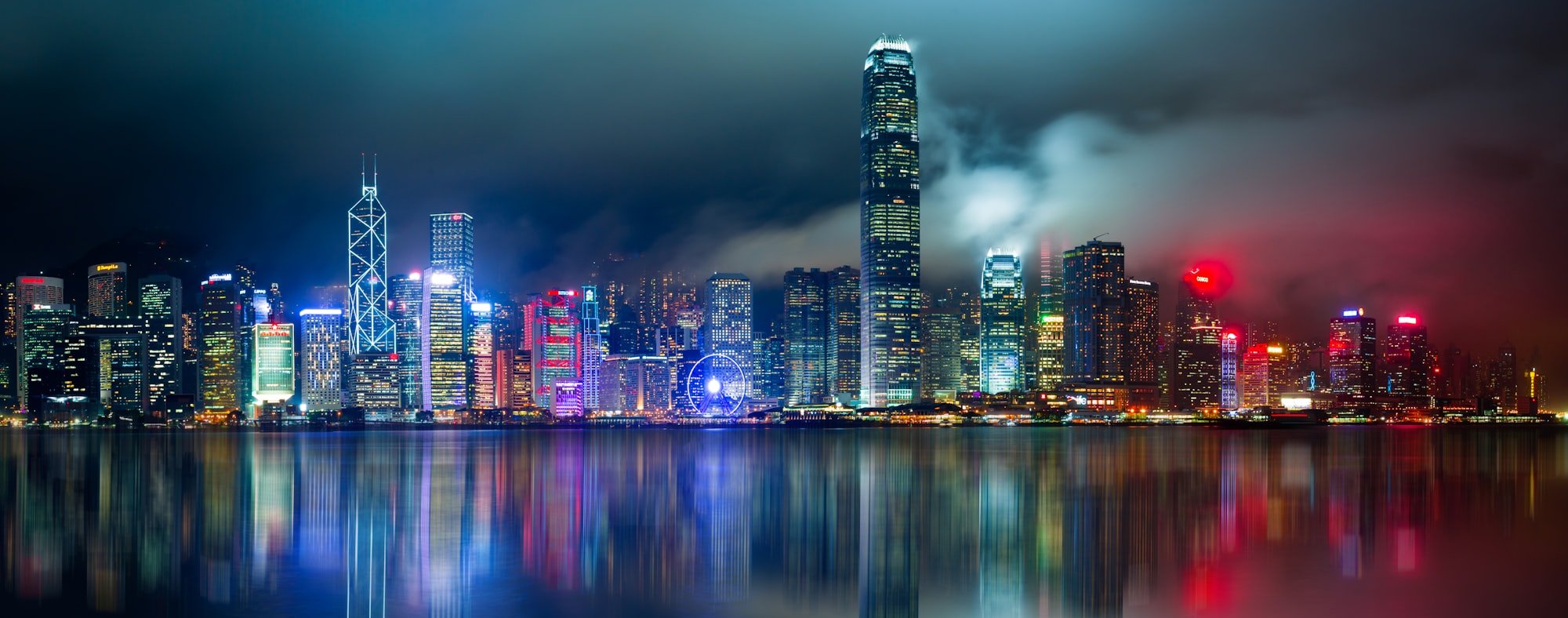
 Lawrence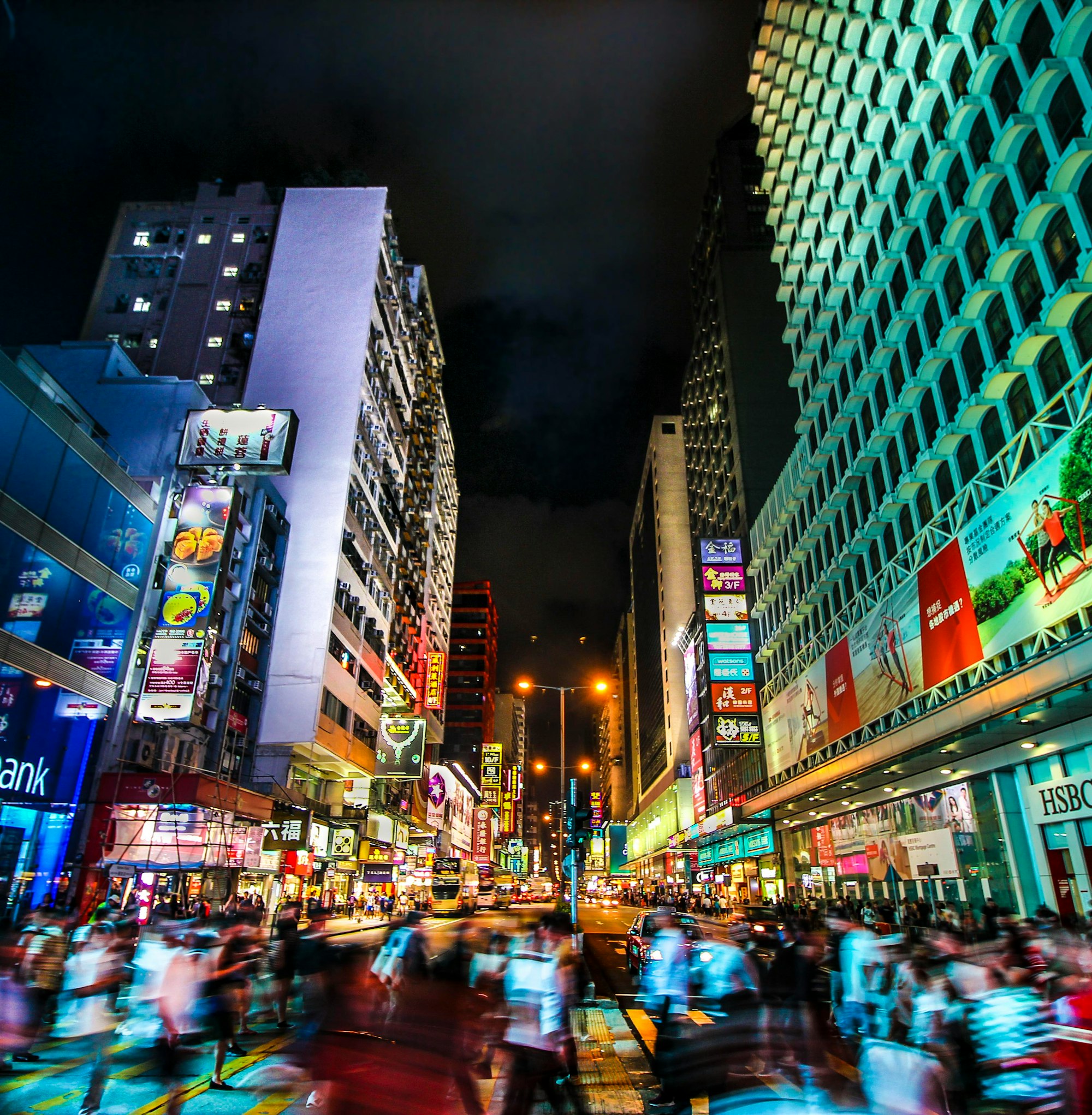
 Lawrence
 Lawrence
 Lawrence